|
|

Tip: In the search results, you can click on any word or abbreviation for more information.
|
Source: Bosworth/Toller, page b0349, entry 15 View original page image as: [TIFF] [PNG] [View previous entry] [View next entry] |
[Comment on this entry] [View comments] |
The following entry has been hand-corrected once. |
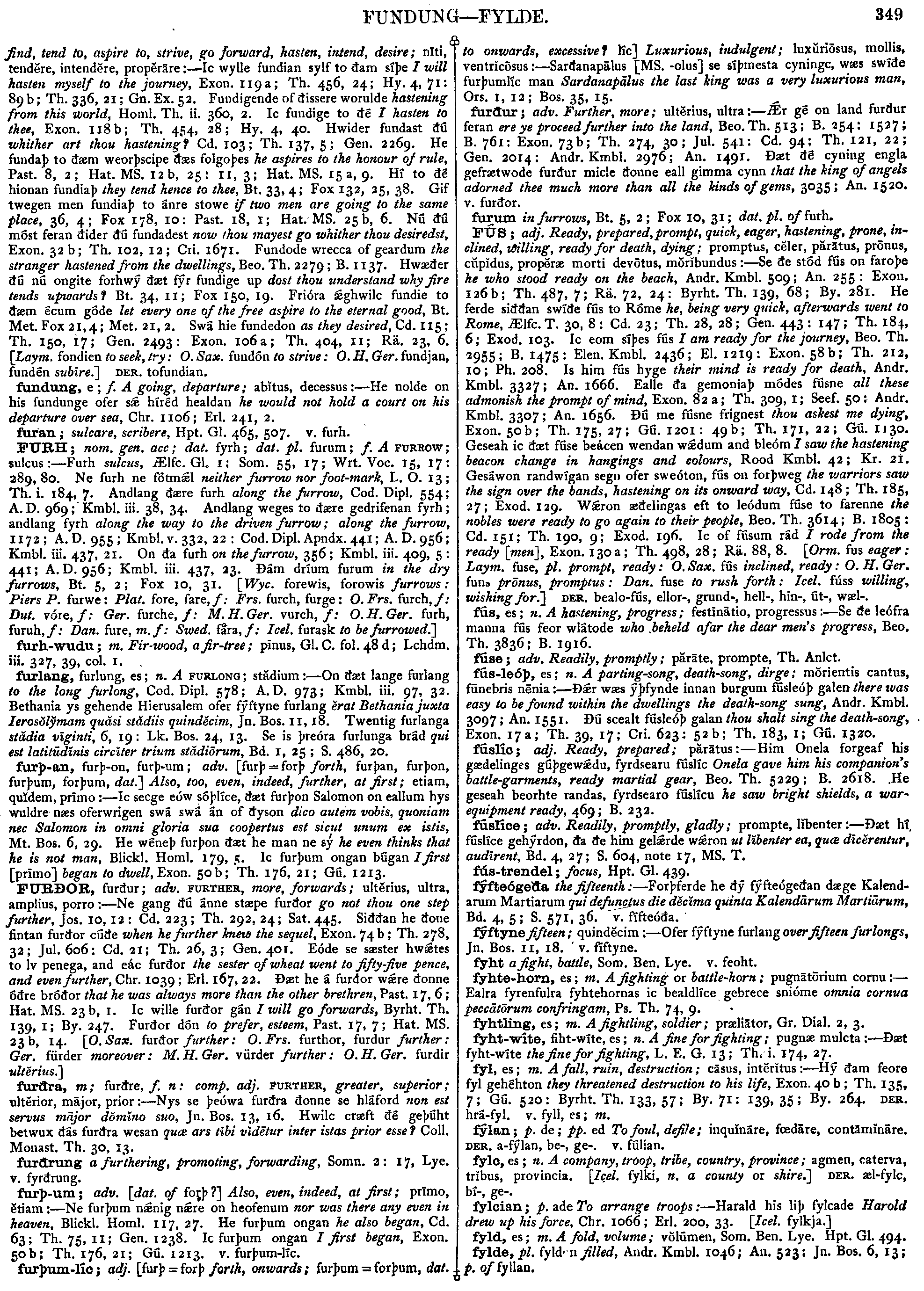
FÚS;
adj.
Ready,
prepared,
prompt,
quick,
eager,
hastening,
prone,
inclined,
willing,
ready
for
death,
dying;
promptus,
c ler,
p
ler,
p r
r tus,
pr
tus,
pr nus,
c
nus,
c p
p dus,
propræ
morti
devtus,
m
dus,
propræ
morti
devtus,
m rbundus
:--
Se
ðe
stód
fús
on
faroþe
he
who
stood
ready
on
the
beach,
Andr.
Kmbl.
509;
An.
255:
Exon.
126
b;
Th.
487,
7;
Rä.
72,
24:
Byrht.
Th.
139,
68;
By.
281.
He
ferde
siððan
swíðe
fús
to
Rome
he,
being
very
quick,
afterwards
went
to
Rome,
Ælfc.
T.
30,
8:
Cd.
23;
Th.
28,
28;
Gen.
443:
147;
Th.
184,
6;
Exod.
103.
Ic
eom
síþes
fús
I
am
ready
for
the
journey,
Beo.
Th.
2955;
B.
1475:
Elen.
Kmbl.
2436;
El.
1219:
Exon.
58
b;
Th.
212,
10;
Ph.
208.
Is
him
fús
hyge
their
mind
is
ready
for
death,
Andr.
Kmbl.
3327;
An.
1666.
Ealle
ða
gemoniaþ
módes
fúsne
all
these
admonish
the
prompt
of
mind,
Exon.
82
a;
Th.
309,
1;
Seef.
50;
Andr.
Kmbl.
3307;
An.
1656.
Ðú
me
fúsne
frignest
thou
askest
me
dying,
Exon.
50
b;
Th.
175,
27;
Gú.
1201:
49
b;
Th.
171,
22;
Gú.
1130.
Geseah
ic
ðæt
fúse
beácen
wendan
w
rbundus
:--
Se
ðe
stód
fús
on
faroþe
he
who
stood
ready
on
the
beach,
Andr.
Kmbl.
509;
An.
255:
Exon.
126
b;
Th.
487,
7;
Rä.
72,
24:
Byrht.
Th.
139,
68;
By.
281.
He
ferde
siððan
swíðe
fús
to
Rome
he,
being
very
quick,
afterwards
went
to
Rome,
Ælfc.
T.
30,
8:
Cd.
23;
Th.
28,
28;
Gen.
443:
147;
Th.
184,
6;
Exod.
103.
Ic
eom
síþes
fús
I
am
ready
for
the
journey,
Beo.
Th.
2955;
B.
1475:
Elen.
Kmbl.
2436;
El.
1219:
Exon.
58
b;
Th.
212,
10;
Ph.
208.
Is
him
fús
hyge
their
mind
is
ready
for
death,
Andr.
Kmbl.
3327;
An.
1666.
Ealle
ða
gemoniaþ
módes
fúsne
all
these
admonish
the
prompt
of
mind,
Exon.
82
a;
Th.
309,
1;
Seef.
50;
Andr.
Kmbl.
3307;
An.
1656.
Ðú
me
fúsne
frignest
thou
askest
me
dying,
Exon.
50
b;
Th.
175,
27;
Gú.
1201:
49
b;
Th.
171,
22;
Gú.
1130.
Geseah
ic
ðæt
fúse
beácen
wendan
w dum
and
bleóm
I
saw
the
hastening
beacon
change
in
hangings
and
colours,
Rood
Kmbl.
42;
Kr.
21.
Gesáwon
randwígan
segn
ofer
sweóton,
fús
on
forþweg
the
warriors
saw
the
sign
over
the
bands,
hastening
on
its
onward
way,
Cd.
148;
Th.
185,
27;
Exod.
129.
Wron
æðelingas
eft
to
leódum
fúse
to
farenne
the
nobles
were
ready
to
go
again
to
their
people,
Beo.
Th.
3614;
B.
1805:
Cd.
151;
Th.
190,
9;
Exod.
196.
Ic
of
fúsum
rád
I
rode
from
the
ready
[men],
Exon.
130
a;
Th.
498,
28;
Rä.
88,
8.
[Orm.
fus
eager:
Laym.
fuse,
pl.
prompt,
ready:
O.
Sax.
fús
inclined,
ready:
O.
H.
Ger.
funs
prnus,
promptus:
Dan.
fuse
to
rush
forth:
Icel.
fúss
willing,
wishing
for.]
DER.
bealo-fús,
ellor-,
grand-,
hell-,
hin-,
út-,
wæl-.
dum
and
bleóm
I
saw
the
hastening
beacon
change
in
hangings
and
colours,
Rood
Kmbl.
42;
Kr.
21.
Gesáwon
randwígan
segn
ofer
sweóton,
fús
on
forþweg
the
warriors
saw
the
sign
over
the
bands,
hastening
on
its
onward
way,
Cd.
148;
Th.
185,
27;
Exod.
129.
Wron
æðelingas
eft
to
leódum
fúse
to
farenne
the
nobles
were
ready
to
go
again
to
their
people,
Beo.
Th.
3614;
B.
1805:
Cd.
151;
Th.
190,
9;
Exod.
196.
Ic
of
fúsum
rád
I
rode
from
the
ready
[men],
Exon.
130
a;
Th.
498,
28;
Rä.
88,
8.
[Orm.
fus
eager:
Laym.
fuse,
pl.
prompt,
ready:
O.
Sax.
fús
inclined,
ready:
O.
H.
Ger.
funs
prnus,
promptus:
Dan.
fuse
to
rush
forth:
Icel.
fúss
willing,
wishing
for.]
DER.
bealo-fús,
ellor-,
grand-,
hell-,
hin-,
út-,
wæl-.
|
Source: Bosworth/Toller, page b0835, entry 23 View original page image as: [TIFF] [PNG] [View previous entry] [View next entry] |
[Comment on this entry] [View comments] |
The following entry has been hand-corrected once. |
scip-setl, es; n. A seat or beach for rowers:--Scipsetl transtra, Wrt. Voc. i. 48, 14: 64, 8.
|
Source: Bosworth/Toller, page d0447, entry 6 View original page image as: [TIFF] [PNG] [View previous entry] [View next entry] |
[Comment on this entry] [View comments] |
The following entry has been hand-corrected once. |
ge-weorp.
Dele
'
A
throwing,
.
.
.
dashing,
'
and
for
first
passage
substitute
:--
Him
þá
beorna
breogo,
þr
hé
on
bolcan
sæt,
ofer
waroða
geweorp
wið
þingode
with
him
(Andrew)
the
prince
of
men,
from
his
seat
on
the
gangway,
across
the
sands
held
parley
(the
boat
was
close
to
land,
cf.
in
ceól
stigon
ellenrófe,
349,
so
that
the
words
spoken
passed
over
the
beach,
not
over
water),
An.
306.
[O.
H.
Ger.
ge-werf
collecta,
con/ati
o.]
v.
sand-geweorp.
|
Source: Cleasby/Vigfusson, page b0156, entry 51 View original page image as: [TIFF] [PNG] [View previous entry] [View next entry] |
[Comment on this entry] [View comments] |
The following entry has been hand-corrected once. |
FJARA, u, f., gen. fjöru, [a Scandin. word, which remains in Orphir in the Orkneys, vide ey] :-- the ebb-tide, ebb, 415. 10, Edda 32-34, Fms. xi. 6, Fs. 157, Grág. ii. 352-366, passim. 2. [cp. fore- in the Engl. fore-shore], the fore-shore, beach, sea-board, Edda l.c., Grág. i. 91, Fas. ii. 148, Nj. 19, Eb. 292, Grett. 89, Orkn. 336, passim: the allit. saying, milli fjalls ok fjöru, between fell and fore-shore; var þá skógr milli fjalls ok fjöru, at that time it was forest between fell and fore-shore, i.e. all over the low land, Landn. 28, Íb. ch. 1; þar sem mætisk gras eðr f., where the grass and sea-beach join, Dipl. iii. 11. COMPDS: fjöru-borð, n. the sea-board, the breadth of the fjara, metaph. from a cup, cp. the mythical tale in Edda l.c. fjöru-grjót, n. the gravel on the beach, Fms. ii. 93, Fas. ii. 112. fjöru-grös, n. pl., botan. a kind of sea-weed, opp. to fjallagrös. fjöru-kóngr (fjöru-kúfungr), m. a kind of snail. fjöru-maðkr, m. a kind of worm used for bait. fjöru-maðr, m. the owner of the shore, Grág. ii. 367, Jb. 318. fjöru-mark, n. the land-marks on the shore, Jb. 320, Dipl. ii. 5, Grág. ii. 361. fjöru-mál, n. the rim of the shore between the flood line and the ebb, more usually flæðarmál, Sturl. ii. 35, v.l. fjöru-nytjar, f. pl. used of drift-timber, dead whales, sea-weed, or the like, Engl. jetsum, Vm. 75, 80. fjöru-steinn, m. shingle on the beach, Bs. i. 506 :-- mark stones, shewing the tide is so far out as to leave a way along the beach, 656 C. 31. fjöru-stúfr, m. a piece of strand or strand right belonging to a farm, Dipl. iii. 11.
|
Source: Cleasby/Vigfusson, page b0163, entry 5 View original page image as: [TIFF] [PNG] [View previous entry] [View next entry] |
[Comment on this entry] [View comments] |
The following entry has been hand-corrected once. |
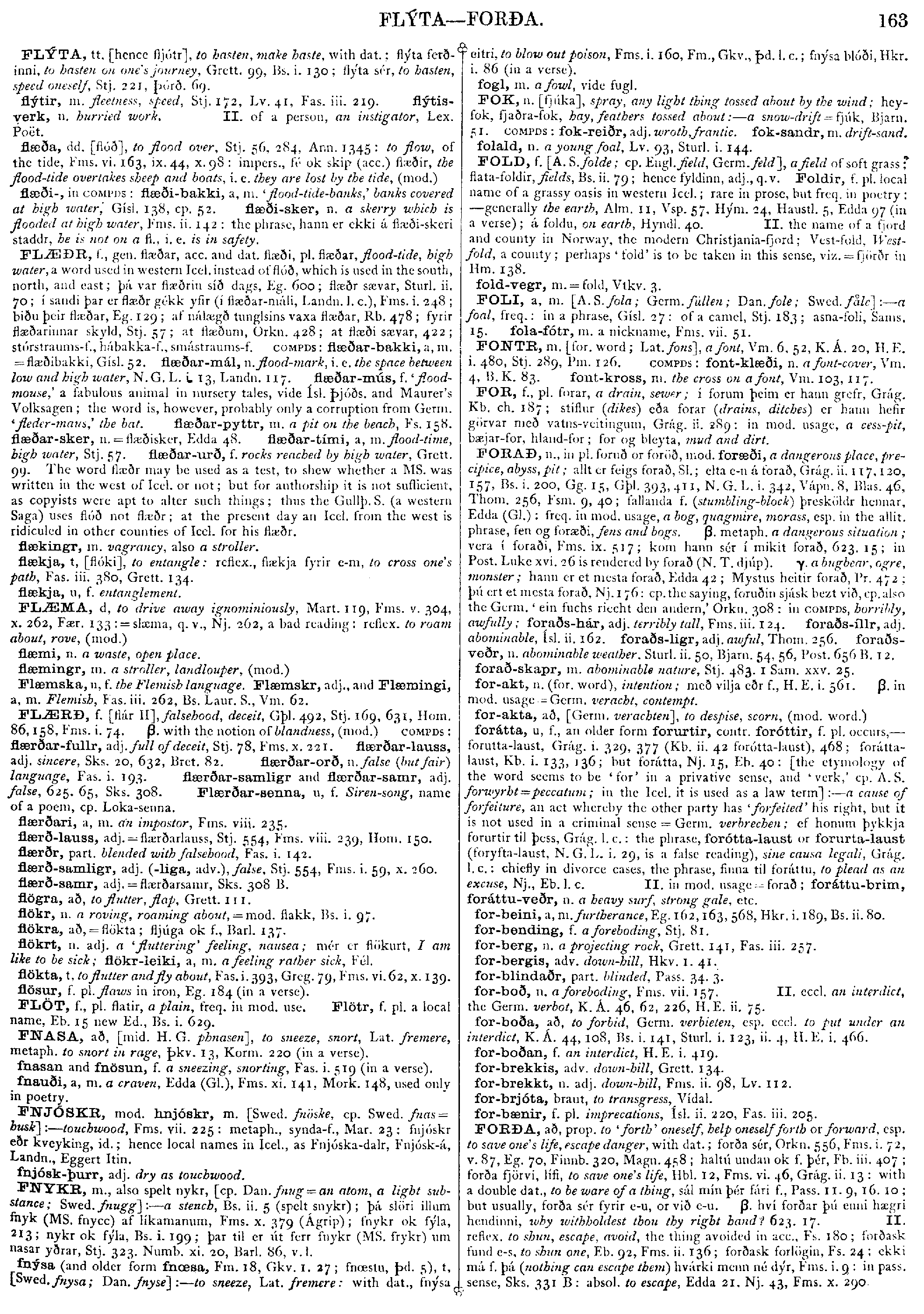
FLÆÐR, f., gen. flæðar, acc. and dat. flæði, pl. flæðar, flood-tide, high water, a word used in western Icel. instead of flóð, which is used in the south, north, and east; þá var flæðrin síð dags, Eg. 600; flæðr sævar, Sturl. ii. 70; í sandi þar er flæðr gékk yfir (í flæðar-máli, Landn. l.c.), Fms. i. 248; biðu þeir flæðar, Eg. 129; af nálægð tunglsins vaxa flæðar, Rb. 478; fyrir flæðarinnar skyld, Stj. 57; at flæðum, Orkn. 428; at flæði sævar, 422; stórstraums-f., hábakka-f., smástraums-f. COMPDS: flæðar-bakki, a, m. = flæðibakki, Gísl. 52. flæðar-mál, n. flood-mark, i.e. the space between low and high water, N. G. L. i. 13, Landn. 117. flæðar-mús, f. 'flood-mouse,' a fabulous animal in nursery tales, vide Ísl. Þjóðs. and Maurer's Volksagen; the word is, however, probably only a corruption from Germ. 'fleder-maus,' the bat. flæðar-pyttr, m. a pit on the beach, Fs. 158. flæðar-sker, n. = flæðisker, Edda 48. flæðar-tími, a, m. flood-time, high water, Stj. 57. flæðar-urð, f. rocks reached by high water, Grett. 99. The word flæðr may be used as a test, to shew whether a MS. was written in the west of Icel. or not; but for authorship it is not sufficient, as copyists were apt to alter such things; thus the Gullþ. S. (a western Saga) uses flóð not flæðr; at the present day an Icel. from the west is ridiculed in other counties of Icel. for his flæðr.
|
Source: Cleasby/Vigfusson, page b0166, entry 65 View original page image as: [TIFF] [PNG] [View previous entry] [View next entry] |
[Comment on this entry] [View comments] |
The following entry has been hand-corrected once. |
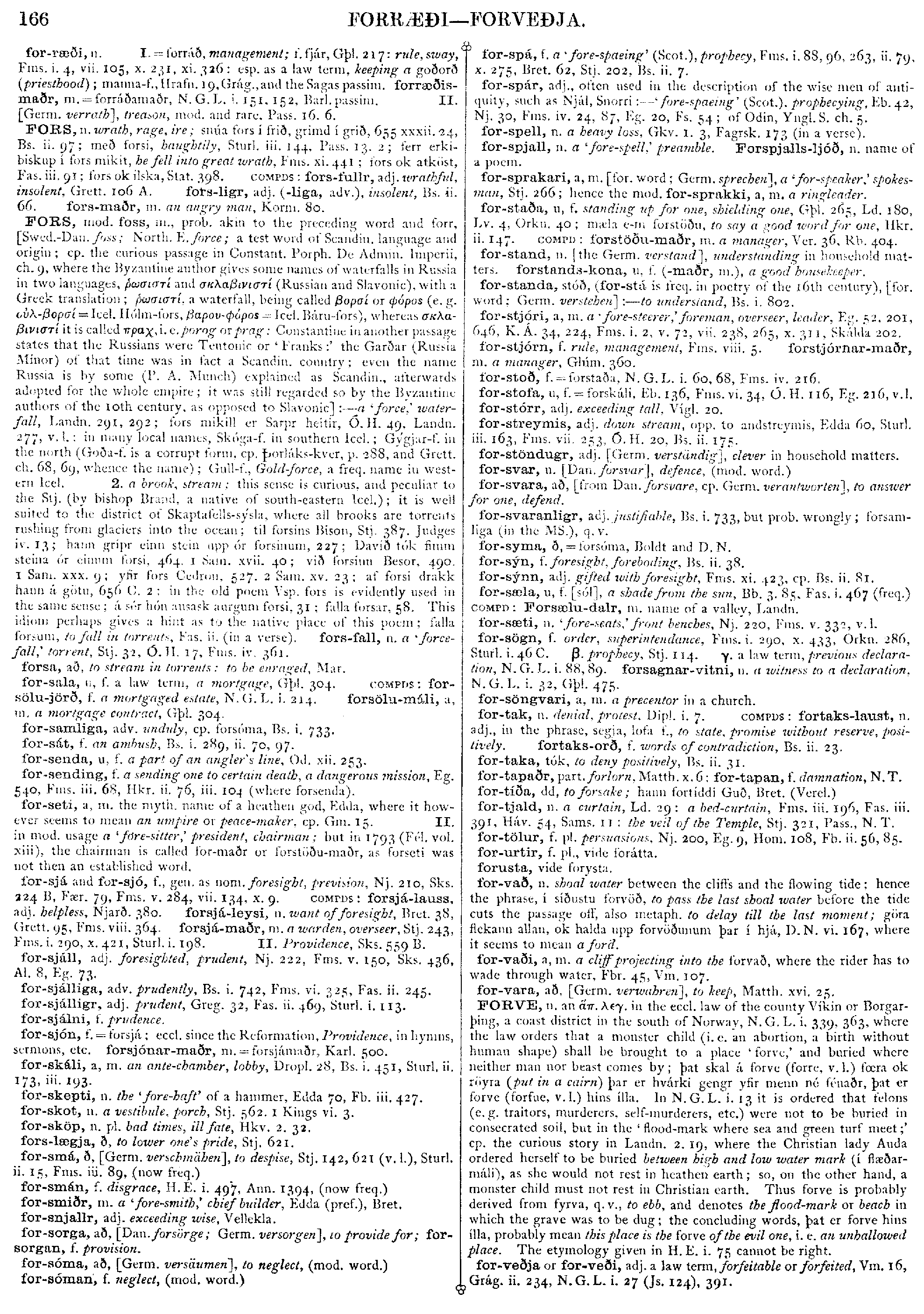
FORVE, n. an GREEK. in the eccl. law of the county Víkin or Borgarþing, a coast district in the south of Norway, N. G. L. i. 339, 363, where the law orders that a monster child (i.e. an abortion, a birth without human shape) shall be brought to a place 'forve,' and buried where neither man nor beast comes by; þat skal á forve (forre, v.l.) fœra ok röyra (put in a cairn) þar er hvárki gengr yfir menn né fénaðr, þat er forve (forfue, v.l.) hins ílla. In N. G. L. i. 13 it is ordered that felons (e.g. traitors, murderers, self-murderers, etc.) were not to be buried in consecrated soil, but in the 'flood-mark where sea and green turf meet;' cp. the curious story in Landn. 2. 19, where the Christian lady Auda ordered herself to be buried between high and low water mark (í flæðarmáli), as she would not rest in heathen earth; so, on the other hand, a monster child must not rest in Christian earth. Thus forve is probably derived from fyrva, q.v., to ebb, and denotes the flood-mark or beach in which the grave was to be dug; the concluding words, þat er forve hins ílla, probably mean this place is the forve of the evil one, i.e. an unhallowed place. The etymology given in H. E. i. 75 cannot be right.
|
Source: Cleasby/Vigfusson, page b0207, entry 21 View original page image as: [TIFF] [PNG] [View previous entry] [View next entry] |
[Comment on this entry] [View comments] |
The following entry has been hand-corrected once. |
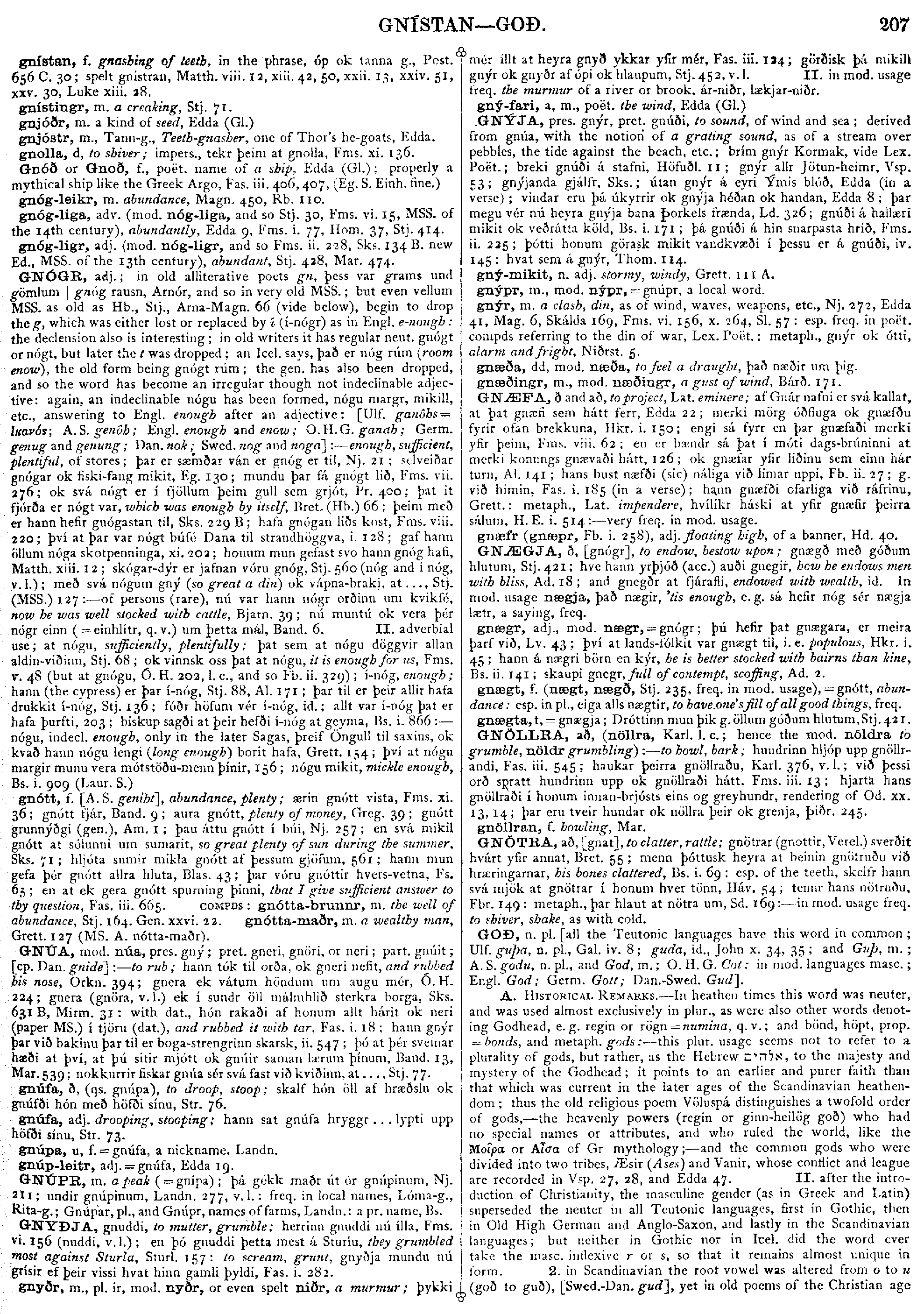
GNÝJA, pres. gnýr, pret. gnúði, to sound, of wind and sea; derived from gnúa, with the notion of a grating sound, as of a stream over pebbles, the tide against the beach, etc.; brím gnýr Kormak, vide Lex. Poët.; breki gnúði á stafni, Höfuðl. 11; gnýr allr Jötun-heimr, Vsp. 53; gnýjanda gjálfr, Sks.; útan gnýr á eyri Ýmis blóð, Edda (in a verse); vindar eru þá úkyrrir ok gnýja héðan ok handan, Edda 8; þar megu vér nú heyra gnýja bana Þorkels frænda, Ld. 326; gnúði á hallæri mikit ok veðrátta köld, Bs. i. 171; þá gnú/ði á hin snarpasta hríð, Fms. ii. 225; þótti honum görask mikit vandkvæði í þessu er á gnúði, iv. 145; hvat sem á gnýr, Thom. 114.
|
Source: Cleasby/Vigfusson, page b0211, entry 18 View original page image as: [TIFF] [PNG] [View previous entry] [View next entry] |
[Comment on this entry] [View comments] |
The following entry has been hand-corrected once. |
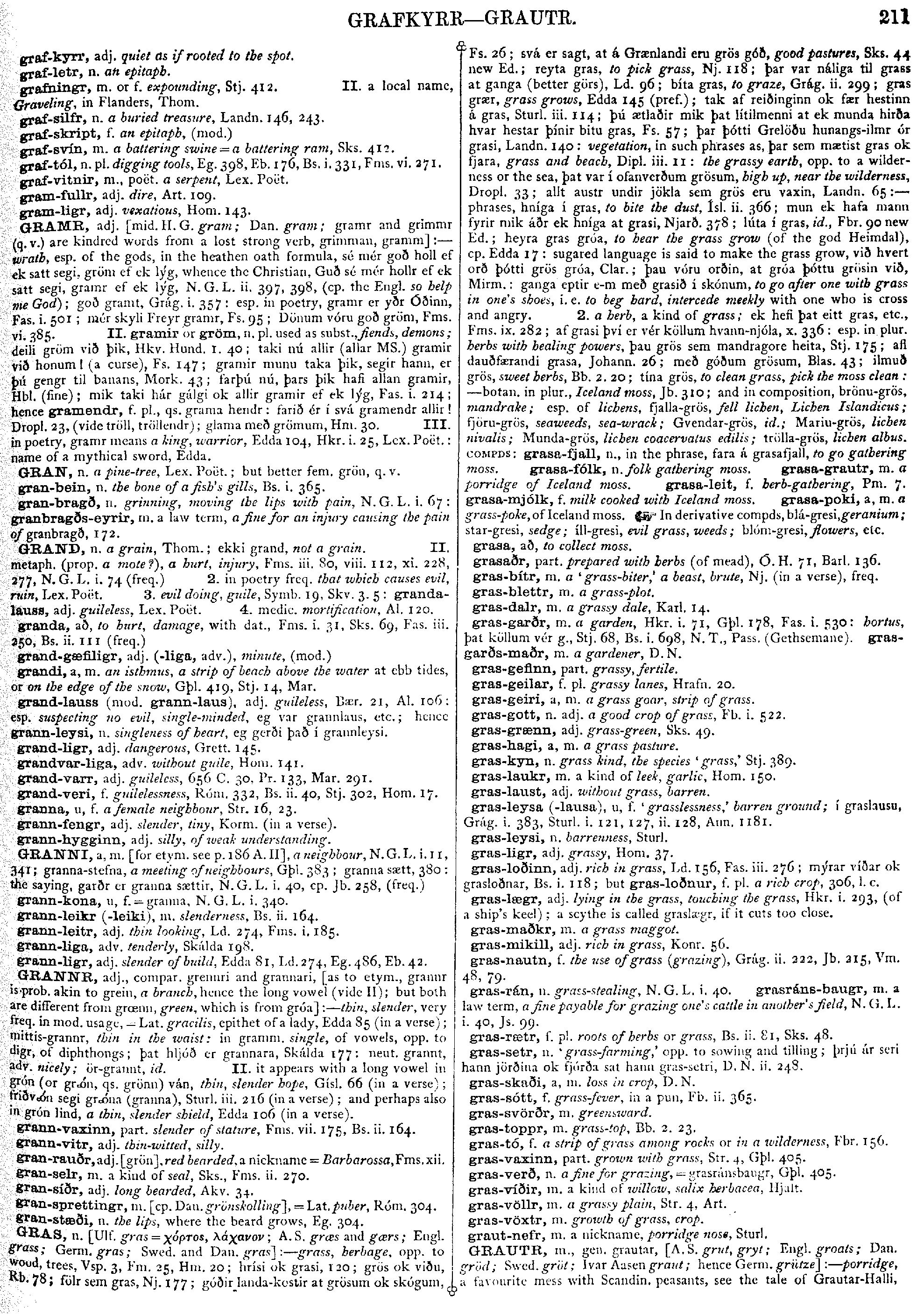
grandi, a, m. an isthmus, a strip of beach above the water at ebb tides, or on the edge of the snow, Gþl. 419, Stj. 14, Mar.
|
Source: Cleasby/Vigfusson, page b0211, entry 41 View original page image as: [TIFF] [PNG] [View previous entry] [View next entry] |
[Comment on this entry] [View comments] |
The following entry has been hand-corrected once. |
GRAS, n. [Ulf. gras = GREEK ; A.S. græ and gærs; Engl. grass; Germ, gras; Swed. and Dan. gras] :-- grass, herbage, opp. to wood, trees, Vsp. 3, Fm. 25, Hm. 20; hrísi ok grasi, 120; grös ok viðu, Rb. 78; fölr sem gras, Nj. 177; góðir landa-kostir at grösum ok skógum, Fs. 26; svá er sagt, at á Grænlandi eru grös góð, good pastures, Sks. 44 new Ed.; reyta gras, to pick grass, Nj. 118; þar var náliga til grass at ganga (better görs), Ld. 96; bíta gras, to graze, Grág. ii. 299; gras grær, grass grows, Edda 145 (pref.); tak af reiðinginn ok fær hestinn á gras, Sturl. iii. 114; þú ætlaðir mik þat lítilmenni at ek munda hirða hvar hestar þínir bitu gras, Fs. 57; þar þótti Grelöðu hunangs-ilmr ór grasi, Landn. 140 : vegetation, in such phrases as, þar sem mætist gras ok fjara, grass and beach, Dipl. iii. 11 : the grassy earth, opp. to a wilderness or the sea, þat var í ofanverðum grösum, high up, near the wilderness, Dropl. 33; allt austr undir jökla sem grös eru vaxin, Landn. 65 :-- phrases, hníga í gras, to bite the dust, Ísl. ii. 366; mun ek hafa mann fyrir mik áðr ek hníga at grasi, Njarð. 378; lúta í gras, id., Fbr. 90 new Ed.; heyra gras gróa, to hear the grass grow (of the god Heimdal), cp. Edda 17 : sugared language is said to make the grass grow, við hvert orð þótti grös gróa, Clar.; þau vóru orðin, at gróa þóttu grösin við, Mirm. : ganga eptir e-m með grasið í skónum, to go after one with grass in one's shoes, i.e. to beg hard, intercede meekly with one who is cross and angry. 2. a herb, a kind of grass; ek hefi þat eitt gras, etc., Fms. ix. 282; af grasi því er vér köllum hvann-njóla, x. 336 : esp. in plur. herbs with healing powers, þau grös sem mandragore heita, Stj. 175; afl dauðfærandi grasa, Johann. 26; með góðum grösum, Blas. 43; ilmuð grös, sweet herbs, Bb. 2. 20; tína grös, to clean grass, pick the moss clean : -- botan. in plur., Iceland moss, Jb. 310; and in composition, brönu-grös, mandrake; esp. of lichens, fjalla-grös, fell lichen, Lichen Islandicus; fjöru-grös, seaweeds, sea-wrack; Gvendar-grös, id.; Mariu-grös, lichen nivalis; Munda-grös, lichen coacervatus edilis; trölla-grös, lichen albus. COMPDS: grasa-fjall, n., in the phrase, fara á grasafjall, to go gathering moss. grasa-fó1k, n. folk gathering moss. grasa-grautr, m. a porridge of Iceland moss. grasa-leit, f. herb-gathering, Pm. 7. grasa-mjólk, f. milk cooked with Iceland moss. grasa-poki, a, m. a grass-poke, of Iceland moss. UNCERTAIN In derivative compds, blá-gresi, geranium; star-gresi, sedge; íll-gresi, evil grass, weeds; blóm-gresi, flowers, etc.
|
Source: Cleasby/Vigfusson, page b0216, entry 7 View original page image as: [TIFF] [PNG] [View previous entry] [View next entry] |
[Comment on this entry] [View comments] |
The following entry has been hand-corrected once. |
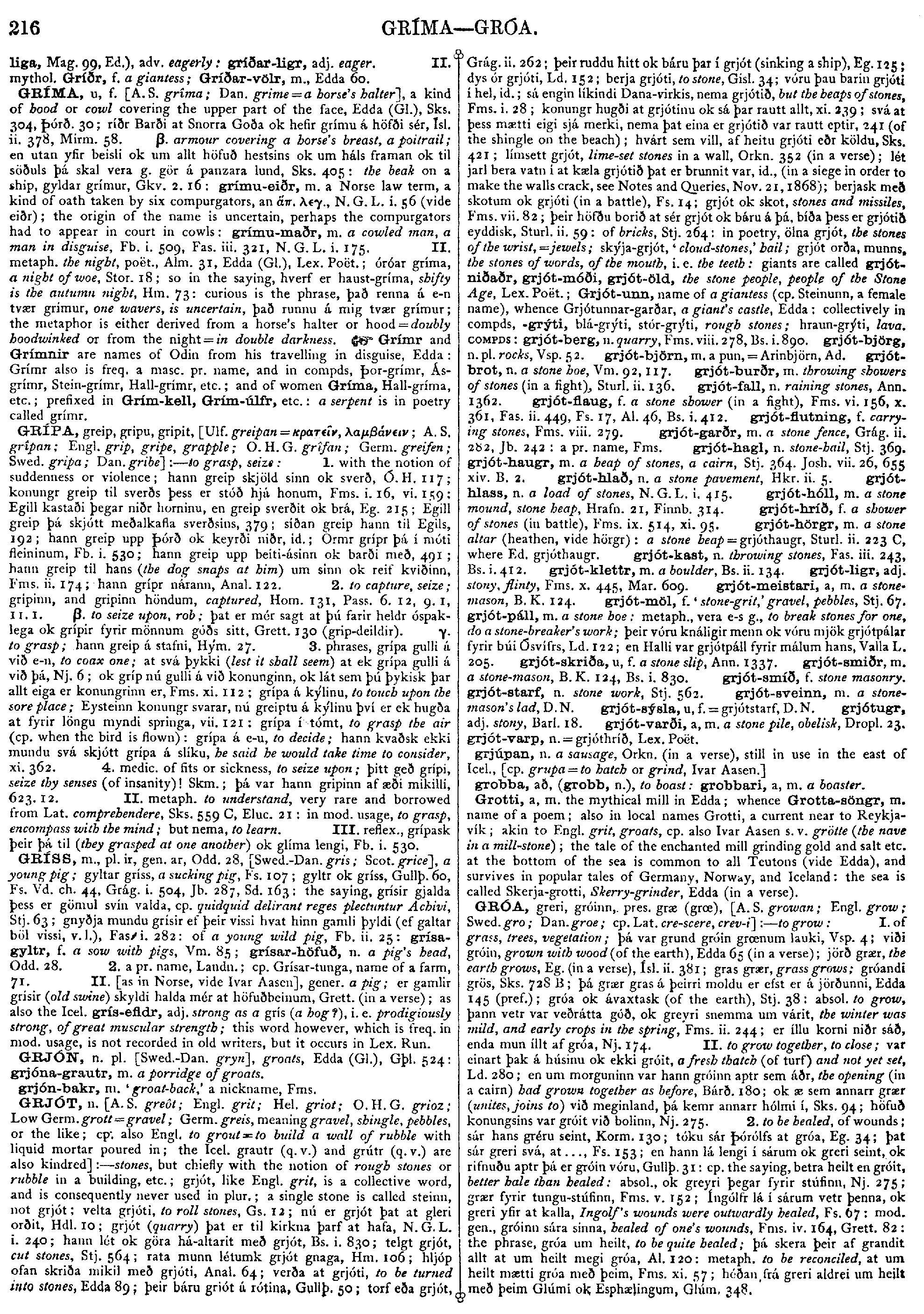
GRJÓT, n. [A. S. greôt; Engl. grit; Hel. griot; O. H. G. grioz; Low Germ. grott = gravel; Germ. greis, meaning gravel, shingle, pebbles, or the like; cp. also Engl. to grout = to build a wall of rubble with liquid mortar poured in; the Icel. grautr (q.v.) and grútr (q.v.) are also kindred] :-- stones, but chiefly with the notion of rough stones or rubble in a building, etc.; grjót, like Engl. grit, is a collective word, and is consequently never used in plur.; a single stone is called steinn, not grjót; velta grjóti, to roll stones, Gs. 12; nú er grjót þat at gleri orðit, Hdl. 10; grjót (quarry) þat er til kirkna þarf at hafa, N. G. L. i. 240; hann lét ok göra há-altarit með grjót, Bs. i. 830; telgt grjót, cut stones, Stj. 564; rata munn létumk grjót gnaga, Hm. 106; hljóp ofan skriða mikil með grjóti, Anal. 64; verða at grjóti, to be turned into stones, Edda 89; þeir báru grjót á rótina, Gullþ. 50; torf eða grjót, Grág. ii. 262; þeir ruddu hitt ok báru þar í grjót (sinking a ship), Eg. 125; dys ór grjóti, Ld. 152; berja grjóti, to stone, Gísl. 34; vóru þau barin grjóti í hel, id.; sá engin líkindi Dana-virkis, nema grjótið, but the heaps of stones, Fms. i. 28; konungr hugði at grjótinu ok sá þar rautt allt, xi. 239; svá at þess mætti eigi sjá merki, nema þat eina er grjótið var rautt eptir, 241 (of the shingle on the beach); hvárt sem vill, af heitu grjóti eðr köldu, Sks. 421; límsett grjót, lime-set stones in a wall, Orkn. 352 (in a verse); lét jarl bera vatn í at kæla grjótið þat er brunnit var, id., (in a siege in order to make the walls crack, see Notes and Queries, Nov. 21, 1868); berjask með skotum ok grjóti (in a battle), Fs. 14; grjót ok skot, stones and missiles, Fms. vii. 82; þeir höfðu borið at sér grjót ok báru á þá, bíða þess er grjótið eyddisk, Sturl. ii. 59: of bricks, Stj. 264: in poetry, ölna grjót, the stones of the wrist, = jewels; skýja-grjót, 'cloud-stones,' hail; grjót orða, munns, the stones of words, of the mouth, i.e. the teeth: giants are called grjót-niðaðr, grjót-móði, grjót-öld, the stone people, people of the Stone Age, Lex. Poët.; Grjót-unn, name of a giantess (cp. Steinunn, a female name), whence Grjótunnar-garðar, a giant's castle, Edda: collectively in compds, -grýti, blá-grýti, stór-grýti, rough stones; hraun-grýti, lava. COMPDS: grjót-berg, n. quarry, Fms. viii. 278, Bs. i. 890. grjót-björg, n. pl. rocks, Vsp. 52. grjót-björn, m. a pun, = Arinbjörn, Ad. grjót-brot, n. a stone hoe, Vm. 92, 117. grjót-burðr, m. throwing showers of stones (in a fight), Sturl. ii. 136. grjót-fall, n. raining stones, Ann. 1362. grjót-flaug, f. a stone shower (in a fight), Fms. vi. 156, x. 361, Fas. ii. 449, Fs. 17, Al. 46, Bs. i. 412. grjót-flutning, f. carrying stones, Fms. viii. 279. grjót-garðr, m. a stone fence, Grág. ii. 282, Jb. 242: a pr. name, Fms. grjót-hagl, n. stone-hail, Stj. 369. grjót-haugr, m. a heap of stones, a cairn, Stj. 364. Josh. vii. 26, 655 xiv. B. 2. grjót-hlað, n. a stone pavement, Hkr. ii. 5. grjót-hlass, n. a load of stones, N. G. L. i. 415. grjót-hóll, m. a stone mound, stone heap, Hrafn. 21, Finnb. 314. grjót-hríð, f. a shower of stones (in battle), Fms. ix. 514, xi. 95. grjót-hörgr, m. a stone altar (heathen, vide hörgr): a stone heap = grjóthaugr, Sturl. ii. 223 C, where Ed. grjóthaugr. grjót-kast, n. throwing stones, Fas. iii. 243, Bs. i. 412. grjót-klettr, m. a boulder, Bs. ii. 134. grjót-ligr, adj. stony, flinty, Fms. x. 445, Mar. 609. grjót-meistari, a, m. a stone-mason, B. K. 124. grjót-möl, f. 'stone-grit,' gravel, pebbles, Stj. 67. grjót-páll, m. a stone hoe: metaph., vera e-s g., to break stones for one, do a stone-breaker's work; þeir vóru knáligir menn ok vóru mjök grjótpálar fyrir búi Ósvífrs, Ld. 122; en Halli var grjótpáll fyrir málum hans, Valla L. 205. grjót-skriða, u, f. a stone slip, Ann. 1337. grjót-smiðr, m. a stone-mason, B. K. 124, Bs. i. 830. grjót-smíð, f. stone masonry. grjót-starf, n. stone work, Stj. 562. grjót-sveinn, m. a stone-mason's lad, D. N. grjót-sýsla, u, f. = grjótstarf, D. N. grjótrugr, adj. stony, Barl. 18. grjót-varði, a, m. a stone pile, obelisk, Dropl. 23. grjót-varp, n. = grjóthríð, Lex. Poët.
| Result Page: | 1 2 3 | Next |  |
Germanic Lexicon Project (main page)
This search system was written by
Sean Crist
Please consider
volunteering
to correct the data in these online dictionaries.
No rights reserved. Feel free to use these data in any way you please.