|
|

Search for au again, using less strict matching (41 results)
|
Source: Cleasby/Vigfusson, page b0121, entry 1 View original page image as: [TIFF] [PNG] [View previous entry] [View next entry] |
[Comment on this entry] [View comments] |
The following entry has been hand-corrected once. |
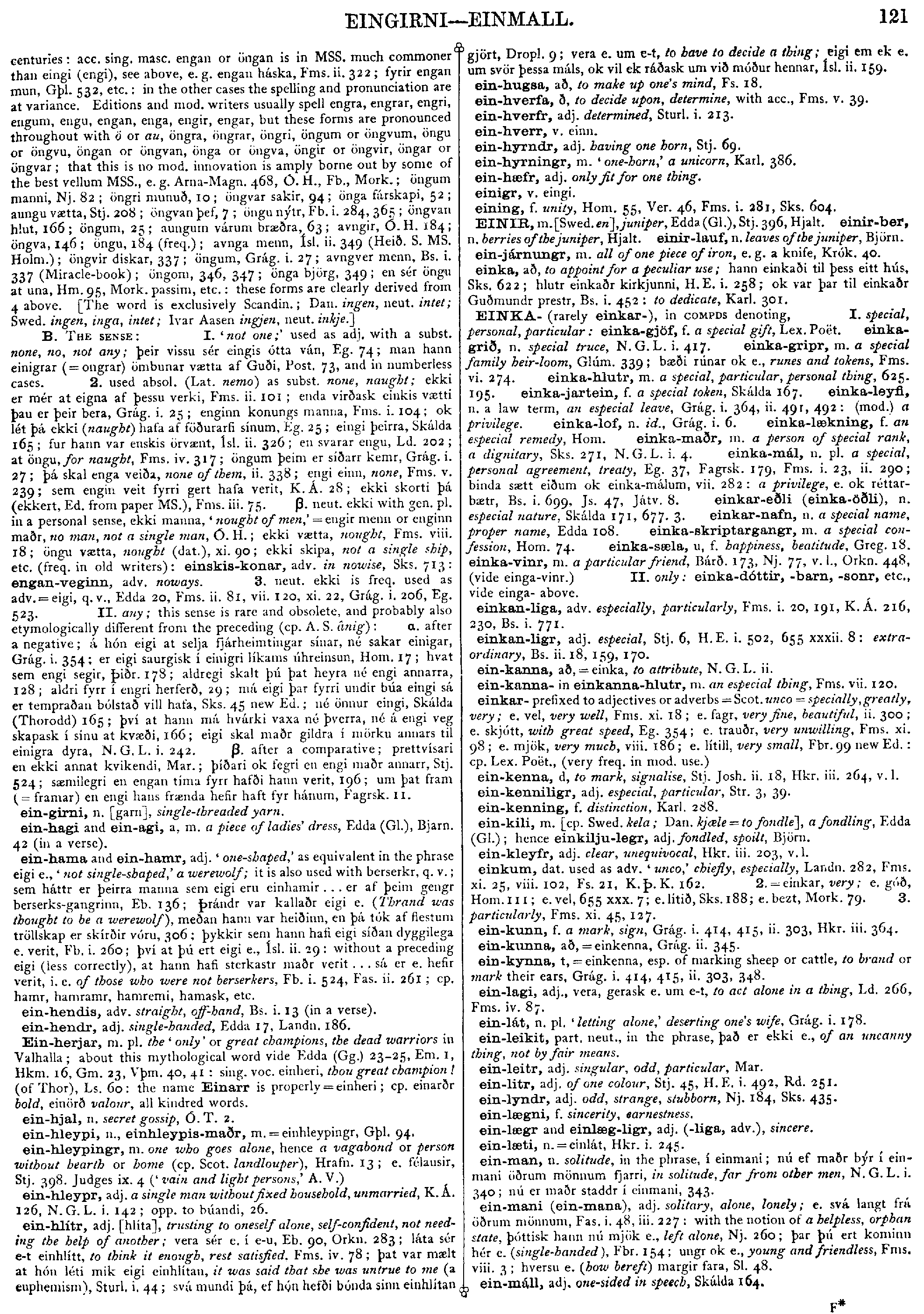
centuries: acc. sing. masc. engan or öngan is in MSS. much commoner than eingi (engi), see above, e.g. engan háska, Fms. ii. 322; fyrir engan mun, Gþl. 532, etc.: in the other cases the spelling and pronunciation are at variance. Editions and mod. writers usually spell engra, engrar, engri, engum, engu, engan, enga, engir, engar, but these forms are pronounced throughout with ö or au, öngra, öngrar, öngri, öngum or öngvum, öngu or öngvu, öngan or öngvan, önga or öngva, öngir or öngvir, öngar or öngvar; that this is no mod. innovation is amply borne out by some of the best vellum MSS., e.g. Arna-Magn. 468, Ó. H., Fb., Mork.; öngum manni, Nj. 82; öngri munuð, 10; öngvar sakir, 94; önga fárskapi, 52; aungu vætta, Stj. 208; öngvan þef, 7; öngu nýtr, Fb. i. 284, 365; öngvan hlut, 166; öngum, 25; aungum várum bræðra, 63; avngir, Ó. H. 184; öngva, 146; öngu, 184 (freq.); avnga menu, Ísl. ii. 349 (Heið. S. MS. Holm.); öngvir diskar, 337; öngum, Grág. i. 27; avngver menu, Bs. i. 337 (Miracle-book); öngom, 346, 347; önga björg, 349; en sér öngu at una, Hm. 95, Mork. passim, etc.: these forms are clearly derived from 4 above. [The word is exclusively Scandin.; Dan. ingen, neut. intet; Swed. ingen, inga, intet; Ivar Aasen ingjen, neut. inkje.]
|
Source: Cleasby/Vigfusson, page b0282, entry 22 View original page image as: [TIFF] [PNG] [View previous entry] [View next entry] |
[Comment on this entry] [View comments] |
The following entry has been hand-corrected once. |
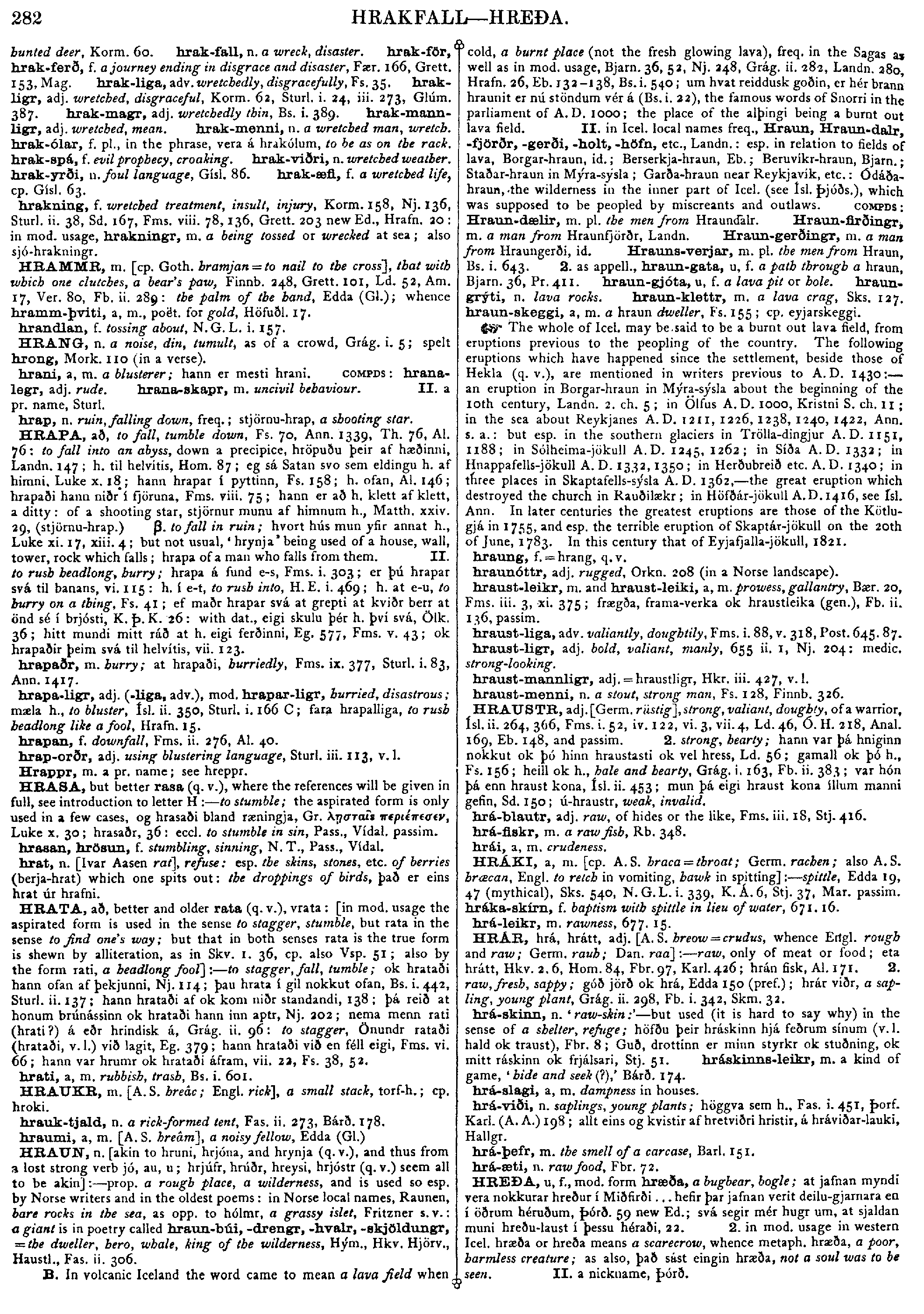
HRAUN, n. [akin to hruni, hrjóna, and hrynja (q.v.), and thus from a lost strong verb jó, au, u; hrjúfr, hrúðr, hreysi, hrjóstr (q.v.) seem all to be akin] :-- prop. a rough place, a wilderness, and is used so esp. by Norse writers and in the oldest poems: in Norse local names, Raunen, bare rocks in the sea, as opp. to hólmr, a grassy islet, Fritzner s.v.: a giant is in poetry called hraun-búi, -drengr, -hvalr, -skjöldungr, = the dweller, hero, whale, king of the wilderness, Hým., Hkv. Hjörv., Haustl., Fas. ii. 306.
|
Source: Cleasby/Vigfusson, page b0307, entry 8 View original page image as: [TIFF] [PNG] [View previous entry] [View next entry] |
[Comment on this entry] [View comments] |
The following entry has been hand-corrected once. |
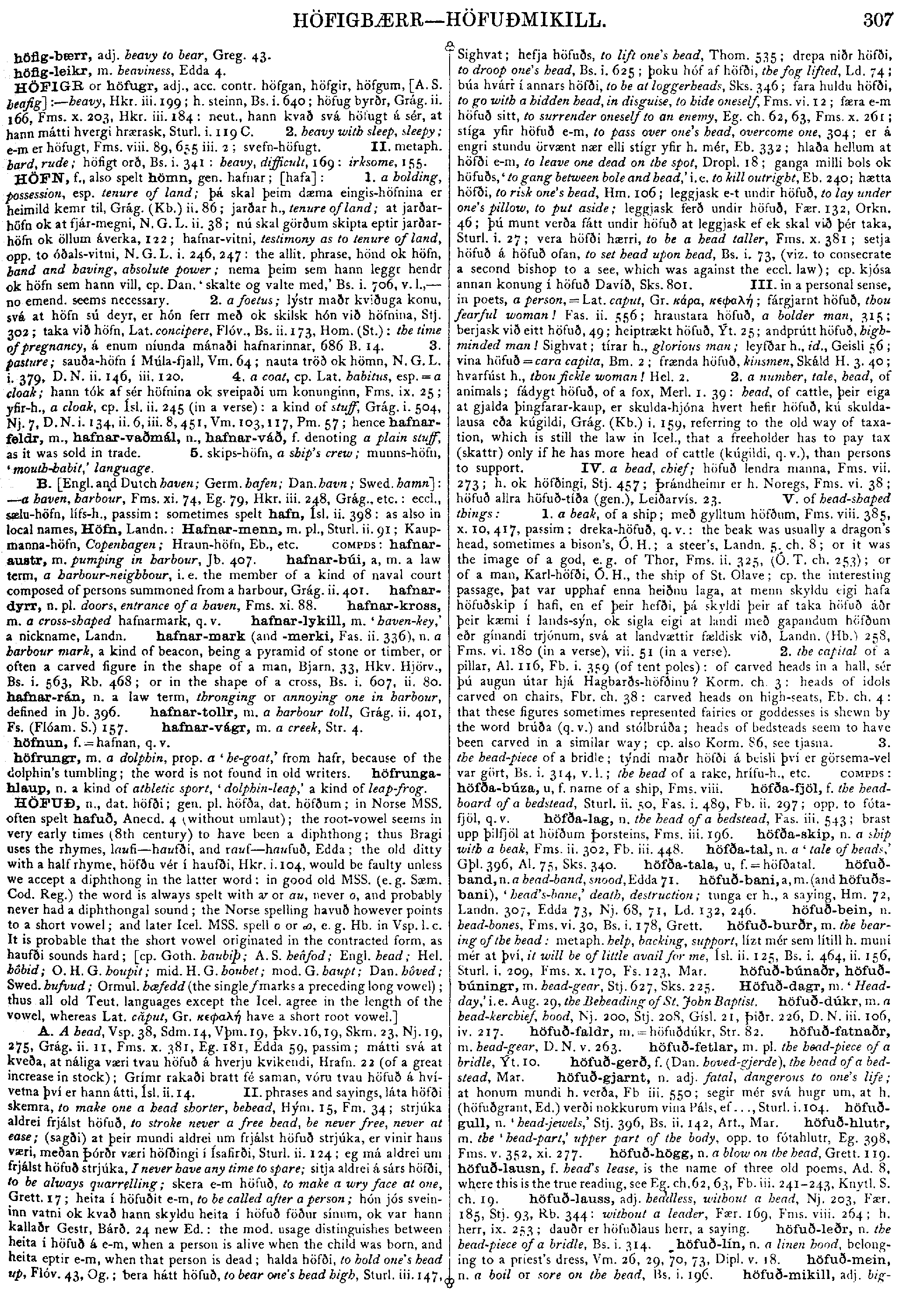
HÖFUÐ,
n.,
dat.
höfði;
gen.
pl.
höfða,
dat.
höfðum;
in
Norse
MSS.
often
spelt
hafuð,
Anecd.
4
(without
umlaut);
the
root-vowel
seems
in
very
early
times
(8th
century)
to
have
been
a
diphthong;
thus
Bragi
uses
the
rhymes,
laufi
--
haufði,
and
rauf
--
haufuð,
Edda;
the
old
ditty
with
a
half
rhyme,
höfðu
vér
í
haufði,
Hkr.
i.
104,
wou'd
be
faulty
unless
we
accept
a
diphthong
in
the
latter
word:
in
good
old
MSS.
(e.g.
Sæm.
Cod.
Reg.)
the
word
is
always
spelt
with
&avlig;
or
au,
never
o,
and
probably
never
had
a
diphthongal
sound;
the
Norse
spelling
havuð
however
points
to
a
short
vowel;
and
later
Icel.
MSS.
spell
o
or
 ,
e.g.
Hb.
in
Vsp.
l.c.
It
is
probable
that
the
short
vowel
originated
in
the
contracted
form,
as
haufði
sounds
hard;
[cp.
Goth.
haubiþ;
A.
S.
heâfod;
Engl.
head;
Hel.
hôbid;
O.
H.
G.
houpit;
mid.
H.
G.
houbet;
mod.
G.
haupt;
Dan.
hôved;
Swed.
hufvud;
Ormul.
hæfedd
(the
single
f
marks
a
preceding
long
vowel);
thus
all
old
Teut.
languages
except
the
Icel.
agree
in
the
length
of
the
vowel,
whereas
Lat.
c
,
e.g.
Hb.
in
Vsp.
l.c.
It
is
probable
that
the
short
vowel
originated
in
the
contracted
form,
as
haufði
sounds
hard;
[cp.
Goth.
haubiþ;
A.
S.
heâfod;
Engl.
head;
Hel.
hôbid;
O.
H.
G.
houpit;
mid.
H.
G.
houbet;
mod.
G.
haupt;
Dan.
hôved;
Swed.
hufvud;
Ormul.
hæfedd
(the
single
f
marks
a
preceding
long
vowel);
thus
all
old
Teut.
languages
except
the
Icel.
agree
in
the
length
of
the
vowel,
whereas
Lat.
c put,
Gr.
GREEK
have
a
short
root
vowel.]
put,
Gr.
GREEK
have
a
short
root
vowel.]
|
Source: Cleasby/Vigfusson, page b0333, entry 15 View original page image as: [TIFF] [PNG] [View previous entry] [View next entry] |
[Comment on this entry] [View comments] |
The following entry has been hand-corrected once. |
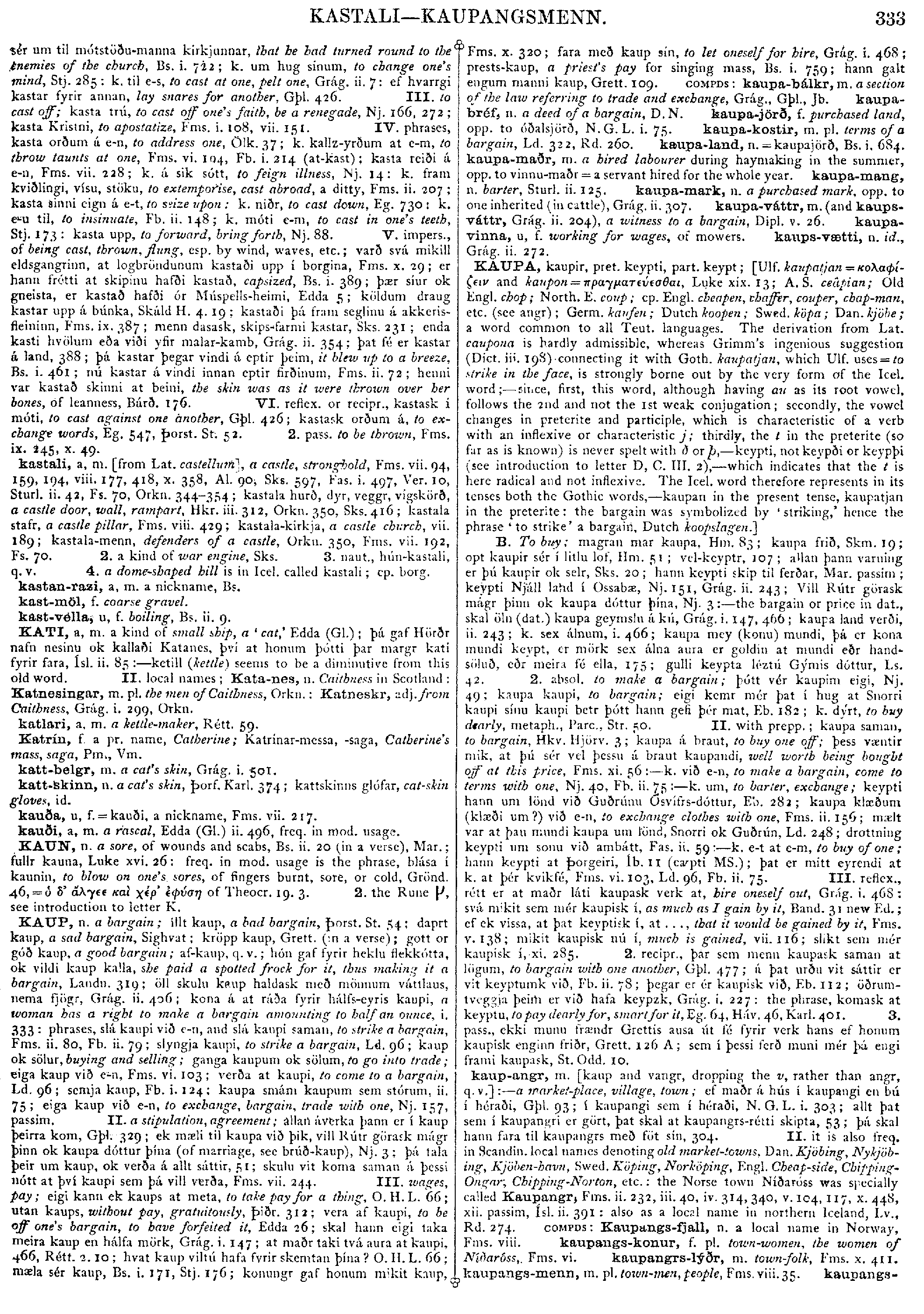
KAUPA, kaupir, pret. keypti, part. keypt; [Ulf. kaupatjan = GREEK and kaupon = GREEK, Luke xix. 13; A. S. ceâpian; Old Engl. chop; North. E. coup; cp. Engl. cheapen, chaffer, couper, chap-man, etc. (see angr); Germ. kaufen; Dutch koopen; Swed. köpa; Dan. kjöbe; a word common to all Teut. languages. The derivation from Lat. caupona is hardly admissible, whereas Grimm's ingenious suggestion (Dict. iii. 198) connecting it with Goth. kaupatjan, which Ulf. uses = to strike in the face, is strongly borne out by the very form of the Icel. word; -- since, first, this word, although having au as its root vowel, follows the 2nd and not the 1st weak conjugation; secondly, the vowel changes in preterite and participle, which is characteristic of a verb with an inflexive or characteristic j; thirdly, the t in the preterite (so far as is known) is never spelt with ð or þ, -- keypti, not keypði or keypþi (see introduction to letter D, C. III. 2), -- which indicates that the t is here radical and not inflexive. The Icel. word therefore represents in its tenses both the Gothic words, -- kaupan in the present tense, kaupatjan in the preterite: the bargain was symbolized by 'striking,' hence the phrase 'to strike' a bargain, Dutch koopslagen.]
|
Source: Cleasby/Vigfusson, page b0343, entry 28 View original page image as: [TIFF] [PNG] [View previous entry] [View next entry] |
[Comment on this entry] [View comments] |
The following entry has been hand-corrected once. |
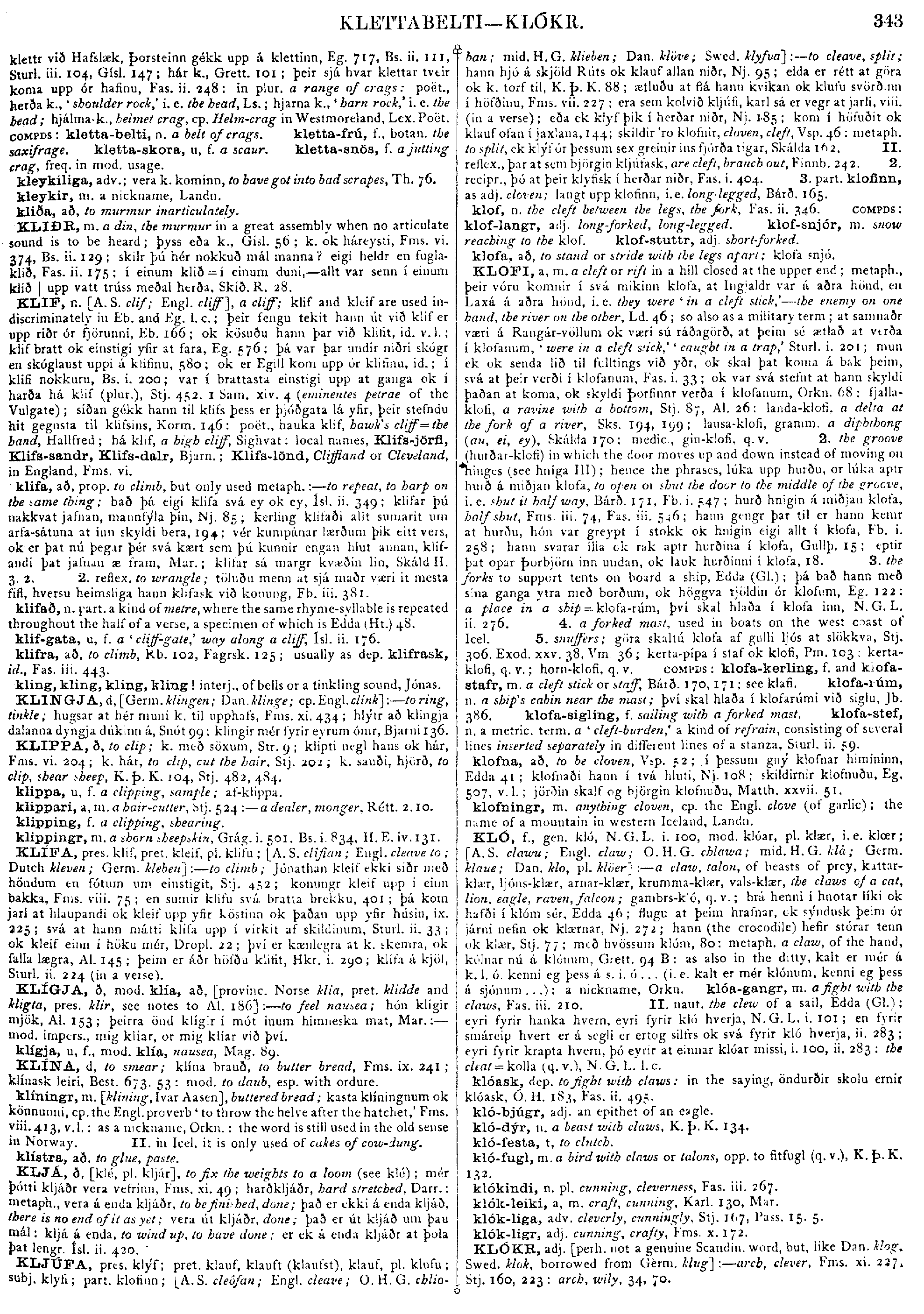
KLOFI, a, m. a cleft or rift in a hill closed at the upper end; metaph., þeir vóru komnir í svá mikinn klofa, at Ingjaldr var á aðra hönd, en Laxá á aðra hönd, i.e. they were 'in a cleft stick,' -- the enemy on one hand, the river on the other, Ld. 46; so also as a military term; at samnaðr væri á Rangár-völlum ok væri sú ráðagörð, at þeim sé ætlað at verða í klofanum, 'were in a cleft stick,' 'caught in a trap,' Sturl. i. 201; mun ek ok senda lið til fulltings við yðr, ok skal þat koma á bak þeim, svá at þeir verði í klofanum, Fas. i. 33; ok var svá stefnt at hann skyldi þaðan at koma, ok skyldi Þorfinnr verða í klofanum, Orkn. 68: fjalla-klofi, a ravine with a bottom, Stj. 87, Al. 26: landa-klofi, a delta at the fork of a river, Sks. 194, 199; lausa-klofi, gramm. a diphthong (au, ei, ey), Skálda 170: medic., gin-klofi, q.v. 2. the groove (hurðar-klofi) in which the door moves up and down instend of moving on hinges (see hníga III); hence the phrases, lúka upp hurðu, or lúka aptr hurð á miðjan klofa, to open or shut the door to the middle of the groove, i.e. shut it half way, Bárð. 171, Fb. i. 547; hurð hnigin á miðjan klofa, half shut, Fms. iii. 74, Fas. iii. 546; hann gengr þar til er hann kemr at hurðu, hón var greypt í stokk ok hnigin eigi allt í klofa, Fb. i. 258; hann svarar ílla ok rak aptr hurðina í klofa, Gullþ. 15; eptir þat opar Þorbjörn inn undan, ok lauk hurðinni í klofa, 18. 3. the forks to support tents on board a ship, Edda (Gl.); þá bað hann með sína ganga ytra með borðum, ok höggva tjöldin ór klofum, Eg. 122: a place in a ship = klofa-rúm, því skal hlaða í klofa inn, N. G. L. ii. 276. 4. a forked mast, used in boats on the west coast of Icel. 5. snuffers; göra skaltú klofa af gulli ljós at slökkva, Stj. 306. Exod. xxv. 38, Vm 36; kerta-pípa í staf ok klofi, Pm. 103; kerta-klofi, q.v.; horn-klofi, q.v. COMPDS: klofa-kerling, f. and klofa-stafr, m. a cleft stick or staff, Bárð. 170, 171; see klafi. klofa-rúm, n. a ship's cabin near the mast; því skal hlaða í klofarúmi við siglu, Jb. 386. klofa-sigling, f. sailing with a forked mast. klofa-stef, n. a metric. term, a 'cleft-burden,' a kind of refrain, consisting of several lines inserted separately in different lines of a stanza, Sturl. ii. 59.
|
Source: Cleasby/Vigfusson, page b0408, entry 13 View original page image as: [TIFF] [PNG] [View previous entry] [View next entry] |
[Comment on this entry] [View comments] |
The following entry has not been hand-corrected. However, the page is reserved and someone is correcting it. |
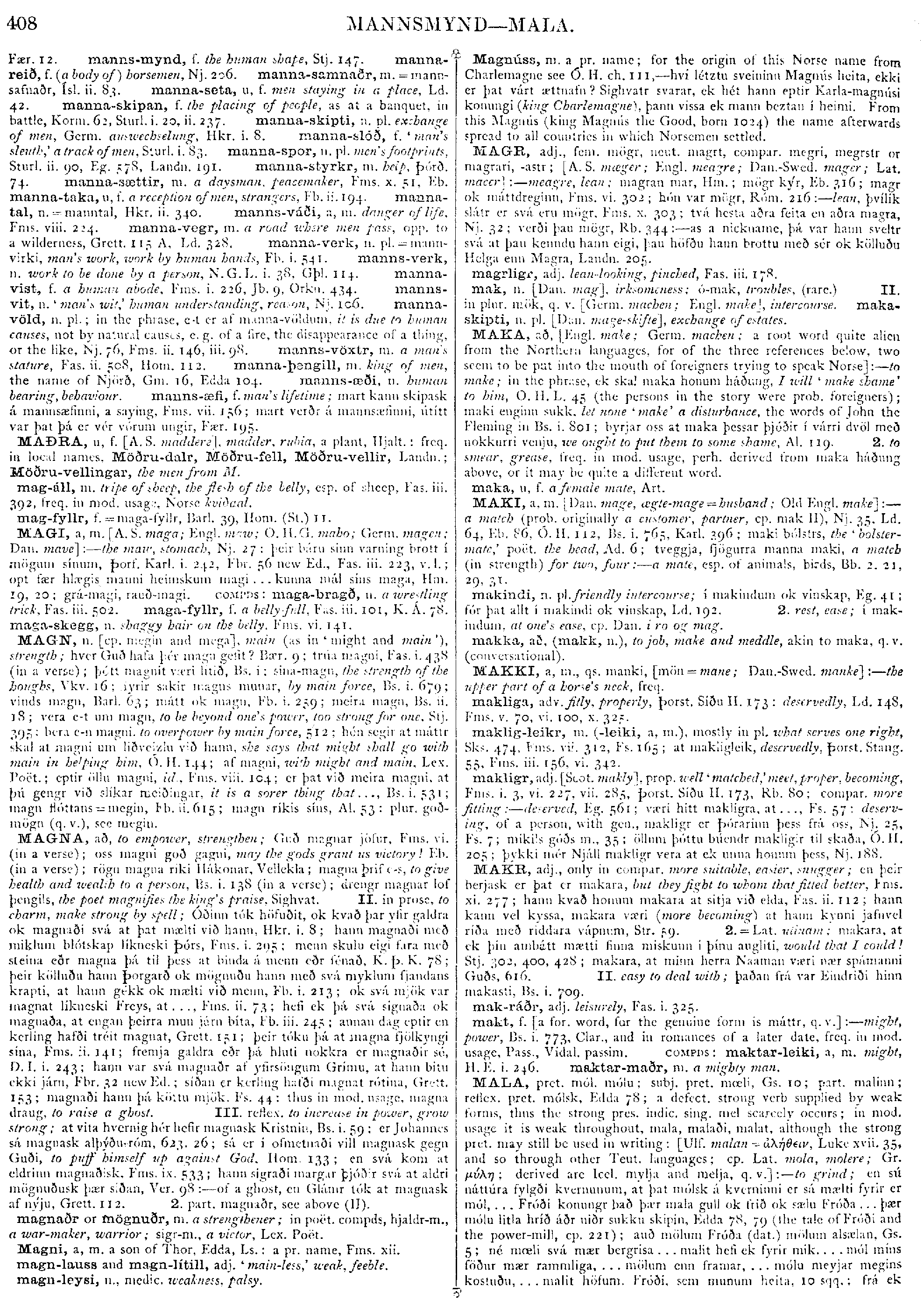
MAGR, adj., fern, niogr, neut. inagrt, compar. mc-gri, meajrstr or magrari, -astr; [A. S. mæger; Engl. meagre; Dan. -Swed. viager; Lat. maccr :-- meagre, lean; magran mar, Hm.; nuigr kv'r, Kb. 316; maT ok muttdreginn, Fms. vi. 302; hón var mogr, Róm. 216 :-- lean, þvílík slá'. r er svá cm mögr. Fms. x. 303; tvá hesta aðra feita en aðra maora, Nj. 32; verði þau mügr, Rb. 344 :-- as a nickname, þá var hann sveltr svá at þan kenndu hann eigi, J. au heifðu hatm brottu með ser ok kölluðu Helga enn Magra, Landn. 205.
|
Source: Cleasby/Vigfusson, page b0462, entry 2 View original page image as: [TIFF] [PNG] [View previous entry] [View next entry] |
[Comment on this entry] [View comments] |
The following entry has been hand-corrected once. |
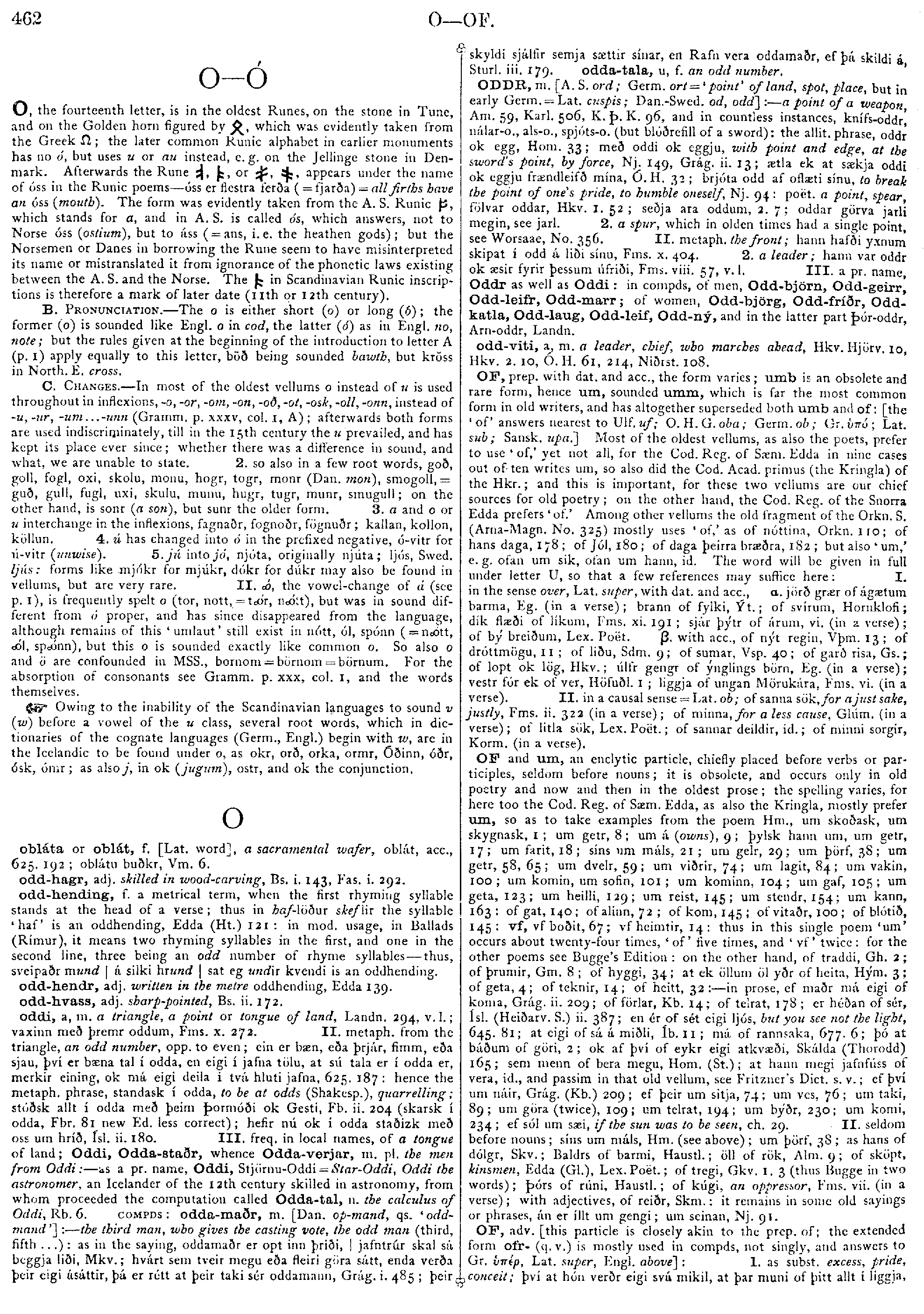
O,
the
fourteenth
letter,
is
in
the
oldest
Runes,
on
the
stone
in
Tune,
and
on
the
Golden
horn
figured
by
RUNE,
which
was
evidently
taken
from
the
Greek
Ω
the
later
common
Runic
alphabet
in
earlier
monuments
has
no
ó,
but
uses
u
or
au
instead,
e.g.
on
the
Jellinge
stone
in
Denmark.
Afterwards
the
Rune
RUNE,
RUNE,
or
RUNE,
RUNE,
appears
under
the
name
of
óss
in
the
Runic
poems
--
óss
er
flestra
ferða
(=
fjarða)
=
all
firths
have
an
óss
(mouth).
The
form
was
evidently
taken
from
the
A.S.
Runic
RUNE,
which
stands
for
a,
and
in
A.S.
is
called
ós,
which
answers,
not
to
Norse
óss
(ostium),
but
to
áss
(=
ans,
i.e.
the
heathen
gods);
but
the
Norsemen
or
Danes
in
borrowing
the
Rune
seem
to
have
misinterpreted
its
name
or
mistranslated
it
from
ignorance
of
the
phonetic
laws
existing
between
the
A.S.
and
the
Norse.
The
RUNE
in
Scandinavian
Runic
inscriptions
is
therefore
a
mark
of
later
date
(11th
or
12th
century).
B.
PRONUNCIATION.
--
The
o
is
either
short
(o)
or
long
(ó);
the
former
(o)
is
sounded
like
Engl.
o
in
cod,
the
latter
(ó)
as
in
Engl.
no,
note;
but
the
rules
given
at
the
beginning
of
the
introduction
to
letter
A
(p.
l)
apply
equally
to
this
letter,
b ð
being
sounded
bawth,
but
kr
ð
being
sounded
bawth,
but
kr ss
in
North.
E.
cross.
C.
CHANGES.
--
In
most
of
the
oldest
vellums
o
instead
of
u
is
used
throughout
in
inflexions,
-o,
-or,
-om,
-on,
-oð,
-ot,
-osk,
-oll,
-onn,
instead
of
-u,
-ur,
-um
...
-unn
(Gramm.
p.
xxxv,
col.
1,
A);
afterwards
both
forms
are
used
indiscriminately,
till
in
the
15th
century
the
u
prevailed,
and
has
kept
its
place
ever
since;
whether
there
was
a
difference
in
sound,
and
what,
we
are
unable
to
state.
2.
so
also
in
a
few
root
words,
goð,
goll,
fogl,
oxi,
skolu,
monu,
hogr,
togr,
monr
(Dan.
mon),
smogoll,
=
guð,
gull,
fugl,
uxi,
skulu,
munu,
hugr,
tugr,
munr,
smugull;
on
the
other
hand,
is
sonr
(a
son),
but
sunr
the
older
form.
3.
a
and
o
or
u
interchange
in
the
inflexions,
fagnaðr,
fognoðr,
fögnuðr;
kallan,
kollon,
köllun.
4.
ú
has
changed
into
ó
in
the
prefixed
negative,
ó-vitr
for
ú-vitr
(unwise).
5.
jú
into
jó,
njóta,
originally
njúta;
ljós,
Swed.
ljús:
forms
like
mjókr
for
mjúkr,
dókr
for
dúkr
may
also
be
found
in
vellums,
but
are
very
rare.
II.
ss
in
North.
E.
cross.
C.
CHANGES.
--
In
most
of
the
oldest
vellums
o
instead
of
u
is
used
throughout
in
inflexions,
-o,
-or,
-om,
-on,
-oð,
-ot,
-osk,
-oll,
-onn,
instead
of
-u,
-ur,
-um
...
-unn
(Gramm.
p.
xxxv,
col.
1,
A);
afterwards
both
forms
are
used
indiscriminately,
till
in
the
15th
century
the
u
prevailed,
and
has
kept
its
place
ever
since;
whether
there
was
a
difference
in
sound,
and
what,
we
are
unable
to
state.
2.
so
also
in
a
few
root
words,
goð,
goll,
fogl,
oxi,
skolu,
monu,
hogr,
togr,
monr
(Dan.
mon),
smogoll,
=
guð,
gull,
fugl,
uxi,
skulu,
munu,
hugr,
tugr,
munr,
smugull;
on
the
other
hand,
is
sonr
(a
son),
but
sunr
the
older
form.
3.
a
and
o
or
u
interchange
in
the
inflexions,
fagnaðr,
fognoðr,
fögnuðr;
kallan,
kollon,
köllun.
4.
ú
has
changed
into
ó
in
the
prefixed
negative,
ó-vitr
for
ú-vitr
(unwise).
5.
jú
into
jó,
njóta,
originally
njúta;
ljós,
Swed.
ljús:
forms
like
mjókr
for
mjúkr,
dókr
for
dúkr
may
also
be
found
in
vellums,
but
are
very
rare.
II.
 ,
the
vowel-change
of
á
(see
p.
1),
is
frequently
spelt
o
(tor,
nott,
=
tr,
ntt),
but
was
in
sound
different
from
ó
proper,
and
has
since
disappeared
from
the
language,
although
remains
of
this
'umlaut'
still
exist
in
nótt,
ól,
spónn
(=
ntt,
l,
spnn),
but
this
o
is
sounded
exactly
like
common
o.
So
also
o
and
ö
are
confounded
in
MSS.,
bornom
=
börnom
=börnum.
For
the
absorption
of
consonants
see
Gramm.
p.
xxx,
col.
1,
and
the
words
themselves.
&FINGER;
Owing
to
the
inability
of
the
Scandinavian
languages
to
sound
v
(w)
before
a
vowel
of
the
u
class,
several
root
words,
which
in
dictionaries
of
the
cognate
languages
(Germ.,
Engl.)
begin
with
w,
are
in
the
Icelandic
to
be
found
under
o,
as
okr,
orð,
orka,
ormr,
Óðinn,
óðr,
ósk,
ómr;
as
also
j,
in
ok
(jugum),
ostr,
and
ok
the
conjunction.
,
the
vowel-change
of
á
(see
p.
1),
is
frequently
spelt
o
(tor,
nott,
=
tr,
ntt),
but
was
in
sound
different
from
ó
proper,
and
has
since
disappeared
from
the
language,
although
remains
of
this
'umlaut'
still
exist
in
nótt,
ól,
spónn
(=
ntt,
l,
spnn),
but
this
o
is
sounded
exactly
like
common
o.
So
also
o
and
ö
are
confounded
in
MSS.,
bornom
=
börnom
=börnum.
For
the
absorption
of
consonants
see
Gramm.
p.
xxx,
col.
1,
and
the
words
themselves.
&FINGER;
Owing
to
the
inability
of
the
Scandinavian
languages
to
sound
v
(w)
before
a
vowel
of
the
u
class,
several
root
words,
which
in
dictionaries
of
the
cognate
languages
(Germ.,
Engl.)
begin
with
w,
are
in
the
Icelandic
to
be
found
under
o,
as
okr,
orð,
orka,
ormr,
Óðinn,
óðr,
ósk,
ómr;
as
also
j,
in
ok
(jugum),
ostr,
and
ok
the
conjunction.
|
Source: Cleasby/Vigfusson, page b0552, entry 20 View original page image as: [TIFF] [PNG] [View previous entry] [View next entry] |
[Comment on this entry] [View comments] |
The following entry has been hand-corrected once. |
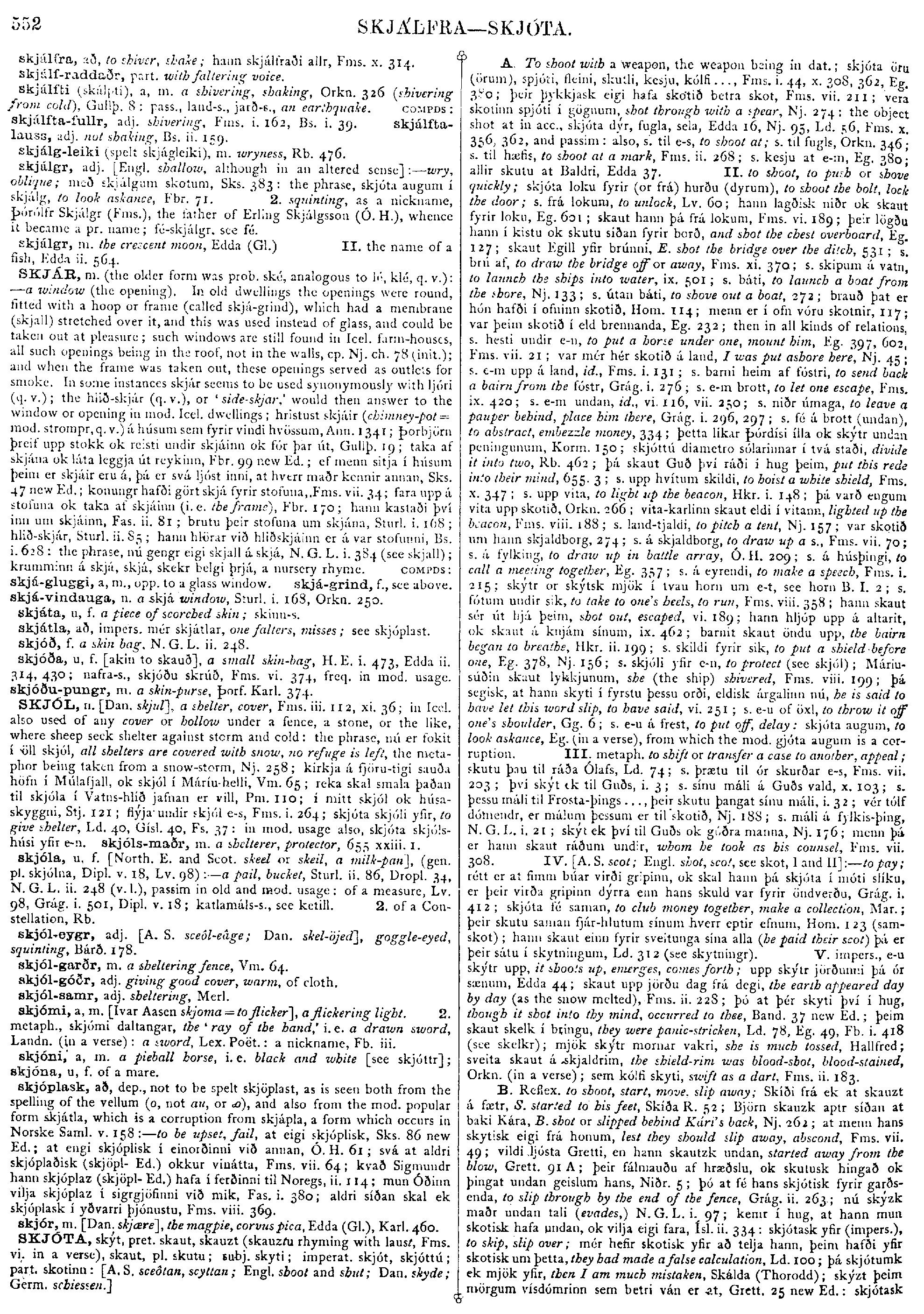
skjóplask, að, dep., not to be spelt skjöplast, as is seen both from the spelling of the vellum (o, not au, or ?? UNCERTAIN), and also from the mod. popular form skjátla, which is a corruption from skjápla, a form which occurs in Norske Saml. v. 158 :-- to be upset, fail, at eigi skjóplisk, Sks. 86 new Ed.; at engi skjóplisk í einorðinni við annan, Ó.H. 6l; svá at aldri skjóplaðisk (skjöpl- Ed.) okkur vinátta, Fms. vii. 64; kvað Sigmundr hann skjóplaz (skjöpl- Ed.) hafa í ferðinni til Noregs, ii. 114; mun Óðinn vilja skjóplaz í sigrgjöfinni við mik, Fas. i. 380; aldri síðan skal ek skjóplask í yðvarri þjónustu, Fms. via. 369.
|
Source: Cleasby/Vigfusson, page b0757, entry 4 View original page image as: [TIFF] [PNG] [View previous entry] [View next entry] |
[Comment on this entry] [View comments] |
The following entry has been hand-corrected once. |
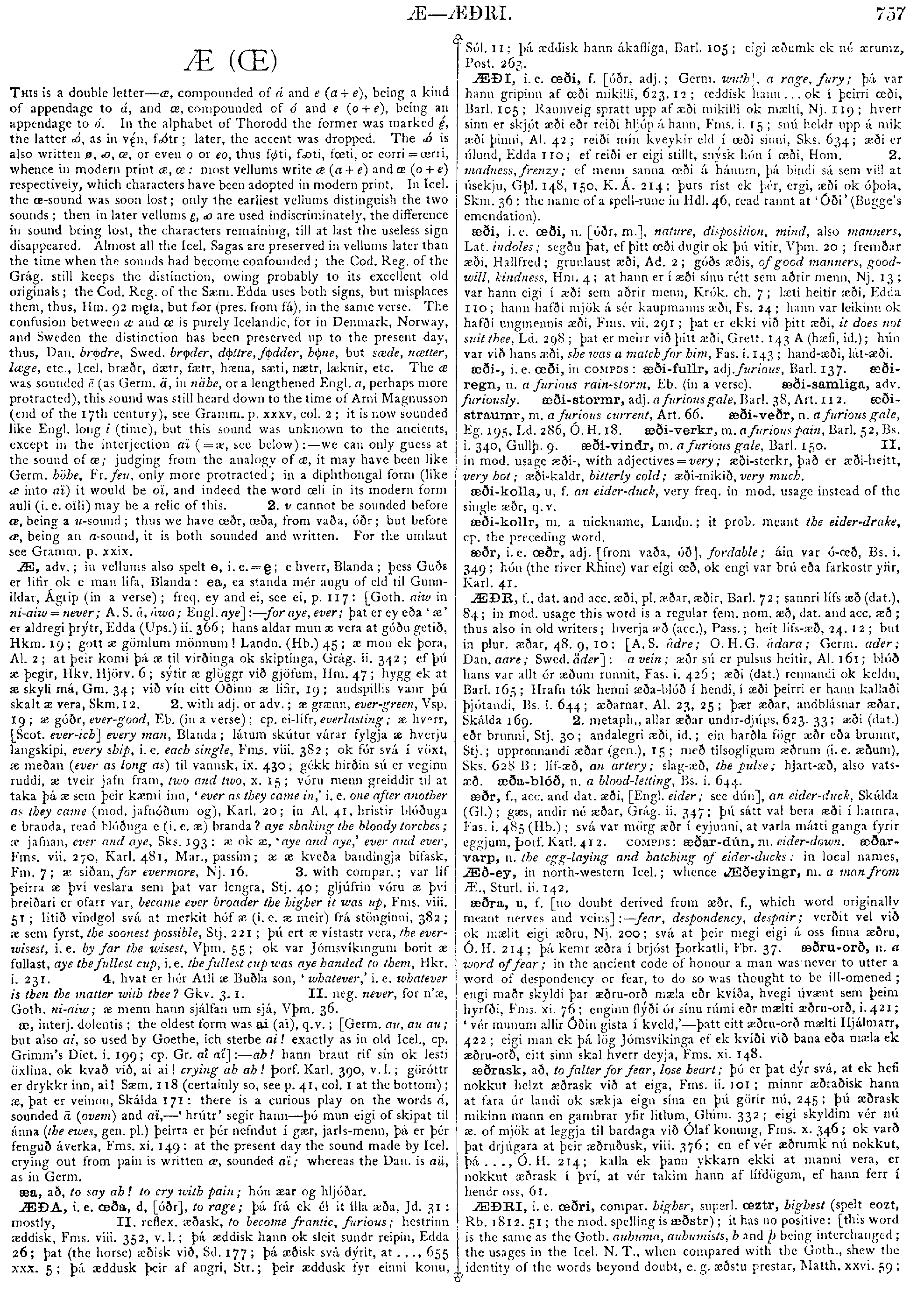
æ,
interj.
dolentis;
the
oldest
form
was
ai
(aï),
q.v.;
[Germ.
au,
au
au;
but
also
ai,
so
used
by
Goethe,
ich
sterbe
ai!
exactly
as
in
old
Icel.,
cp.
Grimm's
Dict.
i.
199;
cp.
Gr.
GREEK]
:--
ah!
hann
braut
rif
sín
ok
lesti
öxlina,
ok
kvað
við,
ai
ai!
crying
ah
ah!
Þorf.
Karl.
390,
v.l.;
göróttr
er
drykkr
inn,
ai!
Sæm.
118
(certainly
so,
see
p.
41,
col.
1
at
the
bottom);
æ
þat
er
veinon,
Skálda
171:
there
is
a
curious
play
on
the
words
á,
sounded
 (ovem)
and
aï,
--
'hrútr'
segir
hann
--
þó
mun
eigi
of
skipat
til
ánna
(the
ewes,
gen.
pl.)
þeirra
er
þer
nefndut
í
gær,
jarls-menn,
þá
er
þér
fenguð
áverka,
Fms.
xi.
149:
at
the
present
day
the
sound
made
by
Icel.
crying
out
from
pain
is
written
æ,
sounded
aï;
whereas
the
Dan.
is
aü,
as
in
Germ.
(ovem)
and
aï,
--
'hrútr'
segir
hann
--
þó
mun
eigi
of
skipat
til
ánna
(the
ewes,
gen.
pl.)
þeirra
er
þer
nefndut
í
gær,
jarls-menn,
þá
er
þér
fenguð
áverka,
Fms.
xi.
149:
at
the
present
day
the
sound
made
by
Icel.
crying
out
from
pain
is
written
æ,
sounded
aï;
whereas
the
Dan.
is
aü,
as
in
Germ.
|
Source: Cleasby/Vigfusson, page b0761, entry 44 View original page image as: [TIFF] [PNG] [View previous entry] [View next entry] |
[Comment on this entry] [View comments] |
The following entry has been hand-corrected once. |
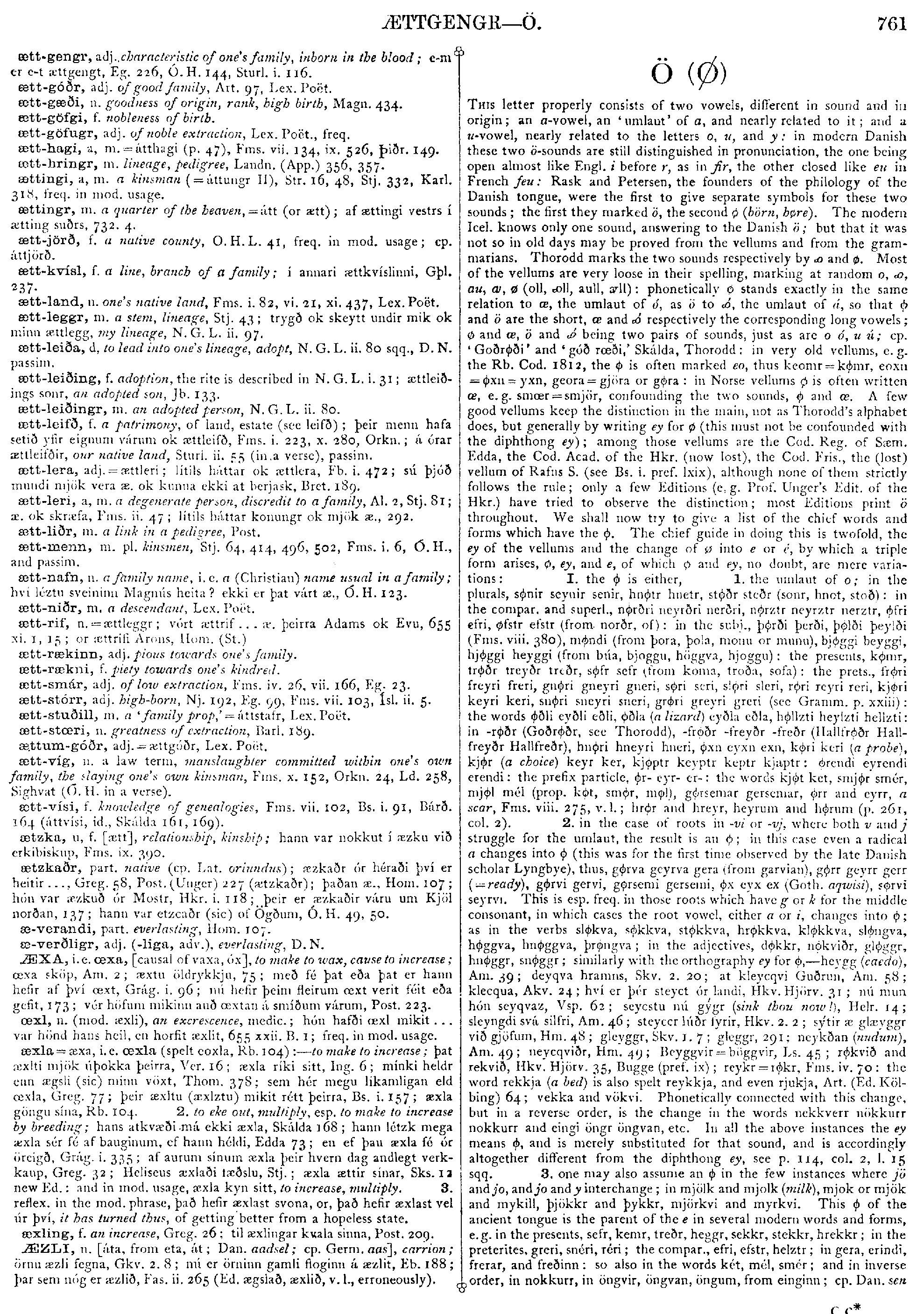
THIS
letter
properly
consists
of
two
vowels,
different
in
sound
and
in
origin;
an
a-vowel,
an
'umlaut'
of
a,
and
nearly
related
to
it;
and
a
u-vowel,
nearly
related
to
the
letters
o,
u,
and
y:
in
modern
Danish
these
two
ö-sounds
are
still
distinguished
in
pronunciation,
the
one
being
open
almost
like
Engl.
i
before
r,
as
in
fir,
the
other
closed
like
eu
in
French
feu:
Rask
and
Petersen,
the
founders
of
the
philology
of
the
Danish
tongue,
were
the
first
to
give
separate
symbols
for
these
two
sounds;
the
first
they
marked
ö,
the
second
ø
(börn,
høre).
The
modern
Icel.
knows
only
one
sound,
answering
to
the
Danish
ö;
but
that
it
was
not
so
in
old
days
may
be
proved
from
the
vellums
and
from
the
grammarians.
Thorodd
marks
the
two
sounds
respectively
by
and
ø.
Most
of
the
vellums
are
very
loose
in
their
spelling,
marking
at
random
o,
,
au,
(?),
UNCERTAIN
ø
(oll,
ll,
aull,
arll
UNCERTAIN):
phonetically
ø
stands
exactly
in
the
same
relation
to
œ,
the
umlaut
of
ó,
as
ö
to
,
the
umlaut
of
á,
so
that
ø
and
ö
are
the
short,
œ
and
respectively
the
corresponding
long
vowels;
ø
and
œ,
ö
and
being
two
pairs
of
sounds,
just
as
are
o
ó,
u
ú;
cp.
'Goðrøði'
and
'góð
rœði,'
Skálda,
Thorodd:
in
very
old
vellums,
e.g.
the
Rb.
Cod.
1812,
the
ø
is
often
marked
eo,
thus
keomr
=
kømr,
eoxn
=
øxn
=
yxn,
geora
=
gjöra
or
gøra:
in
Norse
vellums
ø
is
often
written
œ,
e.g.
smœr
=
smjör,
confounding
the
two
sounds,
ø
and
œ.
A
few
good
vellums
keep
the
distinction
in
the
main,
not
as
Thorodd's
alphabet
does,
but
generally
by
writing
ey
for
ø
(this
must
not
be
confounded
with
the
diphthong
ey);
among
those
vellums
are
the
Cod.
Reg.
of
Sæm.
Edda,
the
Cod.
Acad.
of
the
Hkr.
(now
lost),
the
Cod.
Fris.,
the
(lost)
vellum
of
Rafns
S.
(see
Bs.
i.
pref.
lxix),
although
none
of
them
strictly
follows
the
rule;
only
a
few
Editions
(e.g.
Prof.
Unger's
Edit,
of
the
Hkr.)
have
tried
to
observe
the
distinction;
most
Editions
print
ö
throughout.
We
shall
now
try
to
give
a
list
of
the
chief
words
and
forms
which
have
the
ø.
The
chief
guide
in
doing
this
is
twofold,
the
ey
of
the
vellums
and
the
change
of
ø
into
e
or
é,
by
which
a
triple
form
arises,
ø,
ey,
and
e,
of
which
ø
and
ey,
no
doubt,
are
mere
variations:
I.
the
ø
is
either,
1.
the
umlaut
of
o;
in
the
plurals,
sønir
seynir
senir,
hnøtr
hnetr,
støðr
steðr
(sonr,
hnot,
stoð):
in
the
compar.
and
superl.,
nørðri
neyrðri
nerðri,
nørztr
neyrztr
nerztr,
øfri
efri,
øfstr
efstr
(from
norðr,
of):
in
the
subj.,
þørði
þerði,
þølði
þeylði
(Fms.
viii.
380),
møndi
(from
þora,
þola,
monu
or
munu),
bjøggi
beyggi,
hjøggi
heyggi
(from
búa,
bjoggu,
höggva,
hjoggu):
the
presents,
kømr,
trøðr
treyðr
treðr,
søfr
sefr
(from
koma,
troða,
sofa):
the
prets.,
frøri
freyri
freri,
gnøri
gneyri
gneri,
søri
seri,
sløri
sleri,
róri
reyri
reri,
kjøri
keyri
keri,
snøri
sneyri
sneri,
grøri
greyri
greri
(see
Gramm.
p.
xxiii):
the
words
øðli
eyðli
eðli,
øðla
(a
lizard)
eyðla
eðla,
høllzti
heylzti
hellzti:
in
-røðr
(Goðrøðr,
see
Thorodd),
-frøðr
-freyðr
-freðr
(Hallfrøðr
Hallfreyðr
Hallfreðr),
hnøri
hneyri
hneri,
øxn
eyxn
exn,
køri
keri
(a
probe),
kjør
(a
choice)
keyr
ker,
kjøptr
keyptr
keptr
kjaptr:
ørendi
eyrendi
erendi:
the
prefix
particle,
ør-
eyr-
er-:
the
words
kjøt
ket,
smjør
smér,
mjøl
mél
(prop.
køt,
smør,
møl),
gørsemar
gersemar,
ørr
and
eyrr,
a
scar,
Fms.
viii.
275,
v.l.;
hrør
and
hreyr,
heyrum
and
hørum
(p.
261,
col.
2).
2.
in
the
case
of
roots
in
-vi
or
-vj,
where
both
v
and
j
struggle
for
the
umlaut,
the
result
is
an
ø;
in
this
case
even
a
radical
a
changes
into
ø
(this
was
for
the
first
time
observed
by
the
late
Danish
scholar
Lyngbye),
thus,
gørva
geyrva
gera
(from
garvian),
gørr
geyrr
gerr
(=
ready),
gørvi
gervi,
gørsemi
gersemi,
øx
eyx
ex
(Goth.
aqwisi),
sørvi
seyrvi.
This
is
esp.
freq.
in
those
roots
which
have
g
or
k
for
the
middle
consonant,
in
which
cases
the
root
vowel,
either
a
or
i,
changes
into
ø;
as
in
the
verbs
sløkva,
søkkva,
støkkva,
hrøkkva,
kløkkva,
sløngva,
høggva,
hnøggva,
þrøngva;
in
the
adjectives,
døkkr,
nøkviðr,
gløggr,
hnøggr,
snøggr;
similarly
with
the
orthography
ey
for
ø,
--
heygg
(caedo),
Am.
39;
deyqva
hramns,
Skv.
2.
20;
at
kleycqvi
Guðrun,
Am.
58;
klecqua,
Akv.
24;
hví
er
þér
steyct
ór
landi,
Hkv.
Hjörv.
31;
nú
mun
hón
seyqvaz,
Vsp.
62;
seycstu
nú
gýgr
(sink
thou
now!),
Helr.
14;
sleyngdi
svá
silfri,
Am.
46;
steyccr
lúðr
fyrir,
Hkv.
2.
2;
sýtir
æ
glæyggr
við
gjöfum,
Hm.
48;
gleyggr,
Skv.
1.
7;
gleggr,
291;
neykðan
(nudum),
Am.
49;
neycqviðr,
Hm.
49;
Beyggvir
=
böggvir,
Ls.
45;
røkvið
and
rekvið,
Hkv.
Hjörv.
35,
Bugge
(pref.
ix);
reykr
=
røkr,
Fms.
iv.
70:
the
word
rekkja
(a
bed)
is
also
spelt
reykkja,
and
even
rjukja,
Art.
(Ed.
Kölbing)
64;
vekka
and
vökvi.
Phonetically
connected
with
this
change,
but
in
a
reverse
order,
is
the
change
in
the
words
nekkverr
nökkurr
nokkurr
and
eingi
öngr
öngvan,
etc.
In
all
the
above
instances
the
ey
means
ø,
and
is
merely
substituted
for
that
sound,
and
is
accordingly
altogether
different
from
the
diphthong
ey,
see
p.
114,
col.
2,
l.
15
sqq.
3.
one
may
also
assume
an
ø
in
the
few
instances
where
jö
and
jo,
and
jo
and
y
interchange;
in
mjölk
and
mjolk
(milk),
mjok
or
mjök
and
mykill,
þjökkr
and
þykkr,
mjörkvi
and
myrkvi.
This
ø
of
the
ancient
tongue
is
the
parent
of
the
e
in
several
modern
words
and
forms,
e.g.
in
the
presents,
sefr,
kemr,
treðr,
heggr,
sekkr,
stekkr,
hrekkr;
in
the
preterites,
greri,
snéri,
réri;
the
compar.,
efri,
efstr,
helztr;
in
gera,
erindi,
frerar,
and
freðinn:
so
also
in
the
words
két,
mél,
smér;
and
in
inverse
order,
in
nokkurr,
in
öngvir,
öngvan,
öngum,
from
einginn;
cp.
Dan.
sen
| Result Page: |  |
Previous | 1 2 3 4 |
Germanic Lexicon Project (main page)
This search system was written by
Sean Crist
Please consider
volunteering
to correct the data in these online dictionaries.
No rights reserved. Feel free to use these data in any way you please.