|
|

Tip: In the search results, you can click on any word or abbreviation for more information.
|
Source: Bosworth/Toller, page b1156, entry 19 View original page image as: [TIFF] [PNG] [View previous entry] [View next entry] |
[Comment on this entry] [View comments] |
The following entry has been hand-corrected once. |
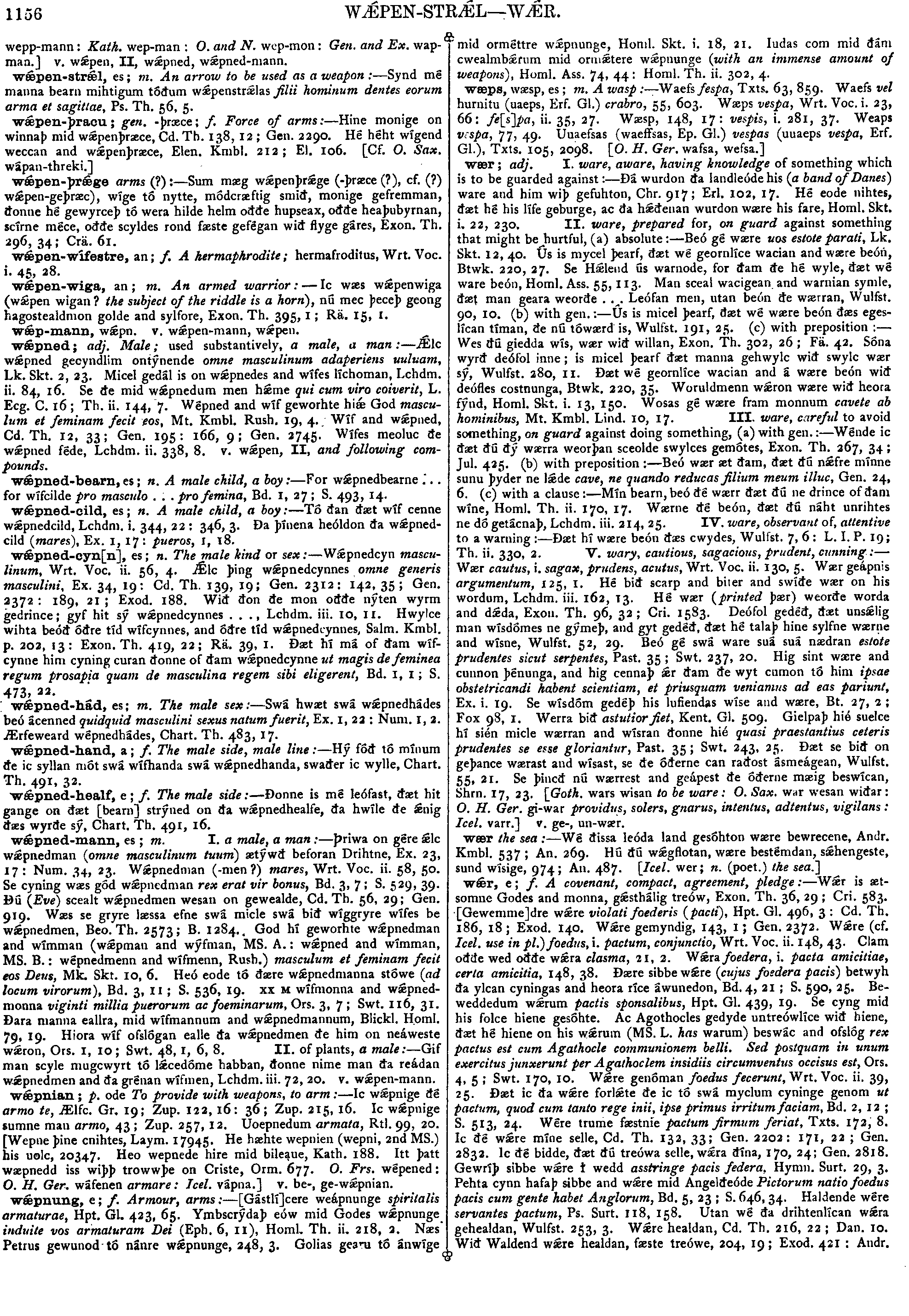
wær;
adj.
I.
ware,
aware,
having
knowledge
of
something
which
is
to
be
guarded
against:--Ðá
wurdon
ða
landleóde
his
(a
band
of
Danes)
ware
and
him
wiþ
gefuhton,
Chr.
917;
Erl.
102,
17.
Hé
eode
nihtes,
ðæt
hé
his
lífe
geburge,
ac
ða
h ðenan
wurdon
wære
his
fare,
Homl.
Skt.
i.
22,
230.
II.
ware,
prepared
for,
on
guard
against
something
that
might
be
hurtful,
(a)
absolute:--Beó
gé
wære
uos
estote
parati,
Lk.
Skt.
12,
40.
Ús
is
mycel
þearf,
ðæt
wé
geornlíce
wacian
and
wære
beón,
Btwk.
220,
27.
Se
Hlend
ús
warnode,
for
ðam
ðe
hé
wyle,
ðæt
wé
ware
beón,
Homl.
Ass.
55,
113.
Man
sceal
wacigean
and
warnian
symle,
ðæt
man
geara
weorðe
.
.
.
Leófan
men,
utan
beón
ðe
wærran,
Wulfst.
90,
10.
(b)
with
gen.:--Ús
is
micel
þearf,
ðæt
wé
wære
beón
ðæs
eges
ðenan
wurdon
wære
his
fare,
Homl.
Skt.
i.
22,
230.
II.
ware,
prepared
for,
on
guard
against
something
that
might
be
hurtful,
(a)
absolute:--Beó
gé
wære
uos
estote
parati,
Lk.
Skt.
12,
40.
Ús
is
mycel
þearf,
ðæt
wé
geornlíce
wacian
and
wære
beón,
Btwk.
220,
27.
Se
Hlend
ús
warnode,
for
ðam
ðe
hé
wyle,
ðæt
wé
ware
beón,
Homl.
Ass.
55,
113.
Man
sceal
wacigean
and
warnian
symle,
ðæt
man
geara
weorðe
.
.
.
Leófan
men,
utan
beón
ðe
wærran,
Wulfst.
90,
10.
(b)
with
gen.:--Ús
is
micel
þearf,
ðæt
wé
wære
beón
ðæs
eges lícan
tíman,
ðe
nú
tówærd
is,
Wulfst.
191,
25.
(c)
with
preposition:--Wes
ðú
giedda
wís,
wær
wið
willan,
Exon.
Th.
302,
26;
Fä.
42.
Sóna
wyrð
deófol
inne;
is
micel
þearf
ðæt
manna
gehwylc
wið
swylc
wær
sý,
Wulfst.
280,
11.
Ðæt
wé
geornlíce
wacian
and
á
wære
beón
wið
deófles
costnunga,
Btwk.
220,
35.
Woruldmenn
wron
wære
wið
heora
fýnd,
Homl.
Skt.
i.
13,
150.
Wosas
gé
wære
fram
monnum
cavete
ab
hominibus,
Mt.
Kmbl.
Lind.
10,
17.
III.
ware,
careful
to
avoid
something,
on
guard
against
doing
something,
(a)
with
gen.:--Wénde
ic
ðæt
ðú
ðý
wærra
weorþan
sceolde
swylces
gemótes,
Exon.
Th.
267,
34;
Jul.
425.
(b)
with
preposition:--Beó
wær
æt
ðam,
ðæt
ðú
nfre
mínne
sunu
þyder
ne
lde
cave,
ne
quando
reducas
filium
meum
illuc,
Gen.
24,
6.
(c)
with
a
clause:--Mín
bearn,
beó
ðé
wærr
ðæt
ðú
ne
drince
of
ðam
wíne,
Homl.
Th.
ii.
170,
17.
Wærne
ðé
beón,
ðæt
ðú
náht
unrihtes
ne
dó
getácnaþ,
Lchdm.
iii.
214,
25.
IV.
ware,
observant
of,
attentive
to
a
warning:--Ðæt
hí
wære
beón
ðæs
cwydes,
Wulfst.
7,
6:
L.
I.
P.
19;
Th.
ii.
330,
2.
V.
wary,
cautious,
sagacious,
prudent,
cunning:--Wær
cautus,
i.
sagax,
prudens,
acutus,
Wrt.
Voc.
ii.
130,
5.
Wær
geápnis
argumentum,
125,
1.
Hé
bið
scarp
and
biter
and
swíðe
wær
on
his
wordum,
Lchdm.
iii.
162,
13.
Hé
wær
(printed
þær)
weorðe
worda
and
dda,
Exon.
Th.
96,
32;
Cri.
1583.
Deófol
gedéð,
ðæt
unslig
man
wísdómes
ne
gýmeþ,
and
gyt
gedéð,
ðæt
hé
talaþ
hine
sylfne
wærne
and
wísne,
Wulfst.
52,
29.
Beó
gé
swá
ware
suá
suá
nædran
estote
prudentes
sicut
serpentes,
Past.
35;
Swt.
237,
20.
Hig
sint
wære
and
cunnon
þénunga,
and
hig
cennaþ
r
ðam
ðe
wyt
cumon
tó
him
ipsae
obstetricandi
habent
scientiam,
et
priusquam
veniamus
ad
eas
pariunt,
Ex.
i.
19.
Se
wísdóm
gedéþ
his
lufiendas
wíse
and
wære,
Bt.
27,
2;
Fox
98,
1.
Werra
bið
astutior
fiet,
Kent.
Gl.
509.
Gielpaþ
hié
suelce
hí
sién
micle
wærran
and
wísran
ðonne
hié
quasi
praestantius
ceteris
prudentes
se
esse
gloriantur,
Past.
35;
Swt.
243,
25.
Ðæt
se
bið
on
geþance
wærast
and
wísast,
se
ðe
óðerne
can
raðost
ásmeágean,
Wulfst.
55,
21.
Se
þincð
nú
wærrest
and
geápest
ðe
óðerne
mæig
beswícan,
Shrn.
17,
23.
[Goth.
wars
wisan
to
be
ware:
O.
Sax.
war
wesan
wiðar:
O.
H.
Ger.
gi-war
providus,
solers,
gnarus,
intentus,
adtentus,
vigilans:
Icel.
varr.]
v.
ge-,
un-wær.
lícan
tíman,
ðe
nú
tówærd
is,
Wulfst.
191,
25.
(c)
with
preposition:--Wes
ðú
giedda
wís,
wær
wið
willan,
Exon.
Th.
302,
26;
Fä.
42.
Sóna
wyrð
deófol
inne;
is
micel
þearf
ðæt
manna
gehwylc
wið
swylc
wær
sý,
Wulfst.
280,
11.
Ðæt
wé
geornlíce
wacian
and
á
wære
beón
wið
deófles
costnunga,
Btwk.
220,
35.
Woruldmenn
wron
wære
wið
heora
fýnd,
Homl.
Skt.
i.
13,
150.
Wosas
gé
wære
fram
monnum
cavete
ab
hominibus,
Mt.
Kmbl.
Lind.
10,
17.
III.
ware,
careful
to
avoid
something,
on
guard
against
doing
something,
(a)
with
gen.:--Wénde
ic
ðæt
ðú
ðý
wærra
weorþan
sceolde
swylces
gemótes,
Exon.
Th.
267,
34;
Jul.
425.
(b)
with
preposition:--Beó
wær
æt
ðam,
ðæt
ðú
nfre
mínne
sunu
þyder
ne
lde
cave,
ne
quando
reducas
filium
meum
illuc,
Gen.
24,
6.
(c)
with
a
clause:--Mín
bearn,
beó
ðé
wærr
ðæt
ðú
ne
drince
of
ðam
wíne,
Homl.
Th.
ii.
170,
17.
Wærne
ðé
beón,
ðæt
ðú
náht
unrihtes
ne
dó
getácnaþ,
Lchdm.
iii.
214,
25.
IV.
ware,
observant
of,
attentive
to
a
warning:--Ðæt
hí
wære
beón
ðæs
cwydes,
Wulfst.
7,
6:
L.
I.
P.
19;
Th.
ii.
330,
2.
V.
wary,
cautious,
sagacious,
prudent,
cunning:--Wær
cautus,
i.
sagax,
prudens,
acutus,
Wrt.
Voc.
ii.
130,
5.
Wær
geápnis
argumentum,
125,
1.
Hé
bið
scarp
and
biter
and
swíðe
wær
on
his
wordum,
Lchdm.
iii.
162,
13.
Hé
wær
(printed
þær)
weorðe
worda
and
dda,
Exon.
Th.
96,
32;
Cri.
1583.
Deófol
gedéð,
ðæt
unslig
man
wísdómes
ne
gýmeþ,
and
gyt
gedéð,
ðæt
hé
talaþ
hine
sylfne
wærne
and
wísne,
Wulfst.
52,
29.
Beó
gé
swá
ware
suá
suá
nædran
estote
prudentes
sicut
serpentes,
Past.
35;
Swt.
237,
20.
Hig
sint
wære
and
cunnon
þénunga,
and
hig
cennaþ
r
ðam
ðe
wyt
cumon
tó
him
ipsae
obstetricandi
habent
scientiam,
et
priusquam
veniamus
ad
eas
pariunt,
Ex.
i.
19.
Se
wísdóm
gedéþ
his
lufiendas
wíse
and
wære,
Bt.
27,
2;
Fox
98,
1.
Werra
bið
astutior
fiet,
Kent.
Gl.
509.
Gielpaþ
hié
suelce
hí
sién
micle
wærran
and
wísran
ðonne
hié
quasi
praestantius
ceteris
prudentes
se
esse
gloriantur,
Past.
35;
Swt.
243,
25.
Ðæt
se
bið
on
geþance
wærast
and
wísast,
se
ðe
óðerne
can
raðost
ásmeágean,
Wulfst.
55,
21.
Se
þincð
nú
wærrest
and
geápest
ðe
óðerne
mæig
beswícan,
Shrn.
17,
23.
[Goth.
wars
wisan
to
be
ware:
O.
Sax.
war
wesan
wiðar:
O.
H.
Ger.
gi-war
providus,
solers,
gnarus,
intentus,
adtentus,
vigilans:
Icel.
varr.]
v.
ge-,
un-wær.
|
Source: Bosworth/Toller, page b1297, entry 3 View original page image as: [TIFF] [PNG] [View previous entry] [View next entry] |
[Comment on this entry] [View comments] |
The following entry has been hand-corrected once. |
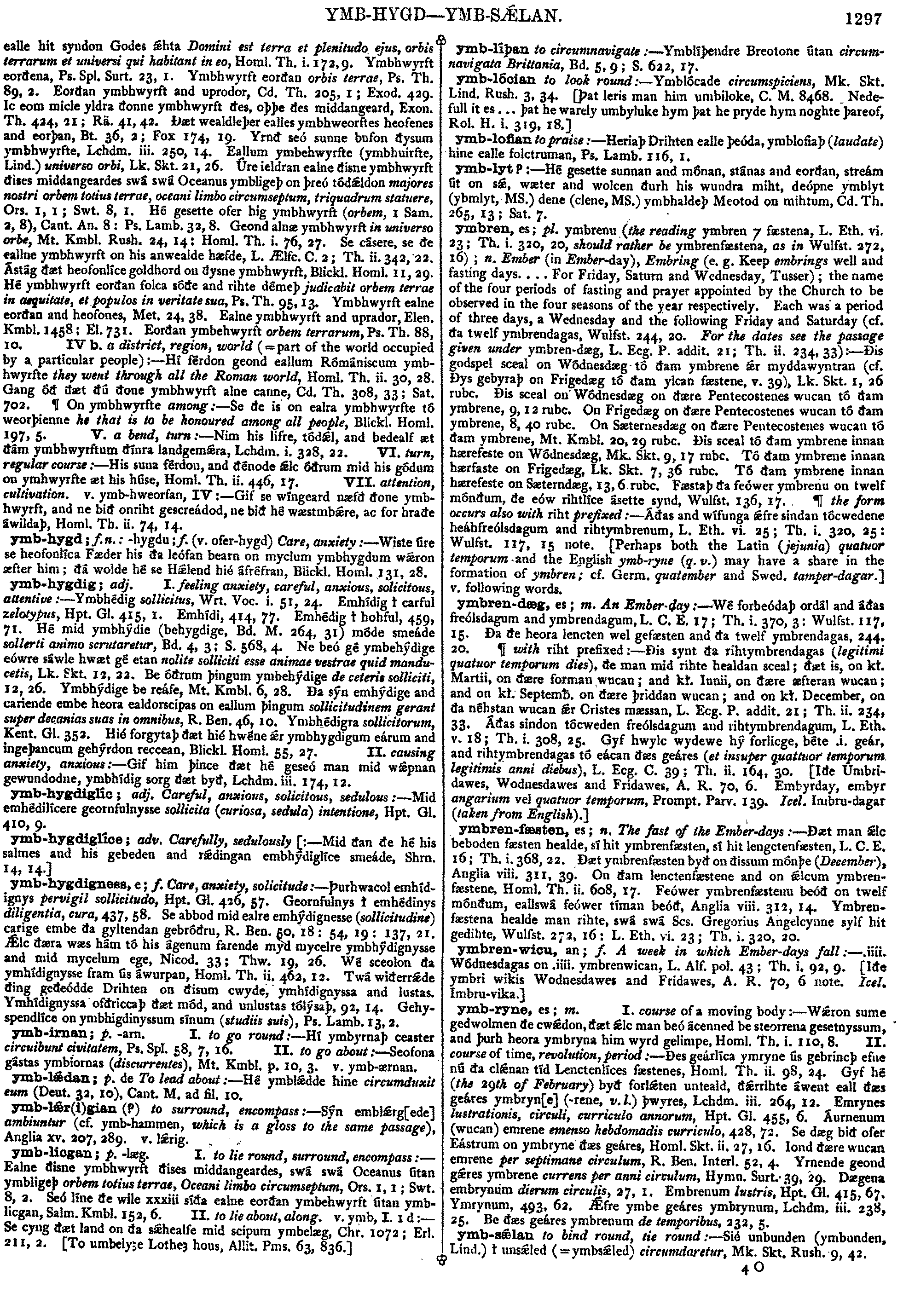
ymb-hygdig;
adj.
I.
feeling
anxiety,
careful,
anxious,
solicitous,
attentive
:--
Ymbhédig
sollicitus,
Wrt.
Voc.
i.
51,
24.
Emhídig
 carful
zelotypus,
Hpt.
Gl.
415,
1.
Emhídi,
414,
77.
Emhédig
hohful,
459,
71.
Hé
mid
ymbhýdie
(behygdige,
Bd.
M.
264,
31)
móde
smeáde
sollerti
animo
scrutaretur,
Bd.
4,
3;
S.
568,
4.
Ne
beó
gé
ymbehýdige
eówre
sáwle
hwæt
gé
etan
nolite
solliciti
esse
animae
vestrae
quid
manducetis,
Lk.
Skt.
12,
22.
Be
óðrum
þingum
ymbehýdige
de
ceteris
solliciti,
12,
26.
Ymbhýdige
be
reáfe,
Mt.
Kmbl.
6,
28.
Ða
sýn
emhýdige
and
cariende
embe
heora
ealdorscipas
on
eallum
þingum
sollicitudinem
gerant
super
decanias
suas
in
omnibus,
R.
Ben.
46,
10.
Ymbhédigra
sollicitorum,
Kent.
Gl.
352.
Hié
forgytaþ
ðæt
hié
hwéne
r
ymbhygdigum
eárum
and
ingeþancum
gehýrdon
reccean,
Blickl.
Homl.
55,
27.
II.
causing
anxiety,
anxious
:--
Gif
him
þince
ðæt
hé
geseó
man
mid
wpnan
gewundodne,
ymbhídig
sorg
ðæt
byð,
Lchdm.
iii.
174,
12.
carful
zelotypus,
Hpt.
Gl.
415,
1.
Emhídi,
414,
77.
Emhédig
hohful,
459,
71.
Hé
mid
ymbhýdie
(behygdige,
Bd.
M.
264,
31)
móde
smeáde
sollerti
animo
scrutaretur,
Bd.
4,
3;
S.
568,
4.
Ne
beó
gé
ymbehýdige
eówre
sáwle
hwæt
gé
etan
nolite
solliciti
esse
animae
vestrae
quid
manducetis,
Lk.
Skt.
12,
22.
Be
óðrum
þingum
ymbehýdige
de
ceteris
solliciti,
12,
26.
Ymbhýdige
be
reáfe,
Mt.
Kmbl.
6,
28.
Ða
sýn
emhýdige
and
cariende
embe
heora
ealdorscipas
on
eallum
þingum
sollicitudinem
gerant
super
decanias
suas
in
omnibus,
R.
Ben.
46,
10.
Ymbhédigra
sollicitorum,
Kent.
Gl.
352.
Hié
forgytaþ
ðæt
hié
hwéne
r
ymbhygdigum
eárum
and
ingeþancum
gehýrdon
reccean,
Blickl.
Homl.
55,
27.
II.
causing
anxiety,
anxious
:--
Gif
him
þince
ðæt
hé
geseó
man
mid
wpnan
gewundodne,
ymbhídig
sorg
ðæt
byð,
Lchdm.
iii.
174,
12.
|
Source: Bosworth/Toller, page d0117, entry 18 View original page image as: [TIFF] [PNG] [View previous entry] [View next entry] |
[Comment on this entry] [View comments (1)] |
The following entry has been hand-corrected once. |
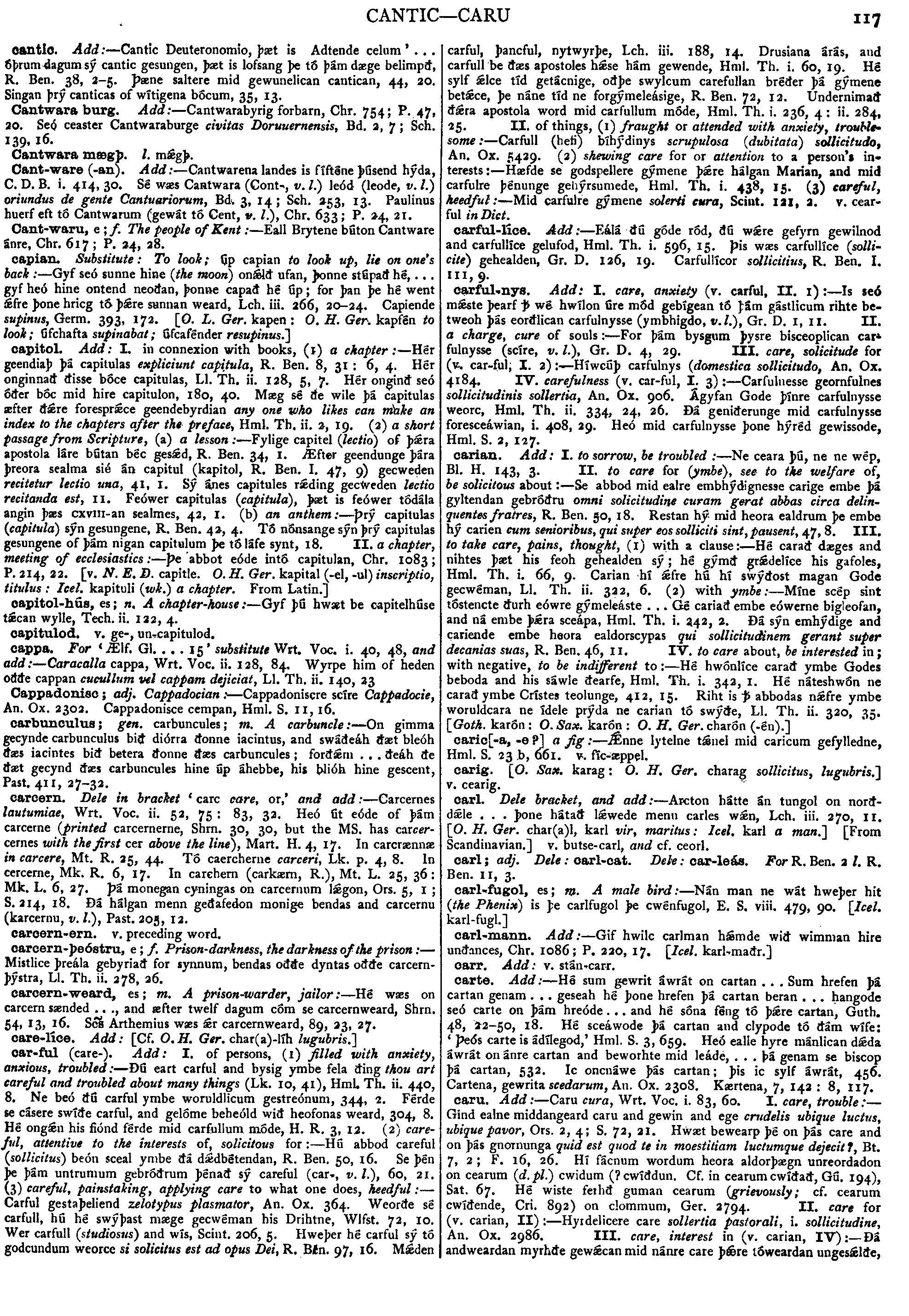
car-ful
(care-).
Add:
I.
of
persons,
(1)
filled
with
anxiety,
anxious,
troubled
:--
Ðú
eart
carful
and
bysig
ymbe
fela
ðing
thou
art
careful
and
troubled
about
many
things
(Lk.
10,
41),
Hml.
Th.
ii.
440,
8.
Ne
beó
ðú
carful
ymbe
woruldlicum
gestreónum,
344,
2.
Férde
se
cásere
swíðe
carful,
and
gelóme
beheóld
wið
heofonas
weard,
304,
8.
Hé
ongn
his
fiónd
férde
mid
carfullum
móde,
H.
R.
3,
12.
(2)
careful,
attentive
to
the
interests
of,
solicitous
for
:--
Hú
abbod
careful
(sollicitus)
beón
sceal
ymbe
ðá
ddbétendan,
R.
Ben.
50,
16.
Se
þén
þe
þám
untrumum
gebróðrum
þénað
sý
careful
(car-,
v.
l.),
60,
21.
(3)
careful,
painstaking,
applying
care
to
what
one
does,
heedful
:--
Carful
gestaþeliend
zelotypus
plasmator,
An.
Ox.
364.
Weorðe
sé
carfull,
hú
hé
swýþast
mæge
gecwéman
his
Drihtne,
Wlfst.
72,
10.
Wer
carfull
(studiosus)
and
wís,
Scint.
206,
5.
Hweþer
hé
carful
sý
tó
godcundum
weorce
si
solicitus
est
ad
opus
Dei,
R.
Ben.
97,
16.
Mæden
carful,
þancful,
nytwyrþe,
Lch.
iii.
188,
14.
Drusiana
árás,
and
carfull
be
ðæs
apostoles
hse
hám
gewende,
Hml.
Th.
i.
60,
19.
Hé
sylf
lce
tíd
getácnige,
oðþe
swylcum
carefullan
bréðer
þá
gýmene
betce,
þe
náne
tíd
ne
forgýmeleásige,
R.
Ben.
72,
12.
Undernimað
ðra
apostola
word
mid
carfullum
móde,
Hml.
Th.
i.
236,
4:
ii.
284,
25.
II.
of
things,
(1)
fraught
or
attended
with
anxiety,
troublesome
:--
Carfull
(heti)
bíhýdinys
scrupulosa
(dubitata)
sollicitudo,
An.
Ox.
5429.
(2)
shewing
care
for
or
attention
to
a
person's
interests
:--
Hæfde
se
godspellere
gýmene
þre
hálgan
Marian,
and
mid
carfulre
þénunge
gehýrsumede,
Hml.
Th.
i.
438,
15.
(3)
careful,
heedful
:--
Mid
carfulre
gýmene
solerti
cura,
Scint.
121,
2.
v.
cearful
in
Dict.
|
Source: Bosworth/Toller, page d0555, entry 1 View original page image as: [TIFF] [PNG] [View previous entry] [View next entry] |
[Comment on this entry] [View comments] |
The following entry has been hand-corrected once. |
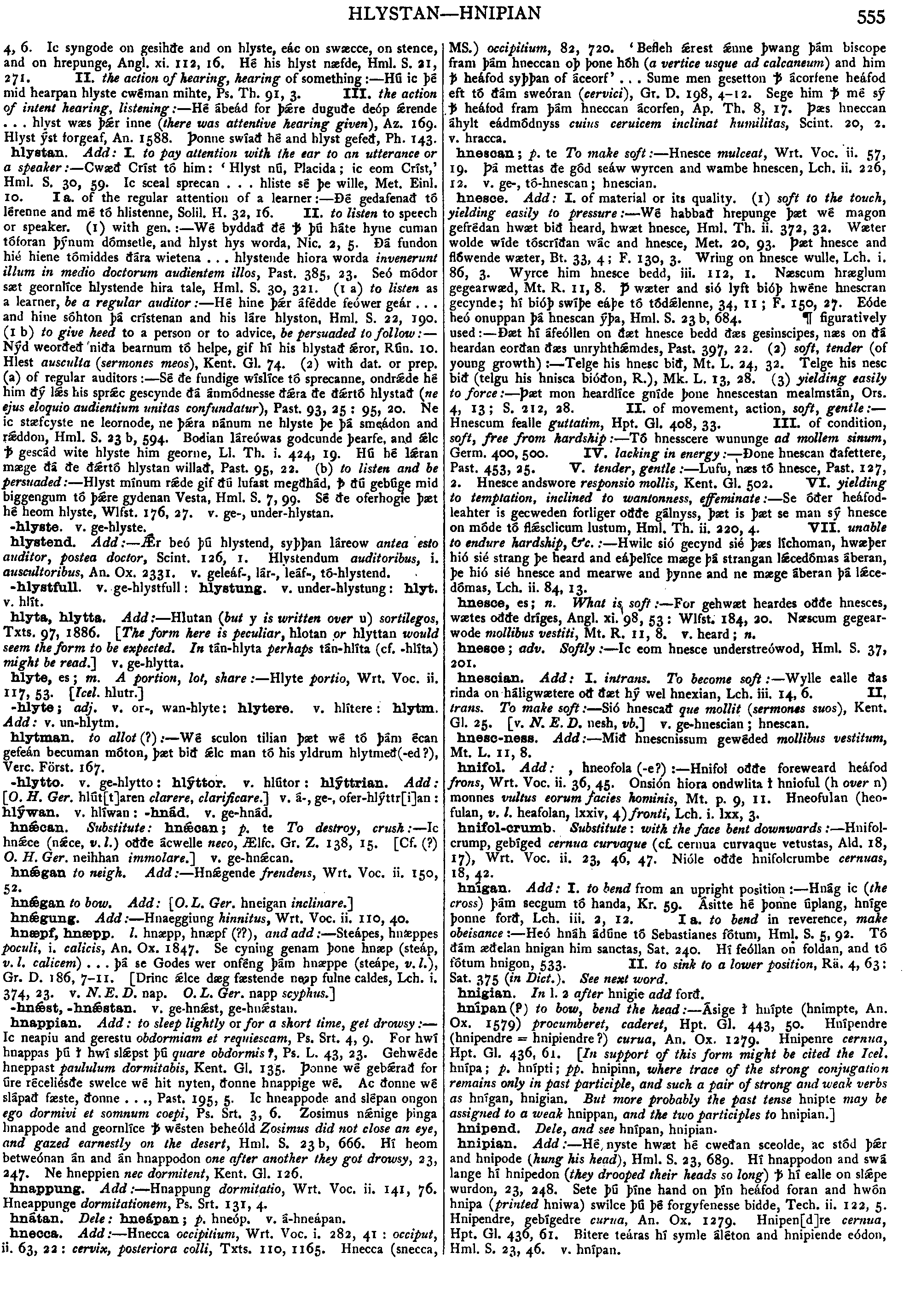
4,
6.
Ic
syngode
on
gesih e
and
on
hlyste,
eác
on
swæcce,
on
stence,
and
on
hrepunge,
Angl.
xi.
112,
16.
H
e
and
on
hlyste,
eác
on
swæcce,
on
stence,
and
on
hrepunge,
Angl.
xi.
112,
16.
H his
hlyst
næfde,
Hml.
S.
21,
271.
II.
the
action
of
hearing,
hearing
of
something
:--
H
his
hlyst
næfde,
Hml.
S.
21,
271.
II.
the
action
of
hearing,
hearing
of
something
:--
H ic
þ
mid
hearpan
hlyste
cwman
mihte,
Ps.
Th.
91,
3.
III.
the
action
of
intent
hearing,
listening
:--
H
ic
þ
mid
hearpan
hlyste
cwman
mihte,
Ps.
Th.
91,
3.
III.
the
action
of
intent
hearing,
listening
:--
H
 beád
for
þ
beád
for
þ re
dugue
deóp
rende
.
.
.
hlyst
wæs
þr
inne
(there
was
attentive
hearing
given),
Az.
169.
Hlyst
re
dugue
deóp
rende
.
.
.
hlyst
wæs
þr
inne
(there
was
attentive
hearing
given),
Az.
169.
Hlyst
 st
forgeaf,
An.
1588.
Þonne
sw
st
forgeaf,
An.
1588.
Þonne
sw a
h
and
hlyst
gefe,
Ph.
143.
a
h
and
hlyst
gefe,
Ph.
143.
|
Source: Cleasby/Vigfusson, page b0030, entry 18 View original page image as: [TIFF] [PNG] [View previous entry] [View next entry] |
[Comment on this entry] [View comments] |
The following entry has been hand-corrected once. |
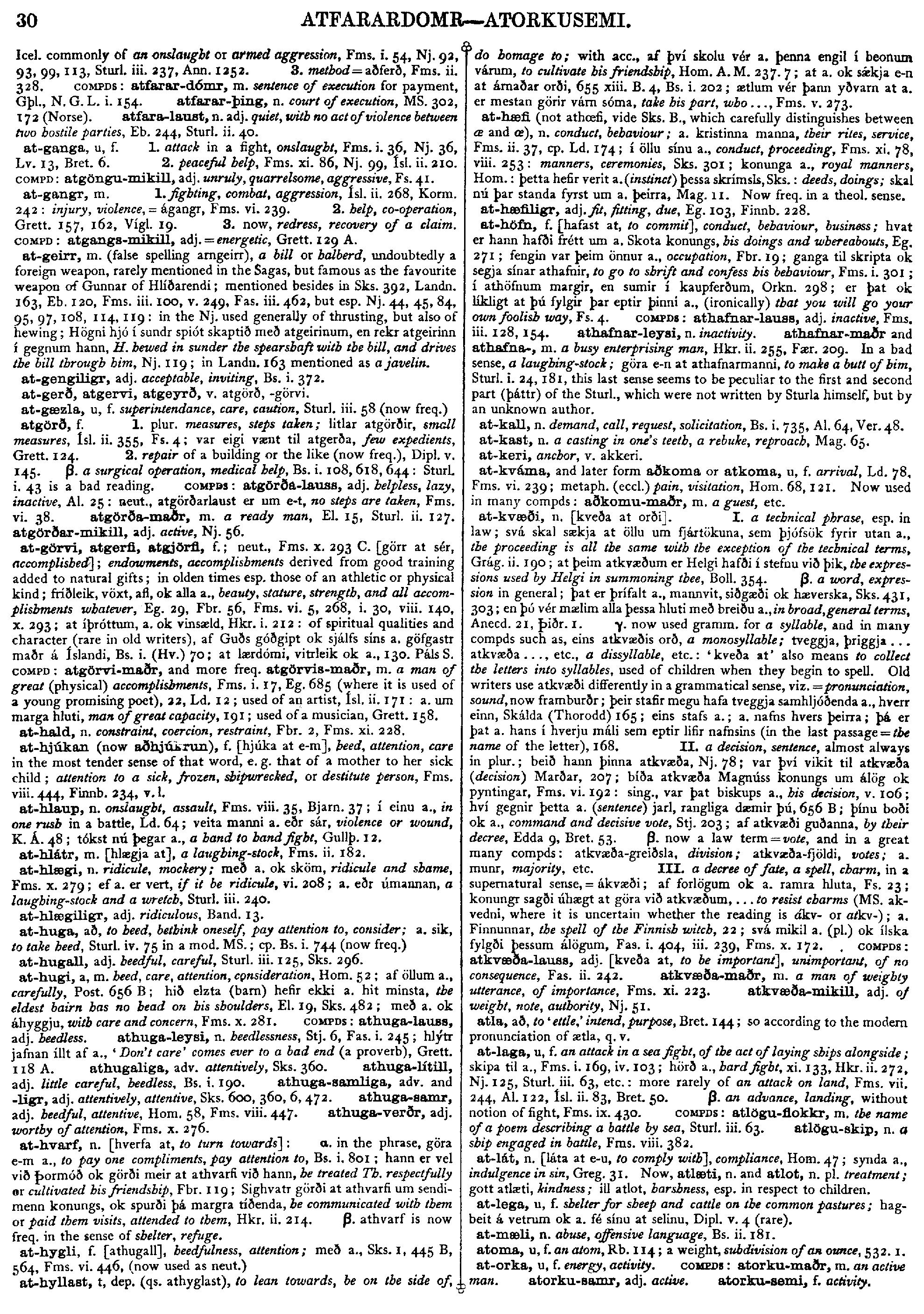
at-hugi, a, m. heed, care, attention, consideration, Hom. 5 2; af öllum a., carefully, Post. 656 B; hið elzta (barn) hefir ekki a. hit minsta, the eldest bairn has no head on his shoulders, El. 19, Sks. 482; með a. ok áhyggju, with care and concern, Fms. x. 281. COMPDS: athuga-lauss, adj. heedless. athuga-leysi, n. beedlessness, Stj. 6, Fas. i. 245; hlýtr jafnan íllt af a., ' Don't care' comes ever to a bad end (a proverb), Grett. 118 A. athugaliga, adv. attentively, Sks. 360. athuga-litill, adj. little careful, heedless, Bs. i. 190. athuga-sarnliga, adv. and -ligr, adj. attentively, attentive, Sks. 600, 360, 6, 472. athuga-samr, adj. heedful, attentive, Hom. 58, Fms. viii. 447. athuga-verðr, adj. worthy of attention, Fms. x. 276.
|
Source: Cleasby/Vigfusson, page b0033, entry 3 View original page image as: [TIFF] [PNG] [View previous entry] [View next entry] |
[Comment on this entry] [View comments] |
The following entry has been hand-corrected once. |
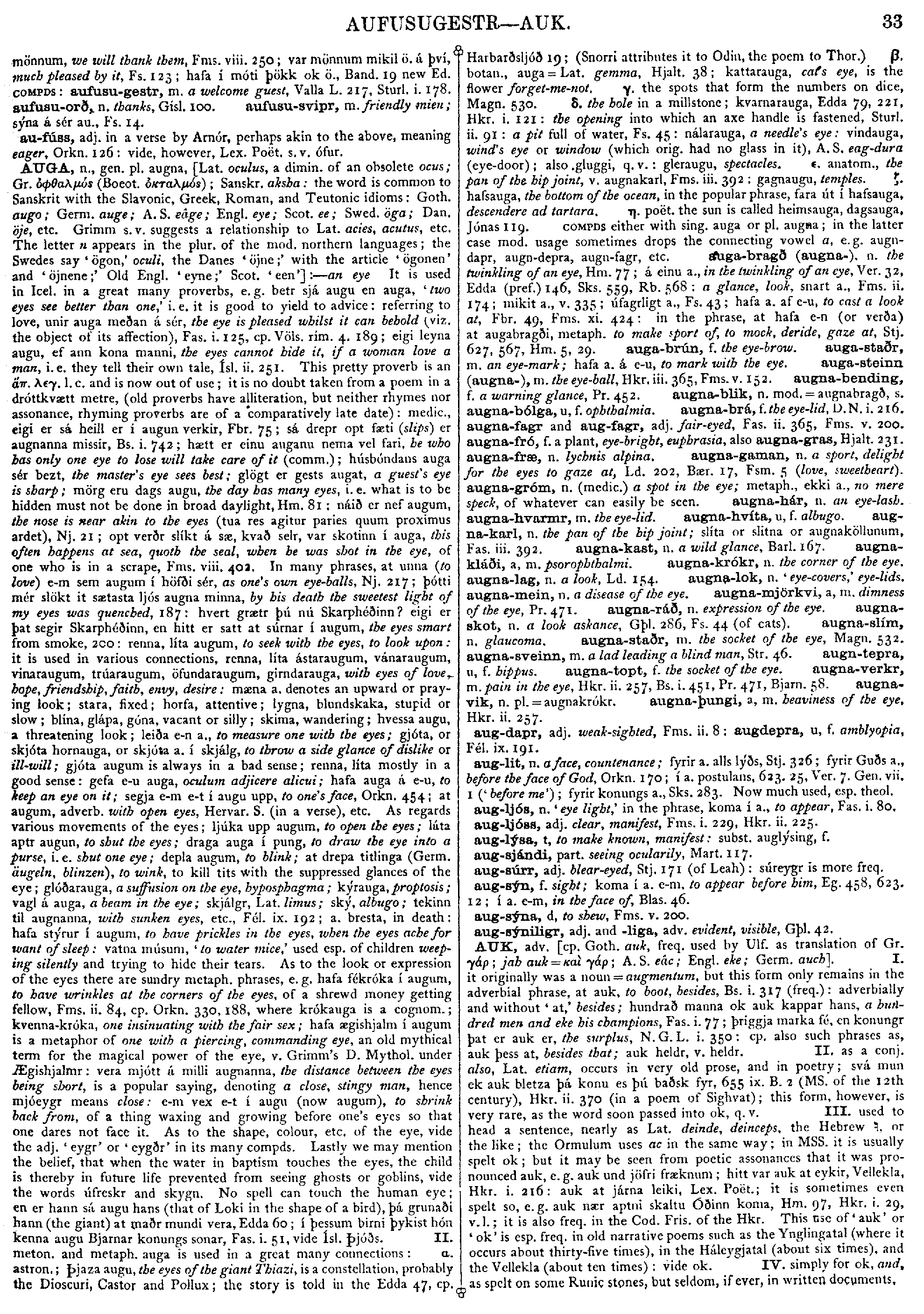
AUGA,
n.,
gen.
pl.
augna,
[Lat.
oculus,
a
dimin.
of
an
obsolete
ocus;
Gr.
GREEK
(Boeot.
GREEK);
Sanskr.
aksha:
the
word
is
common
to
Sanskrit
with
the
Slavonic,
Greek,
Roman,
and
Teutonic
idioms:
Goth.
augo;
Germ,
auge;
A.
S.
eâge;
Engl.
eye;
Scot.
ee;
Swed.
öga;
Dan.
öje,
etc.
Grimm
s.
v.
suggests
a
relationship
to
Lat.
acies,
acutus,
etc.
The
letter
n
appears
in
the
plur.
of
the
mod.
northern
languages;
the
Swedes
say
'ögon,'
oculi,
the
Danes
'öjne;'
with
the
article
'ögonen'
and
'öjnene;'
Old
Engl.
'eyne;'
Scot,
'een']
:--
an
eye
It
is
used
in
Icel.
in
a
great
many
proverbs,
e.
g.
betr
sjá
augu
en
auga,
'
two
eyes
see
better
than
one,'
i.
e.
it
is
good
to
yield
to
advice:
referring
to
love,
unir
auga
meðan
á
sér,
the
eye
is
pleased
whilst
it
can
behold
(viz.
the
object
of
its
affection),
Fas.
i.
125,
cp.
Völs.
rím.
4.
189;
eigi
leyna
augu,
ef
ann
kona
manni,
the
eyes
cannot
bide
it,
if
a
woman
love
a
man,
i.
e.
they
tell
their
own
tale,
Ísl.
ii.
251.
This
pretty
proverb
is
an
GREEK.
1.
c.
and
is
now
out
of
use;
it
is
no
doubt
taken
from
a
poem
in
a
dróttkvætt
metre,
(old
proverbs
have
alliteration,
but
neither
rhymes
nor
assonance,
rhyming
proverbs
are
of
a
comparatively
late
date):
medic.,
eigi
er
sá
heill
er
í
augun
verkir,
Fbr.
75;
sá
drepr
opt
fæti
(slips)
er
augnanna
missir,
Bs.
i.
742;
hætt
er
einu
auganu
nema
vel
fari,
he
who
has
only
one
eye
to
lose
will
take
care
of
it
(comm.);
húsbóndans
auga
sér
bezt,
the
master's
eye
sees
best;
glögt
er
gests
augat,
a
guest's
eye
is
sharp;
mörg
eru
dags
augu,
the
day
has
many
eyes,
i.
e.
what
is
to
be
hidden
must
not
be
done
in
broad
daylight,
Hm.
81;
náið
er
nef
augum,
the
nose
is
near
akin
to
the
eyes
(tua
res
agitur
paries
quum
proximus
ardet),
Nj.
21;
opt
verðr
slíkt
á
sæ,
kvað
selr,
var
skotinn
í
auga,
this
often
happens
at
sea,
quoth
the
seal,
when
he
was
shot
in
the
eye,
of
one
who
is
in
a
scrape,
Fms.
viii.
402.
In
many
phrases,
at
unna
(to
love)
e-m
sem
augum
í
höfði
sér,
as
one's
own
eye-balls,
Nj.
217;
þótti
mér
slökt
it
sætasta
ljós
augna
minna,
by
his
death
the
sweetest
light
of
my
eyes
was
quenched,
187:
hvert
grætr
þú
nú
Skarphéðinn?
eigi
er
þat
segir
Skarphéðinn,
en
hitt
er
satt
at
súrnar
í
augum,
the
eyes
smart
from
smoke,
200:
renna,
líta
augum,
to
seek
with
the
eyes,
to
look
upon:
it
is
used
in
various
connections,
renna,
líta
ástaraugum,
vánaraugum,
vinaraugum,
trúaraugum,
öfundaraugum,
girndarauga,
with
eyes
of
love,
hope,
friendship,
faith,
envy,
desire:
mæna
a.
denotes
an
upward
or
praying
look;
stara,
fixed;
horfa,
attentive;
lygna,
blundskaka,
stupid
or
slow;
blína,
glápa,
góna,
vacant
or
silly;
skima,
wandering;
hvessa
augu,
a
threatening
look;
leiða
e-n
a.,
to
measure
one
with
the
eyes;
gjóta,
or
skjóta
hornauga,
or
skjóta
a.
í
skjálg,
to
throw
a
side
glance
of
dislike
or
ill-will;
gjóta
augum
is
always
in
a
bad
sense;
renna,
líta
mostly
in
a
good
sense:
gefa
e-u
auga,
oculum
adjicere
alicui;
hafa
auga
á
e-u,
to
keep
an
eye
on
it;
segja
e-m
e-t
í
augu
upp,
to
one's
face,
Orkn.
454;
at
augum,
adverb.
with
open
eyes,
Hervar.
S.
(in
a
verse),
etc.
As
regards
various
movements
of
the
eyes;
ljúka
upp
augum,
to
open
the
eyes;
láta
aptr
augun,
to
shut
the
eyes;
draga
auga
í
pung,
to
draw
the
eye
into
a
purse,
i.
e.
shut
one
eye;
depla
augum,
to
blink;
at
drepa
titlinga
(Germ.
äugeln,
blinzen),
to
wink,
to
kill
tits
with
the
suppressed
glances
of
the
eye;
glóðarauga,
a
suffusion
on
the
eye,
hyposphagma;
kýrauga.
proptosis;
vagl
á
auga,
a
beam
in
the
eye;
skjálgr,
Lat.
limus;
ský,
albugo;
tekinn
til
augnanna,
with
sunken
eyes,
etc.,
Fél.
ix.
192;
a.
bresta,
in
death:
hafa
stýrur
í
augum,
to
have
prickles
in
the
eyes,
when
the
eyes
ache
for
want
of
sleep:
vatna
músum,
'to
water
mice,'
used
esp.
of
children
weep-
ing
silently
and
trying
to
hide
their
tears.
As
to
the
look
or
expression
of
the
eyes
there
are
sundry
metaph.
phrases,
e.
g.
hafa
fékróka
í
augum,
to
have
wrinkles
at
the
corners
of
the
eyes,
of
a
shrewd
money
getting
fellow,
Fms.
ii.
84,
cp.
Orkn.
330,
188,
where
krókauga
is
a
cognom.;
kvenna-króka,
one
insinuating
with
the
fair
sex;
hafa
ægishjalm
í
augum
is
a
metaphor
of
one
with
a
piercing,
commanding
eye,
an
old
mythical
term
for
the
magical
power
of
the
eye,
v.
Grimm's
D.
Mythol.
under
Ægishjalmr:
vera
mjótt
á
milli
augnanna,
the
distance
between
the
eyes
being
short,
is
a
popular
saying,
denoting
a
close,
stingy
man,
hence
mjóeygr
means
close:
e-m
vex
e-t
í
augu
(now
augum),
to
shrink
back
from,
of
a
thing
waxing
and
growing
before
one's
eyes
so
that
one
dares
not
face
it.
As
to
the
shape,
colour,
etc.
of
the
eye,
vide
the
adj.
'
eygr'
or
'
eygðr'
in
its
many
compds.
Lastly
we
may
mention
the
belief,
that
when
the
water
in
baptism
touches
the
eyes,
the
child
is
thereby
in
future
life
prevented
from
seeing
ghosts
or
goblins,
vide
the
words
úfreskr
and
skygn.
No
spell
can
touch
the
human
eye;
en
er
harm
sá
augu
hans
(that
of
Loki
in
the
shape
of
a
bird),
þá
grunaði
hann
(the
giant)
at
maðr
mundi
vera,
Edda
60;
í
bessum
birni
þykist
hón
kenna
augu
Bjarnar
konungs
sonar,
Fas.
i.
51,
vide
Ísl.
Þjóðs.
II.
meton.
and
metaph.
auga
is
used
in
a
great
many
connections:
 .
astron.;
þjaza
augu,
the
eyes
of
the
giant
Thiazi,
is
a
constellation,
probably
the
Dioscuri,
Castor
and
Pollux;
the
story
is
told
in
the
Edda
47,
cp.
Harbarðsljóð
19;
(Snorri
attributes
it
to
Odin,
the
poem
to
Thor.)
.
astron.;
þjaza
augu,
the
eyes
of
the
giant
Thiazi,
is
a
constellation,
probably
the
Dioscuri,
Castor
and
Pollux;
the
story
is
told
in
the
Edda
47,
cp.
Harbarðsljóð
19;
(Snorri
attributes
it
to
Odin,
the
poem
to
Thor.)
 .
botan.,
auga
=
Lat.
gemma,
Hjalt.
38;
kattarauga,
cat's
eye,
is
the
flower
forget-me-not.
.
botan.,
auga
=
Lat.
gemma,
Hjalt.
38;
kattarauga,
cat's
eye,
is
the
flower
forget-me-not.
 the
spots
that
form
the
numbers
on
dice,
Magn.
530.
the
spots
that
form
the
numbers
on
dice,
Magn.
530.
 .
the
hole
in
a
millstone;
kvarnarauga,
Edda
79,
221,
Hkr.
i.
121:
the
opening
into
which
an
axe
handle
is
fastened,
Sturl.
ii.
91:
a
pit
full
of
water,
Fs.
45:
nálarauga,
a
needle's
eye:
vindauga,
wind's
eye
or
window
(which
orig.
had
no
glass
in
it),
A.
S.
eag-dura
(eye-door);
also
gluggi,
q.
v.:
gleraugu,
spectacles.
.
the
hole
in
a
millstone;
kvarnarauga,
Edda
79,
221,
Hkr.
i.
121:
the
opening
into
which
an
axe
handle
is
fastened,
Sturl.
ii.
91:
a
pit
full
of
water,
Fs.
45:
nálarauga,
a
needle's
eye:
vindauga,
wind's
eye
or
window
(which
orig.
had
no
glass
in
it),
A.
S.
eag-dura
(eye-door);
also
gluggi,
q.
v.:
gleraugu,
spectacles.
 .
anatom.,
the
pan
of
the
hip
joint,
v.
augnakarl,
Fms.
iii.
392:
gagnaugu,
temples.
.
anatom.,
the
pan
of
the
hip
joint,
v.
augnakarl,
Fms.
iii.
392:
gagnaugu,
temples.
 .
hafsauga,
the
bottom
of
the
ocean,
in
the
popular
phrase,
fara
út
í
hafsauga,
descendere
ad
tartara.
.
hafsauga,
the
bottom
of
the
ocean,
in
the
popular
phrase,
fara
út
í
hafsauga,
descendere
ad
tartara.
 .
poët,
the
sun
is
called
heimsauga,
dagsauga,
Jónas
119.
COMPDS
either
with
sing.
auga
or
pl.
augna;
in
the
latter
case
mod.
usage
sometimes
drops
the
connecting
vowel
a,
e.
g.
augn-
dapr,
augn-depra,
augn-fagr,
etc.
auga-bragð
(augna-),
n.
the
twinkling
of
an
eye,
Hm.
77;
á
einu
a.,
in
the
twinkling
of
an
eye,
Ver.
32,
Edda
(pref.)
146,
Sks.
559,
Rb.
568:
a
glance,
look,
snart
a.,
Fms.
ii.
174;
mikit
a.,
v.
335;
úfagrligt
a.,
Fs.
43;
hafa
a.
af
e-u,
to
cast
a
look
at,
Fbr.
49,
Fms.
xi.
424:
in
the
phrase,
at
hafa
e-n
(or
verða)
at
augabragði,
metaph.
to
make
sport
of,
to
mock,
deride,
gaze
at,
Stj.
627,
567,
Hm.
5,
29.
auga-brun,
f.
the
eye-brow.
auga-staðr,
m.
an
eye-mark;
hafa
a.
á
e-u,
to
mark
with
the
eye.
auga-steinn
(augna-),
m.
the
eye-ball,
Hkr.
iii.
365,
Fms.
v.
152.
augna-bending,
f.
a
warning
glance,
Pr.
452.
augna-blik,
n.
mod.
=
augnabragð,
s.
augna-bólga,
u,
f.
ophthalmia.
augna-brá,
f.
the
eye-lid,
D.
N.
i.
216.
augna-fagr
and
aug-fagr,
adj.
fair-eyed,
Fas.
ii.
365,
Fms.
v.
200.
augna-fró,
f.
a
plant,
eye-bright,
euphrasia,
also
augna-gras,
Hjalt.
231.
augna-fræ,
n.
lychnis
alpina.
augna-gaman,
n.
a
sport,
delight
for
the
eyes
to
gaze
at,
Ld.
202,
Bær.
17,
Fsm.
5
(love,
sweetheart).
augna-gróm,
n.
(medic.)
a
spot
in
the
eye;
metaph.,
ekki
a.,
no
mere
speck,
of
whatever
can
easily
be
seen.
augna-hár,
n.
an
eye-lash.
augna-hvannr,
m.
the
eye-lid.
augna-hvita,
u,
f.
albugo.
augna-karl,
n.
the
pan
of
the
hip
joint;
slíta
or
slitna
or
augnaköllunum,
Fas.
iii.
392.
augna-kast,
n.
a
wild
glance,
Barl.
167.
augna-
kláði,
a,
m.
psorophthalmi.
augna-krókr,
n.
the
corner
of
the
eye.
augna-lag,
n.
a
look,
Ld.
154.
augna-lok,
n.
'eye-covers,'
eye-lids.
augna-mein,
n.
a
disease
of
the
eye.
augna-mjörkvi,
a,
m.
dimness
of
the
eye,
Pr.
471.
augna-ráð,
n.
expression
of
the
eye.
augna-
skot,
n.
a
look
askance,
Gþl.
286,
Fs.
44
(of
cats).
augna-slím,
n.
glaucoma.
augna-staðr,
m.
the
socket
of
the
eye,
Magn.
532.
augna-sveinn,
m.
a
lad
leading
a
blind
man,
Str.
46.
augn-tepra,
u,
f.
hippus.
augna-topt,
f.
the
socket
of
the
eye.
augna-verkr,
m.
pain
in
the
eye,
Hkr.
ii.
257,
Bs.
i.
451,
Pr.
471,
Bjarn.
58.
augna-
vik,
n.
pl.
=
augnakrókr.
augna-þungi,
a,
m.
heaviness
of
the
eye,
Hkr.
ii.
257.
.
poët,
the
sun
is
called
heimsauga,
dagsauga,
Jónas
119.
COMPDS
either
with
sing.
auga
or
pl.
augna;
in
the
latter
case
mod.
usage
sometimes
drops
the
connecting
vowel
a,
e.
g.
augn-
dapr,
augn-depra,
augn-fagr,
etc.
auga-bragð
(augna-),
n.
the
twinkling
of
an
eye,
Hm.
77;
á
einu
a.,
in
the
twinkling
of
an
eye,
Ver.
32,
Edda
(pref.)
146,
Sks.
559,
Rb.
568:
a
glance,
look,
snart
a.,
Fms.
ii.
174;
mikit
a.,
v.
335;
úfagrligt
a.,
Fs.
43;
hafa
a.
af
e-u,
to
cast
a
look
at,
Fbr.
49,
Fms.
xi.
424:
in
the
phrase,
at
hafa
e-n
(or
verða)
at
augabragði,
metaph.
to
make
sport
of,
to
mock,
deride,
gaze
at,
Stj.
627,
567,
Hm.
5,
29.
auga-brun,
f.
the
eye-brow.
auga-staðr,
m.
an
eye-mark;
hafa
a.
á
e-u,
to
mark
with
the
eye.
auga-steinn
(augna-),
m.
the
eye-ball,
Hkr.
iii.
365,
Fms.
v.
152.
augna-bending,
f.
a
warning
glance,
Pr.
452.
augna-blik,
n.
mod.
=
augnabragð,
s.
augna-bólga,
u,
f.
ophthalmia.
augna-brá,
f.
the
eye-lid,
D.
N.
i.
216.
augna-fagr
and
aug-fagr,
adj.
fair-eyed,
Fas.
ii.
365,
Fms.
v.
200.
augna-fró,
f.
a
plant,
eye-bright,
euphrasia,
also
augna-gras,
Hjalt.
231.
augna-fræ,
n.
lychnis
alpina.
augna-gaman,
n.
a
sport,
delight
for
the
eyes
to
gaze
at,
Ld.
202,
Bær.
17,
Fsm.
5
(love,
sweetheart).
augna-gróm,
n.
(medic.)
a
spot
in
the
eye;
metaph.,
ekki
a.,
no
mere
speck,
of
whatever
can
easily
be
seen.
augna-hár,
n.
an
eye-lash.
augna-hvannr,
m.
the
eye-lid.
augna-hvita,
u,
f.
albugo.
augna-karl,
n.
the
pan
of
the
hip
joint;
slíta
or
slitna
or
augnaköllunum,
Fas.
iii.
392.
augna-kast,
n.
a
wild
glance,
Barl.
167.
augna-
kláði,
a,
m.
psorophthalmi.
augna-krókr,
n.
the
corner
of
the
eye.
augna-lag,
n.
a
look,
Ld.
154.
augna-lok,
n.
'eye-covers,'
eye-lids.
augna-mein,
n.
a
disease
of
the
eye.
augna-mjörkvi,
a,
m.
dimness
of
the
eye,
Pr.
471.
augna-ráð,
n.
expression
of
the
eye.
augna-
skot,
n.
a
look
askance,
Gþl.
286,
Fs.
44
(of
cats).
augna-slím,
n.
glaucoma.
augna-staðr,
m.
the
socket
of
the
eye,
Magn.
532.
augna-sveinn,
m.
a
lad
leading
a
blind
man,
Str.
46.
augn-tepra,
u,
f.
hippus.
augna-topt,
f.
the
socket
of
the
eye.
augna-verkr,
m.
pain
in
the
eye,
Hkr.
ii.
257,
Bs.
i.
451,
Pr.
471,
Bjarn.
58.
augna-
vik,
n.
pl.
=
augnakrókr.
augna-þungi,
a,
m.
heaviness
of
the
eye,
Hkr.
ii.
257.
|
Source: Cleasby/Vigfusson, page b0131, entry 34 View original page image as: [TIFF] [PNG] [View previous entry] [View next entry] |
[Comment on this entry] [View comments] |
The following entry has been hand-corrected once. |
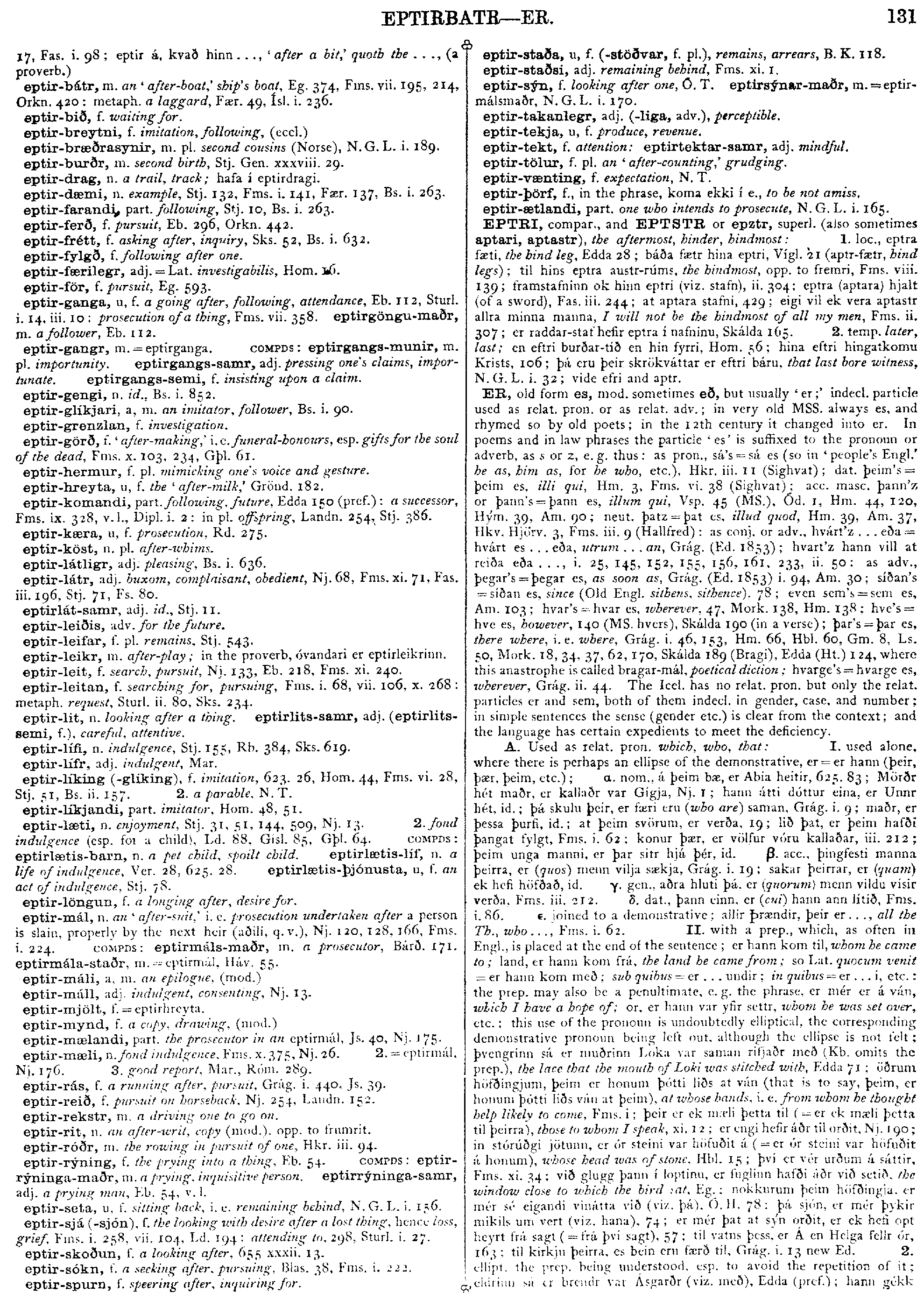
eptir-lit, n. looking after a thing. eptirlits-samr, adj. (eptirlits-semi, f.), careful, attentive.
|
Source: Cleasby/Vigfusson, page b0193, entry 33 View original page image as: [TIFF] [PNG] [View previous entry] [View next entry] |
[Comment on this entry] [View comments] |
The following entry has been hand-corrected once. |
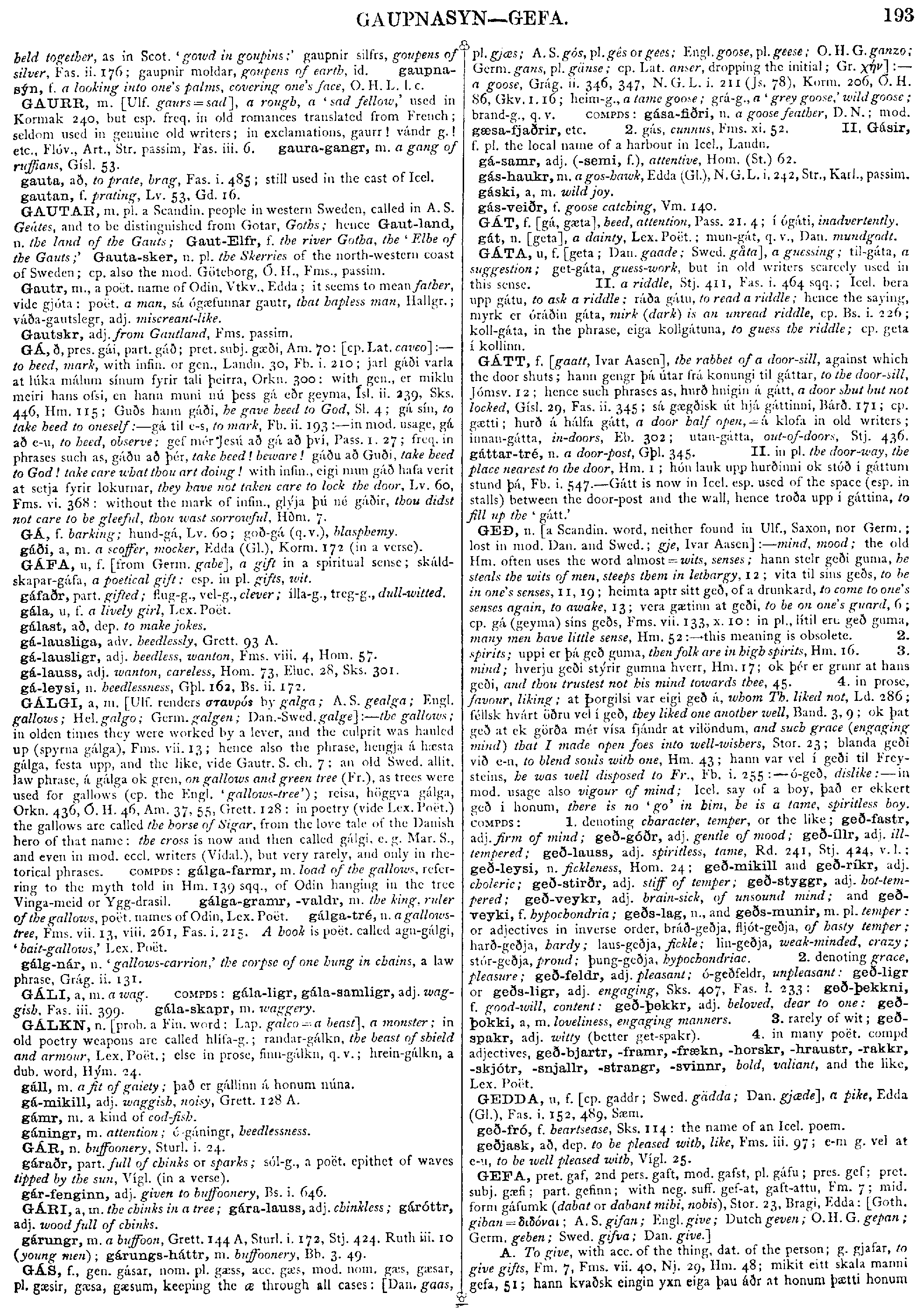
gá-samr, adj. (-semi, f.), attentive, Hom. (St.) 62.
|
Source: Cleasby/Vigfusson, page b0290, entry 20 View original page image as: [TIFF] [PNG] [View previous entry] [View next entry] |
[Comment on this entry] [View comments] |
The following entry has been hand-corrected once. |
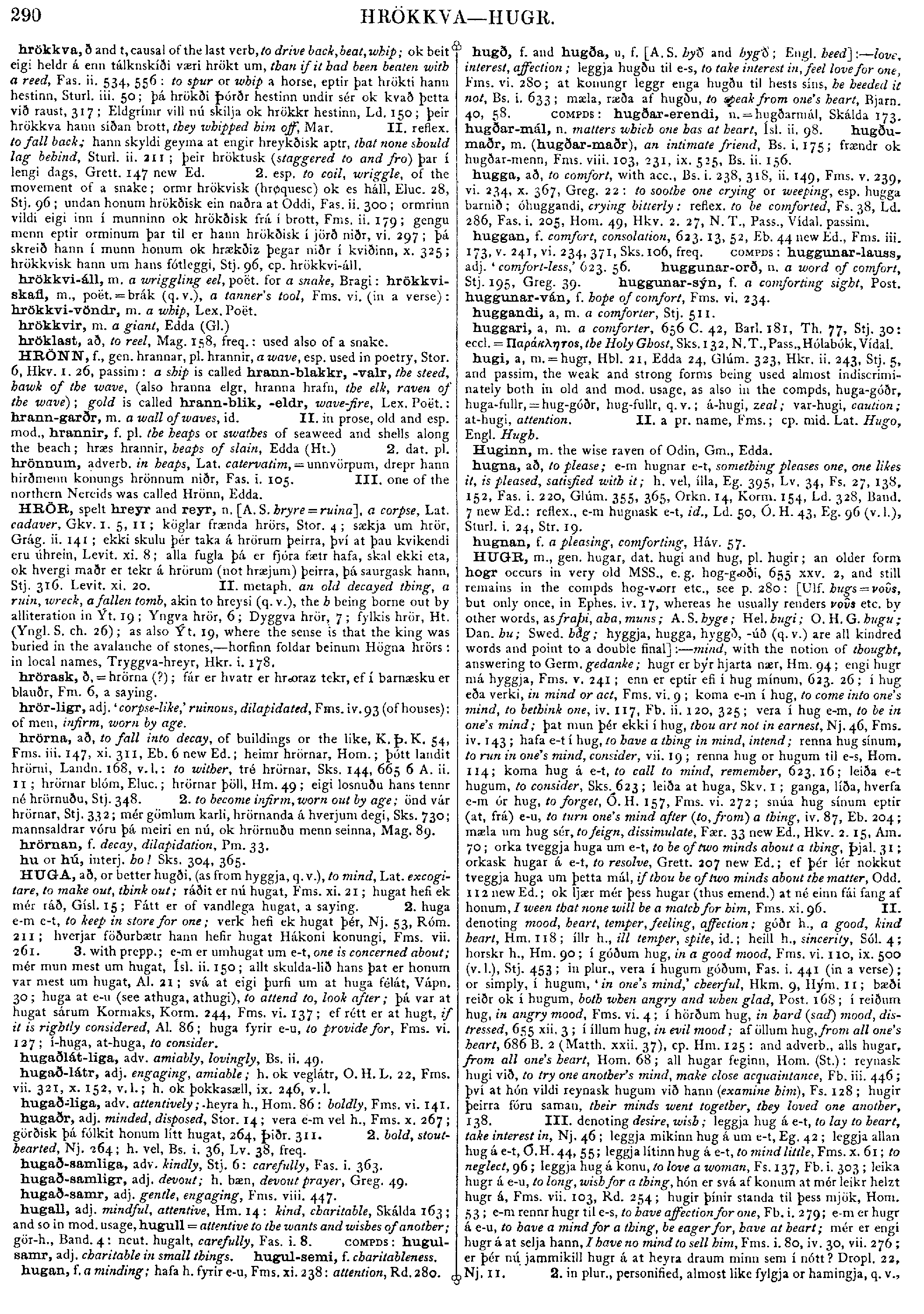
hugall, adj. mindful, attentive, Hm. 14: kind, charitable, Skálda 163; and so in mod. usage, hugull = attentive to the wants and wishes of another; gör-h., Band. 4: neut. hugalt, carefully, Fas. i. 8. COMPDS: hugul-samr, adj. charitable in small things. hugul-semi, f. charitableness.
|
Source: Cleasby/Vigfusson, page b0292, entry 3 View original page image as: [TIFF] [PNG] [View previous entry] [View next entry] |
[Comment on this entry] [View comments] |
The following entry has been hand-corrected once. |
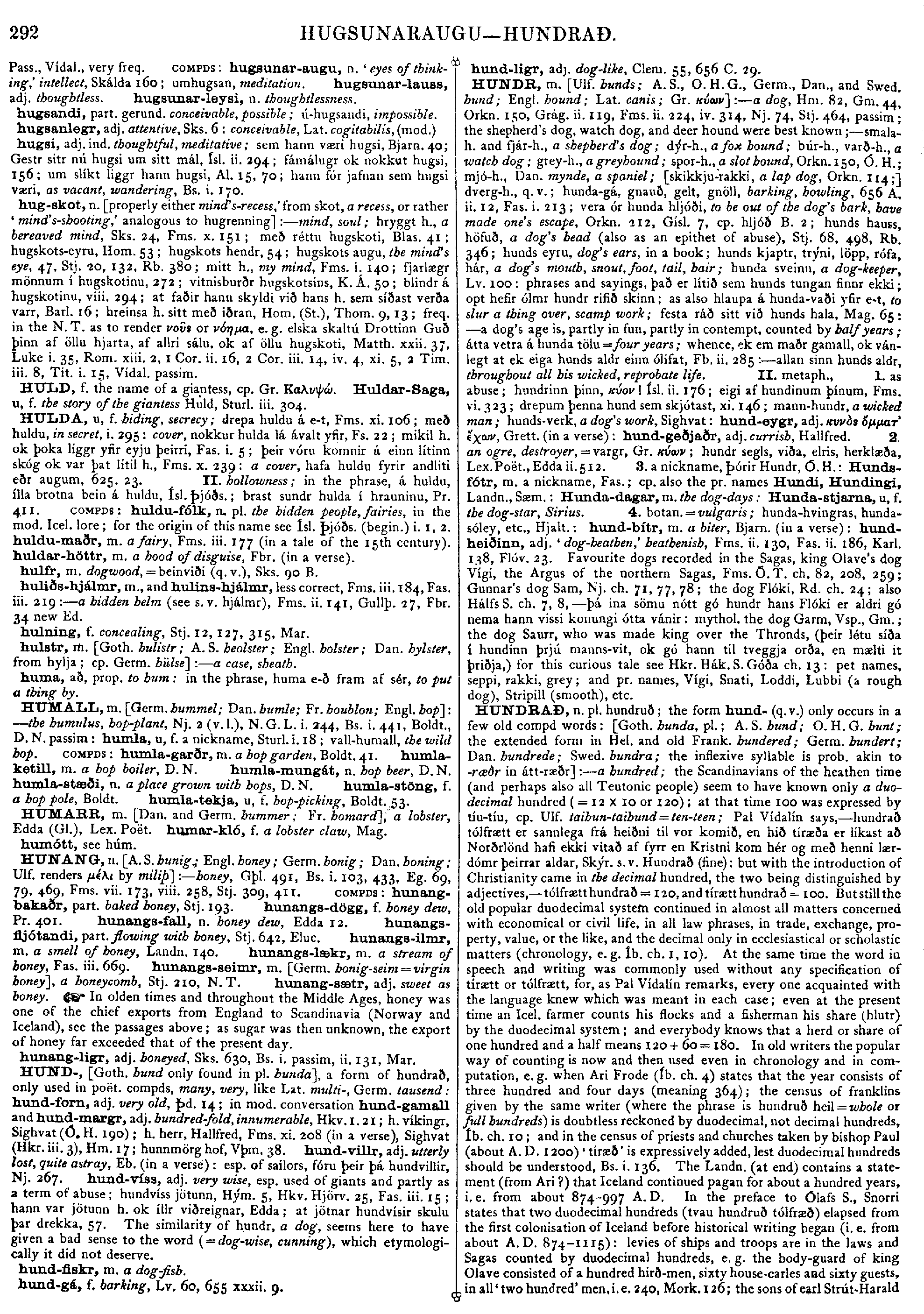
hugsanlegr, adj. attentive, Sks. 6: conceivable, Lat. cogitabilis, (mod.)
| Result Page: | 1 2 | Next |  |
Germanic Lexicon Project (main page)
This search system was written by
Sean Crist
Please consider
volunteering
to correct the data in these online dictionaries.
No rights reserved. Feel free to use these data in any way you please.