|
|

|
Source: Bosworth/Toller, page b0822, entry 4 View original page image as: [TIFF] [PNG] [View previous entry] [View next entry] |
[Comment on this entry] [View comments] |
The following entry has been hand-corrected once. |
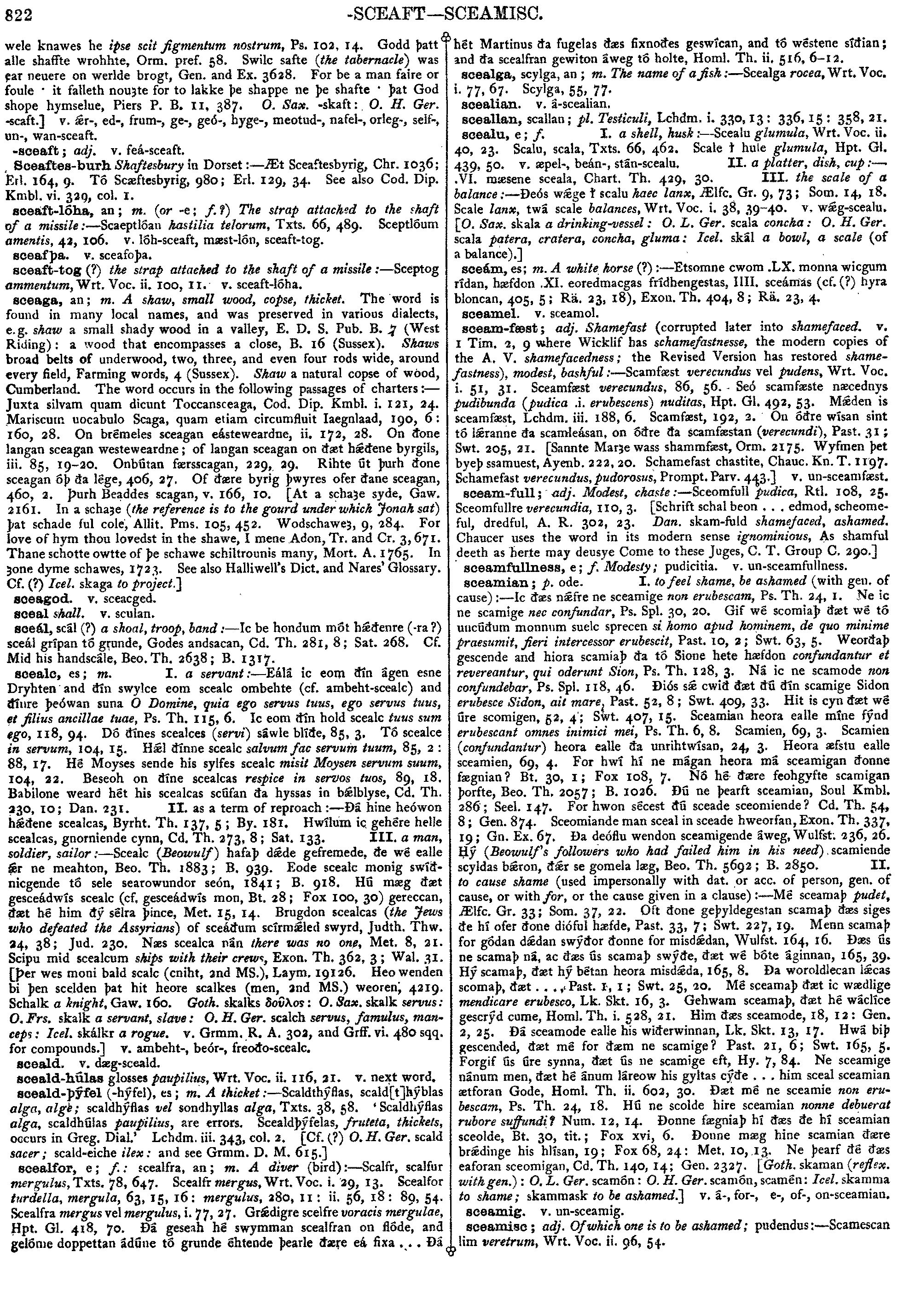
sceaft-lóha, an; m. (or -e; f.?) The strap attached to the shaft of a missile:--Scaeptlóan hastilia telorum, Txts. 66, 489. Sceptlóum amentis, 42, 106. v. lóh-sceaft, mæst-lón, sceaft-tog.
|
Source: Bosworth/Toller, page b0822, entry 6 View original page image as: [TIFF] [PNG] [View previous entry] [View next entry] |
[Comment on this entry] [View comments] |
The following entry has been hand-corrected once. |
sceaft-tog (?) the strap attached to the shaft of a missile:--Sceptog ammentum, Wrt. Voc. ii. 100, 11. v. sceaft-lóha.
|
Source: Bosworth/Toller, page b1044, entry 4 View original page image as: [TIFF] [PNG] [View previous entry] [View next entry] |
[Comment on this entry] [View comments] |
The following entry has been hand-corrected once. |
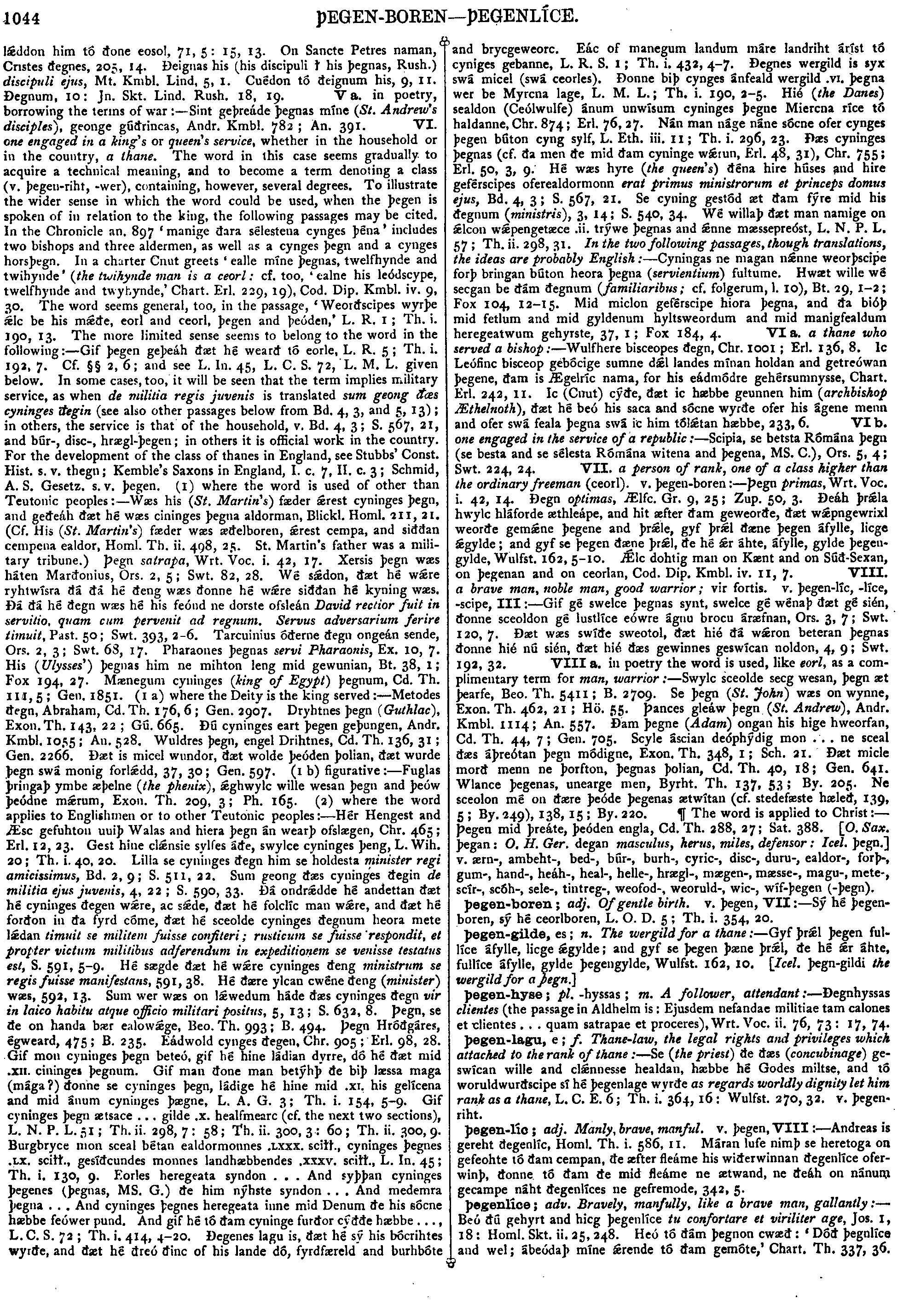
þegen-lagu,
e;
f.
Thane-law,
the
legal
rights
and
privileges
which
attached
to
the
rank
of
thane
:--
Se
(the
priest)
ðe
ðæs
(concubinage)
geswícan
wille
and
cl nnesse
healdan,
hæbbe
hé
Godes
miltse,
and
tó
woruldwurðscipe
sí
hé
þegenlage
wyrðe
as
regards
worldly
dignity
let
him
rank
as
a
thane,
L.
C.
E.
6;
Th.
i.
364,
16:
Wulfst.
270,
32.
v.
þegen-riht.
nnesse
healdan,
hæbbe
hé
Godes
miltse,
and
tó
woruldwurðscipe
sí
hé
þegenlage
wyrðe
as
regards
worldly
dignity
let
him
rank
as
a
thane,
L.
C.
E.
6;
Th.
i.
364,
16:
Wulfst.
270,
32.
v.
þegen-riht.
|
Source: Bosworth/Toller, page b1045, entry 2 View original page image as: [TIFF] [PNG] [View previous entry] [View next entry] |
[Comment on this entry] [View comments] |
The following entry has been hand-corrected once. |
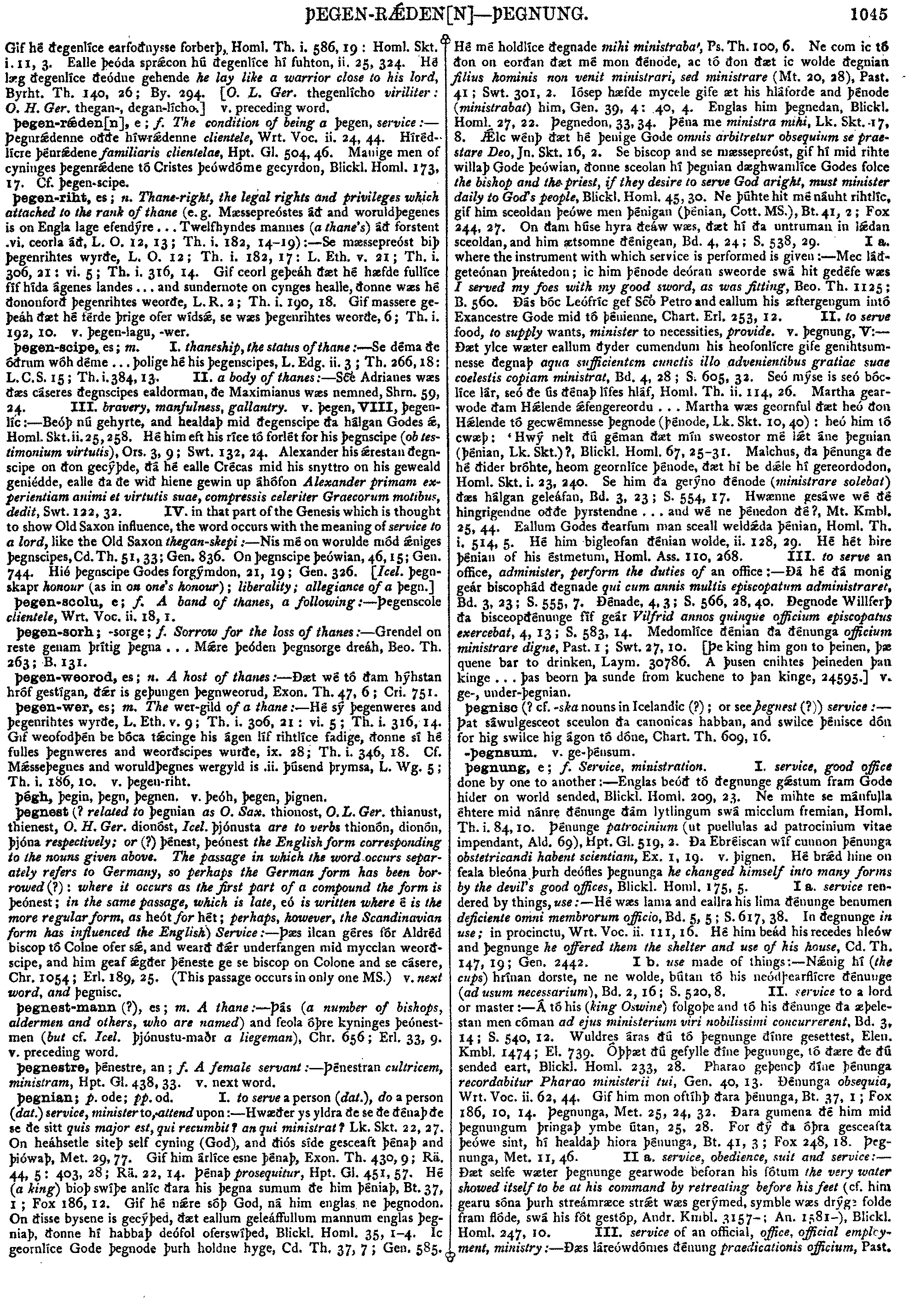
þegen-riht,
es;
n.
Thane-right,
the
legal
rights
and
privileges
which
attached
to
the
rank
of
thane
(e.
g.
Mæssepreóstes
áð
and
woruldþegenes
is
on
Engla
lage
efendýre
...
Twelfhyndes
mannes
(a
thane's)
áð
forstent
.vi.
ceorla
áð,
L.
O.
12,
13;
Th.
i.
182,
14-19)
:--
Se
mæssepreóst
biþ
þegenrihtes
wyrðe,
L.
O.
12;
Th.
i.
182,
17:
L.
Eth.
v.
21;
Th.
i.
306,
21:
vi.
5;
Th.
i.
316,
14.
Gif
ceorl
geþeáh
ðæt
hé
hæfde
fullíce
fíf
hída
ágenes
landes
...
and
sundernote
on
cynges
healle,
ðonne
wæs
hé
ðononforð
þegenrihtes
weorðe,
L.
R.
2;
Th.
i.
190,
18.
Gif
massere
geþeáh
ðæt
hé
férde
þrige
ofer
wíds,
se
wæs
þegenrihtes
weorðe,
6;
Th.
i.
192,
10.
v.
þegen-lagu,
-wer.
|
Source: Bosworth/Toller, page d0108, entry 14 View original page image as: [TIFF] [PNG] [View previous entry] [View next entry] |
[Comment on this entry] [View comments] |
The following entry has been hand-corrected once. |
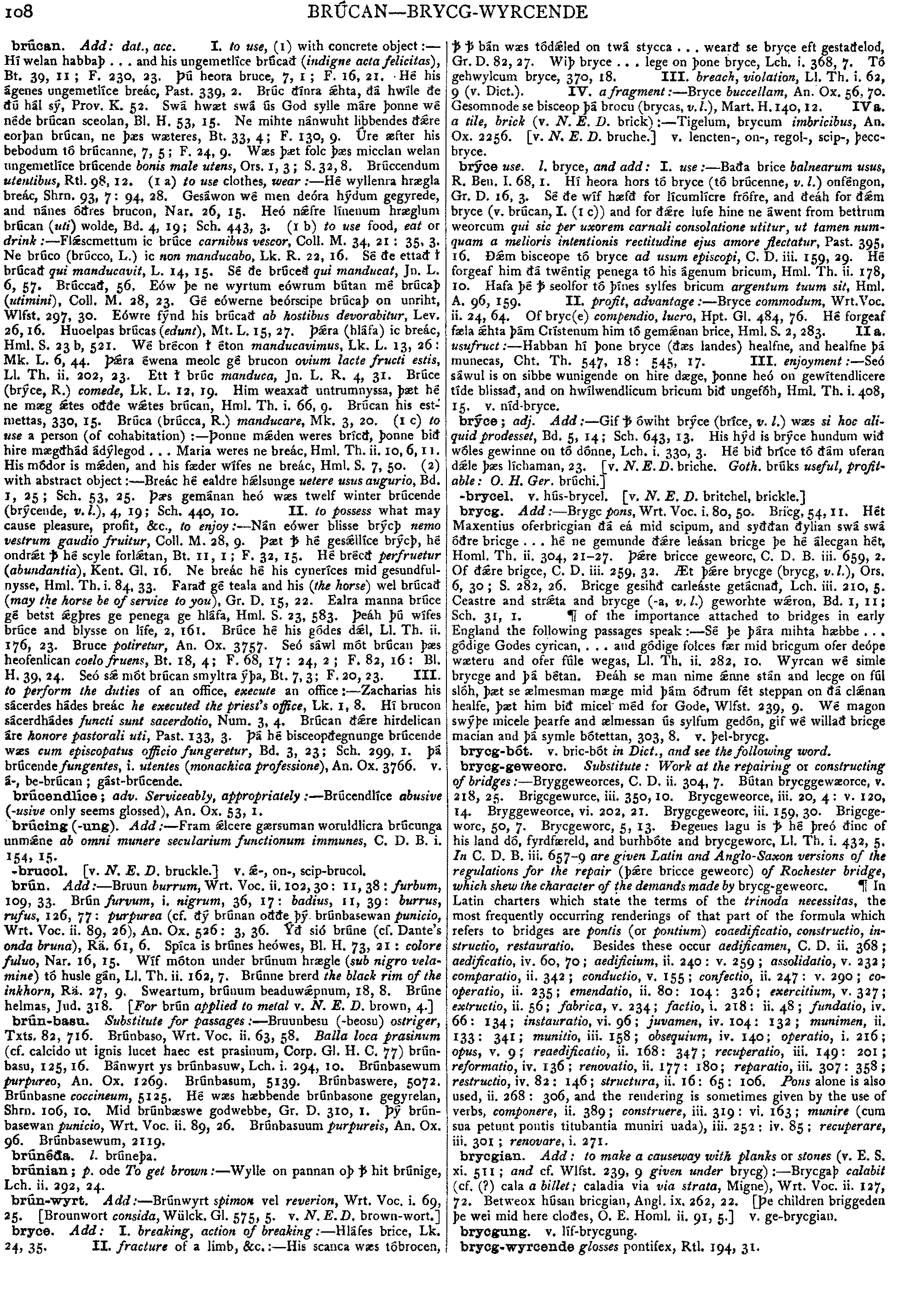
brycg.
Add
:--
Brygc
pons,
Wrt.
Voc.
i.
80,
50.
Brícg,
54,
11.
Hét
Maxentius
oferbricgian
ðá
eá
mid
scipum,
and
syððan
ðylian
swá
swá
óðre
bricge
.
.
.
hé
ne
gemunde
ðre
leásan
bricge
þe
hé
álecgan
hét,
Homl.
Th.
ii.
304,
21-27.
Þre
bricce
geweorc,
C.
D.
B.
iii.
659,
2.
Of
ðre
brigce,
C.
D.
iii.
259,
32.
Æt
þre
brycge
(brycg,
v.
l.),
Ors.
6,
30
;
S.
282,
26.
Bricge
gesihð
carleáste
getácnað,
Lch.
iii.
210,
5.
Ceastre
and
strta
and
brycge
(-a,
v.
l.)
geworhte
wron,
Bd.
1.
11;
Sch.
31,
1.
¶
of
the
importance
attached
to
bridges
in
early
England
the
following
passages
speak
:--
Sé
þe
þára
mihta
hæbbe
.
.
.
gódige
Godes
cyrican,
.
.
.
and
gódige
folces
fær
mid
bricgum
ofer
deópe
wæteru
and
ofer
fúle
wegas,
Ll.
Th.
ii.
282,
10.
Wyrcan
wé
simle
brycge
and
þá
bétan.
Ðeáh
se
man
nime
nne
stán
and
lecge
on
fúl
slóh,
þæt
se
ælmesman
mæge
mid
þám
óðrum
fét
steppan
on
ðá
clnan
healfe,
þæt
him
bið
micel
méd
for
Gode,
Wlfst.
239,
9.
Wé
magon
swýþe
micele
þearfe
and
ælmessan
ús
sylfum
gedón,
gif
wé
willað
bricge
macian
and
þá
symle
bótettan,
303,
8.
v.
þel-brycg.
|
Source: Bosworth/Toller, page d0200, entry 23 View original page image as: [TIFF] [PNG] [View previous entry] [View next entry] |
[Comment on this entry] [View comments] |
The following entry has been hand-corrected once. |
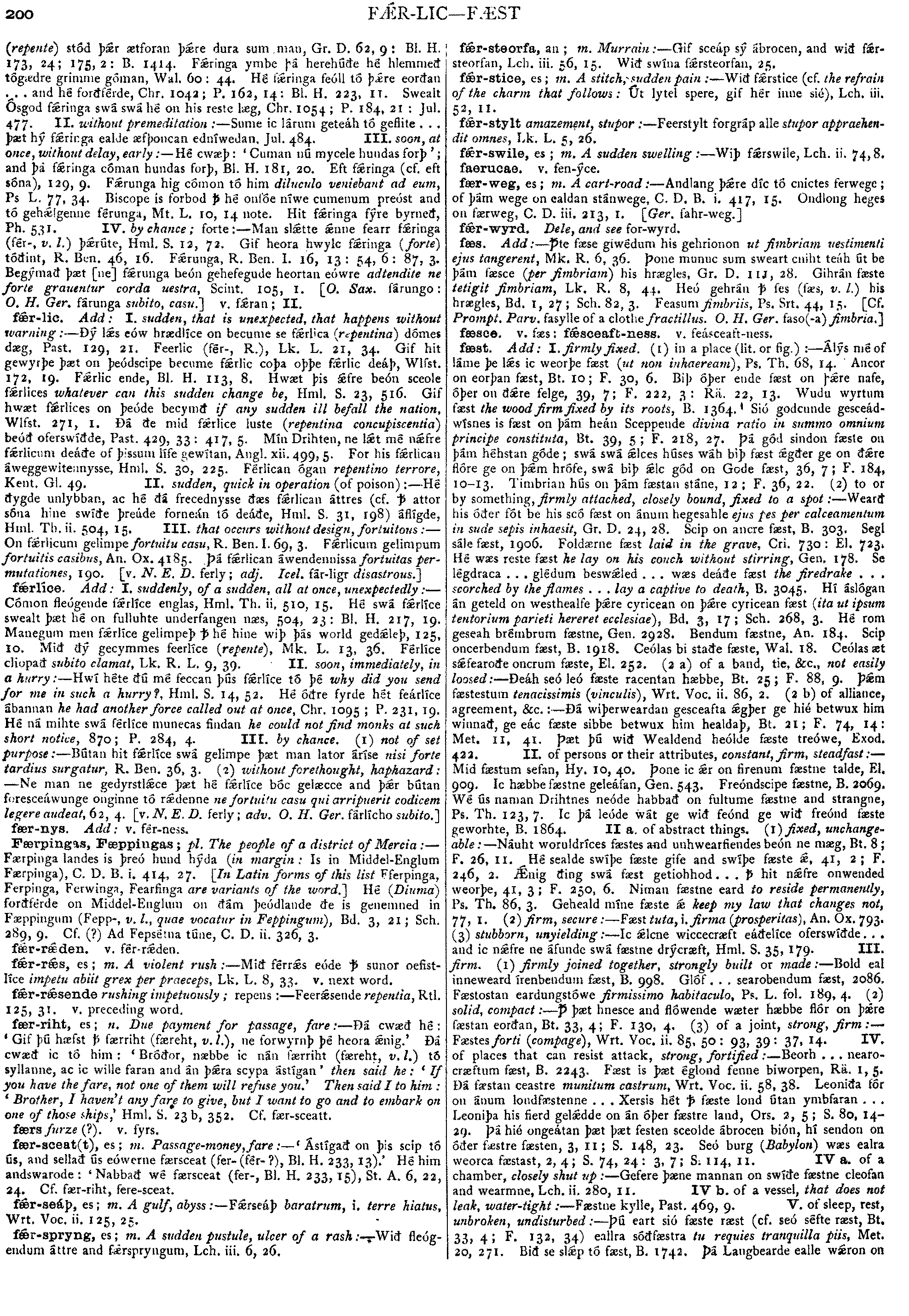
fæst.
Add:
I.
firmly
fixed.
(1)
in
a
place
(lit.
or
fig.)
:--
Álýs
mé
of
láme
þe
ls
ic
weorþe
fæst
(ut
non
inhaeream),
Ps.
Th.
68,
14.
Ancor
on
eorþan
fæst,
Bt.
10;
F.
30,
6.
Biþ
óþer
ende
fæst
on
þre
nafe,
óþer
on
ðre
felge,
39,
7;
F.
222,
3:
Rä.
22,
13.
Wudu
wyrtum
fæst
the
wood
firm
fixed
by
its
roots,
B.
1364.
ILLEGIBLE
Sió
godcunde
gesceádwísnes
is
fæst
on
þám
heán
Sceppende
divina
ratio
in
summo
omnium
principe
constituta,
Bt.
39,
5
;
F.
218,
27.
Þá
gód
sindon
fæste
on
þám
héhstan
góde;
swá
swá
lces
húses
wáh
biþ
fæst
gðer
ge
on
ðre
flóre
ge
on
þm
hrófe,
swá
biþ
lc
gód
on
Gode
fæst,
36,
7
;
F.
184,
10-13.
Timbrian
hús
on
þám
fæstan
stáne,
12
;
F.
36,
22.
(2)
to
or
by
something,
firmly
attached,
closely
bound,
fixed
to
a
spot:
--
Wearð
his
óðer
fót
be
his
scó
fæst
on
ánum
hegesahle
ejus
pes
per
calceamentum
in
sude
sepis
inhaesit,
Gr.
D.
24,
28.
Scip
on
ancre
fæst,
B.
303.
Segl
sále
fæst,
1906.
Foldærne
fæst
laid
in
the
grave,
Cri.
730:
El.
723.
Hé
wæs
reste
fæst
he
lay
on
his
couch
without
stirring,
Gen.
178.
Se
légdraca
.
.
.
glédum
beswled
.
.
.
wæs
deáðe
fæst
the
firedrake
.
.
.
scorched
by
the
flames
.
.
.
lay
a
captive
to
death,
B.
3045.
Hí
áslógan
án
geteld
on
westhealfe
þre
cyricean
on
þre
cyricean
fæst
(ita
ut
ipsum
tentorium
parieti
hereret
ecclesiae),
Bd.
3,
17;
Sch.
268,
3.
Hé
rom
geseah
brémbrum
fæstne,
Gen.
2928.
Bendum
fæstne,
An.
184.
Scip
oncerbendum
fæst,
B.
1918.
Ceólas
bi
staðe
fæste,
Wal.
18.
Ceólas
æt
sfearoðe
oncrum
fæste,
El.
252.
(2
a)
of
a
band,
tie,
&c.,
not
easily
loosed:
--
Ðeáh
seó
leó
fæste
racentan
hæbbe,
Bt.
25;
F.
88,
9.
Þm
fæstestum
tenacissimis
(vinculis),
Wrt.
Voc.
ii.
86,
2.
(2
b)
of
alliance,
agreement,
&c.
:--
Ðá
wiþerweardan
gesceafta
gþer
ge
hié
betwux
him
winnað,
ge
eác
fæste
sibbe
betwux
him
healdaþ,
Bt.
21;
F.
74,
14:
Met.
11,
41.
Þæt
þú
wið
Wealdend
heólde
fæste
treówe,
Exod.
422.
II.
of
persons
or
their
attributes,
constant,
firm,
steadfast
:--
Mid
fæstum
sefan,
Hy.
10,
40.
Þone
ic
r
on
firenum
fæstne
talde,
El.
909.
Ic
hæbbe
fæstne
geleáfan,
Gen.
543.
Freóndscipe
fæstne,
B.
2069.
Wé
ús
naman
Drihtnes
neóde
habbað
on
fultume
fæstne
and
strangne,
Ps.
Th.
123,
7.
Ic
þá
leóde
wát
ge
wið
feónd
ge
wið
freónd
fæste
geworhte,
B.
1864.
II
a.
of
abstract
things.
(1)
fixed,
unchangeable
:
--
Náuht
woruldríces
fæstes
and
unhwearfiendes
beón
ne
mæg,
Bt.
8
;
F.
26,
11.
Hé
sealde
swíþe
fæste
gife
and
swíþe
fæste
,
41,
2
;
F.
246,
2.
Æ-acute;nig
ðing
swá
fæst
getiohhod.
.
.
 hit
nfre
onwended
weorþe,
41,
3;
F.
250,
6.
Niman
fæstne
eard
to
reside
permanently,
Ps.
Th.
86,
3.
Geheald
míne
fæste
keep
my
law
that
changes
not,
77,
1.
(2)
firm,
secure
:--
Fæst
tuta,
i.
firma
(prosperitas),
An.
Ox.
793.
(3)
stubborn,
unyielding
:--
Ic
lcne
wiccecræft
eáðelíce
oferswíðde.
.
.
and
ic
nfre
ne
áfunde
swá
fæstne
drýcræft,
Hml.
S.
35,
179.
III.
firm.
(1)
firmly
joined
together,
strongly
built
or
made
:--
Bold
eal
inneweard
írenbendum
fæst,
B.
998.
Glóf.
.
.
searobendum
fæst,
2086.
Fæstostan
eardungstówe
firmissimo
habitaculo,
Ps.
L.
fol.
189,
4.
(2)
solid,
compact
:--
Þ-bar;
þæt
hnesce
and
flówende
wæter
hæbbe
flór
on
þre
fæstan
eorðan,
Bt.
33,
4;
F.
130,
4.
(3)
of
a
joint,
strong,
firm
:--
Fæstes
forti
(compage),
Wrt.
Voc.
ii.
85,
50:
93,
39:
37,
14.
IV.
of
places
that
can
resist
attack,
strong,
fortified
:--
Beorh
.
.
.
nearocræftum
fæst,
B.
2243.
Fæst
is
þæt
églond
fenne
biworpen,
Rä.
1,
5.
Ðá
fæstan
ceastre
munitum
castrum,
Wrt.
Voc.
ii.
58,
38.
Leoniða
fór
on
ánum
londfæstenne
.
.
.
Xersis
hét
fæste
lond
útan
ymbfaran
.
.
.
Leoniþa
his
fierd
geldde
on
án
óþer
fæstre
land,
Ors.
2,
5
;
S.
80,
14-29.
Þá
hié
ongeátan
þæt
þæt
festen
sceolde
ábrocen
bión,
hí
sendon
on
óðer
fæstre
fæsten,
3,
11;
S.
148,
23.
Seó
burg
(Babylon)
wæs
ealra
weorca
fæstast,
2,
4
;
S.
74,
24
:
3,
7
;
S;
114,
11.
IV
a.
of
a
chamber,
closely
shut
up
:--
Gefere
þæne
mannan
on
swíðe
fæstne
cleofan
and
wearmne,
Lch.
ii.
280,
11.
IV
b.
of
a
vessel,
that
does
not
leak,
water-tight
:--
Fæstne
kylle,
Past.
469,
9.
V.
of
sleep,
rest,
unbroken,
undisturbed
:--
Þú
eart
sió
fæste
ræst
(cf.
seó
séfte
ræst,
Bt.
33,
4;
F.
132,
34)
eallra
sóðfæstra
tu
requies
tranquilla
piis,
Met.
20,
271.
Bið
se
slp
tó
fæst,
B.
1742.
Þá
Langbearde
ealle
wæ-acute;ron
on
hit
nfre
onwended
weorþe,
41,
3;
F.
250,
6.
Niman
fæstne
eard
to
reside
permanently,
Ps.
Th.
86,
3.
Geheald
míne
fæste
keep
my
law
that
changes
not,
77,
1.
(2)
firm,
secure
:--
Fæst
tuta,
i.
firma
(prosperitas),
An.
Ox.
793.
(3)
stubborn,
unyielding
:--
Ic
lcne
wiccecræft
eáðelíce
oferswíðde.
.
.
and
ic
nfre
ne
áfunde
swá
fæstne
drýcræft,
Hml.
S.
35,
179.
III.
firm.
(1)
firmly
joined
together,
strongly
built
or
made
:--
Bold
eal
inneweard
írenbendum
fæst,
B.
998.
Glóf.
.
.
searobendum
fæst,
2086.
Fæstostan
eardungstówe
firmissimo
habitaculo,
Ps.
L.
fol.
189,
4.
(2)
solid,
compact
:--
Þ-bar;
þæt
hnesce
and
flówende
wæter
hæbbe
flór
on
þre
fæstan
eorðan,
Bt.
33,
4;
F.
130,
4.
(3)
of
a
joint,
strong,
firm
:--
Fæstes
forti
(compage),
Wrt.
Voc.
ii.
85,
50:
93,
39:
37,
14.
IV.
of
places
that
can
resist
attack,
strong,
fortified
:--
Beorh
.
.
.
nearocræftum
fæst,
B.
2243.
Fæst
is
þæt
églond
fenne
biworpen,
Rä.
1,
5.
Ðá
fæstan
ceastre
munitum
castrum,
Wrt.
Voc.
ii.
58,
38.
Leoniða
fór
on
ánum
londfæstenne
.
.
.
Xersis
hét
fæste
lond
útan
ymbfaran
.
.
.
Leoniþa
his
fierd
geldde
on
án
óþer
fæstre
land,
Ors.
2,
5
;
S.
80,
14-29.
Þá
hié
ongeátan
þæt
þæt
festen
sceolde
ábrocen
bión,
hí
sendon
on
óðer
fæstre
fæsten,
3,
11;
S.
148,
23.
Seó
burg
(Babylon)
wæs
ealra
weorca
fæstast,
2,
4
;
S.
74,
24
:
3,
7
;
S;
114,
11.
IV
a.
of
a
chamber,
closely
shut
up
:--
Gefere
þæne
mannan
on
swíðe
fæstne
cleofan
and
wearmne,
Lch.
ii.
280,
11.
IV
b.
of
a
vessel,
that
does
not
leak,
water-tight
:--
Fæstne
kylle,
Past.
469,
9.
V.
of
sleep,
rest,
unbroken,
undisturbed
:--
Þú
eart
sió
fæste
ræst
(cf.
seó
séfte
ræst,
Bt.
33,
4;
F.
132,
34)
eallra
sóðfæstra
tu
requies
tranquilla
piis,
Met.
20,
271.
Bið
se
slp
tó
fæst,
B.
1742.
Þá
Langbearde
ealle
wæ-acute;ron
on
|
Source: Bosworth/Toller, page d0274, entry 13 View original page image as: [TIFF] [PNG] [View previous entry] [View next entry] |
[Comment on this entry] [View comments] |
The following entry has been hand-corrected once. |
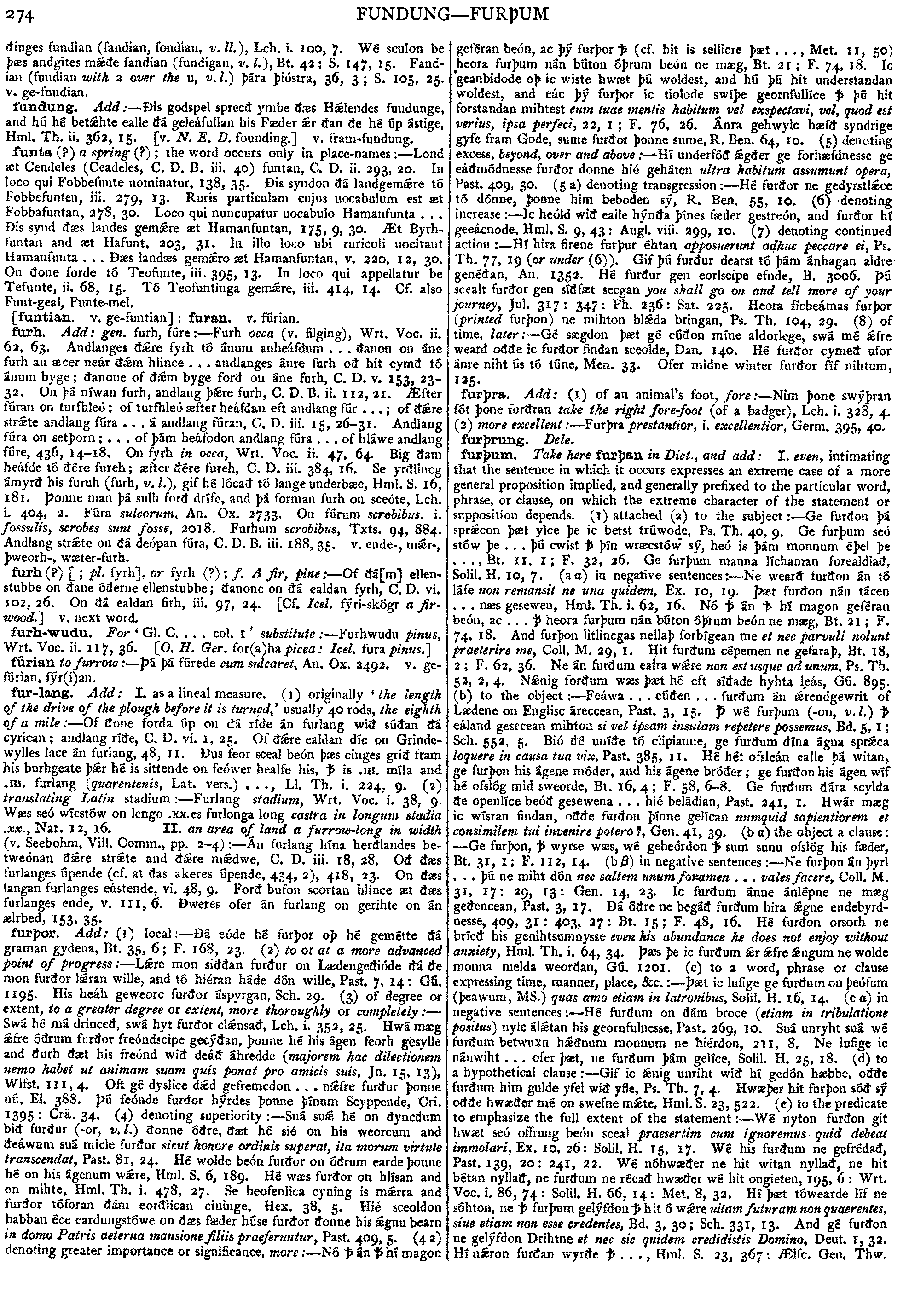
furþum.
Take
here
furþan
in
Dict.,
and
add:
I.
even,
intimating
that
the
sentence
in
which
it
occurs
expresses
an
extreme
case
of
a
more
general
proposition
implied,
and
generally
prefixed
to
the
particular
word,
phrase,
or
clause,
on
which
the
extreme
character
of
the
statement
or
supposition
depends.
(1)
attached
(a)
to
the
subject:--Ge
furðon
þá
sprcon
þæt
ylce
þe
ic
betst
trúwode,
Ps.
Th.
40,
9.
Ge
furþum
seó
stów
þe
.
.
.
þú
cwist
þín
wræcstów
sý,
heó
is
þám
monnum
éþel
þe
.
.
.,
Bt.
11,
1;
F.
32,
26.
Ge
furþum
manna
líchaman
forealdiað,
Solil.
H.
10,
7.
(a
 )
in
negative
sentences:--Ne
wearð
furðon
án
tó
láfe
non
remansit
ne
una
quidem,
Ex.
10,
19.
Þæt
furðon
nán
tácen
.
.
.
næs
gesewen,
Hml.
Th.
i.
62,
16.
Nó
án
hí
magon
geféran
beón,
ac
.
.
.
heora
furþum
nán
búton
óþrum
beón
ne
mæg,
Bt.
21;
F.
74,
18.
And
furþon
litlincgas
nellaþ
forbígean
me
et
nec
parvuli
nolunt
praeterire
me,
Coll.
M.
29,
1.
Hit
furðum
cépemen
ne
gefaraþ,
Bt.
18,
2;
F.
62,
36.
Ne
án
furðum
ealra
wre
non
est
usque
ad
unum,
Ps.
Th.
52,
2,
4.
Nnig
forðum
wæs
þæt
hé
eft
síðade
hyhta
leás,
Gú.
895.
(b)
to
the
object:--Feáwa
.
.
.
cúðen
.
.
.
furðum
án
rendgewrit
of
Lædene
on
Englisc
áreccean,
Past.
3,
15.
Þ-bar;
wé
furþum
(-on,
v.
l.)
eáland
gesecean
mihton
si
vel
ipsam
insulam
repetere
possemus,
Bd.
5,
1;
Sch.
552,
5.
Bió
ðé
uníðe
tó
clipianne,
ge
furðum
ðína
ágna
sprca
loquere
in
causa
tua
vix,
Past.
385,
11.
Hé
hét
ofsleán
ealle
þá
witan,
ge
furþon
his
ágene
móder,
and
his
ágene
bróðer;
ge
furðon
his
ágen
wíf
hé
ofslóg
mid
sweorde,
Bt.
16,
4;
F.
58,
6-8.
Ge
furðum
ðára
scylda
ðe
openlíce
beóð
gesewena
.
.
.
hié
beládian,
Past.
241,
1.
Hwár
mæg
ic
wísran
findan,
oððe
furðon
þínne
gelícan
numquid
sapientiorem
et
consimilem
tui
invenire
potero?,
Gen.
41,
39.
(b
)
the
object
a
clause:--Ge
furþon,
wyrse
wæs,
wé
geheórdon
sum
sunu
ofslóg
his
fæder,
Bt.
31,
1;
F.
112,
14.
(b
)
in
negative
sentences:--Ne
wearð
furðon
án
tó
láfe
non
remansit
ne
una
quidem,
Ex.
10,
19.
Þæt
furðon
nán
tácen
.
.
.
næs
gesewen,
Hml.
Th.
i.
62,
16.
Nó
án
hí
magon
geféran
beón,
ac
.
.
.
heora
furþum
nán
búton
óþrum
beón
ne
mæg,
Bt.
21;
F.
74,
18.
And
furþon
litlincgas
nellaþ
forbígean
me
et
nec
parvuli
nolunt
praeterire
me,
Coll.
M.
29,
1.
Hit
furðum
cépemen
ne
gefaraþ,
Bt.
18,
2;
F.
62,
36.
Ne
án
furðum
ealra
wre
non
est
usque
ad
unum,
Ps.
Th.
52,
2,
4.
Nnig
forðum
wæs
þæt
hé
eft
síðade
hyhta
leás,
Gú.
895.
(b)
to
the
object:--Feáwa
.
.
.
cúðen
.
.
.
furðum
án
rendgewrit
of
Lædene
on
Englisc
áreccean,
Past.
3,
15.
Þ-bar;
wé
furþum
(-on,
v.
l.)
eáland
gesecean
mihton
si
vel
ipsam
insulam
repetere
possemus,
Bd.
5,
1;
Sch.
552,
5.
Bió
ðé
uníðe
tó
clipianne,
ge
furðum
ðína
ágna
sprca
loquere
in
causa
tua
vix,
Past.
385,
11.
Hé
hét
ofsleán
ealle
þá
witan,
ge
furþon
his
ágene
móder,
and
his
ágene
bróðer;
ge
furðon
his
ágen
wíf
hé
ofslóg
mid
sweorde,
Bt.
16,
4;
F.
58,
6-8.
Ge
furðum
ðára
scylda
ðe
openlíce
beóð
gesewena
.
.
.
hié
beládian,
Past.
241,
1.
Hwár
mæg
ic
wísran
findan,
oððe
furðon
þínne
gelícan
numquid
sapientiorem
et
consimilem
tui
invenire
potero?,
Gen.
41,
39.
(b
)
the
object
a
clause:--Ge
furþon,
wyrse
wæs,
wé
geheórdon
sum
sunu
ofslóg
his
fæder,
Bt.
31,
1;
F.
112,
14.
(b
 )
in
negative
sentences:--Ne
furþon
án
þyrl
.
.
.
þú
ne
miht
dón
nec
saltem
unum
foramen
.
.
.
vales
facere,
Coll.
M.
31,
17:
29,
13:
Gen.
14,
23.
Ic
furðum
ánne
ánlépne
ne
mæg
geðencean,
Past.
3,
17.
Ðá
óðre
ne
begáð
furðum
hira
gne
endebyrdnesse,
409,
31:
403,
27:
Bt.
15;
F.
48,
16.
Hé
furðon
orsorh
ne
brícð
his
genihtsumnysse
even
his
abundance
he
does
not
enjoy
without
anxiety,
Hml.
Th.
i.
64,
34.
Þæs
þe
ic
furðum
r
fre
ngum
ne
wolde
monna
melda
weorðan,
Gú.
1201.
(c)
to
a
word,
phrase
or
clause
expressing
time,
manner,
place,
&c.:--Þæt
ic
lufige
ge
furðum
on
þeófum
(þeawum,
MS.)
quas
amo
etiam
in
latronibus,
Solil.
H.
16,
14.
(c
)
in
negative
sentences:--Hé
furðum
on
ðám
broce
(etiam
in
tribulatione
positus)
nyle
áltan
his
geornfulnesse,
Past.
269,
10.
Suá
unryht
suá
wé
furðum
betwuxn
hæðnum
monnum
ne
hiérdon,
211,
8.
Ne
lufige
ic
nánwiht
.
.
.
ofer
þæt,
ne
furðum
þám
gelíce,
Solil.
H.
25,
18.
(d)
to
a
hypothetical
clause:--Gif
ic
nig
unriht
wið
hí
gedón
hæbbe,
oððe
furðum
him
gulde
yfel
wið
yfle,
Ps.
Th.
7,
4.
Hwæþer
hit
furþon
sóð
sý
oððe
hwæðer
mé
on
swefne
mte,
Hml.
S.
23,
522.
(e)
to
the
predicate
to
emphasize
the
full
extent
of
the
statement:--Wé
nyton
furðon
git
hwæt
seó
offrung
beón
sceal
praesertim
cum
ignoremus
quid
debeat
immolari,
Ex.
10,
26:
Solil.
H.
15,
17.
Wé
his
furðum
ne
gefrédað,
Past.
139,
20:
241,
22.
Wé
nóhwæðer
ne
hit
witan
nyllað,
ne
hit
bétan
nyllað,
ne
furðum
ne
récað
hwæðer
wé
hit
ongieten,
195,
6:
Wrt.
Voc.
i.
86,
74:
Solil.
H.
66,
14:
Met.
8,
32.
Hí
þæt
tówearde
líf
ne
sóhton,
ne
furþum
gelýfdon
hit
ó
wre
uitam
futuram
non
quaereates,
siue
etiam
non
esse
credentes,
Bd.
3,
30;
Sch.
331,
13.
And
gé
furðon
ne
gelýfdon
Drihtne
et
nec
sic
quidem
credidistis
Domino,
Deut.
1,
32.
Hí
nron
furðan
wyrðe
.
.
.,
Hml.
S.
23,
367:
Ælfc.
Gen.
Thw.
)
in
negative
sentences:--Ne
furþon
án
þyrl
.
.
.
þú
ne
miht
dón
nec
saltem
unum
foramen
.
.
.
vales
facere,
Coll.
M.
31,
17:
29,
13:
Gen.
14,
23.
Ic
furðum
ánne
ánlépne
ne
mæg
geðencean,
Past.
3,
17.
Ðá
óðre
ne
begáð
furðum
hira
gne
endebyrdnesse,
409,
31:
403,
27:
Bt.
15;
F.
48,
16.
Hé
furðon
orsorh
ne
brícð
his
genihtsumnysse
even
his
abundance
he
does
not
enjoy
without
anxiety,
Hml.
Th.
i.
64,
34.
Þæs
þe
ic
furðum
r
fre
ngum
ne
wolde
monna
melda
weorðan,
Gú.
1201.
(c)
to
a
word,
phrase
or
clause
expressing
time,
manner,
place,
&c.:--Þæt
ic
lufige
ge
furðum
on
þeófum
(þeawum,
MS.)
quas
amo
etiam
in
latronibus,
Solil.
H.
16,
14.
(c
)
in
negative
sentences:--Hé
furðum
on
ðám
broce
(etiam
in
tribulatione
positus)
nyle
áltan
his
geornfulnesse,
Past.
269,
10.
Suá
unryht
suá
wé
furðum
betwuxn
hæðnum
monnum
ne
hiérdon,
211,
8.
Ne
lufige
ic
nánwiht
.
.
.
ofer
þæt,
ne
furðum
þám
gelíce,
Solil.
H.
25,
18.
(d)
to
a
hypothetical
clause:--Gif
ic
nig
unriht
wið
hí
gedón
hæbbe,
oððe
furðum
him
gulde
yfel
wið
yfle,
Ps.
Th.
7,
4.
Hwæþer
hit
furþon
sóð
sý
oððe
hwæðer
mé
on
swefne
mte,
Hml.
S.
23,
522.
(e)
to
the
predicate
to
emphasize
the
full
extent
of
the
statement:--Wé
nyton
furðon
git
hwæt
seó
offrung
beón
sceal
praesertim
cum
ignoremus
quid
debeat
immolari,
Ex.
10,
26:
Solil.
H.
15,
17.
Wé
his
furðum
ne
gefrédað,
Past.
139,
20:
241,
22.
Wé
nóhwæðer
ne
hit
witan
nyllað,
ne
hit
bétan
nyllað,
ne
furðum
ne
récað
hwæðer
wé
hit
ongieten,
195,
6:
Wrt.
Voc.
i.
86,
74:
Solil.
H.
66,
14:
Met.
8,
32.
Hí
þæt
tówearde
líf
ne
sóhton,
ne
furþum
gelýfdon
hit
ó
wre
uitam
futuram
non
quaereates,
siue
etiam
non
esse
credentes,
Bd.
3,
30;
Sch.
331,
13.
And
gé
furðon
ne
gelýfdon
Drihtne
et
nec
sic
quidem
credidistis
Domino,
Deut.
1,
32.
Hí
nron
furðan
wyrðe
.
.
.,
Hml.
S.
23,
367:
Ælfc.
Gen.
Thw.
|
Source: Bosworth/Toller, page d0378, entry 6 View original page image as: [TIFF] [PNG] [View previous entry] [View next entry] |
[Comment on this entry] [View comments] |
The following entry has been hand-corrected once. |
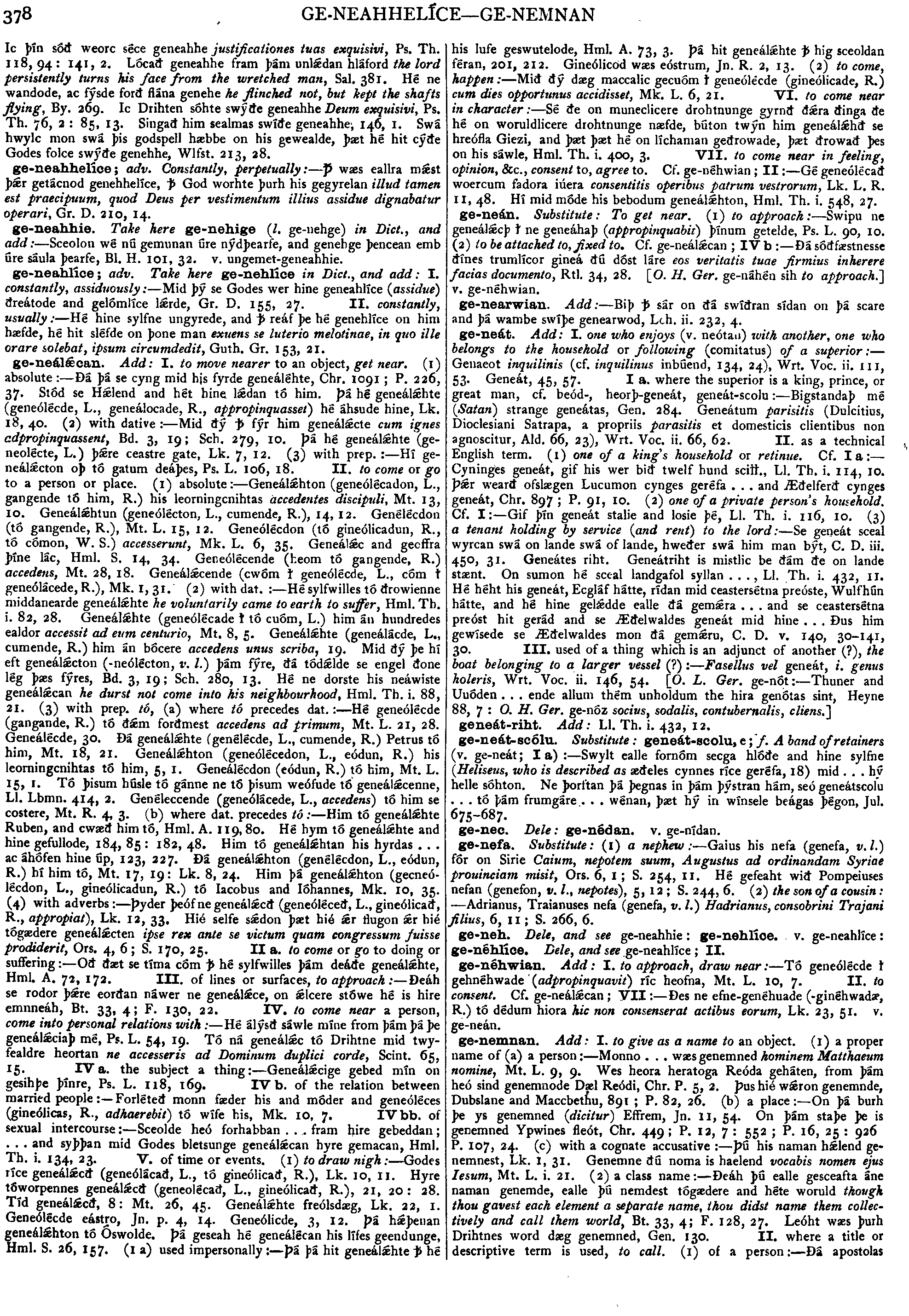
ge-neán.
Substitute:
To
get
near,
(i)
to
approach
:--
Swipu
ne
geneálcþ
 ne
geneáhaþ
(appropinquabit)
þínum
getelde.
Ps.
L.
90,
lo.
(2)
to
be
attached
to,
fixed
to.
Cf.
ge-neálcan
;
IV
b
:--
Ðá
sóðfæstnesse
ðínes
trumlícor
gineá
ðú
dóst
láre
eos
veritatis
tuae
firmius
inherere
facias
documento,
Rtl.
34,
28.
[O.
H.
Ger.
ge-náhén
sih
to
approach.]
v.
ge-néhwian.
ne
geneáhaþ
(appropinquabit)
þínum
getelde.
Ps.
L.
90,
lo.
(2)
to
be
attached
to,
fixed
to.
Cf.
ge-neálcan
;
IV
b
:--
Ðá
sóðfæstnesse
ðínes
trumlícor
gineá
ðú
dóst
láre
eos
veritatis
tuae
firmius
inherere
facias
documento,
Rtl.
34,
28.
[O.
H.
Ger.
ge-náhén
sih
to
approach.]
v.
ge-néhwian.
|
Source: Bosworth/Toller, page d0508, entry 36 View original page image as: [TIFF] [PNG] [View previous entry] [View next entry] |
[Comment on this entry] [View comments] |
The following entry has been hand-corrected once. |
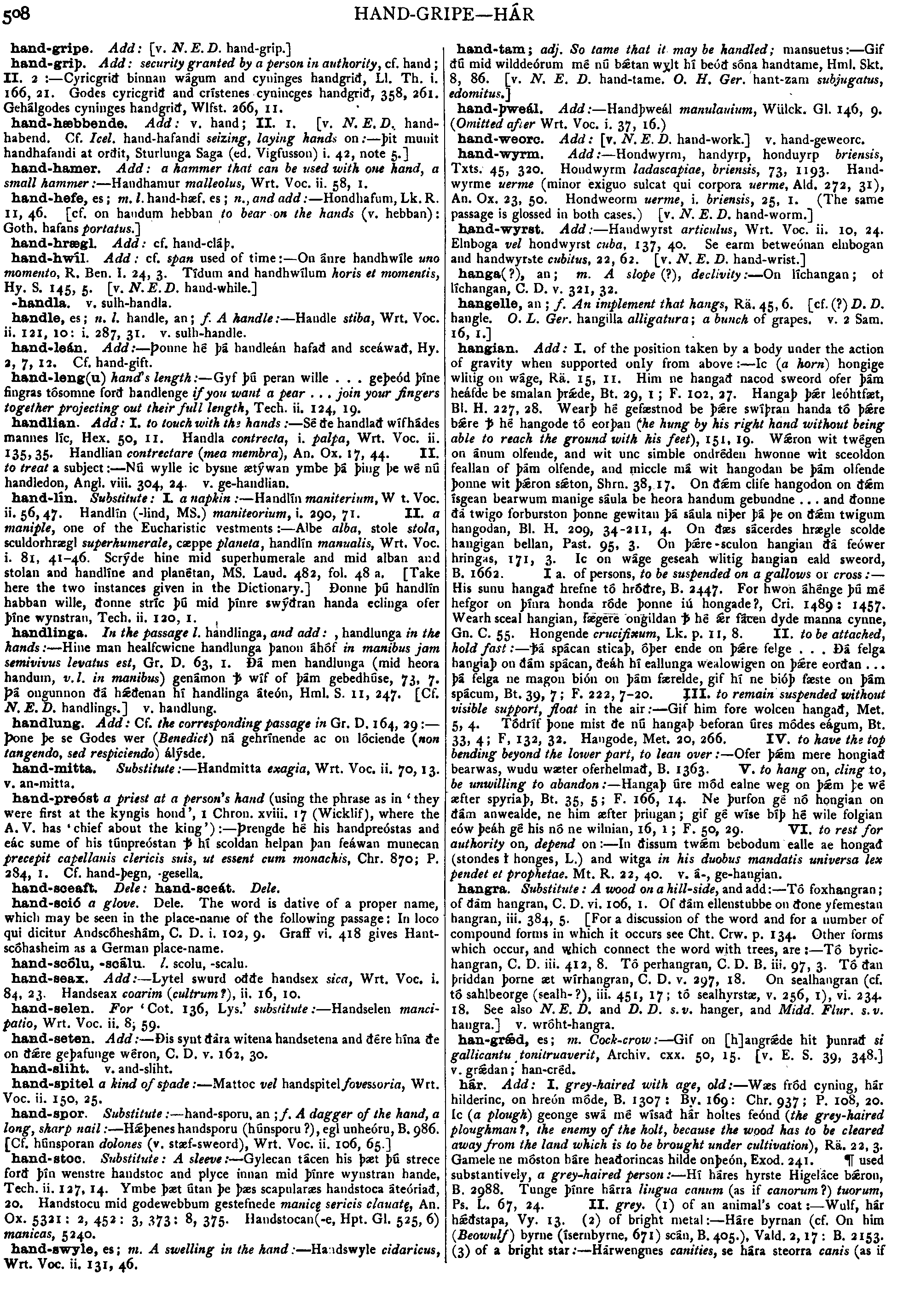
hangian.
Add:
I.
of
the
position
taken
by
a
body
under
the
action
of
gravity
when
supported
only
from
above
:--
Ic
(a
horn)
hongige
wlitig
on
wáge,
Rä.
15,
11.
Him
ne
hangað
nacod
sweord
ofer
þám
heáfde
be
smalan
þrde,
Bt.
29,
1;
F.
102,
27.
Hangaþ
þr
leóhtfæt,
Bl.
H.
227,
28.
Wearþ
hé
gefæstnod
be
þre
swíþran
handa
tó
þre
bre
hé
hangode
tó
eorþan
(he
hung
by
his
right
hand
without
being
able
to
reach
the
ground
with
his
feet),
151,
19.
Wron
wit
twégen
on
ánum
olfende,
and
wit
unc
simble
ondréden
hwonne
wit
sceoldon
feallan
of
þám
olfende,
and
miccle
má
wit
hangodan
be
þám
olfende
þonne
wit
þron
ston,
Shrn.
38,
17.
On
ðm
clife
hangodon
on
ðm
ísgean
bearwum
manige
sáula
be
heora
handum
gebundne
.
.
.
and
þonne
ðá
twigo
forburston
þonne
gewitan
þá
sáula
niþer
þá
þe
on
ðm
twigum
hangodan,
Bl.
H.
209,
34-211,
4.
On
ðæs
sácerdes
hrægle
scolde
hangigan
bellan,
Past.
95,
3.
On
þre-sculon
hangian
ðá
feówer
hringas,
171,
3.
Ic
on
wáge
geseah
wlitig
hangian
eald
sweord,
B.
1662.
I
a.
of
persons,
to
be
suspended
on
a
gallows
or
cross
:
--
His
sunu
hangað
hrefne
tó
hróðre,
B.
2447.
For
hwon
áhénge
þú
mé
hefgor
on
þínra
honda
róde
þonne
iú
hongade?,
Cri.
1489:
1457.
Wearh
sceal
hangian,
fægere
ongildan
hé
r
fácen
dyde
manna
cynne,
Gn.
C.
55.
Hongende
crucifixum,
Lk.
p.
11,
8.
II.
to
be
attached,
hold
fast
:--
þá
spácan
sticaþ,
óþer
ende
on
þre
felge
.
.
.
Ðá
felga
hangiaþ
on
þám
spácan,
ðeáh
hí
eallunga
wealowigen
on
þre
eorðan
.
.
.
þá
felga
ne
magon
bión
on
þám
færelde,
gif
hí
ne
bióþ
fæste
on
þám
spácum,
Bt.
39,
7;
F.
222,
7-20.
III.
to
remain
suspended
without
visible
support,
float
in
the
air:
--
Gif
him
fore
wolcen
hangað,
Met.
5,
4.
Tódríf
þone
mist
ðe
nú
hangaþ
beforan
úres
módes
eágum,
Bt.
33,
4;
F.
132,
32.
Hangode,
Met.
20,
266.
IV.
to
have
the
top
bending
beyond
the
lower
part,
to
lean
over:
--
Ofer
þm
mere
hongiað
bearwas,
wudu
wæter
oferhelmað,
B.
1363.
V.
to
hang
on,
cling
to,
be
unwilling
to
abandon
:--
Hangaþ
úre
mód
ealne
weg
on
þm
þe
wé
æfter
spyriaþ,
Bt.
35,
5;
F.
166,
14.
Ne
þurfon
gé
nó
hongian
on
ðám
anwealde,
ne
him
æfter
þringan;
gif
gé
wíse
bíþ
hé
wile
folgian
eów
þeáh
gé
his
nó
ne
wilnian,
16,
1;
F.
50,
29.
VI.
to
rest
for
authority
on,
depend
on
:--
In
ðissum
twm
bebodum
ealle
ae
hongað
(stondes
honges,
L.)
and
witga
in
his
duobus
mandatis
universa
lex
pendet
et
prophetae.
Mt.
R.
22,
40.
v.
á-,
ge-hangian.
|
Source: Bosworth/Toller, page d0522, entry 12 View original page image as: [TIFF] [PNG] [View previous entry] [View next entry] |
[Comment on this entry] [View comments (1)] |
The following entry has been hand-corrected once. |
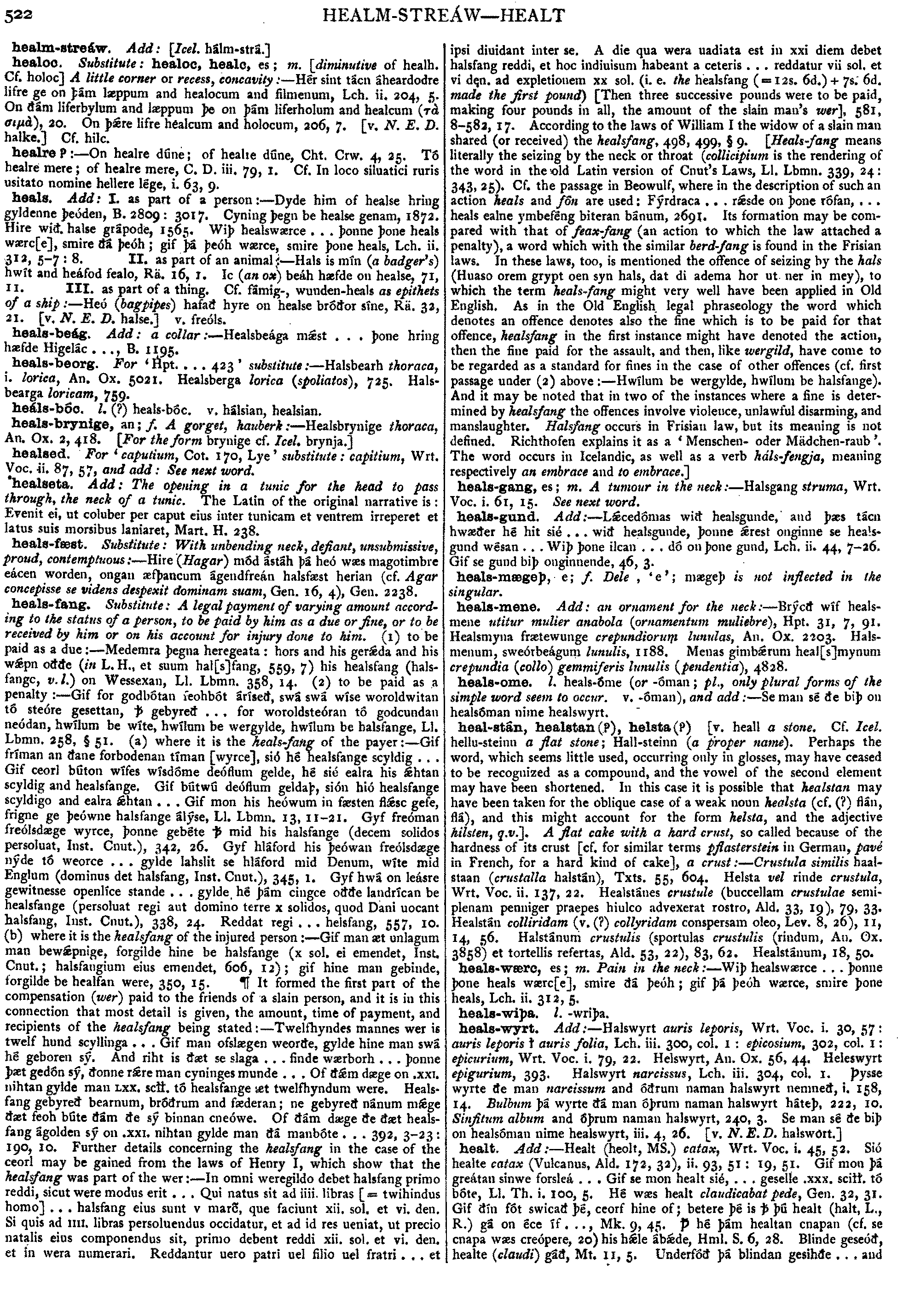
heals-fang.
Substitute:
A
legal
payment
of
varying
amount
according
to
the
status
of
a
person,
to
be
paid
by
him
as
a
due
or
fine,
or
to
be
received
by
him
or
on
his
account
for
injury
done
to
kim,
(1)
to
be
paid
as
a
due
:--
Medemra
þegna
heregeata
:
hors
and
his
gerda
and
his
wpn
oððe
(in
L.
H.,
et
suum
hal[s]fang,
559,
7)
his
healsfang
(halsfangc,
v.
l.)
on
Wessexan,
Ll.
Lbmn.
358,
14.
(2)
to
be
paid
as
a
penalty
:--
Gif
for
godbótan
feohbót
áríseð,
swá
swá
wise
woroldwitan
tó
steóre
gesettan,
gebyreð
.
.
.
for
woroldsteóran
tó
godcundan
neódan,
hwílum
be
wíte,
hwílum
be
wergylde,
hwílum
be
halsfange.
Ll.
Lbmn.
258,
§
51.
(a)
where
it
is
the
heals-fang
of
the
payer
:--
Gif
fríman
an
ðane
forbodenan
tíman
[wyrce],
sió
hé
healsfange
scyldig
.
.
.
Gif
ceorl
búton
wífes
wísdóme
deóflum
gelde,
hé
sié
ealra
his
htan
scyldig
and
healsfange.
Gif
bútwú
deóflum
geldaþ,
sión
hió
healsfange
scyldigo
and
ealra
htan
.
.
.
Gif
mon
his
heówum
in
fæsten
flsc
gefe,
frigne
ge
þeówne
halsfange
álýse.
Ll.
Lbmn.
13,
11-21.
Gyf
freóman
freólsdæge
wyrce,
þonne
gebéte
mid
his
halsfange
(decem
solidos
persoluat,
Inst.
Cnut.
),
342,
26.
Gyf
hláford
his
þeówan
freólsdæge
nýde
tó
weorce
.
.
.
gylde
lahslit
se
hláford
mid
Denum,
wíte
mid
Englum
(dominus
det
halsfang,
Inst.
Cnut.
),
345,
1.
Gyf
hwá
on
leásre
gewitnesse
openlíce
stande
.
.
.
gylde
hé
þám
cingce
oððe
landrícan
be
healsfange
(persoluat
regi
aut
domino
terre
x
solidos,
quod
Dam
uocant
halsfang,
Inst.
Cnut.
),
338,
24.
Reddat
regi
.
.
.
helsfang,
557,
10.
(b)
where
it
is
the
healsfang
of
the
injured
person
:--
Gif
man
æt
unlagum
man
bewpnige,
forgilde
hine
be
halsfange
(x
sol.
ei
emendet,
Inst.
Cnut.;
halsfangium
eius
emendet,
606,
12);
gif
hine
man
gebinde,
forgilde
be
healfan
were,
350,
15.
¶It
formed
the
first
part
of
the
compensation
(wer)
paid
to
the
friends
of
a
slain
person,
and
it
is
in
this
connection
that
most
detail
is
given,
the
amount,
time
of
payment,
and
recipients
of
the
healsfang
being
stated
:--
Twelfhyndes
mannes
wer
is
twelf
hund
scyllinga
.
.
.
Gif
man
ofslægen
weorðe,
gylde
hine
man
swá
hé
geboren
sý.
And
riht
is
ðæt
se
slaga
.
.
.
finde
wærborh
.
.
.
þonne
þæt
gedón
sý,
ðonne
rre
man
cyninges
munde
.
.
.
Of
ðm
dæge
on
.xxi.
nihtan
gylde
man
LXX.
sc
UNCERTAIN
,
tó
healsfange
æt
twelfhyndum
were.
Healsfang
gebyreð
bearnum,
bróðrum
and
fæderan;
ne
gebyreð
nánum
mge
ðæt
feoh
búte
ðám
ðe
sý
binnan
cneówe.
Of
ðám
dæge
ðe
ðæt
healsfang
ágolden
sý
on
.xxi.
nihtan
gylde
man
ðá
manbóte
.
.
.
392,
3-23:
190,
10.
Further
details
concerning
the
healsfang
in
the
case
of
the
ceorl
may
be
gained
from
the
laws
of
Henry
I.
which
show
that
the
healsfang
was
part
of
the
wer
:--
In
omni
weregildo
debet
halsfang
primo
reddi,
sicut
were
modus
erit
.
.
.
Qui
natus
sit
ad
iiii.
libras
[=
twihindus
homo]
.
.
.
halsfang
eius
sunt
v
mar ,
que
faciunt
xii.
sol,
et
vi.
den.
Si
quis
ad
iiii.
UNCERTAIN
libras
persoluendus
occidatur,
et
ad
id
res
ueniat,
ut
precio
natalis
eius
componendus
sit,
primo
debent
reddi
xii.
sol.
et
vi.
den.
et
in
wera
numerari.
Reddantur
uero
patri
uel
filio
uel
fratri
.
.
.
et
ipsi
diuidant
inter
se.
A
die
qua
wera
uadiata
est
in
xxi
diem
debet
halsfang
reddi,
et
hoc
indiuisum
habeant
a
ceteris
.
.
.
reddatur
vii
sol.
et
vi
d
,
que
faciunt
xii.
sol,
et
vi.
den.
Si
quis
ad
iiii.
UNCERTAIN
libras
persoluendus
occidatur,
et
ad
id
res
ueniat,
ut
precio
natalis
eius
componendus
sit,
primo
debent
reddi
xii.
sol.
et
vi.
den.
et
in
wera
numerari.
Reddantur
uero
patri
uel
filio
uel
fratri
.
.
.
et
ipsi
diuidant
inter
se.
A
die
qua
wera
uadiata
est
in
xxi
diem
debet
halsfang
reddi,
et
hoc
indiuisum
habeant
a
ceteris
.
.
.
reddatur
vii
sol.
et
vi
d n.
UNCERTAIN
ad
expletionem
xx
sol.
(i.
e.
the
healsfang
(
=
12s.
6d.
)
+
7s.
6d.
made
the
first
pound)
[Then
three
successive
pounds
were
to
be
paid,
making
four
pounds
in
all,
the
amount
of
the
slain
man's
wer],
581,
8-582,
17.
According
to
the
laws
of
William
I
the
widow
of
a
slain
man
shared
(or
received)
the
healsfang,
498,
499,
§
9.
[Heals-fang
means
literally
the
seizing
by
the
neck
or
throat
(collicipium
is
the
rendering
of
the
word
in
the
old
Latin
version
of
Cnut's
Laws,
Ll.
Lbmn.
339,
24:
343,
25).
Cf.
the
passage
in
Beowulf,
where
in
the
description
of
such
an
action
heals
and
fón
are
used:
Fýrdraca
.
.
.
rsde
on
þone
rófan,
.
.
.
heals
ealne
ymbeféng
biteran
bánum,
2691.
Its
formation
may
be
compared
with
that
of
feax-fang
(an
action
to
which
the
law
attached
a
penalty),
a
word
which
with
the
similar
berd-fang
is
found
in
the
Frisian
laws.
In
these
laws,
too,
is
mentioned
the
offence
of
seizing
by
the
hals
(Huaso
orem
grypt
oen
syn
hals,
dat
di
adema
hor
ut
ner
in
mey),
to
which
the
term
heals-fang
might
very
well
have
been
applied
in
Old
English.
As
in
the
Old
English
legal
phraseology
the
word
which
denotes
an
offence
denotes
also
the
fine
which
is
to
be
paid
for
that
offence,
healsfang
in
the
first
instance
might
have
denoted
the
action,
then
the
fine
paid
for
the
assault,
and
then,
like
wergild,
have
come
to
be
regarded
as
a
standard
for
fines
in
the
case
of
other
offences
(cf.
first
passage
under
(2)
above
:--
Hwílum
be
wergylde,
hwílum
be
halsfange).
And
it
may
be
noted
that
in
two
of
the
instances
where
a
fine
is
determined
by
healsfang
the
offences
involve
violence,
unlawful
disarming,
and
manslaughter.
Halsfang
occurs
in
Frisian
law,
but
its
meaning
is
not
defined.
Richthofen
explains
it
as
a
'Menschen-
oder
Mädchen-raub'.
The
word
occurs
in
Icelandic,
as
well
as
a
verb
háls-fengja,
meaning
respectively
an
embrace
and
to
embrace.]
n.
UNCERTAIN
ad
expletionem
xx
sol.
(i.
e.
the
healsfang
(
=
12s.
6d.
)
+
7s.
6d.
made
the
first
pound)
[Then
three
successive
pounds
were
to
be
paid,
making
four
pounds
in
all,
the
amount
of
the
slain
man's
wer],
581,
8-582,
17.
According
to
the
laws
of
William
I
the
widow
of
a
slain
man
shared
(or
received)
the
healsfang,
498,
499,
§
9.
[Heals-fang
means
literally
the
seizing
by
the
neck
or
throat
(collicipium
is
the
rendering
of
the
word
in
the
old
Latin
version
of
Cnut's
Laws,
Ll.
Lbmn.
339,
24:
343,
25).
Cf.
the
passage
in
Beowulf,
where
in
the
description
of
such
an
action
heals
and
fón
are
used:
Fýrdraca
.
.
.
rsde
on
þone
rófan,
.
.
.
heals
ealne
ymbeféng
biteran
bánum,
2691.
Its
formation
may
be
compared
with
that
of
feax-fang
(an
action
to
which
the
law
attached
a
penalty),
a
word
which
with
the
similar
berd-fang
is
found
in
the
Frisian
laws.
In
these
laws,
too,
is
mentioned
the
offence
of
seizing
by
the
hals
(Huaso
orem
grypt
oen
syn
hals,
dat
di
adema
hor
ut
ner
in
mey),
to
which
the
term
heals-fang
might
very
well
have
been
applied
in
Old
English.
As
in
the
Old
English
legal
phraseology
the
word
which
denotes
an
offence
denotes
also
the
fine
which
is
to
be
paid
for
that
offence,
healsfang
in
the
first
instance
might
have
denoted
the
action,
then
the
fine
paid
for
the
assault,
and
then,
like
wergild,
have
come
to
be
regarded
as
a
standard
for
fines
in
the
case
of
other
offences
(cf.
first
passage
under
(2)
above
:--
Hwílum
be
wergylde,
hwílum
be
halsfange).
And
it
may
be
noted
that
in
two
of
the
instances
where
a
fine
is
determined
by
healsfang
the
offences
involve
violence,
unlawful
disarming,
and
manslaughter.
Halsfang
occurs
in
Frisian
law,
but
its
meaning
is
not
defined.
Richthofen
explains
it
as
a
'Menschen-
oder
Mädchen-raub'.
The
word
occurs
in
Icelandic,
as
well
as
a
verb
háls-fengja,
meaning
respectively
an
embrace
and
to
embrace.]
| Result Page: |  |
Previous | 1 2 3 4 5 | Next |  |
Germanic Lexicon Project (main page)
This search system was written by
Sean Crist
Please consider
volunteering
to correct the data in these online dictionaries.
No rights reserved. Feel free to use these data in any way you please.