|
|

Search for asylum again, using less strict matching (37 results)
|
Source: Bosworth/Toller, page d0268, entry 18 View original page image as: [TIFF] [PNG] [View previous entry] [View next entry] |
[Comment on this entry] [View comments] |
The following entry has been hand-corrected once. |
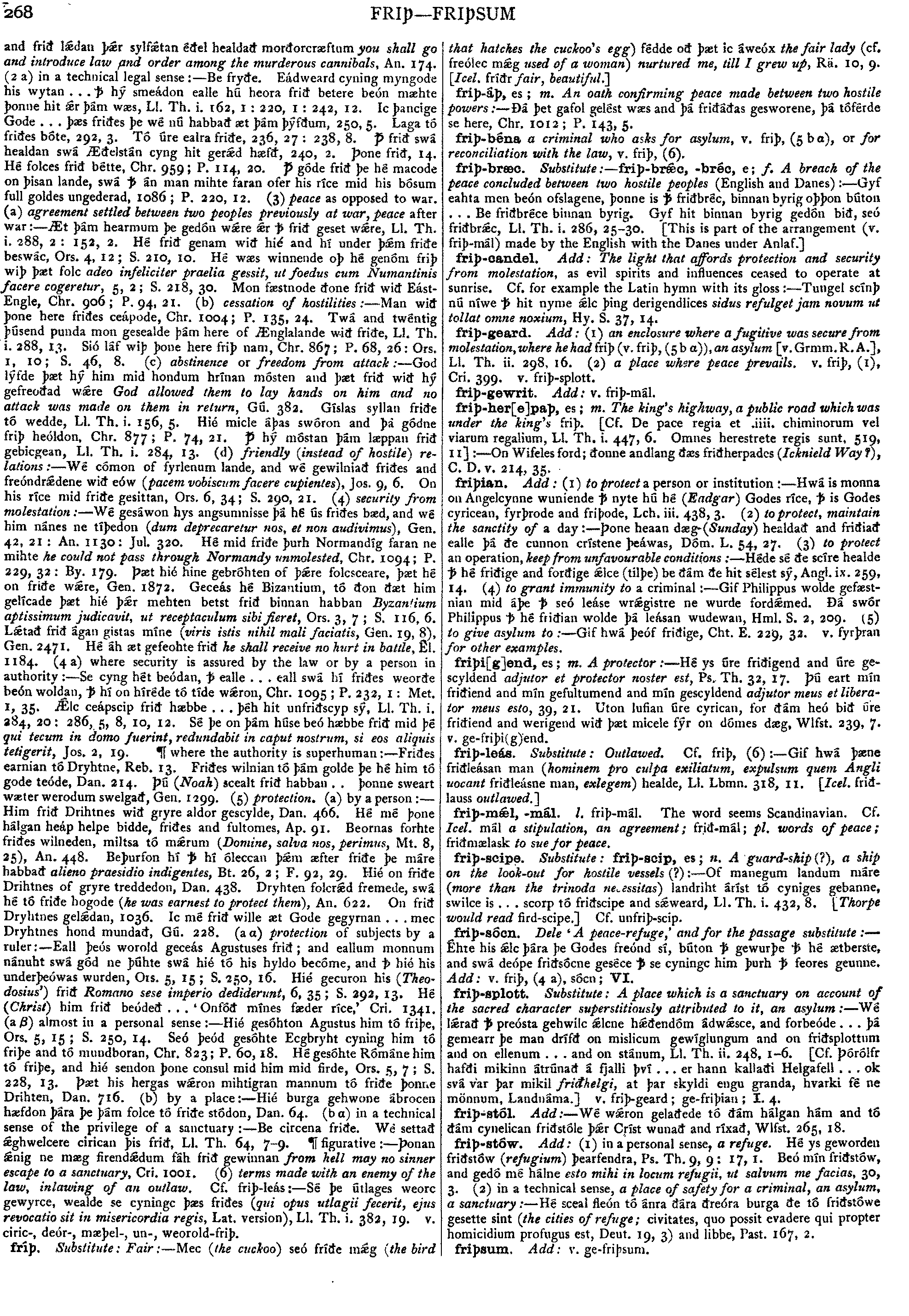
friþ-stów. Add: (1) in a personal sense, a refuge. Hé ys geworden friðstów (refugium) þearfendrä UNCERTAIN. Ps. Th. 9, 9 : 17, I. Beó mín friðstów, and gedó mé hálne esto mihi in locum refugii, ut salvum me facias, 30, 3. (2) in a technical sense, a place of safety for a criminal, an asylum, a sanctuary :-- Hé sceal fleón tó ánra ðára ðreóra burga ðe tó friðstówe gesette sint (the cities of refuge; civitates, quo possit evadere qui propter hornicidium profugus est, Deut. 19, 3) and libbe. Past. 167, 2.
|
Source: Bosworth/Toller, page d0323, entry 1 View original page image as: [TIFF] [PNG] [View previous entry] [View next entry] |
[Comment on this entry] [View comments] |
The following entry has been hand-corrected once. |
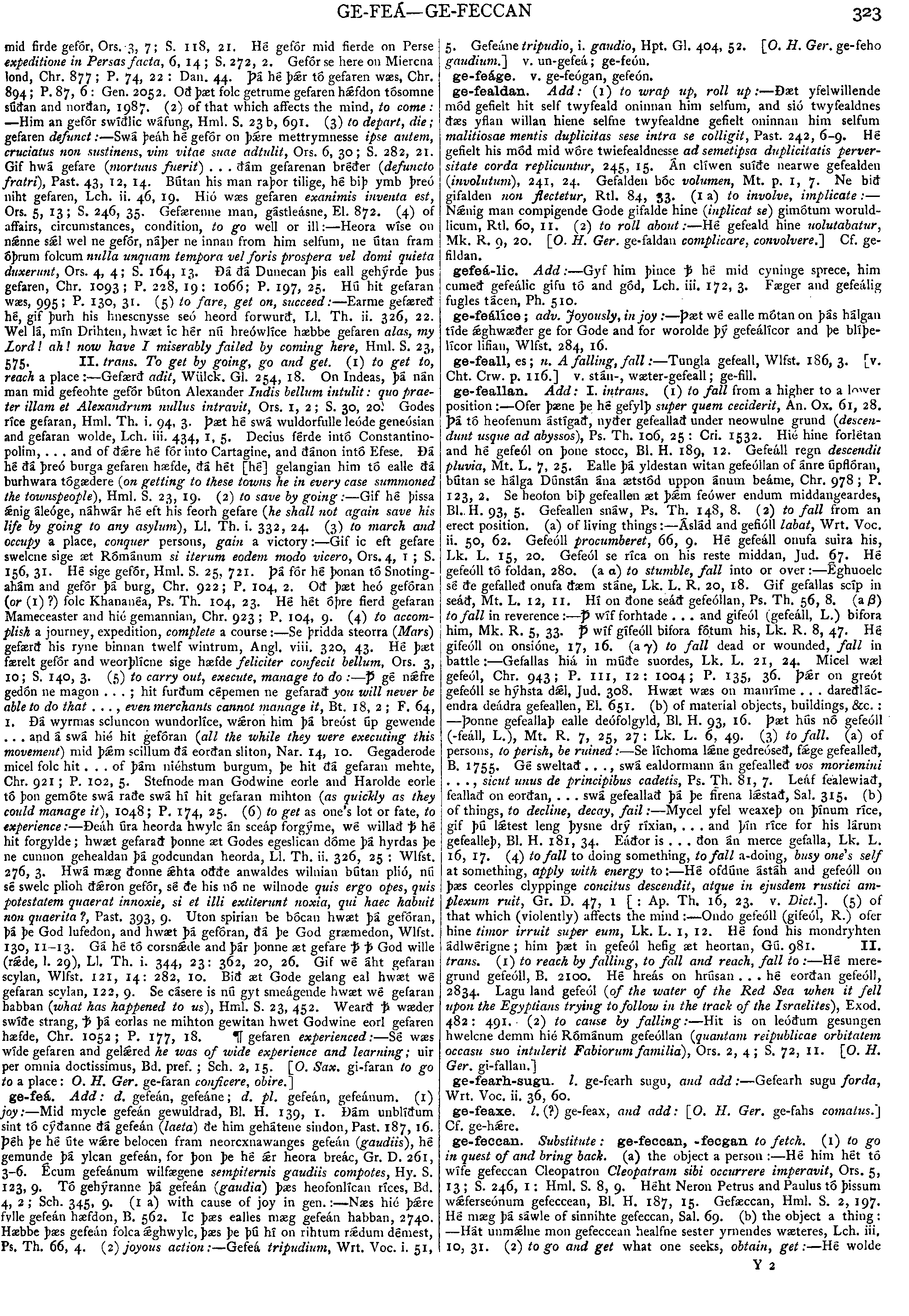
mid
firde
gefór,
Ors.
3,
7;
S.
118,
21.
Hé
gefór
mid
fierde
on
Perse
expeditione
in
Persas
facta,
6,
14;
S.
272,
2.
Gefór
se
here
on
Miercna
lond,
Chr.
877;
P.
74,
22:
Dan.
44.
Þá
hé
þ r
tó
gefaren
wæs,
Chr.
894;
P.
87,
6:
Gen.
2052.
Oð
þæt
folc
getrume
gefaren
hfdon
tósomne
súðan
and
norðan,
1987.
(2)
of
that
which
affects
the
mind,
to
come
:--
Him
an
gefór
swíðlic
wáfung,
Hml.
S.
23
b,
691.
(3)
to
depart,
die;
gefaren
defunct
:--
Swá
þeáh
hé
gefór
on
þre
mettrymnesse
ipse
autem,
cruciatus
non
sustinens,
vim
vitae
suae
adtulit,
Ors.
6,
30;
S.
282,
21.
Gif
hwá
gefare
(mortuus
fuerit)
...
ðám
gefarenan
bréðer
(defuncto
fratri),
Past.
43,
12,
14.
Bútan
his
man
raþor
tilige,
hé
biþ
ymb
þreó
niht
gefaren,
Lch.
ii.
46,
19.
Hió
wæs
gefaren
exanimis
inventa
est,
Ors.
5,
13;
S.
246,
35.
Gefærenne
man,
gástleásne,
El.
872.
(4)
of
affairs,
circumstances,
condition,
to
go
well
or
ill
:--
Heora
wíse
on
nnne
sl
wel
ne
gefór,
náþer
ne
innan
from
him
selfum,
ne
útan
fram
óþrum
folcum
nulla
unquam
tempora
vel
foris
prospera
vel
domi
quieta
duxerunt,
Ors.
4,
4;
S.
164,
13.
Ðá
ðá
Dunecan
þis
eall
gehýrde
þus
gefaren,
Chr.
1093;
P.
228,
19:
1066;
P.
197,
25.
Hú
hit
gefaran
wæs,
995;
P.
130,
31.
(5)
to
fare,
get
on,
succeed
:--
Earme
gefæreð
hé,
gif
þurh
his
hnescnysse
seó
heord
forwurð,
Ll.
Th.
ii.
326,
22.
Wel
lá,
mín
Drihten,
hwæt
ic
hér
nú
hreówlíce
hæbbe
gefaren
alas,
my
Lord!
ah!
now
have
I
miserably
failed
by
coming
here,
Hml.
S.
23,
575.
II.
trans.
To
get
by
going,
go
and
get.
(1)
to
get
to,
reach
a
place
:--
Gefærð
adit,
Wülck.
Gl.
254,
18.
On
Indeas,
þá
nán
man
mid
gefeohte
gefór
búton
Alexander
Indis
bellum
intulit:
quo
praeter
illam
et
Alexandrum
nullus
intravit,
Ors.
1,
2;
S.
30,
20.
Godes
ríce
gefaran,
Hml.
Th.
i.
94,
3.
Þæt
hé
swá
wuldorfulle
leóde
geneósian
and
gefaran
wolde,
Lch.
iii.
434,
1,
5.
Decius
férde
intó
Constantinopolim,
...
and
of
ðre
hé
fór
into
Cartagine,
and
ðánon
intó
Efese.
Ðá
hé
ðá
þreó
burga
gefaren
hæfde,
ðá
hét
[hé]
gelangian
him
tó
ealle
ðá
burhwara
tógædere
(on
getting
to
these
towns
he
in
every
case
summoned
the
townspeople),
Hml.
S.
23,
19.
(2)
to
save
by
going
:--
Gif
hé
þissa
nig
áleóge,
náhwár
hé
eft
his
feorh
gefare
(he
shall
not
again
save
his
life
by
going
to
any
asylum),
Ll.
Th.
i.
332,
24.
(3)
to
march
and
occupy
a
place,
conquer
persons,
gain
a
victory
:--
Gif
ic
eft
gefare
swelcne
sige
æt
Rómánum
si
iterum
eodem
modo
vicero,
Ors.
4,
1;
S.
156,
31.
Hé
sige
gefór,
Hml.
S.
25,
721.
Þá
fór
hé
þonan
tó
Snotingahám
and
gefór
þá
burg,
Chr.
922;
P.
104,
2.
Oð
þæt
heó
gefóran
(or
(1)
?)
folc
Khananéa,
Ps.
Th.
104,
23.
Hé
hét
óþre
fierd
gefaran
Mameceaster
and
hié
gemannian,
Chr.
923;
P.
104,
9.
(4)
to
accomplish
a
journey,
expedition,
complete
a
course
:--
Se
þridda
steorra
(Mars)
gefærð
his
ryne
binnan
twelf
wintrnm,
Angl.
viii.
320,
43.
Hé
þæt
færelt
gefór
and
weorþlícne
sige
hæfde
feliciter
confecit
bellum,
Ors.
3,
10;
S.
140,
3.
(5)
to
carry
out,
execute,
manage
to
do
:--
Þ-bar;
gé
nfre
gedón
ne
magon
...;
hit
furðum
cépemen
ne
gefarað
you
will
never
be
able
to
do
that
...,
even
merchants
cannot
manage
it,
Bt.
18,
2;
F.
64,
1.
Ðá
wyrmas
scluncon
wundorlíce,
wron
him
þá
breóst
úp
gewende
...
and
á
swá
hié
hit
gefóran
(all
the
while
they
were
executing
this
movement)
mid
þm
scillum
ðá
eorðan
sliton,
Nar.
14,
10.
Gegaderode
micel
folc
hit
...
of
þám
niéhstum
burgum,
þe
hit
ðá
gefaran
mehte,
Chr.
921;
P.
102,
5.
Stefnode
man
Godwine
eorle
and
Harolde
eorle
tó
þon
gemóte
swá
raðe
swá
hí
hit
gefaran
mihton
(as
quickly
as
they
could
manage
it),
1048;
P.
174,
25.
(6)
to
get
as
one's
lot
or
fate,
to
experience
:--
Ðeáh
úra
heorda
hwylc
án
sceáp
forgýme,
wé
willað
r
tó
gefaren
wæs,
Chr.
894;
P.
87,
6:
Gen.
2052.
Oð
þæt
folc
getrume
gefaren
hfdon
tósomne
súðan
and
norðan,
1987.
(2)
of
that
which
affects
the
mind,
to
come
:--
Him
an
gefór
swíðlic
wáfung,
Hml.
S.
23
b,
691.
(3)
to
depart,
die;
gefaren
defunct
:--
Swá
þeáh
hé
gefór
on
þre
mettrymnesse
ipse
autem,
cruciatus
non
sustinens,
vim
vitae
suae
adtulit,
Ors.
6,
30;
S.
282,
21.
Gif
hwá
gefare
(mortuus
fuerit)
...
ðám
gefarenan
bréðer
(defuncto
fratri),
Past.
43,
12,
14.
Bútan
his
man
raþor
tilige,
hé
biþ
ymb
þreó
niht
gefaren,
Lch.
ii.
46,
19.
Hió
wæs
gefaren
exanimis
inventa
est,
Ors.
5,
13;
S.
246,
35.
Gefærenne
man,
gástleásne,
El.
872.
(4)
of
affairs,
circumstances,
condition,
to
go
well
or
ill
:--
Heora
wíse
on
nnne
sl
wel
ne
gefór,
náþer
ne
innan
from
him
selfum,
ne
útan
fram
óþrum
folcum
nulla
unquam
tempora
vel
foris
prospera
vel
domi
quieta
duxerunt,
Ors.
4,
4;
S.
164,
13.
Ðá
ðá
Dunecan
þis
eall
gehýrde
þus
gefaren,
Chr.
1093;
P.
228,
19:
1066;
P.
197,
25.
Hú
hit
gefaran
wæs,
995;
P.
130,
31.
(5)
to
fare,
get
on,
succeed
:--
Earme
gefæreð
hé,
gif
þurh
his
hnescnysse
seó
heord
forwurð,
Ll.
Th.
ii.
326,
22.
Wel
lá,
mín
Drihten,
hwæt
ic
hér
nú
hreówlíce
hæbbe
gefaren
alas,
my
Lord!
ah!
now
have
I
miserably
failed
by
coming
here,
Hml.
S.
23,
575.
II.
trans.
To
get
by
going,
go
and
get.
(1)
to
get
to,
reach
a
place
:--
Gefærð
adit,
Wülck.
Gl.
254,
18.
On
Indeas,
þá
nán
man
mid
gefeohte
gefór
búton
Alexander
Indis
bellum
intulit:
quo
praeter
illam
et
Alexandrum
nullus
intravit,
Ors.
1,
2;
S.
30,
20.
Godes
ríce
gefaran,
Hml.
Th.
i.
94,
3.
Þæt
hé
swá
wuldorfulle
leóde
geneósian
and
gefaran
wolde,
Lch.
iii.
434,
1,
5.
Decius
férde
intó
Constantinopolim,
...
and
of
ðre
hé
fór
into
Cartagine,
and
ðánon
intó
Efese.
Ðá
hé
ðá
þreó
burga
gefaren
hæfde,
ðá
hét
[hé]
gelangian
him
tó
ealle
ðá
burhwara
tógædere
(on
getting
to
these
towns
he
in
every
case
summoned
the
townspeople),
Hml.
S.
23,
19.
(2)
to
save
by
going
:--
Gif
hé
þissa
nig
áleóge,
náhwár
hé
eft
his
feorh
gefare
(he
shall
not
again
save
his
life
by
going
to
any
asylum),
Ll.
Th.
i.
332,
24.
(3)
to
march
and
occupy
a
place,
conquer
persons,
gain
a
victory
:--
Gif
ic
eft
gefare
swelcne
sige
æt
Rómánum
si
iterum
eodem
modo
vicero,
Ors.
4,
1;
S.
156,
31.
Hé
sige
gefór,
Hml.
S.
25,
721.
Þá
fór
hé
þonan
tó
Snotingahám
and
gefór
þá
burg,
Chr.
922;
P.
104,
2.
Oð
þæt
heó
gefóran
(or
(1)
?)
folc
Khananéa,
Ps.
Th.
104,
23.
Hé
hét
óþre
fierd
gefaran
Mameceaster
and
hié
gemannian,
Chr.
923;
P.
104,
9.
(4)
to
accomplish
a
journey,
expedition,
complete
a
course
:--
Se
þridda
steorra
(Mars)
gefærð
his
ryne
binnan
twelf
wintrnm,
Angl.
viii.
320,
43.
Hé
þæt
færelt
gefór
and
weorþlícne
sige
hæfde
feliciter
confecit
bellum,
Ors.
3,
10;
S.
140,
3.
(5)
to
carry
out,
execute,
manage
to
do
:--
Þ-bar;
gé
nfre
gedón
ne
magon
...;
hit
furðum
cépemen
ne
gefarað
you
will
never
be
able
to
do
that
...,
even
merchants
cannot
manage
it,
Bt.
18,
2;
F.
64,
1.
Ðá
wyrmas
scluncon
wundorlíce,
wron
him
þá
breóst
úp
gewende
...
and
á
swá
hié
hit
gefóran
(all
the
while
they
were
executing
this
movement)
mid
þm
scillum
ðá
eorðan
sliton,
Nar.
14,
10.
Gegaderode
micel
folc
hit
...
of
þám
niéhstum
burgum,
þe
hit
ðá
gefaran
mehte,
Chr.
921;
P.
102,
5.
Stefnode
man
Godwine
eorle
and
Harolde
eorle
tó
þon
gemóte
swá
raðe
swá
hí
hit
gefaran
mihton
(as
quickly
as
they
could
manage
it),
1048;
P.
174,
25.
(6)
to
get
as
one's
lot
or
fate,
to
experience
:--
Ðeáh
úra
heorda
hwylc
án
sceáp
forgýme,
wé
willað
 hé
hit
forgylde;
hwæt
gefarað
þonne
æt
Godes
egeslican
dóme
þá
hyrdas
þe
ne
cunnon
gehealdan
þá
godcundan
heorda,
Ll.
Th.
ii.
326,
25:
Wlfst.
276,
3.
Hwá
mæg
ðonne
hta
oððe
anwaldes
wilnian
bútan
plió,
nú
sé
swelc
plioh
ðron
gefór,
sé
ðe
his
nó
ne
wilnode
quis
ergo
opes,
quis
potestatem
quaerat
innoxie,
si
et
illi
extiterunt
noxia,
qui
haec
habuit
non
quaerita?,
Past.
393,
9.
Uton
spirian
be
bócan
hwæt
þá
gefóran,
þá
þe
God
lufedon,
and
hwæt
þá
gefóran,
ðá
þe
God
græmedon,
Wlfst.
130,
11-13.
Gá
hé
tó
corsnde
and
þár
þonne
æt
gefare
God
wille
(rde,
l.
29),
Ll.
Th.
i.
344,
23:
362,
20,
26.
Gif
wé
áht
gefaran
scylan,
Wlfst.
121,
14:
282,
10.
Bið
æt
Gode
gelang
eal
hwæt
wé
gefaran
scylan,
122,
9.
Se
cásere
is
nú
gyt
smeágende
hwæt
wé
gefaran
habban
(what
has
happened
to
us),
Hml.
S.
23,
452.
Wearð
wæder
swíðe
strang,
þá
eorlas
ne
mihton
gewitan
hwet
Godwine
eorl
gefaren
hæfde,
Chr.
1052;
P.
177,
18.

gefaren
experienced
:--
Sé
wæs
wíde
gefaren
and
gelred
he
was
of
wide
experience
and
learning;
uir
per
omnia
doctissimus,
Bd.
pref.;
Sch.
2,
15.
[O.
Sax.
gi-faran
to
go
to
a
place:
O.
H.
Ger.
ge-faran
conficere,
obire.]
hé
hit
forgylde;
hwæt
gefarað
þonne
æt
Godes
egeslican
dóme
þá
hyrdas
þe
ne
cunnon
gehealdan
þá
godcundan
heorda,
Ll.
Th.
ii.
326,
25:
Wlfst.
276,
3.
Hwá
mæg
ðonne
hta
oððe
anwaldes
wilnian
bútan
plió,
nú
sé
swelc
plioh
ðron
gefór,
sé
ðe
his
nó
ne
wilnode
quis
ergo
opes,
quis
potestatem
quaerat
innoxie,
si
et
illi
extiterunt
noxia,
qui
haec
habuit
non
quaerita?,
Past.
393,
9.
Uton
spirian
be
bócan
hwæt
þá
gefóran,
þá
þe
God
lufedon,
and
hwæt
þá
gefóran,
ðá
þe
God
græmedon,
Wlfst.
130,
11-13.
Gá
hé
tó
corsnde
and
þár
þonne
æt
gefare
God
wille
(rde,
l.
29),
Ll.
Th.
i.
344,
23:
362,
20,
26.
Gif
wé
áht
gefaran
scylan,
Wlfst.
121,
14:
282,
10.
Bið
æt
Gode
gelang
eal
hwæt
wé
gefaran
scylan,
122,
9.
Se
cásere
is
nú
gyt
smeágende
hwæt
wé
gefaran
habban
(what
has
happened
to
us),
Hml.
S.
23,
452.
Wearð
wæder
swíðe
strang,
þá
eorlas
ne
mihton
gewitan
hwet
Godwine
eorl
gefaren
hæfde,
Chr.
1052;
P.
177,
18.

gefaren
experienced
:--
Sé
wæs
wíde
gefaren
and
gelred
he
was
of
wide
experience
and
learning;
uir
per
omnia
doctissimus,
Bd.
pref.;
Sch.
2,
15.
[O.
Sax.
gi-faran
to
go
to
a
place:
O.
H.
Ger.
ge-faran
conficere,
obire.]
|
Source: Bosworth/Toller, page d0379, entry 7 View original page image as: [TIFF] [PNG] [View previous entry] [View next entry] |
[Comment on this entry] [View comments] |
The following entry has been hand-corrected once. |
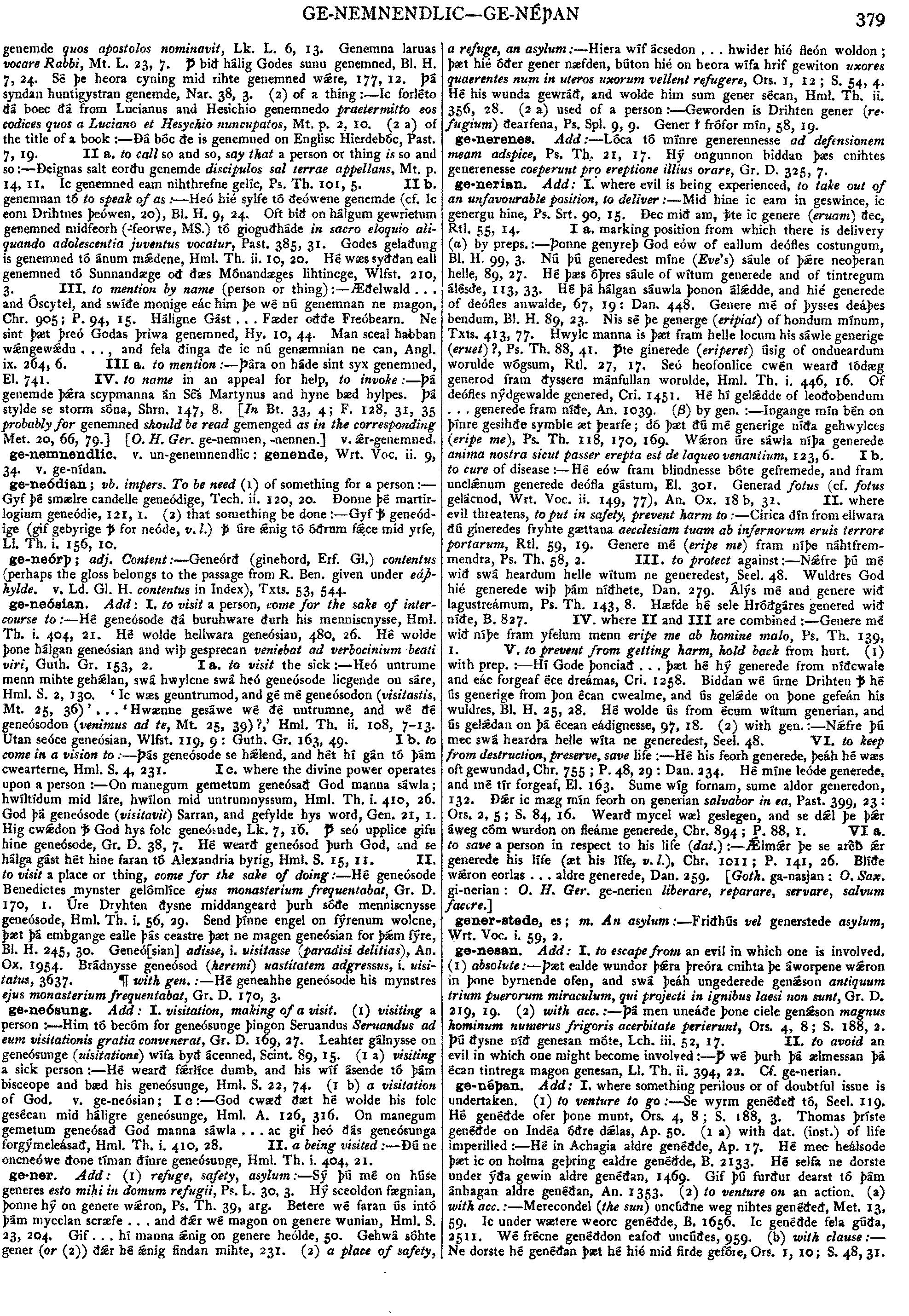
ge-ner.
Add:
(1)
refuge,
safety,
asylum
:--
Sý
þú
mé
on
húse
generes
esto
mihi
in
domum
refugii,
Ps.
L.
30,
3.
Hý
sceoldon
fægnian,
þonne
hý
on
genere
wron,
Ps.
Th.
39,
arg.
Betere
wé
faran
ús
intó
þám
niycclan
scræfe
.
.
.
and
ðr
wé
magon
on
genere
wunian,
Hml.
S.
23,
204.
Gif.
.
.
hí
manna
nig
on
genere
heólde,
50.
Gehwá
sóhte
gener
(or
(2))
ðr
hé
nig
findan
mihte,
231.
(2)
a
place
of
safety,
a
refuge,
an
asylum
:--
Hiera
wíf
ácsedon
.
.
.
hwider
hié
fleón
woldon
;
þæt
hié
óðer
gener
næfden,
búton
hié
on
heora
wífa
hrif
gewiton
uxores
quaerentes
num
in
uteros
uxorum
vellent
refugere,
Ors.
l,
12
;
S.
54,
4.
Hé
his
wunda
gewráð,
and
wolde
him
sum
gener
sécan,
Hml.
Th.
ii.
356,
28.
(2
a)
used
of
a
person
:--
Geworden
is
Drihten
gener
(re-fugium)
ðearfena,
Ps.
Spl.
9,
9.
Gener
 frófor
mín,
58,
19.
frófor
mín,
58,
19.
|
Source: Bosworth/Toller, page d0379, entry 10 View original page image as: [TIFF] [PNG] [View previous entry] [View next entry] |
[Comment on this entry] [View comments] |
The following entry has been hand-corrected once. |
gener-stede, es; m. An asylum :-- Friðhús vel generstede asylum, Wrt. Voc. i. 59, 2.
|
Source: Cleasby/Vigfusson, page b0059, entry 1 View original page image as: [TIFF] [PNG] [View previous entry] [View next entry] |
[Comment on this entry] [View comments] |
The following entry has been hand-corrected once. |
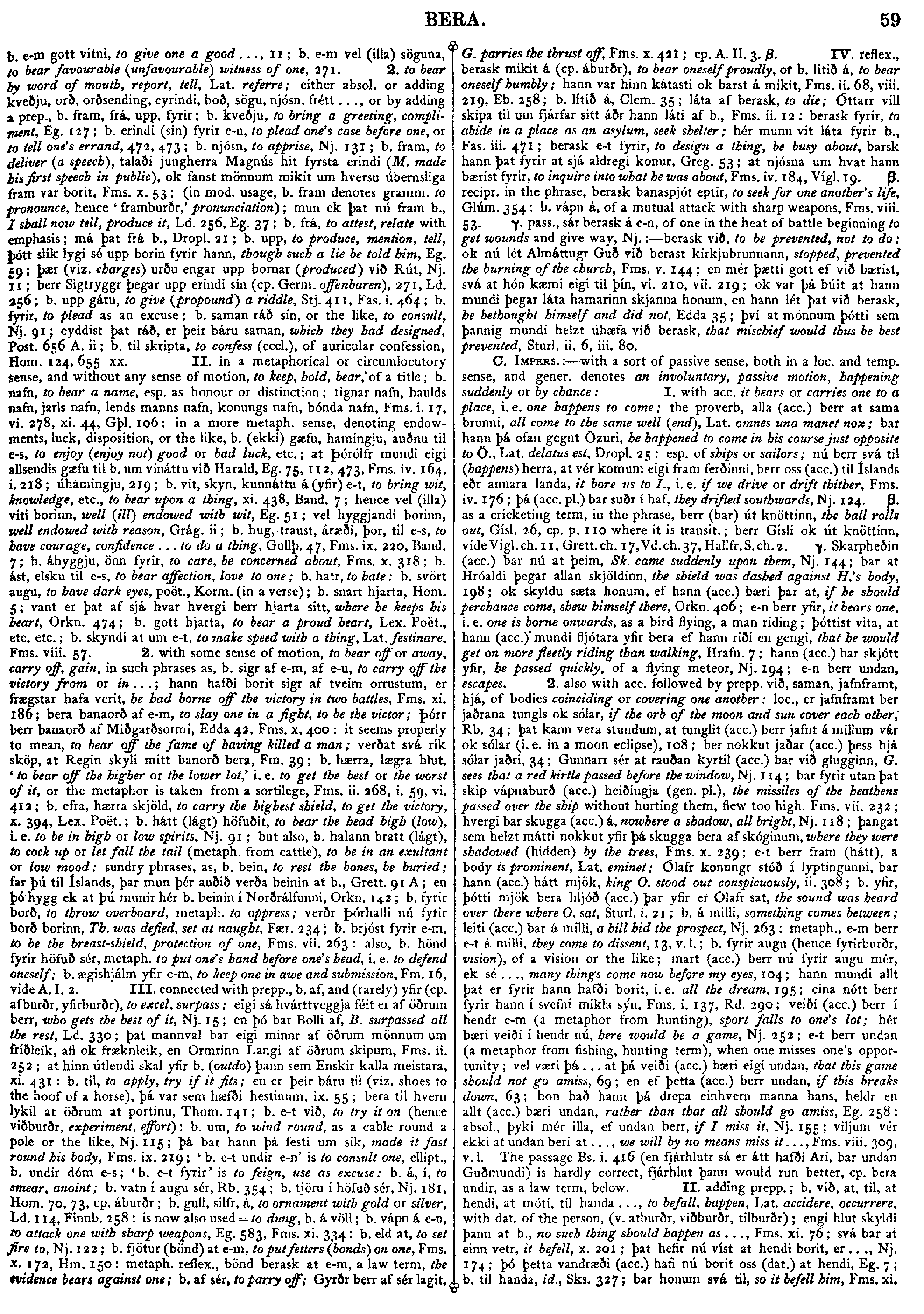
b.
e-m
gott
vitni,
to
give
one
a
good...,
11;
b.
e-m
vel
(illa)
söguna,
to
bear
favourable
(unfavourable)
witness
of
one,
271.
2.
to
bear
by
word
of
mouth,
report,
tell,
Lat.
referre;
either
absol.
or
adding
kveðju,
orð,
orðsending,
eyrindi,
boð,
sögu,
njósn,
frétt...,
or
by
adding
a
prep.,
b.
fram,
frá,
upp,
fyrir;
b.
kveðju,
to
bring
a
greeting,
compliment,
Eg.
127;
b.
erindi
(sín)
fyrir
e-n,
to
plead
one's
case
before
one,
or
to
tell
one's
errand,
472,
473;
b.
njósn,
to
apprise,
Nj.
131;
b.
fram,
to
deliver
(a
speech),
talaði
jungherra
Magnús
hit
fyrsta
erindi
(M.
made
his
first
speech
in
public),
ok
fanst
mönnum
mikit
um
hversu
úbernsliga
fram
var
borit,
Fms.
x.
53;
(in
mod.
usage,
b.
fram
denotes
gramm.
to
pronounce,
hence
'framburðr,'
pronunciation);
mun
ek
þat
nú
fram
b.,
I
shall
now
tell,
produce
it,
Ld.
256,
Eg.
37;
b.
frá,
to
attest,
relate
with
emphasis;
má
þat
frá
b.,
Dropl.
21;
b.
upp,
to
produce,
mention,
tell,
þótt
slík
lygi
sé
upp
borin
fyrir
hann,
though
such
a
lie
be
told
him,
Eg.
59;
þær
(viz.
charges)
urðu
engar
upp
bornar
(produced)
við
Rút,
Nj.
11;
berr
Sigtryggr
þegar
upp
erindi
sín
(cp.
Germ.
ojfenbaren),
271,
Ld.
256;
b.
upp
gátu,
to
give
(propound)
a
riddle,
Stj.
411,
Fas.
i.
464;
b.
fyrir,
to
plead
as
an
excuse;
b.
saman
ráð
sín,
or
the
like,
to
consult,
Nj.
91;
eyddist
þat
ráð,
er
þeir
báru
saman,
which
they
had
designed,
Post.
656
A.
ii;
b.
til
skripta,
to
confess
(eccl.),
of
auricular
confession,
Hom.
124,
655
xx.
II.
in
a
metaphorical
or
circumlocutory
sense,
and
without
any
sense
of
motion,
to
keep,
hold,
bear,
of
a
title;
b.
nafn,
to
bear
a
name,
esp.
as
honour
or
distinction;
tignar
nafn,
haulds
nafn,
jarls
nafn,
lends
manns
nafn,
konungs
nafn,
bónda
nafn,
Fms.
i.
17,
vi.
278,
xi.
44,
Gþl.
106:
in
a
more
metaph.
sense,
denoting
endowments,
luck,
disposition,
or
the
like,
b.
(ekki)
gæfu,
hamingju,
auðnu
til
e-s,
to
enjoy
(enjoy
not)
good
or
bad
luck,
etc.;
at
Þórólfr
mundi
eigi
allsendis
gæfu
til
b.
um
vináttu
við
Harald,
Eg.
75,
112,
473,
Fms.
iv.
164,
i.
218;
úhamingju,
219;
b.
vit,
skyn,
kunnáttu
á
(yfir)
e-t,
to
bring
wit,
knowledge,
etc.,
to
bear
upon
a
thing,
xi.
438,
Band.
7;
hence
vel
(illa)
viti
borinn,
well
(ill)
endowed
with
wit,
Eg.
51;
vel
hyggjandi
borinn,
well
endowed
with
reason,
Grág.
ii;
b.
hug,
traust,
áræði,
þor,
til
e-s,
to
have
courage,
confidence
...
to
do
a
thing,
Gullþ.
47,
Fms.
ix.
220,
Band.
7;
b.
áhyggju,
önn
fyrir,
to
care,
be
concerned
about,
Fms.
x.
318;
b.
ást,
elsku
til
e-s,
to
bear
affection,
love
to
one;
b.
hatr,
to
hate:
b.
svört
augu,
to
have
dark
eyes,
poët.,
Korm.
(in
a
verse);
b.
snart
hjarta,
Hom.
5;
vant
er
þat
af
sjá
hvar
hvergi
berr
hjarta
sitt,
where
he
keeps
his
heart,
Orkn.
474;
b.
gott
hjarta,
to
bear
a
proud
heart,
Lex.
Poët.,
etc.
etc.;
b.
skyndi
at
um
e-t,
to
make
speed
with
a
thing,
Lat.
festinare,
Fms.
viii.
57.
2.
with
some
sense
of
motion,
to
bear
off
or
away,
carry
off,
gain,
in
such
phrases
as,
b.
sigr
af
e-m,
af
e-u,
to
carry
off
the
victory
from
or
in
...;
hann
hafði
borit
sigr
af
tveim
orrustum,
er
frægstar
hafa
verit,
he
had
borne
off
the
victory
in
two
battles,
Fms.
xi.
186;
bera
banaorð
af
e-m,
to
slay
one
in
a
fight,
to
be
the
victor;
Þorr
berr
banaorð
af
Miðgarðsormi,
Edda
42,
Fms.
x.
400:
it
seems
properly
to
mean,
to
bear
off
the
fame
of
having
killed
a
man;
verðat
svá
rík
sköp,
at
Regin
skyli
mitt
banorð
bera,
Fm.
39;
b.
hærra,
lægra
hlut,
'to
bear
off
the
higher
or
the
lower
lot,'
i.
e.
to
get
the
best
or
the
worst
of
it,
or
the
metaphor
is
taken
from
a
sortilege,
Fms.
ii.
268,
i.
59,
vi.
412;
b.
efra,
hærra
skjöld,
to
carry
the
highest
shield,
to
get
the
victory,
x.
394,
Lex.
Poët.;
b.
hátt
(lágt)
höfuðit,
to
bear
the
head
high
(low),
i.
e.
to
be
in
high
or
low
spirits,
Nj.
91;
but
also,
b.
halann
bratt
(lágt),
to
cock
up
or
let
fall
the
tail
(metaph.
from
cattle),
to
be
in
an
exultant
or
low
mood:
sundry
phrases,
as,
b.
bein,
to
rest
the
bones,
be
buried;
far
þú
til
Íslands,
þar
mun
þér
auðið
verða
beinin
at
b.,
Grett.
91
A;
en
þó
hygg
ek
at
þú
munir
hér
b.
beinin
í
Norðrálfunni,
Orkn.
142;
b.
fyrir
borð,
to
throw
overboard,
metaph.
to
oppress;
verðr
Þórhalli
nú
fyrir
borð
borinn,
Th.
was
defied,
set
at
naught,
Fær.
234;
b.
brjóst
fyrir
e-m,
to
be
the
breast-shield,
protection
of
one,
Fms.
vii.
263:
also,
b.
hönd
fyrir
höfuð
sér,
metaph.
to
put
one's
hand
before
one's
head,
i.
e.
to
defend
oneself;
b.
ægishjálm
yfir
e-m,
to
keep
one
in
awe
and
submission,
Fm.
16,
vide
A.
I.
2.
III.
connected
with
prepp.,
b.
af,
and
(rarely)
yfir
(cp.
afburðr,
yfirburðr),
to
excel,
surpass;
eigi
sá
hvárttveggja
féit
er
af
öðrum
berr,
who
gets
the
best
of
it,
Nj.
15;
en
þó
bar
Bolli
af,
B.
surpassed
all
the
rest,
Ld.
330;
þat
mannval
bar
eigi
minnr
af
öðrum
mönnum
um
fríðleik,
afi
ok
fræknleik,
en
Ormrinn
Langi
af
öðrum
skipum,
Fms.
ii.
252;
at
hinn
útlendi
skal
yfir
b.
(outdo)
þann
sem
Enskir
kalla
meistara,
xi.
431:
b.
til,
to
apply,
try
if
it
fits;
en
er
þeir
báru
til
(viz.
shoes
to
the
hoof
of
a
horse),
þá
var
sem
hæfði
hestinum,
ix.
55;
bera
til
hvern
lykil
at
öðrum
at
portinu,
Thom.
141;
b.
e-t
við,
to
try
it
on
(hence
viðburðr,
experiment,
effort):
b.
um,
to
wind
round,
as
a
cable
round
a
pole
or
the
like,
Nj.
115;
þá
bar
hann
þá
festi
um
sik,
made
it
fast
round
his
body,
Fms.
ix.
219;
'b.
e-t
undir
e-n'
is
to
consult
one,
ellipt.,
b.
undir
dóm
e-s;
'b.
e-t
fyrir'
is
to
feign,
use
as
excuse:
b.
á,
í,
to
smear,
anoint;
b.
vatn
í
augu
sér,
Rb.
354;
b.
tjöru
í
höfuð
sér,
Nj.
181,
Hom.
70,
73,
cp.
áburðr;
b.
gull,
silfr,
á,
to
ornament
with
gold
or
silver,
Ld.
114,
Finnb.
258:
is
now
also
used
=
to
dung,
b.
á
völl;
b.
vápn
á
e-n,
to
attack
one
with
sharp
weapons,
Eg.
583,
Fms.
xi.
334:
b.
eld
at,
to
set
fire
to,
Nj.
122;
b.
fjötur
(bönd)
at
e-m,
to
put
fetters
(bonds)
on
one,
Fms.
x.
172,
Hm.
150:
metaph.
reflex.,
bönd
berask
at
e-m,
a
law
term,
the
evidence
bears
against
one;
b.
af
sér,
to
parry
off;
Gyrðr
berr
af
sér
lagit,
G.
parries
the
thrust
off,
Fms.
x.
421;
cp.
A.
II.
3.
 .
IV.
reflex.,
berask
mikit
á
(cp.
áburðr),
to
bear
oneself
proudly,
or
b.
lítið
á,
to
bear
oneself
humbly;
hann
var
hinn
kátasti
ok
barst
á
mikit,
Fms.
ii.
68,
viii.
219,
Eb.
258;
b.
lítið
á,
Clem.
35;
láta
af
berask,
to
die;
Óttarr
vill
skipa
til
um
fjárfar
sitt
áðr
hann
láti
af
b.,
Fms.
ii.
12:
berask
fyrir,
to
abide
in
a
place
as
an
asylum,
seek
shelter;
hér
munu
vit
láta
fyrir
b.,
Fas.
iii.
471;
berask
e-t
fyrir,
to
design
a
thing,
be
busy
about,
barsk
hann
þat
fyrir
at
sjá
aldregi
konur,
Greg.
53;
at
njósna
um
hvat
hann
bærist
fyrir,
to
inquire
into
what
he
was
about,
Fms.
iv.
184,
Vígl.
19.
.
recipr.
in
the
phrase,
berask
banaspjót
eptir,
to
seek
for
one
another's
life,
Glúm.
354:
b.
vápn
á,
of
a
mutual
attack
with
sharp
weapons,
Fms.
viii.
53.
.
IV.
reflex.,
berask
mikit
á
(cp.
áburðr),
to
bear
oneself
proudly,
or
b.
lítið
á,
to
bear
oneself
humbly;
hann
var
hinn
kátasti
ok
barst
á
mikit,
Fms.
ii.
68,
viii.
219,
Eb.
258;
b.
lítið
á,
Clem.
35;
láta
af
berask,
to
die;
Óttarr
vill
skipa
til
um
fjárfar
sitt
áðr
hann
láti
af
b.,
Fms.
ii.
12:
berask
fyrir,
to
abide
in
a
place
as
an
asylum,
seek
shelter;
hér
munu
vit
láta
fyrir
b.,
Fas.
iii.
471;
berask
e-t
fyrir,
to
design
a
thing,
be
busy
about,
barsk
hann
þat
fyrir
at
sjá
aldregi
konur,
Greg.
53;
at
njósna
um
hvat
hann
bærist
fyrir,
to
inquire
into
what
he
was
about,
Fms.
iv.
184,
Vígl.
19.
.
recipr.
in
the
phrase,
berask
banaspjót
eptir,
to
seek
for
one
another's
life,
Glúm.
354:
b.
vápn
á,
of
a
mutual
attack
with
sharp
weapons,
Fms.
viii.
53.
 .
pass.,
sár
berask
á
e-n,
of
one
in
the
heat
of
battle
beginning
to
get
wounds
and
give
way,
Nj.
:--
berask
við,
to
be
prevented,
not
to
do;
ok
nú
lét
Almáttugr
Guð
við
berast
kirkjubrunnann,
stopped,
prevented
the
burning
of
the
church,
Fms.
v.
144;
en
mér
þætti
gott
ef
við
bærist,
svá
at
hón
kæmi
eigi
til
þín,
vi.
210,
vii.
219;
ok
var
þá
búit
at
hann
mundi
þegar
láta
hamarinn
skjanna
honum,
en
hann
lét
þat
við
berask,
he
bethought
himself
and
did
not,
Edda
35;
því
at
mönnum
þótti
sem
þannig
mundi
helzt
úhæfa
við
berask,
that
mischief
would
thus
be
best
prevented,
Sturl.
ii.
6,
iii.
80.
C.
IMPERS.
:--
with
a
sort
of
passive
sense,
both
in
a
loc.
and
temp.
sense,
and
gener.
denotes
an
involuntary,
passive
motion,
happening
suddenly
or
by
chance:
I.
with
acc.
it
bears
or
carries
one
to
a
place,
i.
e.
one
happens
to
come;
the
proverb,
alla
(acc.)
berr
at
sama
brunni,
all
come
to
the
same
well
(end),
Lat.
omnes
una
manet
nox;
bar
hann
þá
ofan
gegnt
Özuri,
he
happened
to
come
in
his
course
just
opposite
to
Ö.,
Lat.
delatus
est,
Dropl.
25:
esp.
of
ships
or
sailors;
nú
berr
svá
til
(happens)
herra,
at
vér
komum
eigi
fram
ferðinni,
berr
oss
(acc.)
til
Íslands
eðr
annara
landa,
it
bore
us
to
I.,
i.
e.
if
we
drive
or
drift
thither,
Fms.
iv.
176;
þá
(acc.
pl.)
bar
suðr
í
haf,
they
drifted
southwards,
Nj.
124.
.
as
a
cricketing
term,
in
the
phrase,
berr
(bar)
út
knöttinn,
the
ball
rolls
out,
Gísl.
26,
cp.
p.
110
where
it
is
transit.;
berr
Gísli
ok
út
knöttinn,
vide
Vígl.
ch.
11,
Grett.
ch.
17,
Vd.
ch.
37,
Hallfr.
S.
ch.
2.
.
Skarpheðin
(acc.)
bar
nú
at
þeim,
Sk.
came
suddenly
upon
them,
Nj.
144;
bar
at
Hróaldi
þegar
allan
skjöldinn,
the
shield
was
dashed
against
H.'s
body,
198;
ok
skyldu
sæta
honum,
ef
hann
(acc.)
bæri
þar
at,
if
he
should
per
chance
come,
shew
himself
there,
Orkn.
406;
e-n
berr
yfir,
it
bears
one,
i.
e.
one
is
borne
onwards,
as
a
bird
flying,
a
man
riding;
þóttist
vita,
at
hann
(acc.)
mundi
fljótara
yfir
bera
ef
hann
riði
en
gengi,
that
he
would
get
on
more
fleetly
riding
than
walking,
Hrafn.
7;
hann
(acc.)
bar
skjótt
yfir,
he
passed
quickly,
of
a
flying
meteor,
Nj.
194;
e-n
berr
undan,
escapes.
2.
also
with
acc.
followed
by
prepp.
við,
saman,
jafnframt,
hjá,
of
bodies
coinciding
or
covering
one
another:
loc.,
er
jafnframt
ber
jaðrana
tungls
ok
sólar,
if
the
orb
of
the
moon
and
sun
cover
each
other,
Rb.
34;
þat
kann
vera
stundum,
at
tunglit
(acc.)
berr
jafht
á
millum
vár
ok
sólar
(i.
e.
in
a
moon
eclipse),
108;
ber
nokkut
jaðar
(acc.)
þess
hjá
sólar
jaðri,
34;
Gunnarr
sér
at
rauðan
kyrtil
(acc.)
bar
við
glugginn,
G.
sees
that
a
red
kirtle
passed
before
the
window,
Nj.
114;
bar
fyrir
utan
þat
skip
vápnaburð
(acc.)
heiðingja
(gen.
pl.),
the
missiles
of
the
heathens
passed
over
the
ship
without
hurting
them,
flew
too
high,
Fms.
vii.
232;
hvergi
bar
skugga
(acc.)
á,
nowhere
a
shadow,
all
bright,
Nj.
118;
þangat
sem
helzt
mátti
nokkut
yfir
þá
skugga
bera
af
skóginum,
where
they
were
shadowed
(hidden)
by
the
trees,
Fms.
x.
239;
e-t
berr
fram
(hátt),
a
body
is
prominent,
Lat.
eminet;
Ólafr
konungr
stóð
í
lyptingunni,
bar
hann
(acc.)
hátt
mjök,
king
O.
stood
out
conspicuously,
ii.
308;
b.
yfir,
þótti
mjök
bera
hljóð
(acc.)
þar
yfir
er
Ólafr
sat,
the
sound
was
heard
over
there
where
O.
sat,
Sturl.
i.
21;
b.
á
milli,
something
comes
between;
leiti
(acc.)
bar
á
milli,
a
hill
hid
the
prospect,
Nj.
263:
metaph.,
e-m
berr
e-t
á
milli,
they
come
to
dissent,
13,
v.
1.;
b.
fyrir
augu
(hence
fyrirburðr,
vision),
of
a
vision
or
the
like;
mart
(acc.)
berr
nú
fyrir
augu
mér,
ek
sé
...,
many
things
come
now
before
my
eyes,
104;
hann
mundi
allt
þat
er
fyrir
hann
hafði
borit,
i.
e.
all
the
dream,
195;
eina
nótt
berr
fyrir
hann
í
svefni
mikla
sýn,
Fms.
i.
137,
Rd.
290;
veiði
(acc.)
berr
í
hendr
e-m
(a
metaphor
from
hunting),
sport
falls
to
one's
lot;
hér
bæri
veiði
í
hendr
nú,
here
would
be
a
game,
Nj.
252;
e-t
berr
undan
(a
metaphor
from
fishing,
hunting
term),
when
one
misses
one's
opportunity;
vel
væri
þá
...
at
þá
veiði
(acc.)
bæri
eigi
undan,
that
this
game
should
not
go
amiss,
69;
en
ef
þetta
(acc.)
berr
undan,
if
this
breaks
down,
63;
hon
bað
hann
þá
drepa
einhvern
manna
hans,
heldr
en
allt
(acc.)
bæri
undan,
rather
than
that
all
should
go
amiss,
Eg.
258:
absol.,
þyki
mér
illa,
ef
undan
berr,
if
I
miss
it,
Nj.
155;
viljum
vér
ekki
at
undan
beri
at...,
we
will
by
no
means
miss
it...,
Fms.
viii.
309,
v.
1.
The
passage
Bs.
i.
416
(en
fjárhlutr
sá
er
átt
hafði
Ari,
bar
undan
Guðmundi)
is
hardly
correct,
fjárhlut
þann
would
run
better,
cp.
bera
undir,
as
a
law
term,
below.
II.
adding
prepp.;
b.
við,
at,
til,
at
hendi,
at
móti,
til
handa
...,
to
befall,
happen,
Lat.
accidere,
occurrere,
with
dat.
of
the
person,
(v.
atburðr,
viðburðr,
tilburðr);
engi
hlut
skyldi
þann
at
b.,
no
such
thing
should
happen
as...,
Fms.
xi.
76;
svá
bar
at
einn
vetr,
it
befell,
x.
201;
þat
hefir
nú
víst
at
hendi
borit,
er...,
Nj.
174;
þó
þetta
vandræði
(acc.)
hafi
nú
borit
oss
(dat.)
at
hendi,
Eg.
7;
b.
til
handa,
id.,
Sks.
327;
bar
honum
svá
til,
so
it
befell
him,
Fms.
.
pass.,
sár
berask
á
e-n,
of
one
in
the
heat
of
battle
beginning
to
get
wounds
and
give
way,
Nj.
:--
berask
við,
to
be
prevented,
not
to
do;
ok
nú
lét
Almáttugr
Guð
við
berast
kirkjubrunnann,
stopped,
prevented
the
burning
of
the
church,
Fms.
v.
144;
en
mér
þætti
gott
ef
við
bærist,
svá
at
hón
kæmi
eigi
til
þín,
vi.
210,
vii.
219;
ok
var
þá
búit
at
hann
mundi
þegar
láta
hamarinn
skjanna
honum,
en
hann
lét
þat
við
berask,
he
bethought
himself
and
did
not,
Edda
35;
því
at
mönnum
þótti
sem
þannig
mundi
helzt
úhæfa
við
berask,
that
mischief
would
thus
be
best
prevented,
Sturl.
ii.
6,
iii.
80.
C.
IMPERS.
:--
with
a
sort
of
passive
sense,
both
in
a
loc.
and
temp.
sense,
and
gener.
denotes
an
involuntary,
passive
motion,
happening
suddenly
or
by
chance:
I.
with
acc.
it
bears
or
carries
one
to
a
place,
i.
e.
one
happens
to
come;
the
proverb,
alla
(acc.)
berr
at
sama
brunni,
all
come
to
the
same
well
(end),
Lat.
omnes
una
manet
nox;
bar
hann
þá
ofan
gegnt
Özuri,
he
happened
to
come
in
his
course
just
opposite
to
Ö.,
Lat.
delatus
est,
Dropl.
25:
esp.
of
ships
or
sailors;
nú
berr
svá
til
(happens)
herra,
at
vér
komum
eigi
fram
ferðinni,
berr
oss
(acc.)
til
Íslands
eðr
annara
landa,
it
bore
us
to
I.,
i.
e.
if
we
drive
or
drift
thither,
Fms.
iv.
176;
þá
(acc.
pl.)
bar
suðr
í
haf,
they
drifted
southwards,
Nj.
124.
.
as
a
cricketing
term,
in
the
phrase,
berr
(bar)
út
knöttinn,
the
ball
rolls
out,
Gísl.
26,
cp.
p.
110
where
it
is
transit.;
berr
Gísli
ok
út
knöttinn,
vide
Vígl.
ch.
11,
Grett.
ch.
17,
Vd.
ch.
37,
Hallfr.
S.
ch.
2.
.
Skarpheðin
(acc.)
bar
nú
at
þeim,
Sk.
came
suddenly
upon
them,
Nj.
144;
bar
at
Hróaldi
þegar
allan
skjöldinn,
the
shield
was
dashed
against
H.'s
body,
198;
ok
skyldu
sæta
honum,
ef
hann
(acc.)
bæri
þar
at,
if
he
should
per
chance
come,
shew
himself
there,
Orkn.
406;
e-n
berr
yfir,
it
bears
one,
i.
e.
one
is
borne
onwards,
as
a
bird
flying,
a
man
riding;
þóttist
vita,
at
hann
(acc.)
mundi
fljótara
yfir
bera
ef
hann
riði
en
gengi,
that
he
would
get
on
more
fleetly
riding
than
walking,
Hrafn.
7;
hann
(acc.)
bar
skjótt
yfir,
he
passed
quickly,
of
a
flying
meteor,
Nj.
194;
e-n
berr
undan,
escapes.
2.
also
with
acc.
followed
by
prepp.
við,
saman,
jafnframt,
hjá,
of
bodies
coinciding
or
covering
one
another:
loc.,
er
jafnframt
ber
jaðrana
tungls
ok
sólar,
if
the
orb
of
the
moon
and
sun
cover
each
other,
Rb.
34;
þat
kann
vera
stundum,
at
tunglit
(acc.)
berr
jafht
á
millum
vár
ok
sólar
(i.
e.
in
a
moon
eclipse),
108;
ber
nokkut
jaðar
(acc.)
þess
hjá
sólar
jaðri,
34;
Gunnarr
sér
at
rauðan
kyrtil
(acc.)
bar
við
glugginn,
G.
sees
that
a
red
kirtle
passed
before
the
window,
Nj.
114;
bar
fyrir
utan
þat
skip
vápnaburð
(acc.)
heiðingja
(gen.
pl.),
the
missiles
of
the
heathens
passed
over
the
ship
without
hurting
them,
flew
too
high,
Fms.
vii.
232;
hvergi
bar
skugga
(acc.)
á,
nowhere
a
shadow,
all
bright,
Nj.
118;
þangat
sem
helzt
mátti
nokkut
yfir
þá
skugga
bera
af
skóginum,
where
they
were
shadowed
(hidden)
by
the
trees,
Fms.
x.
239;
e-t
berr
fram
(hátt),
a
body
is
prominent,
Lat.
eminet;
Ólafr
konungr
stóð
í
lyptingunni,
bar
hann
(acc.)
hátt
mjök,
king
O.
stood
out
conspicuously,
ii.
308;
b.
yfir,
þótti
mjök
bera
hljóð
(acc.)
þar
yfir
er
Ólafr
sat,
the
sound
was
heard
over
there
where
O.
sat,
Sturl.
i.
21;
b.
á
milli,
something
comes
between;
leiti
(acc.)
bar
á
milli,
a
hill
hid
the
prospect,
Nj.
263:
metaph.,
e-m
berr
e-t
á
milli,
they
come
to
dissent,
13,
v.
1.;
b.
fyrir
augu
(hence
fyrirburðr,
vision),
of
a
vision
or
the
like;
mart
(acc.)
berr
nú
fyrir
augu
mér,
ek
sé
...,
many
things
come
now
before
my
eyes,
104;
hann
mundi
allt
þat
er
fyrir
hann
hafði
borit,
i.
e.
all
the
dream,
195;
eina
nótt
berr
fyrir
hann
í
svefni
mikla
sýn,
Fms.
i.
137,
Rd.
290;
veiði
(acc.)
berr
í
hendr
e-m
(a
metaphor
from
hunting),
sport
falls
to
one's
lot;
hér
bæri
veiði
í
hendr
nú,
here
would
be
a
game,
Nj.
252;
e-t
berr
undan
(a
metaphor
from
fishing,
hunting
term),
when
one
misses
one's
opportunity;
vel
væri
þá
...
at
þá
veiði
(acc.)
bæri
eigi
undan,
that
this
game
should
not
go
amiss,
69;
en
ef
þetta
(acc.)
berr
undan,
if
this
breaks
down,
63;
hon
bað
hann
þá
drepa
einhvern
manna
hans,
heldr
en
allt
(acc.)
bæri
undan,
rather
than
that
all
should
go
amiss,
Eg.
258:
absol.,
þyki
mér
illa,
ef
undan
berr,
if
I
miss
it,
Nj.
155;
viljum
vér
ekki
at
undan
beri
at...,
we
will
by
no
means
miss
it...,
Fms.
viii.
309,
v.
1.
The
passage
Bs.
i.
416
(en
fjárhlutr
sá
er
átt
hafði
Ari,
bar
undan
Guðmundi)
is
hardly
correct,
fjárhlut
þann
would
run
better,
cp.
bera
undir,
as
a
law
term,
below.
II.
adding
prepp.;
b.
við,
at,
til,
at
hendi,
at
móti,
til
handa
...,
to
befall,
happen,
Lat.
accidere,
occurrere,
with
dat.
of
the
person,
(v.
atburðr,
viðburðr,
tilburðr);
engi
hlut
skyldi
þann
at
b.,
no
such
thing
should
happen
as...,
Fms.
xi.
76;
svá
bar
at
einn
vetr,
it
befell,
x.
201;
þat
hefir
nú
víst
at
hendi
borit,
er...,
Nj.
174;
þó
þetta
vandræði
(acc.)
hafi
nú
borit
oss
(dat.)
at
hendi,
Eg.
7;
b.
til
handa,
id.,
Sks.
327;
bar
honum
svá
til,
so
it
befell
him,
Fms.
|
Source: Cleasby/Vigfusson, page b0173, entry 29 View original page image as: [TIFF] [PNG] [View previous entry] [View next entry] |
[Comment on this entry] [View comments] |
The following entry has been hand-corrected once. |
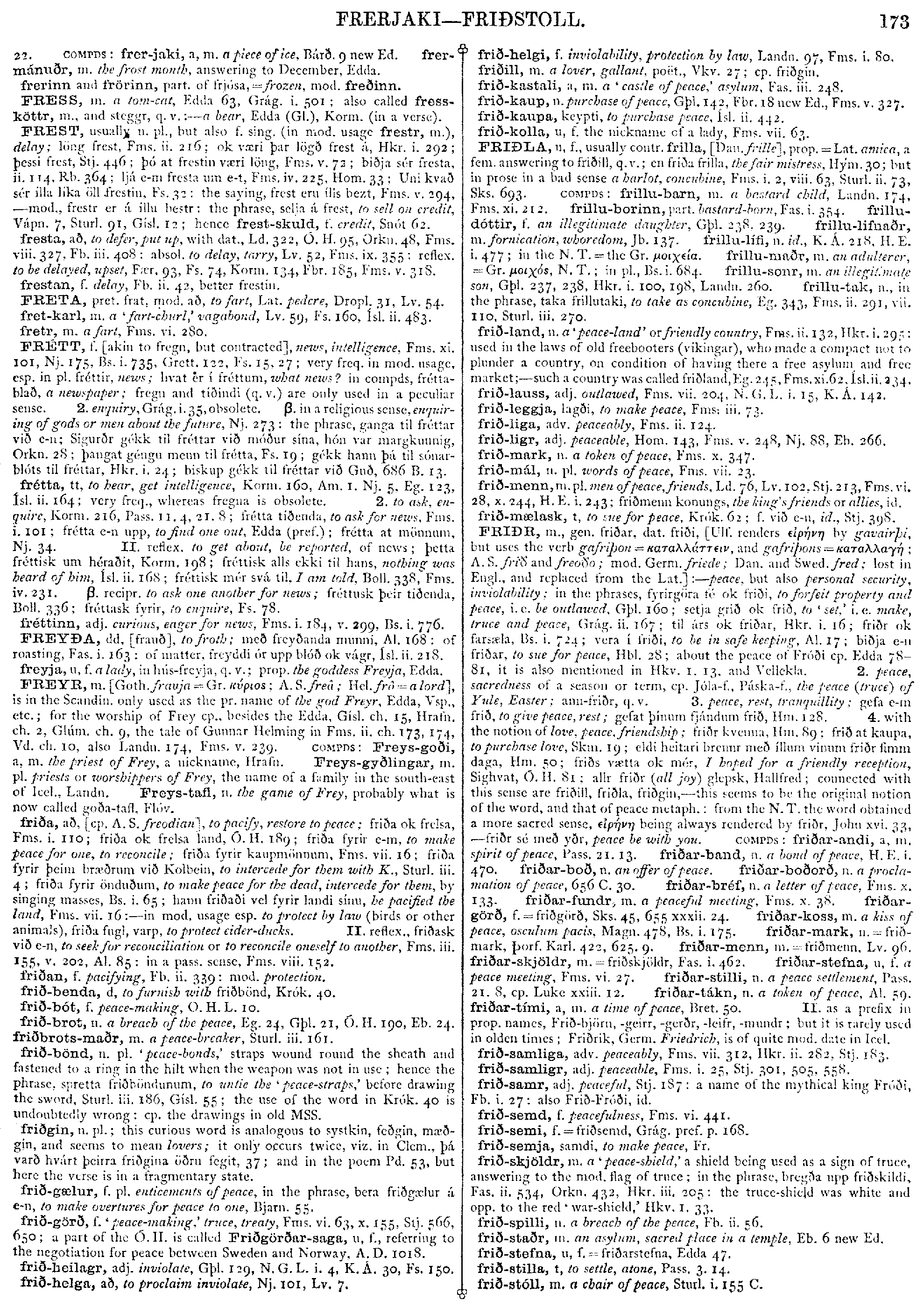
frið-kastali, a, m. a 'castle of peace,' asylum, Fas. iii. 248.
|
Source: Cleasby/Vigfusson, page b0173, entry 34 View original page image as: [TIFF] [PNG] [View previous entry] [View next entry] |
[Comment on this entry] [View comments] |
The following entry has been hand-corrected once. |
frið-land, n. a 'peace-land' or friendly country, Fms. ii. 132, Hkr. i. 295: used in the laws of old freebooters (víkingar), who made a compact not to plunder a country, on condition of having there a free asylum and free market; -- such a country was called friðland, Eg. 245, Fms. xi. 62, Ísl. ii. 334.
|
Source: Cleasby/Vigfusson, page b0173, entry 52 View original page image as: [TIFF] [PNG] [View previous entry] [View next entry] |
[Comment on this entry] [View comments] |
The following entry has been hand-corrected once. |
frið-staðr, m. an asylum, sacred place in a temple, Eb. 6 new Ed.
|
Source: Cleasby/Vigfusson, page b0215, entry 3 View original page image as: [TIFF] [PNG] [View previous entry] [View next entry] |
[Comment on this entry] [View comments] |
The following entry has been hand-corrected once. |
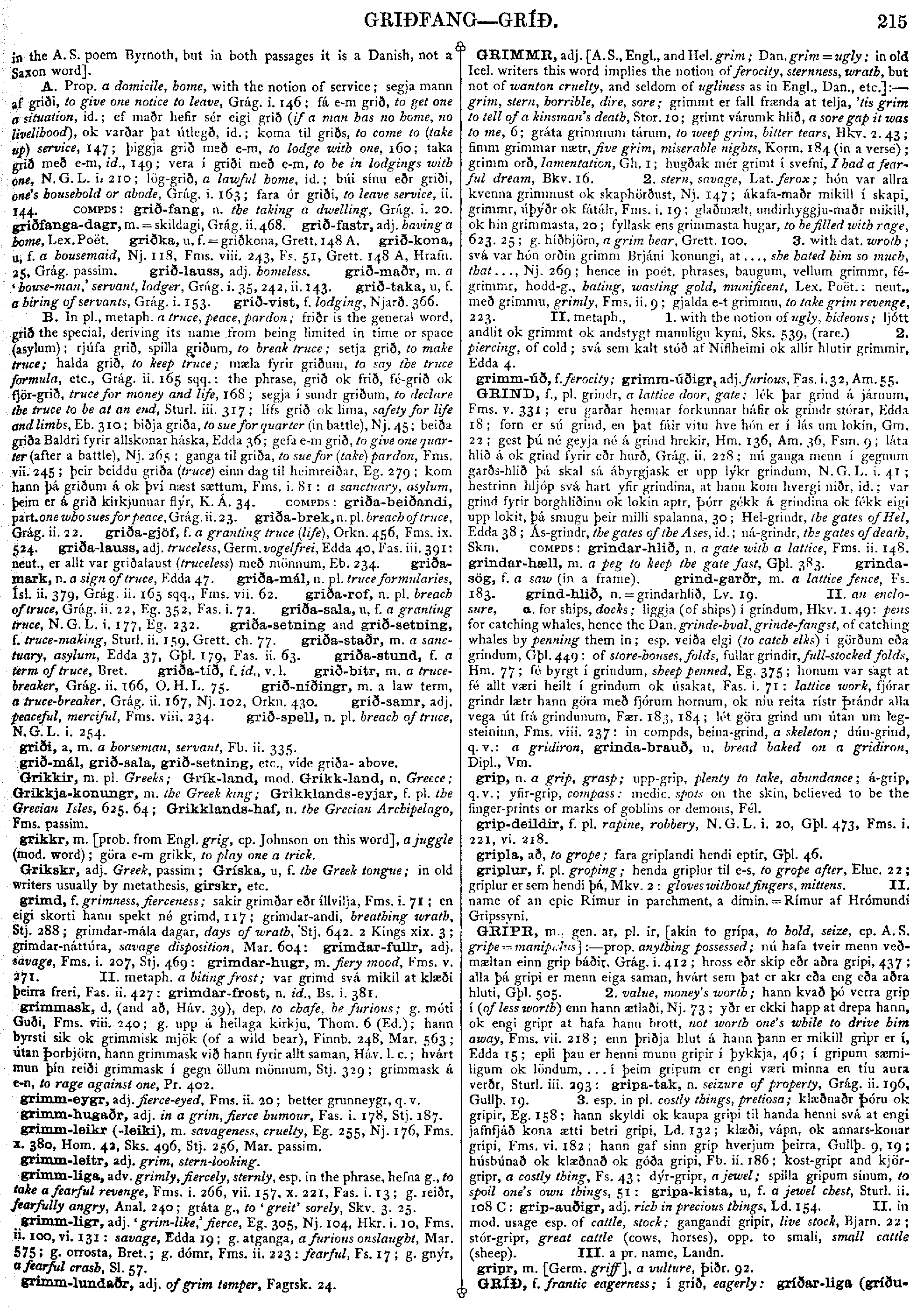
B. In pl., metaph. a truce, peace, pardon; friðr is the general word, grið the special, deriving its name from being limited in time or space (asylum); rjúfa grið, spilla griðum, to break truce; setja grið, to make truce; halda grið, to keep truce; mæla fyrir griðum, to say the truce formula, etc., Grág. ii. 165 sqq.: the phrase, grið ok frið, fé-grið ok fjör-grið, truce for money and life, 168; segja í sundr griðum, to declare the truce to be at an end, Sturl. iii. 317; lífs grið ok lima, safety for life and limbs, Eb. 310; biðja griða, to sue for quarter (in battle), Nj. 45; beiða griða Baldri fyrir allskonar háska, Edda 36; gefa e-m grið, to give one quarter (after a battle), Nj. 265; ganga til griða, to sue for (take) pardon, Fms. vii. 245; þeir beiddu griða (truce) einn dag til heimreiðar, Eg. 279; kom hann þá griðum á ok því næst sættum, Fms. i. 81: a sanctuary, asylum, þeim er á grið kirkjunnar flýr, K. Á. 34. COMPDS: griða-beiðandi, part. one who sues for peace, Grág. ii. 23. griða-brek, n. pl. breach of truce, Grág. ii. 22. griða-gjöf, f. a granting truce (life), Orkn. 456, Fms. ix. 524. griða-lauss, adj. truceless, Germ. vogelfrei, Edda 40, Fas. iii. 391: neut., er allt var griðalaust (truceless) með mönnum, Eb. 234. griða-mark, n. a sign of truce, Edda 47. griða-mál, n. pl. truce formularies, Ísl. ii. 379. Grág. ii. 165 sqq., Fms. vii. 62, griða-rof, n. pl. breach of truce, Grág. ii. 22, Eg. 352, Fas. i. 72. griða-sala, u, f. a granting truce, N. G. L. i. 177, Eg. 232. griða-setning and grið-setning, f. truce-making, Sturl. ii. 159, Grett. ch. 77. griða-staðr, m. a sanctuary, asylum, Edda 37, Gþl. 179, Fas. ii. 63. griða-stund, f. a term of truce, Bret. griða-tíð, f. id., v.l. grið-bítr, m. a truce-breaker, Grág. ii. 166, O. H. L. 75. grið-níðingr, m. a law term, a truce-breaker, Grág. ii. 167, Nj. 102, Orkn. 430. grið-samr, adj. peaceful, merciful, Fms. viii. 234. grið-spell, n. pl. breach of truce, N. G. L. i. 254.
|
Source: Cleasby/Vigfusson, page b0278, entry 1 View original page image as: [TIFF] [PNG] [View previous entry] [View next entry] |
[Comment on this entry] [View comments] |
The following entry has been hand-corrected once. |
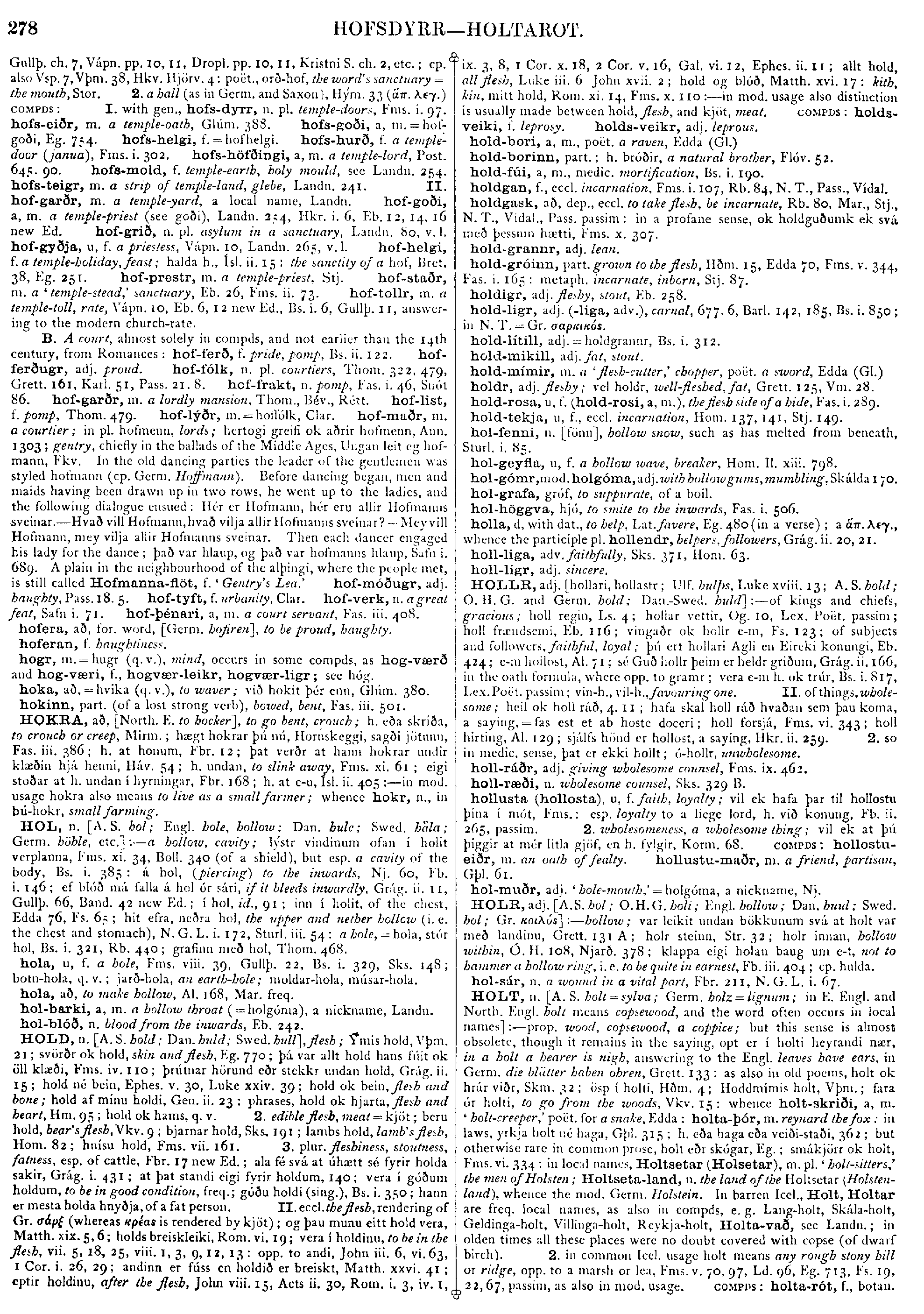
Gullþ. ch. 7, Vápn. pp. 10, 11, Dropl. pp. 10, 11, Kristni S. ch. 2, etc.; cp. also Vsp. 7, Vþm. 38, Hkv. Hjörv. 4: poët., orð-hof, the word's sanctuary = the mouth, Stor. 2. a hall (as in Germ. and Saxon), Hým. 33 (GREEK.) COMPDS: I. with gen., hofs-dyrr, n. pl. temple-doors, Fms. i. 97. hofs-eiðr, m. a temple-oath, Glúm. 388. hofs-goði, a, m. = hofgoði, Eg. 754. hofs-helgi, f. = hofhelgi. hofs-hurð, f. a temple-door (janua), Fms. i. 302. hofs-höfðingi, a, m. a temple-lord, Post. 645. 90. hofs-mold, f. temple-earth, holy mould, see Landn. 254. hofs-teigr, m. a strip of temple-land, glebe, Landn. 241. II. hof-garðr, m. a temple-yard, a local name, Landn. hof-goði, a, m. a temple-priest (see goði), Landn. 254, Hkr. i. 6, Eb. 12, 14, 16 new Ed. hof-grið, n. pl. asylum in a sanctuary, Landn. 80, v.l. hof-gyðja, u, f. a priestess, Vápn. 10, Landn. 265, v.l. hof-helgi, f. a temple-holiday, feast; halda h., Ísl. ii. 15: the sanctity of a hof, Bret. 38, Eg. 251. hof-prestr, m. a temple-priest, Stj. hof-staðr, m. a 'temple-stead,' sanctuary, Eb. 26, Fms. ii. 73. hof-tollr, m. a temple-toll, rate, Vápn. 10, Eb. 6, 12 new Ed., Bs. i. 6, Gullþ. 11, answering to the modern church-rate.
| Result Page: |  |
Previous | 1 2 3 4 | Next |  |
Germanic Lexicon Project (main page)
This search system was written by
Sean Crist
Please consider
volunteering
to correct the data in these online dictionaries.
No rights reserved. Feel free to use these data in any way you please.