|
|

|
Source: Bosworth/Toller, page b0436, entry 22 View original page image as: [TIFF] [PNG] [View previous entry] [View next entry] |
[Comment on this entry] [View comments] |
The following entry has been hand-corrected once. |
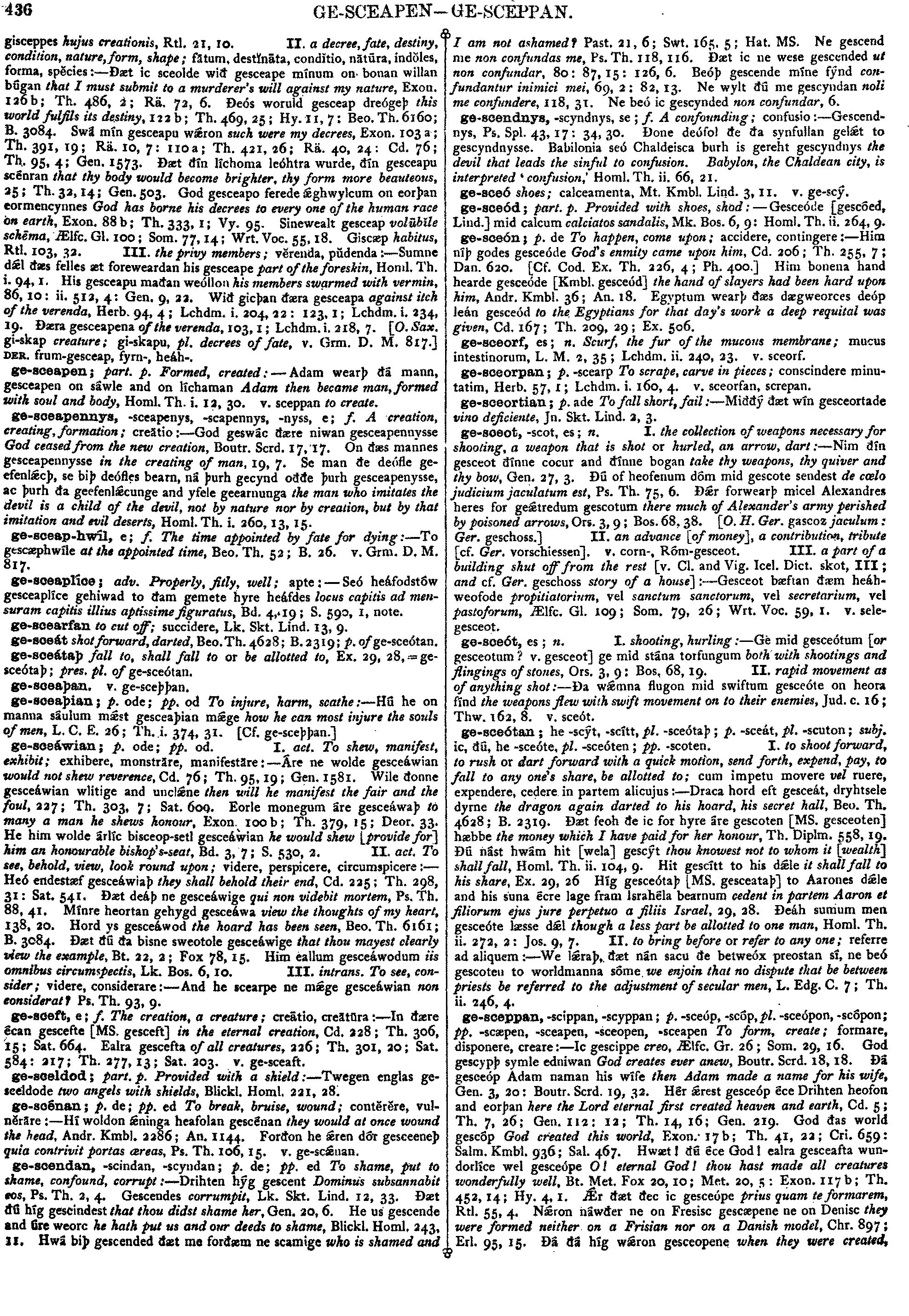
ge-sceot,
-scot,
es;
n.
I.
the
collection
of
weapons
necessary
for
shooting,
a
weapon
that
is
shot
or
hurled,
an
arrow,
dart
:--
Nim
ðín
gesceot
ðínne
cocur
and
ðínne
bogan
take
thy
weapons,
thy
quiver
and
thy
bow,
Gen,
27,
3.
Ðú
of
heofenum
dóm
mid
gescote
sendest
de
cælo
judicium
jaculatum
est,
Ps.
Th.
75,
6.
Ð r
forwearþ
micel
Alexandres
heres
for
getredum
gescotum
there
much
of
Alexander's
army
perished
by
poisoned
arrows,
Ors.
3,
9;
Bos.
68,
38.
[O.
H.
Ger.
gaseoz
jaculum:
Ger.
geschoss.]
II.
an
advance
[of
money],
a
contribution,
tribute
[cf.
Ger.
vorschiessen].
v.
corn-,
Róm-gesceot.
III.
a
part
of
a
building
shut
off
from
the
rest
[v.
Cl.
and
Vig.
Icel.
Dict.
skot,
III
;
and
cf.
Ger.
geschoss
story
of
a
house]
:--
Gesceot
bæftan
ðæm
heáhweofode
propitiatorium,
vel
sanctum
sanctorum,
vel
secretarium,
vel
pastoforum,
Ælfc.
Gl.
109;
Som.
79,
26;
Wrt.
Voc.
59,
1.
v.
selegesceot.
r
forwearþ
micel
Alexandres
heres
for
getredum
gescotum
there
much
of
Alexander's
army
perished
by
poisoned
arrows,
Ors.
3,
9;
Bos.
68,
38.
[O.
H.
Ger.
gaseoz
jaculum:
Ger.
geschoss.]
II.
an
advance
[of
money],
a
contribution,
tribute
[cf.
Ger.
vorschiessen].
v.
corn-,
Róm-gesceot.
III.
a
part
of
a
building
shut
off
from
the
rest
[v.
Cl.
and
Vig.
Icel.
Dict.
skot,
III
;
and
cf.
Ger.
geschoss
story
of
a
house]
:--
Gesceot
bæftan
ðæm
heáhweofode
propitiatorium,
vel
sanctum
sanctorum,
vel
secretarium,
vel
pastoforum,
Ælfc.
Gl.
109;
Som.
79,
26;
Wrt.
Voc.
59,
1.
v.
selegesceot.
|
Source: Bosworth/Toller, page b0437, entry 16 View original page image as: [TIFF] [PNG] [View previous entry] [View next entry] |
[Comment on this entry] [View comments] |
The following entry has been hand-corrected once. |
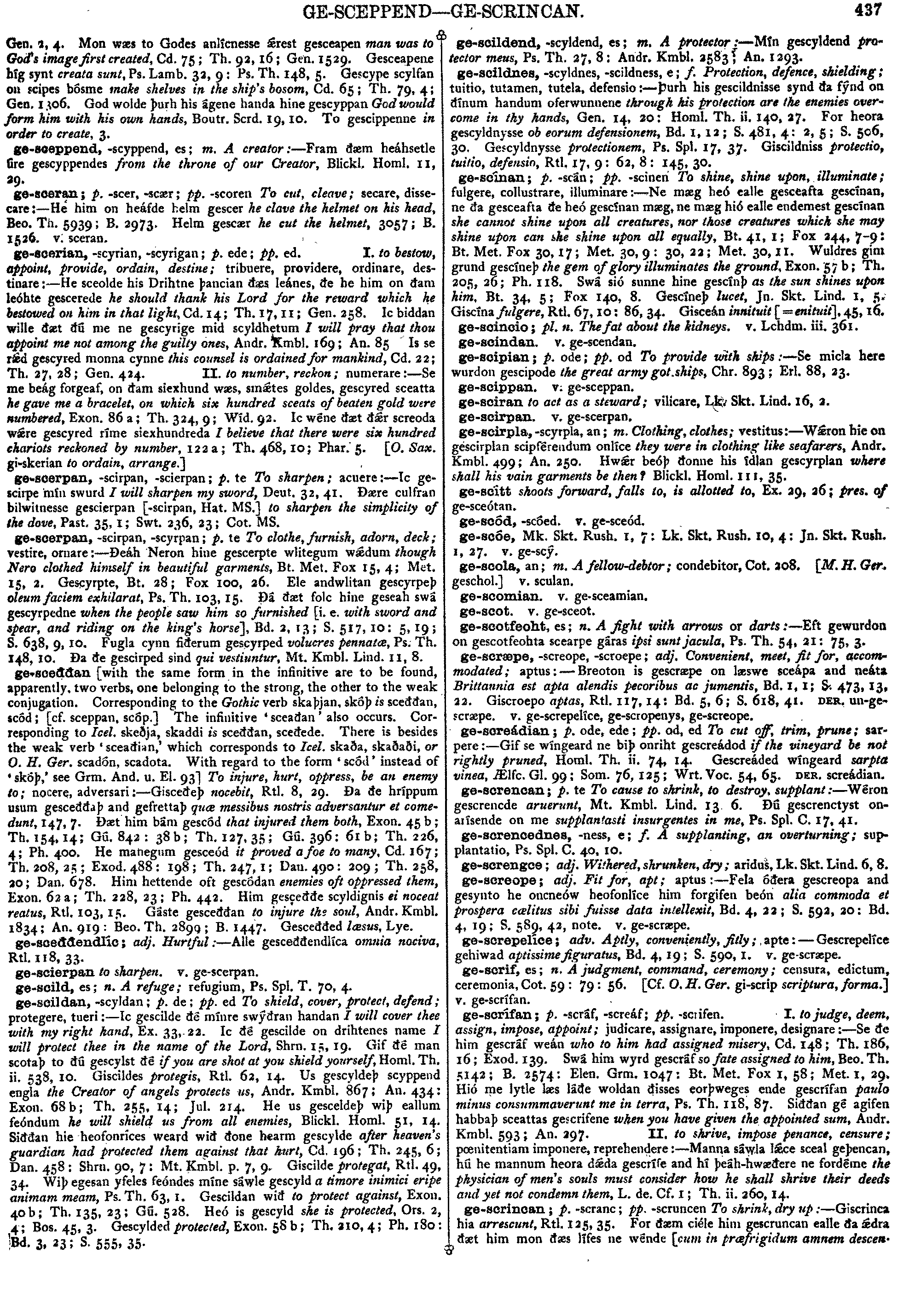
ge-scipian; p. ode; pp. od To provide with ships :-- Se micla here wurdon gescipode the great army got ships, Chr. 893; Erl. 88, 23.
|
Source: Bosworth/Toller, page b0446, entry 2 View original page image as: [TIFF] [PNG] [View previous entry] [View next entry] |
[Comment on this entry] [View comments] |
The following entry has been hand-corrected once. |
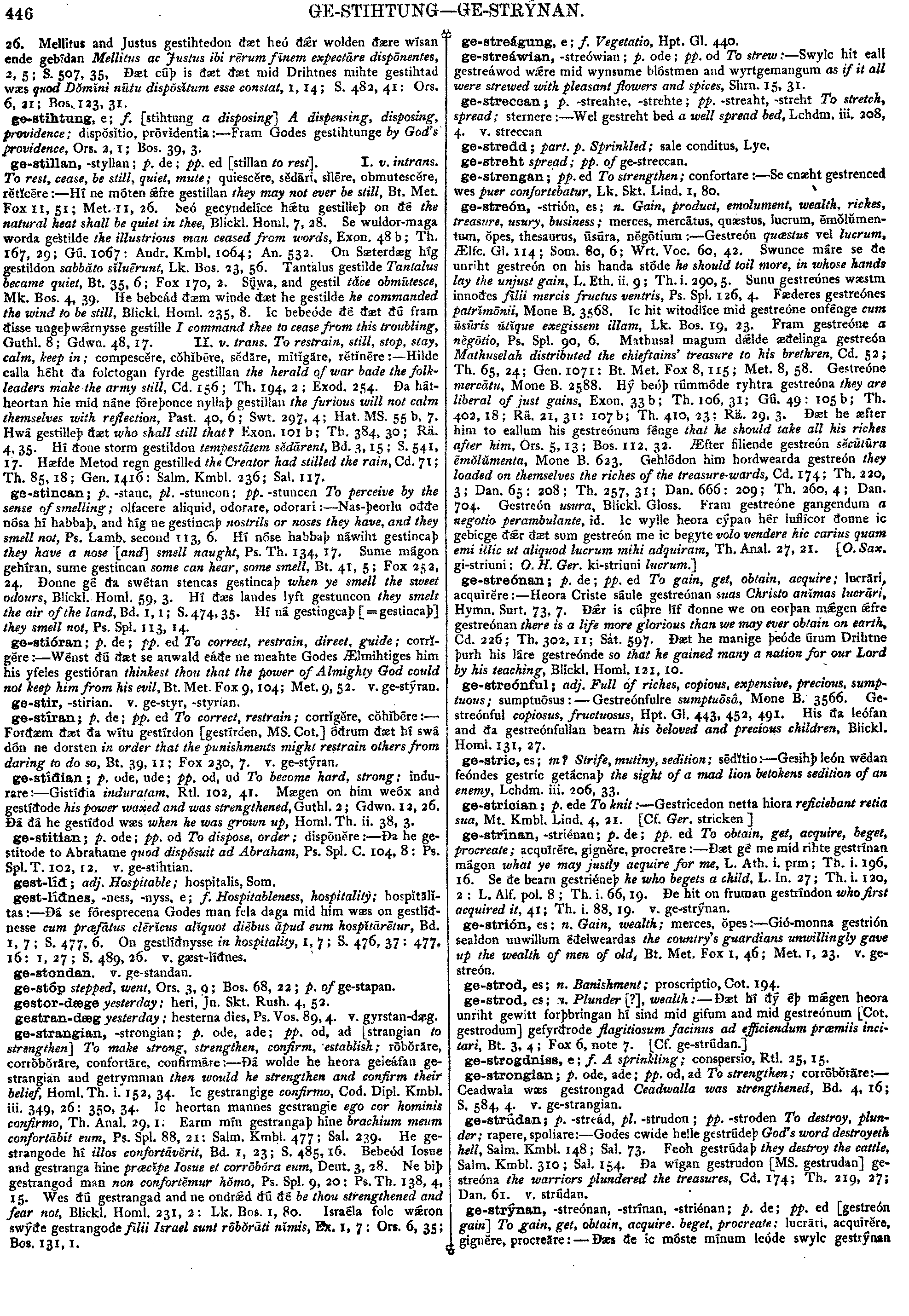
ge-stillan,
-styllan;
p.
de;
pp.
ed
[stillan
to
rest].
I.
v.
intrans.
To
rest,
cease,
be
still,
quiet,
mute;
quiesc re,
sd
re,
sd ri,
s
ri,
s l
l re,
obmutescre,
rtcre
:--
Hí
ne
móten
fre
gestillan
they
may
not
ever
be
still,
Bt.
Met.
Fox
11,
51;
Met.
11,
26.
Seó
gecyndelíce
htu
gestilleþ
on
ðé
the
natural
heat
shall
be
quiet
in
thee,
Blickl.
Homl.
7,
28.
Se
wuldor-maga
worda
gestilde
the
illustrious
man
ceased
from
words,
Exon.
48
b;
Th.
167,
29;
Gú.
1067:
Andr.
Kmbl.
1064;
An.
532.
On
Sæterdæg
híg
gestildon
sabb
re,
obmutescre,
rtcre
:--
Hí
ne
móten
fre
gestillan
they
may
not
ever
be
still,
Bt.
Met.
Fox
11,
51;
Met.
11,
26.
Seó
gecyndelíce
htu
gestilleþ
on
ðé
the
natural
heat
shall
be
quiet
in
thee,
Blickl.
Homl.
7,
28.
Se
wuldor-maga
worda
gestilde
the
illustrious
man
ceased
from
words,
Exon.
48
b;
Th.
167,
29;
Gú.
1067:
Andr.
Kmbl.
1064;
An.
532.
On
Sæterdæg
híg
gestildon
sabb to
slurunt,
Lk.
Bos.
23,
56.
Tantalus
gestilde
Tantalus
became
quiet,
Bt.
35,
6;
Fox
170,
2.
Súwa,
and
gestil
tce
obm
to
slurunt,
Lk.
Bos.
23,
56.
Tantalus
gestilde
Tantalus
became
quiet,
Bt.
35,
6;
Fox
170,
2.
Súwa,
and
gestil
tce
obm tesce,
Mk.
Bos.
4,
39.
He
bebeád
ðæm
winde
ðæt
he
gestilde
he
commanded
the
wind
to
be
still,
Blickl.
Homl.
235,
8.
Ic
bebeóde
ðé
ðæt
ðú
fram
ðisse
ungeþwrnysse
gestille
I
command
thee
to
cease
from
this
troubling,
Guthl.
8;
Gdwn.
48,
17.
II.
v.
trans.
To
restrain,
still,
stop,
stay,
calm,
keep
in;
compescre,
c
tesce,
Mk.
Bos.
4,
39.
He
bebeád
ðæm
winde
ðæt
he
gestilde
he
commanded
the
wind
to
be
still,
Blickl.
Homl.
235,
8.
Ic
bebeóde
ðé
ðæt
ðú
fram
ðisse
ungeþwrnysse
gestille
I
command
thee
to
cease
from
this
troubling,
Guthl.
8;
Gdwn.
48,
17.
II.
v.
trans.
To
restrain,
still,
stop,
stay,
calm,
keep
in;
compescre,
c hbre,
sdre,
m
hbre,
sdre,
m tgre,
rtnre
:--
Hilde
calla
héht
ða
folctogan
fyrde
gestillan
the
herald
of
war
bade
the
folk-leaders
make
the
army
still,
Cd.
156;
Th.
194,
2;
Exod.
254.
Ða
hátheortan
hie
mid
náne
fóreþonce
nyllaþ
gestillan
the
furious
will
not
calm
themselves
with
reflection,
Past.
40,
6;
Swt.
297,
4;
Hat.
MS.
55
b,
7.
Hwá
gestilleþ
ðæt
who
shall
still
that?
Exon.
l01
b;
Th.
384,
30;
Rä.
4,
35.
Hí
ðone
storm
gestildon
tempesttem
sdrent,
Bd.
3,
15;
S.
541,
17.
Hæfde
Metod
regn
gestilled
the
Creator
had
stilled
the
rain,
Cd.
71;
tgre,
rtnre
:--
Hilde
calla
héht
ða
folctogan
fyrde
gestillan
the
herald
of
war
bade
the
folk-leaders
make
the
army
still,
Cd.
156;
Th.
194,
2;
Exod.
254.
Ða
hátheortan
hie
mid
náne
fóreþonce
nyllaþ
gestillan
the
furious
will
not
calm
themselves
with
reflection,
Past.
40,
6;
Swt.
297,
4;
Hat.
MS.
55
b,
7.
Hwá
gestilleþ
ðæt
who
shall
still
that?
Exon.
l01
b;
Th.
384,
30;
Rä.
4,
35.
Hí
ðone
storm
gestildon
tempesttem
sdrent,
Bd.
3,
15;
S.
541,
17.
Hæfde
Metod
regn
gestilled
the
Creator
had
stilled
the
rain,
Cd.
71;
|
Source: Bosworth/Toller, page b0447, entry 14 View original page image as: [TIFF] [PNG] [View previous entry] [View next entry] |
[Comment on this entry] [View comments] |
The following entry has been hand-corrected once. |
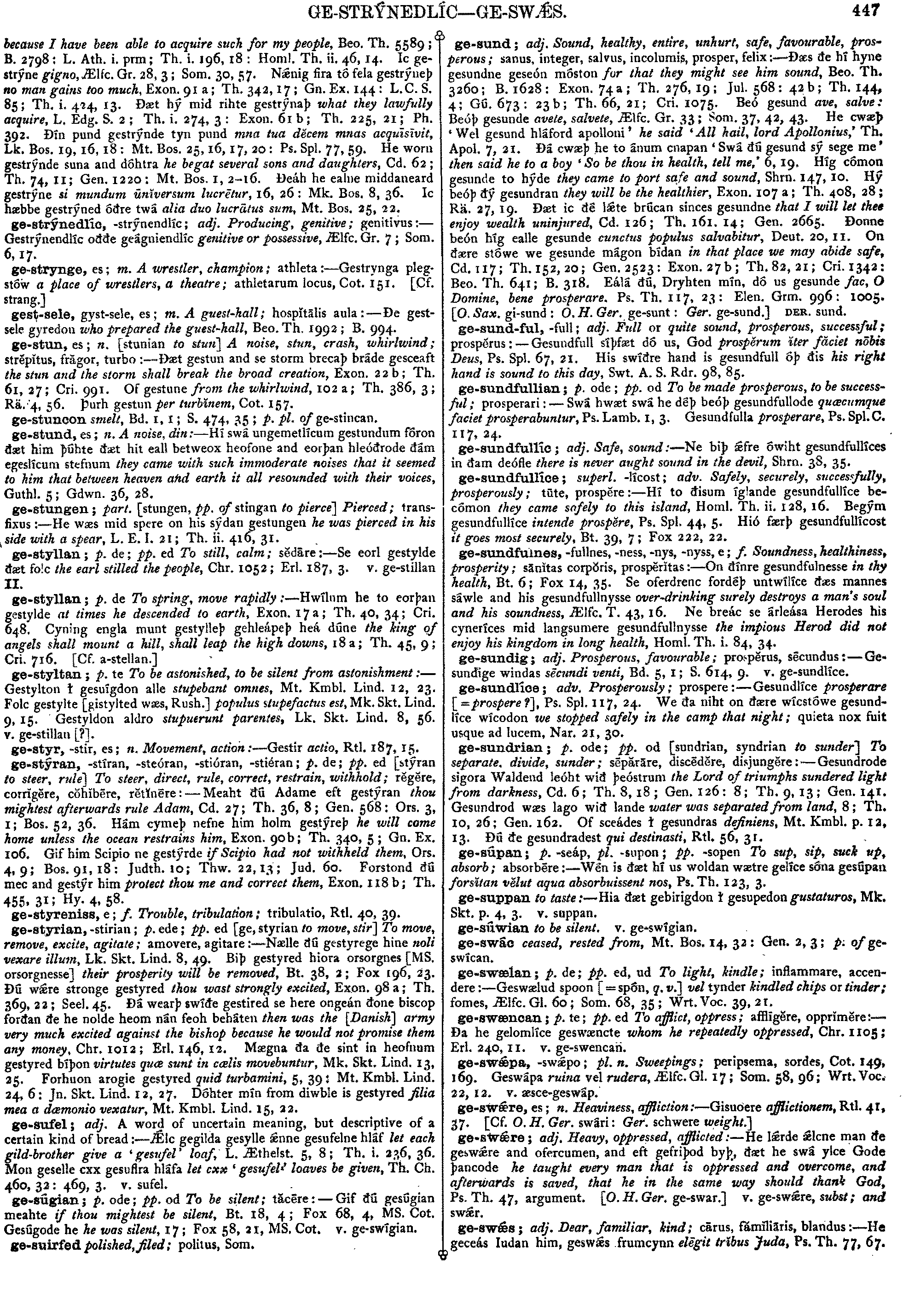
ge-styrian,
-stirian;
p.
ede;
pp.
ed
[ge,
styrian
to
move,
stir]
To
move,
remove,
excite,
agitate;
amovere,
agitare
:--
Nælle
ðú
gestyrege
hine
noli
vexare
illum,
Lk.
Skt.
Lind.
8,
49.
Biþ
gestyred
hiora
orsorgnes
[MS.
orsorgnesse]
their
prosperity
will
be
removed,
Bt.
38,
2;
Fox
196,
23.
Ðú
wre
stronge
gestyred
thou
wast
strongly
excited,
Exon.
98
a;
Th.
369,
22;
Seel.
45.
Ðá
wearþ
swíðe
gestired
se
here
ongeán
ðone
biscop
forðan
ðe
he
nolde
heom
nán
feoh
beháten
then
was
the
[Danish]
army
very
much
excited
against
the
bishop
because
he
would
not
promise
them
any
money,
Chr.
1012;
Erl.
146,
12.
Mægna
ða
ðe
sint
in
heofnum
gestyred
bíþon
virtutes
quæ
sunt
in
cælis
movebuntur,
Mk.
Skt.
Lind.
13,
25.
Forhuon
arogie
gestyred
quid
turbamini,
5,
39:
Mt.
Kmbl.
Lind.
24,
6:
Jn.
Skt.
Lind.
12,
27.
Dóhter
mín
from
diwble
is
gestyred
filia
mea
a
dæmonio
vexatur,
Mt.
Kmbl.
Lind.
15,
22.
|
Source: Bosworth/Toller, page b0460, entry 38 View original page image as: [TIFF] [PNG] [View previous entry] [View next entry] |
[Comment on this entry] [View comments] |
The following entry has been hand-corrected once. |
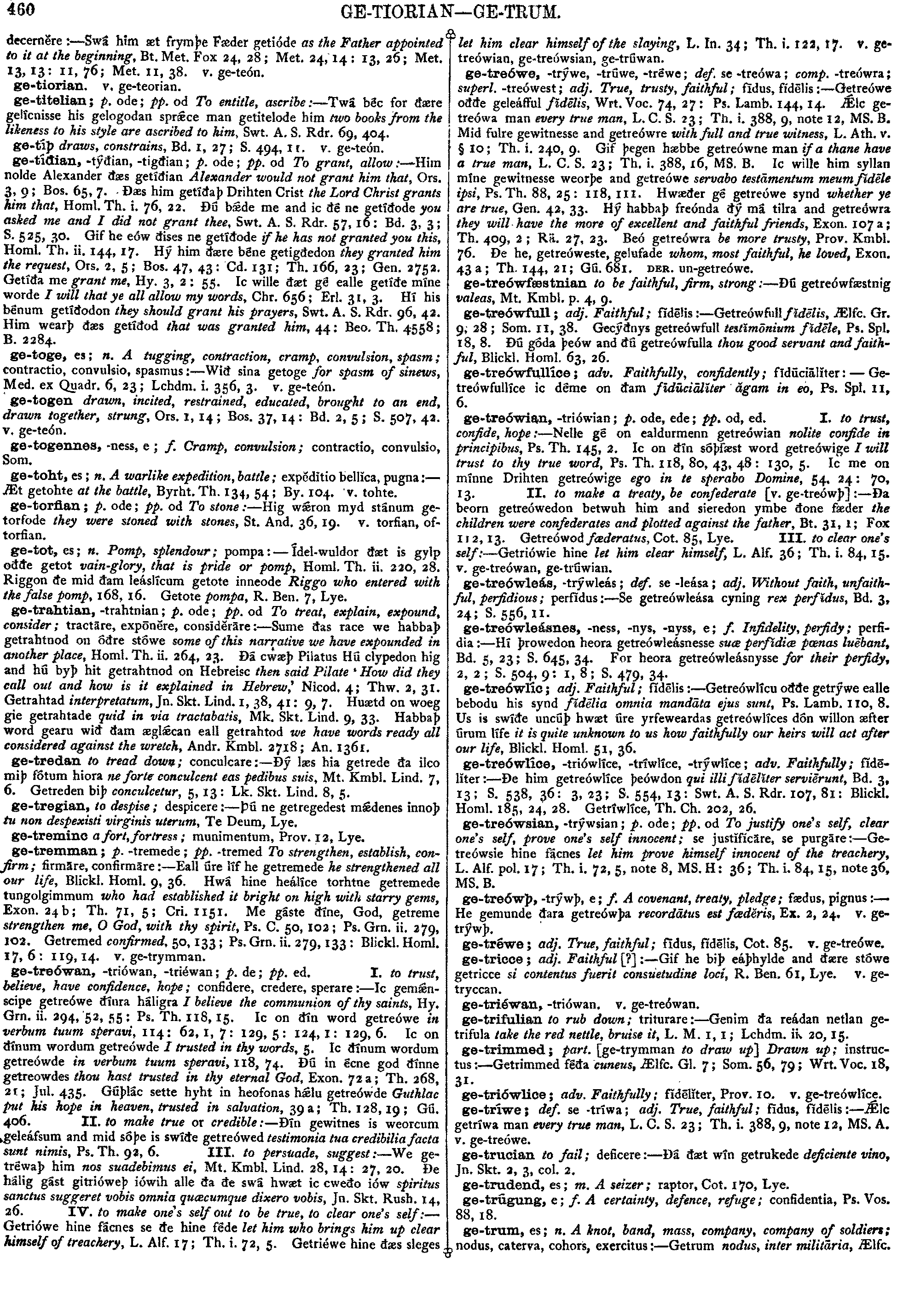
ge-trum,
es;
n.
A
knot,
band,
mass,
company,
company
of
soldiers;
nodus,
caterva,
cohors,
exercitus
:--
Getrum
nodus,
inter
militria,
Ælfc.
Gl.
7;
Som.
56,
81;
Wrt.
Voc.
18,
33.
Fyrd
sceal
ætsomne,
tírfæstra
getrum
the
army
shall
be
assembled,
a
band
of
warriors,
Menol.
Fox
523;
Gn.
C.
32.
Under
tungla
getrumum
under
the
troops
of
stars,
Salm.
Kmbl.
285;
Sal.
142.
He
eft
gewát
getrume
micle
he
returned
with
a
great
company,
Andr.
Kmbl.
1413;
An.
707:
Beo.
Th.
1849;
B.
922:
Exon.
90
a;
Th.
337,
12;
Gn.
Ex.
63.
DER.
án-getrum,
folc-,
fyrd-,
gár-.
|
Source: Bosworth/Toller, page b0461, entry 8 View original page image as: [TIFF] [PNG] [View previous entry] [View next entry] |
[Comment on this entry] [View comments] |
The following entry has been hand-corrected once. |
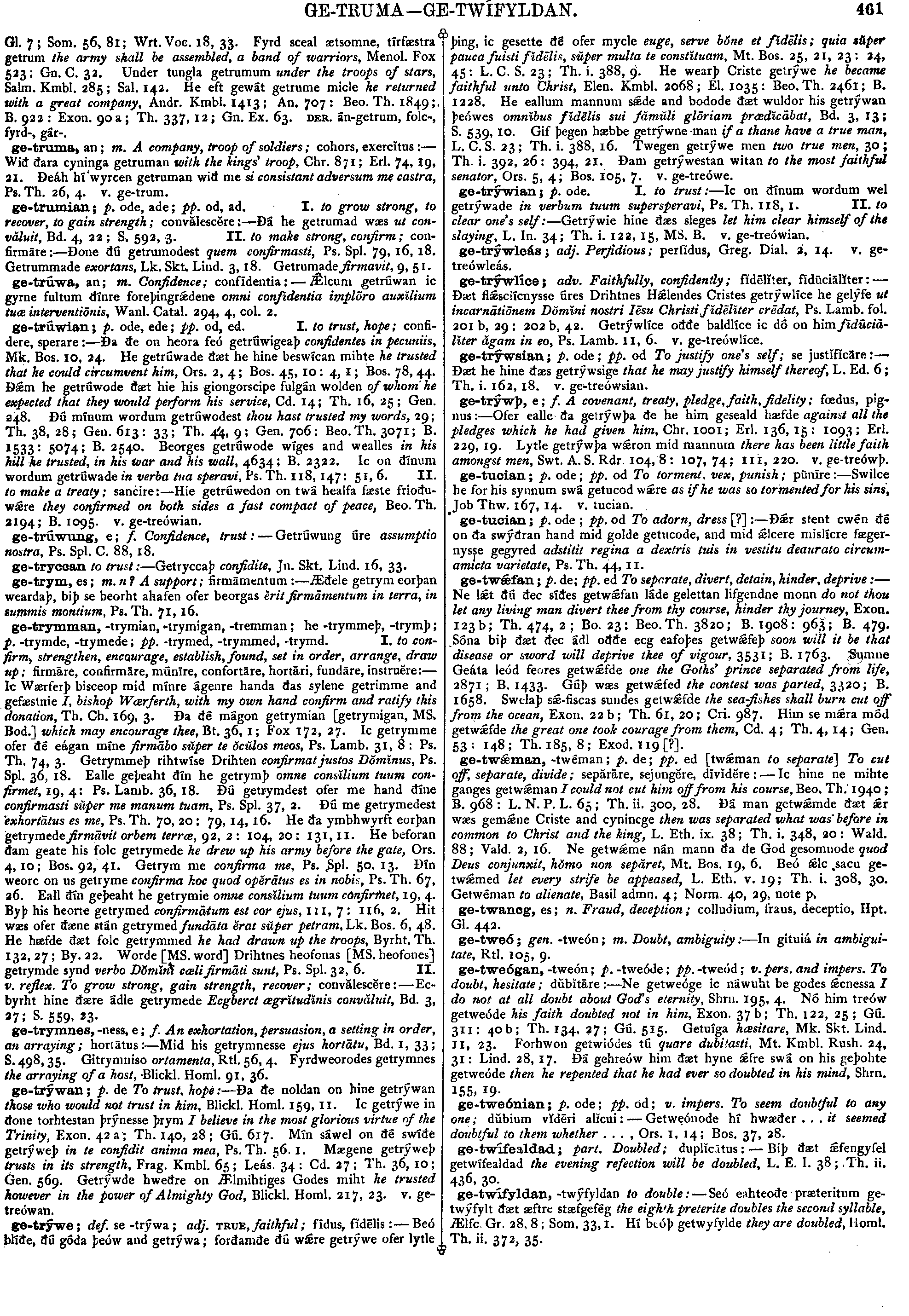
ge-trymman,
-trymian,
-trymigan,
-tremman;
he
-trymmeþ,
-trymþ;
p.
-trymde,
-trymede;
pp.
-trymed,
-trymmed,
-trymd.
I.
to
confirm,
strengthen,
encourage,
establish,
found,
set
in
order,
arrange,
draw
up;
firmre,
confirmre,
mnre,
confortre,
hortri,
fundre,
instrure
:--
Ic
Wærferþ
bisceop
mid
mínre
ágenre
handa
ðas
sylene
getrimme
and
gefæstnie
I,
bishop
Wærferth,
with
my
own
hand
confirm
and
ratify
this
donation,
Th.
Ch.
169,
3.
Ða
ðé
mágon
getrymian
[getrymigan,
MS.
Bod.]
which
may
encourage
thee,
Bt.
36,
1;
Fox
172,
27.
Ic
getrymme
ofer
ðé
eágan
míne
firmbo
s per
te
clos
meos,
Ps.
Lamb.
31,
8:
Ps.
Th.
74,
3.
Getrymmeþ
rihtwíse
Drihten
confirmat
justos
Dmnus,
Ps.
Spl.
36,
18.
Ealle
geþeaht
ðín
he
getrymþ
omne
conslium
tuum
confirmet,
19,
4:
Ps.
Lamb.
36,
18.
Ðú
getrymdest
ofer
me
hand
ðíne
confirmasti
sper
me
manum
tuam,
Ps.
Spl.
37,
2.
Ðú
me
getrymedest
exhorttus
es
me,
Ps.
Th.
70,
20:
79,
14,
16.
He
ða
ymbhwyrft
eorþan
getrymede
firmvit
orbem
terræ,
92,
2:
104,
20:
131,
11.
He
beforan
ðam
geate
his
folc
getrymede
he
drew
up
his
army
before
the
gate,
Ors.
4,
10;
Bos.
92,
41.
Getrym
me
confirma
me,
Ps.
Spl.
50.
13.
Ðín
weorc
on
us
getryme
confirma
hoc
quod
oprtus
es
in
nobis,
Ps.
Th.
67,
26.
Eall
ðín
geþeaht
he
getrymie
omne
conslium
tuum
confirmet,
19,
4.
Byþ
his
heorte
getrymed
confirmtum
est
cor
ejus,
111,
7:
116,
2.
Hit
wæs
ofer
ðæne
stán
getrymed
fundta
rat
sper
petram,
Lk.
Bos.
6,
48.
He
hæfde
ðæt
folc
getrymmed
he
had
drawn
up
the
troops,
Byrht.
Th.
132,
27;
By.
22.
Worde
[MS.
word]
Drihtnes
heofonas
[MS.
heofones]
getrymde
synd
verbo
Dmn
cæli
firmti
sunt,
Ps.
Spl.
32,
6.
II.
v.
reflex.
To
grow
strong,
gain
strength,
recover;
convlescre
:--
Ecbyrht
hine
ðære
ádle
getrymede
Ecgberct
ægrtudnis
convluit,
Bd.
3,
27;
S.
559,
23.
per
te
clos
meos,
Ps.
Lamb.
31,
8:
Ps.
Th.
74,
3.
Getrymmeþ
rihtwíse
Drihten
confirmat
justos
Dmnus,
Ps.
Spl.
36,
18.
Ealle
geþeaht
ðín
he
getrymþ
omne
conslium
tuum
confirmet,
19,
4:
Ps.
Lamb.
36,
18.
Ðú
getrymdest
ofer
me
hand
ðíne
confirmasti
sper
me
manum
tuam,
Ps.
Spl.
37,
2.
Ðú
me
getrymedest
exhorttus
es
me,
Ps.
Th.
70,
20:
79,
14,
16.
He
ða
ymbhwyrft
eorþan
getrymede
firmvit
orbem
terræ,
92,
2:
104,
20:
131,
11.
He
beforan
ðam
geate
his
folc
getrymede
he
drew
up
his
army
before
the
gate,
Ors.
4,
10;
Bos.
92,
41.
Getrym
me
confirma
me,
Ps.
Spl.
50.
13.
Ðín
weorc
on
us
getryme
confirma
hoc
quod
oprtus
es
in
nobis,
Ps.
Th.
67,
26.
Eall
ðín
geþeaht
he
getrymie
omne
conslium
tuum
confirmet,
19,
4.
Byþ
his
heorte
getrymed
confirmtum
est
cor
ejus,
111,
7:
116,
2.
Hit
wæs
ofer
ðæne
stán
getrymed
fundta
rat
sper
petram,
Lk.
Bos.
6,
48.
He
hæfde
ðæt
folc
getrymmed
he
had
drawn
up
the
troops,
Byrht.
Th.
132,
27;
By.
22.
Worde
[MS.
word]
Drihtnes
heofonas
[MS.
heofones]
getrymde
synd
verbo
Dmn
cæli
firmti
sunt,
Ps.
Spl.
32,
6.
II.
v.
reflex.
To
grow
strong,
gain
strength,
recover;
convlescre
:--
Ecbyrht
hine
ðære
ádle
getrymede
Ecgberct
ægrtudnis
convluit,
Bd.
3,
27;
S.
559,
23.
|
Source: Bosworth/Toller, page b0465, entry 28 View original page image as: [TIFF] [PNG] [View previous entry] [View next entry] |
[Comment on this entry] [View comments] |
The following entry has been hand-corrected once. |
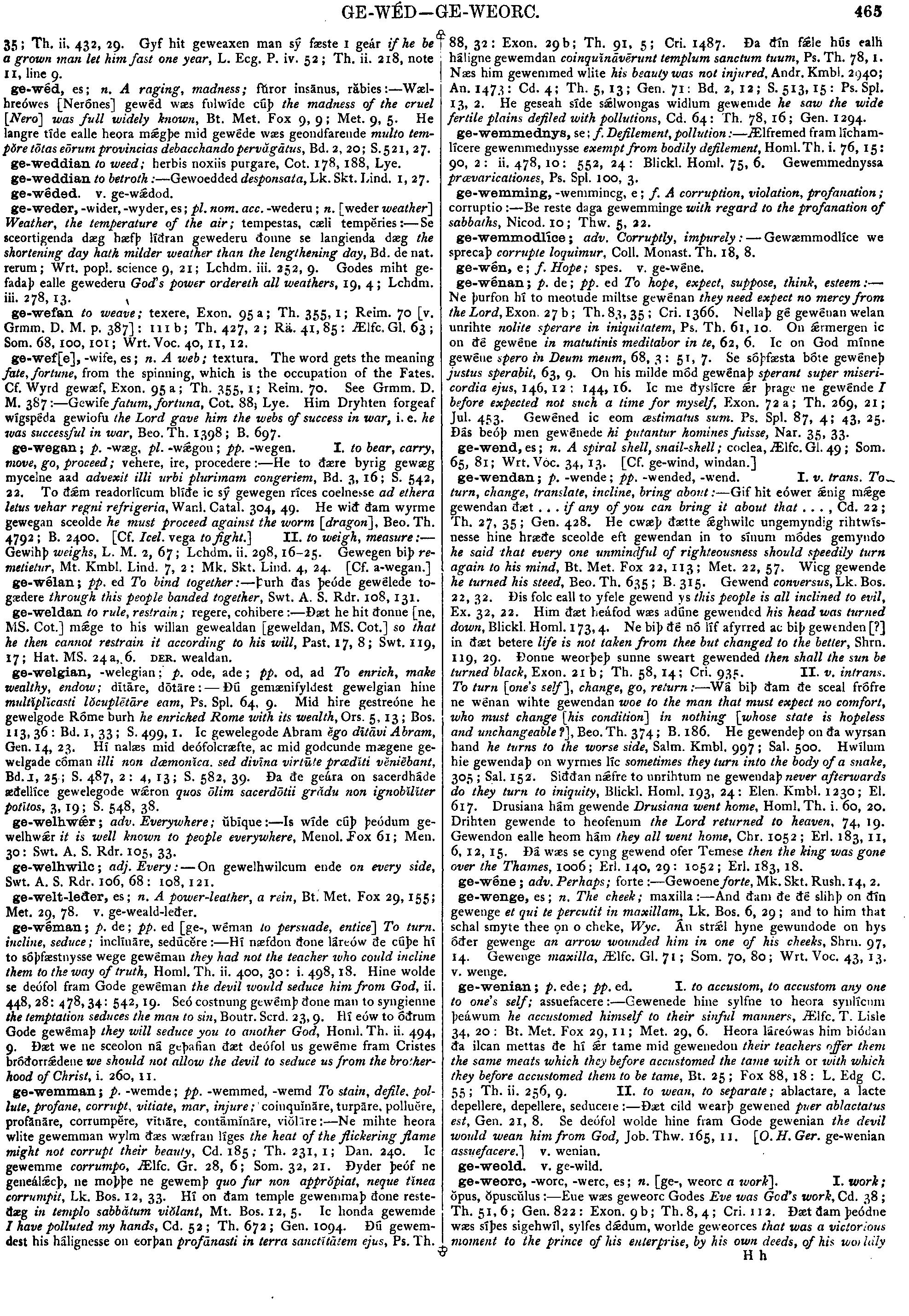
ge-weorc,
-worc,
-were,
es;
n.
[ge-,
weorc
a
work].
I.
work;
pus,
pusclus
:--
Eue
wæs
geweorc
Godes
Eve
was
God's
work,
Cd.
38;
Th.
51,
6;
Gen.
822:
Exon.
9
b;
Th.
8,
4;
Cri.
112.
Ðæt
ðam
þeódne
wæs
síþes
sigehwíl,
sylfes
ddum,
worlde
geweorces
that
was
a
victorious
moment
to
the
prince
of
his
enterprise,
by
his
own
deeds,
of
his
worldly
work,
Beo.
Th.
5415;
B.
2711.
He
geseah
eald
enta
geweorc
he
saw
the
antique
work
of
giants,
Andr.
Kmbl.
2988;
An.
1497:
2155;
An.
1079.
On
ðæt
geweorc
in
pus,
Bd.
1,
23;
S.
485,
40.
Ne
wáciaþ
ðás
geweorc
these
works
fail
not,
Exon.
93
b;
Th.
351,
26;
Sch.
86.
Mre
wurdon
his
wundra
geweorc
great
were
his
wondrous
works,
45
b;
Th.
155,
2;
Gú.
854:
40
a;
Th.
133,
35;
Gú.
500.
Of
geweorcum
árwurþra
fædera
ex
pusclis
venerblium
patrum,
Bd.
5,
24;
S.
647,
33.
II.
a
fort,
fortress;
arx
:--
He
of
ðam
geweorce
wæs
winnende
wið
ðone
here
he
warred
on
the
army
from
the
fortress,
Chr.
878;
Erl.
80,
5:
896;
Erl.
94,
3,
21.
He
worhte
him
geweorc
æt
Middeltúne
he
wrought
him
a
fortress
at
Middleton,
892;
Erl.
89,
14:
894;
Ed.
92,
4,
11.
Ðe
æt
hám
æt
ðm
geweorcum
wron
who
were
at
home
in
the
fortresses,
894;
Erl.
92,
18.
Hí
worhton
tú
geweorc
they
wrought
two
forts,
896;
Erl.
94,
11.
Geweorc
arx,
figmentum,
mchna,
Scint.
62:
Cot.
85:
128,
Lye.
[Goth.
ga-waurki:
O.
Sax.
gi-werk:
O.
H.
Ger.
ga-werk.]
DER.
r-geweorc,
eald-,
flán-,
fyrn-,
gold-,
gúþ-,
hand-,
heáh-,
land-,
níþ-,
sulh-.
|
Source: Bosworth/Toller, page b0486, entry 3 View original page image as: [TIFF] [PNG] [View previous entry] [View next entry] |
[Comment on this entry] [View comments] |
The following entry has been hand-corrected once. |
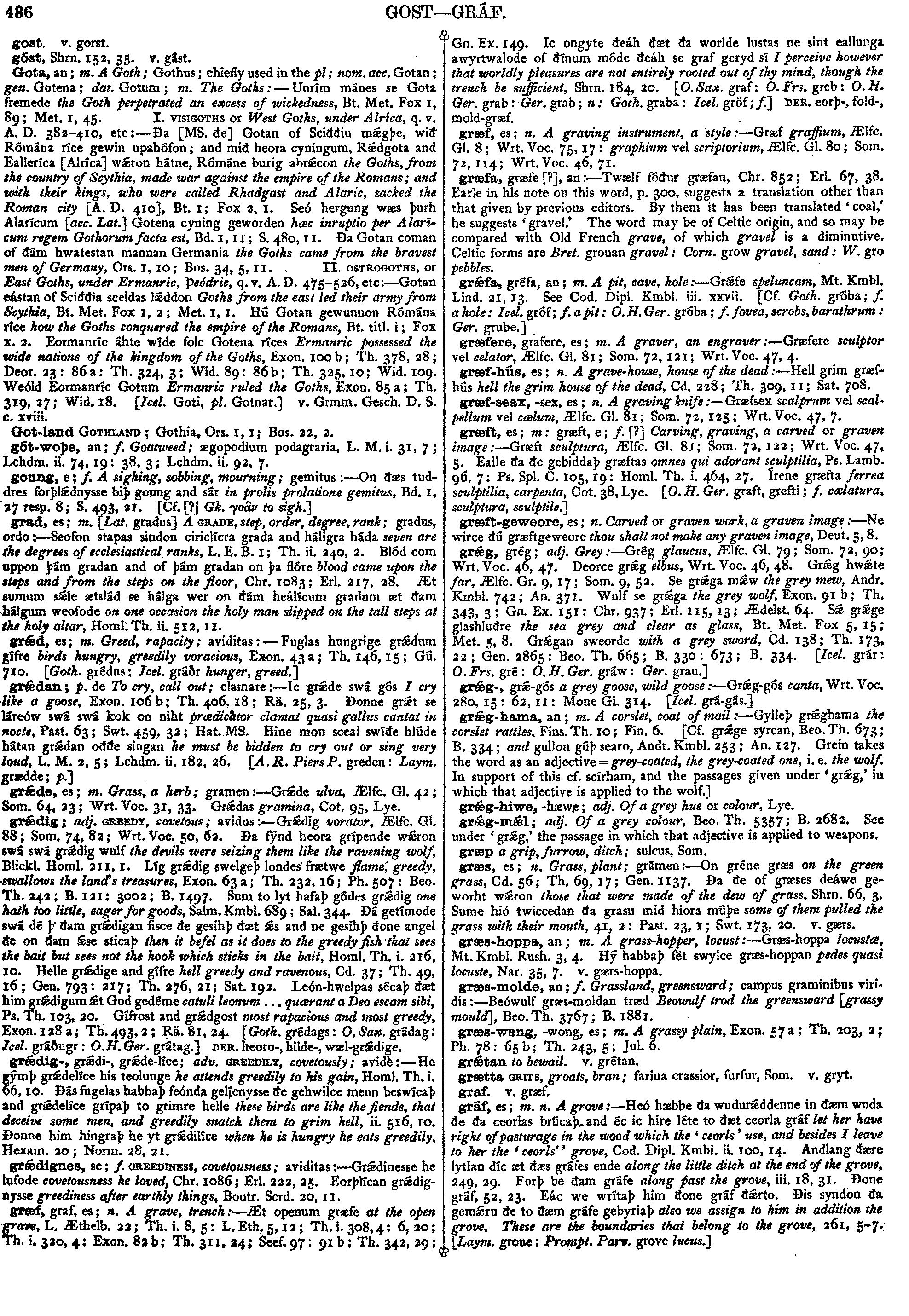
Gota,
an;
m.
A
Goth;
Gothus;
chiefly
used
in
the
pl;
nom.
acc.
Gotan;
gen.
Gotena;
dat.
Gotum;
m.
The
Goths
:--
Unrím
mánes
se
Gota
fremede
the
Goth
perpetrated
an
excess
of
wickedness,
Bt.
Met.
Fox
1,
89;
Met.
1,
45.
I.
VISIGOTHS
or
West
Goths,
under
Alríca,
q.
v.
A.
D.
382-410,
etc
:--
Ða
[MS.
ðe]
Gotan
of
Sciððiu
mgþe,
wið
Rómána
ríce
gewin
upahófon;
and
mið
heora
cyningum,
Rdgota
and
Ealleríca
[Alríca]
wron
hátne,
Rómáne
burig
abrcon
the
Goths,
from
the
country
of
Scythia,
made
war
against
the
empire
of
the
Romans;
and
with
their
kings,
who
were
called
Rhadgast
and
Alaric,
sacked
the
Roman
city
[A.
D.
410],
Bt.
1;
Fox
2,
1.
Seó
hergung
wæs
þurh
Alarícum
[acc.
Lat.]
Gotena
cyning
geworden
hæc
inruptio
per
Alarcum
regem
Gothorum
facta
est,
Bd.
1,
11;
S.
480,
11.
Ða
Gotan
coman
of
ðám
hwatestan
mannan
Germania
the
Goths
came
from
the
bravest
men
of
Germany,
Ors.
1,
10;
Bos.
34,
5,
11.
II.
OSTROGOTHS,
or
East
Goths,
under
Ermanric,
Þeódric,
q.
v.
A.
D.
475-526,
etc
:--
Gotan
eástan
of
Sciððia
sceldas
lddon
Goths
from
the
east
led
their
army
from
Scythia,
Bt.
Met.
Fox
1,
2;
Met.
1,
1.
Hú
Gotan
gewunnon
Rómána
ríce
how
the
Goths
conquered
the
empire
of
the
Romans,
Bt.
titl.
i;
Fox
x.
2.
Eormanríc
áhte
wíde
folc
Gotena
ríces
Ermanric
possessed
the
wide
nations
of
the
kingdom
of
the
Goths,
Exon.
100
b;
Th.
378,
28;
Deor.
23:
86
a:
Th.
324,
3;
Wid.
89:
86
b;
Th.
325,
10;
Wid.
109.
Weóld
Eormanríc
Gotum
Ermanric
ruled
the
Goths,
Exon.
85
a;
Th.
319,
27;
Wid.
18.
[Icel.
Goti,
pl.
Gotnar.]
v.
Grmm.
Gesch.
D.
S.
C.
xviii.
|
Source: Bosworth/Toller, page b0491, entry 2 View original page image as: [TIFF] [PNG] [View previous entry] [View next entry] |
[Comment on this entry] [View comments] |
The following entry has been hand-corrected once. |
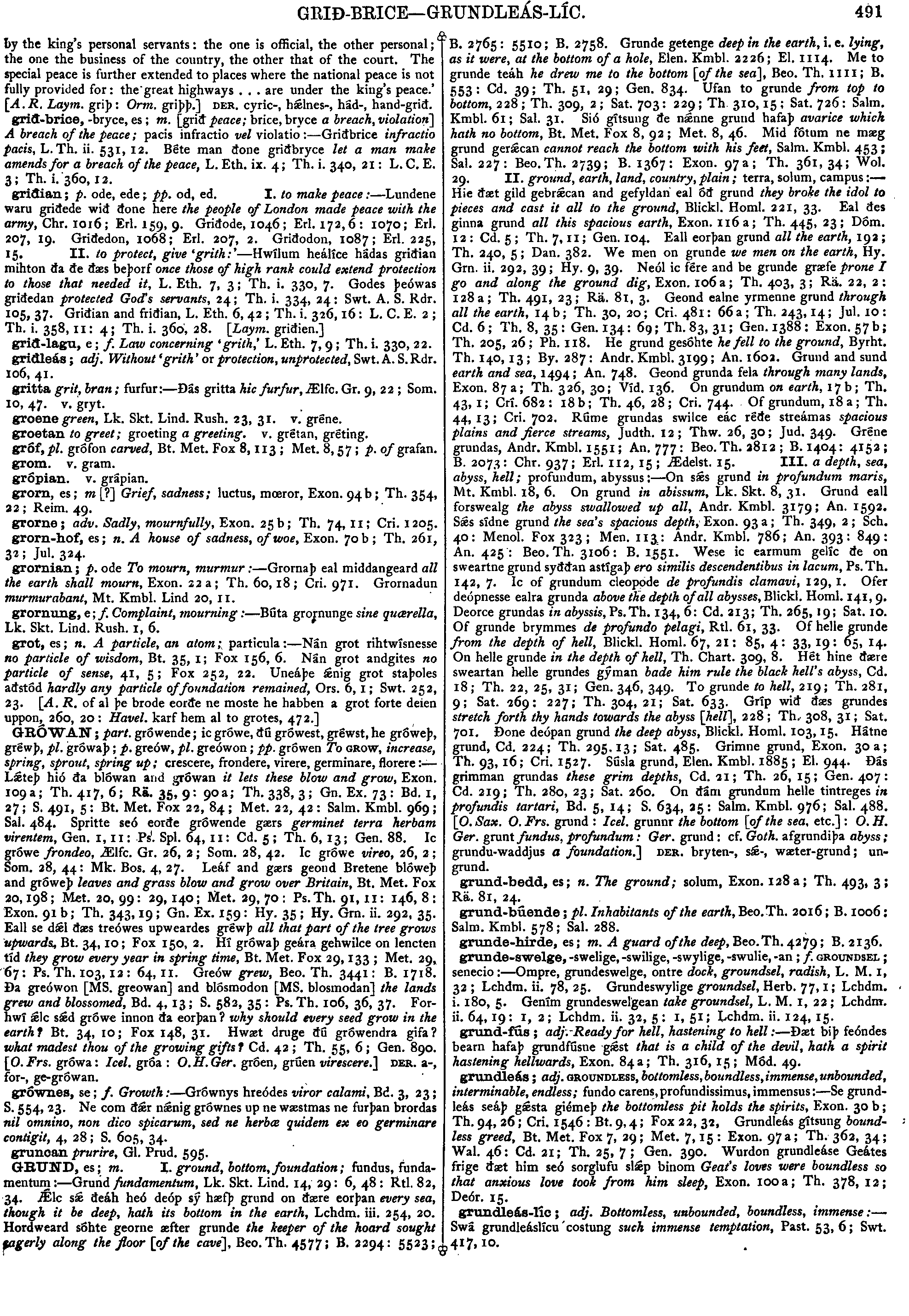
griðian; p. ode, ede; pp. od, ed. I. to make peace :-- Lundene waru griðede wið ðone here the people of London made peace with the army, Chr. 1016; Erl. 559, 9. Griðode, 1046; Erl. 172, 6: 1070; Erl. 207, 19. Griðedon, 1068; Erl. 207, 2. Griðodon, 1087; Er1. 225, 15. II. to protect, give 'grith:'-Hwílum heálíce hádas griðian mihton ða ðe ðæs beþorf once those of high rank could extend protection to those that needed it, L. Eth. 7, 3; Th. i. 330, 7. Godes þeówas griðedan protected God's servants, 24; Th. i. 334, 24: Swt. A. S. Rdr. 105, 37. Griðian and friðian, L. Eth. 6, 42; Th. i. 326, 16: L. C. E. 2; Th. i. 358, 11: 4; Th. i. 360, 28. [Laym. griðien.]
|
Source: Bosworth/Toller, page b0493, entry 40 View original page image as: [TIFF] [PNG] [View previous entry] [View next entry] |
[Comment on this entry] [View comments] |
The following entry has been hand-corrected once. |
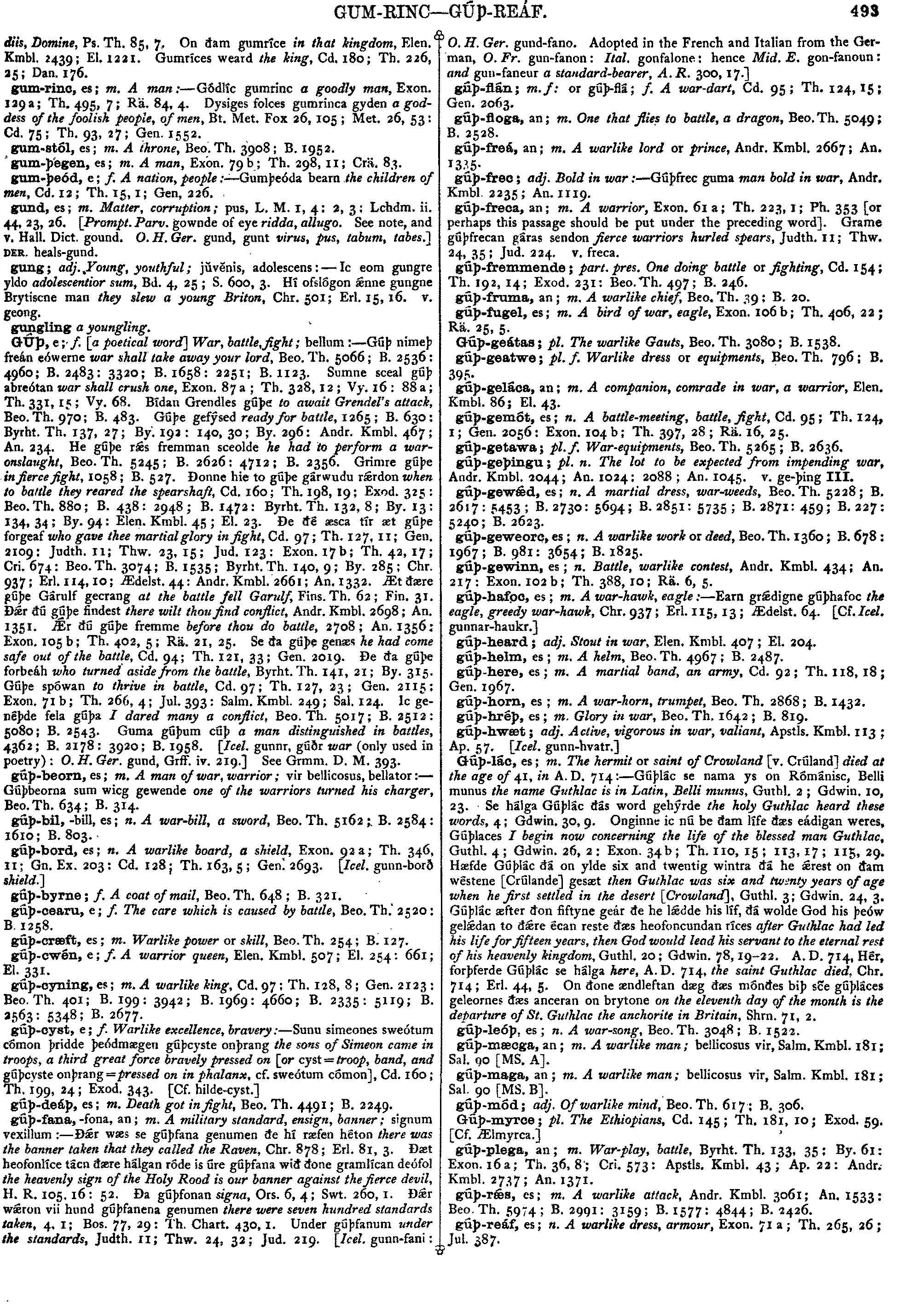
gúþ-here, es; m. A martial band, an army, Cd. 92; Th. 118, 18; Gen. 1967.
| Result Page: |  |
Previous | 2 3 4 5 6 7 8 9 10 11 12 13 14 15 16 17 18 19 20 | Next |  |
Germanic Lexicon Project (main page)
This search system was written by
Sean Crist
Please consider
volunteering
to correct the data in these online dictionaries.
No rights reserved. Feel free to use these data in any way you please.