|
|

Tip: In the search results, you can click on any word or abbreviation for more information.
|
Source: Bosworth/Toller, page b1156, entry 16 View original page image as: [TIFF] [PNG] [View previous entry] [View next entry] |
[Comment on this entry] [View comments] |
The following entry has been hand-corrected once. |
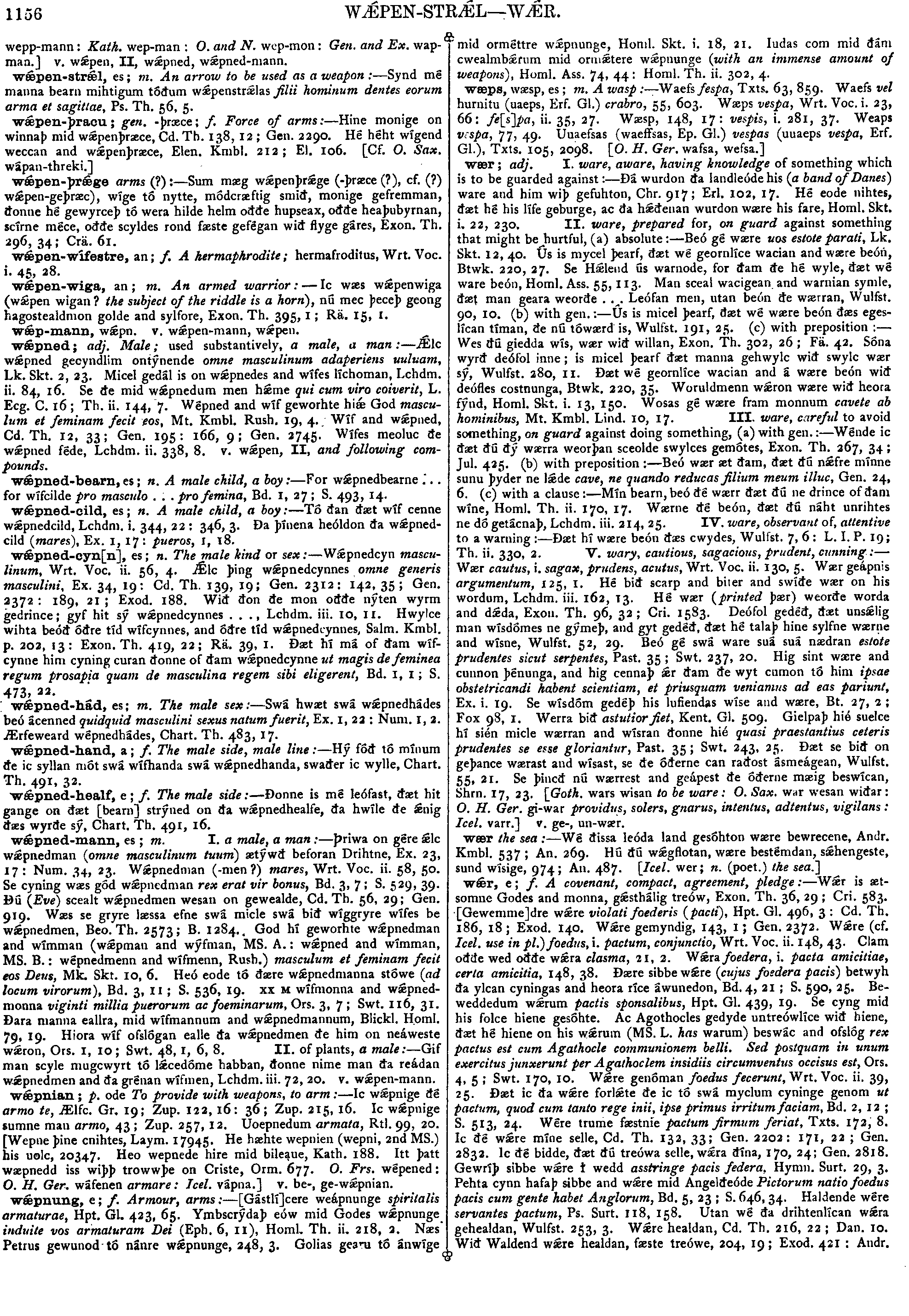
w pnian;
p.
ode
To
provide
with
weapons,
to
arm:--Ic
wpnige
ðé
armo
te,
Ælfc.
Gr.
19;
Zup.
122,
16:
36;
Zup.
215,
16.
Ic
wpnige
sumne
man
armo,
43;
Zup.
257,
12.
Uoepnedum
armata,
Rtl.
99,
20.
[Wepne
þine
cnihtes,
Laym.
17945.
He
hæhte
wepnien
(wepni,
2nd
MS.)
his
uolc,
20347.
Heo
wepnede
hire
mid
bileaue,
Kath.
188.
Itt
þatt
wæpnedd
iss
wiþþ
trowwþe
on
Criste,
Orm.
677.
O.
Frs.
wépened:
O.
H.
Ger.
wáfenen
armare:
Icel.
vápna.]
v.
be-,
ge-wpnian.
pnian;
p.
ode
To
provide
with
weapons,
to
arm:--Ic
wpnige
ðé
armo
te,
Ælfc.
Gr.
19;
Zup.
122,
16:
36;
Zup.
215,
16.
Ic
wpnige
sumne
man
armo,
43;
Zup.
257,
12.
Uoepnedum
armata,
Rtl.
99,
20.
[Wepne
þine
cnihtes,
Laym.
17945.
He
hæhte
wepnien
(wepni,
2nd
MS.)
his
uolc,
20347.
Heo
wepnede
hire
mid
bileaue,
Kath.
188.
Itt
þatt
wæpnedd
iss
wiþþ
trowwþe
on
Criste,
Orm.
677.
O.
Frs.
wépened:
O.
H.
Ger.
wáfenen
armare:
Icel.
vápna.]
v.
be-,
ge-wpnian.
|
Source: Bosworth/Toller, page d0443, entry 12 View original page image as: [TIFF] [PNG] [View previous entry] [View next entry] |
[Comment on this entry] [View comments] |
The following entry has been hand-corrected once. |
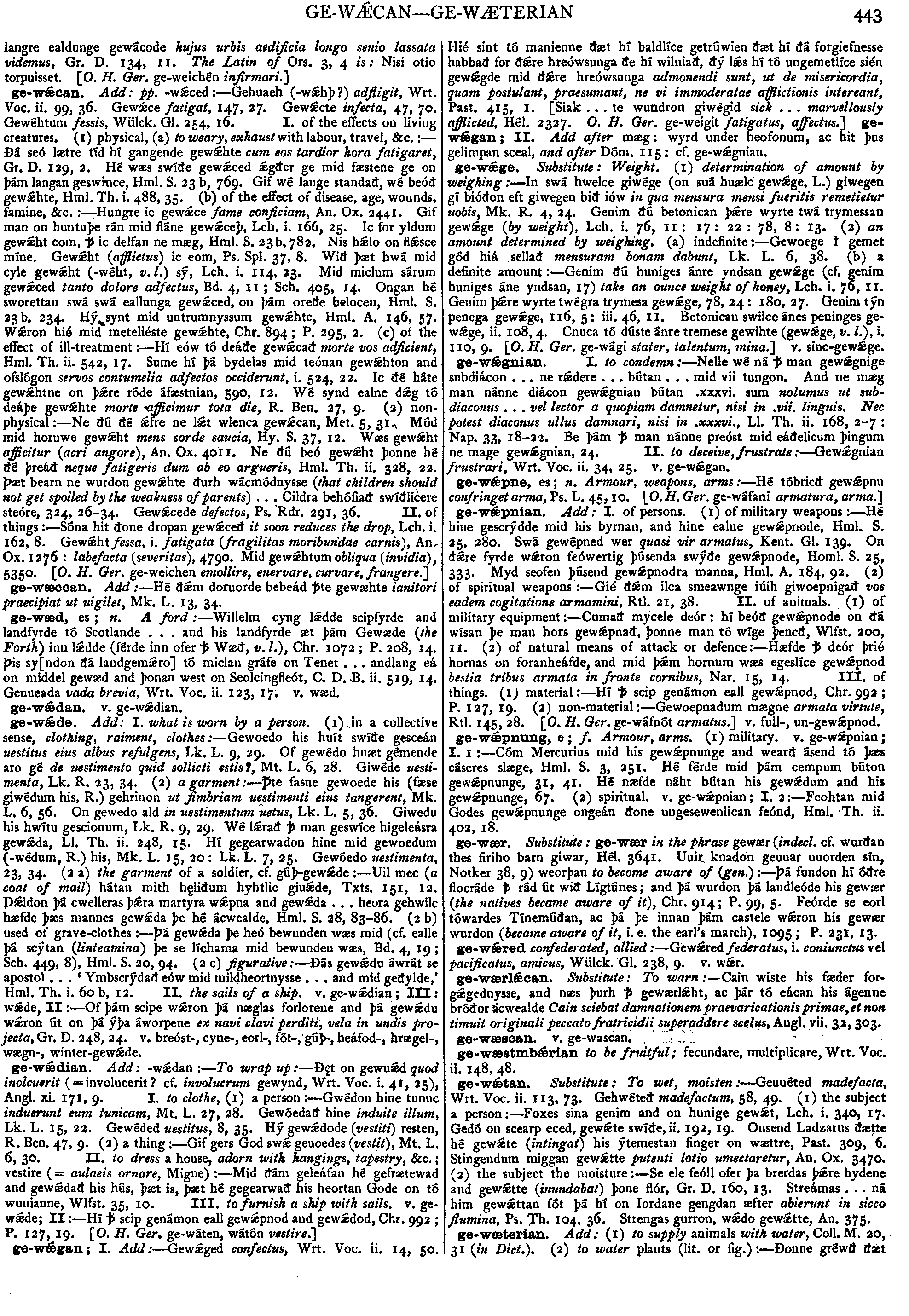
ge-wpnian.
Add:
I.
of
persons,
(1)
of
military
weapons
:--
Hé
hine
gescrýdde
mid
his
byrnan,
and
hine
ealne
gewpnode,
Hml.
S.
25,
280.
Swá
gewépned
wer
quasi
vir
armatus,
Kent.
Gl.
139.
On
ðre
fyrde
wron
feówertig
þúsenda
swýðe
gewpnode,
Homl.
S.
25,
333.
Myd
seofen
þúsend
gewpnodra
manna,
Hml.
A.
184,
92.
(2)
of
spiritual
weapons
:--
Gié
ðm
ilca
smeawnge
iúih
giwoepnigað
vos
eadem
cogitatione
armamini,
Rtl.
21,
38.
II.
of
animals.
(1)
of
military
equipment
:--
Cumad
mycele
deór:
hí
beóð
gewpnode
on
ðá
wísan
þe
man
hors
gewpnað,
þonne
man
tó
wíge
þencð,
Wlfst.
200,
11.
(2)
of
natural
means
of
attack
or
defence
:--
Hæfde
 deór
þrié
hornas
on
foranheáfde,
and
mid
þm
hornum
wæs
egeslíce
gewpnod
bestia
tribus
armata
in
fronte
cornibus,
Nar.
15,
14.
III.
of
things.
(1)
material
:--
Hí
scip
genámon
eall
gewpnod,
Chr.
992;
P.
127,
19.
(2)
non-material
:--
Gewoepnadum
mægne
armata
virtute,
Rtl.
145,
28.
[O.
H.
Ger.
ge-wáfnót
armatus.]
v.
full-,
un-gewpnod.
deór
þrié
hornas
on
foranheáfde,
and
mid
þm
hornum
wæs
egeslíce
gewpnod
bestia
tribus
armata
in
fronte
cornibus,
Nar.
15,
14.
III.
of
things.
(1)
material
:--
Hí
scip
genámon
eall
gewpnod,
Chr.
992;
P.
127,
19.
(2)
non-material
:--
Gewoepnadum
mægne
armata
virtute,
Rtl.
145,
28.
[O.
H.
Ger.
ge-wáfnót
armatus.]
v.
full-,
un-gewpnod.
|
Source: Bosworth/Toller, page d0537, entry 4 View original page image as: [TIFF] [PNG] [View previous entry] [View next entry] |
[Comment on this entry] [View comments (1)] |
The following entry has been hand-corrected once. |
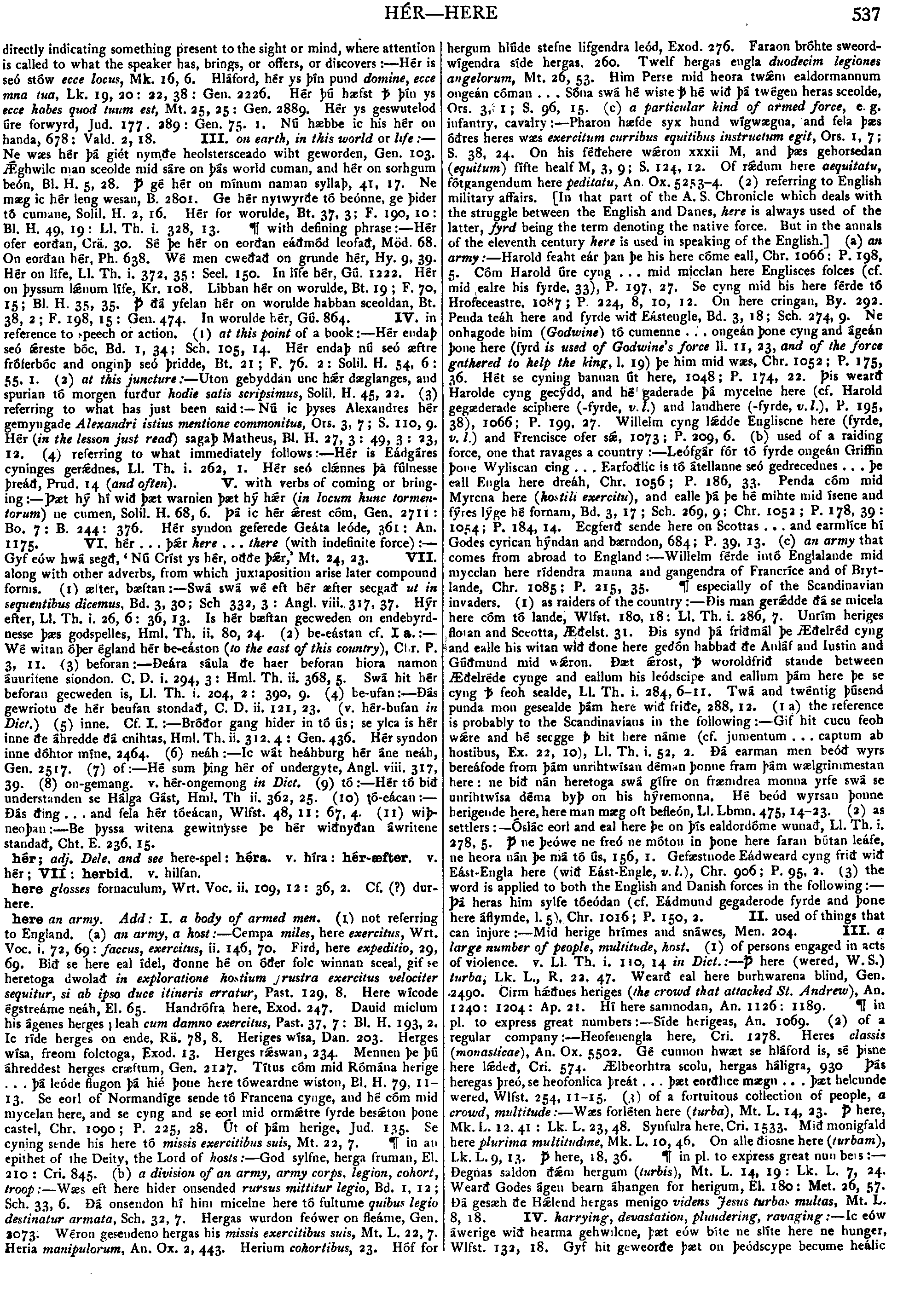
here
an
army.
Add:
I.
a
body
of
armed
men.
(l)
not
referring
to
England,
(a)
an
army,
a
host
:--
Cempa
miles,
here
exercitus,
Wrt.
Voc.
i.
72,
69:
faccus,
exercitus,
ii.
146,
70.
Fird,
here
expeditio,
29,
69.
Bið
se
here
eal
ídel,
ðonne
hé
on
óðer
folc
winnan
sceal,
gif
se
heretoga
dwolað
in
explorations
hostium
jrusira
exercitus
velociter
sequitur,
si
ab
ipso
dace
itineris
erratur,
Past.
129,
8.
Here
wícode
égstreáme
neáh,
El.
65.
Handrófra
here,
Exod.
247.
Dauid
miclum
his
ágenes
herges
þleah
UNCERTAIN
cum
damno
exercitus,
Past.
37,
7
:
Bl.
H.
193,
2.
Ic
ríde
herges
on
ende,
Ra.
78,
8.
Heriges
wísa,
Dan.
203.
Herges
wísa,
freom
folctoga,
Exod.
13.
Herges
rswan,
234.
Mennen
þe
þú
áhreddest
herges
cræftum,
Gen.
2127.
Títus
cóm
mid
Rómána
herige
.
.
.
þá
leóde
flugon
þá
hié
þone
here
tóweardne
wiston,
El.
H.
79,
11-13.
Se
eorl
of
Normandige
sende
tó
Francena
cynge,
and
hé
cóm
mid
mycelan
here,
and
se
cyng
and
se
eorl
mid
ormtre
fyrde
bestoa
þone
castel,
Chr.
1090;
P.
225,
28.
Út
of
þám
herige,
Jud.
135.
Se
cyning
sende
his
here
tó
missis
exercitibus
suis,
Mt.
22,
7.

in
an
epithet
of
the
Deity,
the
Lord
of
hosts
:--
God
sylfne,
herga
fruman,
El.
210
:
Cri.
845.
(b)
a
division
of
an
army,
army
corps,
legion,
cohort,
troop
:--
Wæs
eft
here
hider
onsended
rursus
mittitur
legio,
Bd.
l,
12;
Sch.
33,
6.
Ðá
onsendon
hí
him
micelne
here
tó
fultume
quibus
legio
destinatur
armata,
Sch.
32,
7.
Hergas
wurdon
feówer
on
fleáme,
Gen.
2073.
Wéron
gesendeno
hergas
his
missis
exercitibus
suis,
Mt.
L.
22,
7.
Heria
manipulorum,
An.
Ox.
2,
443.
Herium
cohortibus,
23.
Hóf
for
hergum
hlúde
stefne
lifgendra
leód,
Exod.
276.
Faraon
bróhte
sweord-wígendra
sîde
hergas,
260.
Twelf
hergas
engla
duodecim
legiones
angelorum,
Mt.
26,
53.
Him
Perse
mid
heora
twm
ealdormannum
ongeán
cóman
.
.
.
Sóna
swá
hé
wiste
hé
wið
þá
twégen
heras
sceolde,
Ors.
3,
;
I;
S.
96,
15.
(c)
a
particular
kind
of
armed
force,
e.
g.
infantry,
cavalry
:--
Pharon
hæfde
syx
hund
wígwægna,
and
fela
þæs
óðres
heres
wæs
exercitum
curribus
equitibus
instruction
egit,
Ors.
I.
7;
S.
38,
24.
On
his
féðehere
wron
xxxii
M.
and
þæs
gehorsedan
(equitum]
fifte
healf
M.
3,
9;
S.
124,
12.
Of
rdum
here
aequitatu,
fótgangendum
here
peditatu,
An.
Ox.
52.
-.
3-4.
(2)
referring
to
English
military
affairs.
[In
that
part
of
the
A.
S.
Chronicle
which
deals
with
the
struggle
between
the
English
and
Danes,
here
is
always
used
of
the
latter,
fyrd
being
the
term
denoting
the
native
force.
But
in
the
annals
of
the
eleventh
century
here
is
used
in
speaking
of
the
English.]
(a)
an
army
:--
Harold
feaht
eár
þan
þe
his
here
cóme
eall,
Chr.
1066:
P.
198,
5.
Cóm
Harold
úre
cyng
.
.
.
mid
micclan
here
Englisces
folces
(cf.
mid
ealre
his
fyrde,
33),
P.
197,
27.
Se
cyng
mid
his
here
férde
tó
Hrofeceastre,
1087;
P.
224,
8,
10,
12.
On
here
cringan,
By.
292.
Penda
teáh
here
and
fyrde
wið
Eástengle,
Bd.
3,
18;
Sch.
274,
9.
Ne
onhagode
him
(Godwine)
tó
cumenne
.
.
.
ongeán
þone
cyng
and
ágeán
þone
here
(fyrd
is
used
of
Godwine's
force
ll.
ii.
23,
and
of
the
force
gathered
to
help
the
king,
1.
19)
þe
him
mid
wæs.
Chr.
1052;
P.
175,
36.
Hét
se
cyning
bannan
út
here,
1048;
P.
174,
22.
Þis
wearð
Harolde
cyng
gecýdd,
and
hé
gaderade
þá
mycelne
here
(cf.
Harold
gegæderade
sciphere
(-fyrde,
v.l.)
and
landhere
(-fyrde,
v.
l.),
P.
195,
38),
1066;
P.
199,
27.
Willelm
cyng
ldde
Engliscne
here
(fyrde,
v.
l.)
and
Frencisce
ofer
s,
1073;
P.
209,
6.
(b)
used
of
a
raiding
force,
one
that
ravages
a
country
:--
Leófgár
fór
tó
fyrde
ongeán
Griffin
þone
Wyliscan
cing
.
.
.
Earfoðlic
is
tó
átellanne
seó
gedrecednes
.
.
.
þe
eall
Engla
here
dreáh.
Chr.
1056;
P.
186,
33.
Penda
cóm
mid
Myrcna
here
(hostili
exercitu),
and
ealle
þá
þe
hé
mihte
mid
ísene
and
fýres
lýge
hé
fornam,
Bd.
3,
17
;
Sch.
269,
9;
Chr.
1053
;
P.
178,
39
:
1054;
P.
184,
14.
Ecgferð
sende
here
on
Scottas
.
.
.
and
earmlíce
hí
Godes
cyrican
hýndan
and
bærndon,
684;
P.
39,
13.
(c)
an
army
that
comes
from
abroad
to
England
:--
Willelm
férde
intó
Englalande
mid
mycelan
here
rídendra
manna
and
gangendra
of
Francríce
and
of
Brytlande,
Chr.
1085;
P.
215,
35.

especially
of
the
Scandinavian
invaders.
(l)
as
raiders
of
the
country
:--
Ðis
man
gerdde
ðá
se
micela
here
cóm
tó
lande,
Wlfst.
180,
18:
Ll.
Th.
i.
286,
7.
Unrím
heriges
flotan
and
Sceotta,
Æðelst.
31.
Ðis
synd
þá
friðmál
þe
Æðelréd
cyng
and
ealle
his
witan
wið
ðone
here
gedón
habbað
ðe
Anláf
and
Iustin
and
Gúðmund
mid
wron.
Ðæt
rost,
woroldfrið
stande
between
Æðelréde
cynge
and
eallum
his
leódscipe
and
eallum
þám
here
þe
se
cyng
feoh
sealde,
Ll.
Th.
i.
284,
6-11.
Twá
and
twéntig
þúsend
punda
mon
gesealde
þám
here
wið
friðe,
288,
12.
(l
a)
the
reference
is
probably
to
the
Scandinavians
in
the
following
:--
Gif
hit
cucu
feoh
wre
and
hé
secgge
hit
here
náme
(cf.
jumentum
.
.
.
captum
ab
hostibus,
Ex.
22,
10),
Ll.
Th.
i.
52,
2.
Ðá
earman
men
beóð
wyrs
bereáfode
from
þám
unrihtwísan
déman
þonne
fram
þám
wælgrimmestan
here:
ne
bið
nán
heretoga
swá
gífre
on
fræmdrea
monna
yrfe
swá
se
unrihtwísa
déma
byþ
on
his
hýremonna.
Hé
beód
wyrsan
þonne
herigende
here,
here
man
maeg
oft
befleón,
Ll.
Lbmn.
475,
14-23.
(2)
as
settlers:--
Óslác
eorl
and
eal
here
þe
on
þís
ealdordóme
wunað,
Ll.
Th.
i.
378,
5.
Þ
UNCERTAIN
ne
þeówe
ne
freó
ne
móton
in
þone
here
faran
bútan
leáfe,
ne
heora
nán
þe
má
tó
ús,
156,
l.
Gefæstnode
Eádweard
cyng
frið
wið
Eást-Engla
here
(wið
East-Engle,
v.
l.),
Chr.
906;
P.
95,
a.
( )
the
word
is
applied
to
both
the
English
and
Danish
forces
in
the
following
:--
Þá
heras
him
sylfe
tóeódan
(cf.
Eádmund
gegaderode
fyrde
and
þone
here
áflymde,
1.
5),
Chr.
1016;
P.
150,
2.
II.
used
of
things
that
can
injure
:--
Mid
herige
hrímes
and
snáwes,
Men.
204.
III.
a
large
number
of
people,
multitude,
host.
(l)
of
persons
engaged
in
acts
of
violence,
v.
Ll.
Th.
i.
no,
14
in
Dict.
:--
Þ
UNCERTAIN
here
(wered,
W.S.)
turba;
Lk.
L.
,
R.
22,
47.
Wearð
eal
here
burhwarena
blind,
Gen.
2490.
Cirm
hðnes
heriges
(the
crowd
that
attacked
St.Andrew).
An.
1240:
1204:
Ap.
21.
Hí
here
samnodan,
An.
1126:
1189.

in
pl.
to
express
great
numbers
:--
Síde
herigeas,
An.
1069.
(2)
of
a
regular
company
:--
Heofenengla
here,
Cri.
1278.
Heres
classis
(monasticae),
An.
Ox.
5502.
Gé
cunnon
hwæt
se
hláford
is,
sé
þisne
here
ldeð,
Cri.
574.
Ælbeorhtra
scolu,
hergas
háligra,
930
Þas
heregas
þreó,
se
heofonlica
þreát.
.
.
þæt
eorðlice
mzgii
.
.
.
þæt
helcunde
wered.
Wlfst.
254,
11-15.
(
)
the
word
is
applied
to
both
the
English
and
Danish
forces
in
the
following
:--
Þá
heras
him
sylfe
tóeódan
(cf.
Eádmund
gegaderode
fyrde
and
þone
here
áflymde,
1.
5),
Chr.
1016;
P.
150,
2.
II.
used
of
things
that
can
injure
:--
Mid
herige
hrímes
and
snáwes,
Men.
204.
III.
a
large
number
of
people,
multitude,
host.
(l)
of
persons
engaged
in
acts
of
violence,
v.
Ll.
Th.
i.
no,
14
in
Dict.
:--
Þ
UNCERTAIN
here
(wered,
W.S.)
turba;
Lk.
L.
,
R.
22,
47.
Wearð
eal
here
burhwarena
blind,
Gen.
2490.
Cirm
hðnes
heriges
(the
crowd
that
attacked
St.Andrew).
An.
1240:
1204:
Ap.
21.
Hí
here
samnodan,
An.
1126:
1189.

in
pl.
to
express
great
numbers
:--
Síde
herigeas,
An.
1069.
(2)
of
a
regular
company
:--
Heofenengla
here,
Cri.
1278.
Heres
classis
(monasticae),
An.
Ox.
5502.
Gé
cunnon
hwæt
se
hláford
is,
sé
þisne
here
ldeð,
Cri.
574.
Ælbeorhtra
scolu,
hergas
háligra,
930
Þas
heregas
þreó,
se
heofonlica
þreát.
.
.
þæt
eorðlice
mzgii
.
.
.
þæt
helcunde
wered.
Wlfst.
254,
11-15.
( )
UNCERTAIN
of
a
fortuitous
collection
of
people,
a
crowd,
multitude
:--
Wæs
forléten
here
(turba),
Mt.
L.
14,
23.
Þ
UNCERTAIN
here,
Mk.
L.
12.
41
:
Lk.
L.
23,
48.
Synfulra
here,
Cri.
1533.
Mið
monigfald
here
plurima
multitudme.
Mk.
L.
10,
46.
On
alle
ðiosne
here
(turbam),
Lk.
L.
9,
13.
Þ
UNCERTAIN
here,
18,
36.

in
pl.
to
express
great
nun
beis
:--
Ðegnas
saldon
ðm
hergum
(turbis),
Mt.
L.
14,
19
:
Lk.
L.
7,
24.
Wearð
Godes
ágen
bearn
áhangen
for
herigum,
El.
180:
Met.
26,
57.
Ðá
gesæh
ðe
Hlend
hergas
menigo
videns
Jesus
turbas
multas,
Mt.
L.
8,
18.
IV.
harrying,
devastation,
plundering,
ravaging
:--
Ic
eów
áwerige
wið
hearma
gehwilcne,
þæt
eów
bíte
ne
slíte
here
ne
hunger,
Wlfst.
132,
18.
Gyf
hit
geweorðe
þæt
on
þeódscype
becume
heálic;
)
UNCERTAIN
of
a
fortuitous
collection
of
people,
a
crowd,
multitude
:--
Wæs
forléten
here
(turba),
Mt.
L.
14,
23.
Þ
UNCERTAIN
here,
Mk.
L.
12.
41
:
Lk.
L.
23,
48.
Synfulra
here,
Cri.
1533.
Mið
monigfald
here
plurima
multitudme.
Mk.
L.
10,
46.
On
alle
ðiosne
here
(turbam),
Lk.
L.
9,
13.
Þ
UNCERTAIN
here,
18,
36.

in
pl.
to
express
great
nun
beis
:--
Ðegnas
saldon
ðm
hergum
(turbis),
Mt.
L.
14,
19
:
Lk.
L.
7,
24.
Wearð
Godes
ágen
bearn
áhangen
for
herigum,
El.
180:
Met.
26,
57.
Ðá
gesæh
ðe
Hlend
hergas
menigo
videns
Jesus
turbas
multas,
Mt.
L.
8,
18.
IV.
harrying,
devastation,
plundering,
ravaging
:--
Ic
eów
áwerige
wið
hearma
gehwilcne,
þæt
eów
bíte
ne
slíte
here
ne
hunger,
Wlfst.
132,
18.
Gyf
hit
geweorðe
þæt
on
þeódscype
becume
heálic;
Germanic Lexicon Project (main page)
This search system was written by
Sean Crist
Please consider
volunteering
to correct the data in these online dictionaries.
No rights reserved. Feel free to use these data in any way you please.