|
|

Tip: In the search results, you can click on any word or abbreviation for more information.
|
Source: Torp, page b0012, entry 4 View original page image as: [TIFF] [PNG] [View previous entry] [View next entry] |
[Comment on this entry] [View comments] |
The following entry has been hand-corrected once. |

angan
m.
Spitze
(eig.
Haken);
Biegung.
g.
(hals)-agga
m.
(Hals-)
biegung;
an.
angi
m.
Spitze,
Zacken;
ags.
anga
m.
Spitze,
Stachel;
ahd.
ango
m.,
mhd.
ange
m.
Haken,
Angel.
Vgl.
gr.
[a)gkw'n]
Biegung,
Ellbogen
(norw.
mundartl.
ang-boge),
[o)'gkos]
gebogen,
m.
Haken,
[o)'gkinos]
Pfeilspitze.
-
lat.
uncus
gebogen,
m.
Haken,
Klammer,
ancus
qui
aduncum
bracchium
habet.
-
ir.
écath
(aus
ank-)
Fischhaken.
-
asl.
 kot
kot Haken.
-
skr.
a
Haken.
-
skr.
a ká
m.
Haken,
Klammer,
Biegung
zwischen
Arm
und
Hülfte.
ká
m.
Haken,
Klammer,
Biegung
zwischen
Arm
und
Hülfte.
[Translate the German words]
|
Source: Torp, page b0012, entry 7 View original page image as: [TIFF] [PNG] [View previous entry] [View next entry] |
[Comment on this entry] [View comments] |
The following entry has been hand-corrected once. |
(ang)
[a)'gxw].
Vgl.
lit.
añksztas
enge;
asl.
zk
dass.
-
gr.
[a)'gxw]
-
lat.
ango.
-
ir.
cum-ang
enge.
-
skr.
á has
Not,
ahú
enge
u.
s.
w.
has
Not,
ahú
enge
u.
s.
w.
[Translate the German words]
|
Source: Bosworth/Toller, page b0366, entry 21 View original page image as: [TIFF] [PNG] [View previous entry] [View next entry] |
[Comment on this entry] [View comments] |
The following entry has been hand-corrected once. |
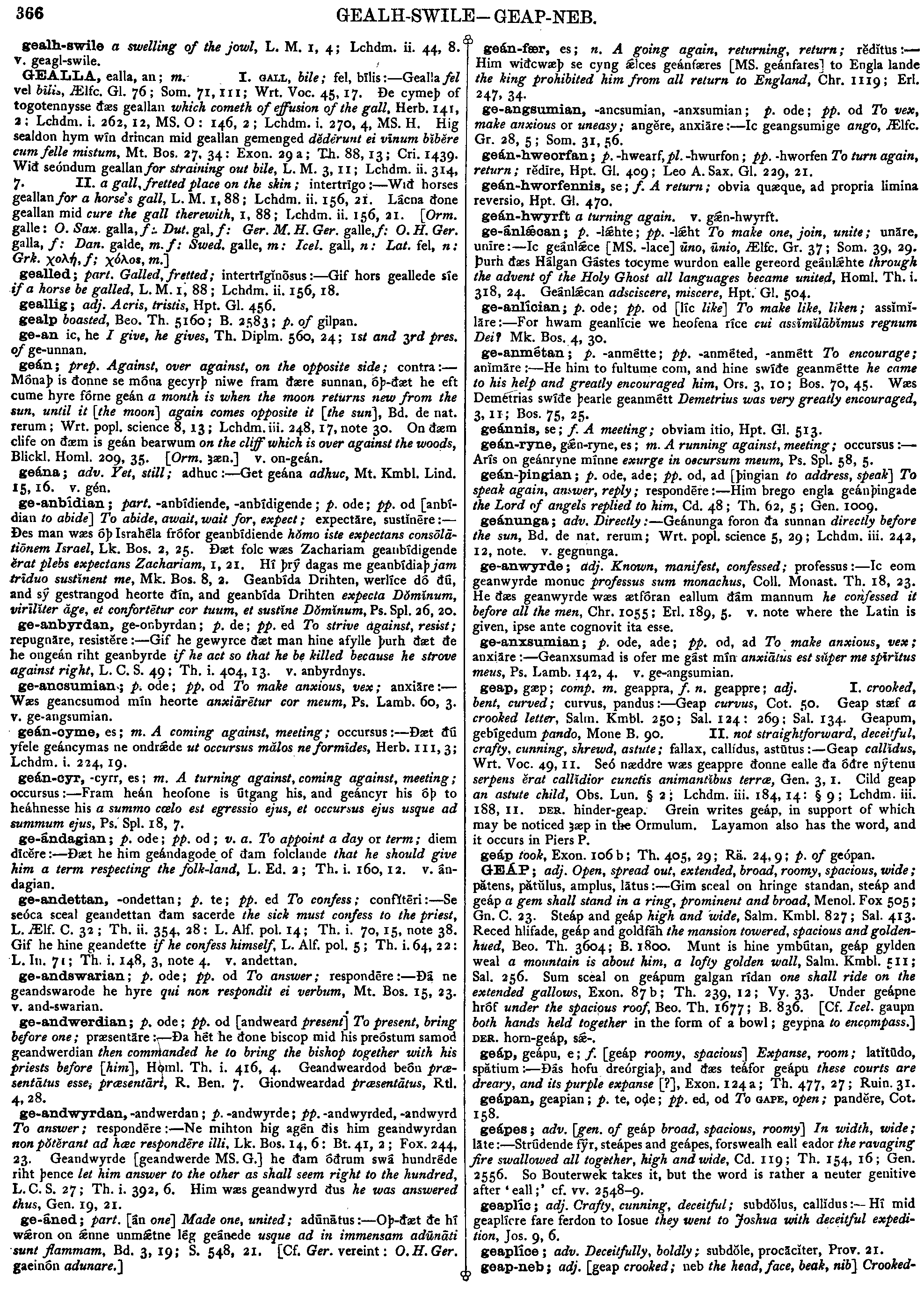
ge-angsumian,
-ancsumian,
-anxsumian;
p.
ode;
pp.
od
To
vex,
make
anxious
or
uneasy;
ang re,
anxi
re,
anxi re
:--
Ic
geangsumige
ango,
Ælfc.
Gr.
28,
5;
Som.
31,
56.
re
:--
Ic
geangsumige
ango,
Ælfc.
Gr.
28,
5;
Som.
31,
56.
|
Source: Bosworth/Toller, page b0751, entry 11 View original page image as: [TIFF] [PNG] [View previous entry] [View next entry] |
[Comment on this entry] [View comments] |
The following entry has been hand-corrected once. |
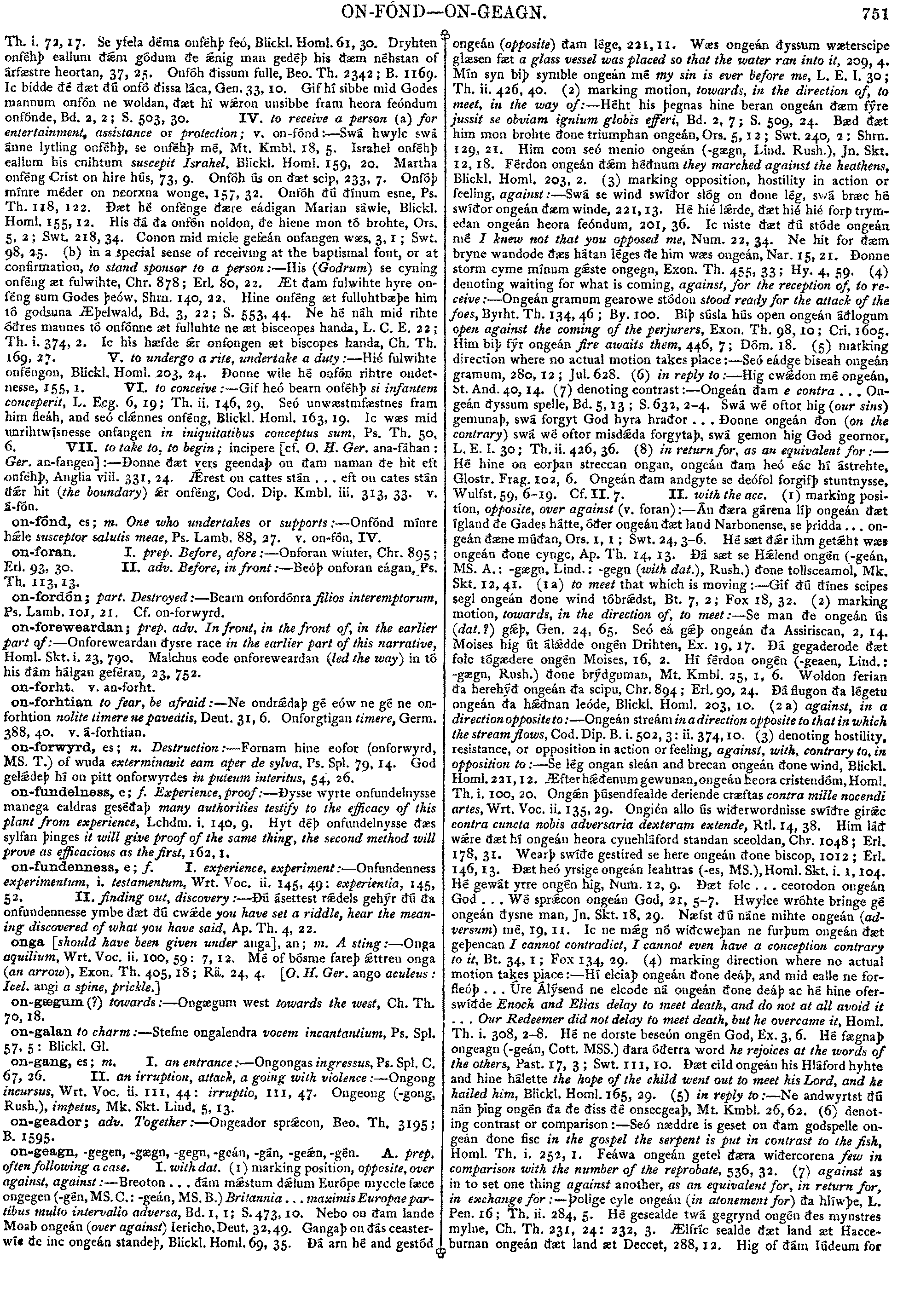
onga
[should
have
been
given
under
anga],
an;
m.
A
sting:--Onga
aquilium,
Wrt.
Voc.
ii.
100,
59:
7,
12.
Mé
of
bósme
fareþ
 ttren
onga
(an
arrow).
Exon.
Th.
405,
18;
Rä.
24,
4.
[O.
H.
Ger.
ango
aculeus:
Icel.
angi
a
spine,
prickle.]
ttren
onga
(an
arrow).
Exon.
Th.
405,
18;
Rä.
24,
4.
[O.
H.
Ger.
ango
aculeus:
Icel.
angi
a
spine,
prickle.]
|
Source: Cleasby/Vigfusson, page b0021, entry 24 View original page image as: [TIFF] [PNG] [View previous entry] [View next entry] |
[Comment on this entry] [View comments] |
The following entry has been hand-corrected once. |
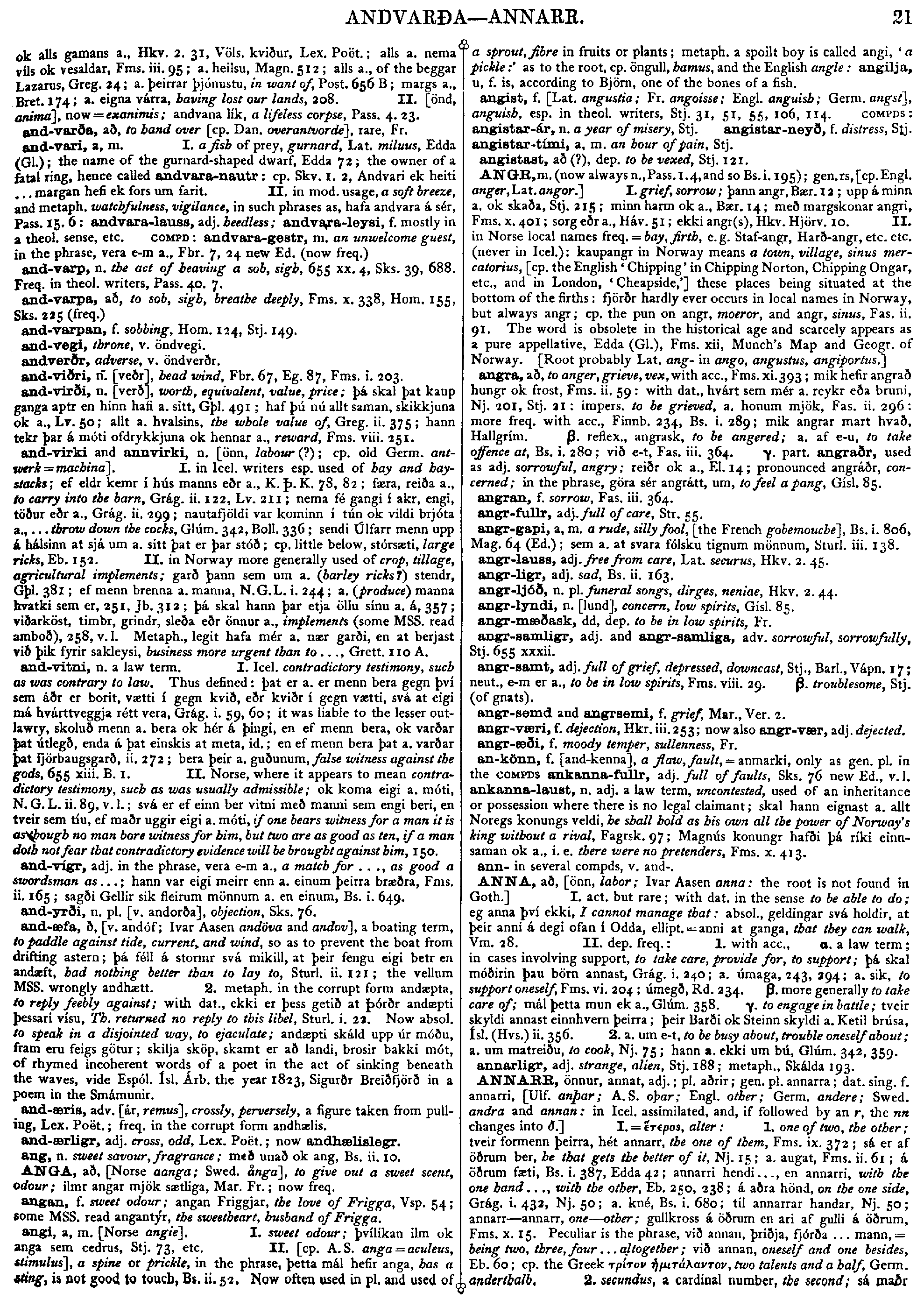
ANGR, m. (now always n., Pass. 1. 4, and so Bs. i. 195); gen.rs, [cp. Engl. anger, Lat. angor.] I. grief, sorrow; þann angr, Bær. 12; upp á minn a. ok skaða, Stj. 215; minn harm ok a., Bær. 14; með margskonar angri, Fms.x.401; sorg eðr a., Háv. 51; ekki angr(s), Hkv. Hjörv. 10. II. in Norse local names freq. = bay, firth, e. g. Staf-angr, Harð-angr, etc. etc. (never in Icel.): kaupangr in Norway means a town, village, sinus mer- catorius, [cp. the English 'Chipping' in Chipping Norton, Chipping Ongar, etc., and in London, 'Cheapside,'] these places being situated at the bottom of the firths: fjörðr hardly ever occurs in local names in Norway, but always angr; cp. the pun on angr, moeror, and angr, sinus, Fas. ii. 91. The word is obsolete in the historical age and scarcely appears as a pure appellative, Edda (Gl.), Fms. xii, Munch's Map and Geogr. of Norway. [Root probably Lat. ang- in ango, angustus, angiportus.]
|
Source: Cleasby/Vigfusson, page b0130, entry 10 View original page image as: [TIFF] [PNG] [View previous entry] [View next entry] |
[Comment on this entry] [View comments] |
The following entry has been hand-corrected once. |
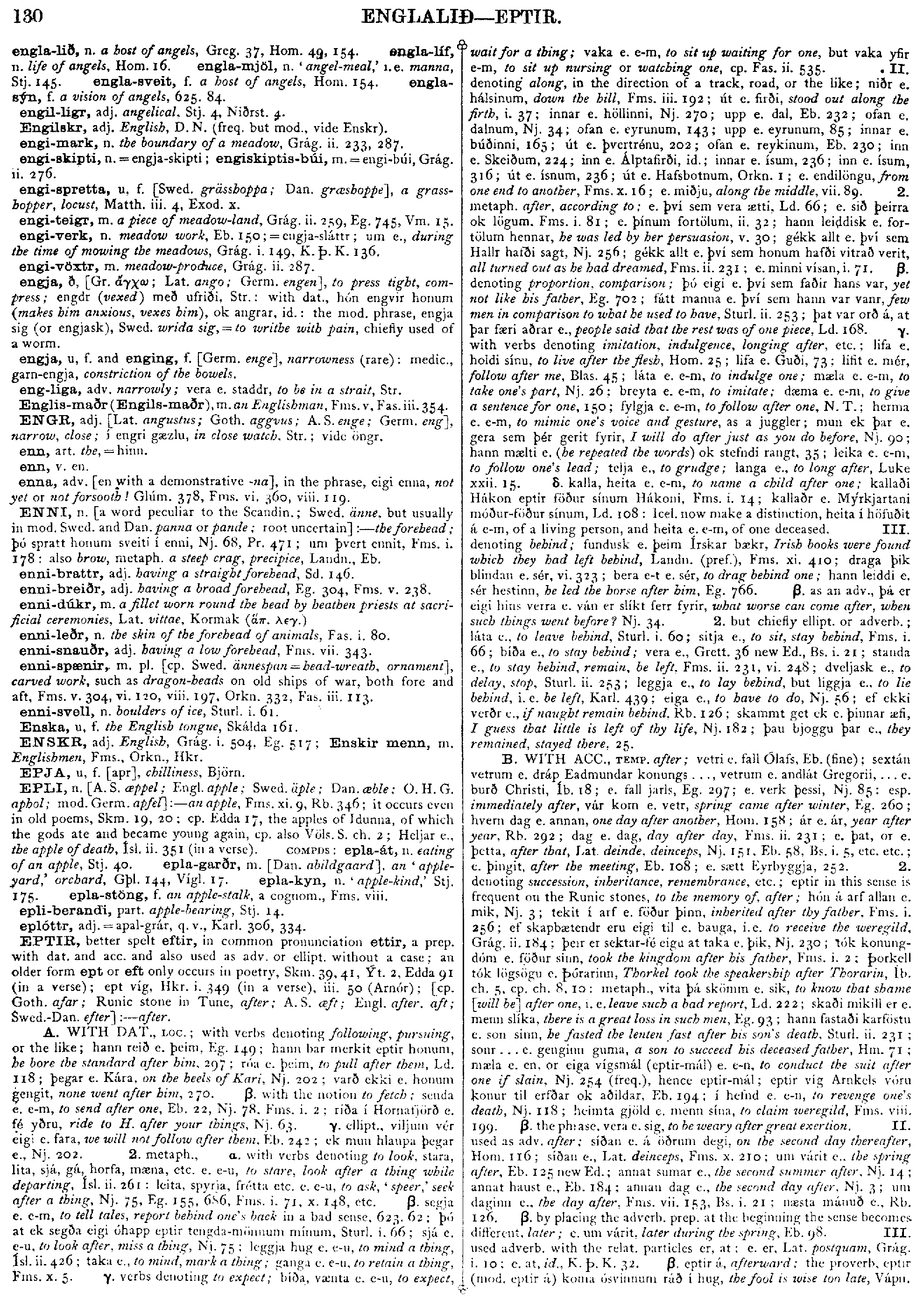
engja, ð, [Gr. GREEK; Lat. ango; Germ. engen] , to press tight, com- press; engdr (vexed) með ufriði, Str.: with dat., hón engvir honum (makes him anxious, vexes him,) ok angrar, id.: the mod. phrase, engja sig (or engjask), Swed. wrida sig, = to writhe with pain, chiefly used of a worm.
Germanic Lexicon Project (main page)
This search system was written by
Sean Crist
Please consider
volunteering
to correct the data in these online dictionaries.
No rights reserved. Feel free to use these data in any way you please.