|
|

|
Source: Bosworth/Toller, page b0487, entry 8 View original page image as: [TIFF] [PNG] [View previous entry] [View next entry] |
[Comment on this entry] [View comments] |
The following entry has been hand-corrected once. |
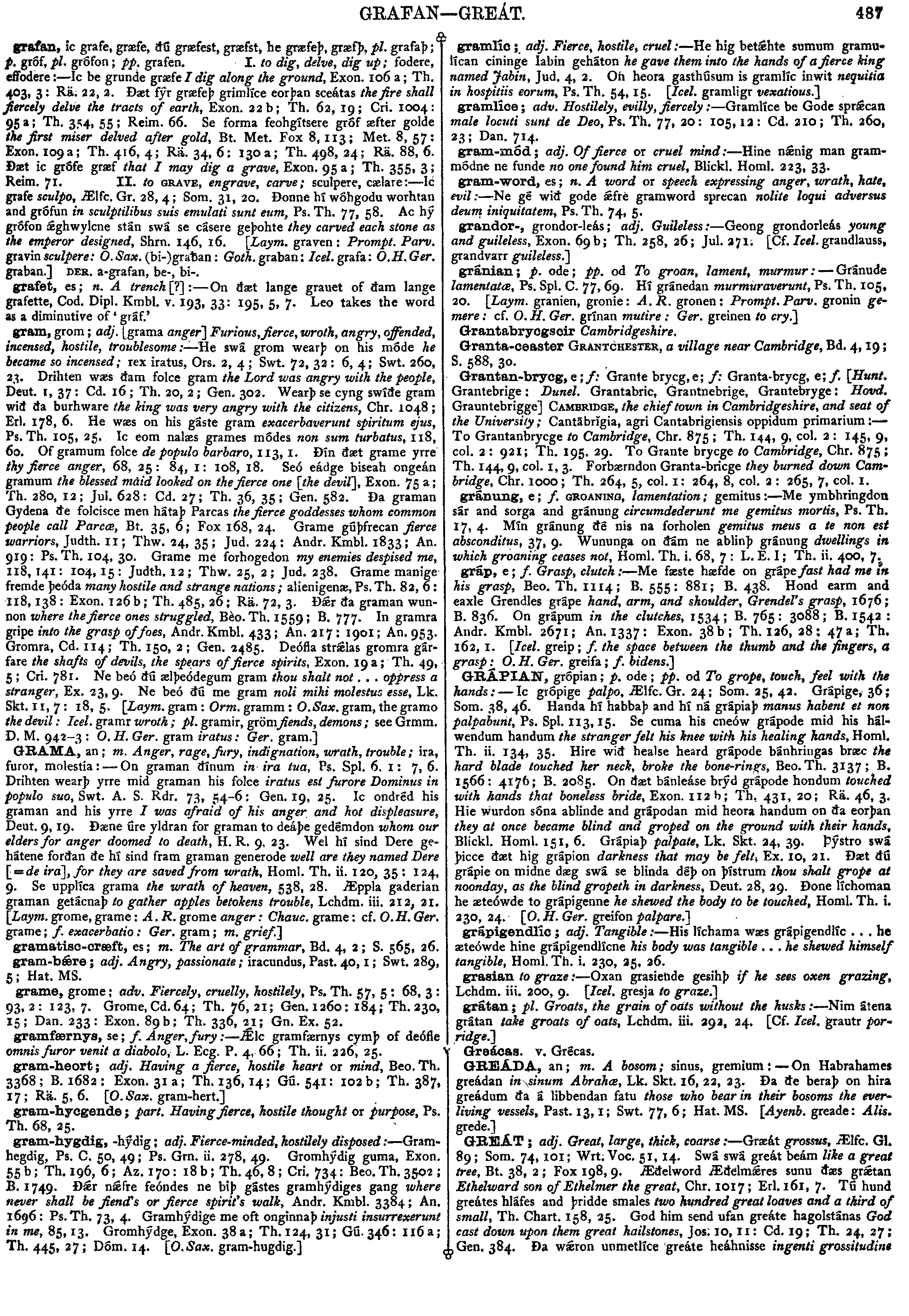
gramfærnys, se; f. Anger, fury :-- Æ-acute;lc gramfærnys cymþ of deófle omnis furor venit a diabolo, L. Ecg. P. 4, 66; Th. ii. 226, 25.
|
Source: Bosworth/Toller, page b0487, entry 15 View original page image as: [TIFF] [PNG] [View previous entry] [View next entry] |
[Comment on this entry] [View comments] |
The following entry has been hand-corrected once. |
gram-word,
es;
n.
A
word
or
speech
expressing
anger,
wrath,
hate,
evil
:--
Ne
gé
wið
eode
 fre
gramword
sprecan
nolite
loqui
adversus
deum
iniquitatem,
Ps.
Th.
74,
5.
fre
gramword
sprecan
nolite
loqui
adversus
deum
iniquitatem,
Ps.
Th.
74,
5.
|
Source: Bosworth/Toller, page b0488, entry 19 View original page image as: [TIFF] [PNG] [View previous entry] [View next entry] |
[Comment on this entry] [View comments] |
The following entry has been hand-corrected once. |
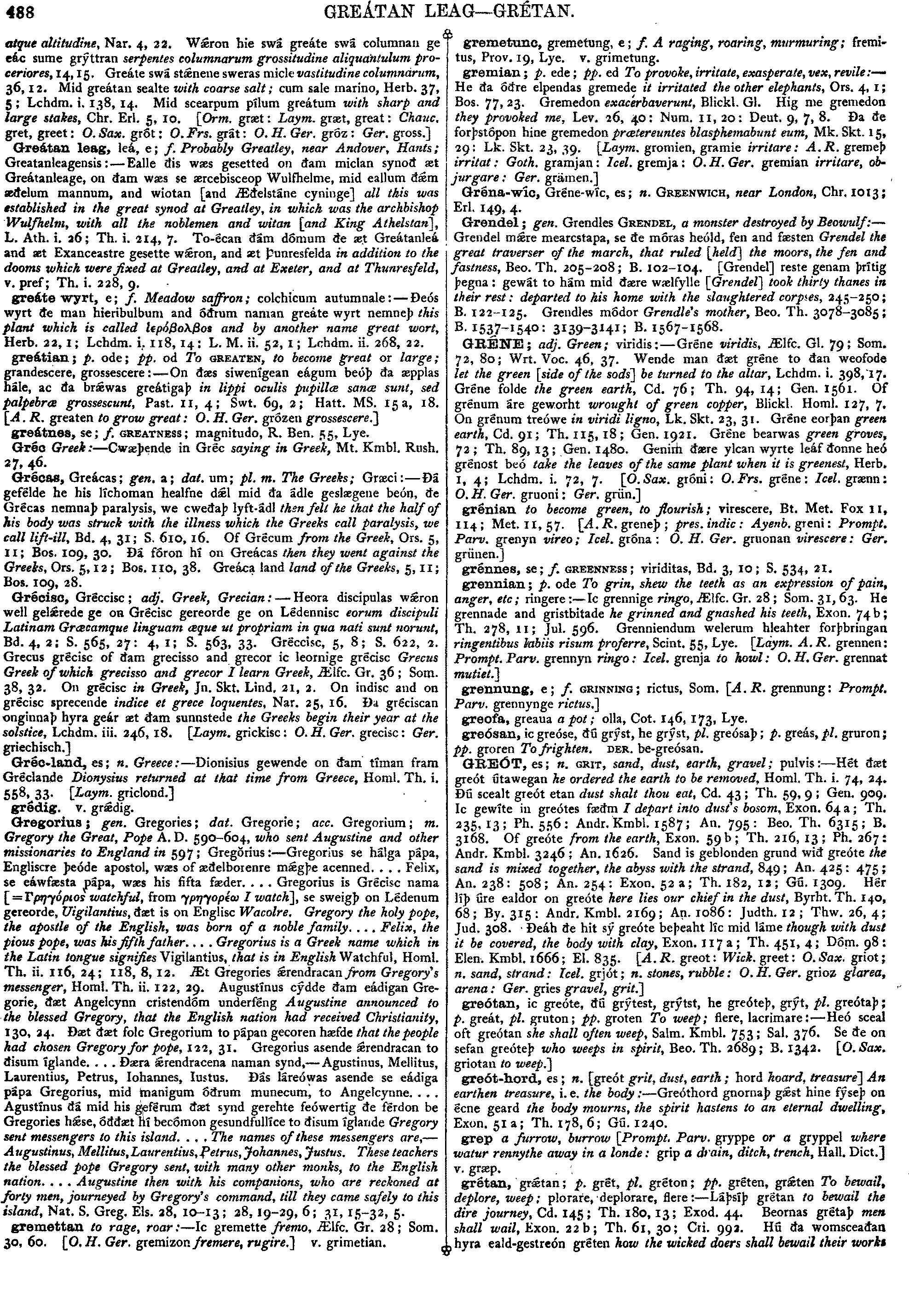
grennian; p. ode To grin, shew the teeth as an expression of pain, anger, etc; ringere :-- Ic grennige ringo, Ælfc. Gr. 28; Som. 31, 63. He grennade and gristbitade he grinned and gnashed his teeth, Exon. 74 b; Th. 278, 11; Jul. 596. Grenniendum welerum hleahter forþbringan ringentibus labiis risum proferre, Scint. 55, Lye. [Laym. A. R. grennen: Prompt. Parv. grennyn ringo: Icel. grenja to howl: O. H. Ger. grennat mutiet.]
|
Source: Bosworth/Toller, page b0510, entry 16 View original page image as: [TIFF] [PNG] [View previous entry] [View next entry] |
[Comment on this entry] [View comments] |
The following entry has been hand-corrected once. |
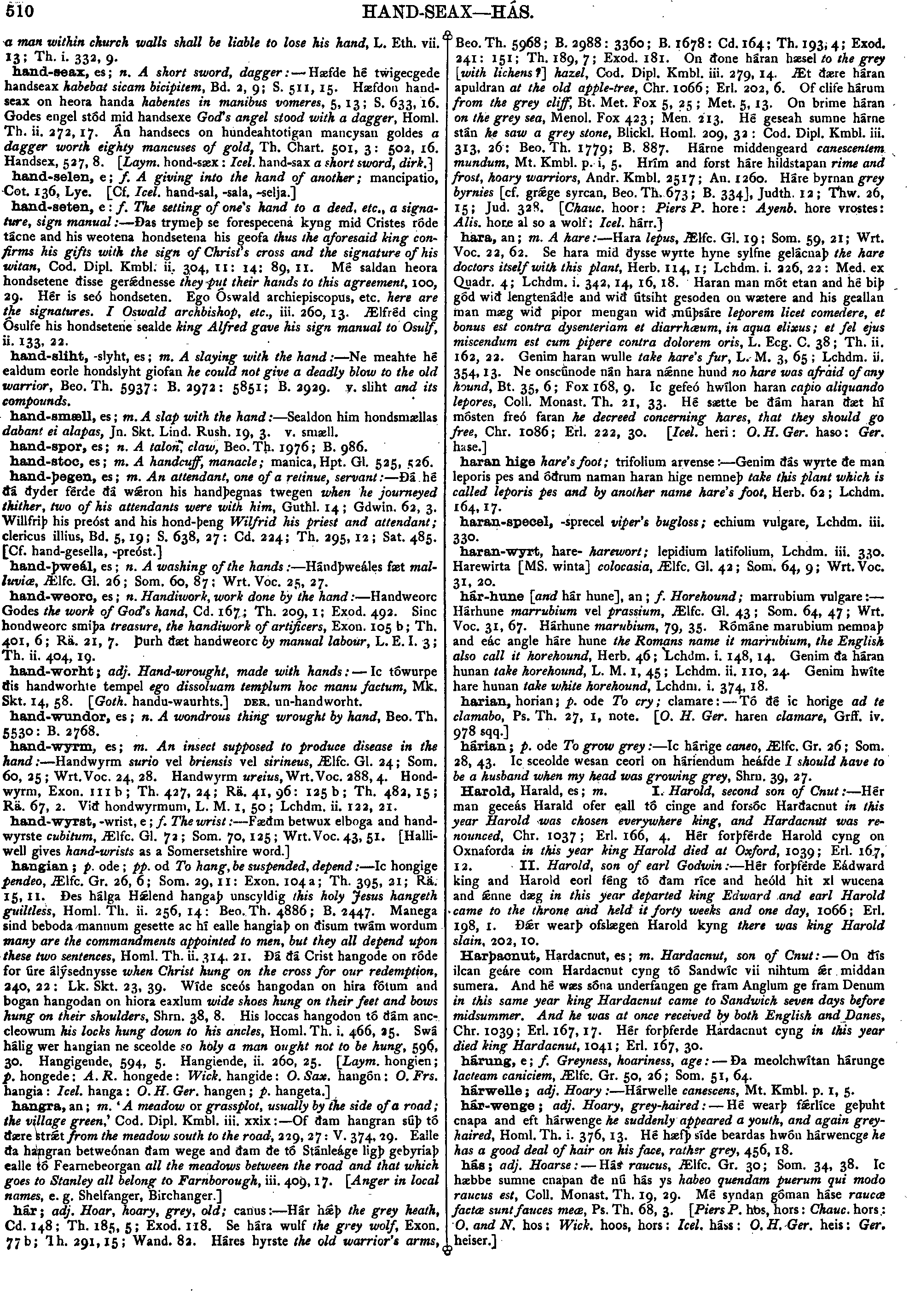
hangra,
an;
m.
'A
meadow
or
grassplot,
usually
by
the
side
of
a
road;
the
village
green,'
Cod.
Dipl.
Kmbl.
iii.
xxix
:--
Of
ðam
hangran
súþ
tó
ðære
strt
from
the
meadow
south
to
the
road,
229,
27:
V.
374,
29.
Ealle
ða
hangran
betweónan
ðam
wege
and
ðam
ðe
tó
Stánleáge
ligþ
gebyriaþ
ealle
tó
Fearnebeorgan
all
the
meadows
between
the
road
and
that
which
goes
to
Stanley
all
belong
to
Farnborough,
iii.
409,
17.
[Anger
in
local
names,
e.g.
Shelfanger,
Birchanger.]
|
Source: Bosworth/Toller, page b0511, entry 18 View original page image as: [TIFF] [PNG] [View previous entry] [View next entry] |
[Comment on this entry] [View comments] |
The following entry has been hand-corrected once. |
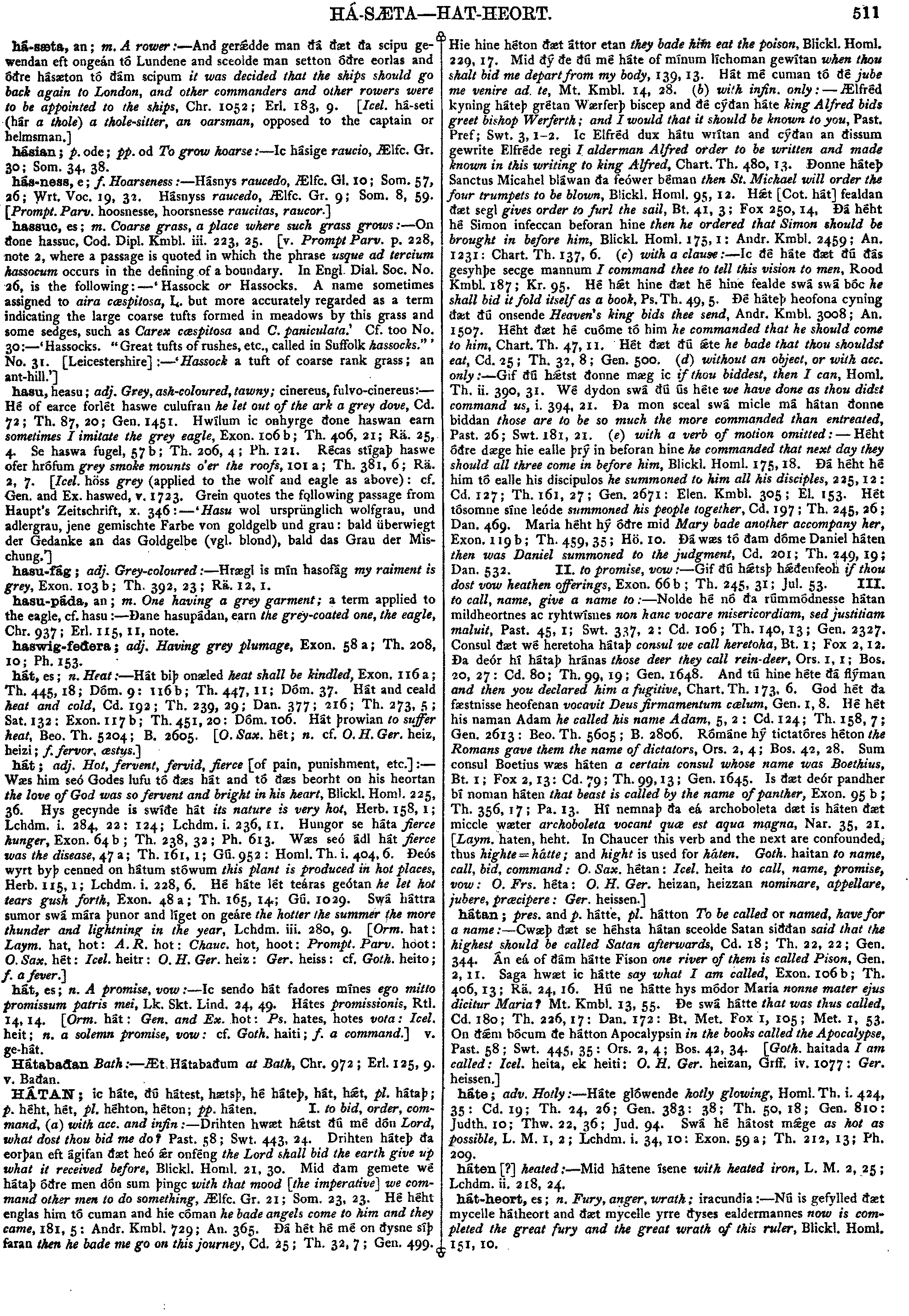
hát-heort, es; n. Fury, anger, wrath; iracundia :-- Nú is gefylled ðæt mycelle hátheort and ðæt mycelle yrre ðyses ealdermannes now is completed the great fury and the great wrath of this ruler, Blickl. Homl. 151, 10.
|
Source: Bosworth/Toller, page b0512, entry 2 View original page image as: [TIFF] [PNG] [View previous entry] [View next entry] |
[Comment on this entry] [View comments] |
The following entry has been hand-corrected once. |
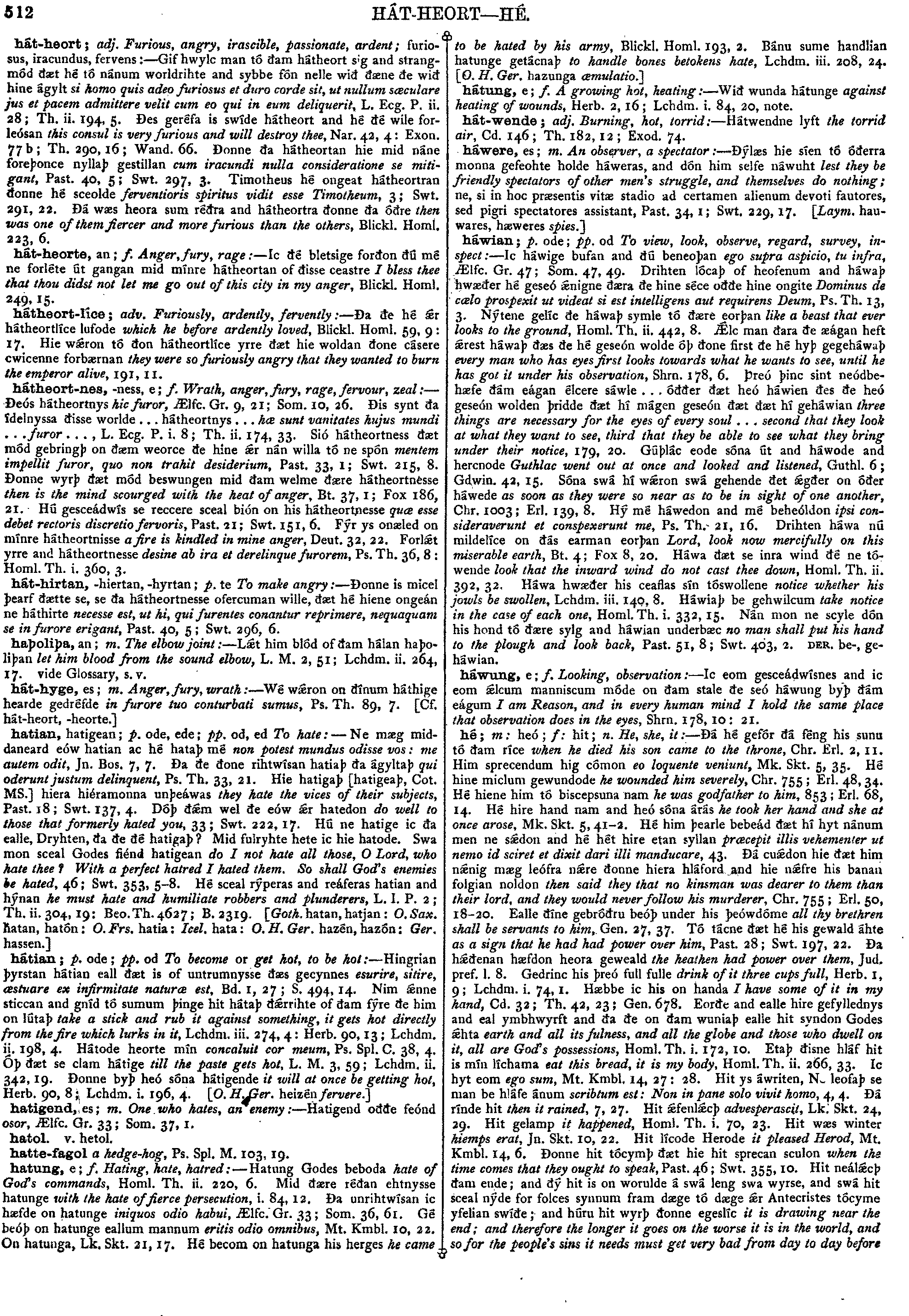
hát-heorte, an; f. Anger, fury, rage :-- Ic ðé bletsige forðon ðú mé ne forléte út gangan mid mínre hátheortan of ðisse ceastre I bless thee that thou didst not let me go out of this city in my anger, Blickl. Homl. 249, 15.
|
Source: Bosworth/Toller, page b0512, entry 4 View original page image as: [TIFF] [PNG] [View previous entry] [View next entry] |
[Comment on this entry] [View comments (1)] |
The following entry has been hand-corrected once. |
hátheort-nes,
-ness,
e;
f.
Wrath,
anger,
fury,
rage,
fervour,
zeal
:--
Ðeós
hátheortnys
hic
furor,
Ælfc.
Gr.
9,
21;
Som.
10,
26.
Ðis
synt
ða
ídelnyssa
ðisse
worlde
...
hátheortnys
...
hæ
sunt
vanitates
hujus
mundi
...
furor
...,
L.
Ecg.
P.
i.
8;
Th.
ii.
174,
33.
Sió
hátheortness
ðæt
mód
gebringþ
on
ðæm
weorce
ðe
hine
r
nán
wills
tó
ne
spón
mentem
impellit
furor,
quo
non
trahit
desiderium,
Past.
33,
1;
Swt.
215,
8.
Ðonne
wyrþ
ðæt
mód
beswungen
mid
ðam
welme
ðære
hátheortnesse
then
is
the
mind
scourged
with
the
heat
of
anger,
Bt.
37,
1;
Fox
186,
21.
Hú
gesceádwís
se
reccere
sceal
bión
on
his
hátheortnesse
quæ
esse
debet
rectoris
discretio
fervoris,
Past.
21;
Swt.
151,
6.
Fýr
ys
onæled
on
mínre
hátheortnisse
a
fire
is
kindled
in
mine
anger,
Deut.
32,
22.
Forlt
yrre
and
hátheortnesse
desine
ab
ira
et
derelinque
furorem,
Ps.
Th.
36,
8:
Homl.
Th.
i.
360,
3.
|
Source: Bosworth/Toller, page b0512, entry 7 View original page image as: [TIFF] [PNG] [View previous entry] [View next entry] |
[Comment on this entry] [View comments] |
The following entry has been hand-corrected once. |
hát-hyge,
es;
m.
Anger,
fury,
wrath
:--
Wé
wron
on
ðínum
háthige
hearde
gedréfde
in
furore
tuo
conturbati
sumus,
Ps.
Th.
89,
7.
[Cf.
hát-heort,
-heorte.]
|
Source: Bosworth/Toller, page b0524, entry 27 View original page image as: [TIFF] [PNG] [View previous entry] [View next entry] |
[Comment on this entry] [View comments] |
The following entry has been hand-corrected once. |
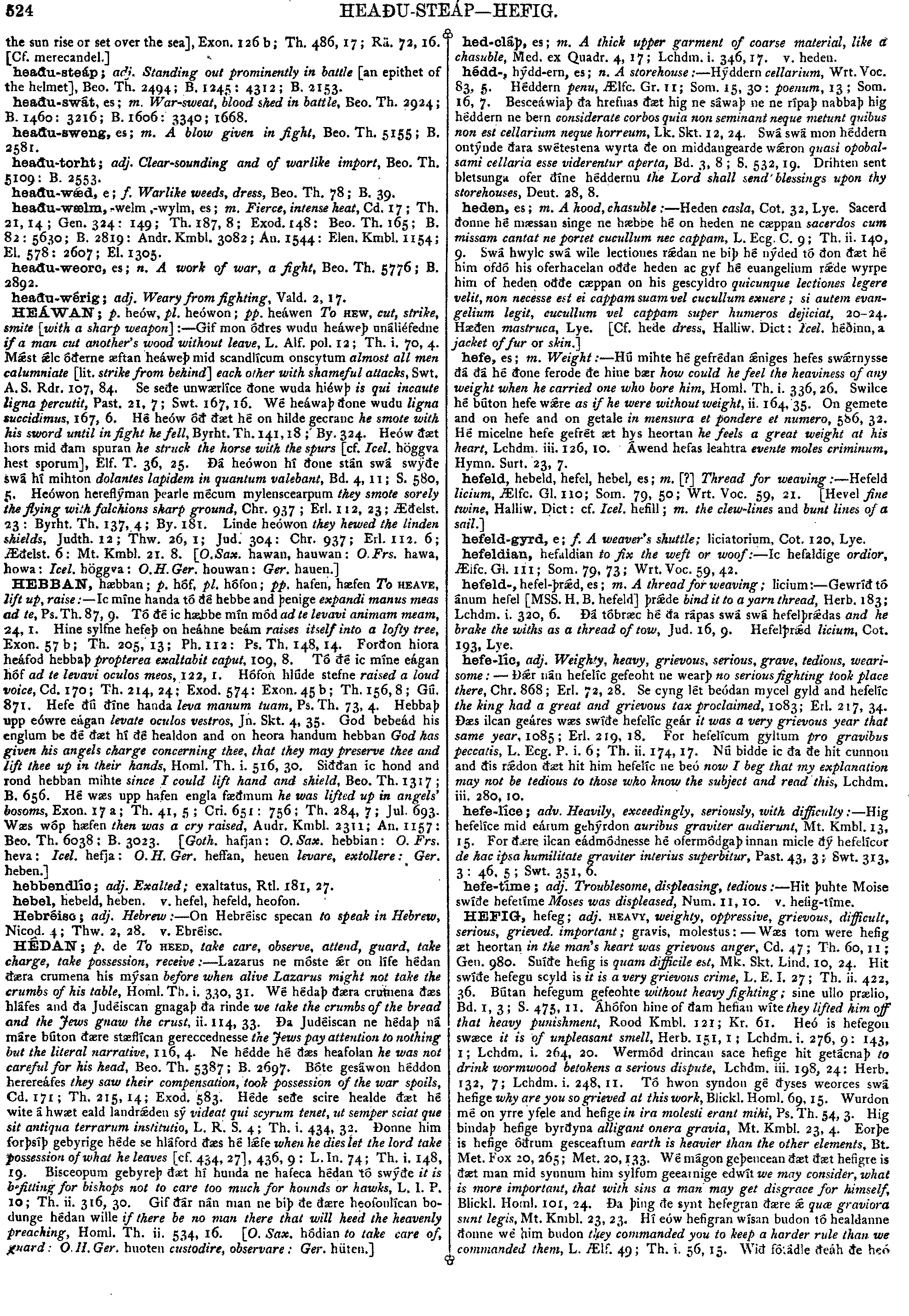
HEFIG,
hefeg;
adj.
HEAVY,
weighty,
oppressive,
grievous,
difficult,
serious,
grieved,
important;
gravis,
molestus
:--
Wæs
torn
were
hefig
æt
heortan
in
the
man's
heart
was
grievous
anger,
Cd.
47;
Th.
60,
11;
Gen.
980.
Suíðe
hefig
is
quam
difficile
est,
Mk.
Skt.
Lind.
10,
24.
Hit
swíðe
hefegu
scyld
is
it
is
a
very
grievous
crime,
L.
E.
I.
27;
Th.
ii.
422,
36.
Bútan
hefegum
gefeohte
without
heavy
fighting;
sine
ullo
prælio,
Bd.
1,
3;
S.
473,
11,
Áhófon
hine
of
ðam
hefian
wíte
they
lifted
him
off
that
heavy
punishment,
Rood
Kmbl.
121;
Kr.
61.
Heó
is
hefegon
swæce
it
is
of
unpleasant
smell,
Herb.
151,
1;
Lchdm.
i.
276,
9:
143,
1;
Lchdm,
i.
264,
20.
Wermód
drincan
sace
hefige
hit
getácnaþ
to
drink
wormwood
betokens
a
serious
dispute,
Lchdm,
iii.
198,
24:
Herb.
132,
7;
Lchdm.
i.
248,
11.
Tó
hwon
syndon
gé
ðyses
weorces
swá
hefige
why
are
you
so
grieved
at
this
work,
Blickl.
Homl.
69,
15.
Wurdon
mé
on
yrre
yfele
and
hefige
in
ira
molesti
erant
mihi,
Ps.
Th.
54,
3.
Hig
bindaþ
hefige
byrðyna
alligant
onera
gravia,
Mt.
Kmbl.
23,
4.
Eorþe
is
hefige
óðrum
gesceaftum
earth
is
heavier
than
the
other
elements,
Bt.
Met.
Fox
20,
265;
Met.
20,
133.
Wé
mágon
geþencean
ðæt
ðæt
hefigre
is
ðæt
man
mid
synnum
him
sylfum
geearnige
edwít
we
may
consider,
what
is
more
important,
that
with
sins
a
man
may
get
disgrace
for
himself,
Blickl.
Homl.
101,
24.
Ða
þing
ðe
synt
hefegran
ðære
quæ
graviora
sunt
legis,
Mt.
Kmbl.
23,
23.
Hí
eów
hefigran
wísan
budon
tó
healdanne
ðonne
wé
him
budon
they
commanded
you
to
keep
a
harder
rule
than
we
commanded
them,
L.
Ælf
49;
Th.
i.
56,
15.
Wíð
fótádle
ðeáh
ðe
heó
hefegust
sý
for
gout,
though
it
be
very
bad,
Herb.
132;
4;
Lchdm.
i.
246,
22.
Mid
ðon
gewunon
ðære
heofogoston
gewemmednesse
synna
with
the
habit
of
the
most
grievous
impurity
of
sins,
Blickl.
Homl.
75,
6.
[O.
Sax.
he ig:
O.
H.
Ger.
hebic,
heuig
gravis,
arduus,
molestus.]
ig:
O.
H.
Ger.
hebic,
heuig
gravis,
arduus,
molestus.]
|
Source: Bosworth/Toller, page b0534, entry 26 View original page image as: [TIFF] [PNG] [View previous entry] [View next entry] |
[Comment on this entry] [View comments] |
The following entry has been hand-corrected once. |
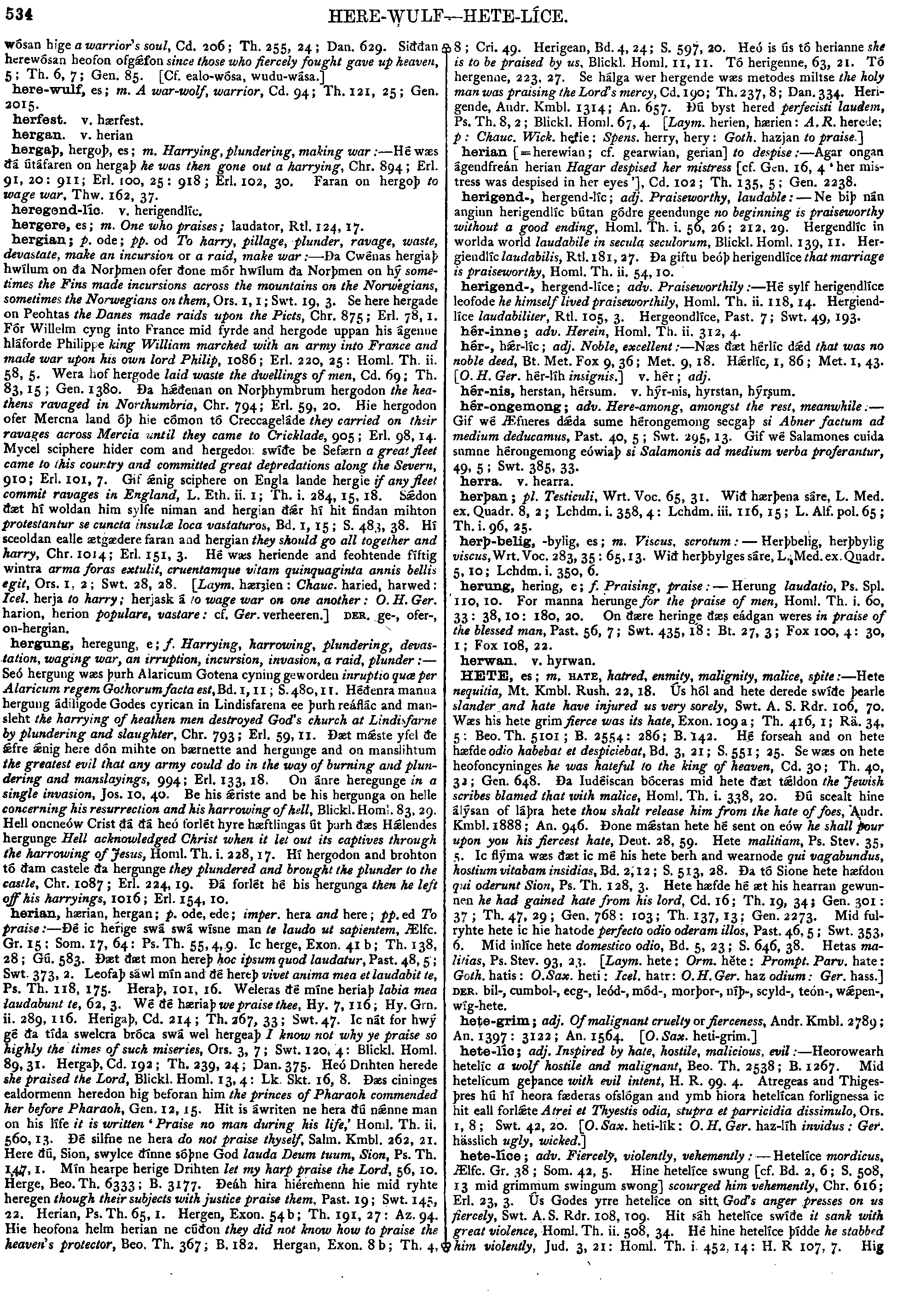
hete-líce; adv. Fiercely, violently, vehemently:-- Hetelíce mordicus, Ælfc. Gr. 38; Som. 42, 5. Hine hetelíce swung [cf. Bd. 2, 6; S. 508, 13 mid grimmum swingum swong] scourged him vehemently, Chr. 616; Erl. 23, 3. Ús Godes yrre hetelíce on sitt, God's anger presses on us fiercely. Swt. A. S. Rdr. 108, 109. Hit sáh hetelíce swíðe it sank with great violence, Homl. Th. ii. 508, 34. Hé hine hetelíce þídde he stabbed him violently, Jud. 3, 21: Homl. Th. i. 452, 14: H. R 107, 7. Hig
| Result Page: |  |
Previous | 1 2 3 4 5 6 7 8 9 10 11 12 13 14 | Next |  |
Germanic Lexicon Project (main page)
This search system was written by
Sean Crist
Please consider
volunteering
to correct the data in these online dictionaries.
No rights reserved. Feel free to use these data in any way you please.