|
|

|
Source: Bosworth/Toller, page d0375, entry 2 View original page image as: [TIFF] [PNG] [View previous entry] [View next entry] |
[Comment on this entry] [View comments] |
The following entry has been hand-corrected once. |
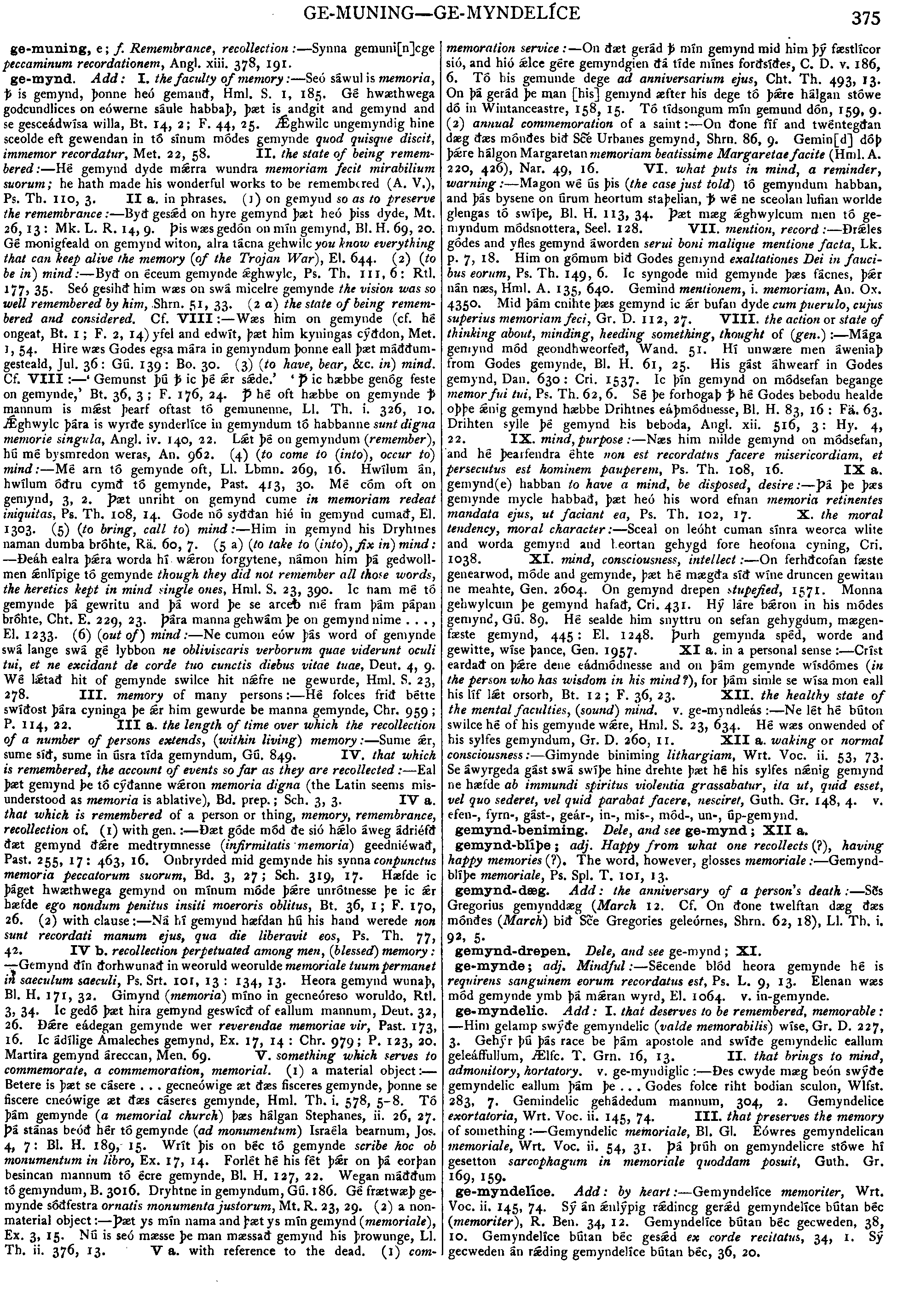
ge-mynd.
Add:
I.
the
faculty
of
memory
:--
Seó
sáwul
is
memoria,
 is
gernynd,
þonne
heó
gemanð,
Hml.
S.
I.
185.
Gé
hwæthwega
godcundlices
on
eówerne
sáule
habbaþ,
þæt
is
andgit
and
gemynd
and
se
gesceádwísa
willa,
Bt.
14,
2;
F.
44,
25.
Æ-acute;ghwilc
ungemyndig
hine
sceolde
eft
gewendan
in
tó
sínum
módes
gemynde
quod
quisque
discit,
immemor
recordatur.
Met.
22,
58.
II,
the
state
of
being
remembered
:--
Hé
gemynd
dyde
m
is
gernynd,
þonne
heó
gemanð,
Hml.
S.
I.
185.
Gé
hwæthwega
godcundlices
on
eówerne
sáule
habbaþ,
þæt
is
andgit
and
gemynd
and
se
gesceádwísa
willa,
Bt.
14,
2;
F.
44,
25.
Æ-acute;ghwilc
ungemyndig
hine
sceolde
eft
gewendan
in
tó
sínum
módes
gemynde
quod
quisque
discit,
immemor
recordatur.
Met.
22,
58.
II,
the
state
of
being
remembered
:--
Hé
gemynd
dyde
m rra
wundra
memoriam
fecit
mirabilium
suorum;
he
hath
made
his
wonderful
works
to
be
remembered
(A.
V.),
Ps.
Th.
110,
3.
II
a.
in
phrases.
(1)
on
gemynd
so
as
to
preserve
the
remembrance
:--
Byð
gesd
on
hyre
gemynd
þæt
heó
þiss
dyde,
Mt.
26,
13:
Mk.
L.
R.
14,
9.
Þis
wæs
gedón
on
mín
gemynd,
Bl.
H.
69,
20.
Gé
monigfeald
on
gemynd
witon,
alra
tácna
gehwilc
you
know
everything
that
can
keep
alive
the
memory
(of
the
Trojan
War),
El.
644.
(2)
(to
be
in)
mind
:--
Byð
on
éceum
gemynde
ghwylc,
Ps.
Th.
111,
6:
Rtl.
177,
35.
Seó
gesihð
him
wæs
on
swá
micelre
gemynde
the
vision
was
so
well
remembered
by
him,
Shrn.
51,
33.
(2
a)
the
state
of
being
remembered
and
considered.
Cf.
VIII
:--
Wæs
him
on
gemynde
(cf.
hé
ongeat,
Bt.
l;
F.
2,
14)
yfel
and
edwít,
þæt
him
kyningas
cýðdon,
Met.
l,
54.
Hire
wæs
Godes
egsa
mára
in
gemyndum
þonne
eall
þæt
máððum-gesteald,
Jul.
36:
Gú.
139:
Bo.
30.
(3)
(to
have,
bear,
&
c.
in)
mind.
Cf.
VIII
:--
'
Gemunst
þú
ic
þé
r
sde.
'
'
ic
hæbbe
genóg
feste
on
gemynde,
'
Bt.
36,
3
;
F.
176,
24.
hé
oft
hæbbe
on
gemynde
mannum
is
mst
þearf
oftast
tó
gemunenne,
Ll.
Th.
i.
326,
10.
Æghwylc
þára
is
wyrðe
synderlíce
in
gemyndum
tó
habbanne
sunt
digna
memorie
singula,
Angl.
iv.
140,
22.
Lt
þé
on
gemyndum
(remember),
hú
mé
bysmredon
weras,
An.
962.
(4)
(to
come
to
(into)
,
occur
to)
mind
:--
Mé
arn
tó
gemynde
oft,
Ll.
Lbmn.
269,
16.
Hwílum
án,
hwílum
óðru
cymð
tó
gemynde,
Past.
413,
30.
Mé
cóm
oft
on
gemynd,
3,
2.
Þæt
unriht
on
gemynd
cume
in
memoriam
redeat
iniquitas.
Ps.
Th.
108,
14.
Gode
nó
syððan
hié
in
gemynd
cumað,
El.
-303-
(5)
(to
bring,
call
to]
mind
:--
Him
in
gemynd
his
Dryhtnes
naman
dumba
bróhte,
Rä.
60,
7.
(5
a)
(to
take
to
(into]
,
fix
in)
mind
:--
Ðeáh
ealra
þra
worda
hí
wron
forgytene,
námon
him
þá
gedwoll-men
nlípige
tó
gemynde
though
they
did
not
remember
all
those
words,
the
heretics
kept
in
mind
single
ones,
Hml.
S.
23,
390.
Ic
nam
mé
tó
gemynde
þá
gewritu
and
þá
word
þe
se
arce
rra
wundra
memoriam
fecit
mirabilium
suorum;
he
hath
made
his
wonderful
works
to
be
remembered
(A.
V.),
Ps.
Th.
110,
3.
II
a.
in
phrases.
(1)
on
gemynd
so
as
to
preserve
the
remembrance
:--
Byð
gesd
on
hyre
gemynd
þæt
heó
þiss
dyde,
Mt.
26,
13:
Mk.
L.
R.
14,
9.
Þis
wæs
gedón
on
mín
gemynd,
Bl.
H.
69,
20.
Gé
monigfeald
on
gemynd
witon,
alra
tácna
gehwilc
you
know
everything
that
can
keep
alive
the
memory
(of
the
Trojan
War),
El.
644.
(2)
(to
be
in)
mind
:--
Byð
on
éceum
gemynde
ghwylc,
Ps.
Th.
111,
6:
Rtl.
177,
35.
Seó
gesihð
him
wæs
on
swá
micelre
gemynde
the
vision
was
so
well
remembered
by
him,
Shrn.
51,
33.
(2
a)
the
state
of
being
remembered
and
considered.
Cf.
VIII
:--
Wæs
him
on
gemynde
(cf.
hé
ongeat,
Bt.
l;
F.
2,
14)
yfel
and
edwít,
þæt
him
kyningas
cýðdon,
Met.
l,
54.
Hire
wæs
Godes
egsa
mára
in
gemyndum
þonne
eall
þæt
máððum-gesteald,
Jul.
36:
Gú.
139:
Bo.
30.
(3)
(to
have,
bear,
&
c.
in)
mind.
Cf.
VIII
:--
'
Gemunst
þú
ic
þé
r
sde.
'
'
ic
hæbbe
genóg
feste
on
gemynde,
'
Bt.
36,
3
;
F.
176,
24.
hé
oft
hæbbe
on
gemynde
mannum
is
mst
þearf
oftast
tó
gemunenne,
Ll.
Th.
i.
326,
10.
Æghwylc
þára
is
wyrðe
synderlíce
in
gemyndum
tó
habbanne
sunt
digna
memorie
singula,
Angl.
iv.
140,
22.
Lt
þé
on
gemyndum
(remember),
hú
mé
bysmredon
weras,
An.
962.
(4)
(to
come
to
(into)
,
occur
to)
mind
:--
Mé
arn
tó
gemynde
oft,
Ll.
Lbmn.
269,
16.
Hwílum
án,
hwílum
óðru
cymð
tó
gemynde,
Past.
413,
30.
Mé
cóm
oft
on
gemynd,
3,
2.
Þæt
unriht
on
gemynd
cume
in
memoriam
redeat
iniquitas.
Ps.
Th.
108,
14.
Gode
nó
syððan
hié
in
gemynd
cumað,
El.
-303-
(5)
(to
bring,
call
to]
mind
:--
Him
in
gemynd
his
Dryhtnes
naman
dumba
bróhte,
Rä.
60,
7.
(5
a)
(to
take
to
(into]
,
fix
in)
mind
:--
Ðeáh
ealra
þra
worda
hí
wron
forgytene,
námon
him
þá
gedwoll-men
nlípige
tó
gemynde
though
they
did
not
remember
all
those
words,
the
heretics
kept
in
mind
single
ones,
Hml.
S.
23,
390.
Ic
nam
mé
tó
gemynde
þá
gewritu
and
þá
word
þe
se
arce mé
fram
þám
pápan
bróhte,
Cht.
E.
229,
23.
Þára
manna
gehwám
þe
on
gemynd
nime
.
.
.
,
El.
1233.
(6)
(out
of)
mind
:--
Ne
cumon
eów
þás
word
of
gemynde
swá
lange
swá
gé
lybbon
ne
obliviscaris
verborum
quae
viderunt
oculi
tui,
et
ne
excidant
de
corde
tuo
cunctis
diebus
vitae
tuae,
Deut.
4,
9.
Wé
ltað
hit
of
gemynde
swilce
hit
nfre
ne
gewurde,
Hml.
S.
23,
278.
III.
memory
of
many
persons
:--
Hé
folces
frið
bétte
swíðost
þára
cyninga
þe
r
him
gewurde
be
manna
gemynde,
Chr.
959
;
P.
114,
22.
III
a.
the
length
of
time
over
which
the
recollection
of
a
number
of
persons
extends,
(within
living)
memory
:--
Sume
r,
sume
síð,
sume
in
úsra
tída
gemyndum,
Gfl.
849.
IV.
that
which
is
remembered,
the
account
of
events
so
far
as
they
are
recollected
:--
Eal
þæt
gemynd
þe
tó
cýðanne
wron
memoria
digna
(the
Latin
seems
misunderstood
as
memoria
is
ablative),
Bd.
prep.
;
Sch.
3,
3.
IV
a.
that
which
is
remembered
of
a
person
or
thing,
memory,
remembrance,
recollection
of.
(1)
with
gen.
:--
Ðæt
góde
mód
ðe
sió
hlo
áweg
ádriéfð
ðæt
gemynd
ðre
medtrymnesse
(infirmitatis
memoria]
geedniéwað,
Past.
255,
17
:
463,
16.
Onbryrded
mid
gemynde
his
synna
conpunctus
memoria
peccatorum
suorum,
Bd.
3,
27;
Sch.
319,
17.
Hæfde
ic
þáget
hwæthwega
gemynd
on
mínum
móde
þre
unrótnesse
þe
ic
r
hæfde
ego
nondum
penitus
insiti
moeroris
oblitus,
Bt.
36,
l;
F.
170,
26.
(2)
with
clause
:--
Ná
hí
gemynd
hæfdan
hú
his
hand
werede
non
sunt
recordati
manum
ejus,
qua
die
liberavit
eos,
Ps.
Th.
77,
42.
IV
b.
recollection
perpetuated
among
men,
(blessed)
memory
:--
Gemynd
ðín
ðorhwunað
in
weoruld
weorulde
memoriale
tuum
permanet
in
saeculum
saeculi,
Ps.
Srt.
101,
13
:
134,
13.
Heora
gemynd
wunaþ,
Bl.
H.
171,
32.
Gimynd
(memoria)
míno
in
gecneóreso
woruldo.
Rtl.
3,
34.
Ic
gedó
þæt
hira
gemynd
geswícð
of
eallum
mannum,
Deut.
32,
26.
Ðre
eádegan
gemynde
wer
reverendae
memoriae
vir,
Past.
173,
16.
Ic
ádílige
Amaleches
gemynd,
Ex.
17,
14
:
Chr.
979;
P.
123,
20.
Martira
gemynd
áreccan,
Men.
69.
V.
something
which
serves
to
commemorate,
a
commemoration,
memorial,
(l)
a
material
object
:--
Betere
is
þæt
se
cásere
.
.
.
gecneówige
æt
ðæs
fisceres
gemynde,
þonne
se
fiscere
cneówige
æt
ðæs
cáseres
gemynde,
Hml.
Th.
i.
578,
5-8.
Tó
þám
gemynde
(a
memorial
church)
þæs
hálgan
Stephanes,
ii.
26,
27.
Þa
stánas
beóð
hér
tó
gemynde
(ad
monumentum]
Israéla
bearnum,
Jos.
4,
7:
Bl.
H.
189,
15.
Wrít
þis
on
béc
tó
gemynde
scribe
hoc
ob
monumentum
in
libro,
Ex.
17,
14.
Forlét
hé
his
fét
þr
on
þá
eorþan
besincan
mannum
tó
écre
gemynde.
Bl.
H.
127,
22.
Wegan
máððum
tó
gemyndum,
B.
3016.
Dryhtne
in
gemyndum,
Gú.
186.
Gé
frætwæþ
gemynde
sóðfestra
ornatis
monumenta
justorum,
Mt.
R.
23,
29.
(2)
a
non-material
object
:--
Þæt
ys
mín
nama
and
þæt
ys
mín
gemynd
(memoriale),
Ex-
3,
15.
Nú
is
seó
mæsse
þe
man
mæssað
gemynd
his
þrowunge,
Ll.
Th.
ii.
376,
13.
V
a.
with
reference
to
the
dead,
(1)
commemoration
service
:--
On
ðæt
gerád
mín
gemynd
mid
him
þý
fæstlícor
sió,
and
hió
lce
gére
gemyndgien
ðá
tíde
mínes
forðsíðes,
C.
D.
v.
186,
6.
Tó
his
gemunde
dege
ad
anniversarium
ejus,
Cht.
Th.
493,
13.
On
þá
gerád
þe
man
[his]
gemynd
æfter
his
dege
tó
þre
hálgan
stówe
dó
in
Wintanceastre,
158,
15.
Tó
tídsongum
mín
gemund
dón,
159,
9.
(2)
annual
commemoration
of
a
saint
:--
On
ðone
fíf
and
twéntegðan
dæg
ðæs
mónðes
bið
Sce
UNCERTAIN
Urbanes
gemynd,
Shrn.
86,
9.
Gemin[d]
dóþ
þre
hálgon
Margaretan
memoriam
beatissime
Margaretae
facile
(Hml.
A.
220,
426),
Nar.
49,
16.
VI.
what
puts
in
mind,
a
reminder,
warning
:--
Magon
wé
ús
þis
(the
case
just
told)
tó
gemyndum
habban,
and
þás
bysene
on
úrum
heortum
staþelian,
wé
ne
sceolan
lufian
worlde
glengas
tó
swíþe,
Bl.
H.
113,
34.
Þæt
mæg
ghwylcum
men
tÓ
gemyndum
módsnottera,
Seel.
128.
VII.
mention,
record
:--
Ðrles
gódes
and
yfles
gemynd
áworden
serui
boni
maliqne
mentione
facta,
Lk.
p.
7,
18.
Him
on
gómum
bið
Godes
gemynd
exaltationes
Dei
in
faucibus
eorum,
Ps.
Th.
149,
6.
Ic
syngode
mid
gemynde
þæs
fácnes,
þr
nán
næs,
Hml.
A.
135,
640.
Gemind
mentionem,
i.
memoriam,
An.
Ox.
4350.
Mid
þám
cnihte
þæs
gemynd
ic
r
bufan
dyde
cum
puerulo,
cujus
superius
memoriam
feci,
Gr.
D.
112,
27.
VIII.
the
action
or
state
of
thinking
about,
minding,
heeding
something,
thought
of
(gen.]
:--
Mága
gemynd
mód
geondhweorfeð,
Wand.
51.
Hí
unwære
men
áweniaþ
from
Godes
gemynde,
Bl.
H.
61,
25.
His
gást
áhwearf
in
Godes
gemynd,
Dan.
630
:
Cri.
1537.
Ic
þín
gemynd
on
módsefan
begange
memor
fui
tui,
Ps.
Th.
62,
6.
Sé
þe
forhogaþ
hé
Godes
bebodu
healde
oþþe
nig
gemynd
hæbbe
Drihtnes
eáþmódnesse,
Bl.
H.
83,
16
:
Fä.
63.
Drihten
sylle
þé
gemynd
his
beboda,
Angl.
xii.
516,
3:
Hy.
4,
22.
IX.
mind,
purpose
:--
Næs
him
milde
gemynd
on
módsefan,
and
hé
þearfendra
éhte
non
est
recordatus
facere
misericordiam,
et
persecutus
est
hominem
pauperem,
Ps.
Th.
108,
16.
IX
a.
gemynd(e)
habban
to
have
a
mind,
be
disposed,
desire
:--
Þá
þe
þæs
gemynde
mycle
habbað,
þæt
heó
his
word
efnan
memoria
retinentes
mandata
ejus,
ut
faciant
ea,
Ps.
Th.
102,
17.
X.
the
moral
tendency,
moral
character
:--
Sceal
on
leóht
cuman
sínra
weorca
wlite
and
worda
gemynd
and
heortan
gehygd
fore
heofona
cyning,
Cri.
1038.
XI.
mind,
consciousness,
intellect
:--
On
ferhðcofan
fæste
genearwod,
móde
and
gemynde,
þæt
hé
mægða
síð
wíne
druncen
gewitan
ne
meahte,
Gen.
2604.
On
gemynd
drepen
stupefied,
1571.
Monna
gehwylcum
þe
gemynd
hafað,
Cri.
431.
Hý
láre
bron
in
his
módes
gemynd
,
Gú.
89.
Hé
sealde
him
snyttru
on
sefan
gehygdum,
mægen-fæste
gemynd,
445:
El.
1248.
Þurh
gemynda
spéd,
worde
and
gewitte,
wÍse
þance,
Gen.
1957.
XI
a.
in
a
personal
sense
:--
Críst
eardað
on
þre
dene
eádmódnesse
and
on
þám
gemvnde
wísdómes
(in
the
person
who
has
wisdom
in
his
mind
?),
for
þám
simle
se
wísa
mon
eall
his
líf
lt
orsorh,
Bt.
12
;
F.
36,
23.
XII.
the
healthy
state
of
the
mental
faculties,
(sound)
mind,
v.
ge-myndleás
:--
Ne
lét
hé
búton
swilce
hé
of
his
gemynde
wre,
Hml.
S.
23,
634.
Hé
wæs
onwended
of
his
sylfes
gemyndum,
Gr.
D.
260,
II.
XII
a.
waking
or
normal
consciousness
:--
Gimynde
biniming
lithargiam,
Wrt.
Voc.
ii.
53,
73,
Se
áwyrgeda
gást
swá
swíþe
hine
drehte
þæt
hé
his
sylfes
nnig
gemynd
ne
hæfde
ab
immundi
spiritus
violentia
grassabatur,
ita
ut,
quid
esset,
vel
quo
sederet,
vel
quid
parabat
facere,
nesciret,
Guth.
Gr.
148,
4.
v.
efen-,
fyrn-,
gást-,
geár-,
in-,
mis-,
mód-,
un-,
úp-gemynd.
mé
fram
þám
pápan
bróhte,
Cht.
E.
229,
23.
Þára
manna
gehwám
þe
on
gemynd
nime
.
.
.
,
El.
1233.
(6)
(out
of)
mind
:--
Ne
cumon
eów
þás
word
of
gemynde
swá
lange
swá
gé
lybbon
ne
obliviscaris
verborum
quae
viderunt
oculi
tui,
et
ne
excidant
de
corde
tuo
cunctis
diebus
vitae
tuae,
Deut.
4,
9.
Wé
ltað
hit
of
gemynde
swilce
hit
nfre
ne
gewurde,
Hml.
S.
23,
278.
III.
memory
of
many
persons
:--
Hé
folces
frið
bétte
swíðost
þára
cyninga
þe
r
him
gewurde
be
manna
gemynde,
Chr.
959
;
P.
114,
22.
III
a.
the
length
of
time
over
which
the
recollection
of
a
number
of
persons
extends,
(within
living)
memory
:--
Sume
r,
sume
síð,
sume
in
úsra
tída
gemyndum,
Gfl.
849.
IV.
that
which
is
remembered,
the
account
of
events
so
far
as
they
are
recollected
:--
Eal
þæt
gemynd
þe
tó
cýðanne
wron
memoria
digna
(the
Latin
seems
misunderstood
as
memoria
is
ablative),
Bd.
prep.
;
Sch.
3,
3.
IV
a.
that
which
is
remembered
of
a
person
or
thing,
memory,
remembrance,
recollection
of.
(1)
with
gen.
:--
Ðæt
góde
mód
ðe
sió
hlo
áweg
ádriéfð
ðæt
gemynd
ðre
medtrymnesse
(infirmitatis
memoria]
geedniéwað,
Past.
255,
17
:
463,
16.
Onbryrded
mid
gemynde
his
synna
conpunctus
memoria
peccatorum
suorum,
Bd.
3,
27;
Sch.
319,
17.
Hæfde
ic
þáget
hwæthwega
gemynd
on
mínum
móde
þre
unrótnesse
þe
ic
r
hæfde
ego
nondum
penitus
insiti
moeroris
oblitus,
Bt.
36,
l;
F.
170,
26.
(2)
with
clause
:--
Ná
hí
gemynd
hæfdan
hú
his
hand
werede
non
sunt
recordati
manum
ejus,
qua
die
liberavit
eos,
Ps.
Th.
77,
42.
IV
b.
recollection
perpetuated
among
men,
(blessed)
memory
:--
Gemynd
ðín
ðorhwunað
in
weoruld
weorulde
memoriale
tuum
permanet
in
saeculum
saeculi,
Ps.
Srt.
101,
13
:
134,
13.
Heora
gemynd
wunaþ,
Bl.
H.
171,
32.
Gimynd
(memoria)
míno
in
gecneóreso
woruldo.
Rtl.
3,
34.
Ic
gedó
þæt
hira
gemynd
geswícð
of
eallum
mannum,
Deut.
32,
26.
Ðre
eádegan
gemynde
wer
reverendae
memoriae
vir,
Past.
173,
16.
Ic
ádílige
Amaleches
gemynd,
Ex.
17,
14
:
Chr.
979;
P.
123,
20.
Martira
gemynd
áreccan,
Men.
69.
V.
something
which
serves
to
commemorate,
a
commemoration,
memorial,
(l)
a
material
object
:--
Betere
is
þæt
se
cásere
.
.
.
gecneówige
æt
ðæs
fisceres
gemynde,
þonne
se
fiscere
cneówige
æt
ðæs
cáseres
gemynde,
Hml.
Th.
i.
578,
5-8.
Tó
þám
gemynde
(a
memorial
church)
þæs
hálgan
Stephanes,
ii.
26,
27.
Þa
stánas
beóð
hér
tó
gemynde
(ad
monumentum]
Israéla
bearnum,
Jos.
4,
7:
Bl.
H.
189,
15.
Wrít
þis
on
béc
tó
gemynde
scribe
hoc
ob
monumentum
in
libro,
Ex.
17,
14.
Forlét
hé
his
fét
þr
on
þá
eorþan
besincan
mannum
tó
écre
gemynde.
Bl.
H.
127,
22.
Wegan
máððum
tó
gemyndum,
B.
3016.
Dryhtne
in
gemyndum,
Gú.
186.
Gé
frætwæþ
gemynde
sóðfestra
ornatis
monumenta
justorum,
Mt.
R.
23,
29.
(2)
a
non-material
object
:--
Þæt
ys
mín
nama
and
þæt
ys
mín
gemynd
(memoriale),
Ex-
3,
15.
Nú
is
seó
mæsse
þe
man
mæssað
gemynd
his
þrowunge,
Ll.
Th.
ii.
376,
13.
V
a.
with
reference
to
the
dead,
(1)
commemoration
service
:--
On
ðæt
gerád
mín
gemynd
mid
him
þý
fæstlícor
sió,
and
hió
lce
gére
gemyndgien
ðá
tíde
mínes
forðsíðes,
C.
D.
v.
186,
6.
Tó
his
gemunde
dege
ad
anniversarium
ejus,
Cht.
Th.
493,
13.
On
þá
gerád
þe
man
[his]
gemynd
æfter
his
dege
tó
þre
hálgan
stówe
dó
in
Wintanceastre,
158,
15.
Tó
tídsongum
mín
gemund
dón,
159,
9.
(2)
annual
commemoration
of
a
saint
:--
On
ðone
fíf
and
twéntegðan
dæg
ðæs
mónðes
bið
Sce
UNCERTAIN
Urbanes
gemynd,
Shrn.
86,
9.
Gemin[d]
dóþ
þre
hálgon
Margaretan
memoriam
beatissime
Margaretae
facile
(Hml.
A.
220,
426),
Nar.
49,
16.
VI.
what
puts
in
mind,
a
reminder,
warning
:--
Magon
wé
ús
þis
(the
case
just
told)
tó
gemyndum
habban,
and
þás
bysene
on
úrum
heortum
staþelian,
wé
ne
sceolan
lufian
worlde
glengas
tó
swíþe,
Bl.
H.
113,
34.
Þæt
mæg
ghwylcum
men
tÓ
gemyndum
módsnottera,
Seel.
128.
VII.
mention,
record
:--
Ðrles
gódes
and
yfles
gemynd
áworden
serui
boni
maliqne
mentione
facta,
Lk.
p.
7,
18.
Him
on
gómum
bið
Godes
gemynd
exaltationes
Dei
in
faucibus
eorum,
Ps.
Th.
149,
6.
Ic
syngode
mid
gemynde
þæs
fácnes,
þr
nán
næs,
Hml.
A.
135,
640.
Gemind
mentionem,
i.
memoriam,
An.
Ox.
4350.
Mid
þám
cnihte
þæs
gemynd
ic
r
bufan
dyde
cum
puerulo,
cujus
superius
memoriam
feci,
Gr.
D.
112,
27.
VIII.
the
action
or
state
of
thinking
about,
minding,
heeding
something,
thought
of
(gen.]
:--
Mága
gemynd
mód
geondhweorfeð,
Wand.
51.
Hí
unwære
men
áweniaþ
from
Godes
gemynde,
Bl.
H.
61,
25.
His
gást
áhwearf
in
Godes
gemynd,
Dan.
630
:
Cri.
1537.
Ic
þín
gemynd
on
módsefan
begange
memor
fui
tui,
Ps.
Th.
62,
6.
Sé
þe
forhogaþ
hé
Godes
bebodu
healde
oþþe
nig
gemynd
hæbbe
Drihtnes
eáþmódnesse,
Bl.
H.
83,
16
:
Fä.
63.
Drihten
sylle
þé
gemynd
his
beboda,
Angl.
xii.
516,
3:
Hy.
4,
22.
IX.
mind,
purpose
:--
Næs
him
milde
gemynd
on
módsefan,
and
hé
þearfendra
éhte
non
est
recordatus
facere
misericordiam,
et
persecutus
est
hominem
pauperem,
Ps.
Th.
108,
16.
IX
a.
gemynd(e)
habban
to
have
a
mind,
be
disposed,
desire
:--
Þá
þe
þæs
gemynde
mycle
habbað,
þæt
heó
his
word
efnan
memoria
retinentes
mandata
ejus,
ut
faciant
ea,
Ps.
Th.
102,
17.
X.
the
moral
tendency,
moral
character
:--
Sceal
on
leóht
cuman
sínra
weorca
wlite
and
worda
gemynd
and
heortan
gehygd
fore
heofona
cyning,
Cri.
1038.
XI.
mind,
consciousness,
intellect
:--
On
ferhðcofan
fæste
genearwod,
móde
and
gemynde,
þæt
hé
mægða
síð
wíne
druncen
gewitan
ne
meahte,
Gen.
2604.
On
gemynd
drepen
stupefied,
1571.
Monna
gehwylcum
þe
gemynd
hafað,
Cri.
431.
Hý
láre
bron
in
his
módes
gemynd
,
Gú.
89.
Hé
sealde
him
snyttru
on
sefan
gehygdum,
mægen-fæste
gemynd,
445:
El.
1248.
Þurh
gemynda
spéd,
worde
and
gewitte,
wÍse
þance,
Gen.
1957.
XI
a.
in
a
personal
sense
:--
Críst
eardað
on
þre
dene
eádmódnesse
and
on
þám
gemvnde
wísdómes
(in
the
person
who
has
wisdom
in
his
mind
?),
for
þám
simle
se
wísa
mon
eall
his
líf
lt
orsorh,
Bt.
12
;
F.
36,
23.
XII.
the
healthy
state
of
the
mental
faculties,
(sound)
mind,
v.
ge-myndleás
:--
Ne
lét
hé
búton
swilce
hé
of
his
gemynde
wre,
Hml.
S.
23,
634.
Hé
wæs
onwended
of
his
sylfes
gemyndum,
Gr.
D.
260,
II.
XII
a.
waking
or
normal
consciousness
:--
Gimynde
biniming
lithargiam,
Wrt.
Voc.
ii.
53,
73,
Se
áwyrgeda
gást
swá
swíþe
hine
drehte
þæt
hé
his
sylfes
nnig
gemynd
ne
hæfde
ab
immundi
spiritus
violentia
grassabatur,
ita
ut,
quid
esset,
vel
quo
sederet,
vel
quid
parabat
facere,
nesciret,
Guth.
Gr.
148,
4.
v.
efen-,
fyrn-,
gást-,
geár-,
in-,
mis-,
mód-,
un-,
úp-gemynd.
|
Source: Bosworth/Toller, page d0385, entry 16 View original page image as: [TIFF] [PNG] [View previous entry] [View next entry] |
[Comment on this entry] [View comments] |
The following entry has been hand-corrected once. |
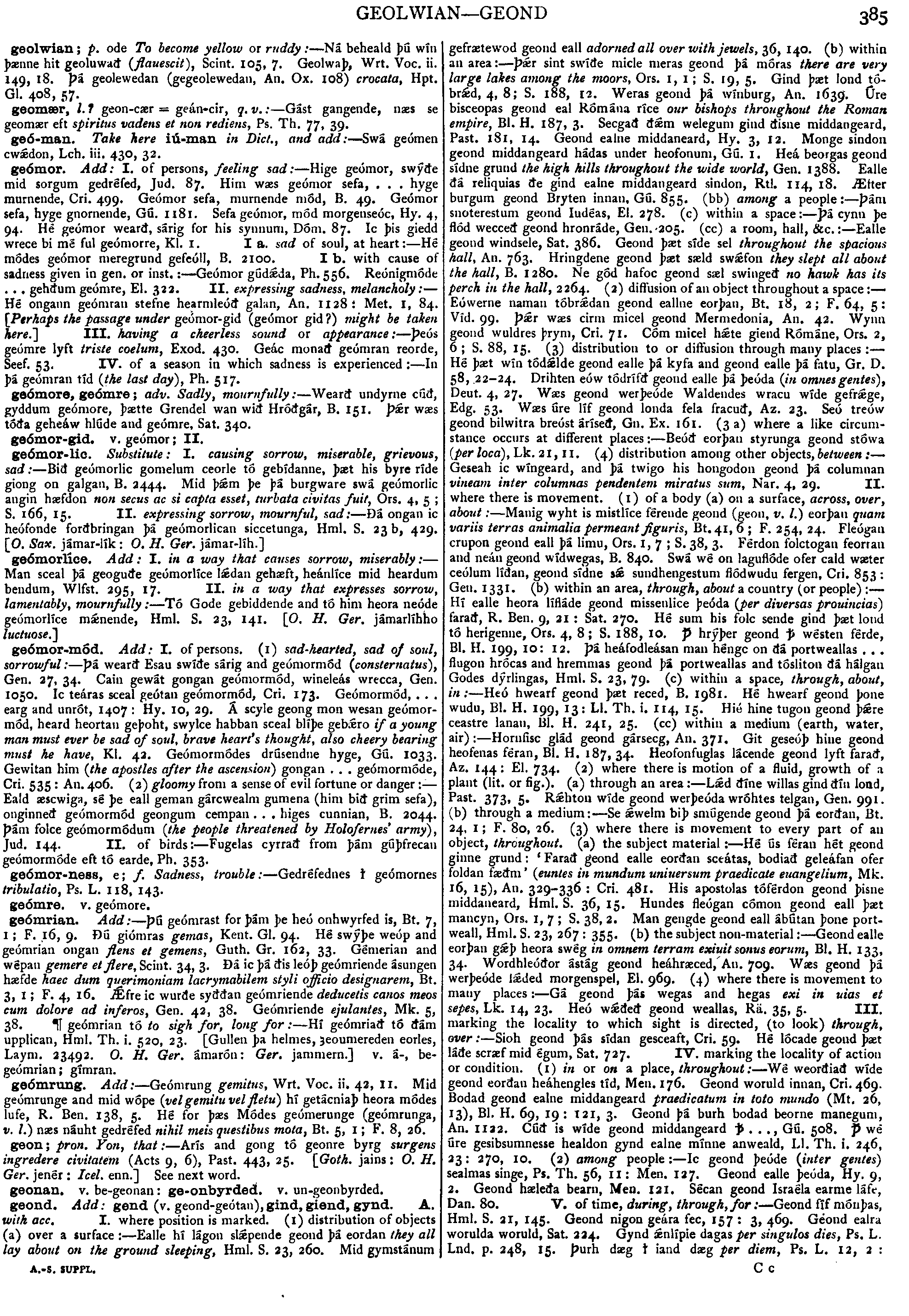
geond.
Add:
gend
(v.
geond-geótan),
gind,
giend,
gynd.
A.
with
acc.
I.
where
position
is
marked.
(1)
distribution
of
objects
(a)
over
a
surface:--Ealle
hí
lágon
slpende
geond
þá
eordan
they
all
lay
about
on
the
ground
sleeping,
Hml.
S.
23,
260.
Mid
gymstánum
gefrætewod
geond
eall
adorned
all
over
with
jewels,
36,
140.
(b)
within
an
area:--Þr
sint
swíðe
micle
meras
geond
þá
móras
there
are
very
large
lakes
among
the
moors,
Ors.
1,
1;
S.
19,
5.
Gind
þæt
lond
tó brd,
4,
8;
S.
188,
12.
Weras
geond
þá
wínburg,
An.
1639.
Úre
bisceopas
geond
eal
Romána
ríce
our
bishops
throughout
the
Roman
empire,
Bl.
H.
187,
3.
Secgað
ðm
welegum
gind
ðisne
middangeard,
Past.
181,
14.
Geond
ealne
middaneard,
Hy.
3,
12.
Monge
sindon
geond
middangeard
hádas
under
heofonum,
Gú.
1.
Heá
beorgas
geond
sídne
grund
the
high
hills
throughout
the
wide
world,
Gen.
1388.
Ealle
ðá
reliquias
ðe
gind
ealne
middangeard
sindon,
Rtl.
114,
18.
Æfter
burgum
geond
Bryten
innan,
Gú.
855.
(bb)
among
a
people:--Þám
snoterestum
geond
Iudéas,
El.
278.
(c)
within
a
space:--Þá
cynn
þe
flód
wecceð
geond
hronráde,
Gen.
205.
(cc)
a
room,
hall,
&c.:--Ealle
geond
windsele,
Sat.
386.
Geond
þæt
síde
sel
throughout
the
spacious
hall,
An.
763.
Hringdene
geond
þæt
sæld
swfon
they
slept
all
about
the
hall,
B.
1280.
Ne
gód
hafoc
geond
sæl
swingeð
no
hawk
has
its
perch
in
the
hall,
2264.
(2)
diffusion
of
an
object
throughout
a
space:--Eówerne
naman
tóbrdan
geond
eallne
eorþan,
Bt.
18,
2;
F.
64,
5:
Víd.
99.
Þr
wæs
cirm
micel
geond
Mermedonia,
An.
42.
Wynn
geond
wuldres
þrym,
Cri.
71.
Cóm
micel
hte
giend
Rómáne,
Ors.
2,
6;
S.
88,
15.
(3)
distribution
to
or
diffusion
through
many
places:--Hé
þæt
wín
tódlde
geond
ealle
þá
kyfa
and
geond
ealle
þá
fatu,
Gr.
D.
58,
22-24.
Drihten
eów
tódrífð
geond
ealle
þá
þeóda
(in
omnes
gentes),
Deut.
4,
27.
Wæs
geond
werþeóde
Waldendes
wracu
wíde
gefrge,
Edg.
53.
Wæs
úre
líf
geond
londa
fela
fracuð,
Az.
23.
Seó
treów
geond
bilwitra
breóst
áríseð,
Gn.
Ex.
161.
(3
a)
where
a
like
circumstance
occurs
at
different
places:--Beóð
eorþan
styrunga
geond
stówa
(per
loca),
Lk.
21,
11.
(4)
distribution
among
other
objects,
between:--Geseah
ic
wíngeard,
and
þá
twigo
his
hongodon
geond
þá
columnan
vineam
inter
columnas
pendentem
miratus
sum,
Nar.
4,
29.
II.
where
there
is
movement.
(1)
of
a
body
(a)
on
a
surface,
across,
over,
about:--Manig
wyht
is
mistlíce
férende
geond
(geon,
v.
l.)
eorþan
quam
variis
terras
animalia
permeant
figuris,
Bt.
41,
6;
F.
254,
24.
Fleógan
crupon
geond
eall
þá
limu,
Ors.
1,
7;
S.
38,
3.
Férdon
folctogan
feorran
and
neán
geond
wídwegas,
B.
840.
Swá
wé
on
laguflóde
ofer
cald
wæter
ceólum
líðan,
geond
sídne
a
sundhengestum
flódwudu
fergen,
Cri.
853:
Gen.
1331.
(b)
within
an
area,
through,
about
a
country
(or
people):--Hí
ealle
heora
lífláde
geond
missenlice
þeóda
(per
diversas
prouincias)
farað,
R.
Ben.
9,
21:
Sat.
270.
Hé
sum
his
folc
sende
gind
þæt
lond
tó
herigenne,
Ors.
4,
8;
S.
188,
10.
Þ-bar;
hrýþer
geond
wésten
férde,
Bl.
H.
199,
10:
12.
Þá
heáfodleásan
man
héngc
on
ðá
portweallas
.
.
.
flugon
hrócas
and
hremmas
geond
þá
portweallas
and
tósliton
ðá
hálgan
Godes
dýrlingas,
Hml.
S.
23,
79.
(c)
within
a
space,
through,
about,
in:--Heó
hwearf
geond
þæt
reced,
B.
1981.
Hé
hwearf
geond
þone
wudu,
Bl.
H.
199,
13:
Ll.
Th.
i.
114,
15.
Hié
hine
tugon
geond
þre
ceastre
lanan,
Bl.
H.
241,
25.
(cc)
within
a
medium
(earth,
water,
air):--Hornfisc
glád
geond
gársecg,
An.
371.
Git
geseóþ
hine
geond
heofenas
féran,
Bl.
H.
187,
34.
Heofonfuglas
lácende
geond
lyft
farað,
Az.
144:
El.
734.
(2)
where
there
is
motion
of
a
fluid,
growth
of
a
plant
(lit.
or
fig.).
(a)
through
an
area:--Ld
ðíne
willas
gind
ðín
lond,
Past.
373,
5.
Rhton
wíde
geond
werþeóda
wróhtes
telgan,
Gen.
991.
(b)
through
a
medium:--Se
welm
biþ
smúgende
geond
þá
eorðan,
Bt.
24,
1;
F.
80,
26.
(3)
where
there
is
movement
to
every
part
of
an
object,
throughout.
(a)
the
subject
material:--Hé
ús
féran
hét
geond
ginne
grund:
'Farað
geond
ealle
eorðan
sceátas,
bodiað
geleáfan
ofer
foldan
fæðm'
(euntes
in
mundum
uniuersum
praedicate
euangelium,
Mk.
16,
15),
An.
329-336:
Cri.
481.
His
apostolas
tóférdon
geond
þisne
middaneard,
Hml.
S.
36,
15.
Hundes
fleógan
cómon
geond
eall
þæt
mancyn,
Ors.
1,
7;
S.
38,
2.
Man
gengde
geond
eall
ábútan
þone
portweall,
Hml.
S.
23,
267:
355.
(b)
the
subject
non-material:--Geond
ealle
eorþan
gþ
heora
swég
in
omnem
terram
exiuit
sonus
eorum,
Bl.
H.
133,
34.
Wordhleóðor
ástág
geond
heáhræced,
An.
709.
Wæs
geond
þá
werþeóde
lded
morgenspel,
El.
969.
(4)
where
there
is
movement
to
many
places:--Gá
geond
þás
wegas
and
hegas
exi
in
uias
et
sepes,
Lk.
14,
23.
Heó
wðeð
geond
weallas,
Rä.
35,
5.
III.
marking
the
locality
to
which
sight
is
directed,
(to
look)
through,
over:--Sioh
geond
þás
sídan
gesceaft,
Cri.
59.
Hé
lócade
geond
þæt
láðe
scræf
mid
égum,
Sat.
727.
IV.
marking
the
locality
of
action
or
condition.
(1)
in
or
on
a
place,
throughout:--Wé
weorðiað
wíde
geond
eorðan
heáhengles
tíd,
Men.
176.
Geond
woruld
innan,
Cri.
469.
Bodad
geond
ealne
middangeard
praedicatum
in
toto
mundo
(Mt.
26,
13),
Bl.
H.
69,
19:
121,
3.
Geond
þá
burh
bodad
beorne
manegum,
An.
1122.
Cúð
is
wíde
geond
middangeard
.
.
.,
Gú.
508.
Þ-bar;
wé
úre
gesibsumnesse
healdon
gynd
ealne
mínne
anweald,
Ll.
Th.
i.
246,
23:
270,
10.
(2)
among
people:--Ic
geond
þeóde
(inter
gentes)
sealmas
singe,
Ps.
Th.
56,
11:
Men.
127.
Geond
ealle
þeóda,
Hy.
9,
2.
Geond
hæleða
bearn,
Men.
121.
Sécan
geond
Israéla
earme
láfe,
Dan.
80.
V.
of
time,
during,
through,
for:--Geond
fíf
mónþas,
Hml.
S.
21,
145.
Geond
nigon
geúra
fec,
157:
3,
469.
Géond
ealra
worulda
woruld,
Sat.
224.
Gynd
nlípie
dagas
per
singulos
dies,
Ps.
L.
Lnd.
p.
248,
15.
Þurh
dæg
brd,
4,
8;
S.
188,
12.
Weras
geond
þá
wínburg,
An.
1639.
Úre
bisceopas
geond
eal
Romána
ríce
our
bishops
throughout
the
Roman
empire,
Bl.
H.
187,
3.
Secgað
ðm
welegum
gind
ðisne
middangeard,
Past.
181,
14.
Geond
ealne
middaneard,
Hy.
3,
12.
Monge
sindon
geond
middangeard
hádas
under
heofonum,
Gú.
1.
Heá
beorgas
geond
sídne
grund
the
high
hills
throughout
the
wide
world,
Gen.
1388.
Ealle
ðá
reliquias
ðe
gind
ealne
middangeard
sindon,
Rtl.
114,
18.
Æfter
burgum
geond
Bryten
innan,
Gú.
855.
(bb)
among
a
people:--Þám
snoterestum
geond
Iudéas,
El.
278.
(c)
within
a
space:--Þá
cynn
þe
flód
wecceð
geond
hronráde,
Gen.
205.
(cc)
a
room,
hall,
&c.:--Ealle
geond
windsele,
Sat.
386.
Geond
þæt
síde
sel
throughout
the
spacious
hall,
An.
763.
Hringdene
geond
þæt
sæld
swfon
they
slept
all
about
the
hall,
B.
1280.
Ne
gód
hafoc
geond
sæl
swingeð
no
hawk
has
its
perch
in
the
hall,
2264.
(2)
diffusion
of
an
object
throughout
a
space:--Eówerne
naman
tóbrdan
geond
eallne
eorþan,
Bt.
18,
2;
F.
64,
5:
Víd.
99.
Þr
wæs
cirm
micel
geond
Mermedonia,
An.
42.
Wynn
geond
wuldres
þrym,
Cri.
71.
Cóm
micel
hte
giend
Rómáne,
Ors.
2,
6;
S.
88,
15.
(3)
distribution
to
or
diffusion
through
many
places:--Hé
þæt
wín
tódlde
geond
ealle
þá
kyfa
and
geond
ealle
þá
fatu,
Gr.
D.
58,
22-24.
Drihten
eów
tódrífð
geond
ealle
þá
þeóda
(in
omnes
gentes),
Deut.
4,
27.
Wæs
geond
werþeóde
Waldendes
wracu
wíde
gefrge,
Edg.
53.
Wæs
úre
líf
geond
londa
fela
fracuð,
Az.
23.
Seó
treów
geond
bilwitra
breóst
áríseð,
Gn.
Ex.
161.
(3
a)
where
a
like
circumstance
occurs
at
different
places:--Beóð
eorþan
styrunga
geond
stówa
(per
loca),
Lk.
21,
11.
(4)
distribution
among
other
objects,
between:--Geseah
ic
wíngeard,
and
þá
twigo
his
hongodon
geond
þá
columnan
vineam
inter
columnas
pendentem
miratus
sum,
Nar.
4,
29.
II.
where
there
is
movement.
(1)
of
a
body
(a)
on
a
surface,
across,
over,
about:--Manig
wyht
is
mistlíce
férende
geond
(geon,
v.
l.)
eorþan
quam
variis
terras
animalia
permeant
figuris,
Bt.
41,
6;
F.
254,
24.
Fleógan
crupon
geond
eall
þá
limu,
Ors.
1,
7;
S.
38,
3.
Férdon
folctogan
feorran
and
neán
geond
wídwegas,
B.
840.
Swá
wé
on
laguflóde
ofer
cald
wæter
ceólum
líðan,
geond
sídne
a
sundhengestum
flódwudu
fergen,
Cri.
853:
Gen.
1331.
(b)
within
an
area,
through,
about
a
country
(or
people):--Hí
ealle
heora
lífláde
geond
missenlice
þeóda
(per
diversas
prouincias)
farað,
R.
Ben.
9,
21:
Sat.
270.
Hé
sum
his
folc
sende
gind
þæt
lond
tó
herigenne,
Ors.
4,
8;
S.
188,
10.
Þ-bar;
hrýþer
geond
wésten
férde,
Bl.
H.
199,
10:
12.
Þá
heáfodleásan
man
héngc
on
ðá
portweallas
.
.
.
flugon
hrócas
and
hremmas
geond
þá
portweallas
and
tósliton
ðá
hálgan
Godes
dýrlingas,
Hml.
S.
23,
79.
(c)
within
a
space,
through,
about,
in:--Heó
hwearf
geond
þæt
reced,
B.
1981.
Hé
hwearf
geond
þone
wudu,
Bl.
H.
199,
13:
Ll.
Th.
i.
114,
15.
Hié
hine
tugon
geond
þre
ceastre
lanan,
Bl.
H.
241,
25.
(cc)
within
a
medium
(earth,
water,
air):--Hornfisc
glád
geond
gársecg,
An.
371.
Git
geseóþ
hine
geond
heofenas
féran,
Bl.
H.
187,
34.
Heofonfuglas
lácende
geond
lyft
farað,
Az.
144:
El.
734.
(2)
where
there
is
motion
of
a
fluid,
growth
of
a
plant
(lit.
or
fig.).
(a)
through
an
area:--Ld
ðíne
willas
gind
ðín
lond,
Past.
373,
5.
Rhton
wíde
geond
werþeóda
wróhtes
telgan,
Gen.
991.
(b)
through
a
medium:--Se
welm
biþ
smúgende
geond
þá
eorðan,
Bt.
24,
1;
F.
80,
26.
(3)
where
there
is
movement
to
every
part
of
an
object,
throughout.
(a)
the
subject
material:--Hé
ús
féran
hét
geond
ginne
grund:
'Farað
geond
ealle
eorðan
sceátas,
bodiað
geleáfan
ofer
foldan
fæðm'
(euntes
in
mundum
uniuersum
praedicate
euangelium,
Mk.
16,
15),
An.
329-336:
Cri.
481.
His
apostolas
tóférdon
geond
þisne
middaneard,
Hml.
S.
36,
15.
Hundes
fleógan
cómon
geond
eall
þæt
mancyn,
Ors.
1,
7;
S.
38,
2.
Man
gengde
geond
eall
ábútan
þone
portweall,
Hml.
S.
23,
267:
355.
(b)
the
subject
non-material:--Geond
ealle
eorþan
gþ
heora
swég
in
omnem
terram
exiuit
sonus
eorum,
Bl.
H.
133,
34.
Wordhleóðor
ástág
geond
heáhræced,
An.
709.
Wæs
geond
þá
werþeóde
lded
morgenspel,
El.
969.
(4)
where
there
is
movement
to
many
places:--Gá
geond
þás
wegas
and
hegas
exi
in
uias
et
sepes,
Lk.
14,
23.
Heó
wðeð
geond
weallas,
Rä.
35,
5.
III.
marking
the
locality
to
which
sight
is
directed,
(to
look)
through,
over:--Sioh
geond
þás
sídan
gesceaft,
Cri.
59.
Hé
lócade
geond
þæt
láðe
scræf
mid
égum,
Sat.
727.
IV.
marking
the
locality
of
action
or
condition.
(1)
in
or
on
a
place,
throughout:--Wé
weorðiað
wíde
geond
eorðan
heáhengles
tíd,
Men.
176.
Geond
woruld
innan,
Cri.
469.
Bodad
geond
ealne
middangeard
praedicatum
in
toto
mundo
(Mt.
26,
13),
Bl.
H.
69,
19:
121,
3.
Geond
þá
burh
bodad
beorne
manegum,
An.
1122.
Cúð
is
wíde
geond
middangeard
.
.
.,
Gú.
508.
Þ-bar;
wé
úre
gesibsumnesse
healdon
gynd
ealne
mínne
anweald,
Ll.
Th.
i.
246,
23:
270,
10.
(2)
among
people:--Ic
geond
þeóde
(inter
gentes)
sealmas
singe,
Ps.
Th.
56,
11:
Men.
127.
Geond
ealle
þeóda,
Hy.
9,
2.
Geond
hæleða
bearn,
Men.
121.
Sécan
geond
Israéla
earme
láfe,
Dan.
80.
V.
of
time,
during,
through,
for:--Geond
fíf
mónþas,
Hml.
S.
21,
145.
Geond
nigon
geúra
fec,
157:
3,
469.
Géond
ealra
worulda
woruld,
Sat.
224.
Gynd
nlípie
dagas
per
singulos
dies,
Ps.
L.
Lnd.
p.
248,
15.
Þurh
dæg
 iand
dæg
per
diem,
Ps.
L.
12,
2:
iand
dæg
per
diem,
Ps.
L.
12,
2:
|
Source: Bosworth/Toller, page d0403, entry 13 View original page image as: [TIFF] [PNG] [View previous entry] [View next entry] |
[Comment on this entry] [View comments] |
The following entry has been hand-corrected once. |
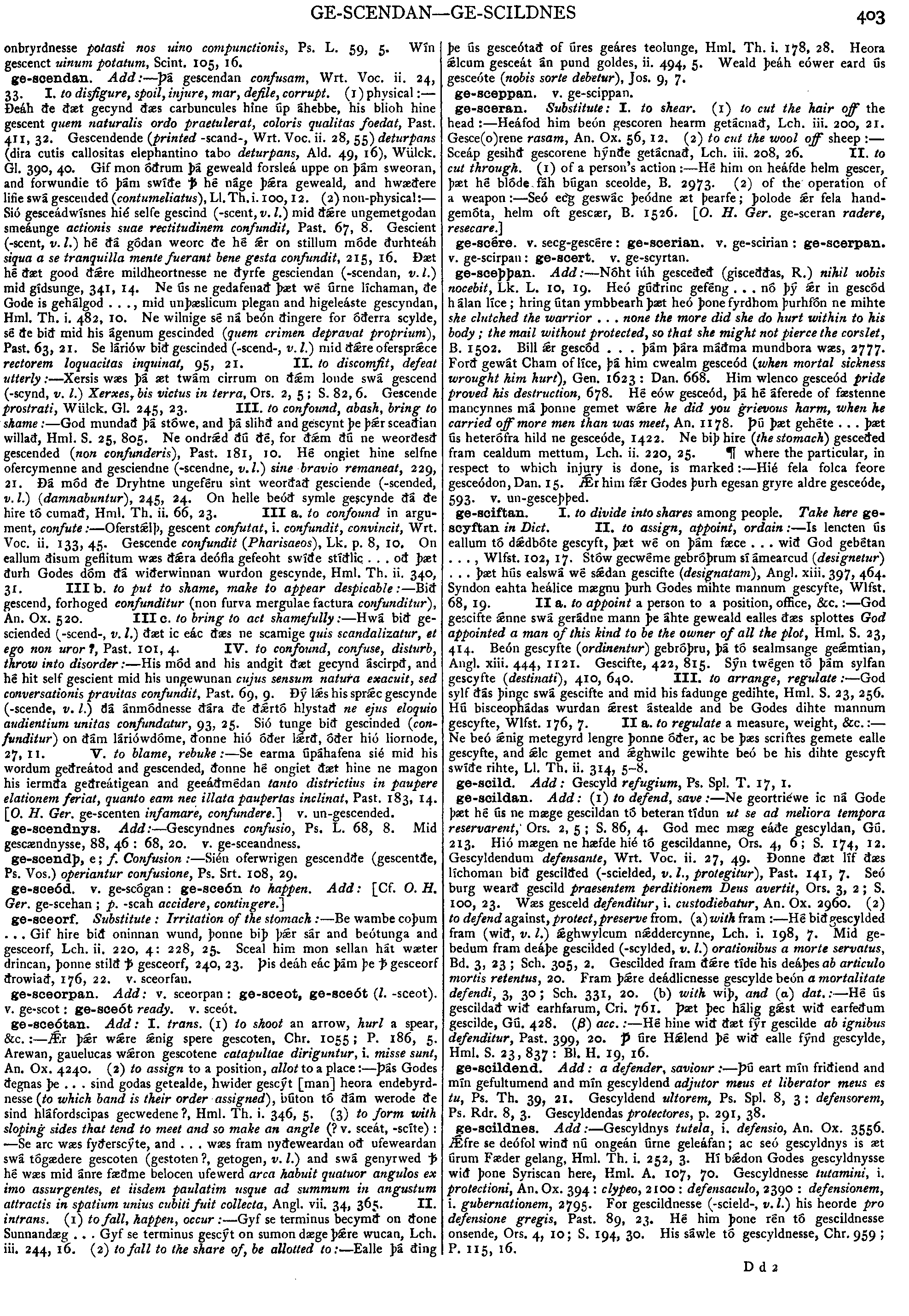
ge-sciftan.
I.
to
divide
into
shares
among
people.
Take
here
ge-scyftan
in
Dict.
II.
to
assign,
appoint,
ordain
:--
Is
lencten
ús
eallum
tó
ddbóte
gescyft,
þæt
wé
on
þám
fæce
.
.
.
wið
God
gebétan
.
.
.
,
Wlfst.
102,
17.
Stów
gecwéme
gebróþrum
sí
ámearcud
(designetur)
.
.
.
þæt
hús
ealswá
wé
sdan
gescifte
(designatam),
Angl.
xiii.
397,
464.
Syndon
eahta
heálice
mægnu
þurh
Godes
mihte
mannum
gescyfte,
Wlfst.
68,
19.
II
a.
to
appoint
a
person
to
a
position,
office,
&c.
:--
God
gescifte
nne
swá
gerádne
mann
þe
áhte
geweald
ealles
ðæs
splottes
God
appointed
a
man
of
this
kind
to
be
the
owner
of
all
the
plot,
Hml.
S.
23,
414.
Beón
gescyfte
(ordinentur)
gebróþru,
þá
tó
sealmsange
gemtian,
Angl.
xiii.
444,
1121.
Gescifte,
422,
815.
Sýn
twégen
tó
þám
sylfan
gescyfte
(destinati),
410,
640.
III.
to
arrange,
regulate
:--
God
sylf
ðás
þingc
swá
gescifte
and
mid
his
fadunge
gedihte.
Hml.
S.
23,
256.
Hú
bisceophádas
wurdan
rest
ástealde
and
be
Godes
dihte
mannum
gescyfte,
Wlfst.
176,
7.
II
a.
to
regulate
a
measure,
weight,
&c.
:--
Ne
beó
nig
metegyrd
lengre
þonne
óðer,
ac
be
þæs
scriftes
gemete
ealle
gescyfte,
and
lc
gemet
and
ghwilc
gewihte
beó
be
his
dihte
gescyft
swíðe
rihte,
Ll.
Th.
ii.
314,
5-8.
|
Source: Bosworth/Toller, page d0426, entry 10 View original page image as: [TIFF] [PNG] [View previous entry] [View next entry] |
[Comment on this entry] [View comments] |
The following entry has been hand-corrected once. |
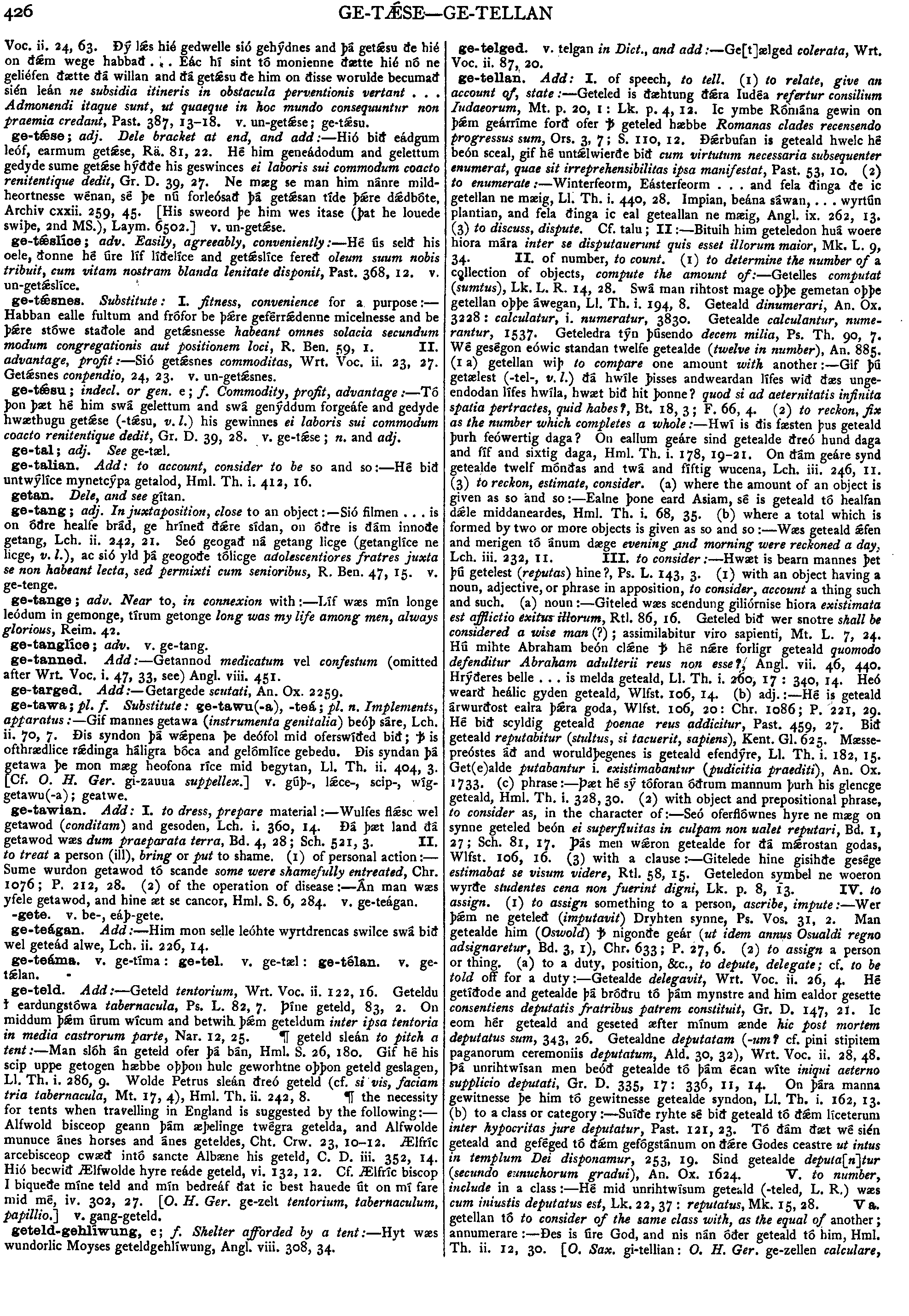
ge-tange; adv. Near to, in connexion with :-- Líf wæs mín longe leódum in gemonge, tírum getonge long was my life among men, always glorious, Reim. 42.
|
Source: Bosworth/Toller, page d0448, entry 1 View original page image as: [TIFF] [PNG] [View previous entry] [View next entry] |
[Comment on this entry] [View comments (3)] |
The following entry has been hand-corrected once. |
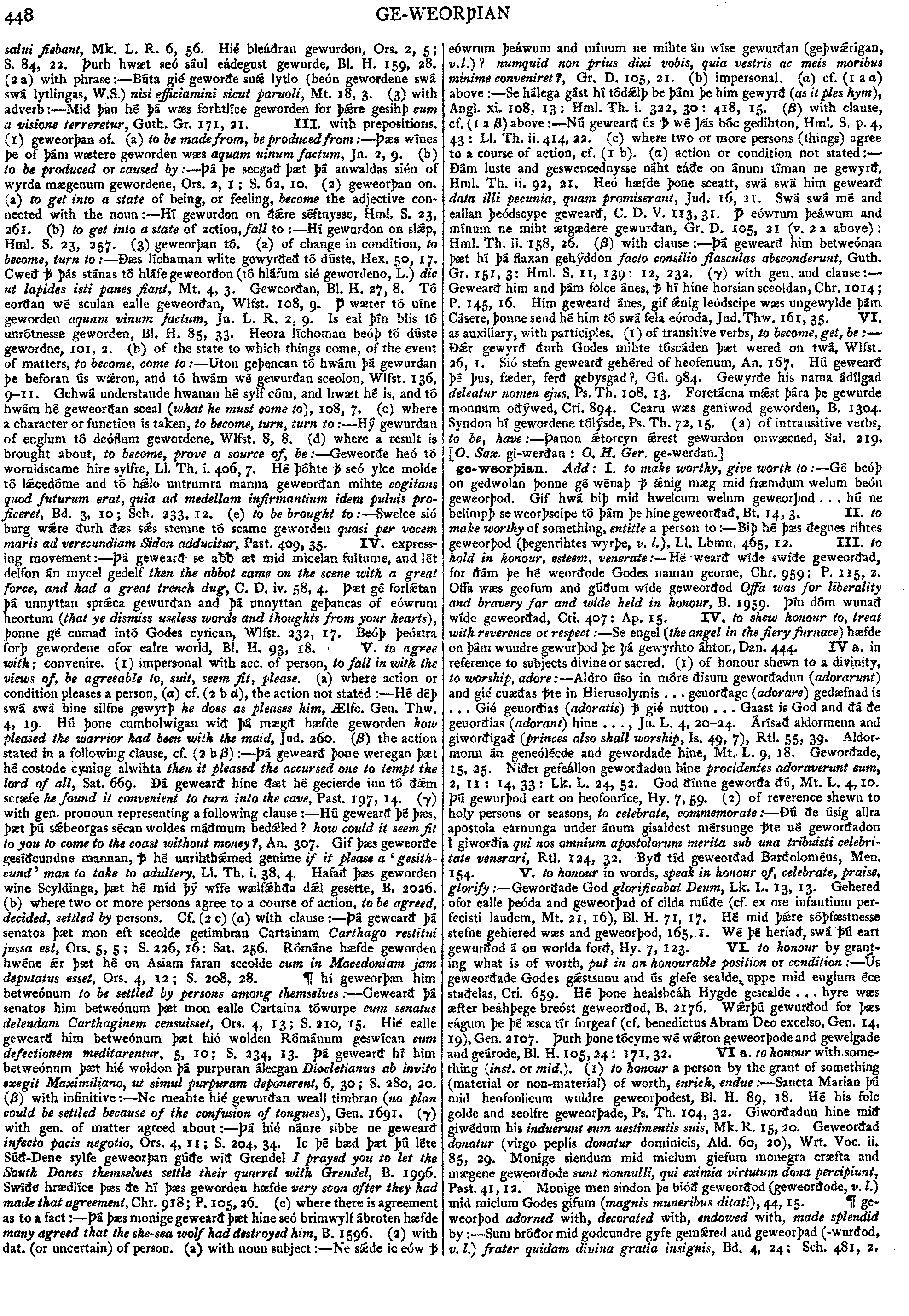
salui
fiebant,
Mk.
L.
R.
6,
56.
Hié
bleáðran
gewnrdon,
Ors.
2,
5;
S.
84,
22.
Þurh
hwæt
seó
sául
eádegust
gewurde,
Bl.
H.
159,
28.
(2
a)
with
phrase
:--
Búta
gié
geworðe
su
lytlo
(beón
gewordene
swá
swá
lytlingas,
W.
S.
)
nisi
efficiamini
sicut
paruoli,
Mt.
18,
3.
( )
with
adverb
:--
Mid
þán
hé
þá
wæs
forhtlíce
geworden
for
þre
gesihþ
cum
a
visione
terreretur,
Guth.
Gr.
171,
21.
III.
with
prepositions,
(l)
geweorþan
of.
(a)
to
be
made
from,
be
produced
from
:--
Þæs
wínes
þe
of
þám
wætere
geworden
wæs
aquam
uinum
factum,
Jn.
2,
9.
(b)
to
be
produced
or
caused
by
:--
Þá
þe
secgað
þæt
þá
anwaldas
sién
of
wyrda
mægenum
gewordene,
Ors.
2,
l
;
S.
62,
10.
(2)
geweorþan
on.
(a)
to
get
into
a
state
of
being,
or
feeling,
become
the
adjective
connected
with
the
noun
:--
Hí
gewurdon
on
ðre
séftnysse,
Hml.
S.
23,
261.
(b)
to
get
into
a
state
of
action,
fall
to
:--
Hí
gewurdon
on
slp,
Hml.
S.
23,
257.
()
geweorþan
tó.
(a)
of
change
in
condition,
to
become,
turn
to:
--
Ðæs
líchaman
wlite
gewyrðeð
to
dúste.
Hex.
50,
17.
Cweð
þás
stánas
tó
hláfe
geweoriton
(tó
hláfum
sió
gewordeno,
L.
)
dic
ut
lapides
isti
panes
fiant,
Mt.
4,
3.
Geweorðan,
Bl.
H.
27,
8.
Tó
eorðan
wé
sculan
ealle
geweorðan,
Wlfst.
108,
9.
Þ-bar;
wæter
tó
níne
geworden
aquam
vinum
factum,
Jn.
L.
R.
2,
9.
Is
eal
þín
blis
tó
unrótnesse
geworden,
Bl.
H.
85,
33.
Heora
líchoman
beóþ
tó
dúste
gewordne,
101,
2.
(b)
of
the
seate
to
which
things
come,
of
the
event
of
matters,
to
become,
come
to
:--
Uton
geþencan
tó
hwám
þá
gewurdan
þe
beforan
ús
wron,
and
tó
hwám
wé
gewurðan
sceolon.
Wlfst.
136,
9-11.
Gehwá
understande
hwanan
he
sylf
cóm,
and
hwæt
hé
is,
and
tó
hwám
hé
geweorðan
sceal
(what
he
must
come
to),
108,
7.
(c)
where
a
character
or
function
is
taken,
to
become,
turn,
turn
to
:--
Hý
gewurdan
of
englum
to
deóflum
gewordene.
Wlfst.
8,
8.
(d)
where
a
result
is
brought
about,
tó
become,
prove
a
source
of,
be
:--
Geweorðe
heó
tó
woruldscame
hire
sylfre,
Ll.
Th.
i.
406,
7.
Hé
þóhte
seó
ylce
molde
tó
lcedðme
and
tó
hlo
untrumra
manna
geweorðan
mihte
cogitans
quod
futurum
erat,
quia
ad
medellam
infirmantium
idem
puluis
proficeret.
Bd.
3,
10
;
Sch.
233,
12,
(e)
to
be
brought
to
:--
Swelce
sió
burg
wre
ðurh
ðæs
ss
stemne
tó
scame
geworden
guasi
per
vocem
mam
ad
verecundiam
Sidon
adducitur,
Past.
409,
35.
IV.
expressing
movement
:--
Þá
gewearð
se
a
æt
mid
micelan
fultume,
and
lét
delfon
án
mycel
gedelf
then
the
abbot
came
on
the
scene
with
a
great
force,
and
had
a
great
trench
dug,
C.
D.
iv.
58,
4.
Þæt
gé
forltan
þá
unnyttan
sprca
gewurðan
and
þá
unnyttan
geþancas
of
eówrum
heortum
(that
ye
dismiss
useless
words
and
thoughts
from
your
hearts),
þonne
gé
cumað
intó
Godes
cyrican,
Wlfst.
232,
17.
Beóþ
þeóstra
forþ
gewordene
ofor
ealre
world,
Bl.
H.
93,
18.
V.
to
agree
with;
convenire.
(1)
impersonal
with
acc.
of
person,
to
fall
in
with
the
views
of,
be
agreeable
to,
suit,
seem
fit,
please,
(a)
where
action
or
condition
pleases
a
person,
(
)
with
adverb
:--
Mid
þán
hé
þá
wæs
forhtlíce
geworden
for
þre
gesihþ
cum
a
visione
terreretur,
Guth.
Gr.
171,
21.
III.
with
prepositions,
(l)
geweorþan
of.
(a)
to
be
made
from,
be
produced
from
:--
Þæs
wínes
þe
of
þám
wætere
geworden
wæs
aquam
uinum
factum,
Jn.
2,
9.
(b)
to
be
produced
or
caused
by
:--
Þá
þe
secgað
þæt
þá
anwaldas
sién
of
wyrda
mægenum
gewordene,
Ors.
2,
l
;
S.
62,
10.
(2)
geweorþan
on.
(a)
to
get
into
a
state
of
being,
or
feeling,
become
the
adjective
connected
with
the
noun
:--
Hí
gewurdon
on
ðre
séftnysse,
Hml.
S.
23,
261.
(b)
to
get
into
a
state
of
action,
fall
to
:--
Hí
gewurdon
on
slp,
Hml.
S.
23,
257.
()
geweorþan
tó.
(a)
of
change
in
condition,
to
become,
turn
to:
--
Ðæs
líchaman
wlite
gewyrðeð
to
dúste.
Hex.
50,
17.
Cweð
þás
stánas
tó
hláfe
geweoriton
(tó
hláfum
sió
gewordeno,
L.
)
dic
ut
lapides
isti
panes
fiant,
Mt.
4,
3.
Geweorðan,
Bl.
H.
27,
8.
Tó
eorðan
wé
sculan
ealle
geweorðan,
Wlfst.
108,
9.
Þ-bar;
wæter
tó
níne
geworden
aquam
vinum
factum,
Jn.
L.
R.
2,
9.
Is
eal
þín
blis
tó
unrótnesse
geworden,
Bl.
H.
85,
33.
Heora
líchoman
beóþ
tó
dúste
gewordne,
101,
2.
(b)
of
the
seate
to
which
things
come,
of
the
event
of
matters,
to
become,
come
to
:--
Uton
geþencan
tó
hwám
þá
gewurdan
þe
beforan
ús
wron,
and
tó
hwám
wé
gewurðan
sceolon.
Wlfst.
136,
9-11.
Gehwá
understande
hwanan
he
sylf
cóm,
and
hwæt
hé
is,
and
tó
hwám
hé
geweorðan
sceal
(what
he
must
come
to),
108,
7.
(c)
where
a
character
or
function
is
taken,
to
become,
turn,
turn
to
:--
Hý
gewurdan
of
englum
to
deóflum
gewordene.
Wlfst.
8,
8.
(d)
where
a
result
is
brought
about,
tó
become,
prove
a
source
of,
be
:--
Geweorðe
heó
tó
woruldscame
hire
sylfre,
Ll.
Th.
i.
406,
7.
Hé
þóhte
seó
ylce
molde
tó
lcedðme
and
tó
hlo
untrumra
manna
geweorðan
mihte
cogitans
quod
futurum
erat,
quia
ad
medellam
infirmantium
idem
puluis
proficeret.
Bd.
3,
10
;
Sch.
233,
12,
(e)
to
be
brought
to
:--
Swelce
sió
burg
wre
ðurh
ðæs
ss
stemne
tó
scame
geworden
guasi
per
vocem
mam
ad
verecundiam
Sidon
adducitur,
Past.
409,
35.
IV.
expressing
movement
:--
Þá
gewearð
se
a
æt
mid
micelan
fultume,
and
lét
delfon
án
mycel
gedelf
then
the
abbot
came
on
the
scene
with
a
great
force,
and
had
a
great
trench
dug,
C.
D.
iv.
58,
4.
Þæt
gé
forltan
þá
unnyttan
sprca
gewurðan
and
þá
unnyttan
geþancas
of
eówrum
heortum
(that
ye
dismiss
useless
words
and
thoughts
from
your
hearts),
þonne
gé
cumað
intó
Godes
cyrican,
Wlfst.
232,
17.
Beóþ
þeóstra
forþ
gewordene
ofor
ealre
world,
Bl.
H.
93,
18.
V.
to
agree
with;
convenire.
(1)
impersonal
with
acc.
of
person,
to
fall
in
with
the
views
of,
be
agreeable
to,
suit,
seem
fit,
please,
(a)
where
action
or
condition
pleases
a
person,
( )
cf.
(2
b
),
the
action
not
stated
:--
Hé
déþ
swá
swá
híne
silfne
gewyrþ
he
does
as
pleases
him,
Ælfc.
Gen.
Thw.
4,
19.
Hú
þone
cumbolwigan
wið
þá
mægð
hæfde
geworden
how
pleased
the
warrior
had
been
with
the
maid,
Jud.
260.
(
)
cf.
(2
b
),
the
action
not
stated
:--
Hé
déþ
swá
swá
híne
silfne
gewyrþ
he
does
as
pleases
him,
Ælfc.
Gen.
Thw.
4,
19.
Hú
þone
cumbolwigan
wið
þá
mægð
hæfde
geworden
how
pleased
the
warrior
had
been
with
the
maid,
Jud.
260.
( )
the
action
stated
in
a
following
clause,
cf.
(2
b
)
:--
Þá
gewearð
þone
weregan
þæt
hé
costode
cy-ning
alwihta
then
it
pleased
the
accursed
one
to
tempt
the
lord
of
all,
Sat.
669.
Ðá
gewearð
hine
ðæt
hé
gecierde
inn
tó
ðm
scræfe
he
found
it
convenient
to
turn
into
the
cave,
Past.
197,
14.
(
)
the
action
stated
in
a
following
clause,
cf.
(2
b
)
:--
Þá
gewearð
þone
weregan
þæt
hé
costode
cy-ning
alwihta
then
it
pleased
the
accursed
one
to
tempt
the
lord
of
all,
Sat.
669.
Ðá
gewearð
hine
ðæt
hé
gecierde
inn
tó
ðm
scræfe
he
found
it
convenient
to
turn
into
the
cave,
Past.
197,
14.
( )
with
gen.
pronoun
representing
a
following
clause
:--
Hú
gewearð
þé
þæs,
þæt
þú
sbeorgas
sécan
woldes
máðmum
bedled
?
how
could
it
seem
pit
to
you
to
come
to
the
coast
without
money
?,
An.
307.
Gif
þæs
geweorðe
gesíðcundne
mannan,
hé
unrihthíémed
genime
if
it
please
a
gesith-cund'
man
to
take
to
adultery,
Ll.
Th.
i.
38,
4.
Hafað
þæs
geworden
wine
Scyldinga,
þæt
hé
mid
þý
wífe
wælfhða
dl
gesette,
B.
2026.
(b)
where
two
or
more
persons
agree
to
a
course
of
action,
to
be
agreed,
decided,
settled
by
persons.
Cf.
(2
c)
(a)
with
clause
:--
Þá
gewearð
þá
senates
þæt
mon
eft
sceolde
getimbran
Cartainam
Carthago
restitui
jussa
est,
Ors.
5,
5;
S.
226,
16:
Sat.
256.
Rómáne
hæfde
geworden
hwéne
r
þæt
hé
on
Asiam
faran
sceolde
cum
in
Macedoniam
jam
diputatus
esset,
Ors.
4,
12;
S.
208,
28.

hí
geweorþan
him
betweónum
to
be
settled
by
persons
among
themselves
:--
Gewearð
þá
senates
him
betweónum
þæt
mon
ealle
Cartaina
tówurpe
cum
senatus
delendam
Carthaginem
censuisset,
Ors.
4,
13;
8.
210,
15.
Hié
ealle
gewearð
him
betweónum
þæt
hié
wolden
Rómánum
geswícan
cum
defectionem
meditarentur,
5,
10;
S.
234,
13.
Þá
gewearð
hí
him
betweónum
þæt
hié
woldon
þá
purpuran
álecgan
Diocletianus
ab
invito
exegit
Maximiliano,
ut
simul
purpuram
deponerent,
6,
30;
S.
280,
20.
()
with
infinitive
:--
Ne
meahte
hié
gewurðan
weall
timbran
(no
plan
could
ie
settled
because
of
the
confusion
of
tongues),
Gen.
1691.
()
with
gen.
of
matter
agreed
about
:--
Þá
hié
nánre
sibbe
ne
gewearð
infecto
paces
negotio.
Ors.
4,
11;
S.
204,
34.
Ic
þé
bd
þæt
þú
léte
Suð-Dene
sylfe
geweorþan
guðe
wið
Grendel
I
prayed
you
to
let
the
South
Danes
themselves
settle
their
quarrel
with
Grendel,
B.
1996.
Swíðe
hrædlíce
þæs
ðe
hí
þæs
geworden
hæfde
very
soon
after
they
had
made
that
agreement,
Chr.
918;
P.
105.
26.
(c)
where
there
is
agreement
as
to
a
fact
:--
Þá
þæs
monige
geweard
þæt
hine
seó
brimwylf
ábroten
hæfde
many
agreed
that
the
she-sea
wolf
had
destroyed
him,
6.
1596.
(2)
with
dat.
(or
uncertain)
of
person,
(a)
with
noun
subject
:--
Ne
sde
ic
eów
eówrum
þeáwum
and
mínum
ne
mihte
an
wise
gewurdan
(geþwrigan,
v.
l.)
?
numquid
non
prius
dixi
vobis,
quia
vestris
ac
meis
moribus
minime
conveniret?,
Gr.
D.
105,
21.
(b)
impersonal,
()
cf.
(l
a
)
above
:--
Se
hálega
gást
hí
tódlþ
be
þám
þe
him
gewyrð
(as
it
ples
hym),
Angl.
xi.
108,
13
:
Hml.
Th.
i.
322,
30
:
418,
15.
()
with
clause,
cf.
(l
a
)
above
:--
Nú
gewearð
ús
wé
þás
bóc
gedihton,
Hml.
S.
p.
4,
43
:
Ll.
Th.
[1.
414,
22.
(c)
where
two
or
more
persons
(things)
agree
to
a
course
of
action,
cf.
(l
b).
()
action
or
condition
not
stated
:--
Ðám
luste
and
geswencednysse
náht
eáðe
on
ánum
tíman
ne
gewyrð,
Hml.
Th.
ii.
92,
21.
Heó
hæfde
þone
sceatt,
swá
swá
him
gewearð
data
illi
pecunia,
quam
promiserant,
Jud.
16,
21.
Swá
swá
mé
and
eallan
þeódscype
gewearð,
C.
D.
V.
113,
31.
Þ-bar;
eówrum
þeáwum
and
mínum
ne
miht
ætgædere
gewurðan,
Gr.
D.
105,
21
(v.
2
a
above)
:
Hml.
Th.
ii.
158,
26.
()
with
clause
:--
Þá
gewearð
him
betweónan
þæt
hí
þá
flaxan
gehýddon
facto
consilio
flasculas
absconderurt,
Guth.
Gr.
151,.
3:
Hml.
S.
11,
139:
12,
232.
()
with
gen.
and
clause
:--
Gewearð
him
and
þám
folce
ánes,
hí
hine
horsian
sceoldan,
Chr.
1014;
P.
145,
16.
Him
gewearð
ánes,
gif
nig
leódscipe
wæs
ungewylde
þám
Cásere,
þonne
send
hé
him
tó
swá
fela
eóroda,
Jud.
Thw.
161,
35.
VI.
as
auxiliary,
with
participles.
(l)
of
transitive
verbs,
to
become,
get,
be
:--
Ðr
gewyrð
ðurh
Godes
mihte
tóscáden
þæt
wered
on
twá,
Wlfst.
26,
l.
Sió
stefn
gewearð
gehéred
of
heofenum,
An.
167.
Hú
gewearð
þé
þus,
fæder,
ferð
gebysgad?,
Gú.
984.
Gewyrðe
his
nama
ádílgad
deleatur
nomen
ejus.
Ps.
Th.
108,
13.
Foretácna
mst
þára
þe
gewurde
monnum
oðýwed,
Cri.
894.
Cearu
wæs
geníwod
geworden,
B.
1304.
Syndon
hí
gewordene
tólýsde,
Ps.
Th.
72,
15.
(2)
of
intransitive
verbs,
to
be,
have
:--
Þanon
torcyn
rest
gewurdon
onwæcned,
Sal.
219.
[O.
Sax.
gi-werðan
:
O.
H.
Ger.
ge-werdan.]
)
with
gen.
pronoun
representing
a
following
clause
:--
Hú
gewearð
þé
þæs,
þæt
þú
sbeorgas
sécan
woldes
máðmum
bedled
?
how
could
it
seem
pit
to
you
to
come
to
the
coast
without
money
?,
An.
307.
Gif
þæs
geweorðe
gesíðcundne
mannan,
hé
unrihthíémed
genime
if
it
please
a
gesith-cund'
man
to
take
to
adultery,
Ll.
Th.
i.
38,
4.
Hafað
þæs
geworden
wine
Scyldinga,
þæt
hé
mid
þý
wífe
wælfhða
dl
gesette,
B.
2026.
(b)
where
two
or
more
persons
agree
to
a
course
of
action,
to
be
agreed,
decided,
settled
by
persons.
Cf.
(2
c)
(a)
with
clause
:--
Þá
gewearð
þá
senates
þæt
mon
eft
sceolde
getimbran
Cartainam
Carthago
restitui
jussa
est,
Ors.
5,
5;
S.
226,
16:
Sat.
256.
Rómáne
hæfde
geworden
hwéne
r
þæt
hé
on
Asiam
faran
sceolde
cum
in
Macedoniam
jam
diputatus
esset,
Ors.
4,
12;
S.
208,
28.

hí
geweorþan
him
betweónum
to
be
settled
by
persons
among
themselves
:--
Gewearð
þá
senates
him
betweónum
þæt
mon
ealle
Cartaina
tówurpe
cum
senatus
delendam
Carthaginem
censuisset,
Ors.
4,
13;
8.
210,
15.
Hié
ealle
gewearð
him
betweónum
þæt
hié
wolden
Rómánum
geswícan
cum
defectionem
meditarentur,
5,
10;
S.
234,
13.
Þá
gewearð
hí
him
betweónum
þæt
hié
woldon
þá
purpuran
álecgan
Diocletianus
ab
invito
exegit
Maximiliano,
ut
simul
purpuram
deponerent,
6,
30;
S.
280,
20.
()
with
infinitive
:--
Ne
meahte
hié
gewurðan
weall
timbran
(no
plan
could
ie
settled
because
of
the
confusion
of
tongues),
Gen.
1691.
()
with
gen.
of
matter
agreed
about
:--
Þá
hié
nánre
sibbe
ne
gewearð
infecto
paces
negotio.
Ors.
4,
11;
S.
204,
34.
Ic
þé
bd
þæt
þú
léte
Suð-Dene
sylfe
geweorþan
guðe
wið
Grendel
I
prayed
you
to
let
the
South
Danes
themselves
settle
their
quarrel
with
Grendel,
B.
1996.
Swíðe
hrædlíce
þæs
ðe
hí
þæs
geworden
hæfde
very
soon
after
they
had
made
that
agreement,
Chr.
918;
P.
105.
26.
(c)
where
there
is
agreement
as
to
a
fact
:--
Þá
þæs
monige
geweard
þæt
hine
seó
brimwylf
ábroten
hæfde
many
agreed
that
the
she-sea
wolf
had
destroyed
him,
6.
1596.
(2)
with
dat.
(or
uncertain)
of
person,
(a)
with
noun
subject
:--
Ne
sde
ic
eów
eówrum
þeáwum
and
mínum
ne
mihte
an
wise
gewurdan
(geþwrigan,
v.
l.)
?
numquid
non
prius
dixi
vobis,
quia
vestris
ac
meis
moribus
minime
conveniret?,
Gr.
D.
105,
21.
(b)
impersonal,
()
cf.
(l
a
)
above
:--
Se
hálega
gást
hí
tódlþ
be
þám
þe
him
gewyrð
(as
it
ples
hym),
Angl.
xi.
108,
13
:
Hml.
Th.
i.
322,
30
:
418,
15.
()
with
clause,
cf.
(l
a
)
above
:--
Nú
gewearð
ús
wé
þás
bóc
gedihton,
Hml.
S.
p.
4,
43
:
Ll.
Th.
[1.
414,
22.
(c)
where
two
or
more
persons
(things)
agree
to
a
course
of
action,
cf.
(l
b).
()
action
or
condition
not
stated
:--
Ðám
luste
and
geswencednysse
náht
eáðe
on
ánum
tíman
ne
gewyrð,
Hml.
Th.
ii.
92,
21.
Heó
hæfde
þone
sceatt,
swá
swá
him
gewearð
data
illi
pecunia,
quam
promiserant,
Jud.
16,
21.
Swá
swá
mé
and
eallan
þeódscype
gewearð,
C.
D.
V.
113,
31.
Þ-bar;
eówrum
þeáwum
and
mínum
ne
miht
ætgædere
gewurðan,
Gr.
D.
105,
21
(v.
2
a
above)
:
Hml.
Th.
ii.
158,
26.
()
with
clause
:--
Þá
gewearð
him
betweónan
þæt
hí
þá
flaxan
gehýddon
facto
consilio
flasculas
absconderurt,
Guth.
Gr.
151,.
3:
Hml.
S.
11,
139:
12,
232.
()
with
gen.
and
clause
:--
Gewearð
him
and
þám
folce
ánes,
hí
hine
horsian
sceoldan,
Chr.
1014;
P.
145,
16.
Him
gewearð
ánes,
gif
nig
leódscipe
wæs
ungewylde
þám
Cásere,
þonne
send
hé
him
tó
swá
fela
eóroda,
Jud.
Thw.
161,
35.
VI.
as
auxiliary,
with
participles.
(l)
of
transitive
verbs,
to
become,
get,
be
:--
Ðr
gewyrð
ðurh
Godes
mihte
tóscáden
þæt
wered
on
twá,
Wlfst.
26,
l.
Sió
stefn
gewearð
gehéred
of
heofenum,
An.
167.
Hú
gewearð
þé
þus,
fæder,
ferð
gebysgad?,
Gú.
984.
Gewyrðe
his
nama
ádílgad
deleatur
nomen
ejus.
Ps.
Th.
108,
13.
Foretácna
mst
þára
þe
gewurde
monnum
oðýwed,
Cri.
894.
Cearu
wæs
geníwod
geworden,
B.
1304.
Syndon
hí
gewordene
tólýsde,
Ps.
Th.
72,
15.
(2)
of
intransitive
verbs,
to
be,
have
:--
Þanon
torcyn
rest
gewurdon
onwæcned,
Sal.
219.
[O.
Sax.
gi-werðan
:
O.
H.
Ger.
ge-werdan.]
|
Source: Bosworth/Toller, page d0476, entry 25 View original page image as: [TIFF] [PNG] [View previous entry] [View next entry] |
[Comment on this entry] [View comments] |
The following entry has been hand-corrected once. |
glíw-mann.
Take
here
gleó-mann
in
Dict.,
and
add:--Glígman
parasitus
(cf.
glíwere),
Hpt.
Gl.
504,
20.
Glígmanna
yppe
orcestra
vel
pulpitus,
Wrt.
Voc.
i.
39,
36.
Suá
micle
méde
.
.
.
suá
wé
habbað
ðæs
hleahtres,
ðonne
wé
hliehað
glígmonna
unnyttes
cræftes.
Wé
herigað
hira
cræftas,
and
ðeáh
nyllað
hí
habban
sic
eis
virtutum
sanctitas
sicut
stultis
spectatoribus
ludicrarum
artium
vanitas
placet.
Illi
aurigarum
et
histrionum
gesta
favoribus
efferunt,
nec
tamen
tales
esse
desiderant,
Past.
231,
7.
Þurh
witige
plegmen
gleáwe
glígmen
per
gymnosophistas,
An.
Ox.
39.
Swá
hweorfað
gleómen
geond
grunda
fela
.
.
.
simle
sumne
gemétað
gydda
gleáwne,
Víd.
136.
[King
Blæðgabreat
.
.
.
ne
cuðe
na
mon
swa
muchel
of
song
.
.
.
gleomen
him
weoren
deore,
Laym.
7004.
Þar
was
gleomenne
song,
þar
was
piping
among,
5109.]
|
Source: Bosworth/Toller, page d0481, entry 2 View original page image as: [TIFF] [PNG] [View previous entry] [View next entry] |
[Comment on this entry] [View comments] |
The following entry has been hand-corrected once. |
god-sd.
Substitute:
A
divine
progeny
(?),
children
of
God.
In
Dan.
901
the
same
meaning
seems
to
be
intended
as
in
89:
ginge
and
góde
=
æðele
cnihtas
and
in
godde
(among
the
children
of
God
?)
=
fæste.
|
Source: Bosworth/Toller, page d0489, entry 6 View original page image as: [TIFF] [PNG] [View previous entry] [View next entry] |
[Comment on this entry] [View comments] |
The following entry has been hand-corrected once. |
grundsópa. Substitute: grund-sopa, an; m. The word translates cartilago in the following glosses :-- Grundsopa (-suopa) cartilago, Txts. 49, 402: Wrt. Voc. ii. 13, 50. Cartilago grundsopa, coriza, sternutatio fnora, 128, 79, 80. In the glossary from which the last instance is taken the Latin words are arranged alphabetically, so that probably coriza, ... fnora is not an independent entry but should be taken with cartilago. This supposition is made still more probable by a later gloss, where coriza occurs correctly among co- words -- coriza, i. sternutatio, cartilagines nebgebraec vel fnora, Wrt. Voc; ii. 135, 77. According to these two glosses cartilago should have much the same meaning as coriza (v. nebgebraec), and so too should grundsopa. This meaning would not be far from that given for the word in Prompt. Parv. -- growndesope (growndsope, grounsop) of any lycoure fex, sedimen, a meaning belonging also to Dutch grondsop. Apparently a different meaning is given to the word in another M. E. vocabulary. In a list 'Nomina arborum et earum fructuum' are these consecutive items -- Cortex bark; liber, interior pars corticis; suber, intima pars corticis; abdomen grundsope, Wrt. Voc. i. 229, 24-27. Elsewhere (Wrt. Voc. i. 200, 46) abdomen is explained by pinguedo porci: could abdomen in the previous case refer to exudation on the bark of a tree? [Cf. grurzapa cartilago, Gall. 121.]
|
Source: Bosworth/Toller, page d0499, entry 15 View original page image as: [TIFF] [PNG] [View previous entry] [View next entry] |
[Comment on this entry] [View comments (1)] |
The following entry has been hand-corrected once. |
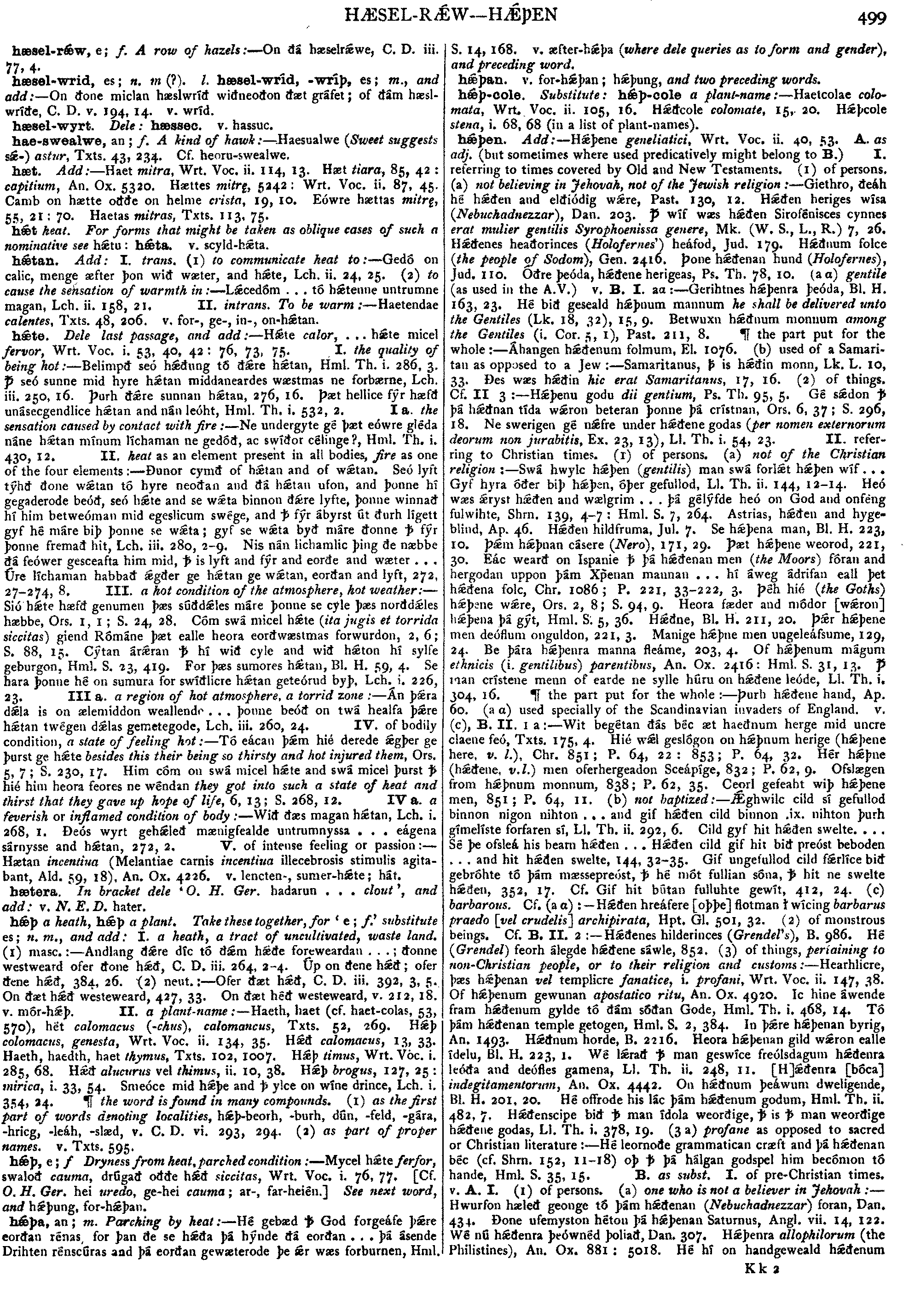
hþen.
Add;
--
Hþene
geneliatici.
Wrt.
Voc.
ii.
40,
53.
A.
as
adj.
(but
sometimes
where
used
predicatively
might
belong
to
B.
)
I.
referring
to
times
covered
by
Old
and
New
Testaments.
(1)
of
persons,
(a)
not
believing
in
Jehovah,
not
of
the
Jewish
religion
:--
Giethro,
ðeáh
hé
hðen
and
elðiódig
wre,
Past.
130,
12.
Hðen
heriges
wísa
(Nebuchadnezzar),
Dan.
203.
Þ-bar;
wíf
wæs
hðen
Sirofénisces
cynnes
erat
mulier
gentilis
Syrophoenissa
genere,
Mk.
(W.
S.
,
L.
,
R.
)
7,
26.
Hðenes
heaðorinces
(Holofernes')
heáfod,
Jud.
179.
Hðnum
folce
(the
people
of
Sodom),
Gen.
2416.
Þone
hðenan
hund
(Holofernes),
Jud.
no.
Óðre
þeóda,
hðene
herigeas,
Ps.
Th.
78,
10.
(a
)
gentile
(as
used
in
the
A.
V.
)
v.
B.
I.
a
:--
Gerihtnes
hþenra
þeóda,
Bl.
H.
163,
23.
Hé
bid
geseald
hþnum
mannum
he
shall
be
delivered
unto
the
Gentiles
(Lk.
18,
32),
15,
9.
Betwuxn
hðnum
monnum
among
the
Gentiles
(i.
Cor.
5,
l),
Past.
211,
8.

the
part
put
for
the
whole
:--
Áhangen
hðenum
folmum,
El.
1076.
(b)
used
of
a
Samaritan
as
opposed
to
a
Jew
:--
Samaritanus,
is
hðin
monn,
Lk.
L.
10,
33.
Des
wæs
hðin
hic
erat
Samaritanus,
17,
16.
(2)
of
things.
Cf.
II
3
:--
Hþenu
godu
dii
gentium,
Ps.
Th.
95,
5.
Ge
sdon
þá
hðnan
tída
wron
beteran
þonne
þá
crístnan,
Ors.
6,
37
;
S.
296,
18.
Ne
swerigen
gé
nfre
under
hðene
godas
(per
nomen
exlernorum
deorum
non
jurabitis.
Ex.
23,
13),
Ll.
Th.
i.
54,
23.
II.
referring
to
Christian
times,
(1)
of
persons,
(a)
not
of
the
Christian
religion
:--
Swá
hwylc
hþen
(gentilis)
man
swá
forlt
hþen
wíf.
.
.
Gyf
hyra
óðer
biþ
hþan,
óþer
gefullod,
Ll.
Th.
ii.
144,
12-14.
Heó
wæs
ryst
hðen
and
wælgrim
.
.
.
þá
gélýfde
heó
on
God
and
onféng
fulwihte,
Shrn.
139,
4-7
:
Hml.
S.
7,
264.
Astrias,
hðen
and
hygeblind,
Ap.
46.
Hðen
hildfruma,
Jul.
7.
Se
hþena
man,
Bl.
H.
223,
10.
Þm
hþnan
cásere
(Nero),
171,
29.
Þæt
hþene
weorod,
221,
30.
Eác
wearð
on
Ispanie
þá
hðenan
men
(the
Moors)
fóran
and
hergodan
uppon
þám
Xpenan
mannan
.
.
.
hí
áweg
ádrifan
eall
þet
hðena
folc,
Chr.
1086;
P.
221,
33-222,
3.
Þén
hié
(the
Goths)
hþene
wre,
Ors.
2,
8;
S.
94,
9.
Heora
fæder
and
módor
[wron]
hþena
þá
gýt,
Hml.
S:
5,
36.
Hdne,
Bl.
H.
211,
20.
Þr
hþene
men
deóflum
onguldon,
221,
3.
Manige
hþne
men
ungeleáfsume,
129,
24.
Be
þára
hþenra
manna
fleáme,
203,
4.
Of
hþenum
mágum
ethnicis
(i.
gentilibus)
parentibus,
An.
Ox.
2416:
Hml.
S.
31,
13.
Þ-bar;
man
crístene
menn
of
earde
ne
sylle
húru
on
hðene
leóde,
Ll.
Th.
i.
304,
16.

the
part
put
for
the
whole
:--
Þurl.
hðene
hand,
Ap.
60.
(a
a)
used
specially
of
the
Scandinavian
invaders
of
England
,
v.
(c),
B.
II.
I
a
:--
Wit
begétan
ðás
béc
æt
haeðnum
herge
mid
uncre
claene
feó,
Txts.
175,
4.
Hié
wl
geslógon
on
hþnum
herige
(hþene
here,
v.
l.),
Chr.
851;
P.
64,
22:
853;
P.
64,
32.
Hér
hþne
(hðene,
v.
l.)
men
oferhergeadon
Sceápíge,
832
;
P.
62,
9.
Ofslægen
from
hþnum
monnum,
838;
P.
62,
35.
Ceprl
gefeaht
wiþ
hþene
men,
851;
P.
64,
11.
(b)
not
baptized
:--
Æ-acute;ghwilc
cild
sí
gefullod
binnon
nigon
nihton
.
.
.
and
gif
hðen
cild
binnon
.ix.
nihton
þurh
gímelíste
forfaren
sí.
Ll.
Th.
ii.
292,
6.
Cild
gyf
hit
hðen
swelte.
.
.
.
Sé
þe
ofsleá
his
beam
hðen
.
.
.
Hðen
cild
gif
hit
bið
preóst
beboden
.
.
.
and
hit
hðen
swelte,
144,
32-35.
Gif
ungefullod
cild
frlíce
bið
gebróhte
tó
þám
mæssepreóst,
hé
mót
fullian
sóna,
hit
ne
swelte
hden,
352,
17.
Cf.
Gif
hit
bútan
fulluhte
gewit,
412,
24.
(c)
barbarous.
Cf.
(a
)
:--
Hðen
hreáfere
[oþþe]
flotman
wícing
barbarus
praedo
[vel
crudelis]
archipirata,
Hpt.
Gl.
501,
32.
(2)
of
monstrous
beings.
Cf.
B.
II.
2
:--
Hðenes
hilderinces
(Grendel's),
B.
986.
Hé
(Grendel)
feorh
álegde
hðene
sáwle,
852.
(3)
of
things,
pertaining
to
non-Christian
people,
or
to
their
religion
and
customs
:--
Hearhlicre,
þæs
hþenan
vel
templicre
fanatice,
i.
profani.
Wrt.
Voc.
ii.
147,
38.
Of
hþenum
gewunan
apostatico
ritu,
An.
Ox.
4920.
Ic
hine
áwende
fram
heth;enum
gylde
tó
ðám
sóðan
Gode,
Hml.
Th.
i.
468,
14.
Tó
þám
hðenan
temple
getogen,
Hml.
S.
2,
384.
In
þre
hþenan
byrig,
An.
1493.
Hðnum
horde,
B.
2216.
Heora
hþenan
gild
wron
ealle
ídelu,
Bl.
H.
223,
i.
We
lrað
man
geswíce
freólsdagutn
hðen
ra
leóða
and
deófles
gamena,
Ll.
Th.
ii.
248,
11.
[H]ðenra
[bóca]
indegitamentorum,
An.
Ox.
4442.
On
hðnum
þeáwum
dweligende,
Bl.
H.
201,
20.
Hé
offrode
his
lác
þám
hðenum
godum,
Hml.
Th.
ii.
482,
7.
Hðenscipe
bið
I
a
man
ídola
weorðige,
is
man
weorttige
hðene
godas,
Ll.
Th.
i.
378,
19.
(3
a)
profane
as
opposed
to
sacred
or
Christian
literature
:--
Hé
leornoðe
grammatical,
craeft
and
þá
hðenan
béc
(cf.
Shrn.
152,
11-18)
oþ
þá
hálgan
godspel
him
becómon
tó
hande.
Hml.
S.
35,
15.
B.
as
subst.
I.
of
pre-Christian
times.
v.
A.
I.
(1)
of
persons,
(a)
one
who
is
not
a
believer
in
Jehovah
:--
Hwurfon
hæleð
geonge
tó
þám
hðenan
(Nebuchadnezzar)
foran,
Dan.
434.
Ðone
ufemyston
héton
þá
hþenan
Saturnus,
Angl.
vii.
14,
122.
Wé
nú
hðenra
þeównéd
þoliað,
Dan.
307.
Hþenra
allophilorum
(the
Philistines),
An.
Ox.
881
:
5018.
Hé
hí
on
handgeweald
hðenum
|
Source: Bosworth/Toller, page d0500, entry 2 View original page image as: [TIFF] [PNG] [View previous entry] [View next entry] |
[Comment on this entry] [View comments] |
The following entry has been hand-corrected once. |
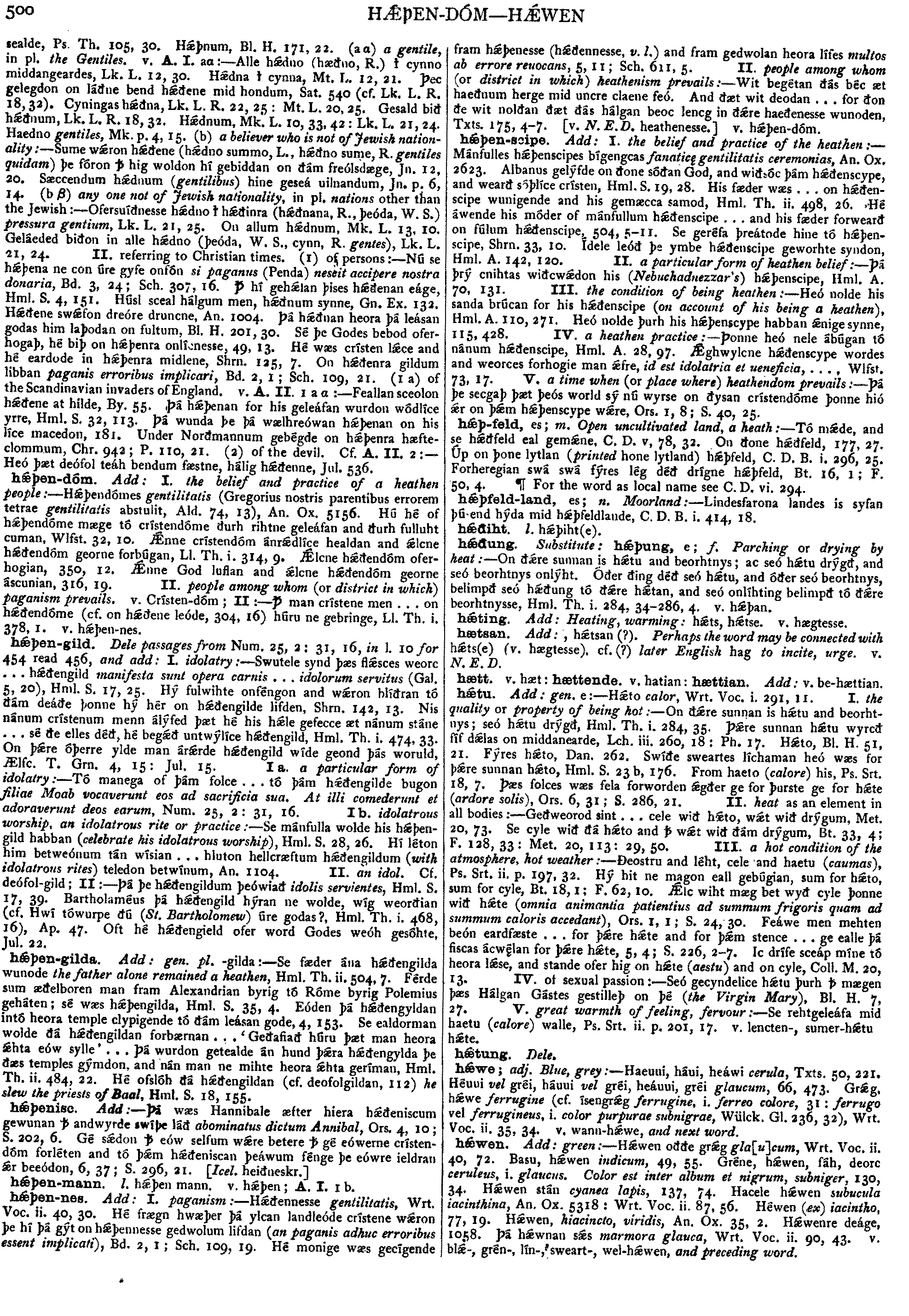
hþen-dóm.
Add:
I.
the
belief
and
practice
of
a
heathen
people
:--
Hþendómes
gentilitatis
(Gregorius
nostris
parentibus
errorem
tetrae
gentilitatis
abstulit,
Ald.
74,
13),
An.
Ox.
5156.
Hú
hé
of
hþendóme
mæge
tó
crístendóme
ðurh
rihtne
geleáfan
and
ðurh
fulluht
cuman,
Wlfst.
32,
10.
Æ-acute;nne
crístendóm
ánrdlíce
healdan
and
lcne
hðendóm
georne
forbúgan,
Ll.
Th.
i.
314,
9.
Æ-acute;lcne
hðendóm
oferhogian,
350,
12.
Æ-acute;nne
God
lufian
and
lcne
hðendóm
georne
áscunian,
316,
19.
II.
people
among
whom
(or
district
in
which)
paganism
prevails.
v.
Crísten-dóm
;
II
:--
Þ-bar;
man
crístene
men
.
.
.
on
hðendóme
(cf.
on
hðene
leóde,
304,
16)
húru
ne
gebringe,
Ll.
Th.
i.
378,
1.
v.
hþen-nes.
| Result Page: |  |
Previous | 12 13 14 15 16 17 18 19 20 21 22 23 24 25 26 27 28 29 30 | Next |  |
Germanic Lexicon Project (main page)
This search system was written by
Sean Crist
Please consider
volunteering
to correct the data in these online dictionaries.
No rights reserved. Feel free to use these data in any way you please.