|
|

|
Source: Bosworth/Toller, page b1114, entry 24 View original page image as: [TIFF] [PNG] [View previous entry] [View next entry] |
[Comment on this entry] [View comments] |
The following entry has been hand-corrected once. |
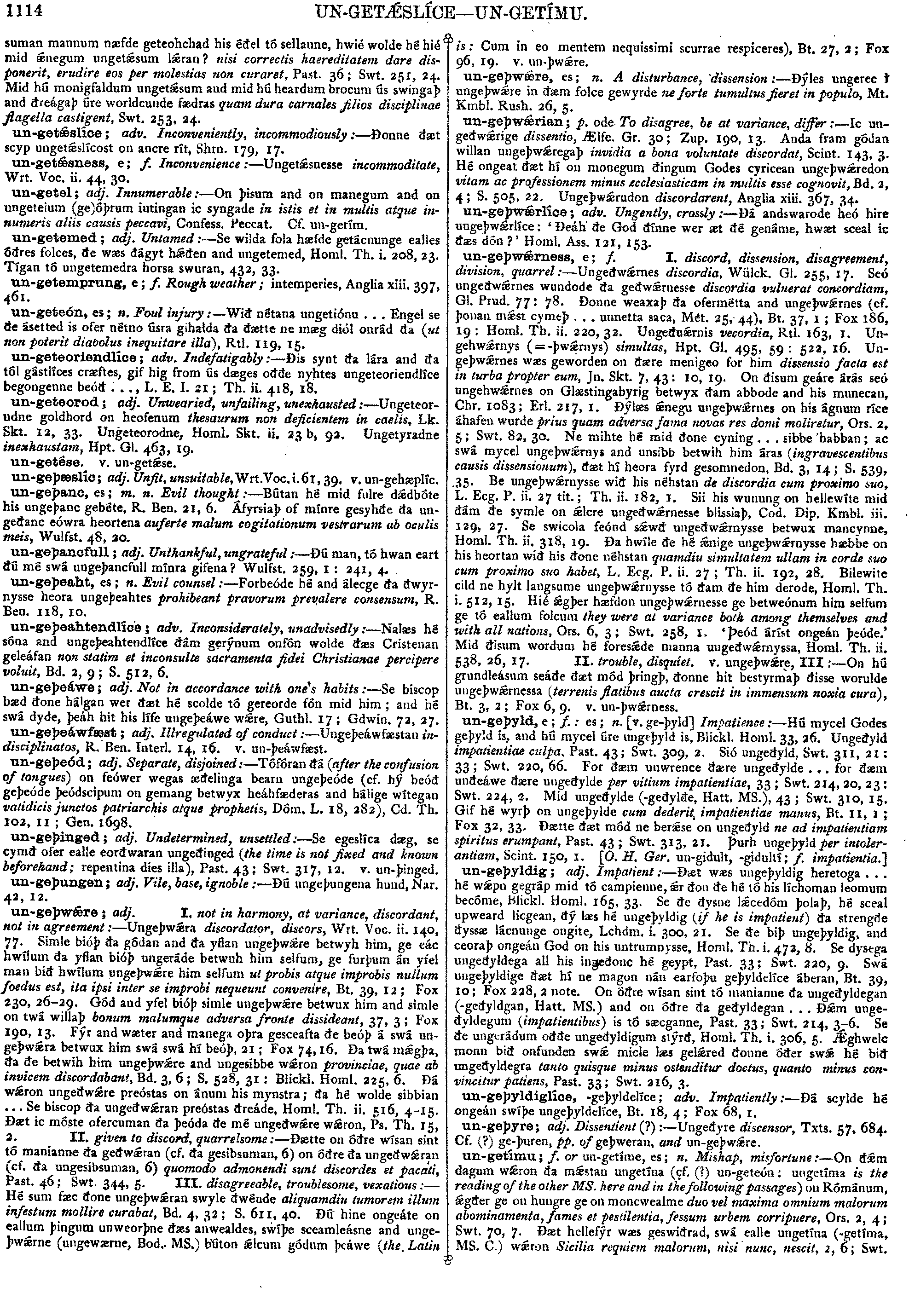
un-geþw rness,
e;
f.
I.
discord,
dissension,
disagreement,
division,
quarrel
:--
Ungeðwrnes
discordia,
Wülck.
Gl.
255,
17.
Seó
ungeðwrnes
wundode
ða
geðwrnesse
discordia
vuluerat
concordiam,
Gl.
Prud.
77:
78.
Ðonne
weaxaþ
ða
ofermétta
and
ungeþwrnes
(cf.
þonan
mst
cymeþ
...
unnetta
saca,
Met.
25,
44),
Bt.
37,
1;
Fox
186,
19:
Homl.
Th.
ii.
220,
32.
Ungeðurnis
vecordia,
Rtl.
163,
1.
Ungehwrnys
(
=
-þwrnys)
simultas,
Hpt.
Gl.
495,
59:
522,
16.
Ungeþwrnes
wæs
geworden
on
ðære
menigeo
for
him
dissensio
facta
est
in
turbo
propter
eum,
Jn.
Skt.
7,
43:
10,
19.
On
ðisum
geáre
árás
seó
ungehwrnes
on
Glæstingabyrig
betwyx
ðam
abbode
and
his
munecan,
Chr.
1083;
Erl.
217,
1.
Ðýlæs
negu
ungeþwrnes
on
his
ágnum
ríce
áhafen
wurde
prius
quam
adversa
fama
novas
res
domi
moliretur,
Ors.
2,
5;
Swt.
82,
30.
Ne
mihte
hé
mid
ðone
cyning
...
sibbe
habban;
ac
swá
mycel
ungeþwrnys
and
unsibb
betwih
him
áras
(ingravescentibus
causis
dissensionum),
ðæt
hí
heora
fyrd
gesomnedon,
Bd.
3,
14;
S.
539,
35.
Be
ungeþwrnysse
wið
his
néhstan
de
discordia
cum
proximo
suo,
L.
Ecg.
P.
ii.
27
tit.;
Th.
ii.
182,
1.
Sii
his
wunung
on
hellewíte
mid
ðám
ðe
symle
on
lcre
ungeðwrnesse
blissiaþ,
Cod.
Dip.
Kmbl.
iii.
129,
27.
Se
swicola
feónd
swð
ungeðwrnysse
betwux
mancynne,
Homl.
Th.
ii.
328,
19.
Ða
hwíle
ðe
hé
nige
ungeþwrnysse
hæbbe
on
his
heortan
wið
his
ðone
néhstan
quamdiu
simultatem
ullam
in
corde
suo
cum
proximo
suo
habet,
L.
Ecg.
P.
ii.
27;
Th.
ii.
192,
28.
Bilewite
cild
ne
hylt
langsume
ungeþwrnysse
tó
ðam
ðe
him
derode,
Homl.
Th.
i.
522,
15.
Hié
gþer
hæfdon
ungeþwrnesse
ge
betweónum
him
selfum
ge
tó
eallum
folcum
they
were
at
variance
both
among
themselves
and
with
all
nations,
Ors.
6,
3;
Swt.
258,
1.
'Þeód
áríst
ongeán
þeóde:'
Mid
ðisum
wordum
hé
foresde
manna
ungeðwrnyssa,
Homl.
Th.
ii.
538,
26,
17.
II.
trouble,
disquiet.
v.
ungeþwre,
III
:--
On
hú
grundleásum
seáðe
ðæt
mód
þringþ,
ðonne
hit
bestyrmaþ
ðisse
worulde
ungeþwrnessa
(terrenis
flatibus
aucta
crescit
in
immensum
noxia
cura),
Bt.
3,
2;
Fox
6,
9.
v.
un-þwrness.
rness,
e;
f.
I.
discord,
dissension,
disagreement,
division,
quarrel
:--
Ungeðwrnes
discordia,
Wülck.
Gl.
255,
17.
Seó
ungeðwrnes
wundode
ða
geðwrnesse
discordia
vuluerat
concordiam,
Gl.
Prud.
77:
78.
Ðonne
weaxaþ
ða
ofermétta
and
ungeþwrnes
(cf.
þonan
mst
cymeþ
...
unnetta
saca,
Met.
25,
44),
Bt.
37,
1;
Fox
186,
19:
Homl.
Th.
ii.
220,
32.
Ungeðurnis
vecordia,
Rtl.
163,
1.
Ungehwrnys
(
=
-þwrnys)
simultas,
Hpt.
Gl.
495,
59:
522,
16.
Ungeþwrnes
wæs
geworden
on
ðære
menigeo
for
him
dissensio
facta
est
in
turbo
propter
eum,
Jn.
Skt.
7,
43:
10,
19.
On
ðisum
geáre
árás
seó
ungehwrnes
on
Glæstingabyrig
betwyx
ðam
abbode
and
his
munecan,
Chr.
1083;
Erl.
217,
1.
Ðýlæs
negu
ungeþwrnes
on
his
ágnum
ríce
áhafen
wurde
prius
quam
adversa
fama
novas
res
domi
moliretur,
Ors.
2,
5;
Swt.
82,
30.
Ne
mihte
hé
mid
ðone
cyning
...
sibbe
habban;
ac
swá
mycel
ungeþwrnys
and
unsibb
betwih
him
áras
(ingravescentibus
causis
dissensionum),
ðæt
hí
heora
fyrd
gesomnedon,
Bd.
3,
14;
S.
539,
35.
Be
ungeþwrnysse
wið
his
néhstan
de
discordia
cum
proximo
suo,
L.
Ecg.
P.
ii.
27
tit.;
Th.
ii.
182,
1.
Sii
his
wunung
on
hellewíte
mid
ðám
ðe
symle
on
lcre
ungeðwrnesse
blissiaþ,
Cod.
Dip.
Kmbl.
iii.
129,
27.
Se
swicola
feónd
swð
ungeðwrnysse
betwux
mancynne,
Homl.
Th.
ii.
328,
19.
Ða
hwíle
ðe
hé
nige
ungeþwrnysse
hæbbe
on
his
heortan
wið
his
ðone
néhstan
quamdiu
simultatem
ullam
in
corde
suo
cum
proximo
suo
habet,
L.
Ecg.
P.
ii.
27;
Th.
ii.
192,
28.
Bilewite
cild
ne
hylt
langsume
ungeþwrnysse
tó
ðam
ðe
him
derode,
Homl.
Th.
i.
522,
15.
Hié
gþer
hæfdon
ungeþwrnesse
ge
betweónum
him
selfum
ge
tó
eallum
folcum
they
were
at
variance
both
among
themselves
and
with
all
nations,
Ors.
6,
3;
Swt.
258,
1.
'Þeód
áríst
ongeán
þeóde:'
Mid
ðisum
wordum
hé
foresde
manna
ungeðwrnyssa,
Homl.
Th.
ii.
538,
26,
17.
II.
trouble,
disquiet.
v.
ungeþwre,
III
:--
On
hú
grundleásum
seáðe
ðæt
mód
þringþ,
ðonne
hit
bestyrmaþ
ðisse
worulde
ungeþwrnessa
(terrenis
flatibus
aucta
crescit
in
immensum
noxia
cura),
Bt.
3,
2;
Fox
6,
9.
v.
un-þwrness.
|
Source: Bosworth/Toller, page b1122, entry 16 View original page image as: [TIFF] [PNG] [View previous entry] [View next entry] |
[Comment on this entry] [View comments] |
The following entry has been hand-corrected once. |
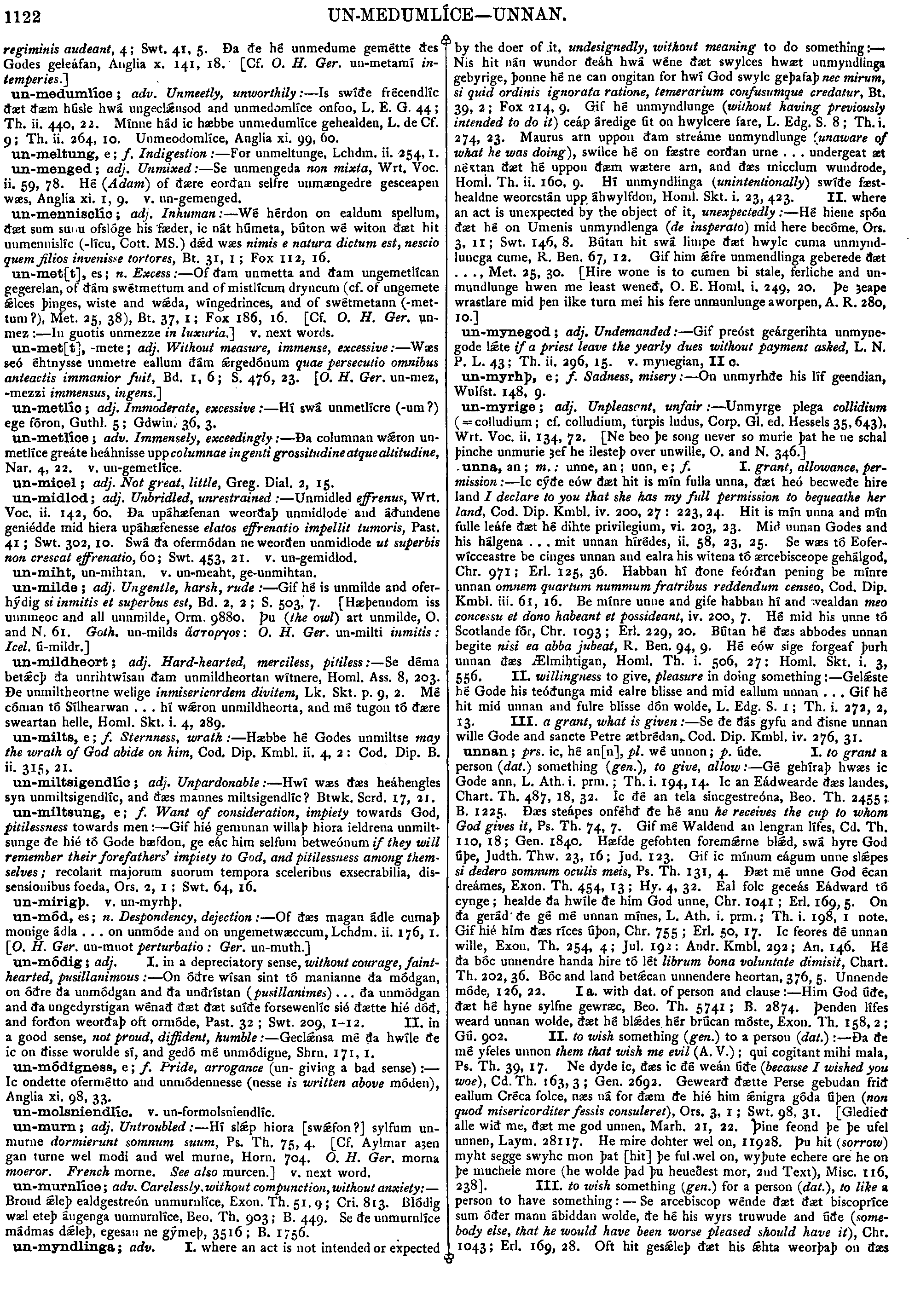
un-miltsung, e; f. Want of consideration, impiety towards God, pitilessness towards men :-- Gif hié gemunan willaþ hiora ieldrena unmiltsunge ðe hié tó Gode hæfdon, ge eác him selfum betweónum if they will remember their forefathers' impiety to God, and pitilessness among themselves; recolant majorum suorum tempora sceleribus exsecrabilia, dissensionibus foeda, Ors. 2, 1; Swt. 64, 16.
|
Source: Bosworth/Toller, page b1161, entry 11 View original page image as: [TIFF] [PNG] [View previous entry] [View next entry] |
[Comment on this entry] [View comments] |
The following entry has been hand-corrected once. |
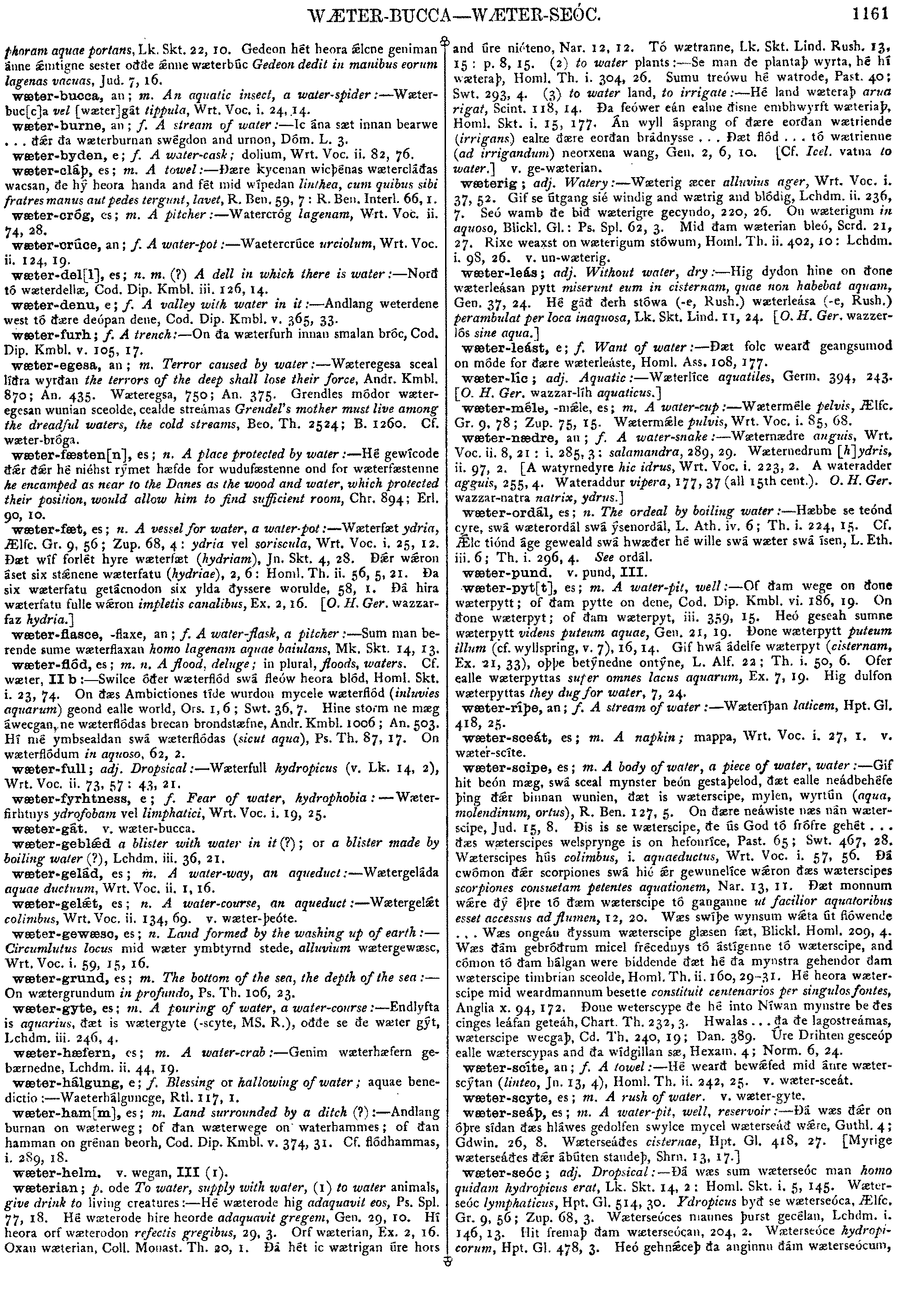
wæter-egesa, an; m. Terror caused by water :-- Wæteregesa sceal líðra wyrðan the terrors of the deep shall lose their force, Andr. Kmbl. 870; An. 435. Wæteregsa, 750; An. 375. Grendles módor wæteregesan wunian sceolde, cealde streámas Grendel's mother must live among the dreadful waters, the cold streams. Beo. Th. 2524; B. 1260. Cf. wæter-bróga.
|
Source: Bosworth/Toller, page b1174, entry 13 View original page image as: [TIFF] [PNG] [View previous entry] [View next entry] |
[Comment on this entry] [View comments] |
The following entry has been hand-corrected once. |
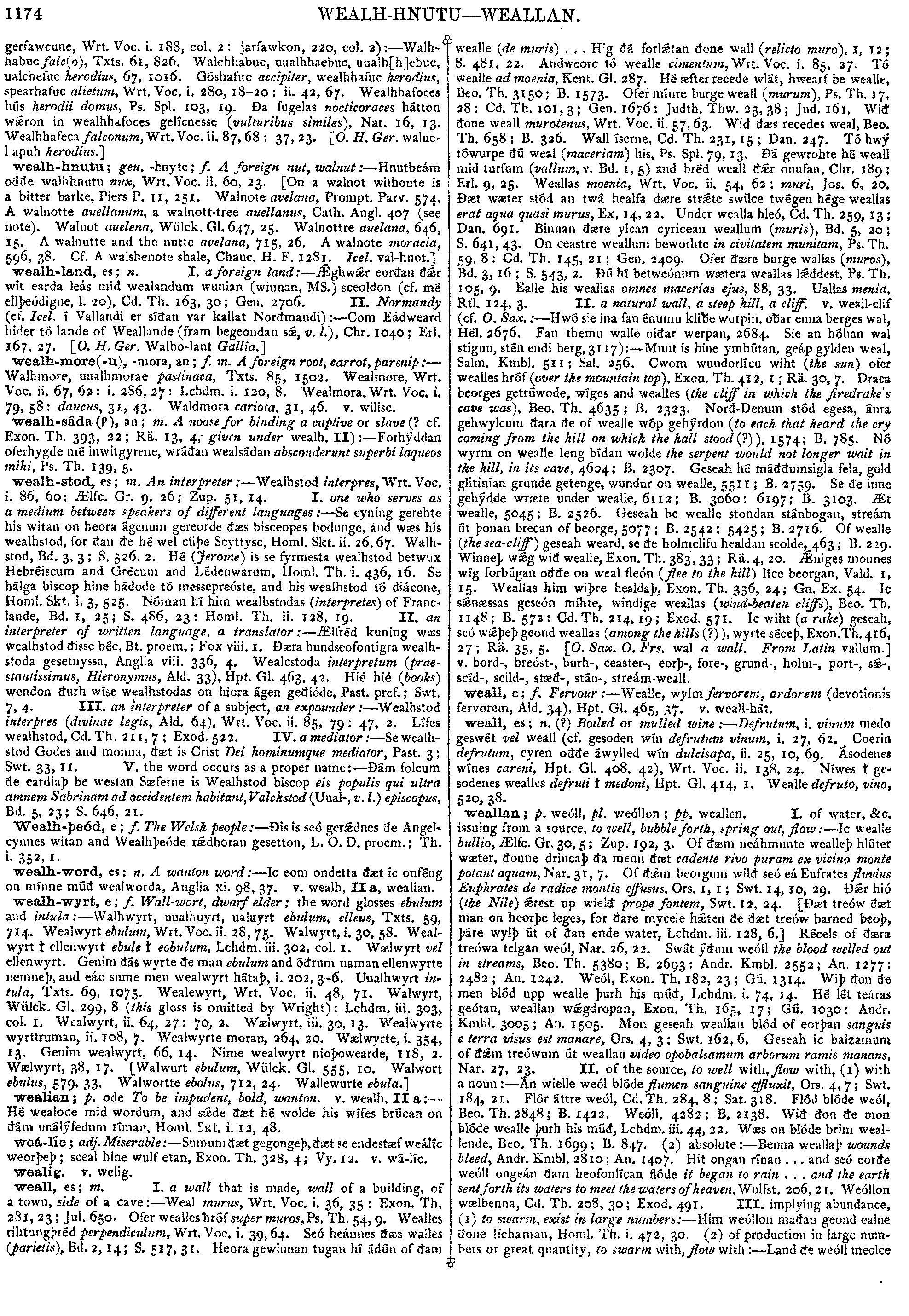
weall,
es;
m.
I.
a
wall
that
is
made,
wall
of
a
building,
of
a
town,
side
of
a
cave:--Weal
murus,
Wrt.
Voc.
i.
36,
35:
Exon.
Th.
281,
23;
Jul.
650.
Ofer
wealles
hróf
super
muros,
Ps.
Th.
54,
9.
Wealles
rihtungþréd
perpendiculum,
Wrt.
Voc.
i.
39,
64.
Seó
heánnes
ðæs
walles
(parietis),
Bd.
2,
14;
S.
517,
31.
Heora
gewinnan
tugan
hí
ádún
of
ðam
wealle
(de
muris)
.
.
.
Hig
ðá
forltan
ðone
wall
(relicto
muro),
1,
12;
S.
481,
22.
Andweorc
tó
wealle
cimentum,
Wrt.
Voc.
i.
85,
27.
Tó
wealle
ad
moenia,
Kent.
Gl.
287.
Hé
æfter
recede
wlát,
hwearf
be
wealle,
Beo.
Th.
3150;
B.
1573.
Ofer
mínre
burge
weall
(murum),
Ps.
Th.
17,
28:
Cd.
Th.
101,
3;
Gen.
1676:
Judth.
Thw.
23,
38;
Jud.
161.
Wið
ðone
weall
murotenus,
Wrt.
Voc.
ii.
57,
63.
Wið
ðæs
recedes
weal,
Beo.
Th.
658;
B.
326.
Wall
íserne,
Cd.
Th.
231,
15;
Dan.
247.
Tó
hwý
tówurpe
ðú
weal
(maceriam)
his,
Ps.
Spl.
79,
13.
Ðá
gewrohte
hé
weall
mid
turfum
(vallum,
v.
Bd.
1,
5)
and
bréd
weall
ðr
onufan,
Chr.
189;
Erl.
9,
25.
Weallas
moenia,
Wrt.
Voc.
ii.
54,
62:
muri,
Jos.
6,
20.
Ðæt
wæter
stód
an
twá
healfa
ðære
strte
swilce
twégen
hége
weallas
erat
aqua
quasi
murus,
Ex.
14,
22.
Under
wealla
hleó,
Cd.
Th.
259,
13;
Dan.
691.
Binnan
ðære
ylcan
cyricean
weallum
(muris),
Bd.
5,
20;
S.
641,
43.
On
ceastre
weallum
beworhte
in
civitatem
munitam,
Ps.
Th.
59,
8:
Cd.
Th.
145,
21;
Gen.
2409.
Ofer
ðære
burge
wallas
(muros),
Bd.
3,
16;
S.
543,
2.
Ðú
hí
betweónum
wætera
weallas
lddest,
Ps.
Th.
105,
9.
Ealle
his
weallas
omnes
macerias
ejus,
88,
33.
Uallas
menia,
Rtl.
124,
3.
II.
a
natural
wall,
a
steep
hill,
a
cliff.
v.
weall-clif
(cf.
O.
Sax.:--Hwó
sie
ina
fan
énumu
kli e
wurpin,
oar
enna
berges
wal,
Hél.
2676.
Fan
themu
walle
niðar
werpan,
2684.
Sie
an
hóhan
wal
stigun,
stén
endi
berg,
3117):--Munt
is
hine
ymbútan,
geáp
gylden
weal,
Salm.
Kmbl.
511;
Sal.
256.
Cwom
wundorlícu
wiht
(the
sun)
ofer
wealles
hróf
(over
the
mountain
top),
Exon.
Th.
412,
1;
Rä.
30,
7.
Draca
beorges
getrúwode,
wíges
and
wealles
(the
cliff
in
which
the
firedrake's
cave
was),
Beo.
Th.
4635;
B.
2323.
Norð-Denum
stód
egesa,
ánra
gehwylcum
ðara
ðe
of
wealle
wóp
gehýrdon
(to
each
that
heard
the
cry
coming
from
the
hill
on
which
the
hall
stood
(?)),
1574;
B.
785.
Nó
wyrm
on
wealle
leng
bídan
wolde
the
serpent
would
not
longer
wait
in
the
hill,
in
its
cave,
4604;
B.
2307.
Geseah
hé
máððumsigla
fela,
gold
glitinian
grunde
getenge,
wundur
on
wealle,
5511;
B.
2759.
Se
ðe
inne
gehýdde
wræte
under
wealle,
6112;
B.
3060:
6197;
B.
3103.
Æt
wealle,
5045;
B.
2526.
Geseah
be
wealle
stondan
stánbogan,
streám
út
þonan
brecan
of
beorge,
5077;
B.
2542:
5425;
B.
2716.
Of
wealle
(the
sea-cliff)
geseah
weard,
se
ðe
holmclifu
healdan
scolde,
463;
B.
229.
Winneþ
wg
wið
wealle,
Exon.
Th.
383,
33;
Rä.
4,
20.
Æ-acute;niges
monnes
wíg
forbúgan
oððe
on
weal
fleón
(flee
to
the
hill)
líce
beorgan,
Vald.
1,
15.
Weallas
him
wiþre
healdaþ,
Exon.
Th.
336,
24;
Gn.
Ex.
54.
Ic
snæssas
geseón
mihte,
windige
weallas
(wind-beaten
cliffs),
Beo.
Th.
1148;
B.
572:
Cd.
Th.
214,
19;
Exod.
571.
Ic
wiht
(a
rake)
geseah,
seó
wþeþ
geond
weallas
(among
the
hills
(?)),
wyrte
séceþ,
Exon.
Th.
416,
27;
Rä.
35,
5.
[O.
Sax.
O.
Frs.
wal
a
wall.
From
Latin
vallum.]
v.
bord-,
breóst-,
burh-,
ceaster-,
eorþ-,
fore-,
grund-,
holm-,
port-,
s-,
scíd-,
scild-,
stæð-,
stán-,
streám-weall.
e
wurpin,
oar
enna
berges
wal,
Hél.
2676.
Fan
themu
walle
niðar
werpan,
2684.
Sie
an
hóhan
wal
stigun,
stén
endi
berg,
3117):--Munt
is
hine
ymbútan,
geáp
gylden
weal,
Salm.
Kmbl.
511;
Sal.
256.
Cwom
wundorlícu
wiht
(the
sun)
ofer
wealles
hróf
(over
the
mountain
top),
Exon.
Th.
412,
1;
Rä.
30,
7.
Draca
beorges
getrúwode,
wíges
and
wealles
(the
cliff
in
which
the
firedrake's
cave
was),
Beo.
Th.
4635;
B.
2323.
Norð-Denum
stód
egesa,
ánra
gehwylcum
ðara
ðe
of
wealle
wóp
gehýrdon
(to
each
that
heard
the
cry
coming
from
the
hill
on
which
the
hall
stood
(?)),
1574;
B.
785.
Nó
wyrm
on
wealle
leng
bídan
wolde
the
serpent
would
not
longer
wait
in
the
hill,
in
its
cave,
4604;
B.
2307.
Geseah
hé
máððumsigla
fela,
gold
glitinian
grunde
getenge,
wundur
on
wealle,
5511;
B.
2759.
Se
ðe
inne
gehýdde
wræte
under
wealle,
6112;
B.
3060:
6197;
B.
3103.
Æt
wealle,
5045;
B.
2526.
Geseah
be
wealle
stondan
stánbogan,
streám
út
þonan
brecan
of
beorge,
5077;
B.
2542:
5425;
B.
2716.
Of
wealle
(the
sea-cliff)
geseah
weard,
se
ðe
holmclifu
healdan
scolde,
463;
B.
229.
Winneþ
wg
wið
wealle,
Exon.
Th.
383,
33;
Rä.
4,
20.
Æ-acute;niges
monnes
wíg
forbúgan
oððe
on
weal
fleón
(flee
to
the
hill)
líce
beorgan,
Vald.
1,
15.
Weallas
him
wiþre
healdaþ,
Exon.
Th.
336,
24;
Gn.
Ex.
54.
Ic
snæssas
geseón
mihte,
windige
weallas
(wind-beaten
cliffs),
Beo.
Th.
1148;
B.
572:
Cd.
Th.
214,
19;
Exod.
571.
Ic
wiht
(a
rake)
geseah,
seó
wþeþ
geond
weallas
(among
the
hills
(?)),
wyrte
séceþ,
Exon.
Th.
416,
27;
Rä.
35,
5.
[O.
Sax.
O.
Frs.
wal
a
wall.
From
Latin
vallum.]
v.
bord-,
breóst-,
burh-,
ceaster-,
eorþ-,
fore-,
grund-,
holm-,
port-,
s-,
scíd-,
scild-,
stæð-,
stán-,
streám-weall.
|
Source: Bosworth/Toller, page b1197, entry 9 View original page image as: [TIFF] [PNG] [View previous entry] [View next entry] |
[Comment on this entry] [View comments] |
The following entry has been hand-corrected once. |
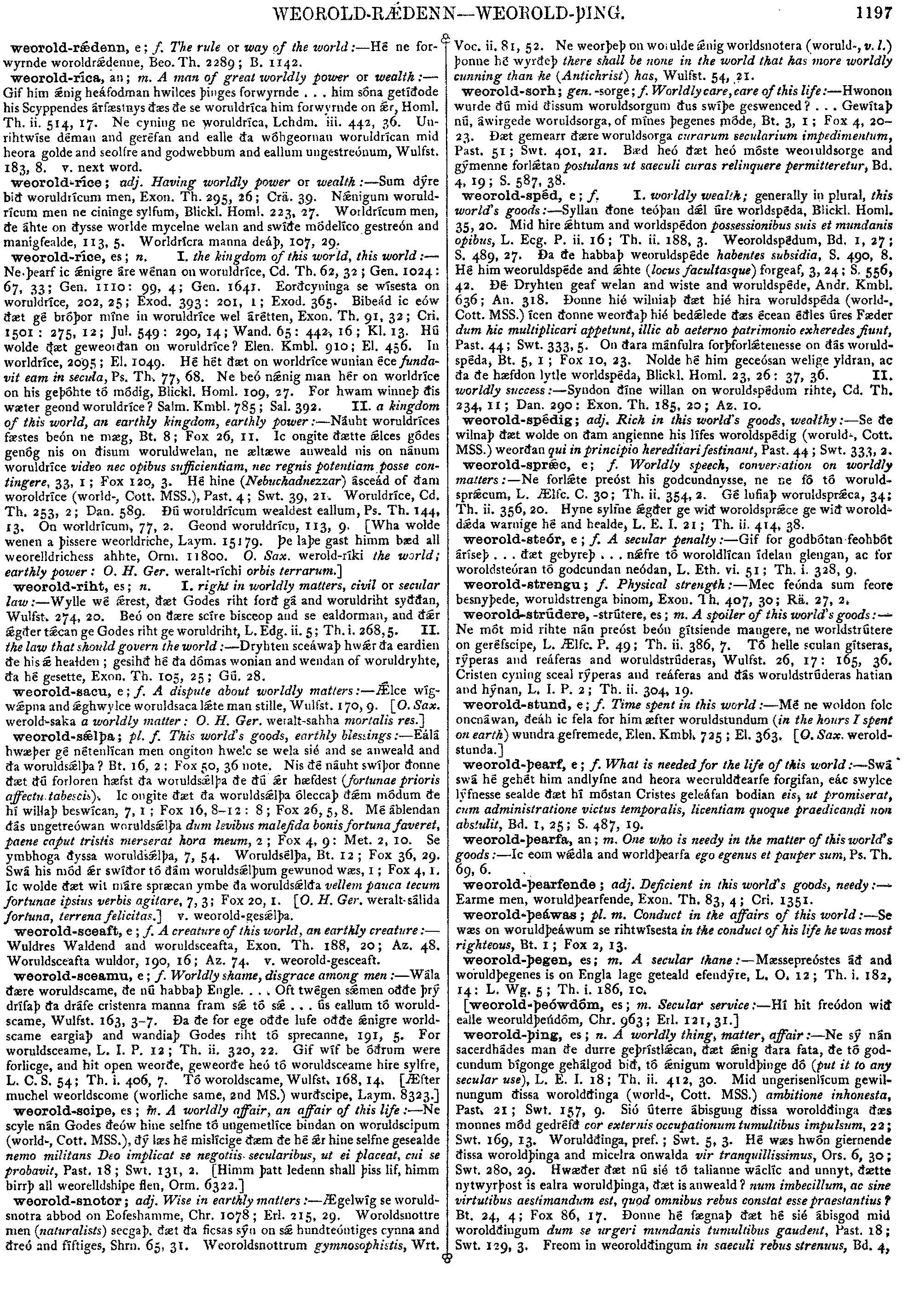
weorold-sceamu,
e;
f.
Worldly
shame,
disgrace
among
men:--
Wála
ðære
woruldscame,
ðe
nú
habbaþ
Engle.
.
.
.
Oft
twégen
smen
oððe
þrý
drífaþ
ða
dráfe
cristenra
manna
fram
s
tó
s.
.
.
ús
eallum
tó
woruldscame,
Wulfst.
163,
3-7.
Ða
ðe
for
ege
oððe
lufe
oððe
nigre
worldscame
eargiaþ
and
wandiaþ
Godes
riht
tó
sprecanne,
191,
5.
For
woruldsceame,
L.
I.
P.
12
;
Th.
ii.
320,
22.
Gif
wíf
be
óðrum
were
forlicge,
and
hit
open
weorðe,
geweorðe
heó
tó
woruldsceame
hire
sylfre,
L.
C.
S.
54;
Th.
i.
406,
7.
Tó
woroldscame,
Wulfst.
168,
14,
[Æfter
muchel
weorldscome
(worliche
same,
2nd
MS.)
wurðscipe,
Laym.
8323.]
|
Source: Bosworth/Toller, page b1206, entry 16 View original page image as: [TIFF] [PNG] [View previous entry] [View next entry] |
[Comment on this entry] [View comments] |
The following entry has been hand-corrected once. |
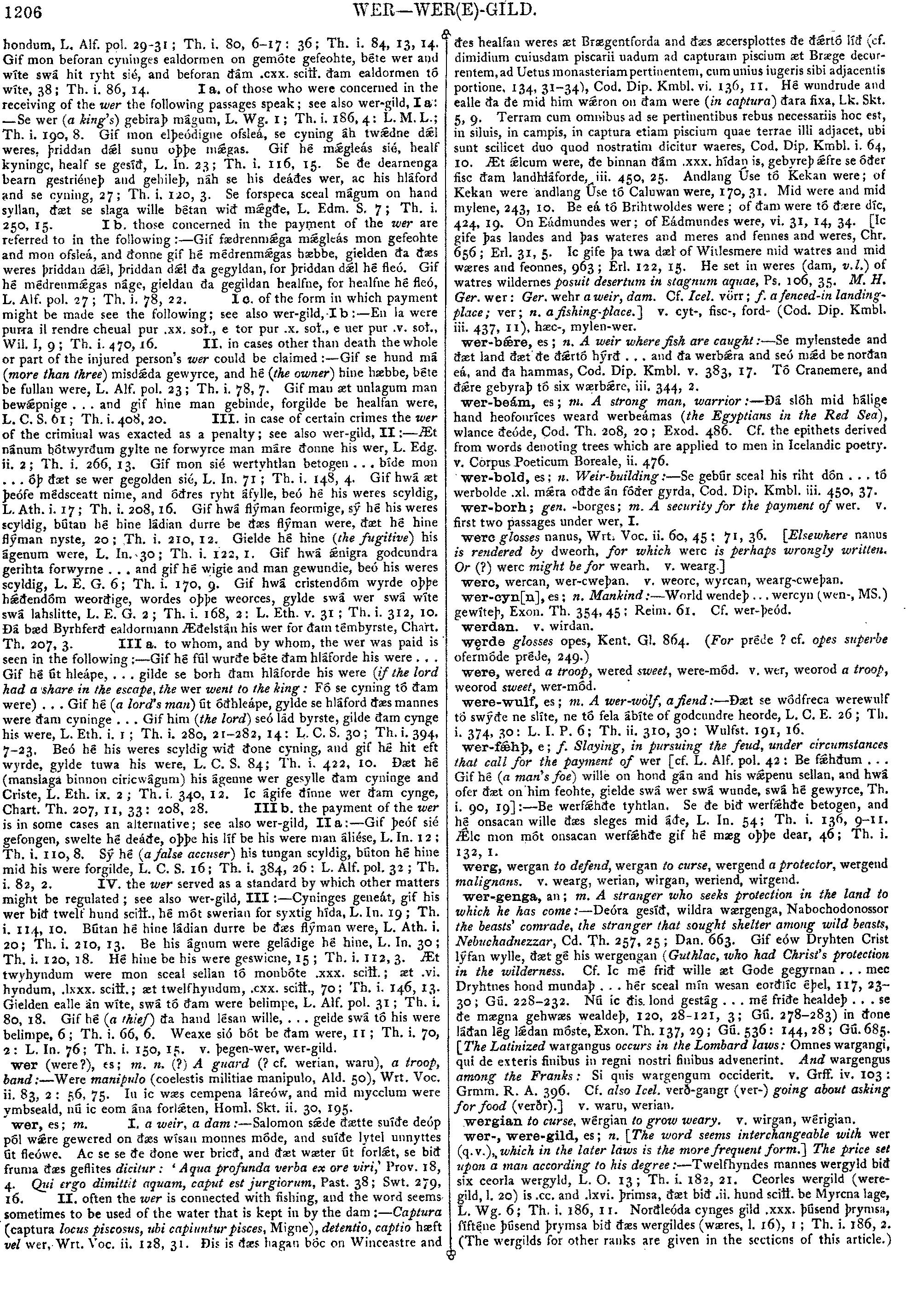
wer-genga,
an;
m.
A
stranger
who
seeks
protection
in
the
land
to
which
he
has
come
:--
Deóra
gesíð,
wildra
wærgenga,
Nabochodonossor
the
beasts'
comrade,
the
stranger
that
sought
shelter
among
wild
beasts,
Nebuchadnezzar,
Cd.
Th.
257,
25;
Dan.
663.
Gif
eów
Dryhten
Crist
lýfan
wylle,
ðæt
gé
his
wergengan
(Guthlac,
who
had
Christ's
protection
in
the
wilderness.
Cf.
Ic
mé
frið
wille
æt
Gode
gegyrnan
.
.
.
mec
Dryhtnes
hond
mundaþ
.
.
.
hér
sceal
mín
wesan
eorðlíc
éþel,
117,
23-30;
Gú.
228-232.
Nú
ic
ðis
lond
gestág
.
.
.
mé
friðe
healdeþ
.
.
.
se
ðe
mægna
gehwæs
wealdeþ,
120,
28-121,
3;
Gú.
278-283)
in
ðone
láðan
lég
ldan
móste,
Exon.
Th.
137,
29;
Gú.
536
:
144,
28;
Gú.
685.
[The
Latinized
wargangus
occurs
in
the
Lombard
laws
:
Omnes
wargangi,
qui
de
exteris
finibus
in
regni
nostri
finibus
advenerint.
And
wargengus
among
the
Franks
:
Si
quis
wargengum
occiderit.
v.
Grff
iv.
103
:
Grmm.
R.
A.
396.
Cf.
also
Icel.
verð-gangr
(ver-)
going
about
asking
for
food
(verðr).]
v.
waru,
werian.
|
Source: Bosworth/Toller, page b1214, entry 5 View original page image as: [TIFF] [PNG] [View previous entry] [View next entry] |
[Comment on this entry] [View comments] |
The following entry has been hand-corrected once. |
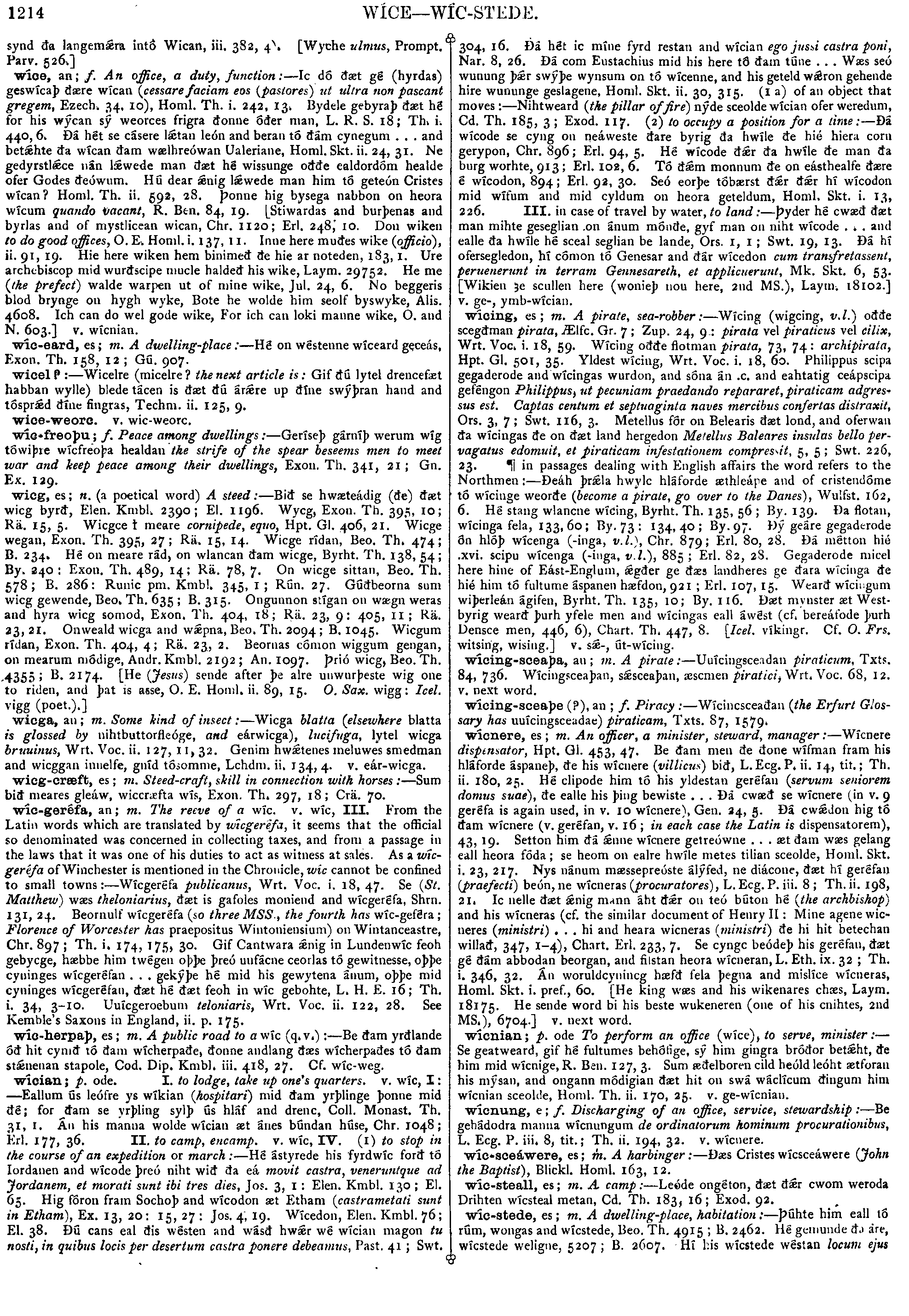
wíc-freoþu; f. Peace among dwellings :-- Geríseþ gárníþ werum wíg tówiþre wícfreoþa healdan the strife of the spear beseems men to meet war and keep peace among their dwellings, Exon. Th. 341, 21; Gn. Ex. 129.
|
Source: Bosworth/Toller, page b1219, entry 5 View original page image as: [TIFF] [PNG] [View previous entry] [View next entry] |
[Comment on this entry] [View comments] |
The following entry has been hand-corrected once. |
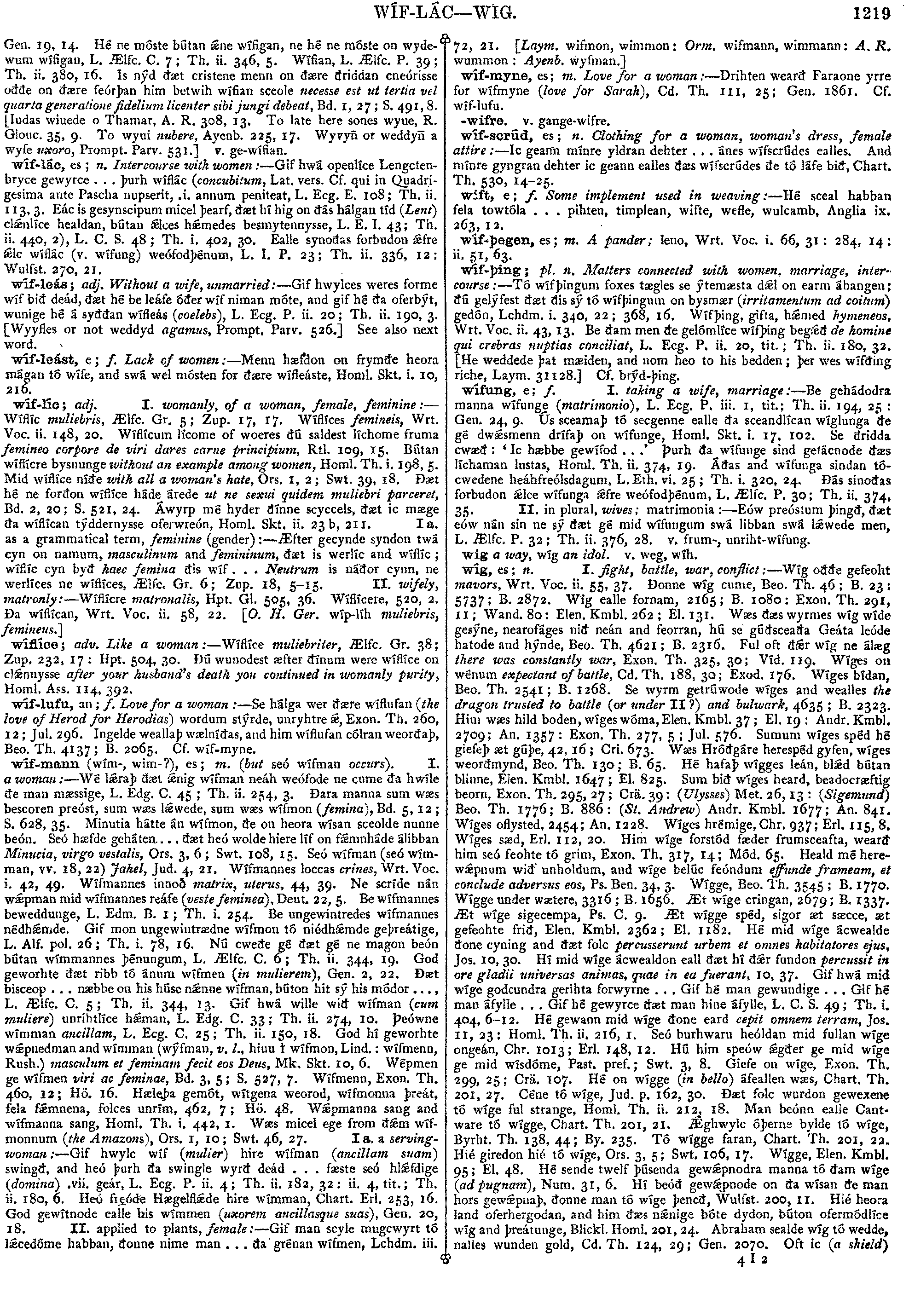
wíf-líc; adj. I. womanly, of a woman, female, feminine :-- Wíflíc muliebris, Ælfc. Gr. 5; Zup. 17, 17. Wíflíces femineis, Wrt. Voc. ii. 148, 20. Wíflícum lícome of woeres ðú saldest líchome fruma femineo corpore de viri dares carne principium, Rtl. 109, 15. Bútan wíflícre bysnunge without an example among women, Homl. Th. i. 198, 5. Mid wíflíce níðe with all a woman's hate, Ors. 1,2 ; Swt. 39, 18. Ðæt hé ne forðon wíflíce háde árede ut ne sexui quidem muliebri parceret, Bd. 2, 20; S. 521, 24. Áwyrp mé hyder ðínne scyccels, ðæt ic mæge ða wíflícan týddernysse oferwreón, Homl. Skt. ii. 23 b, 211. Ia. as a grammatical term, feminine (gender) :-- Æfter gecynde syndon twá cyn on namum, masculinum and femininum, ðæt is werlic and wíflíc ; wíflíc cyn byð haec femina ðis wíf . . . Neutrum is náðor cynn, ne werlíces ne wíflíces, Ælfc. Gr. 6; Zup. 18, 5-15. II. wifely, matronly :-- Wíflícre matronalis, Hpt. Gl. 505, 36. Wíflícere, 520, 2. Ða wíflícan, Wrt. Voc. ii. 58, 22. [O. H. Ger. wíp-líh muliebris, femineus.]
|
Source: Bosworth/Toller, page b1234, entry 16 View original page image as: [TIFF] [PNG] [View previous entry] [View next entry] |
[Comment on this entry] [View comments] |
The following entry has been hand-corrected once. |
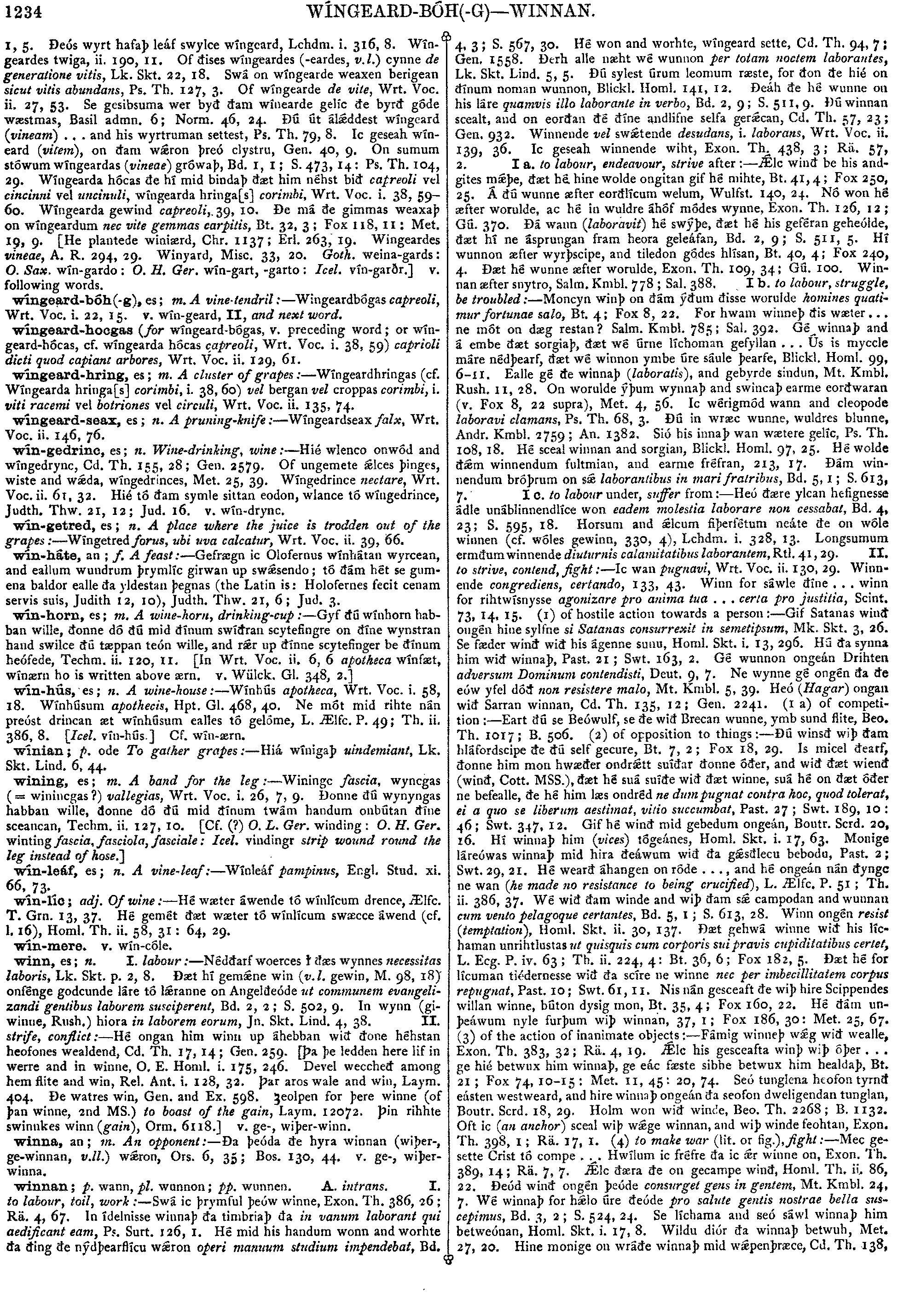
winn,
es;
n.
I.
labour
:--
Nédðarf
woerces
 ðæs
wynnes
necessitas
laboris,
Lk.
Skt.
p.
2,
8.
Ðæt
hí
gemne
win
(v.
l.
gewin,
M.
98,
18)
onfénge
godcunde
láre
tó
lranne
on
Angelðeóde
ut
communem
evangelizandi
gentibus
laborem
susciperent,
Bd.
2,
2;
S.
502,
9.
In
wynn
(gi
ðæs
wynnes
necessitas
laboris,
Lk.
Skt.
p.
2,
8.
Ðæt
hí
gemne
win
(v.
l.
gewin,
M.
98,
18)
onfénge
godcunde
láre
tó
lranne
on
Angelðeóde
ut
communem
evangelizandi
gentibus
laborem
susciperent,
Bd.
2,
2;
S.
502,
9.
In
wynn
(gi winne,
Rush.)
hiora
in
laborem
eorum,
Jn.
Skt.
Lind.
4,
38.
II.
strife,
conflict
:--
Hé
ongan
him
winn
up
áhebban
wið
ðone
héhstan
heofones
wealdend,
Cd.
Th.
17,
14;
Gen.
259.
[Þa
þe
ledden
here
lif
in
werre
and
in
winne,
O.
E.
Homl.
i.
175,
246.
Devel
weccheð
among
hem
flite
and
win,
Rel.
Ant.
i.
128,
32.
Þar
aros
wale
and
win,
Laym.
404.
De
watres
win,
Gen.
and
Ex.
598.
winne,
Rush.)
hiora
in
laborem
eorum,
Jn.
Skt.
Lind.
4,
38.
II.
strife,
conflict
:--
Hé
ongan
him
winn
up
áhebban
wið
ðone
héhstan
heofones
wealdend,
Cd.
Th.
17,
14;
Gen.
259.
[Þa
þe
ledden
here
lif
in
werre
and
in
winne,
O.
E.
Homl.
i.
175,
246.
Devel
weccheð
among
hem
flite
and
win,
Rel.
Ant.
i.
128,
32.
Þar
aros
wale
and
win,
Laym.
404.
De
watres
win,
Gen.
and
Ex.
598.
 eolpen
for
þere
winne
(of
þan
winne,
2nd
MS.)
to
boast
of
the
gain,
Laym.
12072.
Þin
rihhte
swinnkes
winn
(gain),
Orm.
6118.]
v.
ge-,
wiþer-winn.
eolpen
for
þere
winne
(of
þan
winne,
2nd
MS.)
to
boast
of
the
gain,
Laym.
12072.
Þin
rihhte
swinnkes
winn
(gain),
Orm.
6118.]
v.
ge-,
wiþer-winn.
|
Source: Bosworth/Toller, page b1261, entry 15 View original page image as: [TIFF] [PNG] [View previous entry] [View next entry] |
[Comment on this entry] [View comments (1)] |
The following entry has been hand-corrected once. |
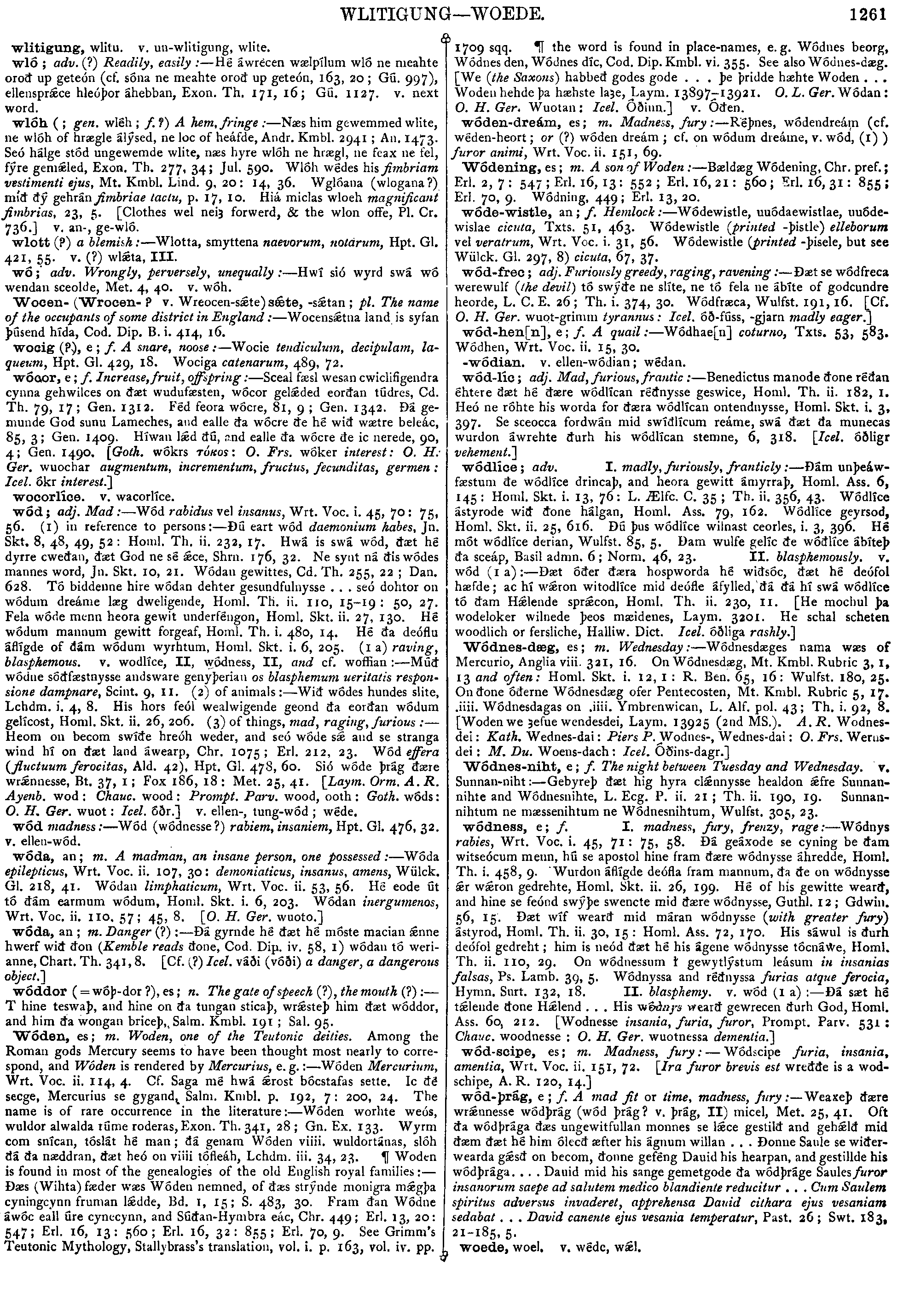
Woden,
es;
m.
Woden,
one
of
the
Teutonic
deities.
Among
the
Roman
gods
Mercury
seems
to
have
been
thought
most
nearly
to
correspond,
and
Wóden
is
rendered
by
Mercurius,
e.
g.
:--
Wóden
Mercurium,
Wrt.
Voc.
ii.
114,
4.
Cf.
Saga
mé
hwá
rost
bócstafas
sette.
Ic
ðé
secge,
Mercurius
se
gygand,
Salm.
Kmbl.
p.
192,
7:
200,
24.
The
name
is
of
rare
occurrence
in
the
literature
:--
Wóden
worhte
weós,
wuldor
alwalda
rúme
roderas,
Exon.
Th.
341,
28;
Gn.
Ex.
133.
Wyrm
com
snícan,
tóslát
hé
man
;
ðá
genam
Woden
viiii.
wuldortánas,
slóh
ðá
ða
næddran,
ðæt
heó
on
viiii
tófleáh,
Lchdm.
iii.
34,
23.

Woden
is
found
in
most
of
the
genealogies
of
the
old
English
royal
families
:--
Ðæs
(Wihta)
fæder
wæs
Wóden
nemned,
of
ðæs
strýnde
monigra
mgþa
cyningcynn
fruman
ldde,
Bd.
I.
15;
S.
483,
30.
Fram
ðan
Wódne
áwóc
eall
úre
cynecynn,
and
Súðan-Hymbra
eác.
Chr.
449;
Erl.
13,
20:
547;
Erl.
16,
13:
560;
Erl.
16,
32:
855;
Erl.
70,
9.
See
Grimm's
Teutonic
Mythology,
Stallybrass's
translation,
vol.
i.
p.
163,
vol.
iv.
pp.
1709
sqq.

the
word
is
found
in
place-names,
e.
g.
Wódnes
beorg,
Wodnes
den,
Wódnes
díc,
Cod.
Dip.
Kmbl.
vi.
355.
See
also
Wódnes-dæg.
[We
(the
Saxons)
habbeð
godes
gode
.
.
.
þe
þridde
næhte
Woden
.
.
.
Woden
hende
þa
næhste
lae,
Laym.
13897-13921.
O.
L.
Ger.
Wódan:
O.
H.
Ger.
Wuotan:
Icel.
Óðinn.]
v.
Óðen.
| Result Page: |  |
Previous | 9 10 11 12 13 14 15 16 17 18 19 20 21 22 23 24 25 26 27 | Next |  |
Germanic Lexicon Project (main page)
This search system was written by
Sean Crist
Please consider
volunteering
to correct the data in these online dictionaries.
No rights reserved. Feel free to use these data in any way you please.