|
|

|
Source: Bosworth/Toller, page b0024, entry 44 View original page image as: [TIFF] [PNG] [View previous entry] [View next entry] |
[Comment on this entry] [View comments (2)] |
The following entry has been hand-corrected once. |
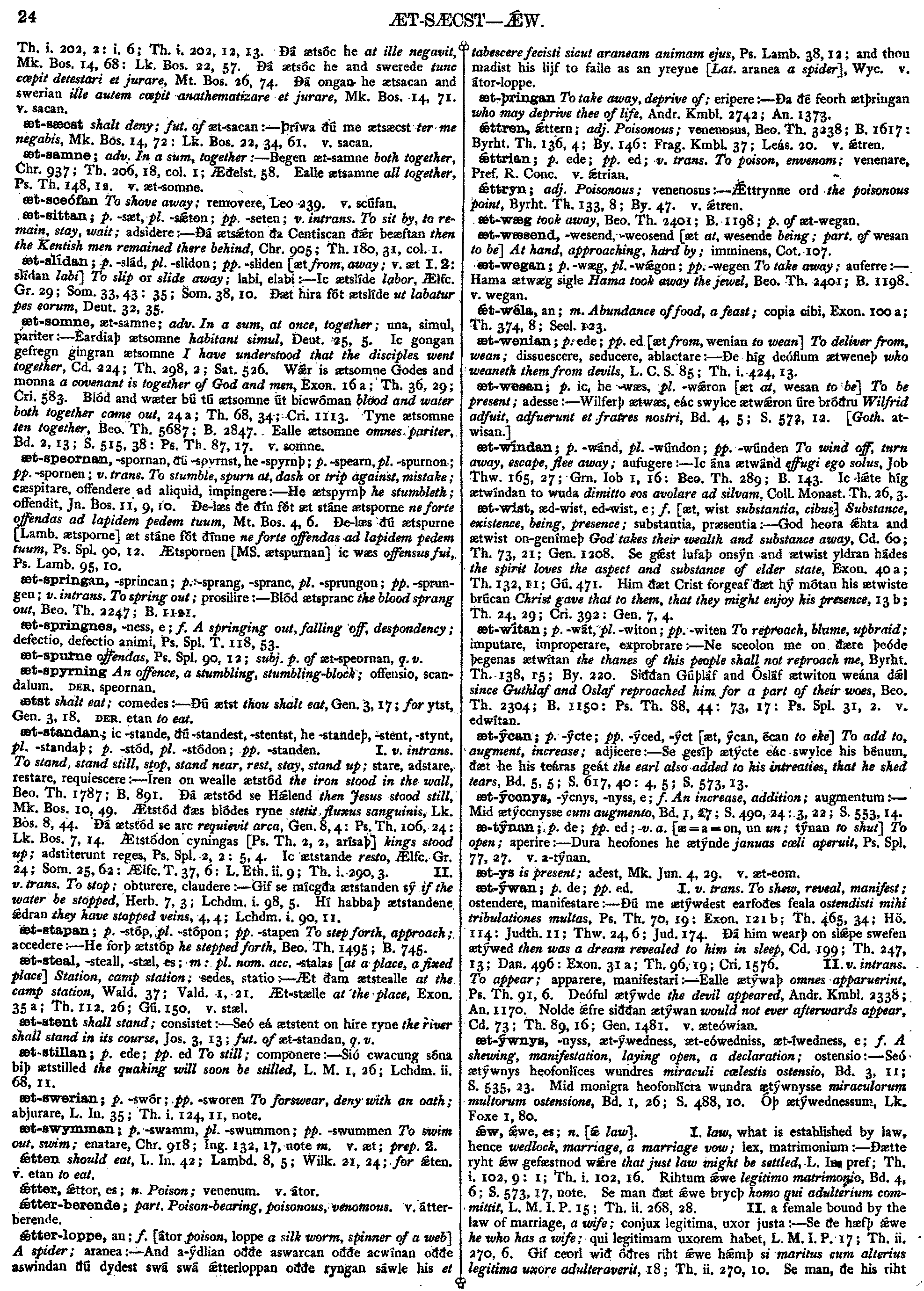
 w;,
we,
es;
n.
law],
I,
law,
what
is
established
by
law,
hence
wedlock,
marriage,
a
marriage
vow;
lex,
matrimonium
:--
Ðætte
ryht
w
gefæstnod
wre
that
just
law
might
be
settled,
L.
In
pref;
Th.
i.
102,
9:
1;
Th.
i.
102,
16.
Rihtum
we
legitimo
matrimonio,
Bd.
4,
6;
S.
573,
7,
note.
Se
man
ðæt
we
brycþ
homo
qui
adulterium
committit,
L.
M.
I.
P.
15
;
Th.
ii.
268,
28.
II.
a
female
bound
by
the
law
of
marriage,
a
wife;
conjux
legitima,
uxor
justa
:--
Se
ðe
hæfþ
we
he
who
has
a
wife;
qui
legitimam
uxorem
habet,
L.
M.
I.
P.
17;
Th.
ii.
270,
6.
Gif
ceorl
wið
óðres
riht
we
hmþ
si
maritus
cum
alterius
legitima
uxore
adulteraverit,
18;
Th.
ii.
270,
10.
Se
man,
ðe
his
riht
w;,
we,
es;
n.
law],
I,
law,
what
is
established
by
law,
hence
wedlock,
marriage,
a
marriage
vow;
lex,
matrimonium
:--
Ðætte
ryht
w
gefæstnod
wre
that
just
law
might
be
settled,
L.
In
pref;
Th.
i.
102,
9:
1;
Th.
i.
102,
16.
Rihtum
we
legitimo
matrimonio,
Bd.
4,
6;
S.
573,
7,
note.
Se
man
ðæt
we
brycþ
homo
qui
adulterium
committit,
L.
M.
I.
P.
15
;
Th.
ii.
268,
28.
II.
a
female
bound
by
the
law
of
marriage,
a
wife;
conjux
legitima,
uxor
justa
:--
Se
ðe
hæfþ
we
he
who
has
a
wife;
qui
legitimam
uxorem
habet,
L.
M.
I.
P.
17;
Th.
ii.
270,
6.
Gif
ceorl
wið
óðres
riht
we
hmþ
si
maritus
cum
alterius
legitima
uxore
adulteraverit,
18;
Th.
ii.
270,
10.
Se
man,
ðe
his
riht
|
Source: Bosworth/Toller, page b0104, entry 4 View original page image as: [TIFF] [PNG] [View previous entry] [View next entry] |
[Comment on this entry] [View comments] |
The following entry has been hand-corrected once. |
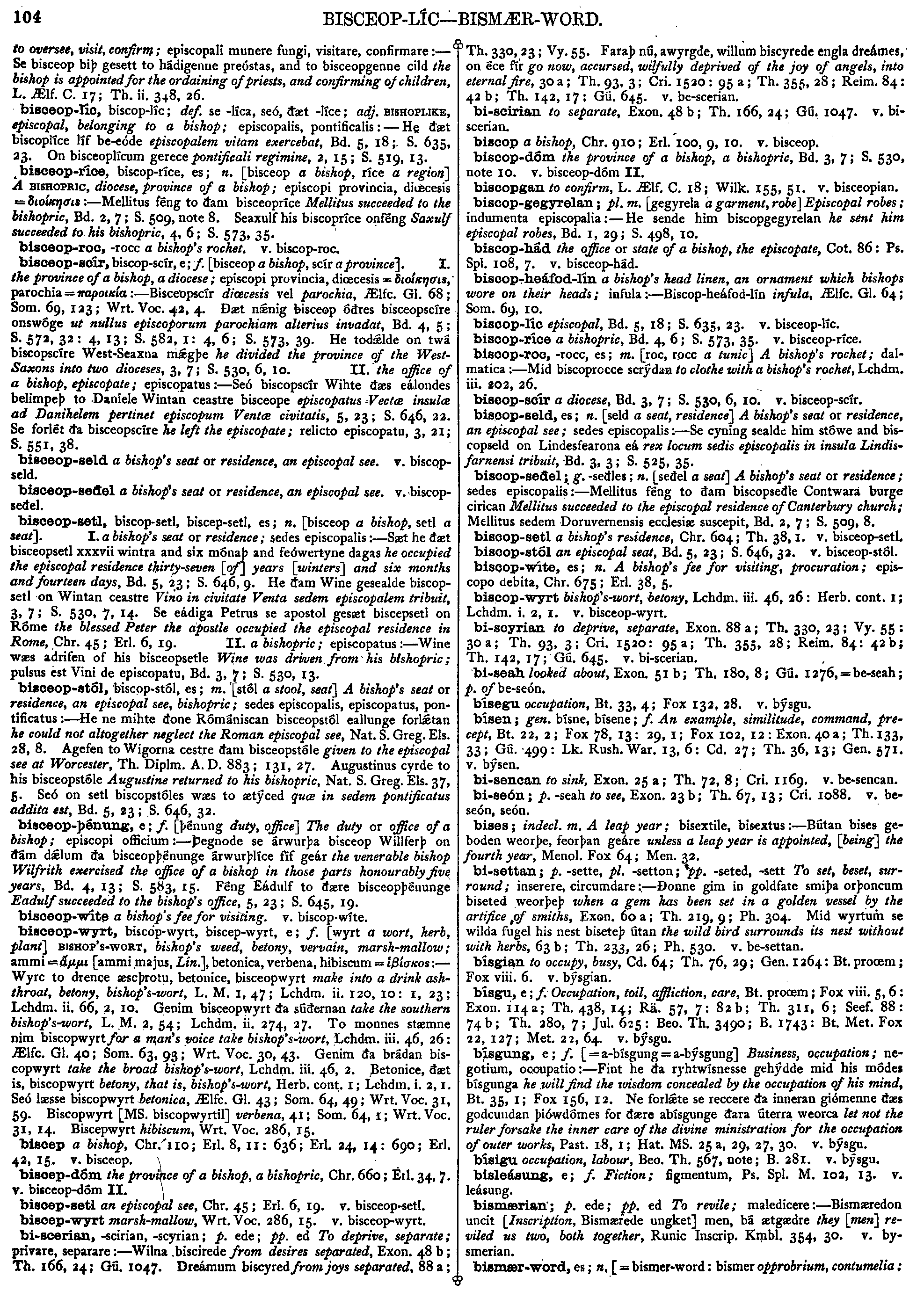
bisceop-scír,
biscop-scír,
e;
f.
[bisceop
a
bishop,
scír
a
province].
I.
the
province
of
a
bishop,
a
diocese;
episcopi
provincia,
diœcesis
=

 o&iota-tonos;

 s,
parochia
=
s,
parochia
=


 o&iota-tonos;
:--
Bisceopscír
diœcesis
vel
parochia,
Ælfc.
Gl.
68;
Som.
69,
123;
Wrt.
Voc.
42,
4.
Ðæt
nnig
bisceop
óðres
bisceopscíre
onswóge
ut
nullus
episcoporum
parochiam
alterius
invadat,
Bd.
4,
5;
S.
572,
32:
4,
13;
S.
582.
1:
4.
6;
S.
573.
39.
He
todlde
on
twá
biscopscíre
West-Seaxna
mgþe
he
divided
the
province
of
the
WestSaxons
into
two
dioceses,
3,
7;
S.
530,
6,
10.
II.
the
office
of
a
bishop,
episcopate;
episcopatus
:--
Seó
biscopscír
Wihte
ðæs
eálondes
belimpeþ
to
Daniele
Wintan
ceastre
bisceope
episcopatus
Vectæ
insulæ
ad
Danihelem
pertinet
episcopum
Ventæ
civitatis,
5,
23;
S.
646,
22.
Se
forlét
ða
bisceopscíre
he
left
the
episcopate;
relicto
episcopatu,
3,
21;
S.
551,
38.
o&iota-tonos;
:--
Bisceopscír
diœcesis
vel
parochia,
Ælfc.
Gl.
68;
Som.
69,
123;
Wrt.
Voc.
42,
4.
Ðæt
nnig
bisceop
óðres
bisceopscíre
onswóge
ut
nullus
episcoporum
parochiam
alterius
invadat,
Bd.
4,
5;
S.
572,
32:
4,
13;
S.
582.
1:
4.
6;
S.
573.
39.
He
todlde
on
twá
biscopscíre
West-Seaxna
mgþe
he
divided
the
province
of
the
WestSaxons
into
two
dioceses,
3,
7;
S.
530,
6,
10.
II.
the
office
of
a
bishop,
episcopate;
episcopatus
:--
Seó
biscopscír
Wihte
ðæs
eálondes
belimpeþ
to
Daniele
Wintan
ceastre
bisceope
episcopatus
Vectæ
insulæ
ad
Danihelem
pertinet
episcopum
Ventæ
civitatis,
5,
23;
S.
646,
22.
Se
forlét
ða
bisceopscíre
he
left
the
episcopate;
relicto
episcopatu,
3,
21;
S.
551,
38.
|
Source: Bosworth/Toller, page b0412, entry 22 View original page image as: [TIFF] [PNG] [View previous entry] [View next entry] |
[Comment on this entry] [View comments] |
The following entry has been hand-corrected once. |
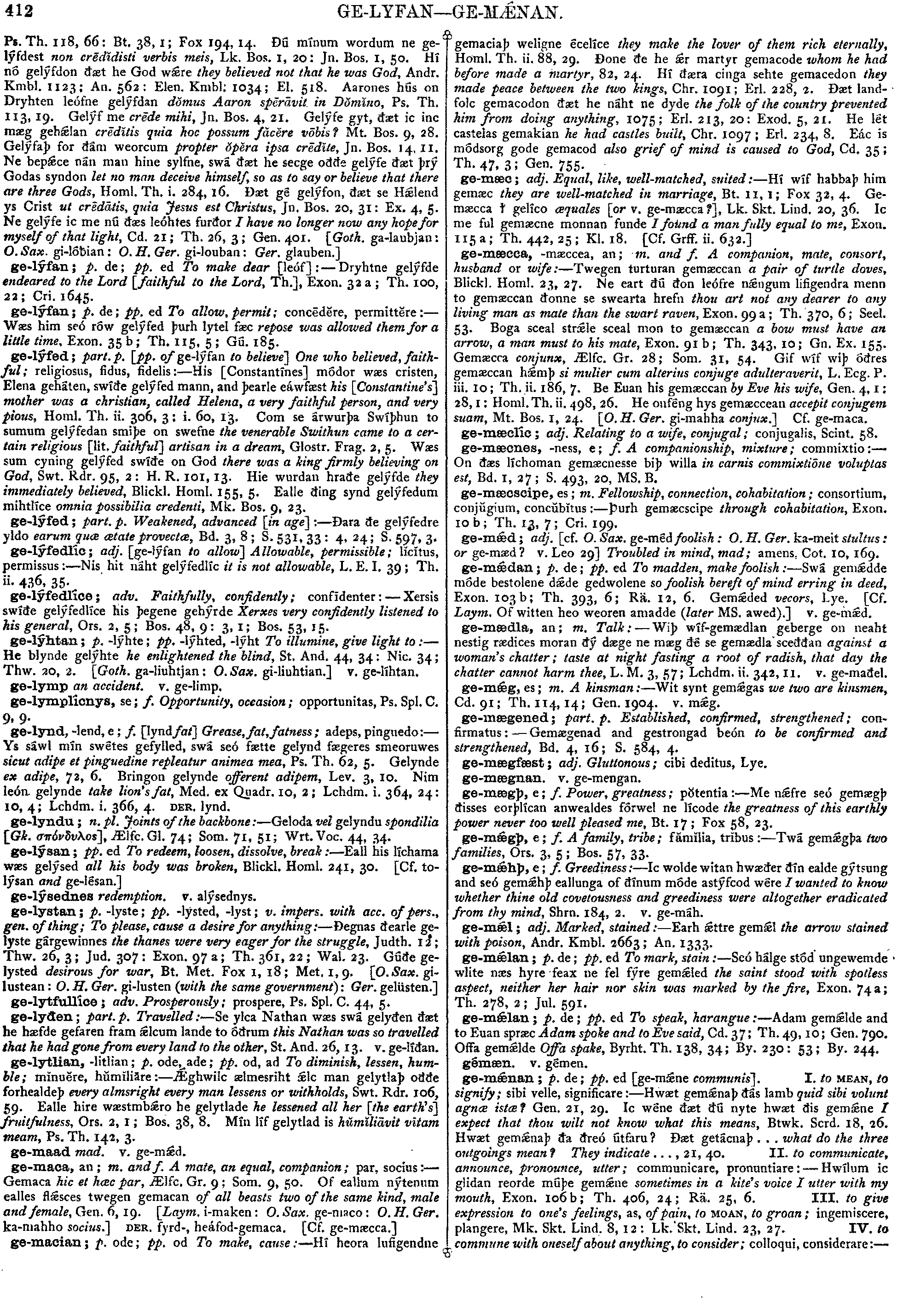
ge-mæcca,
-mæccea,
an;
m.
and
f.
A
companion,
mate,
consort,
husband
or
wife
:--
Twegen
turturan
gemæccan
a
pair
of
turtle
doves,
Blickl.
Homl.
23,
27.
Ne
eart
ðú
ðon
leófre
nngum
lifigendra
menn
to
gemæccan
ðonne
se
swearta
hrefn
thou
art
not
any
dearer
to
any
living
man
as
mate
than
the
swart
raven,
Exon.
99
a;
Th.
370,
6;
Seel.
53.
Boga
sceal
strle
sceal
mon
to
gemæccan
a
bow
must
have
an
arrow,
a
man
must
to
his
mate,
Exon.
91
b;
Th.
343,
10;
Gn.
Ex.
155.
Gemæcca
conjunx,
Ælfc.
Gr.
28;
Som.
31,
54.
Gif
wíf
wiþ
óðres
gemæccan
hmþ
si
mulier
cum
alterius
conjuge
adulteraverit,
L.
Ecg.
P.
iii.
10;
Th.
ii.
186,
7.
Be
Euan
his
gemæccan
by
Eve
his
wife,
Gen.
4,
1
:
28,
1
:
Homl.
Th.
ii.
498,
26.
He
onféng
hys
gemæccean
accepit
conjugem
suam,
Mt.
Bos.
1,
24.
[O.
H.
Ger.
gi-mahha
conjux.]
Cf.
ge-maca.
|
Source: Bosworth/Toller, page b0507, entry 14 View original page image as: [TIFF] [PNG] [View previous entry] [View next entry] |
[Comment on this entry] [View comments] |
The following entry has been hand-corrected once. |
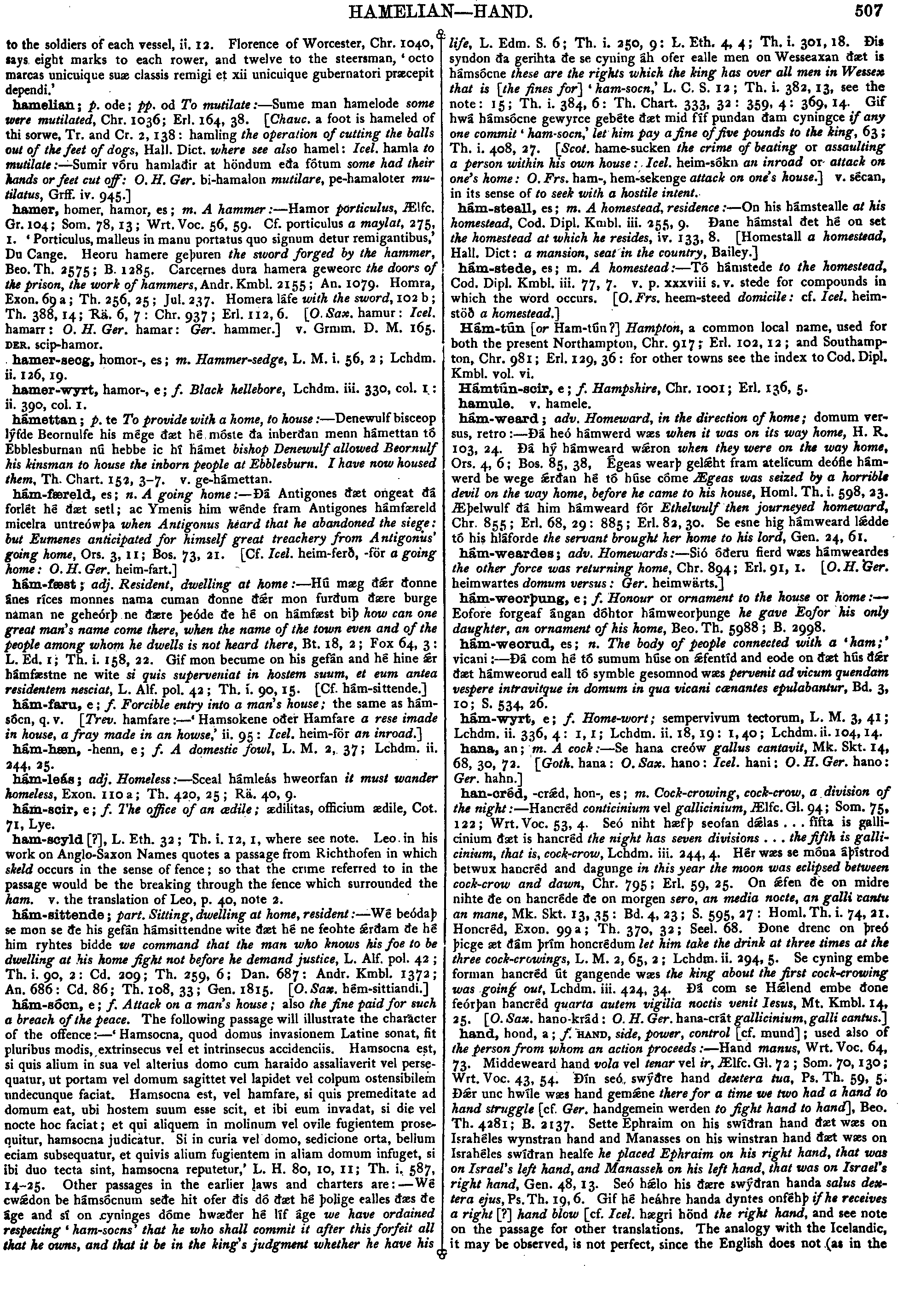
hám-sócn,
e;
f.
Attack
on
a
man's
house;
also
the
fine
paid
for
such
a
breach
of
the
peace.
The
following
passage
will
illustrate
the
character
of
the
offence
:--
'
Hamsocna,
quod
domus
invasionem
Latine
sonat,
fit
pluribus
modis,
extrinsecus
vel
et
intrinsecus
accidenciis.
Hamsocna
est,
si
quis
alium
in
sua
vel
alterius
domo
cum
haraido
assaliaverit
vel
persequatur,
ut
portam
vel
domum
sagittet
vel
lapidet
vel
colpum
ostensibilem
undecunque
faciat.
Hamsocna
est,
vel
hamfare,
si
quis
premeditate
ad
domum
eat,
ubi
hostem
suum
esse
scit,
et
ibi
eum
invadat,
si
die
vel
nocte
hoc
faciat;
et
qui
aliquem
in
molinum
vel
ovile
fugientem
prosequitur,
hamsocna
judicatur.
Si
in
curia
vel
domo,
sedicione
orta,
bellum
eciam
subsequatur,
et
quivis
alium
fugientem
in
aliam
domum
infuget,
si
ibi
duo
tecta
sint,
hamsocna
reputetur,'
L.
H.
80,
10,
11;
Th.
i.
587,
14-25.
Other
passages
in
the
earlier
laws
and
charters
are
:--
Wé
cwdon
be
hámsócnum
seðe
hit
ofer
ðis
dó
ðæt
hé
þolige
ealles
ðæs
ðe
áge
and
sí
on
cyninges
dóme
hwæðer
hé
líf
áge
we
have
ordained
respecting
'ham-socns'
that
he
who
shall
commit
it
after
this
forfeit
all
that
he
owns,
and
that
it
be
in
the
king's
judgment
whether
he
have
his
life,
L.
Edm.
S.
6;
Th.
i.
250,
9:
L.
Eth.
4,
4;
Th.
i.
301,
18.
Ðis
syndon
ða
gerihta
ðe
se
cyning
áh
ofer
ealle
men
on
Wesseaxan
ðæt
is
hámsócne
these
are
the
rights
which
the
king
has
over
all
men
in
Wessex
that
is
[the
fines
for]
'ham-socn,'
L.
C.
S.
12;
Th.
i.
382,
13,
see
the
note:
15;
Th.
i.
384,
6:
Th.
Chart.
333,
32:
359,
4:
369,
14.
Gif
hwá
hámsócne
gewyrce
gebéte
ðæt
mid
fíf
pundan
ðam
cyningce
if
any
one
commit
'ham-socn,'
let
him
pay
a
fine
of
five
pounds
to
the
king,
63;
Th.
i.
408,
27.
[Scot.
hame-sucken
the
crime
of
beating
or
assaulting
a
person
within
his
own
house:
Icel.
heim-sókn
an
inroad
or
attack
on
one's
home:
O.
Frs.
ham-,
hem-sekenge
attack
on
one's
house.]
v.
sécan,
in
its
sense
of
to
seek
with
a
hostile
intent.
|
Source: Bosworth/Toller, page b0592, entry 8 View original page image as: [TIFF] [PNG] [View previous entry] [View next entry] |
[Comment on this entry] [View comments (1)] |
The following entry has been hand-corrected once. |
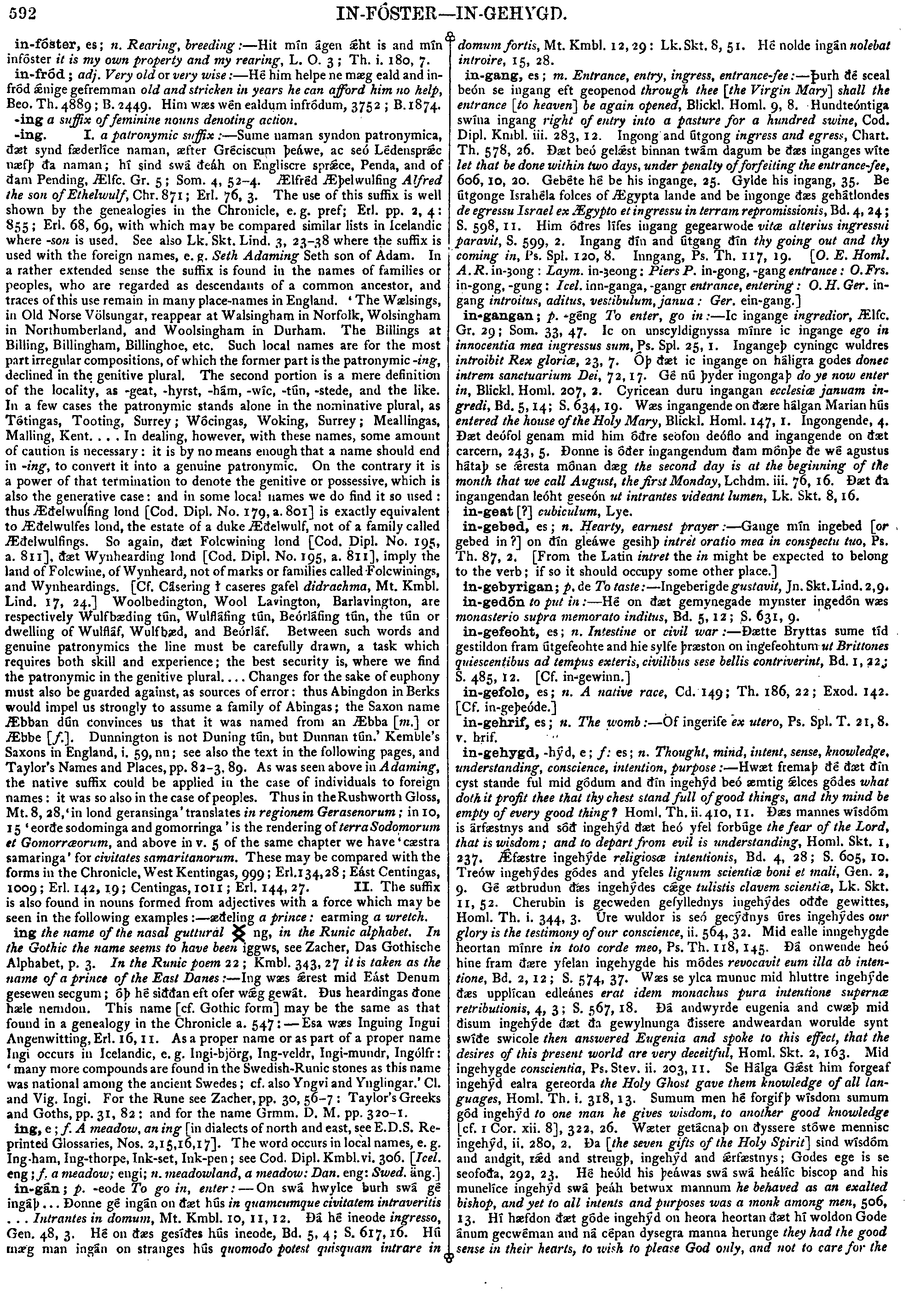
in-gang,
es
;
m.
Entrance,
entry,
ingress,
entrance-fee
:--
Þurh
ðé
sceal
beón
se
ingang
eft
geopenod
through
thee
[the
Virgin
Mary]
shall
the
entrance
[to
heaven]
be
again
opened,
Blickl.
Homl.
9,
8.
Hundteóntiga
swína
ingang
right
of
entry
into
a
pasture
for
a
hundred
swine,
Cod.
Dipl.
Kmbl.
iii.
283,
12.
Ingong
and
útgong
ingress
and
egress,
Chart.
Th.
578,
26.
Ðæt
beó
gelst
binnan
twám
dagum
be
ðæs
inganges
wíte
let
that
be
done
within
two
days,
under
penalty
of
forfeiting
the
entrance-fee,
606,
10,
20.
Gebéte
hé
be
his
ingange,
25.
Gylde
his
ingang,
35.
Be
útgonge
Israhéla
folces
of
Ægypta
lande
and
be
ingonge
ðs
gehátlondes
de
egressu
Israel
ex
Ægypto
et
in
gressu
in
terram
repromissionis,
Bd.
4,
24;
S.
598,
11.
Him
óðres
lífes
ingang
gegearwode
vitæ
alterius
ingressui
paravit,
S.
599,
2.
Ingang
ðín
and
útgang
ðín
thy
going
out
and
thy
coming
in,
Ps.
Spl.
120,
8.
Inngang,
Ps.
Th.
117,
19.
[O.
E.
Homl.
A.
R.
in- ong
:
Laym.
in-eong
:
Piers
P.
in-gong,
-gang
entrance
:
O.
Frs.
in-gong,
-gung
:
Icel.
inn-ganga,
-gangr
entrance,
entering
:
O.
H.
Ger.
in-gang
introitus,
aditus,
vestibulum,
janua
:
Ger.
ein-gang.]
ong
:
Laym.
in-eong
:
Piers
P.
in-gong,
-gang
entrance
:
O.
Frs.
in-gong,
-gung
:
Icel.
inn-ganga,
-gangr
entrance,
entering
:
O.
H.
Ger.
in-gang
introitus,
aditus,
vestibulum,
janua
:
Ger.
ein-gang.]
|
Source: Bosworth/Toller, page b0618, entry 19 View original page image as: [TIFF] [PNG] [View previous entry] [View next entry] |
[Comment on this entry] [View comments] |
The following entry has been hand-corrected once. |
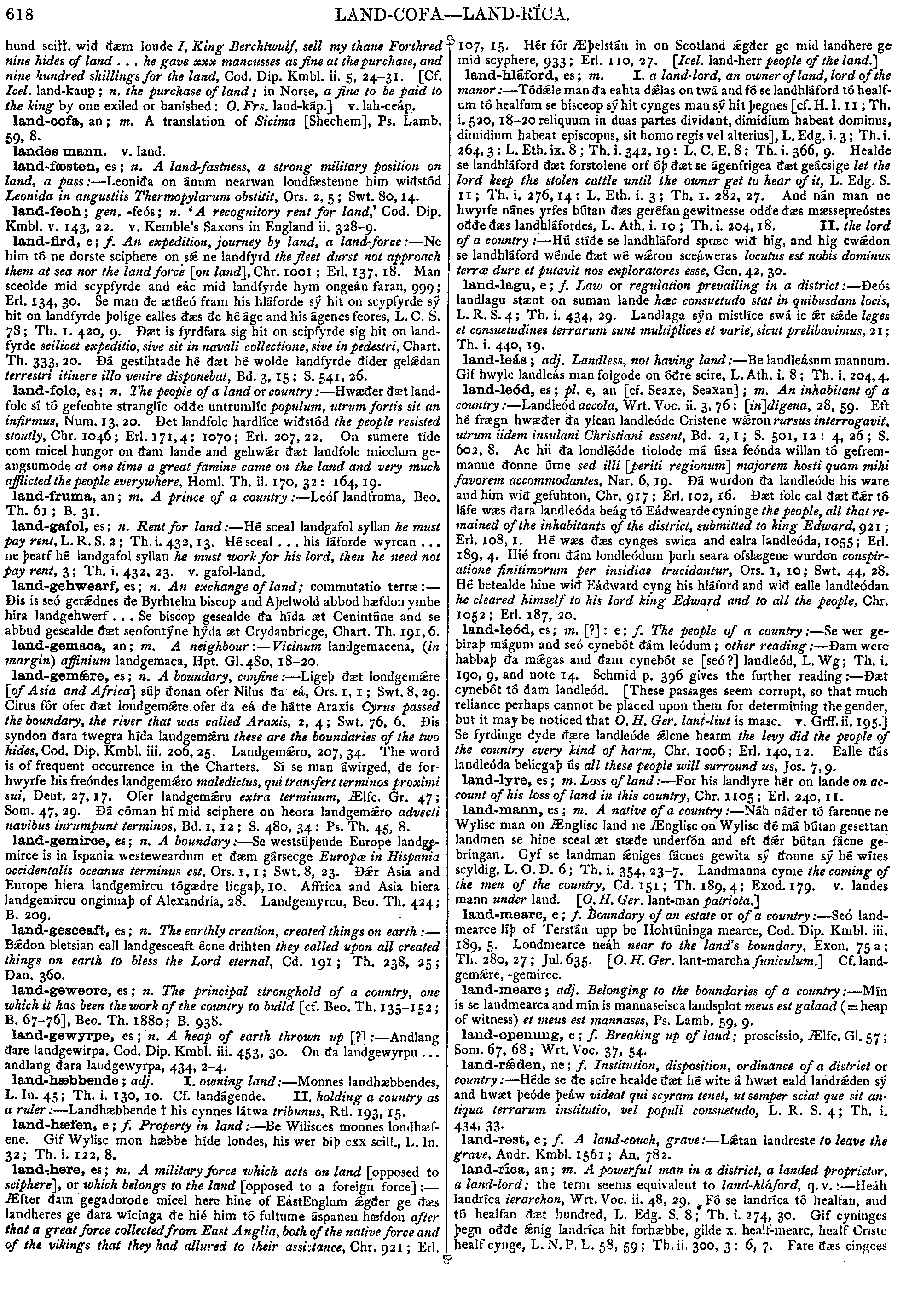
land-hláford,
es;
m.
I.
a
land-lord,
an
owner
of
land,
lord
of
the
manor
:--
Tódle
man
ða
eahta
dlas
on
twá
and
fó
se
landhláford
tó
healfum
tó
healfum
se
bisceop
sý
hit
cynges
man
sý
hit
þegnes
[cf.
H.
I.
11;
Th.
i.
520,
18-20
reliquum
in
duas
partes
dividant,
dimidium
habeat
dominus,
dimidium
habeat
episcopus,
sit
homo
regis
vel
alterius],
L.
Edg.
i.
3;
Th.
i.
264,
3:
L.
Eth.
ix.
8;
Th.
i.
342,
19:
L.
C.
E.
8;
Th.
i.
366,
9.
Healde
se
landhláford
ðæt
forstolene
orf
óþ
ðæt
se
ágenfrigea
ðæt
geácsige
let
the
lord
keep
the
stolen
cattle
until
the
owner
get
to
hear
of
it,
L.
Edg.
S.
11;
Th.
i,
276,
14:
L.
Eth.
i.
3;
Th.
1.
282,
27.
And
nán
man
ne
hwyrfe
nánes
yrfes
bútan
ðæs
geréfan
gewitnesse
oððe
ðæs
mæssepreóstes
oððe
ðæs
landhláfordes,
L.
Ath.
i.
10;
Th.
i.
204,
18.
II.
the
lord
of
a
country
:--
Hú
stíðe
se
landhláford
spræc
wið
hig,
and
hig
cwdon
se
landhláford
wénde
ðæt
wé
wron
sceáweras
locutus
est
nobis
dominus
terræ
dure
et
putavit
nos
exploratores
esse,
Gen.
42,
30.
|
Source: Bosworth/Toller, page b0670, entry 9 View original page image as: [TIFF] [PNG] [View previous entry] [View next entry] |
[Comment on this entry] [View comments] |
The following entry has been hand-corrected once. |
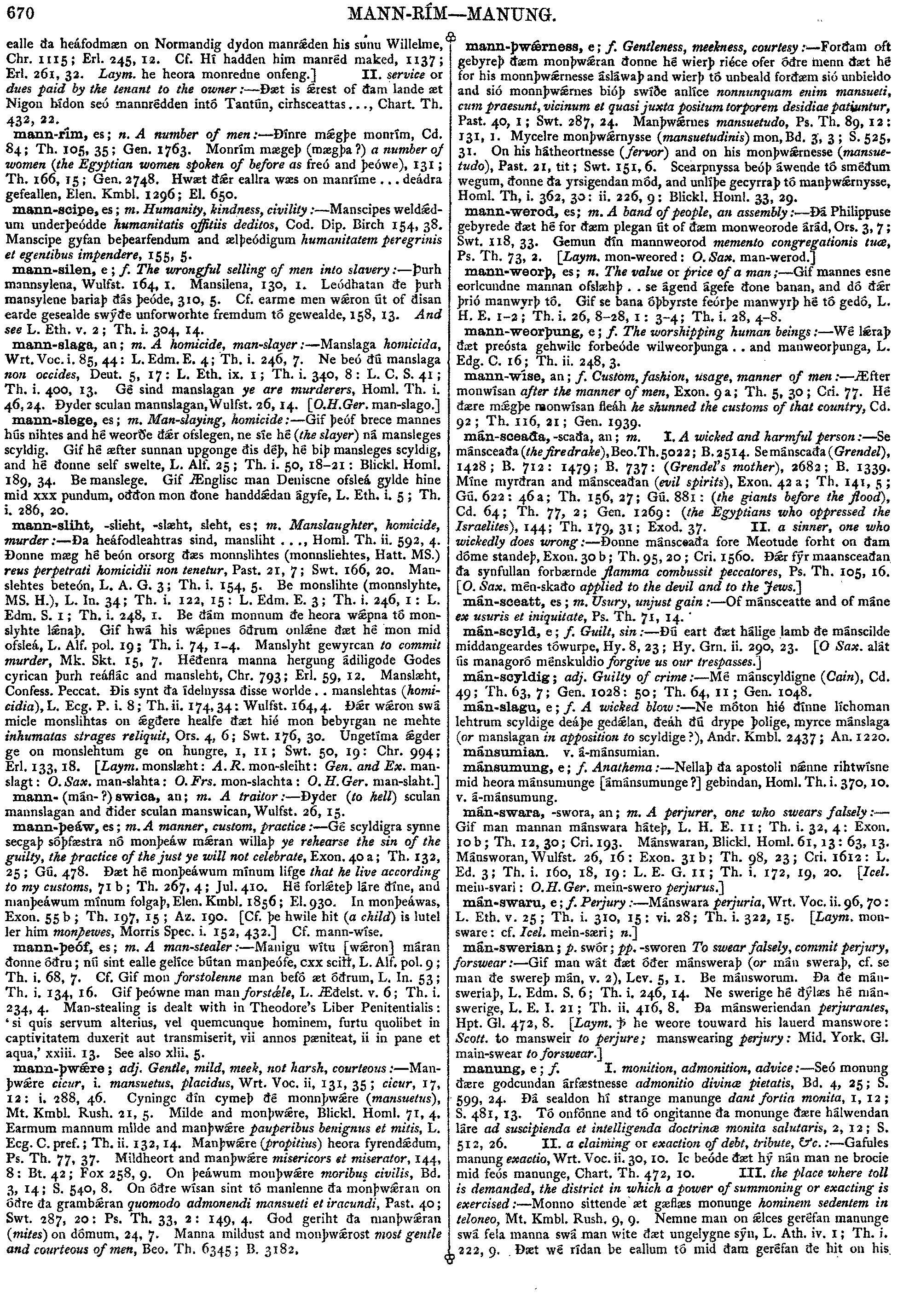
mann-þeóf,
es;
m.
A
man-stealer
:--
Manigu
wítu
[wron]
máran
ðonne
óðru;
nú
sint
ealle
gelíce
bútan
manþeófe,
cxx
sci ,
L.
Alf.
pol.
9;
Th.
i.
68,
7.
Cf.
Gif
mon
forstolenne
man
befó
æt
óðrum,
L.
In.
53;
Th.
i.
134,
16.
Gif
þeówne
man
man
forstle,
L.
Æðelst.
v.
6;
Th.
i.
234,
4.
Man-stealing
is
dealt
with
in
Theodore's
Liber
Penitentialis:
'si
quis
servum
alterius,
vel
quemcunque
hominem,
furtu
quolibet
in
captivitatem
duxerit
aut
transmiserit,
vii
annos
pæniteat,
ii
in
pane
et
aqua,'
xxiii.
13.
See
also
xlii,
5.
,
L.
Alf.
pol.
9;
Th.
i.
68,
7.
Cf.
Gif
mon
forstolenne
man
befó
æt
óðrum,
L.
In.
53;
Th.
i.
134,
16.
Gif
þeówne
man
man
forstle,
L.
Æðelst.
v.
6;
Th.
i.
234,
4.
Man-stealing
is
dealt
with
in
Theodore's
Liber
Penitentialis:
'si
quis
servum
alterius,
vel
quemcunque
hominem,
furtu
quolibet
in
captivitatem
duxerit
aut
transmiserit,
vii
annos
pæniteat,
ii
in
pane
et
aqua,'
xxiii.
13.
See
also
xlii,
5.
|
Source: Bosworth/Toller, page b0708, entry 24 View original page image as: [TIFF] [PNG] [View previous entry] [View next entry] |
[Comment on this entry] [View comments] |
The following entry has been hand-corrected once. |
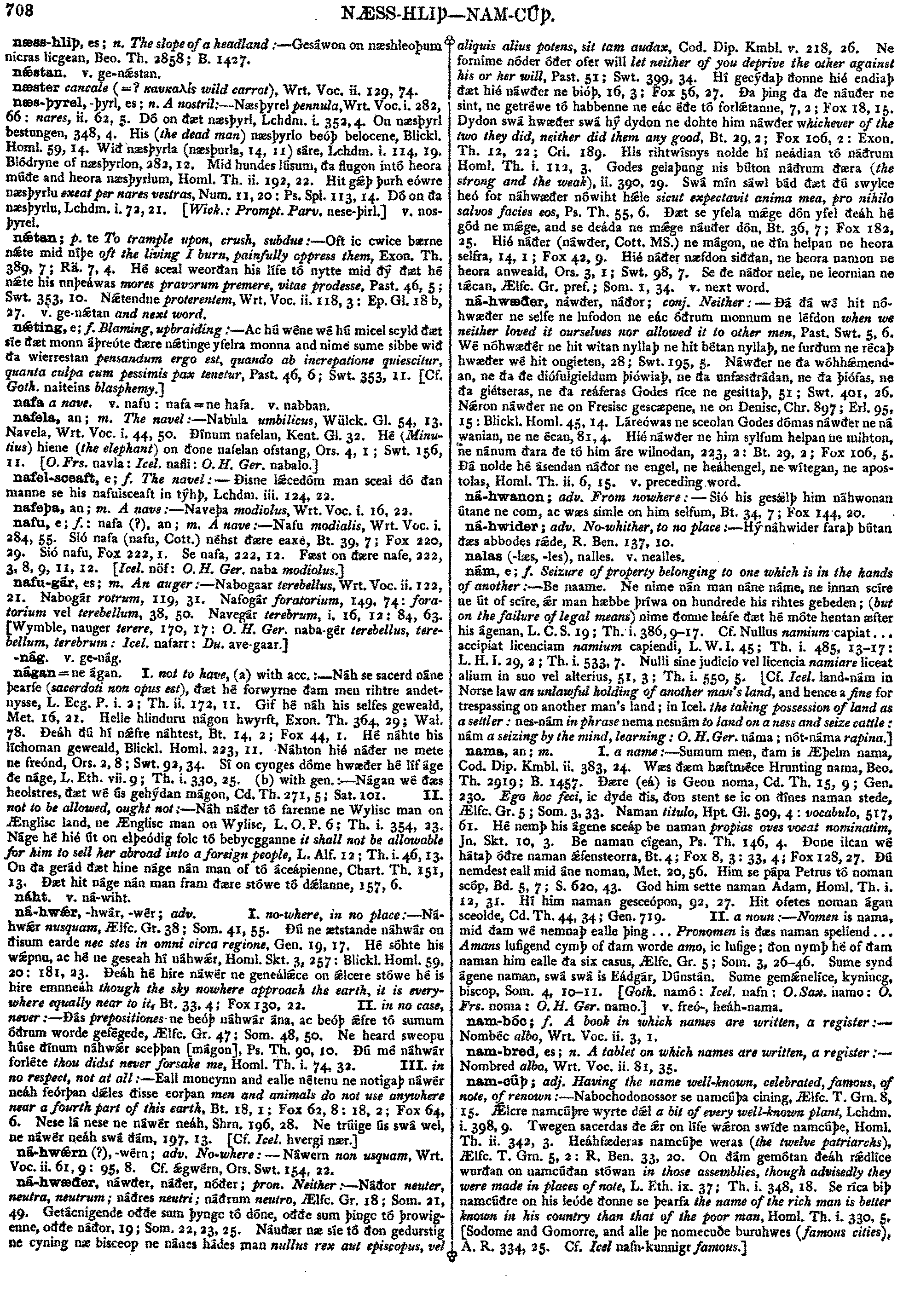
nám,
e
;
f.
Seizure
of
property
belonging
to
one
which
is
in
the
hands
of
another
:--
Be
naame.
Ne
nime
nán
man
náne
náme,
ne
innan
scíre
ne
út
of
scíre,
r
man
hæbbe
þríwa
on
hundrede
his
rihtes
gebeden;
(but
on
the
failure
of
legal
means)
nime
ðonne
leáfe
ðæt
hé
móte
hentan
æfter
his
ágenan,
L.
C.
S.
19
;
Th.
i.
386,
9-17.
Cf.
Nullus
namium
capiat
.
.
.
accipiat
licenciam
namium
capiendi,
L.
W.
I.
45;
Th.
i.
485,
13-17
:
L.
H.
I.
29,
2
;
Th.
i.
533,
7.
Nulli
sine
judicio
vel
licencia
namiare
liceat
alium
in
suo
vel
alterius,
51,
3;
Th.
i.
550,
5.
[Cf.
Icel.
land-nám
in
Norse
law
an
unlawful
holding
of
another
man's
land,
and
hence
a
fine
for
trespassing
on
another
man's
land
;
in
Icel.
the
taking
possession
of
land
as
a
settler
:
nes-nám
in
phrase
nema
nesnám
to
land
on
a
ness
and
seize
cattle
:
nám
a
seizing
by
the
mind,
learning
:
O.
H.
Ger.
náma
;
nót-náma
rapina.]
|
Source: Bosworth/Toller, page b0961, entry 12 View original page image as: [TIFF] [PNG] [View previous entry] [View next entry] |
[Comment on this entry] [View comments] |
The following entry has been hand-corrected once. |
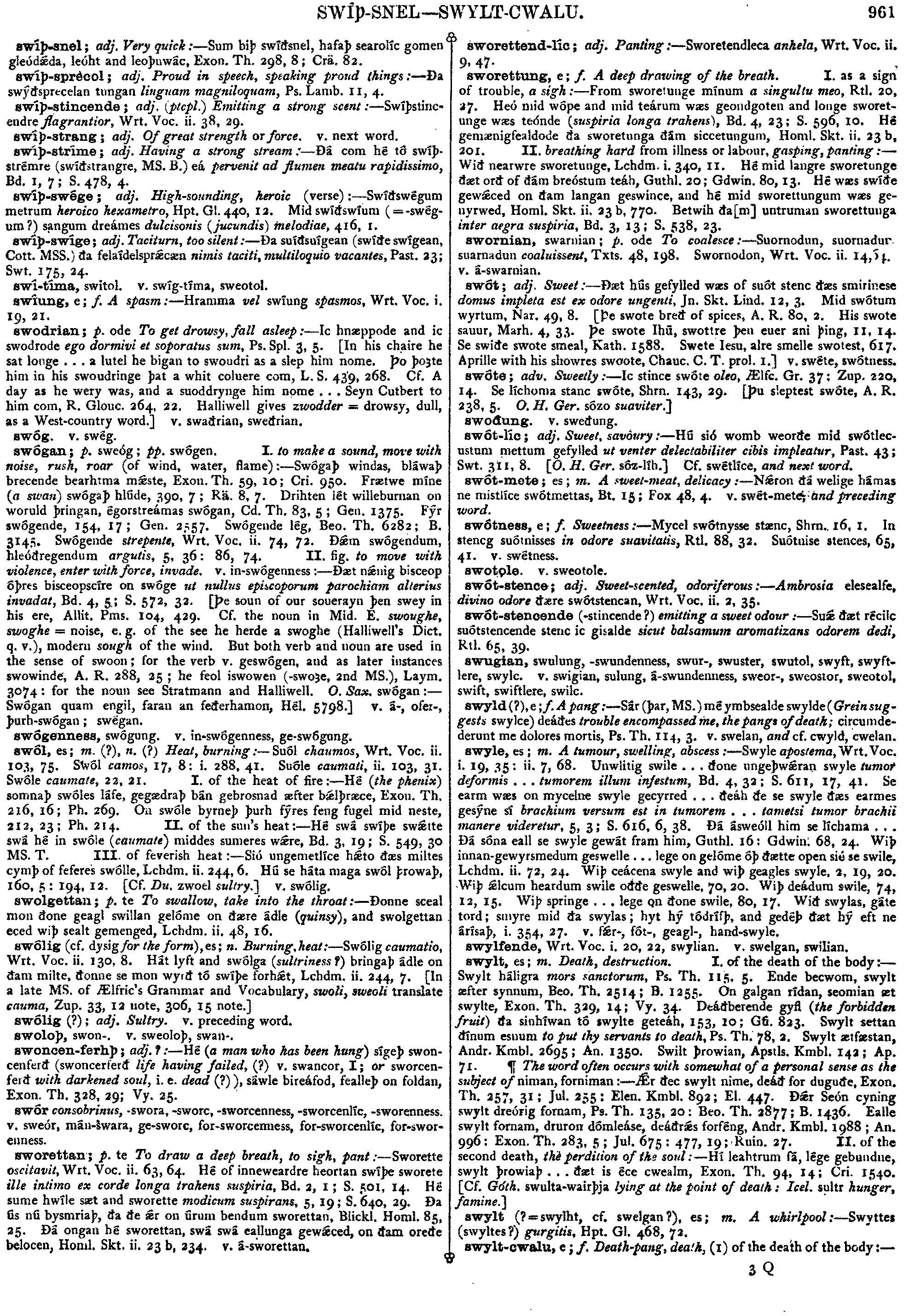
swógan;
p.
sweóg;
pp.
swógen.
I.
to
make
a
sound,
move
with
noise,
rush,
roar
(of
wind,
water,
flame):--Swógaþ
windas,
bláwaþ
brecende
bearhtma
mste,
Exon.
Th.
59,
10;
Cri.
950.
Frætwe
míne
(a
swan)
swógaþ
hlúde,
390,
7;
Rä.
8,
7.
Drihten
lét
willeburnan
on
woruld
þringan,
égorstreámas
swógan,
Cd.
Th.
83,
5;
Gen.
1375.
Fýr
swógende,
154,
17;
Gen.
2557.
Swógende
lég,
Beo.
Th.
6282;
B.
3145.
Swógende
strepente,
Wrt.
Voc.
ii.
74,
72.
Ðm
swógendum,
hleóðregendum
argutis,
5,
36:
86,
74.
II.
fig.
to
move
with
violence,
enter
with
force,
invade.
v.
in-swógenness:--Ðæt
nnig
bisceop
óþres
bisceopscíre
on
swóge
ut
nullus
episcoporum
parochiam
alterius
invadat,
Bd.
4,
5;
S.
572,
32.
[Þe
soun
of
our
souerayn
þen
swey
in
his
ere,
Allit.
Pms.
104,
429.
Cf.
the
noun
in
Mid.
E.
swoughe,
swoghe
=
noise,
e.
g.
of
the
see
he
herde
a
swoghe
(Halliwel's
Dict.
q.
v.),
modern
sough
of
the
wind.
But
both
verb
and
noun
are
used
in
the
sense
of
swoon;
for
the
verb
v.
geswógen,
and
as
later
instances
swowinde,
A.
R.
288,
25;
he
feol
iswowen
(-swoe,
2nd
MS.),
Laym.
3074:
for
the
noun
see
Stratmann
and
Halliwell.
O.
Sax.
swógan:--Swógan
quam
engil,
faran
an
feðerhamon,
Hél.
5798.]
v.
á-,
ofer-,
þurh-swógan;
swégan.
|
Source: Bosworth/Toller, page b1008, entry 13 View original page image as: [TIFF] [PNG] [View previous entry] [View next entry] |
[Comment on this entry] [View comments (1)] |
The following entry has been hand-corrected once. |
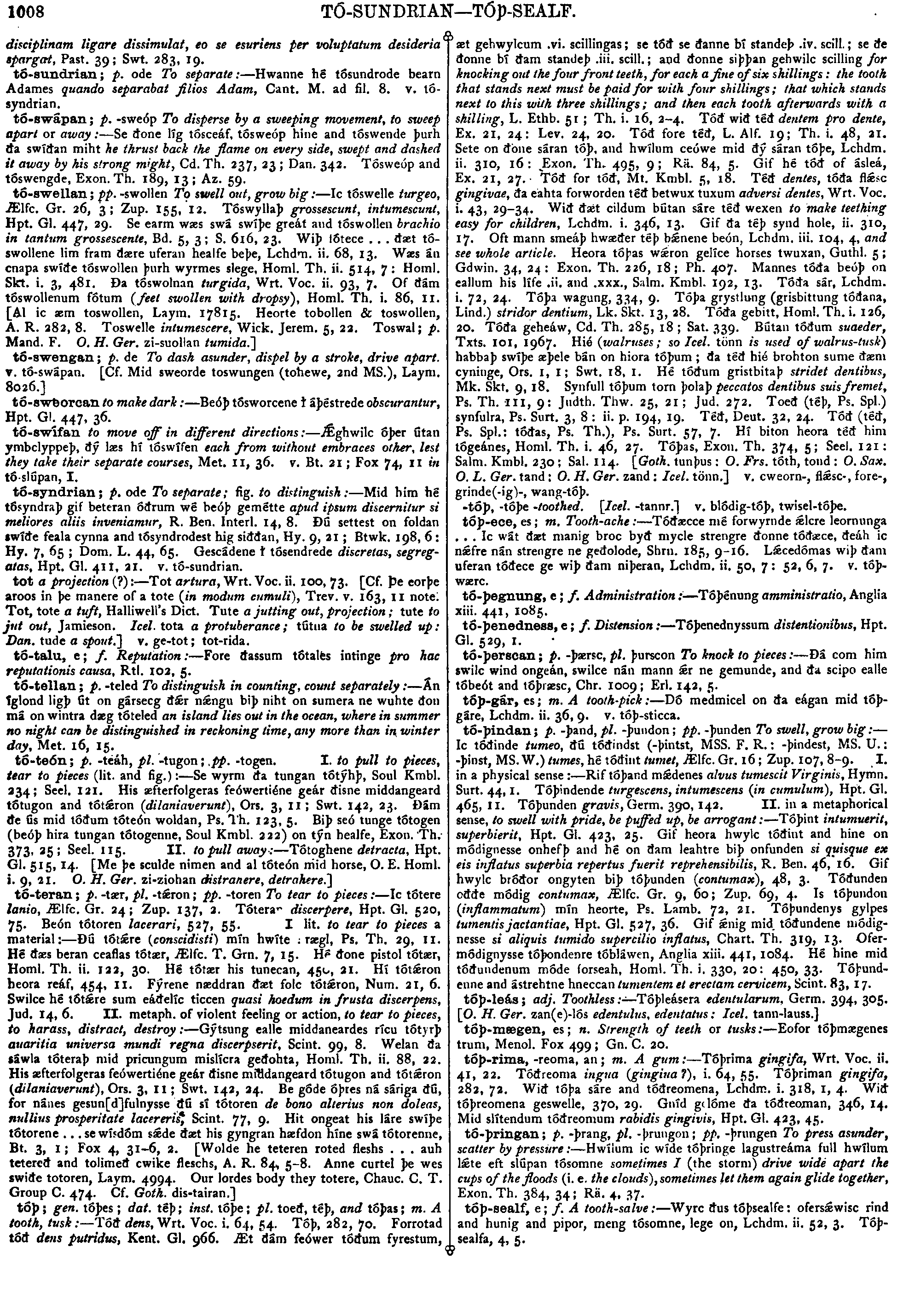
tó-teran;
p.
-tær,
pl.
-tron;
pp.
-toren
To
tear
to
pieces
:--
Ic
tótere
lanio,
Ælfc.
Gr.
24;
Zup.
137,
2.
Tótera-
discerpere,
Hpt.
Gl.
520,
75.
Beón
tótoren
lacerari,
527,
55.
I
lit.
to
tear
to
pieces
a
material
:--
Ðú
tótre
(conscidisti)
mín
hwíte
;
rægl,
Ps.
Th.
29,
II.
Hé
ðæs
beran
ceaflas
tótær,
Ælfc.
T.
Grn.
7,
15.
Hé
ðone
pistol
tótær,
Homl.
Th.
ii.
122,
30.
Hé
tótær
his
tunecan,
450,
21.
Hí
tótron
beora
reáf,
454,
II.
Fýrene
næddran
ðæt
folc
tótron,
Num.
21,
6.
Swilce
he
tótre
sum
eáðelíc
ticcen
quasi
hoedum
in
frusta
discerpens,
Jud.
14,
6.
II.
metaph.
of
violent
feeling
or
action,
to
tear
to
pieces,
to
harass,
distract,
destroy
:--
Gýtsung
ealle
middaneardes
rícu
tótyrþ
auaritia
universa
mundi
regna
discerpserit,
Scint.
99,
8.
Welan
ða
íáwla
tðteraþ
mid
pricungum
misllcra
gedohta,
Homl.
Th.
ii.
88,
22.
His
xfterfolgeras
feówertiéne
gear
ðisne
mio'dangeard
tótugon
and
tðtron
(dilaniaverunt),
Ors.
3,
n
;
Swt.
142,
24.
Be
góde
ðþtes
ná
sáriga
ðB,
for
nánes
gesun[d]fulnysse
ðú
st
tátoren
de
bono
alterius
nan
doleas,
nullius
prosperitate
lacereris
Scint.
77,
9.
Hit
ongeat
his
láre
swíþe
tótorene
.
.
.
se
wíídðm
sde
ðæt
his
gyngran
hæfdon
híne
swá
tðtorenne,
Bt.
3,
l;
Fox
4,
31-6,
2.
[Wolde
he
teteren
roted
fleshs
.
.
.
ann
tetereð
and
tolimeð
cwike
fleschs,
A.
R.
84,
5-8.
Anne
curtel
þe
wes
swiðe
totoren,
Laym.
4994.
Our
lordes
body
they
totere.
Chauc.
C.
T.
Group
C.
474.
Cf.
Goth.
dis-tairan.]
| Result Page: | 1 2 3 | Next |  |
Germanic Lexicon Project (main page)
This search system was written by
Sean Crist
Please consider
volunteering
to correct the data in these online dictionaries.
No rights reserved. Feel free to use these data in any way you please.