|
|

|
Source: Bosworth/Toller, page b0486, entry 36 View original page image as: [TIFF] [PNG] [View previous entry] [View next entry] |
[Comment on this entry] [View comments] |
The following entry has been hand-corrected once. |
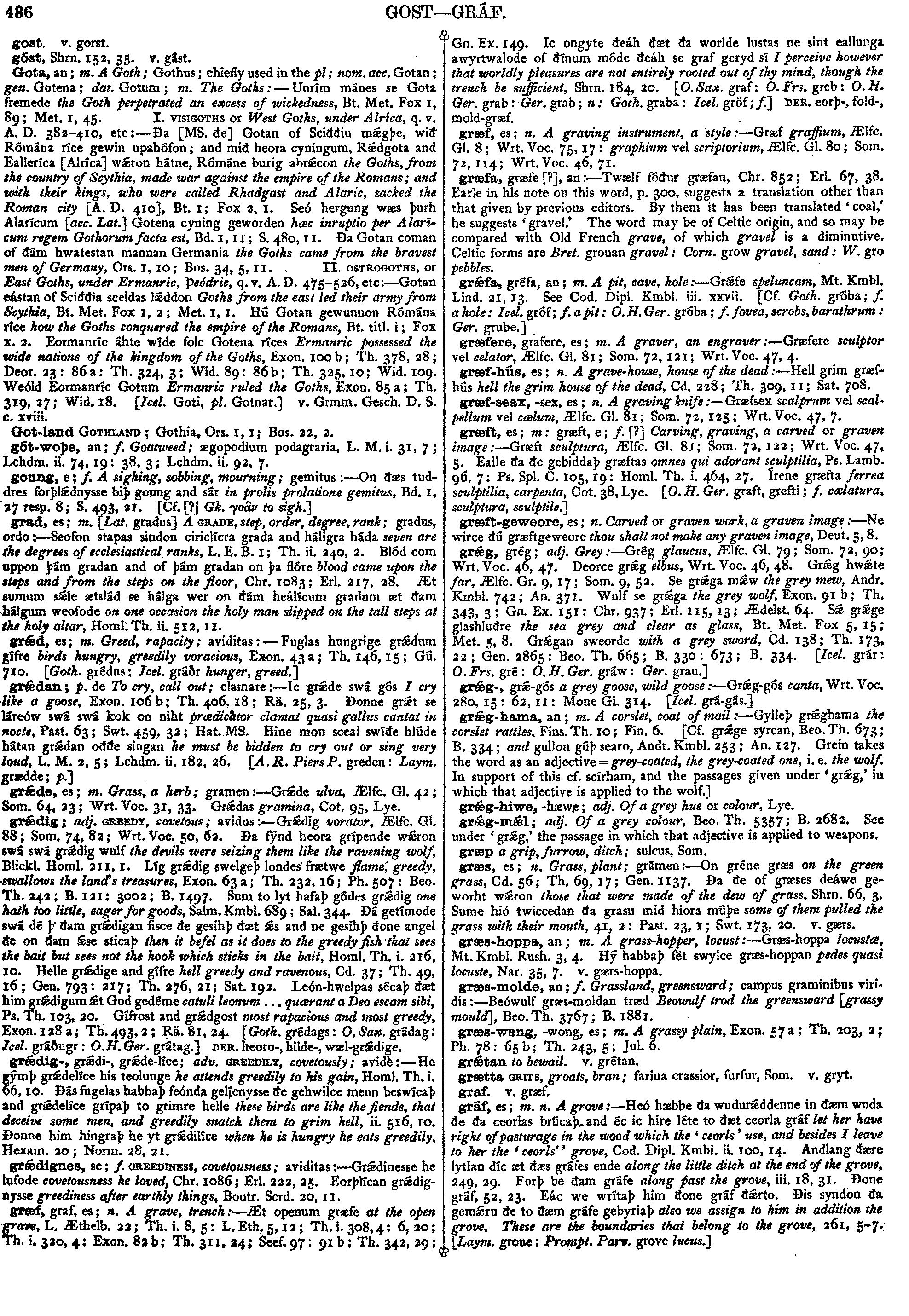
gráf,
es;
m.
n.
A
grove
:--
Heó
hæbbe
ða
wudur ddenne
in
ðæm
wuda
ðe
ða
ceorlas
brúcaþ
and
éc
ic
hire
léte
to
ðæt
ceorla
gráf
let
her
have
right
of
pasturage
in
the
wood
which
the
'ceorls'
use,
and
besides
I
leave
to
her
the
'
ceorls'
grove,
Cod.
Dipl.
Kmbl.
ii.
100,
14.
Andlang
ðære
lytlan
díc
æt
ðæs
gráfes
ende
along
the
little
ditch
at
the
end
of
the
grove,
249,
29.
Forþ
be
ðam
gráfe
along
past
the
grove,
iii.
18,
31.
Ðone
gráf,
52,
23.
Eác
we
wrítaþ
him
ðone
gráf
ðrto.
Ðis
syndon
ða
gemru
ðe
to
ðæm
gráfe
gebyriaþ
also
we
assign
to
him
in
addition
the
grove.
These
are
the
boundaries
that
belong
to
the
grove,
261,
5-7.
[Laym.
groue:
Prompt.
Parv.
grove
lucus.]
ddenne
in
ðæm
wuda
ðe
ða
ceorlas
brúcaþ
and
éc
ic
hire
léte
to
ðæt
ceorla
gráf
let
her
have
right
of
pasturage
in
the
wood
which
the
'ceorls'
use,
and
besides
I
leave
to
her
the
'
ceorls'
grove,
Cod.
Dipl.
Kmbl.
ii.
100,
14.
Andlang
ðære
lytlan
díc
æt
ðæs
gráfes
ende
along
the
little
ditch
at
the
end
of
the
grove,
249,
29.
Forþ
be
ðam
gráfe
along
past
the
grove,
iii.
18,
31.
Ðone
gráf,
52,
23.
Eác
we
wrítaþ
him
ðone
gráf
ðrto.
Ðis
syndon
ða
gemru
ðe
to
ðæm
gráfe
gebyriaþ
also
we
assign
to
him
in
addition
the
grove.
These
are
the
boundaries
that
belong
to
the
grove,
261,
5-7.
[Laym.
groue:
Prompt.
Parv.
grove
lucus.]
|
Source: Bosworth/Toller, page b0492, entry 13 View original page image as: [TIFF] [PNG] [View previous entry] [View next entry] |
[Comment on this entry] [View comments] |
The following entry has been hand-corrected once. |
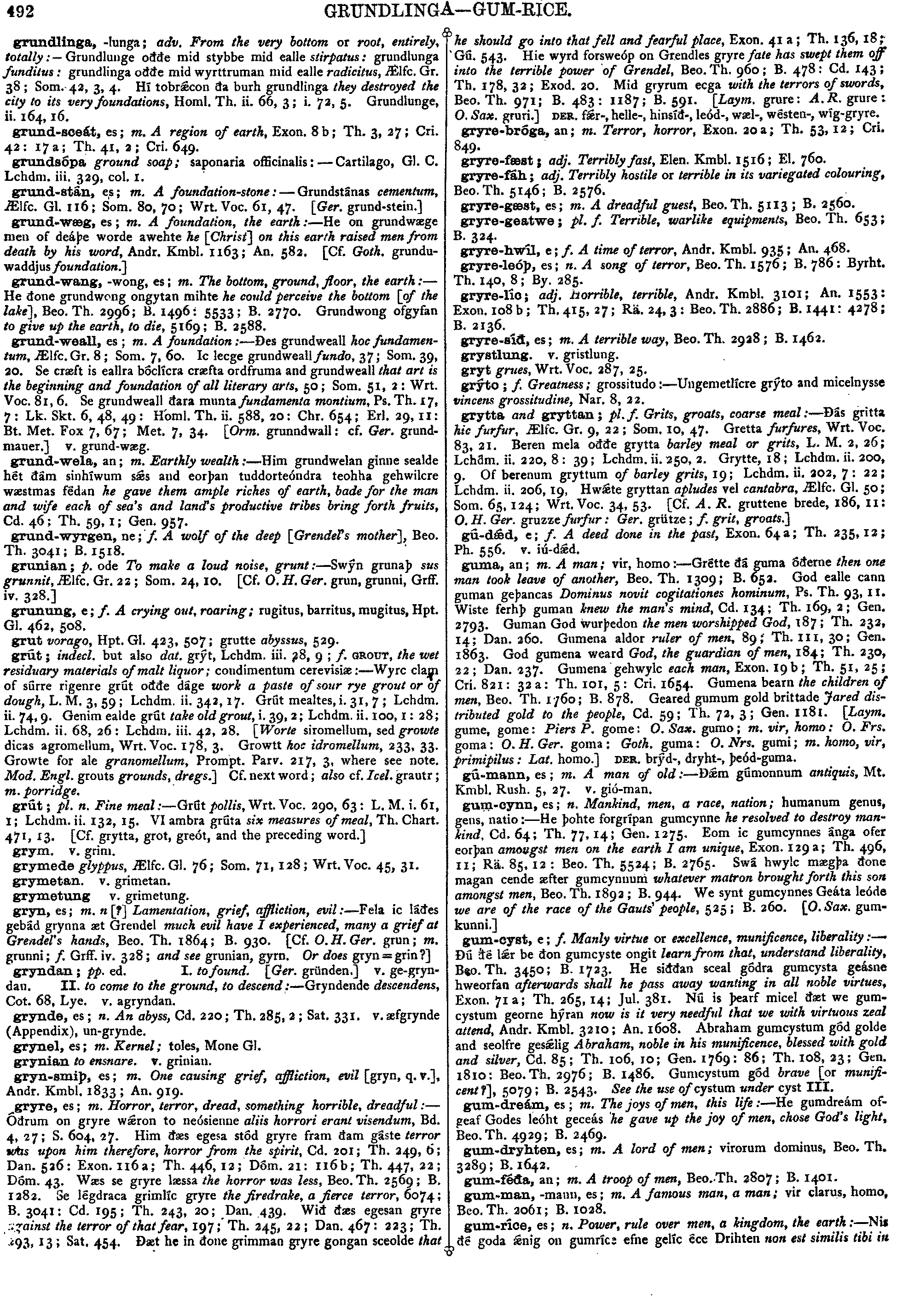
grút; indecl. but also dat. grýt, Lchdm. iii. 28, 9; f. GROUT, the wet residuary materials of malt liquor; condimentum cerevisiæ :-- Wyrc clam of súrre rigenre grút oððe dáge work a paste of sour rye grout or of dough, L. M. 3, 59; Lchdm. ii. 342, 17. Grút mealtes, i. 31, 7; Lchdm. ii. 74, 9. Genim ealde grút take old grout, i. 39, 2; Lchdm. ii. 100, 1: 28; Lchdm. ii. 68, 26: Lchdm. iii. 42, 28. [Worte siromellum, sed growte dicas agromellum, Wrt. Voc. 178, 3. Growtt hoc idromellum, 233, 33. Growte for ale granomellum, Prompt. Parv. 217, 3, where see note. Mod. Engl. grouts grounds, dregs.] Cf. next word; also cf. Icel. grautr; m. porridge.
|
Source: Bosworth/Toller, page b0496, entry 30 View original page image as: [TIFF] [PNG] [View previous entry] [View next entry] |
[Comment on this entry] [View comments] |
The following entry has been hand-corrected once. |
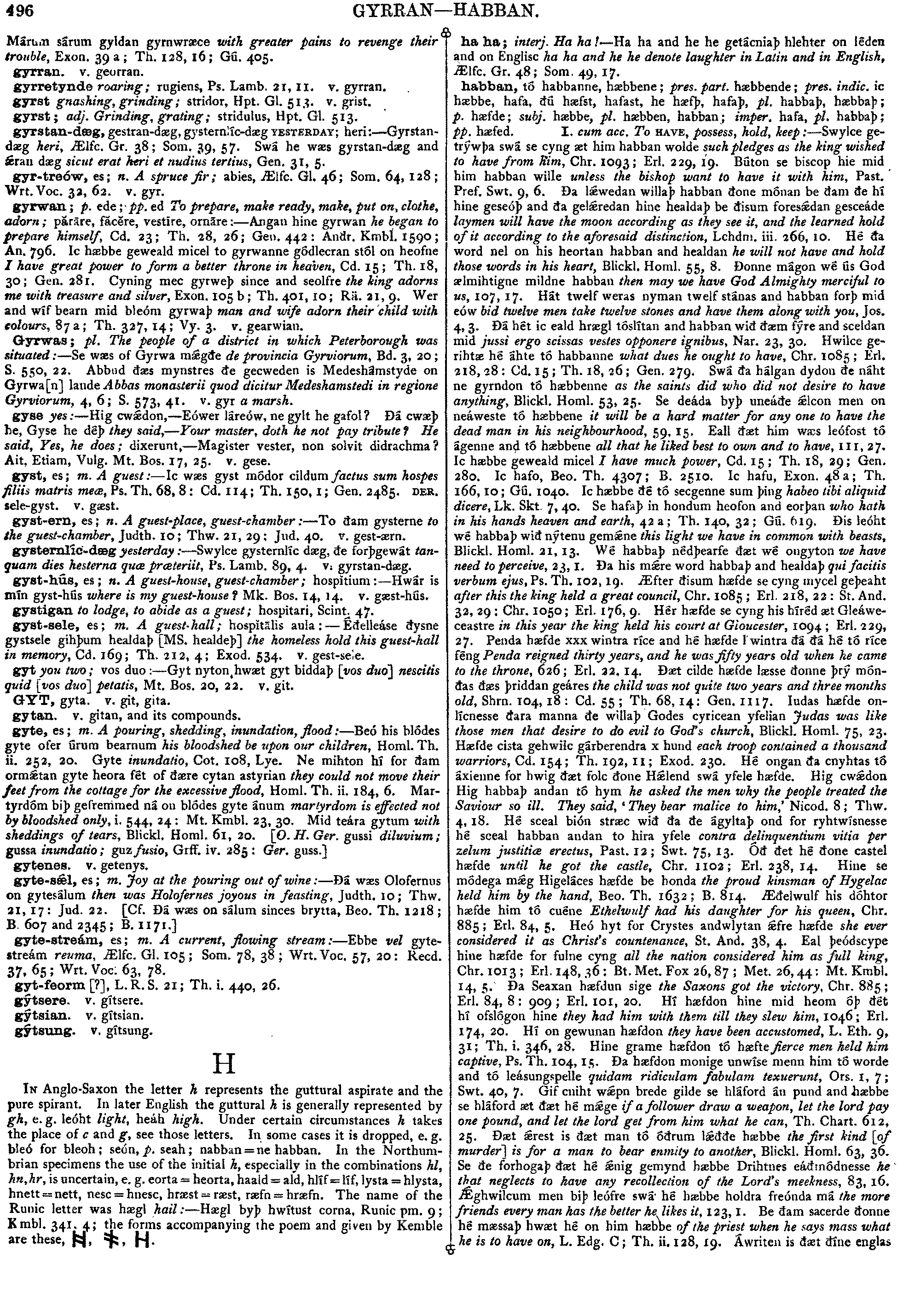
habban,
tó
habbanne,
hæbbene;
pres.
part.
hæbbende;
pres.
indic.
ic
hæbbe,
hafa,
ðú
hæfst,
hafast,
he
hæfþ,
hafaþ,
pl.
habbaþ,
hæbbaþ;
p.
hæfde;
subj.
hæbbe,
pl.
hæbben,
habban;
imper.
hafa,
pl.
habbaþ;
pp.
hæfed.
I.
cum
acc.
To
HAVE,
possess,
hold,
keep
:--
Swylce
getrýwþa
swá
se
cyng
æt
him
habban
wolde
such
pledges
as
the
king
wished
to
have
from
him,
Chr.
1093;
Erl.
229,
19.
Búton
se
biscop
hie
mid
him
habban
wille
unless
the
bishop
want
to
have
it
with
him,
Past.
Pref.
Swt.
9,
6.
Ða
lwedan
willaþ
habban
ðone
mónan
be
ðam
ðe
hí
hine
geseóþ
and
ða
gelredan
hine
healdaþ
be
ðisum
foresdan
gesceáde
laymen
will
have
the
moon
according
as
they
see
it,
and
the
learned
hold
of
it
according
to
the
aforesaid
distinction,
Lchdm.
iii.
266,
10.
Hé
ða
word
nel
on
his
heortan
habban
and
healdan
he
will
not
have
and
hold
those
words
in
his
heart,
Blickl.
Homl.
55,
8.
Ðonne
mágon
wé
ús
God
ælmihtigne
mildne
habban
then
may
we
have
God
Almighty
merciful
to
us,
107,
17.
Hát
twelf
weras
nyman
twelf
stánas
and
habban
forþ
mid
eów
bid
twelve
men
take
twelve
stones
and
have
them
along
with
you,
Jos.
4,
3.
Ðá
hét
ic
eald
hrægl
tóslítan
and
habban
wið
ðæm
fýre
and
sceldan
mid
jussi
ergo
scissas
vestes
opponere
ignibus,
Nar.
23,
30.
Hwilce
gerihtæ
hé
áhte
tó
habbanne
what
dues
he
ought
to
have,
Chr.
1085;
Erl.
218,
28
:
Cd.
15;
Th.
18,
26;
Gen.
279.
Swá
ða
hálgan
dydon
ðe
náht
ne
gyrndon
tó
hæbbenne
as
the
saints
did
who
did
not
desire
to
have
anything,
Blickl.
Homl.
53,
25.
Se
deáda
byþ
uneáðe
lcon
men
on
neáweste
tó
hæbbene
it
will
be
a
hard
matter
for
any
one
to
have
the
dead
man
in
his
neighbourhood,
59,
15.
Eall
ðæt
him
wæs
leófost
tó
ágenne
and
tó
hæbbene
all
that
he
liked
best
to
own
and
to
have,
111,
27.
Ic
hæbbe
geweald
micel
I
have
much
power,
Cd.
15;
Th.
18,
29;
Gen.
280.
Ic
hafo,
Beo.
Th.
4307;
B.
2510.
Ic
hafu,
Exon.
48
a;
Th.
166,
10;
Gú.
1040.
Ic
hæbbe
ðé
tó
secgenne
sum
þing
habeo
tibi
aliquid
dicere,
Lk.
Skt.
7,
40.
Se
hafaþ
in
hondum
heofon
and
eorþan
who
hath
in
his
hands
heaven
and
earth,
42
a;
Th.
140,
32;
Gú.
619.
Ðis
leóht
wé
habbaþ
wið
nýtenu
gemne
this
light
we
have
in
common
with
beasts,
Blickl.
Homl.
21,
13.
We
habbaþ
nédþearfe
ðæt
wé
ongyton
we
have
need
to
perceive,
23,
1.
Ða
his
mre
word
habbaþ
and
healdaþ
qui
facitis
verbum
ejus,
Ps.
Th.
102,
19.
Æfter
ðisum
hæfde
se
cyng
mycel
geþeaht
after
this
the
king
held
a
great
council,
Chr.
1085;
Erl.
218,
22
:
St.
And.
32,
29
:
Chr.
1050;
Erl.
176,
9.
Hér
hæfde
se
cyng
his
híréd
æt
Gleáweceastre
in
this
year
the
king
held
his
court
at
Gloucester,
1094;
Erl.
229,
27.
Penda
hæfde
xxx
wintra
ríce
and
hé
hæfde
l
wintra
ðá
dá
hé
tó
ríce
féng
Penda
reigned
thirty
years,
and
he
was
fifty
years
old
when
he
came
to
the
throne,
626;
Erl.
22,
14.
Ðæt
cilde
hæfde
læsse
ðonne
þrý
mónðas
ðæs
þriddan
geáres
the
child
was
not
quite
two
years
and
three
months
old,
Shrn.
104,
18
:
Cd.
55;
Th.
68,
14
:
Gen.
1117.
Iudas
hæfde
onlícnesse
ðara
manna
ðe
willaþ
Godes
cyricean
yfelian
Judas
was
like
those
men
that
desire
to
do
evil
to
God's
church,
Blickl.
Homl.
75,
23.
Hæfde
cista
gehwilc
gárberendra
x
hund
each
troop
contained
a
thousand
warriors,
Cd.
154;
Th.
192,
11;
Exod.
230.
Hé
ongan
ða
cnyhtas
tó
áxienne
for
hwig
ðæt
folc
ðone
Hlend
swá
yfele
hæfde.
Hig
cwdon
Hig
habbaþ
andan
tó
hym
he
asked
the
men
why
the
people
treated
the
Saviour
so
ill.
They
said,
'They
bear
malice
to
him,'
Nicod.
8;
Thw.
4,
18.
Hé
sceal
bión
stræc
wið
ða
ðe
ágyltaþ
and
for
ryhtwísnesse
hé
sceal
habban
andan
to
hira
yfele
contra
delinquentium
vitia
per
zelum
justitiæ
erectus,
Past.
12;
Swt.
75,
13.
Óð
ðet
hé
ðone
castel
hæfde
until
he
got
the
castle,
Chr.
1102;
Erl.
238,
14.
Hine
se
módega
mg
Higeláces
hæfde
be
honda
the
proud
kinsman
of
Hygelac
held
him
by
the
hand,
Beo.
Th.
1632;
B.
814.
Æðelwulf
his
dóhtor
hæfde
him
tó
cuéne
Ethelwulf
had
his
daughter
for
his
queen,
Chr.
885;
Erl.
84,
5.
Heó
hyt
for
Crystes
andwlytan
fre
hæfde
she
ever
considered
it
as
Christ's
countenance,
St.
And.
38,
4.
Eal
þeódscype
hine
hæfde
for
fulne
cyng
all
the
nation
considered
him
as
full
king,
Chr.
1013;
Erl.
148,
36
:
Bt.
Met.
Fox
26,
87;
Met.
26,
44
:
Mt.
Kmbl.
14,
5.
Ða
Seaxan
hæfdun
sige
the
Saxons
got
the
victory,
Chr.
885;
Erl.
84,
8
:
909;
Erl.
101,
20.
Hí
hæfdon
hine
mid
heom
óþ
ðét
hí
ofslógon
hine
they
had
him
with
them
till
they
slew
him,
1046;
Erl.
174,
20.
Hí
on
gewunan
hæfdon
they
have
been
accustomed,
L.
Eth.
9,
31;
Th.
i.
346,
28.
Hine
grame
hæfdon
tó
hæfte
fierce
men
held
him
captive,
Ps.
Th.
104,
15.
Ða
hæfdon
monige
unwíse
menn
him
tó
worde
and
tó
leásungspelle
quidam
ridiculam
fabulam
texuerunt,
Ors.
1,
7;
Swt.
40,
7.
Gif
cniht
wpn
brede
gilde
se
hláford
án
pund
and
hæbbe
se
hláford
æt
ðæt
hé
mge
if
a
follower
draw
a
weapon,
let
the
lord
pay
one
pound,
and
let
the
lord
get
from
him
what
he
can,
Th.
Chart.
612,
25.
Ðæt
rest
is
ðæt
man
tó
óðrum
lððe
hæbbe
the
first
kind
[of
murder]
is
for
a
man
to
bear
enmity
to
another,
Blickl.
Homl.
63,
36.
Se
ðe
forhogaþ
ðæt
hé
nig
gemynd
hæbbe
Drihtnes
eáðmódnesse
he
that
neglects
to
have
any
recollection
of
the
Lord's
meekness,
83,
16.
Æ-acute;ghwilcum
men
biþ
leófre
swá
hé
hæbbe
holdra
freónda
má
the
more
friends
every
man
has
the
better
he
likes
it,
123,
1.
Be
ðam
sacerde
ðonne
hé
mæssaþ
hwæt
hé
on
him
hæbbe
of
the
priest
when
he
says
mass
what
he
is
to
have
on,
L.
Edg.
C;
Th.
ii.
128,
19.
Áwriten
is
ðæt
ðíne
englas
ðé
on
hondum
habban
it
is
written
that
thine
angels
shall
take
thee
in
their
hands,
27,
14.
Ða
hwíle
ðe
wé
ðæt
líf
on
úrum
gewealde
habban
while
we
have
the
life
in
our
power,
101,
11.
Uton
geþencean
hwylc
handleán
wé
him
forþ
tó
berenne
habban
let
us
consider
what
recompense
we
have
to
produce
for
him,
91,
14.
Hafa
ðé
wunden
gold
take
for
thyself
the
twisted
gold,
Cd.
97;
Th.
128,
18;
Gen.
2128.
Gif
man
frigne
man
æt
hæbbendre
handa
gefó
if
a
freeman
be
taken
with
stolen
goods
upon
him,
L.
Wiht.
26;
Th.
i.
42,
15
:
L.
Ath.
1,
1;
Th.
i.
198,
16
:
4,
pref.
Th.
i.
220,
11.
Wé
beóþ
hæbbende
ðæs
ðe
wé
r
hopedon
we
shall
be
in
possession
of
that
which
before
we
hoped
for,
Homl.
Th.
i.
250,
34.
Is
seó
stów
on
micelre
árwurþnysse
hæfed
in
magna
veneratione
habetur
locus
ille,
Bd.
3,
2;
S.
524,
12.
Mid
ðý
hé
mid
ðone
gesíþ
hæfed
wæs
dum
apted
comitem
teneretur,
4,
22;
S.
591,
32.
Adam
and
Eva
on
bendum
wron
hæfde
Adam
and
Eve
were
held
in
bonds,
Blickl.
Homl.
87,
26.
II.
with
partitive
gen
:--
Hæbbe
ic
his
on
handa
I
have
some
of
it
in
my
hand,
Cd.
32;
Th.
42,
23;
Gen.
678.
Se
ðe
ðara
mihta
hæbbe
árre
cirican
he
who
has
the
means
let
him
erect
a
church,
L.
Pen.
14;
Th.
ii.
282,
5
:
L.
E.
I.
3;
Th.
ii.
404,
22.
Hé
ne
móste
ðæs
fyrstes
habban
ðe
hé
gewilnode
he
might
not
have
any
of
the
respite
that
he
desired,
Homl.
Th.
i.
414,
28.
III.
with
the
gerundial
infin.
to
express
the
future
:--
Ðone
calic
ðe
ic
tó
drincenne
hæbbe
calicem
quem
ego
bibiturus
sum,
Mt.
Kmbl.
20,
22
[cf.
the
formation
of
the
future
tense
in
the
Romance
languages].
IV.
with
an
uninflected
participle
:--
Ðú
mé
forlred
hæfst
thou
hast
seduced
me,
Cd.
38;
Th.
50,
34;
Gen.
818.
Ðæs
lífes
ðe
ðú
hafast
ofslegen
the
life
that
thou
hast
slain,
Exon.
29
b;
Th.
90,
25;
Cri.
1479
For
ðissum
ælþeódigum
ðe
wé
on
ðissum
carcerne
betýned
habbaþ
on
account
of
this
stranger
whom
we
shut
up
in
this
prison,
Blickl.
Homl.
245,
36.
Gé
habbaþ
ús
gedón
láðe
Pharaone
ye
have
made
us
hateful
to
Pharaoh,
Ex.
5,
21.
V.
with
an
inflected
participle,
sometimes
also
with
an
uninflected
participle
as
well
:--
Ic
mínes
þeódnes
hafa
hyldo
forworhte
I
have
forfeited
my
prince's
favour,
Cd.
39;
Th.
52,
1;
Gen.
836.
Ðú
hæfst
ðé
wið
dryhten
dýrne
geworhtne
thou
hast
made
thyself
dear
to
the
Lord,
25;
Th.
32,
22;
Gen.
507.
Ðú
hafast
helle
bereáfod
and
ðæs
deáþes
aldor
gebundenne
thou
hast
despoiled
hell,
and
bound
the
prince
of
death,
Blickl.
Homl.
87,
22.
Ðín
ágen
geleáfa
ðé
hæfþ
gehledne
thine
own
faith
hath
saved
thee,
15,
27
:
85,
23.
Ðás
þing
wé
habbaþ
be
him
gewritene
we
have
written
these
things
about
him,
Chr.
1086;
Erl.
222,
40.
Ðá
cwæþ
Iacob
Bearnleásne
gé
habbaþ
mé
gedónne
then
said
Jacob,
Ye
have
made
me
childless,
Gen.
42,
36.
Hie
hine
ofslægenne
hæfdon
they
had
slain
him,
Chr.
755;
Erl.
50,
1
:
867;
Erl.
72,
9.
[Laym.
habben,
han
:
Orm
:
habbenn,
hafenn
:
A.
R.
habben
:
Goth.
haban
:
O.
Sax.
hebbian
:
O.
Frs.
hebba,
habba
:
Icel.
hafa
:
O.
H.
Ger.
haben.]
DER.
á-,
æt-,
be-,
for-,
ge-,
of-,
on-,
wið-,
wiðer-,
ymb-habban
:
nabban
:
bord-,
daroþ-,
dreám-,
eard-,
lind-,
rand-,
searo-hæbbende.
|
Source: Bosworth/Toller, page b0497, entry 3 View original page image as: [TIFF] [PNG] [View previous entry] [View next entry] |
[Comment on this entry] [View comments (1)] |
The following entry has been hand-corrected once. |
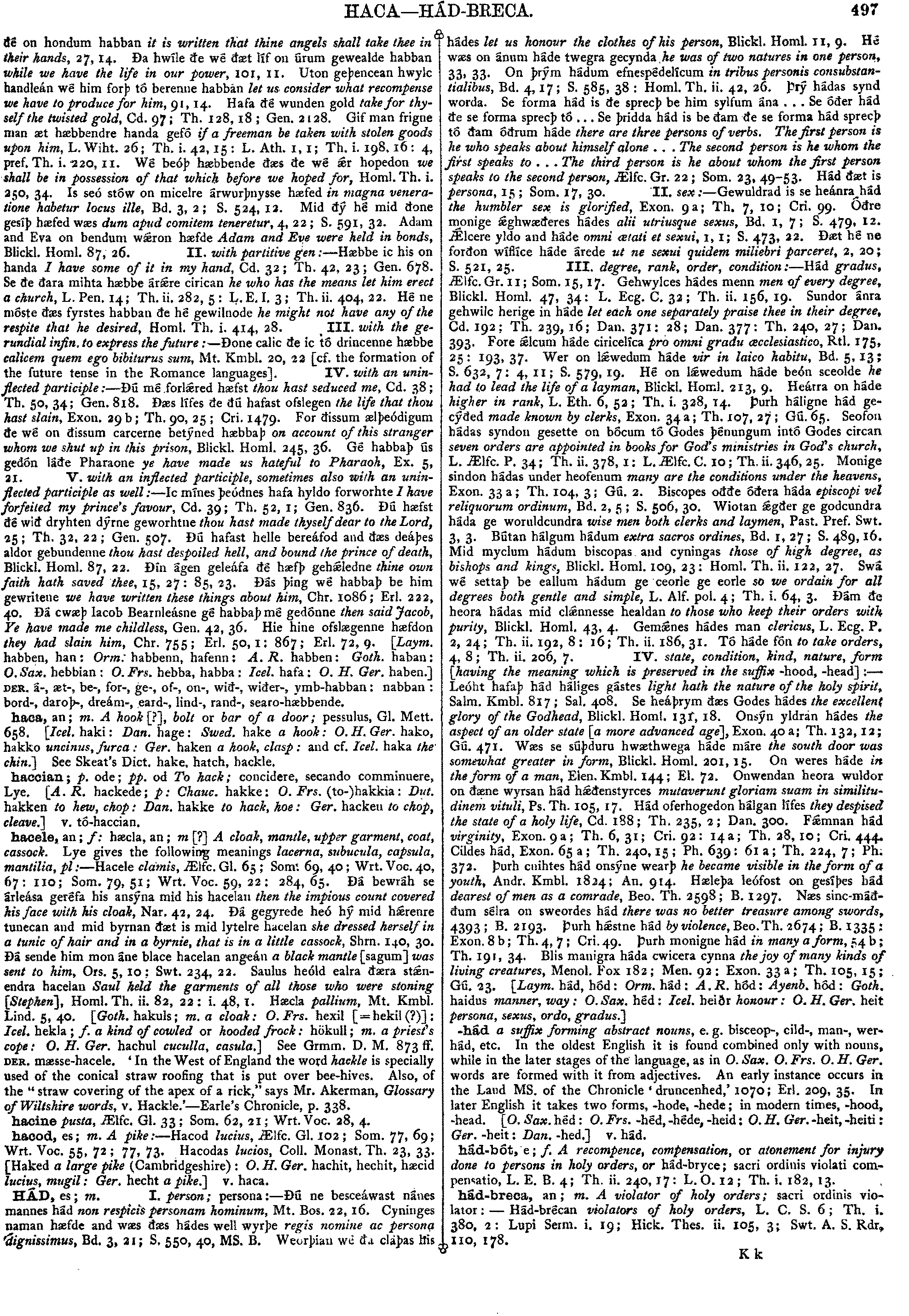
hacele,
an;
f
:
hæcla,
an;
m
[?]
A
cloak,
mantle,
upper
garment,
coal,
cassock.
Lye
gives
the
following
meanings
lacerna,
subucula,
capsula,
mantilia,
pl
:--
Hacele
clamis,
Ælfc.
Gl.
65;
Som.
69,
40;
Wrt.
Voc.
40,
67
:
110;
Som.
79,
51;
Wrt.
Voc.
59,
22
:
284,
65.
Ðá
bewráh
se
árleása
geréfa
his
ansýna
mid
his
hacelan
then
the
impious
count
covered
his
face
with
his
cloak,
Nar.
42,
24.
Ðá
gegyrede
heó
hý
mid
hrenre
tunecan
and
mid
byrnan
ðæt
is
mid
lytelre
hacelan
she
dressed
herself
in
a
tunic
of
hair
and
in
a
byrnie,
that
is
in
a
little
cassock,
Shrn.
140,
30.
Ðá
sende
him
mon
áne
blace
hacelan
angeán
a
black
mantle
[sagum]
was
sent
to
him,
Ors.
5,
10
:
Swt.
234,
22.
Saulus
heóld
ealra
ðæra
stnendra
hacelan
Saul
held
the
garments
of
all
those
who
were
stoning
[Stephen],
Homl.
Th.
ii.
82,
22
:
i.
48,
1.
Hæcla
pallium,
Mt.
Kmbl.
Lind.
5,
40.
[Goth.
hakuls;
m.
a
cloak
:
O.
Frs.
hexil
[
=
hekil
(?)]
:
Icel.
hekla;
f.
a
kind
of
cowled
or
hooded
frock
:
hökull;
m.
a
priest's
cope
:
O.
H.
Ger.
hachul
cuculla,
casula.]
See
Grmm.
D.
M.
873
ff.
DER.
mæsse-hacele.
'In
the
West
of
England
the
word
hackle
is
specially
used
of
the
conical
straw
roofing
that
is
put
over
bee-hives.
Also,
of
the
"straw
covering
of
the
apex
of
a
rick,"
says
Mr.
Akerman,
Glossary
of
Wiltshire
words,
v.
Hackle.'
-
Earle's
Chronicle,
p.
338.
|
Source: Bosworth/Toller, page b0498, entry 17 View original page image as: [TIFF] [PNG] [View previous entry] [View next entry] |
[Comment on this entry] [View comments] |
The following entry has been hand-corrected once. |
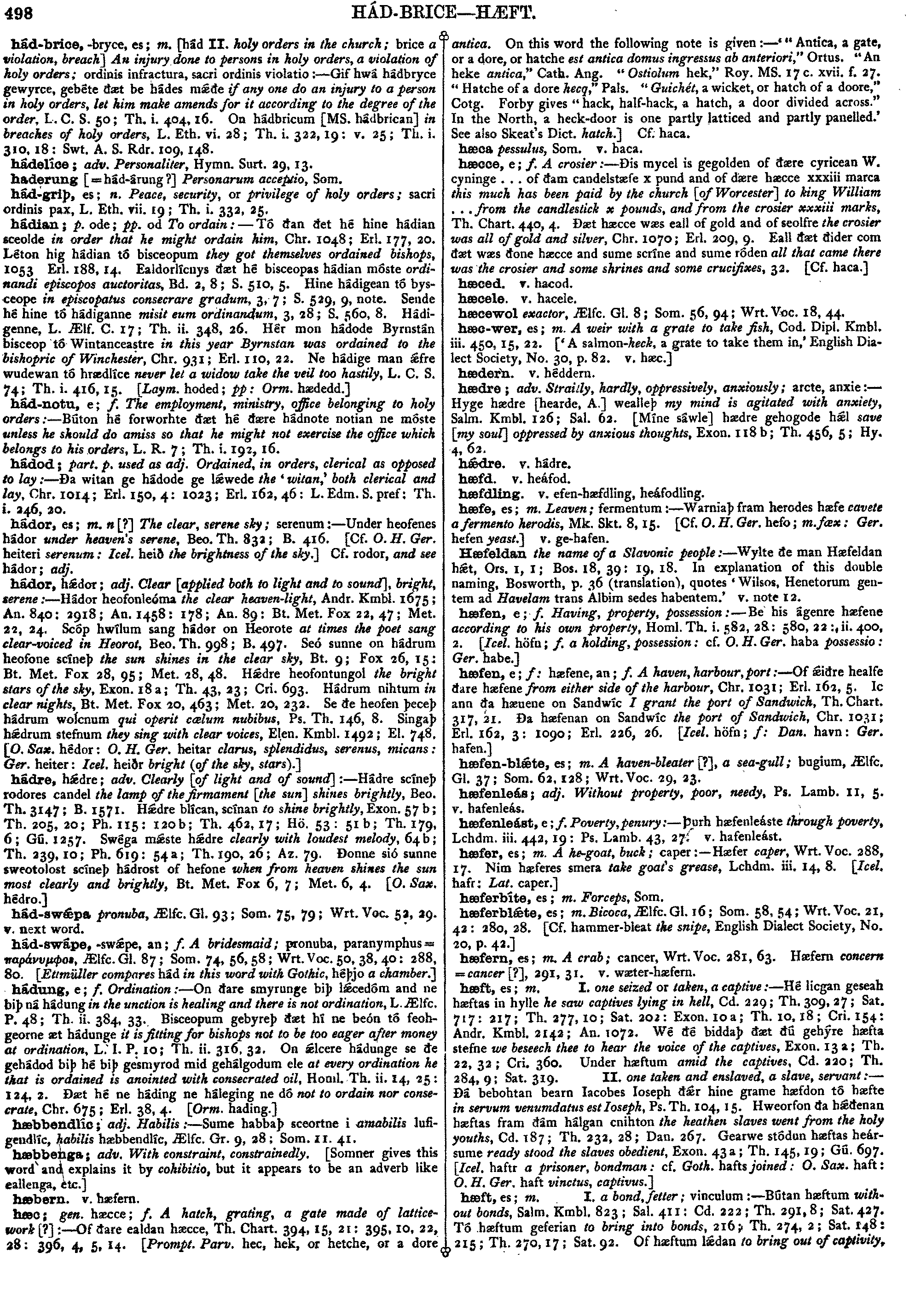
hæc; gen. hæcce; f. A hatch, grating, a gate made of latticework [?] :-- Of ðare ealdan hæcce, Th. Chart. 394, 15, 21 : 395. 10, 22, 28 : 396, 4, 5, 14. [Prompt. Parv. hec, hek, or hetche, or a dore antica. On this word the following note is given :-- ' "Antica, a gate, or a dore, or hatche est antica domus ingressus ab anteriori," Ortus. "An heke antica," Cath. Ang. "Ostiolum hek," Roy. MS. 17 c. xvii. f. 27. "Hatche of a dore hecq," Pals. "Guichét, a wicket, or hatch of a doore," Cotg. Forby gives "hack, half-hack, a hatch, a door divided across." In the North, a heck-door is one partly latticed and partly panelled.' See also Skeat's Dict. hatch.] Cf. haca.
|
Source: Bosworth/Toller, page b0501, entry 33 View original page image as: [TIFF] [PNG] [View previous entry] [View next entry] |
[Comment on this entry] [View comments] |
The following entry has been hand-corrected once. |
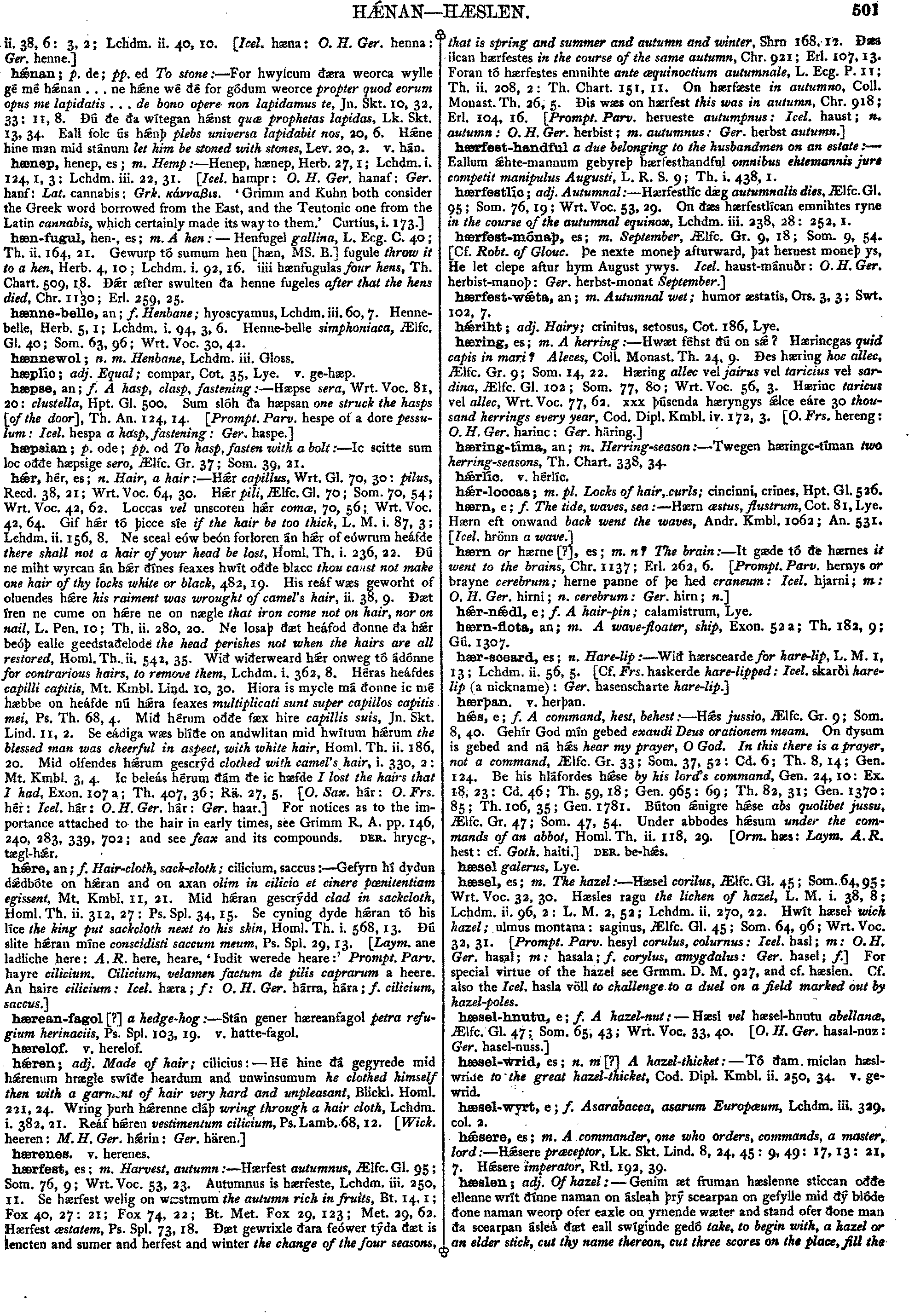
hæsel, es; m. The hazel :-- Hæsel corilus, Ælfc. Gl. 45; Som. 64. 95; Wrt. Voc. 32, 30. Hæsles ragu the lichen of hazel, L. M. i. 38, 8; Lchdm. ii. 96, 2 : L. M. 2, 52; Lchdm. ii. 270, 22. Hwít hæsel wich hazel; ulmus montana : saginus, Ælfc. Gl. 45; Som. 64, 96; Wrt. Voc. 32, 31. [Prompt. Parv. hesyl corulus, colurnus : Icel. hasl; m : O. H. Ger. hasal; m : hasala; f. corylus, amygdalus : Ger. hasel; f.] For special virtue of the hazel see Grmm. D. M. 927, and cf. hæslen. Cf. also the Icel. hasla völl to challenge to a duel on a field marked out by hazel poles.
|
Source: Bosworth/Toller, page b0502, entry 1 View original page image as: [TIFF] [PNG] [View previous entry] [View next entry] |
[Comment on this entry] [View comments] |
The following entry has been hand-corrected once. |
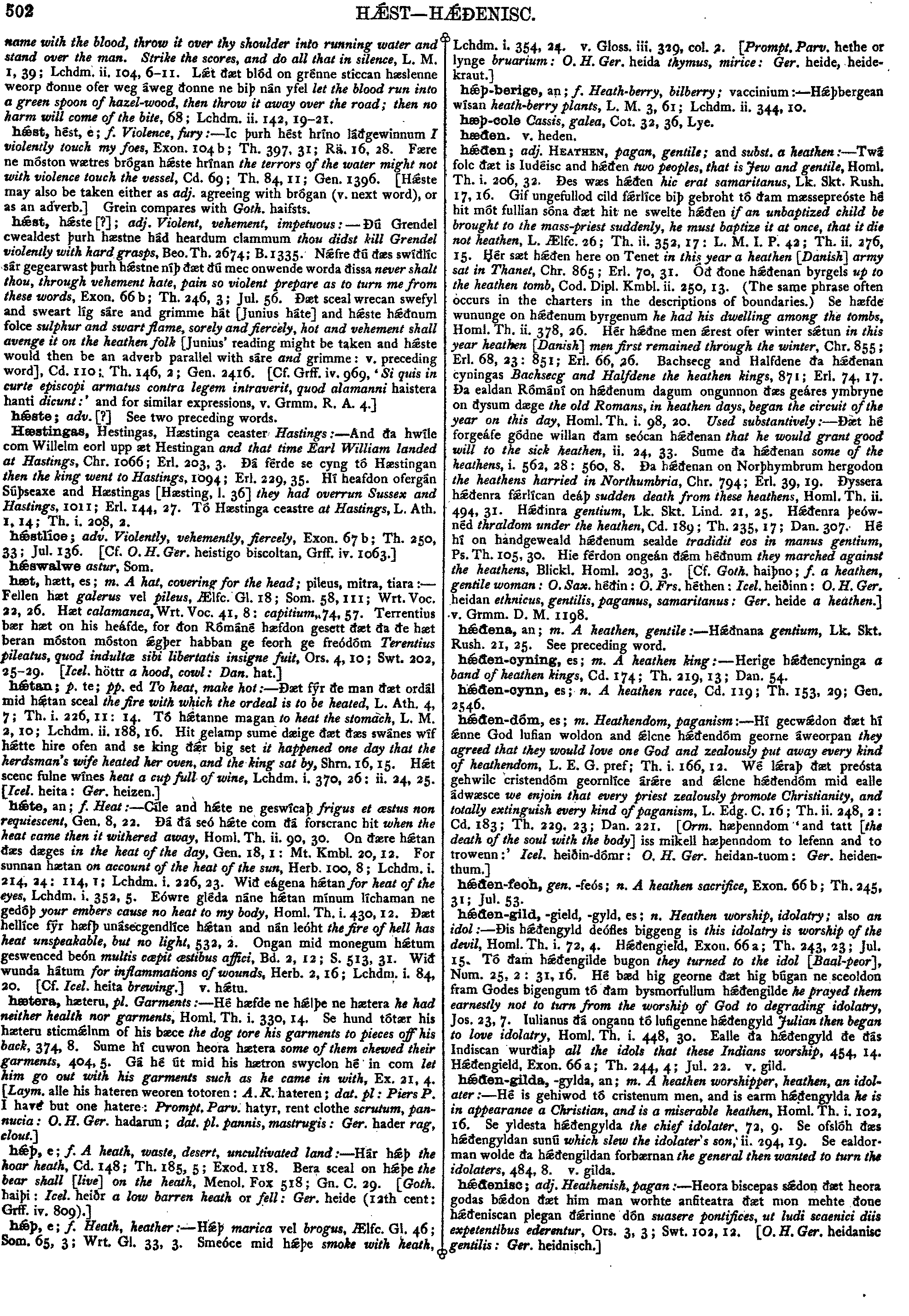
hst,
hést,
e;
f.
Violence,
fury
:--
Ic
þurh
hést
hríno
láðgewinnum
I
violently
touch
my
foes,
Exon.
104
b;
Th.
397,
31;
Rä.
16,
28.
Fære
ne
móston
wætres
brógan
hste
hrínan
the
terrors
of
the
water
might
not
with
violence
touch
the
vessel,
Cd.
69;
Th.
84,
11;
Gen.
1396.
[Hste
may
also
be
taken
either
as
adj.
agreeing
with
brógan
(v.
next
word),
or
as
an
adverb.]
Grein
compares
with
Goth.
haifsts.
|
Source: Bosworth/Toller, page b0502, entry 22 View original page image as: [TIFF] [PNG] [View previous entry] [View next entry] |
[Comment on this entry] [View comments] |
The following entry has been hand-corrected once. |
hðen-gild,
-gield,
-gyld,
es;
n.
Heathen
worship,
idolatry;
also
an
idol
:--
Ðis
hðengyld
deófles
biggeng
is
this
idolatry
is
worship
of
the
devil,
Homl.
Th.
i.
72,
4.
Hðengield,
Exon.
66
a;
Th.
243,
23;
Jul.
15.
Tó
ðam
hðengilde
bugon
they
turned
to
the
idol
[Baal-peor],
Num.
25,
2
:
31,
16.
Hé
bæd
hig
georne
ðæt
hig
búgan
ne
sceoldon
fram
Godes
bigengum
tó
ðam
bysmorfullum
hðengilde
he
prayed
them
earnestly
not
to
turn
from
the
worship
of
God
to
degrading
idolatry,
Jos.
23,
7.
Iulianus
ðá
ongann
tó
lufigenne
hðengyld
Julian
then
began
to
love
idolatry,
Homl.
Th.
i.
448,
30.
Ealle
ða
hðengyld
ðe
ðás
Indiscan
wurðiaþ
all
the
idols
that
these
Indians
worship,
454,
14.
Hðengield,
Exon.
66
a;
Th.
244,
4;
Jul.
22.
v.
gild.
|
Source: Bosworth/Toller, page b0503, entry 23 View original page image as: [TIFF] [PNG] [View previous entry] [View next entry] |
[Comment on this entry] [View comments] |
The following entry has been hand-corrected once. |
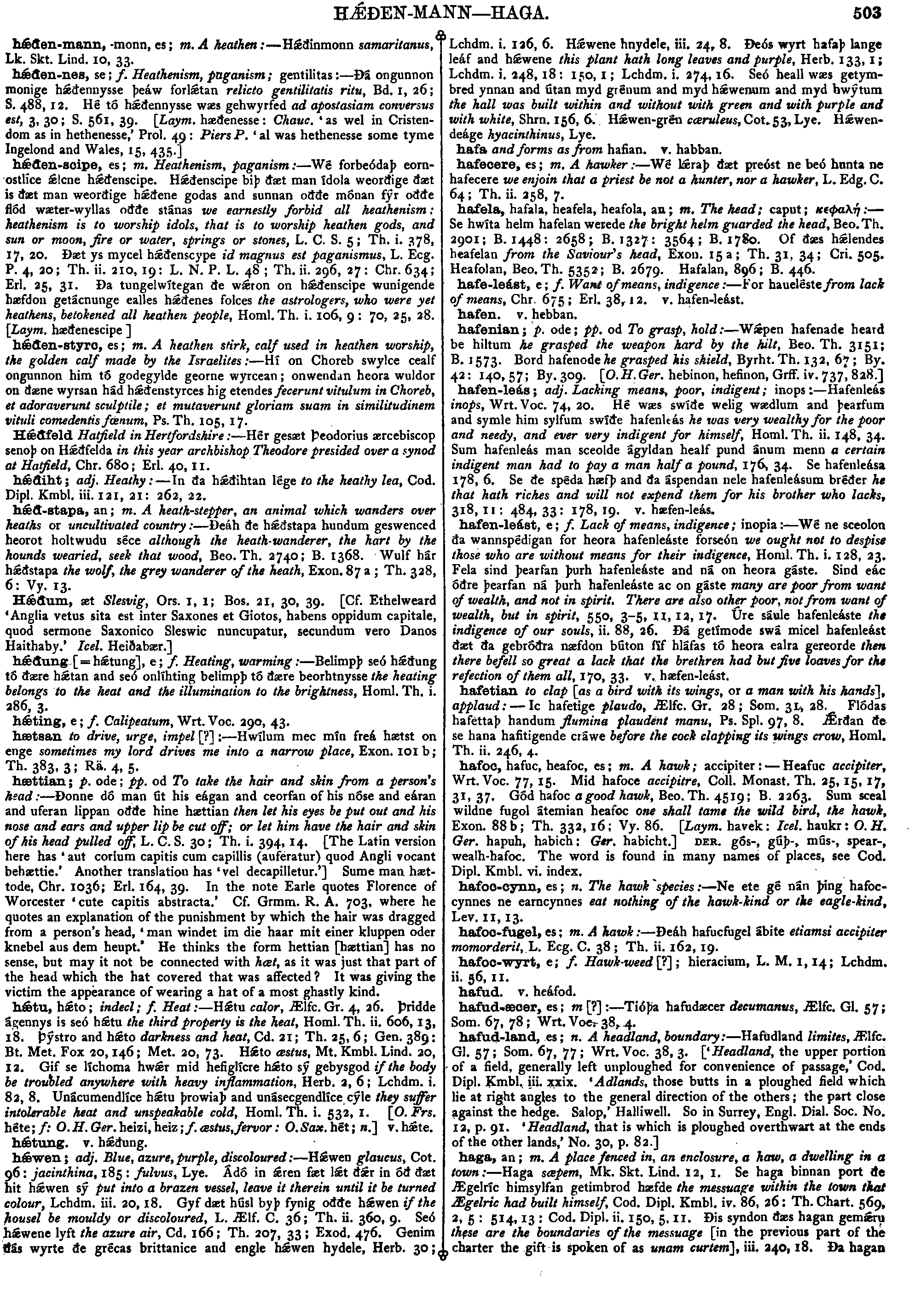
hafen-leást, e; f. Lack of means, indigence; inopia :-- Wé ne sceolon ða wannspédigan for heora hafenleáste forseón we ought not to despise those who are without means for their indigence, Homl. Th. i. 128, 23. Fela sind þearfan þurh hafenleáste and ná on heora gáste. Sind eác óðre þearfan ná þurh hafenleáste ac on gáste many are poor from want of wealth, and not in spirit. There are also other poor, not from want of wealth, but in spirit, 550, 3-5, 11, 12, 17. Úre sáule hafenleáste the indigence of our souls, ii. 88, 26. Ðá getímode swá micel hafenleást ðæt ða gebróðra næfdon búton fíf hláfas tó heora ealra gereorde then there befell so great a lack that the brethren had but five loaves for the refection of them all, 170, 33. v. hæfen-leást.
|
Source: Bosworth/Toller, page b0504, entry 1 View original page image as: [TIFF] [PNG] [View previous entry] [View next entry] |
[Comment on this entry] [View comments] |
The following entry has been hand-corrected once. |
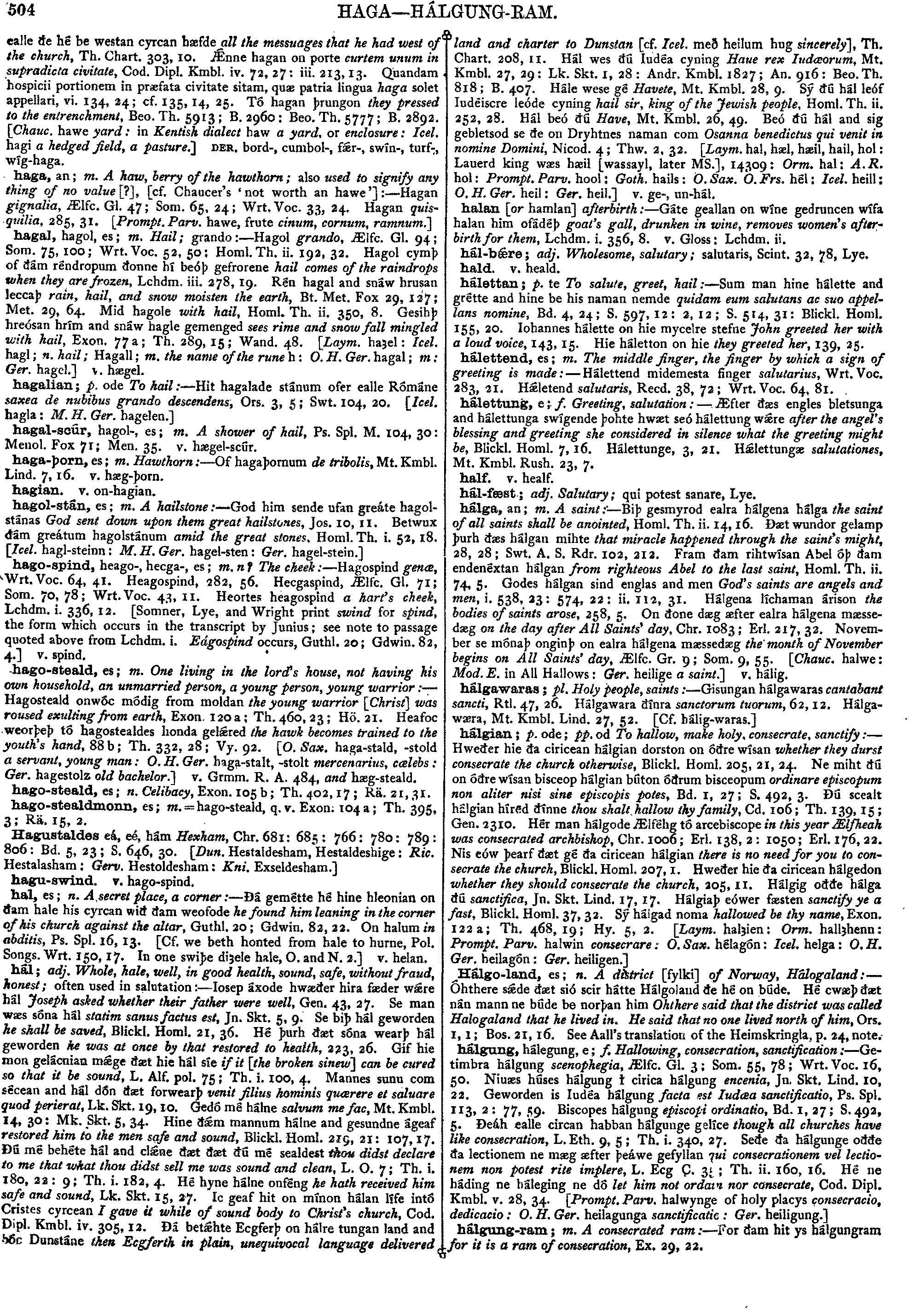
haga, an; m. A haw, berry of the hawthorn; also used to signify any thing of no value [?], [cf. Chaucer's 'not worth an hawe'] :-- Hagan gignalia, Ælfc. Gl. 47; Som. 65, 24; Wrt. Voc. 33, 24. Hagan quisquilia, 285, 31. [Prompt. Parv. hawe, frute cinum, cornum, ramnum.]
| Result Page: |  |
Previous | 8 9 10 11 12 13 14 15 16 17 18 19 20 21 22 23 24 25 26 | Next |  |
Germanic Lexicon Project (main page)
This search system was written by
Sean Crist
Please consider
volunteering
to correct the data in these online dictionaries.
No rights reserved. Feel free to use these data in any way you please.