|
|

|
Source: Cleasby/Vigfusson, page b0186, entry 2 View original page image as: [TIFF] [PNG] [View previous entry] [View next entry] |
[Comment on this entry] [View comments] |
The following entry has been hand-corrected once. |
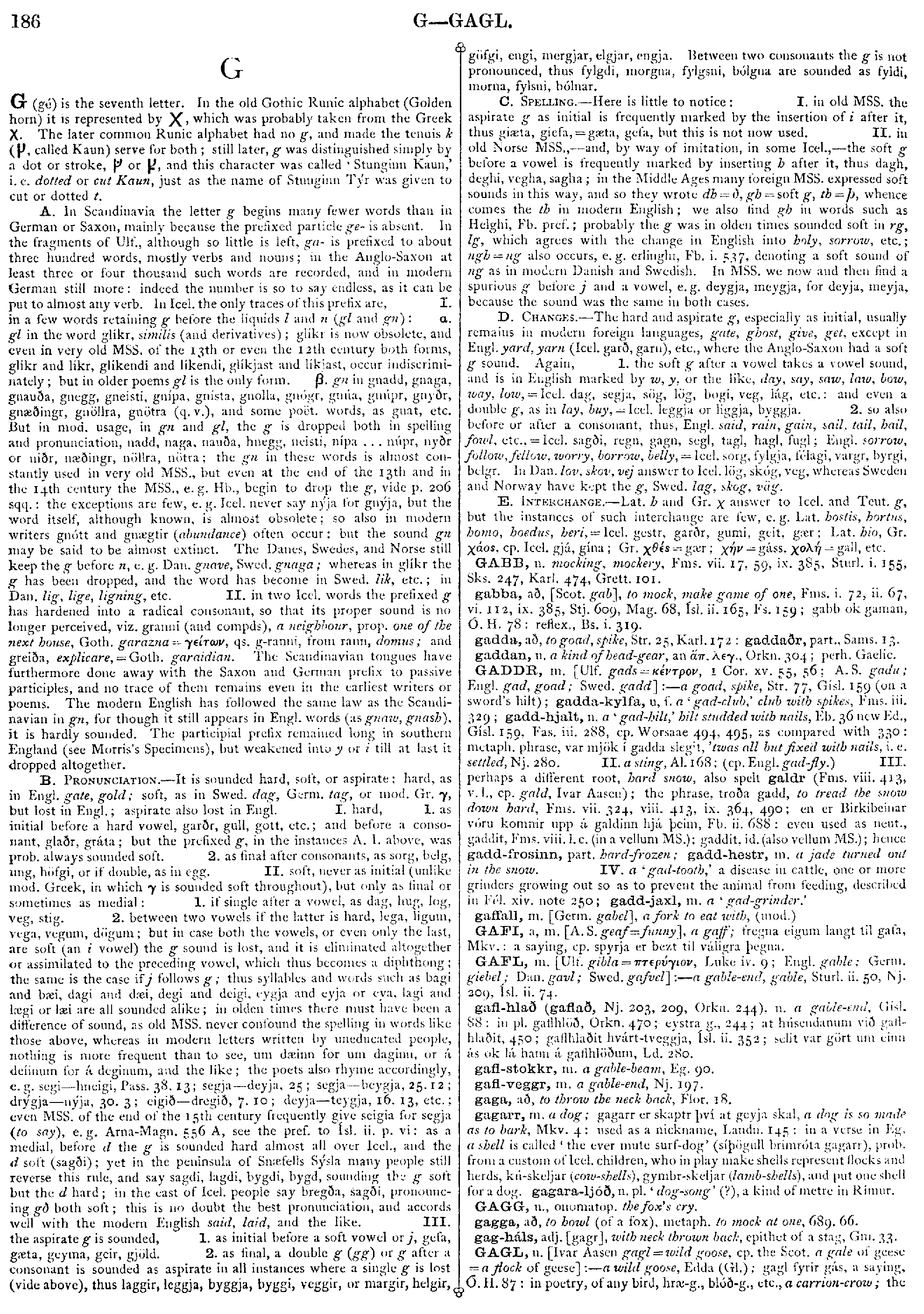
A.
In
Scandinavia
the
letter
g
begins
many
fewer
words
than
in
German
or
Saxon,
mainly
because
the
prefixed
particle
ge-
is
absent.
In
the
fragments
of
Ulf.,
although
so
little
is
left,
ga-
is
prefixed
to
about
three
hundred
words,
mostly
verbs
and
nouns;
in
the
Anglo-Saxon
at
least
three
or
four
thousand
such
words
are
recorded,
and
in
modern
German
still
more:
indeed
the
number
is
so
to
say
endless,
as
it
can
be
put
to
almost
any
verb.
In
Icel.
the
only
traces
of
this
prefix
are,
I.
in
a
few
words
retaining
g
before
the
liquids
l
and
n
(gl
and
gn):
 .
gl
in
the
word
glíkr,
similis
(and
derivatives);
glíkr
is
now
obsolete,
and
even
in
very
old
MSS.
of
the
13th
or
even
the
12th
century
both
forms,
glíkr
and
líkr,
glíkendi
and
líkendi,
glíkjast
and
líkjast,
occur
indiscriminately;
but
in
older
poems
gl
is
the
only
form.
.
gl
in
the
word
glíkr,
similis
(and
derivatives);
glíkr
is
now
obsolete,
and
even
in
very
old
MSS.
of
the
13th
or
even
the
12th
century
both
forms,
glíkr
and
líkr,
glíkendi
and
líkendi,
glíkjast
and
líkjast,
occur
indiscriminately;
but
in
older
poems
gl
is
the
only
form.
 .
gn
in
gnadd,
gnaga,
gnauða,
gnegg,
gneisti,
gnípa,
gnísta,
gnolla,
gnógr,
gnúa,
gnúpr,
gnyðr,
gnæðingr,
gnöllra,
gnötra
(q.v.),
and
some
poët.
words,
as
gnat,
etc.
But
in
mod.
usage,
in
gn
and
gl,
the
g
is
dropped
both
in
spelling
and
pronunciation,
nadd,
naga,
nauða,
hnegg,
neisti,
nípa
...
núpr,
nyðr
or
niðr,
næðingr,
nöllra,
nötra;
the
gn
in
these
words
is
almost
constantly
used
in
very
old
MSS.,
but
even
at
the
end
of
the
13th
and
in
the
14th
century
the
MSS.,
e.g.
Hb.,
begin
to
drop
the
g,
vide
p.
206
sqq.:
the
exceptions
are
few,
e.g.
Icel.
never
say
nýja
tor
gnýja,
but
the
word
itself,
although
known,
is
almost
obsolete:
so
also
in
modern
writers
gnótt
and
gnægtir
(abundance)
often
occur:
but
the
sound
gn
may
be
said
to
be
almost
extinct.
The
Danes,
Swedes,
and
Norse
still
keep
the
g
before
n,
e.g.
Dan.
gnave,
Swed.
gnaga;
whereas
in
glíkr
the
g
has
been
dropped,
and
the
word
has
become
in
Swed.
lik,
etc.;
in
Dan.
lig,
lige,
ligning,
etc.
II.
in
two
Icel.
words
the
prefixed
g
has
hardened
into
a
radical
consonant,
so
that
its
proper
sound
is
no
longer
perceived,
viz.
granni
(and
compds),
a
neighbour,
prop.
one
of
the
next
house,
Goth.
garazna
=
GREEK,
qs.
g-ranni,
from
rann,
domus;
and
greiða,
explicare,
=
Goth.
garaidian.
The
Scandinavian
tongues
have
furthermore
done
away
with
the
Saxon
and
German
prefix
to
passive
participles,
and
no
trace
of
them
remains
even
in
the
earliest
writers
or
poems.
The
modern
English
has
followed
the
same
law
as
the
Scandinavian
in
gn,
for
though
it
still
appears
in
Engl.
words
(as
gnaw,
gnash),
it
is
hardly
sounded.
The
participial
prefix
remained
long
in
southern
England
(see
Morris's
Specimens),
but
weakened
into
y
or
i
till
at
last
it
dropped
altogether.
.
gn
in
gnadd,
gnaga,
gnauða,
gnegg,
gneisti,
gnípa,
gnísta,
gnolla,
gnógr,
gnúa,
gnúpr,
gnyðr,
gnæðingr,
gnöllra,
gnötra
(q.v.),
and
some
poët.
words,
as
gnat,
etc.
But
in
mod.
usage,
in
gn
and
gl,
the
g
is
dropped
both
in
spelling
and
pronunciation,
nadd,
naga,
nauða,
hnegg,
neisti,
nípa
...
núpr,
nyðr
or
niðr,
næðingr,
nöllra,
nötra;
the
gn
in
these
words
is
almost
constantly
used
in
very
old
MSS.,
but
even
at
the
end
of
the
13th
and
in
the
14th
century
the
MSS.,
e.g.
Hb.,
begin
to
drop
the
g,
vide
p.
206
sqq.:
the
exceptions
are
few,
e.g.
Icel.
never
say
nýja
tor
gnýja,
but
the
word
itself,
although
known,
is
almost
obsolete:
so
also
in
modern
writers
gnótt
and
gnægtir
(abundance)
often
occur:
but
the
sound
gn
may
be
said
to
be
almost
extinct.
The
Danes,
Swedes,
and
Norse
still
keep
the
g
before
n,
e.g.
Dan.
gnave,
Swed.
gnaga;
whereas
in
glíkr
the
g
has
been
dropped,
and
the
word
has
become
in
Swed.
lik,
etc.;
in
Dan.
lig,
lige,
ligning,
etc.
II.
in
two
Icel.
words
the
prefixed
g
has
hardened
into
a
radical
consonant,
so
that
its
proper
sound
is
no
longer
perceived,
viz.
granni
(and
compds),
a
neighbour,
prop.
one
of
the
next
house,
Goth.
garazna
=
GREEK,
qs.
g-ranni,
from
rann,
domus;
and
greiða,
explicare,
=
Goth.
garaidian.
The
Scandinavian
tongues
have
furthermore
done
away
with
the
Saxon
and
German
prefix
to
passive
participles,
and
no
trace
of
them
remains
even
in
the
earliest
writers
or
poems.
The
modern
English
has
followed
the
same
law
as
the
Scandinavian
in
gn,
for
though
it
still
appears
in
Engl.
words
(as
gnaw,
gnash),
it
is
hardly
sounded.
The
participial
prefix
remained
long
in
southern
England
(see
Morris's
Specimens),
but
weakened
into
y
or
i
till
at
last
it
dropped
altogether.
|
Source: Cleasby/Vigfusson, page b0186, entry 3 View original page image as: [TIFF] [PNG] [View previous entry] [View next entry] |
[Comment on this entry] [View comments] |
The following entry has been hand-corrected once. |
B.
PRONUNCIATION.
--
It
is
sounded
hard,
soft,
or
aspirate;
hard,
as
in
Engl.
gate,
gold;
soft,
as
in
Swed.
dag,
Germ.
tag,
or
mod.
Gr.
 ,
but
lost
in
Engl.;
aspirate
also
lost
in
Engl.
I.
hard,
1.
as
initial
before
a
hard
vowel,
garðr,
gull,
gott,
etc.;
and
before
a
consonant,
glaðr,
gráta;
but
the
prefixed
g,
in
the
instances
A.
1.
above,
was
prob.
always
sounded
soft.
2.
as
final
after
consonants,
as
sorg,
belg,
ung,
höfgi,
or
if
double,
as
in
egg.
II.
soft,
never
as
initial
(unlike
mod.
Greek,
in
which
is
sounded
soft
throughout),
but
only
as
final
or
sometimes
as
medial:
1.
if
single
after
a
vowel,
as
dag,
hug,
log,
veg,
stig.
2.
between
two
vowels
if
the
latter
is
hard,
lega,
ligum,
vega,
vegum,
dögum;
but
in
case
both
the
vowels,
or
even
only
the
last,
are
soft
(an
i
vowel)
the
g
sound
is
lost,
and
it
is
eliminated
altogether
or
assimilated
to
the
preceding
vowel,
which
thus
becomes
a
diphthong;
the
same
is
the
case
if
j
follows
g;
thus
syllables
and
words
such
as
bagi
and
bæi,
dagi
and
dæi,
degi
and
deigi,
eygja
and
eyja
or
eya,
lagi
and
lægi
or
læi
are
all
sounded
alike;
in
olden
times
there
must
have
been
a
difference
of
sound,
as
old
MSS.
never
confound
the
spelling
in
words
like
those
above,
whereas
in
modern
letters
written
by
uneducated
people,
nothing
is
more
frequent
than
to
see,
um
dæinn
for
um
daginn,
or
á
deíinum
for
á
deginum,
and
the
like;
the
poets
also
rhyme
accordingly,
e.g.
segi
--
hneigi,
Pass.
38.
13;
segja
--
deyja,
25;
segja
--
beygja,
25.
12;
drýgja
--
nýja,
30.
3;
eigið
--
dregið,
7.
10;
deyja
--
teygja,
16.
13,
etc.;
even
MSS.
of
the
end
of
the
15th
century
frequently
give
seigia
for
segja
(to
say),
e.g.
Arna-Magn.
556
A,
see
the
pref.
to
Ísl.
ii.
p.
vi:
as
a
medial,
before
d
the
g
is
sounded
hard
almost
all
over
Icel.,
and
the
d
soft
(sagði);
yet
in
the
peninsula
of
Snæfells
Sýsla
many
people
still
reverse
this
rule,
and
say
sagdi,
lagdi,
bygdi,
bygd,
sounding
the
g
soft
but
the
d
hard;
in
the
east
of
Icel.
people
say
bregða,
sagði,
pronouncing
gð
both
soft;
this
is
no
doubt
the
best
pronunciation,
and
accords
well
with
the
modern
English
said,
laid,
and
the
like.
III.
the
aspirate
g
is
sounded,
1.
as
initial
before
a
soft
vowel
or
j,
gefa,
gæta,
geyma,
geir,
gjöld.
2.
as
final,
a
double
g
(gg)
or
g
after
a
consonant
is
sounded
as
aspirate
in
all
instances
where
a
single
g
is
lost
(vide
above),
thus
laggir,
leggja,
byggja,
byggi,
veggir,
or
margir,
helgir,
göfgi,
engi,
mergjar,
elgjar,
engja.
Between
two
consonants
the
g
is
not
pronounced,
thus
fylgdi,
morgna,
fylgsni,
bólgna
are
sounded
as
fyldi,
morna,
fylsni,
bólnar.
,
but
lost
in
Engl.;
aspirate
also
lost
in
Engl.
I.
hard,
1.
as
initial
before
a
hard
vowel,
garðr,
gull,
gott,
etc.;
and
before
a
consonant,
glaðr,
gráta;
but
the
prefixed
g,
in
the
instances
A.
1.
above,
was
prob.
always
sounded
soft.
2.
as
final
after
consonants,
as
sorg,
belg,
ung,
höfgi,
or
if
double,
as
in
egg.
II.
soft,
never
as
initial
(unlike
mod.
Greek,
in
which
is
sounded
soft
throughout),
but
only
as
final
or
sometimes
as
medial:
1.
if
single
after
a
vowel,
as
dag,
hug,
log,
veg,
stig.
2.
between
two
vowels
if
the
latter
is
hard,
lega,
ligum,
vega,
vegum,
dögum;
but
in
case
both
the
vowels,
or
even
only
the
last,
are
soft
(an
i
vowel)
the
g
sound
is
lost,
and
it
is
eliminated
altogether
or
assimilated
to
the
preceding
vowel,
which
thus
becomes
a
diphthong;
the
same
is
the
case
if
j
follows
g;
thus
syllables
and
words
such
as
bagi
and
bæi,
dagi
and
dæi,
degi
and
deigi,
eygja
and
eyja
or
eya,
lagi
and
lægi
or
læi
are
all
sounded
alike;
in
olden
times
there
must
have
been
a
difference
of
sound,
as
old
MSS.
never
confound
the
spelling
in
words
like
those
above,
whereas
in
modern
letters
written
by
uneducated
people,
nothing
is
more
frequent
than
to
see,
um
dæinn
for
um
daginn,
or
á
deíinum
for
á
deginum,
and
the
like;
the
poets
also
rhyme
accordingly,
e.g.
segi
--
hneigi,
Pass.
38.
13;
segja
--
deyja,
25;
segja
--
beygja,
25.
12;
drýgja
--
nýja,
30.
3;
eigið
--
dregið,
7.
10;
deyja
--
teygja,
16.
13,
etc.;
even
MSS.
of
the
end
of
the
15th
century
frequently
give
seigia
for
segja
(to
say),
e.g.
Arna-Magn.
556
A,
see
the
pref.
to
Ísl.
ii.
p.
vi:
as
a
medial,
before
d
the
g
is
sounded
hard
almost
all
over
Icel.,
and
the
d
soft
(sagði);
yet
in
the
peninsula
of
Snæfells
Sýsla
many
people
still
reverse
this
rule,
and
say
sagdi,
lagdi,
bygdi,
bygd,
sounding
the
g
soft
but
the
d
hard;
in
the
east
of
Icel.
people
say
bregða,
sagði,
pronouncing
gð
both
soft;
this
is
no
doubt
the
best
pronunciation,
and
accords
well
with
the
modern
English
said,
laid,
and
the
like.
III.
the
aspirate
g
is
sounded,
1.
as
initial
before
a
soft
vowel
or
j,
gefa,
gæta,
geyma,
geir,
gjöld.
2.
as
final,
a
double
g
(gg)
or
g
after
a
consonant
is
sounded
as
aspirate
in
all
instances
where
a
single
g
is
lost
(vide
above),
thus
laggir,
leggja,
byggja,
byggi,
veggir,
or
margir,
helgir,
göfgi,
engi,
mergjar,
elgjar,
engja.
Between
two
consonants
the
g
is
not
pronounced,
thus
fylgdi,
morgna,
fylgsni,
bólgna
are
sounded
as
fyldi,
morna,
fylsni,
bólnar.
|
Source: Cleasby/Vigfusson, page b0186, entry 4 View original page image as: [TIFF] [PNG] [View previous entry] [View next entry] |
[Comment on this entry] [View comments] |
The following entry has been hand-corrected once. |
C. SPELLING. -- Here is little to notice: I. in old MSS. the aspirate g as initial is frequently marked by the insertion of i after it, thus giæta, giefa, = gæta, gefa, but this is not now used. II. in old Norse MSS., -- and, by way of imitation, in some Icel., -- the soft g before a vowel is frequently marked by inserting h after it, thus dagh, deghi, vegha, sagha; in the Middle Ages many foreign MSS. expressed soft sounds in this way, and so they wrote dh = ð, gh = soft g, th = þ, whence comes the th in modern English; we also find gh in words such as Helghi, Fb. pref.; probably the g was in olden times sounded soft in rg, lg, which agrees with the change in English into holy, sorrow, etc.; ngh = ng also occurs, e.g. erlinghi, Eb. i. 537, denoting a soft sound of ng as in modern Danish and Swedish. In MSS. we now and then find a spurious g before j and a vowel, e.g. deygja, meygja, for deyja, meyja, because the sound was the same in both cases.
|
Source: Cleasby/Vigfusson, page b0186, entry 5 View original page image as: [TIFF] [PNG] [View previous entry] [View next entry] |
[Comment on this entry] [View comments] |
The following entry has been hand-corrected once. |
D. CHANGES. -- The hard and aspirate g, especially as initial, usually remains in modern foreign languages, gate, ghost, give, get, except in Engl. yard, yarn (Icel. garð, garn), etc., where the Anglo-Saxon had a soft g sound. Again, 1. the soft g after a vowel takes a vowel sound, and is in English marked by w, y, or the like, day, say, saw, law, bow, way, low, = Icel. dag, segja, sög, lög, bogi, veg, lág, etc.: and even a double g, as in lay, buy, = Icel. leggja or liggja, byggja. 2. so also before or after a consonant, thus, Engl. said, rain, gain, sail, tail, bail, fowl, etc., = Icel. sagði, regn, gagn, segl, tagl, hagl, fugl; Engl. sorrow, follow, fellow, worry, borrow, belly, = Icel. sorg, fylgja, félagi, vargr, byrgi, belgr. In Dan. lov, skov, vej answer to Icel. lög, skóg, veg, whereas Sweden and Norway have kept the g, Swed. lag, skog, väg.
|
Source: Cleasby/Vigfusson, page b0186, entry 11 View original page image as: [TIFF] [PNG] [View previous entry] [View next entry] |
[Comment on this entry] [View comments] |
The following entry has been hand-corrected once. |
GADDR, m. [Ulf. gads = GREEK, 1 Cor. xv. 55, 56; A. S. gadu; Engl. gad, goad; Swed. gadd] :-- a goad, spike, Str. 77, Gísl. 159 (on a sword's hilt); gadda-kylfa, u, f. a 'gad-club,' club with spikes, Fms. iii. 329; gadd-hjalt, n. a 'gad-hilt,' hilt studded with nails, Eb. 36 new Ed., Gísl. 159, Fas. iii. 288, cp. Worsaae 494, 495, as compared with 330: metaph. phrase, var mjök í gadda slegit, 'twas all but fixed with nails, i.e. settled, Nj. 280. II. a sting, Al. 168; (cp. Engl. gad-fly.) III. perhaps a different root, hard snow, also spelt galdr (Fms. viii. 413, v.l., cp. gald, Ivar Aasen); the phrase, troða gadd, to tread the snow down hard, Fms. vii. 324, viii. 413, ix. 364, 490; en er Birkibeinar vóru komnir upp á galdinn hjá þeim, Fb. ii. 688: even used as neut., gaddit, Fms. viii. l.c. (in a vellum MS.); gaddit. id. (also vellum MS.); hence gadd-frosinn, part. hard-frozen; gadd-hestr, m. a jade turned out in the snow. IV. a 'gad-tooth,' a disease in cattle, one or more grinders growing out so as to prevent the animal from feeding, described in Fél. xiv. note 250; gadd-jaxl, m. a 'gad-grinder.'
|
Source: Cleasby/Vigfusson, page b0187, entry 6 View original page image as: [TIFF] [PNG] [View previous entry] [View next entry] |
[Comment on this entry] [View comments] |
The following entry has been hand-corrected once. |
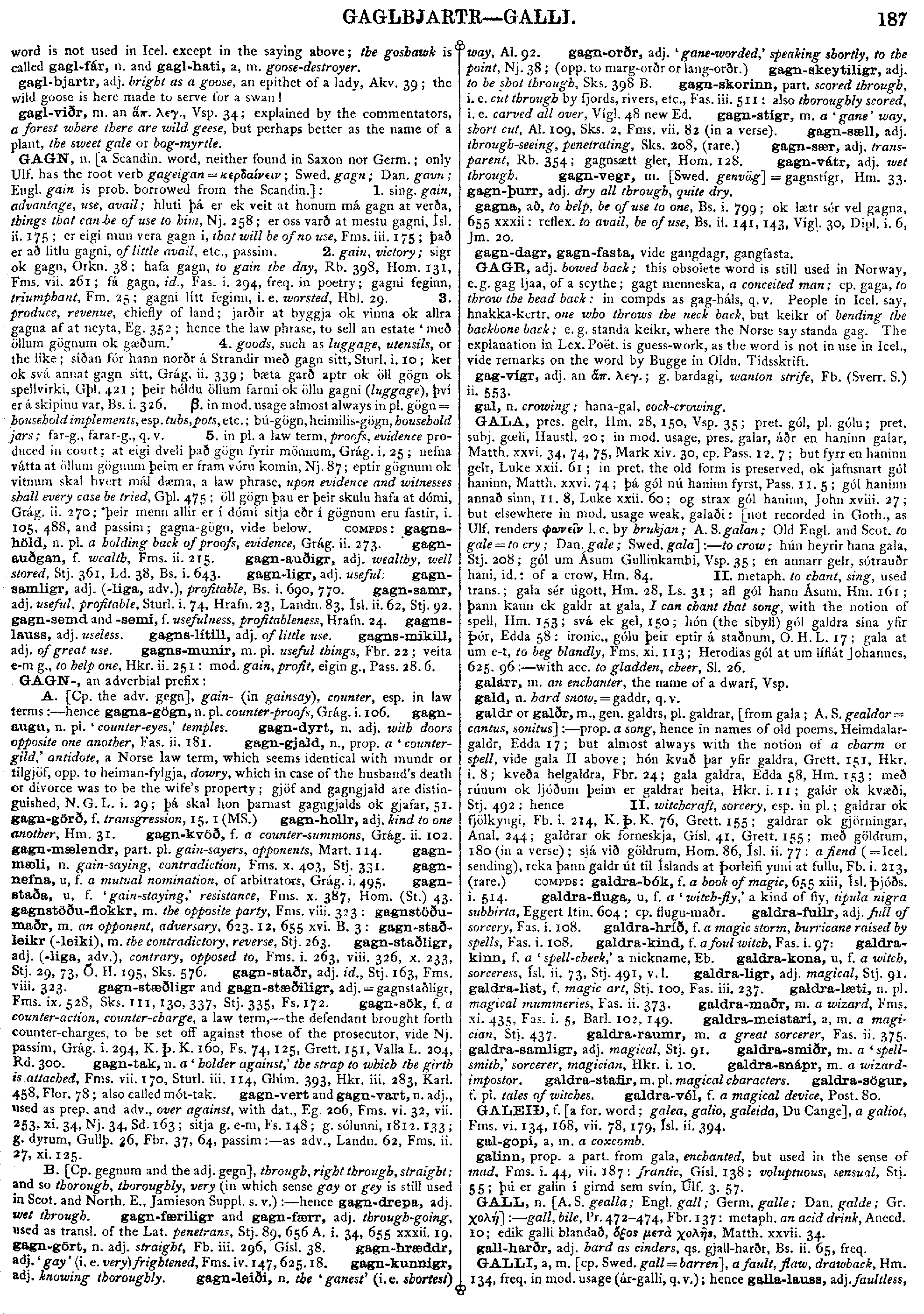
A. [Cp. the adv. gegn], gain- (in gainsay), counter, esp. in law terms :-- hence gagna-gögn, n. pl. counter-proofs, Grág. i. 106. gagn-augu, n. pl. 'counter-eyes,' temples. gagn-dyrt, n. adj. with doors opposite one another, Fas. ii. 181. gagn-gjald, n., prop. a 'countergild,' antidote, a Norse law term, which seems identical with mundr or tilgjöf, opp. to heiman-fylgja, dowry, which in case of the husband's death or divorce was to be the wife's property; gjöf and gagngjald are distinguished, N. G. L. i. 29; þá skal hon þarnast gagngjalds ok gjafar, 51. gagn-görð, f. transgression, 15. 1 (MS.) gagn-hollr, adj. kind to one another, Hm. 31. gagn-kvöð, f. a counter-summons, Grág. ii. 102. gagn-mælendr, part. pl. gain-sayers, opponents, Mart. 114. gagn-mæli, n. gain-saying, contradiction, Fms. x. 403, Stj. 331. gagn-nefna, u, f. a mutual nomination, of arbitrators, Grág. i. 495. gagn-staða, u, f. 'gain-staying,' resistance, Fms. x. 387, Hom. (St.) 43. gagnstöðu-flokkr, m. the opposite party, Fms. viii. 323: gagnstöðu-maðr, m. an opponent, adversary, 623. 12, 655 xvi. B. 3: gagn-staðleikr (-leiki), m. the contradictory, reverse, Stj. 263. gagn-staðligr, adj. (-liga, adv.), contrary, opposed to, Fms. i. 263, viii. 326, x. 233, Stj. 29, 73, Ó. H. 195, Sks. 576. gagn-staðr, adj. id., Stj. 163, Fms. viii. 323. gagn-stæðligr and gagn-stæðiligr, adj. = gagnstaðligr, Fms. ix. 528, Sks. 111, 130, 337, Stj. 335, Fs. 172. gagn-sök, f. a counter-action, counter-charge, a law term, -- the defendant brought forth counter-charges, to be set off against those of the prosecutor, vide Nj. passim, Grág. i. 294, K. Þ. K. 160, Fs. 74, 125, Grett. 151, Valla L. 204, Rd. 300. gagn-tak, n. a 'holder against,' the strap to which the girth is attached, Fms. vii. 170, Sturl. iii. 114, Glúm. 393, Hkr. iii. 283, Karl. 458, Flor. 78; also called mót-tak. gagn-vert and gagn-vart, n. adj., used as prep. and adv., over against, with dat., Eg. 206, Fms. vi. 32, vii. 253. xi. 34, Nj. 34, Sd. 163; sitja g. e-m, Fs. 148; g. sólunni, 1812. 133; g. dyrum, Gullþ. 26, Fbr. 37, 64, passim :-- as adv., Landn. 62, Fms. ii. 27, xi. 125.
|
Source: Cleasby/Vigfusson, page b0187, entry 7 View original page image as: [TIFF] [PNG] [View previous entry] [View next entry] |
[Comment on this entry] [View comments] |
The following entry has been hand-corrected once. |
B. [Cp. gegnum and the adj. gegn], through, right through, straight; and so thorough, thoroughly, very (in which sense gay or gey is still used in Scot. and North. E., Jamieson Suppl. s.v.) :-- hence gagn-drepa, adj. wet through. gagn-færiligr and gagn-færr, adj. through-going, used as transl. of the Lat. penetrans, Stj. 89, 656 A. i. 34, 655 xxxii. 19. gagn-gört, n. adj. straight, Fb. iii. 296, Gísl. 38. gagn-hræddr, adj. 'gay' (i.e. very) frightened, Fms. iv. 147, 625. 18. gagn-kunnigr, adj. knowing thoroughly. gagn-leiði, n. the 'ganest' (i.e. shortest) way, Al. 92. gagn-orðr, adj. 'gane-worded,' speaking shortly, to the point, Nj. 38; (opp. to marg-orðr or lang-orðr.) gagn-skeytiligr, adj. to be shot through, Sks. 398 B. gagn-skorinn, part. scored through, i.e. cut through by fjords, rivers, etc., Fas. iii. 511: also thoroughly scored, i.e. carved all over, Vígl. 48 new Ed. gagn-stígr, m. a 'gane' way, short cut, Al. 109, Sks. 2, Fms. vii. 82 (in a verse). gagn-sæll, adj. through-seeing, penetrating, Sks. 208, (rare.) gagn-sær, adj. transparent, Rb. 354; gagnsætt gler, Hom. 128. gagn-vátr, adj. wet through. gagn-vegr, m. [Swed. genväg] = gagnstígr, Hm. 33. gagn-þurr, adj. dry all through, quite dry.
|
Source: Cleasby/Vigfusson, page b0188, entry 13 View original page image as: [TIFF] [PNG] [View previous entry] [View next entry] |
[Comment on this entry] [View comments] |
The following entry has been hand-corrected once. |
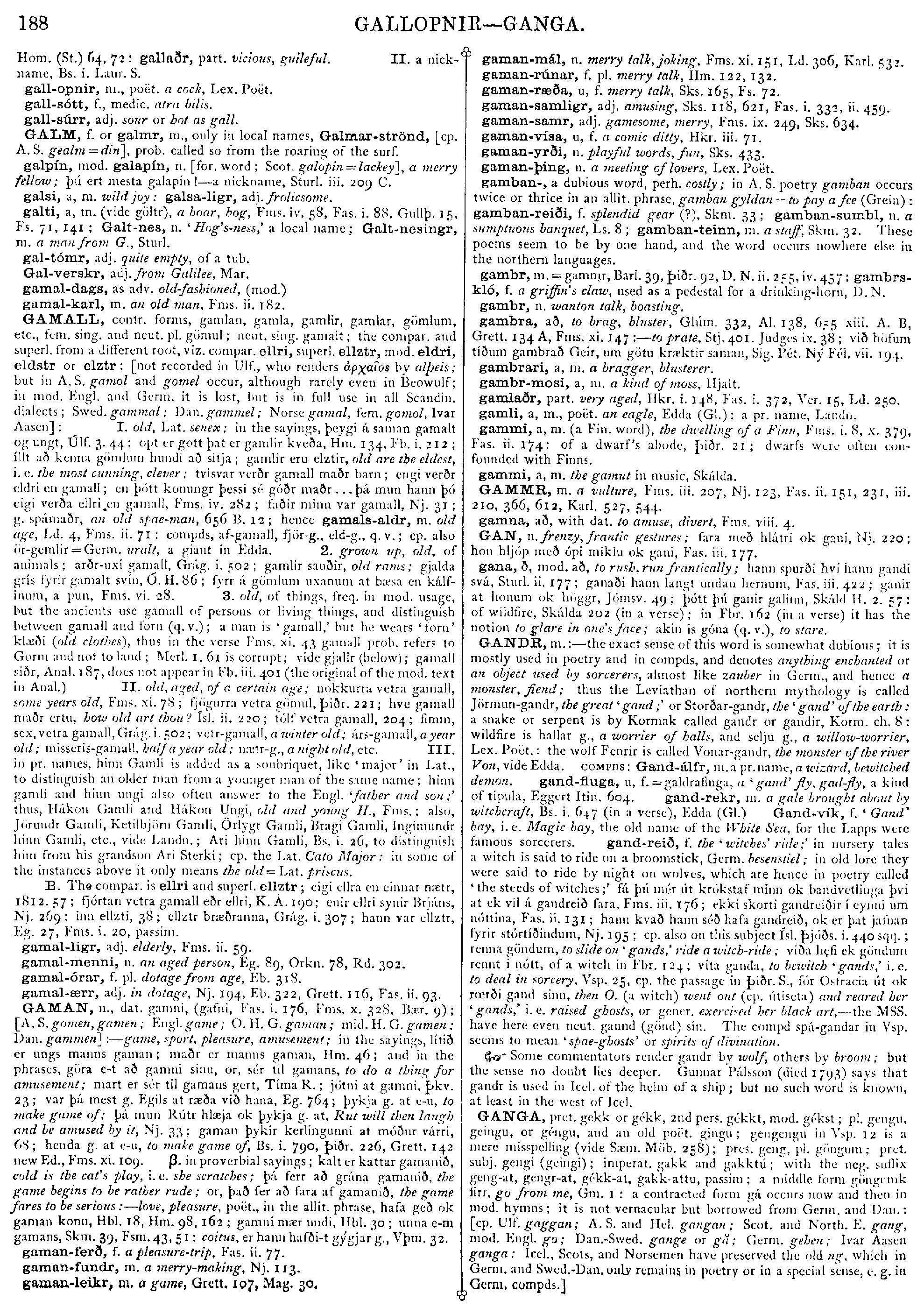
GAMALL, contr. forms, gamlan, gamla, gamlir, gamlar, gömlum, etc., fem. sing. and neut. pl. gömul; neut. sing, gamalt; the compar. and superl. from a different root, viz. compar. ellri, superl. ellztr, mod. eldri eldstr or elztr: [not recorded in Ulf., who renders GREEK by alþeis; but in A. S. gamol and gomel occur, although rarely even in Beowulf; in mod. Engl. and Germ. it is lost, but is in full use in all Scandin. dialects; Swed. gammal; Dan. gammel; Norse gamal, fem. gomol, Ivar Aasen]: I. old, Lat. senex; in the sayings, þeygi á saman gamalt og ungt, Úlf. 3. 44; opt er gott þat er gamlir kveða, Hm. 134, Fb. i. 212; íllt að kenna gömlum hundi að sitja; gamlir eru elztir, old are the eldest, i.e. the most cunning, clever; tvisvar verðr gamall maðr barn; engi verðr eldri en gamall; en þótt konungr þessi sé góðr maðr ... þá mun hann þó eigi verða ellri en gamall, Fms. iv. 282; faðir minn var gamall, Nj. 31; g. spámaðr, an old spae-man, 656 B. 12; hence gamals-aldr, m. old age, Ld. 4, Fms. ii. 71: compds, af-garnall, fjör-g., eld-g., q.v.; cp. also ör-gemlir = Germ. uralt, a giant in Edda. 2. grown up, old, of animals; arðr-uxi gamall, Grág. i. 502; gamlir sauðir, old rams; gjalda grís fyrir gamalt svín, Ó. H. 86; fyrr á gömlum uxanum at bæsa en kálfinum, a pun, Fms. vi. 28. 3. old, of things, freq. in mod. usage, but the ancients use gamall of persons or living things, and distinguish between gamall and forn (q.v.); a man is 'gamall,' but he wears 'forn' klæði (old clothes), thus in the verse Fms. xi. 43 gamall prob. refers to Gorm and not to land; Merl. 1. 61 is corrupt; vide gjallr (below); gamall siðr, Anal. 187, does not appear in Fb. iii. 401 (the original of the mod. text in Anal.) II. old, aged, of a certain age; nokkurra vetra gamall, some years old, Fms. xi. 78; fjögurra vetra gömul, Þiðr. 221; hve gamall maðr ertu, how old art thou? Ísl. ii. 220; tólf vetra gamall, 204; fimm, sex, vetra gamall, Grág. i. 502; vetr-gamall, a winter old; árs-gamall, a year old; misseris-gamall, half a year old; nætr-g., a night old, etc. III. in pr. names, hinn Gamli is added as a soubriquet, like 'major' in Lat., to distinguish an older man from a younger man of the same name; hinn gamli and hinn ungi also often answer to the Engl. 'father and son;' thus, Hákon Gamli and Hákon Ungi, old and young H., Fms.; also, Jörundr Gamli, Ketilbjörn Gamli, Örlygr Gamli, Bragi Gamli, Ingimundr hinn Gamli, etc., vide Landn.; Ari hinn Gamli, Bs. i. 26, to distinguish him from his grandson Ari Sterki; cp. the Lat. Cato Major: in some of the instances above it only means the old = Lat. priscus.
|
Source: Cleasby/Vigfusson, page b0188, entry 45 View original page image as: [TIFF] [PNG] [View previous entry] [View next entry] |
[Comment on this entry] [View comments] |
The following entry has been hand-corrected once. |
GANDR, m. :-- the exact sense of this word is somewhat dubious; it is mostly used in poetry and in compds, and denotes anything enchanted or an object used by sorcerers, almost like zauber in Germ., and hence a monster, fiend; thus the Leviathan of northern mythology is called Jörmun-gandr, the great 'gand;' or Storðar-gandr, the 'gand' of the earth: a snake or serpent is by Kormak called gandr or gandir, Korm. ch. 8: wildfire is hallar g., a worrier of halls, and selju g., a willow-worrier, Lex. Poët.: the wolf Fenrir is called Vonar-gandr, the monster of the river Von, vide Edda. COMPDS: Gand-álfr, in. a pr. name, a wizard, bewitched demon. gand-fluga, u, f. = galdrafluga, a 'gand' fly, gad-fly, a kind of tipula, Eggert Itin. 604. gand-rekr, m. a gale brought about by witchcraft, Bs. i. 647 (in a verse), Edda (Gl.) Gand-vík, f. 'Gand' bay, i.e. Magic bay, the old name of the White Sea, for the Lapps were famous sorcerers. gand-reið, f. the 'witches' ride;' in nursery tales a witch is said to ride on a broomstick, Germ. besenstiel; in old lore they were said to ride by night on wolves, which are hence in poetry called 'the steeds of witches;' fá þú mér út krókstaf minn ok bandvetlinga því at ek vil á gandreið fara, Fms. iii. 176; ekki skorti gandreiðir í eynni um nóttina, Fas. ii. 131; hann kvað hann séð hafa gandreið, ok er þat jafnan fyrir stórtíðindum, Nj. 195; cp. also on this subject Ísl. Þjóðs. i. 440 sqq.; renna göndum, to slide on 'gands,' ride a witch-ride; víða hefi ek göndum rennt í nótt, of a witch in Fbr. 124; víta ganda, to bewitch 'gands,' i.e. to deal in sorcery, Vsp. 25, cp. the passage in Þiðr. S., fór Ostracia út ok rœrði gand sinn, then O. (a witch) went out (cp. útiseta) and reared her 'gands,' i.e. raised ghosts, or gener. exercised her black art, -- the MSS. have here even neut. gannd (gönd) sín. The compd spá-gandar in Vsp. seems to mean 'spae-ghosts' or spirits of divination.
|
Source: Cleasby/Vigfusson, page b0189, entry 1 View original page image as: [TIFF] [PNG] [View previous entry] [View next entry] |
[Comment on this entry] [View comments] |
The following entry has been hand-corrected once. |
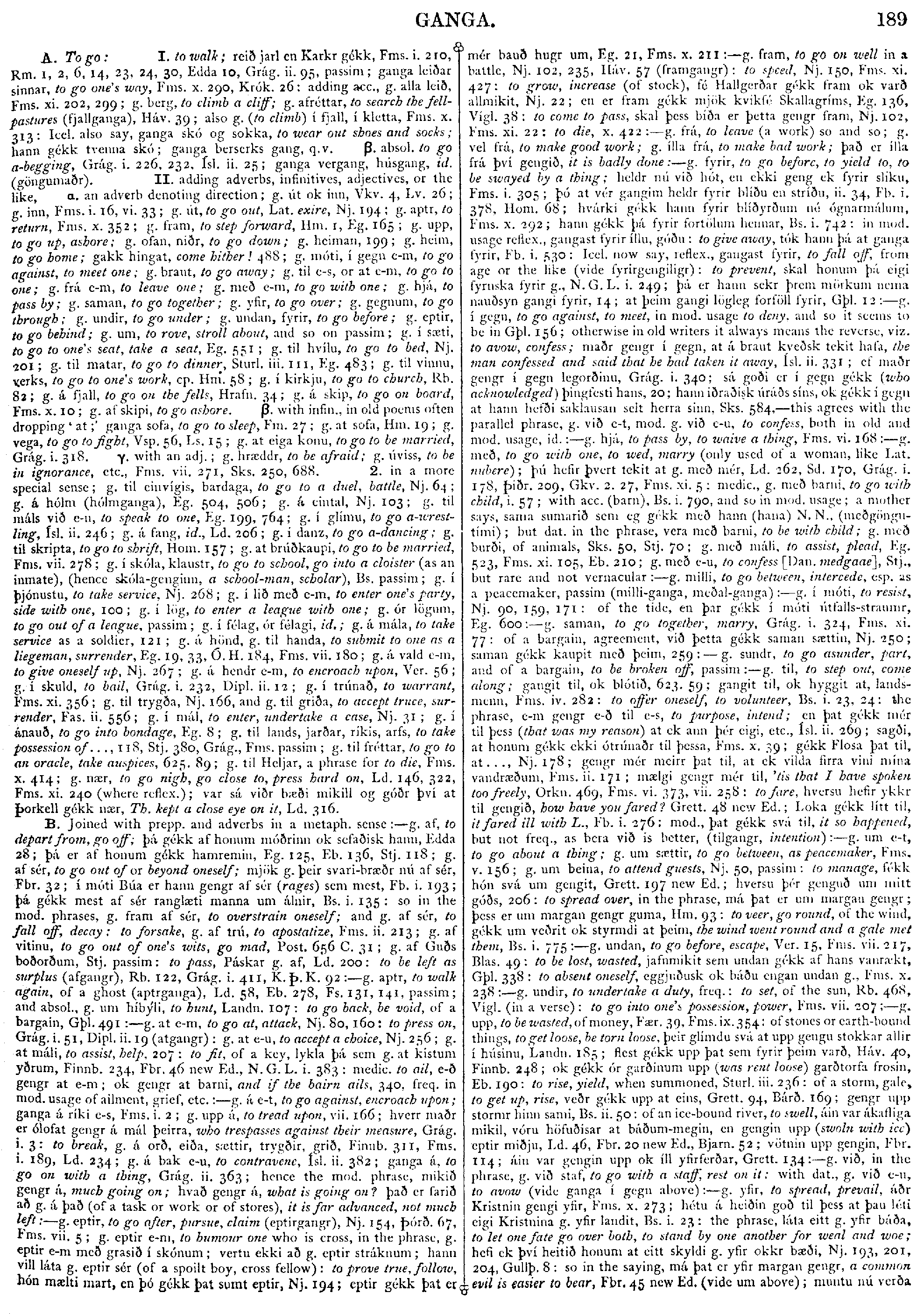
A.
To
go:
I.
to
walk;
reið
jarl
en
Karkr
gékk,
Fms.
i.
210,
Rm.
1,
2,
6,
14,
23,
24,
30,
Edda
10,
Grág.
ii.
95,
passim;
ganga
leiðar
sinnar,
to
go
one's
way,
Fms.
x.
290,
Krók.
26:
adding
acc.,
g.
alla
leið,
Fms.
xi.
202,
299;
g.
berg,
to
climb
a
cliff;
g.
afréttar,
to
search
the
fell-pastures
(fjallganga),
Háv.
39;
also
g.
(to
climb)
í
fjall,
í
kletta,
Fms.
x.
313:
Icel.
also
say,
ganga
skó
og
sokka,
to
wear
out
shoes
and
socks;
hann
gékk
tvenna
skó;
ganga
berserks
gang,
q.v.
.
absol.
to
go
a-begging,
Grág.
i.
226,
232,
Ísl.
ii.
25;
ganga
vergang,
húsgang,
id.
(göngumaðr).
II.
adding
adverbs,
infinitives,
adjectives,
or
the
like,
.
an
adverb
denoting
direction;
g.
út
ok
inn,
Vkv.
4,
Lv.
26;
g.
inn,
Fms.
i.
16,
vi.
33;
g.
út,
to
go
out,
Lat.
exire,
Nj.
194;
g.
aptr,
to
return,
Fms.
x.
352;
g.
fram,
to
step
forward,
Hm.
1,
Eg.
165;
g.
upp,
to
go
up,
ashore;
g.
ofan,
niðr,
to
go
down;
g.
heiman,
199;
g.
heim,
to
go
home;
gakk
hingat,
come
hither!
488;
g.
móti,
í
gegn
e-m,
to
go
against,
to
meet
one;
g.
braut,
to
go
away;
g.
til
e-s,
or
at
e-m,
to
go
to
one;
g.
frá
e-m,
to
leave
one;
g.
með
e-m,
to
go
with
one;
g.
hjá,
to
pass
by;
g.
saman,
to
go
together;
g.
yfir,
to
go
over;
g.
gegnum,
to
go
through;
g.
undir,
to
go
under;
g.
undan,
fyrir,
to
go
before;
g.
eptir,
to
go
behind;
g.
um,
to
rove,
stroll
about,
and
so
on
passim;
g.
í
sæti,
to
go
to
one's
seat,
take
a
seat,
Eg.
551;
g.
til
hvílu,
to
go
to
bed,
Nj.
201;
g.
til
matar,
to
go
to
dinner,
Sturl.
iii.
111,
Eg.
483;
g.
til
vinnu,
verks,
to
go
to
one's
work,
cp.
Hm.
58;
g.
í
kirkju,
to
go
to
church,
Rb.
82;
g.
á
fjall,
to
go
on
the
fells,
Hrafn.
34;
g.
á
skip,
to
go
on
board,
Fms.
x.
10;
g.
af
skipi,
to
go
ashore.
.
with
infin.,
in
old
poems
often
dropping
'at;'
ganga
sofa,
to
go
to
sleep,
Fm.
27;
g.
at
sofa,
Hm.
19;
g.
vega,
to
go
to
fight,
Vsp.
56,
Ls.
15;
g.
at
eiga
konu,
to
go
to
be
married,
Grág.
i.
318.
.
with
an
adj.;
g.
hræddr,
to
be
afraid;
g.
úviss,
to
be
in
ignorance,
etc.,
Fms.
vii.
271,
Sks.
250,
688.
2.
in
a
more
special
sense;
g.
til
einvígis,
bardaga,
to
go
to
a
duel,
battle,
Nj.
64;
g.
á
hólm
(hólmganga),
Eg.
504,
506;
g.
á
eintal,
Nj.
103;
g.
til
máls
við
e-n,
to
speak
to
one,
Eg.
199,
764;
g.
í
glímu,
to
go
a-wrestling,
Ísl.
ii.
246;
g.
á
fang,
id.,
Ld.
206;
g.
í
danz,
to
go
a-dancing;
g.
til
skripta,
to
go
to
shrift,
Hom.
157;
g.
at
brúðkaupi,
to
go
to
be
married,
Fms.
vii.
278;
g.
í
skóla,
klaustr,
to
go
to
school,
go
into
a
cloister
(as
an
inmate),
(hence
skóla-genginn,
a
school-man,
scholar),
Bs.
passim;
g.
í
þjónustu,
to
take
service,
Nj.
268;
g.
í
lið
með
e-m,
to
enter
one's
party,
side
with
one,
100;
g.
í
lög,
to
enter
a
league
with
one;
g.
ór
lögum,
to
go
out
of
a
league,
passim;
g.
í
félag,
ór
félagi,
id.;
g.
á
mala,
to
take
service
as
a
soldier,
121;
g.
á
hönd,
g.
til
handa,
to
submit
to
one
as
a
liegeman,
surrender,
Eg.
19,
33,
Ó.
H.
184,
Fms.
vii.
180;
g.
á
vald
e-m,
to
give
oneself
up,
Nj.
267;
g.
á
hendr
e-m,
to
encroach
upon,
Ver.
56;
g.
í
skuld,
to
bail,
Grág.
i.
232,
Dipl.
ii.
12;
g.
í
trúnað,
to
warrant,
Fms.
xi.
356;
g.
til
trygða,
Nj.
166,
and
g.
til
griða,
to
accept
truce,
surrender,
Fas.
ii.
556;
g.
í
mál,
to
enter,
undertake
a
case,
Nj.
31;
g.
í
ánauð,
to
go
into
bondage,
Eg.
8;
g.
til
lands,
jarðar,
ríkis,
arfs,
to
take
possession
of
...,
118,
Stj.
380,
Grág.,
Fms.
passim;
g.
til
fréttar,
to
go
to
an
oracle,
take
auspices,
625.
89;
g.
til
Heljar,
a
phrase
for
to
die,
Fms.
x.
414;
g.
nær,
to
go
nigh,
go
close
to,
press
hard
on,
Ld.
146,
322,
Fms.
xi.
240
(where
reflex.);
var
sá
viðr
bæði
mikill
og
góðr
því
at
Þorkell
gékk
nær,
Th.
kept
a
close
eye
on
it,
Ld.
316.
| Result Page: |  |
Previous | 107 108 109 110 111 112 113 114 115 116 117 118 119 120 121 122 123 124 125 | Next |  |
Germanic Lexicon Project (main page)
This search system was written by
Sean Crist
Please consider
volunteering
to correct the data in these online dictionaries.
No rights reserved. Feel free to use these data in any way you please.