|
|

ædificium (3 results)
Search for aedificium again, using less strict matching (14 results)
|
Source: Torp, page b0187, entry 14 View original page image as: [TIFF] [PNG] [View previous entry] [View next entry] |
[Comment on this entry] [View comments] |
The following entry has been hand-corrected once. |
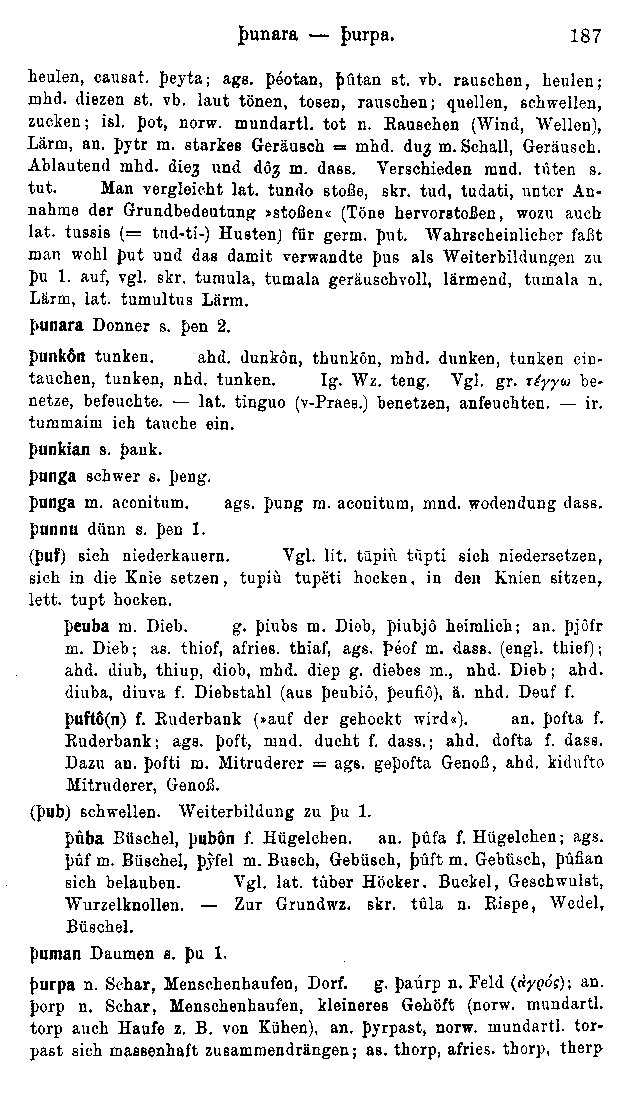
þurpa
n.
Schar,
Menschenhaufen,
Dorf.
g.
þaúrp
n.
Feld
([a)gro's]);
an.
þorp
n.
Schar,
Menschenhaufen,
kleineres
Gehöft
(norw.
mundartl.
torp
auch
Haufe
z.
B.
von
Kühen),
an.
þyrpast,
norw.
mundartl.
torpast
sich
massenhaft
zusammendrängen;
as.
thorp,
afries.
thorp,
therp
[Translate the German words]
|
Source: Torp, page b0190, entry 7 View original page image as: [TIFF] [PNG] [View previous entry] [View next entry] |
[Comment on this entry] [View comments] |
The following entry has been hand-corrected once. |
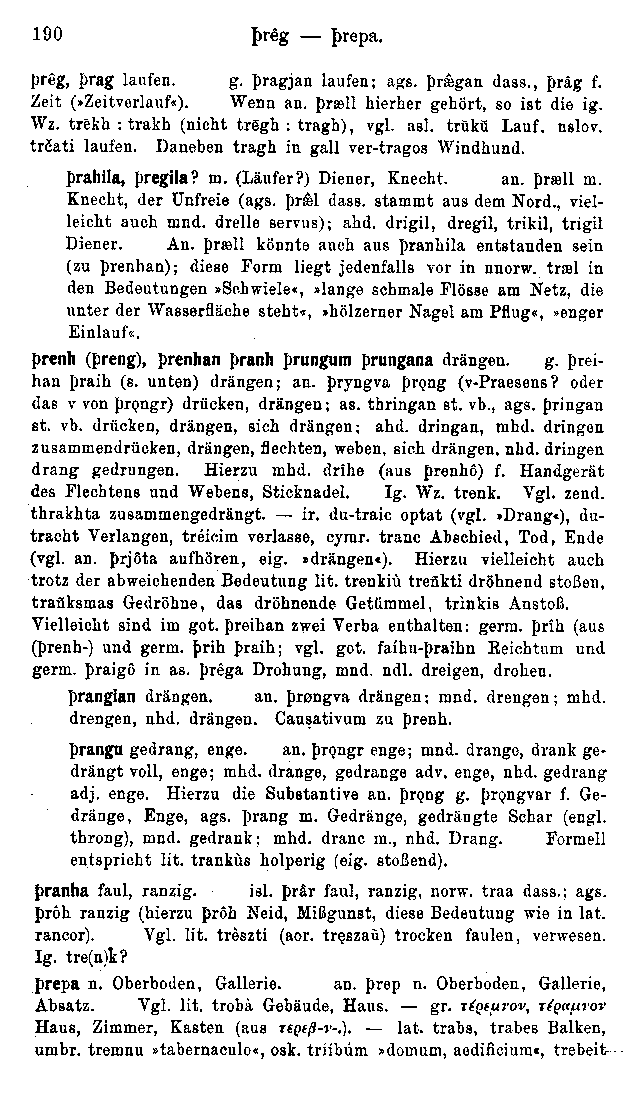
þrepa
n.
Oberboden,
Gallerie.
an.
þrep
n.
Oberboden,
Gallerie,
Absatz.
Vgl.
lit.
trobà
Gebäude,
Haus.
-
gr.
[te'remnon,
te'ramnon]
Haus,
Zimmer,
Kasten
(aus
[tereb-n-].).
-
lat.
trabs,
trabes
Balken,
umbr.
tremnu
»tabernaculo«,
osk.
trííbúm
»domum,
aedificium«,
trebeit
[Translate the German words]
|
Source: Bosworth/Toller, page b0962, entry 29 View original page image as: [TIFF] [PNG] [View previous entry] [View next entry] |
[Comment on this entry] [View comments] |
The following entry has been hand-corrected once. |
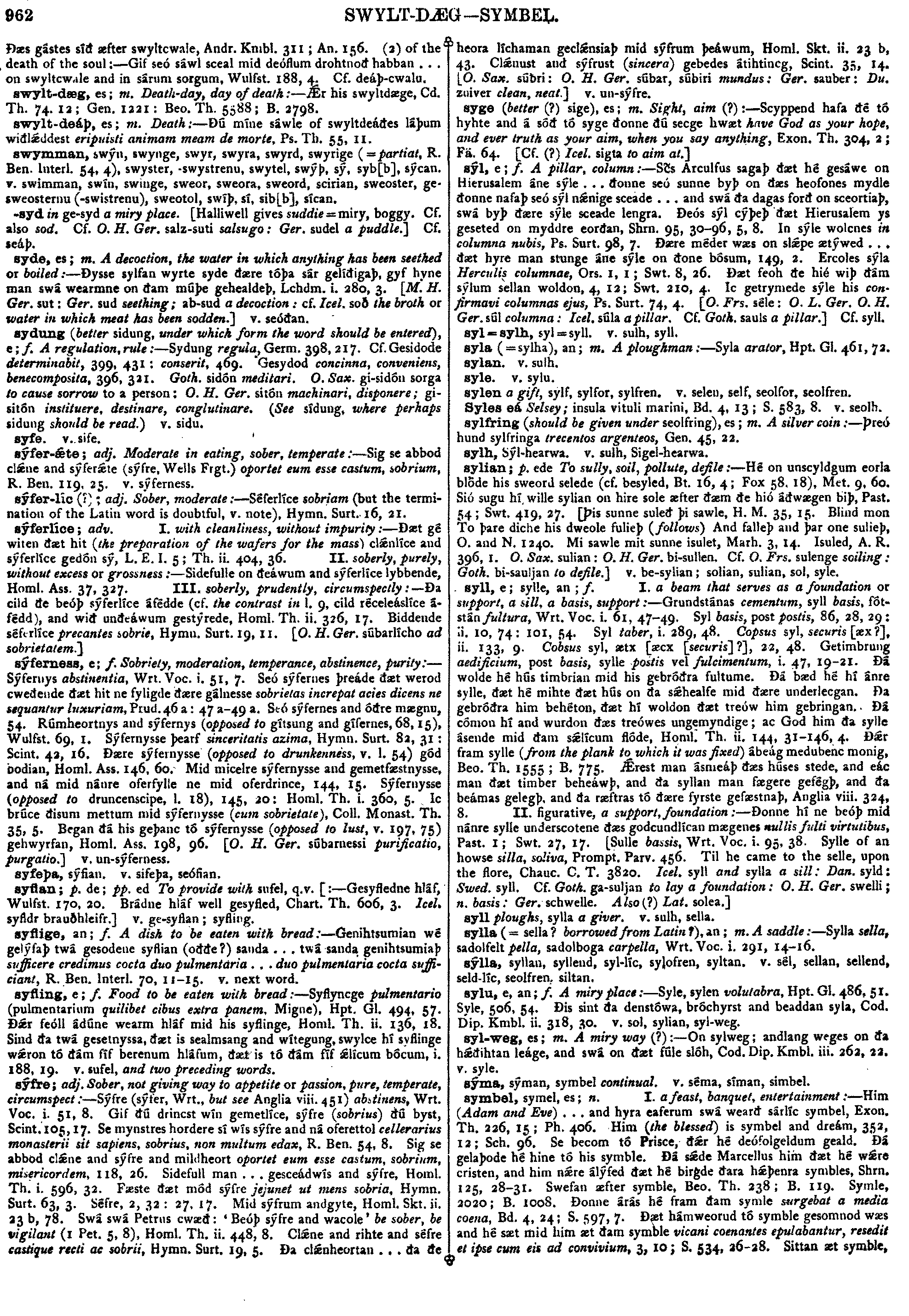
syll,
e;
sylle,
an;
f.
I.
a
beam
that
serves
as
a
foundation
or
support,
a
sill,
a
basis,
support:--Grundstánas
cementum,
syll
basis,
fót stán
fultura,
Wrt.
Voc.
i.
61,
47-49.
Syl
basis,
post
postis,
86,
28,
29:
ii.
10,
74:
101,
54.
Syl
taber,
i.
289,
48.
Copsus
syl,
securis
[æx?],
ii.
133,
9.
Cobsus
syl,
ætx
[æcx
[securis]?],
22,
48.
Getimbrung
aedificium,
post
basis,
sylle
postis
vel
fulcimentum,
i.
47,
19-21.
Ðá
wolde
hé
hús
timbrian
mid
his
gebróðra
fultume.
Ðá
bæd
hé
hí
ánre
sylle,
ðæt
hé
mihte
ðæt
hús
on
ða
s
stán
fultura,
Wrt.
Voc.
i.
61,
47-49.
Syl
basis,
post
postis,
86,
28,
29:
ii.
10,
74:
101,
54.
Syl
taber,
i.
289,
48.
Copsus
syl,
securis
[æx?],
ii.
133,
9.
Cobsus
syl,
ætx
[æcx
[securis]?],
22,
48.
Getimbrung
aedificium,
post
basis,
sylle
postis
vel
fulcimentum,
i.
47,
19-21.
Ðá
wolde
hé
hús
timbrian
mid
his
gebróðra
fultume.
Ðá
bæd
hé
hí
ánre
sylle,
ðæt
hé
mihte
ðæt
hús
on
ða
s healfe
mid
ðære
underlecgan.
Ða
gebróðra
him
behéton,
ðæt
hí
woldon
ðæt
treów
him
gebringan.
Ðá
cómon
hí
and
wurdon
ðæs
treówes
ungemyndige;
ac
God
him
ða
sylle
ásende
mid
ðam
slícum
flóde,
Homl.
Th.
ii.
144,
31-146,
4.
Ðr
fram
sylle
(from
the
plank
to
which
it
was
fixed)
ábeág
medubenc
monig,
Beo.
Th.
1555;
B.
775.
Æ-acute;rest
man
ásmeáþ
ðæs
húses
stede,
and
eác
man
ðæt
timber
beheáwþ,
and
ða
syllan
man
fægere
gefégþ,
and
ða
beámas
gelegþ,
and
ða
ræftras
tó
ðære
fyrste
gefæstnaþ,
Anglia
viii.
324,
8.
II.
figurative,
a
support,
foundation:--Ðonne
hí
ne
beóþ
mid
nánre
sylle
underscotene
ðæs
godcundlícan
mægenes
nullis
fulti
virtutibus,
Past.
1;
Swt.
27,
17.
[Sulle
bassis,
Wrt.
Voc.
i.
95,
38.
Sylle
of
an
howse
silla,
soliva,
Prompt.
Parv.
456.
Til
he
came
to
the
selle,
upon
the
flore,
Chauc.
C.
T.
3820.
Icel.
syll
and
sylla
a
sill:
Dan.
syld:
Swed.
syll.
Cf.
Goth.
ga-suljan
to
lay
a
foundation:
O.
H.
Ger.
swelli;
n.
basis:
Ger.
schwelle.
Also
(?)
Lat.
solea.]
healfe
mid
ðære
underlecgan.
Ða
gebróðra
him
behéton,
ðæt
hí
woldon
ðæt
treów
him
gebringan.
Ðá
cómon
hí
and
wurdon
ðæs
treówes
ungemyndige;
ac
God
him
ða
sylle
ásende
mid
ðam
slícum
flóde,
Homl.
Th.
ii.
144,
31-146,
4.
Ðr
fram
sylle
(from
the
plank
to
which
it
was
fixed)
ábeág
medubenc
monig,
Beo.
Th.
1555;
B.
775.
Æ-acute;rest
man
ásmeáþ
ðæs
húses
stede,
and
eác
man
ðæt
timber
beheáwþ,
and
ða
syllan
man
fægere
gefégþ,
and
ða
beámas
gelegþ,
and
ða
ræftras
tó
ðære
fyrste
gefæstnaþ,
Anglia
viii.
324,
8.
II.
figurative,
a
support,
foundation:--Ðonne
hí
ne
beóþ
mid
nánre
sylle
underscotene
ðæs
godcundlícan
mægenes
nullis
fulti
virtutibus,
Past.
1;
Swt.
27,
17.
[Sulle
bassis,
Wrt.
Voc.
i.
95,
38.
Sylle
of
an
howse
silla,
soliva,
Prompt.
Parv.
456.
Til
he
came
to
the
selle,
upon
the
flore,
Chauc.
C.
T.
3820.
Icel.
syll
and
sylla
a
sill:
Dan.
syld:
Swed.
syll.
Cf.
Goth.
ga-suljan
to
lay
a
foundation:
O.
H.
Ger.
swelli;
n.
basis:
Ger.
schwelle.
Also
(?)
Lat.
solea.]
|
Source: Bosworth/Toller, page b0987, entry 1 View original page image as: [TIFF] [PNG] [View previous entry] [View next entry] |
[Comment on this entry] [View comments] |
The following entry has been hand-corrected once. |
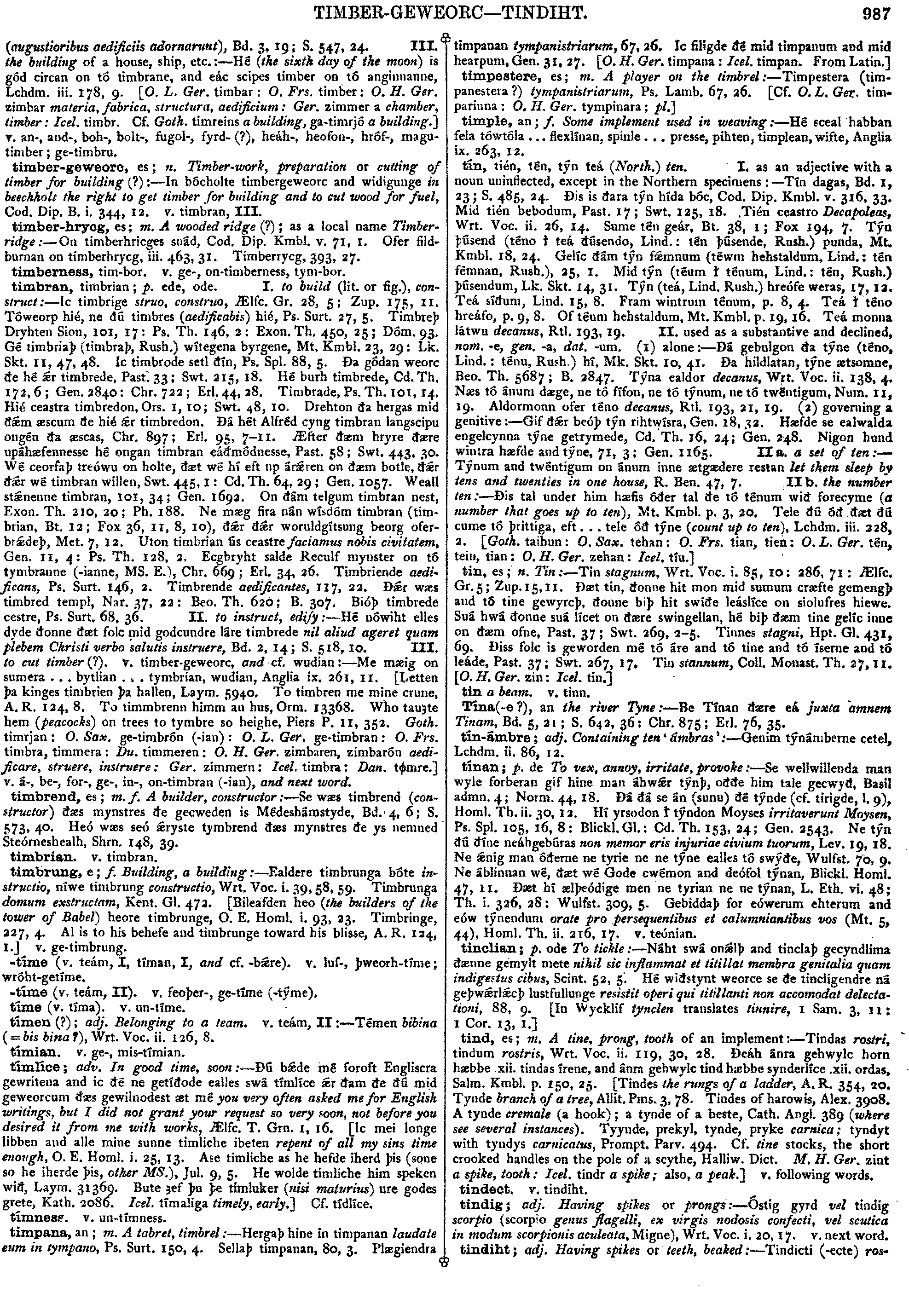
(augustioribus aedificiis adornarunt), Bd. 3, 19; S. 547, 24. III. the building of a house, ship, etc.:--Hé (the sixth day of the moon) is gód circan on tó timbrane, and eác scipes timber on tó anginnanne, Lchdm. iii. 178, 9. [O. L. Ger. timbar: O. Frs. timber: O. H. Ger. zimbar materia, fabrica, structura, aedificium: Ger. zimmer a chamber, timber: Icel. timbr. Cf. Goth. timreins a building, ga-timrjó a building.] v. an-, and-, boh-, bolt-, fugol-, fyrd- (?), heáh-, heofon-, hróf-, magu-timber; ge-timbru.
|
Source: Bosworth/Toller, page d0108, entry 16 View original page image as: [TIFF] [PNG] [View previous entry] [View next entry] |
[Comment on this entry] [View comments] |
The following entry has been hand-corrected once. |
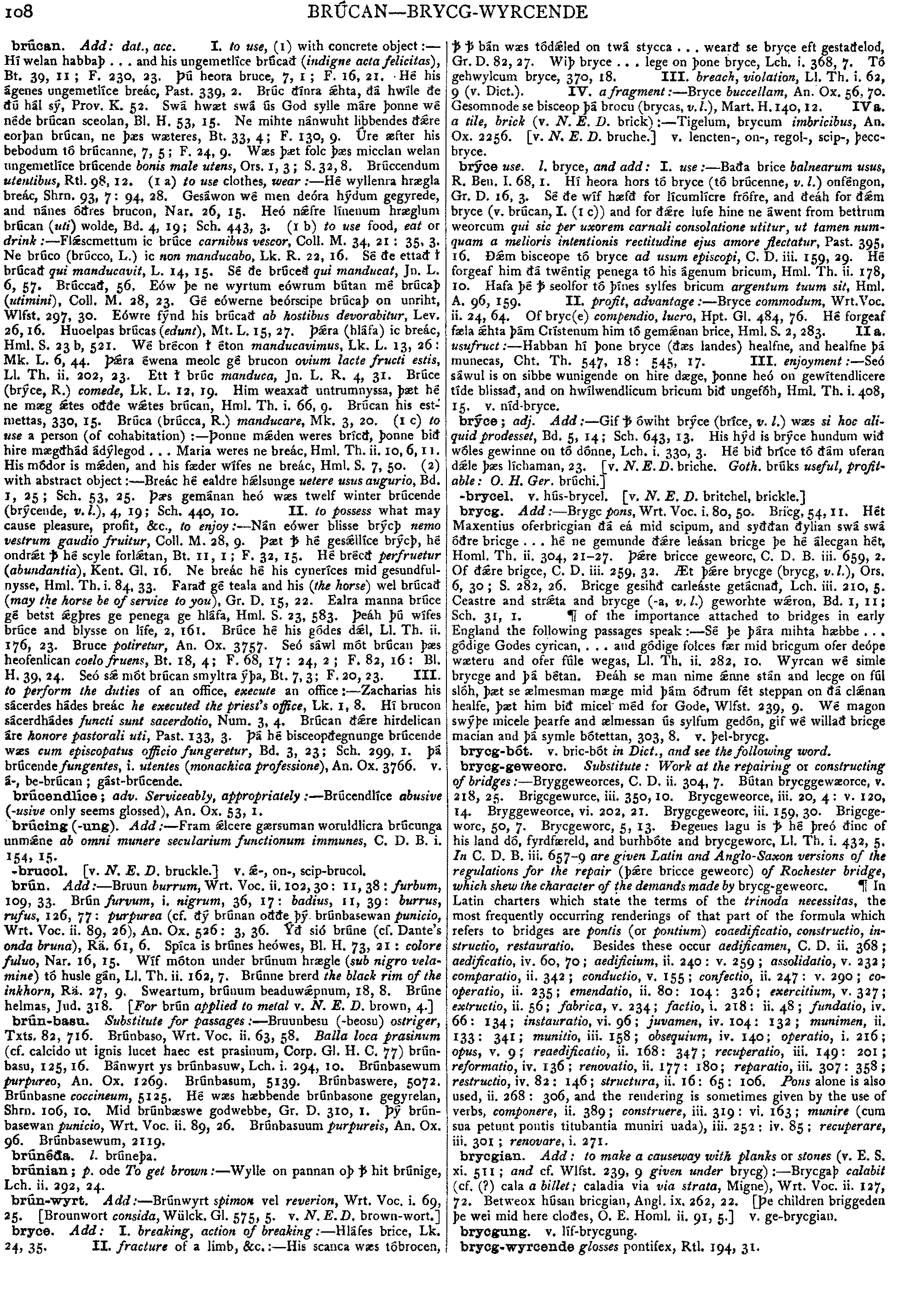
brycg-geweorc.
Substitute
:
Work
at
the
repairing
or
constructing
of
bridges
:--
Bryggeweorces,
C.
D.
ii.
304,
7.
Bútan
brycggewæorce,
v.
218,
25.
Brigcgewurce,
iii.
350,
10.
Brycgeweorce,
iii.
20,
4:
v.
120,
14.
Bryggeweorce,
vi.
202,
21.
Brygcgeweorc,
iii.
159,
30.
Brigcgeworc,
50,
7.
Brycgeworc,
5,
13.
Ðegenes
lagu
is
 hé
þreó
ðinc
of
his
land
dó,
fyrdfæreld,
and
burhbóte
and
brycgeworc.
Ll.
Th.
i.
432,
5.
In
C.
D.
B.
iii.
657-9
are
given
Latin
and
Anglo-Saxon
versions
of
the
regulations
for
the
repair
(þre
bricce
geweorc)
of
Rochester
bridge,
which
shew
the
character
of
the
demands
made
by
brycg-geweorc.

In
Latin
charters
which
state
the
terms
of
the
trinoda
necessitas,
the
most
frequently
occurring
renderings
of
that
part
of
the
formula
which
refers
to
bridges
are
pontis
(or
pontium)
coaedificatio,
constructio,
instructio,
restauratio.
Besides
these
occur
aedificamen,
C.
D.
ii.
368
;
aedificatio,
iv.
60,
70;
aedificium,
ii.
240
:
v.
259
;
assolidatio,
v.
232
;
comparatio,
ii.
342
;
conductio,
v.
155
;
confecfio,
ii.
247
:
v.
290
;
cooperatio,
ii.
235;
emendatio,
ii.
80:
104:
326;
exercitium,
v.
327;
extructio,
ii.
56;
fabrica,
v.
234;
factio,
i.
218:
ii.
48;
fundatio,
iv.
66:
134;
instauratio,
vi.
96;
juvamen,
iv.
104:
132;
munimen,
ii.
133:
341;
munitio,
iii.
158;
obsequium,
iv.
140;
operatio,
i.
216;
opus,
v.
9;
reaedificatio,
ii.
168:
347;
recuperatio,
iii.
149:
201;
reformatio,
iv.
136
;
renovatio,
ii.
177
:
180;
reparatio,
iii.
307
:
358
;
restructio,
iv.
82
:
146;
structura,
ii.
16:
65
:
106.
Pons
alone
is
also
used,
ii.
268
:
306,
and
the
rendering
is
sometimes
given
by
the
use
of
verbs,
componere,
ii.
389;
construere,
iii.
319:
vi.
163;
munire
(cum
sua
petunt
pontis
titubantia
muniri
uada),
iii.
252
:
iv.
85
;
recuperare,
iii.
301
;
renovare,
i.
271.
hé
þreó
ðinc
of
his
land
dó,
fyrdfæreld,
and
burhbóte
and
brycgeworc.
Ll.
Th.
i.
432,
5.
In
C.
D.
B.
iii.
657-9
are
given
Latin
and
Anglo-Saxon
versions
of
the
regulations
for
the
repair
(þre
bricce
geweorc)
of
Rochester
bridge,
which
shew
the
character
of
the
demands
made
by
brycg-geweorc.

In
Latin
charters
which
state
the
terms
of
the
trinoda
necessitas,
the
most
frequently
occurring
renderings
of
that
part
of
the
formula
which
refers
to
bridges
are
pontis
(or
pontium)
coaedificatio,
constructio,
instructio,
restauratio.
Besides
these
occur
aedificamen,
C.
D.
ii.
368
;
aedificatio,
iv.
60,
70;
aedificium,
ii.
240
:
v.
259
;
assolidatio,
v.
232
;
comparatio,
ii.
342
;
conductio,
v.
155
;
confecfio,
ii.
247
:
v.
290
;
cooperatio,
ii.
235;
emendatio,
ii.
80:
104:
326;
exercitium,
v.
327;
extructio,
ii.
56;
fabrica,
v.
234;
factio,
i.
218:
ii.
48;
fundatio,
iv.
66:
134;
instauratio,
vi.
96;
juvamen,
iv.
104:
132;
munimen,
ii.
133:
341;
munitio,
iii.
158;
obsequium,
iv.
140;
operatio,
i.
216;
opus,
v.
9;
reaedificatio,
ii.
168:
347;
recuperatio,
iii.
149:
201;
reformatio,
iv.
136
;
renovatio,
ii.
177
:
180;
reparatio,
iii.
307
:
358
;
restructio,
iv.
82
:
146;
structura,
ii.
16:
65
:
106.
Pons
alone
is
also
used,
ii.
268
:
306,
and
the
rendering
is
sometimes
given
by
the
use
of
verbs,
componere,
ii.
389;
construere,
iii.
319:
vi.
163;
munire
(cum
sua
petunt
pontis
titubantia
muniri
uada),
iii.
252
:
iv.
85
;
recuperare,
iii.
301
;
renovare,
i.
271.
|
Source: Bosworth/Toller, page d0438, entry 2 View original page image as: [TIFF] [PNG] [View previous entry] [View next entry] |
[Comment on this entry] [View comments (1)] |
The following entry has been hand-corrected once. |
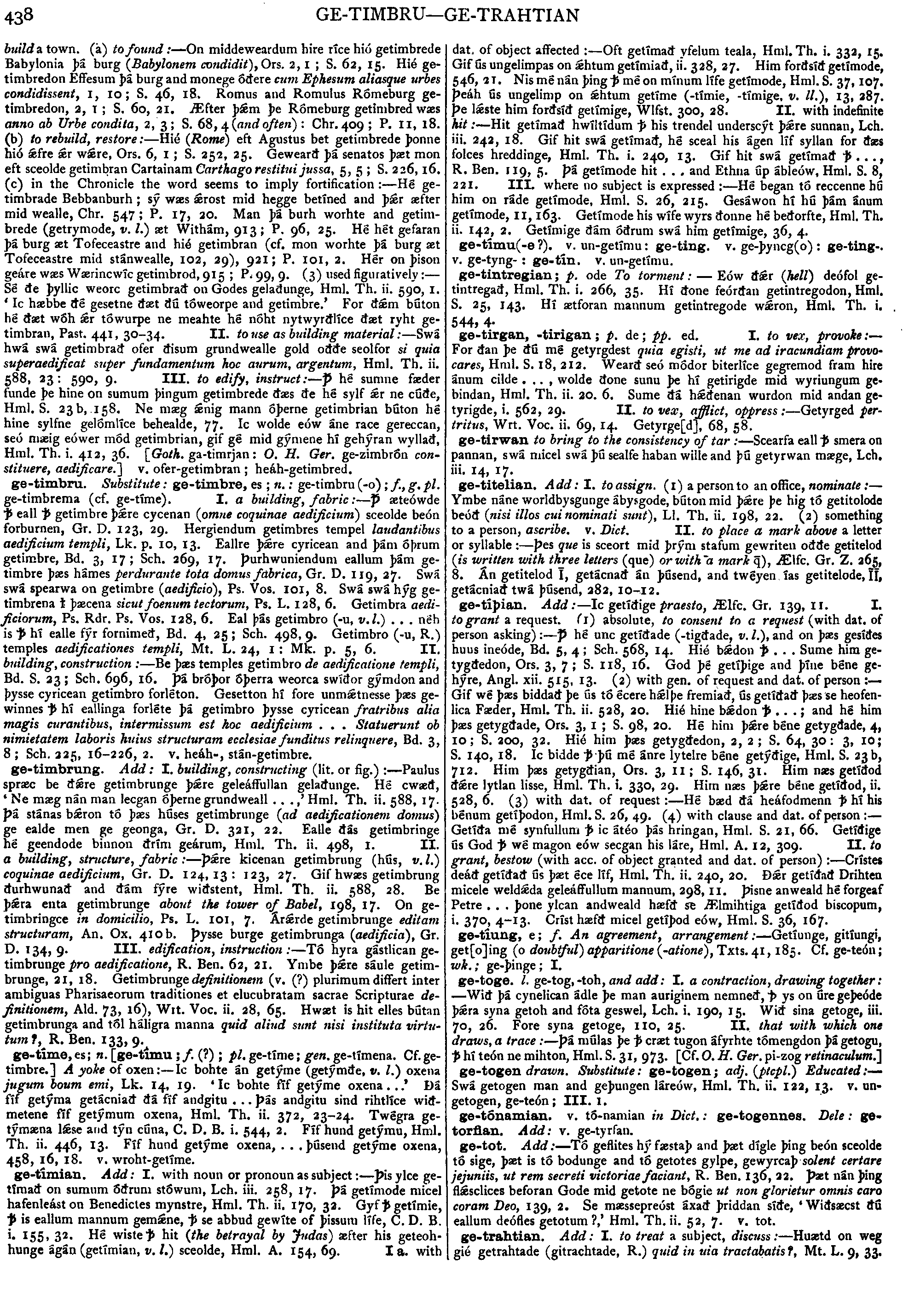
ge-timbru.
Substitute:
ge-timbre,
es;
n.:
ge-timbru
(-o);
f.,
g.
pl.
ge-timbrema
(cf.
ge-tíme).
I.
a
building,
fabric
:--
Þ-bar;
æteówde
eall
getimbre
þre
cycenan
(omne
coquinae
aedificium)
sceolde
beón
forburnen,
Gr.
D.
123,
29.
Hergiendum
getimbres
tempel
laudantibus
aedificium
templi,
Lk.
p.
10,
13.
Eallre
þre
cyricean
and
þám
óþrum
getimbre,
Bd.
3,
17;
Sch.
269,
17.
Þurhwuniendum
eallum
þám
getimbre
þæs
hames
perdurante
tota
domus
fabrica,
Gr.
D.
119,
27.
Swá
swá
spearwa
on
getimbre
(aedificio),
Ps.
Vos.
101,
8.
Swá
swá
hýg
getimbrena
 þæcena
sicut
foenum
tectorum,
Ps.
L.
128,
6.
Getimbra
aedificiorum,
Ps.
Rdr.
Ps.
Vos.
128,
6.
Eal
þás
getimbro
(-u,
v.
l.)
...
néh
is
hí
ealle
fýr
fornimeð,
Bd.
4,
25;
Sch.
498,
9.
Getimbro
(-u,
R.)
temples
aedificationes
templi,
Mt.
L.
24,
1:
Mk.
p.
5,
6.
II.
building,
construction
:--
Be
þæs
temples
getimbro
de
aedificatione
templi,
Bd.
S.
23;
Sch.
696,
16.
Þá
broþor
óþerra
weorca
swíðor
gýmdon
and
þysse
cyricean
getimbro
forléton.
Gesetton
hí
fore
unmtnesse
þæs
gewinnes
hí
eallinga
forléte
þá
getimbro
þysse
cyricean
fratribus
alia
magis
curantibus,
intermissum
esi
hoc
aedificium
...
Statuerunt
ob
nimietatem
laboris
huius
structuram
ecclesiae
funditus
relinquere,
Bd.
3,
8;
Sch.
225,
16-226,
2.
v.
heáh-,
stán-getimbre.
þæcena
sicut
foenum
tectorum,
Ps.
L.
128,
6.
Getimbra
aedificiorum,
Ps.
Rdr.
Ps.
Vos.
128,
6.
Eal
þás
getimbro
(-u,
v.
l.)
...
néh
is
hí
ealle
fýr
fornimeð,
Bd.
4,
25;
Sch.
498,
9.
Getimbro
(-u,
R.)
temples
aedificationes
templi,
Mt.
L.
24,
1:
Mk.
p.
5,
6.
II.
building,
construction
:--
Be
þæs
temples
getimbro
de
aedificatione
templi,
Bd.
S.
23;
Sch.
696,
16.
Þá
broþor
óþerra
weorca
swíðor
gýmdon
and
þysse
cyricean
getimbro
forléton.
Gesetton
hí
fore
unmtnesse
þæs
gewinnes
hí
eallinga
forléte
þá
getimbro
þysse
cyricean
fratribus
alia
magis
curantibus,
intermissum
esi
hoc
aedificium
...
Statuerunt
ob
nimietatem
laboris
huius
structuram
ecclesiae
funditus
relinquere,
Bd.
3,
8;
Sch.
225,
16-226,
2.
v.
heáh-,
stán-getimbre.
|
Source: Bosworth/Toller, page d0438, entry 3 View original page image as: [TIFF] [PNG] [View previous entry] [View next entry] |
[Comment on this entry] [View comments] |
The following entry has been hand-corrected once. |
ge-timbrung.
Add:
I.
building,
constructing
(lit.
or
fig.)
:--
Paulus
spræc
be
ðre
getimbrunge
þre
geleáffullan
gelaðunge.
Hé
cwæð,
'Ne
mæg
nán
man
lecgan
óþerne
grundweall
...,'
Hml.
Th.
ii.
588,
17.
Þá
stánas
bron
tó
þæs
húses
getimbrunge
(ad
aedificationem
domus)
ge
ealde
men
ge
geonga,
Gr.
D.
321,
22.
Ealle
ðás
getimbringe
hé
geendode
binnon
ðrím
geárum,
Hml.
Th.
ii.
498,
1.
II.
a
building,
structure,
fabric
:--
Þre
kicenan
getimbrung
(hús,
v.
l.)
coquinae
aedificium,
Gr.
D.
124,
13:
123,
27.
Gif
hwæs
getimbrung
ðurhwunað
and
ðám
fýre
wiðstent,
Hml.
Th.
ii.
588,
28.
Be
þra
enta
getimbrunge
about
the
tower
of
Babel,
198,
17.
On
getimbringce
in
domicilio,
Ps.
L.
101,
7.
Árrde
getimbrunge
editam
structuram,
An.
Ox.
410
b.
Þysse
burge
getimbrunga
(aedificia),
Gr.
D.
134,
9.
III.
edification,
instruction
:--
Tó
hyra
gástlican
getimbrunge
pro
aedificatione,
R.
Ben.
62,
21.
Ymbe
þre
sáule
getimbrunge,
21,
18.
Getimbrunge
definitionem
(v.
(?)
plurimum
differt
inter
ambiguas
Pharisaeorum
traditiones
et
elucubratam
sacrae
Scripturae
definitionem,
Ald.
73,
16),
Wrt.
Voc.
ii.
28,
65.
Hwæt
is
hit
elles
bútan
getimbrunga
and
tól
háligra
manna
quid
aliud
sunt
nisi
instituta
virtutum?,
R.
Ben.
133,
9.
|
Source: Bosworth/Toller, page d0668, entry 19 View original page image as: [TIFF] [PNG] [View previous entry] [View next entry] |
[Comment on this entry] [View comments] |
The following entry has been hand-corrected once. |
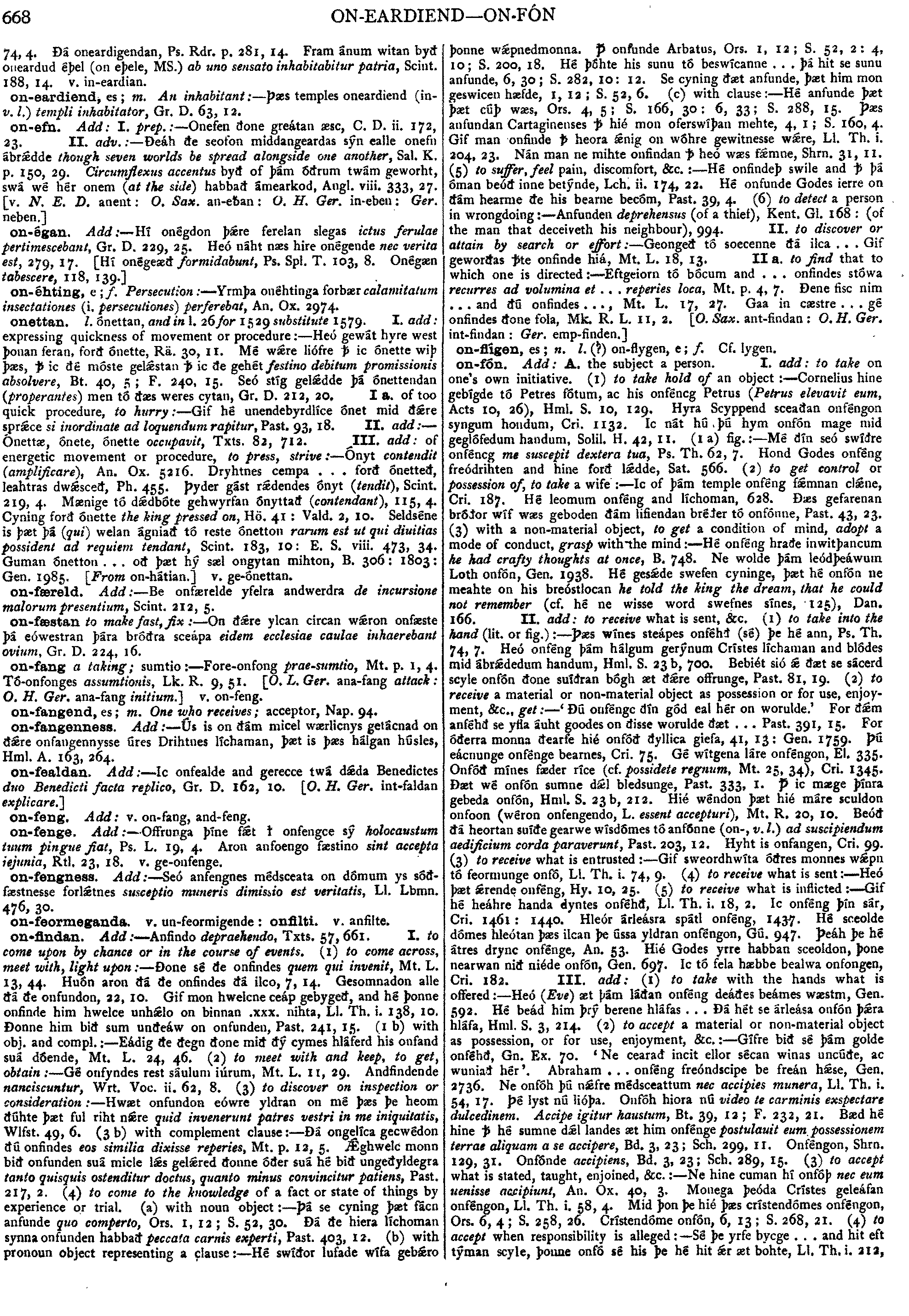
on-fón.
Add:
A.
the
subject
a
person.
I.
add:
to
take
on
one's
own
initiative.
(1)
to
take
hold
of
an
object
:--
Cornelius
hine
gebígde
tó
Petres
fótum,
ac
his
onféncg
Petrus
(Petrus
elevavit
eum,
Acts
10,
26),
Hml.
S.
10,
129.
Hyra
Scyppend
sceaðan
onféngon
syngum
hondum,
Cri.
1132.
Ic
nát
hú
þú
hym
onfón
mage
mid
geglófedum
handum,
Solil.
H.
42,
11.
(1
a)
fig.
:--
Mé
ðín
seó
swíðre
onféncg
me
suscepit
dextera
tua,
Ps.
Th.
62,
7.
Hond
Godes
onféng
freódrihten
and
hine
forð
ldde,
Sat.
566.
(2)
to
get
control
or
possession
of,
to
take
a
wife
:--
Ic
of
þám
temple
onféng
fmnan
clne,
Cri.
187.
Hé
leomum
onféng
and
líchoman,
628.
Ðæs
gefarenan
bróðor
wíf
wæs
geboden
dám
lifiendan
bréðer
tó
onfónne,
Past.
43,
23.
(3)
with
a
non-material
object,
to
get
a
condition
of
mind,
adopt
a
mode
of
conduct,
grasp
with
the
mind
:--
Hé
onféng
hraðe
inwitþancum
he
had
crafty
thoughts
at
once,
B.
748.
Ne
wolde
þám
leódþeáwum
Loth
onfón,
Gen.
1938.
Hé
gesde
swefen
cyninge,
þæt
hé
onfón
ne
meahte
on
his
breóstlocan
he
told
the
king
the
dream,
that
he
could
not
remember
(cf.
hé
ne
wisse
word
swefnes
sínes,
125),
Dan.
166.
II.
add:
to
receive
what
is
sent,
&c.
(1)
to
take
into
the
hand
(lit.
or
fig.
)
:--
-Þæs
wínes
steápes
onféhð
(sé)
þe
hé
ann,
Ps.
Th.
74,
7.
Heó
onféng
þám
hálgum
gerýnum
Crístes
líchaman
and
blódes
mid
ábrdedum
handum,
Hml.
S.
23
b,
700.
Bebiét
sió
ðæt
se
sácerd
scyle
onfón
ðone
suíðran
bógh
æt
ðre
offrunge,
Past.
81,
19.
(2)
to
receive
a
material
or
non-material
object
as
possession
or
for
use,
enjoyment,
&c.
,
get
:--
'Ðú
onféngc
ðín
gód
eal
hér
on
worulde.'
For
ðm
anféhð
se
yfla
áuht
goodes
on
ðisse
worulde
ðæt
.
.
.
Past.
391,
15.
For
óðerra
monna
ðearfe
hié
onfóð
ðyllica
giefa,
41,
13;
Gen.
1759.
Þú
eácnunge
onfénge
bearnes,
Cri.
75.
Gé
wítgena
láre
onféngon,
El.
335.
Onfóð
mínes
fæder
ríce
(cf.
possidete
regnum,
Mt.
25,
34),
Cri.
1345.
Ðæt
wé
onfón
sumne
dl
bledsunge,
Past.
333,
1.
Þ-bar;
ic
mæge
þínra
gebeda
onfón,
Hml.
S.
23
b,
212.
Hié
wéndon
þæt
hié
máre
sculdon
onfoon
(wéron
onfengendo,
L.
essent
accepturi),
Mt.
R.
20,
10.
Beóð
ðá
heortan
suíðe
gearwe
wísdómes
tó
anfónne
(on-,
v.
l.
)
ad
suscipiendum
aedificium
corda
paraverunt,
Past.
203,
12.
Hyht
is
onfangen,
Cri.
99.
(3)
to
receive
what
is
entrusted
:--
Gif
sweordhwíta
óðres
monnes
wpn
tó
feormunge
onfó,
Ll.
Th.
i.
74,
9.
(4)
to
receive
what
is
sent
:--
Heó
þæt
.
.
érende
onféng,
Hy.
10,
25.
(5)
to
receive
what
is
inflicted
:--
Gif
hé
heáhre
handa
dyntes
onféhð,
Ll.
Th.
i.
18,
2.
Ic
onféng
þín
sár,
Cri.
1461
:
1440.
Hleór
árleásra
spátl
onféng,
1437.
Hé
sceolde
dómes
hleótan
þæs
ilcan
þe
ússa
yldran
onféngon,
Gú.
947.
Þeáh
þe
hé
átres
drync
onfénge,
An.
53.
Hié
Godes
yrre
habban
sceoldon,
þone
nearwan
nið
niéde
onfón,
Gen.
697.
Ic
tó
fela
hæbbe
bealwa
onfongen,
Cri.
182.
III.
add:
(1)
to
take
with
the
hands
what
is
offered
:--
Heó
(Eve)
æt
þám
láðan
onféng
deáðes
beámes
wæstm,
Gen.
592.
Hé
beád
him
þrý
berene
hláfas
.
.
.
Ðá
hét
se
árleása
onfón
þra
hláfa,
Hml.
S.
3,
214.
(2)
to
accept
a
material
or
non-material
object
as
possession,
or
for
use,
enjoyment,
&c.
:--
Gífre
bið
sé
þám
golde
onféhð,
Gn.
Ex.
70.
'Ne
cearað
incit
ellor
sécan
winas
uncúðe,
ac
wuniað
hér'.
Abraham
.
.
.
onféng
freóndscipe
be
freán
hse,
Gen.
2736.
Ne
onfóh
þú
nfre
médsceattum
nec
accipies
munera,
Ll.
Th.
i.
54,
17.
Þé
lyst
nú
lióþa.
Onfóh
hiora
nú
video
te
carminis
exspectare
dulcedinem.
Accipe
igitur
haustum,
Bt.
39,
12
;
F.
232,
21.
Bæd
hé
hine
hé
sumne
dl
landes
æt
him
onfénge
postulauit
eum
possessionem
terrae
aliquam
a
se
accipere,
Bd.
3,
23;
Sch.
299,
11.
Onféngon,
Shrn.
129,
31.
Onfónde
accipiens,
Bd.
3,
23;
Sch.
289,
15.
(3)
to
accept
what
is
stated,
taught,
enjoined,
&c.
:--
Ne
hine
cuman
hí
onfóþ
nec
eum
uenisse
accipiunt,
An.
Ox.
40,
3.
Monega
þeóda
Crístes
geleáfan
onféngon,
Ll.
Th.
i.
58,
4.
Mid
þon
þe
hié
þæs
crístendómes
onféngon,
Ors.
6,
4
;
S.
258,
26.
Crístendóme
onfón,
6,
13
;
S.
268,
21.
(4)
to
accept
when
responsibility
is
alleged:--
Sé
þe
yrfe
bycge
.
.
.
and
hit
eft
týman
scyle,
þonne
onfó
sé
his
þe
hé
hit
r
æt
bohte,
Ll.
Th.
i.
212,
|
Source: Bosworth/Toller, page d0722, entry 5 View original page image as: [TIFF] [PNG] [View previous entry] [View next entry] |
[Comment on this entry] [View comments] |
The following entry has been hand-corrected once. |
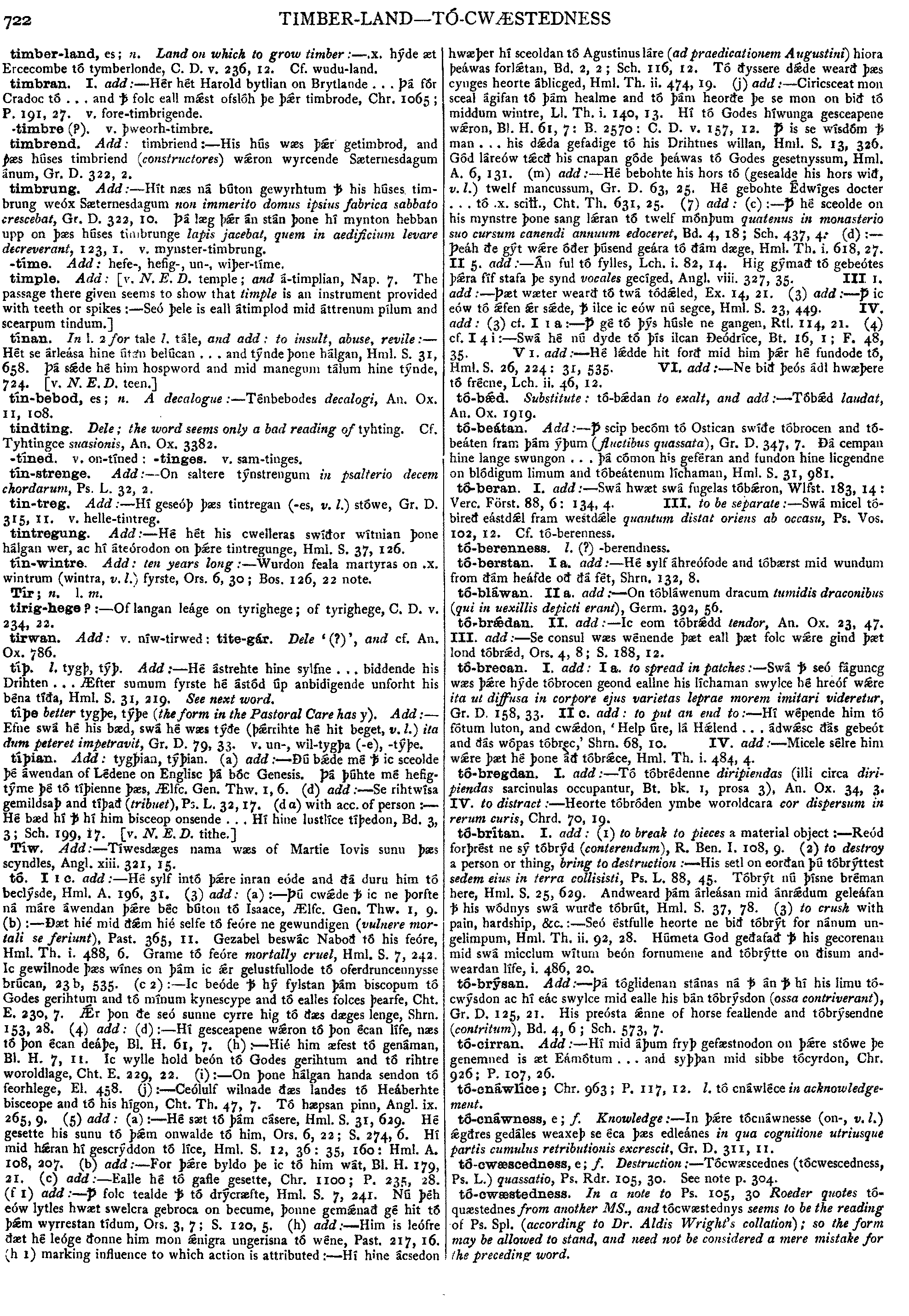
timbrung.
Add
:--
Hít
næs
ná
búton
gewyrhtum
his
húses
timbrung
weóx
Sæternesdagum
non
immerito
domus
ipsias
fabrica
sabbato
crescebat,
Gr.
D.
322,
10.
Þá
læg
þr
án
stán
þone
hí
mynton
hebban
upp
on
þæs
húses
timbrunge
lapis
jacebat,
quem
in
aedificium
levare
dicreverant,
123,
1.
v.
mynster-timbrung.
Germanic Lexicon Project (main page)
This search system was written by
Sean Crist
Please consider
volunteering
to correct the data in these online dictionaries.
No rights reserved. Feel free to use these data in any way you please.