|
|

|
Source: Cleasby/Vigfusson, page b0150, entry 16 View original page image as: [TIFF] [PNG] [View previous entry] [View next entry] |
[Comment on this entry] [View comments] |
The following entry has been hand-corrected once. |
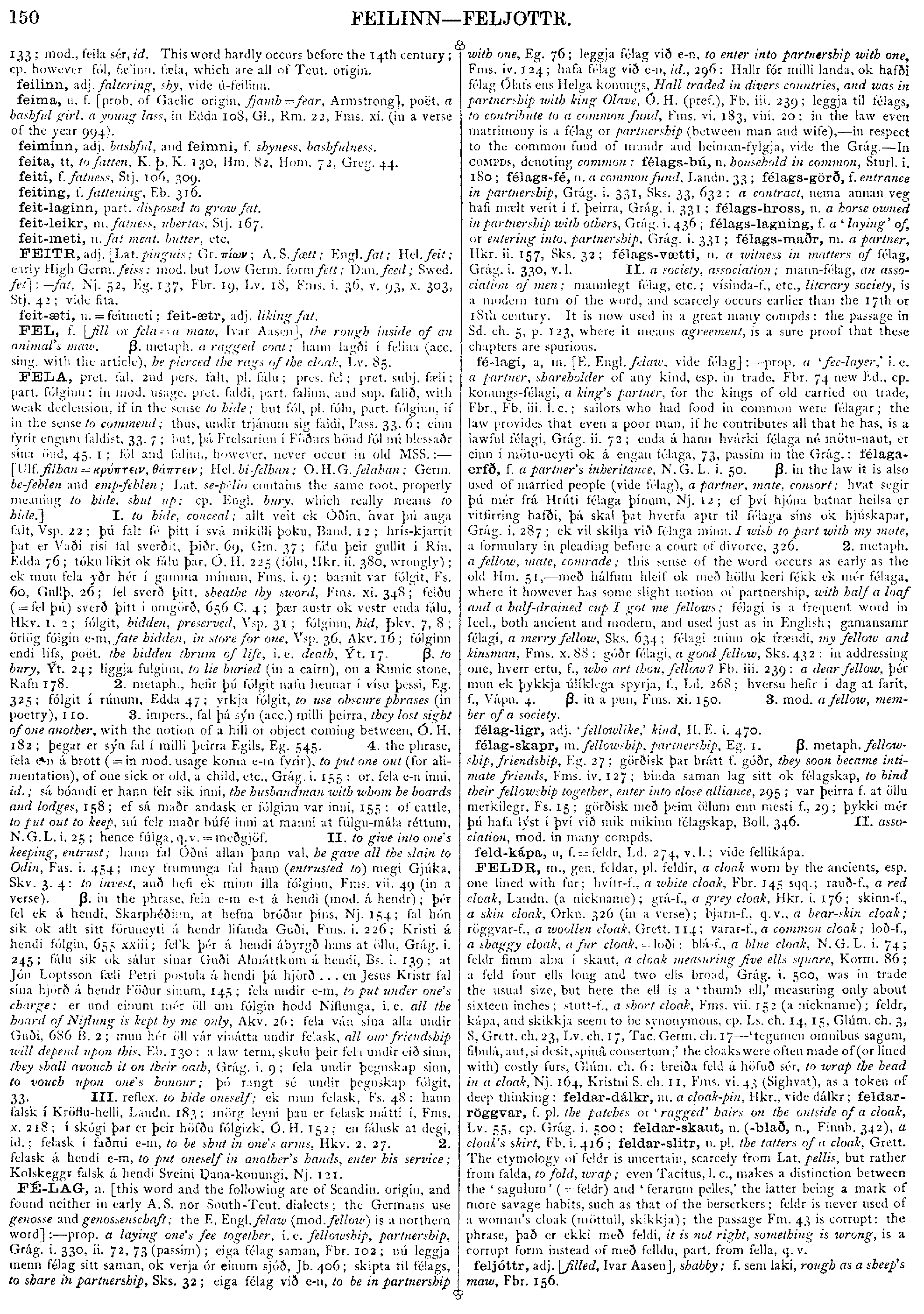
fé-lagi,
a,
m.
[E.
Engl.
felaw,
vide
félag]
:--
prop,
a
'fee-layer,'
i.e.
a
partner,
shareholder
of
any
kind,
esp.
in
trade,
Fbr.
74
new
Ed.,
cp.
konungs-félagi,
a
king's
partner,
for
the
kings
of
old
carried
on
trade,
Fbr.,
Fb.
iii.
l.c.;
sailors
who
had
food
in
common
were
félagar;
the
law
provides
that
even
a
poor
man,
if
he
contributes
all
that
he
has,
is
a
lawful
félagi,
Grág.
ii.
72;
enda
á
hann
hvárki
félaga
né
mötu-naut,
er
einn
í
mötu-neyti
ok
á
engan
félaga,
73,
passim
in
the
Grág.:
félaga-erfð,
f.
a
partner's
inheritance,
N.
G.
L.
i.
50.
 .
in
the
law
it
is
also
used
of
married
people
(vide
félag),
a
partner,
mate,
consort;
hvat
segir
þú
mér
frá
Hrúti
félaga
þínum,
Nj.
12;
ef
því
hjóna
batnar
heilsa
er
vitfirring
hafði,
þá
skal
þat
hverfa
aptr
til
félaga
síns
ok
hjúskapar,
Grág.
i.
287;
ek
vil
skilja
við
félaga
minn,
I
wish
to
part
with
my
mate,
a
formulary
in
pleading
before
a
court
of
divorce,
326.
2.
metaph.
a
fellow,
mate,
comrade;
this
sense
of
the
word
occurs
as
early
as
the
old
Hm.
51,--með
hálfum
hleif
ok
með
höllu
keri
fékk
ek
mér
félaga,
where
it
however
has
some
slight
notion
of
partnership,
with
half
a
loaf
and
a
half-drained
cup
I
got
me
fellows;
félagi
is
a
frequent
word
in
Icel.,
both
ancient
and
modern,
and
used
just
as
in
English;
gamansamr
félagi,
a
merry
fellow,
Sks.
634;
félagi
minn
ok
frændi,
my
fellow
and
kinsman,
Fms.
x.
88;
góðr
félagi,
a
good
fellow,
Sks.
432:
in
addressing
one,
hverr
ertu,
f.,
who
art
thou,
fellow?
Fb.
iii.
239:
a
dear
fellow,
þér
mun
ek
þykkja
úlíklega
spyrja,
f.,
Ld.
268;
hversu
hefir
í
dag
at
farit,
f.,
Vápn.
4.
.
in
a
pun,
Fms.
xi.
150.
3.
mod.
a
fellow,
member
of
a
society.
.
in
the
law
it
is
also
used
of
married
people
(vide
félag),
a
partner,
mate,
consort;
hvat
segir
þú
mér
frá
Hrúti
félaga
þínum,
Nj.
12;
ef
því
hjóna
batnar
heilsa
er
vitfirring
hafði,
þá
skal
þat
hverfa
aptr
til
félaga
síns
ok
hjúskapar,
Grág.
i.
287;
ek
vil
skilja
við
félaga
minn,
I
wish
to
part
with
my
mate,
a
formulary
in
pleading
before
a
court
of
divorce,
326.
2.
metaph.
a
fellow,
mate,
comrade;
this
sense
of
the
word
occurs
as
early
as
the
old
Hm.
51,--með
hálfum
hleif
ok
með
höllu
keri
fékk
ek
mér
félaga,
where
it
however
has
some
slight
notion
of
partnership,
with
half
a
loaf
and
a
half-drained
cup
I
got
me
fellows;
félagi
is
a
frequent
word
in
Icel.,
both
ancient
and
modern,
and
used
just
as
in
English;
gamansamr
félagi,
a
merry
fellow,
Sks.
634;
félagi
minn
ok
frændi,
my
fellow
and
kinsman,
Fms.
x.
88;
góðr
félagi,
a
good
fellow,
Sks.
432:
in
addressing
one,
hverr
ertu,
f.,
who
art
thou,
fellow?
Fb.
iii.
239:
a
dear
fellow,
þér
mun
ek
þykkja
úlíklega
spyrja,
f.,
Ld.
268;
hversu
hefir
í
dag
at
farit,
f.,
Vápn.
4.
.
in
a
pun,
Fms.
xi.
150.
3.
mod.
a
fellow,
member
of
a
society.
|
Source: Cleasby/Vigfusson, page b0168, entry 12 View original page image as: [TIFF] [PNG] [View previous entry] [View next entry] |
[Comment on this entry] [View comments] |
The following entry has been hand-corrected once. |
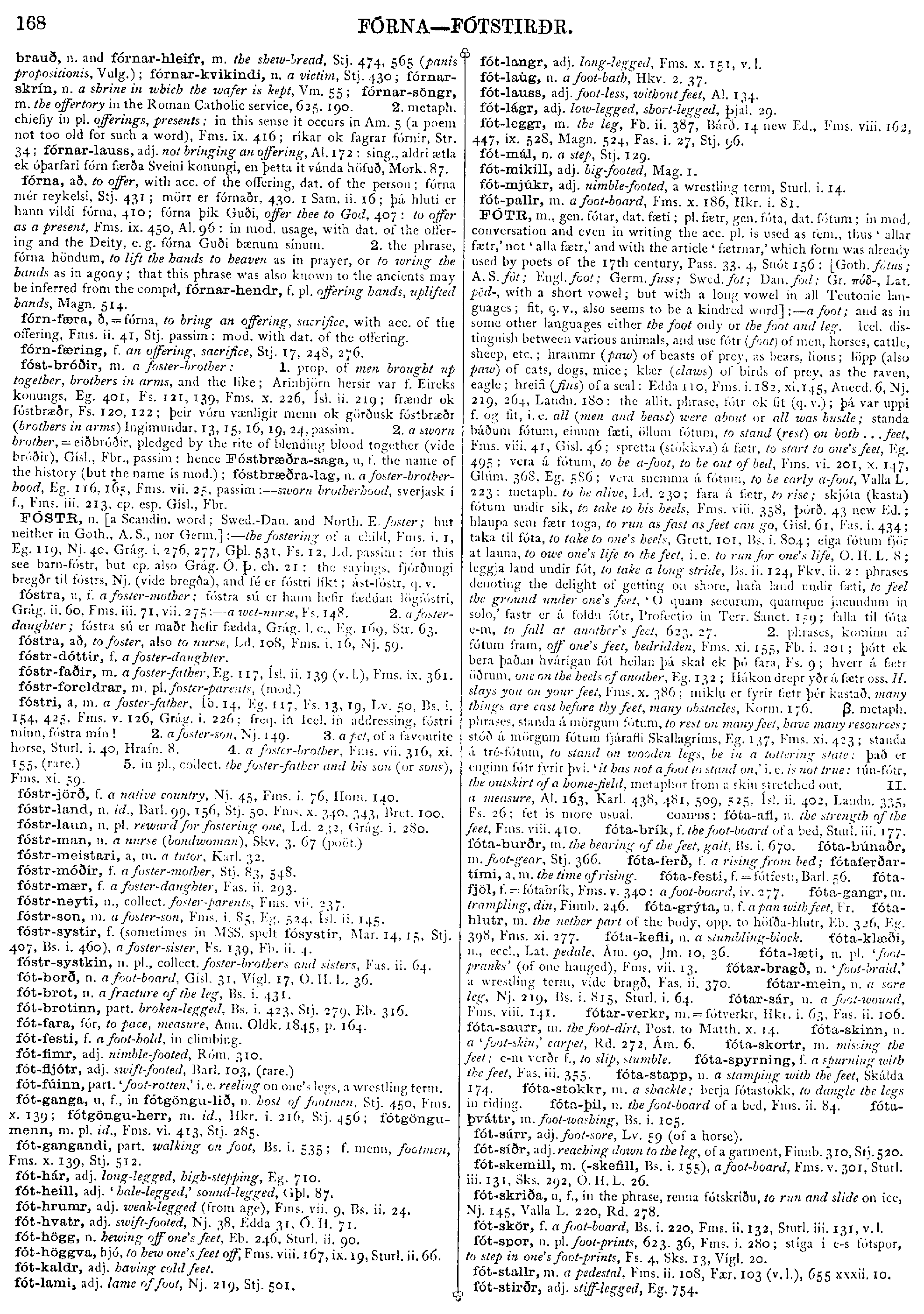
fóstri, a, m. a foster-father, Íb. 14, Eg. 117, Fs. 13, 19, Lv. 50, Bs. i. 154. 425, Fms. v. 126, Grág. i. 226; freq. in Icel. in addressing, fóstri minn, fóstra min! 2. a foster-son, Nj. 149. 3. a pet, of a favourite horse, Sturl. i. 40, Hrafn. 8. 4. a foster-brother, Fms. vii. 316, xi. 155, (rare.) 5. in pl., collect. the foster-father and his son (or sons), Fms. xi. 59.
|
Source: Cleasby/Vigfusson, page b0175, entry 24 View original page image as: [TIFF] [PNG] [View previous entry] [View next entry] |
[Comment on this entry] [View comments] |
The following entry has been hand-corrected once. |
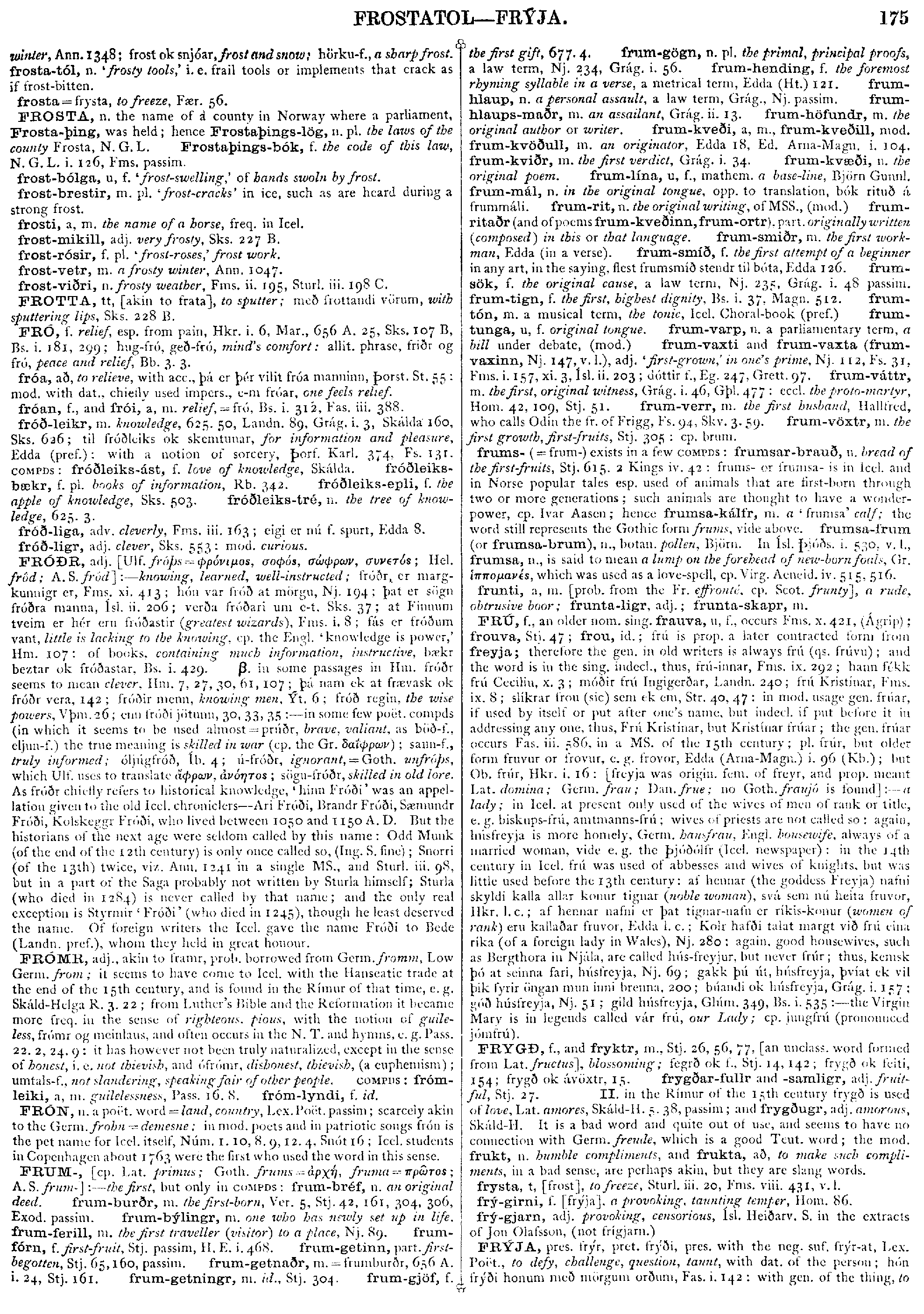
FRÚ, f., an older nom. sing. frauva, u, f., occurs Fms. x. 421, (Ágrip); frouva, Stj. 47; frou, id.; frú is prop. a later contracted form from freyja; therefore the gen. in old writers is always frú (qs. frúvu); and the word is in the sing. indecl., thus, frú-innar, Fms. ix. 292; hann fékk frú Ceciliu, x. 3; móðir frú Ingigerðar, Landn. 240; frú Kristínar, Fms. ix. 8; slíkrar frou (sic) sem ek em, Str. 40, 47: in mod. usage gen. frúar, if used by itself or put after one's name, but indecl. if put before it in addressing any one, thus, Frú Kristínar, but Kristínar frúar; the gen. frúar occurs Fas. iii. 586, in a MS. of the 15th century; pl. frúr, but older form fruvur or frovur, e.g. frovor, Edda (Arna-Magn.) i. 96 (Kb.); but Ob. frúr, Hkr. i. 16: [freyja was origin. fem. of freyr, and prop. meant Lat. domina; Germ. frau; Dan. frue; no Goth. fraujô is found] :-- a lady; in Icel. at present only used of the wives of men of rank or title, e.g. biskups-frú, amtmanns-frú; wives of priests are not called so: again, húsfreyja is more homely, Germ. hausfrau, Engl. housewife, always of a married woman, vide e.g. the Þjóðólfr (Icel. newspaper): in the 14th century in Icel. frú was used of abbesses and wives of knights, but was little used before the 13th century: af hennar (the goddess Freyja) nafni skyldi kalla allar konur tignar (noble woman), svá sem nú heita fruvor, Hkr. l.c.; af hennar nafni er þat tignar-nafn er ríkis-konur (women of rank) eru kallaðar fruvor, Edda l.c.; Kolr hafði talat margt við frú eina ríka (of a foreign lady in Wales), Nj. 280: again, good housewives, such as Bergthora in Njála, are called hús-freyjur, but never frúr; thus, kemsk þó at seinna fari, húsfreyja, Nj. 69; gakk þú út, húsfreyja, þvíat ek vil þik fyrir öngan mun inni brenna, 200; búandi ok húsfreyja, Grág. i. 157; góð húsfreyja, Nj. 51; gild húsfreyja, Glúm. 349, Bs. i. 535 :-- the Virgin Mary is in legends called vár frú, our Lady; cp. jungfrú (pronounced jómfrú).
|
Source: Cleasby/Vigfusson, page b0192, entry 17 View original page image as: [TIFF] [PNG] [View previous entry] [View next entry] |
[Comment on this entry] [View comments] |
The following entry has been hand-corrected once. |
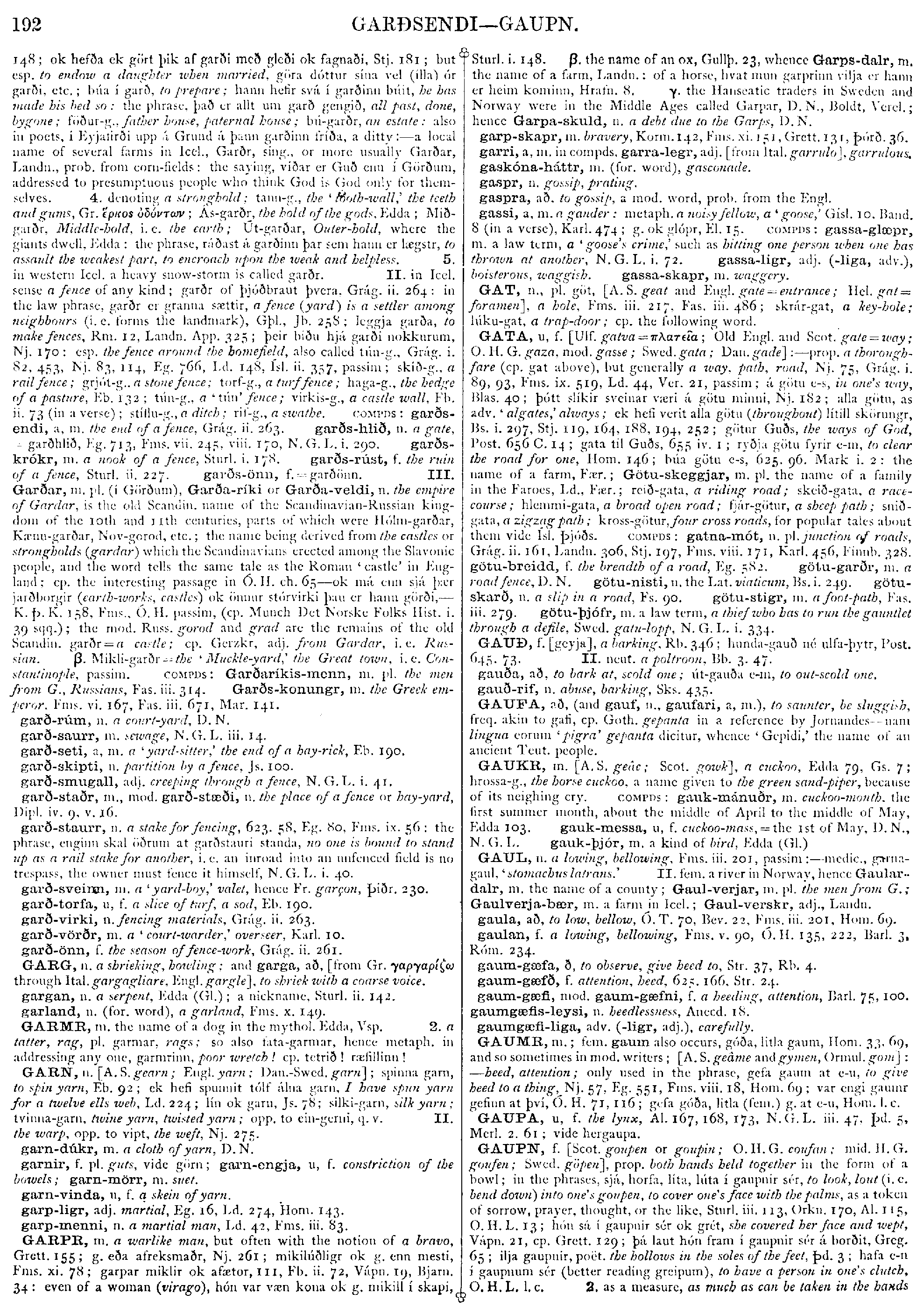
GARMR, m. the name of a dog in the mythol. Edda, Vsp. 2. a tatter, rag, pl. garmar. rags; so also fata-garmar, hence metaph. in addressing any one, garmrinn, poor wretch! cp. tetrið! ræfillinn!
|
Source: Cleasby/Vigfusson, page b0210, entry 1 View original page image as: [TIFF] [PNG] [View previous entry] [View next entry] |
[Comment on this entry] [View comments] |
The following entry has been hand-corrected once. |
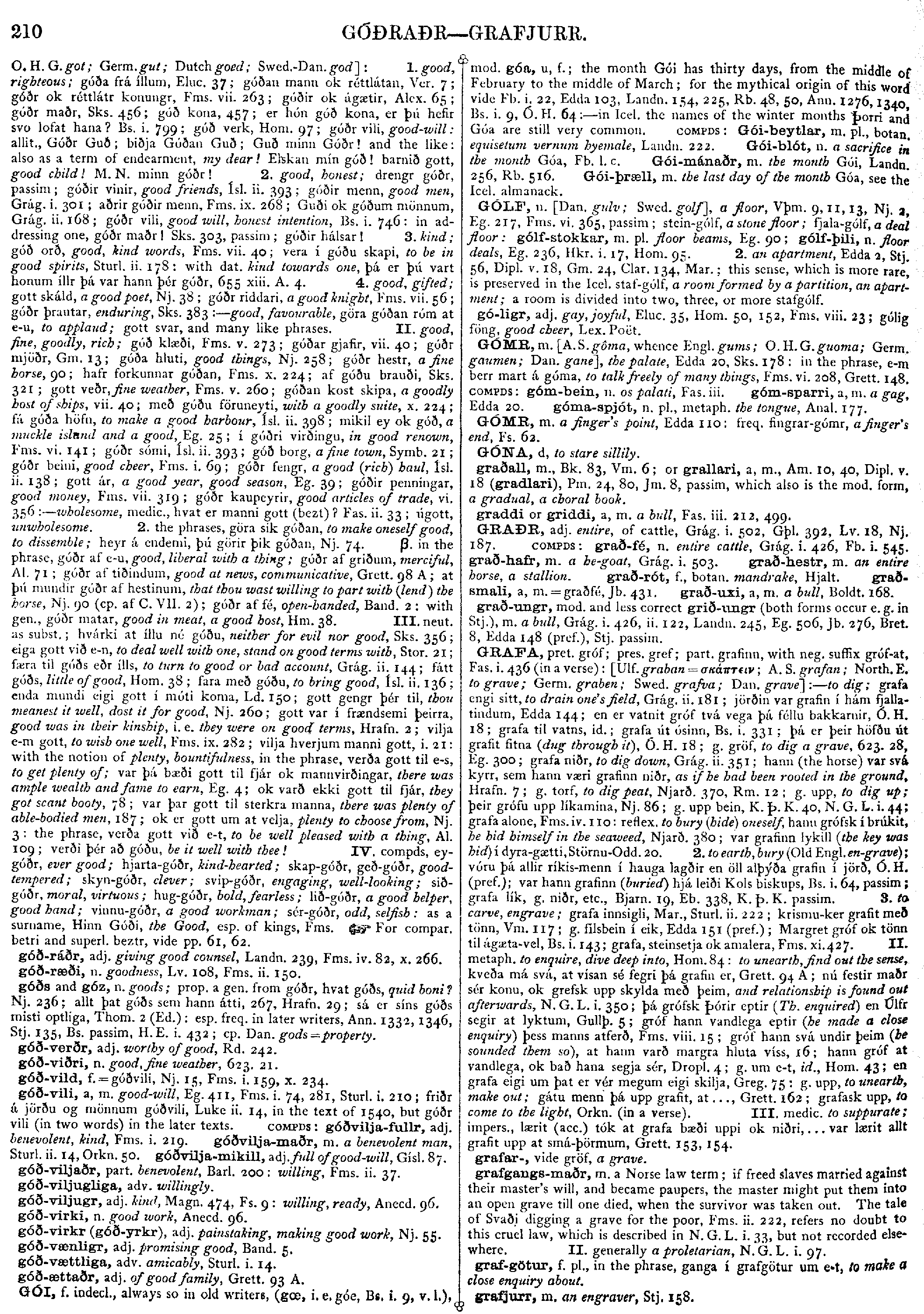
O.H.G.
got;
Germ.
gut;
Dutch
goed;
Swed.-Dan.
god]
:
1.
good,
righteous;
góða
frá
íllum,
Eluc.
37;
góðan
mann
ok
réttlátan,
Ver.
7;
góðr
ok
réttlátr
konungr,
Fms.
vii.
263;
góðir
ok
ágætir,
Alex.
65;
góðr
maðr,
Sks.
456;
góð
kona,
457;
er
hón
góð
kona,
er
þú
hefir
svo
lofat
hana?
Bs.
i.
799;
góð
verk,
Hom.
97;
góðr
vili,
good-will
:
allit.,
Góðr
Guð;
biðja
Góðan
Guð;
Guð
minn
Góðr!
and
the
like
:
also
as
a
term
of
endearment,
my
dear!
Elskan
mín
góð!
barnið
gott,
good
child!
M.
N.
minn
góðr!
2.
good,
honest;
drengr
góðr,
passim;
góðir
vinir,
good
friends,
Ísl.
ii.
393;
góðir
menn,
good
men,
Grág.
i.
301;
aðrir
góðir
menn,
Fms.
ix.
268;
Guði
ok
góðum
mönnum,
Grág.
ii.
168;
góðr
vili,
good
will,
honest
intention,
Bs.
i.
746
:
in
addressing
one,
góðr
maðr!
Sks.
303,
passim;
góðir
hálsar!
3.
kind;
góð
orð,
good,
kind
words,
Fms.
vii.
40;
vera
í
góðu
skapi,
to
be
in
good
spirits,
Sturl.
ii.
178
:
with
dat.
kind
towards
one,
þá
er
þú
vart
honum
íllr
þá
var
hann
þér
góðr,
655
xiii.
A.
4.
4.
good,
gifted;
gott
skáld,
a
good
poet,
Nj.
38;
góðr
riddari,
a
good
knight,
Fms.
vii.
56;
góðr
þrautar,
enduring,
Sks.
383
:--
good,
favourable,
göra
góðan
róm
at
e-u,
to
applaud;
gott
svar,
and
many
like
phrases.
II.
good,
fine,
goodly,
rich;
góð
klæði,
Fms.
v.
273;
góðar
gjafir,
vii.
40;
góðr
mjöðr,
Gm.
13;
góða
hluti,
good
things,
Nj.
258;
góðr
hestr,
a
fine
horse,
90;
hafr
forkunnar
góðan,
Fms.
x.
224;
af
góðu
brauði,
Sks.
321;
gott
veðr,
fine
weather,
Fms.
v.
260;
góðan
kost
skipa,
a
goodly
host
of
ships,
vii.
40;
með
góðu
föruneyti,
with
a
goodly
suite,
x.
224;
fá
góða
höfn,
to
make
a
good
harbour,
Ísl.
ii.
398;
mikil
ey
ok
góð,
a
muckle
island
and
a
good,
Eg.
25;
í
góðri
virðingu,
in
good
renown,
Fms.
vi.
141;
góðr
sómi,
Ísl.
ii.
393;
góð
borg,
a
fine
town,
Symb.
21;
góðr
beini,
good
cheer,
Fms.
i.
69;
góðr
fengr,
a
good
(rich)
haul,
Ísl.
ii.
138;
gott
ár,
a
good
year,
good
season,
Eg.
39;
góðir
penningar,
good
money,
Fms.
vii.
319;
góðr
kaupeyrir,
good
articles
of
trade,
vi.
356
:--
wholesome,
medic.,
hvat
er
manni
gott
(bezt)?
Fas.
ii.
33;
úgott,
unwholesome.
2.
the
phrases,
göra
sik
góðan,
to
make
oneself
good,
to
dissemble;
heyr
á
endemi,
þú
görir
þik
góðan,
Nj.
74.
.
in
the
phrase,
góðr
af
e-u,
good,
liberal
with
a
thing;
góðr
af
griðum,
merciful,
Al.
71;
góðr
af
tíðindum,
good
at
news,
communicative,
Grett.
98
A;
at
þú
mundir
góðr
af
hestinum,
that
thou
wast
willing
to
part
with
(lend)
the
horse,
Nj.
90
(cp.
af
C.
VII.
2);
góðr
af
fé,
open-handed,
Band.
2
:
with
gen.,
góðr
matar,
good
in
meat,
a
good
host,
Hm.
38.
III.
neut.
as
subst.;
hvárki
at
íllu
né
góðu,
neither
for
evil
nor
good,
Sks.
356;
eiga
gott
við
e-n,
to
deal
well
with
one,
stand
on
good
terms
with,
Stor.
21;
færa
til
góðs
eðr
ílls,
to
turn
to
good
or
bad
account,
Grág.
ii.
144;
fátt
góðs,
little
of
good,
Hom.
38;
fara
með
góðu,
to
bring
good,
Ísl.
ii.
136;
enda
mundi
eigi
gott
í
móti
koma,
Ld.
150;
gott
gengr
þér
til,
thou
meanest
it
well,
dost
it
for
good,
Nj.
260;
gott
var
í
frændsemi
þeirra,
good
was
in
their
kinship,
i.e.
they
were
on
good
terms,
Hrafn.
2;
vilja
e-m
gott,
to
wish
one
well,
Fms.
ix.
282;
vilja
hverjum
manni
gott,
i.
21
:
with
the
notion
of
plenty,
bountifulness,
in
the
phrase,
verða
gott
til
e-s,
to
get
plenty
of;
var
þá
bæði
gott
til
fjár
ok
mannvirðingar,
there
was
ample
wealth
and
fame
to
earn,
Eg.
4;
ok
varð
ekki
gott
til
fjár,
they
got
scant
booty,
78;
var
þar
gott
til
sterkra
manna,
there
was
plenty
of
able-bodied
men,
187;
ok
er
gott
um
at
velja,
plenty
to
choose
from,
Nj.
3
:
the
phrase,
verða
gott
við
e-t,
to
be
well
pleased
with
a
thing,
Al.
109;
verði
þér
að
góðu,
be
it
well
with
thee!
IV.
compds,
ey-
góðr,
ever
good;
hjarta-góðr,
kind-hearted;
skap-góðr,
geð-góðr,
good-
tempered;
skyn-góðr,
clever;
svip-góðr,
engaging,
well-looking;
sið-
góðr,
moral,
virtuous;
hug-góðr,
bold,
fearless;
lið-góðr,
a
good
helper,
good
hand;
vinnu-góðr,
a
good
workman;
sér-góðr,
odd,
selfish
:
as
a
surname,
Hinn
Góði,
the
Good,
esp.
of
kings,
Fms.
UNCERTAIN
For
compar.
betri
and
superl.
beztr,
vide
pp.
6l,
62.
|
Source: Cleasby/Vigfusson, page b0259, entry 2 View original page image as: [TIFF] [PNG] [View previous entry] [View next entry] |
[Comment on this entry] [View comments] |
The following entry has been hand-corrected once. |
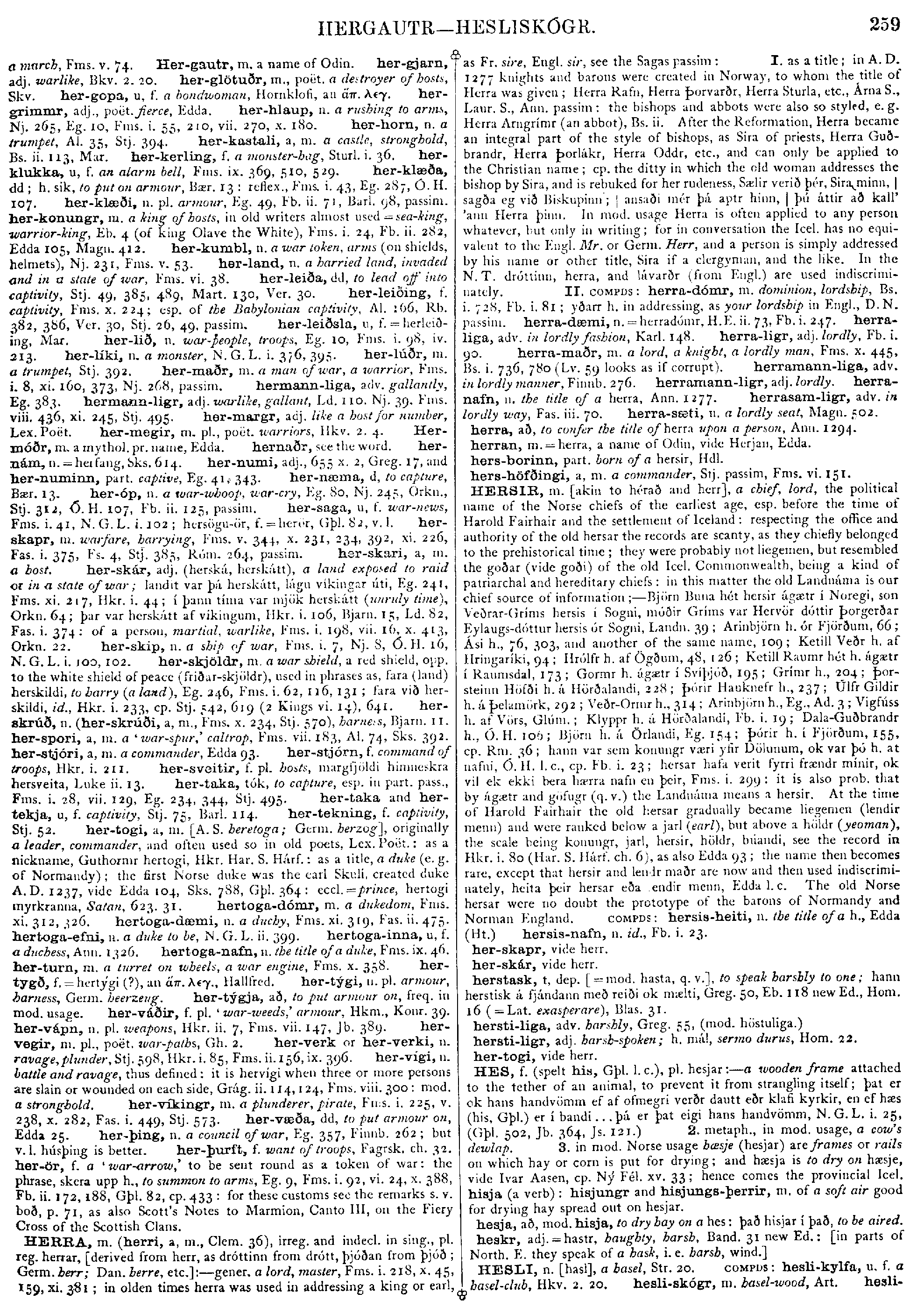
HERRA, m. (herri, a, m., Clem. 36), irreg. and indecl. in sing., pl. reg. herrar, [derived from herr, as dróttinn from drótt, þjóðan from þjóð; Germ. herr; Dan. herre, etc.] :-- gener. a lord, master, Fms. i. 218, x. 45, 159, xi. 381; in olden times herra was used in addressing a king or earl, as Fr. sire, Engl. sir, see the Sagas passim: I. as a title; in A.D. 1277 knights and barons were created in Norway, to whom the title of Herra was given; Herra Rafn, Herra Þorvarðr, Herra Sturla, etc., Árna S., Laur. S., Ann. passim: the bishops and abbots were also so styled, e.g. Herra Arngrímr (an abbot), Bs. ii. After the Reformation, Herra became an integral part of the style of bishops, as Sira of priests, Herra Guðbrandr, Herra Þorlákr, Herra Oddr, etc., and can only be applied to the Christian name; cp. the ditty in which the old woman addresses the bishop bv Sira, and is rebuked for her rudeness, Sælir verið þér, Sira minn, | sagða eg við Biskupinn; | ansaði mér þá aptr hinn, | þú áttir að kall' 'ann Herra þinn. In mod. usage Herra is often applied to any person whatever, but only in writing; for in conversation the Icel. has no equivalent to the Engl. Mr. or Germ. Herr, and a person is simply addressed by his name or other title, Sira if a clergyman, and the like. In the N. T. dróttinn, herra, and lávarðr (from Engl.) are used indiscriminately. II. COMPDS: herra-dómr, m. dominion, lordship, Bs. i. 728, Fb. i. 81; yðarr h. in addressing, as your lordship in Engl., D. N. passim. herra-dæmi, n. = herradómr, H. E. ii. 73, Fb. i. 247. herra-liga, adv. in lordly fashion, Karl. 148. herra-ligr, adj. lordly, Fb. i. 90. herra-maðr, m. a lord, a knight, a lordly man, Fms. x. 445, Bs. i. 736, 780 (Lv. 59 looks as if corrupt). herramann-liga, adv. in lordly manner, Finnb. 276. herramann-ligr, adj. lordly. herra-nafn, n. the title of a herra, Ann. 1277. herrasam-ligr, adv. in lordly way, Fas. iii. 70. herra-sæti, n. a lordly seat, Magn. 502.
|
Source: Cleasby/Vigfusson, page b0263, entry 2 View original page image as: [TIFF] [PNG] [View previous entry] [View next entry] |
[Comment on this entry] [View comments] |
The following entry has been hand-corrected once. |
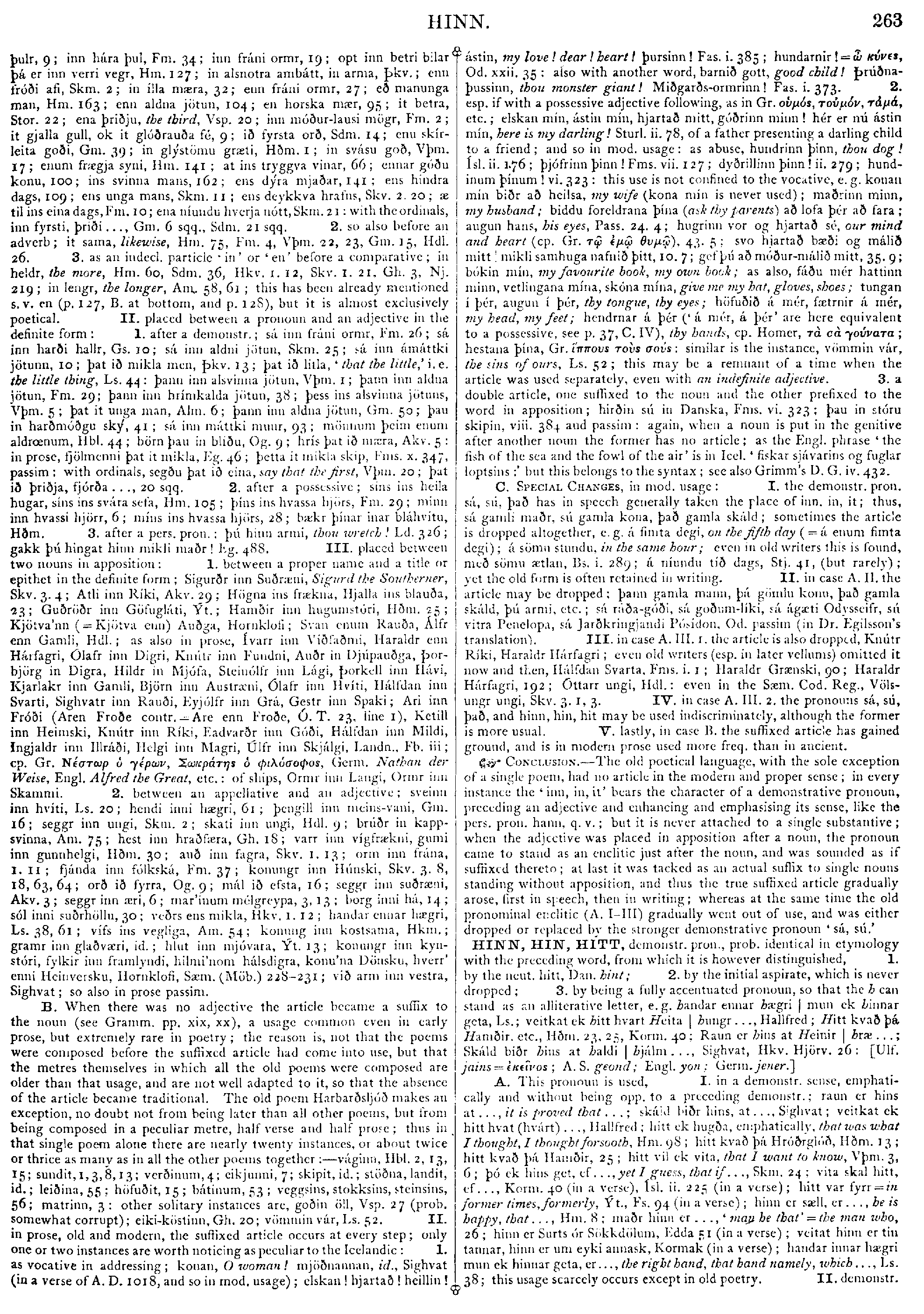
B. When there was no adjective the article became a suffix to the noun (see Gramm. pp. xix, xx), a usage common even in early prose, but extremely rare in poetry; the reason is, not that the poems were composed before the suffixed article had come into use, but that the metres themselves in which all the old poems were composed are older than that usage, and are not well adapted to it, so that the absence of the article became traditional. The old poem Harbarðsljóð makes an exception, no doubt not from being later than all other poems, but from being composed in a peculiar metre, half verse and half prose; thus in that single poem alone there are nearly twenty instances, or about twice or thrice as many as in all the other poems together :-- váginn, Hbl. 2, 13, 15; sundit, 1, 3, 8, 13; verðinum, 4; eikjunni, 7; skipit, id.; stöðna, landit, id.; leiðina, 55; höfuðit, 15; bátinum, 53; veggsins, stokksins, steinsins, 56; matrinn, 3: other solitary instances are, goðin öll, Vsp. 27 (prob. somewhat corrupt); eiki-köstinn, Gh. 20; vömmin vár, Ls. 52. II. in prose, old and modern, the suffixed article occurs at every step; only one or two instances are worth noticing as peculiar to the Icelandic: 1. as vocative in addressing; konan, O woman! mjöðnannan, id., Sighvat (in a verse of A.D. 1018, and so in mod. usage); elskan! hjartað! heillin! ástin, my love! dear! heart! þursinn! Fas. i. 385; hundarnir! = GREEK, Od. xxii. 35: also with another word, barnið gott, good child! Þrúðnaþussinn, thou monster giant! Miðgarðs-ormrinn! Fas. i. 373. 2. esp. if with a possessive adjective following, as in Gr. GREEK, etc.; elskan mín, ástin mín, hjartað mitt, góðrinn minn! hér er nú ástin mín, here is my darling! Sturl. ii. 78, of a father presenting a darling child to a friend; and so in mod. usage: as abuse, hundrinn þinn, thou dog! Ísl. ii. 176; þjófrinn þinn! Fms. vii. 127; dyðrillinn þinn! ii. 279; hundinum þínum! vi. 323: this use is not confined to the vocative, e.g. konan mín biðr að heilsa, my wife (kona mín is never used); maðrinn minn, my husband; biddu foreldrana þína (ask thy parents) að lofa þér að fara; augun hans, his eyes, Pass. 24. 4; hugrinn vor og hjartað sé, our mind and heart (cp. Gr. GREEK), 43. 5; svo hjartað bæði og málið mitt | mikli samhuga nafnið þitt, 10. 7; gef þú að móður-málið mitt, 35. 9; bókin mín, my favourite book, my own book; as also, fáðu mér hattinn minn, vetlingana mína, skóna mína, give me my hat, gloves, shoes; tungan í þér, augun í þér, thy tongue, thy eyes; höfuðið á mér, fætrnir á mér, my head, my feet; hendrnar á þér ('á mér, á þér' are here equivalent to a possessive, see p. 37, C. IV), thy hands, cp. Homer, GREEK; hestana þína, Gr. GREEK: similar is the instance, vömmin vár, the sins of ours, Ls. 52; this may be a remnant of a time when the article was used separately, even with an indefinite adjective. 3. a double article, one suffixed to the noun and the other prefixed to the word in apposition; hirðin sú in Danska, Fms. vi. 323; þau in stóru skipin, viii. 384 and passim: again, when a noun is put in the genitive after another noun the former has no article; as the Engl. phrase 'the fish of the sea and the fowl of the air' is in Icel. 'fiskar sjávarins og fuglar loptsins:' but this belongs to the syntax; see also Grimm's D. G. iv. 432.
|
Source: Cleasby/Vigfusson, page b0266, entry 4 View original page image as: [TIFF] [PNG] [View previous entry] [View next entry] |
[Comment on this entry] [View comments] |
The following entry has been hand-corrected once. |
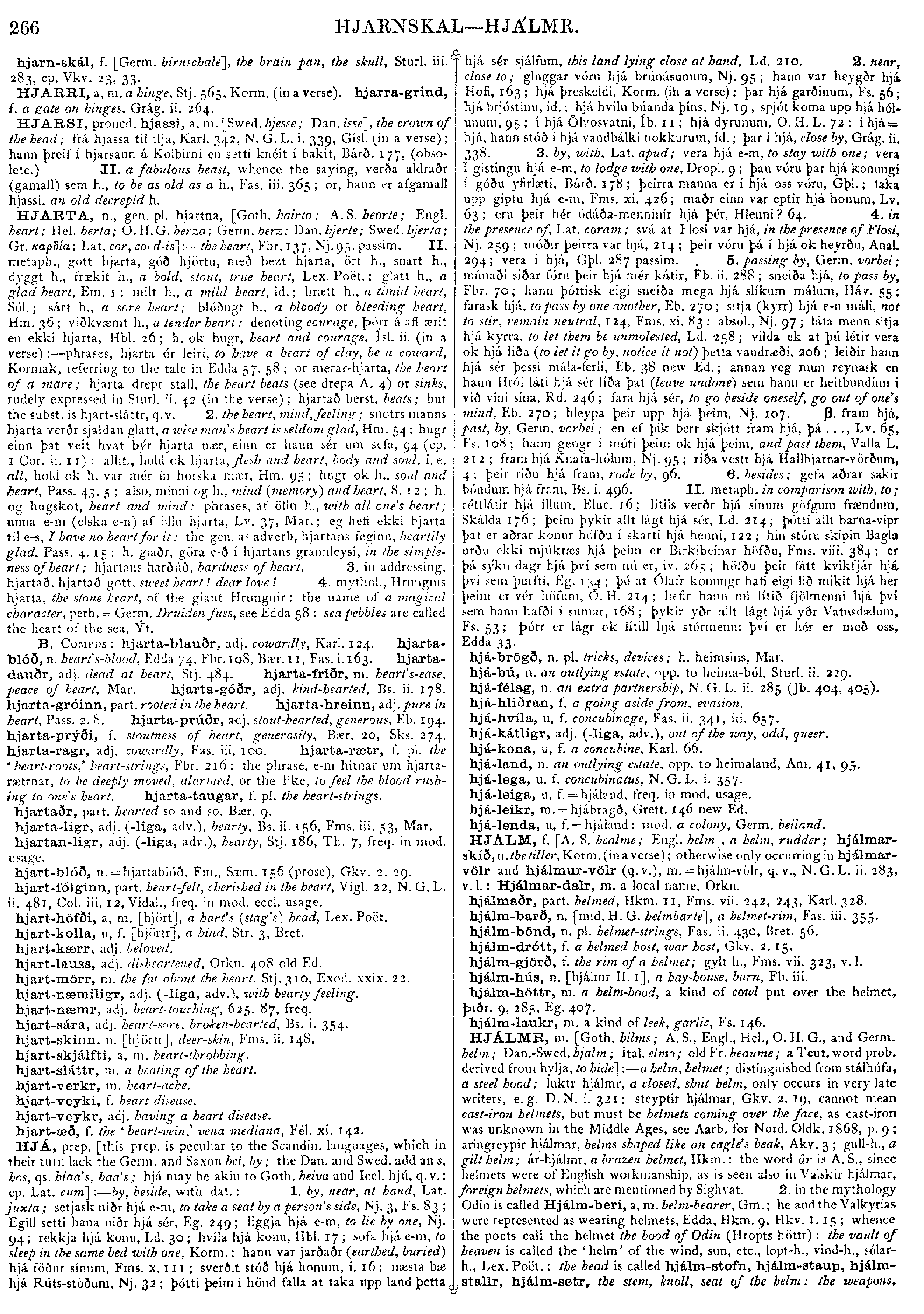
HJARTA, n., gen. pl. hjartna, [Goth. hairto; A. S. heorte; Engl. heart; Hel. herta; O. H. G. herza; Germ. herz; Dan. hjerte; Swed. hjerta; Gr. GREEK; Lat. cor, cord-is] :-- the heart, Fbr. 137, Nj. 95, passim. II. metaph., gott hjarta, góð hjörtu, með bezt hjarta, ört h., snart h., dyggt h., frækit h., a bold, stout, true heart, Lex. Poët.; glatt h., a glad heart, Em. 1; milt h., a mild heart, id.; hrætt h., a timid heart, Sól.; sárt h., a sore heart; blóðugt h., a bloody or bleeding heart, Hm. 36; viðkvæmt h., a tender heart: denoting courage, Þórr á afl ærit en ekki hjarta, Hbl. 26; h. ok hugr, heart and courage, Ísl. ii. (in a verse) :-- phrases, hjarta ór leiri, to have a heart of clay, be a coward, Kormak, referring to the tale in Edda 57, 58; or merar-hjarta, the heart of a mare; hjarta drepr stall, the heart beats (see drepa A. 4) or sinks, rudely expressed in Sturl. ii. 42 (in the verse); hjartað berst, beats; but the subst. is hjart-sláttr, q.v. 2. the heart, mind, feeling; snotrs manns hjarta verðr sjaldan glatt, a wise man's heart is seldom glad, Hm. 54; hugr einn þat veit hvat býr hjarta nær, einn er hann sér um sefa, 94 (cp. 1 Cor. ii. 11): allit., hold ok hjarta, flesh and heart, body and soul, i.e. all, hold ok h. var mér in horska mær, Hm. 95; hugr ok h., soul and heart, Pass. 43. 5; also, minni og h., mind (memory) and heart, 8. 12; h. og hugskot, heart and mind: phrases, af öllu h., with all one's heart; unna e-m (elska e-n) af öllu hjarta, Lv. 37, Mar.; eg heft ekki hjarta til e-s, I have no heart for it: the gen. as adverb, hjartans feginn, heartily glad, Pass. 4. 15; h. glaðr, göra e-ð í hjartans grannleysi, in the simpleness of heart; hjartans harðúð, hardness of heart. 3. in addressing, hjartað, hjartað gott, sweet heart! dear love! 4. mythol., Hrungnis hjarta, the stone heart, of the giant Hrungnir: the name of a magical character, perh. = Germ. Druiden fuss, see Edda 58: sea pebbles are called the heart of the sea, Ýt.
|
Source: Cleasby/Vigfusson, page b0396, entry 8 View original page image as: [TIFF] [PNG] [View previous entry] [View next entry] |
[Comment on this entry] [View comments] |
The following entry has been hand-corrected once. |
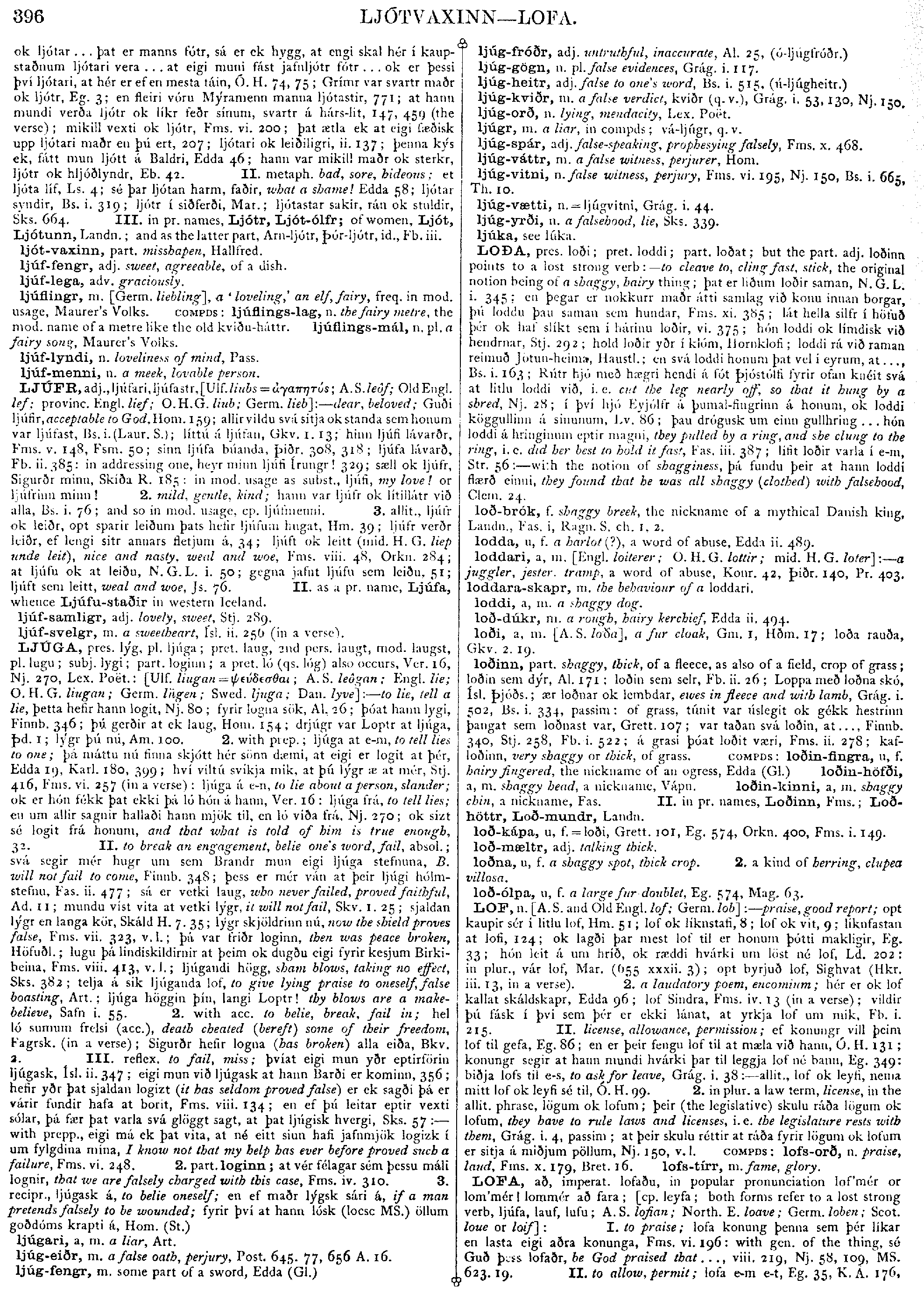
LJÚFR, adj., ljúíari, ljúfastr. [Ulf. liubs = GREEK; A.S. leôf; Old Engl. lef; provinc. Engl. lief; O.H.G. liub; Germ. lieb] :-- dear, beloved; Guði ljúfir, acceptable to God, Hom. 159; allir vildu svá sitja ok standa sem honum var ljúfast, Bs. i. (Laur. S.); líttú á ljúfan, Gkv. 1. 13; hinn ljúfi lávarðr, Fms. v. 148, Fsm. 50; sinn ljúfa búanda, Þiðr. 308, 318; ljúfa lávarð, Fb. ii. 385: in addressing one, heyr minn ljúfi Írungr! 329; sæll ok ljúfr, Sigurðr minn, Skíða R. 185: in mod. usage as subst., ljúfi, my love! or ljúfrinn minn! 2. mild, gentle, kind; hann var ljúfr ok lítillátr við alla, Bs. i. 76; and so in mod. usage, cp. ljúfmenni. 3. allit., ljúfr ok leiðr, opt sparir leiðum þats heftr ljúfum hugat, Hm. 39; ljúfr verðr leiðr, ef lengi sitr annars fletjum á, 34; ljúft ok leitt (mid.H.G. liep unde leit), nice and nasty, weal and woe, Fms. viii. 48, Orkn. 284; at ljúfu ok at leiðu, N.G.L. i. 50; gegna jafnt ljúfu sem leiðu, 51; ljúft sem leitt, weal and woe, Js. 76. II. as a pr. name, Ljúfa, whence Ljúfu-staðir in western Iceland.
|
Source: Cleasby/Vigfusson, page b0407, entry 7 View original page image as: [TIFF] [PNG] [View previous entry] [View next entry] |
[Comment on this entry] [View comments] |
The following entry has not been hand-corrected. However, the page is reserved and someone is correcting it. |
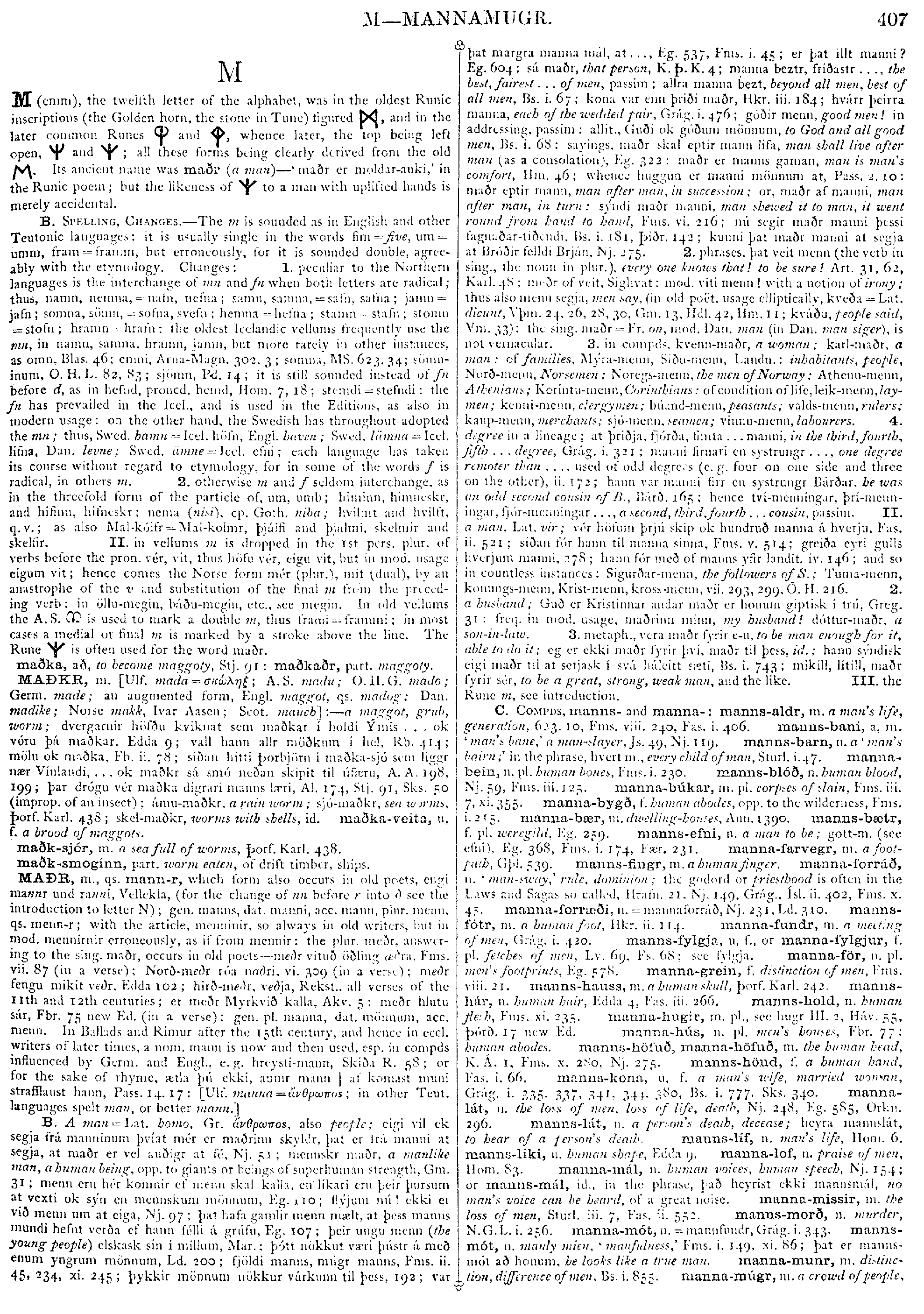
MAÐR, m., qs. mann-r, which form also occurs in old poets, cr. !'i mattnr und nrini, velltkla, (for the change of nn before r into ') see the introduction to letter N); gen. nianns, dat. maiuii, acc. maun, plur. menu, qs. menn-r; with the article, menninir, so always in old writers, but in mod. mennirnir erroneously, as if from niennir: the plur. meðr. answer- ing to the sing, maðr, occurs in old poets -- m e f)r vituð öðlin:; rfj-'Va, P'ms. vii. 87 (in a verse); Norð-m e()r róa nnf)ri. vi. 309 (in a verse); m?()r fengu mikit ve*)r, Edda 102; hirð-m e dr, v e dja, Rekst., all verses of the Ilth and 12th centuries; er ineîSr Myrkvið kalla, Akv. 5: meðr hlutu sár, Fbr. 75 new Ed. (in a verse): gen. pl. manna, dat. iiuiiinmn, acc. menu. In Ballads and Rimur after the 15th century, and hence in eccl. writers of later times, a noni. mann is now and then used, esp. in compels influenced by Germ, and Engl., e. g. hreysti-mann, Skiða R. 58; or for the sake of rhyme, ætla Ju'i ekki, aumr maim | af koinast muni strafflaust hann, Pass. 14. 17: [Ulf. manna = ('w6paiiros; in other Teut. languages spelt man, or better mann. '] B. A man -- Lat. bomo, Gr. avOpu-rros, also people; eigi vil ek segja frá manninum þvíat mér er niaðrinn skyKlr, þat er frá nianni at segja, at maðr er vel auðigr at K, Nj. s; j; n:cnnskr niaðr, a manlike man, ahnman being, opp. to giants or beings of superhuman strength. Gin. 31; menu eru her koinnir ef menu skal kalla, en líkari crn þeir þursum at vexti ok sy'n en mennskum monnum, Eg. ïio; flvjuin mi! ekki er við menn um at eiga, Nj. 97; bat hafa ganilir menn niælî, at þess maims mundi hefnt verôa cf hann fï'lli á gn'tfu, Eg. 107; þeir UUEJU menn (the young people) elskask sin í millum, Mar.; þótt nökkut væri þústr á með enum yngrum münnum, Ld. -200; fjöldi manns, múgr manns, Ems. ii. 45i 234, xi. 245; þykkir mönnum nükkur várkunn til þess, 192; var bat niargra manna nuii, at..., Eg. 537, Eniï. i. 45; er þat illt manni ? Eg. 604; sá maðr, that person, K. p. K. 4; manna beztr, fríðastr ..., the best, fairest... of men, passim; allra manna bezt, beyond all men, best of all men, Bs. i. 67; kona var enn þriði maðr, Hkr. iii. 184; hvárr þeirra manna, each ofthe wedded fair. Gray;, i. 476; góðir menu, good men ! in addressing, passim: allit., Guði ok gúðuni niönnum, to God and all good men, Bs. i. 68: sayings, maðr skal eptir mann lifa, man shall live after man (as a consolation), Eg. 322: maðr er maims gaman, man is man's comfort, 11111. 46; whence huggun er manni monnum at, Pass. 2. 10: maðr eptir mann, man after man, in succession; or, niaðr af manni, man after man, in turn: svndi maðr manni, man shewed it to man, it went round from band to hand, Ems. vi. 216; mi segir maðr manni þessi iagnaðar-tiðendi. Bs. i. 181, foiðr. 142; kunni þat inaðr manni at segja at Bróöir felldi Brjan, Nj. 275. 2. phrases, þat veil menu (the verb in sing., the noun in plur.), every one knows that! to be sure ! Art. 31, 62, Karl. 48; nicôr of veil, Sighvat: mod. viti menn ! with a notion of irony; thus also menu segja, men say, (in old pout, usage elliptically, kveða -- Lat. dicunt, Ybm. 24, 26, 28, 30. Gin. 13, lldl. 42, llni. í I; k'iib'J, people said, Ym. 33): the sing, maör -- Er. on, mod. Dan. man (in Dan. man siger), is not vernacular. 3. in compds. kvenn-maðr, a woman; karl-maðr, a man: (. ii families, Alyra-inenn, Síðu-nicnn, Landn.: inhabitants, people, Norð-menu, Norsemen; Noregs-ineni), / he men of Norway; Athenu-nienn, Athenians; Kcrintu-meim. Oj rin/ h iVi ns; of condition of life, leik-menn, lay- m ew; kenni-ineun, clergymen; biiand-rncnn, pea s ants; valds-rncnn, rulers; kaup-nienn, merchants; sjo-inenn, seamen; vinnu-inenn, labourers. 4. degree in a lineage: at þriðja, fjóröa, iînita ... manni, in the third, fourth, fifth ... degree, Gn'ig. i. 321; manni firnari en systrungr ..., one degree remoter than ... . used ot odd degrees (e. g. four on one side and three on the other), ii. 172; hann var manni firr en systrungr Bárðar, hewax an oild iccond cousin of 1!. . lîárð. 165; hence tvi-inenningar, þrí-incnn- ingar, fjor-menningar ..., a second, third, fourth ... cousin, passim. II. a man. Lat. vir; vi'-r liofum brjii skip ok hundruð manna á hverju. Eas. ii. 521; síðan tor hann til manna sinna, Fms. v. 514; grciða e)-ri gulls hverjum manni,, 178; hann for nicð of maims yfir landit, iv. 146; and so in countless instances: Sigurðar-menn, the followers ofS.; Tuina-ineiin, konungb-inenn, Krist-menn, kross-inenn, vii. 293, 299, 0. II. 216. 2. a husband; Guð er Kristinnar andar inaðr er honum giptisk í tru, Greg. 31: freq. in mod. usage, maðrinn minii, w y husband! dóttur-maðr, a son-in-law. 3. metaph., vera maðr fyrir e-u, to be man enough for it, able to do it; eg er ekki maðr f-rir því, inaðr til þess, id.; hann svndisk eigi maðr til at setja. sk í svá háíeitt sreti, Bs. i. 743; mikill, lítill, niaðr fyrir sur, to be a great, strong, weak man, and the like. III. the Rune m, see introduction. C. COMPDS, inarms- and manna-: manns-aldr, in. a man's life, generation. 6. ', 3. 10, Ems. viii. 240, Eas. i. 406. mauns-bani, a, in. ' man's bane, ' a man-slayer. Js. 49, Ni. 119. manns-barn, n. a ' man's bairn;' in the phrase, hvert in., every child of man, Stud. 1. 47. maniia- bein, n. pl. human bones, Fms. i. 230. manns-blóð, n. human blood, Nj. 59, Ems. iii. j 25. manna-bukar, m. pl. corpses of slain, Ems. iii. 7' x'- 355- manna-bygð, f. human abodes, opp. to the wilderness, Ems. i. 2 15. marma-bter, in. tlwclling-bo;i?ef, Ann. 1390. manns-bsotr, f. pl. weregrlil. Eg. 259. manns-efni, n. a;;; an to be; gott-m. (see efni Eg. 368, Ems. i. 174, Eær. 231. manna-farvegr, in. a foot- pa:h, ('îþi. 539. manns-fmgr, m. a human finger. nianna-forráð, n. ' man-sway ' rule, dominion; the g^dord or priesthood is often in the Laws and Sagas so called, Hrafn. 21, Nj. 149, Gn'ig., Ísl. ii. 402, Ems. x. 45. manna-forrœði. n. -- niannaforráð, Nj. 231, Ld. 3. 10. manns- fótr, m. a human foot, Hkr. ii. 114. inaiina-fundr, m. a meeting of men, (în'ig. i. 420. manns-fylgja, u, f., or manna-i'ylgjur, f. pl. fetches of men, I. v. 69, Es. 68; see íylgja. manna-för, n. pl. men's footprints, Eg. 578. manna-grein, f. distinction of men, Ems. viii. 21. inanns-hauss, m. a human skull, borf. Karl. 242. manns- liar, n. human hair, Edda 4, Eas. iii. 266. manns-hold, n. human Jie:h, Ems. xi. 235. manna-hugir, m. pl., see hugr III. 2, lláv. 55, Jjórð. 17 new Ed. manna-hús, n. pl. men's bonset, Fbr. 77: human abodes. manns-höíuð, manna-höfuð, m. (he human head, K. Á. i. Ems. x. 280, Nj. 275. manns-hönd, f. a human hand, Fas. i. 66. mo. nua-kona, u, f. a man's wife, married w)ii*nn, Gn'ig. i. 335. 337, 34r, 341, 380, Bs. i. 777, Sks. 340. manna- lát, n. the loss of men. loss af life, death, Nj. 248, Eg. 585, Orkn. 296. marms-lát, n. a person's death, decease; heyra inannslut, to bear of a person's ch-atb. raanns-lif, n. man's life, Honi. 6. manns-liki, n. human shape, Edda 9. manna-lof, n. praise of men, Hom. 83. manna-inal, n. human voices, human speech, Nj. 154; or manns-rnal, id., in the phrase, að heyrist ekki inanusmal, no man's voice can be heard, of a great noise. inanna-missir, in. the loss of men, Sturl. iii. 7, Eas. ii. 552. manns-morð, n. murder, N. G. L. i. 256. manna-mót, n. -- mar. nfuudr, (jrag. i. 343. manns- mót, n. manly mien, ' manfnlness, ' Ems. i. 149, xi. 86; þat er inanns- niót að honum, he looks like a true man. manna-munr, m. distinc- ^ /ion, difference of men. 13s. i. 85. 5. mauna-mxigr, m. a crcwd of people.
| Result Page: |  |
Previous | 1 2 3 4 | Next |  |
Germanic Lexicon Project (main page)
This search system was written by
Sean Crist
Please consider
volunteering
to correct the data in these online dictionaries.
No rights reserved. Feel free to use these data in any way you please.