|
|

|
Source: Cleasby/Vigfusson, page b0001, entry 1 View original page image as: [TIFF] [PNG] [View previous entry] [View next entry] |
[Comment on this entry] [View comments] |
The following entry has been hand-corrected once. |
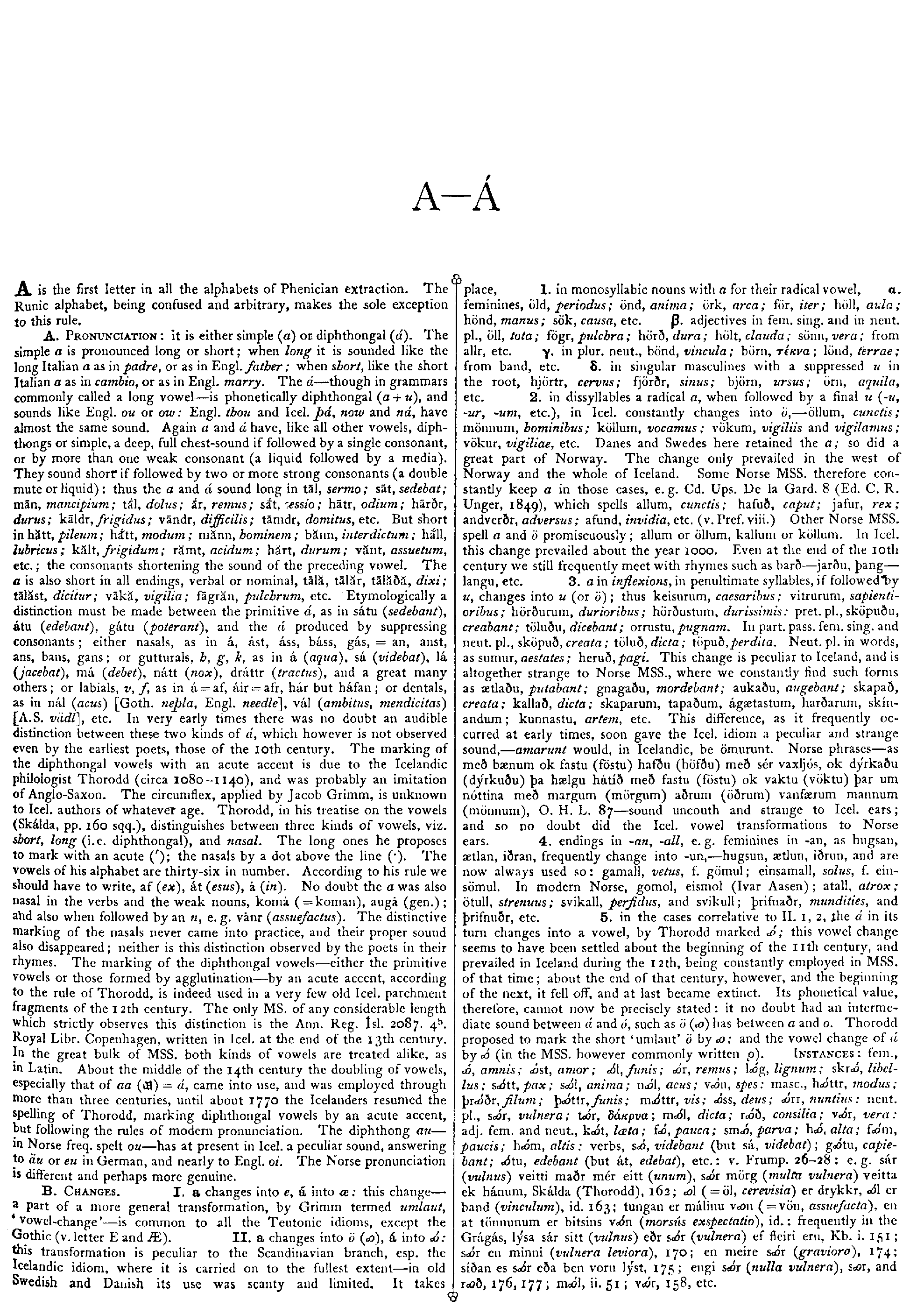
A.
is
the
first
letter
in
all
the
alphabets
of
Phenician
extraction.
The
Runic
alphabet,
being
confused
and
arbitrary,
makes
the
sole
exception
to
this
rule.
A.
PRONUNCIATION:
it
is
either
simple
(a)
or
diphthongal
(á).
The
simple
a
is
pronounced
long
or
short;
when
long
it
is
sounded
like
the
long
Italian
a
as
in
padre,
or
as
in
Engl.
father;
when
short,
like
the
short
Italian
a
as
in
cambio,
or
as
in
Engl.
marry.
The
á
--
though
in
grammars
commonly
called
a
long
vowel
--
is
phonetically
diphthongal
(a
+
u),
and
sounds
like
Engl.
ou
or
ow:
Engl.
thou
and
Icel.
þá,
now
and
ná,
have
almost
the
same
sound.
Again
a
and
á
have,
like
all
other
vowels,
diph-
thongs
or
simple,
a
deep,
full
chest-sound
if
followed
by
a
single
consonant,
or
by
more
than
one
weak
consonant
(a
liquid
followed
by
a
media).
They
sound
short
if
followed
by
two
or
more
strong
consonants
(a
double
mute
or
liquid):
thus
the
a
and
á
sound
long
in
tál,
sermo;
sát,
sedebat;
mán,
mancipium;
tál,
dolus;
ár,
remits;
sát,
sessio,
hátr,
odium;
hárðr,
durus;
káldr,
frigidus;
vándr,
difficilis;
támdr,
domitus,
etc.
But
short
in
hátt,
pileum;
hátt,
modum;
mánn,
bominem;
bánn,
interdictum;
háll,
lubricus;
kált,
frigidum;
rámt,
acidum;
hárt,
durum;
vánt,
assuetum,
etc.;
the
consonants
shortening
the
sound
of
the
preceding
vowel.
The
a
is
also
short
in
all
endings,
verbal
or
nominal,
tala,
talar,
talaða,
dixi;
talast,
dicitur;
vaka,
vigilia;
fagran,
pulchrum,
etc.
Etymologically
a
distinction
must
be
made
between
the
primitive
á,
as
in
sátu
(sedebant),
átu
(edebant),
gátu
(poterant),
and
the
á
produced
by
suppressing
consonants;
either
nasals,
as
in
á,
ást,
áss,
báss,
gás,
=
an,
anst,
ans,
bans,
gans;
or
gutturals,
h,
g,
k,
as
in
á
(aqua),
sá
(videbat),
lá
(jacebat),
má
(debet),
nátt
(nox),
dráttr
(tractus),
and
a
great
many
others;
or
labials,
v,
f,
as
in
á
=
af,
áir
=
afr,
hár
but
háfan;
or
dentals,
as
in
nál
(acus)
[Goth.
nepla,
Engl.
needle],
vál
(ambitus,
mendicitas)
[A.
S.
vädl],
etc.
In
very
early
times
there
was
no
doubt
an
audible
distinction
between
these
two
kinds
of
á,
which
however
is
not
observed
even
by
the
earliest
poets,
those
of
the
10th
century.
The
marking
of
the
diphthongal
vowels
with
an
acute
accent
is
due
to
the
Icelandic
philologist
Thorodd
(circa
1080-1140),
and
was
probably
an
imitation
of
Anglo-Saxon.
The
circumflex,
applied
by
Jacob
Grimm,
is
unknown
to
Icel.
authors
of
whatever
age.
Thorodd,
in
his
treatise
on
the
vowels
(Skálda,
pp.
160
sqq.),
distinguishes
between
three
kinds
of
vowels,
viz.
short,
long
(i.
e.
diphthongal),
and
nasal.
The
long
ones
he
proposes
to
mark
with
an
acute
( );
the
nasals
by
a
dot
above
the
line
(•).
The
vowels
of
his
alphabet
are
thirty-six
in
number.
According
to
his
rule
we
should
have
to
write,
af
(ex),
át
(esus),
ä
(in).
No
doubt
the
a
was
also
nasal
in
the
verbs
and
the
weak
nouns,
komå
(=
koman),
augä
(gen.);
and
also
when
followed
by
an
n,
e.
g.
vänr
(assuefactus).
The
distinctive
marking
of
the
nasals
never
came
into
practice,
and
their
proper
sound
also
disappeared;
neither
is
this
distinction
observed
by
the
poets
in
their
rhymes.
The
marking
of
the
diphthongal
vowels
--
either
the
primitive
vowels
or
those
formed
by
agglutination
--
by
an
acute
accent,
according
to
the
rule
of
Thorodd,
is
indeed
used
in
a
very
few
old
Icel.
parchment
fragments
of
the
12th
century.
The
only
MS.
of
any
considerable
length
which
strictly
observes
this
distinction
is
the
Ann.
Reg.
Ísl.
2087.
4b.
Royal
Libr.
Copenhagen,
written
in
Icel.
at
the
end
of
the
13th
century.
In
the
great
bulk
of
MSS.
both
kinds
of
vowels
are
treated
alike,
as
in
Latin.
About
the
middle
of
the
14th
century
the
doubling
of
vowels,
especially
that
of
aa
()
=
á,
came
into
use,
and
was
employed
through
more
than
three
centuries,
until
about
1770
the
Icelanders
resumed
the
spelling
of
Thorodd,
marking
diphthongal
vowels
by
an
acute
accent,
but
following
the
rules
of
modern
pronunciation.
The
diphthong
au
--
in
Norse
freq.
spelt
ou
--
has
at
present
in
Icel.
a
peculiar
sound,
answering
to
äu
or
eu
in
German,
and
nearly
to
Engl.
oi.
The
Norse
pronunciation
is
different
and
perhaps
more
genuine.
B.
CHANGES.
I.
a
changes
into
æ,
á
into
Æ:
this
change
--
a
part
of
a
more
general
transformation,
by
Grimm
termed
umlaut,
'vowel-change'
--
is
common
to
all
the
Teutonic
idioms,
except
the
Gothic
(v.
letter
E
and
Æ).
II.
a
changes
into
ö
(),
á
into
:
this
transformation
is
peculiar
to
the
Scandinavian
branch,
esp.
the
Icelandic
idiom,
where
it
is
carried
on
to
the
fullest
extent
--
in
old
Swedish
and
Danish
its
use
was
scanty
and
limited.
It
takes
place,
1.
in
monosyllabic
nouns
with
a
for
their
radical
vowel,
);
the
nasals
by
a
dot
above
the
line
(•).
The
vowels
of
his
alphabet
are
thirty-six
in
number.
According
to
his
rule
we
should
have
to
write,
af
(ex),
át
(esus),
ä
(in).
No
doubt
the
a
was
also
nasal
in
the
verbs
and
the
weak
nouns,
komå
(=
koman),
augä
(gen.);
and
also
when
followed
by
an
n,
e.
g.
vänr
(assuefactus).
The
distinctive
marking
of
the
nasals
never
came
into
practice,
and
their
proper
sound
also
disappeared;
neither
is
this
distinction
observed
by
the
poets
in
their
rhymes.
The
marking
of
the
diphthongal
vowels
--
either
the
primitive
vowels
or
those
formed
by
agglutination
--
by
an
acute
accent,
according
to
the
rule
of
Thorodd,
is
indeed
used
in
a
very
few
old
Icel.
parchment
fragments
of
the
12th
century.
The
only
MS.
of
any
considerable
length
which
strictly
observes
this
distinction
is
the
Ann.
Reg.
Ísl.
2087.
4b.
Royal
Libr.
Copenhagen,
written
in
Icel.
at
the
end
of
the
13th
century.
In
the
great
bulk
of
MSS.
both
kinds
of
vowels
are
treated
alike,
as
in
Latin.
About
the
middle
of
the
14th
century
the
doubling
of
vowels,
especially
that
of
aa
()
=
á,
came
into
use,
and
was
employed
through
more
than
three
centuries,
until
about
1770
the
Icelanders
resumed
the
spelling
of
Thorodd,
marking
diphthongal
vowels
by
an
acute
accent,
but
following
the
rules
of
modern
pronunciation.
The
diphthong
au
--
in
Norse
freq.
spelt
ou
--
has
at
present
in
Icel.
a
peculiar
sound,
answering
to
äu
or
eu
in
German,
and
nearly
to
Engl.
oi.
The
Norse
pronunciation
is
different
and
perhaps
more
genuine.
B.
CHANGES.
I.
a
changes
into
æ,
á
into
Æ:
this
change
--
a
part
of
a
more
general
transformation,
by
Grimm
termed
umlaut,
'vowel-change'
--
is
common
to
all
the
Teutonic
idioms,
except
the
Gothic
(v.
letter
E
and
Æ).
II.
a
changes
into
ö
(),
á
into
:
this
transformation
is
peculiar
to
the
Scandinavian
branch,
esp.
the
Icelandic
idiom,
where
it
is
carried
on
to
the
fullest
extent
--
in
old
Swedish
and
Danish
its
use
was
scanty
and
limited.
It
takes
place,
1.
in
monosyllabic
nouns
with
a
for
their
radical
vowel,
 .
feminines,
öld,
periodus;
önd,
anima;
örk,
arca;
för,
iter;
höll,
aula;
hönd,
manus;
sök,
causa,
etc.
.
feminines,
öld,
periodus;
önd,
anima;
örk,
arca;
för,
iter;
höll,
aula;
hönd,
manus;
sök,
causa,
etc.
 .
adjectives
in
fem.
sing,
and
in
neut.
pl.,
öll,
tota;
fögr,
pulchra;
hörð,
dura;
hölt,
clauda;
sönn,
vera;
from
allr,
etc.
.
adjectives
in
fem.
sing,
and
in
neut.
pl.,
öll,
tota;
fögr,
pulchra;
hörð,
dura;
hölt,
clauda;
sönn,
vera;
from
allr,
etc.
 .
in
plur.
neut.,
bönd,
vincula;
börn,
GREEK;
lönd,
terrae;
from
band,
etc.
.
in
plur.
neut.,
bönd,
vincula;
börn,
GREEK;
lönd,
terrae;
from
band,
etc.
 .
in
singular
masculines
with
a
suppressed
u
in
the
root,
hjörtr,
cervus;
fjörðr,
sinus;
björn,
ursus;
örn,
aquila,
etc.
2.
in
dissyllables
a
radical
a,
when
followed
by
a
final
u
(-u,
-ur,
-um,
etc.),
in
Icel.
constantly
changes
into
ö,
--
öllum,
cunctis;
mönnum,
hominibus;
köllum,
vocamus;
vökum,
vigiliis
and
vigilamus;
vökur,
vigiliae,
etc.
Danes
and
Swedes
here
retained
the
a;
so
did
a
great
part
of
Norway.
The
change
only
prevailed
in
the
west
of
Norway
and
the
whole
of
Iceland.
Some
Norse
MSS.
therefore
con-
stantly
keep
a
in
those
cases,
e.
g.
Cd.
Ups.
De
la
Gard.
8
(Ed.
C.
R.
Unger,
1849),
which
spells
allum,
cunctis;
hafuð,
caput;
jafur,
rex;
andverðr,
adversus;
afund,
invidia,
etc.
(v.
Pref.
viii.)
Other
Norse
MSS.
spell
a
and
ö
promiscuously;
allum
or
öllum,
kallum
or
köllum.
In
Icel.
this
change
prevailed
about
the
year
1000.
Even
at
the
end
of
the
loth
century
we
still
frequently
meet
with
rhymes
such
as
barð
--
jarðu,
þang
--
langu,
etc.
3.
a
in
inflexions,
in
penultimate
syllables,
if
followed
by
u,
changes
into
u
(or
ö);
thus
keisurum,
caesaribus;
vitrurum,
sapienti-
oribus;
hörðurum,
durioribus;
hörðustum,
durissimis:
pret.
pl.,
sköpuðu,
creabant;
töluðu,
dicebant;
orrustu,
pugnam.
In
part.
pass.
fem.
sing,
and
neut.
pl.,
sköpuð,
creata;
töluð,
dicta;
töpuð,
perdi/
a.
Neut.
pl.
in
words,
as
sumur,
aestates;
heruð,
pagi.
This
change
is
peculiar
to
Iceland,
and
is
altogether
strange
to
Norse
MSS.,
where
we
constantly
find
such
forms
as
ætlaðu,
putabant;
gnagaðu,
mordebant;
aukaðu,
augebant;
skapað,
creata;
kallað,
dicta;
skaparum,
tapaðum,
ágætastum,
harðarum,
skín-
andum;
kunnastu,
artem,
etc.
This
difference,
as
it
frequently
oc-
curred
at
early
times,
soon
gave
the
Icel.
idiom
a
peculiar
and
strange
sound,
--
amarunt
would,
in
Icelandic,
be
ömurunt.
Norse
phrases
--
as
með
bænum
ok
fastu
(fostu)
hafðu
(höfðu)
með
sér
vaxljós,
ok
dýrkaðu
(dýrkuðu)
þa
hælgu
hátíð
með
fastu
(föstu)
ok
vaktu
(vöktu)
þar
um
nóttina
með
margum
(mörgum)
aðrum
(öðrum)
vanfærum
mannum
(monnum),
O.
H.
L.
87
--
sound
uncouth
and
strange
to
Icel.
ears;
and
so
no
doubt
did
the
Icel.
vowel
transformations
to
Norse
ears.
4.
endings
in
-an,
-all,
e.
g.
feminines
in
-an,
as
hugsan,
ætlan,
iðran,
frequently
change
into
-un,
--
hugsun,
ætlun,
iðrun,
and
are
now
always
used
so:
gamall,
vetus,
f.
gömul;
einsamall,
solus,
f.
ein-
sömul.
In
modern
Norse,
gomol,
eismol
(Ivar
Aasen);
atall,
atrox;
ötull,
strenuus;
svikall,
perfidus,
and
svikull;
þrifnaðr,
mundities,
and
þrifnuðr,
etc.
5.
in
the
cases
correlative
to
II.
1,
2,
the
á
in
its
turn
changes
into
a
vowel,
by
Thorodd
marked
;
this
vowel
change
seems
to
have
been
settled
about
the
beginning
of
the
11th
century,
and
prevailed
in
Iceland
during
the
12th,
being
constantly
employed
in
MSS.
of
that
time;
about
the
end
of
that
century,
however,
and
the
beginning
of
the
next,
it
fell
off,
and
at
last
became
extinct.
Its
phonetical
value,
therefore,
cannot
now
be
precisely
stated:
it
no
doubt
had
an
interme-
diate
sound
between
á
and
ó,
such
as
ö
(oo)
has
between
a
and
o.
Thorodd
proposed
to
mark
the
short
'umlaut'
ö
by
;
and
the
vowel
change
of
á
by
(in
the
MSS.
however
commonly
written
).
INSTANCES:
fcm.,
,
amnis;
st,
amor;
l,
funis;
r,
remits;
lg,
lignum;
skr,
libel-
lus;
stt,
pax;
sl,
anima;
nl,
acus;
vn,
spes:
masc.,
httr,
modus;
þrðr,
fîlum;
þttr,
funis;
mttr,
vis;
ss,
deus;
rr,
nuntius:
neut.
pl.,
sr,
vulnera;
tr,
GREEK;
ml,
dicta;
rð,
consilia;
vr,
vera:
adj.
fem,
and
neut.,
koát,
læta;
f,
pauca;
sm,
parva;
h,
alta;
fm,
paucis;
hm,
altis:
verbs,
s,
videbant
(but
sá,
videbat);
gtu,
capie-
bant;
tu,
edebant
(but
at,
edebat),
etc.:
v.
Frump.
26-28:
e.
g.
sár
(vulnus)
veitti
maðr
mer
eitt
(unum),
sr
mörg
(multa
vulnera)
veitta
ek
hánum,
Skálda
(Thorodd),
162;
l
(=
öl,
cerevisia)
er
drykkr,
l
er
band
(vinculum),
id.
163;
tungan
er
málinu
vn
(=
vön,
assuefacta),
en
at
tönnunum
er
bitsins
vn
(morsils
exspectatio),
id.:
frequently
in
the
Grágás,
lýsa
sár
sitt
(vulnus)
eðr
sr
(vulnera)
ef
fleiri
eru,
Kb.
i.
151;
sr
en
minni
(vulnera
leviora),
170;
en
meire
sr
(graviora),
174;
síðan
es
sr
eða
ben
voru
lýst,
175;
engi
sr
(nulla
vulnera),
sr,
and
rð,
176,
177;
ml,
ii.
51;
vr,
158,
.
in
singular
masculines
with
a
suppressed
u
in
the
root,
hjörtr,
cervus;
fjörðr,
sinus;
björn,
ursus;
örn,
aquila,
etc.
2.
in
dissyllables
a
radical
a,
when
followed
by
a
final
u
(-u,
-ur,
-um,
etc.),
in
Icel.
constantly
changes
into
ö,
--
öllum,
cunctis;
mönnum,
hominibus;
köllum,
vocamus;
vökum,
vigiliis
and
vigilamus;
vökur,
vigiliae,
etc.
Danes
and
Swedes
here
retained
the
a;
so
did
a
great
part
of
Norway.
The
change
only
prevailed
in
the
west
of
Norway
and
the
whole
of
Iceland.
Some
Norse
MSS.
therefore
con-
stantly
keep
a
in
those
cases,
e.
g.
Cd.
Ups.
De
la
Gard.
8
(Ed.
C.
R.
Unger,
1849),
which
spells
allum,
cunctis;
hafuð,
caput;
jafur,
rex;
andverðr,
adversus;
afund,
invidia,
etc.
(v.
Pref.
viii.)
Other
Norse
MSS.
spell
a
and
ö
promiscuously;
allum
or
öllum,
kallum
or
köllum.
In
Icel.
this
change
prevailed
about
the
year
1000.
Even
at
the
end
of
the
loth
century
we
still
frequently
meet
with
rhymes
such
as
barð
--
jarðu,
þang
--
langu,
etc.
3.
a
in
inflexions,
in
penultimate
syllables,
if
followed
by
u,
changes
into
u
(or
ö);
thus
keisurum,
caesaribus;
vitrurum,
sapienti-
oribus;
hörðurum,
durioribus;
hörðustum,
durissimis:
pret.
pl.,
sköpuðu,
creabant;
töluðu,
dicebant;
orrustu,
pugnam.
In
part.
pass.
fem.
sing,
and
neut.
pl.,
sköpuð,
creata;
töluð,
dicta;
töpuð,
perdi/
a.
Neut.
pl.
in
words,
as
sumur,
aestates;
heruð,
pagi.
This
change
is
peculiar
to
Iceland,
and
is
altogether
strange
to
Norse
MSS.,
where
we
constantly
find
such
forms
as
ætlaðu,
putabant;
gnagaðu,
mordebant;
aukaðu,
augebant;
skapað,
creata;
kallað,
dicta;
skaparum,
tapaðum,
ágætastum,
harðarum,
skín-
andum;
kunnastu,
artem,
etc.
This
difference,
as
it
frequently
oc-
curred
at
early
times,
soon
gave
the
Icel.
idiom
a
peculiar
and
strange
sound,
--
amarunt
would,
in
Icelandic,
be
ömurunt.
Norse
phrases
--
as
með
bænum
ok
fastu
(fostu)
hafðu
(höfðu)
með
sér
vaxljós,
ok
dýrkaðu
(dýrkuðu)
þa
hælgu
hátíð
með
fastu
(föstu)
ok
vaktu
(vöktu)
þar
um
nóttina
með
margum
(mörgum)
aðrum
(öðrum)
vanfærum
mannum
(monnum),
O.
H.
L.
87
--
sound
uncouth
and
strange
to
Icel.
ears;
and
so
no
doubt
did
the
Icel.
vowel
transformations
to
Norse
ears.
4.
endings
in
-an,
-all,
e.
g.
feminines
in
-an,
as
hugsan,
ætlan,
iðran,
frequently
change
into
-un,
--
hugsun,
ætlun,
iðrun,
and
are
now
always
used
so:
gamall,
vetus,
f.
gömul;
einsamall,
solus,
f.
ein-
sömul.
In
modern
Norse,
gomol,
eismol
(Ivar
Aasen);
atall,
atrox;
ötull,
strenuus;
svikall,
perfidus,
and
svikull;
þrifnaðr,
mundities,
and
þrifnuðr,
etc.
5.
in
the
cases
correlative
to
II.
1,
2,
the
á
in
its
turn
changes
into
a
vowel,
by
Thorodd
marked
;
this
vowel
change
seems
to
have
been
settled
about
the
beginning
of
the
11th
century,
and
prevailed
in
Iceland
during
the
12th,
being
constantly
employed
in
MSS.
of
that
time;
about
the
end
of
that
century,
however,
and
the
beginning
of
the
next,
it
fell
off,
and
at
last
became
extinct.
Its
phonetical
value,
therefore,
cannot
now
be
precisely
stated:
it
no
doubt
had
an
interme-
diate
sound
between
á
and
ó,
such
as
ö
(oo)
has
between
a
and
o.
Thorodd
proposed
to
mark
the
short
'umlaut'
ö
by
;
and
the
vowel
change
of
á
by
(in
the
MSS.
however
commonly
written
).
INSTANCES:
fcm.,
,
amnis;
st,
amor;
l,
funis;
r,
remits;
lg,
lignum;
skr,
libel-
lus;
stt,
pax;
sl,
anima;
nl,
acus;
vn,
spes:
masc.,
httr,
modus;
þrðr,
fîlum;
þttr,
funis;
mttr,
vis;
ss,
deus;
rr,
nuntius:
neut.
pl.,
sr,
vulnera;
tr,
GREEK;
ml,
dicta;
rð,
consilia;
vr,
vera:
adj.
fem,
and
neut.,
koát,
læta;
f,
pauca;
sm,
parva;
h,
alta;
fm,
paucis;
hm,
altis:
verbs,
s,
videbant
(but
sá,
videbat);
gtu,
capie-
bant;
tu,
edebant
(but
at,
edebat),
etc.:
v.
Frump.
26-28:
e.
g.
sár
(vulnus)
veitti
maðr
mer
eitt
(unum),
sr
mörg
(multa
vulnera)
veitta
ek
hánum,
Skálda
(Thorodd),
162;
l
(=
öl,
cerevisia)
er
drykkr,
l
er
band
(vinculum),
id.
163;
tungan
er
málinu
vn
(=
vön,
assuefacta),
en
at
tönnunum
er
bitsins
vn
(morsils
exspectatio),
id.:
frequently
in
the
Grágás,
lýsa
sár
sitt
(vulnus)
eðr
sr
(vulnera)
ef
fleiri
eru,
Kb.
i.
151;
sr
en
minni
(vulnera
leviora),
170;
en
meire
sr
(graviora),
174;
síðan
es
sr
eða
ben
voru
lýst,
175;
engi
sr
(nulla
vulnera),
sr,
and
rð,
176,
177;
ml,
ii.
51;
vr,
158,
|
Source: Cleasby/Vigfusson, page b0002, entry 1 View original page image as: [TIFF] [PNG] [View previous entry] [View next entry] |
[Comment on this entry] [View comments] |
The following entry has been hand-corrected once. |
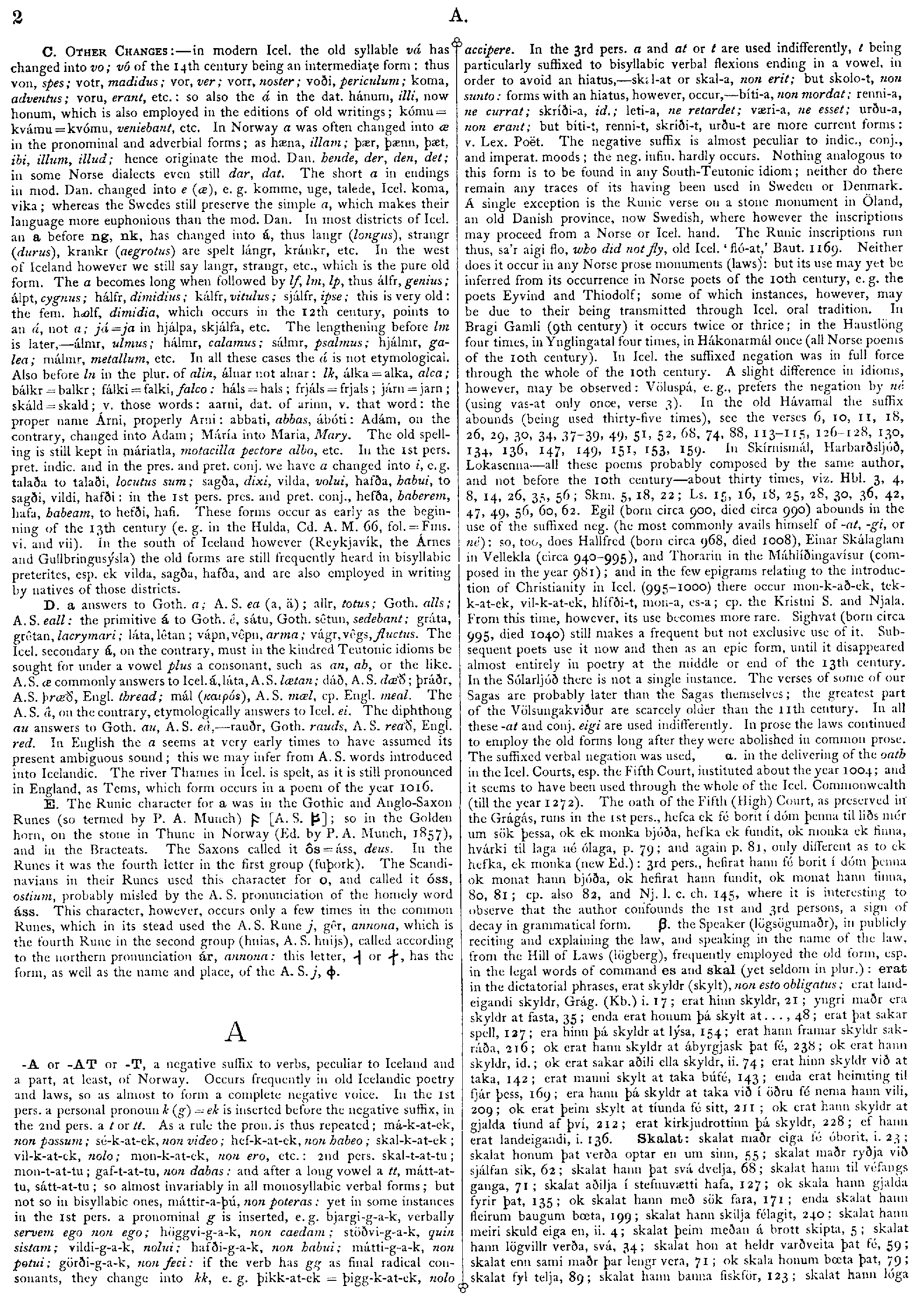
C.
OTHER
CHANGES
:--
in
modern
Icel.
the
old
syllable
va
has
changed
into
vo;
vó
of
the
14th
century
being
an
intermediate
form:
thus
von,
spes;
votr,
madidus;
vor,
ver;
vorr,
noster;
voði,
periculum;
koma,
adventus;
voru,
erant,
etc.:
so
also
the
á
in
the
dat.
hánum,
illi,
now
honum,
which
is
also
employed
in
the
editions
of
old
writings;
kómu
=
kvámu
=
kvómu,
veniebant,
etc.
In
Norway
a
was
often
changed
into
æ
in
the
pronominal
and
adverbial
forms;
as
hæna,
illam;
þær,
þænn,
þæt,
ibi,
ilium,
illud;
hence
originate
the
mod.
Dan.
hende,
der,
den,
det;
in
some
Norse
dialects
even
still
dar,
dat.
The
short
a
in
endings
in
mod.
Dan.
changed
into
e
(æ),
e.
g.
komme,
uge,
talede,
Icel.
koma,
vika;
whereas
the
Swedes
still
preserve
the
simple
a,
which
makes
their
language
more
euphonious
than
the
mod.
Dan.
In
most
districts
of
Icel.
an
a
before
ng,
nk,
has
changed
into
á,
thus
langr
(longus),
strangr
(durus),
krankr
(aegrotus)
are
spelt
lángr,
kránkr,
etc.
In
the
west
of
Iceland
however
we
still
say
langr,
strangr,
etc.,
which
is
the
pure
old
form.
The
a
becomes
long
when
followed
by
lf,
lm,
lp,
thus
álfr,
genius;
álpt,
cygnus;
hálfr,
dimidius;
kálfr,
vitulus;
sjálfr,
ipse;
this
is
very
old:
the
fem.
hlf,
dimidia,
which
occurs
in
the
12th
century,
points
to
an
á,
not
a;
já
=
ja
in
hjálpa,
skjálfa,
etc.
The
lengthening
before
lm
is
later,
--
álmr,
ulmus;
hálmr,
calamus;
sálmr,
psalmus;
hjálmr,
ga-
lea;
málmr,
metallum,
etc.
In
all
these
cases
the
á
is
not
etymological.
Also
before
ln
in
the
plur.
of
alin,
álnar
not
alnar:
lk,
alka
=
alka,
alca;
bálkr
=
balkr;
fálki
=
falki,
falco:
háls
=
hals;
frjáls
=
frjals;
járn
=
jarn;
skáld
=
skald;
v.
those
words:
aarni,
dat.
of
arinn,
v.
that
word:
the
proper
name
Árni,
properly
Arni:
abbati,
abbas,
ábóti:
Adám,
on
the
contrary,
changed
into
Adam;
Máría
into
Maria,
Mary.
The
old
spell-
ing
is
still
kept
in
máriatla,
motacilla
pectore
albo,
etc.
In
the
1st
pers.
pret.
indic.,
and
in
the
pres.
and
pret.
conj.
we
have
a
changed
into
i,
e.
g.
talaða
to
talaði,
locutus
sum;
sagða,
dixi,
vilda,
volui,
hafða,
habui,
to
sagði,
vildi,
hafði:
in
the
1st
pers.
pres.
and
pret.
conj.,
hefða,
haberem,
hafa,
habeam,
to
hefði,
hafi.
These
forms
occur
as
early
as
the
begin-
ning
of
the
13th
century
(e.
g.
in
the
Hulda,
Cd.
A.
M.
66,
fol.
=
Fms.
vi.
and
vii).
In
the
south
of
Iceland
however
(Reykjavik,
the
Árnes
and
Gullbringusýsla)
the
old
forms
are
still
frequently
heard
in
bisyllabic
preterites,
esp.
ek
vilda,
sagða,
hafða,
and
are
also
employed
in
writing
by
natives
of
those
districts.
D.
a
answers
to
Goth,
a;
A.
S.
ea
(a,
ä);
allr,
totus;
Goth,
alls;
A.
S.
eall:
the
primitive
á
to
Goth,
ê,
sátu,
Goth,
sêtun,
sedebant;
gráta,
grétun,
lacrymari;
láta,
lêtan;
vápn,
vêpn,
arma;
vagr,
vêgs,
fluctus.
The
Icel.
secondary
á,
on
the
contrary,
must
in
the
kindred
Teutonic
idioms
be
sought
for
under
a
vowel
plus
a
consonant,
such
as
an,
ah,
or
the
like.
A.
S.
æ
commonly
answers
to
Icel.
á,
láta,
A.
S.
lætan;
dáð,
A.
S.
dæð;
þráðr,
A.
S.
þræð,
Engl.
thread;
mál
(GREEK),
A.
S.
mœl,
cp.
Engl.
meal.
The
A.
S.
(1,
on
the
contrary,
etyrnologically
answers
to
Icel.
ei.
The
diphthong
au
answers
to
Goth.
au,
A.
S.
eá,
--
rauðr,
Goth.
rauds,
A.
S.
reað,
Engl.
red.
In
English
the
a
seems
at
very
early
times
to
have
assumed
its
present
ambiguous
sound;
this
we
may
infer
from
A.
S.
words
introduced
into
Icelandic.
The
river
Thames
in
Icel.
is
spelt,
as
it
is
still
pronounced
in
England,
as
Tems,
which
form
occurs
in
a
poem
of
the
year
1016.
E.
The
Runic
character
for
a
was
in
the
Gothic
and
Anglo-Saxon
Runes
(so
termed
by
P.
A.
Munch)
RUNE
[A.
S.
RUNE];
so
in
the
Golden
horn,
on
the
stone
in
Thune
in
Norway
(Ed.
by
P.
A.
Munch,
1857),
and
in
the
Bracteats.
The
Saxons
called
it
os
=
áss,
deus.
In
the
Runes
it
was
the
fourth
letter
in
the
first
group
(fuþork).
The
Scandi-
navians
in
their
Runes
used
this
character
for
o,
and
called
it
óss,
ostium,
probably
misled
by
the
A.
S.
pronunciation
of
the
homely
word
áss.
This
character,
however,
occurs
only
a
few
times
in
the
common
Runes,
which
in
its
stead
used
the
A.
S.
Rune
RUNE,
gér,
annona,
which
is
the
fourth
Rune
in
the
second
group
(hnias,
A.
S.
hnijs),
called
according
to
the
northern
pronunciation
ár,
annona:
this
letter,
RUNE
or
RUNE
has
the
form,
as
well
as
the
name
and
place,
of
the
A.
S.
RUNE,
RUNE.
|
Source: Cleasby/Vigfusson, page b0010, entry 11 View original page image as: [TIFF] [PNG] [View previous entry] [View next entry] |
[Comment on this entry] [View comments] |
The following entry has been hand-corrected once. |
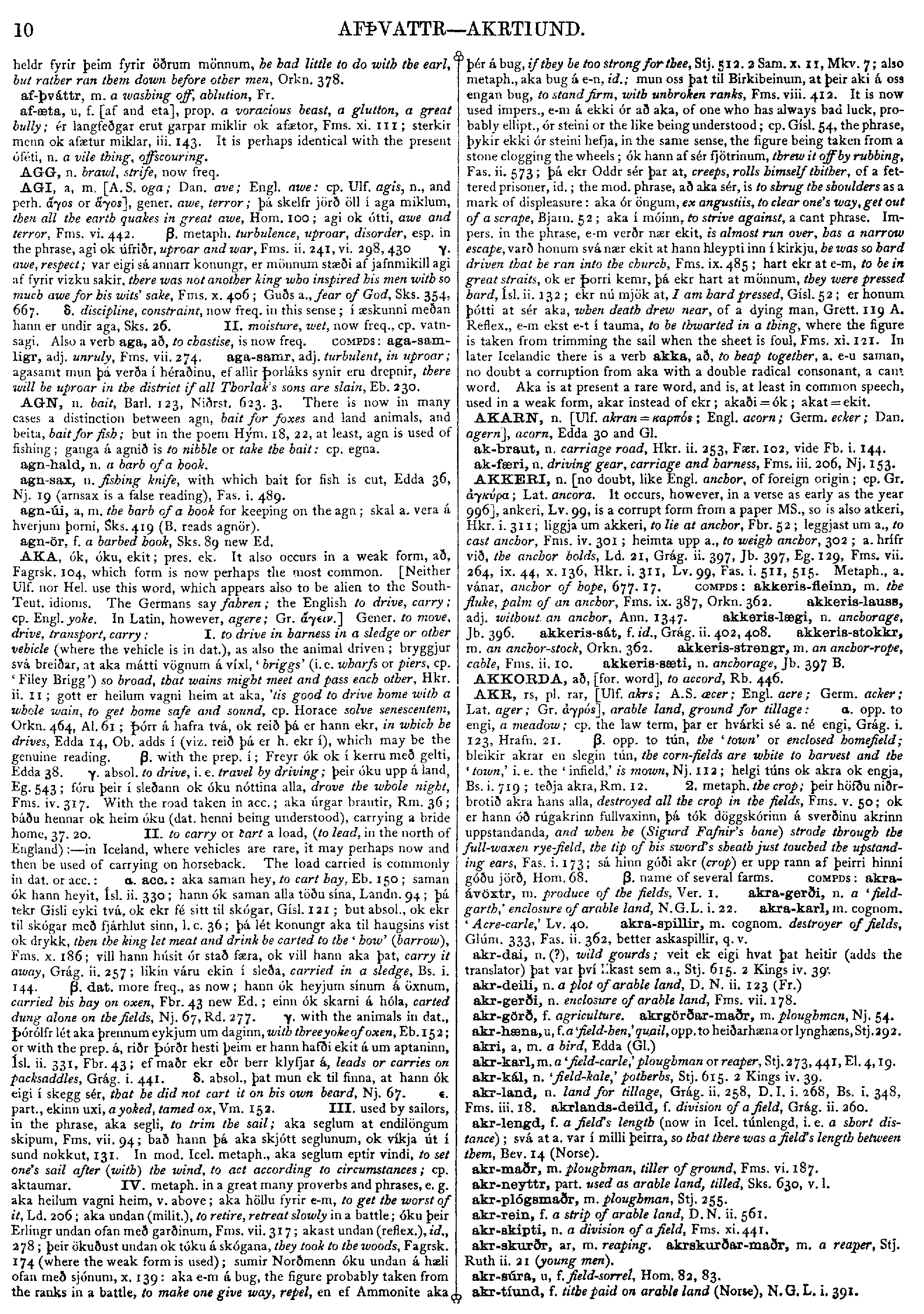
AKA,
ók,
óku,
ekit;
pres.
ek.
It
also
occurs
in
a
weak
form,
að,
Fagrsk.
104,
which
form
is
now
perhaps
the
most
common.
[Neither
Ulf.
nor
Hel.
use
this
word,
which
appears
also
to
be
alien
to
the
South-
Teut.
idioms.
The
Germans
say
fahren;
the
English
to
drive,
carry;
cp.
Engl.
yoke.
In
Latin,
however,
agere;
Gr.
GREEK]
Gener.
to
move,
drive,
transport,
carry:
I.
to
drive
in
harness
in
a
sledge
or
other
vehicle
(where
the
vehicle
is
in
dat.),
as
also
the
animal
driven;
bryggjur
svá
breiðar,
at
aka
mátti
vögnum
á
víxl,
'briggs'
(i.
e.
wharfs
or
piers,,
cp.
'Filey
Brigg')
so
broad,
that
wains
might
meet
and
pass
each
other,
Hkr.
ii.
11;
gott
er
heilum
vagni
heim
at
aka,
'tis
good
to
drive
home
with
a
whole
wain,
to
get
home
safe
and
sound,
cp.
Horace
solve
senescentem,
Orkn.
464,
Al.
61;
þórr
á
hafra
tvá,
ok
reið
þá
er
hann
ekr,
in
which
he
drives,
Edda
14,
Ób.
adds
í
(viz.
reið
þá
er
hekr
i),
which
may
be
the
genuine
reading.
.
with
the
prep,
i;
Freyr
ok
ok
í
kerru
með
gelti,
Edda
38.
.
absol.
to
drive,
i.
e.
travel
by
driving;
þeir
óku
upp
á
land,
Eg.
543;
fóru
þeir
í
sleðann
ok
óku
nóttina
alia,
drove
the
whole
night,
Fms.
iv.
317.
With
the
road
taken
in
acc.;
aka
úrgar
brautir,
Rm.
36;
báðu
hennar
ok
heim
óku
(dat.
henni
being
understood),
carrying
a
bride
home,
37.
20.
II.
to
carry
or
cart
a
load,
(to
lead,
in
the
north
of
England)
:--
in
Iceland,
where
vehicles
are
rare,
it
may
perhaps
now
and
then
be
used
of
carrying
on
horseback.
The
load
carried
is
commonly
in
dat.
or
acc.:
.
acc.:
aka
saman
hey,
to
cart
hay,
Eb.
150;
saman
ok
hann
heyit,
Ísl.
ii.
330;
hann
ok
saman
alla
töðu
sína,
Landn.
94;
þá
tekr
Gísli
eyki
tvá,
ok
ekr
fé
sitt
til
skógar,
Gísl.
121;
but
absol.,
ok
ekr
til
skógar
með
fjárhlut
sinn,
l.
c.
36;
þá
let
konungr
aka
til
haugsins
vist
ok
drykk,
then
the
king
let
meat
and
drink
be
carted
to
the
'how'
(barrow),
Fms.
x.
186;
vill
hann
húsit
ór
stað
færa,
ok
vill
hann
aka
þat,
carry
it
away,
Grág.
ii.
257;
líkin
váru
ekin
í
sleða,
carried
in
a
sledge,
Bs.
i.
144.
.
dat.
more
freq.,
as
now;
hann
ók
heyjum
sínum
á
öxnum,
carried
his
hay
on
oxen,
Fbr.
43
new
Ed.;
einn
ók
skarni
á
hóla,
carted
dung
alone
on
the
fields,
Nj.
67,
Rd.
277.
.
with
the
animals
in
dat.,
þórólfr
let
aka
þrennum
eykjum
um
daginn,
with
three
yoke
of
oxen,
Eb.
152;
or
with
the
prep.
á,
ríðr
þórðr
hesti
þeim
er
hann
hafði
ekit
á
um
aptaninn,
Ísl.
ii.
331,
Fbr.
43;
ef
maðr
ekr
eðr
berr
klyfjar
á,
leads
or
carries
on
packsaddles,
Grág.
i.
441.
.
absol.,
þat
mun
ek
til
finna,
at
hann
ok
eigi
í
skegg
ser,
that
he
did
not
cart
it
on
his
own
beard,
Nj.
67.
 .
part.,
ekinn
uxi,
a
yoked,
tamed
ox,
Vm.
152.
III.
used
by
sailors,
in
the
phrase,
aka
segli,
to
trim
the
sail;
aka
seglum
at
endilöngum
skipum,
Fms.
vii.
94;
bað
hann
þá
aka
skjótt
seglunum,
ok
víkja
út
í
sund
nokkut,
131.
In
mod.
Icel.
metaph.,
aka
seglum
eptir
vindi,
to
set
one's
sail
after
(with)
the
wind,
to
act
according
to
circumstances;
cp.
aktaumar.
IV.
metaph.
in
a
great
many
proverbs
and
phrases,
e.
g.
aka
heilum
vagni
heim,
v.
above;
aka
höllu
fyrir
e-m,
to
get
the
worst
of
it,
Ld.
206;
aka
undan
(milit),
to
retire,
retreat
slowly
in
a
battle;
óku
þeir
Erlingr
undan
ofan
með
garðinum,
Fms.
vii.
317;
akast
undan
(reflex.),
id.,
278;
þeir
ökuðust
undan
ok
tóku
á
skógana,
they
took
to
the
woods,
Fagrsk.
174
(where
the
weak
form
is
used);
sumir
Norðmenn
óku
undan
á
hæli
ofan
með
sjónum,
x.
139:
aka
e-m
á
bug,
the
figure
probably
taken
from
the
ranks
in
a
battle,
to
make
one
give
way,
repel,
en
ef
Ammonite
aka,
þér
á
bug,
if
they
be
too
strong
for
thee,
Stj.
512.
2
Sam.
x.
11.
Mkv.
7;
also
metaph.,
aka
bug
á
e-n,
id.;
mun
oss
þat
til
Birkibeinum,
at
þeir
aki
á
oss
engan
bug,
to
stand
firm,
with
unbroken
ranks,
Fms.
viii.
412.
It
is
now
used
impers.,
e-m
á
ekki
ór
að
aka,
of
one
who
has
always
bad
luck,
pro-
bably
ellipt.,
ór
steini
or
the
like
being
understood;
cp.
GÍsl.
54,
the
phrase,
þykir
ekki
ór
steini
hefja,
in
the
same
sense,
the
figure
being
taken
from
a
stone
clogging
the
wheels;
ok
hann
af
sér
fjötrinum,
threw
it
off
by
rubbing,
Fas.
ii.
573;
þá
ekr
Oddr
sér
þar
at,
creeps,
rolls
himself
thither,
of
a
fet-
tered
prisoner,
id.;
the
mod.
phrase,
að
aka
sér,
is
to
shrug
the
shoulders
as
a
mark
of
displeasure:
aka
ór
öngum,
ex
angustiis,
to
clear
one's
way,
get
out
of
a
scrape,
Bjarn.
52;
aka
í
moínn,
to
strive
against,
a
cant
phrase.
Im-
pers.
in
the
phrase,
e-m
verðr
nær
ekit,
is
almost
run
over,
has
a
narrow
escape,
varð
honum
svá
nær
ekit
at
hann
hleypti
inn
í
kirkju,
he
was
so
hard
driven
that
he
ran
into
the
church,
Fms.
ix.
485;
hart
ekr
at
e-m,
to
be
in
great
straits,
ok
er
þorri
kemr,
þá
ekr
hart
at
mönnum,
they
were
pressed
hard,
Ísl.
ii.
132;
ekr
mi
mjök
at,
I
am
hard
pressed,
GÍsl.
52;
er
honum
þótti
at
sér
aka,
when
death
drew
near,,
of
a
dying
man,
Grett.
119
A.
Reflex.,
e-m
ekst
e-t
í
tauma,
to
be
thwarted
in
a
thing,
where
the
figure
is
taken
from
trimming
the
sail
when
the
sheet
is
foul,
Fms.
xi.
121.
In
later
Icelandic
there
is
a
verb
akka,
að,
to
heap
together,
a.
e-u
saman,
no
doubt
a
corruption
from
aka
with
a
double
radical
consonant,
a
cant
word.
Aka
is
at
present
a
rare
word,
and
is,
at
least
in
common
speech,
used
in
a
weak
form,
akar
instead
of
ekr;
akaði
=
ók;
akat
=
.
part.,
ekinn
uxi,
a
yoked,
tamed
ox,
Vm.
152.
III.
used
by
sailors,
in
the
phrase,
aka
segli,
to
trim
the
sail;
aka
seglum
at
endilöngum
skipum,
Fms.
vii.
94;
bað
hann
þá
aka
skjótt
seglunum,
ok
víkja
út
í
sund
nokkut,
131.
In
mod.
Icel.
metaph.,
aka
seglum
eptir
vindi,
to
set
one's
sail
after
(with)
the
wind,
to
act
according
to
circumstances;
cp.
aktaumar.
IV.
metaph.
in
a
great
many
proverbs
and
phrases,
e.
g.
aka
heilum
vagni
heim,
v.
above;
aka
höllu
fyrir
e-m,
to
get
the
worst
of
it,
Ld.
206;
aka
undan
(milit),
to
retire,
retreat
slowly
in
a
battle;
óku
þeir
Erlingr
undan
ofan
með
garðinum,
Fms.
vii.
317;
akast
undan
(reflex.),
id.,
278;
þeir
ökuðust
undan
ok
tóku
á
skógana,
they
took
to
the
woods,
Fagrsk.
174
(where
the
weak
form
is
used);
sumir
Norðmenn
óku
undan
á
hæli
ofan
með
sjónum,
x.
139:
aka
e-m
á
bug,
the
figure
probably
taken
from
the
ranks
in
a
battle,
to
make
one
give
way,
repel,
en
ef
Ammonite
aka,
þér
á
bug,
if
they
be
too
strong
for
thee,
Stj.
512.
2
Sam.
x.
11.
Mkv.
7;
also
metaph.,
aka
bug
á
e-n,
id.;
mun
oss
þat
til
Birkibeinum,
at
þeir
aki
á
oss
engan
bug,
to
stand
firm,
with
unbroken
ranks,
Fms.
viii.
412.
It
is
now
used
impers.,
e-m
á
ekki
ór
að
aka,
of
one
who
has
always
bad
luck,
pro-
bably
ellipt.,
ór
steini
or
the
like
being
understood;
cp.
GÍsl.
54,
the
phrase,
þykir
ekki
ór
steini
hefja,
in
the
same
sense,
the
figure
being
taken
from
a
stone
clogging
the
wheels;
ok
hann
af
sér
fjötrinum,
threw
it
off
by
rubbing,
Fas.
ii.
573;
þá
ekr
Oddr
sér
þar
at,
creeps,
rolls
himself
thither,
of
a
fet-
tered
prisoner,
id.;
the
mod.
phrase,
að
aka
sér,
is
to
shrug
the
shoulders
as
a
mark
of
displeasure:
aka
ór
öngum,
ex
angustiis,
to
clear
one's
way,
get
out
of
a
scrape,
Bjarn.
52;
aka
í
moínn,
to
strive
against,
a
cant
phrase.
Im-
pers.
in
the
phrase,
e-m
verðr
nær
ekit,
is
almost
run
over,
has
a
narrow
escape,
varð
honum
svá
nær
ekit
at
hann
hleypti
inn
í
kirkju,
he
was
so
hard
driven
that
he
ran
into
the
church,
Fms.
ix.
485;
hart
ekr
at
e-m,
to
be
in
great
straits,
ok
er
þorri
kemr,
þá
ekr
hart
at
mönnum,
they
were
pressed
hard,
Ísl.
ii.
132;
ekr
mi
mjök
at,
I
am
hard
pressed,
GÍsl.
52;
er
honum
þótti
at
sér
aka,
when
death
drew
near,,
of
a
dying
man,
Grett.
119
A.
Reflex.,
e-m
ekst
e-t
í
tauma,
to
be
thwarted
in
a
thing,
where
the
figure
is
taken
from
trimming
the
sail
when
the
sheet
is
foul,
Fms.
xi.
121.
In
later
Icelandic
there
is
a
verb
akka,
að,
to
heap
together,
a.
e-u
saman,
no
doubt
a
corruption
from
aka
with
a
double
radical
consonant,
a
cant
word.
Aka
is
at
present
a
rare
word,
and
is,
at
least
in
common
speech,
used
in
a
weak
form,
akar
instead
of
ekr;
akaði
=
ók;
akat
=
|
Source: Cleasby/Vigfusson, page b0021, entry 21 View original page image as: [TIFF] [PNG] [View previous entry] [View next entry] |
[Comment on this entry] [View comments] |
The following entry has been hand-corrected once. |
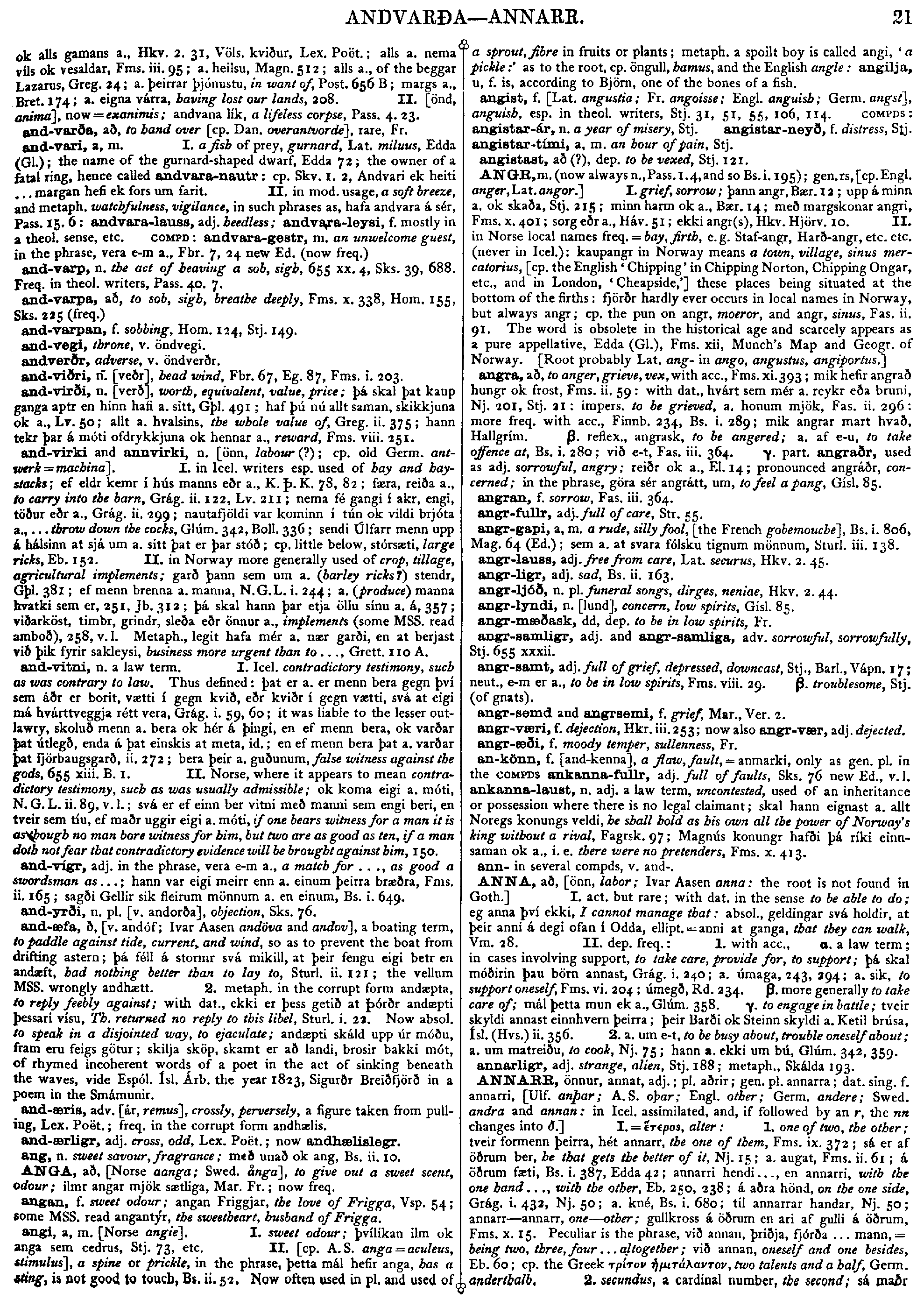
angi, a, m. [Norse angie] . I. sweet odour; þvílíkan ilm ok anga sem cedrus, Stj. 73, etc. II. [cp. A. S. anga = aculeus, stimulus], a spine or prickle, in the phrase, þetta mál hefir anga, has a sting, is not good to touch, Bs. ii. 52. Now often used in pl. and used of a sprout, fibre in fruits or plants; metaph. a spoilt boy is called angi, 'a pickle:' as to the root, cp. öngull, hamus, and the English angle: angilja, u, f. is, according to Björn, one of the bones of a fish.
|
Source: Cleasby/Vigfusson, page b0023, entry 4 View original page image as: [TIFF] [PNG] [View previous entry] [View next entry] |
[Comment on this entry] [View comments] |
The following entry has been hand-corrected once. |
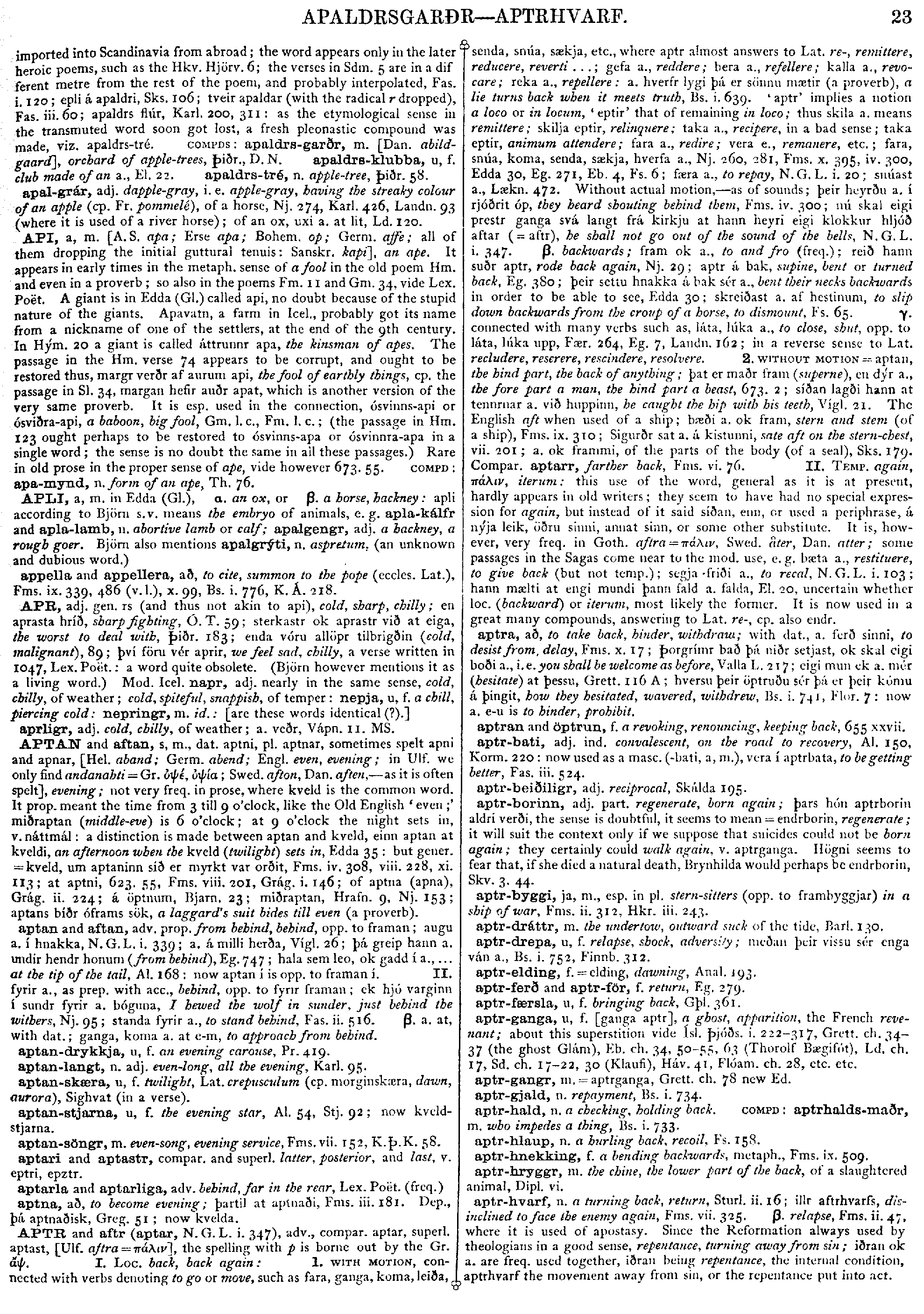
APLI,
a,
m.
in
Edda
(Gl.),
.
an
ox,
or
.
a
horse,
hackney:
apli
according
to
Björn
s.v.
means
the
embryo
of
animals,
e.g.
apla-kálfr
and
apla-lamb,
n.
abortive
lamb
or
calf;
apalgengr,
adj.
a
hackney,
a
rough
goer.
Björn
also
mentions
apalgrýti,
n.
aspretum,
(an
unknown
and
dubious
word.)
|
Source: Cleasby/Vigfusson, page b0028, entry 1 View original page image as: [TIFF] [PNG] [View previous entry] [View next entry] |
[Comment on this entry] [View comments] |
The following entry has been hand-corrected once. |
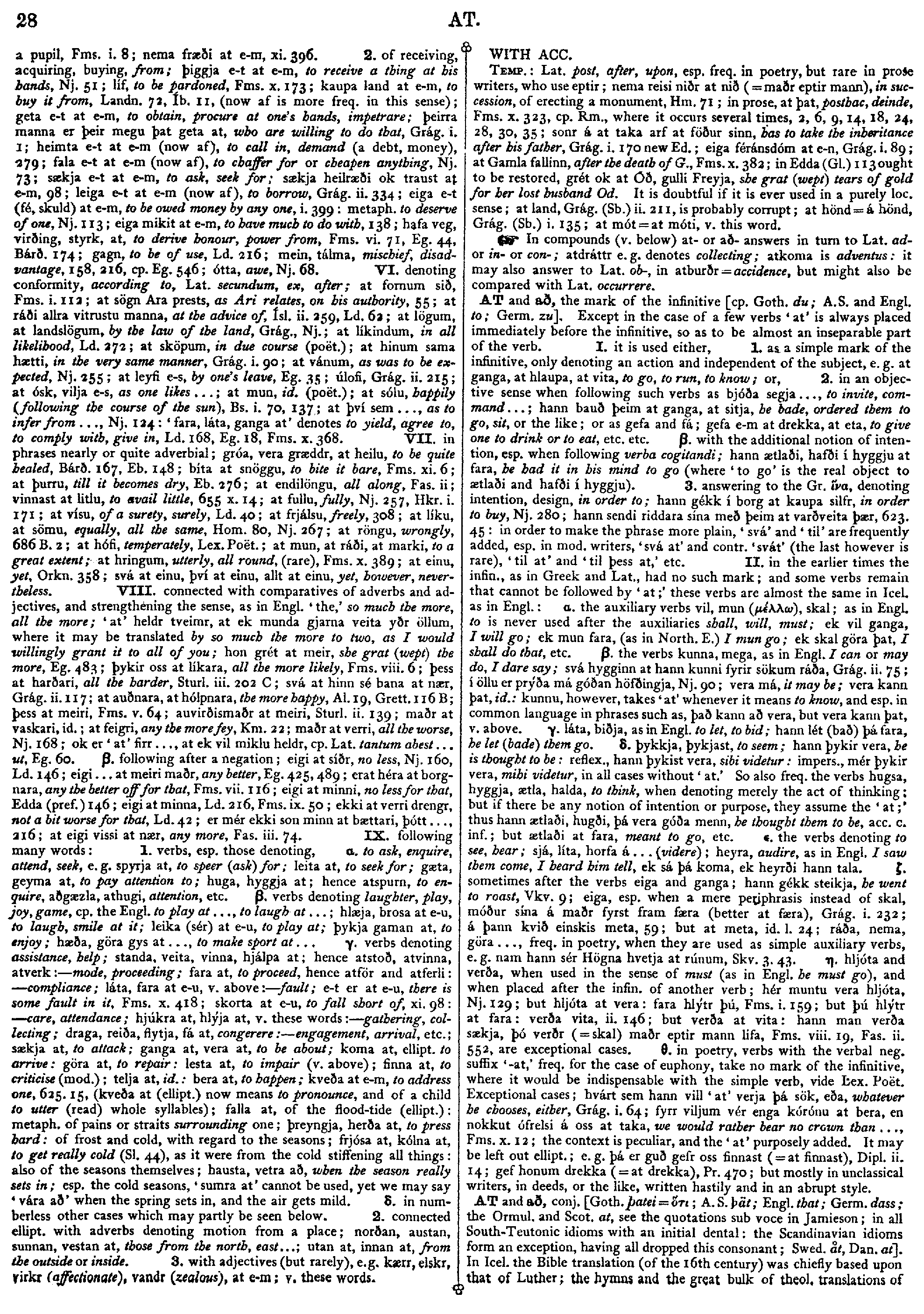
a
pupil,
Fms.
i.
8;
nema
fræði
at
e-m,
xi.
396.
2.
of
receiving,
acquiring,
buying,
from;
þiggja
e-t
at
e-m,
to
receive
a
thing
at
his
hands,
Nj.
51;
líf,
to
be
pardoned,
Fms.
x.
173;
kaupa
land
at
e-m,
to
buy
it
from,
Landn.
72,
Íb.
II,
(now
af
is
more
freq.
in
this
sense);
geta
e-t
at
e-m,
to
obtain,
procure
at
one's
hands,
impetrare;
þeirra
manna
er
þeir
megu
þat
geta
at,
who
are
willing
to
do
that,
Grág.
i.
I;
heimta
e-t
at
e-m
(now
af),
to
call
in,
demand
(a
debt,
money),
279;
fala
e-t
at
e-m
(now
af),
to
chaffer
for
or
cheapen
anything,
Nj.
73;
sækja
e-t
at
e-m,
to
ask,
seek
for;
sækja
heilræði
ok
traust
at
e-m,
98;
leiga
e-t
at
e-m
(now
af),
to
borrow,
Grág.
ii.
334;
eiga
e-t
(fé,
skuld)
at
e-m,
to
be
owed
money
by
any
one,
i.
399:
metaph.
to
deserve
of
one,
Nj.
113;
eiga
mikit
at
e-m,
to
have
much
to
do
with,
138;
hafa
veg,
virðing,
styrk,
at,
to
derive
honour,
power
from,
Fms.
vi.
71,
Eg.
44,
Bárð.
174;
gagn,
to
be
of
use,
Ld.
216;
mein,
tálma,
mischief,
disadvantage,
158,
216,
cp.
Eg.
546;
ótta,
awe,
Nj.
68.
VI.
denoting
conformity,
according
to,
Lat.
secundum,
ex,
after;
at
fornum
sið,
Fms.
i.
112;
at
sögn
Ara
prests,
as
Ari
relates,
on
his
authority,
55;
at
ráði
allra
vitrustu
manna,
at
the
advice
of,
Ísl.
ii.
259,
Ld.
62;
at
lögum,
at
landslögum,
by
the
law
of
the
land,
Grág.,
Nj.;
at
líkindum,
in
all
likelihood,
Ld.
272;
at
sköpum,
in
due
course
(poet.);
at
hinum
sama
hætti,
in
the
very
same
manner,
Grág.
i.
90;
at
vánum,
as
was
to
be
expected,
Nj.
255;
at
leyfi
e-s,
by
one's
leave,
Eg.
35;
úlofi,
Grág.
ii.
215;
at
ósk,
vilja
e-s,
as
one
likes...;
at
mun,
id.
(poet.);
at
sólu,
happily
(following
the
course
of
the
sun),
Bs.
i.
70,
137;
at
því
sem
...,
as
to
infer
from
...,
Nj.
124:'
fara,
láta,
ganga
at'
denotes
to
yield,
agree
to,
to
comply
with,
give
in,
Ld.
168,
Eg.
18,
Fms.
x.
368.
VII.
in
phrases
nearly
or
quite
adverbial;
gróa,
vera
græddr,
at
heilu,
to
be
quite
healed,
Bárð.
167,
Eb.
148;
bíta
at
snöggu,
to
bite
it
bare,
Fms.
xi.
6;
at
þurru,
till
it
becomes
dry,
Eb.
276;
at
endilöngu,
all
along,
Fas.
ii;
vinnast
at
litlu,
to
avail
little,
655
x.
14;
at
fullu,
fully,
Nj.
257,
Hkr.
i.
171;
at
vísu,
of
a
surety,
surely,
Ld.
40;
at
frjálsu,
freely,
308;
at
líku,
at
sömu,
equally,
all
the
same,
Hom.
80,
Nj.
267;
at
röngu,
wrongly,
686
B.
2;
at
hófi,
temperately,
Lex.
Poët.;
at
mun,
at
ráði,
at
marki,
to
a
great
extent;
at
hringum,
utterly,
all
round,
(rare),
Fms.
x.
389;
at
einu,
yet,
Orkn.
358;
svá
at
einu,
því
at
einu,
allt
at
einu,
yet,
however,
nevertheless.
VIII.
connected
with
comparatives
of
adverbs
and
adjectives,
and
strengthening
the
sense,
as
in
Engl.
'
the,
'
so
much
the
more,
all
the
more;
'at'
heldr
tveimr,
at
ek
munda
gjarna
veita
yðr
öllum,
where
it
may
be
translated
by
so
much
the
more
to
two,
as
I
would
willingly
grant
it
to
all
of
you;
hon
grét
at
meir,
she
grat
(wept)
the
more,
Eg.
483;
þykir
oss
at
líkara,
all
the
more
likely,
Fms.
viii.
6;
þess
at
harðari,
all
the
harder,
Sturl.
iii.
202
C;
svá
at
hinn
sé
bana
at
nær,
Grág.
ii.
117;
at
auðnara,
at
hólpnara,
the
more
happy,
Al.
19,
Grett.
116
B;
þess
at
meiri,
Fms.
v.
64;
auvirðismaðr
at
meiri,
Sturl.
ii.
139;
maðr
at
vaskari,
id.;
at
feigri,
any
the
more
fey,
Km.
22;
maðr
at
verri,
all
the
worse,
Nj.
168;
ok
er'
at'
firr...,
at
ek
vil
miklu
heldr,
cp.
Lat.
tantum
abest...
ut,
Eg.
60.
ß.
following
after
a
negation;
eigi
at
síðr,
no
less,
Nj.
160,
Ld.
146;
eigi...
at
meiri
maðr,
any
better,
Eg.
425,
489;
erat
héra
at
borgnara,
any
the
better
off
for
that,
Fms.
vii.
116;
eigi
at
minni,
no
less
for
that,
Edda
(pref.)
146;
eigi
at
minna,
Ld.
216,
Fms.
ix.
50;
ekki
at
verri
drengr,
not
a
bit
worse
for
that,
Ld.
42;
er
mér
ekki
son
minn
at
bættari,
þótt...,
216;
at
eigi
vissi
at
nær,
any
more,
Fas.
iii.
74.
IX.
following
many
words:
1.
verbs,
esp.
those
denoting,
a.
to
ask,
enquire,
attend,
seek,
e.
g.
spyrja
at,
to
speer
(ask)
for;
leita
at,
to
seek
for;
gæta,
geyma
at,
to
pay
attention
to;
huga,
hyggja
at;
hence
atspurn,
to
enquire,
aðgæzla,
athugi,
attention,
etc.
ß.
verbs
denoting
laughter,
play,
joy,
game,
cp.
the
Engl.
to
play
at.
..,
to
laugh
at..
.;
hlæja,
brosa
at
e-u,
to
laugh,
smile
at
it;
leika
(sér)
at
e-u,
to
play
at;
þykja
gaman
at,
to
enjoy;
hæða,
göra
gys
at...,
to
make
sport
at...
.
verbs
denoting
assistance,
help;
standa,
veita,
vinna,
hjálpa
at;
hence
atstoð,
atvinna,
atverk
:—mode,
proceeding;
fara
at,
to
proceed,
hence
atför
and
atferli
:—compliance;
láta,
fara
at
e-u,
v.
above
:—fault;
e-t
er
at
e-u,
there
is
some
fault
in
it,
Fms.
x.
418;
skorta
at
e-u,
to
fall
short
of,
xi.
98:
—care,
attendance;
hjúkra
at,
hlýja
at,
v.
these
words
:—gathering,
collecting;
draga,
reiða,
flytja,
fá
at,
congerere
:—engagement,
arrival,
etc.;
sækja
at,
to
attack;
ganga
at,
vera
at,
to
be
about;
koma
at,
ellipt.
to
arrive:
göra
at,
to
repair:
lesta
at,
to
impair
(v.
above);
finna
at,
to
criticise
(mod.);
telja
at,
id.:
bera
at,
to
happen;
kveða
at
e-m,
to
address
one,
625.
15,
(kveða
at
(ellipt.)
now
means
to
pronounce,
and
of
a
child
to
utter
(read)
whole
syllables);
falla
at,
of
the
flood-tide
(ellipt.):
metaph.
of
pains
or
straits
surrounding
one;
þreyngja,
herða
at,
to
press
hard:
of
frost
and
cold,
with
regard
to
the
seasons;
frjósa
at,
kólna
at,
to
get
really
cold
(SI.
44),
as
it
were
from
the
cold
stiffening
all
things:
also
of
the
seasons
themselves;
hausta,
vetra
að,
when
the
season
really
sets
in;
esp.
the
cold
seasons,
'sumra
at'
cannot
be
used,
yet
we
may
say
'vára
að'
when
the
spring
sets
in,
and
the
air
gets
mild.
.
in
num-
berless
other
cases
which
may
partly
be
seen
below.
2.
connected
ellipt.
with
adverbs
denoting
motion
from
a
place;
norðan,
austan,
sunnan,
vestan
at,
those
from
the
north,
east...;
utan
at,
innan
at,
from
the
outside
or
inside.
3.
with
adjectives
(but
rarely),
e.
g.
kærr,
elskr,
virkr
(affectionate),
vandr
(zealous),
at
e-m;
v,
these
words.
WITH
ACC.
TEMP.:
Lat.
post,
after,
upon,
esp.
freq.
in
poetry,
but
rare
in
prose
writers,
who
use
eptir;
nema
reisi
niðr
at
nið
(=
maðr
eptir
mann),
in
succession,
of
erecting
a
monument,
Hm.
71;
in
prose,
at
þat.
posthac,
deinde,
Fms.
x.
323,
cp.
Rm.,
where
it
occurs
several
times,
2,
6,
9,
14,
18,
24,
28,
30,
35;
sonr
á
at
taka
arf
at
föður
sinn,
has
to
take
the
inheritance
after
his
father,
Grág.
i.
170
new
Ed.;
eiga
féránsdóm
at
e-n,
Grág.
i.
89;
at
Gamla
fallinn,
after
the
death
of
G.,
Fms.
x.
382;
in
Edda
(Gl.)
113
ought
to
be
restored,
grét
ok
at
Oð,
gulli
Freyja,
she
grat
(wept)
tears
of
gold
for
her
lost
husband
Od.
It
is
doubtful
if
it
is
ever
used
in
a
purely
loc.
sense;
at
land,
Grág.
(Sb.)ii.
211,
is
probably
corrupt;
at
hönd
=
á
hönd,
Grág.
(Sb.)
i.
135;
at
mót
=
at
móti,
v.
this
word.
ILLEGIBLE
In
compounds
(v.
below)
at-
or
að-
answers
in
turn
to
Lat.
ad-
or
in-
or
con-;
atdráttr
e.
g.
denotes
collecting;
atkoma
is
adventus:
it
may
also
answer
to
Lat.
ob-,
in
atburðr
=
accidence,
but
might
also
be
compared
with
Lat.
occurrere.
|
Source: Cleasby/Vigfusson, page b0030, entry 30 View original page image as: [TIFF] [PNG] [View previous entry] [View next entry] |
[Comment on this entry] [View comments] |
The following entry has been hand-corrected once. |
atla, að, to 'ettle', intend, purpose, Bret. 144; so according to the modern pronunciation of ætla, q. v.
|
Source: Cleasby/Vigfusson, page b0031, entry 22 View original page image as: [TIFF] [PNG] [View previous entry] [View next entry] |
[Comment on this entry] [View comments] |
The following entry has been hand-corrected once. |
at-vik, n. [víkja at], mostly in plur. details, particulars; in the phrases, eptir atvikum, according to the circumstances of each case, Gþl. 403; atvik sakar, the particulars of a case, Sks. 663; með atvikum, circumstantially, chapter and verse, Fas. iii. 330: in Stj. 179 it seems to mean gestures. II. an onset, prob. only another way of spelling atvígi, N. G. L. ii. 65; at ek geta eigi hefnt þessa atviks er mér er gört, that I cannot get this affront avenged which has been done me, Grett. 151 A.
|
Source: Cleasby/Vigfusson, page b0041, entry 76 View original page image as: [TIFF] [PNG] [View previous entry] [View next entry] |
[Comment on this entry] [View comments] |
The following entry has been hand-corrected once. |
ÁLFR, s, m. [A. S. ælf, munt-ælfen, sæ-ælfen, wudu-ælfen, etc.; Engl. elf, elves, in Shakespeare ouphes are 'fairies;' Germ. alb and elfen, Erl- in Erlkönig (Göthe) is, according to Grimm, a corrupt form from the Danish Ellekonge qs. Elver-konge]; in the west of Icel. also pronounced álbr: I. mythically, an elf, fairy; the Edda distinguishes between Ljósálfar, the elves of light, and Dökkálfar, of darkness (the last not elsewhere mentioned either in mod. fairy tales or in old writers), 12; the Elves and Ases are fellow gods, and form a favourite alliteration in the old mythical poems, e.g. Vsp. 53, Hm. 144, 161, Gm. 4, Ls. 2, 13, Þkv. 7, Skm. 7, 17, Sdm. 18. In the Alvismál Elves and Dwarfs are clearly distinguished as different. The abode of the elves in the Edda is Álfheimar, fairy land, and their king the god Frey (the god of light), Edda 12; see the poem Gm. 12, Álfheim Frey gáfu í árdaga tívar at tannfé. In the fairy tales the Elves haunt the hills, hence their name Huldufólk, hidden people: respecting their origin, life, and customs, v. Ísl. Þjóðs. i. I sqq. In old writers the Elves are rarely mentioned; but that the same tales were told as at present is clear;-- Hallr mælti, hvi brosir þú nú? þórhallr svarar, af því brosir ek, at margr hóll opnast ok hvert kvikindi býr sinn bagga bæði smá ok stór, ok gera fardaga (a foreboding of the introduction of Christianity), Fms. ii. 197, cp. landvættir; álfamenn, elves, Bs. i. 417, Fas. i. 313, 96; hóll einn er hér skamt í brott er álfar búa í, Km. 216: álfrek, in the phrase, ganga álfreka, cacare, means dirt, excrements, driving the elves away through contamination, Eb. 12, cp. Landn. 97, Fms. iv. 308, Bárð. ch. 4: álfröðull, elfin beam or light, a poët. name of the sun; álfavakir, elf-holes, the small rotten holes in the ice in spring-time in which the elves go a fishing; the white stripes in the sea in calm weather are the wakes of elfin fishing boats, etc.: medic. álfabruni is an eruption in the face, Fél. ix. 186: Ivar Aasen mentions 'alvgust, alveblaastr, alveld,' the breath, fire of elves (cp. St. Vitus' dance or St. Anthony's fire); 'alvskot,' a sort of cancer in the bone :-- græti álfa, elfin tears, Hðm. I, is dubious; it may mean some flower with dew-drops glittering in the morning sun, vide s. v. glýstamr (glee-steaming). Jamieson speaks of an elf's cup, but elf tears are not noticed elsewhere; cp. Edda 39. In Sweden, where the worship of Frey prevailed, sacrifices, álfa-blót, were made to the elves, stóð húsfreyja í dyrum ok bað hann (the guest) eigi þar innkoma, segir at þau ætti álfa blót, Hkr. ii. 124 (referring to the year 1018), cp. Korm. ch. 22. 2. metaph., as the elves had the power to bewitch men, a silly, vacant person is in Icel. called álfr; hence álfalegr, silly álfaskapr and álfaháttr, silly behaviour. II. in historical sense, the Norse district situated between the two great rivers Raumelfr and Gautelfr (Alhis Raumarum, et Gotharum) was in the mythical times called Álfheimar, and its inhabitants Álfar, Fas. i. 413, 384, 387, Fb. i. 23, vide also P. A. Munch, Beskrivelse over Norge, p. 7. For the compds v. above.
|
Source: Cleasby/Vigfusson, page b0041, entry 131 View original page image as: [TIFF] [PNG] [View previous entry] [View next entry] |
[Comment on this entry] [View comments] |
The following entry has been hand-corrected once. |
ÁR, n. [Goth. jêr; A. S. gear; Engl. year; Germ. jabr; the Scandin. idioms all drop the j, as in ungr, young; cp. also the Gr. GREEK; Lat. hora; Ulf. renders not only GREEK but also sometimes GREEK and GREEK by jêr]. I. a year, = Lat. annus, divided into twelve lunar months, each of 30 days, with four intercalary days, thus making 364 days; as the year was reckoned about the middle of the 10th century (the original calculation probably only reckoned 360 days, and made up the difference by irregular intercalary months). About the year 960 Thorstein Surt introduced the sumarauki (intercalary week), to be inserted every seventh year, thus bringing the year up to 365 days. After the introduction of Christianity (A. D. 1000) the sumarauki was made to harmonize with the Julian calendar; but from A. D. 1700 with the Gregorian calendar; v. the words sumarauki, hlaupár, mánuðr, vika, etc., Íb. ch. 4, Rb. 6, Fms. i. 67; telja árum, to count the time by years, Vsp. 6; í ári, used adverb., at present, as yet, Ó. H. 41, 42 (in a verse). II. = Lat. annona, plenty, abundance, fruitfulness; the phrase, friðr ok ár, Fms. vii. 174, Hkr. Yngl. ch. 8-12; ár ok fésæla, Hkr. l. c.; þá var ár urn öll lönd, id.; létu hlaða skip mörg af korni ok annarri gæzku, ok flytja svá ár í Dan- mörku, Fms. xi. 8, Sks. 323, Fas. i. 526, Hom. 68; gott ár, Eg. 39; blota til árs, Fms. i. 34. III. the name of the Rune RUNE (a), Skálda 176; in the A. S. and Goth. Runes the j has the name jêr, gêr, according to the Germ. and Engl. pronunciation of this word; vide p. 2, col. 1. COMPDS: ára-tal, n. and ára-tala, u, f. number of years; fimtugr at áratali, Stj. 110, Rb. 484, Mar. 656 A. i. 29; hann (Ari Frodi) hafði áratal fyrst til þess er Kristni kom á Ísland, en síðan allt til sinna daga, Hkr. (pref.), seems to mean that Ari in respect of chronology divided his Íslendingabók into two periods, that before and that after the introduction of Christianity; Stj. 112 (periode). árs-bót, f. = árbót, Bs. i. 343, q. v.
| Result Page: |  |
Previous | 11 12 13 14 15 16 17 18 19 20 21 22 23 24 25 26 27 28 | Next |  |
Germanic Lexicon Project (main page)
This search system was written by
Sean Crist
Please consider
volunteering
to correct the data in these online dictionaries.
No rights reserved. Feel free to use these data in any way you please.