|
|

Search for ac again, using less strict matching (1638 results)
|
Source: Bosworth/Toller, page b1105, entry 4 View original page image as: [TIFF] [PNG] [View previous entry] [View next entry] |
[Comment on this entry] [View comments] |
The following entry has been hand-corrected once. |
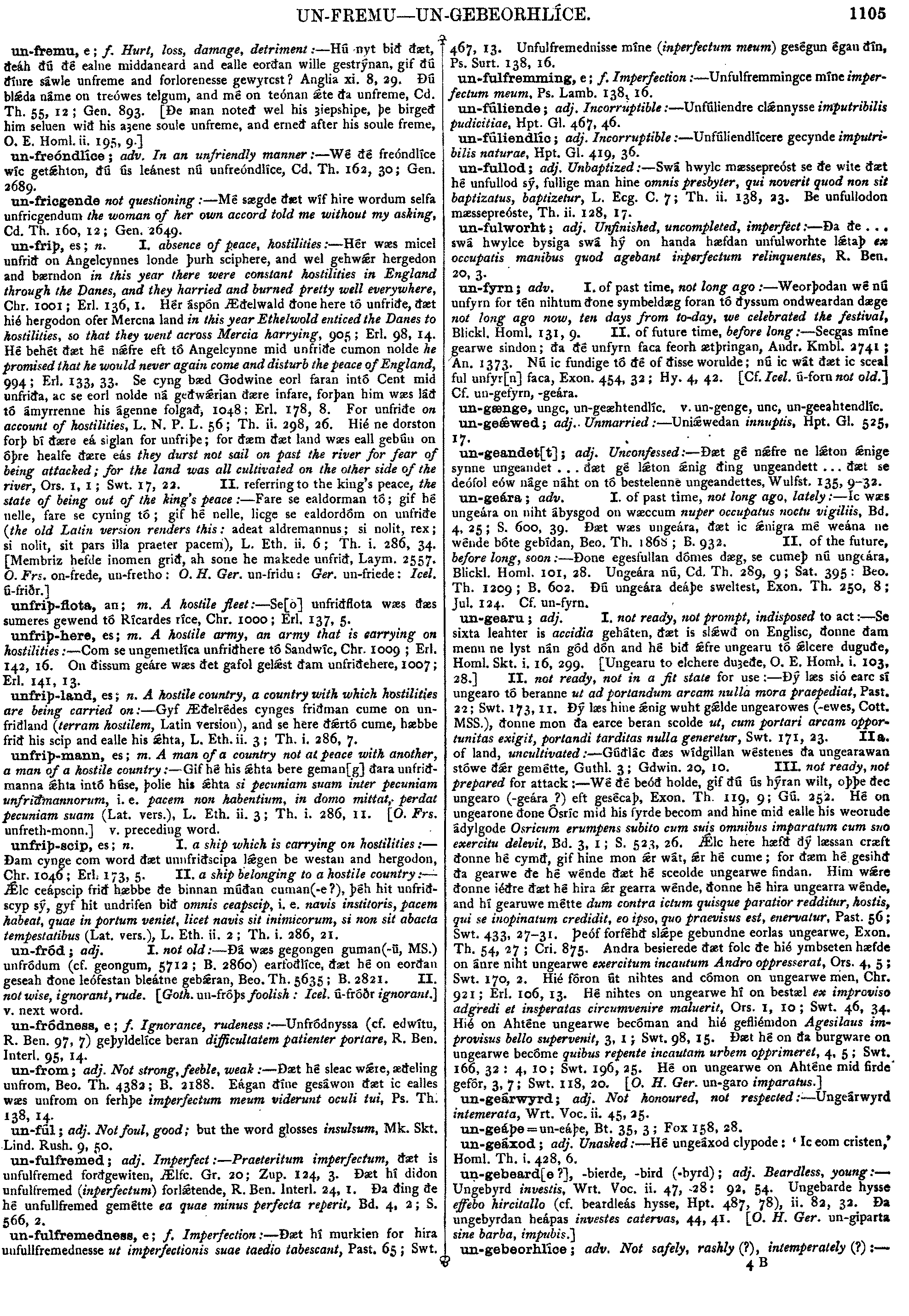
un-friþ,
es;
n.
I.
absence
of
peace,
hostilities
:--
Hér
wæs
micel
unfrið
on
Angelcynnes
londe
þurh
sciphere,
and
wel
gehw r
hergedon
and
bærndon
in
this
year
there
were
constant
hostilities
in
England
through
the
Danes,
and
they
harried
and
burned
pretty
well
everywhere,
Chr.
1001;
Erl.
136,
1.
Hér
áspón
Æðelwald
ðone
here
tó
unfriðe,
ðæt
hié
hergodon
ofer
Mercna
land
in
this
year
Ethelwold
enticed
the
Danes
to
hostilities,
so
that
they
went
across
Mercia
harrying,
905;
Erl.
98,
14.
Hé
behét
ðæt
hé
nfre
eft
tó
Angelcynne
mid
unfriðe
cumon
nolde
he
promised
that
he
would
never
again
come
and
disturb
the
peace
of
England,
994;
Erl.
133,
33.
Se
cyng
bæd
Godwine
eorl
faran
intó
Cent
mid
unfriða,
ac
se
eorl
nolde
ná
geðwrian
ðære
infare,
forþan
him
wæs
láð
tó
ámyrrenne
his
ágenne
folgað;
1048;
Erl.
178,
8.
For
unfriðe
on
account
of
hostilities,
L.
N.
P.
L.
56;
Th.
ii.
298,
26.
Hié
ne
dorston
forþ
bí
ðære
eá
siglan
for
unfriþe;
for
ðæm
ðæt
land
wæs
eall
gebún
on
óþre
healfe
ðære
eás
they
durst
not
sail
on
past
the
river
for
fear
of
being
attacked;
for
the
land
was
all
cultivated
on
the
other
side
of
the
river,
Ors.
1,
1;
Swt.
17,
22.
II.
referring
to
the
king's
peace,
the
state
of
being
out
of
the
king's
peace
:--
Fare
se
ealdorman
tó;
gif
hé
nelle,
fare
se
cyning
tó;
gif
hé
nelle,
licge
se
ealdordóm
on
unfriðe
(the
old
Latin
version
renders
this:
adeat
aldremannus;
si
nolit,
rex;
si
nolit,
sit
pars
illa
praeter
pacem),
L.
Eth.
ii.
6;
Th.
i.
286,
34.
[Membriz
hefde
inomen
grið,
ah
sone
he
makede
unfrið,
Laym.
2557.
O.
Frs.
on-frede,
un-fretho:
O.
H.
Ger.
un-fridu:
Ger.
un-friede:
Icel.
ú-friðr.]
r
hergedon
and
bærndon
in
this
year
there
were
constant
hostilities
in
England
through
the
Danes,
and
they
harried
and
burned
pretty
well
everywhere,
Chr.
1001;
Erl.
136,
1.
Hér
áspón
Æðelwald
ðone
here
tó
unfriðe,
ðæt
hié
hergodon
ofer
Mercna
land
in
this
year
Ethelwold
enticed
the
Danes
to
hostilities,
so
that
they
went
across
Mercia
harrying,
905;
Erl.
98,
14.
Hé
behét
ðæt
hé
nfre
eft
tó
Angelcynne
mid
unfriðe
cumon
nolde
he
promised
that
he
would
never
again
come
and
disturb
the
peace
of
England,
994;
Erl.
133,
33.
Se
cyng
bæd
Godwine
eorl
faran
intó
Cent
mid
unfriða,
ac
se
eorl
nolde
ná
geðwrian
ðære
infare,
forþan
him
wæs
láð
tó
ámyrrenne
his
ágenne
folgað;
1048;
Erl.
178,
8.
For
unfriðe
on
account
of
hostilities,
L.
N.
P.
L.
56;
Th.
ii.
298,
26.
Hié
ne
dorston
forþ
bí
ðære
eá
siglan
for
unfriþe;
for
ðæm
ðæt
land
wæs
eall
gebún
on
óþre
healfe
ðære
eás
they
durst
not
sail
on
past
the
river
for
fear
of
being
attacked;
for
the
land
was
all
cultivated
on
the
other
side
of
the
river,
Ors.
1,
1;
Swt.
17,
22.
II.
referring
to
the
king's
peace,
the
state
of
being
out
of
the
king's
peace
:--
Fare
se
ealdorman
tó;
gif
hé
nelle,
fare
se
cyning
tó;
gif
hé
nelle,
licge
se
ealdordóm
on
unfriðe
(the
old
Latin
version
renders
this:
adeat
aldremannus;
si
nolit,
rex;
si
nolit,
sit
pars
illa
praeter
pacem),
L.
Eth.
ii.
6;
Th.
i.
286,
34.
[Membriz
hefde
inomen
grið,
ah
sone
he
makede
unfrið,
Laym.
2557.
O.
Frs.
on-frede,
un-fretho:
O.
H.
Ger.
un-fridu:
Ger.
un-friede:
Icel.
ú-friðr.]
|
Source: Bosworth/Toller, page b1108, entry 33 View original page image as: [TIFF] [PNG] [View previous entry] [View next entry] |
[Comment on this entry] [View comments] |
The following entry has been hand-corrected once. |
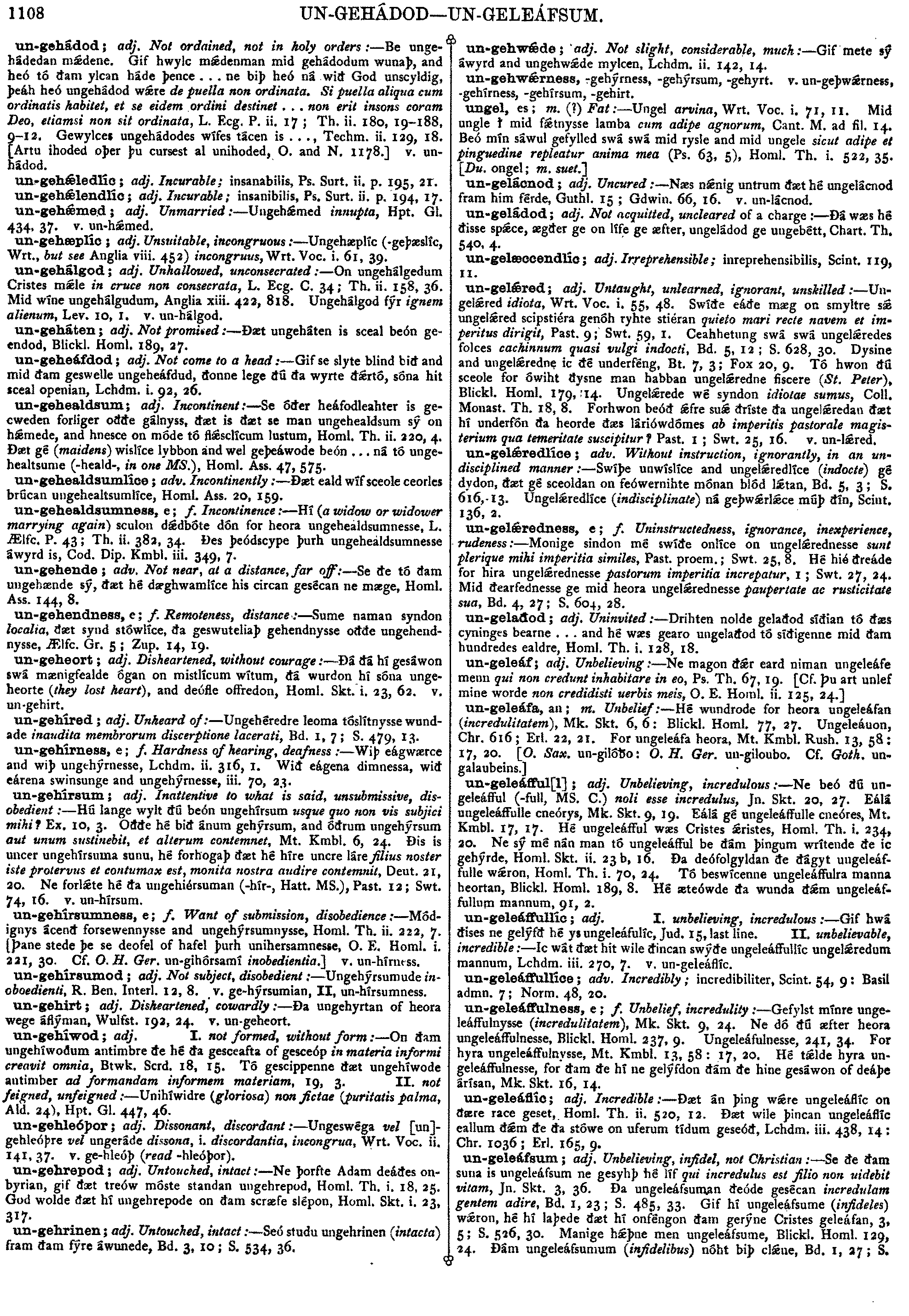
un-gelredness,
e;
f.
Uninstructedness,
ignorance,
inexperience,
rudeness
:--
Monige
sindon
mé
swíðe
onlíce
on
ungelrednesse
sunt
plerique
mihi
imperitia
similes,
Past.
proem.;
Swt.
25,
8.
Hé
hié
ðreáde
for
hira
ungelrednesse
pastorum
imperitia
increpatur,
1;
Swt.
27,
24.
Mid
ðearfednesse
ge
mid
heora
ungelrednesse
paupertate
ac
rusticitate
sua,
Bd.
4,
27;
S.
604,
28.
|
Source: Bosworth/Toller, page b1109, entry 7 View original page image as: [TIFF] [PNG] [View previous entry] [View next entry] |
[Comment on this entry] [View comments] |
The following entry has been hand-corrected once. |
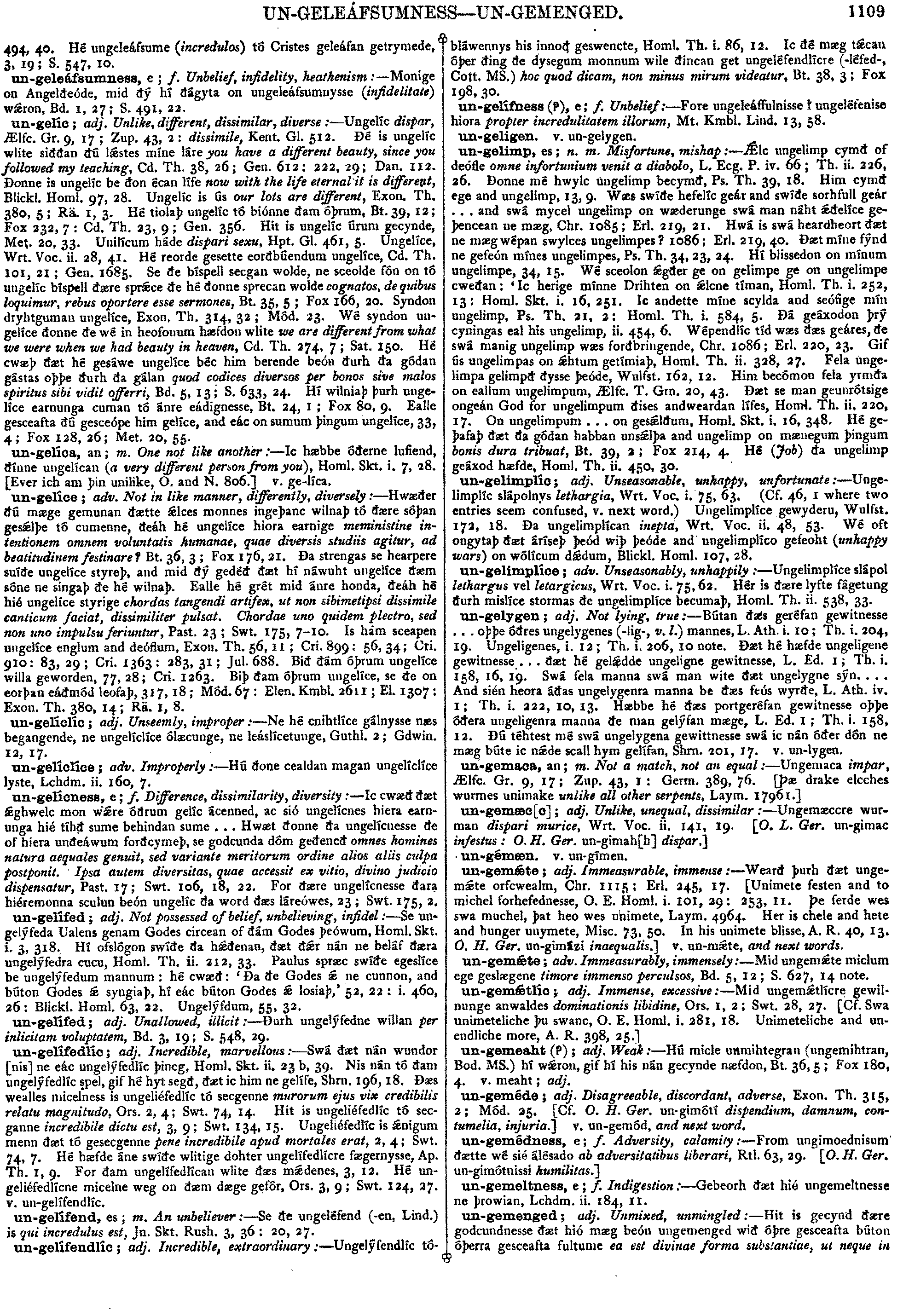
un-gelícness,
e;
f.
Difference,
dissimilarity,
diversity
:--
Ic
cwæð
ðæt
ghwelc
mon
wre
óðrum
gelíc
ácenned,
ac
sió
ungelícnes
hiera
earnunga
hié
tíhð
sume
behindan
sume
...
Hwæt
ðonne
ða
ungelícnesse
ðe
of
hiera
unðeáwum
forðcymeþ,
se
godcunda
dóm
geðencð
omnes
homines
natura
aequales
genuit,
sed
variante
meritorum
ordine
alios
aliis
culpa
postponit.
Ipsa
autem
diversitas,
quae
accessit
ex
vitio,
divino
judicio
dispensatur,
Past.
17;
Swt.
106,
18,
22.
For
ðære
ungelícnesse
ðara
hiéremonna
sculun
beón
ungelíc
ða
word
ðæs
láreówes,
23;
Swt.
175,
2.
|
Source: Bosworth/Toller, page b1111, entry 4 View original page image as: [TIFF] [PNG] [View previous entry] [View next entry] |
[Comment on this entry] [View comments] |
The following entry has been hand-corrected once. |
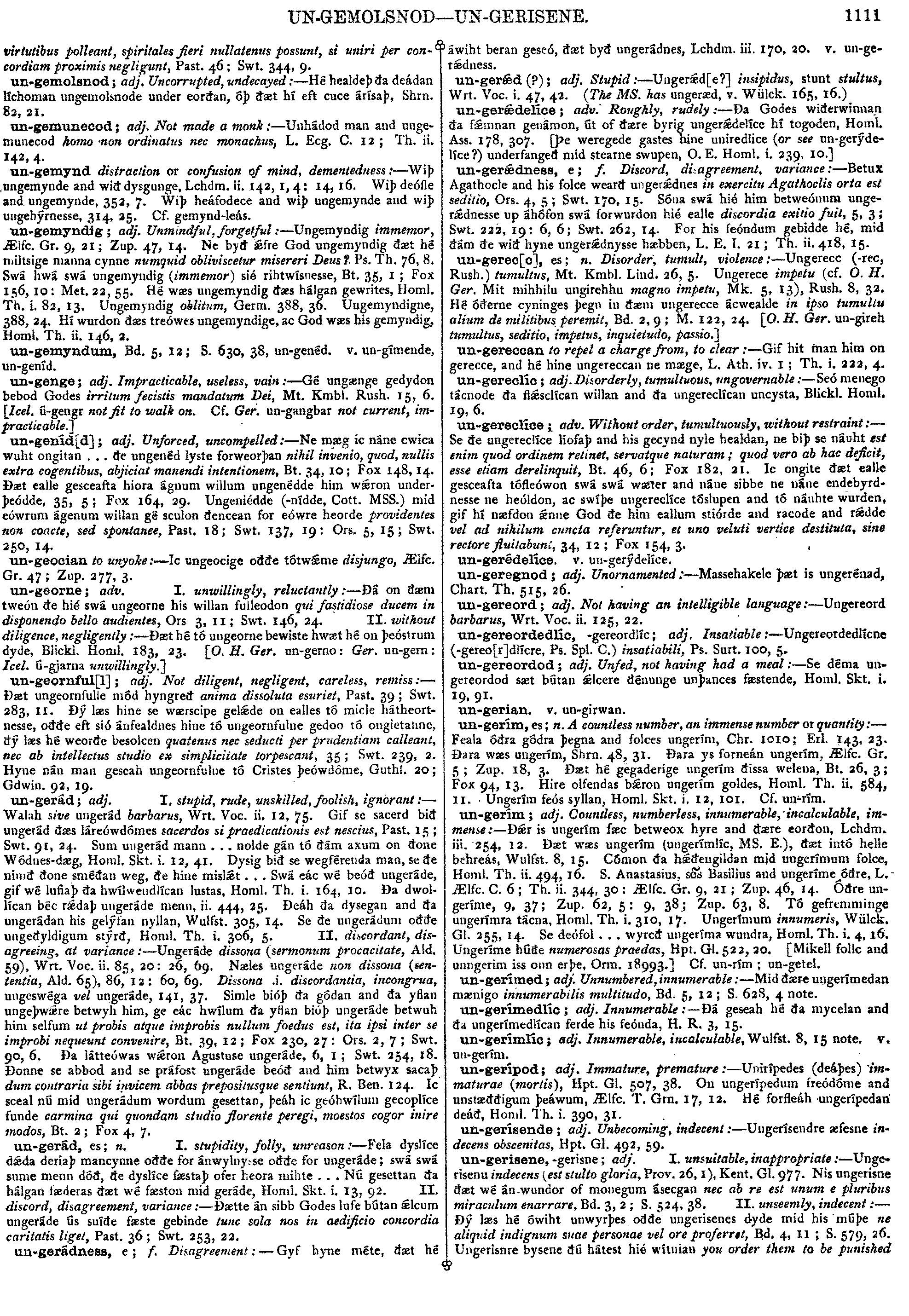
un-gemyndig;
adj.
Unmindful,
forgetful
:--
Ungemyndig
immemor,
Ælfc.
Gr.
9,
21;
Zup.
47,
14.
Ne
byð
fre
God
ungemyndig
ðæt
hé
miltsige
manna
cynne
numquid
obliviscetur
misereri
Deus?
Ps.
Th.
76,
8.
Swá
hwá
swá
ungemyndig
(immemor)
sié
rihtwísnesse,
Bt.
35,
1;
Fox
156,
10:
Met.
22,
55.
Hé
wæs
ungemyndig
ðæs
hálgan
gewrites,
Homl.
Th.
i.
82,
13.
Ungemyndig
oblitum,
Germ.
388,
36.
Ungemyndigne,
388,
24.
Hí
wurdon
ðæs
treówes
ungemyndige,
ac
God
wæs
his
gemyndig,
Homl.
Th.
ii.
146,
2.
|
Source: Bosworth/Toller, page b1111, entry 20 View original page image as: [TIFF] [PNG] [View previous entry] [View next entry] |
[Comment on this entry] [View comments] |
The following entry has been hand-corrected once. |
un-gereclíce;
adv.
Without
order,
tumultuously,
without
restraint
:--
Se
ðe
ungereclíce
liofaþ
and
his
gecynd
nyle
healdan,
ne
biþ
se
náuht
est
enim
quod
ordinem
retinet,
servatque
naturam;
quod
vero
ab
hac
deficit,
esse
etiam
derelinquit,
Bt.
46,
6;
Fox
182,
21.
Ic
ongite
ðæt
ealle
gesceafta
tófleówon
swá
swá
wæter
and
náne
sibbe
ne
náne
endebyrdnesse
ne
heóldon,
ac
swíþe
ungereclíce
tóslupen
and
tó
náuhte
wurden,
gif
hí
næfdon
nne
God
ðe
him
eallum
stiórde
and
racode
and
rdde
vel
ad
nihilum
cuncta
referuntur,
et
uno
veluti
vertice
destituta,
sine
rectore
fluitabunt,
34,
12;
Fox
154,
3.
|
Source: Bosworth/Toller, page b1112, entry 11 View original page image as: [TIFF] [PNG] [View previous entry] [View next entry] |
[Comment on this entry] [View comments] |
The following entry has been hand-corrected once. |
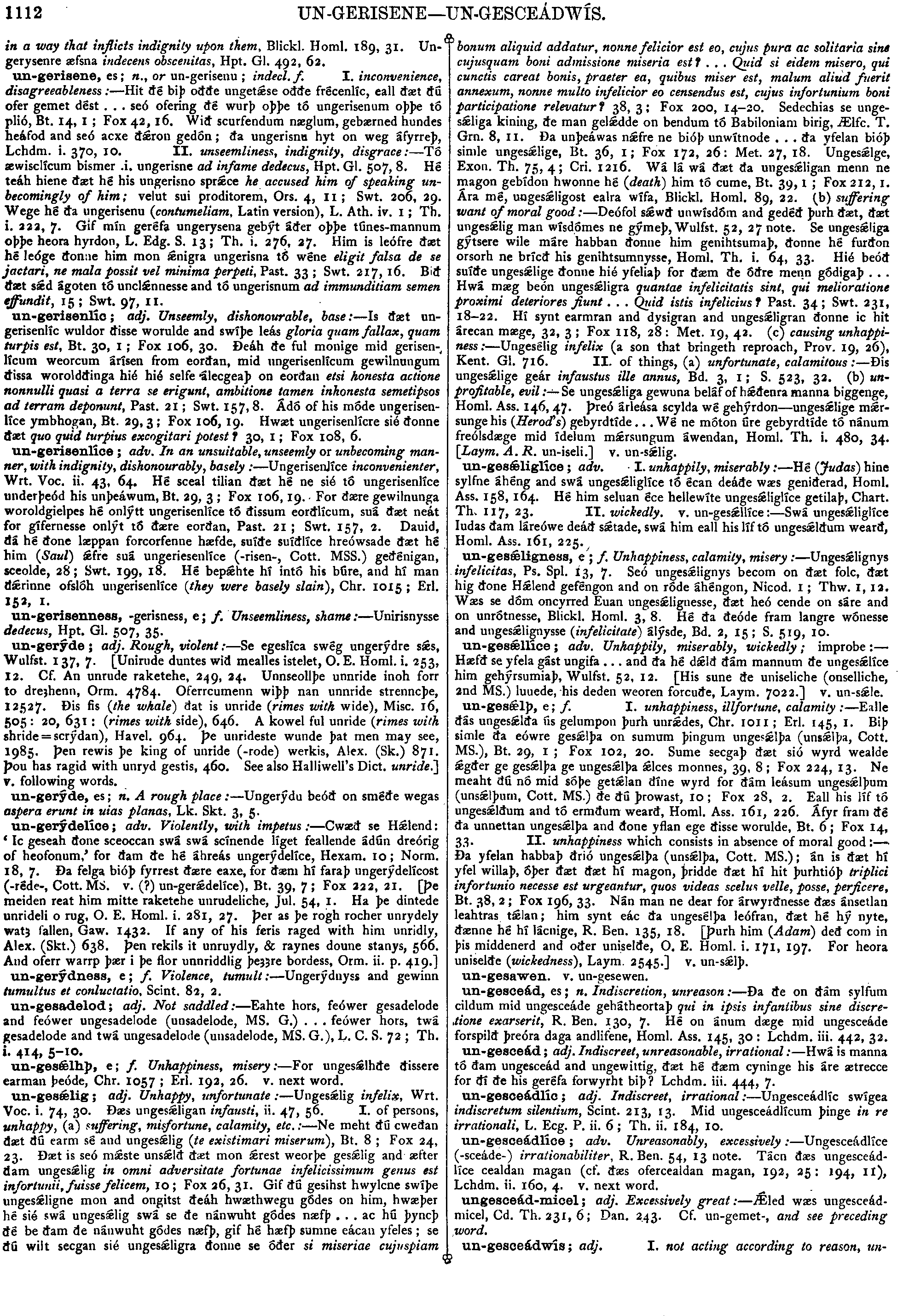
un-geslig;
adj.
Unhappy,
unfortunate
:--
Ungeslig
infelix,
Wrt.
Voc.
i.
74,
30.
Ðæs
ungesligan
infausti,
ii.
47,
56.
I.
of
persons,
unhappy,
(a)
suffering,
misfortune,
calamity,
etc.
:--
Ne
meht
ðú
cweðan
ðæt
ðú
earm
sé
and
ungeslig
(te
existimari
miserum),
Bt.
8;
Fox
24,
23.
Ðæt
is
seó
mste
unsld
ðæt
mon
rest
weorþe
geslig
and
æfter
ðam
ungeslig
in
omni
adversitate
fortunae
infelicissimum
genus
est
infortunii,
fuisse
felicem,
10;
Fox
26,
31.
Gif
ðú
gesihst
hwylcne
swíþe
ungesligne
mon
and
ongitst
ðeáh
hwæthwegu
gódes
on
him,
hwæþer
hé
sié
swá
ungeslig
swá
se
ðe
nánwuht
gódes
næfþ
...
ac
hú
þyncþ
ðé
be
ðam
ðe
nánwuht
gódes
næfþ,
gif
hé
hæfþ
sumne
eácan
yfeles;
se
ðú
wilt
secgan
sié
ungesligra
ðonne
se
óðer
si
miseriae
cujuspiam
bonum
aliquid
addatur,
nonne
felicior
est
eo,
cujus
pura
ac
solitaria
sine
cujusquam
boni
admissione
miseria
est?
...
Quid
si
eidem
misero,
qui
cunctis
careat
bonis,
praeter
ea,
quibus
miser
est,
malum
aliud
fuerit
annexum,
nonne
multo
infelicior
eo
censendus
est,
cujus
infortunium
boni
participatione
relevatur?
38,
3;
Fox
200,
14-20.
Sedechias
se
ungesliga
kining,
ðe
man
geldde
on
bendum
tó
Babiloniam
birig,
Ælfc.
T.
Grn.
8,
11.
Ða
unþeáwas
nfre
ne
bióþ
unwítnode
...
ða
yfelan
bióþ
simle
ungeslige,
Bt.
36,
1;
Fox
172,
26:
Met.
27,
18.
Ungeslge,
Exon.
Th.
75,
4;
Cri.
1216.
Wá
lá
wá
ðæt
ða
ungesligan
menn
ne
magon
gebídon
hwonne
hé
(death)
him
tó
cume,
Bt.
39,
1;
Fox
212,
1.
Ára
mé,
ungesligost
ealra
wífa,
Blickl.
Homl.
89,
22.
(b)
suffering
want
of
moral
good
:--
Deófol
swð
unwísdóm
and
gedéð
þurh
ðæt,
ðæt
ungeslig
man
wísdómes
ne
gýmeþ,
Wulfst.
52,
27
note.
Se
ungesliga
gýtsere
wile
máre
habban
ðonne
him
genihtsumaþ,
ðonne
hé
furðon
orsorh
ne
brícð
his
genihtsumnysse,
Homl.
Th.
i.
64,
33.
Hié
beóð
suíðe
ungeslige
ðonne
hié
yfeliaþ
for
ðæm
ðe
óðre
menn
gódigaþ
...
Hwá
mæg
beón
ungesligra
quantae
infelicitatis
sint,
qui
melioratione
proximi
deteriores
fiunt
...
Quid
istis
infelicius?
Past.
34;
Swt.
231,
18-22.
Hí
synt
earmran
and
dysigran
and
ungesligran
ðonne
ic
hit
árecan
mæge,
32,
3;
Fox
118,
28:
Met.
19,
42.
(c)
causing
unhappiness
:--
Ungesélig
infelix
(a
son
that
bringeth
reproach,
Prov.
19,
26),
Kent.
Gl.
716.
II.
of
things,
(a)
unfortunate,
calamitous
:--
Ðis
|
Source: Bosworth/Toller, page b1113, entry 34 View original page image as: [TIFF] [PNG] [View previous entry] [View next entry] |
[Comment on this entry] [View comments] |
The following entry has been hand-corrected once. |
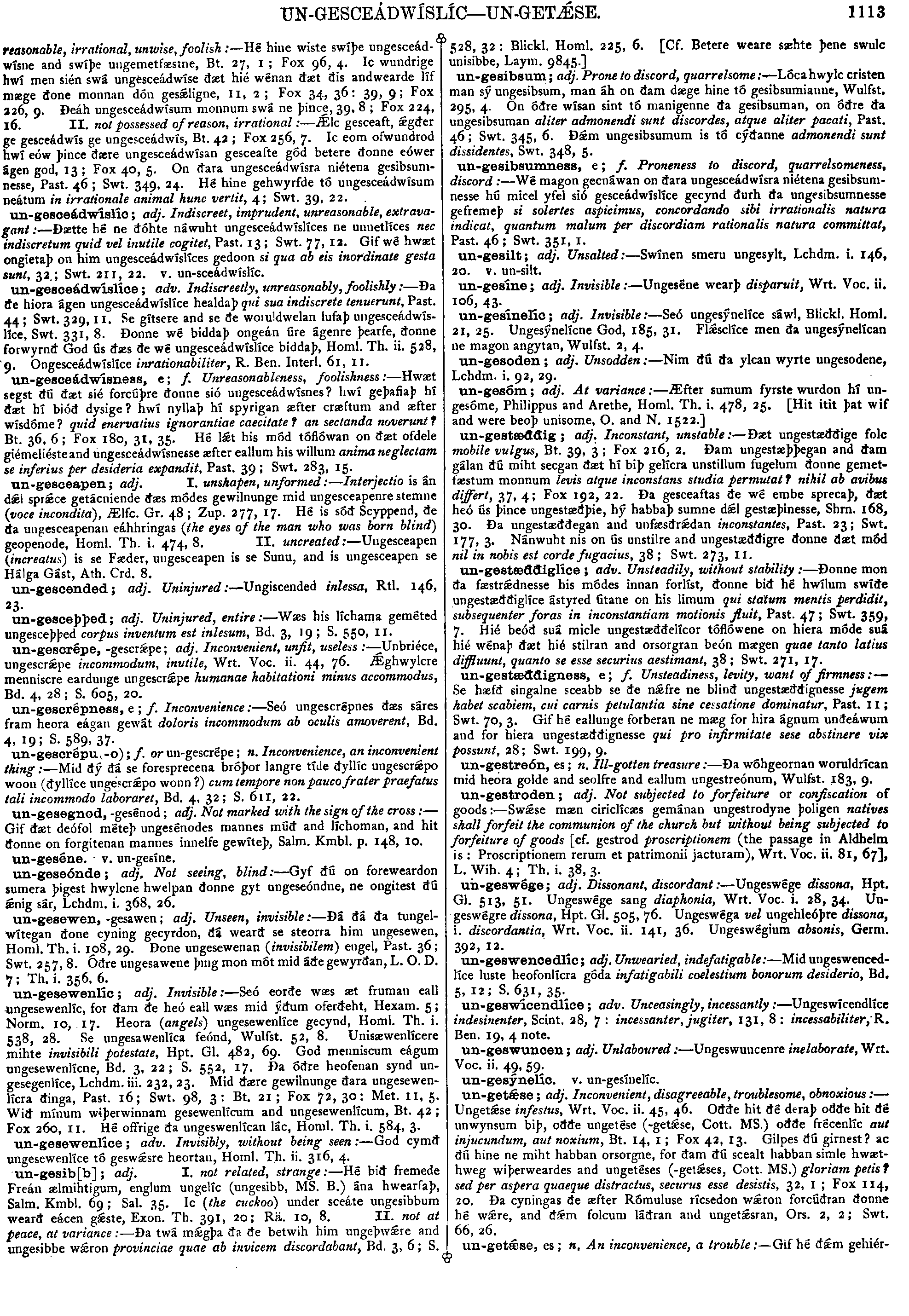
un-getse;
adj.
Inconvenient,
disagreeable,
troublesome,
obnoxious
:--
Ungetse
infestus,
Wrt.
Voc.
ii.
45,
46.
Oððe
hit
ðé
deraþ
oððe
hit
ðé
unwynsum
biþ,
oððe
ungetése
(-getse,
Cott.
MS.)
oððe
frécenlíc
aut
injucundum,
aut
noxium,
Bt.
14,
1;
Fox
42,
13.
Gilpes
ðú
girnest?
ac
ðú
hine
ne
miht
habban
orsorgne,
for
ðam
ðú
scealt
habban
simle
hwæthweg
wiþerweardes
and
ungetéses
(-getses,
Cott.
MS.)
gloriam
petis?
sed
per
aspera
quaeque
distractus,
securus
esse
desistis,
32,
1;
Fox
114,
20.
Ða
cyningas
ðe
æfter
Rómuluse
rícsedon
wron
forcúðran
ðonne
hé
wre,
and
ðm
folcum
láðran
and
ungetsran,
Ors.
2,
2;
Swt.
66,
26.
|
Source: Bosworth/Toller, page b1114, entry 22 View original page image as: [TIFF] [PNG] [View previous entry] [View next entry] |
[Comment on this entry] [View comments] |
The following entry has been hand-corrected once. |
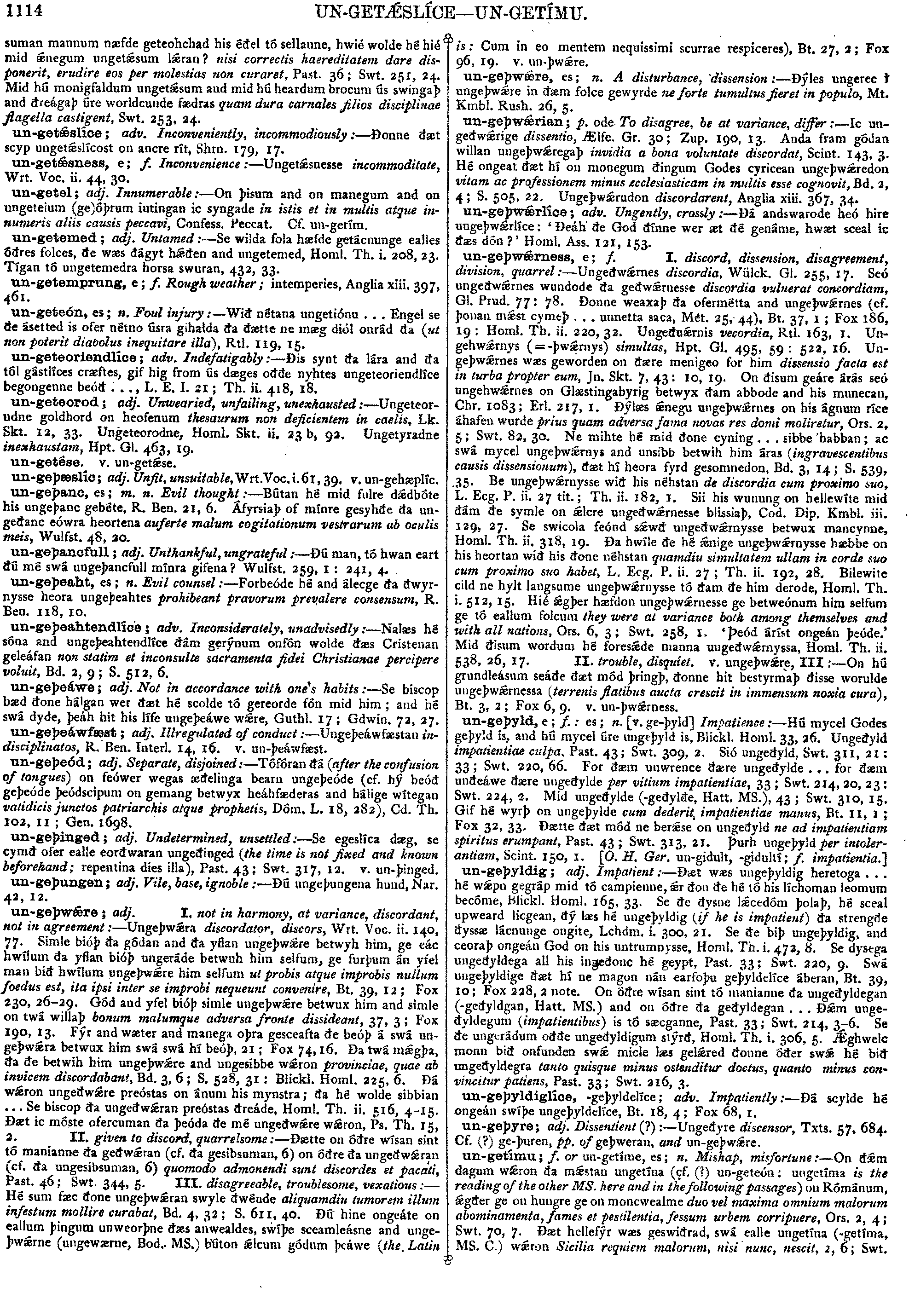
un-geþwrian;
p.
ode
To
disagree,
be
at
variance,
differ
:--
Ic
ungeðwrige
dissentio,
Ælfc.
Gr.
30;
Zup.
190,
13.
Anda
fram
gódan
willan
ungeþwregaþ
invidia
a
bona
voluntate
discordat,
Scint.
143,
3.
Hé
ongeat
ðæt
hí
on
monegum
ðingum
Godes
cyricean
ungeþwredon
vitam
ac
professionem
minus
ecclesiasticam
in
multis
esse
cognovit,
Bd.
2,
4;
S.
505,
22.
Ungeþwrudon
discordarent,
Anglia
xiii.
367,
34.
|
Source: Bosworth/Toller, page b1114, entry 24 View original page image as: [TIFF] [PNG] [View previous entry] [View next entry] |
[Comment on this entry] [View comments] |
The following entry has been hand-corrected once. |
un-geþwrness,
e;
f.
I.
discord,
dissension,
disagreement,
division,
quarrel
:--
Ungeðwrnes
discordia,
Wülck.
Gl.
255,
17.
Seó
ungeðwrnes
wundode
ða
geðwrnesse
discordia
vuluerat
concordiam,
Gl.
Prud.
77:
78.
Ðonne
weaxaþ
ða
ofermétta
and
ungeþwrnes
(cf.
þonan
mst
cymeþ
...
unnetta
saca,
Met.
25,
44),
Bt.
37,
1;
Fox
186,
19:
Homl.
Th.
ii.
220,
32.
Ungeðurnis
vecordia,
Rtl.
163,
1.
Ungehwrnys
(
=
-þwrnys)
simultas,
Hpt.
Gl.
495,
59:
522,
16.
Ungeþwrnes
wæs
geworden
on
ðære
menigeo
for
him
dissensio
facta
est
in
turbo
propter
eum,
Jn.
Skt.
7,
43:
10,
19.
On
ðisum
geáre
árás
seó
ungehwrnes
on
Glæstingabyrig
betwyx
ðam
abbode
and
his
munecan,
Chr.
1083;
Erl.
217,
1.
Ðýlæs
negu
ungeþwrnes
on
his
ágnum
ríce
áhafen
wurde
prius
quam
adversa
fama
novas
res
domi
moliretur,
Ors.
2,
5;
Swt.
82,
30.
Ne
mihte
hé
mid
ðone
cyning
...
sibbe
habban;
ac
swá
mycel
ungeþwrnys
and
unsibb
betwih
him
áras
(ingravescentibus
causis
dissensionum),
ðæt
hí
heora
fyrd
gesomnedon,
Bd.
3,
14;
S.
539,
35.
Be
ungeþwrnysse
wið
his
néhstan
de
discordia
cum
proximo
suo,
L.
Ecg.
P.
ii.
27
tit.;
Th.
ii.
182,
1.
Sii
his
wunung
on
hellewíte
mid
ðám
ðe
symle
on
lcre
ungeðwrnesse
blissiaþ,
Cod.
Dip.
Kmbl.
iii.
129,
27.
Se
swicola
feónd
swð
ungeðwrnysse
betwux
mancynne,
Homl.
Th.
ii.
328,
19.
Ða
hwíle
ðe
hé
nige
ungeþwrnysse
hæbbe
on
his
heortan
wið
his
ðone
néhstan
quamdiu
simultatem
ullam
in
corde
suo
cum
proximo
suo
habet,
L.
Ecg.
P.
ii.
27;
Th.
ii.
192,
28.
Bilewite
cild
ne
hylt
langsume
ungeþwrnysse
tó
ðam
ðe
him
derode,
Homl.
Th.
i.
522,
15.
Hié
gþer
hæfdon
ungeþwrnesse
ge
betweónum
him
selfum
ge
tó
eallum
folcum
they
were
at
variance
both
among
themselves
and
with
all
nations,
Ors.
6,
3;
Swt.
258,
1.
'Þeód
áríst
ongeán
þeóde:'
Mid
ðisum
wordum
hé
foresde
manna
ungeðwrnyssa,
Homl.
Th.
ii.
538,
26,
17.
II.
trouble,
disquiet.
v.
ungeþwre,
III
:--
On
hú
grundleásum
seáðe
ðæt
mód
þringþ,
ðonne
hit
bestyrmaþ
ðisse
worulde
ungeþwrnessa
(terrenis
flatibus
aucta
crescit
in
immensum
noxia
cura),
Bt.
3,
2;
Fox
6,
9.
v.
un-þwrness.
|
Source: Bosworth/Toller, page b1115, entry 1 View original page image as: [TIFF] [PNG] [View previous entry] [View next entry] |
[Comment on this entry] [View comments] |
The following entry has been hand-corrected once. |
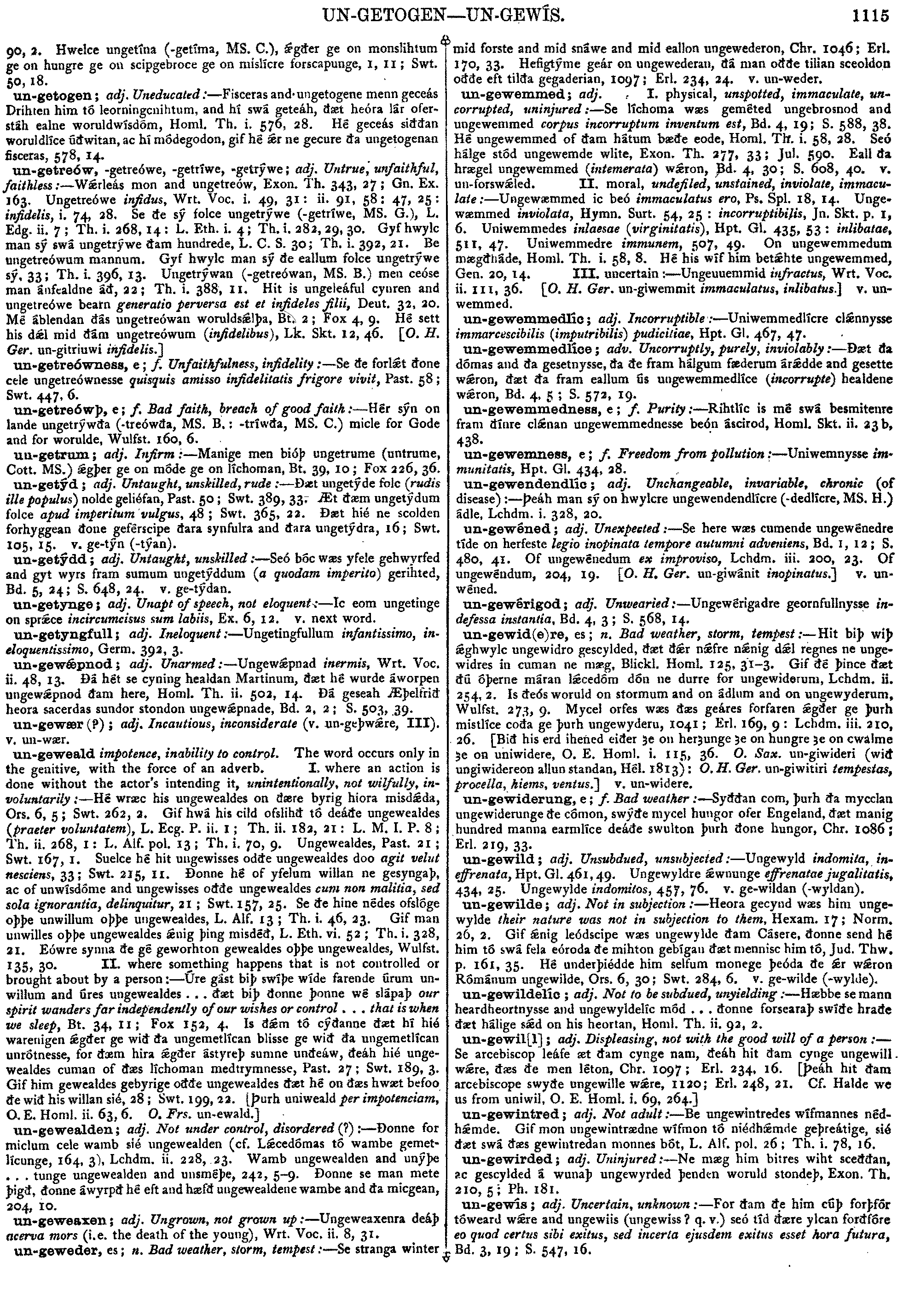
un-getogen;
adj.
Uneducated
:--
Fisceras
and
ungetogene
menn
geceás
Drihten
him
tó
leorningcnihtum,
and
hí
swá
geteáh,
ðæt
heóra
lár
oferstáh
ealne
woruldwísdóm,
Homl.
Th.
i.
576,
28.
Hé
geceás
siððan
woruldlíce
úðwitan,
ac
hí
módegodon,
gif
hé
r
ne
gecure
ða
ungetogenan
fisceras,
578,
14.
| Result Page: |  |
Previous | 56 57 58 59 60 61 62 63 64 65 66 67 68 69 70 71 72 73 74 | Next |  |
Germanic Lexicon Project (main page)
This search system was written by
Sean Crist
Please consider
volunteering
to correct the data in these online dictionaries.
No rights reserved. Feel free to use these data in any way you please.