|
|

Tip: In the search results, you can click on any word or abbreviation for more information.
|
Source: Bosworth/Toller, page b0077, entry 30 View original page image as: [TIFF] [PNG] [View previous entry] [View next entry] |
[Comment on this entry] [View comments] |
The following entry has been hand-corrected once. |
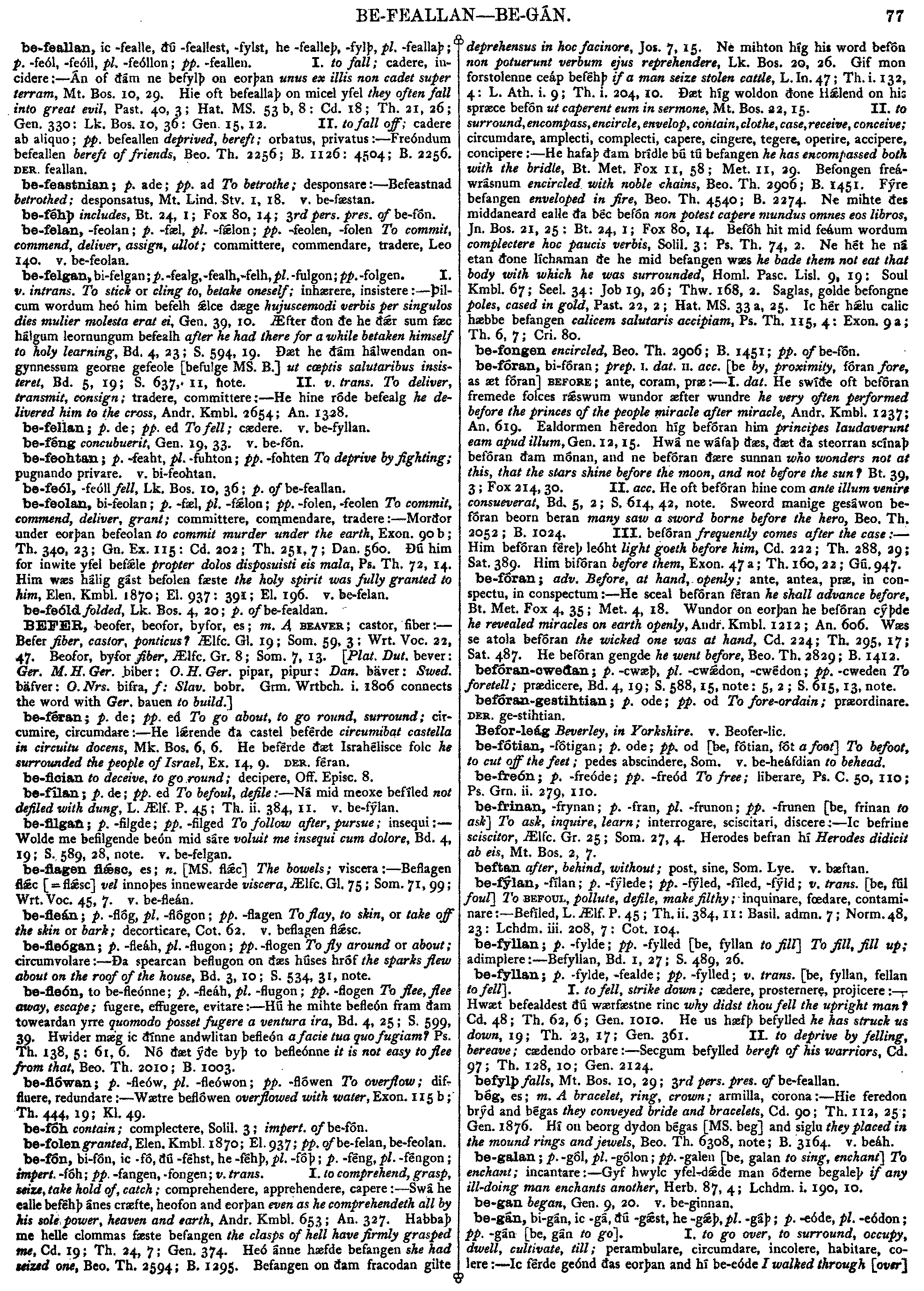
Befor-leág Beverley, in Yorkshire. v. Beofer-lic.
|
Source: Bosworth/Toller, page b0084, entry 28 View original page image as: [TIFF] [PNG] [View previous entry] [View next entry] |
[Comment on this entry] [View comments] |
The following entry has been hand-corrected once. |
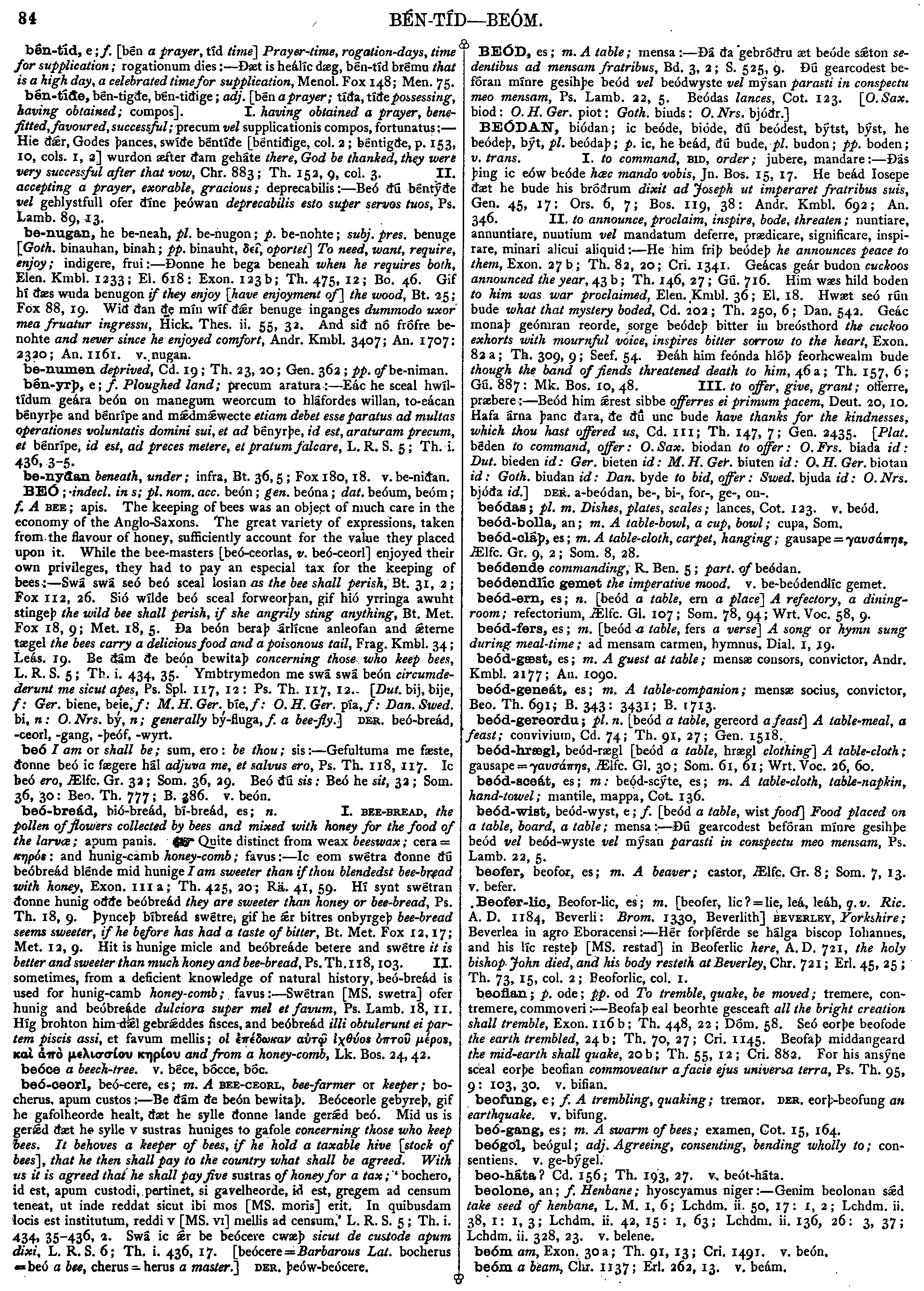
Beofer-lic, Beofor-lic, es; m. [beofer, lic ? = lie, leá, leáh, q. v. Ric. A. D. 1184, Beverli : Brom. 1330, Beverlith] BEVERLEY, Yorkshire; Beverlea in agro Eboracensi :-- Hér forþférde se hálga biscop Iohannes, and his líc resteþ [MS. restad] in Beoferlic here, A. D. 721, the holy bishop John died, and his body resteth at Beverley, Chr. 721; Erl. 45, 25; Th. 73, 15, col. 2; Beoforlic, col. 1.
|
Source: Bosworth/Toller, page b0085, entry 18 View original page image as: [TIFF] [PNG] [View previous entry] [View next entry] |
[Comment on this entry] [View comments] |
The following entry has been hand-corrected once. |
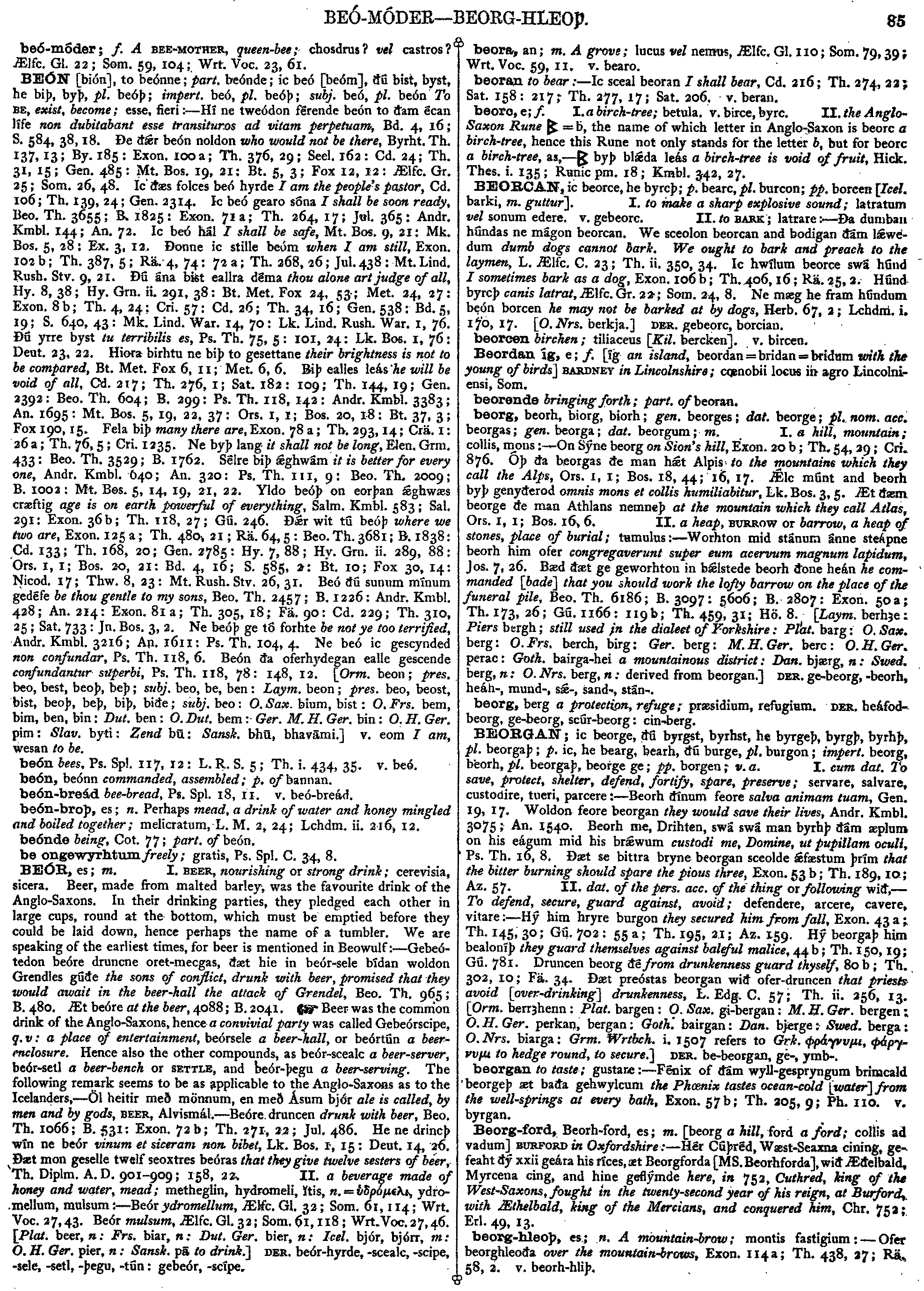
beorg,
beorh,
biorg,
biorh;
gen.
beorges;
dat.
beorge;
pl.
nom.
acc.
beorgas;
gen.
beorga;
dat.
beorgum;
m.
I.
a
hill,
mountain;
collis,
mons
:--
On
Sýne
beorg
on
Sion's
hill,
Exon.
20
b;
Th.
54,
29;
Cri.
876.
Óþ
ða
beorgas
ðe
man
h t
Alpis
to
the
mountains
which
they
call
the
Alps,
Ors.
1,
1;
Bos.
18,
44;
16,
17.
Æ-acute;lc
múnt
and
beorh
byþ
genyðerod
omnis
mons
et
collis
humiliabitur,
Lk.
Bos.
3,
5.
Æt
ðæm,
beorge
ðe
man
Athlans
nemneþ
at
the
mountain
which
they
call
Atlas,
Ors.
1,
1;
Bos.
16,
6.
II.
a
heap,
BURROW
or
barrow,
a
heap
of
stones,
place
of
burial;
tumulus
:--
Worhton
mid
stánum
ánne
steápne
beorh
him
ofer
congregaverunt
super
eum
acervum
magnum
lapidum,
Jos.
7,
26.
Bæd
ðæt
ge
geworhton
in
blstede
beorh
ðone
heán
he
commanded
[bade]
that
you
should
work
the
lofty
barrow
on
the
place
of
the
funeral
pile,
Beo.
Th.
6186;
B.
3097
:
5606;
B.
2807
:
Exon.
50
a;
Th.
173,
26;
Gú.
1166
:
119
b;
Th.
459,
31;
Hö.
8.
[Laym.
berh
t
Alpis
to
the
mountains
which
they
call
the
Alps,
Ors.
1,
1;
Bos.
18,
44;
16,
17.
Æ-acute;lc
múnt
and
beorh
byþ
genyðerod
omnis
mons
et
collis
humiliabitur,
Lk.
Bos.
3,
5.
Æt
ðæm,
beorge
ðe
man
Athlans
nemneþ
at
the
mountain
which
they
call
Atlas,
Ors.
1,
1;
Bos.
16,
6.
II.
a
heap,
BURROW
or
barrow,
a
heap
of
stones,
place
of
burial;
tumulus
:--
Worhton
mid
stánum
ánne
steápne
beorh
him
ofer
congregaverunt
super
eum
acervum
magnum
lapidum,
Jos.
7,
26.
Bæd
ðæt
ge
geworhton
in
blstede
beorh
ðone
heán
he
commanded
[bade]
that
you
should
work
the
lofty
barrow
on
the
place
of
the
funeral
pile,
Beo.
Th.
6186;
B.
3097
:
5606;
B.
2807
:
Exon.
50
a;
Th.
173,
26;
Gú.
1166
:
119
b;
Th.
459,
31;
Hö.
8.
[Laym.
berh e
:
Piers
bergh;
still
used
in
the
dialect
of
Yorkshire
:
Plat.
barg
:
O.
Sax.
berg
:
O.
Frs.
berch,
birg
:
Ger.
berg
:
M.
H.
Ger.
berc
:
O.
H.
Ger.
perac
:
Goth.
bairga-hei
a
mountainous
district
:
Dan.
bjærg,
n
:
Swed.
berg,
n
:
O.
Nrs.
berg,
n
:
derived
from
beorgan.]
DER.
ge-beorg,
-beorh,
heáh-,
mund-,
s-,
sand-,
stán-.
e
:
Piers
bergh;
still
used
in
the
dialect
of
Yorkshire
:
Plat.
barg
:
O.
Sax.
berg
:
O.
Frs.
berch,
birg
:
Ger.
berg
:
M.
H.
Ger.
berc
:
O.
H.
Ger.
perac
:
Goth.
bairga-hei
a
mountainous
district
:
Dan.
bjærg,
n
:
Swed.
berg,
n
:
O.
Nrs.
berg,
n
:
derived
from
beorgan.]
DER.
ge-beorg,
-beorh,
heáh-,
mund-,
s-,
sand-,
stán-.
|
Source: Bosworth/Toller, page b0147, entry 26 View original page image as: [TIFF] [PNG] [View previous entry] [View next entry] |
[Comment on this entry] [View comments] |
The following entry has been hand-corrected once. |
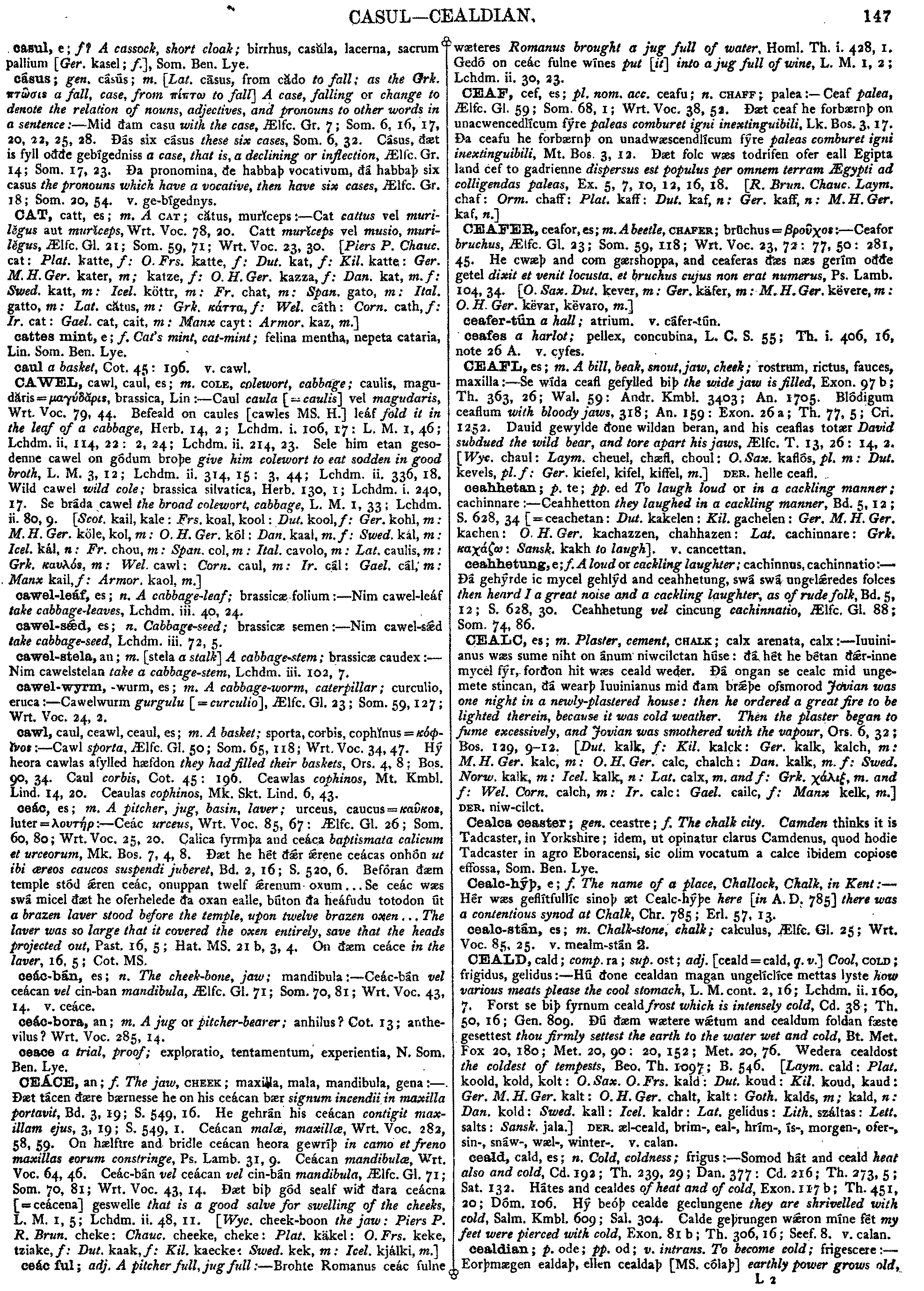
Cealca ceaster; gen. ceastre; f. The chalk city. Camden thinks it is Tadcaster, in Yorkshire; idem, ut opinatur clarus Camdenus, quod hodie Tadcaster in agro Eboracensi, sic olim vocatum a ealce ibidem copiose effossa, Som. Ben. Lye.
|
Source: Bosworth/Toller, page b0153, entry 34 View original page image as: [TIFF] [PNG] [View previous entry] [View next entry] |
[Comment on this entry] [View comments] |
The following entry has been hand-corrected once. |
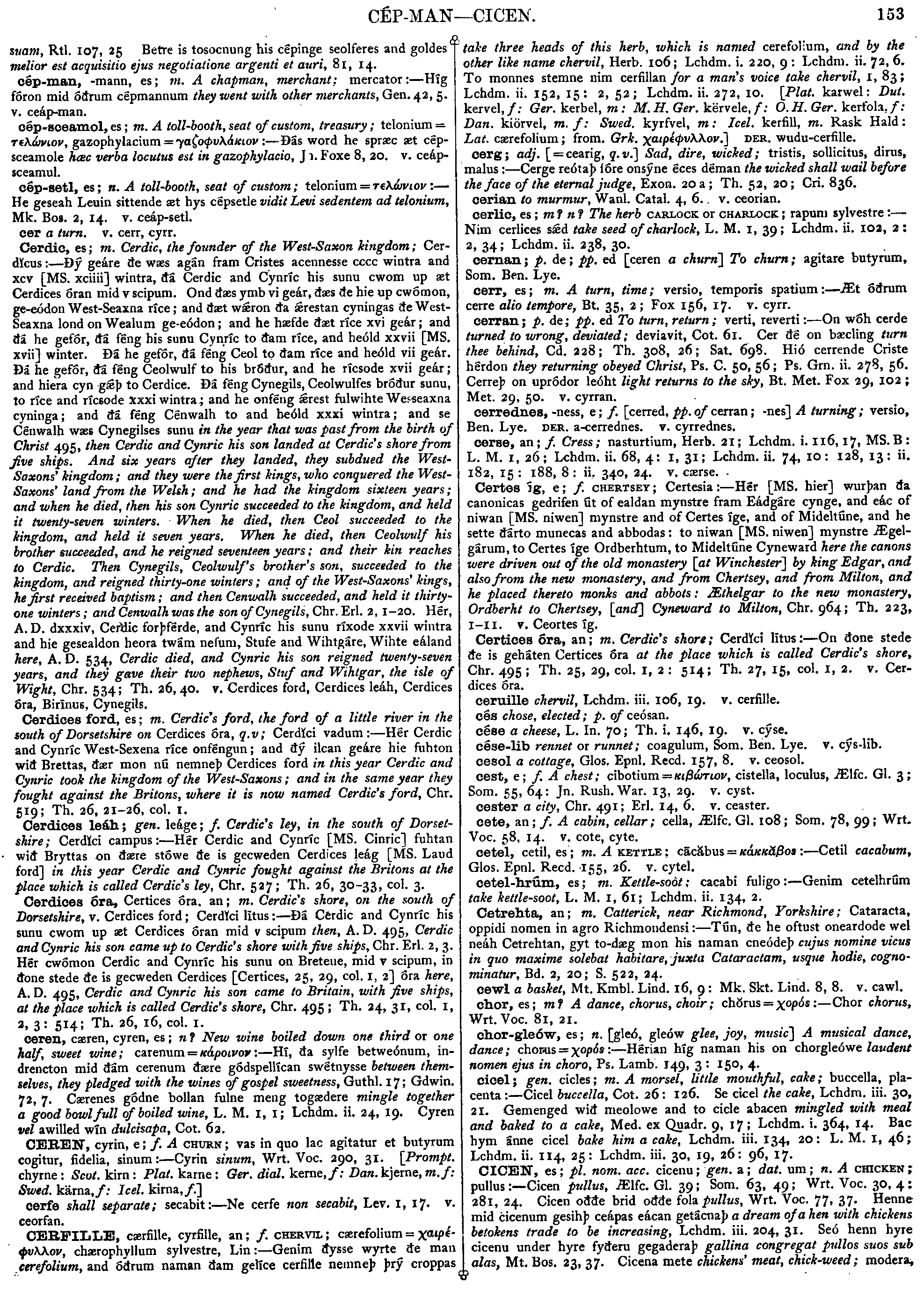
Cetrehta, an; m. Catterick, near Richmond, Yorkshire; Cataracta, oppidi nomen in agro Richrnondensi :-- Tún, ðe he oftust oneardode wel neáh Cetrehtan, gyt to-dæg mon his naman cneódeþ cujus nomine vicus in quo maxime solebat habitare, juxta Cataractam, usque hodie, cognominatur, Bd. 2, 20; S. 522, 24.
|
Source: Bosworth/Toller, page b0203, entry 4 View original page image as: [TIFF] [PNG] [View previous entry] [View next entry] |
[Comment on this entry] [View comments] |
The following entry has been hand-corrected once. |
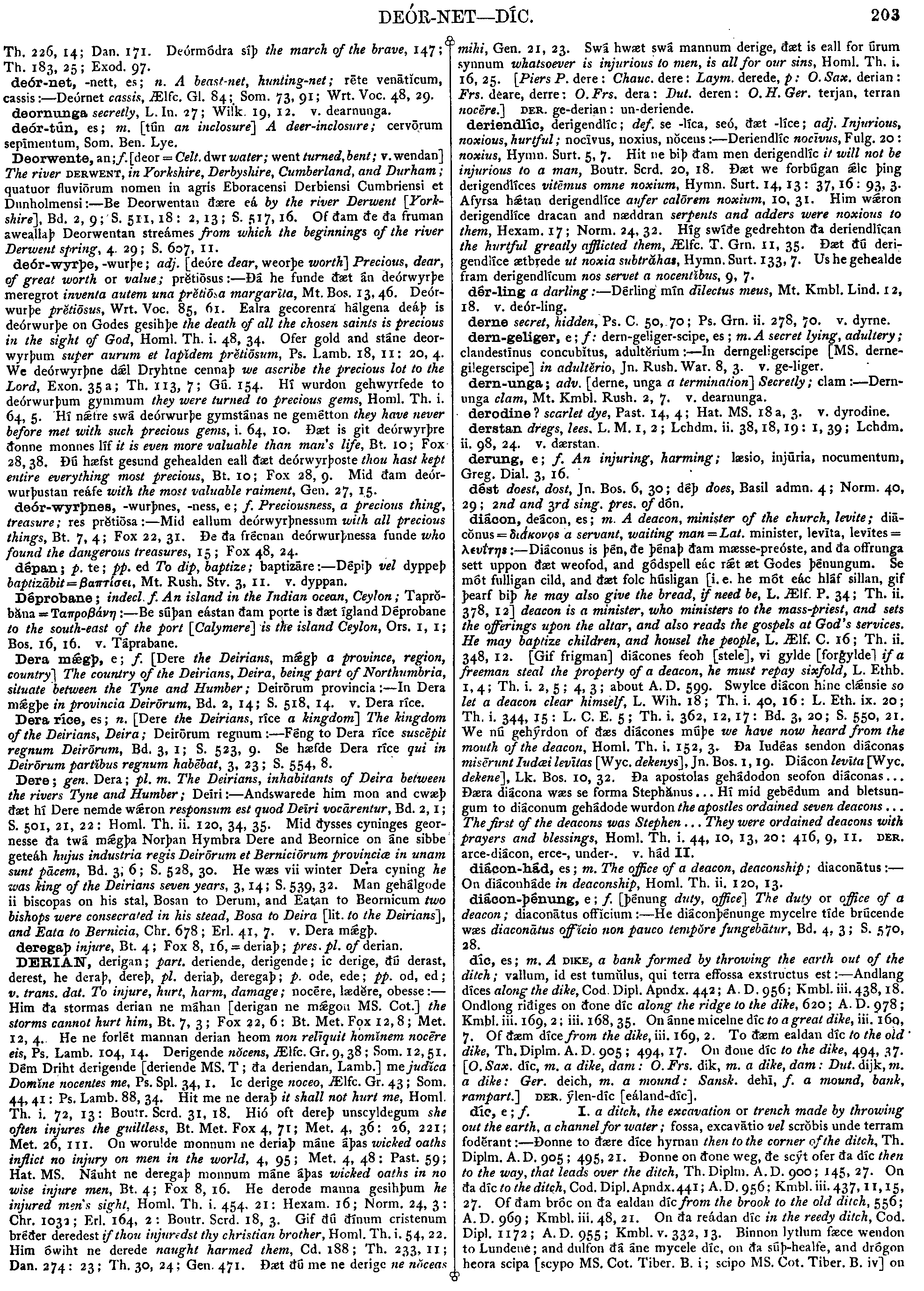
Deorwente,
an;
f.
[deor
=
Celt.
dwr
water;
went
turned,
bent;
v.
wendan]
The
river
DERWENT,
in
Yorkshire,
Derbyshire,
Cumberland,
and
Durham;
quatuor
fluvi rum
nomen
in
agris
Eboracensi
Derbiensi
Cumbriensi
et
Dunholmensi
:--
Be
Deorwentan
ðære
eá
by
the
river
Derwent
[Yorkshire],
Bd.
2,
9;
S.
511,
18:
2,
13;
S.
517,
16.
Of
ðam
ðe
ða
fruman
aweallaþ
Deorwentan
streámes
from
which
the
beginnings
of
the
river
Derwent
spring,
4.
29;
S.
607,
11.
rum
nomen
in
agris
Eboracensi
Derbiensi
Cumbriensi
et
Dunholmensi
:--
Be
Deorwentan
ðære
eá
by
the
river
Derwent
[Yorkshire],
Bd.
2,
9;
S.
511,
18:
2,
13;
S.
517,
16.
Of
ðam
ðe
ða
fruman
aweallaþ
Deorwentan
streámes
from
which
the
beginnings
of
the
river
Derwent
spring,
4.
29;
S.
607,
11.
|
Source: Bosworth/Toller, page b0209, entry 1 View original page image as: [TIFF] [PNG] [View previous entry] [View next entry] |
[Comment on this entry] [View comments (1)] |
The following entry has been hand-corrected once. |
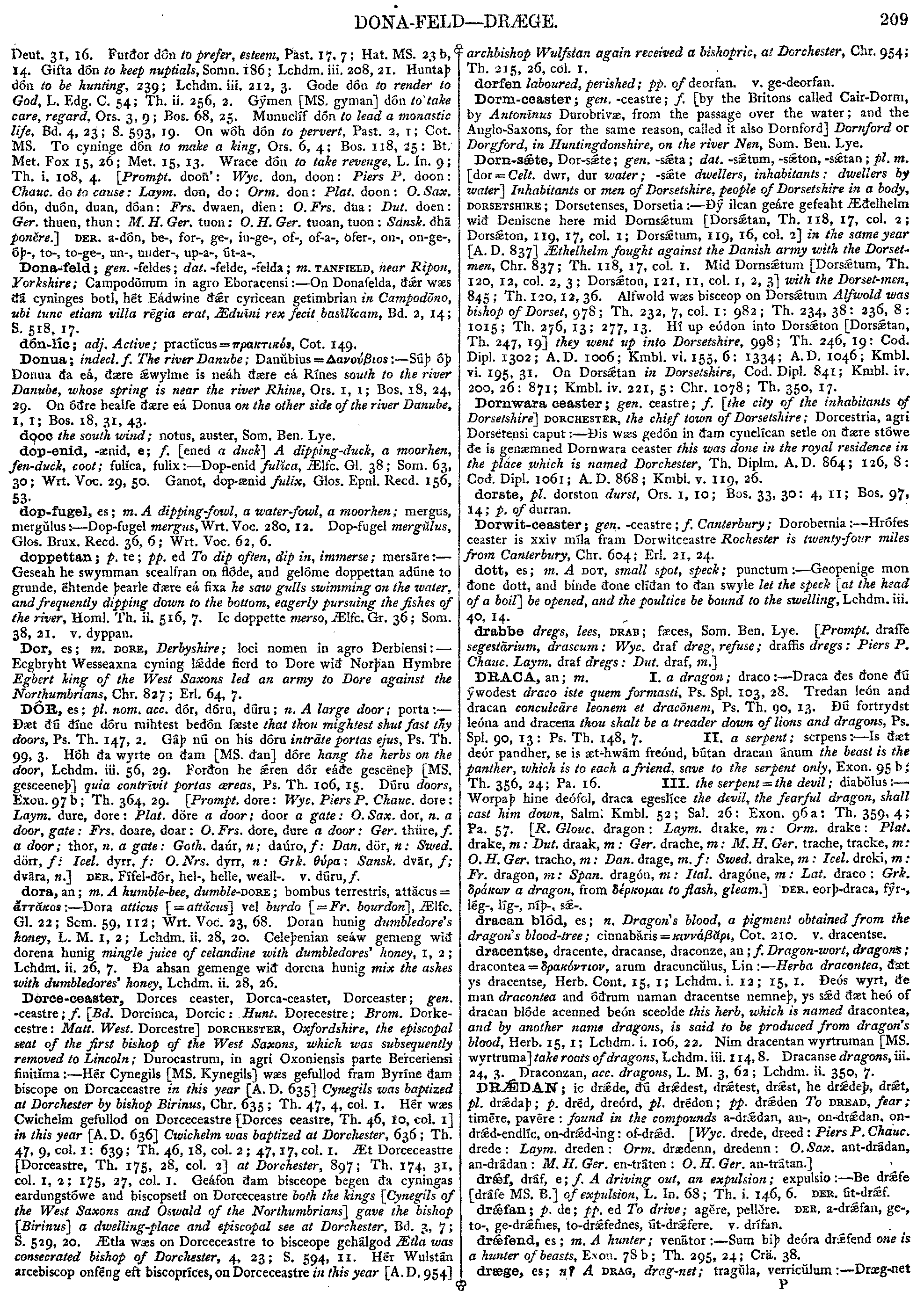
Dona-feld;
gen.
-feldes;
dat.
-felde,
-felda;
m.
TANFIELD,
near
Ripon,
Yorkshire;
Campodnum
in
agro
Eboracensi
:--
On
Donafelda,
dr
wæs
ðá
cyninges
botl,
hét
Eádwine
ðr
cyricean
getimbrian
in
Campodno,
ubi
tunc
etiam
villa
r gia
erat,
Ædu
gia
erat,
Ædu ni
rex
fecit
bas
ni
rex
fecit
bas lcam,
Bd.
2,
14;
S.
518,
17.
lcam,
Bd.
2,
14;
S.
518,
17.
|
Source: Bosworth/Toller, page b0213, entry 1 View original page image as: [TIFF] [PNG] [View previous entry] [View next entry] |
[Comment on this entry] [View comments] |
The following entry has been hand-corrected once. |
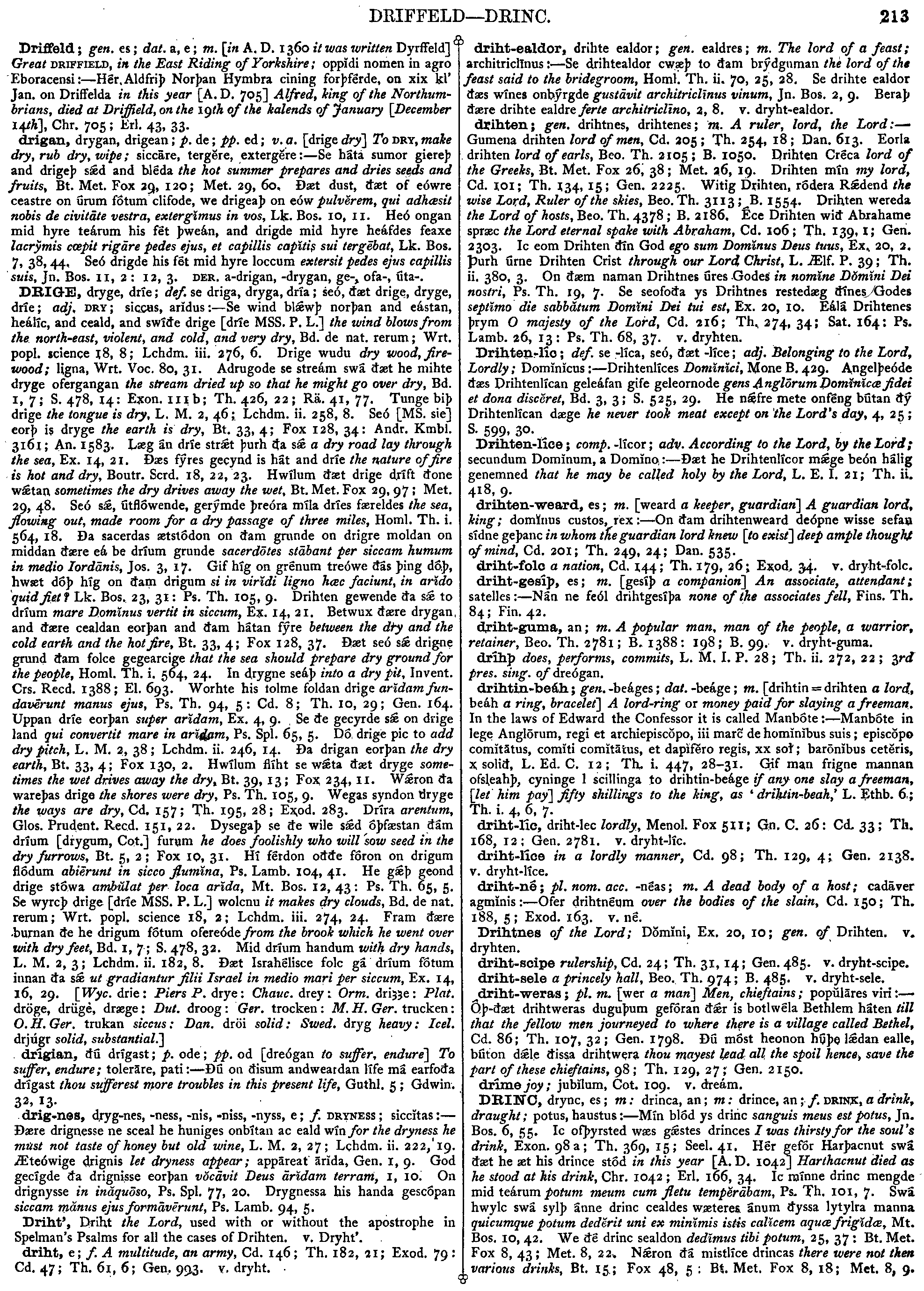
Driffeld;
gen.
es;
dat.
a,
e;
m.
[in
A.
D.
1360
it
was
written
Dyrffeld]
Great
DRIFFIELD,
in
the
East
Riding
of
Yorkshire;
oppdi
nomen
in
agro
Eboracensi
:--
Hér
Aldfriþ
Norþan
Hymbra
cining
forþférde,
on
xix
kl'
Jan.
on
Driffelda
in
this
year
[A.
D.
705]
Alfred,
king
of
the
Northumbrians,
died
at
Driffield,
on
the
19th
of
the
kalends
of
January
[December
14th],
Chr.
705;
Erl.
43,
33.
|
Source: Bosworth/Toller, page b0222, entry 4 View original page image as: [TIFF] [PNG] [View previous entry] [View next entry] |
[Comment on this entry] [View comments] |
The following entry has been hand-corrected once. |
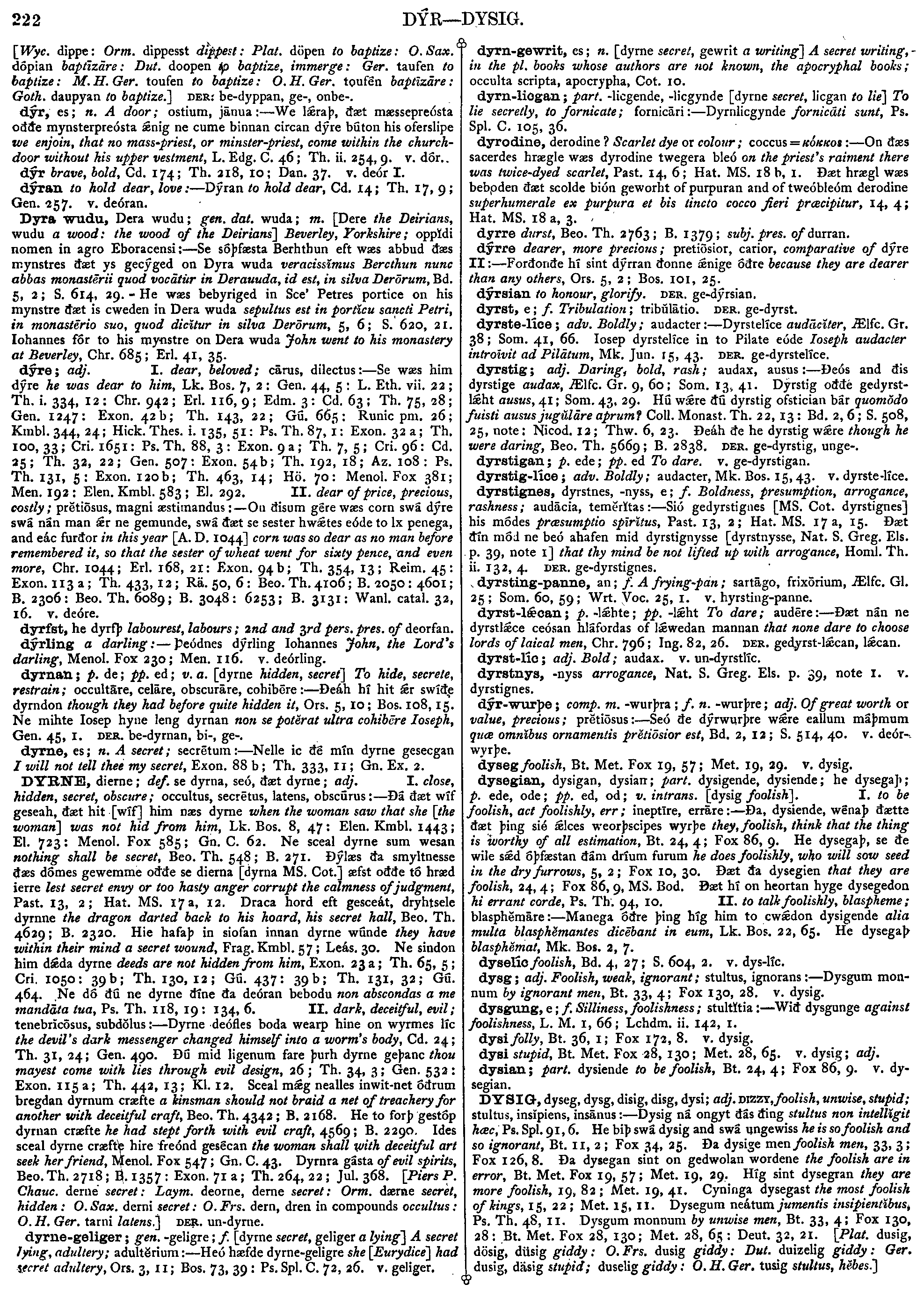
Dyra
wudu,
Dera
wudu;
gen.
dat.
wuda;
m.
[Dere
the
Deirians,
wudu
a
wood:
the
wood
of
the
Deirians]
Beverley,
Yorkshire;
oppdi
nomen
in
agro
Eboracensi
:--
Se
sóþfæsta
Berhthun
eft
wæs
abbud
ðæs
mynstres
ðæt
ys
gecýged
on
Dyra
wuda
veracissmus
Bercthun
nunc
abbas
monastrii
quod
voc tur
in
Derauuda,
id
est,
in
silva
Derrum,
Bd.
5,
2;
S.
614,
29.
He
wæs
bebyriged
in
Sce'
Petres
portice
on
his
mynstre
ðæt
is
cweden
in
Dera
wuda
sepultus
est
in
portcu
sancti
Petri,
in
monastrio
suo,
quod
dictur
in
silva
Derrum,
5,
6;
S.
620,
21.
Iohannes
fór
to
his
mynstre
on
Dera
wuda
John
went
to
his
monastery
at
Beverley,
Chr.
685;
Erl.
41,
35.
tur
in
Derauuda,
id
est,
in
silva
Derrum,
Bd.
5,
2;
S.
614,
29.
He
wæs
bebyriged
in
Sce'
Petres
portice
on
his
mynstre
ðæt
is
cweden
in
Dera
wuda
sepultus
est
in
portcu
sancti
Petri,
in
monastrio
suo,
quod
dictur
in
silva
Derrum,
5,
6;
S.
620,
21.
Iohannes
fór
to
his
mynstre
on
Dera
wuda
John
went
to
his
monastery
at
Beverley,
Chr.
685;
Erl.
41,
35.
|
Source: Bosworth/Toller, page b0253, entry 13 View original page image as: [TIFF] [PNG] [View previous entry] [View next entry] |
[Comment on this entry] [View comments] |
The following entry has been hand-corrected once. |
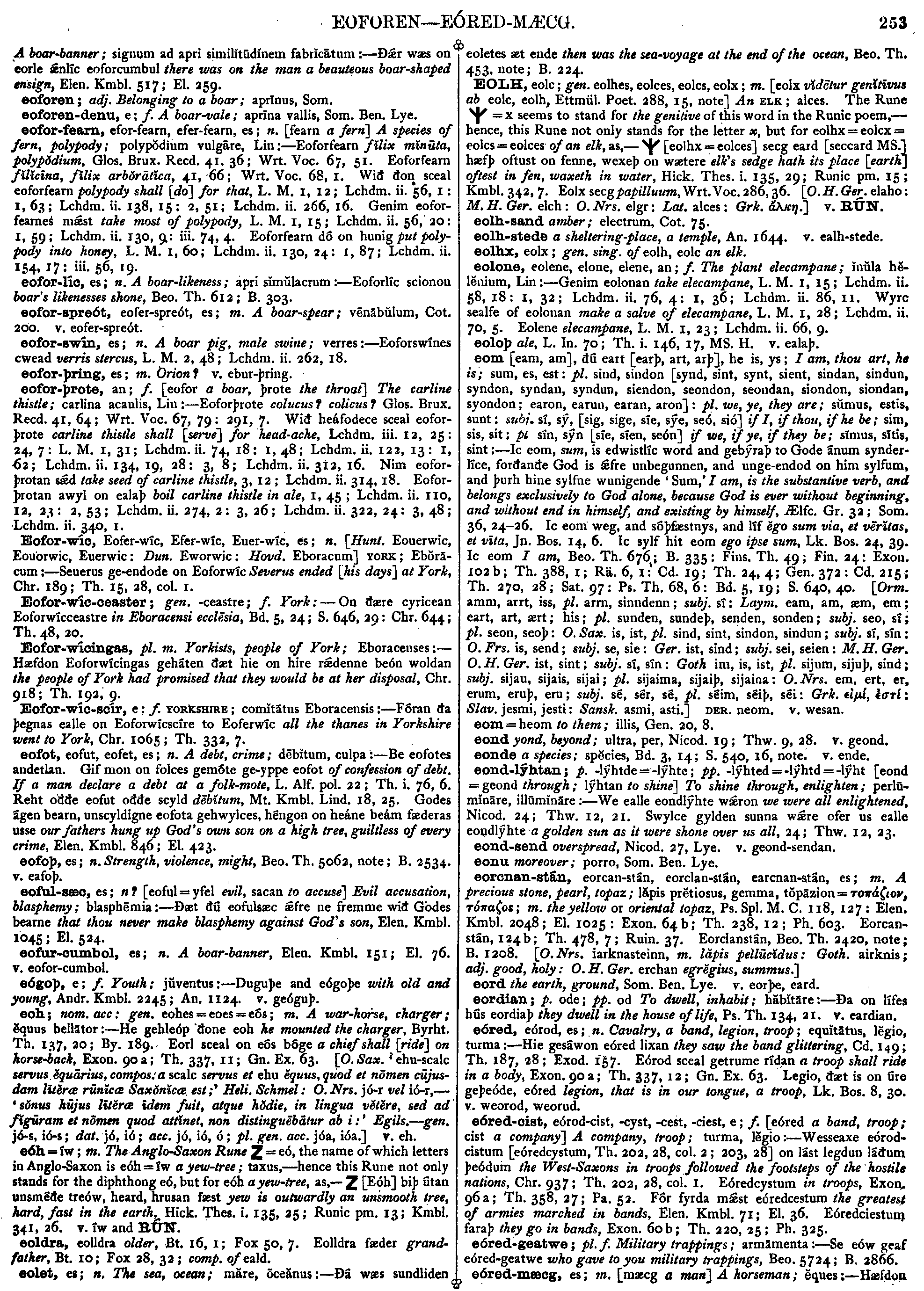
Eofor-wíc-scír,
e:
f.
YORKSHIRE;
comttus
Eboracensis
:--
Fóran
ða
þegnas
ealle
on
Eoforwícscíre
to
Eoferwíc
all
the
thanes
in
Yorkshire
went
to
York,
Chr.
1065
;
Th.
332,
7.
| Result Page: | 1 2 | Next |  |
Germanic Lexicon Project (main page)
This search system was written by
Sean Crist
Please consider
volunteering
to correct the data in these online dictionaries.
No rights reserved. Feel free to use these data in any way you please.