|
|

Tip: In the search results, you can click on any word or abbreviation for more information.
|
Source: Bosworth/Toller, page b1194, entry 1 View original page image as: [TIFF] [PNG] [View previous entry] [View next entry] |
[Comment on this entry] [View comments] |
The following entry has been hand-corrected once. |
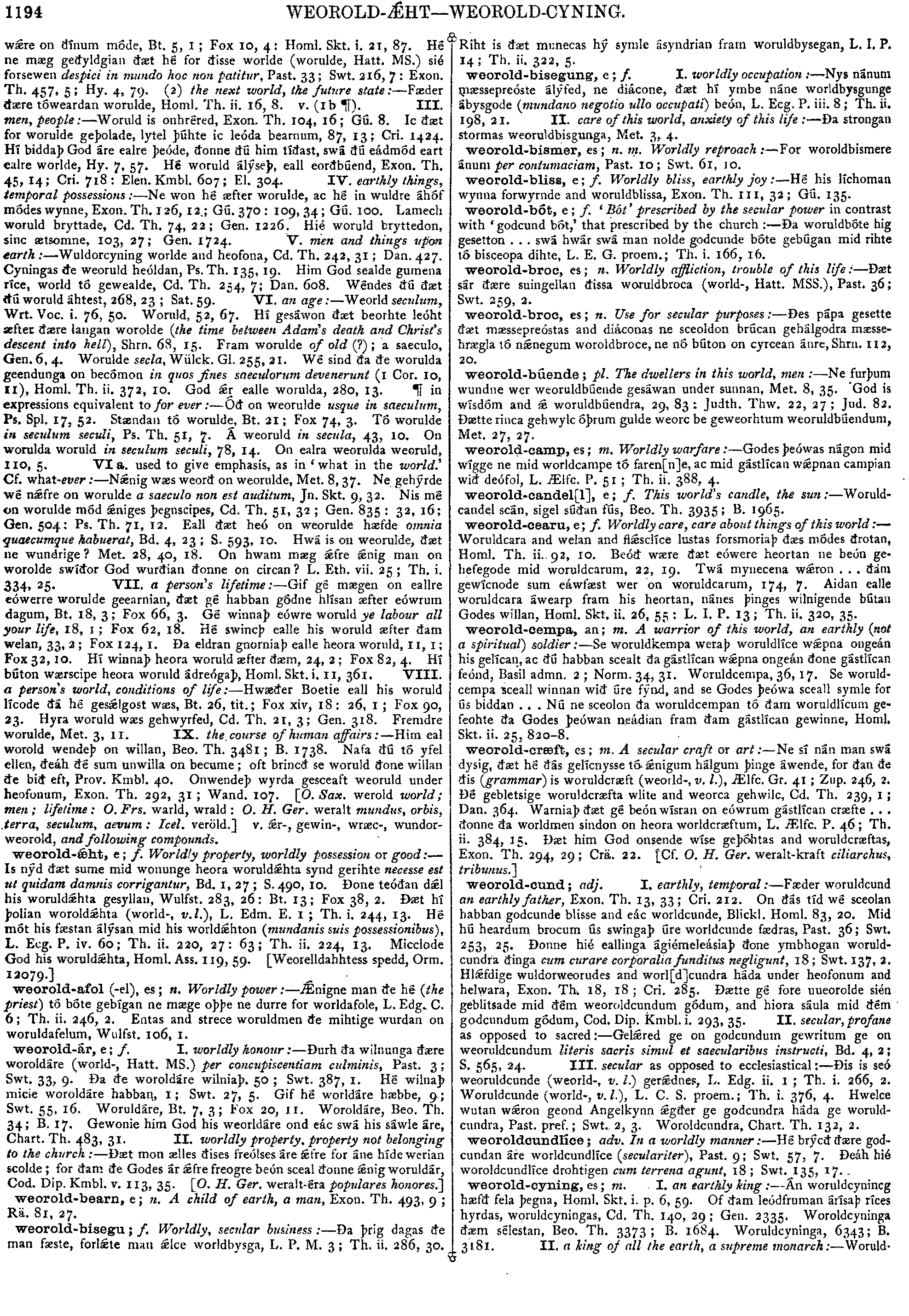
w re
on
ðínum
móde,
Bt.
5,
1;
Fox
10,
4:
Homl.
Skt.
i.
21,
87.
Hé
ne
mæg
geðyldgian
ðæt
hé
for
ðisse
worlde
(worulde,
Hatt.
MS.)
sié
forsewen
despici
in
mundo
hoc
nan
patitur.
Past.
33;
Swt.
216,
7
:
Exon.
Th.
457,
5;
Hy.
4,
79.
(2)
the
next
world,
the
future
state
:--
Fæder
ðære
tóweardan
worulde,
Homl.
Th.
ii.
16,
8.
v.
(Ib
¶).
III.
men,
people
:--
Woruld
is
onhréred,
Exon.
Th.
104,
16;
Gú.
8.
Ic
ðæt
for
worulde
geþolade,
lytel
þúhte
ic
leóda
bearnum,
87,
13;
Cri.
1424.
Hé
biddaþ
God
áre
ealre
þeóde,
ðonne
ðú
him
tíðast,
swá
ðú
eádmód
eart
ealre
worlde,
Hy.
7,
57.
Hé
woruld
álýseþ,
eall
eorðbúend,
Exon.
Th.
45,
14;
Cri.
718:
Elen.
Kmbl.
607;
El.
304.
IV.
earthly
things,
temporal
possessions
:--
Ne
won
hé
æfter
worulde,
ac
hé
in
wuldre
áhóf
módes
wynne,
Exon.
Th.
126,
12.
;
Gú.
370:
109,
34;
Gú.
100.
Lamech
woruld
bryttade,
Cd.
Th.
74,
22;
Gen.
1226.
Hié
woruld
bryttedon,
sine
ætsomne,
103,
27;
Gen.
1724.
V.
men
and
things
upon
earth
:--
Wuldorcyning
worlde
and
heofona,
Cd.
Th.
242,
31;
Dan.
427.
Cyningas
ðe
weoruld
heóldan,
Ps.
Th.
135,
19.
Him
God
sealde
gumena
ríce,
world
tó
gewealde,
Cd.
Th.
254,
7;
Dan.
608.
Wéndes
ðú
ðæt
ðú
woruld
áhtest,
268,
23;
Sae.
59.
VI.
an
age
:--
Weorld
seculum,
Wrt.
Voc.
i.
76,
50.
Woruld,
52,
67.
Hí
gesáwon
ðæt
beorhte
leóht
æfter
ðære
langan
worolde
(the
time
between
Adam's
death
and
Christ's
descent
into
hell),
Shrn.
68,
15.
Fram
worulde
of
old
(?)
;
a
saeculo,
Gen.
6,
4.
Worulde
secla.
Wülck.
Gl.
255,
21.
Wé
sind
ða
ðe
worulda
geendunga
on
becómon
in
quos
fines
saeculorum
devenerunt
(1
Cor.
10,
11),
Homl.
Th.
ii.
372,
10.
God
r
ealle
worulda,
280,
13.

in
expressions
equivalent
to
for
ever
:--
Óð
on
weorulde
usque
in
saeculum,
Ps.
Spl.
17,
52.
Stændan
tó
worulde,
Bt.
21;
Fox
74,
3.
Tó
worulde
in
seculum
seculi,
Ps.
Th.
51,
7.
Á
weoruld
in
secula,
43,
10.
On
worulda
woruld
in
seculum
seculi,
78,
14.
On
ealra
weorulda
weoruld,
110,
5.
VIa.
used
to
give
emphasis,
as
in
'what
in
the
world.
Cf.
what-ever:
--
Nnig
wæs
weorð
on
weorulde,
Met.
8,
37.
Ne
gehýrde
wé
nfre
on
worulde
a
saeculo
non
est
auditum,
Jn.
Skt.
9,
32.
Nis
mé
on
worulde
mód
niges
þegnscipes,
Cd.
Th.
51,
32
;
Gen.
835
:
32,
16;
Gen.
504:
Ps.
Th.
71,
12.
Eall
ðæt
heó
on
weorulde
hæfde
omnia
quaecumque
habuerat,
Bd.
4,
23
;
S.
593,
10.
Hwá
is
on
weorulde,
ðæt
ne
wundrige?
Met.
28,
40,
18.
On
hwam
mæg
fre
nig
man
on
worolde
swíðor
God
wurðian
ðonne
on
circan?
L.
Eth.
vii.
25
;
Th.
i.
334,
25.
VII.
a
person's
lifetime:
--
Gif
gé
mægen
on
eallre
eówerre
worulde
geearnian,
ðæt
gé
habban
gódne
hlísan
æfter
eówrum
dagum,
Bt.
18,
3;
Fox
66,
3.
Gé
winnaþ
eówre
woruld
ye
labour
all
your
life,
18,
1;
Fox
62,
18.
Hé
swincþ
ealle
his
woruld
æfter
ðam
welan,
33,
2;
Fox
124,
1.
Ða
eldran
gnorniaþ
ealle
heora
woruld,
11,
1;
Fox
32,
10.
Hí
winnaþ
heora
woruld
æfter
ðæm,
24,
2;
Fox
82,
4.
Hí
búton
wærscipe
heora
woruld
ádreógaþ,
Homl.
Skt.
i.
11,
361.
VIII.
a
person's
world,
conditions
of
life
:--
Hwæðer
Boetie
eall
his
woruld
lícode
ðá
hé
geslgost
wæs,
Bt.
26,
tit.;
Fox
xiv,
18:
26,
1;
Fox
90,
23.
Hyra
woruld
wæs
gehwyrfed,
Cd.
Th.
21,
3;
Gen.
318.
Fremdre
worulde,
Met.
3,
11.
IX.
the,
course
of
human
affairs
:--
Him
eal
worold
wendeþ
on
willan,
Beo.
Th.
3481
;
B.
1738.
Nafa
ðú
tó
yfel
ellen,
ðeáh
ðé
sum
unwilla
on
becume;
oft
brincð
se
woruld
ðone
willan
ðe
bið
eft,
Prov.
Kmbl.
40.
Onwendeþ
wyrda
gesceaft
weoruld
under
heofonum,
Exon.
Th.
292,
31;
Wand.
107.
[O.
Sax.
werold
world;
men;
lifetime
:
O.
Frs.
warld,
wrald
:
O.
H.
Ger.
weralt
mundus,
orbis,
terra,
seculum,
aevum
:
Icel.
veröld.]
v.
r-,
gewin-,
wraec-,
wundor
re
on
ðínum
móde,
Bt.
5,
1;
Fox
10,
4:
Homl.
Skt.
i.
21,
87.
Hé
ne
mæg
geðyldgian
ðæt
hé
for
ðisse
worlde
(worulde,
Hatt.
MS.)
sié
forsewen
despici
in
mundo
hoc
nan
patitur.
Past.
33;
Swt.
216,
7
:
Exon.
Th.
457,
5;
Hy.
4,
79.
(2)
the
next
world,
the
future
state
:--
Fæder
ðære
tóweardan
worulde,
Homl.
Th.
ii.
16,
8.
v.
(Ib
¶).
III.
men,
people
:--
Woruld
is
onhréred,
Exon.
Th.
104,
16;
Gú.
8.
Ic
ðæt
for
worulde
geþolade,
lytel
þúhte
ic
leóda
bearnum,
87,
13;
Cri.
1424.
Hé
biddaþ
God
áre
ealre
þeóde,
ðonne
ðú
him
tíðast,
swá
ðú
eádmód
eart
ealre
worlde,
Hy.
7,
57.
Hé
woruld
álýseþ,
eall
eorðbúend,
Exon.
Th.
45,
14;
Cri.
718:
Elen.
Kmbl.
607;
El.
304.
IV.
earthly
things,
temporal
possessions
:--
Ne
won
hé
æfter
worulde,
ac
hé
in
wuldre
áhóf
módes
wynne,
Exon.
Th.
126,
12.
;
Gú.
370:
109,
34;
Gú.
100.
Lamech
woruld
bryttade,
Cd.
Th.
74,
22;
Gen.
1226.
Hié
woruld
bryttedon,
sine
ætsomne,
103,
27;
Gen.
1724.
V.
men
and
things
upon
earth
:--
Wuldorcyning
worlde
and
heofona,
Cd.
Th.
242,
31;
Dan.
427.
Cyningas
ðe
weoruld
heóldan,
Ps.
Th.
135,
19.
Him
God
sealde
gumena
ríce,
world
tó
gewealde,
Cd.
Th.
254,
7;
Dan.
608.
Wéndes
ðú
ðæt
ðú
woruld
áhtest,
268,
23;
Sae.
59.
VI.
an
age
:--
Weorld
seculum,
Wrt.
Voc.
i.
76,
50.
Woruld,
52,
67.
Hí
gesáwon
ðæt
beorhte
leóht
æfter
ðære
langan
worolde
(the
time
between
Adam's
death
and
Christ's
descent
into
hell),
Shrn.
68,
15.
Fram
worulde
of
old
(?)
;
a
saeculo,
Gen.
6,
4.
Worulde
secla.
Wülck.
Gl.
255,
21.
Wé
sind
ða
ðe
worulda
geendunga
on
becómon
in
quos
fines
saeculorum
devenerunt
(1
Cor.
10,
11),
Homl.
Th.
ii.
372,
10.
God
r
ealle
worulda,
280,
13.

in
expressions
equivalent
to
for
ever
:--
Óð
on
weorulde
usque
in
saeculum,
Ps.
Spl.
17,
52.
Stændan
tó
worulde,
Bt.
21;
Fox
74,
3.
Tó
worulde
in
seculum
seculi,
Ps.
Th.
51,
7.
Á
weoruld
in
secula,
43,
10.
On
worulda
woruld
in
seculum
seculi,
78,
14.
On
ealra
weorulda
weoruld,
110,
5.
VIa.
used
to
give
emphasis,
as
in
'what
in
the
world.
Cf.
what-ever:
--
Nnig
wæs
weorð
on
weorulde,
Met.
8,
37.
Ne
gehýrde
wé
nfre
on
worulde
a
saeculo
non
est
auditum,
Jn.
Skt.
9,
32.
Nis
mé
on
worulde
mód
niges
þegnscipes,
Cd.
Th.
51,
32
;
Gen.
835
:
32,
16;
Gen.
504:
Ps.
Th.
71,
12.
Eall
ðæt
heó
on
weorulde
hæfde
omnia
quaecumque
habuerat,
Bd.
4,
23
;
S.
593,
10.
Hwá
is
on
weorulde,
ðæt
ne
wundrige?
Met.
28,
40,
18.
On
hwam
mæg
fre
nig
man
on
worolde
swíðor
God
wurðian
ðonne
on
circan?
L.
Eth.
vii.
25
;
Th.
i.
334,
25.
VII.
a
person's
lifetime:
--
Gif
gé
mægen
on
eallre
eówerre
worulde
geearnian,
ðæt
gé
habban
gódne
hlísan
æfter
eówrum
dagum,
Bt.
18,
3;
Fox
66,
3.
Gé
winnaþ
eówre
woruld
ye
labour
all
your
life,
18,
1;
Fox
62,
18.
Hé
swincþ
ealle
his
woruld
æfter
ðam
welan,
33,
2;
Fox
124,
1.
Ða
eldran
gnorniaþ
ealle
heora
woruld,
11,
1;
Fox
32,
10.
Hí
winnaþ
heora
woruld
æfter
ðæm,
24,
2;
Fox
82,
4.
Hí
búton
wærscipe
heora
woruld
ádreógaþ,
Homl.
Skt.
i.
11,
361.
VIII.
a
person's
world,
conditions
of
life
:--
Hwæðer
Boetie
eall
his
woruld
lícode
ðá
hé
geslgost
wæs,
Bt.
26,
tit.;
Fox
xiv,
18:
26,
1;
Fox
90,
23.
Hyra
woruld
wæs
gehwyrfed,
Cd.
Th.
21,
3;
Gen.
318.
Fremdre
worulde,
Met.
3,
11.
IX.
the,
course
of
human
affairs
:--
Him
eal
worold
wendeþ
on
willan,
Beo.
Th.
3481
;
B.
1738.
Nafa
ðú
tó
yfel
ellen,
ðeáh
ðé
sum
unwilla
on
becume;
oft
brincð
se
woruld
ðone
willan
ðe
bið
eft,
Prov.
Kmbl.
40.
Onwendeþ
wyrda
gesceaft
weoruld
under
heofonum,
Exon.
Th.
292,
31;
Wand.
107.
[O.
Sax.
werold
world;
men;
lifetime
:
O.
Frs.
warld,
wrald
:
O.
H.
Ger.
weralt
mundus,
orbis,
terra,
seculum,
aevum
:
Icel.
veröld.]
v.
r-,
gewin-,
wraec-,
wundor weorold,
and
following
compounds.
weorold,
and
following
compounds.
|
Source: Bosworth/Toller, page b1275, entry 2 View original page image as: [TIFF] [PNG] [View previous entry] [View next entry] |
[Comment on this entry] [View comments] |
The following entry has been hand-corrected once. |
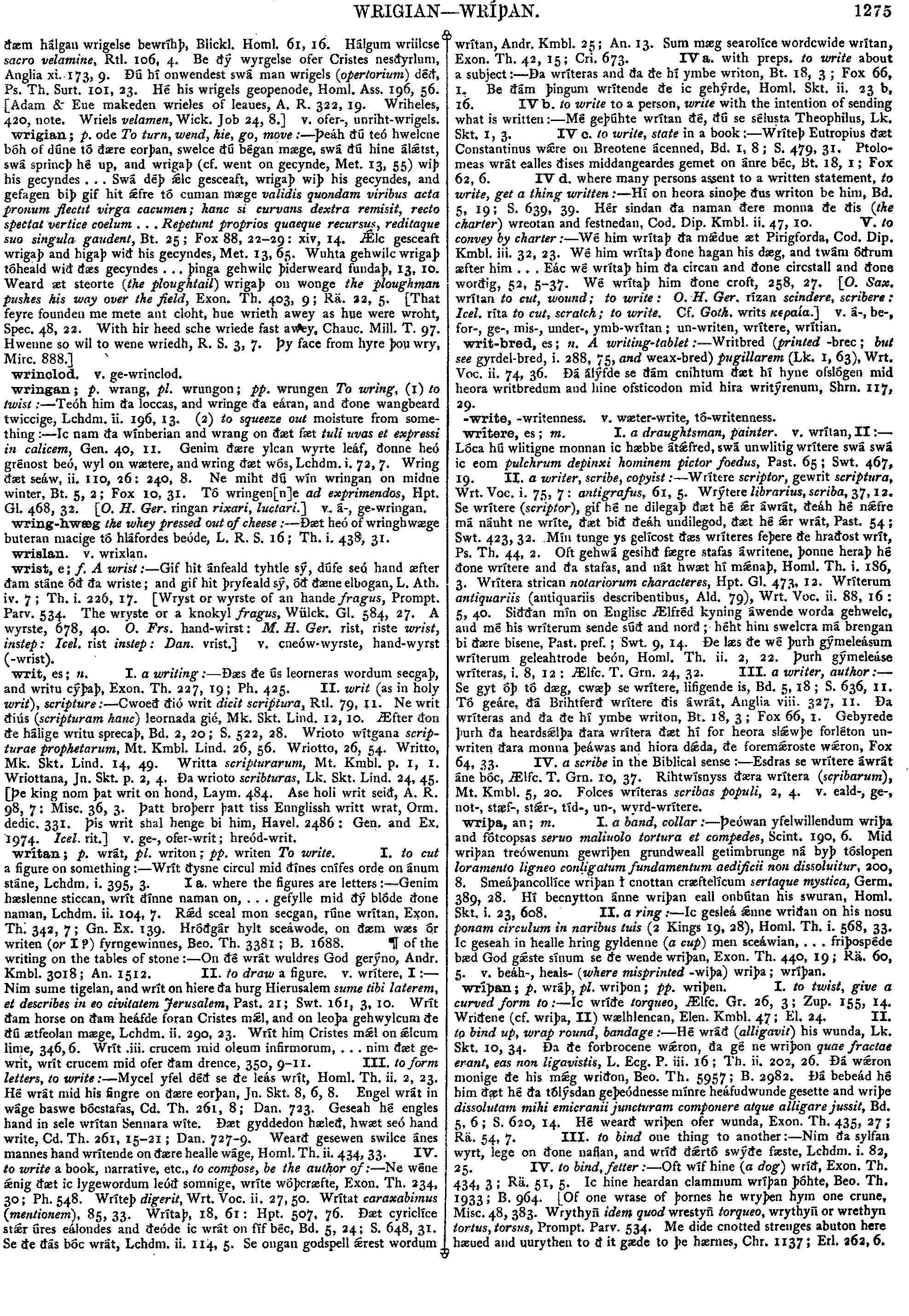
wrigian;
p.
ode
To
turn,
wend,
hie,
go,
move
:
--
þeáh
ðú
teó
hwelcne
bóh
of
dúne
tó
ðære
eorþan,
swelce
ðú
bégan
mæge,
swá
ðú
hine
áltst,
swá
sprincþ
hé
up,
and
wrigaþ
(cf.
went
on
gecynde,
Met.
13,
55)
wiþ
his
gecyndes.
.
.
Swá
déþ
lc
gesceaft,
wrigaþ
wiþ
his
gecyndes,
and
gefagen
biþ
gif
hit
fre
tó
cuman
mæge
validis
quondam
viribus
acta
fronam
flectet
virga
cacumen;
hanc
si
curvans
dextra
remisit,
recto
special
writes
coelum
.
.
.
Repetunt
proprios
quaeque
recursus,
reditaque
suo
singula
gavdent,
Bt.
25;
Fox
88,
22-29:
xiv,
14.
Æ-acute;lc
gesceaft
wrigaþ
and
higaþ
wið
his
gecyndes,
Met.
13,
65.
Wuhta
gehwilc
wrigaþ
tóheald
wið
ðæs
gecyndes
.
.
.
þinga
gehwilc
þiderweard
fundaþ,
13,
10.
Weard
æt
steorte
(the
ploughtail)
wrigaþ
on
wonge
the
ploughman
pushes
his
way
over
the
field,
Exon.
Th.
403,
9;
Rä.
22,
5.
[That
feyre
founden
me
mete
ant
cloht,
hue
wrieth
awey
as
hue
were
wroht,
Spec.
48,
22.
With
hir
need
sche
wriede
fast
awey.
Chauc.
Mill.
T.
97.
Hwenne
so
wil
to
wene
wriedh,
R.
S.
3,
7.
Þy
face
from
hyre
þon
wry,
Mire.
888.]
|
Source: Bosworth/Toller, page d0235, entry 26 View original page image as: [TIFF] [PNG] [View previous entry] [View next entry] |
[Comment on this entry] [View comments] |
The following entry has been hand-corrected once. |
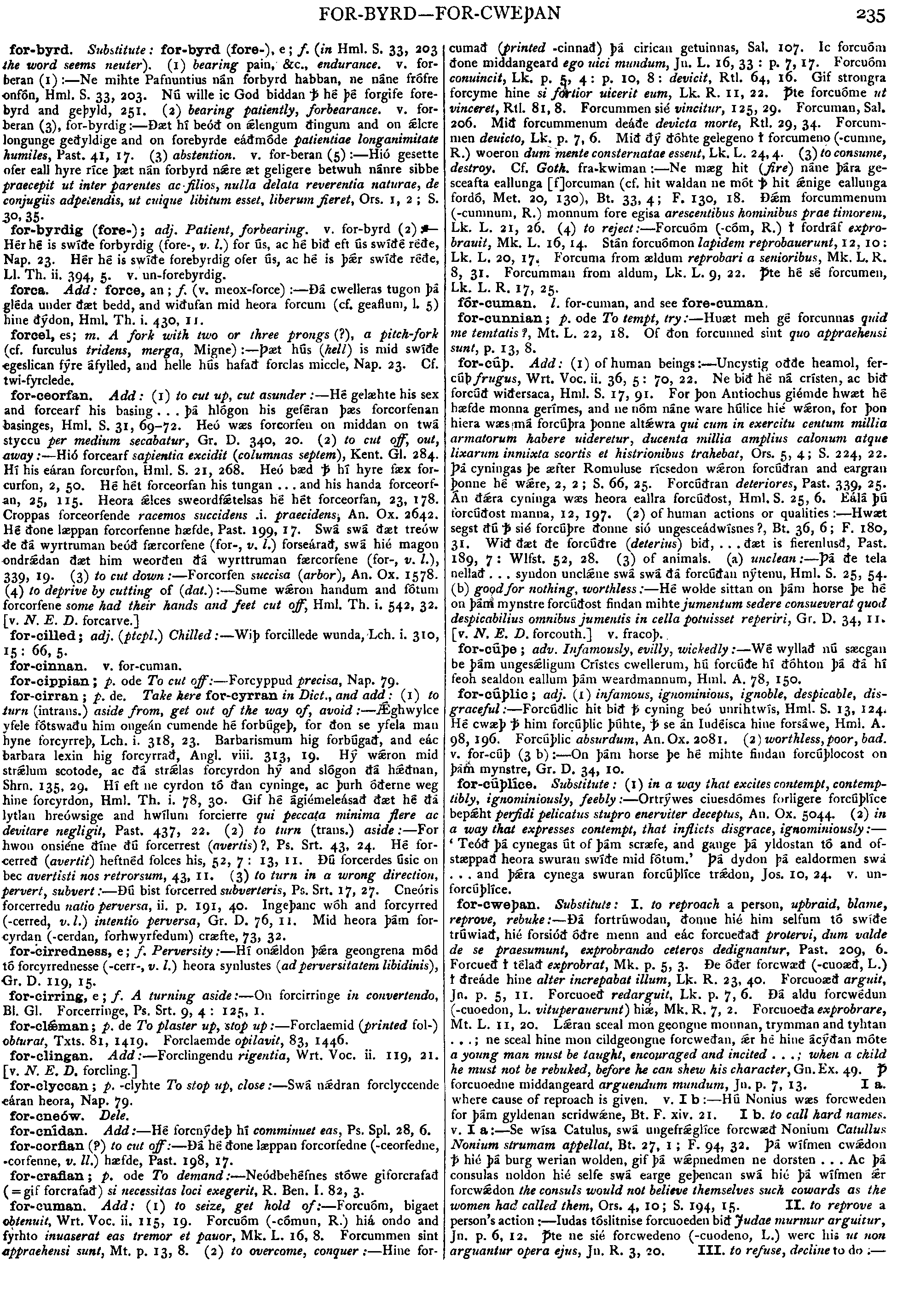
for-cweþan.
Substitute:
I.
to
reproach
a
person,
upbraid,
blame,
reprove,
rebuke
:--
Ðá
fortrúwodan,
ðonne
hié
him
selfum
tó
swíðe
trúwiað,
hié
forsióð
óðre
menn
and
eác
forcueðað
protervi,
dum
valde
de
se
praesumunt,
exprobrando
ceteros
dedignantur.
Past.
209,
6.
Forcueð
 télað
exprobrat,
Mk.
p.
5,
3.
Ðe
óðer
forcwæð
(-cuoæð,
L.)
ðreáde
hine
alter
increpabat
illum,
Lk.
R.
23,
40.
Forcuoæð
arguit,
Jn.
p.
5,
11.
Forcuoeð
redarguit,
Lk.
p.
7,
6.
Ðá
aldu
forcwédun
(-cuoedon,
L.
vituperauerunt)
hi,
Mk.
R.
7,
2.
Forcuoeða
exprobrare,
Mt.
L.
11,
20.
Lran
sceal
mon
geongne
monnan,
trymman
and
tyhtan
...;
ne
sceal
hine
mon
cildgeongne
forcweðan,
r
hé
hine
ácýðan
móte
a
young
man
must
be
taught,
encouraged
and
incited
...;
when
a
child
he
must
not
be
rebuked,
before
he
can
shew
his
character,
Gn.
Ex.
49.
Þ-bar;
forcuoedne
middangeard
arguendum
mundum,
Jn.
p.
7,
13.
I
a.
where
cause
of
reproach
is
given,
v.
I
b
:--
Hú
Nonius
wæs
forcweden
for
þám
gyldenan
scridwne,
Bt.
F.
xiv.
21.
I
b.
to
call
hard
names.
v.
I
a
:--
Se
wísa
Catulus,
swá
ungefrglíce
forcwæð
Nomum
Catullus
Nonium
strumam
appellat,
Bt.
27,
1;
F.
94,
32.
Þa
wífmen
cwdon
télað
exprobrat,
Mk.
p.
5,
3.
Ðe
óðer
forcwæð
(-cuoæð,
L.)
ðreáde
hine
alter
increpabat
illum,
Lk.
R.
23,
40.
Forcuoæð
arguit,
Jn.
p.
5,
11.
Forcuoeð
redarguit,
Lk.
p.
7,
6.
Ðá
aldu
forcwédun
(-cuoedon,
L.
vituperauerunt)
hi,
Mk.
R.
7,
2.
Forcuoeða
exprobrare,
Mt.
L.
11,
20.
Lran
sceal
mon
geongne
monnan,
trymman
and
tyhtan
...;
ne
sceal
hine
mon
cildgeongne
forcweðan,
r
hé
hine
ácýðan
móte
a
young
man
must
be
taught,
encouraged
and
incited
...;
when
a
child
he
must
not
be
rebuked,
before
he
can
shew
his
character,
Gn.
Ex.
49.
Þ-bar;
forcuoedne
middangeard
arguendum
mundum,
Jn.
p.
7,
13.
I
a.
where
cause
of
reproach
is
given,
v.
I
b
:--
Hú
Nonius
wæs
forcweden
for
þám
gyldenan
scridwne,
Bt.
F.
xiv.
21.
I
b.
to
call
hard
names.
v.
I
a
:--
Se
wísa
Catulus,
swá
ungefrglíce
forcwæð
Nomum
Catullus
Nonium
strumam
appellat,
Bt.
27,
1;
F.
94,
32.
Þa
wífmen
cwdon
 hié
þá
burg
werian
wolden,
gif
þá
wpnedmen
ne
dorsten
...
Ac
þá
consulas
noldon
hié
selfe
swá
earge
geþencan
swá
hié
þá
wífmen
r
forcwdon
the
consuls
would
not
believe
themselves
such
cowards
as
the
women
had
called
them.
Ors.
4,
10;
S.
194,
15.
II.
to
reprove
a
person's
action
:--
Iudas
tóslitnise
forcuoeden
bið
Judae
murmur
arguitur,
Jn.
p.
6,
12.
Þ-bar;te
ne
sié
forcwedeno
(-cuodeno,
L.)
werc
his
ut
non
arguantur
opera
ejus,
Jn.
R.
3,
20.
III.
to
refuse,
decline
to
do
:--
hié
þá
burg
werian
wolden,
gif
þá
wpnedmen
ne
dorsten
...
Ac
þá
consulas
noldon
hié
selfe
swá
earge
geþencan
swá
hié
þá
wífmen
r
forcwdon
the
consuls
would
not
believe
themselves
such
cowards
as
the
women
had
called
them.
Ors.
4,
10;
S.
194,
15.
II.
to
reprove
a
person's
action
:--
Iudas
tóslitnise
forcuoeden
bið
Judae
murmur
arguitur,
Jn.
p.
6,
12.
Þ-bar;te
ne
sié
forcwedeno
(-cuodeno,
L.)
werc
his
ut
non
arguantur
opera
ejus,
Jn.
R.
3,
20.
III.
to
refuse,
decline
to
do
:--
|
Source: Bosworth/Toller, page d0339, entry 9 View original page image as: [TIFF] [PNG] [View previous entry] [View next entry] |
[Comment on this entry] [View comments] |
The following entry has been hand-corrected once. |
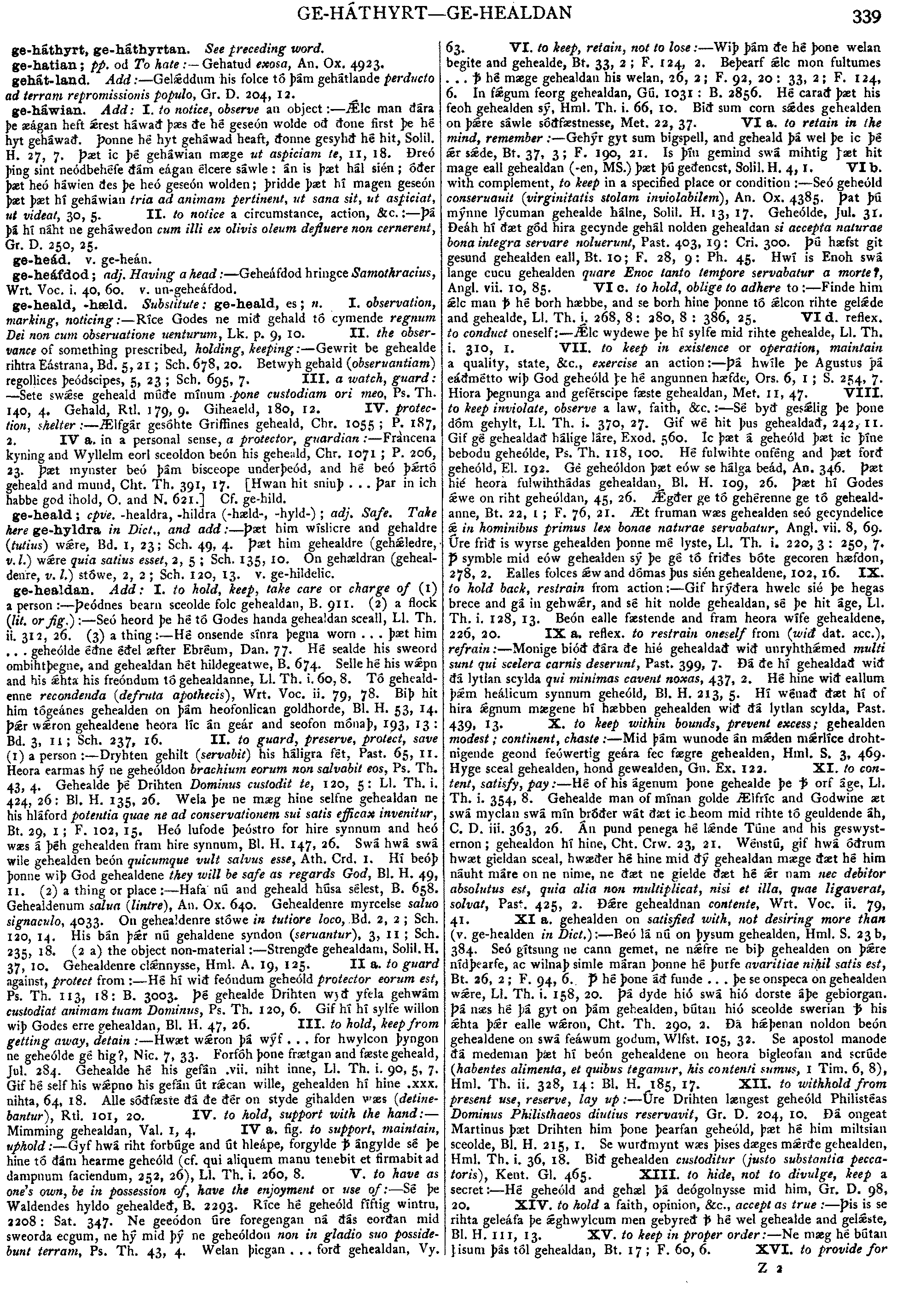
ge-healdan.
Add:
I.
to
hold,
keep,
take
care
or
charge
of
(1)
a
person:--Þeódnes
bearn
sceolde
folc
gehealdan,
B.
911.
(2)
a
flock
(lit.
or
fig.):--Seó
heord
þe
hé
tó
Godes
handa
gehealdan
sceall,
Ll.
Th.
ii.
312,
26.
(3)
a
thing:--Hé
onsende
sínra
þegna
worn
.
.
.
þæt
him
.
.
.
geheólde
éðne
éðel
æfter
Ebréum,
Dan.
77.
Hé
sealde
his
sweord
ombihtþegne,
and
gehealdan
hét
hildegeatwe,
B.
674.
Selle
hé
his
wpn
and
his
hta
his
freóndum
tó
gehealdanne,
Ll.
Th.
i.
60,
8.
Tó
gehealdenne
recondenda
(defruta
apothecis),
Wrt.
Voc.
ii.
79,
78.
Biþ
hit
him
tógeánes
gehealden
on
þám
heofonlican
goldhorde,
Bl.
H.
53,
14.
Þr
wron
gehealdene
heora
líc
án
geár
and
seofon
mónaþ,
193,
13:
Bd.
3,
11;
Sch.
237,
16.
II.
to
guard,
preserve,
protect,
save
(1)
a
person:--Dryhten
gehilt
(servabit)
his
háligra
fét,
Past.
65,
11.
Heora
earmas
hý
ne
geheóldon
brachium
eorum
non
salvabit
eos,
Ps.
Th.
43,
4.
Gehealde
þé
Drihten
Dominus
custodit
te,
120,
5:
Ll.
Th.
i.
424,
26:
Bl.
H.
135,
26.
Wela
þe
ne
mæg
hine
selfne
gehealdan
ne
his
hláford
potentia
quae
ne
ad
conservationem
sui
satis
efficax
invenitur,
Bt.
29,
1;
F.
102,
15.
Heó
lufode
þeóstro
for
hire
synnum
and
heó
wæs
á
þéh
gehealden
fram
hire
synnum,
Bl.
H.
147,
26.
Swá
hwá
swá
wile
gehealden
beón
quicumque
vult
salvus
esse,
Ath.
Crd.
1.
Hí
beóþ
þonne
wiþ
God
gehealdene
they
will
be
safe
as
regards
God,
Bl.
H.
49,
11.
(2)
a
thing
or
place:--Hafa
nú
and
geheald
húsa
sélest,
B.
658.
Gehealdenum
salua
(lintre),
An.
Ox.
640.
Gehealdenre
myrcelse
saluo
signaculo,
4033.
On
gehealdenre
stówe
in
tutiore
loco,
Bd.
2,
2;
Sch.
120,
14.
His
bán
þr
nú
gehaldene
syndon
(seruantur),
3,
11;
Sch.
235,
18.
(2
a)
the
object
non-material:--Strengðe
gehealdam,
Solil.
H.
37,
10.
Gehealdenre
clnnysse,
Hml.
A.
19,
125.
II
a.
to
guard
against,
protect
from:--Hé
hí
wið
feóndum
geheóld
protector
eorum
est,
Ps.
Th.
113,
18:
B.
3003.
Þé
gehealde
Drihten
wyð
yfela
gehwám
custodiat
animam
tuam
Dominus,
Ps.
Th.
120,
6.
Gif
hí
hí
sylfe
willon
wiþ
Godes
erre
gehealdan,
Bl.
H.
47,
26.
III.
to
hold,
keep
from
getting
away,
detain:--Hwæt
wron
þá
wýf
.
.
.
for
hwylcon
þyngon
ne
geheólde
gé
hig?,
Nic.
7,
33.
Forfóh
þone
frætgan
and
fæste
geheald,
Jul.
284.
Gehealde
hé
his
gefán
.vii.
niht
inne,
Ll.
Th.
i.
90,
5,
7.
Gif
hé
self
his
wpno
his
gefán
út
rcan
wille,
gehealden
hí
hine
.xxx.
nihta,
64,
18.
Alle
sóðfæste
ðá
ðe
ðér
on
styde
gihalden
wæs
(detinebantur),
Rtl.
101,
20.
IV.
to
hold,
support
with
the
hand:--Mimming
gehealdan,
Val.
1,
4.
IV
a.
fig.
to
support,
maintain,
uphold:--Gyf
hwá
riht
forbúge
and
út
hleápe,
forgylde
ángylde
sé
þe
hine
tó
ðám
hearme
geheóld
(cf.
qui
aliquem
manu
tenebit
et
firmabit
ad
dampnum
faciendum,
252,
26),
Ll.
Th.
i.
260,
8.
V.
to
have
as
one's
own,
be
in
possession
of,
have
the
enjoyment
or
use
of:--Sé
þe
Waldendes
hyldo
gehealdeð,
B.
2293.
Ríce
hé
geheóld
fíftig
wintru,
2208:
Sat.
347.
Ne
geeódon
úre
foregengan
ná
ðás
eorðan
mid
sweorda
ecgum,
ne
hý
mid
þý
ne
geheóldon
non
in
gladio
suo
possidebunt
terram,
Ps.
Th.
43,
4.
Welan
þicgan
.
.
.
forð
gehealdan,
Vy.
63.
VI.
to
keep,
retain,
not
to
lose:--Wiþ
þám
ðe
hé
þone
welan
begite
and
gehealde,
Bt.
33,
2;
F.
124,
2.
Beþearf
lc
mon
fultumes
.
.
.
hé
mæge
gehealdan
his
welan,
26,
2;
F.
92,
20:
33,
2;
F.
124,
6.
In
fgum
feorg
gehealdan,
Gú.
1031:
B.
2856.
Hé
carað
þæt
his
feoh
gehealden
sý,
Hml.
Th.
i.
66,
10.
Bið
sum
corn
sdes
gehealden
on
þre
sáwle
sóðfæstnesse,
Met.
22,
37.
VI
a.
to
retain
in
the
mind,
remember:--Gehýr
gyt
sum
bigspell,
and
geheald
þá
wel
þe
ic
þé
r
sde,
Bt.
37,
3;
F.
190,
21.
Is
þín
gemind
swá
mihtig
þæt
hit
mage
eall
gehealdan
(-en,
MS.)
þæt
þú
geðencst,
Solil.
H.
4,
1.
VI
b.
with
complement,
to
keep
in
a
specified
place
or
condition:--Seó
geheóld
conseruauit
(virginitatis
stolam
inviolabilem),
An.
Ox.
4385.
Þat
þú
mýnne
lýcuman
gehealde
hálne,
Solil.
H.
13,
17.
Geheólde,
Jul.
31.
Ðeáh
hí
ðæt
gód
hira
gecynde
gehál
nolden
gehealdan
si
accepta
naturae
bona
integra
servare
noluerunt,
Past.
403,
19:
Cri.
300.
Þú
hæfst
git
gesund
gehealden
eall,
Bt.
10;
F.
28,
9:
Ph.
45.
Hwí
is
Enoh
swá
lange
cucu
gehealden
quare
Enoc
tanto
tempore
servabatur
a
morte?,
Angl.
vii.
10,
85.
VI
c.
to
hold,
oblige
to
adhere
to:--Finde
him
lc
man
hé
borh
hæbbe,
and
se
borh
hine
þonne
tó
lcon
rihte
gelde
and
gehealde,
Ll.
Th.
i.
268,
8:
280,
8:
386,
25.
VI
d.
reflex.
to
conduct
oneself:--Æ-acute;lc
wydewe
þe
hí
sylfe
mid
rihte
gehealde,
Ll.
Th.
i.
310,
1.
VII.
to
keep
in
existence
or
operation,
maintain
a
quality,
state,
&c.,
exercise
an
action:--Þá
hwíle
þe
Agustus
þá
eáðmétto
wiþ
God
geheóld
þe
hé
angunnen
hæfde,
Ors.
6,
1;
S.
254,
7.
Hiora
þegnunga
and
geférscipe
fæste
gehealdan,
Met.
11,
47.
VIII.
to
keep
inviolate,
observe
a
law,
faith,
&c.:--Sé
byð
geslig
þe
þone
dóm
gehylt,
Ll.
Th.
i.
370,
27.
Gif
wé
hit
þus
gehealdað,
242,
11.
Gif
gé
gehealdað
hálige
láre,
Exod.
560.
Ic
þæt
á
geheóld
þæt
ic
þíne
bebodu
geheólde,
Ps.
Th.
118,
100.
Hé
fulwihte
onféng
and
þæt
forð
geheóld,
El.
192.
Gé
geheóldon
þæt
eów
se
hálga
beád,
An.
346.
Þæt
hié
heora
fulwihthádas
gehealdan,
Bl.
H.
109,
26.
Þæt
hí
Godes
we
on
riht
geheóldan,
45,
26.
Æ-acute;gðer
ge
tó
gehérenne
ge
tó
gehealdanne,
Bt.
22,
1;
F.
76,
21.
Æt
fruman
wæs
gehealden
seó
gecyndelice
in
hominibus
primus
lex
bonae
naturae
servabatur,
Angl.
vii.
8,
69.
Úre
frið
is
wyrse
gehealden
þonne
mé
lyste,
Ll.
Th.
i.
220,
3:
250,
7.
Þ-bar;
symble
mid
eów
gehealden
sý
þe
gé
tó
friðes
bóte
gecoren
hæfdon,
278,
2.
Ealles
folces
w
and
dómas
þus
sién
gehealdene,
102,
16.
IX.
to
hold
back,
restrain
from
action:--Gif
hrýðera
hwelc
sié
þe
hegas
brece
and
gá
in
gehwr,
and
sé
hit
nolde
gehealdan,
sé
þe
hit
áge,
Ll.
Th.
i.
128,
13.
Beón
ealle
fæstende
and
fram
heora
wífe
gehealdene,
226,
20.
IX
a.
reflex.
to
restrain
oneself
from
(wið
dat.
acc.),
refrain:--Monige
bióð
ðára
ðe
hié
gehealdað
wið
unryhthmed
multi
sunt
qui
scelera
carnis
deserunt,
Past.
399,
7.
Ðá
ðe
hí
gehealdað
wið
ðá
lytlan
scylda
qui
minimas
cavent
noxas,
437,
2.
Hé
hine
wið
eallum
þm
heálicum
synnum
geheóld,
Bl.
H.
213,
5.
Hí
wénað
ðæt
hí
of
hira
gnum
mægene
hí
hæbben
gehealden
wið
ðá
lytlan
scylda.
Past.
439,
13.
X.
to
keep
within
bounds,
prevent
excess;
gehealden
modest;
continent,
chaste:--Mid
þám
wunode
án
mden
mrlíce
drohtnigende
geond
feówertig
geára
fec
fægre
gehealden,
Hml.
S.
3,
469.
Hyge
sceal
gehealden,
hond
gewealden,
Gn.
Ex.
122.
XI.
to
content,
satisfy,
pay:--Hé
of
his
ágenum
þone
gehealde
þe
orf
áge,
Ll.
Th.
i.
354,
8.
Gehealde
man
of
mínan
golde
Ælfríc
and
Godwine
æt
swá
myclan
swá
mín
bróðer
wát
ðæt
ic
heom
mid
rihte
tó
geuldende
áh,
C.
D.
iii.
363,
26.
Án
pund
penega
hé
lnde
Túne
and
his
geswysternon;
gehealdon
hí
hine,
Cht.
Crw.
23,
21.
Wénstú,
gif
hwá
óðrum
hwæt
gieldan
sceal,
hwæðer
hé
hine
mid
ðý
gehealdan
mæge
ðæt
hé
him
náuht
máre
on
ne
nime,
ne
ðæt
ne
gielde
ðæt
hé
r
nam
nec
debitor
absolutus
est,
quia
alia
non
multiplicat,
nisi
et
illa,
quae
ligaverat,
solvat,
Past.
425,
2.
Ðre
gehealdnan
contente,
Wrt.
Voc.
ii.
79,
41.
XI
a.
gehealden
on
satisfied
with,
not
desiring
more
than
(v.
ge-healden
in
Dict.):--Beó
lá
nú
on
þysum
gehealden,
Hml.
S.
23b,
384.
Seó
gítsung
ne
cann
gemet,
ne
nfre
ne
biþ
gehealden
on
þre
nídþearfe,
ac
wilnaþ
simle
máran
þonne
hé
þurfe
avaritiae
nihil
satis
est,
Bt.
26,
2;
F.
94,
6.
Þ-bar;
hé
þone
áð
funde
.
.
.
þe
se
onspeca
on
gehealden
wre,
Ll.
Th.
i.
158,
20.
Þá
dyde
hió
swá
hió
dorste
áþe
gebiorgan.
Þá
næs
hé
þá
gyt
on
þám
gehealden,
bútan
hió
sceolde
swerian
his
hta
þr
ealle
wron,
Cht.
Th.
290,
2.
Ðá
hþenan
noldon
beón
gehealdene
on
swá
feáwum
godum,
Wlfst.
105,
32.
Se
apostol
manode
ðá
medeman
þæt
hí
beón
gehealdene
on
heora
bigleofan
and
scúde
(habentes
alimenta,
et
quibus
tegamur,
his
contenti
sumus,
1
Tim.
6,
8),
Hml.
Th.
ii.
328,
14:
Bl.
H.
185,
17.
XII.
to
withhold
from
present
use,
reserve,
lay
up:--Úre
Drihten
længest
geheóld
Philistéas
Dominus
Philisthaeos
diutius
reservavit,
Gr.
D.
204,
10.
Ðá
ongeat
Martinus
þæt
Drihten
him
þone
þearfan
geheóld,
þæt
hé
him
miltsian
sceolde,
Bl.
H.
215,
1.
Se
wurðmynt
wæs
þises
dæges
mrðe
gehealden,
Hml.
Th.
i.
36,
18.
Bið
gehealden
custoditur
(justo
substantia
peccatoris),
Kent.
Gl.
465.
XIII.
to
hide,
not
to
divulge,
keep
a
secret:--Hé
geheóld
and
gehæl
þá
deógolnysse
mid
him,
Gr.
D.
98,
20.
XIV.
to
hold
a
faith,
opinion,
&c.,
accept
as
true:--Þis
is
se
rihta
geleáfa
þe
ghwylcum
men
gebyreð
hé
wel
gehealde
and
gelste,
Bl.
H.
111,
13.
XV.
to
keep
in
proper
order:--Ne
mæg
hé
bútan
þisum
þás
tól
gehealdan,
Bt.
17;
F.
60,
6.
XVI.
to
provide
for
|
Source: Bosworth/Toller, page d0381, entry 1 View original page image as: [TIFF] [PNG] [View previous entry] [View next entry] |
[Comment on this entry] [View comments] |
The following entry has been hand-corrected once. |
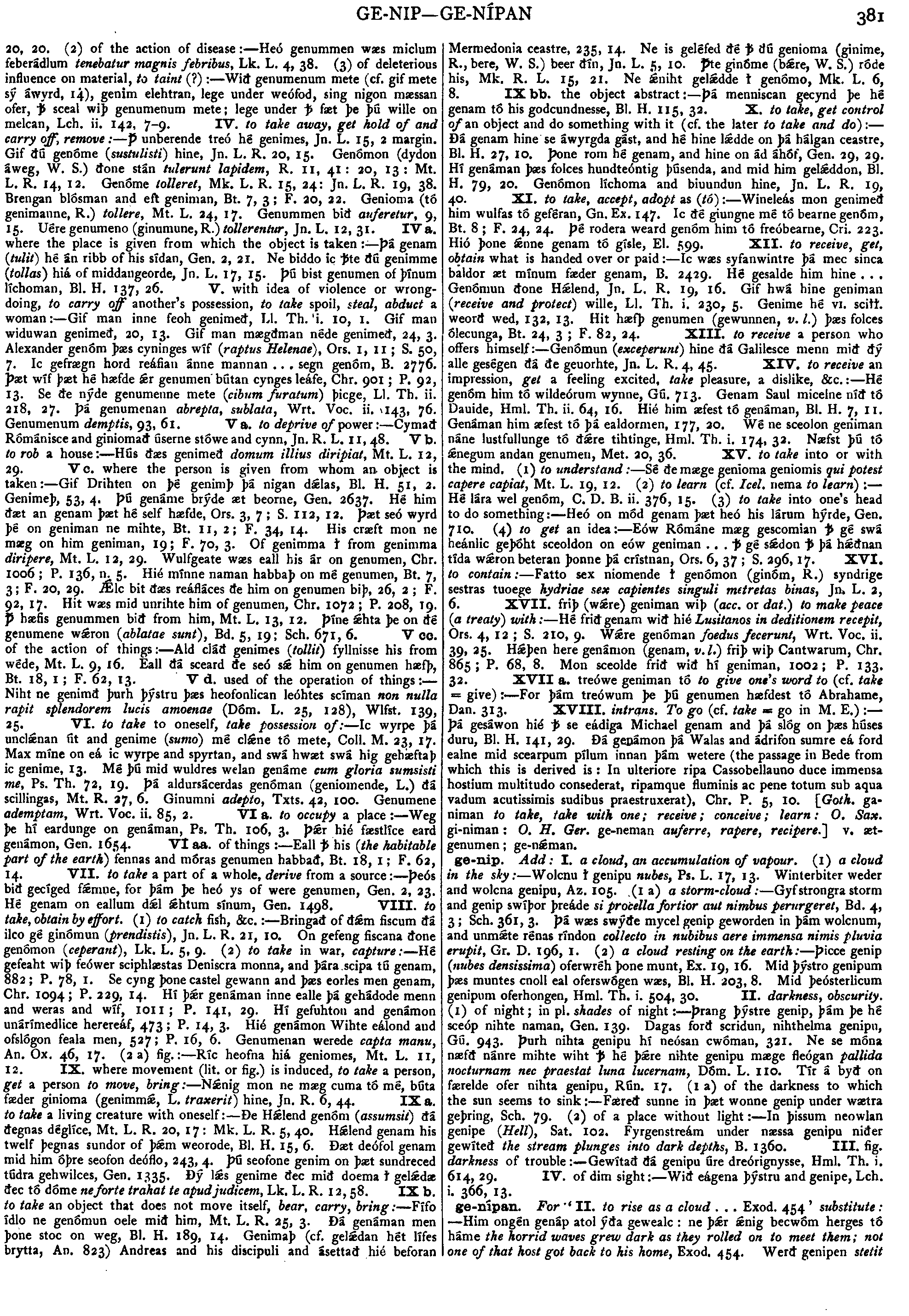
20,
20.
(2)
of
the
action
of
disease:--Heó
genummen
wæs
miclum
feberádlum
tenebatur
magnis
febribus,
Lk.
L.
4,
38.
(3)
of
deleterious
influence
on
material,
to
taint
(?):--Wið
genumenum
mete
(cf.
gif
mete
sý
áwyrd,
14),
genim
elehtran,
lege
under
weófod,
sing
nigon
mæssan
ofer,
sceal
wiþ
genumenum
mete;
lege
under
fæt
þe
þú
wille
on
melcan,
Lch.
ii.
142,
7-9.
IV.
to
take
away,
get
hold
of
and
carry
off,
remove:--Þ-bar;
unberende
treó
hé
genimes,
Jn.
L.
15,
2
margin.
Gif
ðú
genóme
(sustulisti)
hine,
Jn.
L.
R.
20,
15.
Genómon
(dydon
áweg,
W.
S.)
ðone
stán
tulertunt
lapidem,
R.
11,
41:
20,
13:
Mt.
L.
R.
14,
12.
Genóme
tolleret,
Mk.
L.
R.
15,
24:
Jn.
L.
R.
19,
38.
Brengan
blósman
and
eft
geniman,
Bt.
7,
3;
F.
20,
22.
Genioma
(tó
genimanne,
R.)
tollere,
Mt.
L.
24,
17.
Genummen
bið
auferetur,
9,
15.
Uére
genumeno
(ginumune,
R.)
tollerentur,
Jn.
L.
12,
31.
IV
a.
where
the
place
is
given
from
which
the
object
is
taken:--Þá
genam
(tulit)
hé
án
ribb
of
his
sídan,
Gen.
2,
21.
Ne
biddo
ic
te
ðú
genimme
(tollas)
hiá
of
middangeorde,
Jn.
L.
17,
15.
Þú
bist
genumen
of
þínum
líchoman,
Bl.
H.
137,
26.
V.
with
idea
of
violence
or
wrongdoing,
to
carry
off
another's
possession,
to
take
spoil,
steal,
abduct
a
woman:--Gif
man
inne
feoh
genimeð,
Ll.
Th.
i.
10,
1.
Gif
man
widuwan
genimeð,
20,
13.
Gif
man
mægðman
néde
genimeð,
24,
3.
Alexander
genóm
þæs
cyninges
wíf
(raptus
Helenae),
Ors.
1,
11;
S.
50,
7.
Ic
gefrægn
hord
reáfian
ánne
mannan
.
.
.
segn
genóm,
B.
2776.
Þæt
wíf
þæt
hé
hæfde
r
genumen
bútan
cynges
leáfe,
Chr.
901;
P.
92,
13.
Se
ðe
nýde
genumenne
mete
(cibum
furatum)
þicge,
Ll.
Th.
ii.
218,
27.
Þá
genumenan
abrepta,
sublata,
Wrt.
Voc.
ii.
143,
76.
Genumenum
demptis,
93,
61.
V
a.
to
deprive
of
power:--Cymað
Rómánisce
and
giniomað
úserne
stówe
and
cynn,
Jn.
R.
L.
11,
48.
V
b.
to
rob
a
house:--Hús
ðæs
genimeð
domum
illius
diripiat,
Mt.
L.
12,
29.
V
c.
where
the
person
is
given
from
whom
an
object
is
taken:--Gif
Drihten
on
þé
genimþ
þá
nigan
dlas,
Bl.
H.
51,
2.
Genimeþ,
53,
4.
Þú
genáme
brýde
æt
beorne,
Gen.
2637.
Hé
him
ðæt
an
genam
þæt
hé
self
hæfde,
Ors.
3,
7;
S.
112,
12.
Þæt
seó
wyrd
þé
on
geniman
ne
mihte,
Bt.
11,
2;
F.
34,
14.
His
cræft
mon
ne
mæg
on
him
geniman,
19;
F.
70,
3.
Of
genimma
from
genimma
diripere,
Mt.
L.
12,
29.
Wulfgeate
waes
eall
his
ár
on
genumen,
Chr.
1006;
P.
136,
n.
5.
Hié
mínne
naman
habbaþ
on
mé
genumen,
Bt.
7,
3;
F.
20,
29.
Æ-acute;lc
bit
ðæs
reáfláces
ðe
him
on
genumen
biþ,
26,
2;
F.
92,
17.
Hit
wæs
mid
unrihte
him
of
genumen,
Chr.
1072;
P.
208,
19.
Þ-bar;
hæfis
genummen
bið
from
him,
Mt.
L.
13,
12.
Þíne
hta
þe
on
ðé
genumene
wron
(ablatae
sunt),
Bd.
5,
19;
Sch.
671,
6.
V
cc.
of
the
action
of
things:--Ald
cláð
genimes
(tollit)
fyllnisse
his
from
wéde,
Mt.
L.
9,
16.
Eall
ðá
sceard
ðe
seó
s
him
on
genumen
hæfþ,
Bt.
18,
1;
F.
62,
13.
V
d.
used
of
the
operation
of
things:--Niht
ne
genimð
þurh
þýstru
þæs
heofonlican
leóhtes
scíman
non
nulla
rapit
splendorem
lucis
amoenae
(Dóm.
L.
25,
128),
Wlfst.
139,
25.
VI.
to
take
to
oneself,
take
possession
of:--Ic
wyrpe
þá
unclnan
út
and
genime
(sumo)
mé
clne
tó
mete,
Coll.
M.
23,
17.
Max
míne
on
eá
ic
wyrpe
and
spyrtan,
and
swá
hwæt
swá
hig
gehæftaþ
ic
genime,
13.
Mé
þú
mid
wuldres
welan
genáme
cum
gloria
sumsisti
me,
Ps.
Th.
72,
19.
Þá
aldursácerdas
genóman
(geniomende,
L.)
ðá
scillingas,
Mt.
R.
27,
6.
Ginumni
adepto,
Txts.
42,
100.
Genumene
ademptam,
Wrt.
Voc.
ii.
85,
2.
VI
a.
to
occupy
a
place:--Weg
þe
hí
eardunge
on
genáman,
Ps.
Th.
106,
3.
Þr
hié
fæstlíce
eard
genámon,
Gen.
1654.
VI
aa.
of
things:--Eall
his
(the
habitable
part
of
the
earth)
fennas
and
móras
genumen
habbað,
Bt.
18,
1;
F.
62,
14.
VII.
to
take
a
part
of
a
whole,
derive
from
a
source:--Þeós
bið
gecíged
fmne,
for
þám
þe
heó
ys
of
were
genumen,
Gen.
2,
23.
Hé
genam
on
eallum
dl
htum
sínum,
Gen.
1498.
VIII.
to
take,
obtain
by
effort.
(1)
to
catch
fish,
&c.:--Bringað
of
ðm
fiscum
ðá
ilco
gé
ginómun
(prendistis),
Jn.
L.
R.
21,
10.
On
gefeng
fiscana
ðone
genómon
(ceperant),
Lk.
L.
5,
9.
(2)
to
take
in
war,
capture:--Hé
gefeaht
wiþ
feówer
sciphlæstas
Deniscra
monna,
and
þára
scipa
tú
genam,
882;
P.
78,
1.
Se
cyng
þone
castel
gewann
and
þæs
eorles
men
genam,
Chr.
1094;
P.
229,
14.
Hí
þr
genáman
inne
ealle
þá
gehádode
menn
and
weras
and
wíf,
1011;
P.
141,
29.
Hí
gefuhton
and
genámon
unárímedlice
herereáf,
473;
P.
14,
3.
Hié
genámon
Wihte
eálond
and
ofslógon
feala
men,
527;
P.
16,
6.
Genumenan
werede
capta
manu,
An.
Ox.
46,
17.
(2
a)
fig.:--Ríc
heofna
hiá
geniomes,
Mt.
L.
11,
12.
IX.
where
movement
(lit.
or
fig.)
is
induced,
to
take
a
person,
get
a
person
to
move,
bring:--Nnig
mon
ne
mæg
cuma
tó
mé,
búta
fæder
ginioma
(genimm,
L.
traxerit)
hine,
Jn.
R.
6,
44.
IX
a.
to
take
a
living
creature
with
oneself:--Ðe
Hlend
genóm
(assumsit)
ðá
ðegnas
déglíce,
Mt.
L.
R.
20,
17:
Mk.
L.
R.
5,
40.
Hlend
genam
his
twelf
þegnas
sundor
of
þm
weorode,
Bl.
H.
15,
6.
Ðæt
deófol
genam
mid
him
óþre
seofon
deóflo,
243,
4.
Þú
seofone
genim
on
þæt
sundreced
túdra
gehwilces,
Gen.
1335.
Ðý
ls
genime
ðec
mið
doema
geldæ
ðec
tó
dóme
ne
forte
trahat
te
apud
judicem,
Lk.
L.
R.
12,
58.
IX
b.
to
take
an
object
that
does
not
move
itself,
bear,
carry,
bring:--Fífo
ídlo
ne
genómun
oele
mið
him,
Mt.
L.
R.
25,
3.
Ðá
genáman
men
þone
stoc
on
weg,
Bl.
H.
189,
14.
Genimaþ
(cf.
geldan
hét
lífes
brytta,
An.
823)
Andreas
and
his
discipuli
and
ásettað
hié
beforan
Mermedonia
ceastre,
235,
14.
Ne
is
geléfed
ðé
ðú
genioma
(ginime,
R.,
bere,
W.
S.)
beer
ðín,
Jn.
L.
5,
10.
Þ-bar;te
ginóme
(bre,
W.
S.)
róde
his,
Mk.
R.
L.
15,
21.
Ne
niht
geldde
genómo,
Mk.
L.
6,
8.
IX
bb.
the
object
abstract:--Þá
menniscan
gecynd
þe
hé
genam
tó
his
godcundnesse,
Bl.
H.
115,
32.
X.
to
take,
get
control
of
an
object
and
do
something
with
it
(cf.
the
later
to
take
and
do):--Ðá
genam
hine
se
áwyrgda
gást,
and
hé
hine
ldde
on
þá
hálgan
ceastre,
Bl.
H.
27,
10.
Þone
rom
hé
genam,
and
hine
on
ád
áhóf,
Gen.
29,
29.
Hí
genáman
þæs
folces
hundteóntig
þúsenda,
and
mid
him
gelddon,
Bl.
H.
79,
20.
Genómon
líchoma
and
biuundun
hine,
Jn.
L.
R.
19,
40.
XI.
to
take,
accept,
adopt
as
(tó):--Wineleás
mon
genimeð
him
wulfas
tó
geféran,
Gn.
Ex.
147.
Ic
ðé
giungne
mé
tó
bearne
genóm,
Bt.
8;
F.
24,
24.
Þé
rodera
weard
genóm
him
tó
freóbearne,
Cri.
223.
Hió
þone
nne
genam
tó
gísle,
El.
599.
XII.
to
receive,
get,
obtain
what
is
handed
over
or
paid:--Ic
wæs
syfanwintre
þá
mec
sinca
baldor
æt
mínum
fæder
genam,
B.
2429.
Hé
gesalde
him
hine
.
.
.
Genómun
ðone
Hlend,
Jn.
L.
R.
19,
16.
Gif
hwá
hine
geniman
(receive
and
protect)
wille,
Ll.
Th.
i.
230,
5.
Genime
hé
vi.
sci.
weorð
wed,
132,
13.
Hit
hæfþ
genumen
(gewunnen,
v.
l.)
þæs
folces
ólecunga,
Bt.
24,
3;
F.
82,
24.
XIII.
to
receive
a
person
who
offers
himself:--Genómun
(exceperunt)
hine
ðá
Galilesce
menn
mið
ðý
alle
geségen
ðá
ðe
geuorhte,
Jn.
L.
R.
4,
45.
XIV.
to
receive
an
impression,
get
a
feeling
excited,
take
pleasure,
a
dislike,
&c.:--Hé
genóm
him
tó
wildeórum
wynne,
Gú.
713.
Genam
Saul
micelne
níð
tó
Dauide,
Hml.
Th.
ii.
64,
16.
Hié
him
æfest
tó
genáman,
Bl.
H.
7,
11.
Genáman
him
æfest
tó
þá
ealdormen,
177,
20.
Wé
ne
sceolon
geniman
náne
lustfullunge
tó
ðre
tihtinge,
Hml.
Th.
i.
174,
32.
Næfst
þú
tó
negum
andan
genumen,
Met.
20,
36.
XV.
to
take
into
or
with
the
mind.
(1)
to
understand:--Sé
ðe
mæge
genioma
geniomis
qui
potest
capere
capiat,
Mt.
L.
19,
12.
(2)
to
learn
(cf.
Icel.
nema
to
learn):--Hé
lára
wel
genóm,
C.
D.
B.
ii.
376,
15.
(3)
to
take
into
one's
head
to
do
something:--Heó
on
mód
genam
þæt
heó
his
lárum
hýrde,
Gen.
710.
(4)
to
get
an
idea:--Eów
Rómáne
mæg
gescomian
gé
swá
heánlic
geþóht
sceoldon
on
eów
geniman
.
.
.
gé
sdon
þá
hðnan
tída
wron
beteran
þonne
þá
crístnan,
Ors.
6,
37;
S.
296,
17.
XVI.
to
contain:--Fatto
sex
niomende
genómon
(ginóm,
R.)
syndrige
sestras
tuoege
hydriae
sex
capientes
singuli
metretas
binas,
Jn.
L.
2,
6.
XVII.
friþ
(wre)
geniman
wiþ
(acc.
or
dat.)
to
make
peace
(a
treaty)
with:--Hé
frið
genam
wið
hié
Lusitanos
in
deditionem
recepit,
Ors.
4,
12;
S.
210,
9.
Wre
genóman
foedus
fecerunt,
Wrt.
Voc.
ii.
39,
25.
Hþen
here
genámon
(genam,
v.
l.)
friþ
wiþ
Cantwarum,
Chr.
865;
P.
68,
8.
Mon
sceolde
frið
wið
hí
geniman,
1002;
P.
133,
32.
XVII
a.
treówe
geniman
tó
to
give
one's
word
to
(cf.
take
=
give):--For
þám
treówum
þe
þú
genumen
hæfdest
tó
Abrahame,
Dan.
313.
XVIII.
intrans.
To
go
(cf.
take
=
go
in
M.
E.):--Þá
gesáwon
hié
se
eádiga
Michael
genam
and
þá
slóg
on
þæs
húses
duru,
Bl.
H.
141,
29.
Ðá
genámon
þá
Walas
and
ádrifon
sumre
eá
ford
ealne
mid
scearpum
pílum
innan
þám
wetere
(the
passage
in
Bede
from
which
this
is
derived
is:
In
ulteriore
ripa
Cassobellauno
duce
immensa
hostium
multitudo
consederat,
ripamque
fluminis
ac
pene
totum
sub
aqua
vadum
acutissimis
sudibus
praestruxerat),
Chr.
P.
5,
10.
[Goth.
ga-niman
to
take,
take
with
one;
receive;
conceive;
learn:
O.
Sate.
gi-mman:
O.
H.
Ger.
ge-neman
auferre,
rapere,
recipere.?
v.
æt-genumen;
ge-nman.
|
Source: Bosworth/Toller, page d0464, entry 1 View original page image as: [TIFF] [PNG] [View previous entry] [View next entry] |
[Comment on this entry] [View comments] |
The following entry has been hand-corrected once. |
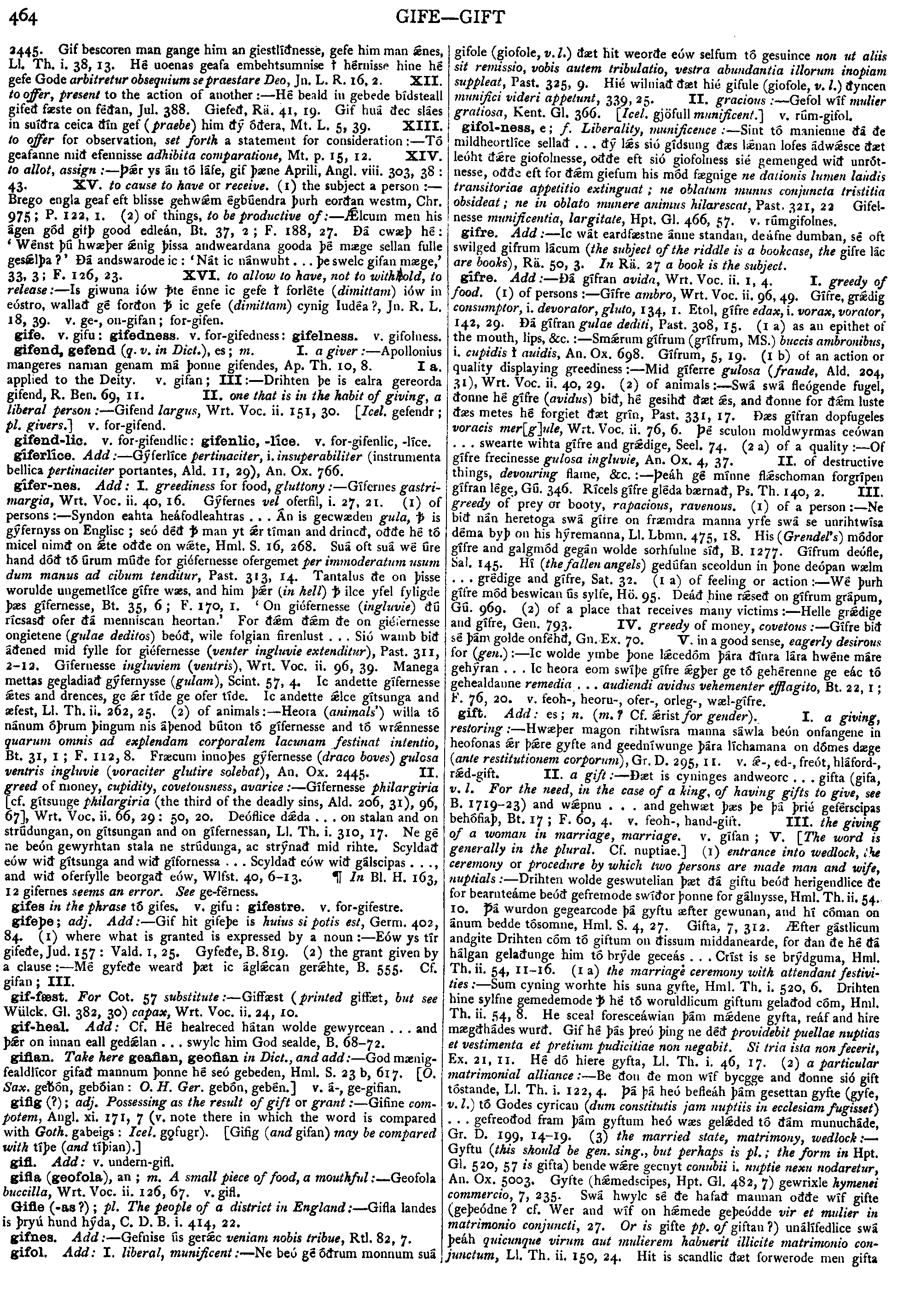
2445.
Gif
bescoren
man
gange
him
an
giestl
 nesse,
gefe
him
man
nesse,
gefe
him
man
 nes,
Ll.
Th.
i.
38,
13.
H
nes,
Ll.
Th.
i.
38,
13.
H uoenas
geafa
embehtsumnise
hrnisse
hine
h
gefe
Gode
arbitretur
obseguium
se
praestare
Deo,
Jn.
L.
R.
16,
2.
XII.
to
offer,
present
to
the
action
of
another
:--
H
beald
in
gebede
bdsteall
gife
fæste
on
fan.
Jul.
388.
Giefe,
Rä.
41,
19.
Gif
hu
uoenas
geafa
embehtsumnise
hrnisse
hine
h
gefe
Gode
arbitretur
obseguium
se
praestare
Deo,
Jn.
L.
R.
16,
2.
XII.
to
offer,
present
to
the
action
of
another
:--
H
beald
in
gebede
bdsteall
gife
fæste
on
fan.
Jul.
388.
Giefe,
Rä.
41,
19.
Gif
hu ec
sles
in
sura
ceica
n
gef
(praebe)
him
ec
sles
in
sura
ceica
n
gef
(praebe)
him

 era.
Mt.
L.
5,
39.
XIII.
to
Orfee
for
observation,
set
forth
a
statement
for
consideration
:--
T
geafanne
mi
efennisse
adhibita
comparatione,
Mt.
p.
15,
12.
XIV.
to
allot,
assign
:--
Þr
ys
n
t
lfe,
gif
þæne
Aprili,
Angl.
viii.
303,
38
:
43.
XV.
to
cause
to
have
or
receive.
(l)
the
subject
a
person
:--
Brego
engla
geaf
eft
blisse
gehwm
gb
era.
Mt.
L.
5,
39.
XIII.
to
Orfee
for
observation,
set
forth
a
statement
for
consideration
:--
T
geafanne
mi
efennisse
adhibita
comparatione,
Mt.
p.
15,
12.
XIV.
to
allot,
assign
:--
Þr
ys
n
t
lfe,
gif
þæne
Aprili,
Angl.
viii.
303,
38
:
43.
XV.
to
cause
to
have
or
receive.
(l)
the
subject
a
person
:--
Brego
engla
geaf
eft
blisse
gehwm
gb endra
þurh
eoran
westm,
Chr.
975;
P.
122,
l.
(2)
of
things,
to
be
productive
of
:--
Æ-acute;lcum
men
his
gen
gd
giUNCERTAINþ
good
edleán,
Bt.
37,
2
;
F.
188,
27.
Ð
cwæþ
h:
'
Wnst
þ
hwæþer
nig
þissa
andweardana
gooda
þ
mæge
sellan
fulle
geslþa
?
´
Ð
andswarode
ic
:
'
Nt
ic
nnwuht.
.
.
þe
swelc
gifan
mæge
´
33.
3;
F.
126,
23.
XVI.
to
allow
to
have,
not
to
withhold,
to
release
:--
Is
giwuna
iów
te
nne
ic
gefe
forlte
(dimittam)
iów
in
eóstro,
wallad
g
foron
ic
gefe
(dimittam)
cynig
luda?,
Jn.
R.
L.
18,
39.
v.
ge-,
on-gifan;
for-gifen.
endra
þurh
eoran
westm,
Chr.
975;
P.
122,
l.
(2)
of
things,
to
be
productive
of
:--
Æ-acute;lcum
men
his
gen
gd
giUNCERTAINþ
good
edleán,
Bt.
37,
2
;
F.
188,
27.
Ð
cwæþ
h:
'
Wnst
þ
hwæþer
nig
þissa
andweardana
gooda
þ
mæge
sellan
fulle
geslþa
?
´
Ð
andswarode
ic
:
'
Nt
ic
nnwuht.
.
.
þe
swelc
gifan
mæge
´
33.
3;
F.
126,
23.
XVI.
to
allow
to
have,
not
to
withhold,
to
release
:--
Is
giwuna
iów
te
nne
ic
gefe
forlte
(dimittam)
iów
in
eóstro,
wallad
g
foron
ic
gefe
(dimittam)
cynig
luda?,
Jn.
R.
L.
18,
39.
v.
ge-,
on-gifan;
for-gifen.
|
Source: Bosworth/Toller, page d0492, entry 1 View original page image as: [TIFF] [PNG] [View previous entry] [View next entry] |
[Comment on this entry] [View comments] |
The following entry has been hand-corrected once. |
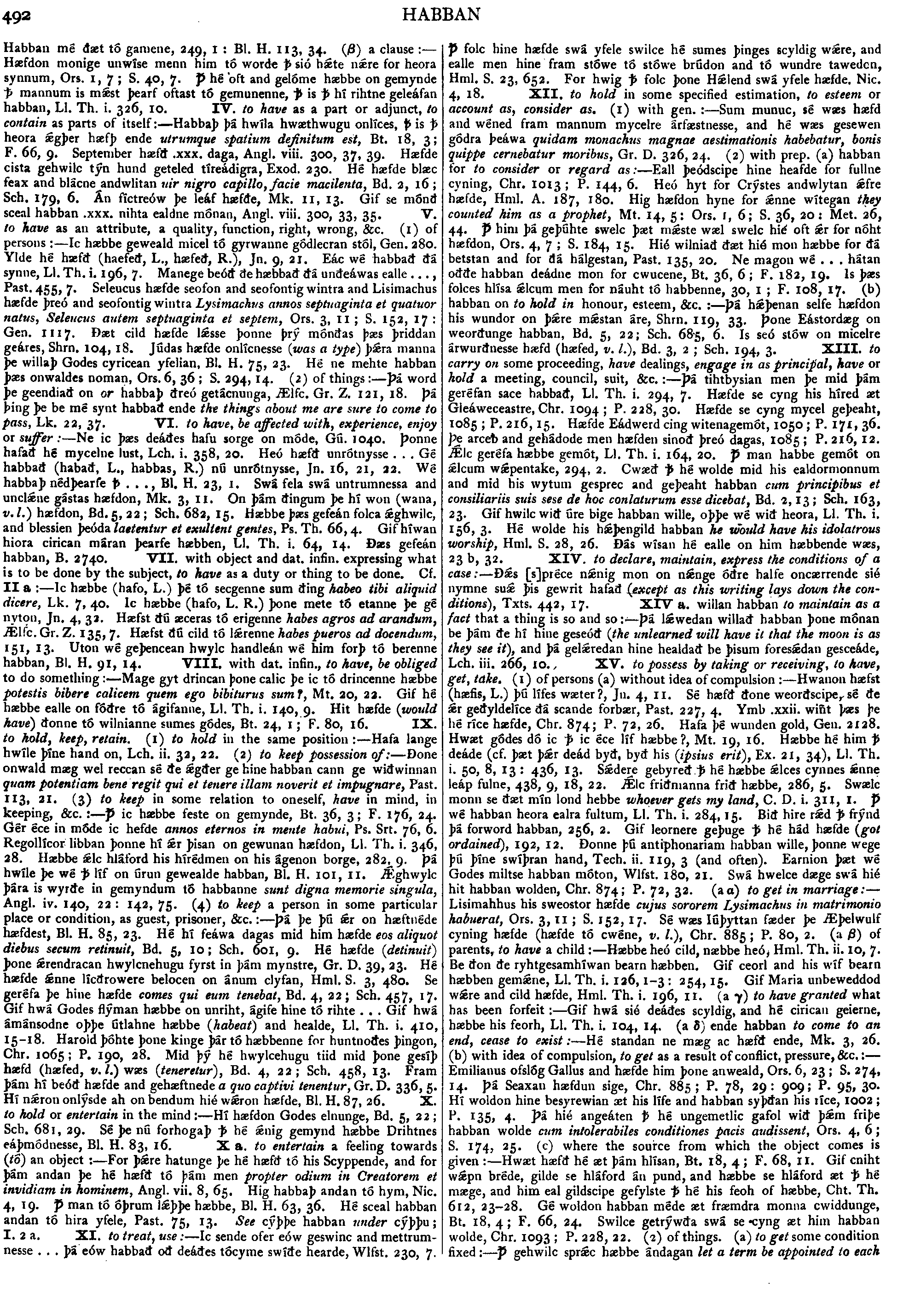
Habban
mé
dæt
tó
gamene,
249,
l
:
Bl.
H.
113,
34.
( )
a
clause
:--
Hæfdon
monige
unwíse
menn
him
tó
worde
sió
hate
nre
for
heora
synnum,
Ors.
1,
7;
S.
40,
7.
Þ-bar;
he
oft
and
gelóme
hæbbe
on
gemynde
mannum
is
mst
þearf
oftast
tó
gemunenne,
is
hí
rihtne
geleáfan
habban,
Ll.
Th.
i.
326,
10.
IV.
to
have
as
a
part
or
adjunct,
to
contain
as
parts
of
itself
:--
Habbaþ
þá
hwíla
hwæthwugu
onlíces,
is
heora
gþer
hæfþ
ende
utrumque
spatium
definitum
est,
Bt.
18,
3;
F.
66,
9.
September
hæfð
.xxx.
daga,
Angl.
viii.
300,
37,
39.
Hæfde
cista
gehwilc
týn
hund
geteled
tíreádigra,
Exod.
230.
Hé
hæfde
blæc
feax
and
blácne
andwlitan
uir
nigro
capillo,
facie
macilenta,
Bd.
2,
16
;
Sch.
179,
6.
Án
fíctreów
þe
leáf
hæfde,
Mk.
ii.
13.
Gif
se
mónð
sceal
habban
.xxx.
nihta
ealdne
mónan,
Angl.
viii.
300,
33,
35,
V.
to
have
as
an
attribute,
a
quality,
function,
right,
wrong,
&c.
(l)
of
persons
:--
Ic
hæbbe
geweald
micel
tó
gyrwanne
gódlecran
stól.
Gen.
280.
Ylde
hé
hæfð
(haefeð,
L.
,
hæfeð,
R.
),
Jn.
9,
21.
Eác
wé
habbað
ðá
synne,
Ll.
Th.
i.
196,
7.
Manege
beóððe
hæbbað
ðá
unðeáwas
ealle.
.
.
,
Past.
455,
7.
Seleucus
hæfde
seofon
and
seofontig
wintra
and
Lisimachus
hæfde
þreó
and
seofontig
wintra
Lysimachus
annos
septuaginta
et
quatuor
natus,
Seleucus
autem
septuaginta
et
septem,
Ors.
3,
11;
S.
152,
17
:
Gen.
1117.
Ðæt
cild
hæfde
lsse
þonne
brý
mónðas
þæs
þriddan
geáres,
Shrn.
104,
18.
Júdas
hæfde
onlícnesse
(was
a
type)
þra
manna
be
willaþ
Godes
cyricean
yfelian.
Bl.
H.
75,
23.
Hé
ne
mehte
habban
þæs
onwaldes
noman,
Ors.
6,
36;
S.
294,
14.
(2)
of
things
:--
Þá
word
þe
geendiað
on
or
habbaþ
ðreó
getácnunga,
Ælfc.
Gr.
Z.
121,
18.
Þá
þing
þe
be
mé
synt
habbað
ende
the
things
about
me
are
sure
to
come
to
pass,
Lk.
22,
37.
VI.
to
have,
be
affected
with,
experience,
enjoy
or
suffer
:--
Ne
ic
þæs
deáðes
hafu
sorge
on
móde,
Gú.
1040.
Þonne
hafað
hé
mycelne
lust,
Lch.
i.
358,
20.
Heó
hæfð
unrótnysse
.
.
.
Gé
habbað
(habað.
L.
,
habbas,
R.
)
nú
unrótnysse,
Jn.
16,
21,
12.
Wé
habbaþ
nédbearfe
.
.
.
,
Bl.
H.
23,
1.
Swá
fela
swá
untrumnessa
and
unclne
gástas
hæfdon,
Mk.
3,
11.
On
þám
ðingum
þe
hí
won
(wana,
v.
l.)
hæfdon,
Bd.
5,
22
;
Sch.
682,
15.
Hæbbe
þæs
gefeán
folca
ghwilc,
and
blessien
þeóda
laetentur
et
exutient
gentes,
Ps.
Th.
66,
4.
Gif
híwan
hiora
cirican
máran
þearfe
hæbben,
Ll.
Th.
i.
64,
14.
Ðæs
gefeán
habban,
B.
2740.
VII.
with
object
and
dat.
infin.
expressing
what
is
to
be
done
by
the
subject,
to
have
as
a
duty
or
thing
to
be
done.
Cf.
II
a
:--
Ic
hæbbe
(hafo.
L.
)
þé
tó
secgenne
sum
ðing
habeo
tibi
aliquid
dicere,
Lk.
7,
40.
Ic
hæbbe
(hafo,
L.
R.
)
þone
mete
tó
etanne
þe
gé
nyton,
Jn.
4,
32.
Hæfst
ðú
æceras
tó
erigenne
habes
agros
ad
arandum,
Æ-acute;lfc.
Gr.
Z.
135,
7.
Hæfst
ðú
cild
tó
lrenne
habes
pueros
ad
docendum,
151,
13.
Uton
wé
geþencean
hwylc
handleán
wé
him
forþ
tó
berenne
habban,
Bl.
H.
91,
14.
VIII.
with
dat.
infin.
to
have,
be
obliged
to
do
something
:--
Mage
gyt
drincan
þone
calic
þe
ic
tó
drincenne
hæbbe
potestis
bibere
calicem
quem
ego
bibiturus
sum
?
Mt.
20,
22.
Gif
hé
hæbbe
ealle
on
fððre
tó
ágifanne,
Ll.
Th.
i.
140,
9.
Hit
hæfde
(would
have)
ðonne
tó
wilnianne
sumes
gódes,
Bt.
24,
i;
F.
80,
16.
IX.
to
hold,
keep,
retain.
(l)
to
hold
in
the
same
position
:--
Hafa
lange
hwlle
þíne
hand
on.
Lch.
ii.
32,
22.
(2)
to
keep
possession
of
:--
Ðone
onwald
mæg
wel
reccan
sé
ðe
gðer
ge
bine
habban
cann
ge
wiðwinnan
quam
potentiam
bene
regit
qui
et
tenere
illam
noverit
et
impugnare,
Past.
113,
21.
(3)
to
keep
in
some
relation
to
oneself
,
have
in
mind,
in
keeping,
&c.
:--
p
ic
hæbbe
feste
on
gemynde,
Bt.
36,
3;
F.
176,
24.
Gér
éce
in
móde
ic
hefde
annos
eternos
in
meute
habui.
Ps.
Srt.
76,
6.
Regolllcór
libban
þonne
hí
r
þisan
on
gewunan
hæfdon,
Ll.
Th.
i.
346,
28.
Hæbbe
lc
hláford
his
hírédmen
on
his
ágenon
borge,
282,
9.
Þá
hwíle
be
we
líf
on
úrun
gewealde
habban,
Bl.
H.
101,
11.
Æ-acute;ghwylc
þára
is
wyrlte
in
gemyndum
tó
habbanne
sunt
digna
memorie
singula,
Angl.
iv.
140,
22
:
142,
75.
(4)
to
keep
a
person
in
some
particular
place
or
condition,
as
guest,
prisoner,
&c.
:--
Þá
þe
þú
r
on
hæftnéde
hæfdest,
Bl.
H.
85,
23.
Hé
hí
feáwa
dagas
mid
him
hæfde
eos
aliquot
diebus
secum
retinuit,
Bd.
5,
10;
Sch.
601,
9.
Hé
hæfde
(detinuit)
þone
rendracan
hwylcnehugu
fyrst
in
þám
mynstre,
Gr.
D.
39,
23.
Hé
hæfde
nne
lícðrowere
belocen
on
ánum
clyfan,
Hml.
S.
3,
480.
Se
geréfa
þe
hine
hæfde
comes
qui
eum
tenebat,
Bd.
4,
22;
Sch.
457,
17.
Gif
hwá
Godes
flýman
hæbbe
on
unriht,
ágife
hine
tó
rihte
.
.
.
Gif
hwá
ámánsodne
oþþe
útlahne
hæbbe
(habeat)
and
healde,
Ll.
Th.
i.
410,
15-18.
Harold
þóhte
þone
kinge
þár
tó
hæbbenne
for
huntnoðes
þingon,
Chr.
1065;
P.
190,
28.
Mid
þý
hé
hwylcehugu
tiid
mid
þone
gesíþ
hæfd
(haefed,
v.
l.)
wæs
(tenerelur),
Bd.
4,
22;
Sch.
458,
13.
Fram
þám
hí
beóð
hæfde
and
gehæftnede
a
quo
captivi
tenentur,
Gr.
D.
336,
5.
Hí
nron
onlýsde
ah
on
bendum
hié
wiéron
hæfde,
Bl.
H.
87,
26.
X.
to
hold
or
entertain
in
the
mind
:--
Hí
hæfdon
Godes
elnunge,
Bd.
5,
22
;
Sch.
681,
29.
Sé
þe
nú
forhogaþ
þ
hé
nig
gemynd
hæbbe
Drihtnes
eáþmódnesse,
Bl.
H.
83,
16.
X
a.
to
entertain
a
feeling
towards
(tó)
an
object
:--
For
þre
hatunge
þe
hé
hæfð
tó
his
Scyppende,
and
for
þám
andan
þe
hé
hæfð
tó
þám
men
propter
odium
in
Creatorem
et
invidiam
in
hominem,
Angl.
vii.
8,
65.
Hig
habbaþ
andan
tó
hym,
Nic.
4,
19.
man
tó
óþrum
lþþe
hæbbe,
Bl.
H.
63,
36.
Hé
sceal
habban
andan
tó
hira
yfele,
Past.
75,
13.
See
cýþþe
habban
unáer
cýþþu;
1.
2
a.
XI.
to
treat,
use
:--
Ic
sende
ofer
eów
geswinc
and
mettrumnesse
.
.
.
þá
eów
habbað
oð
deáðes
tócyme
swíðe
hearde,
Wlfst.
230,
7.
Þ-bar;
folc
hine
hæfde
swá
yfele
swilce
hé
sumes
þinges
scyldig
wre,
and
ealle
men
hine
fram
stówe
tó
stówe
brúdon
and
tó
wundre
tawedcn,
Hml.
S.
23,
652.
For
hwig
;
folc
þone
Hlend
swá
yfele
hæfde.
Nic.
4,
18.
XII.
to
hold
in
some
specified
estimation,
to
esteem
or
account
as,
consider
as.
(l)
with
gen.
:--
Sum
munuc,
sé
wæs
hæfd
and
wéned
fram
mannum
mycelre
árfæstnesse,
and
hé
wæs
gesewen
gódra
þeáwa
quidam
monachtis
magnae
aestimationis
habebatur,
bonis
quippe
cernebatur
moribus,
Gr.
D.
326,
24.
(2)
with
prep,
(a)
habban
for
to
consider
or
regard
as
:--
Eall
þeódscipe
hine
heafde
for
fullne
cyning,
Chr.
1013
;
P.
144,
6.
Heó
hyt
for
Crýstes
andwlytan
fre
hæfde,
Hml.
A.
187,
180.
Hig
hæfdon
hyne
for
nne
wítegan
they
counted
him
as
a
prophet,
Mt.
14,
5:
Ors.
l,
6;
S.
36,
20:
Met.
26,
44.
Þ-bar;
him
þá
geþflhte
swelc
þæt
mste
wæl
swelc
hié
oft
r
for
nóht
hæfdon.
Ors.
4,
7
;
S.
184,
15.
Hié
wilniað
ðæt
hié
mon
hæbbe
for
ðá
betstan
and
for
dá
hálgestan,
Past.
135,
20.
Ne
magon
wé
.
.
.
hátan
oððe
habban
deádne
mon
for
cwucene,
Bt.
36,
6
;
F.
182,
19.
Is
þæs
folces
hlísa
lcum
men
for
náuht
tó
habbenne,
30,
l
;
F.
108,
17.
(b)
habban
on
to
hold
in
honour,
esteem,
&c.
:--
Þá
hþenan
selfe
hæfdon
his
wundor
on
þre
mstan
áre,
Shrn.
119,
33.
Þone
Eástordæg
on
weorðunge
habban,
Bd.
5,
22;
Sch.
685,
6.
Is
seó
stów
on
micelre
árwurðnesse
hæfd
(hæfed,
v.
l.),
Bd.
3,
2
;
Sch.
194,
3.
XIII.
to
carry
on
some
proceeding,
have
dealings,
engage
in
as
principal,
have
or
hold
a
meeting,
council,
suit,
&c.
:--
Þá
tihtbysian
men
þe
mid
þám
geréfan
sace
habbað,
Ll.
Th.
i.
294,
7.
Hæfde
se
cyng
his
hired
set
Gieáweceastre,
Chr.
1094
;
P.
228,
30.
Hæfde
se
cyng
mycel
geþeaht,
1085
;
P.
216,
15.
Hæfde
Eádwerd
cing
witenagemót,
1050;
P.
171,
36.
Þe
arceb
and
gehádode
men
hæfden
sinoit
þreó
dagas,
1085;
P.
216,
12.
Æ-acute;lc
geréfa
hæbbe
gemót,
Ll.
Th.
i.
164,
20.
Þ-bar;
man
habbe
gemót
on
lcum
wpentake,
294,
2.
Cwæð
hé
wolde
mid
his
ealdormonnum
and
mid
his
wytum
gesprec
and
geþeaht
habban
cum
principibus
et
consiliariis
suis
sese
de
hoc
conlaturum
esse
dicebat,
Bd.
2,
13;
Sch.
163,
23.
Gif
hwilc
wið
úre
bige
habban
wille,
oþþe
wé
wið
heora,
Ll.
Th.
i.
156,
3.
Hé
wolde
his
hbengild
habban
he
would
have
his
idolatrous
worship,
Hml.
S.
28,
26.
Ðás
wísan
hé
ealle
on
him
hæbbende
wæs,
23
b,
32.
XIV.
to
declare,
maintain,
express
the
conditions
of
a
case
:--
Ðs
[s]préce
nnig
mon
on
nnge
óðre
halfe
oncærrende
sié
nymne
su
þis
gewrit
hafað
(except
as
this
writing
lays
down
the
conditions),
Txts.
442,
17.
XIV
a.
willan
habban
to
maintain
as
a
fact
that
a
thing
is
so
and
so:--
Þá
lwedan
willað
habban
þone
mónan
be
þám
ðe
hí
hine
geseóð
(the
unlearned
will
have
it
that
the
moon
is
as
they
see
if),
and
þá
gelredan
hine
healdað
be
þisum
foresdan
gesceáde,
Lch.
iii.
266,
10.
,
XV.
to
possess
by
taking
or
receiving,
to
have,
get,
take.
(l)
of
persons
(a)
without
idea
of
compulsion
:--
Hwanon
hæfst
(hæfis,
L.
)
þú
lífes
wæter?,
Jn.
4,
11.
Sé
hæfð
ðone
weorðscipe.
sé
ðe
r
geðyldelíce
ðá
scande
forbær,
Past.
227,
4.
Ymb
.xxii.
wiñt
þæs
þe
hé
ríce
hæfde,
Chr.
874;
P.
72,
26.
Hafa
þé
wunden
gold,
Gen.
2128.
Hwæt
gódes
dó
ic
ic
éce
líf
hæbbe?,
Mt.
19,
16.
Hæbbe
hé
him
deáde
(cf.
þæt
þr
deád
byð,
byð
his
(ipsius
erif),
Ex.
21,
34),
Ll.
Th.
i.
50,
8,
13
:
436,
13.
Sdere
gebyreð
hé
hæbbe
lces
cynnes
nne
leáp
fulne,
438,
9,
18,
22.
Æ-acute;lc
friðmanna
frið
hæbbe,
286,
5.
Swælc
monn
se
ðæt
mín
lond
hebbe
whoever
gets
my
land,
C.
D.
i.
311,
I.
Þ-bar;
wé
habban
heora
ealra
fultum,
Ll.
Th.
i.
284,
15.
Bið
hire
rd
frýnd
þá
forword
habban,
256,
2.
Gif
leornere
geþuge
hé
had
hsefde
(got
ordained),
192,
12,
Ðonne
þú
antiphonariam
habban
wille,
þonne
wege
þú
þíne
swíþran
hand,
Tech.
ii.
119,
3
(and
often).
Earmon
þæt
wé
Godes
miltse
habban
móton,
Wlfst.
180,
21.
Swá
hwelce
dæge
swá
hié
hit
habban
wolden,
Chr.
874;
P.
72,
32.
(a
)
a
clause
:--
Hæfdon
monige
unwíse
menn
him
tó
worde
sió
hate
nre
for
heora
synnum,
Ors.
1,
7;
S.
40,
7.
Þ-bar;
he
oft
and
gelóme
hæbbe
on
gemynde
mannum
is
mst
þearf
oftast
tó
gemunenne,
is
hí
rihtne
geleáfan
habban,
Ll.
Th.
i.
326,
10.
IV.
to
have
as
a
part
or
adjunct,
to
contain
as
parts
of
itself
:--
Habbaþ
þá
hwíla
hwæthwugu
onlíces,
is
heora
gþer
hæfþ
ende
utrumque
spatium
definitum
est,
Bt.
18,
3;
F.
66,
9.
September
hæfð
.xxx.
daga,
Angl.
viii.
300,
37,
39.
Hæfde
cista
gehwilc
týn
hund
geteled
tíreádigra,
Exod.
230.
Hé
hæfde
blæc
feax
and
blácne
andwlitan
uir
nigro
capillo,
facie
macilenta,
Bd.
2,
16
;
Sch.
179,
6.
Án
fíctreów
þe
leáf
hæfde,
Mk.
ii.
13.
Gif
se
mónð
sceal
habban
.xxx.
nihta
ealdne
mónan,
Angl.
viii.
300,
33,
35,
V.
to
have
as
an
attribute,
a
quality,
function,
right,
wrong,
&c.
(l)
of
persons
:--
Ic
hæbbe
geweald
micel
tó
gyrwanne
gódlecran
stól.
Gen.
280.
Ylde
hé
hæfð
(haefeð,
L.
,
hæfeð,
R.
),
Jn.
9,
21.
Eác
wé
habbað
ðá
synne,
Ll.
Th.
i.
196,
7.
Manege
beóððe
hæbbað
ðá
unðeáwas
ealle.
.
.
,
Past.
455,
7.
Seleucus
hæfde
seofon
and
seofontig
wintra
and
Lisimachus
hæfde
þreó
and
seofontig
wintra
Lysimachus
annos
septuaginta
et
quatuor
natus,
Seleucus
autem
septuaginta
et
septem,
Ors.
3,
11;
S.
152,
17
:
Gen.
1117.
Ðæt
cild
hæfde
lsse
þonne
brý
mónðas
þæs
þriddan
geáres,
Shrn.
104,
18.
Júdas
hæfde
onlícnesse
(was
a
type)
þra
manna
be
willaþ
Godes
cyricean
yfelian.
Bl.
H.
75,
23.
Hé
ne
mehte
habban
þæs
onwaldes
noman,
Ors.
6,
36;
S.
294,
14.
(2)
of
things
:--
Þá
word
þe
geendiað
on
or
habbaþ
ðreó
getácnunga,
Ælfc.
Gr.
Z.
121,
18.
Þá
þing
þe
be
mé
synt
habbað
ende
the
things
about
me
are
sure
to
come
to
pass,
Lk.
22,
37.
VI.
to
have,
be
affected
with,
experience,
enjoy
or
suffer
:--
Ne
ic
þæs
deáðes
hafu
sorge
on
móde,
Gú.
1040.
Þonne
hafað
hé
mycelne
lust,
Lch.
i.
358,
20.
Heó
hæfð
unrótnysse
.
.
.
Gé
habbað
(habað.
L.
,
habbas,
R.
)
nú
unrótnysse,
Jn.
16,
21,
12.
Wé
habbaþ
nédbearfe
.
.
.
,
Bl.
H.
23,
1.
Swá
fela
swá
untrumnessa
and
unclne
gástas
hæfdon,
Mk.
3,
11.
On
þám
ðingum
þe
hí
won
(wana,
v.
l.)
hæfdon,
Bd.
5,
22
;
Sch.
682,
15.
Hæbbe
þæs
gefeán
folca
ghwilc,
and
blessien
þeóda
laetentur
et
exutient
gentes,
Ps.
Th.
66,
4.
Gif
híwan
hiora
cirican
máran
þearfe
hæbben,
Ll.
Th.
i.
64,
14.
Ðæs
gefeán
habban,
B.
2740.
VII.
with
object
and
dat.
infin.
expressing
what
is
to
be
done
by
the
subject,
to
have
as
a
duty
or
thing
to
be
done.
Cf.
II
a
:--
Ic
hæbbe
(hafo.
L.
)
þé
tó
secgenne
sum
ðing
habeo
tibi
aliquid
dicere,
Lk.
7,
40.
Ic
hæbbe
(hafo,
L.
R.
)
þone
mete
tó
etanne
þe
gé
nyton,
Jn.
4,
32.
Hæfst
ðú
æceras
tó
erigenne
habes
agros
ad
arandum,
Æ-acute;lfc.
Gr.
Z.
135,
7.
Hæfst
ðú
cild
tó
lrenne
habes
pueros
ad
docendum,
151,
13.
Uton
wé
geþencean
hwylc
handleán
wé
him
forþ
tó
berenne
habban,
Bl.
H.
91,
14.
VIII.
with
dat.
infin.
to
have,
be
obliged
to
do
something
:--
Mage
gyt
drincan
þone
calic
þe
ic
tó
drincenne
hæbbe
potestis
bibere
calicem
quem
ego
bibiturus
sum
?
Mt.
20,
22.
Gif
hé
hæbbe
ealle
on
fððre
tó
ágifanne,
Ll.
Th.
i.
140,
9.
Hit
hæfde
(would
have)
ðonne
tó
wilnianne
sumes
gódes,
Bt.
24,
i;
F.
80,
16.
IX.
to
hold,
keep,
retain.
(l)
to
hold
in
the
same
position
:--
Hafa
lange
hwlle
þíne
hand
on.
Lch.
ii.
32,
22.
(2)
to
keep
possession
of
:--
Ðone
onwald
mæg
wel
reccan
sé
ðe
gðer
ge
bine
habban
cann
ge
wiðwinnan
quam
potentiam
bene
regit
qui
et
tenere
illam
noverit
et
impugnare,
Past.
113,
21.
(3)
to
keep
in
some
relation
to
oneself
,
have
in
mind,
in
keeping,
&c.
:--
p
ic
hæbbe
feste
on
gemynde,
Bt.
36,
3;
F.
176,
24.
Gér
éce
in
móde
ic
hefde
annos
eternos
in
meute
habui.
Ps.
Srt.
76,
6.
Regolllcór
libban
þonne
hí
r
þisan
on
gewunan
hæfdon,
Ll.
Th.
i.
346,
28.
Hæbbe
lc
hláford
his
hírédmen
on
his
ágenon
borge,
282,
9.
Þá
hwíle
be
we
líf
on
úrun
gewealde
habban,
Bl.
H.
101,
11.
Æ-acute;ghwylc
þára
is
wyrlte
in
gemyndum
tó
habbanne
sunt
digna
memorie
singula,
Angl.
iv.
140,
22
:
142,
75.
(4)
to
keep
a
person
in
some
particular
place
or
condition,
as
guest,
prisoner,
&c.
:--
Þá
þe
þú
r
on
hæftnéde
hæfdest,
Bl.
H.
85,
23.
Hé
hí
feáwa
dagas
mid
him
hæfde
eos
aliquot
diebus
secum
retinuit,
Bd.
5,
10;
Sch.
601,
9.
Hé
hæfde
(detinuit)
þone
rendracan
hwylcnehugu
fyrst
in
þám
mynstre,
Gr.
D.
39,
23.
Hé
hæfde
nne
lícðrowere
belocen
on
ánum
clyfan,
Hml.
S.
3,
480.
Se
geréfa
þe
hine
hæfde
comes
qui
eum
tenebat,
Bd.
4,
22;
Sch.
457,
17.
Gif
hwá
Godes
flýman
hæbbe
on
unriht,
ágife
hine
tó
rihte
.
.
.
Gif
hwá
ámánsodne
oþþe
útlahne
hæbbe
(habeat)
and
healde,
Ll.
Th.
i.
410,
15-18.
Harold
þóhte
þone
kinge
þár
tó
hæbbenne
for
huntnoðes
þingon,
Chr.
1065;
P.
190,
28.
Mid
þý
hé
hwylcehugu
tiid
mid
þone
gesíþ
hæfd
(haefed,
v.
l.)
wæs
(tenerelur),
Bd.
4,
22;
Sch.
458,
13.
Fram
þám
hí
beóð
hæfde
and
gehæftnede
a
quo
captivi
tenentur,
Gr.
D.
336,
5.
Hí
nron
onlýsde
ah
on
bendum
hié
wiéron
hæfde,
Bl.
H.
87,
26.
X.
to
hold
or
entertain
in
the
mind
:--
Hí
hæfdon
Godes
elnunge,
Bd.
5,
22
;
Sch.
681,
29.
Sé
þe
nú
forhogaþ
þ
hé
nig
gemynd
hæbbe
Drihtnes
eáþmódnesse,
Bl.
H.
83,
16.
X
a.
to
entertain
a
feeling
towards
(tó)
an
object
:--
For
þre
hatunge
þe
hé
hæfð
tó
his
Scyppende,
and
for
þám
andan
þe
hé
hæfð
tó
þám
men
propter
odium
in
Creatorem
et
invidiam
in
hominem,
Angl.
vii.
8,
65.
Hig
habbaþ
andan
tó
hym,
Nic.
4,
19.
man
tó
óþrum
lþþe
hæbbe,
Bl.
H.
63,
36.
Hé
sceal
habban
andan
tó
hira
yfele,
Past.
75,
13.
See
cýþþe
habban
unáer
cýþþu;
1.
2
a.
XI.
to
treat,
use
:--
Ic
sende
ofer
eów
geswinc
and
mettrumnesse
.
.
.
þá
eów
habbað
oð
deáðes
tócyme
swíðe
hearde,
Wlfst.
230,
7.
Þ-bar;
folc
hine
hæfde
swá
yfele
swilce
hé
sumes
þinges
scyldig
wre,
and
ealle
men
hine
fram
stówe
tó
stówe
brúdon
and
tó
wundre
tawedcn,
Hml.
S.
23,
652.
For
hwig
;
folc
þone
Hlend
swá
yfele
hæfde.
Nic.
4,
18.
XII.
to
hold
in
some
specified
estimation,
to
esteem
or
account
as,
consider
as.
(l)
with
gen.
:--
Sum
munuc,
sé
wæs
hæfd
and
wéned
fram
mannum
mycelre
árfæstnesse,
and
hé
wæs
gesewen
gódra
þeáwa
quidam
monachtis
magnae
aestimationis
habebatur,
bonis
quippe
cernebatur
moribus,
Gr.
D.
326,
24.
(2)
with
prep,
(a)
habban
for
to
consider
or
regard
as
:--
Eall
þeódscipe
hine
heafde
for
fullne
cyning,
Chr.
1013
;
P.
144,
6.
Heó
hyt
for
Crýstes
andwlytan
fre
hæfde,
Hml.
A.
187,
180.
Hig
hæfdon
hyne
for
nne
wítegan
they
counted
him
as
a
prophet,
Mt.
14,
5:
Ors.
l,
6;
S.
36,
20:
Met.
26,
44.
Þ-bar;
him
þá
geþflhte
swelc
þæt
mste
wæl
swelc
hié
oft
r
for
nóht
hæfdon.
Ors.
4,
7
;
S.
184,
15.
Hié
wilniað
ðæt
hié
mon
hæbbe
for
ðá
betstan
and
for
dá
hálgestan,
Past.
135,
20.
Ne
magon
wé
.
.
.
hátan
oððe
habban
deádne
mon
for
cwucene,
Bt.
36,
6
;
F.
182,
19.
Is
þæs
folces
hlísa
lcum
men
for
náuht
tó
habbenne,
30,
l
;
F.
108,
17.
(b)
habban
on
to
hold
in
honour,
esteem,
&c.
:--
Þá
hþenan
selfe
hæfdon
his
wundor
on
þre
mstan
áre,
Shrn.
119,
33.
Þone
Eástordæg
on
weorðunge
habban,
Bd.
5,
22;
Sch.
685,
6.
Is
seó
stów
on
micelre
árwurðnesse
hæfd
(hæfed,
v.
l.),
Bd.
3,
2
;
Sch.
194,
3.
XIII.
to
carry
on
some
proceeding,
have
dealings,
engage
in
as
principal,
have
or
hold
a
meeting,
council,
suit,
&c.
:--
Þá
tihtbysian
men
þe
mid
þám
geréfan
sace
habbað,
Ll.
Th.
i.
294,
7.
Hæfde
se
cyng
his
hired
set
Gieáweceastre,
Chr.
1094
;
P.
228,
30.
Hæfde
se
cyng
mycel
geþeaht,
1085
;
P.
216,
15.
Hæfde
Eádwerd
cing
witenagemót,
1050;
P.
171,
36.
Þe
arceb
and
gehádode
men
hæfden
sinoit
þreó
dagas,
1085;
P.
216,
12.
Æ-acute;lc
geréfa
hæbbe
gemót,
Ll.
Th.
i.
164,
20.
Þ-bar;
man
habbe
gemót
on
lcum
wpentake,
294,
2.
Cwæð
hé
wolde
mid
his
ealdormonnum
and
mid
his
wytum
gesprec
and
geþeaht
habban
cum
principibus
et
consiliariis
suis
sese
de
hoc
conlaturum
esse
dicebat,
Bd.
2,
13;
Sch.
163,
23.
Gif
hwilc
wið
úre
bige
habban
wille,
oþþe
wé
wið
heora,
Ll.
Th.
i.
156,
3.
Hé
wolde
his
hbengild
habban
he
would
have
his
idolatrous
worship,
Hml.
S.
28,
26.
Ðás
wísan
hé
ealle
on
him
hæbbende
wæs,
23
b,
32.
XIV.
to
declare,
maintain,
express
the
conditions
of
a
case
:--
Ðs
[s]préce
nnig
mon
on
nnge
óðre
halfe
oncærrende
sié
nymne
su
þis
gewrit
hafað
(except
as
this
writing
lays
down
the
conditions),
Txts.
442,
17.
XIV
a.
willan
habban
to
maintain
as
a
fact
that
a
thing
is
so
and
so:--
Þá
lwedan
willað
habban
þone
mónan
be
þám
ðe
hí
hine
geseóð
(the
unlearned
will
have
it
that
the
moon
is
as
they
see
if),
and
þá
gelredan
hine
healdað
be
þisum
foresdan
gesceáde,
Lch.
iii.
266,
10.
,
XV.
to
possess
by
taking
or
receiving,
to
have,
get,
take.
(l)
of
persons
(a)
without
idea
of
compulsion
:--
Hwanon
hæfst
(hæfis,
L.
)
þú
lífes
wæter?,
Jn.
4,
11.
Sé
hæfð
ðone
weorðscipe.
sé
ðe
r
geðyldelíce
ðá
scande
forbær,
Past.
227,
4.
Ymb
.xxii.
wiñt
þæs
þe
hé
ríce
hæfde,
Chr.
874;
P.
72,
26.
Hafa
þé
wunden
gold,
Gen.
2128.
Hwæt
gódes
dó
ic
ic
éce
líf
hæbbe?,
Mt.
19,
16.
Hæbbe
hé
him
deáde
(cf.
þæt
þr
deád
byð,
byð
his
(ipsius
erif),
Ex.
21,
34),
Ll.
Th.
i.
50,
8,
13
:
436,
13.
Sdere
gebyreð
hé
hæbbe
lces
cynnes
nne
leáp
fulne,
438,
9,
18,
22.
Æ-acute;lc
friðmanna
frið
hæbbe,
286,
5.
Swælc
monn
se
ðæt
mín
lond
hebbe
whoever
gets
my
land,
C.
D.
i.
311,
I.
Þ-bar;
wé
habban
heora
ealra
fultum,
Ll.
Th.
i.
284,
15.
Bið
hire
rd
frýnd
þá
forword
habban,
256,
2.
Gif
leornere
geþuge
hé
had
hsefde
(got
ordained),
192,
12,
Ðonne
þú
antiphonariam
habban
wille,
þonne
wege
þú
þíne
swíþran
hand,
Tech.
ii.
119,
3
(and
often).
Earmon
þæt
wé
Godes
miltse
habban
móton,
Wlfst.
180,
21.
Swá
hwelce
dæge
swá
hié
hit
habban
wolden,
Chr.
874;
P.
72,
32.
(a
 )
to
get
in
marriage
:--
Lisimahhus
his
sweostor
hæfde
cujus
sororem
Lysimachus
in
matrimonio
habuerat,
Ors.
3,
11;
S.
152,
17.
Sé
wæs
lúþyttan
fæder
þe
Æþelwulf
cyning
hæfde
(hæfde
tó
cwéne,
v.
l.),
Chr.
885;
P.
80,
2.
(a
)
of
parents,
to
have
a
child
:--
Hæbbe
heó
cild,
næbbe
heó,
Hml.
Th.
ii.
10,
7-Be
ðon
ðe
ryhtgesamhíwan
beam
hæbben.
Gif
ceorl
and
his
wíf
bearn
hæbben
gemne,
Ll.
Th.
i.
126,
1-3:
254,
15.
Gif
Maria
unbeweddod
wre
and
cild
hæfde.
Hml.
Th.
i.
196,
11.
(a
)
to
get
in
marriage
:--
Lisimahhus
his
sweostor
hæfde
cujus
sororem
Lysimachus
in
matrimonio
habuerat,
Ors.
3,
11;
S.
152,
17.
Sé
wæs
lúþyttan
fæder
þe
Æþelwulf
cyning
hæfde
(hæfde
tó
cwéne,
v.
l.),
Chr.
885;
P.
80,
2.
(a
)
of
parents,
to
have
a
child
:--
Hæbbe
heó
cild,
næbbe
heó,
Hml.
Th.
ii.
10,
7-Be
ðon
ðe
ryhtgesamhíwan
beam
hæbben.
Gif
ceorl
and
his
wíf
bearn
hæbben
gemne,
Ll.
Th.
i.
126,
1-3:
254,
15.
Gif
Maria
unbeweddod
wre
and
cild
hæfde.
Hml.
Th.
i.
196,
11.
(a
 )
to
have
granted
what
has
been
forfeit
:--
Gif
hwá
sié
deáðes
scyldig,
and
hé
cirican
geierne,
hæbbe
his
feorh,
Ll.
Th.
i.
104,
14.
(a
)
to
have
granted
what
has
been
forfeit
:--
Gif
hwá
sié
deáðes
scyldig,
and
hé
cirican
geierne,
hæbbe
his
feorh,
Ll.
Th.
i.
104,
14.
(a
 )
ende
habban
to
come
to
an
end,
cease
to
exist
:--
Hé
standan
ne
mæg
ac
hæfð
ende,
Mk.
3,
26.
(b)
with
idea
of
compulsion,
to
get
as
a
result
of
conflict,
pressure,
&c.
:--
Emilianus
ofslóg
Gallus
and
hæfde
him
þone
anweald,
Ors.
6,
23
;
S.
274a
14.
Þá
Seaxan
hæfdun
sige,
Chr.
885
;
P.
78,
29
:
909;
P.
95,
30.
Hí
woldon
hine
besyrewian
æt
his
lífe
and
habban
syþðan
his
ríce,
1002;
P.
13S.
4.
Pá
hié
angeáten
hé
ungemetlic
gafol
wid
þm
friþe
habban
wolde
cum
intolerabiles
conditiones
pacis
audissent,
Ors.
4,
6;
S.
174,
25.
(c)
where
the
source
from
which
the
object
comes
is
given
:--
Hwæt
hæfð
hé
æt
þám
hlísan.
Bt.
18,
4;
F.
68,
11.
Gif
cniht
wpn
bréde,
gilde
se
hláford
án
pund,
and
hæbbe
se
hláford
æt
hé
mæge,
and
him
eal
gildscipe
gefylste
hé
his
feoh
of
hæbbe,
Cht.
Th.
612,
23-28.
Gé
woldon
habban
méde
æt
fræmdra
monna
cwiddunge,
Bt.
18,
4;
F.
66,
24.
Swilce
getrýwða
swá
se
cyng
æt
him
habban
wolde,
Chr.
1093
;
P.
228,
22.
(2)
of
things,
(a)
to
get
some
condition
fixed
:--
Þ-bar;
gehwilc
sprc
hæbbe
ándagan
let
a
term
be
appointed
to
each
)
ende
habban
to
come
to
an
end,
cease
to
exist
:--
Hé
standan
ne
mæg
ac
hæfð
ende,
Mk.
3,
26.
(b)
with
idea
of
compulsion,
to
get
as
a
result
of
conflict,
pressure,
&c.
:--
Emilianus
ofslóg
Gallus
and
hæfde
him
þone
anweald,
Ors.
6,
23
;
S.
274a
14.
Þá
Seaxan
hæfdun
sige,
Chr.
885
;
P.
78,
29
:
909;
P.
95,
30.
Hí
woldon
hine
besyrewian
æt
his
lífe
and
habban
syþðan
his
ríce,
1002;
P.
13S.
4.
Pá
hié
angeáten
hé
ungemetlic
gafol
wid
þm
friþe
habban
wolde
cum
intolerabiles
conditiones
pacis
audissent,
Ors.
4,
6;
S.
174,
25.
(c)
where
the
source
from
which
the
object
comes
is
given
:--
Hwæt
hæfð
hé
æt
þám
hlísan.
Bt.
18,
4;
F.
68,
11.
Gif
cniht
wpn
bréde,
gilde
se
hláford
án
pund,
and
hæbbe
se
hláford
æt
hé
mæge,
and
him
eal
gildscipe
gefylste
hé
his
feoh
of
hæbbe,
Cht.
Th.
612,
23-28.
Gé
woldon
habban
méde
æt
fræmdra
monna
cwiddunge,
Bt.
18,
4;
F.
66,
24.
Swilce
getrýwða
swá
se
cyng
æt
him
habban
wolde,
Chr.
1093
;
P.
228,
22.
(2)
of
things,
(a)
to
get
some
condition
fixed
:--
Þ-bar;
gehwilc
sprc
hæbbe
ándagan
let
a
term
be
appointed
to
each
|
Source: Bosworth/Toller, page d0518, entry 1 View original page image as: [TIFF] [PNG] [View previous entry] [View next entry] |
[Comment on this entry] [View comments (1)] |
The following entry has been hand-corrected once. |
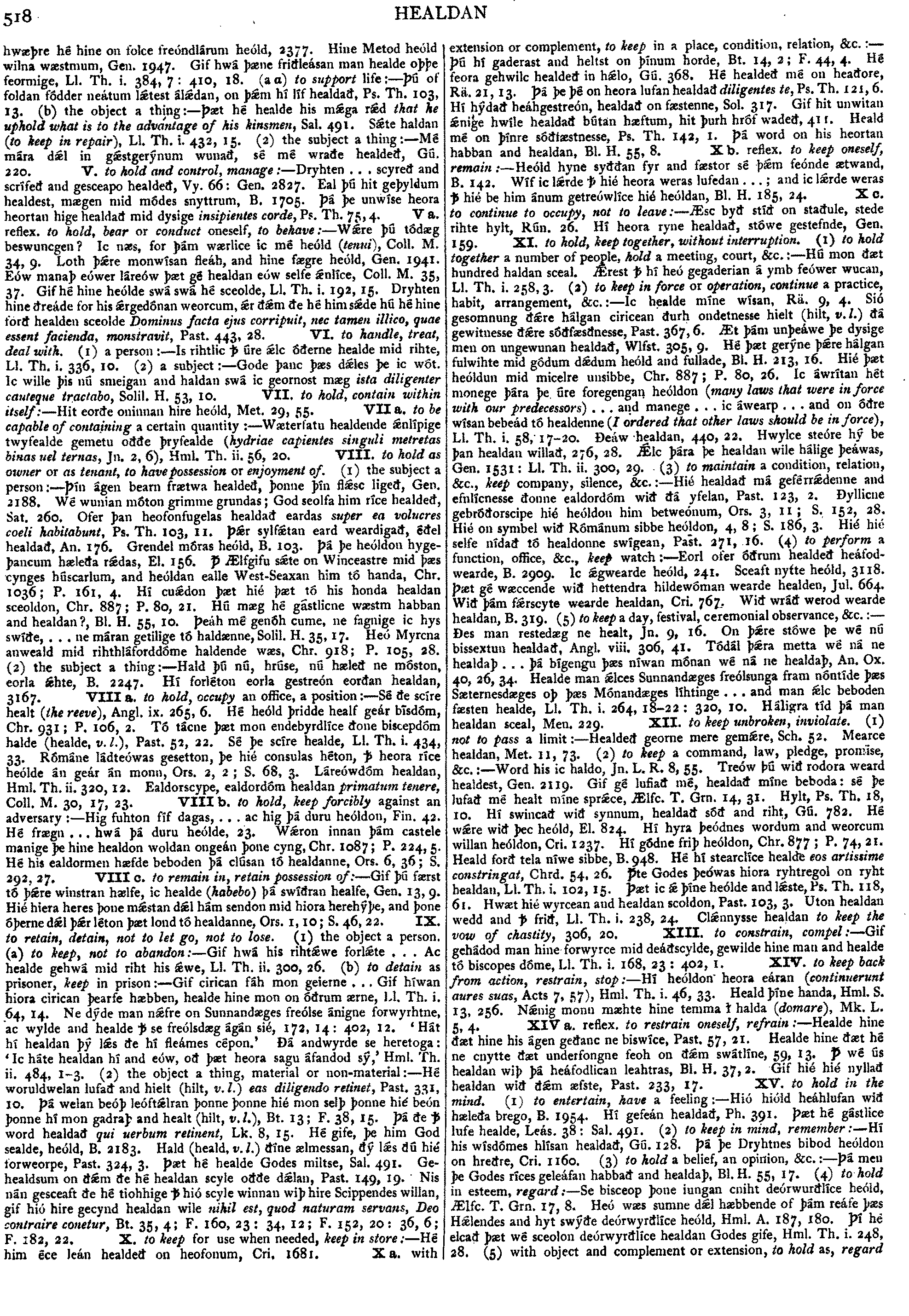
hwæþre
hé
hine
on
folce
freóndlárum
heóld,
2377.
Hine
Metod
heóld
wilna
wæstmum,
Gen.
1947.
Gif
hwá
þæne
friðleásan
man
healde
oþþe
feormige,
Ll.
Th.
i.
384,
7:
410,
18.
(a
)
to
support
life
:--
Þú
of
foldan
fódder
neátum
ltest
áldan,
on
þm
hí
líf
healdað,
Ps.
Th.
103,
13.
(b)
the
object
a
thing
:--
Þæt
hé
healde
his
mga
rd
that
he
uphold
what
is
to
the
advantage
of
his
kinsmen,
Sal.
491.
Ste
haldan
(to
keep
in
repair),
Ll.
Th.
i.
432,
15.
(2)
the
subject
a
thing
:--
Mé
mára
dl
in
gstgerýnum
wunað,
sé
mé
wraðe
healdeð,
Gú
220.
V.
to
hold
and
control,
manage
:--
Dryhten
.
.
.
scyreð
and
scrífeð
and
gesceapo
healdeð,
Vy.
66:
Gen.
2827.
Eal
þú
hit
geþyldum
healdest,
mægen
mid
módes
snyttrum,
B.
1705.
Þá
þe
unwíse
heora
heortan
hige
healdað
mid
dysige
insipientes
corde,
Ps.
Th.
75,
4.
V
a.
reflex.
to
hold,
bear
or
conduct
oneself,
to
behave
:--
Wre
þú
tódæg
beswuncgen
?
Ic
næs,
for
þám
wærlice
ic
me
heóld
(tenui),
Coll.
M
34,
9.
Loth
þre
monwísan
fleáh,
and
hine
fægre
heóld,
Gen.
1941.
Eów
manaþ
eówer
láreów
þæt
gé
healdan
eów
selfe
nlíce,
Coll.
M.
35,
37.
Gif
hé
hine
heólde
swá
swá
hé
sceolde,
Ll.
Th.
i.
192,
15.
Dryhten
hine
ðreáde
for
his
rgedónan
weorcum,
r
ðm
ðe
hé
him
sde
hú
hé
hine
fórð
healden
sceolde
Dominus
facta
ejus
corripuit,
nec
tamen
illico,
guae
essent
facienda,
monstravit,
Past.
443,
28.
VI.
to
handle,
treat,
deal
with.
(1)
a
person
:--
Is
rihtlic
úre
lc
óðerne
healde
mid
rihte,
Ll.
Th.
i.
336,
10.
(2)
a
subject
:--
Gode
þanc
þæs
dles
þe
ic
wót.
Ic
wille
þis
nú
smeigan
and
haldan
swá
ic
geornost
mæg
ista
diligenter
cauteque
tractabo,
Solil.
H.
53,
10.
VII.
to
hold,
contain
within
itself
:--
Hit
eorðe
oninnan
hire
heóld,
Met.
29,
55.
VII
a.
to
be
capable
of
containing
a
certain
quantity
:--
Wæterfatu
healdende
nlípige
twyfealde
gemetu
oððe
þryfealde
(hydriae
capientes
singuli
metretas
binas
uel
ternas,
Jn.
2,
6),
Hml.
Th.
ii.
56,
20.
VIII.
to
hold
as
owner
or
as
tenant,
to
have
possession
or
enjoyment
of.
(1)
the
subject
a
person
:--
Þín
ágen
bearn
frætwa
healdeð,
þonne
þín
flsc
ligeð,
Gen
2188.
Wé
wunian
móton
grimme
grundas;
God
seolfa
him
ríce
healdeð,
Sat.
260.
Ofer
þan
heofonfugelas
healdað
eardas
super
ea
volucres
coeli
habilabunt,
UNCERTAIN
Ps.
Th.
103,
11.
Þr
sylftan
eard
weardigað,
éðel
healdað,
An.
176.
Grendel
móras
heóld,
B.
103.
Þá
þe
heóldon
hygeþancum
hæleða
rdas,
El.
156.
Þ-bar;
Ælfgifu
ste
on
Winceastre
mid
þæs
cynges
húscarlum,
and
heóldan
ealle
West-Seaxan
him
tó
handa,
Chr.
1036;
P.
161,
4.
Hí
cudon
þæt
hié
þæt
tó
his
honda
healdan
sceoldon,
Chr.
887;
P.
80,
21.
Hú
mæg
hé
gástlicne
wæstm
habban
and
healdan?,
Bl.
H.
55,
10.
Þeáh
mé
genóh
cume,
ne
fagnige
ic
hys
swíðe,
.
.
.
ne
máran
getilige
tó
haldænne,
Solil.
H.
35,
17.
Heó
Myrcna
anweald
mid
rihthláforddóme
haldende
wæs,
Chr.
918;
P.
105,
28.
(2)
the
subject
a
thing
:--
Hald
þú
nú,
hrúse,
nú
hæleð
ne
móston,
eorla
hte,
B.
2247.
Hí
forléton
eorla
gestreón
eorðan
healdan
3167.
VIII
a.
to
hold,
occupy
an
office,
a
position
:--
Sé
ðe
scíre
healt
(the
reeve),
Angl.
ix.
265,
6.
Hé
heóld
þridde
healf
geár
bísdóm,
Chr.
931;
P.
106,
2.
Tó
tácne
þæt
mon
endebyrdlíce
ðone
biscepdóm
halde
(healde,
v.
l.),
Past.
52,
22.
Sé
þe
scíre
healde,
Ll.
Th.
i.
434,
33.
Rómáne
ládteówas
gesetton,
þe
hié
consulas
héton,
heora
ríce
heólde
án
geár
án
monn,
Ors.
2,
2
;
S.
68,
3.
Láreówdóm
healdan,
Hml.
Th.
ii.
320,
12.
Ealdorscype,
ealdordóm
healdan
primatum
tenere,
Coll.
M.
30,
17,
23.
VIII
b.
to
hold,
keep
forcibly
against
an
adversary
:--
Hig
fuhton
fíf
dagas,
.
.
.
ac
hig
þá
duru
heóldon,
Fin.
42.
Hé
frægn
.
.
.
hwá
þá
duru
heólde,
23.
Wron
innan
þám
castele
manige
þe
hine
healdon
woldan
ongeán
þone
cyng,
Chr.
1087;
P.
224,
5.
Hé
his
ealdormen
hæfde
beboden
þá
clúsan
tó
healdanne,
Ors.
6,
36;
S.
292,
27.
VIII
c.
to
remain
in,
retain
possession
of
:--
Gif
þú
færst
tó
þre
winstran
hælfe,
ic
healde
(habebo)
þá
swíðran
healfe,
Gen.
13,
9.
Hié
hiera
heres
þone
mstan
dl
hám
sendon
mid
hiora
herehýþe,
and
þone
óþerne
dl
þr
léton
þæt
lond
tó
healdanne,
Ors.
1,
10;
S.
46,
22.
IX.
to
retain,
detain,
not
to
let
go,
not
to
lose.
(1)
the
object
a
person.
(a)
to
keep,
not
to
abandon
:--
Gif
hwá
his
rihtwe
forlte
.
.
.
Ac
healde
gehwá
mid
riht
his
we,
Ll.
Th.
ii.
300,
26.
(b)
to
detain
as
prisoner,
keep
in
prison
:--
Gif
cirican
fáh
mon
geierne
.
.
.
Gif
híwan
hiora
cirican
þearfe
hæbben,
healde
hine
mon
on
óðrum
ærne,
Ll.
Th.
i.
64,
14.
Ne
dýde
man
nfre
on
Sunnandæges
freólse
ánigne
forwyrhtne,
ac
wylde
and
healde
se
freólsdæg
ágán
sié,
172,
14:
402,
12.
'Hát
hí
healdan
þý
ls
ðe
hí
fleámes
cépon.'
Ðá
andwyrde
se
heretoga:
'
Ic
háte
healdan
hí
and
eów,
oð
þæt
heora
sagu
áfandod
sý,'
Hml.
Th.
ii.
484,
1-3.
(2)
the
object
a
thing,
material
or
non-material
:--
Hé
woruldwelan
lufað
and
hielt
(hilt,
v.
l.)
eas
diligendo
retinet,
Past.
331,
10.
Þá
welan
beóþ
leóftlran
þonne
þonne
hié
mon
selþ
þonne
hié
beón
þonne
hí
mon
gadraþ
and
healt
(hilt,
v.
l.),
Bt.
13;
F.
38,
15.
Þá
ðe
word
healdað
qui
uerbum
retinent,
Lk.
8,
15.
Hé
gife,
þe
him
God
sealde,
heóld,
B.
2183.
Hald
(heald,
v.
l.)
ðíne
ælmessan,
ðý
ls
ðú
hié
forweorpe,
Past.
324,
3.
Þæt
hé
healde
Godes
miltse,
Sal.
491.
Gehealdsum
on
ðm
ðe
hé
healdan
scyle
oððe
dlan,
Past.
149,
19.
Nis
nán
gesceaft
ðe
hé
tiohhige
hió
scyle
winnan
wiþ
hire
Scippendes
willan,
gif
hió
hire
gecynd
healdan
wile
nihil
est,
quod
naturam
servans,
Deo
contraire
conetur,
Bt.
35,
4;
F.
160,
23
:
34,
12;
F.
152,
20:
36,
6;
F.
182,
22.
X.
to
keep
for
use
when
needed,
keep
in
store:
--
Hé
him
éce
leán
healdeð
on
heofonum,
Cri.
1681.
X
a.
with
extension
or
complement,
to
keep
in
a
place,
condition,
relation,
&c.:--
Þú
hí
gaderast
and
heltst
on
þínum
horde,
Bt.
14,
2;
F.
44,
4.
Hé
feora
gehwilc
healdeð
in
hlo,
Gú.
368.
Hé
healdeð
mé
on
heaðore,
Rä.
21,
13.
Þá
þe
þé
on
heora
lufan
healdað
diligentes
te,
Ps.
Th.
121,
6.
Hí
hýdað
heáhgestreón,
healdað
on
fæstenne,
Sol.
317.
Gif
hit
unwitan
nige
hwíle
healdað
bútan
hæftum,
hit
þurh
hróf
wadeð,
411.
Heald
mé
on
þínre
sóðfæstnesse,
Ps.
Th.
142,
1.
Þá
word
on
his
heortan
habban
and
healdan,
Bl.
H.
55,
8.
X
b.
reflex.
to
keep
oneself,
remain:
--
Heóld
hyne
syððan
fyr
and
fæstor
sé
þm
feónde
ætwand,
B.
142.
Wíf
ic
lrde
hié
heora
weras
lufedan
.
.
.
;
and
ic
lrde
weras
hié
be
him
ánum
getreówlíce
hié
heóldan,
Bl.
H.
185,
24.
X
c.
to
continue
to
occupy,
not
to
leave
:--
Æsc
byð
stíð
on
staðule,
stede
rihte
hylt,
Rún.
26.
Hí
heora
ryne
healdað,
stówe
gestefnde,
Gen.
159.
XI.
to
hold,
keep
together,
without
interruption,
(1)
to
hold
together
a
number
of
people,
hold
a
meeting,
court,
&c.:--
Hú
mon
ðæt
hundred
haldan
sceal.
Æ-acute;rest
hí
heó
gegaderian
á
ymb
feówer
wucan,
Ll.
Th.
i.
258,
3.
(2)
to
keep
in
force
or
operation,
continue
a
practice,
habit,
arrangement,
&c.:--
Ic
healde
míne
wísan,
Rä.
9,
4.
Sió
gesomnung
ðre
hálgan
ciricean
ðurh
ondetnesse
hielt
(hilt,
v.
l.)
ðá
gewitnesse
ðre
sóðfæsðnesse,
Past.
367,
6.
Æt
þám
unþeáwe
þe
dysige
men
on
ungewunan
healdað,
Wlfst.
305,
9.
Hé
þæt
gerýne
þre
hálgan
fulwihte
mid
gódum
ddum
heóld
and
fullade,
Bl.
H.
213,
16.
Hié
þæt
heóldun
mid
micelre
unsibbe,
Chr.
887
;
P.
80,
26.
Ic
áwrítan
hét
monege
þára
þe
úre
foregengan
heóldon
(many
laws
that
were
in
force
with
our
predecessors)
.
.
.
and
manege
.
.
.
ic
áwearp
.
.
.
and
on
óðre
wísan
bebeád
tó
healdenne
(I
ordered
that
other
laws
should
be
in
force),
Ll.
Th.
i.
58,
17-20.
Ðeáw
healdan,
440,
22.
Hwylce
steóre
hý
be
þan
healdan
willað,
276,
28.
Æ-acute;lc
þára
þe
healdan
wile
hálige
þeáwas,
Gen.
1531:
Ll.
Th.
ii.
300,
29.
(3)
to
maintain
a
condition,
relation,
&c.,
keep
company,
silence,
&c.:--
Hié
healdað
má
geférrædenne
and
efnlícnesse
ðonne
ealdordóm
wið
ðá
yfelan,
Past.
123,
2.
Ðyllicne
gebróðorscipe
hié
heóldon
him
betweónum,
Ors.
3,
11;
S.
152,
28.
Hié
on
symbel
wið
Rómánum
sibbe
heóldon,
4,
8
;
S.
186,
3.
Hié
hié
selfe
nídað
tó
healdonne
swígean,
Past.
271,
16.
(4)
to
perform
a
function,
office,
&c.,
keep
watch
:--
Eorl
ofer
óðrum
healdeð
heáfodwearde,
B.
2909.
Ic
gwearde
heóld,
241.
Sceaft
nytte
heóld,
3118.
Þæt
gé
wæccende
wið
hettendra
hildewóman
wearde
healden,
Jul.
664.
Wið
þám
frscyte
wearde
healdan,
Cri.
767.
Wið
wráð
werod
wearde
healdan,
B.
319.
(5)
to
keep
a
day,
festival,
ceremonial
observance,
&c.:--
Ðes
man
restedæg
ne
healt,
Jn.
9,
16.
On
þre
stówe
þe
wé
nú
bissextun
healdað,
Angl.
viii.
306,
41.
Tódál
þra
metta
wé
ná
ne
healdaþ
.
.
.
þá
bígengu
þæs
níwan
mónan
wé
ná
ne
healdaþ,
An.
Ox.
40,
26,
34.
Healde
man
lces
Sunnandæges
freólsunga
fram
nóntíde
þæs
Sæternesdæges
oþ
þæs
Mónandæges
líhtinge
.
.
.
and
man
lc
beboden
fæsten
healde,
Ll.
Th.
i.
264,
18-22
:
320,
10.
Háligra
tíd
þá
man
healdan
sceal,
Men.
229.
XII.
to
keep
unbroken,
inviolate.
(1)
not
to
pass
a
limit
:--
Healdeð
georne
mere
gemre,
Sch.
52.
Mearce
healdan,
Met.
11,
73.
(2)
to
keep
a
command,
law,
pledge,
promise,
&c.:--
Word
his
ic
haldo,
Jn.
L.
R.
8,
55.
Treów
þú
wið
rodora
weard
healdest,
Gen.
2119.
Gif
gé
lufiað
mé,
healdað
míne
beboda:
sé
þe
lufað
mé
healt
míne
sprce,
Ælfc.
T.
Grn.
14,
31.
Hylt,
Ps.
Th.
18,
10.
Hí
swincað
wið
synnum,
healdað
sóð
and
riht,
Gú.
782.
Hé
wre
wið
þec
heóld,
El.
824.
Hí
hyra
þeódnes
wordum
and
weorcum
willan
heóldon,
Cri.
1237.
Hí
gódne
friþ
heóldon,
Chr.
877
;
P.
74,
21.
Heald
forð
tela
níwe
sibbe,
B.
948.
Hé
hí
stearclíce
healde
eos
artissime
constringat,
Chrd.
54,
26.
Þ-bar;te
Godes
þeówas
hiora
ryhtregol
on
ryht
healdan,
Ll.
Th.
i.
102,
15.
Þæt
ic
þíne
heólde
and
lste,
Ps.
Th.
118,
61.
Hwæt
hié
wyrcean
and
healdan
scoldon,
Past.
103,
3.
Uton
healdan
wedd
and
frið,
Ll.
Th.
i.
238,
24.
Clnnysse
healdan
to
keep
the
vow
of
chastity,
306,
20.
XIII.
to
constrain,
compel
:--
Gif
gehádod
man
hine
forwyrce
mid
deáðscylde,
gewilde
hine
man
and
healde
tó
biscopes
dóme,
Ll.
Th.
i.
168,
23
:
402,
1.
XIV.
to
keep
back
from
action,
restrain,
stop:--
Hí
heóldon
heora
eáran
(continuerunt
aures
suas,
Acts
7,
57),
Hml.
Th.
i.
46,
33.
Heald
þíne
handa,
Hml.
S.
13.
256.
Nnig
monn
mæhte
hine
temma
halda
(domare),
Mk.
L.
5,
4.
XIV
a.
reflex,
to
restrain
oneself,
refrain
:--
Healde
hine
ðæt
hine
his
ágen
geðanc
ne
biswíce,
Past.
57,
21.
Healde
hine
ðæt
hé
ne
cnytte
ðæt
underfongne
feoh
on
ðm
swátlíne,
59,
13.
Þ-bar;
wé
ús
healdan
wiþ
þá
heáfodlican
leahtras,
Bl.
H.
37,
2.
Gif
hié
hié
nyllað
healdan
wið
ðm
æfste,
Past.
233,
17.
XV.
to
hold
in
the
mind.
(1)
to
entertain,
have
a
feeling
:--
Hió
hióld
heáhlufan
wið
hæleða
brego,
B.
1954.
Hí
gefeán
healdað,
Ph.
391.
Þæt
hé
gástlice
lufe
healde,
Leás.
38
:
Sal.
491.
(2)
to
keep
in
mind,
remember
:--
Hí
his
wísdómes
hlísan
healdað,
Gú.
128.
Þá
þe
Dryhtnes
bibod
heóldon
on
hreðre,
Cri.
1160.
(3)
to
hold
a
belief,
an
opinion,
&c.:--
Þá
men
þe
Godes
ríces
geleáfan
habbað
and
healdaþ,
Bl.
H.
55,
17.
(4)
to
hold
in
esteem,
regard
:--
Se
bisceop
þone
iungan
cniht
deórwurðlíce
heóld,
Ælfc.
T.
Grn.
17,
8.
Heó
wæs
sumne
dl
hæbbende
of
þám
reáfe
þæs
Hlendes
and
hyt
swýðe
deórwyrðlíce
heóld,
Hml.
A.
187,
180.
Þí
hé
elcað
þæt
wé
sceolon
deórwyrðlíce
healdan
Godes
gife,
Hml.
Th.
i.
248,
28.
(5)
with
object
and
complement
or
extension,
to
hold
as,
regard
|
Source: Bosworth/Toller, page d0536, entry 1 View original page image as: [TIFF] [PNG] [View previous entry] [View next entry] |
[Comment on this entry] [View comments] |
The following entry has been hand-corrected once. |
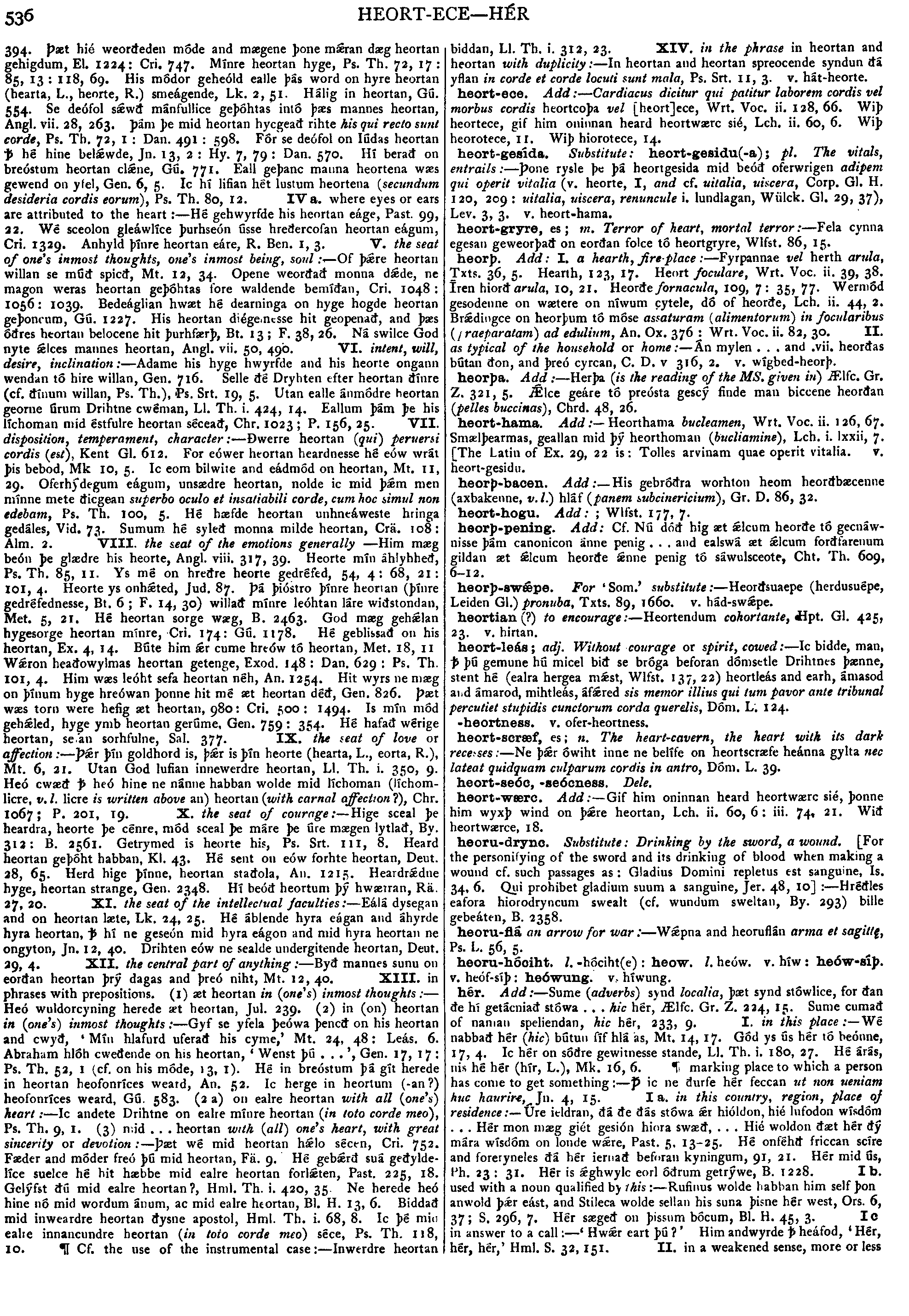
394.
Þæt
hié
weorðeden
móde
and
mægene
þone
mran
dæg
heortan
gehigdum,
El.
1224:
Crl.
747.
Mínre
heortan
hyge,
Ps.
Th.
72,
17
:
85,
13
:
118,
69.
His
módor
geheóld
ealle
þás
word
on
hyre
heortan
(hearta,
L.,
heorte,
R.)
smeágende,
Lk.
2,
51.
Hálig
in
heortan,
Gú.
554.
Se
deófol
swð
mánfullice
geþóhtas
intó
þæs
mannes
heortan,
Angl.
vii.
28,
263,
Þám
þe
mid
heortan
hycgeað
rihte
his
qui
recto
sunt
corde,
Ps.
Th.
72,
I
:
Dan.
491
:
598.
Fór
se
deófol
on
Iúdas
heortan
hé
hine
belwde,
Jn.
13,
2
:
Hy.
7,
79
:
Dan.
570.
Hí
berað
on
breóstum
heortan
clne,
Gú.
771.
Eall
geþanc
manna
heortena
wæs
gewend
on
yfel,
Gen.
6,
5.
Ic
hí
lifian
hét
lustum
heortena
(secundum
desideria
cordis
eorum),
Ps.
Th.
80,
12.
IV
a.
where
eyes
or
ears
are
attributed
to
the
heart
:--
Hé
gehwyrfde
his
heortan
eáge,
Past.
99,
22.
Wé
sceolon
gleáwlíce
þurhseón
ússe
hreðercofan
heortan
eágum,
Cri.
1329.
Anhyld
þínre
heortan
eáre,
R.
Ben.
I.
3.
V.
the
seat
of
one's
inmost
thoughts,
one's
inmost
being,
soul
:--
Of
þre
heortan
willan
se
muð
spicð,
Mt.
12,
34.
Opene
weorðað
monna
dde,
ne
magon
weras
heortan
geþóhtas
fore
waldende
bemíðan,
Cri.
1048:
1056:
1039.
Bedeáglian
hwæt
hé
dearninga
on
hyge
hogde
heortan
geþoncum,
Gú.
1227.
His
heortan
diégemesse
hit
geopenað,
and
þæs
óðres
heortan
belocene
hit
þurhfærþ,
Bt.
13
;
F.
38,
26.
Ná
swilce
God
nyte
lces
mannes
heortan,
Angl.
vii.
50,
496.
VI.
intent,
will,
desire,
inclination:
:--
Adame
his
hyge
hwyrfde
and
his
heorte
ongann
wendan
tó
hire
willan,
Gen.
716.
Selle
ðé
Dryhten
efter
heortan
ðínre
(cf.
ðínum
willan,
Ps.
Th.),
Ps.
Srt.
19,
5.
Utan
ealle
ánmódre
heortan
georne
úrum
Drihtne
cwéman,
Ll.
Th.
i.
424,
14.
Eallum
þám
þe
his
líchoman
mid
éstfulre
heortan
séceað,
Chr.
1023
;
P.
156,
25.
VII.
disposition,
temperament,
character
:--
Ðwerre
heortan
(qui)
peruersi
cordis
(est),
Kent
Gl.
612.
For
eówer
heortan
heardnesse
hé
eów
wrát
þis
bebod,
Mk
10,
5.
Ic
eom
bilwite
and
eádmód
on
heortan,
Mt.
ii.
29.
Oferhýdegum
eágum,
unsædre
heortan,
nolde
ic
mid
þm
men
mínne
mete
ðicgean
superbo
oculo
et
insatiabili
corde,
cum
hoc
simul
non
edebam,
Ps.
Th.
100,
5.
Hé
hæfde
heortan
unhneáweste
hringa
gedáles,
Vid.
73.
Sumum
hé
syleð
monna
milde
heortan,
Crä.
108:
Alm.
2.
VIII.
the
seat
of
the
emotions
generally
--
Him
mæg
beón
þe
glædre
his
heorte,
Angl.
viii.
317,
39.
Heorte
mín
áhlyhheð,
Ps.
Th.
85,
ii.
Ys
mé
on
hreðre
heorte
gedréfed,
54,
4:
68,
21:
101,
4.
Heorte
ys
onhted,
Jud.
87.
Þá
þióstro
þínre
heorian
(þínre
gedréfednesse,
Bt.
6
;
F.
14,
30)
willað
mínre
leóhtan
láre
wiðstondan,
Met.
5,
21.
Hé
heortan
sorge
wæg,
B.
2463.
God
mæg
gehlan
hygesorge
heortan
mínre,
Cri.
174:
GB.
1178.
Hé
geblissað
on
his
heortan,
Ex.
4,
14.
Búte
him
r
cume
hreáw
tó
heortan,
Met.
18,
II
Wron
heaðowylmas
heortan
getenge,
Exod.
148
:
Dan.
629
:
Ps.
Th.
101,
4.
Him
wæs
leóht
sefa
heortan
néh,
An.
1254.
Hit
wyrs
ne
mæg
on
þínum
hyge
hreówan
þonne
hit
mé
æt
heortan
déð,
Gen.
826.
Þæt
wæs
torn
were
hefig
æt
heortan,
980:
Cri.
500:
1494.
Is
mín
mód
gehled,
hyge
ymb
heortan
gerúme,
Gen.
759
:
354.
He
hafað
wérige
heortan,
se.
'an
sorhfulne,
Sal.
377.
IX.
the
seat
of
love
or
affection
:--
Þr
þín
goldhord
is,
þr
is
þín
heorte
(hearta,
L.,
eorta,
R.),
Mt.
6,
21.
Utan
God
lufian
innewerdre
heortan,
Ll.
Th.
i.
350,
9.
Heó
cwæð
heó
hine
ne
nánne
habban
wolde
mid
líchoman
(lichom-licre,
v.
l.
licre
is
written
above
an)
heortan
(with
camal
affection
?),
Chr.
1067;
P.
201,
19.
X.
the
seat
of
courage
:--
Hige
sceal
þe
heardra,
heorte
þe
cénre,
mód
sceal
þe
máre
be
úre
mægen
lytlað,
By.
312:
B.
2561.
Getrymed
is
heorte
his,
Ps.
Srt.
III,
8.
Heard
heortan
geþóht
habban,
Kl.
43.
Hé
sent
on
eów
forhte
heortan,
Deut.
28,
65.
Herd
hige
þínne,
heortan
staðola,
An.
1215.
Heardrdne
hyge,
heortan
strange,
Gen.
2348.
Hí
beóð
heortum
þý
hwærran,
Rä.
27,
20.
XI.
the
seat
of
the
intellectual
faculties
:--
Eálá
dysegan
and
on
heortan
læte,
Lk.
24,
25.
Hé
áblende
hyra
eágan
and
áhyrde
hyra
heortan,
hí
ne
geseón
mid
hyra
eágon
and
mid
hyra
heortan
ne
ongyton,
Jn.
12,
40.
Drihten
eów
ne
sealde
undergitende
heortan,
Deut.
29,
4.
XII.
the
central
part
of
anything
:--
Byð
mannes
sunu
on
eorðan
heortan
þrý
dagas
and
þreó
niht,
Mt.
12,
40.
XIII.
in
phrases
with
prepositions.
(l)
æt
heortan
in
(one's)
inmost
thoughts
:--
Heó
wuldorcyning
herede
æt
heortan,
Jul.
239.
(2)
in
(on)
heortan
in
(one's)
inmost
thoughts
:--
Gyf
se
yfela
þeówa
þencð
on
his
heortan
and
cwyð,
'Mín
hlafurd
uferað
his
cyme,'
Mt.
24,
48:
Leás.
6.
Abraham
hlóh
cweðende
on
his
heortan,
'Wenst
þú
.
.
.
',
Gen.
17,
17
:
Ps.
Th.
52,
l
(cf.
on
his
móde,
13,
l).
Hé
in
breóstum
þá
gít
herede
in
heortan
heofonríces
weard,
An.
52.
Ic
herge
in
heortum
(-an?)
heofonrlces
weard,
GO.
583.
(2
a)
on
ealre
heortan
with
all
(one´s)
heart
:--
Ic
andete
Drihtne
on
ealre
mínre
heortan
(in
toto
corde
meo),
Ps.
Th.
9,
l.
(3)
mid
.
.
.
heortan
with
(all)
one's
heart,
with
great
sincerity
or
devotion
:--
Þæt
wé
mid
heortan
hlo
sécen,
Cri.
752.
Fæder
and
móder
freó
þú
mid
heortan,
Fä.
9.
Hé
gebrð
suá
geðyldelíce
suelce
hé
hit
hæbbe
mid
ealre
heortan
forlten,
Past.
225,
18.
Gelýfst
ðú
mid
ealre
heortan
?,
Hml.
Th.
i.
420,
35
Ne
herede
heó
hine
nó
mid
wordum
ánum,
ac
mid
ealre
heortan,
Bl.
H.
13,
6.
Biddað
mid
inweardre
heortan
ðysne
apostol,
Hml.
Th.
i.
68,
8.
Ic
þe
mid
ealre
innancundre
heortan
(in
toto
corde
meo)
séce,
Ps.
Th.
118,
10.

Cf.
the
use
of
the
instrumental
case
:--
Inwerdre
heortan
biddan,
Ll.
Th.
i.
312,
23.
XIV.
in
the
phrase
in
heortan
and
heortan
with
duplicity
:--
In
heortan
and
heortan
spreocende
syndun
ðá
yflan
in
corde
et
corde
locuti
sunt
mala,
Ps.
Srt.
II,
3.
v.
hát-heorte.
|
Source: Bosworth/Toller, page d0702, entry 39 View original page image as: [TIFF] [PNG] [View previous entry] [View next entry] |
[Comment on this entry] [View comments] |
The following entry has been hand-corrected once. |
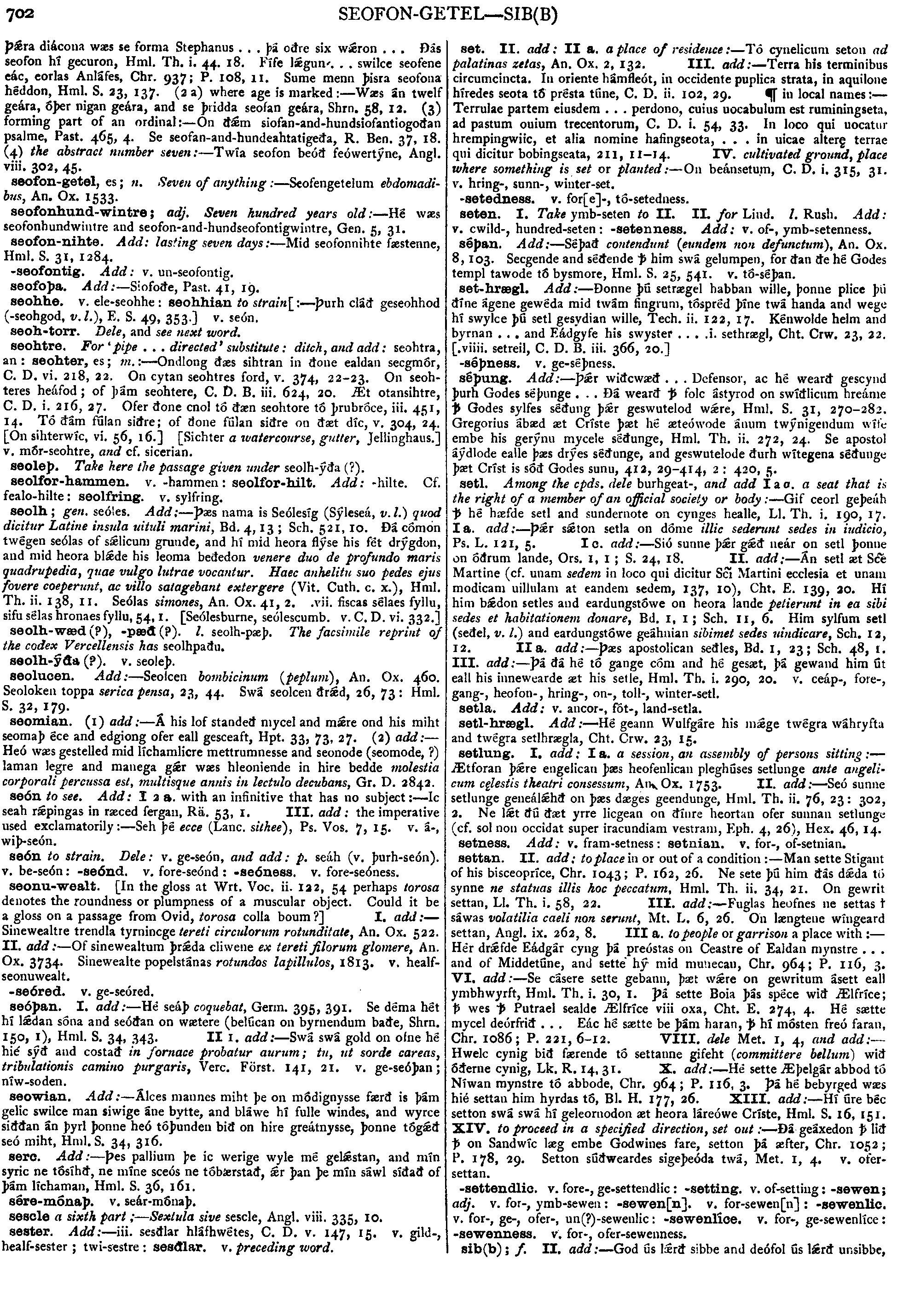
settan.
II.
add:
to
place
in
or
out
of
a
condition
:--
Man
sette
Stigant
of
his
bisceopríce,
Chr.
1043;
P.
162,
26.
Ne
sete
þú
him
ðás
dda
tó
synne
ne
statuas
illis
hoc
peccatum,
Hml.
Th.
ii.
34,
21.
On
gewrit
settan,
Ll.
Th.
i.
58,
22.
III.
add
:--
Fuglas
heofnes
ne
settas
sáwas
volatilia
caeli
non
serunt,
Mt.
L.
6,
26.
On
længtene
wíngeard
settan,
Angl.
ix.
262,
8.
III
a.
to
people
or
garrison
a
place
with
:--
Hér
drfde
Eádgár
cyng
þá
preóstas
on
Ceastre
of
Ealdan
mynstre
.
.
.
and
of
Middetúne,
and
sette
hý
mid
munecan,
Chr.
964;
P.
116,
3.
VI.
add
:--
Se
cásere
sette
gebann,
þæt
wre
on
gewritum
ásett
eall
ymbhwyrft,
Hml.
Th.
i.
30,
1.
Þá
sette
Boia
þás
spéce
wið
Ælfríce;
wes
Putrael
sealde
Ælfríce
viii
oxa,
Cht.
E.
274,
4.
Hé
sætte
mycel
deórfrið
.
.
.
Eác
hé
sætte
be
þám
haran,
hí
mósten
freó
faran,
Chr.
1086;
P.
221,
6-12.
VIII.
dele
Met.
1,
4,
and
add
:--
Hwelc
cynig
bið
færende
tó
settanne
gifeht
(committere
bellum)
wið
óðerne
cynig,
Lk.
R.
14,
31.
X.
add
:--
Hé
sette
Æþelgár
abbod
tó
Níwan
mynstre
tó
abbode,
Chr.
964;
P.
116,
3.
Þá
hé
bebyrged
wæs
hié
settan
him
hyrdas
tó,
Bl.
H.
177,
26.
XIII.
add
:--
Hí
úre
béc
setton
swá
swá
hí
geleornodon
æt
heora
láreówe
Críste,
Hml.
S.
16,
151.
XIV.
to
proceed
in
a
specified
direction,
set
out
:--
Ðá
geáxedon
lið
on
Sandwíc
læg
embe
Godwines
fare,
setton
þá
æfter,
Chr.
1052;
P.
178,
29.
Setton
súðweardes
sigeþeóda
twá,
Met.
1,
4.
v.
ofer-settan.
| Result Page: |  |
Previous | 1 2 3 4 5 6 7 8 9 10 | Next |  |
Germanic Lexicon Project (main page)
This search system was written by
Sean Crist
Please consider
volunteering
to correct the data in these online dictionaries.
No rights reserved. Feel free to use these data in any way you please.