|
|

|
Source: Bosworth/Toller, page b1283, entry 8 View original page image as: [TIFF] [PNG] [View previous entry] [View next entry] |
[Comment on this entry] [View comments] |
The following entry has been hand-corrected once. |
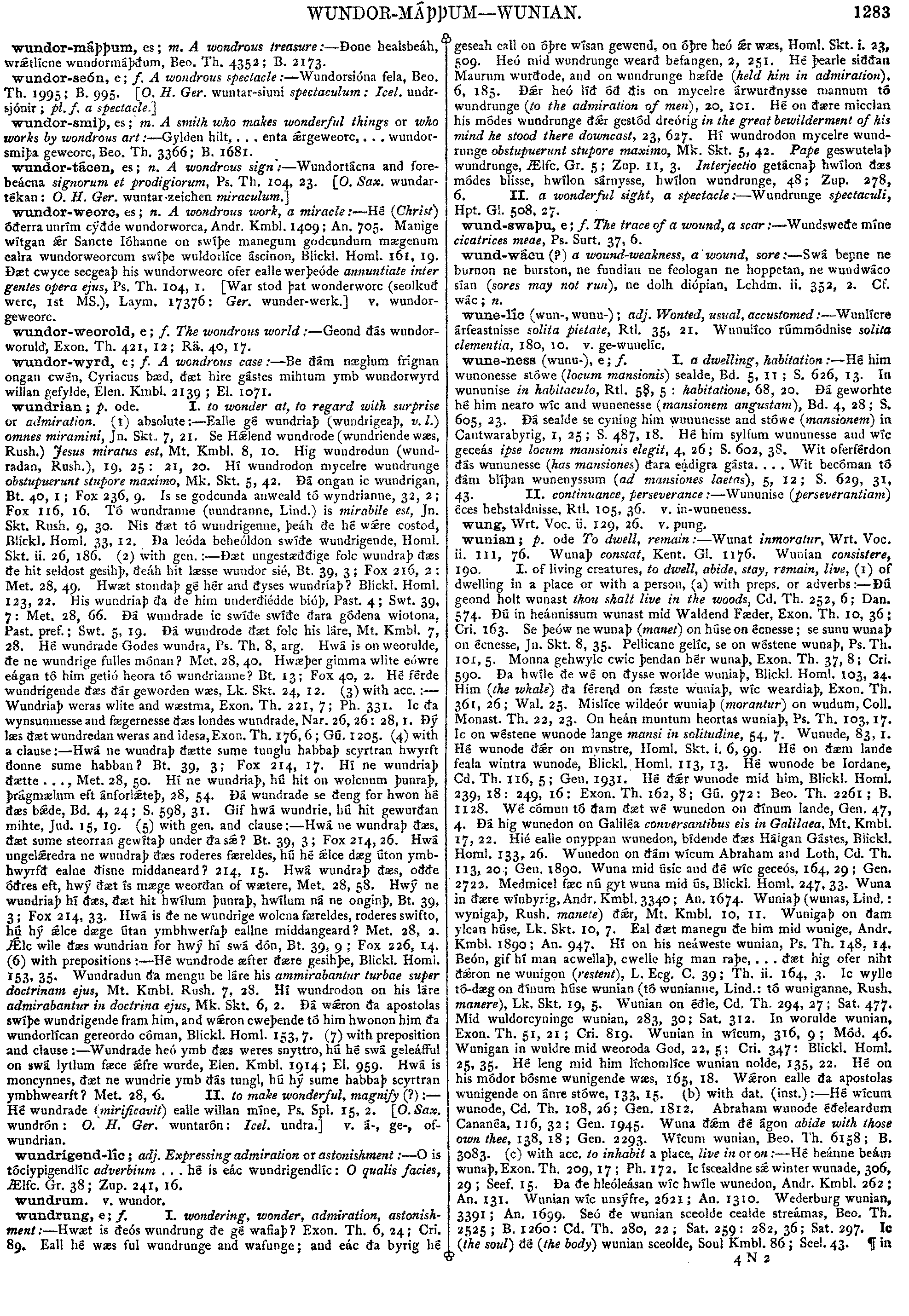
wundrian;
p.
ode.
I.
to
wonder
at,
to
regard
with
surprise
or
admiration.
(1)
absolute
:--
Ealle
gé
wundriaþ
(wundrigeaþ,
v.l.)
omnes
miramini,
Jn.
Skt.
7,
21.
Se
H lend
wundrode
(wundriende
wæs,
Rush.)
Jesus
miratus
est,
Mt.
Kmbl.
8,
10,
Hig
wundrodun
(wundradan,
Rush.),
19,
25:
21,
20.
Hí
wundrodon
mycelre
wundrunge
obstupuerunt
stupore
maximo,
Mk.
Skt.
5,
42.
Ðá
ongan
ic
wundrigan,
Bt.
40,
1;
Fox
236,
9.
Is
se
godcunda
anweald
tó
wyndrianne,
32,
2;
Fox
116,
16.
Tó
wundranne
(uundranne,
Lind.)
is
mirabile
est,
Jn.
Skt.
Rush.
9,
30.
Nis
ðæt
tó
wundrigende,
þeáh
ðe
hé
wre
costod,
Blickl.
Homl.
33,
12.
Ða
leóda
beheóldon
swíðe
wundrigende,
Homl.
Skt.
ii.
26,
186.
(2)
with
gen.
:--
Ðæt
ungestæððige
folc
wundraþ
ðæs
ðe
hit
seldost
gesihþ,
ðeáh
hit
læsse
wundor
sié,
Bt.
39,
3;
Fox
216,
2:
Met.
28,
49.
Hwæt
stondaþ
gé
hér
and
ðyses
wundriap?
Blickl.
Homl.
123,
22.
His
wundriaþ
ða
ðe
him
underðiédde
bióþ,
Past.
4;
Swt,
39,
7:
Met.
28,
66.
Ðá
wundrade
ic
swíðe
swíðe
ðara
gódena
wiotona,
Past.
pref.;
Swt.
5,
19.
Ðá
wundrode
ðæt
folc
his
láre,
Mt.
Kmbl.
7,
28.
Hé
wundrade
Godes
wundra,
Ps.
Th.
8,
arg.
Hwá
is
on
weorulde,
ðe
ne
wundrige
fulles
mónan?
Met.
28,
40.
Hwæþer
gimma
wlite
eówre
eágan
tó
him
getió
heora
tó
wundrianne?
Bt.
13;
Fox
40,
2.
Hé
férde
wundrigende
ðæs
ðár
geworden
wæs,
Lk.
Skt.
24,
12.
(3)
with
acc.
:--
Wundriaþ
weras
wlite
and
wæstma,
Exon.
Th.
221,
7;
Ph.
331.
Ic
ða
wynsumnesse
and
fægernesse
ðæs
londes
wundrade,
Nar.
26,
26:
28,
1.
Ðý
læs
ðæt
wundredan
weras
and
idesa,
Exon.
Th.
176,
6;
Gú.
1205.
(4)
with
a
clause
:--
Hwá
ne
wundraþ
ðætte
sume
tunglu
habbaþ
scyrtran
hwyrft
ðonne
sume
habban?
Bt.
39,
3;
Fox
214,
17.
Hí
ne
wundriaþ
ðætte...,
Met.
28,
50.
Hí
ne
wundriaþ,
hú
hit
on
wolcnum
þunraþ,
þrágmælum
eft
ánforlteþ,
28,
54.
Ðá
wundrade
se
ðeng
for
hwon
hé
ðæs
bde,
Bd.
4,
24;
S.
598,
31.
Gif
hwá
wundrie,
hú
hit
gewurðan
mihte,
Jud.
15,
19.
(5)
with
gen.
and
clause
:--
Hwá
ne
wundraþ
ðæs,
ðæt
sume
steorran
gewítaþ
under
ða
s?
Bt.
39,
3;
Fox
214,
26.
Hwá
ungelredra
ne
wundraþ
ðæs
roderes
færeldes,
hú
hé
lce
dæg
útan
ymbhwyrfð
ealne
ðisne
middaneard?
214,
15.
Hwá
wundraþ
ðæs,
oððe
óðres
eft,
hwý
ðæt
ís
mæge
weorðan
of
wætere,
Met.
28,
58.
Hwý
ne
wundriaþ
hí
ðæs,
ðæt
hit
hwílum
þunraþ,
hwílum
ná
ne
onginþ,
Bt.
39,
3;
Fox
214,
33.
Hwá
is
ðe
ne
wundrige
wolcna
færeldes,
roderes
swifto,
hú
hý
lce
dæge
útan
ymbhwerfaþ
eallne
middangeard?
Met.
28,
2.
Æ-acute;lc
wile
ðæs
wundrian
for
hwý
hí
swá
dón,
Bt.
39,
9;
Fox
226,
14.
(6)
with
prepositions
:--
Hé
wundrode
æfter
ðære
gesihþe,
Blickl.
Homl.
153,
35.
Wundradun
ða
mengu
be
láre
his
ammirabantur
turbae
super
doctrinam
ejus,
Mt.
Kmbl.
Rush.
7,
28.
Hí
wundrodon
on
his
láre
admirabantur
in
doctrina
ejus,
Mk.
Skt.
6,
2.
Ðá
wron
ða
apostolas
swíþe
wundrigende
frand
him,
and
wron
cweþende
tó
him
hwonon
him
ða
wundorlícan
gereordo
cóman,
Blickl.
Homl.
153,
7.
(7)
with
preposition
and
clause
:--
Wundrade
heó
ymb
ðæs
weres
snyttro,
hú
hé
swá
geleáfful
on
swá
lytlum
fæce
fre
wurde,
Elen.
Kmbl.
1914;
El.
959.
Hwá
is
moncynnes,
ðæt
ne
wundrie
ymb
ðás
tungl,
hú
hý
sume
habbaþ
scyrtran
ymbhwearft?
Met.
28,
6.
II.
to
make
wonderful,
magnify(?)
:--
Hé
wundrade
(mirificavit)
ealle
willan
míne,
Ps.
Spl.
15,
2.
[O.
Sax.
wundrón:
O.
H.
Ger.
wuntarón:
Icel.
undra.]
v.
á-,
ge-,
of-wundrian.
lend
wundrode
(wundriende
wæs,
Rush.)
Jesus
miratus
est,
Mt.
Kmbl.
8,
10,
Hig
wundrodun
(wundradan,
Rush.),
19,
25:
21,
20.
Hí
wundrodon
mycelre
wundrunge
obstupuerunt
stupore
maximo,
Mk.
Skt.
5,
42.
Ðá
ongan
ic
wundrigan,
Bt.
40,
1;
Fox
236,
9.
Is
se
godcunda
anweald
tó
wyndrianne,
32,
2;
Fox
116,
16.
Tó
wundranne
(uundranne,
Lind.)
is
mirabile
est,
Jn.
Skt.
Rush.
9,
30.
Nis
ðæt
tó
wundrigende,
þeáh
ðe
hé
wre
costod,
Blickl.
Homl.
33,
12.
Ða
leóda
beheóldon
swíðe
wundrigende,
Homl.
Skt.
ii.
26,
186.
(2)
with
gen.
:--
Ðæt
ungestæððige
folc
wundraþ
ðæs
ðe
hit
seldost
gesihþ,
ðeáh
hit
læsse
wundor
sié,
Bt.
39,
3;
Fox
216,
2:
Met.
28,
49.
Hwæt
stondaþ
gé
hér
and
ðyses
wundriap?
Blickl.
Homl.
123,
22.
His
wundriaþ
ða
ðe
him
underðiédde
bióþ,
Past.
4;
Swt,
39,
7:
Met.
28,
66.
Ðá
wundrade
ic
swíðe
swíðe
ðara
gódena
wiotona,
Past.
pref.;
Swt.
5,
19.
Ðá
wundrode
ðæt
folc
his
láre,
Mt.
Kmbl.
7,
28.
Hé
wundrade
Godes
wundra,
Ps.
Th.
8,
arg.
Hwá
is
on
weorulde,
ðe
ne
wundrige
fulles
mónan?
Met.
28,
40.
Hwæþer
gimma
wlite
eówre
eágan
tó
him
getió
heora
tó
wundrianne?
Bt.
13;
Fox
40,
2.
Hé
férde
wundrigende
ðæs
ðár
geworden
wæs,
Lk.
Skt.
24,
12.
(3)
with
acc.
:--
Wundriaþ
weras
wlite
and
wæstma,
Exon.
Th.
221,
7;
Ph.
331.
Ic
ða
wynsumnesse
and
fægernesse
ðæs
londes
wundrade,
Nar.
26,
26:
28,
1.
Ðý
læs
ðæt
wundredan
weras
and
idesa,
Exon.
Th.
176,
6;
Gú.
1205.
(4)
with
a
clause
:--
Hwá
ne
wundraþ
ðætte
sume
tunglu
habbaþ
scyrtran
hwyrft
ðonne
sume
habban?
Bt.
39,
3;
Fox
214,
17.
Hí
ne
wundriaþ
ðætte...,
Met.
28,
50.
Hí
ne
wundriaþ,
hú
hit
on
wolcnum
þunraþ,
þrágmælum
eft
ánforlteþ,
28,
54.
Ðá
wundrade
se
ðeng
for
hwon
hé
ðæs
bde,
Bd.
4,
24;
S.
598,
31.
Gif
hwá
wundrie,
hú
hit
gewurðan
mihte,
Jud.
15,
19.
(5)
with
gen.
and
clause
:--
Hwá
ne
wundraþ
ðæs,
ðæt
sume
steorran
gewítaþ
under
ða
s?
Bt.
39,
3;
Fox
214,
26.
Hwá
ungelredra
ne
wundraþ
ðæs
roderes
færeldes,
hú
hé
lce
dæg
útan
ymbhwyrfð
ealne
ðisne
middaneard?
214,
15.
Hwá
wundraþ
ðæs,
oððe
óðres
eft,
hwý
ðæt
ís
mæge
weorðan
of
wætere,
Met.
28,
58.
Hwý
ne
wundriaþ
hí
ðæs,
ðæt
hit
hwílum
þunraþ,
hwílum
ná
ne
onginþ,
Bt.
39,
3;
Fox
214,
33.
Hwá
is
ðe
ne
wundrige
wolcna
færeldes,
roderes
swifto,
hú
hý
lce
dæge
útan
ymbhwerfaþ
eallne
middangeard?
Met.
28,
2.
Æ-acute;lc
wile
ðæs
wundrian
for
hwý
hí
swá
dón,
Bt.
39,
9;
Fox
226,
14.
(6)
with
prepositions
:--
Hé
wundrode
æfter
ðære
gesihþe,
Blickl.
Homl.
153,
35.
Wundradun
ða
mengu
be
láre
his
ammirabantur
turbae
super
doctrinam
ejus,
Mt.
Kmbl.
Rush.
7,
28.
Hí
wundrodon
on
his
láre
admirabantur
in
doctrina
ejus,
Mk.
Skt.
6,
2.
Ðá
wron
ða
apostolas
swíþe
wundrigende
frand
him,
and
wron
cweþende
tó
him
hwonon
him
ða
wundorlícan
gereordo
cóman,
Blickl.
Homl.
153,
7.
(7)
with
preposition
and
clause
:--
Wundrade
heó
ymb
ðæs
weres
snyttro,
hú
hé
swá
geleáfful
on
swá
lytlum
fæce
fre
wurde,
Elen.
Kmbl.
1914;
El.
959.
Hwá
is
moncynnes,
ðæt
ne
wundrie
ymb
ðás
tungl,
hú
hý
sume
habbaþ
scyrtran
ymbhwearft?
Met.
28,
6.
II.
to
make
wonderful,
magnify(?)
:--
Hé
wundrade
(mirificavit)
ealle
willan
míne,
Ps.
Spl.
15,
2.
[O.
Sax.
wundrón:
O.
H.
Ger.
wuntarón:
Icel.
undra.]
v.
á-,
ge-,
of-wundrian.
|
Source: Bosworth/Toller, page d0579, entry 1 View original page image as: [TIFF] [PNG] [View previous entry] [View next entry] |
[Comment on this entry] [View comments] |
The following entry has been hand-corrected once. |
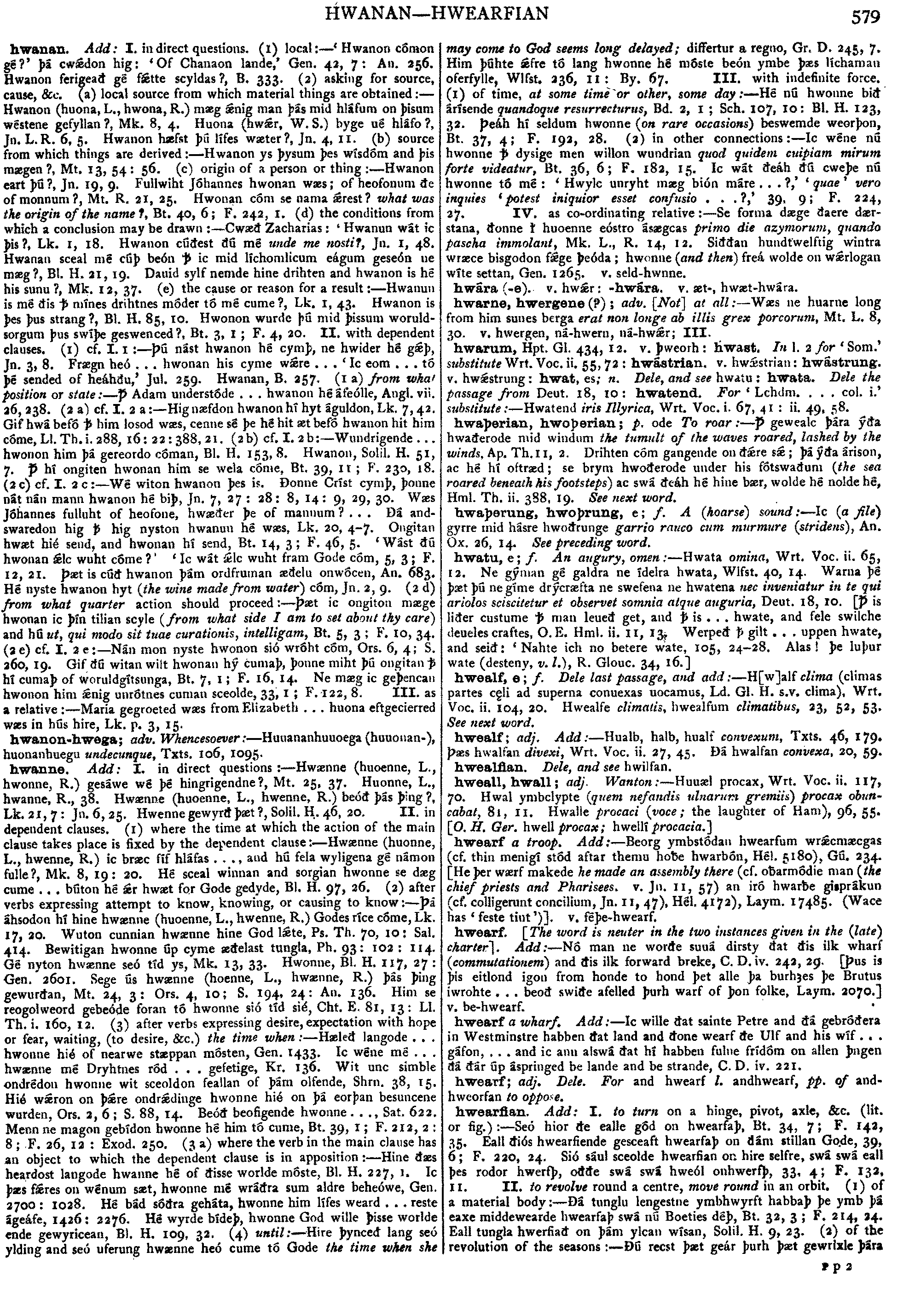
hwanan.
Add;
I.
in
direct
questions.
(1)
local
:--
'Hwanon
cómon
gé?'
þá
cwdon
hig:
'Of
Chanaon
lande,'
Gen.
42,
7:
An.
256.
Hwanon
ferigeað
gé
ftte
scyldas?,
B.
333.
(2)
asking
for
source,
cause,
&c.
(a)
local
source
from
which
material
things
are
obtained
:--
Hwanon
(huona,
L.,
hwona,
R.)
mæg
nig
man
þás
mid
hláfum
on
þisum
wéstene
gefyllan?,
Mk.
8,
4.
Huona
(hwr,
W.
S.)
byge
ué
hláfo?,
Jn.
L.
R.
6,
5.
Hwanon
hæfst
þú
lífes
wæter?,
Jn.
4,
11.
(b)
source
from
which
things
are
derived
:--
Hwanon
ys
þysum
þes
wísdóm
and
þis
mægen?,
Mt.
13,
54:
56.
(c)
origin
of
a
person
or
thing
:--
Hwanon
eart
þú?,
Jn.
19,
9.
Fullwiht
Jóhannes
hwonan
wæs;
of
heofonum
ðe
of
monnum?,
Mt.
R.
21,
25.
Hwonan
cóm
se
nama
rest?
what
was
the
origin
of
the
name?,
Bt.
40,
6;
F.
242,
1.
(d)
the
conditions
from
which
a
conclusion
may
be
drawn
:--
Cwæð
Zacharias:
'Hwanun
wát
ic
þis?,
Lk.
1,
18.
Hwanon
cúðest
ðú
mé
unde
me
nosti?,
Jn.
1,
48.
Hwanan
sceal
mé
cúþ
beón
 ic
mid
líchomlicum
eágum
geseón
ne
mæg?,
Bl.
H.
21,
19.
Dauid
sylf
nemde
hine
drihten
and
hwanon
is
hé
his
sunu?,
Mk.
12,
37.
(e)
the
cause
or
reason
for
a
result
:--
Hwanun
is
mé
ðis
mínes
drihtnes
móder
tó
mé
cume?,
Lk.
1,
43.
Hwanon
is
þes
þus
strang?,
Bl.
H.
85,
10.
Hwonon
wurde
þú
mid
þissum
woruldsorgum
þus
swíþe
geswenced?,
Bt.
3,
1;
F.
4,
20.
II.
with
dependent
clauses.
(1)
cf.
I.
1
:--
Þú
nást
hwanon
hé
cymþ,
ne
hwider
hé
gþ,
Jn.
3,
8.
Frægn
heó
...
hwonan
his
cyme
wre
...
'Ic
eom
...
tó
þé
sended
of
heáhðu,'
Jul.
259.
Hwanan,
B.
257.
(1
a)
from
what
position
or
state
:--
Adam
understóde
...
hwanon
hé
áfeólle,
Angl.
vii.
26,
238.
(2
a)
cf.
I.
2
a
:--
Hig
næfdon
hwanon
hí
hyt
águldon,
Lk.
7,
42.
Gif
hwá
befó
him
losod
wæs,
cenne
sé
þe
hé
hit
æt
befó
hwanon
hit
him
cóme,
Ll.
Th.
i.
288,
16:
22:
388,
21.
(2
b)
cf.
I.
2b
:--
Wundrigende
...
hwonon
him
þá
gereordo
cóman,
Bl.
H.
153,
8.
Hwanon,
Solil.
H.
51,
7.
hí
ongiten
hwonan
him
se
wela
cóme,
Bt.
39,
11;
F.
230,
18.
(2
c)
cf.
I.
2
c
:--
Wé
witon
hwanon
þes
is.
Ðonne
Críst
cymþ,
þonne
nát
nán
mann
hwanon
he
bi,
Jn.
7,
27:
28:
8,
14:
9,
29,
30.
Wæs
Jóhannes
fulluht
of
heofone,
hwæðer
þe
of
mannum?
...
Ða
andswaredon
hig
hig
nyston
hwanun
hé
wæs,
Lk.
20,
4-7.
Ongitan
hwæt
hié
send,
and
hwonan
hí
send,
Bt.
14,
3;
F.
46,
5.
'Wást
ðú
hwonan
lc
wuht
cóme?'
'Ic
wát
lc
wuht
fram
Gode
cóm,
5,
3;
F.
12,
21.
Þæt
is
cúð
hwanon
þám
ordfruman
æðelu
onwócen,
An.
683.
Hé
nyste
hwanon
hyt
(the
wine
made
from
water)
cóm,
Jn.
2,
9.
(2
d)
from
what
quarter
action
should
proceed
:--
Þæt
ic
ongiton
mæge
hwonan
ic
þín
tilian
scyle
(from
what
side
I
am
to
set
about
thy
care)
and
hú
ut,
qui
modo
sit
tuae
curationis,
intelligam,
Bt.
5,
3;
F.
10,
34.
(2
e)
cf.
I.
2
e
:--
Nán
mon
nyste
hwonon
sió
wróht
cóm,
Ors.
6,
4;
S.
260,
19.
Gif
ðú
witan
wilt
hwonan
hý
cumaþ,
þonne
miht
þú
ongitan
hí
cumaþ
of
woruldgítsunga,
Bt.
7,
1;
F.
16,
14.
Ne
mæg
ic
geþencan
hwonon
him
nig
unrótnes
cuman
sceolde,
33,
1;
F.
122,
8.
III.
as
a
relative
:--
Maria
gegroeted
wæs
from
Elizabeth
...
huona
eftgecierred
wæs
in
hús
hire,
Lk.
p.
3,
15.
ic
mid
líchomlicum
eágum
geseón
ne
mæg?,
Bl.
H.
21,
19.
Dauid
sylf
nemde
hine
drihten
and
hwanon
is
hé
his
sunu?,
Mk.
12,
37.
(e)
the
cause
or
reason
for
a
result
:--
Hwanun
is
mé
ðis
mínes
drihtnes
móder
tó
mé
cume?,
Lk.
1,
43.
Hwanon
is
þes
þus
strang?,
Bl.
H.
85,
10.
Hwonon
wurde
þú
mid
þissum
woruldsorgum
þus
swíþe
geswenced?,
Bt.
3,
1;
F.
4,
20.
II.
with
dependent
clauses.
(1)
cf.
I.
1
:--
Þú
nást
hwanon
hé
cymþ,
ne
hwider
hé
gþ,
Jn.
3,
8.
Frægn
heó
...
hwonan
his
cyme
wre
...
'Ic
eom
...
tó
þé
sended
of
heáhðu,'
Jul.
259.
Hwanan,
B.
257.
(1
a)
from
what
position
or
state
:--
Adam
understóde
...
hwanon
hé
áfeólle,
Angl.
vii.
26,
238.
(2
a)
cf.
I.
2
a
:--
Hig
næfdon
hwanon
hí
hyt
águldon,
Lk.
7,
42.
Gif
hwá
befó
him
losod
wæs,
cenne
sé
þe
hé
hit
æt
befó
hwanon
hit
him
cóme,
Ll.
Th.
i.
288,
16:
22:
388,
21.
(2
b)
cf.
I.
2b
:--
Wundrigende
...
hwonon
him
þá
gereordo
cóman,
Bl.
H.
153,
8.
Hwanon,
Solil.
H.
51,
7.
hí
ongiten
hwonan
him
se
wela
cóme,
Bt.
39,
11;
F.
230,
18.
(2
c)
cf.
I.
2
c
:--
Wé
witon
hwanon
þes
is.
Ðonne
Críst
cymþ,
þonne
nát
nán
mann
hwanon
he
bi,
Jn.
7,
27:
28:
8,
14:
9,
29,
30.
Wæs
Jóhannes
fulluht
of
heofone,
hwæðer
þe
of
mannum?
...
Ða
andswaredon
hig
hig
nyston
hwanun
hé
wæs,
Lk.
20,
4-7.
Ongitan
hwæt
hié
send,
and
hwonan
hí
send,
Bt.
14,
3;
F.
46,
5.
'Wást
ðú
hwonan
lc
wuht
cóme?'
'Ic
wát
lc
wuht
fram
Gode
cóm,
5,
3;
F.
12,
21.
Þæt
is
cúð
hwanon
þám
ordfruman
æðelu
onwócen,
An.
683.
Hé
nyste
hwanon
hyt
(the
wine
made
from
water)
cóm,
Jn.
2,
9.
(2
d)
from
what
quarter
action
should
proceed
:--
Þæt
ic
ongiton
mæge
hwonan
ic
þín
tilian
scyle
(from
what
side
I
am
to
set
about
thy
care)
and
hú
ut,
qui
modo
sit
tuae
curationis,
intelligam,
Bt.
5,
3;
F.
10,
34.
(2
e)
cf.
I.
2
e
:--
Nán
mon
nyste
hwonon
sió
wróht
cóm,
Ors.
6,
4;
S.
260,
19.
Gif
ðú
witan
wilt
hwonan
hý
cumaþ,
þonne
miht
þú
ongitan
hí
cumaþ
of
woruldgítsunga,
Bt.
7,
1;
F.
16,
14.
Ne
mæg
ic
geþencan
hwonon
him
nig
unrótnes
cuman
sceolde,
33,
1;
F.
122,
8.
III.
as
a
relative
:--
Maria
gegroeted
wæs
from
Elizabeth
...
huona
eftgecierred
wæs
in
hús
hire,
Lk.
p.
3,
15.
|
Source: Bosworth/Toller, page d0629, entry 16 View original page image as: [TIFF] [PNG] [View previous entry] [View next entry] |
[Comment on this entry] [View comments] |
The following entry has been hand-corrected once. |
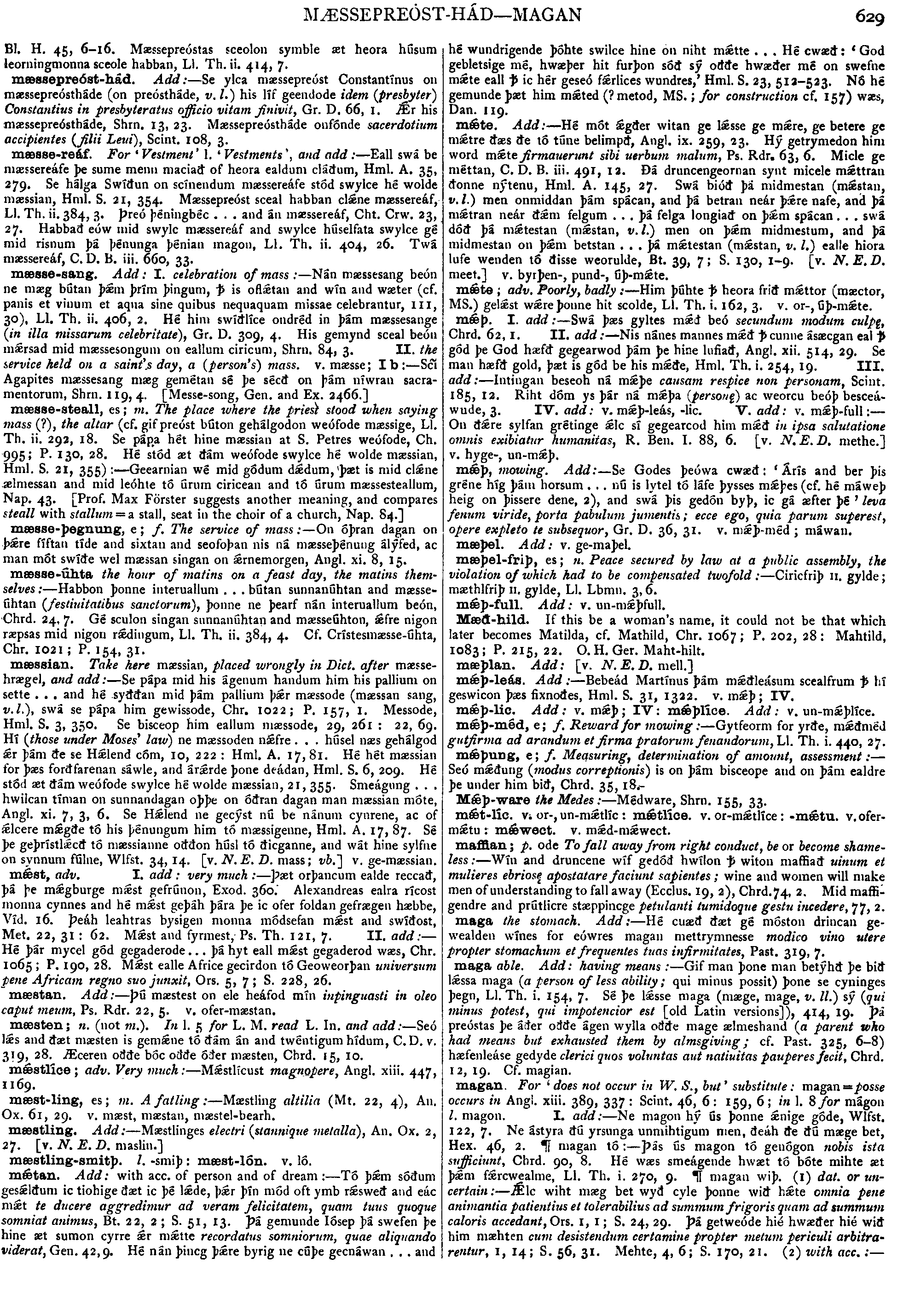
mtan.
Add:
with
acc.
of
person
and
of
dream
:--
Tó
þm
sóðum
geslðum
ic
tiohige
ðæt
ic
þé
lde,
þr
þín
mód
oft
ymb
rsweð
and
eác
mt
te
ducere
aggredimur
ad
veram
felicitatem,
quam
tuus
quoque
somniat
animus,
Bt.
22,
2
;
S.
51,
13.
Þá
gemunde
Iósep
þá
swefen
þe
hine
æt
sumon
cyrre
r
mtte
recordatus
somniorum,
quae
aliquando
viderat,
Gen.
42,
9.
Hé
nán
þincg
þre
byrig
ne
cúþe
gecnáwan
.
.
.
and
hé
wundrigende
þóhte
swilce
hine
on
niht
mtte
.
.
.
Hé
cwæð:
'God
gebletsige
mé,
hwæþer
hit
furþon
sóð
sý
oððe
hwæðer
mé
on
swefne
mte
eall
ic
hér
geseó
frlices
wundres,
Hml.
S.
23,
512-523.
Nó
hé
gemunde
þæt
him
mted
(?
metod,
MS.;
for
construction
cf.
157)
wæs,
Dan.
119.
|
Source: Bosworth/Toller, page d0736, entry 8 View original page image as: [TIFF] [PNG] [View previous entry] [View next entry] |
[Comment on this entry] [View comments] |
The following entry has been hand-corrected once. |
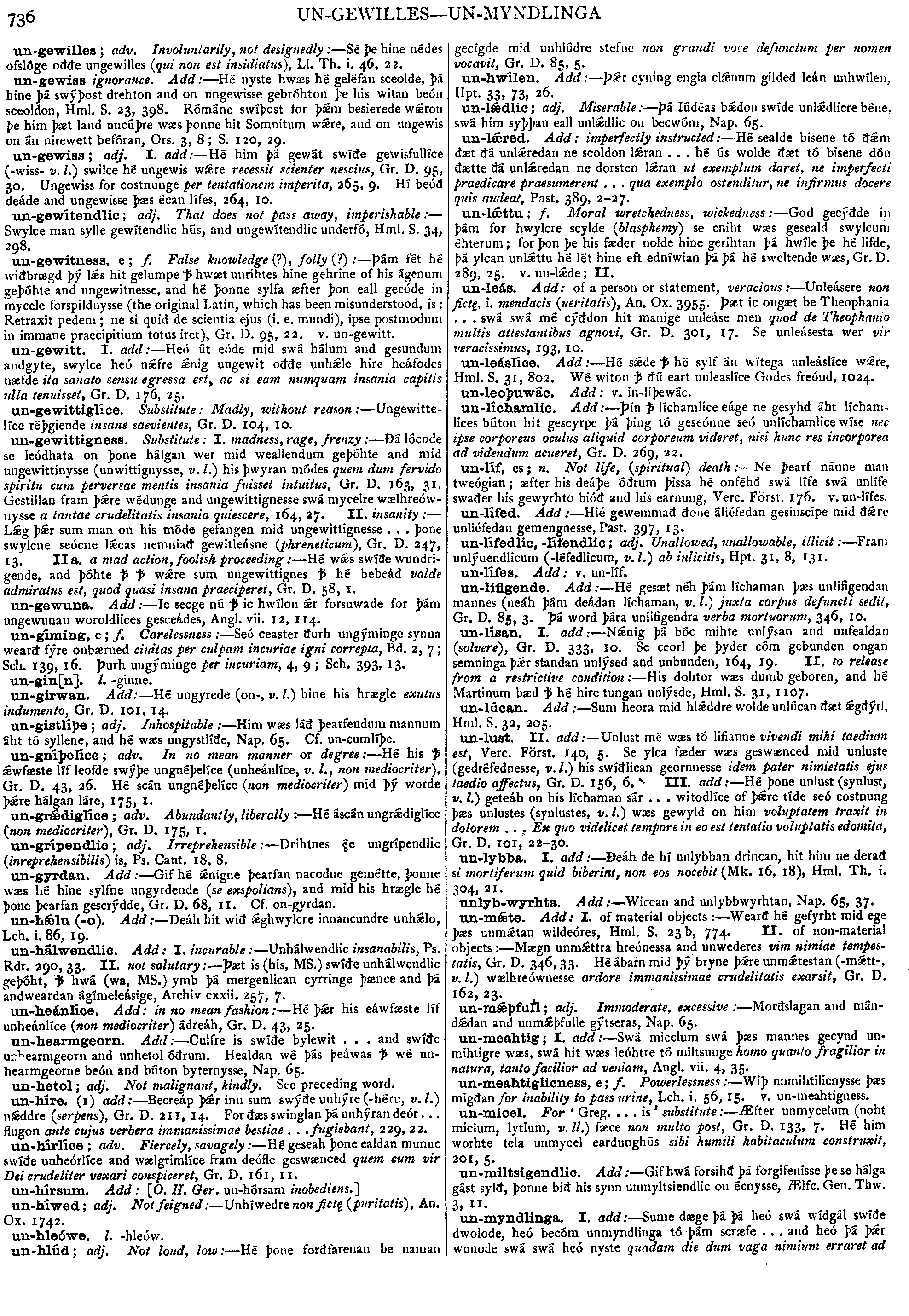
un-gewittigness.
Substitute:
I.
madness,
rage,
frenzy
:--
Ðá
lócode
se
leódhata
on
þone
hálgan
wer
mid
weallendum
geþóhte
and
mid
ungewittinysse
(unwittignysse,
v.l.)
his
þwyran
módes
quern
dum
fervido
spiritu
cum
perversae
mentis
insania
fuisset
intuitus.
Gr.
D.
163,
31.
Gestillan
fram
þre
wédunge
and
ungewittignesse
swá
mycelre
wælhreów-nysse
a
tantae
crudelitatis
insania
quiescere,
164,
27.
II.
insanity:
Lg
þær
sum
man
on
his
móde
gefangen
mid
ungewittignesse
.
.
.
þone
swylcne
seócne
lcas
nemniað
gewitleásne
(phreneticum).
Gr.
D.
247,
13.
II
a.
a
mad
action,
foolish
proceeding
:--
Hé
wæs
swíðe
wundrigende,
and
þóhte
wre
sum
ungewittignes
hé
bebeád
valde
admiratus
est,
quod
quasi
insana
praeciperet,
Gr.
D.
58,
l.
|
Source: Bright's OE Grammar, page b0382, entry 27 View original page image as: [TIFF] [PNG] [View previous entry] [View next entry] |
[Comment on this entry] [View comments] |
The following entry has been hand-corrected once. |
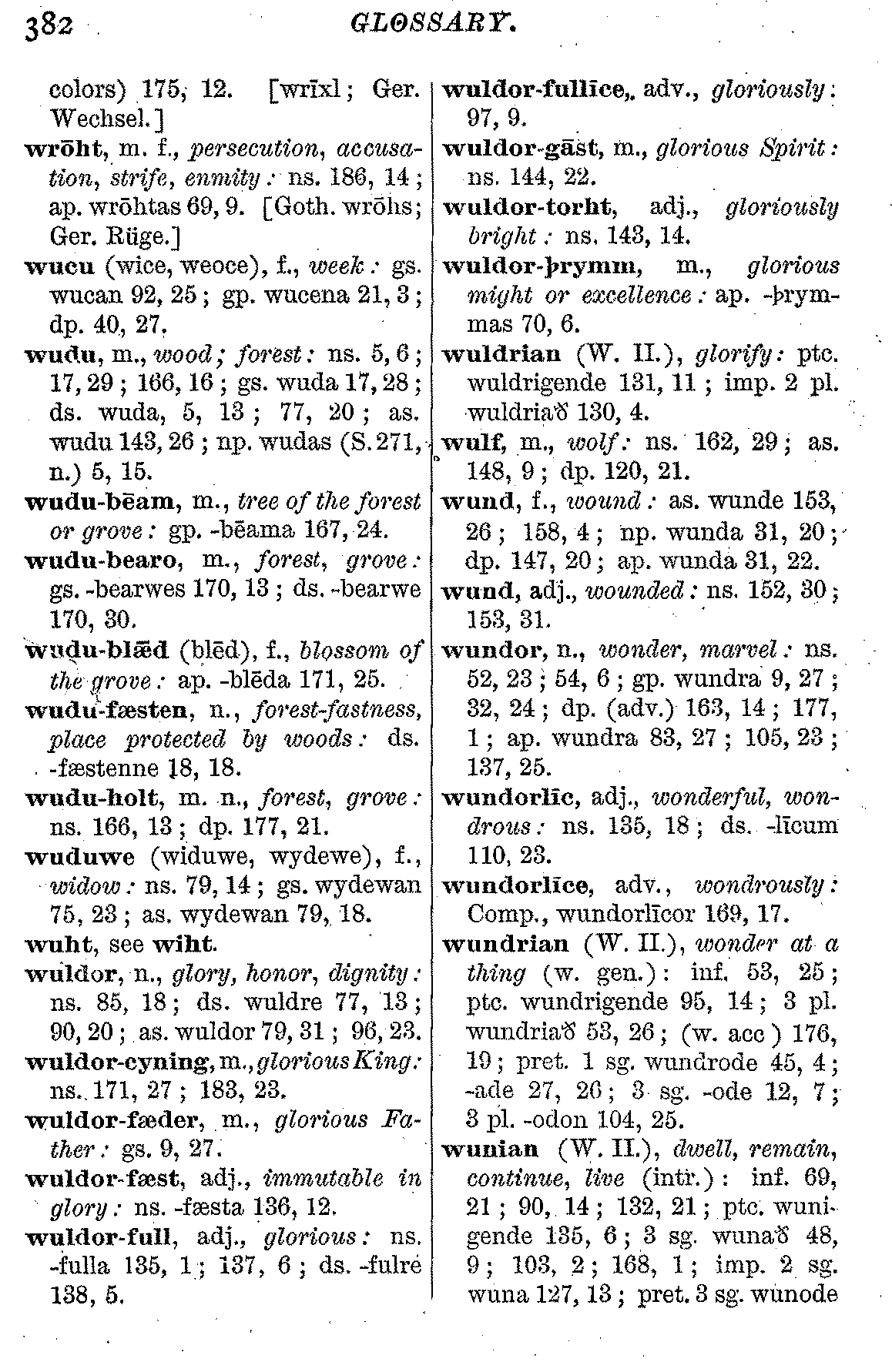
wundrian WII wonder at a thing (w gen)
Germanic Lexicon Project (main page)
This search system was written by
Sean Crist
Please consider
volunteering
to correct the data in these online dictionaries.
No rights reserved. Feel free to use these data in any way you please.