|
|

|
Source: Bosworth/Toller, page b0679, entry 9 View original page image as: [TIFF] [PNG] [View previous entry] [View next entry] |
[Comment on this entry] [View comments] |
The following entry has been hand-corrected once. |
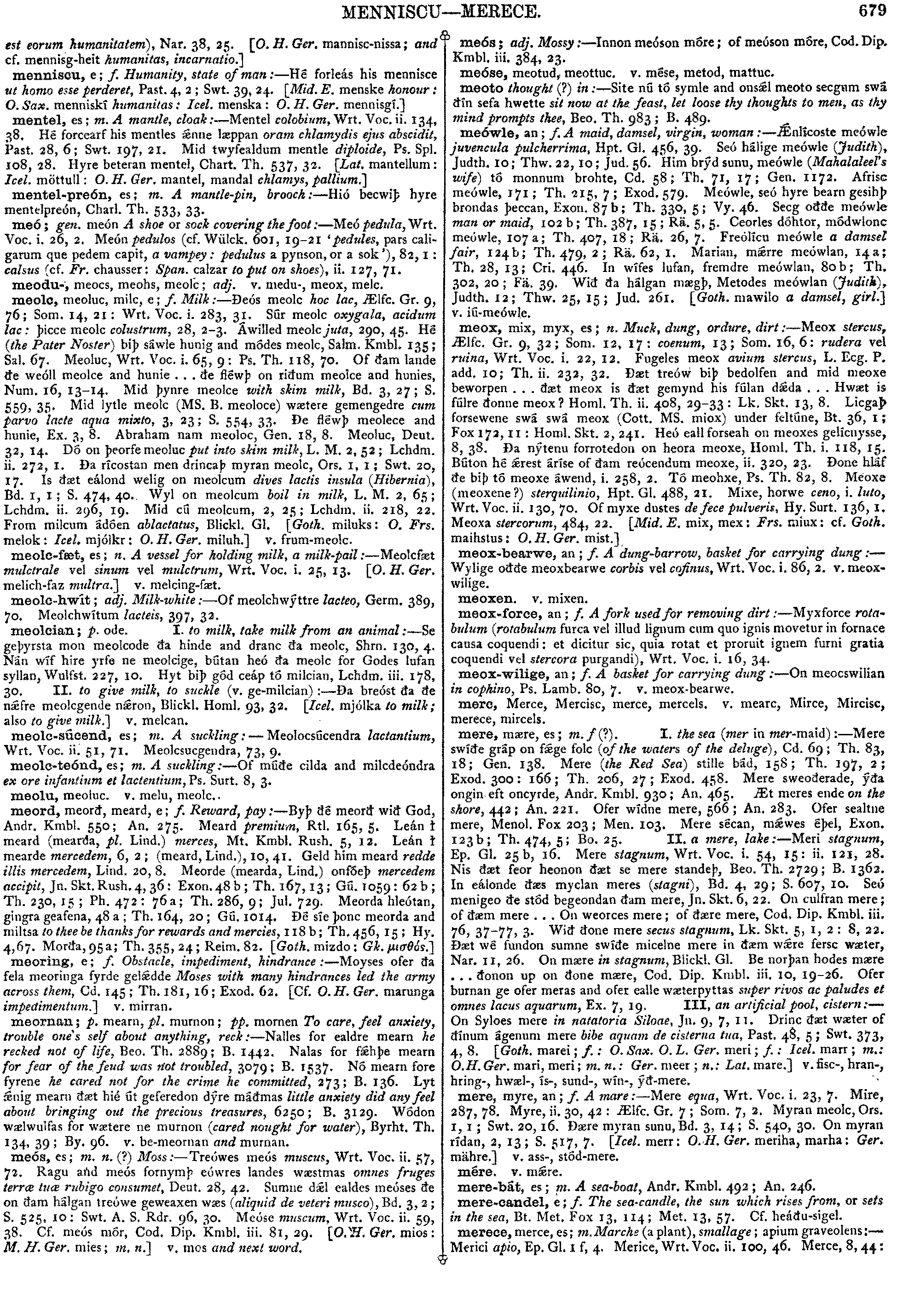
meolcian;
p.
ode.
I.
to
milk,
take
milk
from
an
animal
:--
Se
geþyrsta
men
meolcode
ða
hinde
and
dranc
ða
meolc,
Shrn.
130,
4.
Nán
wíf
hire
yrfe
ne
meolcige,
bútan
heó
ða
meolc
for
Godes
lufan
syllan,
Wulfst.
227,
10.
Hyt
biþ
gód
ceáp
tó
milcian,
Lchdm.
iii.
178,
30.
II.
to
give
milk,
to
suckle
(v.
ge-milcian)
:--
Ða
breóst
ða
ðe
n fre
meolcgende
nron,
Blickl.
Homl.
93,
32.
[Icel.
mjólka
to
milk;
also
to
give
milk.]
v.
melcan.
fre
meolcgende
nron,
Blickl.
Homl.
93,
32.
[Icel.
mjólka
to
milk;
also
to
give
milk.]
v.
melcan.
|
Source: Bosworth/Toller, page b0685, entry 7 View original page image as: [TIFF] [PNG] [View previous entry] [View next entry] |
[Comment on this entry] [View comments] |
The following entry has been hand-corrected once. |
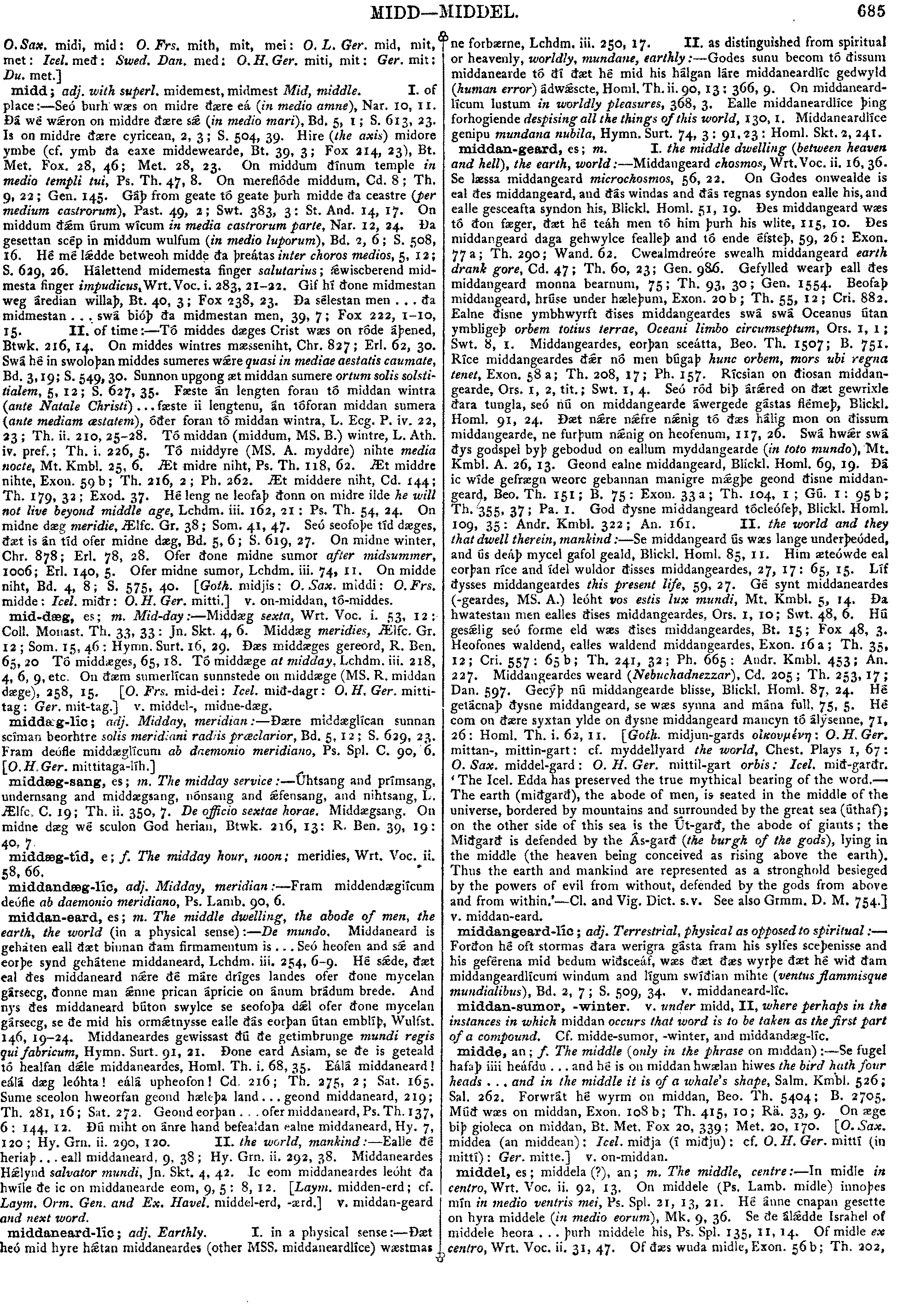
middan-eard,
es;
m.
The
middle
dwelling,
the
abode
of
men,
the
earth,
the
world
(in
a
physical
sense)
:--
De
mundo.
Middaneard
is
gehaten
eall
ðæt
binnan
ðam
firmamentum
is
...
Seó
heofen
and
s
and
eorþe
synd
gehátene
middaneard,
Lchdm.
iii.
254,
6-9.
Hé
sde,
ðæt
eal
ðes
middaneard
nre
ðé
máre
dríges
landes
ofer
ðone
mycelan
gársecg,
ðonne
man
nne
prican
ápricie
on
ánum
brádum
brede.
And
nys
ðes
middaneard
búton
swylce
se
seofoþa
dl
ofer
ðone
mycelan
gársecg,
se
ðe
mid
his
ormtnysse
ealle
ðás
eorþan
útan
emblíþ,
Wulfst.
146,
19-24.
Middaneardes
gewissast
ðú
ðe
getimbrunge
mundi
regis
qui
fabricum,
Hymn.
Surt.
91,
21.
Ðone
eard
Asiam,
se
ðe
is
geteald
tó
healfan
dle
middaneardes,
Homl.
Th.
i.
68,
35.
Eálá
middaneard!
eálá
dæg
leóhta!
eálá
upheofon!
Cd.
216;
Th.
275,
2;
Sat.
165.
Sume
sceolon
hweorfan
geond
hæleþa
land
...
geond
middaneard,
219;
Th.
281,
16;
Sat.
272.
Geond
eorþan
...
ofer
middaneard,
Ps.
Th.
137,
6:
144,
12.
Ðú
miht
on
ánre
hand
befealdan
ealne
middaneard,
Hy.
7,
120;
Hy.
Grn.
ii.
290,
120.
II.
the
world,
mankind
:--
Ealle
ðé
heriaþ
...
eall
middaneard,
9,
38;
Hy.
Grn.
ii.
292,
38.
Middaneardes
Hlynd
salvator
mundi,
Jn.
Skt,
4,
42.
Ic
eom
middaneardes
leóht
ða
hwíle
ðe
ic
on
middanearde
eom,
9,
5:
8,
12.
[Laym.
midden-erd;
cf.
Laym.
Orm.
Gen.
and
Ex.
Havel.
middel-erd,
-ærd.]
v.
middan-geard
and
next
word.
|
Source: Bosworth/Toller, page b0687, entry 16 View original page image as: [TIFF] [PNG] [View previous entry] [View next entry] |
[Comment on this entry] [View comments] |
The following entry has been hand-corrected once. |
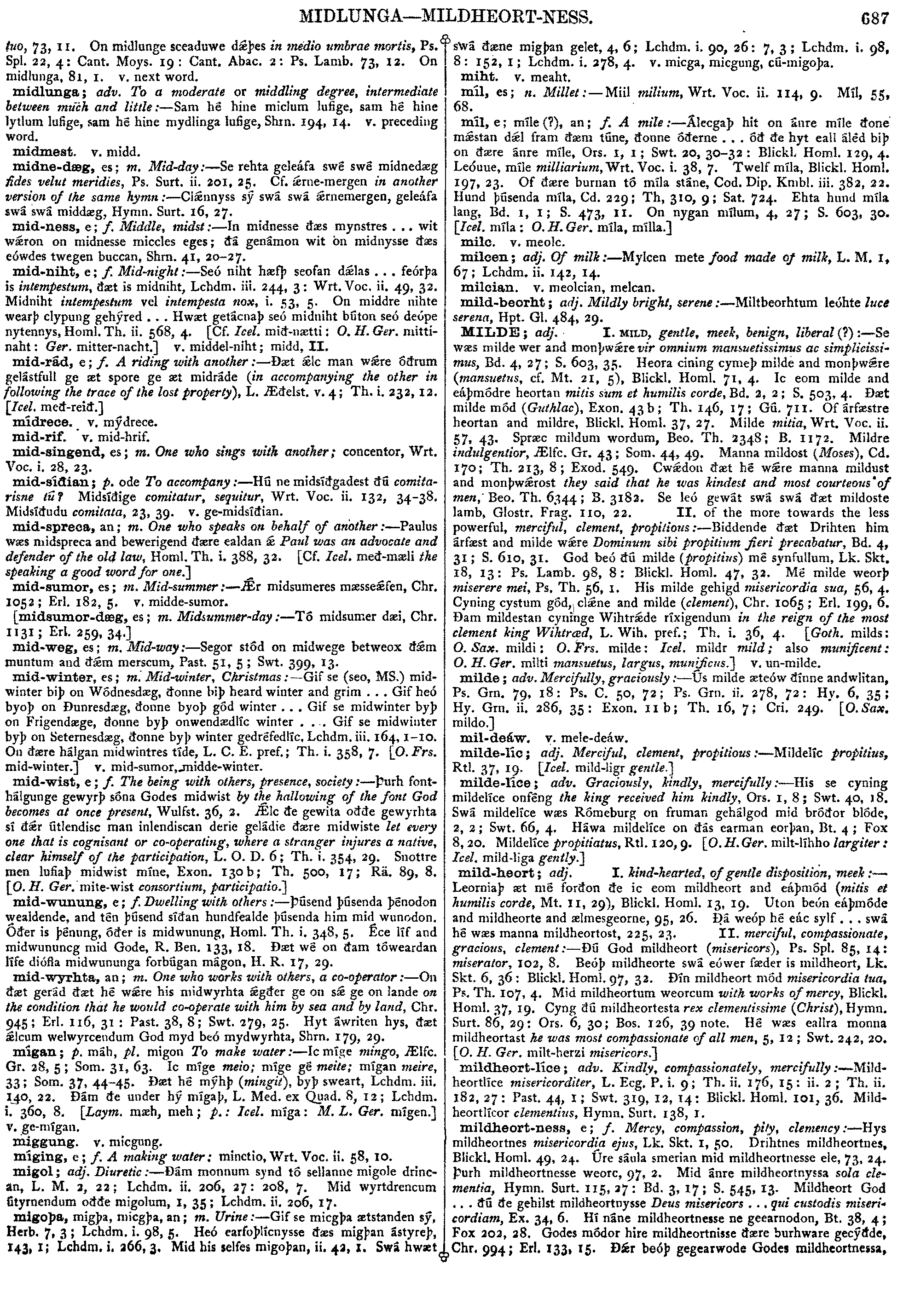
mid-wist,
e;
f.
The
being
with
others,
presence,
society
:--
Þurh
font-hálgunge
gewyrþ
sóna
Godes
midwist
by
the
hallowing
of
the
font
God
becomes
at
once
present,
Wulfst.
36,
2.
Æ-acute;lc
ðe
gewita
oððe
gewyrhta
sí
ðr
útlendisc
man
inlendiscan
derie
geládie
ðære
midwiste
let
every
one
that
is
cognisant
or
co-operating,
where
a
stranger
injures
a
native,
clear
himself
of
the
participation,
L.
O.
D.
6;
Th.
i.
354,
29.
Snottre
men
lufiaþ
midwist
míne,
Exon.
130
b;
Th.
500,
17;
Rä.
89,
8.
[O.
H.
Ger.
mite-wist
consortium,
participatio.]
|
Source: Bosworth/Toller, page b0689, entry 1 View original page image as: [TIFF] [PNG] [View previous entry] [View next entry] |
[Comment on this entry] [View comments] |
The following entry has been hand-corrected once. |
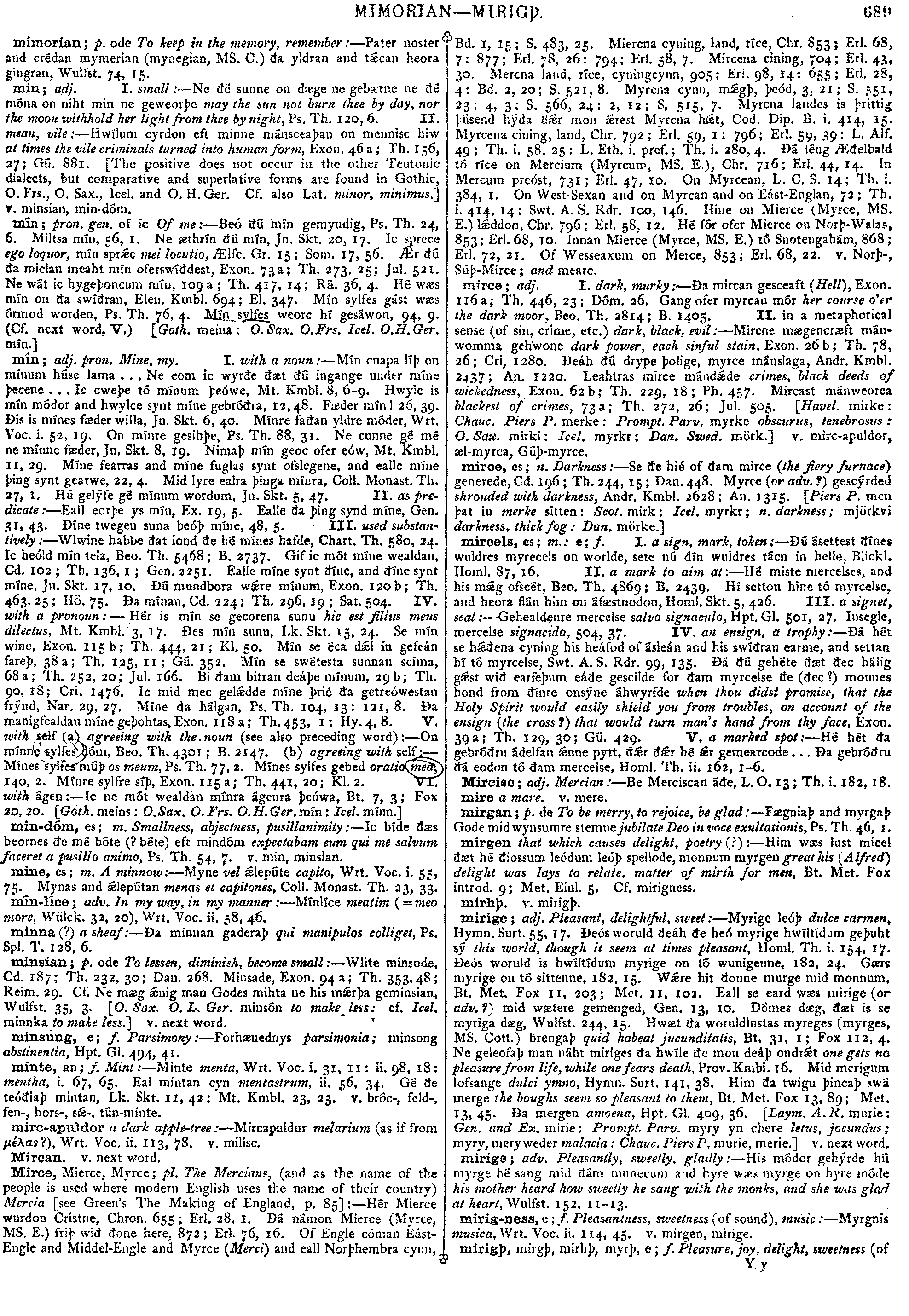
mimorian;
p.
ode
To
keep
in
the
memory
remember
:--
Pater
noster
and
crédan
mymerian
(mynegian,
MS.
C.)
ða
yldran
and
tcan
heora
gingran,
Wulfst.
74,
15.
|
Source: Bosworth/Toller, page b0689, entry 9 View original page image as: [TIFF] [PNG] [View previous entry] [View next entry] |
[Comment on this entry] [View comments] |
The following entry has been hand-corrected once. |
minsian;
p.
ode
To
lessen,
diminish,
become
small
:--
Wlite
minsode,
Cd.
187;
Th.
232,
30;
Dan.
268.
Minsade,
Exon.
94
a;
Th.
353,
48;
Reim.
29.
Cf.
Ne
mæg
nig
man
Godes
mihta
ne
his
mrþa
geminsian,
Wulfst.
35,
3.
[O.
Sax.
O.
L.
Ger.
minsón
to
make
less:
cf.
Icel.
minnka
to
make
less.]
v.
next
word.
|
Source: Bosworth/Toller, page b0689, entry 23 View original page image as: [TIFF] [PNG] [View previous entry] [View next entry] |
[Comment on this entry] [View comments] |
The following entry has been hand-corrected once. |
mirige;
adj.
Pleasant,
delightful,
sweet
:--
Myrige
leóþ
dulce
carmen,
Hymn.
Surt.
55,
17.
Ðeós
woruld
ðeáh
ðe
beó
myrige
hwíltídum
geþuht
sý
this
world,
though
it
seem
at
times
pleasant,
Homl.
Th.
i.
154,
17.
Ðeós
woruld
is
hwíltídum
myrige
on
tó
wunigenne,
182,
24.
Gærs
myrige
on
tó
sittenne,
182,
15.
Wre
hit
ðonne
murge
mid
monnum,
Bt.
Met.
Fox
11,
203;
Met.
11,
102.
Eall
se
eard
wæs
mirige
(or
adv.
?)
mid
wætere
gemenged,
Gen.
13,
10.
Dómes
dæg,
ðæt
is
se
myriga
dæg,
Wulfst.
244,
15.
Hwæt
ða
woruldlustas
myreges
(myrges,
MS.
Cott.)
brengaþ
quid
habeat
jucunditatis,
Bt.
31,
1;
Fox
112,
4.
Ne
geleofaþ
man
náht
miriges
ða
hwíle
ðe
mon
deáþ
ondrt
one
gets
no
pleasure
from
life,
while
one
fears
death,
Prov.
Kmbl.
16.
Mid
merigum
lofsange
dulci
ymno,
Hymn.
Surt.
141,
38.
Him
ða
twigu
þincaþ
swá
merge
the
boughs
seem
so
pleasant
to
them,
Bt.
Met.
Fox
13,
89;
Met.
13,
45.
Ða
mergen
amoena,
Hpt.
Gl.
409,
36.
[Laym.
A.
R.
murie:
Gen.
and
Ex.
mirie:
Prompt.
Parv.
myry
yn
chere
letus,
jocundus;
myry,
mery
weder
malacia:
Chauc.
Piers
P.
murie,
merie.]
v.
next
word.
|
Source: Bosworth/Toller, page b0689, entry 24 View original page image as: [TIFF] [PNG] [View previous entry] [View next entry] |
[Comment on this entry] [View comments] |
The following entry has been hand-corrected once. |
mirige; adv. Pleasantly, sweetly, gladly :-- His módor gehýrde hú myrge hé sang mid ðám munecum and hyre wæs myrge on hyre móde his mother heard how sweetly he sang with the monks, and she was glad at heart, Wulfst. 152, 11-13.
|
Source: Bosworth/Toller, page b0689, entry 26 View original page image as: [TIFF] [PNG] [View previous entry] [View next entry] |
[Comment on this entry] [View comments] |
The following entry has been hand-corrected once. |
mirigþ,
mirhþ,
mirhþ,
myrþ,
e;
f.
Pleasure,
joy,
delight,
sweetness
(of
sound)
:--
Dæg
byþ
myrþþ
eádgum
and
earmum
day
is
a
delight
to
rich
and
to
poor,
Runic
pm.
Kmbl.
344,
12;
Rún.
24.
Wá
him
ðære
mirigþe
búte
hé
ðæs
yfeles
r
geswíce
alas
for
his
delight,
unless
first
he
leave
evil,
Hy.
2,
6;
Hy.
Grn.
ii.
281,
6.
Hé
ádrfed
wæs
of
neorxena
wanges
myrþe
(paradisum
voluptatis),
Gen.
3,
24.
For
ðære
mirhte
(mergþe,
MS.
Cott.)
ðæs
sónes,
Bt.
35,
6;
Fox
168,
11.
On
heofonan
ríces
mirhþe,
Ælfc.
T.
Grn.
1,
11.
Myrhþe,
Homl.
Th.
i.
58,
4.
Ða
heorde
tó
heofonlícre
myrhþe
(myrþe,
MS.
B.)
ldan,
L.
C.
S.
85;
Th.
i.
424,
11.
Man
byþ
on
myrhþe
(joyous),
Runic
pm.
Kmbl.
343,
11;
Rún.
20.
Ðú
ðr
náne
myrhþe
on
næfdest
ðá
ðá
ðú
hié
hæfdest
thou
hadst
no
pleasure
in
them,
when
thou
hadst
them;
nec
habuisse
te
in
ea
pulcrum
aliquid,
Bt.
7,
1;
Fox
16,
17.
Ðín
ríce
ðr
wé
gemétaþ
ealle
mirhþe,
Hy.
7,
31;
Hy.
Grn.
ii.
287,
31.
Ðr
(heaven)
syndan
mihta,
mrþa
and
myrhþa.
Wulfst.
5,
5:
167,
9:
28,
7.
Adam
wearþ
of
myclum
myrhþum
bescofen
tó
hefigum
geswincum,
104,
1.
v.
myrige,
un-mirigþ.
|
Source: Bosworth/Toller, page b0690, entry 8 View original page image as: [TIFF] [PNG] [View previous entry] [View next entry] |
[Comment on this entry] [View comments] |
The following entry has been hand-corrected once. |
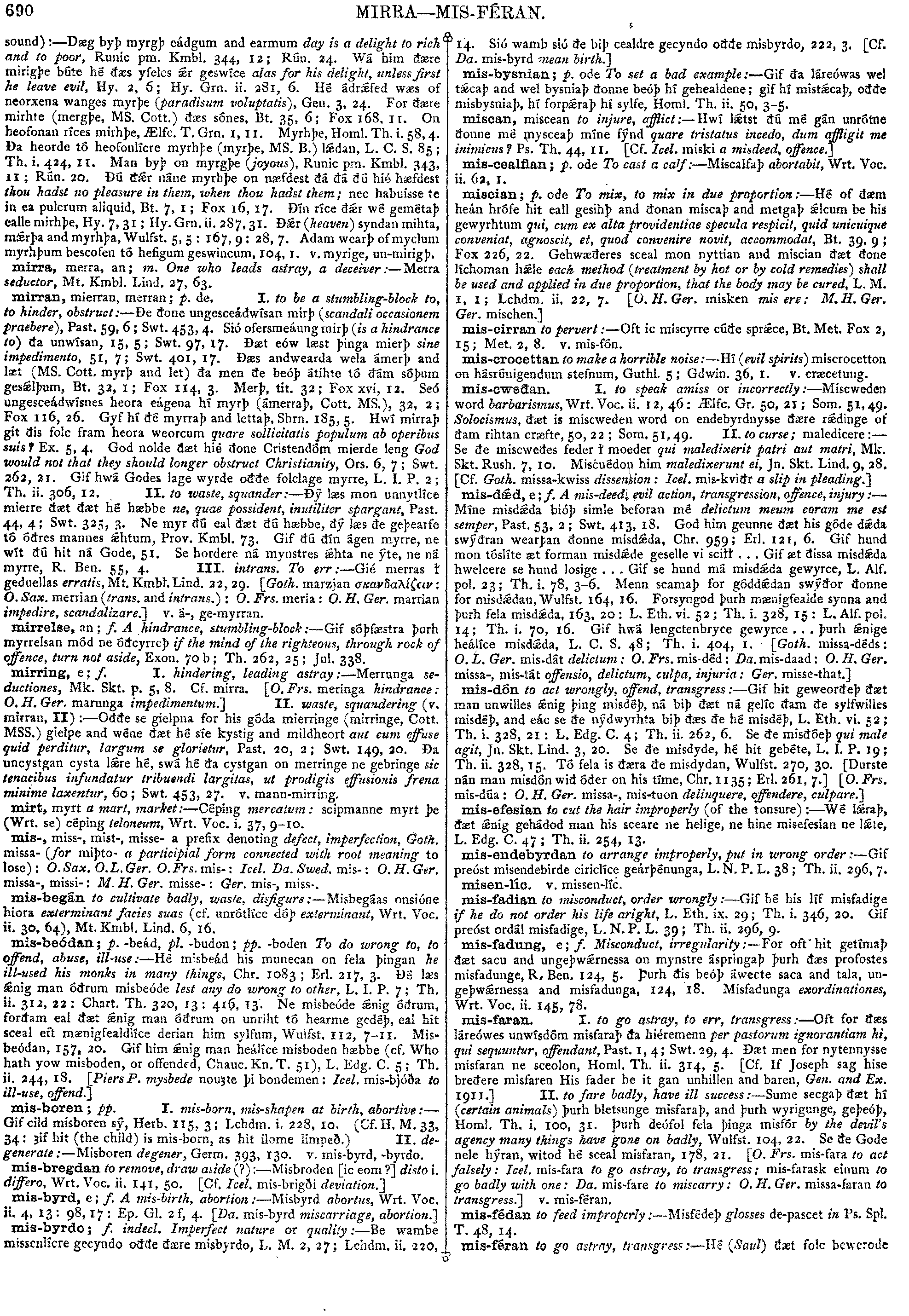
mis-beódan;
p.
-beád,
pl.
-budon;
pp.
-boden
To
do
wrong
to,
to
offend,
abuse,
ill-use
:--
Hé
misbeád
his
munecan
on
fela
þingan
he
ill-used
his
monks
in
many
things,
Chr.
1083;
Erl.
217,
3.
Ðé
læs
nig
man
óðrum
misbeóde
lest
any
do
wrong
to
other,
L.
I.
P.
7;
Th.
ii.
312,
22:
Chart.
Th.
320,
13:
416,
13.
Ne
misbeóde
nig
óðrum,
forðam
eal
ðæt
nig
man
óðrum
on
unriht
tó
hearme
gedéþ,
eal
hit
sceal
eft
mænigfealdlíce
derian
him
sylfum,
Wulfst.
112,
7-11.
Misbeódan,
157,
20.
Gif
him
nig
man
heálíce
misboden
hæbbe
(cf.
Who
hath
yow
misboden,
or
offended,
Chauc.
Kn.
T.
51),
L.
Edg.
C.
5;
Th.
ii.
244,
18.
[Piers
P.
mysbede
nou te
þi
bondemen:
Icel.
mis-bjóða
to
ill-use,
offend.]
te
þi
bondemen:
Icel.
mis-bjóða
to
ill-use,
offend.]
|
Source: Bosworth/Toller, page b0690, entry 20 View original page image as: [TIFF] [PNG] [View previous entry] [View next entry] |
[Comment on this entry] [View comments] |
The following entry has been hand-corrected once. |
mis-dd,
e;
f.
A
mis-deed;
evil
action,
transgression,
offence,
injury
:--
Míne
misdda
bióþ
simle
beforan
mé
delictum
meum
coram
me
est
semper,
Past.
53,
2;
Swt.
413,
18.
God
him
geunne
ðæt
his
góde
dda
swýðran
wearþan
ðonne
misdda,
Chr.
959;
Erl.
121,
6.
Gif
hund
mon
tóslíte
æt
forman
misdde
geselle
vi
sci ...
Gif
æt
ðissa
misdda
hwelcere
se
hund
losige
...
Gif
se
hund
má
misdda
gewyrce,
L.
Alf.
pol.
23;
Th.
i.
78,
3-6.
Menn
scamaþ
for
gódddan
swýðor
ðonne
for
misddan,
Wulfst.
164,
16.
Forsyngod
þurh
mænigfealde
synna
and
þurh
fela
misdda,
163,
20:
L.
Eth.
vi.
52;
Th.
i.
328,
15:
L.
Alf.
pol.
14;
Th.
i.
70,
16.
Gif
hwá
lengctenbryce
gewyrce
...
þurh
nige
heálíce
misdda,
L.
C.
S.
48;
Th.
i.
404,
1.
[Goth.
missa-déds:
O.
L.
Ger.
mis-dát
delictum:
O.
Frs.
mis-déd:
Da.
mis-daad:
O.
H.
Ger.
missa-,
mis-tát
offensio,
delictum,
culpa,
injuria:
Ger.
misse-that.]
...
Gif
æt
ðissa
misdda
hwelcere
se
hund
losige
...
Gif
se
hund
má
misdda
gewyrce,
L.
Alf.
pol.
23;
Th.
i.
78,
3-6.
Menn
scamaþ
for
gódddan
swýðor
ðonne
for
misddan,
Wulfst.
164,
16.
Forsyngod
þurh
mænigfealde
synna
and
þurh
fela
misdda,
163,
20:
L.
Eth.
vi.
52;
Th.
i.
328,
15:
L.
Alf.
pol.
14;
Th.
i.
70,
16.
Gif
hwá
lengctenbryce
gewyrce
...
þurh
nige
heálíce
misdda,
L.
C.
S.
48;
Th.
i.
404,
1.
[Goth.
missa-déds:
O.
L.
Ger.
mis-dát
delictum:
O.
Frs.
mis-déd:
Da.
mis-daad:
O.
H.
Ger.
missa-,
mis-tát
offensio,
delictum,
culpa,
injuria:
Ger.
misse-that.]
| Result Page: |  |
Previous | 4 5 6 7 8 9 10 11 12 13 14 15 16 17 18 19 20 21 22 | Next |  |
Germanic Lexicon Project (main page)
This search system was written by
Sean Crist
Please consider
volunteering
to correct the data in these online dictionaries.
No rights reserved. Feel free to use these data in any way you please.