|
|

|
Source: Bosworth/Toller, page d0544, entry 3 View original page image as: [TIFF] [PNG] [View previous entry] [View next entry] |
[Comment on this entry] [View comments] |
The following entry has been hand-corrected once. |
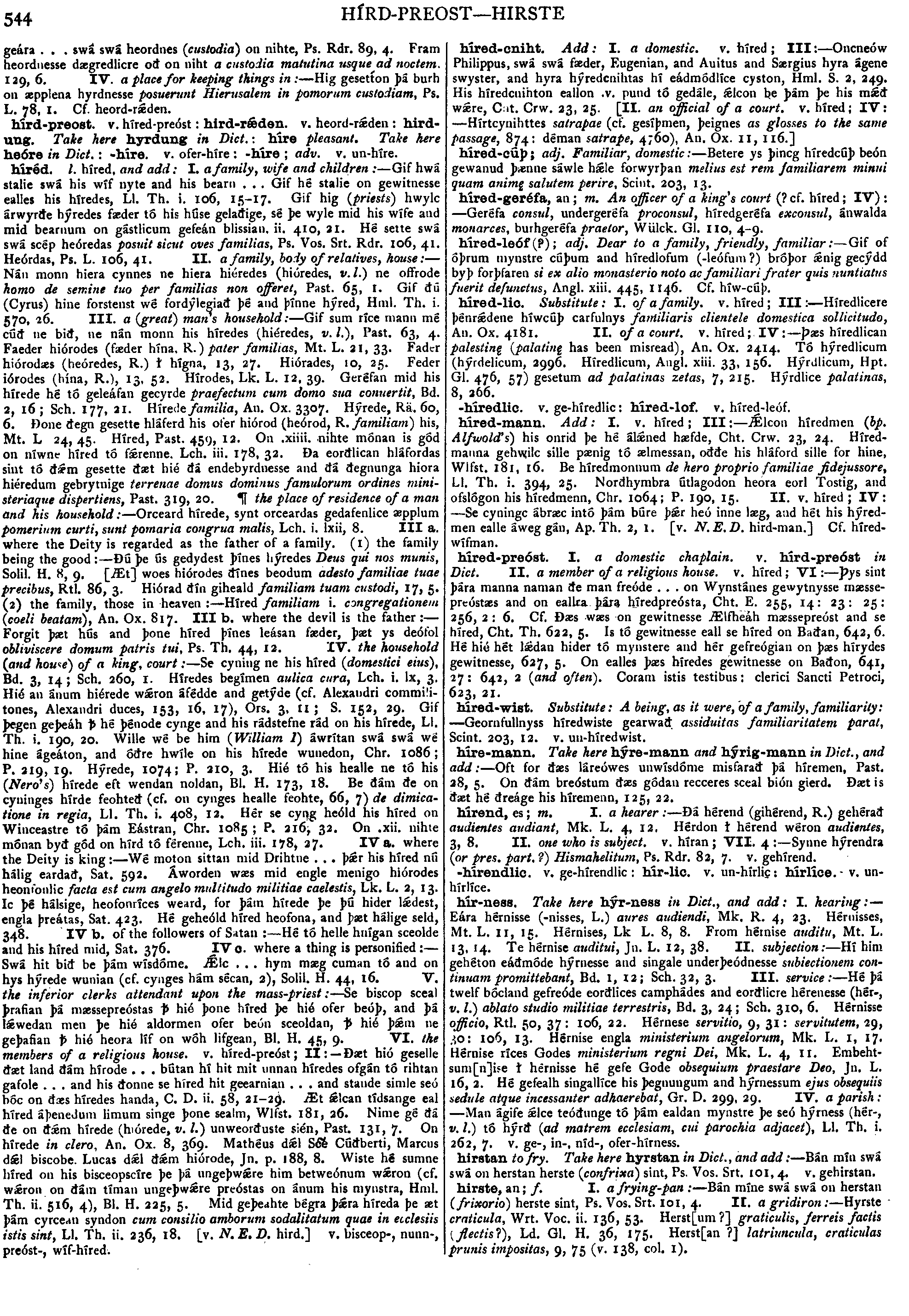
híréd,
l.
híred,
and
add:
I.
a
family,
wife
and
children
:--
Gif
hwá
stalie
swá
his
wif
nyte
and
his
bearn
...
Gif
hé
stalie
on
gewitnesse
ealles
his
híredes,
Ll.
Th.
i.
106,
15-17.
Gif
hig
(priests)
hwylc
árwyrðe
hýredes
fæder
tó
his
húse
gelaðige,
sé
þe
wyle
mid
his
wífe
and
mid
bearnum
on
gástlicum
gefeán
blissian,
ii.
410,
21.
Hé
sette
swá
swá
scép
heóredas
posuit
sicut
oves
familias,
Ps.
Vos.
Srt.
Rdr.
106,
41.
Heórdas,
Ps.
L.
106,
41.
II.
a
family,
body
of
relatives,
house
:--
Nán
monn
hiera
cynnes
ne
hiera
hiéredes
(hióredes,
v.
l.)
ne
offrode
homo
de
semine
tuo
per
familias
nan
offeret,
Past.
65,
1.
Gif
ðú
(Cyrus)
hine
forstenst
wé
fordýlegiað
þé
and
þínne
hýred,
Hml.
Th.
i.
570,
26.
III.
a
(great)
mans
household
:--
Gif
sum
ríce
mann
mé
cúð
ne
bið,
ne
nán
monn
his
híredes
(hiéredes,
v.
l.),
Past.
63,
4.
Faeder
hiórodes
(fæder
hína,
R.)
pater
familias,
Mt.
L.
31,
33.
Fader
hiórodæs
(heóredes,
R.)
 hígna,
13,
27.
Hiórades,
10,
25.
Feder
iórodes
(hína,
R.),
13,
52.
Hírodes,
Lk.
L.
12,
39.
Geréfan
mid
his
hírede
hé
tó
geleáfan
gecyrde
praefectum
cum
domo
sua
conuertit,
Bd.
2,
16;
Sch.
177,
21.
Hírede
familia,
An.
Ox.
3307.
Hýrede,
Rä.
60,
6.
Ðone
ðegn
gesette
hláferd
his
ofer
hiórod
(heórod,
R.
familiam)
his,
Mt.
L.
24,
45.
Híred,
Past.
459,
12.
On
.xiiii.
nihte
mónan
is
gód
on
níwne
híred
tó
f
hígna,
13,
27.
Hiórades,
10,
25.
Feder
iórodes
(hína,
R.),
13,
52.
Hírodes,
Lk.
L.
12,
39.
Geréfan
mid
his
hírede
hé
tó
geleáfan
gecyrde
praefectum
cum
domo
sua
conuertit,
Bd.
2,
16;
Sch.
177,
21.
Hírede
familia,
An.
Ox.
3307.
Hýrede,
Rä.
60,
6.
Ðone
ðegn
gesette
hláferd
his
ofer
hiórod
(heórod,
R.
familiam)
his,
Mt.
L.
24,
45.
Híred,
Past.
459,
12.
On
.xiiii.
nihte
mónan
is
gód
on
níwne
híred
tó
f renne,
Lch.
iii.
178,
32.
Ða
eorðlican
hláfordas
sint
tó
ðm
gesette
ðæt
hié
ðá
endebyrdnesse
and
ðá
ðegnunga
hiora
hiéredum
gebrytnige
terrenae
domus
dominus
famulorum
ordines
ministeriaque
dispertiens,
Past.
319,
20.

the
place
of
residence
of
a
man
and
his
household
:--
Orceard
hírede,
synt
orceardas
gedafenlice
æpplum
pomerium
curti,
sunt
pomaria
congrua
malis,
Lch.
i.
lxii,
8.
III
a.
where
the
Deity
is
regarded
as
the
father
of
a
family.
(1)
the
family
being
the
good
:--
Ðú
þe
ús
gedydest
þínes
hýredes
Deus
qui
nos
munis,
Solil.
H.
8,
9.
[Æt]
woes
hiórodes
ðínes
beodum
adesto
familiae
tuae
precibus,
Rtl.
86,
3.
Hiórad
ðín
giheald
familiam
tuam
custodi,
17,
5.
(2)
the
family,
those
in
heaven
:--
Híred
familiam
i.
congregationem
(coeli
beatam),
An.
Ox.
817.
III
b.
where
the
devil
is
the
father
:--
Forgit
þæt
hús
and
þone
híred
þínes
leásan
fæder,
þæt
ys
deófol
obliviscere
domum
patris
tui,
Ps.
Th.
44,
12.
IV.
the
household
(and
house)
of
a
king,
court
:--
Se
cyning
ne
his
híred
(domestici
eius),
Bd.
3,
14;
Sch.
260,
1.
Híredes
begímen
aulica
cura,
Lch.
i.
lx,
3.
Hié
an
ánum
hiérede
wron
áfédde
and
getýde
(cf.
Alexandri
commilitones,
Alexandri
duces,
153,
16,
17),
Ors.
3,
11;
S.
152,
29.
Gif
þegen
geþeáh
renne,
Lch.
iii.
178,
32.
Ða
eorðlican
hláfordas
sint
tó
ðm
gesette
ðæt
hié
ðá
endebyrdnesse
and
ðá
ðegnunga
hiora
hiéredum
gebrytnige
terrenae
domus
dominus
famulorum
ordines
ministeriaque
dispertiens,
Past.
319,
20.

the
place
of
residence
of
a
man
and
his
household
:--
Orceard
hírede,
synt
orceardas
gedafenlice
æpplum
pomerium
curti,
sunt
pomaria
congrua
malis,
Lch.
i.
lxii,
8.
III
a.
where
the
Deity
is
regarded
as
the
father
of
a
family.
(1)
the
family
being
the
good
:--
Ðú
þe
ús
gedydest
þínes
hýredes
Deus
qui
nos
munis,
Solil.
H.
8,
9.
[Æt]
woes
hiórodes
ðínes
beodum
adesto
familiae
tuae
precibus,
Rtl.
86,
3.
Hiórad
ðín
giheald
familiam
tuam
custodi,
17,
5.
(2)
the
family,
those
in
heaven
:--
Híred
familiam
i.
congregationem
(coeli
beatam),
An.
Ox.
817.
III
b.
where
the
devil
is
the
father
:--
Forgit
þæt
hús
and
þone
híred
þínes
leásan
fæder,
þæt
ys
deófol
obliviscere
domum
patris
tui,
Ps.
Th.
44,
12.
IV.
the
household
(and
house)
of
a
king,
court
:--
Se
cyning
ne
his
híred
(domestici
eius),
Bd.
3,
14;
Sch.
260,
1.
Híredes
begímen
aulica
cura,
Lch.
i.
lx,
3.
Hié
an
ánum
hiérede
wron
áfédde
and
getýde
(cf.
Alexandri
commilitones,
Alexandri
duces,
153,
16,
17),
Ors.
3,
11;
S.
152,
29.
Gif
þegen
geþeáh
 hé
þénode
cynge
and
his
rádstefne
rád
on
his
hírede,
Ll.
Th.
i.
190,
20.
Wille
wé
be
him
(William
I)
áwrítan
swá
swá
wé
hine
ágeáton,
and
óðre
hwíle
on
his
hírede
wunedon,
Chr.
1086;
P.
219,
19.
Hýrede,
1074;
P.
210,
3.
Hié
tó
his
healle
ne
tó
his
(Nero's)
hírede
eft
wendan
noldan,
Bl.
H.
173,
18.
Be
ðám
ðe
on
cyninges
hírde
feohteð
(cf.
on
cynges
healle
feohte,
66,
7)
de
dimicatione
in
regia,
Ll.
Th.
i.
408,
12.
Hér
se
cyng
heóld
his
híred
on
Winceastre
tó
þám
Eástran,
Chr.
1085;
P.
216,
32.
On
.xii.
nihte
mónan
byð
gód
on
hírd
tó
férenne,
Lch.
iii.
178,
27.
IV
a.
where
the
Deity
is
king
:--
Wé
moton
sittan
mid
Drihtne
...
þr
his
híred
nú
hálig
eardað,
Sat.
592.
Áworden
wæs
mid
engle
menigo
hiórodes
heonfonlic
facta
est
cum
angelo
multitudo
militiae
caelestis,
Lk.
L.
2,
13.
Ic
þé
hálsige,
heofonríces
weard,
for
þám
hírede
þe
þú
hider
ldest,
engla
þreátas,
Sat.
423.
Hé
geheóld
híred
heofona,
and
þæt
hálige
seld,
348.
IV
b.
of
the
followers
of
Satan
:--
Hé
tó
helle
hnígan
sceolde
and
his
híred
mid,
Sat.
376.
IV
c.
where
a
thing
is
personified
:--
Swá
hit
bið
be
þám
wísdóme.
Æ-acute;lc
...
hym
mæg
cuman
tó
and
on
hys
hýrede
wunian
(cf.
cynges
hám
sécan,
2),
Solil.
H.
44,
16.
V.
the
inferior
clerks
attendant
upon
the
mass-priest
:--
Se
biscop
sceal
þrafian
þá
mæssepreóstas
hié
þone
híred
þe
hié
ofer
beóþ,
and
þá
lwedan
men
þe
hié
aldormen
ofer
beón
sceoldan,
hié
þm
ne
geþafian
hié
heora
líf
on
wóh
lifgean,
Bl.
H.
45,
9.
VI.
the
members
of
a
religious
house,
v.
híred-preóst;
II
:--
Ðæt
hió
geselle
ðæt
land
ðám
hírode
...
bútan
hí
hit
mit
unnan
híredes
ofgán
tó
rihtan
gafole
...
and
his
ðonne
se
híred
hit
geearnian
...
and
stande
simle
seó
bóc
on
ðæs
híredes
handa,
C.
D.
ii.
58,
21-29.
Æt
lcan
tídsange
eal
híred
áþenedum
limum
singe
þone
sealm,
Wlfst.
181,
26.
Nime
gé
ðá
ðe
on
ðm
hírede
(hiórede,
v.
l.)
unweorðuste
sién,
Past.
131,
7.
On
hírede
in
clero,
An.
Ox.
8,
369.
Mathéus
dl
S
hé
þénode
cynge
and
his
rádstefne
rád
on
his
hírede,
Ll.
Th.
i.
190,
20.
Wille
wé
be
him
(William
I)
áwrítan
swá
swá
wé
hine
ágeáton,
and
óðre
hwíle
on
his
hírede
wunedon,
Chr.
1086;
P.
219,
19.
Hýrede,
1074;
P.
210,
3.
Hié
tó
his
healle
ne
tó
his
(Nero's)
hírede
eft
wendan
noldan,
Bl.
H.
173,
18.
Be
ðám
ðe
on
cyninges
hírde
feohteð
(cf.
on
cynges
healle
feohte,
66,
7)
de
dimicatione
in
regia,
Ll.
Th.
i.
408,
12.
Hér
se
cyng
heóld
his
híred
on
Winceastre
tó
þám
Eástran,
Chr.
1085;
P.
216,
32.
On
.xii.
nihte
mónan
byð
gód
on
hírd
tó
férenne,
Lch.
iii.
178,
27.
IV
a.
where
the
Deity
is
king
:--
Wé
moton
sittan
mid
Drihtne
...
þr
his
híred
nú
hálig
eardað,
Sat.
592.
Áworden
wæs
mid
engle
menigo
hiórodes
heonfonlic
facta
est
cum
angelo
multitudo
militiae
caelestis,
Lk.
L.
2,
13.
Ic
þé
hálsige,
heofonríces
weard,
for
þám
hírede
þe
þú
hider
ldest,
engla
þreátas,
Sat.
423.
Hé
geheóld
híred
heofona,
and
þæt
hálige
seld,
348.
IV
b.
of
the
followers
of
Satan
:--
Hé
tó
helle
hnígan
sceolde
and
his
híred
mid,
Sat.
376.
IV
c.
where
a
thing
is
personified
:--
Swá
hit
bið
be
þám
wísdóme.
Æ-acute;lc
...
hym
mæg
cuman
tó
and
on
hys
hýrede
wunian
(cf.
cynges
hám
sécan,
2),
Solil.
H.
44,
16.
V.
the
inferior
clerks
attendant
upon
the
mass-priest
:--
Se
biscop
sceal
þrafian
þá
mæssepreóstas
hié
þone
híred
þe
hié
ofer
beóþ,
and
þá
lwedan
men
þe
hié
aldormen
ofer
beón
sceoldan,
hié
þm
ne
geþafian
hié
heora
líf
on
wóh
lifgean,
Bl.
H.
45,
9.
VI.
the
members
of
a
religious
house,
v.
híred-preóst;
II
:--
Ðæt
hió
geselle
ðæt
land
ðám
hírode
...
bútan
hí
hit
mit
unnan
híredes
ofgán
tó
rihtan
gafole
...
and
his
ðonne
se
híred
hit
geearnian
...
and
stande
simle
seó
bóc
on
ðæs
híredes
handa,
C.
D.
ii.
58,
21-29.
Æt
lcan
tídsange
eal
híred
áþenedum
limum
singe
þone
sealm,
Wlfst.
181,
26.
Nime
gé
ðá
ðe
on
ðm
hírede
(hiórede,
v.
l.)
unweorðuste
sién,
Past.
131,
7.
On
hírede
in
clero,
An.
Ox.
8,
369.
Mathéus
dl
S e
Cúðberti,
Marcus
dl
biscobe.
Lucas
dl
ðm
hiórode,
Jn.
p.
188,
8.
Wiste
hé
sumne
híred
on
his
bisceopscíre
þe
þá
ungeþwre
him
betweónum
wron
(cf.
wron
on
ðám
tíman
ungeþwre
preóstas
on
ánum
his
mynstra,
Hml.
Th.
ii.
516,
4),
Bl.
H.
225,
5.
Mid
geþeahte
bégra
þra
híreda
þe
æt
þám
cyrcean
syndon
cum
consilio
amborum
sodalitatum
quae
in
ecclesiis
istis
sint,
Ll.
Th.
ii.
236,
18.
[v.
N.
E.
D.
hird.]
v.
bisceop-,
nunn-,
preóst-,
wíf-híred.
e
Cúðberti,
Marcus
dl
biscobe.
Lucas
dl
ðm
hiórode,
Jn.
p.
188,
8.
Wiste
hé
sumne
híred
on
his
bisceopscíre
þe
þá
ungeþwre
him
betweónum
wron
(cf.
wron
on
ðám
tíman
ungeþwre
preóstas
on
ánum
his
mynstra,
Hml.
Th.
ii.
516,
4),
Bl.
H.
225,
5.
Mid
geþeahte
bégra
þra
híreda
þe
æt
þám
cyrcean
syndon
cum
consilio
amborum
sodalitatum
quae
in
ecclesiis
istis
sint,
Ll.
Th.
ii.
236,
18.
[v.
N.
E.
D.
hird.]
v.
bisceop-,
nunn-,
preóst-,
wíf-híred.
|
Source: Bosworth/Toller, page d0544, entry 10 View original page image as: [TIFF] [PNG] [View previous entry] [View next entry] |
[Comment on this entry] [View comments] |
The following entry has been hand-corrected once. |
híred-mann.
Add:
I.
v.
híred;
III
:--
Æ-acute;lcon
híredmen
(bp.
Alfwold's)
his
onrid
þe
hé
álned
hæfde,
Cht.
Crw.
23,
24.
Híredmanna
gehwilc
sille
pænig
tó
ælmessan,
oððe
his
hláford
sille
for
hine,
Wlfst.
181,
16.
Be
híredmonnum
de
hero
proprio
familiae
fidejussore,
Ll.
Th.
i.
394,
25.
Norðhymbra
útlagodon
heora
eorl
Tostig,
and
ofslógon
his
híredmenn,
Chr.
1064;
P.
190,
15.
II.
v.
híred;
IV
:--
Se
cyningc
ábræc
intó
þám
búre
þr
heó
inne
læg,
and
hét
his
hýredmen
ealle
áweg
gán,
Ap.
Th.
2,
1.
[v.
N.
E.
D.
hird-man.]
Cf.
híred-wífman.
|
Source: Bosworth/Toller, page d0545, entry 14 View original page image as: [TIFF] [PNG] [View previous entry] [View next entry] |
[Comment on this entry] [View comments] |
The following entry has been hand-corrected once. |
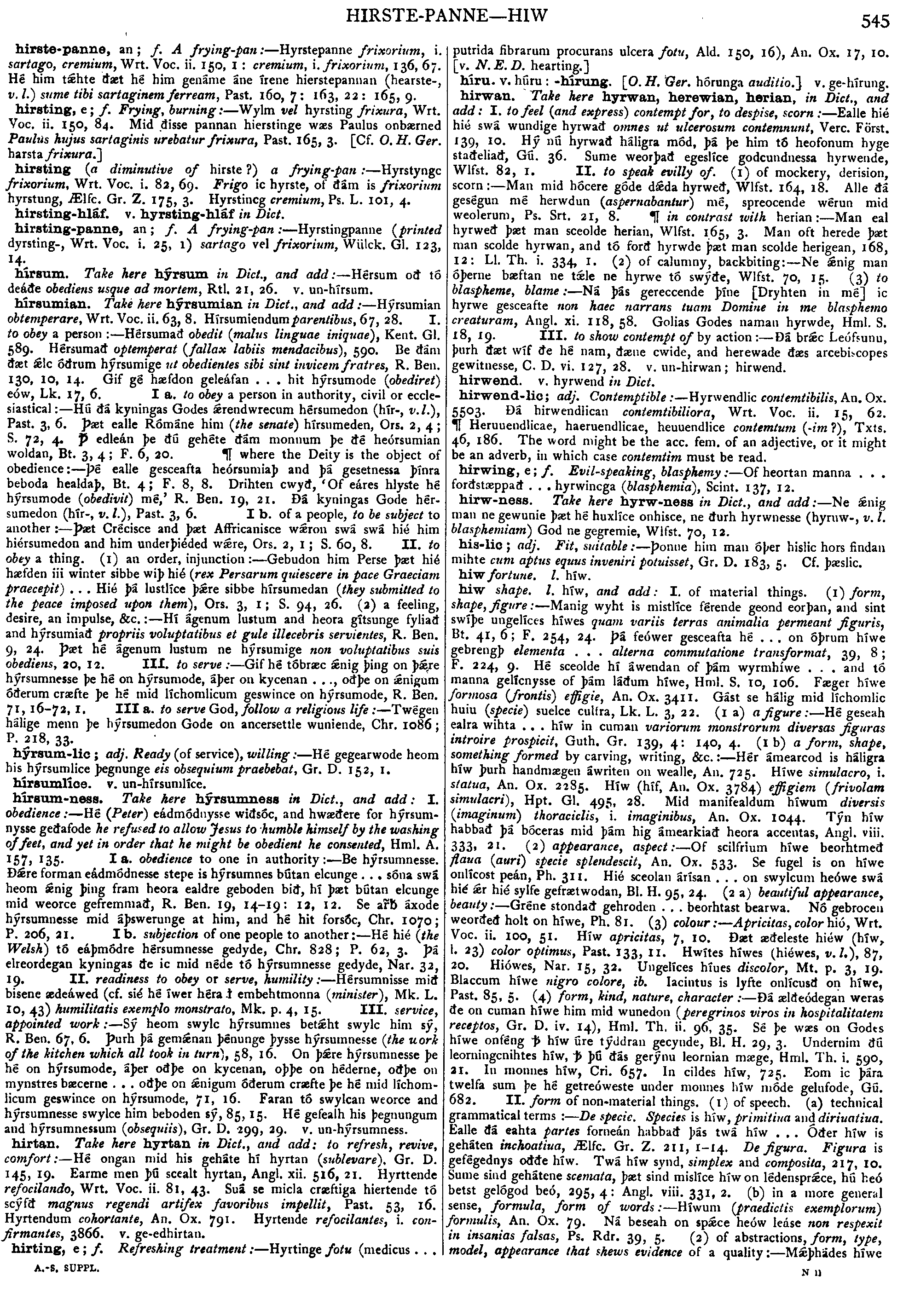
hirwan.
Take
here
hyrwan,
herewian,
herian,
in
Dict.,
and
add:
I.
to
feel
(and
express)
contempt
for,
to
despise,
scorn
:--
Ealle
hié
hié
swá
wundige
hyrwað
omnes
ut
ulcerosum
contemnunt,
Verc.
Först.
139,
10.
Hý
nú
hyrwað
háligra
mód,
þá
þe
him
tó
heofonum
hyge
staðeliað,
Gú.
36.
Sume
weorþað
egeslíce
godcundnessa
hyrwende,
Wlfst.
82,
1.
II.
to
speak
evilly
of.
(1)
of
mockery,
derision,
scorn
:--
Man
mid
hócere
góde
dda
hyrweð,
Wlfst.
164,
18.
Alle
ðá
geségun
mé
herwdun
(aspernabantur)
mé,
spreocende
wérun
mid
weolerum,
Ps.
Srt.
21,
8.

in
contrast
with
herian
:--
Man
eal
hyrweð
þæt
man
sceolde
herian,
Wlfst.
165,
3.
Man
oft
herede
þæt
man
scolde
hyrwan,
and
tó
forð
hyrwde
þæt
man
scolde
herigean,
168,
12:
Ll.
Th.
i.
334,
1.
(2)
of
calumny,
backbiting
:--
Ne
nig
man
óþerne
bæftan
ne
tle
ne
hyrwe
tó
swýðe,
Wlfst.
70,
15.
(3)
to
blaspheme,
blame
:--
Ná
þás
gereccende
þíne
[Dryhten
in
mé]
ic
hyrwe
gesceafte
non
haec
narrans
tuam
Domine
in
me
blasphemo
creaturam,
Angl.
xi.
118,
58.
Golias
Godes
naman
hyrwde,
Hml.
S.
18,
19.
III.
to
show
contempt
of
by
action
:--
Ðá
brc
Leófsunu,
þurh
ðæt
wíf
ðe
hé
nam,
ðæne
cwide,
and
herewade
ðæs
arcebiscopes
gewitnesse,
C.
D.
vi.
127,
28.
v.
un-hirwan;
hirwend.
|
Source: Bosworth/Toller, page d0545, entry 18 View original page image as: [TIFF] [PNG] [View previous entry] [View next entry] |
[Comment on this entry] [View comments] |
The following entry has been hand-corrected once. |
hirw-ness.
Take
here
hyrw-ness
in
Dict.,
and
add
:--
Ne
nig
man
ne
gewunie
þæt
hé
huxlíce
onhisce,
ne
ðurh
hyrwnesse
(hyruw-,
v.
l.
blasphemiam)
God
ne
gegremie,
Wlfst.
70,
12.
|
Source: Bosworth/Toller, page d0546, entry 1 View original page image as: [TIFF] [PNG] [View previous entry] [View next entry] |
[Comment on this entry] [View comments] |
The following entry has been hand-corrected once. |
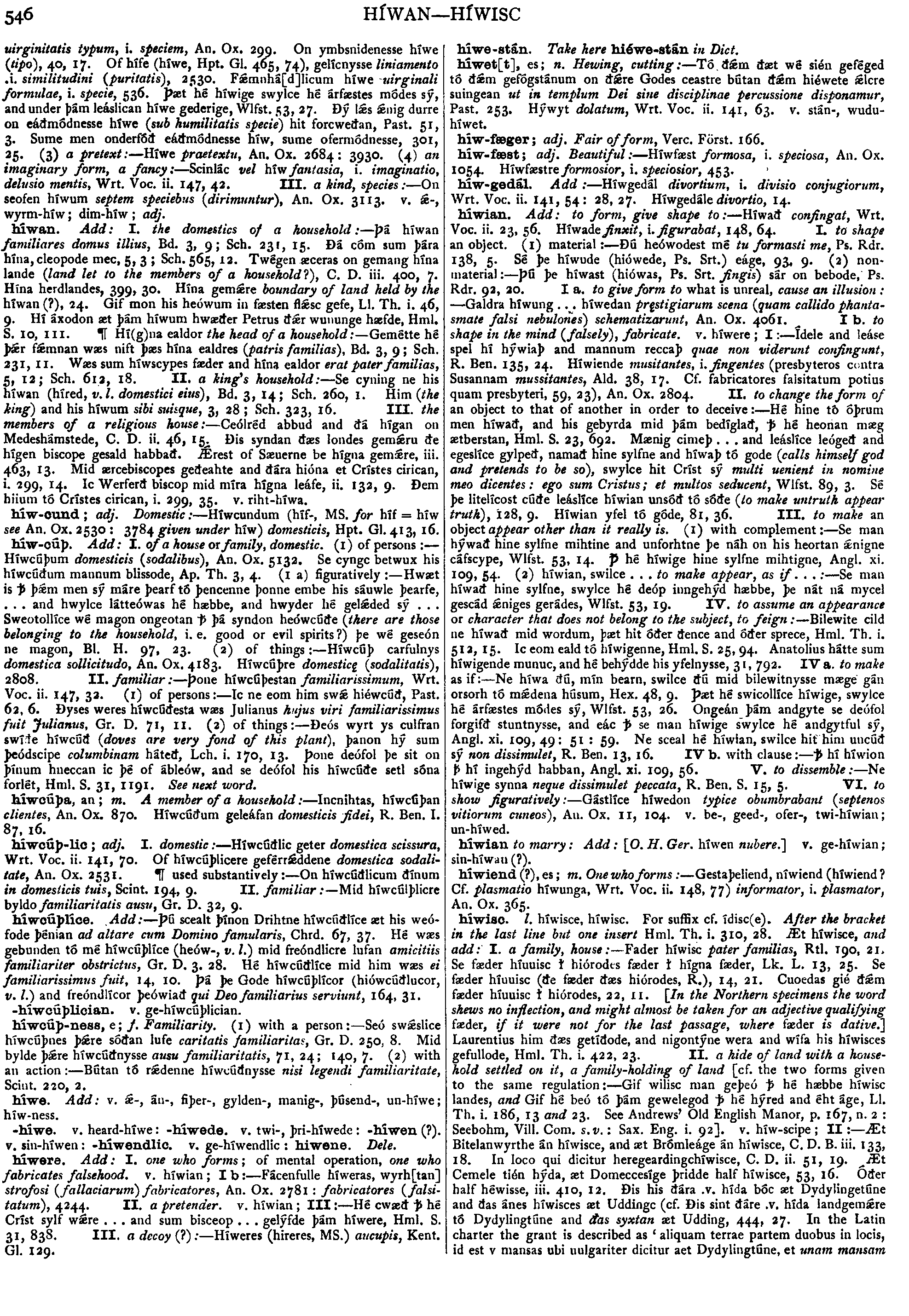
uirginitatis
typum,
i.
speciem,
An.
Ox,
299.
On
ymbsnidenesse
híwe
(tipo),
40,
17.
Of
hífe
(híwe,
Hpt.
Gl.
465,
74),
gelícnysse
liniamento
.i.
similitudini
(puritatis),
2530,
Fmnhá[d]licum
híwe
uirginali
formulae,
i.
specie,
536.
Þæt
hé
híwige
swylce
hé
árfæstes
módes
sý,
and
under
þám
leáslican
híwe
gederige,
Wlfst.
53,
27.
Ðý
ls
nig
durre
on
eáðmódnesse
híwe
(sub
humilitatis
specie)
hit
forcweðan,
Past.
51,
3.
Sume
men
onderfóð
eáðmódnesse
híw,
sume
ofermódnesse,
301,
25.
(3)
a
pretext
:--
Híwe
praetextu,
An.
Ox.
2684:
3930.
(4)
an
imaginary
form,
a
fancy
:--
Scinlác
vel
híw
fantasia,
i.
imaginatio,
delusio
mentis,
Wrt.
Voc.
ii.
147,
42.
III.
a
kind,
species
:--
On
seofen
híwum
septem
speciebus
(dirimuntur),
An.
Ox.
3113.
v.
-,
wyrm-híw;
dim-híw;
adj.
|
Source: Bosworth/Toller, page d0546, entry 18 View original page image as: [TIFF] [PNG] [View previous entry] [View next entry] |
[Comment on this entry] [View comments] |
The following entry has been hand-corrected once. |
híwian.
Add:
to
form,
give
shape
to
:--
Híwað
confingat,
Wrt.
Voc.
ii.
23,
56.
Híwade
finxit,
i.
figurabat,
148,
64.
I.
to
shape
an
object.
(1)
material
:--
Ðú
heówodest
mé
tu
formasti
me,
Ps.
Rdr.
138,
5.
Sé
þe
híwude
(hiówede,
Ps.
Srt.)
eáge,
93,
9.
(2)
non-material
:--
Þú
þe
híwast
(hiówas,
Ps.
Srt.
fingis)
sár
on
bebode,
Ps.
Rdr.
92,
20.
I
a.
to
give
form
to
what
is
unreal,
cause
an
illusion
:--
Galdra
híwung
...
híwedan
pr stigiarum
scena
(quam
callido
phantasmate
falsi
nebulones)
schematizarunt,
An.
Ox.
4061.
I
b.
to
shape
in
the
mind
(falsely),
fabricate.
v.
híwere;
I
:--
Ídele
and
leáse
spel
hí
hýwiaþ
and
mannum
reccaþ
quae
non
viderunt
confingunt,
R.
Ben.
135,
24.
Híwiende
musitantes,
i.
fingentes
(presbyteros
contra
Susannam
mussitantes,
Ald.
38,
17.
Cf.
fabricatores
falsitatum
potius
quam
presbyteri,
59,
23),
An.
Ox.
2804.
II.
to
change
the
form
of
an
object
to
that
of
another
in
order
to
deceive
:--
Hé
hine
tó
óþrum
men
híwað,
and
his
gebyrda
mid
þám
bedíglað,
hé
heonan
mæg
ætberstan,
Hml.
S.
23,
692.
Mænig
cimeþ
...
and
leáslíce
leógeð
and
egeslíce
gylpeð,
namað
hine
sylfne
and
híwaþ
tó
gode
(calls
himself
god
and
pretends
to
be
so),
swylce
hit
Críst
sý
multi
uenient
in
nomine
meo
dicentes:
ego
sum
Cristus;
et
multos
seducent,
Wlfst.
89,
3.
Sé
þe
litelícost
cúðe
leáslíce
híwian
unsóð
tó
sóðe
(to
make
untruth
appear
truth),
128,
9.
Híwian
yfel
tó
góde,
81,
36.
III.
to
make
an
object
appear
other
than
it
really
is.
(1)
with
complement
:--
Se
man
hýwað
hine
sylfne
mihtine
and
unforhtne
þe
náh
on
his
heortan
nigne
cáfscype,
Wlfst.
53,
14.
hé
híwige
hine
sylfne
mihtigne,
Angl.
xi.
109,
54.
(2)
híwian,
swilce
...
to
make
appear,
as
if
...
:--
Se
man
híwað
hine
sylfne,
swylce
hé
deóp
inngehýd
hæbbe,
þe
nát
ná
mycel
gescád
niges
gerádes,
Wlfst.
53,
19.
IV.
to
assume
an
appearance
or
character
that
does
not
belong
to
the
subject,
to
feign
:--
Bilewite
cild
ne
híwað
mid
wordum,
þæt
hit
óðer
ðence
and
óðer
sprece,
Hml.
Th.
i.
512,
15.
Ic
eom
eald
tó
híwigenne,
Hml.
S.
25,
94.
Anatolius
hátte
sum
híwigende
munuc,
and
hé
behýdde
his
yfelnysse,
31,
792.
IV
a.
to
make
as
if
:--
Ne
híwa
ðú,
mín
bearn,
swilce
ðú
mid
bilewitnysse
mæge
gán
orsorh
tó
mdena
húsum,
Hex.
48,
9.
Þæt
hé
swicollíce
híwige,
swylce
hé
árfæstes
módes
sý,
Wlfst.
53,
26.
Ongeán
þám
andgyte
se
deófol
forgifð
stuntnysse,
and
eác
se
man
híwige
swylce
hé
andgytful
sý,
Angl.
xi.
109,
49:
51:
59.
Ne
sceal
hé
híwian,
swilce
hit
him
uncúð
sý
non
dissimulet,
R.
Ben.
13,
16.
IV
b.
with
clause
:--
hí
híwion
hí
ingehýd
habban,
Angl.
xi.
109,
56.
V.
to
dissemble
:--
Ne
híwige
synna
neque
dissimulet
peccata,
R.
Ben.
S.
15,
5.
VI.
to
show
figuratively
:--
Gástlíce
híwedon
typice
obumbrabant
(septenos
vitiorum
cuneos),
An.
Ox.
11,
104.
v.
be-,
geed-,
ofer-,
twi-híwian;
un-híwed.
stigiarum
scena
(quam
callido
phantasmate
falsi
nebulones)
schematizarunt,
An.
Ox.
4061.
I
b.
to
shape
in
the
mind
(falsely),
fabricate.
v.
híwere;
I
:--
Ídele
and
leáse
spel
hí
hýwiaþ
and
mannum
reccaþ
quae
non
viderunt
confingunt,
R.
Ben.
135,
24.
Híwiende
musitantes,
i.
fingentes
(presbyteros
contra
Susannam
mussitantes,
Ald.
38,
17.
Cf.
fabricatores
falsitatum
potius
quam
presbyteri,
59,
23),
An.
Ox.
2804.
II.
to
change
the
form
of
an
object
to
that
of
another
in
order
to
deceive
:--
Hé
hine
tó
óþrum
men
híwað,
and
his
gebyrda
mid
þám
bedíglað,
hé
heonan
mæg
ætberstan,
Hml.
S.
23,
692.
Mænig
cimeþ
...
and
leáslíce
leógeð
and
egeslíce
gylpeð,
namað
hine
sylfne
and
híwaþ
tó
gode
(calls
himself
god
and
pretends
to
be
so),
swylce
hit
Críst
sý
multi
uenient
in
nomine
meo
dicentes:
ego
sum
Cristus;
et
multos
seducent,
Wlfst.
89,
3.
Sé
þe
litelícost
cúðe
leáslíce
híwian
unsóð
tó
sóðe
(to
make
untruth
appear
truth),
128,
9.
Híwian
yfel
tó
góde,
81,
36.
III.
to
make
an
object
appear
other
than
it
really
is.
(1)
with
complement
:--
Se
man
hýwað
hine
sylfne
mihtine
and
unforhtne
þe
náh
on
his
heortan
nigne
cáfscype,
Wlfst.
53,
14.
hé
híwige
hine
sylfne
mihtigne,
Angl.
xi.
109,
54.
(2)
híwian,
swilce
...
to
make
appear,
as
if
...
:--
Se
man
híwað
hine
sylfne,
swylce
hé
deóp
inngehýd
hæbbe,
þe
nát
ná
mycel
gescád
niges
gerádes,
Wlfst.
53,
19.
IV.
to
assume
an
appearance
or
character
that
does
not
belong
to
the
subject,
to
feign
:--
Bilewite
cild
ne
híwað
mid
wordum,
þæt
hit
óðer
ðence
and
óðer
sprece,
Hml.
Th.
i.
512,
15.
Ic
eom
eald
tó
híwigenne,
Hml.
S.
25,
94.
Anatolius
hátte
sum
híwigende
munuc,
and
hé
behýdde
his
yfelnysse,
31,
792.
IV
a.
to
make
as
if
:--
Ne
híwa
ðú,
mín
bearn,
swilce
ðú
mid
bilewitnysse
mæge
gán
orsorh
tó
mdena
húsum,
Hex.
48,
9.
Þæt
hé
swicollíce
híwige,
swylce
hé
árfæstes
módes
sý,
Wlfst.
53,
26.
Ongeán
þám
andgyte
se
deófol
forgifð
stuntnysse,
and
eác
se
man
híwige
swylce
hé
andgytful
sý,
Angl.
xi.
109,
49:
51:
59.
Ne
sceal
hé
híwian,
swilce
hit
him
uncúð
sý
non
dissimulet,
R.
Ben.
13,
16.
IV
b.
with
clause
:--
hí
híwion
hí
ingehýd
habban,
Angl.
xi.
109,
56.
V.
to
dissemble
:--
Ne
híwige
synna
neque
dissimulet
peccata,
R.
Ben.
S.
15,
5.
VI.
to
show
figuratively
:--
Gástlíce
híwedon
typice
obumbrabant
(septenos
vitiorum
cuneos),
An.
Ox.
11,
104.
v.
be-,
geed-,
ofer-,
twi-híwian;
un-híwed.
|
Source: Bosworth/Toller, page d0547, entry 11 View original page image as: [TIFF] [PNG] [View previous entry] [View next entry] |
[Comment on this entry] [View comments] |
The following entry has been hand-corrected once. |
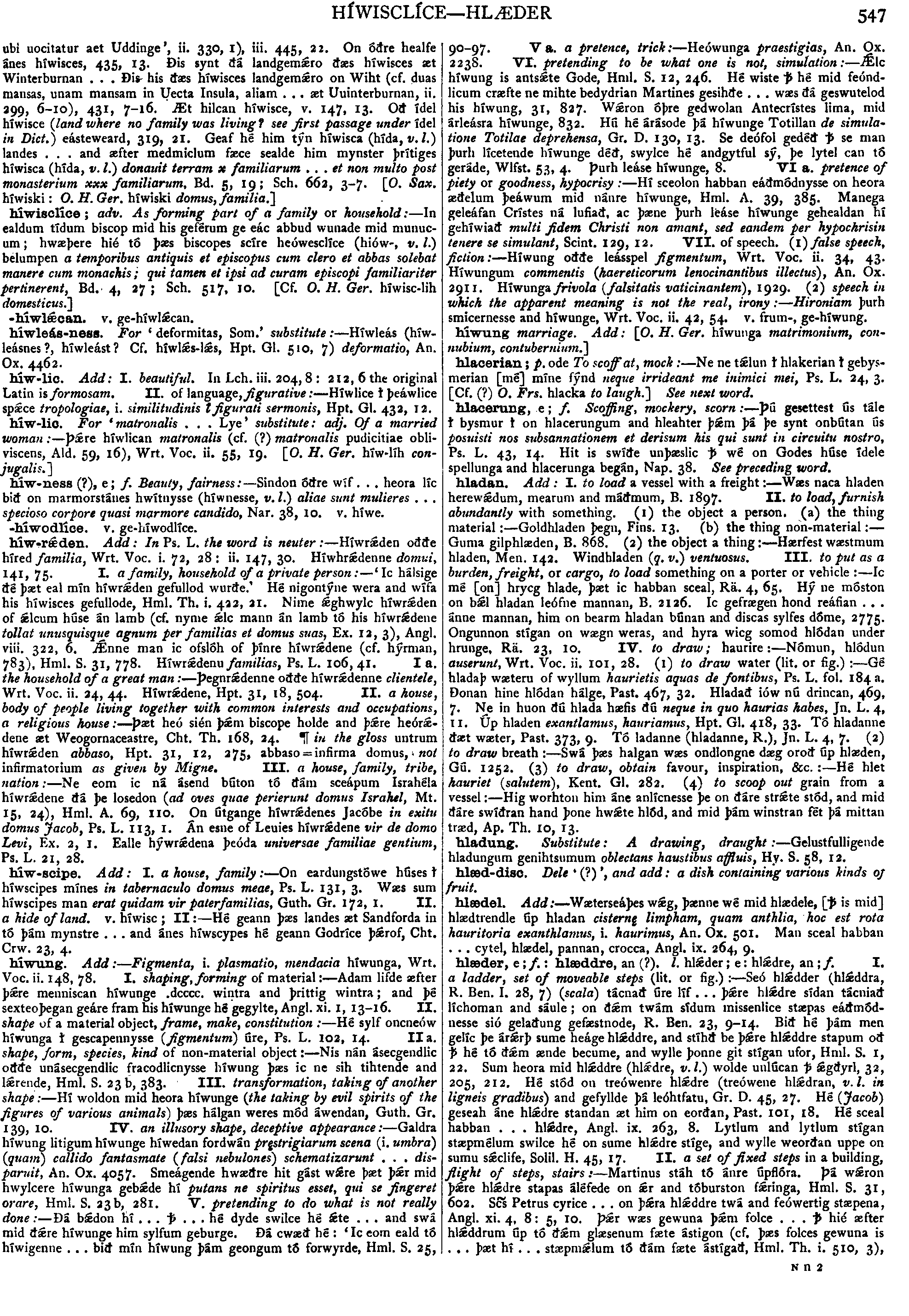
híwung.
Add
:--
Figmenta,
i.
plasmatio,
mendacia
híwunga,
Wrt.
Voc.
ii.
148,
78.
I.
shaping,
forming
of
material
:--
Adam
lifde
æfter
þre
menniscan
híwunge
.dcccc.
wintra
and
þrittig
wintra;
and
þé
sexteoþegan
geáre
fram
his
híwunge
hé
gegylte,
Angl.
xi.
1,
13-16.
II.
shape
of
a
material
object,
frame,
make,
constitution
:--
Hé
sylf
oncneów
híwunga
gescapennysse
(figmentum)
úre,
Ps.
L.
102,
14.
II
a.
shape,
form,
species,
kind
of
non-material
object
:--
Nis
nán
ásecgendlic
oððe
unásecgendlic
fracodlicnysse
híwung
þæs
ic
ne
sih
tihtende
and
lrende,
Hml.
S.
23.
5,
383.
III.
transformation,
taking
of
another
shape
:--
Hí
woldon
mid
heora
híwunge
(the
taking
by
evil
spirits
of
the
figures
of
various
animals)
þæs
hálgan
weres
mód
áwendan,
Guth.
Gr.
139,
10.
IV.
an
illusory
shape,
deceptive
appearance
:--
Galdra
híwung
litigum
híwunge
híwedan
fordwán
prstrigiarum
scena
(i.
umbra)
(quam)
callido
fantasmate
(falsi
nebulones)
schematizarunt
...
disparuit,
An.
Ox.
4057.
Smeágende
hwæðre
hit
gást
wre
þæt
þr
mid
hwylcere
híwunga
gebde
hí
putans
ne
spiritus
esset,
qui
se
fingeret
orare,
Hml.
S.
23
b,
281.
V.
pretending
to
do
what
is
not
really
done
:--
Ðá
bdon
hí
...
...
hé
dyde
swilce
hé
te
...
and
swá
mid
ðre
híwunge
him
sylfum
geburge.
Ðá
cwæð
hé:
'Ic
eom
eald
tó
híwigenne
...
bið
mín
híwung
þám
geongum
tó
forwyrde,
Hml.
S.
25,
90-97.
V
a.
a
pretence,
trick
:--
Heówunga
praestigias,
An.
Ox.
2238.
VI.
pretending
to
be
what
one
is
not,
simulation
:--
Æ-acute;lc
híwung
is
antste
Gode,
Hml.
S.
12,
246.
Hé
wiste
hé
mid
feóndlicum
cræfte
ne
mihte
bedydrian
Martines
gesihðe
...
wæs
ðá
geswutelod
his
híwung,
31,
827.
Wron
óþre
gedwolan
Antecrístes
lima,
mid
árleásra
híwunge,
832.
Hú
hé
árásode
þá
híwunge
Totillan
de
simulatione
Totilae
deprehensa,
Gr.
D.
130,
13.
Se
deófol
gedéð
se
man
þurh
lícetende
híwunge
déð,
swylce
hé
andgytful
sý,
þe
lytel
can
tó
geráde,
Wlfst.
53,
4.
Þurh
leáse
híwunge,
8.
VI
a.
pretence
of
piety
or
goodness,
hypocrisy
:--
Hí
sceolon
habban
eáðmódnysse
on
heora
æðelum
þeáwum
mid
nánre
híwunge,
Hml.
A.
39,
385.
Manega
geleáfan
Crístes
ná
lufiað,
ac
þæne
þurh
leáse
híwunge
gehealdan
hí
gehíwiað
multi
fidem
Christi
non
amant,
sed
eandem
per
hypochrisin
tenere
se
simulant,
Scint.
129,
12.
VII.
of
speech,
(1)
false
speech,
fiction
:--
Híwung
oððe
leásspel
figmentum,
Wrt.
Voc.
ii.
34,
43.
Híwungum
commentis
(haereticorum
lenocinantibus
illectus),
An.
Ox.
2911.
Híwunga
frivola
(falsitatis
vaticinantem),
1929.
(2)
speech
in
which
the
apparent
meaning
is
not
the
real,
irony
:--
Hironiam
þurh
smicernesse
and
híwunge,
Wrt.
Voc.
ii.
42,
54.
v.
frum-,
ge-híwung.
|
Source: Bosworth/Toller, page d0548, entry 16 View original page image as: [TIFF] [PNG] [View previous entry] [View next entry] |
[Comment on this entry] [View comments] |
The following entry has been hand-corrected once. |
hláf.
In
l.
27
after
'bran'
add
Cht.
Th.,
and
add:
I.
bread
made
from
meal
or
flour
:--
Þú
him
of
eorþan
út
álddest
hláf
(panem)
tó
helpe
...
hláf
trymeð
heortan
mannes,
Ps.
Th.
103,
14,
15.
Sý
ánes
pundes
gewihte
hláf
tó
eallum
dæge.
Sý
gehealden
þæs
pundmtan
hláfes
se
þridda
dl
panis
libera
una
propensa
sufficiat
in
die
...
de
eadem
libra
tertia
pars
reservetur,
R.
Ben.
63,
14-16.
Hú
mæg
þm
geweorðan
þe
...
him
hláf
and
stán
on
gesihðe
geweorðað
...
þæt
hé
þone
stán
nime,
...
hláfes
ne
gíme,
El.
611-616.
Hé
his
líchoman
him
sealde
on
hláfe,
Bl.
H.
73,
5.
Gé
etað
hláf
be
gewihte
and
gé
ne
beóð
fulle.
Lev.
26,
26.
Hí
hláf
ne
ton
(cf.
næs
þr
(Mermedonia)
hláfes
wist
werum,
An.
21)
...
ac
ton
manna
líchaman,
Bl.
H.
229,
8.

bread
as
a
food
for
penitents,
&c.
:--
Gif
hwá
ordáles
weddige
...
féde
hé
hine
sylfne
mid
hláfe
and
mid
wætere
and
sealte
and
wyrtum.
Ll.
Th.
i.
210,
28.
Fæsten
tó
berenan
hláfe,
Wlfst.
173,
10.
I
a.
in
phrases
implying
the
eating
of
bread,
( )
hláfbrecan
to
break
bread
for
distribution
to
others
:--
Brec
ðm
hyngriendum
ðínne
hláf
frange
esurienti
panem
tuam
(Is.
58,
7),
Past.
315,
14:
Bl.
H.
37,
20.
Áféng
se
Hlend
hláf
and
hine
brc,
Mk.
14,
22.
Cf.
Hú
hig
hine
oncneówan
on
hláfes
brice,
Lk.
24,
35.
(
)
hláfbrecan
to
break
bread
for
distribution
to
others
:--
Brec
ðm
hyngriendum
ðínne
hláf
frange
esurienti
panem
tuam
(Is.
58,
7),
Past.
315,
14:
Bl.
H.
37,
20.
Áféng
se
Hlend
hláf
and
hine
brc,
Mk.
14,
22.
Cf.
Hú
hig
hine
oncneówan
on
hláfes
brice,
Lk.
24,
35.
( )
tó
hláfe
gan
to
go
to
eat
bread.
Cf.
hláf-gang
:--
Ðre
wucan
rdere
gange
tó
hláfe
(hláue,
v.l.)
and
drince
r
ðám
þe
hé
beginne
tó
rdenne
frater
ebdomedarius
accipiat
mixtum
priusquam
incipiat
legere,
R.
Ben.
63,
1.
Ðá
wicþénas
nre
tíde
r
gemnum
gereorde
gán
tó
hláfe
(accipiant
panem),
59,
14.
I
b.
with
qualifying
words
:--
Cruman
berenes
hláfes,
Lch.
ii.
134,
9.
Hé
þre
ytemestan
yldo
his
lífes
mid
medmiclum
hláfe
and
cealde
wætere
(pane
cibario
et
frigida
aqua)
áwreþede,
Bd.
5,
12;
Sch.
630,
19.
Fæsten
tó
berenan
hláfe,
Wlfst.
173,
10.
Eton
hig
þeorfne
hláf,
Angl.
viii.
322,
14.
His
synna
beóð
ádýlegode
þurh
þone
drihtenlican
hláf
(=
húsel,
5),
Ll.
Th.
ii.
392,
6.
II.
a
loaf,
cake
:--
Smal
hláf
artocobus
(cf.
artocopus
a
symynel,
Wülck.
Gl.
564,
43),
Wrt.
Voc.
ii.
10,
47.
Þú
nymst
ánne
holne
hláf
and
ánne
gebígedne
hláf
of
þm
þeorfra
hláfa
windle
tolles
tortam
panis
unius
crustulam,
laganum
de
canistro
azymorum,
Ex.
29,
23.
Cuoeð
stánas
ðás
hláfa
tó
hláfum
sié
gewordeno
dic
ut
lapides
isti
panes
fiant,
Mt.
L.
4,
3.
Gé
ne
geðencas
fíf
hláfana
(hláfa,
R.)
non
recordamini
quinque
panum,
16,
9.
Æt
.x.
hídum
tó
fóstre
.x.
fata
hunies,
.ccc.
hláfa,
Ll.
Th.
i.
146,
16.
Fíf
hláfum
onfangenum
...
hé
...
þá
hláfas
bræc,
Mk.
6,
41:
An.
590.
Hé
nam
þæt
flsc
mid
þám
heorðbacenum
hláfum
(cf.
focan
subcinericios
panes,
6),
Gen.
18,
8.
Æt
ánre
feorme
þonne
mon
þá
hláfas
wrát
tó
þicgeanne
cum
panes
per
convivia
frangerentur,
Oto
5,
10;
S.
234,
5.
Méwran
míne
teáras
for
hláfas,
Ps.
Th.
41,
3.
Æ-acute;;lc
gebúr
sylle
.vi.
hláfas
ðám
inswáne,
Ll.
Th.
i.
434,
21.
Hylstene
hláfas
tortam
panis
(v.
Ex.
29,
23),
Wrt.
Voc.
ii.
30,
21.
Hláfas
turtas,
94,
24.
Hláfas
of
bere,
Jn.
R.
6,
9.
II
a.
a
bit
of
bread
:--
Hláfes
cruste,
Wrt.
Voc.
ii.
21,
1.
Hláue
crusta,
94,
3.
Þá
þe
wilniað
fretan
mín
folc
swá
ánne
hláf
(sicut
escam
panis),
Ps.
Th.
13,
9.
III.
bread
as
representing
food
in
general
:--
On
swáte
þínes
andwlitan
þú
brícst
þínes
hláfes
in
sudore
vultus
tui
vesceris
pane,
Gen.
3,
19.
Wurdon
wíde
menn
wdlan
hláfes,
Ps.
Th.
104,
14.
Hé
eóde
on
sumes
Fariséa
ealdres
hús
hé
hláf
te
(tó
brúcanne
hláf,
L.
R.
manducare
panem),
Lk.
14,
1:
15.
Þonne
hi
hláf
etað
(mete
þicgeað,
W.S.),
Mt.
R.
L.
15,
2:
Ps.
Th.
101,
4:
Gen.
935.
Þú
senst
úsne
hláf
dæghwámlíce,
Hy.
7,
68.
Hingrendum
hláf
and
hrægl
nacedum,
Cri.
1355.
III
a.
where
bread
is
taken
to
represent
the
food
of
a
meal
:--
'Gerestað
eów
...
oð
þæt
ic
eów
lecge
hláf
ætforan,
þæt
gé
eów
gereordian'
...
Abraham
þa
nam
buteran
and
meoloc
and
þæt
flsc
mid
þám
hláfum
and
léde
him
ætforan,
Gen.
18,
4-8.
III
b.
in
special
phrases,
e.g.
bread
of
affliction
:--
Ðú
ús
fédest
teára
hláfe,
Ps.
Th.
79,
5.
Þá
þe
sáres
hláf
ton,
126,
3.
III
c.
of
spiritual
sustenance,
bread
of
life
:--
Ic
eom
lífes
hláf,
Jn.
6,
35.
Críst,
se
sóða
hláf
be
him
sylfum
cwæð,
'Ic
eom
se
líflica
hláf,'
Hml.
Th.
i.
34,
16.
Ðú
ús
sillest
þone
hláf
éces
lýfes,
Solil.
H.
8,
13.
Þé
sóðfæst
Meotud
wist
gife,
heofonlícne
hláf,
An.
389.
IV.
material
like
bread,
manna
:--
Hé
sealde
him
heofenes
hláf
panem
coeli
dedit
eis,
Ps.
Th.
77,
25.
V.
a
loaf-shaped
mass,
cake
of
material
:--
Hláf
wexenne
(cf.
weax-hláf)
niman
freó[n]dscipas
níwe
gefégð
panem
cerarium
accipere,
amicitias
nouas
iungit
(Archiv,
cxxv.
63),
Lch.
iii.
210,
2.
v.
ælmes-,
brád-,
hirsting-,
hwíte-,
oflæt-,
oster-,
þeorf-,
weax-hláf.
)
tó
hláfe
gan
to
go
to
eat
bread.
Cf.
hláf-gang
:--
Ðre
wucan
rdere
gange
tó
hláfe
(hláue,
v.l.)
and
drince
r
ðám
þe
hé
beginne
tó
rdenne
frater
ebdomedarius
accipiat
mixtum
priusquam
incipiat
legere,
R.
Ben.
63,
1.
Ðá
wicþénas
nre
tíde
r
gemnum
gereorde
gán
tó
hláfe
(accipiant
panem),
59,
14.
I
b.
with
qualifying
words
:--
Cruman
berenes
hláfes,
Lch.
ii.
134,
9.
Hé
þre
ytemestan
yldo
his
lífes
mid
medmiclum
hláfe
and
cealde
wætere
(pane
cibario
et
frigida
aqua)
áwreþede,
Bd.
5,
12;
Sch.
630,
19.
Fæsten
tó
berenan
hláfe,
Wlfst.
173,
10.
Eton
hig
þeorfne
hláf,
Angl.
viii.
322,
14.
His
synna
beóð
ádýlegode
þurh
þone
drihtenlican
hláf
(=
húsel,
5),
Ll.
Th.
ii.
392,
6.
II.
a
loaf,
cake
:--
Smal
hláf
artocobus
(cf.
artocopus
a
symynel,
Wülck.
Gl.
564,
43),
Wrt.
Voc.
ii.
10,
47.
Þú
nymst
ánne
holne
hláf
and
ánne
gebígedne
hláf
of
þm
þeorfra
hláfa
windle
tolles
tortam
panis
unius
crustulam,
laganum
de
canistro
azymorum,
Ex.
29,
23.
Cuoeð
stánas
ðás
hláfa
tó
hláfum
sié
gewordeno
dic
ut
lapides
isti
panes
fiant,
Mt.
L.
4,
3.
Gé
ne
geðencas
fíf
hláfana
(hláfa,
R.)
non
recordamini
quinque
panum,
16,
9.
Æt
.x.
hídum
tó
fóstre
.x.
fata
hunies,
.ccc.
hláfa,
Ll.
Th.
i.
146,
16.
Fíf
hláfum
onfangenum
...
hé
...
þá
hláfas
bræc,
Mk.
6,
41:
An.
590.
Hé
nam
þæt
flsc
mid
þám
heorðbacenum
hláfum
(cf.
focan
subcinericios
panes,
6),
Gen.
18,
8.
Æt
ánre
feorme
þonne
mon
þá
hláfas
wrát
tó
þicgeanne
cum
panes
per
convivia
frangerentur,
Oto
5,
10;
S.
234,
5.
Méwran
míne
teáras
for
hláfas,
Ps.
Th.
41,
3.
Æ-acute;;lc
gebúr
sylle
.vi.
hláfas
ðám
inswáne,
Ll.
Th.
i.
434,
21.
Hylstene
hláfas
tortam
panis
(v.
Ex.
29,
23),
Wrt.
Voc.
ii.
30,
21.
Hláfas
turtas,
94,
24.
Hláfas
of
bere,
Jn.
R.
6,
9.
II
a.
a
bit
of
bread
:--
Hláfes
cruste,
Wrt.
Voc.
ii.
21,
1.
Hláue
crusta,
94,
3.
Þá
þe
wilniað
fretan
mín
folc
swá
ánne
hláf
(sicut
escam
panis),
Ps.
Th.
13,
9.
III.
bread
as
representing
food
in
general
:--
On
swáte
þínes
andwlitan
þú
brícst
þínes
hláfes
in
sudore
vultus
tui
vesceris
pane,
Gen.
3,
19.
Wurdon
wíde
menn
wdlan
hláfes,
Ps.
Th.
104,
14.
Hé
eóde
on
sumes
Fariséa
ealdres
hús
hé
hláf
te
(tó
brúcanne
hláf,
L.
R.
manducare
panem),
Lk.
14,
1:
15.
Þonne
hi
hláf
etað
(mete
þicgeað,
W.S.),
Mt.
R.
L.
15,
2:
Ps.
Th.
101,
4:
Gen.
935.
Þú
senst
úsne
hláf
dæghwámlíce,
Hy.
7,
68.
Hingrendum
hláf
and
hrægl
nacedum,
Cri.
1355.
III
a.
where
bread
is
taken
to
represent
the
food
of
a
meal
:--
'Gerestað
eów
...
oð
þæt
ic
eów
lecge
hláf
ætforan,
þæt
gé
eów
gereordian'
...
Abraham
þa
nam
buteran
and
meoloc
and
þæt
flsc
mid
þám
hláfum
and
léde
him
ætforan,
Gen.
18,
4-8.
III
b.
in
special
phrases,
e.g.
bread
of
affliction
:--
Ðú
ús
fédest
teára
hláfe,
Ps.
Th.
79,
5.
Þá
þe
sáres
hláf
ton,
126,
3.
III
c.
of
spiritual
sustenance,
bread
of
life
:--
Ic
eom
lífes
hláf,
Jn.
6,
35.
Críst,
se
sóða
hláf
be
him
sylfum
cwæð,
'Ic
eom
se
líflica
hláf,'
Hml.
Th.
i.
34,
16.
Ðú
ús
sillest
þone
hláf
éces
lýfes,
Solil.
H.
8,
13.
Þé
sóðfæst
Meotud
wist
gife,
heofonlícne
hláf,
An.
389.
IV.
material
like
bread,
manna
:--
Hé
sealde
him
heofenes
hláf
panem
coeli
dedit
eis,
Ps.
Th.
77,
25.
V.
a
loaf-shaped
mass,
cake
of
material
:--
Hláf
wexenne
(cf.
weax-hláf)
niman
freó[n]dscipas
níwe
gefégð
panem
cerarium
accipere,
amicitias
nouas
iungit
(Archiv,
cxxv.
63),
Lch.
iii.
210,
2.
v.
ælmes-,
brád-,
hirsting-,
hwíte-,
oflæt-,
oster-,
þeorf-,
weax-hláf.
|
Source: Bosworth/Toller, page d0549, entry 7 View original page image as: [TIFF] [PNG] [View previous entry] [View next entry] |
[Comment on this entry] [View comments] |
The following entry has been hand-corrected once. |
hláford.
Add:
I.
applied
to
non-English
persons,
or
in
a
general
sense.
(1)
a
master
of
servants,
a
male
head
of
a
household
:--
Gleáw
þeów
þone
geset
hys
hláfurd
(hláferd.
L.,
dryhten,
R.)
ofer
his
híred,
ðæt
hé
him
on
tíde
mete
sylle,
Mt.
24,
45.
Se
ðeówa
nát
hwæt
se
hláford
(hláfard,
L.
R.)
déð,
Jn.
15,
15.
Gif
þeów
næbbe
wíf
and
his
hláford
him
wíf
sylle
...
þæt
wíf
and
hire
winclo
beóð
þæs
hláfordes
...
Gif
se
wiel
cwið:
'Mé
is
mín
hláford
leóf,'
Ex.
21,
4-5.
Se
apostol
beád
ðeówum
mannum
þæt
hí
wron
heora
hláforde
getreówe
and
holde,
wre
se
hláford
good,
wre
hé
yfel.
Hml.
Th.
ii.
68,
9.
Wénst
þú
þæt
seó
mengio
þínra
monna
þé
mæge
dón
gesligne?
...
yfele
þegnas
beóþ
heora
hláforde
fiénd
an
te
longus
ordo
famulorum
facit
esse
felicem?
qui
si
vitiosi
moribus
sint
...
ipsi
domino
inimici,
Bt.
14,
1;
F.
42,
23.
Swé
swé
égan
ðiówa
in
hondum
hláfarda
heara,
Ps.
Srt.
122,
2.
Ne
mæg
nán
man
twám
hláfordum
þeówian,
Mt.
6,
24.
(1
a)
where
the
servant
is
a
thing
personified
:--
Hláford
mín
(a
plough's),
Rä.
22,
3.
(2)
a
ruler,
one
who
has
subjects,
one
to
whom
obedience
is
due.
(a)
sovereign
of
a
country,
governor
of
a
city
or
province,
an
ecclesiastical
chief
:--
Se
hláford
(Nero),
Met.
9,
55.
Se
hláford
(cf.
v.
2)
ðe
ðm
here
waldeð,
25,
15.
Hyra
hláford
(Caldéa
cyning,
668)
læg,
Dan.
675.
Þæt
hé
Heardréde
hláford
wre
oððe
þone
cynedóm
ciósan
wolde,
B.
2375.
Gif
hwelc
swíþe
ríce
mon
on
his
hláfordes
rende
færþ,
Bt.
27,
2;
F.
98,
21.
Gyf
þínes
hláfordes
rendgewrit
and
hys
insegel
tó
ðé
cymð,
Solil.
H.
23,
14.
Geðenc
nú
hweðer
mani
mann
cynges
hám
séce
...
hí
cumað
æalle
tó
ánum
hláforde,
41,
1-10.
Heretoga
hláforde
leóf,
Met.
1,
47.
Þegnas
síne
mynton
forltan
leófne
hláford
(cf.
Ðracia
cining,
22),
26,
72.
Þeóda
ghwilc
hæfdon
heora
hláford
for
þone
héhstan
god
(cf.
hiora
cyningas
hí
weorþodon
for
godas,
Bt.
38,
1;
F.
194,
15),
44.
Pílatus
gréteþ
Claudium
his
hláford,
Bl.
H.
177,
5.
Rómwarena
hláford,
El.
983.
Úrne
hláford
(cf.
Heliseus
hæfde
ealdordóm
micelne,
25),
Jul.
129:
681.
Dryhten
hláforda
Dominus
dominorum,
Ps.
Srt.
135,
3.
Hwæt
tácnað
ús
Saul
búton
yfle
hláfurdas
(mali
rectores)?
oððe
hwæt
Dauid
búton
góde
ðeówas
(boni
subditi)?,
Past.
197,
22.

applied
to
Deity
:--
Gif
ðá
gesceafta
heora
unwillum
hláforde
hérden,
Bt.
35,
4:
F.
160,
21.
hí
þeówian
swilcum
hláforde
and
fægniaþ
þæs
hé
heora
wealt,
39,
13;
F.
234,
29.
Áhóf
ic
riicnæ
kyningc,
heafunæs
hláford,
Txts.
126,
5.
Heofeones
hláford
and
ealles
middangeardes,
Bl.
H.
69,
13.
Þane
can
hláford,
Solil.
H.
25,
2.
Hláford
eallra,
engla
and
elda,
El.
475.
(a
a)
used
in
addressing
a
ruler
:--
Se
biscop
wrát
nne
pistol
Theodosio
cásere
þus
cweðende:
'Hyt
gedafenað,
lá
wynsuma
hláford
...,'
Angl.
viii.
322,
48.
(b)
a
military
officer,
captain
:--
Hundraðes
monna
hláford
centurio,
Mt.
p.
15,
13.
(c)
a
master
of
disciples
:--
Hláford
mín
(cf.
þone
leófestan
láreów,
977),
Gú.
1331.
Hé
his
hláford
geseah
ellorfúsne
...
ongan
þá
duguda
hleó
geongran
rétan,
1026-1035.
Hý
þæs
láreówes
word
ne
gehyrwdon;
sóna
wron
gearwe
hæleð
mid
hláford,
Cri.
461.
(d)
a
major-domo.
v.
hláf-weard
:--
Gesette
hine
hláford
húses
his,
Ps.
Srt.
104,
21.
(e)
figurative
()
where
the
ruler
or
master
is
a
thing
:--
Se
wela
and
se
anweald
and
þá
woruldgeslþa
sint
eówre
hláfordas
and
eówre
wealdandas,
Bt.
16,
2;
F.
50,
36.
Ðá
unrihtwísan
cynges
hí
underþiódaþ
unþeáwum;
sceal
ðonne
néde
tó
þára
hláforda
dóme
þe
hé
hine
r
underþeódde,
37,
1;
F.
186,
29
:
Met.
25,
65.
()
where
the
ruled
is
a
thing
:--
Is
forweorþfullic
wela
þe
náuþer
ne
mæg
hine
selfne
gehealdan
ne
his
hláford,
Bt.
29,
1;
F.
102,
15.
Hwí
wæs
Adame
án
treów
forboden,
þá
þá
hé
wæs
ealles
óðres
hláford?,
Angl.
vii.
6,
42.
Þás
woruldgeslþa
and
þes
anweald
willaþ
clifian
on
þm
wyrstan
monnum,
and
him
geþafiaþ
þæt
hí
bióð
heora
hláfordas,
Bt.
16,
3;
F.
54,
20.
(f)
used
of
animals
:--
Gif
gé
gesáwen
hwelce
mús
þæt
wre
hláford
ofer
óþre
mýs
and
sette
him
dómas
and
nídde
hié
æfter
gafole
si
inter
mures
videres
unum
aliquem
jus
sibi
ac
potestatem
prae
caeteris
vendicantem,
Bt.
16,
2;
F.
52,
2.
(3)
an
owner,
a
proprietor
:--
Gif
oxa
hníte
wer
oððe
wíf
...
his
hláford
(dominus
bovis)
bið
unscildig.
Gif
se
oxa
hnitol
wre
...
and
hig
hit
his
hláforde
cýðden
...
ofsleah
þone
hláford,
Ex.
21,
28-29.
Sum
fearr
wearð
ángencga
...
Se
hláford
ðá
gegaderode
micele
menigu
his
incnihta,
Hml.
Th.
i.
502,
12;
Bl.
H.
199,
9.
(4)
a
husband
:--
Nerónes
wíf,
Libia,
and
Agrippan
wíf,
Agrippina,
noldan
leng
heora
hláforda
ne
heora
wera
restgemánan
sécean.
Bl.
H.
173,
15.
II.
used
of
Englishmen
in
technical
senses.
(1)
a
master
of
free
or
servile
labourers
:--
Gif
þeów
mon
wyrce
on
Sunnandæge
be
his
hláfordes
hse
...
se
hláford
geselle
.xxx.
sci.
tó
wíte
...
Gif
se
frígea
þý
dæge
wyrce
bútan
his
hláfordes
hse,
Ll.
Th.
i.
104,
2-6.
Gif
hláford
his
þeówan
freólsdæge
nýde
tó
weorce
...
gylde
lahslit
se
hláford,
402,
17-19.
Gif
wíteþeów
hine
forstalie,
hó
hine
mon,
and
ne
gylde
his
hláforde,
118,
7.
(2)
the
male
head
of
a
household,
(a)
the
master
of
domestics
:--
Hæbbe
lc
hláford
his
híredmen
on
his
ágenum
borge.
Ll.
Th.
i.
394,
27.
Híredmanna
gehwilc
sille
pænig
tó
ælmessan,
oððe
his
hláford
sille
for
hine.
Wlfst.
181,
17.
(b)
the
master
of
a
wife,
a
wife's
lord
and
master,
the
husband
:--
Ðis
is
geðinge
Eádwaldes
and
Cyneðrýðe,
Eðelmódes
láfe
ymbe
ðet
lond
ðe
hire
Eðelmód
hire
hlábard
salde,
C.D.
i.
295,
34.
Æfter
Byrhtwara
(cf.
Byrhtwaru
Ælfríces
láf,
380,
23)
dæge
...
for
Ælfríc
hire
hláford;
and
Bró;mleáh
...
swá
Ælfríc
hire
hláford
hit
becwæð,
ii.
381,
20-23.
Eádgyð
seó
hlfdie
forðférde,
seó
wæs
Eádwardes
cynges
geresta
...
and
se
cyngc
...
leide
heó
wið
Eádwearde
cynge
hire
hláforde,
Chr.
1076;
P.
212,
22.
Þæt
wíf
sceal
hire
ealdore
(hláforde,
v.l.)
hiéran,
Ll.
Th.
i.
138,
18.
(3)
a
lord
spiritual,
the
chief
of
an
ecclesiastical
establishment,
v.
hláford-dóm
:--
Gif
preóst
mon
ofsleá
...
hine
mon
of
þám
mynstre
ágife,
búton
se
hláford
þone
wer
foreþingian
wille,
Ll.
Th.
i.
76,
3.
Fóe
se
hláford
tó
and
ðá
hígon
æt
Krístes
cirican
...
an
ðás
rédenne
ic
hit
ðider
selle
ðe
se
monn,
sé
ðe
Krístes
cirican
hláford
sié,
sé
mín
and
mínra
erfewearda
forespreoca,
and
an
his
hláforddóme
wé
bión
móten,
C.D.
i.
311,
17-22:
310,
31.
Bútan
þæs
munuces
hláfordes
léfnesse.
Ll.
Th.
i.
74,
16.
Healf
cyninge,
healf
biscepe
and
þre
cirican
hláforde
þe
þá
nunnan
áge,
66,
17.
Wiib
and
cild
ðm
hláforde
and
hígum
and
ðre
stówe
befestan,
C.D.
i.
316,
10.
Geunnan
healfes
Gode
and
sancte
Petre
and
ðre
cyrcean
hláforde,
v.
143,
2.
Ðá
menn
ðá
ðaer
(Canterbury)
hláfordas
wron,
292,
29.
Aet
hláforda
tídum,
293,
17.
(4)
a
lord
of
vassals
or
retainers,
a
feudal
lord
:--
Godríc
þone
gódan
forlét
þe
him
mænigne
oft
meár
gesealde;
hé
gehleóp
þone
eoh
þe
áhte
his
hláford,
By.
189.
Wé
cweðað
mon
móte
mid
his
hláforde
feohtan
orwíge,
gif
mon
on
þone
hláford
fiohte;
swá
mót
se
hláford
mid
þý
men
feohtan.
Æfter
þre
ilcan
wísan
mon
mót
feohtan
mid
his
mge
...
búton
wið
his
hláforde;
wé
ne
liéfað,
Ll.
Th.
i.
90,
19-25:
120,
3:
220,
22:
228,
27.
Ne
teó
se
hláford
ná
máre
on
his
hte
bútan
his
rihtan
heregeate,
412,
29.
Sé
þe
ymb
his
hláfordes
feorh
sierwe,
64,
4.
Sé
ðe
ðone
ándagan
brece,
búton
hit
sý
þurh
hláfordes
geban,
260,
13.
Gif
hwá
fare
unáliéfed
fram
his
hláforde,
126,
9:
150,
15.
Þá
þe
hine
r
hláforde
befæston,
162,
17.
On
cinges
sele
hé
his
hláforde
þénode,
192,
1.
Se
man
þe
ætfleó
fram
his
hláforde
...
on
scypfyrde
oþþe
on
landfyrde,
420,
7.
Se
man
þe
on
fyrdunge
ætforan
his
hláforde
fealle,
15.
Gif
mon
wille
of
boldgetale
in
óðer
boldgetæl
hláford
sécan,
dó
mid
þæs
ealdormonnes
gewitnesse
þe
hé
r
in
his
scíre
folgode,
86,
3:
134,
3.
Gif
hwá
embe
cynincg
oþþe
hláford
syrwie,
408,
3.
(4
a)
with
special
reference
to
the
grant
of
land
:--
Fó
se
hláford
tó
his
lande
þe
hé
him
r
sealde,
Ll.
Th.
i.
420,
10.
Hláfordes
gifu,
292,
16:
422,
2.
Æ-acute;lcne
man
lyst,
siððan
hé
nig
cotlýf
on
his
hláfordes
lne
getimbred
hæfð,
þæt
hé
hine
móte
þár
on
gerestan
...
oð
ðone
fyrst
þe
hé
bócland
and
ce
yrfe
þurh
his
hláfordes
miltse
geearnige,
Solil.
H.
2,
7-13.
Ymb
mín
lond
þe
ic
(Abba
geroefa)
hæbbe
and
mé
God
láh
and
ic
æt
mínum
hláfordum
begæt,
C.D.
i.
310,
6.
(5)
the
lord
of
a
manor
:--
Gif
se
hláford
him
wile
land
árran
tó
weorce
and
tó
gafole.
Ll.
Th.
i.
146,
3:
436,
9.
Gif
geneátmanna
hwilc
forgýmeleásað
his
hláfordes
gafol
...
gif
se
hláford
mildheort
bið
...,
270,
16-18.
Æt
hláfordes
falde,
berne,
434.
13,
16.
Gescádwís
geréfa
sceal
witan
ge
hláfordes
landriht
ge
folces
gerihtu,
Angl.
ix.
259,
4.
(5
a)
the
lord
of
a
manor
in
legal
relations
:--
Fó
se
hláford
(landhláford,
v.l.)
tó
healfan,
tó
healfan
hundred,
Ll.
Th.
i.
268,
20:
258,
12-13.
Gif
se
hláford
sæcge
him
náðor
ne
burste
ne
áð
ne
ordál
...
niman
se
hláford
him
twégen
getreówe
þegenas
innan
þám
hundrede
and
swerian
...,
280,
10-13.
Gif
se
hláford
hine
ládian
wylle,
294,
12.
Gif
þeós
lád
teórie,
gylde
twygylde,
and
hláforde
his
wíte,
354,
31:
282,
3.
(6)
a
ruler,
(a)
of
a
country,
(our)
lord
(the
king)
:--
Gif
úre
hláford
ús
nigne
eácan
geþæncean
mæge
tó
úrum
friðgildum
...
uton
healdan
frið
swá
hit
úrum
hláforde
lícige,
Ll.
Th.
i.
238,
15-25.
Þone
man
þe
úres
hláfordes
grið
tóbrocen
hæbbe,
296,
29.
Úres
hláfordes
gerdnes
and
his
witena,
304,
9,
14,
18.
Æ-acute;lc
mæssepreóst
mæssige
for
úrne
hláford
and
for
ealle
his
þeóde,
Wlfst.
181,
22.
(b)
of
a
province
:--
Æ-acute;r
Æðelréd
wæs
Myrcna
hláford,
C.D.
ii.
131,
28.
Æþelrédes
dohtor
Myrcna
hláfordes,
Chr.
919;
P.
105,
31.
Æþréd
aldorman
and
Æthelflæd
Myrcna
hláfordas,
C.D.
ii.
151,
1.
Hé
hit
geearnode
hit
æt
Mercna
hláfordum,
111,
29.
See
Chr.
P.
ii.
118.
v.
land-,
riht-,
scip-hláford.
|
Source: Bosworth/Toller, page d0550, entry 5 View original page image as: [TIFF] [PNG] [View previous entry] [View next entry] |
[Comment on this entry] [View comments] |
The following entry has been hand-corrected once. |
hl fording,
es;
m.
I.
a
prince,
sovereign
:--
Nis
n
m
hlfordinga
on
worulde
þonne
tw
fording,
es;
m.
I.
a
prince,
sovereign
:--
Nis
n
m
hlfordinga
on
worulde
þonne
tw gen,
God
Ælmihtig
and
deófol,
Wlfst.
298,
7.
II.
a
prince,
noble,
lord
spiritual
or
temporal
:--
Hit
wes
gesitolad
þm
hlfordingan
þ
þ
gen,
God
Ælmihtig
and
deófol,
Wlfst.
298,
7.
II.
a
prince,
noble,
lord
spiritual
or
temporal
:--
Hit
wes
gesitolad
þm
hlfordingan
þ
þ ron
wron,
þæt
wes
Adelwold
bisceof
and
Ælfstn
bisceop
and
Æþelgr
abbod
and
Ælfr
ron
wron,
þæt
wes
Adelwold
bisceof
and
Ælfstn
bisceop
and
Æþelgr
abbod
and
Ælfr c
cild
.
.
.
and
sw
c
cild
.
.
.
and
sw æ
manega
æ
manega
 ra
egenas,
C.
D.
B.
iii.
547,
9.
[v.
N.
E.
D.
lording.]
ra
egenas,
C.
D.
B.
iii.
547,
9.
[v.
N.
E.
D.
lording.]
| Result Page: |  |
Previous | 100 101 102 103 104 105 106 107 108 109 110 111 112 113 114 115 116 117 118 | Next |  |
Germanic Lexicon Project (main page)
This search system was written by
Sean Crist
Please consider
volunteering
to correct the data in these online dictionaries.
No rights reserved. Feel free to use these data in any way you please.