|
|

Search for Wisdom again, using less strict matching (305 results)
|
Source: Bosworth/Toller, page b0454, entry 18 View original page image as: [TIFF] [PNG] [View previous entry] [View next entry] |
[Comment on this entry] [View comments] |
The following entry has been hand-corrected once. |
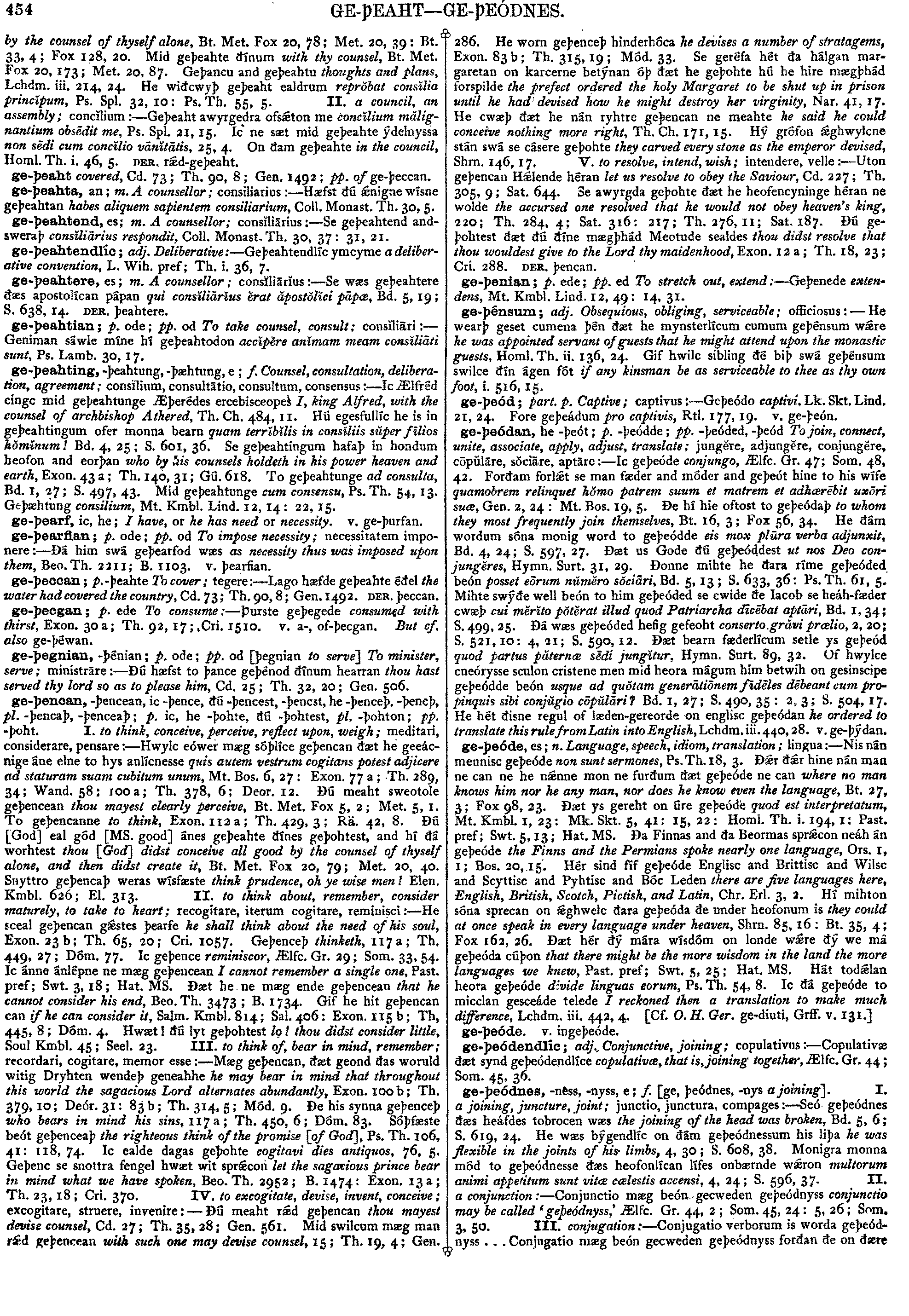
ge-þeóde,
es;
n.
Language,
speech,
idiom,
translation;
lingua
:--
Nis
nán
mennisc
geþeóde
non
sunt
sermones,
Ps.
Th.
18,
3.
Ð r
ðr
hine
nán
man
ne
can
ne
he
nnne
mon
ne
furðum
ðæt
geþeóde
ne
can
where
no
man
knows
him
nor
he
any
man,
nor
does
he
know
even
the
language,
Bt.
27,
3;
Fox
98,
23.
Ðæt
ys
gereht
on
úre
geþeóde
quod
est
interpretatum,
Mt.
Kmbl.
1,
23:
Mk.
Skt.
5,
41:
15,
22:
Homl.
Th.
i.
194,
1:
Past.
pref;
Swt.
5,
13;
Hat.
MS.
Ða
Finnas
and
ða
Beormas
sprcon
neáh
án
geþeóde
the
Finns
and
the
Permians
spoke
nearly
one
language,
Ors.
1,
1;
Bos.
20,
15.
Hér
sind
fíf
geþeóde
Englisc
and
Brittisc
and
Wilsc
and
Scyttisc
and
Pyhtisc
and
Bóc
Leden
there
are
five
languages
here,
English,
British,
Scotch,
Pictish,
and
Latin,
Chr.
Erl.
3,
2.
Hí
mihton
sóna
sprecan
on
ghwelc
ðara
geþeóda
ðe
under
heofonum
is
they
could
at
once
speak
in
every
language
under
heaven,
Shrn.
85,
16:
Bt.
35,
4;
Fox
162,
26.
Ðæt
hér
ðý
mára
wísdóm
on
londe
wre
ðý
we
má
geþeóda
cúþon
that
there
might
be
the
more
wisdom
in
the
land
the
more
languages
we
knew,
Past.
pref;
Swt.
5,
25;
Hat.
MS.
Hát
todlan
heora
geþeóde
divide
linguas
eorum,
Ps.
Th.
54,
8.
Ic
ðá
geþeóde
to
micclan
gesceáde
telede
I
reckoned
then
a
translation
to
make
much
difference,
Lchdm.
iii.
442,
4.
[Cf.
O.
H.
Ger.
ge-diuti,
Grff.
v.
131.]
r
ðr
hine
nán
man
ne
can
ne
he
nnne
mon
ne
furðum
ðæt
geþeóde
ne
can
where
no
man
knows
him
nor
he
any
man,
nor
does
he
know
even
the
language,
Bt.
27,
3;
Fox
98,
23.
Ðæt
ys
gereht
on
úre
geþeóde
quod
est
interpretatum,
Mt.
Kmbl.
1,
23:
Mk.
Skt.
5,
41:
15,
22:
Homl.
Th.
i.
194,
1:
Past.
pref;
Swt.
5,
13;
Hat.
MS.
Ða
Finnas
and
ða
Beormas
sprcon
neáh
án
geþeóde
the
Finns
and
the
Permians
spoke
nearly
one
language,
Ors.
1,
1;
Bos.
20,
15.
Hér
sind
fíf
geþeóde
Englisc
and
Brittisc
and
Wilsc
and
Scyttisc
and
Pyhtisc
and
Bóc
Leden
there
are
five
languages
here,
English,
British,
Scotch,
Pictish,
and
Latin,
Chr.
Erl.
3,
2.
Hí
mihton
sóna
sprecan
on
ghwelc
ðara
geþeóda
ðe
under
heofonum
is
they
could
at
once
speak
in
every
language
under
heaven,
Shrn.
85,
16:
Bt.
35,
4;
Fox
162,
26.
Ðæt
hér
ðý
mára
wísdóm
on
londe
wre
ðý
we
má
geþeóda
cúþon
that
there
might
be
the
more
wisdom
in
the
land
the
more
languages
we
knew,
Past.
pref;
Swt.
5,
25;
Hat.
MS.
Hát
todlan
heora
geþeóde
divide
linguas
eorum,
Ps.
Th.
54,
8.
Ic
ðá
geþeóde
to
micclan
gesceáde
telede
I
reckoned
then
a
translation
to
make
much
difference,
Lchdm.
iii.
442,
4.
[Cf.
O.
H.
Ger.
ge-diuti,
Grff.
v.
131.]
|
Source: Bosworth/Toller, page b0455, entry 4 View original page image as: [TIFF] [PNG] [View previous entry] [View next entry] |
[Comment on this entry] [View comments] |
The following entry has been hand-corrected once. |
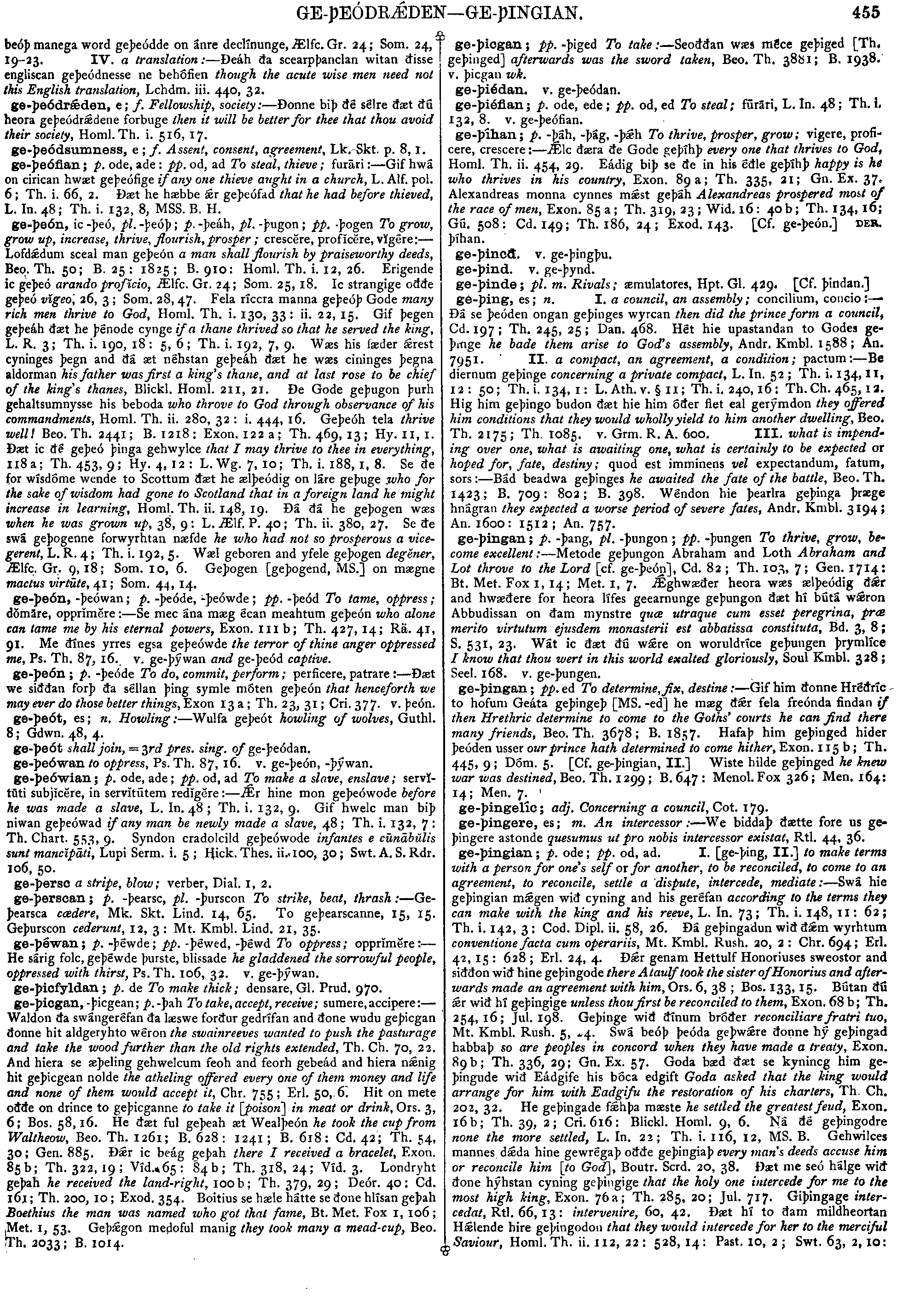
ge-þeón,
ic
-þeó,
pl.
-þeóþ;
p.
-þeáh,
pl.
-þugon;
pp.
þogen
To
grow,
grow
up,
increase,
thrive,
flourish,
prosper;
cresc re,
prof
re,
prof cre,
vg
cre,
vg re
:--
Lofddum
sceal
man
geþeón
a
man
shall
flourish
by
praiseworthy
deeds,
Beo.
Th.
50;
B.
25:
1825;
B.
910:
Homl.
Th.
i.
12,
26.
Erigende
ic
geþeó
arando
profcio,
Ælfc.
Gr.
24;
Som.
25,
18.
Ic
strangige
oððe
geþeó
vgeo,
26,
3;
Som.
28,
47.
Fela
ríccra
manna
geþeóþ
Gode
many
rich
men
thrive
to
God,
Homl.
Th.
i.
130,
33:
ii.
22,
15.
Gif
þegen
geþeáh
ðæt
he
þénode
cynge
if
a
thane
thrived
so
that
he
served
the
king,
L.
R.
3;
Th.
i.
190,
18:
5,
6;
Th.
i.
192,
7,
9.
Wæs
his
fæder
rest
cyninges
þegn
and
ðá
æt
néhstan
geþeáh
ðæt
he
wæs
cininges
þegna
aldorman
his
father
was
first
a
king's
thane,
and
at
last
rose
to
be
chief
of
the
king's
thanes,
Blickl.
Homl.
211,
21.
Ðe
Gode
geþugon
þurh
gehaltsumnysse
his
beboda
who
throve
to
God
through
observance
of
his
commandments,
Homl.
Th.
ii.
280,
32:
i.
444,
16.
Geþeóh
tela
thrive
well!
Beo.
Th.
2441;
B.
1218:
Exon.
122
a;
Th.
469,
13;
Hy.
11,
1.
Ðæt
ic
ðé
geþeó
þinga
gehwylce
that
I
may
thrive
to
thee
in
everything,
118
a;
Th.
453,
9;
Hy.
4,
12:
L.
Wg.
7,
10;
Th.
i.
188,
1,
8.
Se
ðe
for
wísdóme
wende
to
Scottum
ðæt
he
ælþeódig
on
láre
geþuge
who
for
the
sake
of
wisdom
had
gone
to
Scotland
that
in
a
foreign
land
he
might
increase
in
learning,
Homl.
Th.
ii.
148,
19.
Ðá
ðá
he
geþogen
wæs
when
he
was
grown
up,
38,
9:
L.
Ælf.
P.
40;
Th.
ii.
380,
27.
Se
ðe
swá
geþogenne
forwyrhtan
næfde
he
who
had
not
so
prosperous
a
vicegerent,
L.
R.
4;
Th.
i.
192,
5.
Wæl
geboren
and
yfele
geþogen
degner,
Ælfc.
Gr.
9,
18;
Som.
10,
6.
Geþogen
[geþogend,
MS.]
on
mægne
mactus
virt
re
:--
Lofddum
sceal
man
geþeón
a
man
shall
flourish
by
praiseworthy
deeds,
Beo.
Th.
50;
B.
25:
1825;
B.
910:
Homl.
Th.
i.
12,
26.
Erigende
ic
geþeó
arando
profcio,
Ælfc.
Gr.
24;
Som.
25,
18.
Ic
strangige
oððe
geþeó
vgeo,
26,
3;
Som.
28,
47.
Fela
ríccra
manna
geþeóþ
Gode
many
rich
men
thrive
to
God,
Homl.
Th.
i.
130,
33:
ii.
22,
15.
Gif
þegen
geþeáh
ðæt
he
þénode
cynge
if
a
thane
thrived
so
that
he
served
the
king,
L.
R.
3;
Th.
i.
190,
18:
5,
6;
Th.
i.
192,
7,
9.
Wæs
his
fæder
rest
cyninges
þegn
and
ðá
æt
néhstan
geþeáh
ðæt
he
wæs
cininges
þegna
aldorman
his
father
was
first
a
king's
thane,
and
at
last
rose
to
be
chief
of
the
king's
thanes,
Blickl.
Homl.
211,
21.
Ðe
Gode
geþugon
þurh
gehaltsumnysse
his
beboda
who
throve
to
God
through
observance
of
his
commandments,
Homl.
Th.
ii.
280,
32:
i.
444,
16.
Geþeóh
tela
thrive
well!
Beo.
Th.
2441;
B.
1218:
Exon.
122
a;
Th.
469,
13;
Hy.
11,
1.
Ðæt
ic
ðé
geþeó
þinga
gehwylce
that
I
may
thrive
to
thee
in
everything,
118
a;
Th.
453,
9;
Hy.
4,
12:
L.
Wg.
7,
10;
Th.
i.
188,
1,
8.
Se
ðe
for
wísdóme
wende
to
Scottum
ðæt
he
ælþeódig
on
láre
geþuge
who
for
the
sake
of
wisdom
had
gone
to
Scotland
that
in
a
foreign
land
he
might
increase
in
learning,
Homl.
Th.
ii.
148,
19.
Ðá
ðá
he
geþogen
wæs
when
he
was
grown
up,
38,
9:
L.
Ælf.
P.
40;
Th.
ii.
380,
27.
Se
ðe
swá
geþogenne
forwyrhtan
næfde
he
who
had
not
so
prosperous
a
vicegerent,
L.
R.
4;
Th.
i.
192,
5.
Wæl
geboren
and
yfele
geþogen
degner,
Ælfc.
Gr.
9,
18;
Som.
10,
6.
Geþogen
[geþogend,
MS.]
on
mægne
mactus
virt te,
41;
Som.
44,
14.
te,
41;
Som.
44,
14.
|
Source: Bosworth/Toller, page b0467, entry 1 View original page image as: [TIFF] [PNG] [View previous entry] [View next entry] |
[Comment on this entry] [View comments] |
The following entry has been hand-corrected once. |
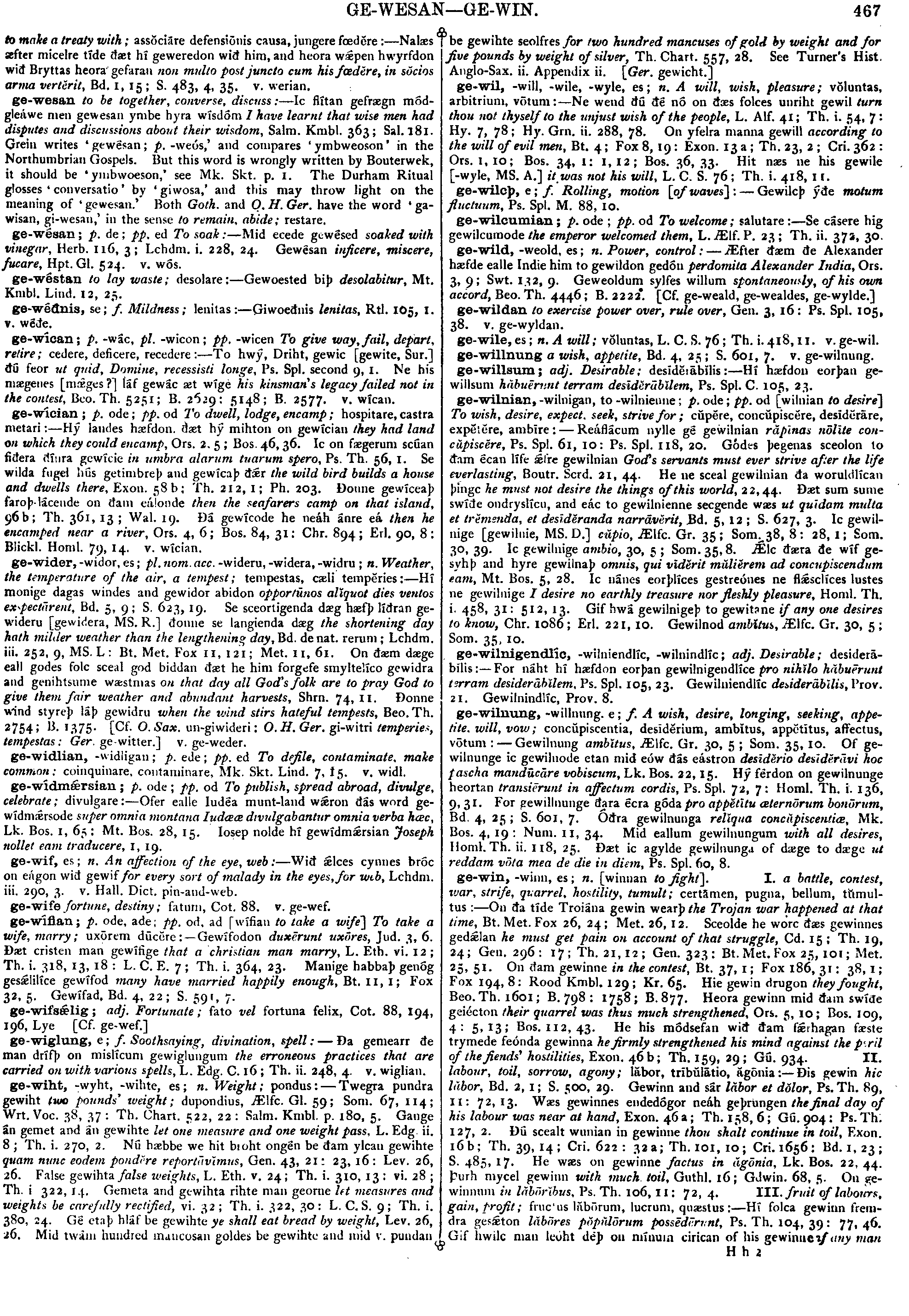
ge-wesan to be together, converse, discuss :-- Ic flítan gefrægn módgleáwe men gewesan ymbe hyra wísdóm I have learnt that wise men had disputes and discussions about their wisdom, Salm. Kmbl. 363; Sal. 181. Grein writes 'gewésan; p. -weós,' and compares 'ymbweoson' in the Northumbrian Gospels. But this word is wrongly written by Bouterwek, it should be 'ymbwoeson,' see Mk. Skt. p. 1. The Durham Ritual glosses 'conversatio' by 'giwosa,' and this may throw light on the meaning of 'gewesan.' Both Goth. and O. H. Ger. have the word 'gawisan, gi-wesan,' in the sense to remain, abide; restare.
|
Source: Bosworth/Toller, page b0468, entry 10 View original page image as: [TIFF] [PNG] [View previous entry] [View next entry] |
[Comment on this entry] [View comments] |
The following entry has been hand-corrected once. |
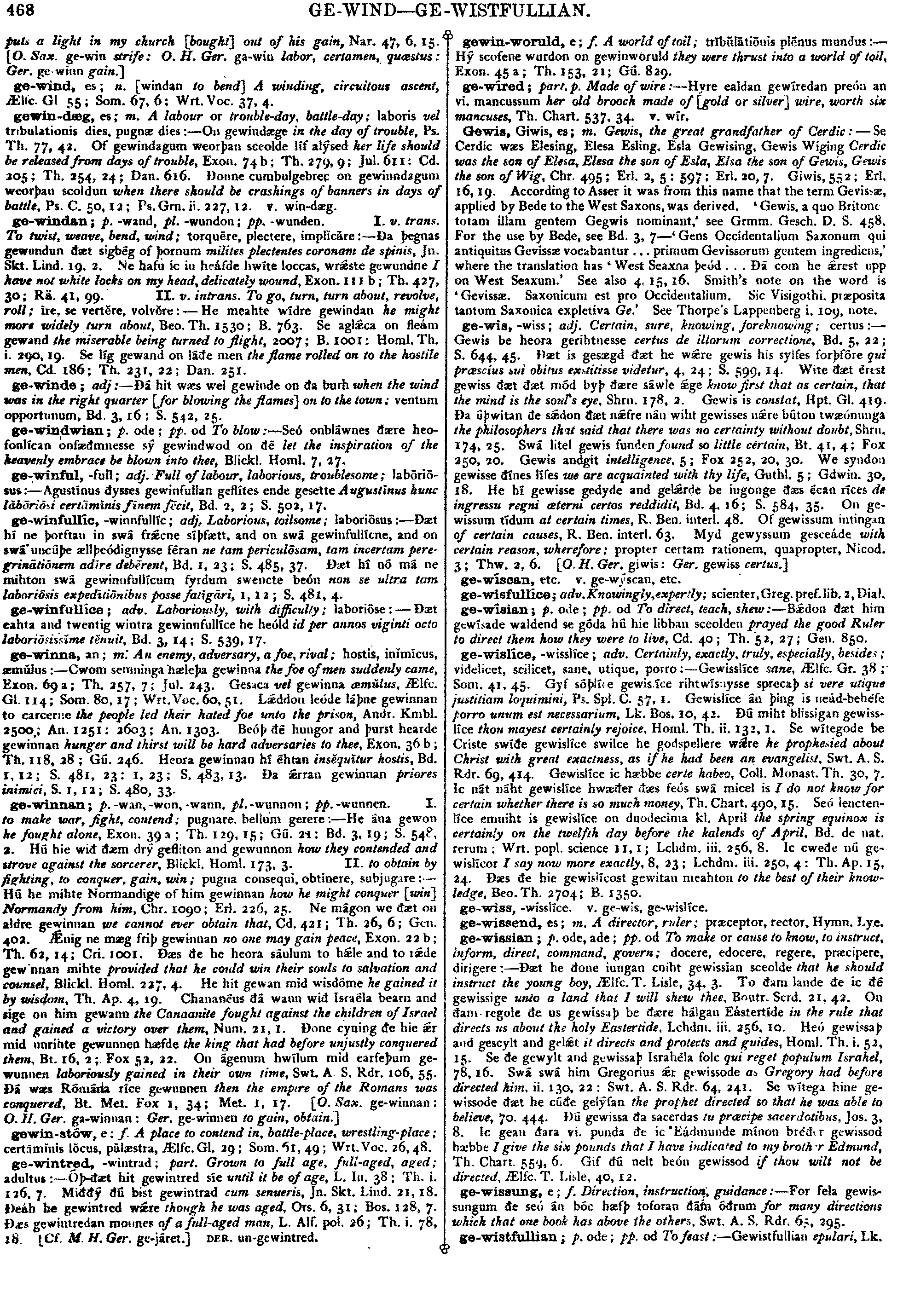
ge-winnan;
p.
-wan,
-won,
-wann,
pl.
-wunnon;
pp.
-wunnen.
I.
to
make
war,
fight,
contend;
pugnare,
bellum
gerere
:--
He
ána
gewon
he
fought
alone,
Exon.
39
a;
Th.
129,
15;
Gú.
21:
Bd.
3,
19;
S.
548,
2.
Hú
hie
wið
ðæm
drý
gefliton
and
gewunnon
how
they
contended
and
strove
against
the
sorcerer,
Blickl.
Homl.
173,
3.
II.
to
obtain
by
fighting,
to
conquer,
gain,
win;
pugna
consequi,
obtinere,
subjugare
:--
Hú
he
mihte
Normandige
of
him
gewinnan
how
he
might
conquer
[win]
Normandy
from
him,
Chr.
1090;
Erl.
226,
25.
Ne
mágon
we
ðæt
on
aldre
gewinnan
we
cannot
ever
obtain
that,
Cd.
421;
Th.
26,
6;
Gen.
402.
Æ-acute;nig
ne
mæg
friþ
gewinnan
no
one
may
gain
peace,
Exon.
22
b;
Th.
62,
14;
Cri.
1001.
Ðæs
ðe
he
heora
sáulum
to
hle
and
to
rde
gewinnan
mihte
provided
that
he
could
win
their
souls
to
salvation
and
counsel,
Blickl.
Homl.
227,
4.
He
hit
gewan
mid
wisdóme
he
gained
it
by
wisdom,
Th.
Ap.
4,
19.
Chananéus
ðá
wann
wið
Israéla
bearn
and
sige
on
him
gewann
the
Canaanite
fought
against
the
children
of
Israel
and
gained
a
victory
over
them,
Num.
21,
1.
Ðone
cyning
ðe
hie
r
mid
unrihte
gewunnen
hæfde
the
king
that
had
before
unjustly
conquered
them,
Bt.
16,
2;
Fox
52,
22.
On
ágenum
hwílum
mid
earfeþum
gewunnen
laboriously
gained
in
their
own
time,
Swt.
A.
S.
Rdr.
106,
55.
Ðá
wæs
Rómána
ríce
gewunnen
then
the
empire
of
the
Romans
was
conquered,
Bt.
Met.
Fox
1,
34;
Met.
1,
17.
[O.
Sax.
ge-winnan:
O.
H.
Ger.
ga-winnan:
Ger.
ge-winnen
to
gain,
obtain.]
|
Source: Bosworth/Toller, page b0474, entry 7 View original page image as: [TIFF] [PNG] [View previous entry] [View next entry] |
[Comment on this entry] [View comments] |
The following entry has been hand-corrected once. |
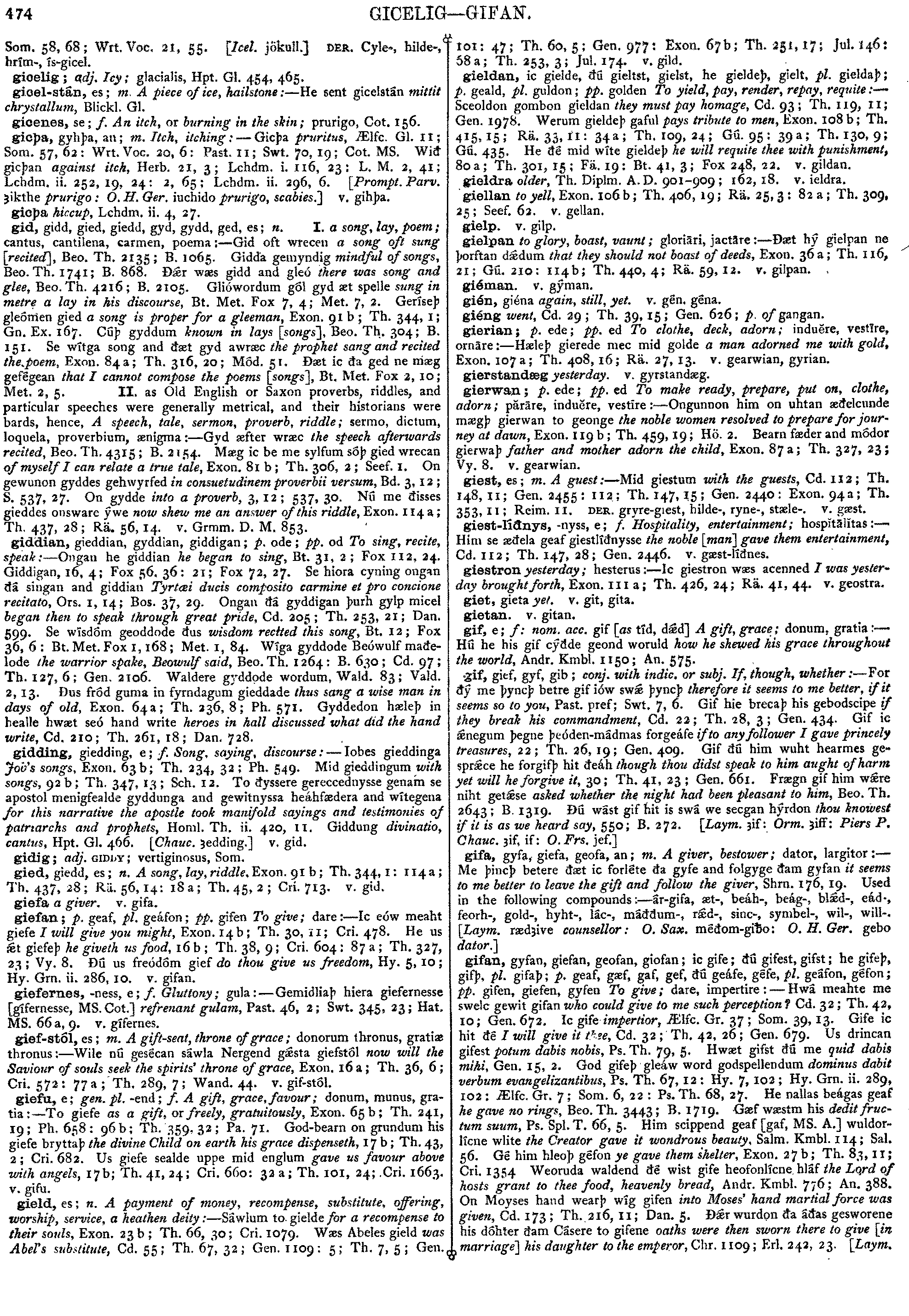
giddian, gieddian, gyddian, giddigan; p. ode; pp. od To sing, recite, speak :-- Ongan he giddian he began to sing, Bt. 31, 2; Fox 112, 24. Giddigan, 16, 4; Fox 56, 36: 21; Fox 72, 27. Se hiora cyning ongan ðá singan and giddian Tyrtæi ducis composito carmine et pro concione recitato, Ors. 1, 14; Bos. 37, 29. Ongan ðá gyddigan þurh gylp micel began then to speak through great pride, Cd. 205; Th. 253, 21; Dan. 599. Se wísdóm geoddode ðus wisdom recited this song, Bt. 12; Fox 36, 6: Bt. Met. Fox 1, 168; Met. 1, 84. Wíga gyddode Beówulf maðelode the warrior spake, Beowulf said, Beo. Th. 1264: B. 630; Cd. 97; Th. 127, 6; Gen. 2106. Waldere gyddode wordum, Wald. 83; Vald. 2, 13. Ðus fród guma in fyrndagum gieddade thus sang a wise man in days of old, Exon. 64 a; Th. 236, 8; Ph. 571. Gyddedon hæleþ in healle hwæt seó hand write heroes in hall discussed what did the hand write, Cd. 210; Th. 261, 18; Dan. 728.
|
Source: Bosworth/Toller, page b0475, entry 29 View original page image as: [TIFF] [PNG] [View previous entry] [View next entry] |
[Comment on this entry] [View comments] |
The following entry has been hand-corrected once. |
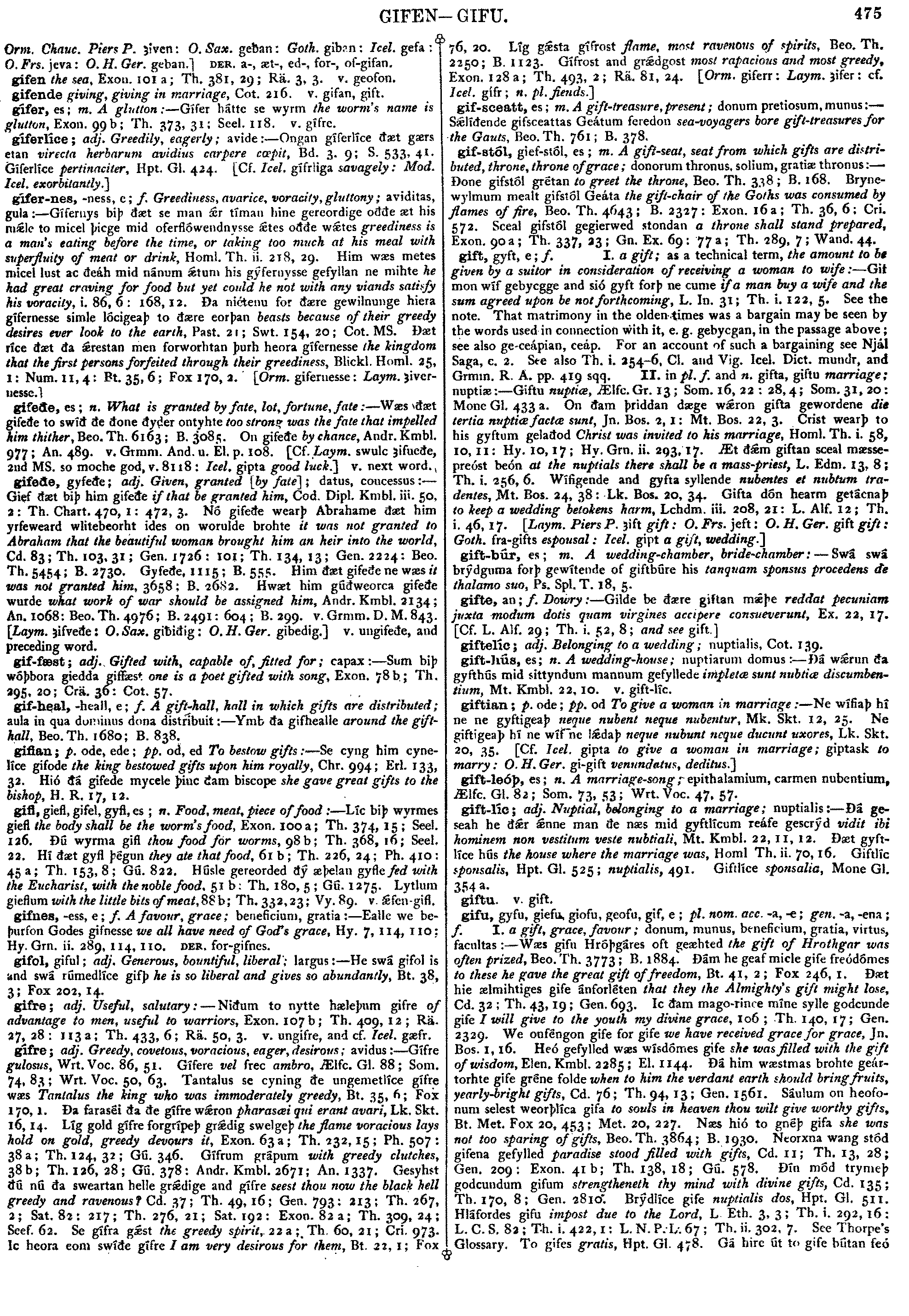
gifu,
gyfu,
giefu,
giofu,
geofu,
gif,
e;
pl.
nom.
acc.
-a,
-e;
gen.
-a,
-ena;
f.
I.
a
gift,
grace,
favour;
donum,
munas,
beneficium,
gratia,
virtus,
facultas
:--
Wæs
gifu
Hróþgáres
oft
geæhted
the
gift
of
Hrothgar
was
often
prized,
Beo.
Th.
3773;
B.
1884.
Ðám
he
geaf
micle
gife
freódómes
to
these
he
gave
the
great
gift
of
freedom,
Bt.
41,
2;
Fox
246,
1.
Ðæt
hie
ælmihtiges
gife
ánforléten
that
they
the
Almighty's
gift
might
lose,
Cd.
32;
Th.
43,
19;
Gen.
693.
Ic
ðam
mago-rince
míne
sylle
godcunde
gife
I
will
give
to
the
youth
my
divine
grace,
106;
Th.
140,
17;
Gen.
2329.
We
onféngon
gife
for
gife
we
have
received
grace
for
grace,
Jn.
Bos.
1,
16.
Heó
gefylled
wæs
wísdómes
gife
she
was
filled
with
the
gift
of
wisdom,
Elen.
Kmbl.
2285;
El.
1144.
Ðá
him
wæstmas
brohte
geár-torhte
gife
gréne
folde
when
to
him
the
verdant
earth
should
bring
fruits,
yearly-bright
gifts,
Cd.
76;
Th.
94,
13;
Gen.
1561.
Sáulum
on
heofonum
selest
weorþlíca
gifa
to
souls
in
heaven
thou
wilt
give
worthy
gifts,
Bt.
Met.
Fox
20,
453;
Met.
20,
227.
Næs
hió
to
gnéþ
gifa
she
was
not
too
sparing
of
gifts,
Beo.
Th.
3864;
B.
1930.
Neorxna
wang
stód
gifena
gefylled
paradise
stood
filled
with
gifts,
Cd.
11;
Th.
13,
28;
Gen.
209:
Exon.
41
b;
Th.
138,
18;
Gú.
578.
Ðín
mód
trymeþ
godcundum
gifum
strengtheneth
thy
mind
with
divine
gifts,
Cd.
135;
Th.
170,
8;
Gen.
2810.
Brýdlíce
gife
nuptialis
dos,
Hpt.
Gl.
511.
Hláfordes
gifu
impost
due
to
the
Lord,
L.
Eth.
3,
3;
Th.
i.
292,
16:
L.
C.
S.
82;
Th.
i.
422,
1:
L.
N.
P.
L.
67;
Th.
ii.
302,
7.
See
Thorpe's
Glossary.
To
gifes
gratis,
Hpt.
Gl.
478.
Gá
hire
út
to
gife
bútan
feó
let
her
go
out
free
without
money,
Ex.
21,
11:
Num.
11,
5.
To
gife
gratis,
Gen.
29,
15.
Gifum
gratis,
Ps.
Spl.
T.
34,
8.
II.
the
Anglo-Saxon
Rune
RUNE
=
g,
the
name
of
which
letter
in
Anglo-Saxon
is
gifu
a
gift,-hence,
this
Rune
not
only
stands
for
the
letter
g,
but
for
gifu
a
gift,
as
:--
RUNE
[Gifu]
gumena
byþ
gleng
and
herenys
a
gift
is
the
honour
and
praise
of
men,
Runic.
pm.
7;
Kmbl.
340,
23;
Hick.
Thes.
i.
135.
[Orm.
gife:
Laym.
geve:
R.
Brun.
give:
Kath.
geoven,
pl:
Piers
P.
yeves:
O.
Sax.
ge a;
f.
donum:
O.
Frs.
jeve:
O.
H.
Ger.
geba:
Goth.
giba:
Icel.
gjöf;
f.
donum,
munus.]
DER.
beáh-gifu,
brýd-,
eád-,
feorh-,
freót-,
frum-,
hyht-,
máððum,
morgen-,
sinc-,
sundor-,
sundur-,
sweord-,
wóþ-,
wuldor-,
wundor-.
a;
f.
donum:
O.
Frs.
jeve:
O.
H.
Ger.
geba:
Goth.
giba:
Icel.
gjöf;
f.
donum,
munus.]
DER.
beáh-gifu,
brýd-,
eád-,
feorh-,
freót-,
frum-,
hyht-,
máððum,
morgen-,
sinc-,
sundor-,
sundur-,
sweord-,
wóþ-,
wuldor-,
wundor-.
|
Source: Bosworth/Toller, page b0480, entry 20 View original page image as: [TIFF] [PNG] [View previous entry] [View next entry] |
[Comment on this entry] [View comments] |
The following entry has been hand-corrected once. |
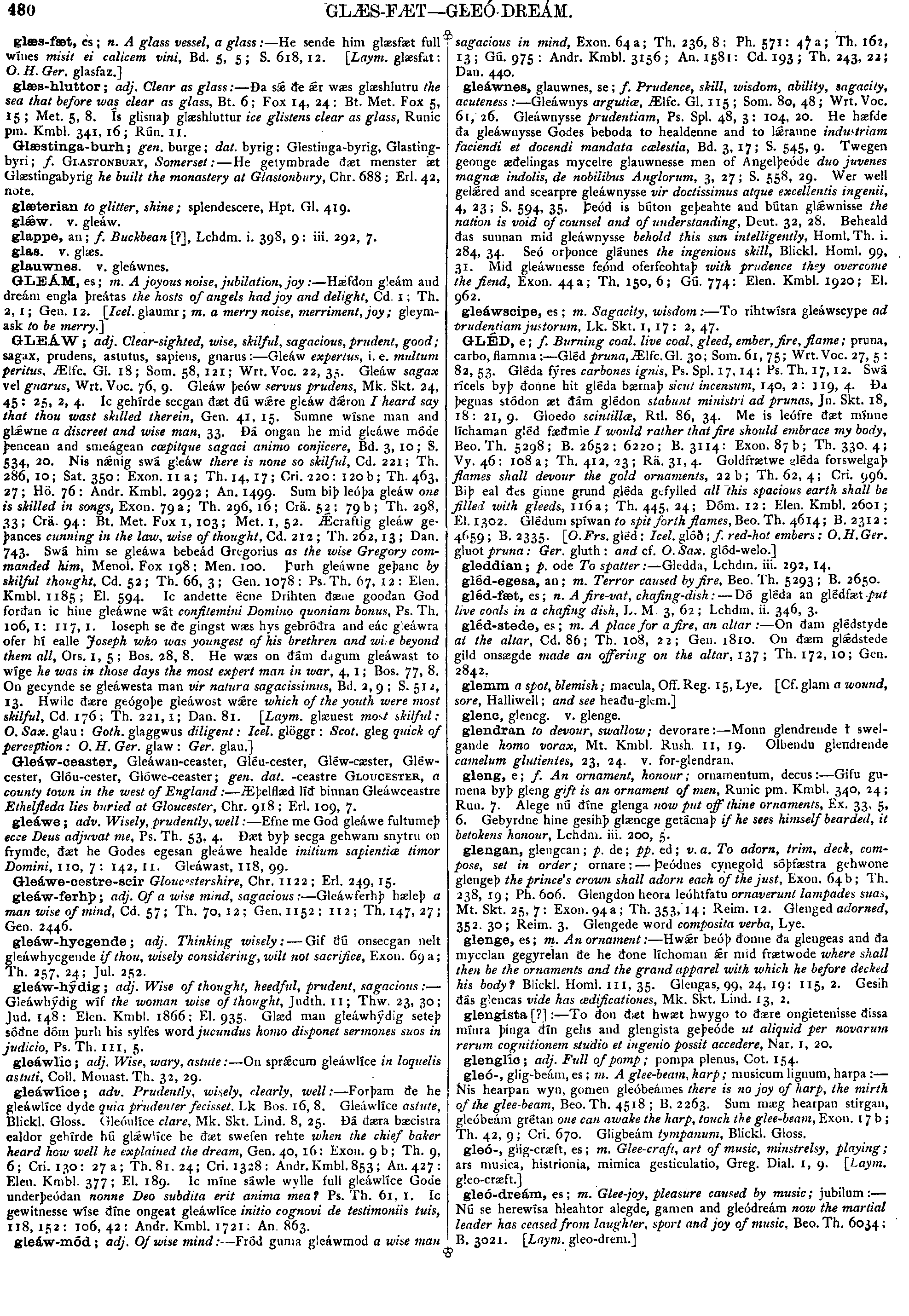
gleáwnes,
glauwnes,
se;
f.
Prudence,
skill,
wisdom,
ability,
sagacity,
acuteness
:--
Gleáwnys
argutiæ,
Ælfc.
Gl.
115;
Som.
80,
48;
Wrt.
Voc.
61,
26.
Gleáwnysse
prudentiam,
Ps.
Spl.
48,
3:
104,
20.
He
hæfde
ða
gleáwnysse
Godes
beboda
to
healdenne
and
to
lranne
industriam
faciendi
et
docendi
mandata
cælestia,
Bd.
3,
17;
S.
545,
9.
Twegen
geonge
æðelingas
mycelre
glauwnesse
men
of
Angelþeóde
duo
juvenes
magnæ
indolis,
de
nobilibus
Anglorum,
3,
27;
S.
558,
29.
Wer
well
gelred
and
scearpre
gleáwnysse
vir
doctissimus
atque
excellentis
ingenii,
4,
23;
S.
594,
35.
Þeód
is
búton
geþeahte
and
bútan
glwnisse
the
nation
is
void
of
counsel
and
of
understanding,
Deut.
32,
28.
Beheald
ðas
sunnan
mid
gleáwnysse
behold
this
sun
intelligently,
Homl.
Th.
i.
284,
34.
Seó
orþonce
gláunes
the
ingenious
skill,
Blickl.
Homl.
99,
31.
Mid
gleáwnesse
feónd
oferfeohtaþ
with
prudence
they
overcome
the
fiend,
Exon.
44
a;
Th.
150,
6;
Gú.
774:
Elen.
Kmbl.
1920;
El.
962.
|
Source: Bosworth/Toller, page b0480, entry 21 View original page image as: [TIFF] [PNG] [View previous entry] [View next entry] |
[Comment on this entry] [View comments] |
The following entry has been hand-corrected once. |
gleáwscipe, es; m. Sagacity, wisdom :-- To rihtwísra gleáwscype ad prudentiam justorum, Lk. Skt. 1, 17: 2, 47.
|
Source: Bosworth/Toller, page b0481, entry 8 View original page image as: [TIFF] [PNG] [View previous entry] [View next entry] |
[Comment on this entry] [View comments] |
The following entry has been hand-corrected once. |
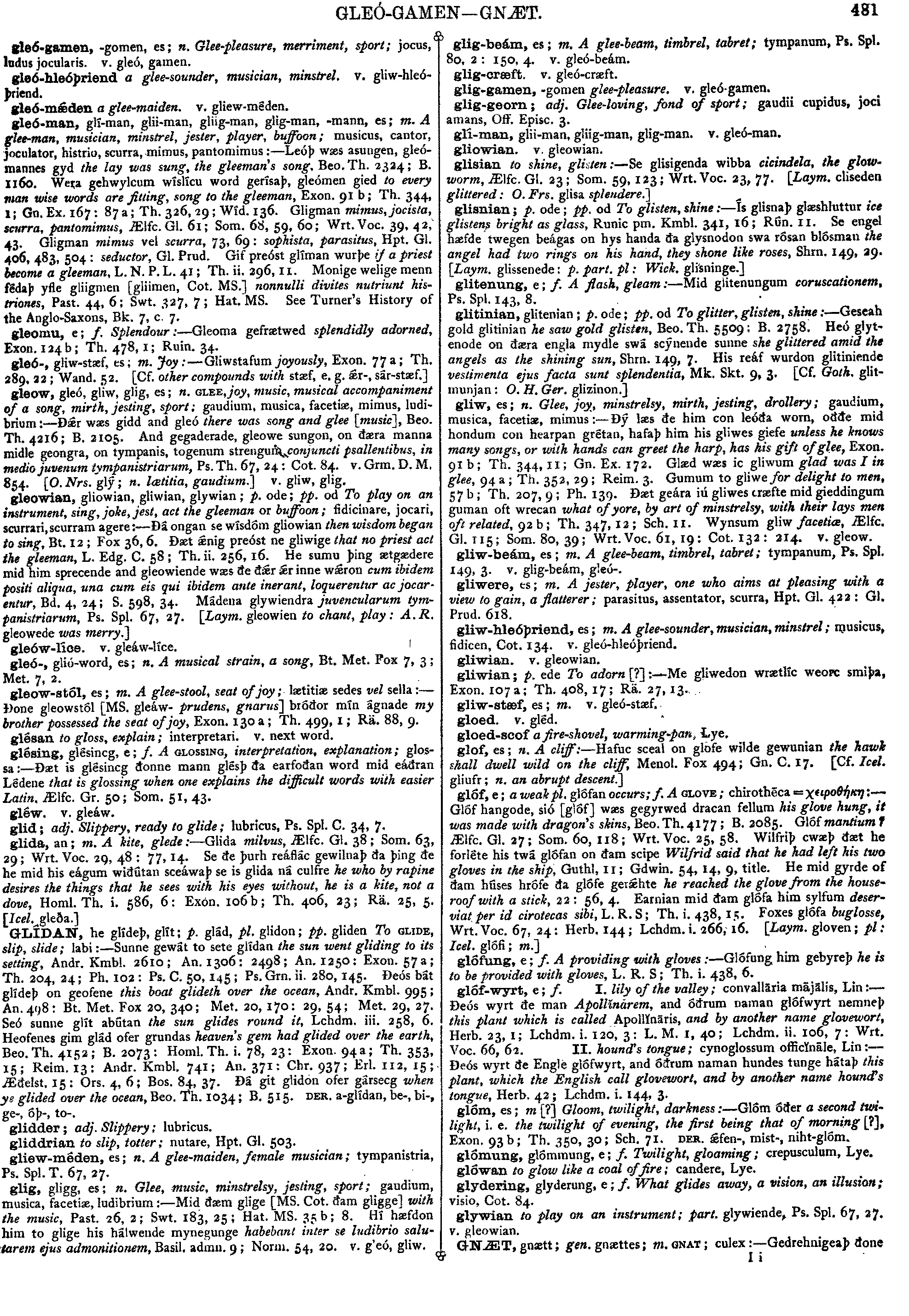
gleowian,
gliowian,
gliwian,
glywian;
p.
ode;
pp.
od
To
play
on
an
instrument,
sing,
joke,
jest,
act
the
gleeman
or
buffoon;
fidicinare,
jocari,
scurrari,
scurram
agere
:--
Ðá
ongan
se
wísdóm
gliowian
then
wisdom
began
to
sing,
Bt.
12;
Fox
36,
6.
Ðæt
nig
preóst
ne
gliwige
that
no
priest
act
the
gleeman,
L.
Edg.
C.
58;
Th.
ii.
256,
16.
He
sumu
þing
ætgædere
mid
him
sprecende
and
gleowiende
wæs
ðe
ðr
r
inne
wron
cum
ibidem
positi
aliqua,
una
cum
eis
qui
ibidem
ante
inerant,
loquerentur
ac
jocarentur,
Bd.
4,
24;
S.
598,
34.
Mádena
glywiendra
juvencularum
tympanistriarum,
Ps.
Spl.
67,
27.
[Laym.
gleowien
to
chant,
play:
A.
R.
gleowede
was
merry.]
|
Source: Bosworth/Toller, page b0491, entry 16 View original page image as: [TIFF] [PNG] [View previous entry] [View next entry] |
[Comment on this entry] [View comments] |
The following entry has been hand-corrected once. |
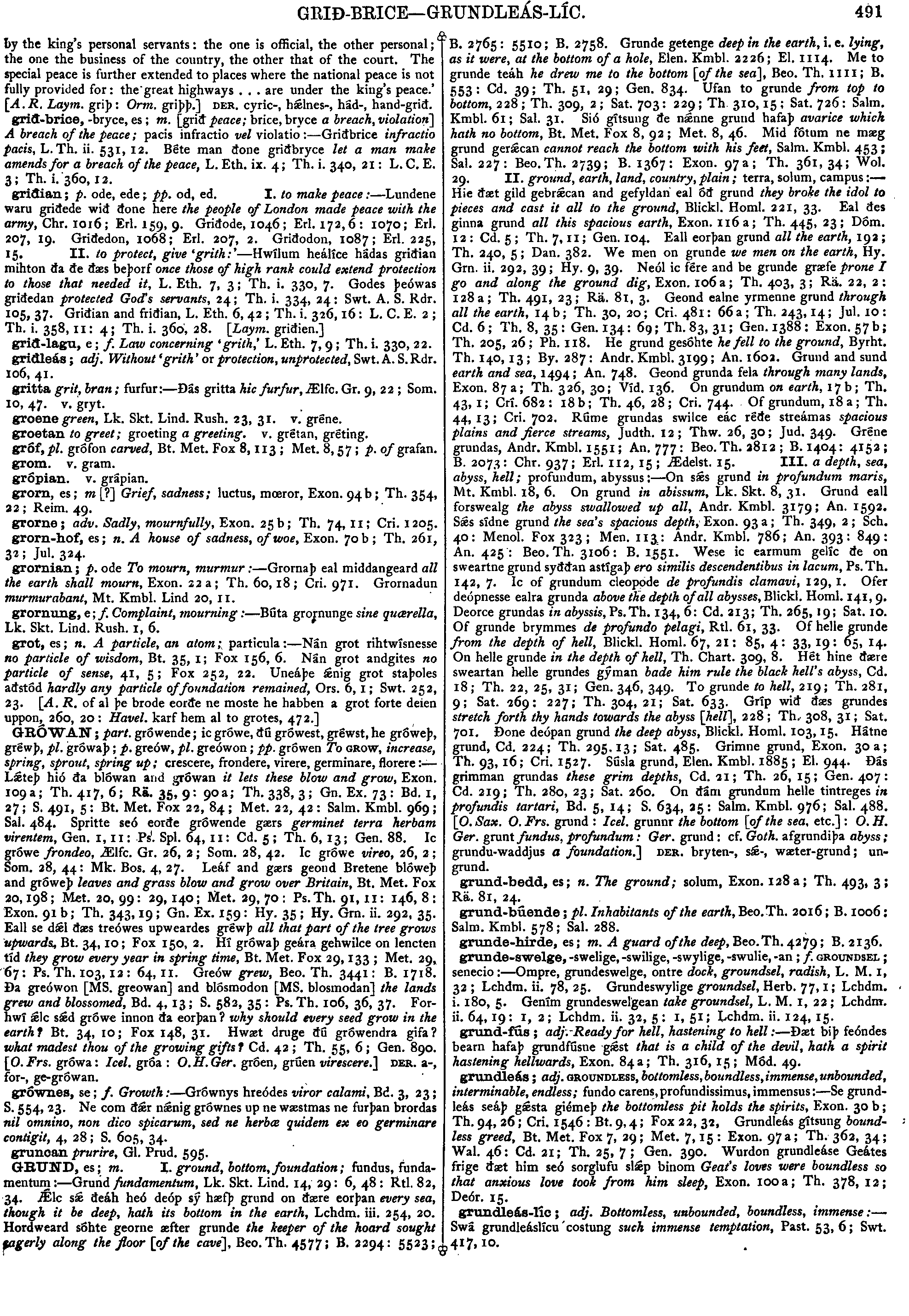
grot,
es;
n.
A
particle,
an
atom;
particula
:--
Nán
grot
rihtwísnesse
no
particle
of
wisdom,
Bt.
35,
1;
Fox
156,
6.
Nán
grot
andgites
no
particle
of
sense,
41,
5
Fox
252,
22.
Uneáþe
nig
grot
staþoles
aðstód
hardly
any
particle
of
foundation
remained,
Ors.
6,
1;
Swt.
252,
23.
[A.
R.
of
al
þe
brode
eorðe
ne
moste
he
habben
a
grot
forte
deien
uppon,
260,
20:
Havel.
karf
hem
al
to
grotes,
472.]
| Result Page: |  |
Previous | 1 2 3 4 5 6 7 8 9 10 11 12 13 14 15 | Next |  |
Germanic Lexicon Project (main page)
This search system was written by
Sean Crist
Please consider
volunteering
to correct the data in these online dictionaries.
No rights reserved. Feel free to use these data in any way you please.