|
|

|
Source: Bosworth/Toller, page d0463, entry 3 View original page image as: [TIFF] [PNG] [View previous entry] [View next entry] |
[Comment on this entry] [View comments (1)] |
The following entry has been hand-corrected once. |
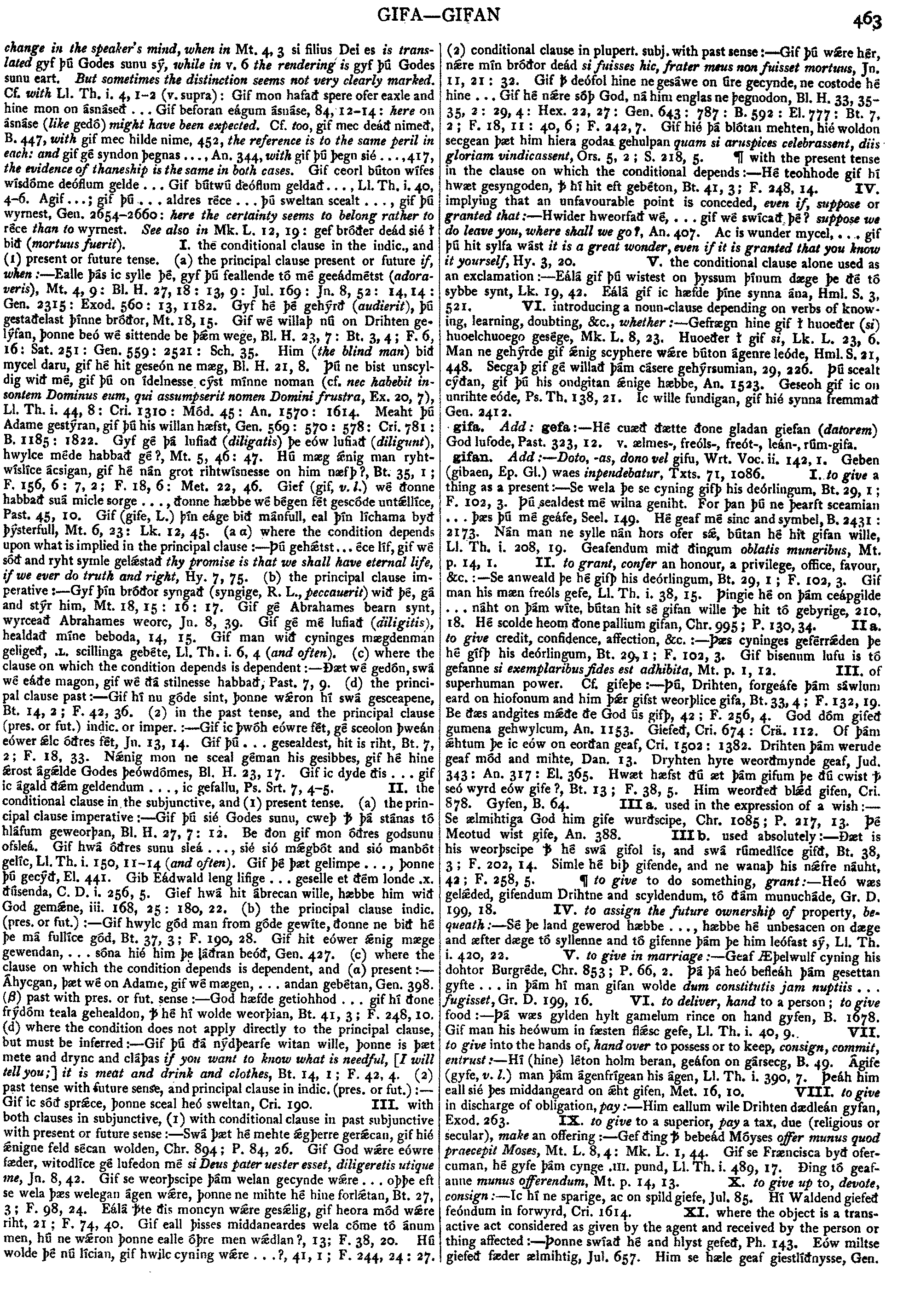
gifan.
Add
:--
Doto,
-as,
dono
vel
gifu,
Wrt.
Voc.
ii.
142,
l.
Geben
(gibaen,
Ep.
Gl.)
wæs
inpendebatur,
Txts.
71,
1086.
I.
to
give
a
thing
as
a
present
:--
Se
wela
þe
se
cyning
gifþ
his
deórlingum.
Bt.
29,
1
;
F.
102,
3.
Þ .
sealdest
m
.
sealdest
m wilna
geniht.
For
þan
þ
ne
þearft
sceamiaii
.
.
.
þæs
þ
m
geáfe,
Seel.
149.
H
geaf
m
sinc
and
symbel,
B.
2431
:
2173.
N
wilna
geniht.
For
þan
þ
ne
þearft
sceamiaii
.
.
.
þæs
þ
m
geáfe,
Seel.
149.
H
geaf
m
sinc
and
symbel,
B.
2431
:
2173.
N n
man
ne
sylle
nn
hors
ofer
s
n
man
ne
sylle
nn
hors
ofer
s ,
btan
h
hit
gifan
wille,
Ll.
Th.
i.
208,
19.
Geafendum
mi
,
btan
h
hit
gifan
wille,
Ll.
Th.
i.
208,
19.
Geafendum
mi ingum
oblatis
muneribus,
Mt.
p.
14,
II.
to
grant,
confer
an
honour,
a
privilege,
office,
favour,
&c.
:--
Se
anweald
þe
h
gifþ
his
deórlingum,
Bt.
29,
I
;
F.
102,
3.
Gif
man
his
mæn
freóls
gefe,
Ll.
Th.
i.
38,
15.
Þpingie
h
on
þm
ceápgilde
.
.
.
nht
on
þm
w
ingum
oblatis
muneribus,
Mt.
p.
14,
II.
to
grant,
confer
an
honour,
a
privilege,
office,
favour,
&c.
:--
Se
anweald
þe
h
gifþ
his
deórlingum,
Bt.
29,
I
;
F.
102,
3.
Gif
man
his
mæn
freóls
gefe,
Ll.
Th.
i.
38,
15.
Þpingie
h
on
þm
ceápgilde
.
.
.
nht
on
þm
w te,
btan
hit
s
gifan
wille
te,
btan
hit
s
gifan
wille
 e
hit
t
e
hit
t gebyrige,
210,
18.
H
scolde
heom
one
pallium
gifan,
Chr.
995
;
P.
130,
34.
II
a.
to
give
credit,
confidence,
affection,
&c.
:--
Þæs
cyninges
gefrrden
þe
h
gfþ
his
deórlingum,
Bt.
29,
1
;
F.
102,
3.
Gif
bisenum
lufu
is
t
gefanne
si
exemplar
ibus
fides
est
adhibita.
Mt.
p.
I.
12.
III.
of
superhuman
power.
Cf.
gifeþe
:--
Þ,
Drihten,
forgeáfe
þm
swlum
eard
on
hiofonum
and
him
þr
UNCERTAIN
gifst
weorþlice
gifa,
Bt.
33,
4
;
F.
132,
19.
Be
æs
andgites
me
e
God
s
gifþ,
42
;
F.
256,
4.
God
dm
gife
gumena
gehwylcum,
An.
1153.
Giefe,
Cri.
674
:
Crä.
112.
Of
þm
htum
þe
ic
eów
on
eoran
geaf,
Cri.
1502
:
1382.
Drihten
þm
werude
geaf
md
and
mihte,
Dan.
13.
Dryhten
hyre
weormynde
geaf,
Jud.
343
:
An.
317
:
El.
365.
Hwæt
hæfst
æt
þm
gifum
þe
cwist
seó
wyrd
eów
gife?,
Bt.
13
;
F.
38,
5.
Him
weore
bld
gifen,
Cri.
878.
Gyfen,
B.
64.
III
a.
used
in
the
expression
of
a
wish
:--
Se
ælmihtiga
God
him
gife
wurscipe,
Chr.
1085;
P.
217,
13.]
Þ
Meotud
wist
gife,
An.
388.
III
b.
used
absolutely:--
Ðæt
is
his
weorþscipe
h
sw
gifol
is,
and
sw
rmedlce
gif,
Bt.
38,
3;
F.
202,
14.
Simle
h
biþ
gifende,
and
ne
wanaþ
his
nfre
nuht,
42;
F.
258,
5.
¶
to
give
to
do
something,
grant
:--
Heó
wæs
gelded,
gifendum
Drihtne
and
scyldendum,
t
m
munuchde,
Gr.
D.
199,
18.
IV.
to
assign
the
future
ownership
of
property,
be-queath
:--
S
þe
land
gewerod
hæbbe
.
.
.
,
hæbbe
h
unbesacen
on
dæge
and
æfter
dæge
t
syllenne
and
t
gifenne
þm
þe
him
leófast
s
gebyrige,
210,
18.
H
scolde
heom
one
pallium
gifan,
Chr.
995
;
P.
130,
34.
II
a.
to
give
credit,
confidence,
affection,
&c.
:--
Þæs
cyninges
gefrrden
þe
h
gfþ
his
deórlingum,
Bt.
29,
1
;
F.
102,
3.
Gif
bisenum
lufu
is
t
gefanne
si
exemplar
ibus
fides
est
adhibita.
Mt.
p.
I.
12.
III.
of
superhuman
power.
Cf.
gifeþe
:--
Þ,
Drihten,
forgeáfe
þm
swlum
eard
on
hiofonum
and
him
þr
UNCERTAIN
gifst
weorþlice
gifa,
Bt.
33,
4
;
F.
132,
19.
Be
æs
andgites
me
e
God
s
gifþ,
42
;
F.
256,
4.
God
dm
gife
gumena
gehwylcum,
An.
1153.
Giefe,
Cri.
674
:
Crä.
112.
Of
þm
htum
þe
ic
eów
on
eoran
geaf,
Cri.
1502
:
1382.
Drihten
þm
werude
geaf
md
and
mihte,
Dan.
13.
Dryhten
hyre
weormynde
geaf,
Jud.
343
:
An.
317
:
El.
365.
Hwæt
hæfst
æt
þm
gifum
þe
cwist
seó
wyrd
eów
gife?,
Bt.
13
;
F.
38,
5.
Him
weore
bld
gifen,
Cri.
878.
Gyfen,
B.
64.
III
a.
used
in
the
expression
of
a
wish
:--
Se
ælmihtiga
God
him
gife
wurscipe,
Chr.
1085;
P.
217,
13.]
Þ
Meotud
wist
gife,
An.
388.
III
b.
used
absolutely:--
Ðæt
is
his
weorþscipe
h
sw
gifol
is,
and
sw
rmedlce
gif,
Bt.
38,
3;
F.
202,
14.
Simle
h
biþ
gifende,
and
ne
wanaþ
his
nfre
nuht,
42;
F.
258,
5.
¶
to
give
to
do
something,
grant
:--
Heó
wæs
gelded,
gifendum
Drihtne
and
scyldendum,
t
m
munuchde,
Gr.
D.
199,
18.
IV.
to
assign
the
future
ownership
of
property,
be-queath
:--
S
þe
land
gewerod
hæbbe
.
.
.
,
hæbbe
h
unbesacen
on
dæge
and
æfter
dæge
t
syllenne
and
t
gifenne
þm
þe
him
leófast
s ,
Ll.
Th.
i.
420,
22.
V.
to
give
in
marriage
:--
Geaf
Æþelwulf
cyning
his
dohtor
Burgrde,
Chr.
853
;
P.
66,
2.
Þ
þ
heó
befleáh
þm
gesettan
gyfte
.
.
.
in
þm
h
man
gifan
wolde
dum
constitutis
jam
nuptiis
.
.
.
fugisset,
Gr.
D.
199,
16.
VI.
to
deliver,
hand
to
a
person;
to
give
food
:--
Þ
wæs
gylden
hylt
gamelum
rince
on
hand
gyfen,
B.
1678.
Gif
man
his
heówum
in
fæsten
flsc
gefe,
Ll.
Th.
i.
40,
9.
.
VII.
to
give
into
the
hands
of,
handover
to
possess
or
to
keep,
consign,
commit,
entrust
:--
H
(hine)
lton
holm
beran,
geáfon
on
grsecg,
B.
49.
&A-long;gife
(gyfe,
v.
l.)
man
þm
genfrgean
his
gen,
Ll.
Th.
i.
390,
7.
Þeáh
him
eall
sié
þes
middangeard
on
ht
gifen,
Met.
16,
10.
VIII.
to
give
in
discharge
of
obligation,
pay
:--
Him
eallum
wile
Drihten
dædleán
gyfan,
Exod.
263.
IX.
to
give
to
a
superior,
pay
a
tax,
due
(religious
or
secular),
make
an
offering
:--
Gef
ing
bebeád
Myses
offer
munus
quod
praecepit
Moses,
Mt.
L.
8,
4:
Mk.
L.
l,
44.
Gif
se
Fræncisca
by
ofer-cuman,
h
gyfe
þm
cynge
.III.
pund,
Ll.
Th.
i.
489,
17.
Ðing
t
geaf-anne
munus
offerendum,
Mt.
p.
14,
13.
X.
to
give
up
to,
devote,
consign
:--
Ic
h
ne
sparige,
ac
on
spild
giefe,
Jul.
85.
H
Waldend
giefe
feóndum
in
forwyrd,
Cri.
1614.
XI.
where
the
object
is
a
trans-active
act
considered
as
given
by
the
agent
and
received
by
the
person
or
thing
affected
:--
Þonne
swa
h
and
hlyst
gefe,
Ph.
143.
Eów
miltse
giefe
fæder
ælmihtig,
Jul.
657.
Him
se
hæle
geaf
giestlnysse,
Gen.
,
Ll.
Th.
i.
420,
22.
V.
to
give
in
marriage
:--
Geaf
Æþelwulf
cyning
his
dohtor
Burgrde,
Chr.
853
;
P.
66,
2.
Þ
þ
heó
befleáh
þm
gesettan
gyfte
.
.
.
in
þm
h
man
gifan
wolde
dum
constitutis
jam
nuptiis
.
.
.
fugisset,
Gr.
D.
199,
16.
VI.
to
deliver,
hand
to
a
person;
to
give
food
:--
Þ
wæs
gylden
hylt
gamelum
rince
on
hand
gyfen,
B.
1678.
Gif
man
his
heówum
in
fæsten
flsc
gefe,
Ll.
Th.
i.
40,
9.
.
VII.
to
give
into
the
hands
of,
handover
to
possess
or
to
keep,
consign,
commit,
entrust
:--
H
(hine)
lton
holm
beran,
geáfon
on
grsecg,
B.
49.
&A-long;gife
(gyfe,
v.
l.)
man
þm
genfrgean
his
gen,
Ll.
Th.
i.
390,
7.
Þeáh
him
eall
sié
þes
middangeard
on
ht
gifen,
Met.
16,
10.
VIII.
to
give
in
discharge
of
obligation,
pay
:--
Him
eallum
wile
Drihten
dædleán
gyfan,
Exod.
263.
IX.
to
give
to
a
superior,
pay
a
tax,
due
(religious
or
secular),
make
an
offering
:--
Gef
ing
bebeád
Myses
offer
munus
quod
praecepit
Moses,
Mt.
L.
8,
4:
Mk.
L.
l,
44.
Gif
se
Fræncisca
by
ofer-cuman,
h
gyfe
þm
cynge
.III.
pund,
Ll.
Th.
i.
489,
17.
Ðing
t
geaf-anne
munus
offerendum,
Mt.
p.
14,
13.
X.
to
give
up
to,
devote,
consign
:--
Ic
h
ne
sparige,
ac
on
spild
giefe,
Jul.
85.
H
Waldend
giefe
feóndum
in
forwyrd,
Cri.
1614.
XI.
where
the
object
is
a
trans-active
act
considered
as
given
by
the
agent
and
received
by
the
person
or
thing
affected
:--
Þonne
swa
h
and
hlyst
gefe,
Ph.
143.
Eów
miltse
giefe
fæder
ælmihtig,
Jul.
657.
Him
se
hæle
geaf
giestlnysse,
Gen.
|
Source: Bosworth/Toller, page d0468, entry 1 View original page image as: [TIFF] [PNG] [View previous entry] [View next entry] |
[Comment on this entry] [View comments (1)] |
The following entry has been hand-corrected once. |
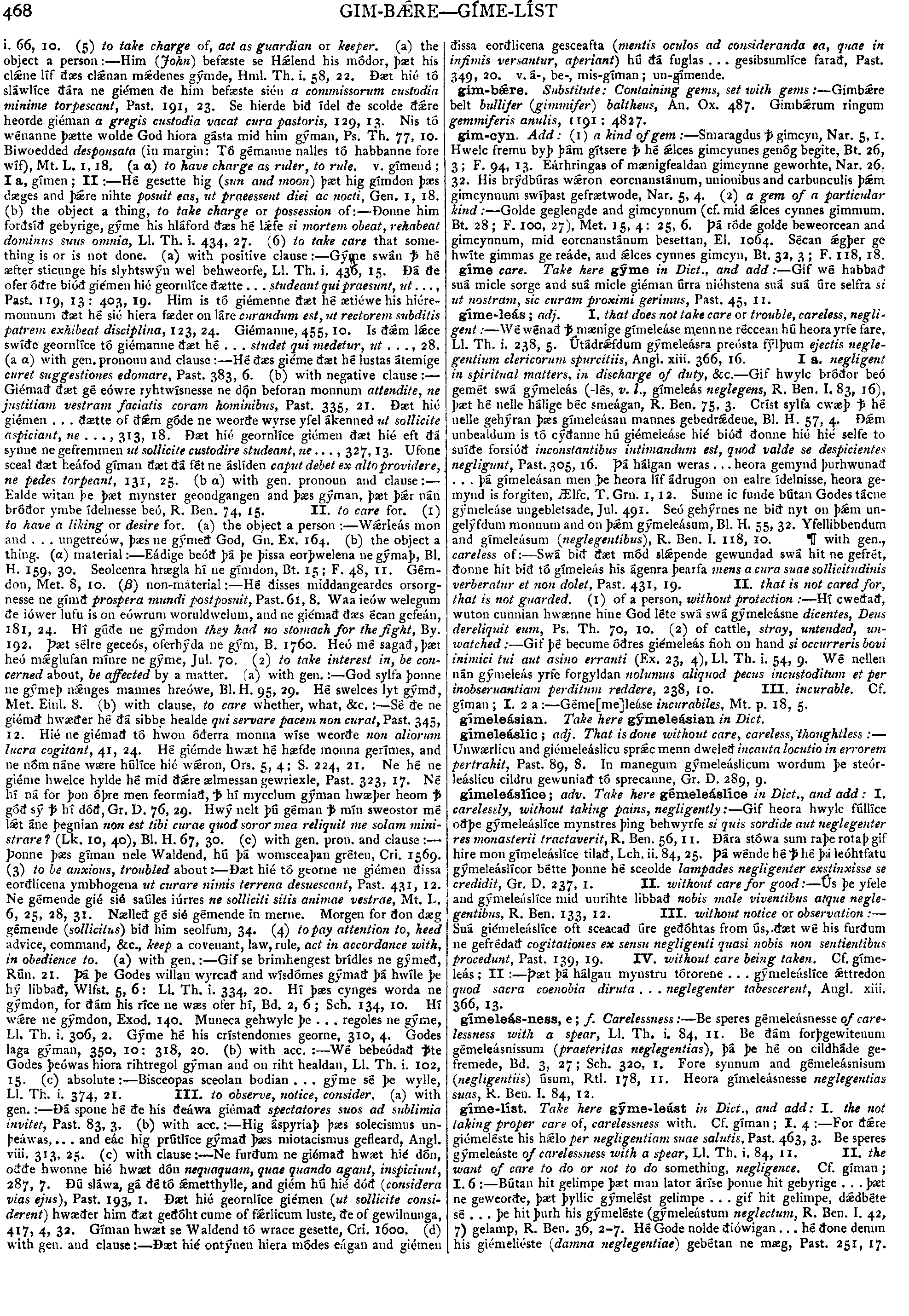
i.
66,
10.
(5)
to
take
charge
of,
act
as
guardian
or
keeper,
(a)
the
object
a
person
:--
Him
(John)
befæste
se
Hlend
his
mdor,
þæt
his
clne
lf
æs
clnan
mdenes
gmde,
Hml.
Th.
i.
58,
22.
Ðæt
hié
t
slwlce
ra
ne
giémen
e
him
befæste
sién
a
commissorum
custodia
minime
torpescant,
Past.
191,
23.
Se
hierde
bi
del
e
scolde
re
heorde
giéman
a
gregis
custodia
vacat
cura
pastoris,
129,
13.
Nis
t
wnanne
þætte
wolde
God
hiora
gsta
mid
him
gman,
Ps.
Th.
77,
10.
Biwoedded
desponsata
(in
margin:
T
gmanne
nalles
t
habbanne
fore
wf),
Mt.
L.
1,
18.
(a
 )
to
have
charge
as
ruler,
to
rule.
v.
gmend
;
I
a.
gmen
;
II
:--
H
gesette
hig
(sun
and
moon)
þæt
hig
gmdon
þæs
dæges
and
þre
nihte
posuit
eas,
ut
praeessent
diei
ac
nocti,
Gen.
l,
18.
(b)
the
object
a
thing,
to
take
charge
or
possession
of:--
Ðonne
him
fors
gebyrige,
gme
his
hlford
æs
h
lfe
si
mortem
obeat,
rehabeat
dominus
suus
omnia,
Ll.
Th.
i.
434,
27.
(6)
to
take
care
that
something
is
or
is
not
done,
(a)
with
positive
clause
:--
Gme
swn
h
æfter
sticunge
his
slyhtswn
we]
behweorfe,
Ll.
Th.
i.
430,
15.
Ð
e
ofer
re
bió
giUNCERTAINmen
hié
geornlce
ætte
.
.
.
studeant
quipraesunt,
ut
.
.
.
.
Past.
119,
13
:
403,
19.
Him
is
t
giémenne
æt
h
ætiéwe
his
hiére-monnum
æt
h
sié
hiera
fæder
on
lre
curandum
est,
ut
rectorem
subditis
patrem
exhibeat
disciplina,
123,
24.
Giémanne,
455,
10.
Is
m
lce
swe
geornlce
t
giémanne
æt
h
.
.
.
studet
qui
medetur,
ut
.
.
.
,
28.
(a
)
with
gen.
pronoun
and
clause
:--
H
æs
giéme
æt
h
lustas
temige
curet
suggestiones
edomare,
Past.
383,
6.
(b)
with
negative
clause
:--
Giéma
æt
g
eówre
ryhtwsnesse
ne
dUNCERTAINn
beforan
monnum
attendite,
ne
justitiam
vestram
faciatis
coram
hominibus,
Past.
335,
21.
Ðæt
hié
giémen
.
.
.
ætte
of
m
gde
ne
weore
wyrse
yfel
kenned
ut
sollicite
aspiciant,
ne
.
.
.
,
313,
18.
Ðæt
hié
geornlce
giémen
æt
hié
eft
synne
ne
gefremmen
ut
sollicite
custodire
studeant,
ne
.
.
.
,
327,
13.
Ufone
sceal
æt
heáfod
gman
æt
ft
ne
slden
caput
debet
ex
alto
providere,
ne
pedes
torpeant,
131,
25.
(b
)
with
gen.
pronoun
and
clause:--
Ealde
witan
þe
þæt
mynster
geondgangen
and
þæs
gman,
þæt
þr
nn
bror
ymbe
delnesse
beó,
R.
Ben.
74,
15.
II.
to
core
for.
(l)
to
have
a
liking
or
desire
for.
(a)
the
object
a
person
:--
Wrleás
mon
and
.
.
.
ungetreów,
þæs
ne
gme
God,
Gn.
Ex.
164.
(b)
the
object
a
thing,
(a)
material
:--
Eádige
beó
þ
þe
þissa
eorþwelena
ne
gmaþ,
Bl.
H.
159,
30.
Seolcenra
hrægla
h
ne
gmdon,
Bt.
15
;
F.
48,
ii.
Gm-don,
Met.
8,
10.
(
)
to
have
charge
as
ruler,
to
rule.
v.
gmend
;
I
a.
gmen
;
II
:--
H
gesette
hig
(sun
and
moon)
þæt
hig
gmdon
þæs
dæges
and
þre
nihte
posuit
eas,
ut
praeessent
diei
ac
nocti,
Gen.
l,
18.
(b)
the
object
a
thing,
to
take
charge
or
possession
of:--
Ðonne
him
fors
gebyrige,
gme
his
hlford
æs
h
lfe
si
mortem
obeat,
rehabeat
dominus
suus
omnia,
Ll.
Th.
i.
434,
27.
(6)
to
take
care
that
something
is
or
is
not
done,
(a)
with
positive
clause
:--
Gme
swn
h
æfter
sticunge
his
slyhtswn
we]
behweorfe,
Ll.
Th.
i.
430,
15.
Ð
e
ofer
re
bió
giUNCERTAINmen
hié
geornlce
ætte
.
.
.
studeant
quipraesunt,
ut
.
.
.
.
Past.
119,
13
:
403,
19.
Him
is
t
giémenne
æt
h
ætiéwe
his
hiére-monnum
æt
h
sié
hiera
fæder
on
lre
curandum
est,
ut
rectorem
subditis
patrem
exhibeat
disciplina,
123,
24.
Giémanne,
455,
10.
Is
m
lce
swe
geornlce
t
giémanne
æt
h
.
.
.
studet
qui
medetur,
ut
.
.
.
,
28.
(a
)
with
gen.
pronoun
and
clause
:--
H
æs
giéme
æt
h
lustas
temige
curet
suggestiones
edomare,
Past.
383,
6.
(b)
with
negative
clause
:--
Giéma
æt
g
eówre
ryhtwsnesse
ne
dUNCERTAINn
beforan
monnum
attendite,
ne
justitiam
vestram
faciatis
coram
hominibus,
Past.
335,
21.
Ðæt
hié
giémen
.
.
.
ætte
of
m
gde
ne
weore
wyrse
yfel
kenned
ut
sollicite
aspiciant,
ne
.
.
.
,
313,
18.
Ðæt
hié
geornlce
giémen
æt
hié
eft
synne
ne
gefremmen
ut
sollicite
custodire
studeant,
ne
.
.
.
,
327,
13.
Ufone
sceal
æt
heáfod
gman
æt
ft
ne
slden
caput
debet
ex
alto
providere,
ne
pedes
torpeant,
131,
25.
(b
)
with
gen.
pronoun
and
clause:--
Ealde
witan
þe
þæt
mynster
geondgangen
and
þæs
gman,
þæt
þr
nn
bror
ymbe
delnesse
beó,
R.
Ben.
74,
15.
II.
to
core
for.
(l)
to
have
a
liking
or
desire
for.
(a)
the
object
a
person
:--
Wrleás
mon
and
.
.
.
ungetreów,
þæs
ne
gme
God,
Gn.
Ex.
164.
(b)
the
object
a
thing,
(a)
material
:--
Eádige
beó
þ
þe
þissa
eorþwelena
ne
gmaþ,
Bl.
H.
159,
30.
Seolcenra
hrægla
h
ne
gmdon,
Bt.
15
;
F.
48,
ii.
Gm-don,
Met.
8,
10.
( )
non-material
:--
H
isses
middangeardes
orsorg-nesse
ne
gm
prospera
mundi
postposuit,
Past.
61,
8.
Waa
ieów
welegum
e
iówer
lufu
is
on
eówrum
wortildwelum,
and
ne
giéma
æs
can
gefeán,
181,
24.
H
ge
ne
gmdon
they
had
no
stomach
for
the
fight,
By.
192.
Þæt
slre
geceós,
oferhda
ne
gm,
B.
1760.
Heó
m
saga,
þæt
heó
mglufan
mnre
ne
gme,
Jul.
70.
(2)
to
take
interest
in,
be
noc-cerned
about,
be
affected
by
a
matter,
(a)
with
gen.
:--
God
sylfa
þonne
ne
gmeþ
nnges
mannes
hreówe,
Bl.
H.
95,
29.
H
swelces
lyt
gm,
Met.
Einl.
8.
(b)
with
clause,
to
care
whether,
what,
&c.
:--
S
e
ne
giém
hwæer
h
sibbe
healde
qui
servare
pacem
non
curat,
Past.
345,
12.
Hié
ne
giéma
t
hwon
erra
monna
wse
weore
non
aliorum
lucra
cogitant,
41,
24.
H
giémde
hwæt
h
hæfde
monna
germes,
and
ne
nm
nne
wære
hlce
hié
wron,
Ors.
5,
4;
S.
224,
21.
Ne
h
ne
giéme
hwelce
hylde
h
mid
re
ælmessan
gewriexle.
Past.
323,
17.
N
h
n
for
þon
þre
men
feormia,
h
mycclum
gman
hwæþer
heom
g
s
h
d,
Gr.
D.
76,
29.
Hw
nelt
þ
gman
mn
sweostor
m
lt
ne
þegnian
non
est
tibi
curae
quod
soror
mea
reliquit
me
solam
mini-strare?
(Lk.
10,
40),
Bl.
H.
67,
30.
(c)
with
gen.
pron.
and
clause
:--
Þonne
þæs
gman
nele
Waldend,
h
þ
womsceaþan
grten,
Cri.
1569.
(3)
to
be
anxious,
troubled
about
:--
Ðæt
hié
t
georne
ne
giémen
issa
eorlicena
ymbhogena
ut
curare
nimis
terrena
desuescant,
Past.
431,
12.
Ne
gmende
gié
sié
sales
iúrres
ne
solliciti
sitis
animae
vestrae,
Mt.
L.
6,
25,
28,
31.
Nælle
g
sié
gmende
in
merne.
Morgen
for
on
dæg
gmende
(sollicitus)
bi
him
seolfum,
34.
(4)
to
pay
attention
to,
heed
advice,
command,
&c.,
keep
a
covenant,
law,
rule,
act
in
accordance
with,
in
obedience
to.
(a)
with
gen.
:--
Gif
se
brimhengest
brdles
ne
gme,
Rn.
21.
Þ
þe
Godes
willan
wyrca
and
wsdmes
gma
þ
hwle
þe
h
libba,
Wlfst.
5,
6:
Ll.
Th.
i.
334,
20.
H
þæs
cynges
worda
ne
gmdon,
for
m
his
rce
ne
wæs
ofer
h,
Bd.
2,
6
;
Sch.
134,
10.
H
wre
ne
gmdon,
Exod.
140.
Muneca
gehwylc
þe
.
.
.
regoles
ne
gme,
Ll.
Th.
i.
306,
2.
Gme
h
his
crstendomes
georne,
310,
4.
Godes
laga
gman,
350,
10:
318,
20.
(b)
with
acc.
:--
W
bebeóda
te
Godes
þeówas
hiora
rihtregol
gman
and
on
riht
healdan,
Ll.
Th.
i.
102,
15.
(c)
absolute:--
Bisceopas
sceolan
bodian
.
.
.
gme
s
þe
wylle,
Ll.
Th.
i.
374,
21.
III.
to
observe,
notice,
consider,
(a)
with
gen.
:--
Ð
spone
h
e
his
eáwa
giéma
spectatores
suos
ad
sublimia
invitet,
Past.
83,
3.
(b)
with
acc.
:--
Hig
spyriaþ
þæs
solecismus
un-þeúwas,
.
.
.
and
eác
hig
prtlce
gma
þæs
miotacisnius
gefleard,
Angl.
viii.
313,
25.
(c)
with
clause:--
Ne
furum
ne
giéma
hwæt
hié
dn,
oe
hwonne
hié
hwæt
dn
nequaquam,
quae
quando
agant,
inspiciuut.
287,
7.
Ð
slwa,
g
t
metthylle,
and
giém
h
hié
dó
(considera
vias
ejus),
Past.
193,
l.
Ðæt
hié
geornlce
giémen
(ut
sollicite
consi-derent)
hwæer
him
æt
geht
cume
of
frlicum
luste,
e
of
gewilnunga,
417,
4,
32.
Gman
hwæt
se
Waldend
t
wrace
gesette,
Cri.
1600.
(d)
with
gen.
and
clause
:--
Ðæt
hié
ontnen
hiera
mdes
eágan
and
giémen
issa
eorðlicena
gesceafta
(mentis
oculos
ad
consideranda
ea,
quae
in
infimis
versantur,
aperiant)
h
fuglas
.
.
.
gesibsumlce
fara,
Past.
349,
20.
v.
-,
be-,
mis-gman
;
un-gmende.
)
non-material
:--
H
isses
middangeardes
orsorg-nesse
ne
gm
prospera
mundi
postposuit,
Past.
61,
8.
Waa
ieów
welegum
e
iówer
lufu
is
on
eówrum
wortildwelum,
and
ne
giéma
æs
can
gefeán,
181,
24.
H
ge
ne
gmdon
they
had
no
stomach
for
the
fight,
By.
192.
Þæt
slre
geceós,
oferhda
ne
gm,
B.
1760.
Heó
m
saga,
þæt
heó
mglufan
mnre
ne
gme,
Jul.
70.
(2)
to
take
interest
in,
be
noc-cerned
about,
be
affected
by
a
matter,
(a)
with
gen.
:--
God
sylfa
þonne
ne
gmeþ
nnges
mannes
hreówe,
Bl.
H.
95,
29.
H
swelces
lyt
gm,
Met.
Einl.
8.
(b)
with
clause,
to
care
whether,
what,
&c.
:--
S
e
ne
giém
hwæer
h
sibbe
healde
qui
servare
pacem
non
curat,
Past.
345,
12.
Hié
ne
giéma
t
hwon
erra
monna
wse
weore
non
aliorum
lucra
cogitant,
41,
24.
H
giémde
hwæt
h
hæfde
monna
germes,
and
ne
nm
nne
wære
hlce
hié
wron,
Ors.
5,
4;
S.
224,
21.
Ne
h
ne
giéme
hwelce
hylde
h
mid
re
ælmessan
gewriexle.
Past.
323,
17.
N
h
n
for
þon
þre
men
feormia,
h
mycclum
gman
hwæþer
heom
g
s
h
d,
Gr.
D.
76,
29.
Hw
nelt
þ
gman
mn
sweostor
m
lt
ne
þegnian
non
est
tibi
curae
quod
soror
mea
reliquit
me
solam
mini-strare?
(Lk.
10,
40),
Bl.
H.
67,
30.
(c)
with
gen.
pron.
and
clause
:--
Þonne
þæs
gman
nele
Waldend,
h
þ
womsceaþan
grten,
Cri.
1569.
(3)
to
be
anxious,
troubled
about
:--
Ðæt
hié
t
georne
ne
giémen
issa
eorlicena
ymbhogena
ut
curare
nimis
terrena
desuescant,
Past.
431,
12.
Ne
gmende
gié
sié
sales
iúrres
ne
solliciti
sitis
animae
vestrae,
Mt.
L.
6,
25,
28,
31.
Nælle
g
sié
gmende
in
merne.
Morgen
for
on
dæg
gmende
(sollicitus)
bi
him
seolfum,
34.
(4)
to
pay
attention
to,
heed
advice,
command,
&c.,
keep
a
covenant,
law,
rule,
act
in
accordance
with,
in
obedience
to.
(a)
with
gen.
:--
Gif
se
brimhengest
brdles
ne
gme,
Rn.
21.
Þ
þe
Godes
willan
wyrca
and
wsdmes
gma
þ
hwle
þe
h
libba,
Wlfst.
5,
6:
Ll.
Th.
i.
334,
20.
H
þæs
cynges
worda
ne
gmdon,
for
m
his
rce
ne
wæs
ofer
h,
Bd.
2,
6
;
Sch.
134,
10.
H
wre
ne
gmdon,
Exod.
140.
Muneca
gehwylc
þe
.
.
.
regoles
ne
gme,
Ll.
Th.
i.
306,
2.
Gme
h
his
crstendomes
georne,
310,
4.
Godes
laga
gman,
350,
10:
318,
20.
(b)
with
acc.
:--
W
bebeóda
te
Godes
þeówas
hiora
rihtregol
gman
and
on
riht
healdan,
Ll.
Th.
i.
102,
15.
(c)
absolute:--
Bisceopas
sceolan
bodian
.
.
.
gme
s
þe
wylle,
Ll.
Th.
i.
374,
21.
III.
to
observe,
notice,
consider,
(a)
with
gen.
:--
Ð
spone
h
e
his
eáwa
giéma
spectatores
suos
ad
sublimia
invitet,
Past.
83,
3.
(b)
with
acc.
:--
Hig
spyriaþ
þæs
solecismus
un-þeúwas,
.
.
.
and
eác
hig
prtlce
gma
þæs
miotacisnius
gefleard,
Angl.
viii.
313,
25.
(c)
with
clause:--
Ne
furum
ne
giéma
hwæt
hié
dn,
oe
hwonne
hié
hwæt
dn
nequaquam,
quae
quando
agant,
inspiciuut.
287,
7.
Ð
slwa,
g
t
metthylle,
and
giém
h
hié
dó
(considera
vias
ejus),
Past.
193,
l.
Ðæt
hié
geornlce
giémen
(ut
sollicite
consi-derent)
hwæer
him
æt
geht
cume
of
frlicum
luste,
e
of
gewilnunga,
417,
4,
32.
Gman
hwæt
se
Waldend
t
wrace
gesette,
Cri.
1600.
(d)
with
gen.
and
clause
:--
Ðæt
hié
ontnen
hiera
mdes
eágan
and
giémen
issa
eorðlicena
gesceafta
(mentis
oculos
ad
consideranda
ea,
quae
in
infimis
versantur,
aperiant)
h
fuglas
.
.
.
gesibsumlce
fara,
Past.
349,
20.
v.
-,
be-,
mis-gman
;
un-gmende.
|
Source: Bosworth/Toller, page d0496, entry 14 View original page image as: [TIFF] [PNG] [View previous entry] [View next entry] |
[Comment on this entry] [View comments] |
The following entry has been hand-corrected once. |
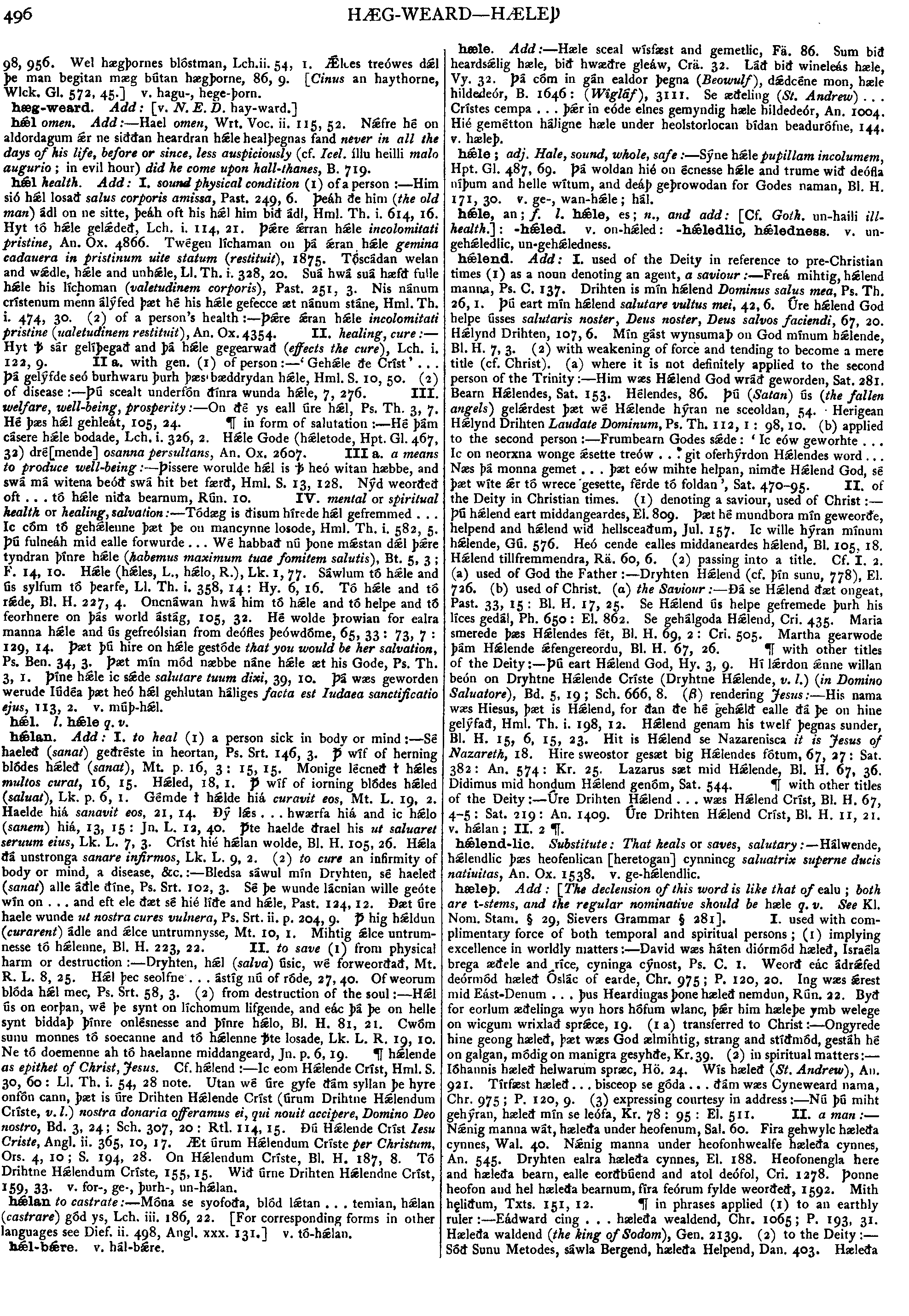
hæleþ.
Add:
[The
declension
of
this
word
is
like
that
of
ealu
;
both
are
t-stems,
and
the
regular
nominative
should
be
hæle
q.
v.
See
Kl.
Nom.
Stam.
§29,
Sievers
Grammar
§
281].
I.
used
with
complimentary
force
of
both
temporal
and
spiritual
persons;
(1)
implying
excellence
in
worldly
matters
:--
David
wæs
háten
diórmód
hæleð,
Israéls
brega
æðele
and
ríce,
cyninga
cýnost,
Ps.
C.
I.
Weorð
eác
ádr fed
deórmód
hæleð
Óslác
of
earde,
Chr.
975
;
P.
120,
20.
Ing
wæs
rest
mid
Eást-Denum
.
.
.
þus
Heardingasþone
hæleð
nemdun,
Rún.
22.
Byð
for
eorlum
æðelinga
wyn
hors
hófum
wlanc,
þr
him
hæleþe
ymb
welege
on
wicgum
wrixlað
sprce,
19.
(l
a)
transferred
to
Christ
:--
Ongyrede
hine
geong
hæleð,
þæt
wæs
God
ælmihtig,
strang
and
stíðmód,
gestáh
hé
on
galgan,
módig
on
manigra
gesyhðe,
Kr.
39.
(2)
in
spiritual
matters
:--
Ióhannis
hæleð
helwarum
spr.
ec,
Hö.
24.
Wís
hæleð
(St.
Andrew),
An.
921.
Tírfæst
hæleð.
.
.
bisceop
se
góda
.
.
.
ðám
wæs
Cyneweard
nama,
Chr.
975
;
P.
120,
9.
(3)
expressing
courtesy
in
address
:--
Nú
þú
miht
gehýran,
hæleð
mín
se
leófa,
Kr.
78
:
95
:
El.
511.
II.
a
man
:--
Nnig
manna
wát,
hæleða
under
heofenum,
Sal.
60.
Fira
gehwylc
hæleða
cynnes,
Wal.
40.
Nnig
manna
under
heofonhwealfe
hæleða
cynnes,
An.
545.
Dryhten
ealra
hæleða
cynnes,
El.
188.
Heofonengla
here
and
hæleða
beam,
ealle
eorðbúend
and
atol
deófol,
Cri.
1278.
Þonne
heofon
and
hel
hæleda
bearnum,
fíra
feórum
fylde
weorðeð,
1592.
Mith
h
fed
deórmód
hæleð
Óslác
of
earde,
Chr.
975
;
P.
120,
20.
Ing
wæs
rest
mid
Eást-Denum
.
.
.
þus
Heardingasþone
hæleð
nemdun,
Rún.
22.
Byð
for
eorlum
æðelinga
wyn
hors
hófum
wlanc,
þr
him
hæleþe
ymb
welege
on
wicgum
wrixlað
sprce,
19.
(l
a)
transferred
to
Christ
:--
Ongyrede
hine
geong
hæleð,
þæt
wæs
God
ælmihtig,
strang
and
stíðmód,
gestáh
hé
on
galgan,
módig
on
manigra
gesyhðe,
Kr.
39.
(2)
in
spiritual
matters
:--
Ióhannis
hæleð
helwarum
spr.
ec,
Hö.
24.
Wís
hæleð
(St.
Andrew),
An.
921.
Tírfæst
hæleð.
.
.
bisceop
se
góda
.
.
.
ðám
wæs
Cyneweard
nama,
Chr.
975
;
P.
120,
9.
(3)
expressing
courtesy
in
address
:--
Nú
þú
miht
gehýran,
hæleð
mín
se
leófa,
Kr.
78
:
95
:
El.
511.
II.
a
man
:--
Nnig
manna
wát,
hæleða
under
heofenum,
Sal.
60.
Fira
gehwylc
hæleða
cynnes,
Wal.
40.
Nnig
manna
under
heofonhwealfe
hæleða
cynnes,
An.
545.
Dryhten
ealra
hæleða
cynnes,
El.
188.
Heofonengla
here
and
hæleða
beam,
ealle
eorðbúend
and
atol
deófol,
Cri.
1278.
Þonne
heofon
and
hel
hæleda
bearnum,
fíra
feórum
fylde
weorðeð,
1592.
Mith
h liðum,
Txts.
151,
12.
¶
in
phrases
applied
(1)
to
an
earthly
ruler
:--
Eádward
cing
.
.
.
hæleða
wealdend,
Chr.
1065;
P.
193,
31.
Hæleða
waldend
(the
king
of
Sodom),
Gen.
2139.
(2)
to
the
Deity
:--
Sóð
Sunu
Metodes,
sáwla
Bergend,
hæleða
Helpend,
Dan.
403.
Hælða
liðum,
Txts.
151,
12.
¶
in
phrases
applied
(1)
to
an
earthly
ruler
:--
Eádward
cing
.
.
.
hæleða
wealdend,
Chr.
1065;
P.
193,
31.
Hæleða
waldend
(the
king
of
Sodom),
Gen.
2139.
(2)
to
the
Deity
:--
Sóð
Sunu
Metodes,
sáwla
Bergend,
hæleða
Helpend,
Dan.
403.
Hælða
|
Source: Bosworth/Toller, page d0497, entry 11 View original page image as: [TIFF] [PNG] [View previous entry] [View next entry] |
[Comment on this entry] [View comments (1)] |
The following entry has been hand-corrected once. |
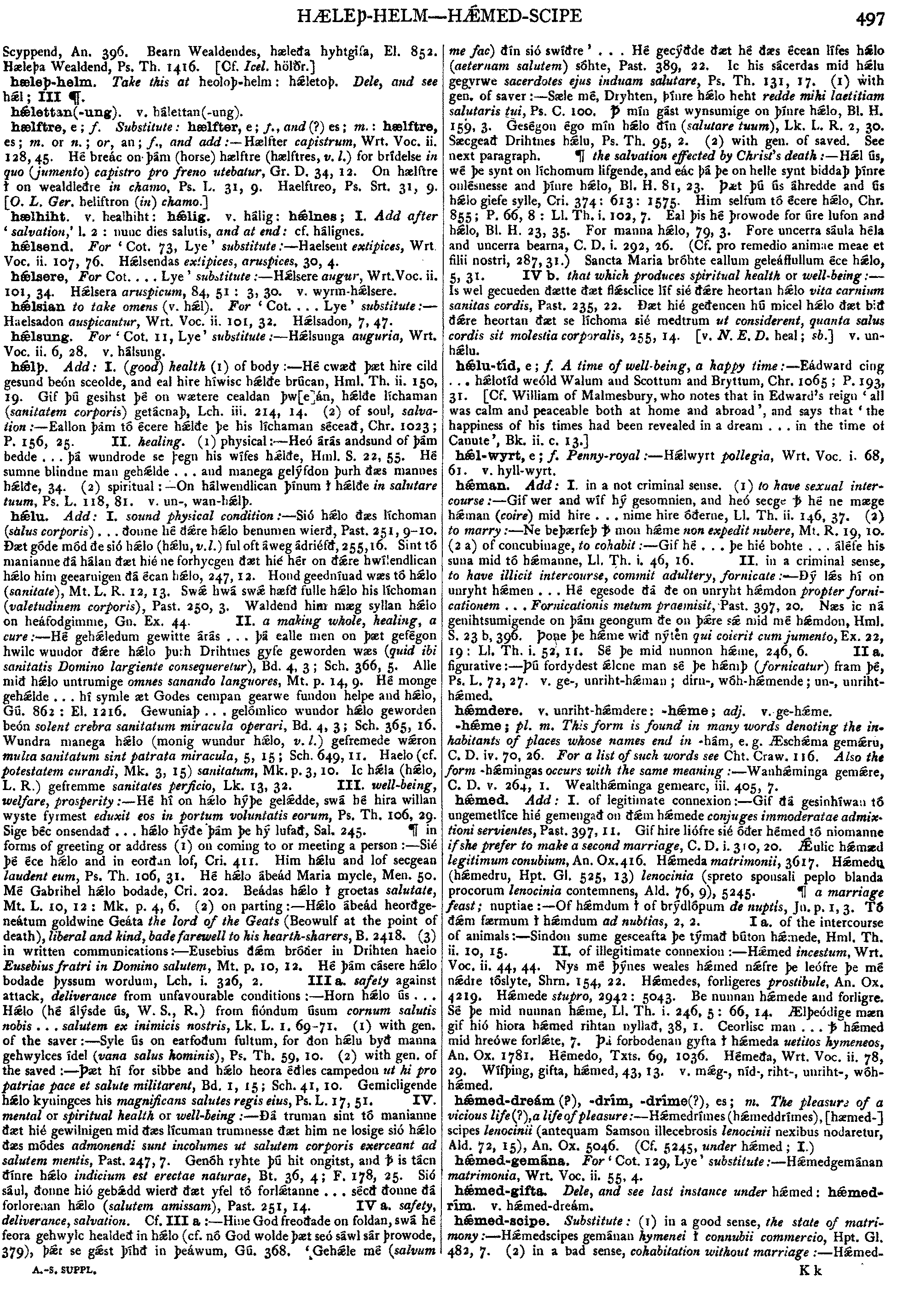
hlu.
Add:
I.
sound
physical
condition
:--
Sió
hlo
ðæs
líchoman
(salus
corporis)
,
.
.
ðonne
hé
ðre
hlo
benumen
wierð,
Past.
251,
9-10.
Ðæt
góde
mód
de
sió
hlo
(hlu,
v.
l.)
fut
oft
áweg
ádriéfð,
255,
16.
Sine
tó
manianneðá
hálan
ðæt
hié
ne
forhycgen
ðæt
hié
hér
on
ðre
hwilendlican
hlo
him
geearuigen
ðá
écan
hlo,
247,
12.
Hond
geedníuad
wæs
tó
hlo
(sanitate),
Mt.
L.
R.
12,
13.
Sw
hwá
sw
hæfð
fulle
hlo
his
líchoman
(valeiudinem
carports),
Past.
250,
3.
Waldend
him
mæg
syllan
hlo
on
heáfodgimme,
Gn.
Ex.
44.
II.
a
making
whole,
healing,
a
cure
:--
Hé
gehledum
gewitte
árás
.
.
.
þá
ealle
men
on
þæt
gefégon
hwilc
wundor
ðre
hlo
þurh
Drihtnes
gyfe
geworden
wæs
(quid
ibi
sanitatis
Domino
largiente
consejuerelur),
Bd.
4,
3
;
Sch.
366,
5.
Alle
mið
hlo
untrumige
omties
sanando
languores,
Mt.
p.
14,
9.
Hé
monge
gehlde
.
.
.
hí
symle
æt
Godes
cempan
gearwe
fundon
helpe
and
hlo,
Gú.
861
:
El.
1216.
Gewuniaþ
.
.
,
gelómlico
wundor
hlo
geworden
beón
solent
crebra
sanitatum
miracula
operari,
Bd.
4,
3;
Sch.
365,
16.
Wundra
manega
hlo
(monig
wundur
hlo,
v.
l.)
gefremede
wron
mulra
sauitatum
sint
patrata
miracula,
5,
15;
Sch.
649,
11.
Haelo
(cf.
potestatem
curandi,
Mk.
3,
15)
sanitatum.
Mk.
p.
3,
10.
Ic
hla
(hlo,
L.
R.
)
gefremme
sanitates
perficio,
Lk.
13,
32.
III.
well-being,
welfare,
prosperity
:--
Hé
hí
on
hlo
hýþe
geldde,
swá
hé
hira
willan
wyste
fytmest
eduxit
eos
in
portum
voluntatis
eorum,
Ps.
Th.
106,
29.
Sige
béc
onsendað
.
.
.
hlo
hýðe
þám
þe
hý
lufai,
Sal.
245.
¶
in
forms
of
greeting
or
address
(1)
on
coming
to
or
meeting
a
person
:--
Sié
þé
éce
hlo
and
in
eorðan
lof,
Cri.
411.
Him
hlu
and
lof
secgean
laudent
eum,
Ps.
Th.
106,
31.
Hé
hlo
ábeád
Maria
mycle,
Men.
50.
Mé
Gabrihel
hlo
bodade,
Cri.
202.
Beádas
hlo
 groetas
salutate,
Mt.
L.
ID,
12
:
Mk.
p.
4,
6.
(2)
on
parting
:--
Hlo
ábeád
heorðgeneátum
goldwine
Geáta
the
lord
of
the
Geats
(Beowulf
at
the
point
of
death),
liberal
and
kind,
bade
farewell
to
his
hearth-sharers,
B.
2418.
(3)
in
written
communications
:--
Eusebius
dm
bróder
in
Drihten
hlo
Eusebius
fratri
in
Domino
salulem,
Mt.
p,
10,
12.
Hé
þám
cásere
hlo
bodade
þyssum
worduin,
Lch.
i.
326,
2.
Ilia,
safety
against
attack,
deliverance
from
unfavourable
conditions
:--
Horn
hlo
ús.
.
.
Hlo
(he
álýsde
ús,
W.
S.
,
R.
)
from
fióndum
úsum
cornum
salutis
nobis
.
.
.
salutem
ex
inimicis
nostris,
Lk.
L.
l.
69-71.
(1)
with
gen.
of
the
saver
:--
Syle
ús
on
earfoðum
fultum,
for
don
hlu
byð
manna
gehwylces
ídel
(vana
solus
hominis),
Ps.
Th.
59,
10.
(2)
with
gen.
of
the
saved
:--
Þæt
hí
for
sibbe
and
hlo
heora
éðles
campedon
ut
hi
pro
patriae
pace
et
salute
mililarent,
Bd.
1,
15;
Sch.
41,
10.
Gemicligende
hlo
kyningces
his
magnificans
salutes
regis
eius,
Ps.
L.
17,
51.
IV.
mental
or
spiritual
health
or
well-being
:--
Ðá
truman
sint
tó
manianne
ðæt
hié
gewilnigen
mid
ðæs
lícuman
trumnesse
ðæt
him
ne
losige
sió
hlo
ðæs
módes
admanend:
sunt
incolumes
ut
salutem
carports
exerceant
ad
salutem
mentis,
Past.
247,
7.
Genóh
ryhte
þú
hit
ongitst,
and
is
tácn
ðínre
hlo
indicium
est
erectae
naturae,
Bt.
36,
4;
F.
178,
25.
SiÍ
sául,
ðonne
hió
gebdd
wierð
ðæt
yfel
tó
forltanne
.
.
.
sécð
ðonne
ðá
forloreaan
hlo
(salutem
amissam),
Past.
251,
14.
IV
a.
safety,
deliverance,
salvation.
Cf.
III
a
:--
Hine
God
freoðade
on
foldan,
swá
hé
feora
gehwylc
healdeð
in
hlo
(cf.
nó
God
wolde
þæt
seó
sáwl
sár
þrowode,
379),
þr
se
gst
þíhð
in
þeáwum,
Gú.
368.
'Gehle
mé
(salvum
me
fac)
ðín
sió
swíðre
'
.
.
.
Hé
gecýðde
ðæt
hé
dæs
écean
llfes
hílo
(aeternam
salutem)
sóhte,
Past.
389,
22.
Ic
his
sácerdas
mid
hlu
gegyrwe
sacerdotes
ejus
induam
salutare,
Ps.
Th.
131,
17.
(1)
with
gen.
of
saver
:--
Sæle
mé,
Dryhten,
þínre
hlo
heht
redde
mihi
laetitiam
salutaris
tui,
Ps.
C.
loo.
Þ-bar;
mín
gást
wynsumige
on
þínre
hlo,
Bl.
H.
159,
3.
Geségon
égo
mín
hlo
ðín
(salutare
tuum),
Lk.
L.
R.
2,
30.
Sæcgeað
Drihtnes
hlu,
Ps.
Th.
95,
2.
(2)
with
gen.
of
saved.
See
next
paragraph.
¶
the
salvation
effected
by
Christ's
death
:--
Hl
ús,
wé
þe
synt
on
líchomum
lifgende,
and
eác
þá
þe
on
helle
synt
biddaþ
þínre
onlésnesse
and
þínre
hlo,
Bl.
H.
81,
23.
Þt
þú
ús
áhredde
and
ús
hlo
giefe
sylle,
Cri.
374:
613:
1575.
Him
selfum
tó
écere
hlo.
Chr.
855;
P.
66,
8
:
Ll.
Th.
i.
103,
7.
Eal
þis
hé
þrowode
for
úre
lufon
and
hlo,
61.
H.
23,
35.
For
manna
hlo,
79,
3.
Fore
uncerra
sáula
héla
and
uncerra
bearna,
C.
D.
i.
292,
26.
(Cf.
pro
remedio
animae
meae
et
filii
nostri,
287,
31.
)
Sancta
Maria
bróhte
eallum
geleaffullum
éce
hlo,
5,
31.
IV
b.
that
which
produces
spiritual
health
or
well-being
:--
Is
wel
gecueden
ðætte
ðæt
flsclice
líf
sié
ðre
heortan
hlo
vita
carnium
sanitas
cordis,
Past.
235,
22.
Ðæt
hié
geðencen
hú
micel
hlo
ðæt
bið
ðre
heortan
ðæt
se
líchoma
sié
medtrum
ut
considerent,
quanta
salus
cordis
sit
molestia
corporalis,
255,
14.
[v.
N.
E.
D.
heal;
sb.]
v.
un-hlu.
groetas
salutate,
Mt.
L.
ID,
12
:
Mk.
p.
4,
6.
(2)
on
parting
:--
Hlo
ábeád
heorðgeneátum
goldwine
Geáta
the
lord
of
the
Geats
(Beowulf
at
the
point
of
death),
liberal
and
kind,
bade
farewell
to
his
hearth-sharers,
B.
2418.
(3)
in
written
communications
:--
Eusebius
dm
bróder
in
Drihten
hlo
Eusebius
fratri
in
Domino
salulem,
Mt.
p,
10,
12.
Hé
þám
cásere
hlo
bodade
þyssum
worduin,
Lch.
i.
326,
2.
Ilia,
safety
against
attack,
deliverance
from
unfavourable
conditions
:--
Horn
hlo
ús.
.
.
Hlo
(he
álýsde
ús,
W.
S.
,
R.
)
from
fióndum
úsum
cornum
salutis
nobis
.
.
.
salutem
ex
inimicis
nostris,
Lk.
L.
l.
69-71.
(1)
with
gen.
of
the
saver
:--
Syle
ús
on
earfoðum
fultum,
for
don
hlu
byð
manna
gehwylces
ídel
(vana
solus
hominis),
Ps.
Th.
59,
10.
(2)
with
gen.
of
the
saved
:--
Þæt
hí
for
sibbe
and
hlo
heora
éðles
campedon
ut
hi
pro
patriae
pace
et
salute
mililarent,
Bd.
1,
15;
Sch.
41,
10.
Gemicligende
hlo
kyningces
his
magnificans
salutes
regis
eius,
Ps.
L.
17,
51.
IV.
mental
or
spiritual
health
or
well-being
:--
Ðá
truman
sint
tó
manianne
ðæt
hié
gewilnigen
mid
ðæs
lícuman
trumnesse
ðæt
him
ne
losige
sió
hlo
ðæs
módes
admanend:
sunt
incolumes
ut
salutem
carports
exerceant
ad
salutem
mentis,
Past.
247,
7.
Genóh
ryhte
þú
hit
ongitst,
and
is
tácn
ðínre
hlo
indicium
est
erectae
naturae,
Bt.
36,
4;
F.
178,
25.
SiÍ
sául,
ðonne
hió
gebdd
wierð
ðæt
yfel
tó
forltanne
.
.
.
sécð
ðonne
ðá
forloreaan
hlo
(salutem
amissam),
Past.
251,
14.
IV
a.
safety,
deliverance,
salvation.
Cf.
III
a
:--
Hine
God
freoðade
on
foldan,
swá
hé
feora
gehwylc
healdeð
in
hlo
(cf.
nó
God
wolde
þæt
seó
sáwl
sár
þrowode,
379),
þr
se
gst
þíhð
in
þeáwum,
Gú.
368.
'Gehle
mé
(salvum
me
fac)
ðín
sió
swíðre
'
.
.
.
Hé
gecýðde
ðæt
hé
dæs
écean
llfes
hílo
(aeternam
salutem)
sóhte,
Past.
389,
22.
Ic
his
sácerdas
mid
hlu
gegyrwe
sacerdotes
ejus
induam
salutare,
Ps.
Th.
131,
17.
(1)
with
gen.
of
saver
:--
Sæle
mé,
Dryhten,
þínre
hlo
heht
redde
mihi
laetitiam
salutaris
tui,
Ps.
C.
loo.
Þ-bar;
mín
gást
wynsumige
on
þínre
hlo,
Bl.
H.
159,
3.
Geségon
égo
mín
hlo
ðín
(salutare
tuum),
Lk.
L.
R.
2,
30.
Sæcgeað
Drihtnes
hlu,
Ps.
Th.
95,
2.
(2)
with
gen.
of
saved.
See
next
paragraph.
¶
the
salvation
effected
by
Christ's
death
:--
Hl
ús,
wé
þe
synt
on
líchomum
lifgende,
and
eác
þá
þe
on
helle
synt
biddaþ
þínre
onlésnesse
and
þínre
hlo,
Bl.
H.
81,
23.
Þt
þú
ús
áhredde
and
ús
hlo
giefe
sylle,
Cri.
374:
613:
1575.
Him
selfum
tó
écere
hlo.
Chr.
855;
P.
66,
8
:
Ll.
Th.
i.
103,
7.
Eal
þis
hé
þrowode
for
úre
lufon
and
hlo,
61.
H.
23,
35.
For
manna
hlo,
79,
3.
Fore
uncerra
sáula
héla
and
uncerra
bearna,
C.
D.
i.
292,
26.
(Cf.
pro
remedio
animae
meae
et
filii
nostri,
287,
31.
)
Sancta
Maria
bróhte
eallum
geleaffullum
éce
hlo,
5,
31.
IV
b.
that
which
produces
spiritual
health
or
well-being
:--
Is
wel
gecueden
ðætte
ðæt
flsclice
líf
sié
ðre
heortan
hlo
vita
carnium
sanitas
cordis,
Past.
235,
22.
Ðæt
hié
geðencen
hú
micel
hlo
ðæt
bið
ðre
heortan
ðæt
se
líchoma
sié
medtrum
ut
considerent,
quanta
salus
cordis
sit
molestia
corporalis,
255,
14.
[v.
N.
E.
D.
heal;
sb.]
v.
un-hlu.
|
Source: Bosworth/Toller, page d0506, entry 9 View original page image as: [TIFF] [PNG] [View previous entry] [View next entry] |
[Comment on this entry] [View comments] |
The following entry has been hand-corrected once. |
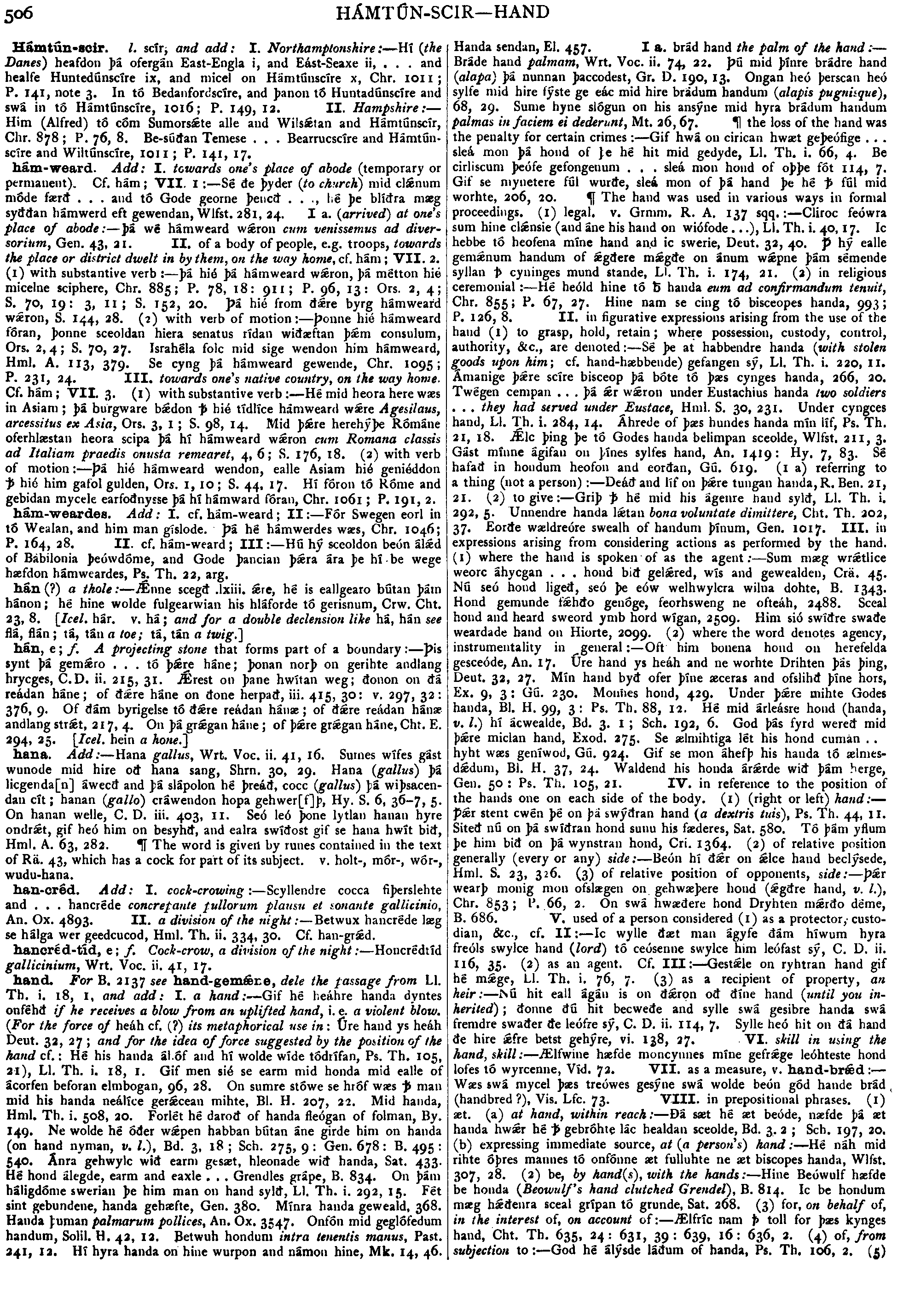
hand.
For
B.
2137
see
hand-gemne,
dele
the
passage
from
Ll.
Th.
i.
18,
1.
and
add:
I.
a
hand:
--
Gif
hé
heáhre
handa
dyntes
onféhð
if
he
receives
a
blow
from
an
uplifted
hand,
i.
e.
a
violent
blow.
(
For
the
force
of
heáh
cf.
(?)
its
metaphorical
use
in:
Úre
hand
ys
heáh
Deut.
32,
27
;
and
for
the
idea
of
force
suggested
by
the
position
of
the
hand
cf.
:
Hé
his
handa
ál
UNCERTAIN
óf
and
hí
wolde
wíde
tódrífan,
Ps.
Th.
105,
21),
Ll.
Th.
i.
18,
1.
Gif
men
sié
se
earm
mid
honda
mid
ealle
of
ácorfen
beforan
elmbogan,
96,
28.
On
sumre
stówe
se
hróf
wæs
man
mid
his
handa
neálíce
gercean
mihte,
Bl.
H.
207,
22.
Mid
handa,
Hml.
Th.
i.
508,
20.
Forlét
hé
daroð
of
handa
fleógan
of
folman,
By.
149.
Ne
wolde
hé
óðer
wpen
habban
bútan
áne
girde
him
on
handa
(on
hand
nyman,
v.
l.),
Bd.
3,
18
;
Sch.
275,
9
:
Gen.
678:
B.
495
:
540.
Ánra
gehwylc
wið
earm
gesæt,
hleonade
wið
handa,
Sat.
433.
Hé
hond
álegde,
earm
and
eaxle
.
.
.
Grendles
grápe,
B.
834.
On
þám
háligdóme
swerian
þe
him
man
on
hand
sylð,
Ll.
Th.
i.
292,
15.
Fét
sint
gebundene,
handa
gehæfte,
Gen.
380.
Mínra
handa
geweald,
368.
Handa
þuman
palmarum
pollices,
An.
Ox.
3547.
Onfón
mid
geglófedum
handum,
Solil.
H.
42,
12.
Betwuh
hondum
intra
tenentis
manus,
Past.
241,
12.
Hí
hyra
handa
on
hine
wurpon
and
námon
hine,
Mk.
14,
46.
Handa
sendan,
El.
457.
I
a.
brád
hand
the
palm
of
the
hand
:--
Bráde
hand
palmam,
Wrt.
Voc.
ii.
74,
22.
Þú
mid
þínre
brádre
hand
(alapa)
þá
nunnan
þaccodest,
Gr.
D.
190,
13.
Ongan
heó
þerscan
heó
sylfe
mid
hire
fýste
ge
eác
mid
hire
brádum
handum
(
alapis
pugnisque),
68,
29.
Sume
hyne
slógun
on
his
ansýne
mid
hyra
brádum
handum
palmas
in
faciem
ei
dederunt,
Mt.
26,
67.
¶
the
loss
of
the
hand
was
the
penalty
for
certain
crimes
:--
Gif
hwá
on
cirican
hwæt
geþeófige
.
.
.
sleá
mon
þá
hond
of
þe
hé
hit
mid
gedyde,
Ll.
Th.
i.
66,
4.
Be
cirliscum
þeófe
gefongenum
.
.
.
sleá
mon
hond
of
oþþe
fót
114,
7.
Gif
se
mynetere
fúl
wurðe,
sleá
mon
of
þá
hand
þe
hé
fúl
mid
worhte,
206,
20.
¶
The
hand
was
used
in
various
ways
in
formal
proceedings.
(1)
legal,
v.
Grmm.
R.
A.
137
sqq.
:--
Cliroc
feówra
sum
hine
clnsie
(and
áne
his
hand
on
wiófode
.
.
.
),
Ll.
Th.
i.
40,
17.
Ic
hebbe
tó
heofena
míne
hand
and
ic
swerie,
Deut.
32,
40.
Þ-bar;
hý
ealle
gemnum
handum
of
gðere
mgðe
on
ánum
wpne
þám
sémende
syllan
cyninges
mund
stande,
Ll.
Th.
i.
174,
21.
(2)
in
religious
ceremonial
:--
Hé
heóld
hine
tó
 handa
eum
ad
confirmandum
tenuit,
Chr.
855;
P.
67,
27.
Hine
nam
se
cing
tó
bisceopes
handa,
993;
P.
126,
8.
II.
in
figurative
expressions
arising
from
the
use
of
the
hand
(1)
to
grasp,
hold,
retain;
where
possession,
custody,
control,
authority,
&c.,
are
denoted
:--
Sé
þe
at
habbendre
handa
(with
stolen
goods
upon
him;
cf.
hand-hæbbende)
gefangen
sý,
Ll.
Th.
i.
220,
11.
Ámanige
þre
scíre
bisceop
þá
bóte
tó
þæs
cynges
handa,
266,
20.
Twégen
cempan
.
.
.
þá
r
wron
under
Eustachius
handa
two
soldiers
.
.
.
they
had
served
under
Eustace,
Hml.
S.
30,
231.
Under
cyngces
hand,
Ll.
Th.
i.
284,
14.
Áhrede
of
þæs
hundes
handa
mín
líf,
Ps.
Th.
21,
18.
Æ-acute;lc
þing
þe
tó
Godes
handa
belimpan
sceolde,
Wlfst.
211,
3.
Gást
mínne
ágifan
on
þínes
sylfes
hand,
An.
1419:
Hy.
7,
83.
Sé
hafað
in
hondum
heofon
and
eorðan,
Gú.
619.
(1
a)
referring
to
a
thing
(not
a
person)
:--
Deað
and
líf
on
þre
tungan
handa,
R.
Ben.
21,
21.
(2)
to
give
:--
Griþ
hé
mid
his
ágenre
hand
sylð,
Ll.
Th.
i.
292,
5.
Unnendre
handa
ltan
bona
voluntate
dimittere,
Cht.
Th.
202,
37.
Eorðe
wældreóre
swealh
of
handum
þínum,
Gen.
1017.
III.
in
expressions
arising
from
considering
actions
as
performed
by
the
hand.
(1)
where
the
hand
is
spoken
of
as
the
agent
:
--
Sum
mæg
wrtlice
weorc
áhycgan
.
.
.
hond
bið
gelred,
wís
and
gewealden,
Crä.
45.
Nú
seó
hond
ligeð,
seó
þe
eów
welhwylcra
wilna
dohte,
B.
1343.
Hond
gemunde
fhðo
genóge,
feorhsweng
ne
ofteáh,
2488.
Sceal
hond
and
heard
sweord
ymb
hord
wígan,
2509.
Him
sió
swíðre
swaðe
weardade
hand
on
Hiorte,
2099.
(2)
where
the
word
denotes
agency,
instrumentality
in
general
:--
Oft
him
bonena
hond
on
herefelda
gesceóde,
An.
17.
Úre
hand
ys
heáh
and
ne
worhte
Drihten
þás
þing,
Deut.
32,
27.
Mín
hand
byð
ofer
þíne
æceras
and
ofslihð
þíne
hors,
Ex.
9,
3:
Gú.
230.
Monnes
hond,
429.
Under
þre
mihte
Godes
handa,
Bl.
H.
99,
3:
Ps.
Th.
88,
12.
Hé
mid
árleásre
hond
(handa,
v.
l.)
hí
ácwealde,
Bd.
3.
1
;
Sch.
192,
6.
God
þás
fyrd
wereð
mid
þre
miclan
hand,
Exod.
275.
Se
ælmihtiga
lét
his
hond
cuman
.
.
hyht
wæs
geníwod,
Gú.
924.
Gif
se
mon
áhefþ
his
handa
tó
ælmesddum,
Bl.
H.
37,
24.
Waldend
his
honda
árrde
wið
þám
herge,
Gen.
50
:
Ps.
Th.
105,
21.
IV.
in
reference
to
the
position
of
the
hands
one
on
each
side
of
the
body.
(1)
(right
or
left)
hand
:--
Þr
stent
cwén
þé
on
þá
swýðran
hand
(a
dextris
tuis),
Ps.
Th.
44,
11.
Siteð
nú
on
þá
swíðran
hond
sunu
his
fæderes,
Sat.
580.
Tó
þám
yflum
þe
him
bið
on
þá
wynstran
hond,
Cri.
1364.
(2)
of
relative
position
generally
(every
or
any)
side
:--
Beón
hí
ðr
on
lce
hand
beclýsede,
Hml.
S.
23,
326.
(3)
of
relative
position
of
opponents,
side:
--
Þr
wearþ
monig
mon
ofslægen
on
gehwæþere
hond
(gðre
hand,
v.
l.),
Chr.
853
;
P.
66,
2.
On
swá
hwæðere
hond
Dryhten
mrðo
déme,
B.
686.
V.
used
of
a
person
considered
(1)
as
a
protector,
custodian,
&c.,
cf.
II
:--
Ic
wylle
ðæt
man
ágyfe
ðám
híwum
hyra
freóls
swylce
hand
(lord)
tó
ceósenne
swylce
him
leófast
sý,
C.
D.
ii.
116,
35.
(2)
as
an
agent.
Cf.
III
:--
Gestle
on
ryhtran
hand
gif
hé
mge,
Ll.
Th.
i.
76,
7.
(3)
as
a
recipient
of
property,
an
heir:
--
Nú
hit
eall
ágán
is
on
ðron
oð
ðíne
hand
(until
you
inherited)
;
ðonne
ðú
hit
becweðe
and
sylle
swá
gesibre
handa
swá
fremdre
swaðer
ðe
leófre
sý,
C.
D.
ii.
114,
7.
Sylle
heó
hit
on
ðá
hand
ðe
hire
fre
betst
gehýre,
vi.
138,
27.
VI.
skill
in
using
the
hand,
skill
:--
Ælfwine
hæfde
moncynnes
míne
gefrge
leóhteste
hond
lofes
tó
wyrcenne,
Víd.
72.
VII.
as
a
measure,
v.
hand-brd
:--
Wæs
swá
mycel
þæs
treówes
gesýne
swá
wolde
beón
gód
hande
brád
(handbred
?),
Vis.
Lfc.
73.
VIII.
in
prepositional
phrases.
(1)
æt.
(a)
at
hand,
within
reach
:--Ðá
sæt
hé
æt
beóde,
næfde
þá
æt
handa
hwr
hé
gebróhte
lác
healdan
sceolde,
Bd.
3.
2
;
Sch.
197,
20.
(b)
expressing
immediate
source,
at
(a
person's)
hand
:--
Hé
náh
mid
rihte
óþres
mannes
tó
onfónne
æt
fulluhte
ne
æt
biscopes
handa,
Wlfst.
307,
28.
(2)
be,
by
hand(s),
with
the
hands:
--
Hine
Beówulf
hæfde
be
honda
(Beowulf's
hand
clutched
Grendel),
B.
814.
Ic
be
hondum
mæg
hðenra
sceal
grípan
tó
grunde,
Sat.
268.
(3)
for,
on
behalf
of,
in
the
interest
of,
on
account
of
:--
Ælfríc
nam
toll
for
þæs
kynges
hand,
Cht.
Th.
635,
24:
631,
39:
639,
16:
636,
2.
(4)
of,
from
subjection
to
:--
God
hé
álýsde
láðum
of
handa,
Ps.
Th.
106,
2.
(5)
handa
eum
ad
confirmandum
tenuit,
Chr.
855;
P.
67,
27.
Hine
nam
se
cing
tó
bisceopes
handa,
993;
P.
126,
8.
II.
in
figurative
expressions
arising
from
the
use
of
the
hand
(1)
to
grasp,
hold,
retain;
where
possession,
custody,
control,
authority,
&c.,
are
denoted
:--
Sé
þe
at
habbendre
handa
(with
stolen
goods
upon
him;
cf.
hand-hæbbende)
gefangen
sý,
Ll.
Th.
i.
220,
11.
Ámanige
þre
scíre
bisceop
þá
bóte
tó
þæs
cynges
handa,
266,
20.
Twégen
cempan
.
.
.
þá
r
wron
under
Eustachius
handa
two
soldiers
.
.
.
they
had
served
under
Eustace,
Hml.
S.
30,
231.
Under
cyngces
hand,
Ll.
Th.
i.
284,
14.
Áhrede
of
þæs
hundes
handa
mín
líf,
Ps.
Th.
21,
18.
Æ-acute;lc
þing
þe
tó
Godes
handa
belimpan
sceolde,
Wlfst.
211,
3.
Gást
mínne
ágifan
on
þínes
sylfes
hand,
An.
1419:
Hy.
7,
83.
Sé
hafað
in
hondum
heofon
and
eorðan,
Gú.
619.
(1
a)
referring
to
a
thing
(not
a
person)
:--
Deað
and
líf
on
þre
tungan
handa,
R.
Ben.
21,
21.
(2)
to
give
:--
Griþ
hé
mid
his
ágenre
hand
sylð,
Ll.
Th.
i.
292,
5.
Unnendre
handa
ltan
bona
voluntate
dimittere,
Cht.
Th.
202,
37.
Eorðe
wældreóre
swealh
of
handum
þínum,
Gen.
1017.
III.
in
expressions
arising
from
considering
actions
as
performed
by
the
hand.
(1)
where
the
hand
is
spoken
of
as
the
agent
:
--
Sum
mæg
wrtlice
weorc
áhycgan
.
.
.
hond
bið
gelred,
wís
and
gewealden,
Crä.
45.
Nú
seó
hond
ligeð,
seó
þe
eów
welhwylcra
wilna
dohte,
B.
1343.
Hond
gemunde
fhðo
genóge,
feorhsweng
ne
ofteáh,
2488.
Sceal
hond
and
heard
sweord
ymb
hord
wígan,
2509.
Him
sió
swíðre
swaðe
weardade
hand
on
Hiorte,
2099.
(2)
where
the
word
denotes
agency,
instrumentality
in
general
:--
Oft
him
bonena
hond
on
herefelda
gesceóde,
An.
17.
Úre
hand
ys
heáh
and
ne
worhte
Drihten
þás
þing,
Deut.
32,
27.
Mín
hand
byð
ofer
þíne
æceras
and
ofslihð
þíne
hors,
Ex.
9,
3:
Gú.
230.
Monnes
hond,
429.
Under
þre
mihte
Godes
handa,
Bl.
H.
99,
3:
Ps.
Th.
88,
12.
Hé
mid
árleásre
hond
(handa,
v.
l.)
hí
ácwealde,
Bd.
3.
1
;
Sch.
192,
6.
God
þás
fyrd
wereð
mid
þre
miclan
hand,
Exod.
275.
Se
ælmihtiga
lét
his
hond
cuman
.
.
hyht
wæs
geníwod,
Gú.
924.
Gif
se
mon
áhefþ
his
handa
tó
ælmesddum,
Bl.
H.
37,
24.
Waldend
his
honda
árrde
wið
þám
herge,
Gen.
50
:
Ps.
Th.
105,
21.
IV.
in
reference
to
the
position
of
the
hands
one
on
each
side
of
the
body.
(1)
(right
or
left)
hand
:--
Þr
stent
cwén
þé
on
þá
swýðran
hand
(a
dextris
tuis),
Ps.
Th.
44,
11.
Siteð
nú
on
þá
swíðran
hond
sunu
his
fæderes,
Sat.
580.
Tó
þám
yflum
þe
him
bið
on
þá
wynstran
hond,
Cri.
1364.
(2)
of
relative
position
generally
(every
or
any)
side
:--
Beón
hí
ðr
on
lce
hand
beclýsede,
Hml.
S.
23,
326.
(3)
of
relative
position
of
opponents,
side:
--
Þr
wearþ
monig
mon
ofslægen
on
gehwæþere
hond
(gðre
hand,
v.
l.),
Chr.
853
;
P.
66,
2.
On
swá
hwæðere
hond
Dryhten
mrðo
déme,
B.
686.
V.
used
of
a
person
considered
(1)
as
a
protector,
custodian,
&c.,
cf.
II
:--
Ic
wylle
ðæt
man
ágyfe
ðám
híwum
hyra
freóls
swylce
hand
(lord)
tó
ceósenne
swylce
him
leófast
sý,
C.
D.
ii.
116,
35.
(2)
as
an
agent.
Cf.
III
:--
Gestle
on
ryhtran
hand
gif
hé
mge,
Ll.
Th.
i.
76,
7.
(3)
as
a
recipient
of
property,
an
heir:
--
Nú
hit
eall
ágán
is
on
ðron
oð
ðíne
hand
(until
you
inherited)
;
ðonne
ðú
hit
becweðe
and
sylle
swá
gesibre
handa
swá
fremdre
swaðer
ðe
leófre
sý,
C.
D.
ii.
114,
7.
Sylle
heó
hit
on
ðá
hand
ðe
hire
fre
betst
gehýre,
vi.
138,
27.
VI.
skill
in
using
the
hand,
skill
:--
Ælfwine
hæfde
moncynnes
míne
gefrge
leóhteste
hond
lofes
tó
wyrcenne,
Víd.
72.
VII.
as
a
measure,
v.
hand-brd
:--
Wæs
swá
mycel
þæs
treówes
gesýne
swá
wolde
beón
gód
hande
brád
(handbred
?),
Vis.
Lfc.
73.
VIII.
in
prepositional
phrases.
(1)
æt.
(a)
at
hand,
within
reach
:--Ðá
sæt
hé
æt
beóde,
næfde
þá
æt
handa
hwr
hé
gebróhte
lác
healdan
sceolde,
Bd.
3.
2
;
Sch.
197,
20.
(b)
expressing
immediate
source,
at
(a
person's)
hand
:--
Hé
náh
mid
rihte
óþres
mannes
tó
onfónne
æt
fulluhte
ne
æt
biscopes
handa,
Wlfst.
307,
28.
(2)
be,
by
hand(s),
with
the
hands:
--
Hine
Beówulf
hæfde
be
honda
(Beowulf's
hand
clutched
Grendel),
B.
814.
Ic
be
hondum
mæg
hðenra
sceal
grípan
tó
grunde,
Sat.
268.
(3)
for,
on
behalf
of,
in
the
interest
of,
on
account
of
:--
Ælfríc
nam
toll
for
þæs
kynges
hand,
Cht.
Th.
635,
24:
631,
39:
639,
16:
636,
2.
(4)
of,
from
subjection
to
:--
God
hé
álýsde
láðum
of
handa,
Ps.
Th.
106,
2.
(5)
|
Source: Bosworth/Toller, page d0512, entry 1 View original page image as: [TIFF] [PNG] [View previous entry] [View next entry] |
[Comment on this entry] [View comments] |
The following entry has been hand-corrected once. |
bioð
anlíc
þára
his
þegna
sumum,
37,
1
;
F.
186,
12.
Sendon
hý
ymb
heora
þæt
mste
bismer,
Ors.
3,
11
;
S.
146,
28.
()
without
noun
:--
Æ-acute;r
þá
Crístnan
mehten
hira
út
áscúfan,
Chr.
897
;
P.
91,
13.
(
)
as
substantive:--
Hé
bið
gelícost
ðm
men
ðe
his
tówirpð,
Past.
445,
18.
Ðá
ðe
hiera
(hiora,
v.
l.)
sellað
qui
sua
largiuntur,
327,
12.
II.
where
the
pronoun
refers
to
an
animal.
(1)
masculine:--
Feóll
se
assa
.
.
.
and
Balaam
beót
hine.
Þá
geopenode
Drihten
þæs
assan
múð,
and
hé
cwæð:
'Hwí
beáest
UNCERTAIN
þú
me?'
Num.
22,
27-28.
Þr
wæs
begyten
se
msta
bera
.
.
.,
sé
wæs
gewunod
hé
manna
líchaman
slát
.
.
.
þá
wæs
hé
mid
réðnesse
onled,
and
ðone
biscop
gesóhte;
ac
hé
forgeat
ealle
þá
his
réðnesse
and
his
heáfod
ofdúne
ásænde,
Gr.
D.
194,
24-195,
3.
Fleógende
fugel,
ðonne
hé
gífre
bið,
hé
gesihð
ðæt
s,
Past.
331,
17.
Gif
se
hund
má
misdda
gewyrce,
and
hé
(the
owner)
hine
(the
dog)
hæebbe,
Ll.
Th.
i.
78,
6.
(2)
feminine
:--
Hé
ásende
áne
culfran,
heó
sceáwode.
.
.
.
Heó
fleáh,
and
ne
mihte
findan
hwær
heó
hire
fót
ásette,
Gen.
8,
8-9.
Seó
leó,
ðeáh
hió
wel
tam
sé,
and
hire
mágister
lufige,
Bt.
25
;
F.
88,
9.
Seó
leó
mid
hire
clifrum
scræf
geworhte,
Hml.
S.
23
b,
787.
Beseó
hé
tó
þre
nddran,
and
hé
leofað
sóna
swá
hé
besihð
on
hig.
Num.
21,
8.
(3)
for
genitive
as
possessive
see
instances
under
(1)
and
(2).
III.
where
the
pronoun
refers
to
an
inanimate
thing.
(1)
masculine
:--
Ðæs
mónan
ryne
is
nearo,
for
þan
þe
hé
yrnð
ealra
tungla
niðemest,
Lch.
iii.
248,
9.
Of
ðám
wtan
þe
byð
gefroren
r
þan
hé
tó
dropum
geurnen
UNCERTAIN
sý,
278,
25.
Þá
lwedan
willað
habban
þone
mónan
be
þám
ðe
hí
hine
geseóð,
266,
10.
Hé
nam
þá
hláfas
and
hig
gedlde,
Jn.
6,
11.
(1
a)
where
the
pronoun
refers
to
either
a
masc.
or
fem.
noun,
cf.
I.
1
a
:--
Gyf
þín
hand
oððe
þín
fót
þé
swicað
áceorf
hyne
of,
Mt.
18,
8.
(2)
feminine:--
Sió
sprc
.
.
.,
hié
(hió,
v.
l.)
.
.
.
gelrð,
Past.
275,
4.
Sió
gesceádwíslice
gecynd
.
.
.
ðonne
hé
.
.
.
forliésð,
351,
1
.
Nilus
seó
eá
hire
wielme
is
néh
þm
clife
.
.
.
and
þr
hió
rest
úp
wielð.
.
.
.
Ond
þonne
of
þm
s
þr
hé
úp
of
þm
sonde
scýt
hé
is
eást
irnende
.
.
.
and
þr
mon
ht
þá
eá
Ion,
Ors.
1,
1;
S.
12,
19-27.
Man
wísdóm
and
láre
hieder
on
lond
sóhte,
and
wé
hié
(hí,
v.
l.)
nú
sceoldon
úte
begietan,
gif
wé
hié
habban
sceoldon.
Swá
clne
hió
wæs
oðfeallenu
.
.
.,
Past.
3,
13.
Æ-acute;lc
s,
þeáh
heó
deóp
sý,
hæfð
grund
on
ðre
eorðan,
Lch.
iii.
254,
20.
'Teóh
ðíne
hand'
.
.
.
þá
teóh
hé
hig
ongeán
and
bróhte
hí
eft
út,
and
heó
wæs
gelíc
þám
óðrum
flsce,
Ex.
4,
7.
Seó
Ægyptus
.
.
.
be
norþan
hire
.
.
.,
and
be
eástan
hiere,
Ors.
1.
1
;
S.
12,
16-17.
Genim
þás
wyrte
.
.
.
cnuca
hý,
Lch.
i.
122,
2.
Hié
hiora
(books)
nánwuht
ongiotan
ne
meahton
for
ðm
ðe
hié
nron
on
hiora
ágen
geðióde
áwritene,
Past.
5,
12.
(2
a)
pleonastic
:--
Seó
eorþe
þe
Lazarus
deádan
líchaman
heóld,
heó
hyne
cwycne
ágeaf,
Nic.
14,
37.
v.
Ors.
1,
1;
S.
12,
16
supra.
(2
b)
possessive
:--
Heó
(the
sun)
mid
heore
beorhtan
scíman,
Bt.
4
;
F.
6,
33.
Hiore,
41,
1
;
F.
244,
7.
Hyre,
Lch.
iii.
260,
10.
IV.
where
the
pronouns
are
used
to
mark
sex
:--
Sum
cyn
is
gecweden
epicena,
þæt
is
on
Englisc
gemenged
:
hic
coruus
ðes
hremn,
swá
hwæðer
swá
hit
byð,
swá
hé
,
swá
heó
;
hic
miluus
ðes
glida,
gðer
ge
hé
ge
heó
;
haec
aquila
ðes
earn;
gðer
ge
hé
ge
heó,
Ælfc.
Gr.
Z.
19,
10-14.
Ursus
bera,
ursa
heó,
Wrt.
Voc.
i.
78,
12,
13.
B.
neuter
forms.
I.
where
the
pronoun
refers
to
a
neuter
noun.
(1)
the
noun
denoting
a
person.
(a)
a
male.
cf.
A.
I.
1
a
:--
Underfóh
þis
cild
(puerum
istum)
and
féd
hit,
Ex.
2,
9.
Áxiað
be
þám
cilde,
and
þonne
gé
hyt
gemélað,
Mt.
2,
8.
(b)
a
female,
v.
(4).
(c)
sex
not
determined
:
--
Manig
wíf
swelt
for
hire
bearne
r
heó
hit
forðbringan
mæge,
Bt.
31,
1;
F.
112,
11.
(2)
the
noun
denoting
an
animal
:--
Ongan
his
hors
wérigean
.
.
.
oð
ðæt
hit
on
eorðan
hreás,
Bd.
3,
9;
Sch.
230,
3;
Ps.
Th.
32,
15.
nán
man
ne
sylle
nán
hors
ofer
s
bútan
hé
hit
gifan
wille,
Ll.
Th.
i.
208,
19.
Hé
genam
án
cealf
.
.
.
and
se
cnapa
hit
ofslóh,
Gen.
18,
7.
(3)
the
noun
denoting
an
inanimate
object
:--
Ðæt
hefige
mód
glít
.
.
.
,
oð
hit
áfielð
.
.
.
;
for
ðæm
hit
r
hit
nolde
behealdan
.
.
.
,
hit
sceal
áfeallan,
Past.
279,
2-5.
Hé
ðæs
áliéfdan
nánwuht
nolde
forltan,
ac
his
swíðe
ungemetlíce
breác,
339,
5.
Wé
cwdon
be
hláfordsearwe,
hé
beó
his
feóres
scyldig,
gif
hé
his
ætsacan
ne
mihte,
Ll.
Th.
i.
202,
3.
Hé
ástígende
on
án
scyp
.
.
.
bæd
hyne
hé
hit
fram
lande
tuge,
Lk.
5,
3.
Wæs
micel
licggende
feoh
funden
;
sum
hit
Scipia
tó
Róme
sende,
sum
hé
hit
hét
ðm
folce
dlan,
Ors.
4,
10
;
S.
196,
30.
(3
a)
pleonastic
:--
Hit
is
welig
þis
eálond
on
wæstmum,
Bd.
1,
1
;
Sch.
8,
6.
Hit
hafað
þis
land
sealtseáðas,
and
hit
hafað
hát
wæter,
24.
Brittania
þæt
ígland
hit
is
norðeástlang
;
and
hit
is
eahta
míla
lang,
Ors.
1,
1
;
S.
24,
12.
Mýn
rýce
nys
ná
on
þysum
myddanearde;
gif
hyt
on
þysum
myddaneard(e)
mýn
ríce
wre,
þonne
.
.
.
,
Nic.
4,
37.
Uton
oðwendan
hit
monna
bearnum,
þæt
heofonríce,
nú
wé
hit
habban
ne
móton.
Gen.
403
:
B.
1705.
(3
b)
pronoun
omitted
:--
On
þám
gemótan,
þeáh
wurðan
on
namcúðan
stówan,
Ll.
Th.
i.
348,
17.
(4)
possessive,
its
(his,
her)
:--
Þ-bar;
hús
feóll;
and
his
hryre
wæs
mycel,
Mt.
7,
27.
Þ-bar;
mægden
cuoeð
móder
his
puella
dicit
matri
suae,
Mk.
L.
6,
28.
Hé
geheáld
hond
his
(hyre
hand,
W.
S.)
cuoeðende,
'Lá,
mægden,
árís,'
Lk.
8.
54.
II.
where
the
pronoun
represents
a
masculine
or
feminine
noun.
(1)
masc.
(a)
a
living
creature
:--
Gif
se
oxa
spyrnð
ongeán
ðá
gáde,
hit
dereð
him
sylfum,
Hml.
Th.
i.
390,
10.
(b)
an
inanimate
object
:--
Se
wta
.
.
.
,
gyf
hit
sealt
sý
.
.
.
,
hit
byð
.
.
.
tó
ferscum
wæterum
áwend,
Lch.
iii.
278,
10.
Hié
wurdon
geunrét
mid
moncwealme,
and
sé
wæs
swá
ungemetlic,
ðæt
hié
.
.
.
sóhton
hú
hí
hit
gestillan
mehte,
Ors.
3,
10;
S.
140,
8.
Þisne
middangeard
.
.
.
hit,
S.
142,
23:
Past.
5,
5.
(2)
fem.
(a)
a
living
creature
:--
Geseah
hé
león
(cf.
seó
leó,
777)
.
.
.
and
hit
his
fótlástes
liccode,
Hml.
S.
23
b,
773.
(b)
an
inanimate
object
:--
Ðára
byrðenna
hefignesse,
eall
ðæt
ic
his
geman,
ic
áwríte,
Past.
23,
12.
Ne
gð
ná
máre
tó
métinge
búton
þæt
þú
hit
geseó
and
herige,
Hml.
Th.
i.
186,
7.
Þá
þe
landáre
hæfdon,
hí
hit
beceápodon,
316,
10.
¶
possessive
:--
Þonne
seó
leó
bringð
his
hungregum
hwelpum
hwæt
tó
etaune,
Ors.
3,
11;
S.
142,
24
:
Hml.
S.
23
b,
778.
III.
the
pronoun
representing
a
personal
pronoun
or
noun
:--
Cwyst
þú
eom
ic
hyt
(ah
ic
hit
eam,
R.
)
numquid
ego
sum?.
Mt.
26,
22.
Ah
hit
sié
ic
numquid
ego
?,
Mk.
R.
14,
19.
Gif
þú
hyt
eart
(
si,
R.)
si
tu
es,
Mt.
14,
28.
Hí
wiston
hit
wæs
Drihten
scientes
quia
Dominus
est,
Jn.
21,
12.
III
a.
the
pronoun
omitted
:--
Se
Hlend
cwæð:
'Hé
ys
(he
it
is,
A.
V.)
sé
ðe
ic
ráce
hláf,
'
Jn.
13,
26.
Him
wearð
gesd
wre
Martinus,
Hml.
S.
31,
994.
IV.
where
the
pronoun
represents
an
object
which
is
described
in,
or
may
be
inferred
from,
the
context
:--
Þá
þá
þú
tó
þám
gefeohte
férdest
þú
offrodest
deóflum,
and
nú
ðú
sigefæst
cóme
þú
gebde
þé
tó
Críste;
cýð
mé
hú
hit
sý,
Hml.
S.
7,
342.
Genim
þá
ylcan
wyrte,
and
wyl
on
ealdan
wíne
tó
þriddan
dle,
hit
hlþ
wunderlíce,
Lch.
i.
72,
24:
122,
9.
Genim
þre
ylcan
wyrte
þreóra
trymessa
wge,
seóð
on
ealdum
wíne,
and
gníd
þrtó
xxvii
piporcorn;
gedrinc
his
þreó
full
fulle,
74,
1.
Sete
ðín
wín,
and
lege
ðínne
hláf
ofer
ryhtwísra
monna
byrgenne,
and
ne
et
his
nánwuht,
Past.
327,
2.
Æfter
ðm
þe
him
swá
oftrdlíce
mislamp,
hié
angunnan
hit
wítan
heora
látteówum
and
heora
cempum
heora
earfeþa,
Ors.
4,
4;
S.
164,
25.
IV
a.
where
hit
stands
in
apposition
to
a
following
clause
or
infinitive
phrase
:--
Hycgað
his
ealle,
hú
gé
hí
beswícen,
Gen.
432.
Unc
hit
Waldend
héht
for
wera
synnum
Sodoma
and
Gomorra
sweartan
líge
fýre
gesyllan
and
þás
folc
sleán,
2504.
V.
hit
as
indefinite
subject
:--
On
lencten
hit
gréwð,
and
on
hærfest
hit
fealwaþ,
Bt.
21;
F.
74,
22.
Swylce
hit
ealle
niht
dagie,
Lch.
iii.
260,
1.
Hit
segð
on
hálgum
bócum,
þæt
.
.
.
,
Wlfst.
146,
16.
Þæs
ylcan
scyldige
þe
hit
hér
beforan
cwæð,
Ll.
Th.
i.
248,
18.
Winnende
þr
hit
þonne
þearf
wæs,
Ors.
6,
23;
S.
274,
29.
Harold
þr
his
liðes
ábád,
for
þám
þe
hit
wæs
lang
r
hit
man
gegaderian
mihte,
Chr.
1066
;
P.
196,
14.
¶
with
plural
verb
:--
Fór
Hannibal,
þéh
þe
hit
(the
earlier
MS.
omits
hit)
ymbe
þone
tíman
wron
swá
micel
snáwgebland,
Ors.
4.
8;
Bos.
90,
5.
|
Source: Bosworth/Toller, page d0532, entry 3 View original page image as: [TIFF] [PNG] [View previous entry] [View next entry] |
[Comment on this entry] [View comments] |
The following entry has been hand-corrected once. |
heofon.
Add;
In
later
specimens
the
word
is
often
feminine,
e.g.
:--
Hoc
caelum
þeós
heofen,
Ælfc.
Gr.
Z.
86,
ii.
I.
the
overarching
vault
of
sky,
the
sky,
firmament,
v.
heofon-hróf,
-hwealf
:--
Hé
cwæð,
'Geweorðe
heofen',
and
þrrihte
wæs
heofen
geworht
(cf.
Gen.
I.
6,
8),
Hml.
Th.
i.
6,
1-2.
Heofon
biþ
open
on
þm
eástdle.
and
mycel
mægen
forþ
cymeþ,
and
þone
heofon
oforþecþ
.
.
.
and
seó
heofon
biþ
gefeallen
æt
þm
feówer
endum
middangeardes,
Bl.
H.
93,
1-5.
Swelce
eal
se
hefon
birnende
wre,
Ors.
2,
6;
S.
86.
23.
Se
heofen,
4,
7;
S.
184,
22.
Hié
gesáwon
swelce
se
hefon
wre
tóhliden
Falescis
coelum
scindi
velut
magno
hiatu
visum,
4,
8
;
S.
188,
26.
Hí
woldon
witon
hú
heáh
hit
wre
tó
þm
hefone,
and
hú
ðicke
se
hefon
wre
and
hú
fæst,
oððe
hwæt
þr
ofer
wre,
Bt.
35,
4;
F.
162,
21-23.
Behealde
hé
on
feówer
healfe
his
hú
widgille
ðæs
heofones
hwealfa
biþ,
19;
F.
68,
22.
Þá
gigantas
woldon
tóbrecan
ðone
heofon
under
him
(Jove),
35,
4;
F.
162,
12.
Byrnendne
heofon,
Exod.
73.
I
a.
as
the
expanse
in
which
the
sun,
moon,
and
stars
are
fixed
:--
Firmamentum
is
þeós
roderlice
heofen
mid
manegum
steorrum
ámétt,
Lch.
iii.
254i
8:
232,
21.
Tunglena
heofon,
Angl.
vii.
12,
109.
Þá
þá
Críst
ácenned
wæs,
þá
sende
seó
heofen
níwne
steorran,
Hml.
Th.
i.
298,
26.
Heofon
ongeat
hwá
hine
getremede
tungolgimmum,
Cri.
1150.
Beneald
þá
tunglu
þæs
heán
heofnes,
Bt.
39,
13;
F.
232,
26.
Heofones
tungul.
Ors.
3,
5;
S.
104,
18.
Mon
geseah
swelce
hit
wre
án
gylden
bring
on
heofonum
brdre
þonne
sunne;
and
wæs
from
þm
heofone
brádiende
niþer
oþ
þá
eorþan,
and
wæs
eft
farende
wið
þæs
heofones,
5,
10;
S.
234,
8-11.
Ðonne
seó
sunne
on
hádrum
heofone
beorhtost
scíneþ,
Bt.
9;
F.
26,
15.
Þá
steorran
synd
fæste
on
þre
heofene;
þæt
(what)
menn
geseóð
feallan
of
þre
heofone,
swylce
hyt
sýn
steorran,
hyt
beóð
spearcan,
Angl.
viii.
320,
31:
Cri.
940.
Sceáwa
heofon,
hyrste
gerím,
rodores
tungel,
Gen.
2180.
I
b.
considered
as
a
revolving
sphere
:--
Seó
heofon
belýcð
on
hyre
bósme
ealne
middaneard.
And
heó
fre
tyrnð
onbútan
ús
swiftre
þonne
ánig
mylenhweól
eal
swá
deóp
under
þyssere
eorðan
swá
heó
is
bufan.
Ealle
heó
is
sinewealt
and
ansund,
Lch.
iii.
232,
17-21.
Firmamentum
is
þeós
roderlice
heofen
.
.
.
seó
firmamentum
tyrnð
symle
onbútan
ús.
.
.
ac
þr
is
ungerím
fæc
betweón
hyre
and
þre
eorðon,
254,
8-13.
Firmamentum,
ys
þeós
heofon,
heó
ys
gesewenlic
and
líchamlic
.
.
.
and
heó
fre
tyrnð
onbútan
ús,
Angl.
viii.
309,
44.
Hwylces
gecyndes
is
seó
heofon
?
Fýres
gecyndes
and
sinewealt
and
symle
turniende,
vii.
12,
107:
14,
137.
Se
heofen
mót
brengon
leóhte
dagas
and
eft
leóht
mid
þeóstrum
behelian,
Bt.
7,
3
;
F.
20,
20.
Wé
wendað
úre
neb
tó
eástdle
þr
seó
heofen
áríst,
Hml.
Th.
i.
262,
ii.
6.
Behealdaþ
ðá
hrædférnesse
þisses
heofenes,
Bt.
32,
2
;
F.
116,
6.
¶
used
figuratively
:--
Míne
þeówas
sindon
wísðómas
and
cræftas;
mid
þám
þeówum
ic
eom
ealne
þone
heofon
ymbhweorfende,
and
þá
niþemestan
ic
gebrenge
æt
þám
héhstan,
and
þá
héhstan
æt
þám
niþemestan
rotam
volubili
orbe
versamus,
infima
summis,
summa
infimis
mutare
gaudemus,
Bt.
7,
3;
F.
20,
35.
I
c.
the
plural
used
with
the
same
sense
as
the
singular
:--
Þæt
weorc
þínra
fingra,
þæt
synd
heofonas
and
móna
and
steorran,
Ps.
Th.
8,
4.
Hé
geseah
áne
hldre
standan
æt
him
on
eorðan.
Óðer
ende
wæs
uppe
on
hefenum
(-onum,
v.l.),
Past.
101,
19:
Chr.
773;
P.
50,
20.
On
heofonum
coelo,
Ors.
5,
10;
S.
234,
9
:
2,
6;
S.
86,
22.
God
hét
hyne
lócian
tó
heofonum
suspice
coelum,
Gen.
15,
5
:
Bt.
39,
7
;
F.
222,
6
:
Hml.
Th.
ii.
150,
23.
Holm
under
heofonum,
Gen.
161
:
1387
:
Ph.
58.
Hæleð
under
heofenum,
B.
52.
Ic
gesié
heofenas
(caelos),
werc
fingra
ðínra.
Ps.
Srt.
8,
4.
I
d.
as
the
object
towards
which
eyes
or
hands
are
directed
under
the
influence
of
reverence
or
strong
emotion
:--
Hé
his
handa
wæs
uppweardes
brdende
wið
þæs
heofones
(manus
ad
coelum
tendens),
and
mid
oferheortnesse
him
wæs
wniende,
Ors.
4,
5
;
S.
166,
19.
Ic
hebbe
tó
heofena
míne
hand
and
ic
swerie,
Deut.
32,
40.
Hé
nolde
furðun
his
eágan
áhebban
úp
tó
þám
heofone
(heofne,
L.,
R.),
Lk.
18,
13.
Hé
beseah
on
þone
heofon
(heofun,
R.),
Mt.
14,
19.
On
þone
heofon
behealdende
geómrode,
Mk.
7,
34.
Mid
ábrdedum
handum
and
in
þá
heofon
lócigende,
and
mid
teárum
geómrigende.
Hml.
S.
23b.
701.
I
e.
where
great
height
is
expressed
by
saying
a
thing
reaches
heaven.
(l)
physical
:--
Micle
burga
and
oð
heofun
fæste
urbes
magnae
et
ad
coelum
usque
munitae,
Deut.
I.
28.
Þá
tó
heofenum
úp
heáh
ástígað
ascendant
usque
ad
coelos,
Ps.
Th.
106,
25
:
Exod.
460:
492.
Bryne
stígeð
heáh
tó
heofonum,
Ph.
521.
Dúst
stonc
tó
heofonum,
Ra.
30,
12.
(2)
of
exalted
position
:--
Þú,
Cappernaum,
cwyst
þú
bysi
þú
úpáhafen
oð
heofen,
Mt.
ii.
23.
II.
the
region
of
the
atmosphere
in
which
birds
fly,
clouds
float,
moisture
is
stored,
v.
heofon-fleógende,
-flód,
-fugol,
-fýr,
-wolcen
:--
Seó
heofon
(hefon,
L.,
heofunn,
R.)
wæs
belocen
þreó
gér
and
syx
mónþas,
Lk.
4,
25.
Heofon
réce
swealg,
B.
3156.
Of
heofenes
deáwe
de
rore
coeli,
Gen.
27,
28.
Heofenes
(heofnes,
L.,
R.)
fugelas,
Lk.
13,
19.
Se
swéta
mete
ðe
him
cuóm
of
hefonum
(cf.
hét
hé
þá
wídan
duru
wolceiv
ontýnan
heá
of
heofenum,
and
hider
rignan
mannum
tó
móse,
Ps.
Th.
77,
25),
Past.
125,
20.
Mon
geseah
weallan
blód
of
eorþan,
and
rínan
meolc
of
heofonum,
Ors.
4,
3
;
l.
162,
7.
III.
the
region
beyond
the
visible
sky
:--
Ær
þám
þe
gewíte
heofon
and
eorþe,
Mt.
5,
18.
Þeós
wlitige
gesceaft,
heofon
and
eorðe,
An.
1440.
III
a.
plural
with
force
of
singular
:--
Bið
gehýred
mycel
stefn
on
heofenum
fyrdweorodes
getrymnesse,
and
heofon
biþ
open
on
þm
eástdle,
and
mycel
mægen
forþ
cymeþ
þurh
þone
openan
dl,
Bl.
H.
91,
35.
Ealle
gesceafta,
heofenas
and
englas,
sunnan
and
mónan
and
eorðan,
sand
ealle
fixas
God
gesceóp
on
syx
dagum,
Hml.
Th.
i.
14,
27.
IV.
one
of
the
spheres
into
which
the
realms
of
space
round
the
earth
were
divided
by
the
early
astronomers
:--
Siofon
heofonas
sindon
in
gewritum
leornode;
is
se
lyftlica
heofon,
and
se
oferlyftlica
and
se
fýrena
heofon
and
se
stronga
heofon
þe
wé
rodor
hafað,
and
se
egeslica
heofon
and
engla
heofon
and
heofon
þre
hálgan
ðrinnisse,
Nap.
50.
Ðonne
bist
þú
bufan
ðám
swiftan
rodore
and
ltst
behindan
þe
þone
héhstan
heofon,
Bt.
36,
2
;
F.
174,
16.
V.
the
celestial
abode
of
immortal
beings.
(
l)
of
God
and
his
angels
:--
Heofon
is
his
þrymsetl,
Hml.
Th.
i.
262,
4.
Heofan,
El.
753.
Heofones
waldend,
Gen.
300.
Ic
hæbbe
geweald
tó
gyrwanne
seðl
on
heofne,
282.
(I
a)
plural
with
same
meaning
as
singular
:--
Heofona
freá,
Gen.
1404.
On
heofona
ríce,
254.
Heofna
ealdor.
Sat.
567.
On
heáhsetle
heafena
ríces,
Hy.
8,
29.
Hé
r
worolde
rícsode
on
hefenum
(-onum,
v.l.),
Past.
33,
13.
Hé
tó
heofonum
ástág,
on
his
ealdcýððe,
Cri.
737.
Ic
gefylle
mid
mé
sylfum
heofenas
and
eorðan,
Hml.
Th.
i.
262,
3
:
Men.
65.
(2)
of
beatified
spirits
:--
Sié
þára
manna
gehwám
heofones
duru
ontýned,
El.
1230.
(2
a)
pl.
as
sing.
:--
Seó
sáwl
færð
tó
heofonum,
Bt.
18,
4;
F.
68,
14.
Þú
forgeáfe
þám
sáwlum
eard
on
heofonum,
33,
4
;
F.
132,
19.
(3)
one
of
the
seven
heavens
recognized
by
the
Jews
:--
Paulus
árímde
ðá
diógolnissa
ðæs
ðriddan
hefones,
Past.
99,
8.
Þá
óðre
heofenan
þe
bufan
hyre
(the
firmamenf)
synd
and
beneoðan
synd
ungesegenlice
and
mannum
unásmeágendlice.
Synd
swá
þeáh
má
heofenan
(heofena,
Angl.
viii.
310,
3.
,
swá
swá
se
wítega
cwæð,
'Coeli
coelorum,
'
is
heofena
heofenan.
[Þás
heofona
tácniað
þá
apostolas
and
þá
wítegan;
be
heom
ys
gecweden,
'Celi
enarrant
gloriam
Dei,'
Angl.
viii.
310,
5.]
Eác
se
apostol
Paulus
áwrát
hé
wæs
geldd
oð
ðá
þriddan
heofenan,
Lch.
iii.
232,
21-26.
Þeáh
hé
(Christ)
on
eorðan
cenned
wre,
hwæðre
his
meahta
spéd
heáh
ofer
heofonum
(or
under
I
c
?)
wunade,
Ph.
641.
Hefonas
hé
(St.
Paul)
ðurhfór
mid
his
módes
sceáwunga,
Past.
99,
23.
(4)
the
abode
of
heathen
deities
:--
Þte
UNCERTAIN
Job
sceolde
beón
se
héhsta
god
.
.
.
and
sceolde
rícsian
on
heofenum,
Bt.
35,
4;
F.
162,
7.
(5)
applied
figuratively
to
a
righteous
person
:--
Se
rihtwísa
is
heofen
geháten,
for
ðam
þe
on
rihtwísum
mannum
is
Godes
wunung,
Hml.
Th.
i
262,
15.
VI.
the
power
or
majesty
of
heaven;
the
ruler
of
heaven
:--
Se
wísdóm
nis
ufan
cumen
of
hefenum
.
.
.
ac
sé
sé
ðe
of
Gode
cymð,
hé
bið
gesibsum
non
est
ista
sapientia
desursum
descendens
.
.
.
Quae
desursum
esi
sapientia,
pacifica
est,
Past.
347,
25.
Ic
syngude
on
heofon,
Lk.
15,
21.
VI
a.
referring
to
heathen
mythology
:--
Job
sceolde
bión
ðæs
heofenes
sunu,
Bt.
35,
4;
F.
162,
7.
VI
b.
in
asseveration
or
oaths
:--
Ðæt
gé
ne
swerian
þurh
heofon,
Mt.
5,
34.
Ic
hæbbe
tó
gewítnisse
heofen
and
eorðan
testes
invoco
coelum
et
terram,
Deut.
4,
26.
VII.
a
condition
of
peace
or
happiness
:--
Gif
þú
ðé
ofsceamian
wilt
ðínes
gedwolan,
þonne
onginne
ic
þé
sóna
beran
and
þé
bringe
mid
mé
tó
heofonum.
Bt.
3,
4;
F.
6,
16.
Ic
gebrenge
eáþmódnesse
on
heofonum,
7,
3;
F.
22,
2.
Ic
wát
manegum
men
ðúhte
hé
wre
tó
heofonum
áhafen
gif
hé
nigne
dl
hæfde
þára
þínra
geslða
þe
ðú
nú
gét
hæfst,
II.
l
;
F.
33,
2:;
.
VIII.
a
ceiling
:--
Húshefen
oððe
heofen,
hróf
(heofenhróf?
but
cf.
lacunar
hróf,
55,
and
for
two
alternatives
after
oððe
v.
e,
70:
36,
5:
47,
13)
lacunar.
Wrt
Voc.
ii.
50,
58.
Heben,
hús[heben]
(?
hebenhús,
MS.)
lacunar,
112,
34.
v.
hús-,
úp-heofon;
heofone.
|
Source: Bosworth/Toller, page d0543, entry 4 View original page image as: [TIFF] [PNG] [View previous entry] [View next entry] |
[Comment on this entry] [View comments] |
The following entry has been hand-corrected once. |
hirde.
Add:
I.
one
who
has
charge
of
cattle
:--
Gátbuccan
hyrde
copra
aegida,
Wrt.
Voc.
i.
22,
78.
Án
hirde
(hierde,
S.
5,
12),
Ueriatus
háten
Viriathus,
homo
pastoralis,
Ors.
5,
2;
S.
216,
6.
Ceápes
heorde
gregarius.
Nar.
18,
26.
Swá
hiorde
(pastor)
áscádeþ
scep
from
ticnum,
Mt.
R.
L.
25,
32.
Hyrdas
(ðá
hiordas,
R.
,
dá
hiorde,
L.
pastores)
wron
nihtwacccan
healdende
ofer
heora
heorde,
Lk.
2,
8.
Hyrdas
(hiordas,
R.,
hiorda),
15.
Bodan
hyrdum
cýðdon,
Cri.
450.
Oxena
hierdas
bobulcos,
Wrt.
Voc.
ii.
80,
17.
II.
a
keeper,
guardian,
protector,
director
of
people
:--
Búton
ic
hyrde
(custos)
ætwere
eów,
Coll.
M.
28,
21.
Mec
sáwelcund
hyrde
bihealdeð,
Gú.
289.
Under
háligra
hyrda
gewealdum,
386.
(1)
used
of
a
person
in
authority,
one
who
bears
rule
:--
Is
óþer
(St.
Peter)
cyricean
hyrde
tó
Crístes
handa,
Bl.
H.
171,
7.
Se
cyning
and
se
biscop
sceoldan
beon
Crístenra
folca
hyrdas,
and
hí
from
eallum
unrithwísum
áhweorfan,
45,
26.
in
phrases
denoting
a
king,
ruler,
head
of
a
house,
leader,
&c.
(a)
:--
Ríces
hyrde,
werodes
wísa
(Moses),
Exod.
256.
Wine
Scyldinga,
ríces
hyrde
(Hrothgar).
Leóf
þeóden,
ríces
hyrde
(Beowulf),
3080.
Ríces
hyrde
(cf.
ríce
geréfa
rondburgum
weóld,
19),
Jul.
66.
Bregowearda
fela,
ríces
hyrdas,
Gen.
2334.
Se
wísa
and
se
fæstrda
folces
hyrde
(cf.
se
wísa
and
fæstrda
Cato,
sé
wæs
eác
Rómána
lieretoga,
Bt.
19;
F.
70,
8),
Met.
10,
49.
Brego
Beorhtdena,
folces
hyrde
(Hrothgar),
B
610:
(Hygelac),
1849:
(Beowulf),
2644.
Enoch
siððan
ealdor-dóm
áhóf,
folces
wísa
.
.
.
hé
hyrde
wæs
heáfodmága,
Gen.
1200.
(1
a)
applied
to
the
Deity
:--
Wæs
him
hyrde
gód
heofonríces
weard,
Dan.
11.
in
phrases
:--
Wuldorcyning
.
.
.
ríces
hyrde.
An.
808.
Lífes
weard,
dugoða
hyrde.
Gen.
164.
þone
hean
cyning,
gásta
hyrde,
Dan.
199.
þeóda
hyrde,
Az.
150.
(2)
used
of
a
teacher,
guide,
pastor
:--
Ð
á
hierdas
næfdon
andgit,
Past.
27,
25.
Ðám
gasilicum
hyrdum,
þæt
sind
láreówas,
Hml.
Th.
i.
36,
10.
III.
the
keeper
of
a
thing,
(1)
with
the
idea
of
possession
or
control,
(a)
material
:--
Malalehel
wæs
æfter
larede
yrfes
hyrde
.
.
.
Sídðan
Mathusal
mágum
daélde
gestreón,
Gen.
1067:
1545:
219.
Sinces
hyrde,
2101.
Hringa
hyrde,
B.
2245.
(a
)
used
of
a
dragon
:--
Wyrm,
hordes
hyrde,
B.
887.
Frætwa
hyrde,
3
33.
(b)
non-material
:--
Fyrena
hyrde,
B.
750.
Synna
hyrdas,
Gú.
522.
(2)
with
the
idea
of
protection,
caretaking
of
a
place
:--
Adam
neorxna-wonges
níwre
gesceafte
hyrde
and
healdend,
Gen.
172.
Beorges
hyrde
(the
fire-drake),
B.
2304.
Ic
ofslóg
húses
hyrdas,
1666.
(2
a)
the
subject
a
thing
:--
Ne
bið
sond
wið
micelne
ren
manna
ngum
húses
hyrde,
Met.
7,
22.
(2
b)
non-material
:--
þonne
se
weard
(conscience)
swefeð,
sawele
hyrde,
B.
1742.
,
(3)
in
phrases
denoting
the
Deity
:--
Leóhtes
hyrde,
Az.
121
:
Hy.
4,
7.
þrymmes
hyrde,
Jud.
60:
Jul.
280:
El.
348
:
859.
Wuldres
hyrde,
B.
931.
Tungla
hyrde,
Hy.
4,
9.
Lífes
waldend,
heofona
hyrde,
Dóm.
86
IV.
a
keeper
of
a
prison,
one
on
the
watch
to
prevent,
a
guard,
watchman
:--
Hié
gemétton
þæs
carcernes
duru
opene
and
þá
seoton
hyrdas
deáde
licgan,
Bl.
H.
239,
25:
An.
1079.
IVa.
fig.
:--
Wer
þú
giedda
wís,
wær
wið
willan,
worda
hyrde,
Fä.
42.
v.
cg-,
cwén-,
heáh-,
hríþ-,
mþum-,
múl-,
oxan-hirde.
|
Source: Bosworth/Toller, page d0554, entry 3 View original page image as: [TIFF] [PNG] [View previous entry] [View next entry] |
[Comment on this entry] [View comments] |
The following entry has been hand-corrected once. |
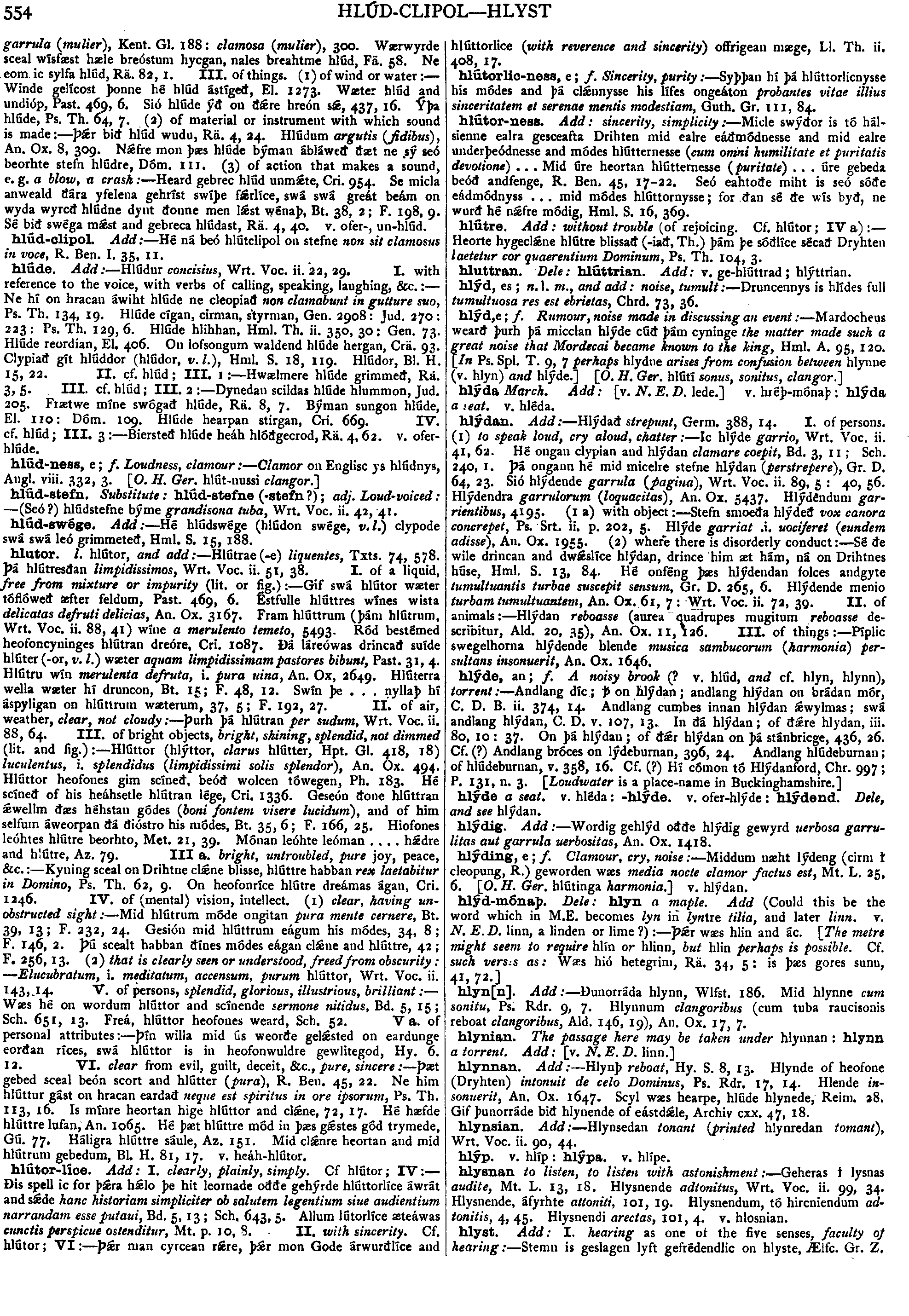
hlde.
Add
:--
Hldur
concisius,
Wrt.
Voc.
ii.
22,
29,
I.
with
reference
to
the
voice,
with
verbs
of
calling,
speaking,
laughing,
&c.
:--
Ne
h
on
hracan
wiht
hlde
ne
cleopia
non
clamabunt
in
gutture
suo,
Ps.
Th.
134,
19.
Hlde
cgan,
cirman,
styrman,
Gen.
2908:
Jud.
270:
223
:
Ps.
Th.
129,
6.
Hlde
hlihhan.
Hml.
Th.
ii.
350,
30:
Gen.
73.
Hlde
reordian,
El.
406.
On
lofsongum
waldend
hlde
hergan,
Crä.
93.
Clypia
gt
hlddor
(hldor,
v.
l.),
Hml.
S.
18,
119.
Hldor,
Bl.
H.
15,
22.
II.
cf.
hld
;
III.
1
:--
Hwælmere
hlde
grimme,
RUNCERTAIN.
3,
5.
III.
cf.
hld;
III.
2
:--
Dynedan
scildas
hlde
hlummon,
Jud.
205.
Frætwe
mne
swga
hlde,
Rä.
8,
7.
Bman
sungon
hlde,
El.
110:
Dm.
109.
Hlde
hearpan
stirgan,
Cri.
669.
IV.
cf.
hld;
III.
3
:--
Bierste
hlde
heáh
hlgecrod,
Rä.
4,
62.
v.
ofer-hlde.
|
Source: Bosworth/Toller, page d0569, entry 8 View original page image as: [TIFF] [PNG] [View previous entry] [View next entry] |
[Comment on this entry] [View comments] |
The following entry has been hand-corrected once. |
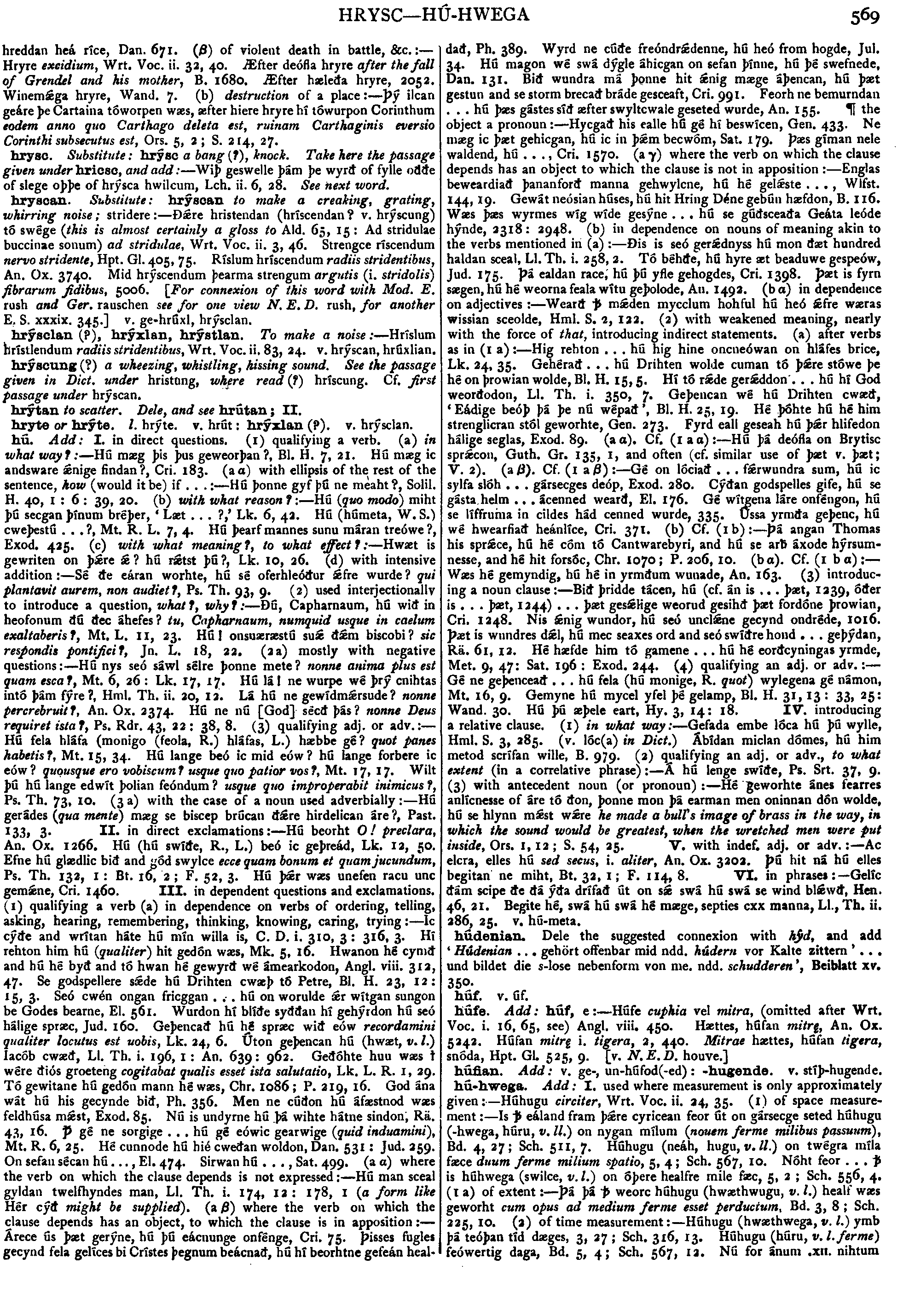
hú.
Add;
I.
in
direct
questions.
(1)
qualifying
a
verb.
(a)
in
what
way?:--Hú
mæg
þis
þus
geweorþan?,
Bl.
H.
7,
21.
Hú
mæg
ic
andsware
nige
findan?,
Cri.
183.
(a
)
with
ellipsis
of
the
rest
of
the
sentence,
how
(would
it
be)
if
.
.
.:--Hú
þonne
gyf
þú
ne
meaht?,
Solil.
H.
40,
1:
6:
39,
20.
(b)
with
what
reason?:--Hú
(quo
modo)
miht
þú
secgan
þínum
bréþer,
'Læt
.
.
.
?,'
Lk.
6,
42.
Hú
(húmeta,
W.
S.)
cweþestú
.
.
.?,
Mt.
R.
L.
7,
4.
Hú
þearf
mannes
sunu
máran
treówe?,
Exod.
425.
(c)
with
what
meaning?,
to
what
effect?:--Hwæt
is
gewriten
on
þre
?
hú
rtst
þú?,
Lk.
10,
26.
(d)
with
intensive
addition:--Sé
ðe
eáran
worhte,
hú
sé
oferhleóður
fre
wurde?
qui
plantavit
aurem,
non
audiet?,
Ps.
Th.
93,
9.
(2)
used
interjectionally
to
introduce
a
question,
what?,
why?:--Ðú,
Capharnaum,
hú
wið
in
heofonum
ðú
ðec
áhefes?
tu,
Capharnaum,
numquid
usque
in
caelum
exaltaberis?,
Mt.
L.
11,
23.
Hú
!
onsuæræstú
su
ðm
biscobi?
sic
respondis
pontifici?,
Jn.
L.
18,
22.
(2
a)
mostly
with
negative
questions:--Hú
nys
seó
sáwl
sélre
þonne
mete?
nonne
anima
plus
est
quam
esca?,
Mt.
6,
26:
Lk.
17,
17.
Hú
lá
!
ne
wurpe
wé
þrý
cnihtas
intó
þám
fýre?,
Hml.
Th.
ii.
20,
12.
Lá
hú
ne
gewídmrsude?
nonne
percrebruit?,
An.
Ox.
2374.
Hú
ne
nú
[God]
sécð
þás?
nonne
Deus
requiret
ista?,
Ps.
Rdr.
43,
22:
38,
8.
(3)
qualifying
adj.
or
adv.:--Hú
fela
hláfa
(monigo
(feola,
R.)
hláfas,
L.)
hæbbe
gé?
quot
panes
habetis?,
Mt.
15,
34.
Hú
lange
beó
ic
mid
eów?
hú
lange
forbere
ic
eów?
quousque
ero
vobiscum?
usque
quo
patior
vos?,
Mt.
17,
17.
Wilt
þú
hú
lange
edwít
þolian
feóndum?
usque
quo
improperabit
inimicus?,
Ps.
Th.
73,
10.
(3
a)
with
the
case
of
a
noun
used
adverbially:--Hú
gerádes
(qua
mente)
mæg
se
biscep
brúcan
ðre
hirdelican
áre?,
Past.
133,
3.
II.
in
direct
exclamations:--Hú
beorht
O!
preclara,
An.
Ox.
1266.
Hú
(hú
swíðe,
R.,
L.)
beó
ic
geþreád,
Lk.
12,
50.
Efne
hú
glædlic
bið
and
gód
swylce
ecce
quam
bonum
et
quam
jucundum,
Ps.
Th.
132,
1:
Bt.
16,
2;
F.
52,
3.
Hú
þr
wæs
unefen
racu
unc
gemne,
Cri.
1460.
III.
in
dependent
questions
and
exclamations,
(1)
qualifying
a
verb
(a)
in
dependence
on
verbs
of
ordering,
telling,
asking,
hearing,
remembering,
thinking,
knowing,
caring,
trying:--Ic
cýðe
and
wrítan
háte
hú
mín
willa
is,
C.
D.
i.
310,
3:
316,
3.
Hí
rehton
him
hú
(qualiter)
hit
gedón
wæs,
Mk.
5,
16.
Hwanon
hé
cymð
and
hú
hé
byð
and
tó
hwan
hé
gewyrð
wé
ámearkodon,
Angl.
viii.
312,
47.
Se
godspellere
sde
hú
Drihten
cwæþ
tó
Petre,
Bl.
H.
23,
12:
15,
3.
Seó
cwén
ongan
fricggan
.
.
.
hú
on
worulde
r
wítgan
sungon
be
Godes
bearne,
El.
561.
Wurdon
hí
blíðe
syððan
hí
gehýrdon
hú
seó
hálige
spræc,
Jud.
160.
Geþencað
hú
hé
spræc
wið
eów
recordamini
qualiter
locutus
est
uobis,
Lk.
24,
6.
Úton
geþencan
hú
(hwæt,
v.
l.)
Iacób
cwæð,
Ll.
Th.
i.
196,
1:
An.
639:
962.
Geðóhte
huu
wæs
wére
ðiós
groeteng
cogitabat
qualis
esset
ista
salutatio,
Lk.
L.
R.
1,
29.
Tó
gewitane
hú
gedón
mann
hé
wæs,
Chr.
1086;
P.
219,
16.
God
ána
wát
hú
his
gecynde
bið,
Ph.
356.
Men
ne
cúðon
hú
áfæstnod
wæs
feldhúsa
mst,
Exod.
85.
Nú
is
undyrne
hú
þá
wihte
hátne
sindon,
Rä.
43,
16.
Þ-bar;
gé
ne
sorgige
.
.
.
hú
gé
eówic
gearwige
(quid
induamini),
Mt.
R.
6,
25.
Hé
cunnode
hú
hié
cweðan
woldon,
Dan.
531:
Jud.
259.
On
sefan
sécan
hú
.
.
.,
El.
474.
Sirwan
hú
.
.
.,
Sat.
499.
(a
)
where
the
verb
on
which
the
clause
depends
is
not
expressed:--Hú
man
sceal
gyldan
twelfhyndes
man,
Ll.
Th.
i.
174,
12:
178,
1
(a
form
like
Hér
cýð
might
be
supplied).
(a
)
where
the
verb
on
which
the
clause
depends
has
an
object,
to
which
the
clause
is
in
apposition:--Árece
ús
þæt
gerýne,
hú
þú
eácnunge
onfénge,
Cri.
75.
Þisses
fugles
gecynd
fela
gelíces
bi
Crístes
þegnum
beácnað,
hú
hí
beorhtne
gefeán
healdað,
Ph.
389.
Wyrd
ne
cúðe
freóndrdenne,
hú
heó
from
hogde,
Jul.
34.
Hú
magon
wé
swá
dýgle
áhicgan
on
sefan
þínne,
hú
þé
swefnede,
Dan.
131.
Bið
wundra
má
þonne
hit
nig
mæge
áþencan,
hú
þæt
gestun
and
se
storm
brecað
bráde
gesceaft,
Cri.
991.
Feorh
ne
bemurndan
.
.
.
hú
þæs
gástes
síð
æfter
swyltcwale
geseted
wurde,
An.
155.
¶
the
object
a
pronoun:--Hycgað
his
ealle
hú
gé
hí
beswícen,
Gen.
433.
Ne
mæg
ic
þæt
gehicgan,
hú
ic
in
þm
becwóm,
Sat.
179.
Þæs
gíman
nele
waldend,
hú
.
.
.,
Cri.
1570.
(a
 )
where
the
verb
on
which
the
clause
depends
has
an
object
to
which
the
clause
is
not
in
apposition:--Englas
beweardiað
þananforð
manna
gehwylcne,
hú
hé
gelste
.
.
.,
Wlfst.
144,
19.
Gewát
neósian
húses,
hú
hit
Hring
Déne
gebún
hæfdon,
B.
116.
Wæs
þæs
wyrmes
wíg
wíde
gesýne
.
.
.
hú
se
gúðsceaða
Geáta
leóde
hýnde,
2318:
2948.
(b)
in
dependence
on
nouns
of
meaning
akin
to
the
verbs
mentioned
in
(a):--Ðis
is
seó
gerdnyss
hú
mon
ðæt
hundred
haldan
sceal,
Ll.
Th.
i.
258,
2.
Tó
béhðe,
hú
hyre
æt
beaduwe
gespeów,
Jud.
175.
Þá
ealdan
race,
hú
þú
yfle
gehogdes,
Cri.
1398.
Þæt
is
fyrn
sægen,
hú
hé
weorna
feala
wítu
geþolode,
An.
1492.
(b
)
independence
on
adjectives:--Wearð
mden
mycclum
hohful
hú
heó
fre
wæras
wissian
sceolde,
Hml.
S.
2,
122.
(2)
with
weakened
meaning,
nearly
with
the
force
of
that,
introducing
indirect
statements.
(a)
after
verbs
as
in
(1
a):--Hig
rehton
.
.
.
hú
hig
hine
oncneówan
on
hláfes
brice,
Lk.
24,
35.
Gehérað
.
.
.
hú
Drihten
wolde
cuman
tó
þre
stówe
þe
hé
on
þrowian
wolde,
Bl.
H.
15,
5.
Hí
tó
rde
gerddon
.
.
.
hú
hí
God
weorðodon,
Ll.
Th.
i.
350,
7.
Geþencan
wé
hú
Drihten
cwæð,
'Eádige
beóþ
þá
þe
nú
wépað',
Bl.
H.
25,
19.
Hé
þóhte
hú
hé
him
strenglicran
stól
geworhte,
Gen.
273.
Fyrd
eall
geseah
hú
þr
hlifedon
hálige
seglas,
Exod.
89.
(a
).
Cf.
(1
a
):--Hú
þá
deófla
on
Brytisc
sprcon,
Guth.
Gr.
135,
1,
and
often
(cf.
similar
use
of
þæt
v.
þæt;
V.
2).
(a
).
Cf.
(1
a
):--Gé
on
lóciað
.
.
.
frwundra
sum,
hú
ic
sylfa
slóh
.
.
.
gársecges
deóp,
Exod.
280.
Cýðan
godspelles
gife,
hú
se
gásta
helm
.
.
.
ácenned
wearð,
El.
176.
Gé
wítgena
láre
onféngon,
hú
se
líffruma
in
cildes
hád
cenned
wurde,
335.
Ússa
yrmða
geþenc,
hú
wé
hwearfiað
heánlíce,
Cri.
371.
(b)
Cf.
(1
b):--Þá
angan
Thomas
his
sprce,
hú
hé
cóm
tó
Cantwarebyri,
and
hú
se
ar
áxode
hýrsumnesse,
and
hé
hit
forsóc,
Chr.
1070;
P.
206,
10.
(b
).
Cf.
(1
b
):--Wæs
hé
gemyndig,
hú
hé
in
yrmðum
wunade,
An.
163.
(3)
introducing
a
noun
clause:--Bið
þridde
tácen,
hú
(cf.
án
is
.
.
.
þæt,
1239,
óðer
is
.
.
.
þæt,
1244)
.
.
.
þæt
geslige
weorud
gesihð
þæt
fordóne
þrowian,
Cri.
1248.
Nis
nig
wundor,
hú
seó
unclne
gecynd
ondréde,
1016.
Þæt
is
wundres
dl,
hú
mec
seaxes
ord
and
seó
swíðre
hond
.
.
.
geþýdan,
Rä.
61,
12.
Hé
hæfde
him
tó
gamene
.
.
.
hú
hé
eorðcyningas
yrmde,
Met.
9,
47:
Sat.
196:
Exod.
244.
(4)
qualifying
an
adj.
or
adv.:--Gé
ne
geþenceað
.
.
.
hú
fela
(hú
monige,
R.
quot)
wylegena
gé
námon,
Mt.
16,
9.
Gemyne
hú
mycel
yfel
þé
gelamp,
Bl.
H.
31,
13:
33,
25:
Wand.
30.
Hú
þú
æþele
eart,
Hy.
3,
14:
18.
IV.
introducing
a
relative
clause.
(1)
in
what
way:--Gefada
embe
lóca
hú
þú
wylle,
Hml.
S.
3,
285.
(v.
lóc(a)
in
Dict.)
Ábídan
miclan
dómes,
hú
him
metod
scrífan
wille,
B.
979.
(2)
qualifying
an
adj.
or
adv.,
to
what
extent
(in
a
correlative
phrase):--Á
hú
lenge
swíðe,
Ps.
Srt.
37,
9.
(3)
with
antecedent
noun
(or
pronoun):--Hé
geworhte
ánes
fearres
anlícnesse
of
áre
tó
ðon,
þonne
mon
þá
earman
men
oninnan
dón
wolde,
hú
se
hlynn
mst
wre
he
made
a
bull's
image
of
brass
in
the
way,
in
which
the
sound
would
be
greatest,
when
the
wretched
men
were
put
inside,
Ors.
1,
12;
S.
54,
25.
V.
with
indef.
adj.
or
adv.:--Ac
elcra,
elles
hú
sed
secus,
i.
aliter,
An.
Ox.
3202.
Þú
hit
ná
hú
elles
begitan
ne
miht,
Bt.
32,
1;
F.
114,
8.
VI.
in
phrases:--Gelíc
ðám
scipe
ðe
ðá
ýða
drífað
út
on
s
swá
hú
swá
se
wind
blwð,
Hen.
46,
21.
Begite
hé,
swá
hú
swá
hé
mæge,
septies
cxx
manna,
Ll.,
Th.
ii.
286,
25.
v.
hú-meta.
)
where
the
verb
on
which
the
clause
depends
has
an
object
to
which
the
clause
is
not
in
apposition:--Englas
beweardiað
þananforð
manna
gehwylcne,
hú
hé
gelste
.
.
.,
Wlfst.
144,
19.
Gewát
neósian
húses,
hú
hit
Hring
Déne
gebún
hæfdon,
B.
116.
Wæs
þæs
wyrmes
wíg
wíde
gesýne
.
.
.
hú
se
gúðsceaða
Geáta
leóde
hýnde,
2318:
2948.
(b)
in
dependence
on
nouns
of
meaning
akin
to
the
verbs
mentioned
in
(a):--Ðis
is
seó
gerdnyss
hú
mon
ðæt
hundred
haldan
sceal,
Ll.
Th.
i.
258,
2.
Tó
béhðe,
hú
hyre
æt
beaduwe
gespeów,
Jud.
175.
Þá
ealdan
race,
hú
þú
yfle
gehogdes,
Cri.
1398.
Þæt
is
fyrn
sægen,
hú
hé
weorna
feala
wítu
geþolode,
An.
1492.
(b
)
independence
on
adjectives:--Wearð
mden
mycclum
hohful
hú
heó
fre
wæras
wissian
sceolde,
Hml.
S.
2,
122.
(2)
with
weakened
meaning,
nearly
with
the
force
of
that,
introducing
indirect
statements.
(a)
after
verbs
as
in
(1
a):--Hig
rehton
.
.
.
hú
hig
hine
oncneówan
on
hláfes
brice,
Lk.
24,
35.
Gehérað
.
.
.
hú
Drihten
wolde
cuman
tó
þre
stówe
þe
hé
on
þrowian
wolde,
Bl.
H.
15,
5.
Hí
tó
rde
gerddon
.
.
.
hú
hí
God
weorðodon,
Ll.
Th.
i.
350,
7.
Geþencan
wé
hú
Drihten
cwæð,
'Eádige
beóþ
þá
þe
nú
wépað',
Bl.
H.
25,
19.
Hé
þóhte
hú
hé
him
strenglicran
stól
geworhte,
Gen.
273.
Fyrd
eall
geseah
hú
þr
hlifedon
hálige
seglas,
Exod.
89.
(a
).
Cf.
(1
a
):--Hú
þá
deófla
on
Brytisc
sprcon,
Guth.
Gr.
135,
1,
and
often
(cf.
similar
use
of
þæt
v.
þæt;
V.
2).
(a
).
Cf.
(1
a
):--Gé
on
lóciað
.
.
.
frwundra
sum,
hú
ic
sylfa
slóh
.
.
.
gársecges
deóp,
Exod.
280.
Cýðan
godspelles
gife,
hú
se
gásta
helm
.
.
.
ácenned
wearð,
El.
176.
Gé
wítgena
láre
onféngon,
hú
se
líffruma
in
cildes
hád
cenned
wurde,
335.
Ússa
yrmða
geþenc,
hú
wé
hwearfiað
heánlíce,
Cri.
371.
(b)
Cf.
(1
b):--Þá
angan
Thomas
his
sprce,
hú
hé
cóm
tó
Cantwarebyri,
and
hú
se
ar
áxode
hýrsumnesse,
and
hé
hit
forsóc,
Chr.
1070;
P.
206,
10.
(b
).
Cf.
(1
b
):--Wæs
hé
gemyndig,
hú
hé
in
yrmðum
wunade,
An.
163.
(3)
introducing
a
noun
clause:--Bið
þridde
tácen,
hú
(cf.
án
is
.
.
.
þæt,
1239,
óðer
is
.
.
.
þæt,
1244)
.
.
.
þæt
geslige
weorud
gesihð
þæt
fordóne
þrowian,
Cri.
1248.
Nis
nig
wundor,
hú
seó
unclne
gecynd
ondréde,
1016.
Þæt
is
wundres
dl,
hú
mec
seaxes
ord
and
seó
swíðre
hond
.
.
.
geþýdan,
Rä.
61,
12.
Hé
hæfde
him
tó
gamene
.
.
.
hú
hé
eorðcyningas
yrmde,
Met.
9,
47:
Sat.
196:
Exod.
244.
(4)
qualifying
an
adj.
or
adv.:--Gé
ne
geþenceað
.
.
.
hú
fela
(hú
monige,
R.
quot)
wylegena
gé
námon,
Mt.
16,
9.
Gemyne
hú
mycel
yfel
þé
gelamp,
Bl.
H.
31,
13:
33,
25:
Wand.
30.
Hú
þú
æþele
eart,
Hy.
3,
14:
18.
IV.
introducing
a
relative
clause.
(1)
in
what
way:--Gefada
embe
lóca
hú
þú
wylle,
Hml.
S.
3,
285.
(v.
lóc(a)
in
Dict.)
Ábídan
miclan
dómes,
hú
him
metod
scrífan
wille,
B.
979.
(2)
qualifying
an
adj.
or
adv.,
to
what
extent
(in
a
correlative
phrase):--Á
hú
lenge
swíðe,
Ps.
Srt.
37,
9.
(3)
with
antecedent
noun
(or
pronoun):--Hé
geworhte
ánes
fearres
anlícnesse
of
áre
tó
ðon,
þonne
mon
þá
earman
men
oninnan
dón
wolde,
hú
se
hlynn
mst
wre
he
made
a
bull's
image
of
brass
in
the
way,
in
which
the
sound
would
be
greatest,
when
the
wretched
men
were
put
inside,
Ors.
1,
12;
S.
54,
25.
V.
with
indef.
adj.
or
adv.:--Ac
elcra,
elles
hú
sed
secus,
i.
aliter,
An.
Ox.
3202.
Þú
hit
ná
hú
elles
begitan
ne
miht,
Bt.
32,
1;
F.
114,
8.
VI.
in
phrases:--Gelíc
ðám
scipe
ðe
ðá
ýða
drífað
út
on
s
swá
hú
swá
se
wind
blwð,
Hen.
46,
21.
Begite
hé,
swá
hú
swá
hé
mæge,
septies
cxx
manna,
Ll.,
Th.
ii.
286,
25.
v.
hú-meta.
| Result Page: |  |
Previous | 3 4 5 6 7 8 9 10 11 12 13 | Next |  |
Germanic Lexicon Project (main page)
This search system was written by
Sean Crist
Please consider
volunteering
to correct the data in these online dictionaries.
No rights reserved. Feel free to use these data in any way you please.