|
|

Search for Wal again, using less strict matching (174 results)
|
Source: Bosworth/Toller, page b1152, entry 10 View original page image as: [TIFF] [PNG] [View previous entry] [View next entry] |
[Comment on this entry] [View comments] |
The following entry has been hand-corrected once. |
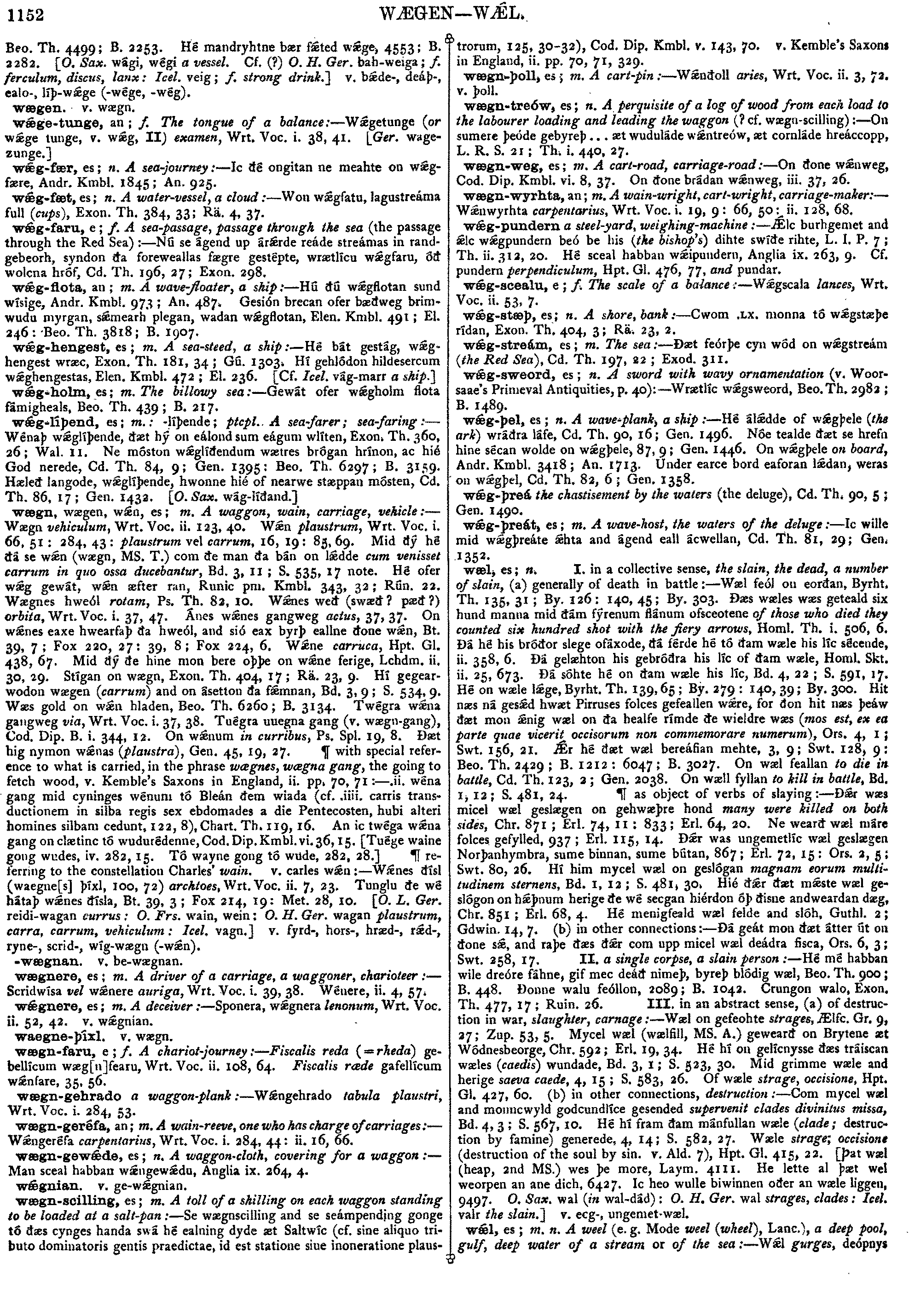
w g-líþend,
es;
m.:
-líþende;
ptcpl.
A
sea-farer;
sea-faring
:--
Wénaþ
wglíþende,
ðæt
hý
on
eálond
sum
eágum
wlíten,
Exon.
Th.
360,
26;
Wal.
11.
Ne
móston
wglíðendum
wætres
brógan
hrínon,
ac
hié
God
nerede,
Cd.
Th.
84,
9;
Gen.
1395:
Beo.
Th.
6297;
B.
3159.
Hæleð
langode,
wglíþende,
hwonne
hié
of
nearwe
stæppan
mósten,
Cd.
Th.
86,
17;
Gen.
1432.
[O.
Sax.
wág-líðand.]
g-líþend,
es;
m.:
-líþende;
ptcpl.
A
sea-farer;
sea-faring
:--
Wénaþ
wglíþende,
ðæt
hý
on
eálond
sum
eágum
wlíten,
Exon.
Th.
360,
26;
Wal.
11.
Ne
móston
wglíðendum
wætres
brógan
hrínon,
ac
hié
God
nerede,
Cd.
Th.
84,
9;
Gen.
1395:
Beo.
Th.
6297;
B.
3159.
Hæleð
langode,
wglíþende,
hwonne
hié
of
nearwe
stæppan
mósten,
Cd.
Th.
86,
17;
Gen.
1432.
[O.
Sax.
wág-líðand.]
|
Source: Bosworth/Toller, page b1152, entry 34 View original page image as: [TIFF] [PNG] [View previous entry] [View next entry] |
[Comment on this entry] [View comments (1)] |
The following entry has been hand-corrected once. |
wæl,
es;
a.
I.
in
a
collective
sense,
the
slain,
the
dead,
a
number
of
slain,
(a)
generally
of
death
in
battle
:--
Wæl
feól
on
eorðan,
Byrht.
Th.
135,
31;
By.
126:
140,
45;
By.
303.
Ðæs
wæles
wæs
geteald
six
hund
manna
mid
ðám
fýrenum
flánum
ofsceotene
of
those
who
died
they
counted
six
hundred
shot
with
the
fiery
arrows,
Homl.
Th.
i.
506,
6.
Ðá
hé
his
bróðor
siege
ofáxode,
ðá
férde
hé
tó
ðam
wæle
his
líc
sécende,
ii.
358,
6.
Ðá
gelæhton
his
gebróðra
his
líc
of
ðam
wæle,
Homl.
Skt.
ii.
25,
673.
Ðá
sóhte
hé
on
ðam
wæle
his
líc,
Bd.
4,
22;
S.
591,
17.
Hé
on
wæle
lge,
Byrht.
Th.
139,
65;
By.
279:
140,
39;
By.
300.
Hit
næs
ná
gesd
hwæt
Pirruses
folces
gefeallen
wre,
for
ðon
hit
næs
þeáw
ðæt
mon
nig
wæl
on
ða
healfe
rímde
ðe
wieldre
wæs
(mos
est,
ex
ea
parte
quae
vicerit
occisorum
non
commemorare
numerum),
Ors.
4,
1;
Swt.
156,
21.
Æ-acute;r
hé
ðæt
wæl
bereáfian
mehte,
3,
9;
Swt.
128,
9:
Beo.
Th.
2429;
B.
1212:
6047;
B.
3027.
On
wæl
feallan
to
die
in
battle,
Cd.
Th.
123,
2;
Gen.
2038.
On
wæll
fyllan
to
kill
in
battle,
Bd.
1,
12;
S.
481,
24.

as
object
of
verbs
of
slaying
:--
Ðr
wæs
micel
wæl
geslægen
on
gehwæþre
hond
many
were
killed
on
both
sides,
Chr.
871;
Erl.
74,
11:
833;
Erl.
64,
20.
Ne
wearð
wæl
máre
folces
gefylled,
937;
Erl.
115,
14.
Ðr
was
ungemetlíc
wæl
geslægen
Norþanhymbra,
sume
binnan,
sume
bútan,
867;
Erl.
72,
15:
Ors.
2,
5;
Swt.
80,
26.
Hí
him
mycel
wæl
on
geslógan
magnam
eorum
multitudinem
sternens,
Bd.
1,
12;
S.
481,
30,
Hié
ðr
ðæt
mste
wæl
geslógon
on
hþnum
herige
ðe
wé
secgan
hiérdon
óþ
ðisne
andweardan
dæg,
Chr.
851;
Erl.
68,
4.
Hé
menigfeald
wæl
felde
and
slóh,
Guthl.
2;
Gdwin.
14,
7.
(b)
in
other
connections
:--
Ðá
geát
mon
ðæt
átter
út
on
ðone
s,
and
raþe
ðæs
ðr
com
upp
micel
wæl
deádra
fisca,
Ors.
6,
3;
Swt.
258,
17.
II.
a
single
corpse,
a
slain
person
:--
Hé
mé
habban
wile
dreóre
fáhne,
gif
mec
deáð
nimeþ,
byreþ
blódig
wæl,
Beo.
Th.
900;
B.
448.
Ðonne
walu
feóllon,
2089;
B.
1042.
Crungon
walo,
Exon.
Th.
477,
17;
Ruin.
26.
III.
in
an
abstract
sense,
(a)
of
destruction
in
war,
slaughter,
carnage
:--
Wæl
on
gefeohte
strages,
Ælfc.
Gr.
9,
27;
Zup.
53,
5.
Mycel
wæl
(wælfill,
MS.
A.)
gewearð
on
Brytene
æt
Wódnesbeorge,
Chr.
592;
Erl.
19,
34.
Hé
hí
on
gelícnysse
ðæs
tráiscan
wæles
(caedis)
wundade,
Bd.
3,
1;
S.
523,
30.
Mid
grimme
wæle
and
herige
saeva
caede,
4,
15;
S.
583,
26.
Of
wæle
strage,
occisione,
Hpt.
Gl.
427,
60.
(b)
in
other
connections,
destruction
:--
Com
mycel
wæl
and
monncwyld
godcundlíce
gesended
supervenit
clades
divinitus
missa,
Bd.
4,
3;
S.
567,
10.
Hé
hí
fram
ðam
mánfullan
wæle
(clade;
destruction
by
famine)
generede,
4,
14;
S.
582,
27.
Wæle
strage;
occisione
(destruction
of
the
soul
by
sin.
v.
Ald.
7),
Hpt.
Gl.
415,
22.
[Þat
wæl
(heap,
2nd
MS.)
wes
þe
more,
Laym.
4111.
He
lette
al
þæt
wel
weorpen
an
ane
dich,
6427.
Ic
heo
wulle
biwinnen
oðer
an
wæle
liggen,
9497.
O.
Sax.
wal
(in
wal-dád):
O.
H.
Ger.
wal
strages,
clades:
Icel.
valr
the
slain.]
v.
ecg-,
ungemet-wæl.
|
Source: Bosworth/Toller, page b1157, entry 19 View original page image as: [TIFF] [PNG] [View previous entry] [View next entry] |
[Comment on this entry] [View comments] |
The following entry has been hand-corrected once. |
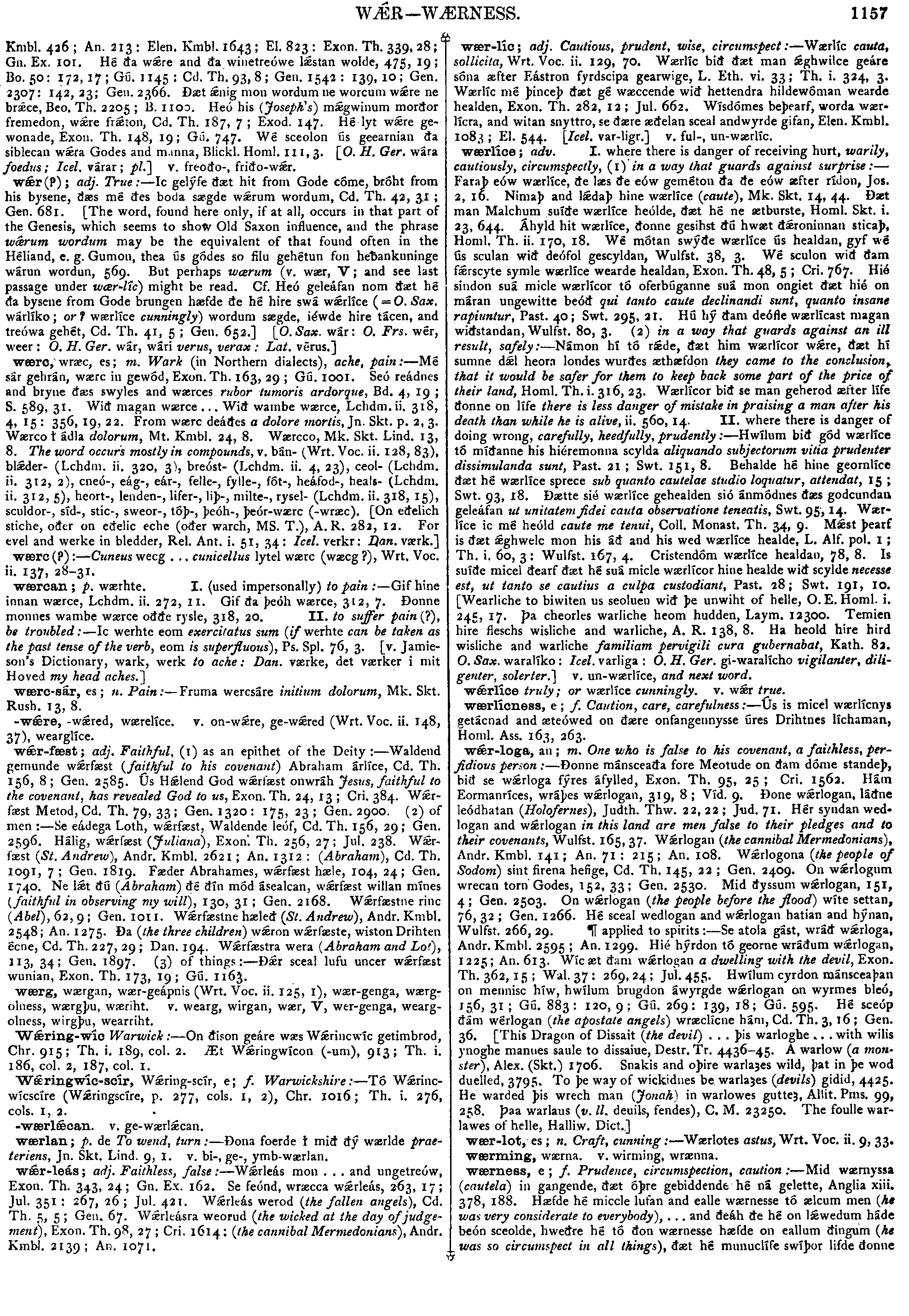
wr-loga,
an;
m.
One
who
is
false
to
his
covenant,
a
faithless,
perfidious
person:--Ðonne
mánsceaða
fore
Meotude
on
ðam
dóme
standeþ,
bið
se
wrloga
fýres
áfylled,
Exon.
Th.
95,
25;
Cri.
1562.
Hám
Eormanríces,
wráþes
wrlogan,
319,
8;
Víd.
9.
Ðone
wrlogan,
láðne
leódhatan
(Holofernes),
Judth.
Thw.
22,
22;
Jud.
71.
Hér
syndan
wed logan
and
wrlogan
in
this
land
are
men
false
to
their
pledges
and
to
their
covenants,
Wulfst.
165,
37.
Wrlogan
(the
cannibal
Mermedonians),
Andr.
Kmbl.
141;
An.
71:
215;
An.
108.
Wrlogona
(the
people
of
Sodom)
sint
firena
hefige,
Cd.
Th.
145,
22;
Gen.
2409.
On
wrlogum
wrecan
torn
Godes,
152,
33;
Gen.
2530.
Mid
ðyssum
wrlogan,
151,
4;
Gen.
2503.
On
wrlogan
(the
people
before
the
flood)
wíte
settan,
76,
32;
Gen.
1266.
Hé
sceal
wedlogan
and
wrlogan
hatian
and
hýnan,
Wulfst.
266,
29.

applied
to
spirits:--Se
atola
gást,
wráð
wrloga,
Andr.
Kmbl.
2595;
An.
1299.
Hié
hýrdon
tó
georne
wráðum
wrlogan,
1225;
An.
613.
Wíc
æt
ðam
wrlogan
a
dwelling
with
the
devil,
Exon.
Th.
362,
15;
Wal.
37:
269,
24;
Jul.
455.
Hwílum
cyrdon
mánsceaþan
on
mennisc
híw,
hwílum
brugdon
áwyrgde
wrlogan
on
wyrmes
bleó,
156,
31;
Gú.
883:
120,
9;
Gú.
269:
139,
18;
Gú.
595.
Hé
sceóp
ðám
wérlogan
(the
apostate
angels)
wræclícne
hám,
Cd.
Th.
3,
16;
Gen.
36.
[This
Dragon
of
Dissait
(the
devil)
.
.
.
þis
warloghe
.
.
.
with
wilis
ynoghe
mannes
saule
to
dissaiue,
Destr.
Tr.
4436-45.
A
warlow
(a
monster),
Alex.
(Skt.)
1706.
Snakis
and
oþire
warla
logan
and
wrlogan
in
this
land
are
men
false
to
their
pledges
and
to
their
covenants,
Wulfst.
165,
37.
Wrlogan
(the
cannibal
Mermedonians),
Andr.
Kmbl.
141;
An.
71:
215;
An.
108.
Wrlogona
(the
people
of
Sodom)
sint
firena
hefige,
Cd.
Th.
145,
22;
Gen.
2409.
On
wrlogum
wrecan
torn
Godes,
152,
33;
Gen.
2530.
Mid
ðyssum
wrlogan,
151,
4;
Gen.
2503.
On
wrlogan
(the
people
before
the
flood)
wíte
settan,
76,
32;
Gen.
1266.
Hé
sceal
wedlogan
and
wrlogan
hatian
and
hýnan,
Wulfst.
266,
29.

applied
to
spirits:--Se
atola
gást,
wráð
wrloga,
Andr.
Kmbl.
2595;
An.
1299.
Hié
hýrdon
tó
georne
wráðum
wrlogan,
1225;
An.
613.
Wíc
æt
ðam
wrlogan
a
dwelling
with
the
devil,
Exon.
Th.
362,
15;
Wal.
37:
269,
24;
Jul.
455.
Hwílum
cyrdon
mánsceaþan
on
mennisc
híw,
hwílum
brugdon
áwyrgde
wrlogan
on
wyrmes
bleó,
156,
31;
Gú.
883:
120,
9;
Gú.
269:
139,
18;
Gú.
595.
Hé
sceóp
ðám
wérlogan
(the
apostate
angels)
wræclícne
hám,
Cd.
Th.
3,
16;
Gen.
36.
[This
Dragon
of
Dissait
(the
devil)
.
.
.
þis
warloghe
.
.
.
with
wilis
ynoghe
mannes
saule
to
dissaiue,
Destr.
Tr.
4436-45.
A
warlow
(a
monster),
Alex.
(Skt.)
1706.
Snakis
and
oþire
warla es
wild,
þat
in
þe
wod
duelled,
3795.
To
þe
way
of
wickidnes
be
warlaes
(devils)
gidid,
4425.
He
warded
þis
wrech
man
(Jonah)
in
warlowes
gutte,
Allit.
Pms.
99,
258.
Þaa
warlaus
(v.
ll.
deuils,
fendes),
C.
M.
23250.
The
foulle
warlawes
of
helle,
Halliw.
Dict.]
es
wild,
þat
in
þe
wod
duelled,
3795.
To
þe
way
of
wickidnes
be
warlaes
(devils)
gidid,
4425.
He
warded
þis
wrech
man
(Jonah)
in
warlowes
gutte,
Allit.
Pms.
99,
258.
Þaa
warlaus
(v.
ll.
deuils,
fendes),
C.
M.
23250.
The
foulle
warlawes
of
helle,
Halliw.
Dict.]
|
Source: Bosworth/Toller, page b1162, entry 9 View original page image as: [TIFF] [PNG] [View previous entry] [View next entry] |
[Comment on this entry] [View comments] |
The following entry has been hand-corrected once. |
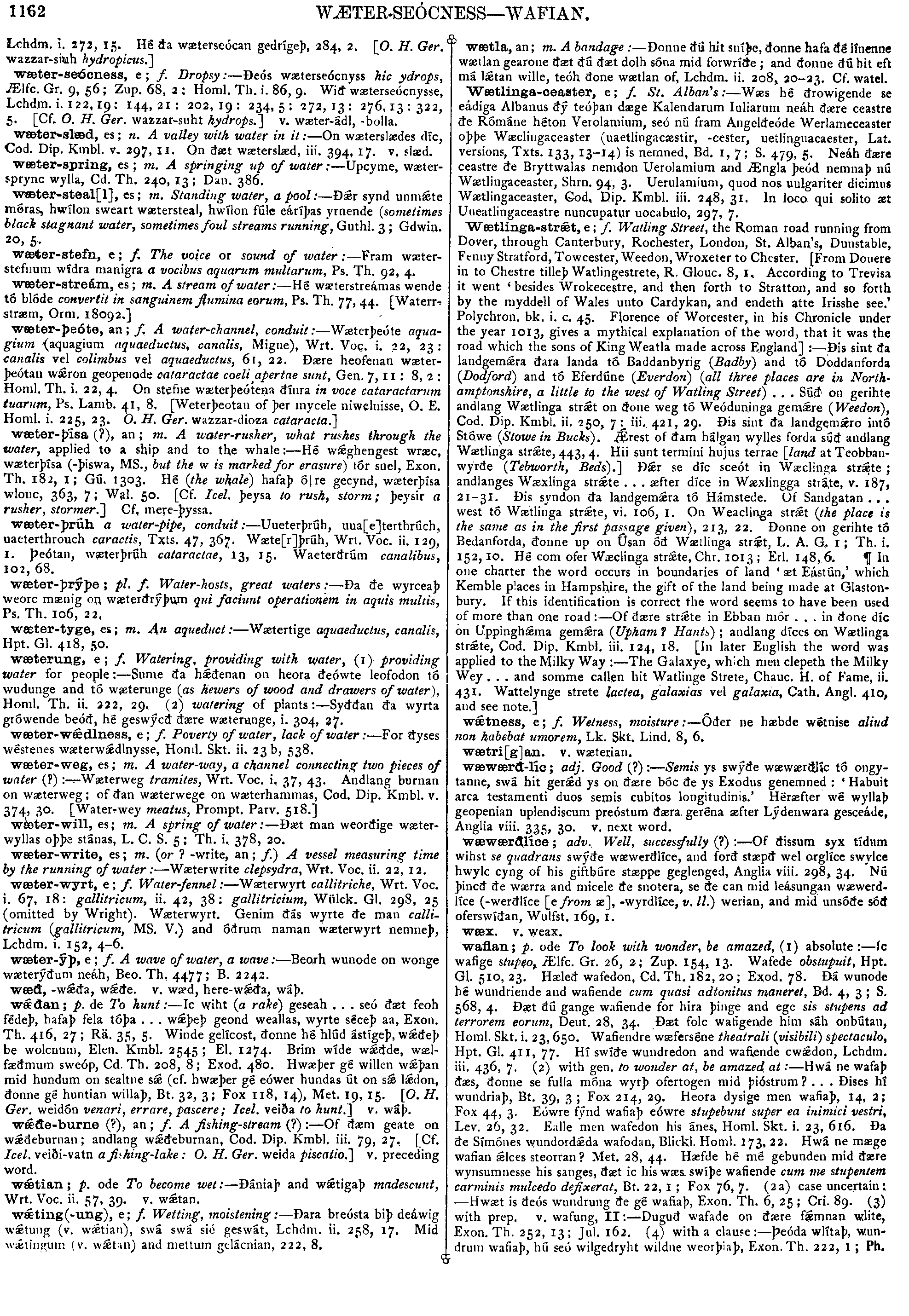
wæter-þísa
(?),
an;
m.
A
water-rusher,
what
rushes
through
the
water,
applied
to
a
ship
and
to
the
whale
:--
Hé
wghengest
wræc,
wæterþísa
(-þiswa,
MS.,
but
the
w
is
marked
for
erasure)
fór
ILLEGIBLE
snel,
Exon.
Th.
182,
1;
Gú.
1303.
Hé
(the
whale)
hafaþ
óþre
gecynd,
wæterþísa
wlonc,
363,
7;
Wal.
50.
[Cf.
Icel.
þeysa
to
rush,
storm;
þeysir
a
rusher,
stormer.]
Cf.
mere-þyssa.
|
Source: Bosworth/Toller, page b1163, entry 7 View original page image as: [TIFF] [PNG] [View previous entry] [View next entry] |
[Comment on this entry] [View comments] |
The following entry has been hand-corrected once. |
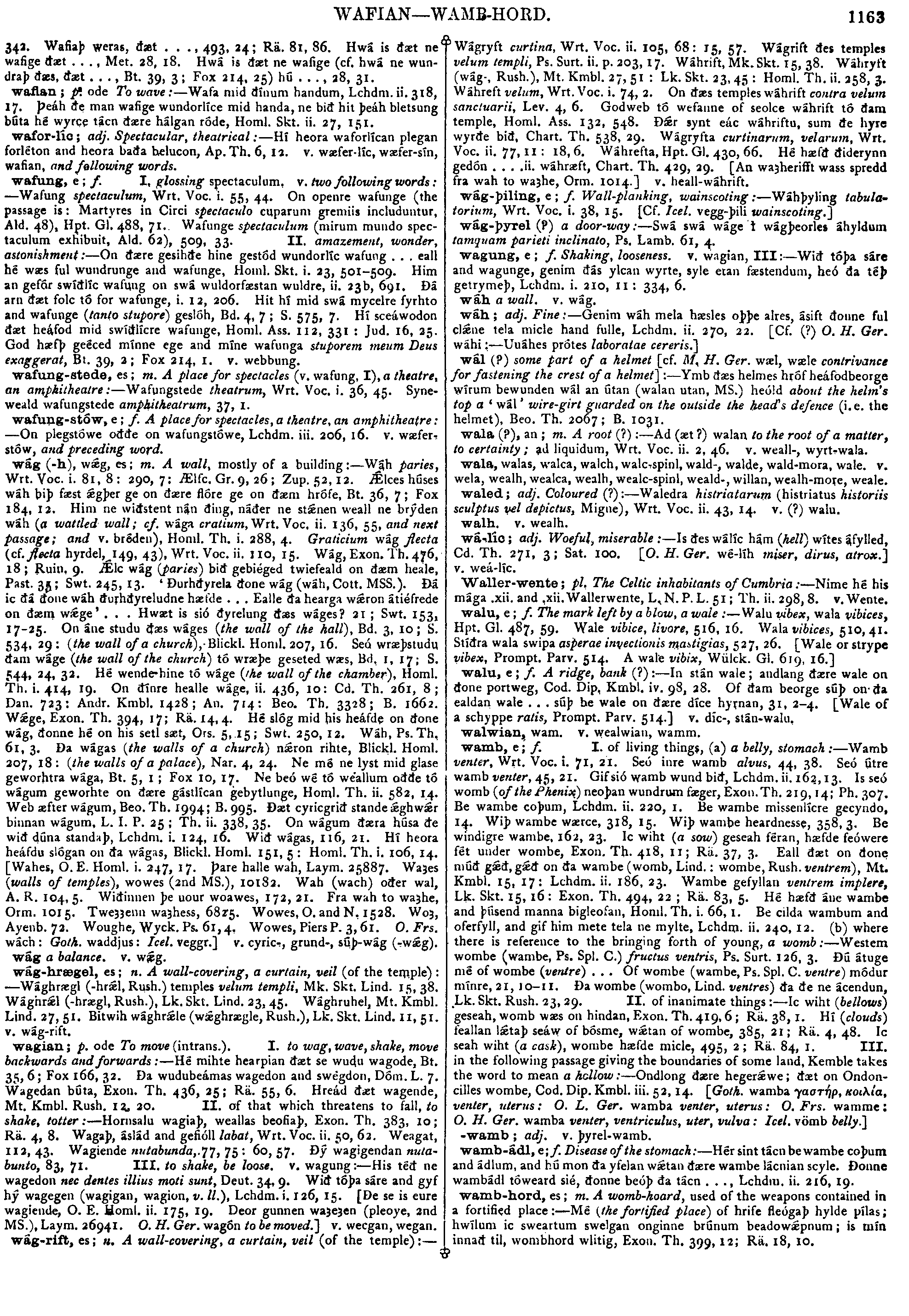
wág
(-h),
wg,
es;
m.
A
wall,
mostly
of
a
building
:--
Wáh
paries,
Wrt.
Voc.
i.
81,
8:
290,
7:
Ælfc.
Gr.
9,
26;
Zup.
52,
12.
Æ-acute;lces
húses
wáh
biþ
fæst
gþer
ge
on
ðære
flóre
ge
on
ðæm
hrófe,
Bt.
36,
7;
Fox
184,
12.
Him
ne
wiðstent
nán
ðing,
náðer
ne
stnen
weall
ne
brýden
wáh
(a
wattled
wall;
cf.
wága
cratium,
Wrt.
Voc.
ii.
136,
55,
and
next
passage;
and
v.
bréden),
Homl.
Th.
i.
288,
4.
Graticium
wág
flecta
(cf.
flecta
hyrdel,
149,
43),
Wrt.
Voc.
ii.
110,
15.
Wág,
Exon.
Th.
476,
18;
Ruin.
9.
Æ-acute;lc
wág
(paries)
bið
gebiéged
twiefeald
on
ðæm
heale,
Past.
35;
Swt.
245,
13.
'Ðurhðyrela
ðone
wág
(wáh,
Cott.
MSS.).
Ðá
ic
ðá
ðone
wáh
ðurhðyreludne
hæfde
.
.
.
Ealle
ða
hearga
wron
átiéfrede
on
ðæm
wge'
.
.
.
Hwæt
is
sió
ðyrelung
ðæs
wáges?
21
;
Swt.
153,
17-25.
On
áne
studu
ðæs
wáges
(the
wall
of
the
hall),
Bd.
3,
10;
S.
534,
29
:
(the
wall
of
a
church),
Blickl.
Homl.
207,
16.
Seó
wræþstudu
ðam
wáge
(the
wall
of
the
church)
tó
wræþe
geseted
wæs,
Bd.
1,
17;
S.
544,
24,
32.
Hé
wende
hine
tó
wáge
(the
wall
of
the
chamber),
Homl.
Th.
i.
414,
19.
On
ðínre
healle
wáge,
ii.
436,
10
:
Cd.
Th.
261,
8;
Dan.
723
:
Andr.
Kmbl.
1428;
An.
714:
Beo.
Th.
3328;
B.
1662.
Wge,
Exon.
Th.
394,
17;
Rä.
14,
4.
Hé
slóg
mid
his
heáfde
on
ðone
wág,
ðonne
hé
on
his
setl
sæt,
Ors.
5,
15;
Swt.
250,
12.
Wáh,
Ps.
Th.
61,
3.
Ða
wágas
(the
walls
of
a
church)
nron
rihte,
Blickl.
Homl.
207,
18
:
(the
walls
of
a
palace),
Nar.
4,
24.
Ne
mé
ne
lyst
mid
glase
geworhtra
wága,
Bt.
5,
l
;
Fox
10,
17.
Ne
beó
wé
tó
weallum
oððe
tó
wágum
geworhte
on
ðære
gástlícan
gebytlunge,
Homl.
Th.
ii.
582,
14.
Web
æfter
wágum,
Beo.
Th.
1994;
B.
995.
Ðæt
cyricgrið
stande
ghwr
binnan
wágum,
L.
I.
P.
25
:
Th.
ii.
338,
35.
On
wágum
ðæra
húsa
ðe
wið
dúna
standaþ,
Lchdm.
i.
124,
16.
Wið
wágas,
116,
21.
Hí
heora
heáfdu
slogan
on
ða
wágas,
Blickl.
Homl.
151,
5
:
Homl.
Th.
i.
106,
14.
[Wahes,
O.
E.
Homl.
i.
247,
17.
Þare
halle
wah,
Laym.
25887.
Waes
UNCERTAIN
(walls
of
temples),
wowes
(2nd
MS.),
10182.
Wah
(wach)
oðer
wal,
A.
R.
104,
5.
Wiðinnen
þe
uour
woawes,
172,
21.
Fra
wah
to
wahe,
UNCERTAIN
Orm.
1015.
Tweenn
UNCERTAIN
wahess,
UNCERTAIN
6825.
Wowes,
O.
and
N.
1528.
Wo,
UNCERTAIN
Ayenb.
72.
Woughe,
Wyck.
Ps.
61,
4,
Wowes,
Piers
P.
3,
61.
O.
Frs.
wách:
Goth.
waddjus:
Icel.
veggr.]
v.
cyric-,
grund-,
súþ-wág
(-wg).
|
Source: Bosworth/Toller, page b1174, entry 13 View original page image as: [TIFF] [PNG] [View previous entry] [View next entry] |
[Comment on this entry] [View comments] |
The following entry has been hand-corrected once. |
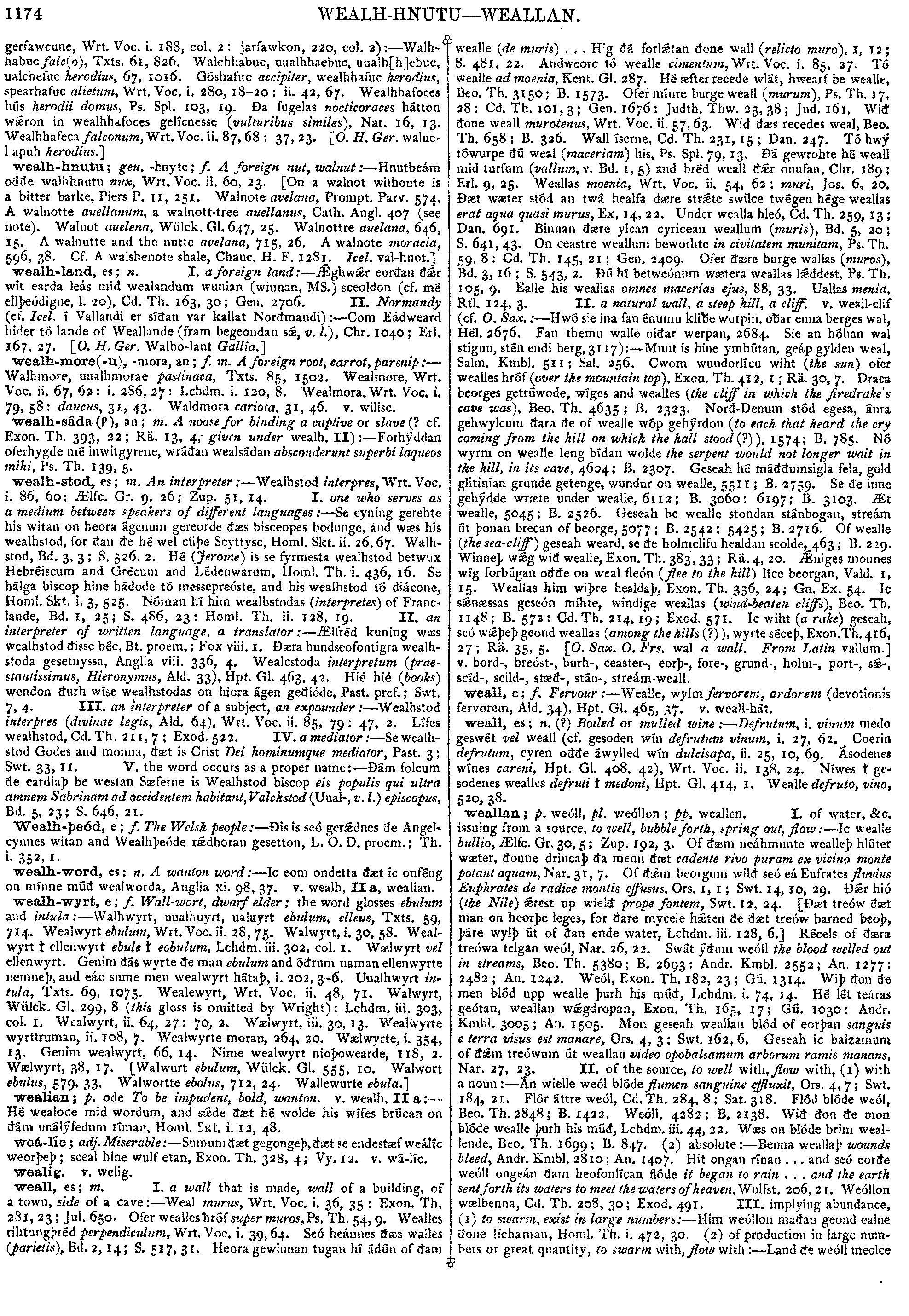
weall,
es;
m.
I.
a
wall
that
is
made,
wall
of
a
building,
of
a
town,
side
of
a
cave:--Weal
murus,
Wrt.
Voc.
i.
36,
35:
Exon.
Th.
281,
23;
Jul.
650.
Ofer
wealles
hróf
super
muros,
Ps.
Th.
54,
9.
Wealles
rihtungþréd
perpendiculum,
Wrt.
Voc.
i.
39,
64.
Seó
heánnes
ðæs
walles
(parietis),
Bd.
2,
14;
S.
517,
31.
Heora
gewinnan
tugan
hí
ádún
of
ðam
wealle
(de
muris)
.
.
.
Hig
ðá
forltan
ðone
wall
(relicto
muro),
1,
12;
S.
481,
22.
Andweorc
tó
wealle
cimentum,
Wrt.
Voc.
i.
85,
27.
Tó
wealle
ad
moenia,
Kent.
Gl.
287.
Hé
æfter
recede
wlát,
hwearf
be
wealle,
Beo.
Th.
3150;
B.
1573.
Ofer
mínre
burge
weall
(murum),
Ps.
Th.
17,
28:
Cd.
Th.
101,
3;
Gen.
1676:
Judth.
Thw.
23,
38;
Jud.
161.
Wið
ðone
weall
murotenus,
Wrt.
Voc.
ii.
57,
63.
Wið
ðæs
recedes
weal,
Beo.
Th.
658;
B.
326.
Wall
íserne,
Cd.
Th.
231,
15;
Dan.
247.
Tó
hwý
tówurpe
ðú
weal
(maceriam)
his,
Ps.
Spl.
79,
13.
Ðá
gewrohte
hé
weall
mid
turfum
(vallum,
v.
Bd.
1,
5)
and
bréd
weall
ðr
onufan,
Chr.
189;
Erl.
9,
25.
Weallas
moenia,
Wrt.
Voc.
ii.
54,
62:
muri,
Jos.
6,
20.
Ðæt
wæter
stód
an
twá
healfa
ðære
strte
swilce
twégen
hége
weallas
erat
aqua
quasi
murus,
Ex.
14,
22.
Under
wealla
hleó,
Cd.
Th.
259,
13;
Dan.
691.
Binnan
ðære
ylcan
cyricean
weallum
(muris),
Bd.
5,
20;
S.
641,
43.
On
ceastre
weallum
beworhte
in
civitatem
munitam,
Ps.
Th.
59,
8:
Cd.
Th.
145,
21;
Gen.
2409.
Ofer
ðære
burge
wallas
(muros),
Bd.
3,
16;
S.
543,
2.
Ðú
hí
betweónum
wætera
weallas
lddest,
Ps.
Th.
105,
9.
Ealle
his
weallas
omnes
macerias
ejus,
88,
33.
Uallas
menia,
Rtl.
124,
3.
II.
a
natural
wall,
a
steep
hill,
a
cliff.
v.
weall-clif
(cf.
O.
Sax.:--Hwó
sie
ina
fan
énumu
kli e
wurpin,
oar
enna
berges
wal,
Hél.
2676.
Fan
themu
walle
niðar
werpan,
2684.
Sie
an
hóhan
wal
stigun,
stén
endi
berg,
3117):--Munt
is
hine
ymbútan,
geáp
gylden
weal,
Salm.
Kmbl.
511;
Sal.
256.
Cwom
wundorlícu
wiht
(the
sun)
ofer
wealles
hróf
(over
the
mountain
top),
Exon.
Th.
412,
1;
Rä.
30,
7.
Draca
beorges
getrúwode,
wíges
and
wealles
(the
cliff
in
which
the
firedrake's
cave
was),
Beo.
Th.
4635;
B.
2323.
Norð-Denum
stód
egesa,
ánra
gehwylcum
ðara
ðe
of
wealle
wóp
gehýrdon
(to
each
that
heard
the
cry
coming
from
the
hill
on
which
the
hall
stood
(?)),
1574;
B.
785.
Nó
wyrm
on
wealle
leng
bídan
wolde
the
serpent
would
not
longer
wait
in
the
hill,
in
its
cave,
4604;
B.
2307.
Geseah
hé
máððumsigla
fela,
gold
glitinian
grunde
getenge,
wundur
on
wealle,
5511;
B.
2759.
Se
ðe
inne
gehýdde
wræte
under
wealle,
6112;
B.
3060:
6197;
B.
3103.
Æt
wealle,
5045;
B.
2526.
Geseah
be
wealle
stondan
stánbogan,
streám
út
þonan
brecan
of
beorge,
5077;
B.
2542:
5425;
B.
2716.
Of
wealle
(the
sea-cliff)
geseah
weard,
se
ðe
holmclifu
healdan
scolde,
463;
B.
229.
Winneþ
wg
wið
wealle,
Exon.
Th.
383,
33;
Rä.
4,
20.
Æ-acute;niges
monnes
wíg
forbúgan
oððe
on
weal
fleón
(flee
to
the
hill)
líce
beorgan,
Vald.
1,
15.
Weallas
him
wiþre
healdaþ,
Exon.
Th.
336,
24;
Gn.
Ex.
54.
Ic
snæssas
geseón
mihte,
windige
weallas
(wind-beaten
cliffs),
Beo.
Th.
1148;
B.
572:
Cd.
Th.
214,
19;
Exod.
571.
Ic
wiht
(a
rake)
geseah,
seó
wþeþ
geond
weallas
(among
the
hills
(?)),
wyrte
séceþ,
Exon.
Th.
416,
27;
Rä.
35,
5.
[O.
Sax.
O.
Frs.
wal
a
wall.
From
Latin
vallum.]
v.
bord-,
breóst-,
burh-,
ceaster-,
eorþ-,
fore-,
grund-,
holm-,
port-,
s-,
scíd-,
scild-,
stæð-,
stán-,
streám-weall.
e
wurpin,
oar
enna
berges
wal,
Hél.
2676.
Fan
themu
walle
niðar
werpan,
2684.
Sie
an
hóhan
wal
stigun,
stén
endi
berg,
3117):--Munt
is
hine
ymbútan,
geáp
gylden
weal,
Salm.
Kmbl.
511;
Sal.
256.
Cwom
wundorlícu
wiht
(the
sun)
ofer
wealles
hróf
(over
the
mountain
top),
Exon.
Th.
412,
1;
Rä.
30,
7.
Draca
beorges
getrúwode,
wíges
and
wealles
(the
cliff
in
which
the
firedrake's
cave
was),
Beo.
Th.
4635;
B.
2323.
Norð-Denum
stód
egesa,
ánra
gehwylcum
ðara
ðe
of
wealle
wóp
gehýrdon
(to
each
that
heard
the
cry
coming
from
the
hill
on
which
the
hall
stood
(?)),
1574;
B.
785.
Nó
wyrm
on
wealle
leng
bídan
wolde
the
serpent
would
not
longer
wait
in
the
hill,
in
its
cave,
4604;
B.
2307.
Geseah
hé
máððumsigla
fela,
gold
glitinian
grunde
getenge,
wundur
on
wealle,
5511;
B.
2759.
Se
ðe
inne
gehýdde
wræte
under
wealle,
6112;
B.
3060:
6197;
B.
3103.
Æt
wealle,
5045;
B.
2526.
Geseah
be
wealle
stondan
stánbogan,
streám
út
þonan
brecan
of
beorge,
5077;
B.
2542:
5425;
B.
2716.
Of
wealle
(the
sea-cliff)
geseah
weard,
se
ðe
holmclifu
healdan
scolde,
463;
B.
229.
Winneþ
wg
wið
wealle,
Exon.
Th.
383,
33;
Rä.
4,
20.
Æ-acute;niges
monnes
wíg
forbúgan
oððe
on
weal
fleón
(flee
to
the
hill)
líce
beorgan,
Vald.
1,
15.
Weallas
him
wiþre
healdaþ,
Exon.
Th.
336,
24;
Gn.
Ex.
54.
Ic
snæssas
geseón
mihte,
windige
weallas
(wind-beaten
cliffs),
Beo.
Th.
1148;
B.
572:
Cd.
Th.
214,
19;
Exod.
571.
Ic
wiht
(a
rake)
geseah,
seó
wþeþ
geond
weallas
(among
the
hills
(?)),
wyrte
séceþ,
Exon.
Th.
416,
27;
Rä.
35,
5.
[O.
Sax.
O.
Frs.
wal
a
wall.
From
Latin
vallum.]
v.
bord-,
breóst-,
burh-,
ceaster-,
eorþ-,
fore-,
grund-,
holm-,
port-,
s-,
scíd-,
scild-,
stæð-,
stán-,
streám-weall.
|
Source: Bosworth/Toller, page b1176, entry 16 View original page image as: [TIFF] [PNG] [View previous entry] [View next entry] |
[Comment on this entry] [View comments] |
The following entry has been hand-corrected once. |
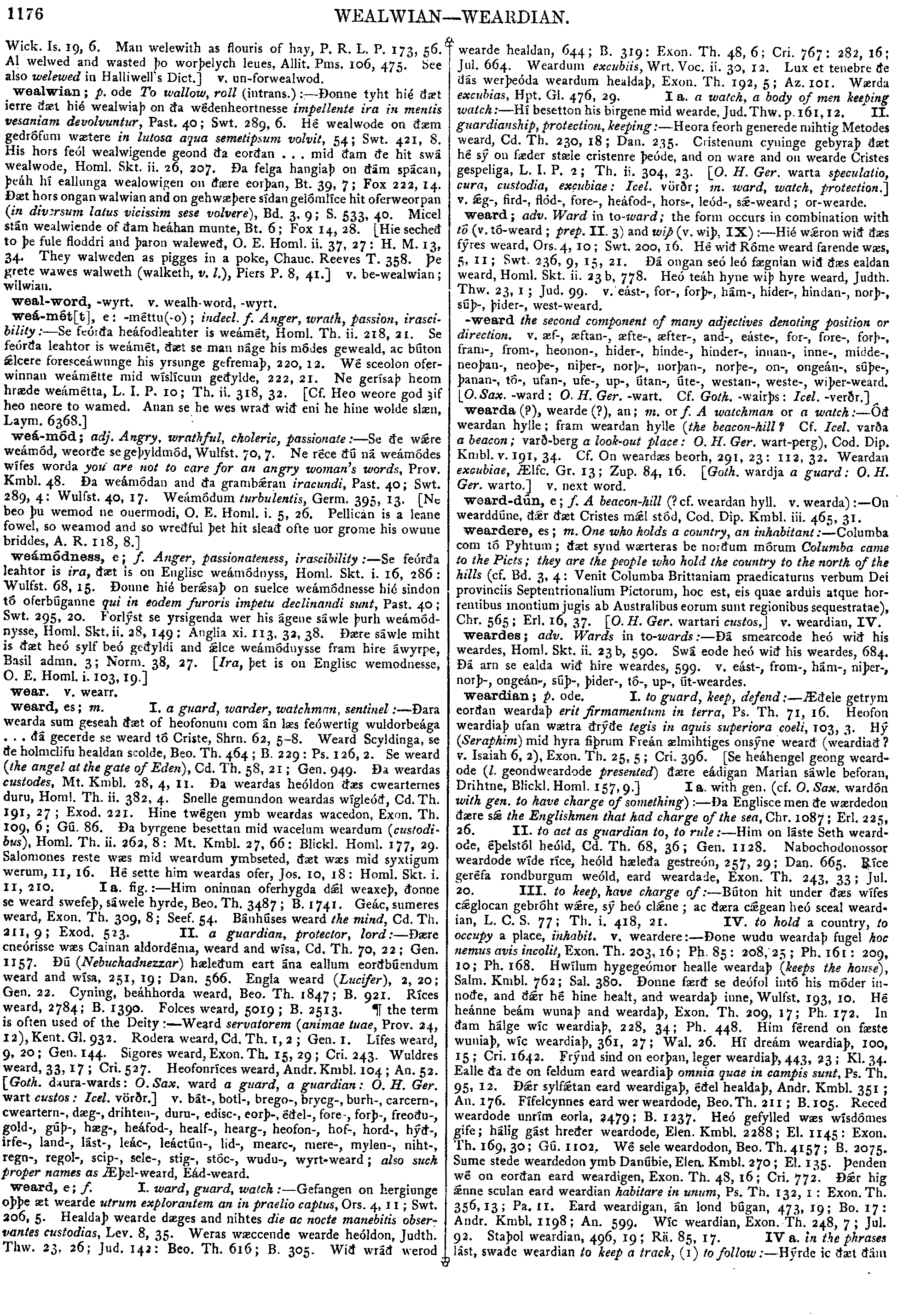
weardian;
p.
ode.
I.
to
guard,
keep,
defend:--Æðele
getrym
eorðan
weardaþ
erit
firmamentum
in
terra,
Ps.
Th.
71,
16.
Heofon
weardiaþ
ufan
wætra
drýðe
tegis
in
aquis
superiora
coeli,
103,
3.
Hý
(Seraphim)
mid
hyra
fiþrum
Freán
ælmihtiges
onsýne
wearð
(weardiað?
v.
Isaiah
6,
2),
Exon.
Th.
25,
5;
Cri.
396.
[Se
heáhengel
geong
weardode
(l.
geondweardode
presented)
ðære
eádigan
Marian
sáwle
beforan,
Drihtne,
Blickl.
Homl.
157,
9.]
I
a.
with
gen.
(cf.
O.
Sax.
wardón
with
gen.
to
have
charge
of
something):--Ða
Englisce
men
ðe
wærdedon
ðære
s
the
Englishmen
that
had
charge
of
the
sea,
Chr.
1087;
Erl.
225,
26.
II.
to
act
as
guardian
to,
to
rule:--Him
on
láste
Seth
weardode,
éþelstól
heóld,
Cd.
Th.
68,
36;
Gen.
1128.
Nabochodonossor
weardode
wíde
ríce,
heóld
hæleða
gestreón,
257,
29;
Dan.
665.
Ríce
geréfa
rondburgum
weóld,
eard
weardade,
Exon.
Th.
243,
33;
Jul.
20.
III.
to
keep,
have
charge
of:--Búton
hit
under
ðæs
wífes
cglocan
gebróht
wre,
sý
heó
clne;
ac
ðæra
cgean
heó
sceal
weardian,
L.
C.
S.
77;
Th.
i.
418,
21.
IV.
to
hold
a
country,
to
occupy
a
place,
inhabit.
v.
weardere:--Ðone
wudu
weardaþ
fugel
hoc
nemus
avis
incolit,
Exon.
Th.
203,
16;
Ph.
85:
208,
25;
Ph.
161:
209,
10;
Ph.
168.
Hwílum
hygegeómor
healle
weardaþ
(keeps
the
house),
Salm.
Kmbl.
762;
Sal.
380.
Ðonne
færð
se
deófol
intó
his
móder
innoðe,
and
ðr
hé
hine
healt,
and
weardaþ
inne,
Wulfst.
193,
10.
Hé
heánne
beám
wunaþ
and
weardaþ,
Exon.
Th.
209,
17;
Ph.
172.
In
ðam
hálge
wíc
weardiaþ,
228,
34;
Ph.
448.
Him
férend
on
fæste
wuniaþ,
wíc
weardiaþ,
361,
27;
Wal.
26.
Hí
dreám
weardiaþ,
100,
15;
Cri.
1642.
Frýnd
sind
on
eorþan,
leger
weardiaþ,
443,
23;
Kl.
34.
Ealle
ða
ðe
on
feldum
eard
weardiaþ
omnia
quae
in
campis
sunt,
Ps.
Th.
95,
12.
Ðr
sylftan
eard
weardigaþ,
éðel
healdaþ,
Andr.
Kmbl.
351;
An.
176.
Fífelcynnes
eard
wer
weardode,
Beo.
Th.
211;
B.
105.
Reced
weardode
unrím
eorla,
2479;
B.
1237.
Heó
gefylled
wæs
wísdómes
gife;
hálig
gást
hreðer
weardode,
Elen.
Kmbl.
2288;
El.
1145:
Exon.
Th.
169,
30;
Gú.
1102.
Wé
sele
weardodon,
Beo.
Th.
4157;
B.
2075.
Sume
stede
weardedon
ymb
Danúbie,
Elen.
Kmbl.
270;
El.
135.
Þenden
wé
on
eorðan
eard
weardigen,
Exon.
Th.
48,
16;
Cri.
772.
Ðr
hig
nne
sculan
eard
weardian
habitare
in
unum,
Ps.
Th.
132,
1:
Exon.
Th.
356.
13;
Pa.
11.
Eard
weardigan,
án
lond
búgan,
473,
19;
Bo.
17:
Andr.
Kmbl.
1198;
An.
599.
Wíc
weardian,
Exon.
Th.
248,
7;
Jul.
92.
Staþol
weardian,
496,
19;
Rä.
85,
17.
IV
a.
in
the
phrases
lást,
swaðe
weardian
to
keep
a
track,
(1)
to
follow:--Hýrde
ic
ðæt
ðám
|
Source: Bosworth/Toller, page b1180, entry 20 View original page image as: [TIFF] [PNG] [View previous entry] [View next entry] |
[Comment on this entry] [View comments] |
The following entry has been hand-corrected once. |
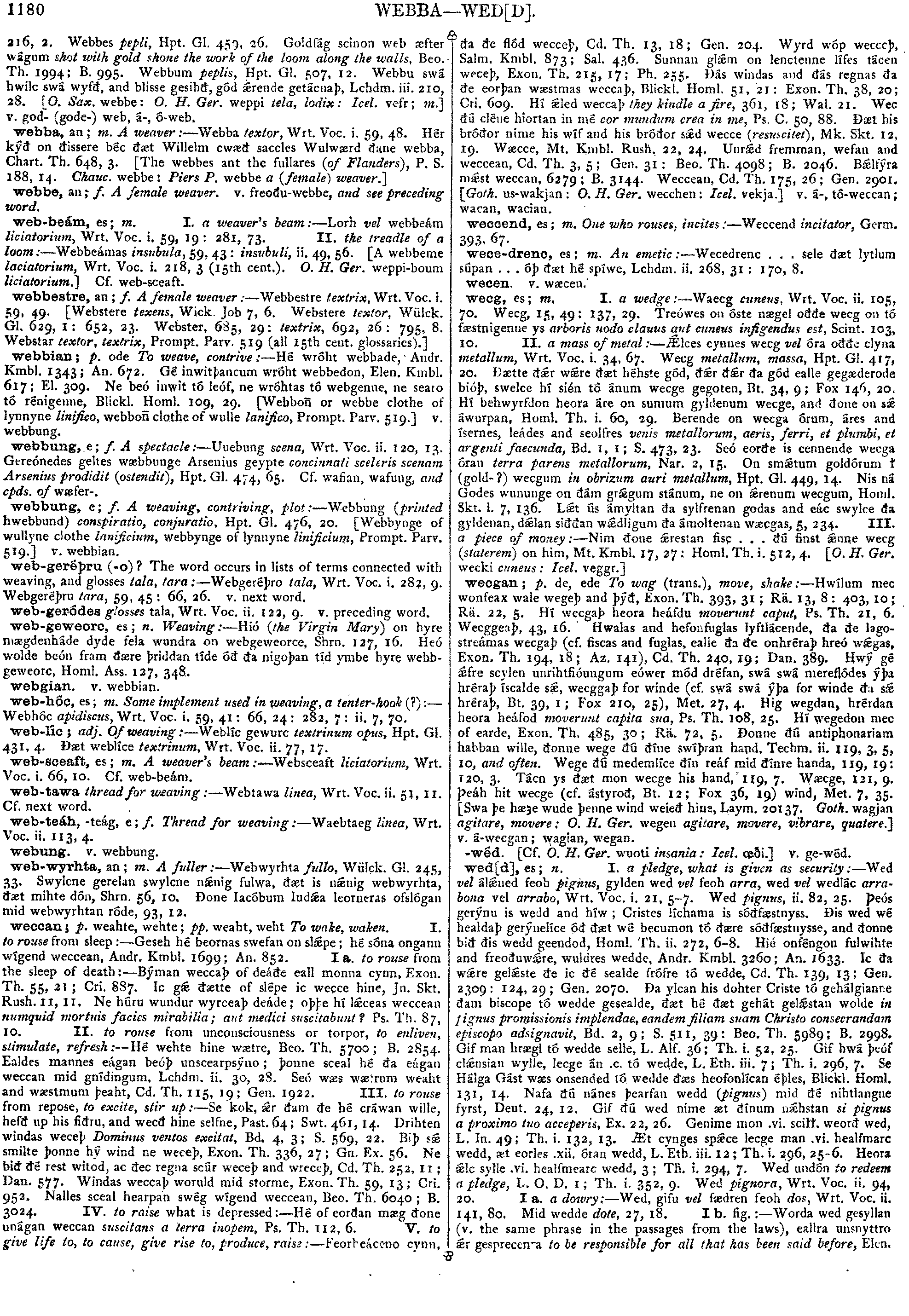
weccan;
p.
weahte,
wehte;
pp.
weaht,
weht
To
wake,
waken.
I.
to
rouse
from
sleep:--Geseh
hé
beornas
swefan
on
slpe;
hé
sóna
ongann
wígend
weccean,
Andr.
Kmbl.
1699;
An.
852.
I
a.
to
rouse
from
the
sleep
of
death:--Býman
weccaþ
of
deáðe
eall
monna
cynn,
Exon.
Th.
55,
21;
Cri.
887.
Ic
g
ðætte
of
slépe
ic
wecce
hine,
Jn.
Skt.
Rush.
11,
11.
Ne
húru
wundur
wyrceaþ
deáde;
oþþe
hí
lceas
weccean
numquid
mortuis
facies
mirabilia;
aut
medici
suscitabunt?
Ps.
Th.
87,
10.
II.
to
rouse
from
unconsciousness
or
torpor,
to
enliven,
stimulate,
refresh:--Hé
wehte
hine
wætre,
Beo.
Th.
5700;
B.
2854.
Ealdes
mannes
eágan
beóþ
unscearpsýno;
þonne
sceal
hé
ða
eágan
wecean
mid
gnídingum,
Lchdm.
ii.
30,
28.
Seó
wæs
wætrum
weaht
and
wæstmum
þeaht,
Cd.
Th.
115,
19;
Gen.
1922.
III.
to
rouse
from
repose,
to
excite,
stir
up:--Se
kok,
r
ðam
ðe
hé
cráwan
wille,
hefð
up
his
fiðru,
and
wecð
hine
selfne,
Past.
64;
Swt.
461,
14.
Drihten
windas
weceþ
Dominus
ventos
excitat,
Bd.
4,
3;
S.
569,
22.
Biþ
s
smilte
þonne
hý
wind
ne
weceþ,
Exon.
Th.
336,
27;
Gn.
Ex.
56.
Ne
bið
ðé
rest
witod,
ac
ðec
regna
scúr
weceþ
and
wreceþ,
Cd.
Th.
252,
11;
Dan.
577.
Windas
weccaþ
woruld
mid
storme,
Exon.
Th.
59,
13;
Cri.
952.
Nalles
sceal
hearpan
swég
wígend
weccean,
Beo.
Th.
6040;
B.
3024.
IV.
to
raise
what
is
depressed:--Hé
of
eorðan
mæg
ðone
unágan
weccan
suscitans
a
terra
inopem,
Ps.
Th.
112,
6.
V.
to
give
life
to,
to
cause,
give
rise
to,
produce,
raise:--Feorbeáceno
cynn,
ða
ðe
flód
wecceþ,
Cd.
Th.
13,
18;
Gen.
204.
Wyrd
wóp
wecccþ,
Salm.
Kmbl.
873;
Sal.
436.
Sunnan
glm
on
lenctenne
lífes
tácen
weceþ,
Exon.
Th.
215,
17;
Ph.
255.
Ðás
windas
and
ðás
regnas
ða
ðe
eorþan
wæstmas
weccaþ,
Blickl.
Homl.
51,
21:
Exon.
Th.
38,
20;
Cri.
609.
Hí
led
weccaþ
they
kindle
a
fire,
361,
18;
Wal.
21.
Wec
ðú
cléne
hiortan
in
mé
cor
mundum
crea
in
me,
Ps.
C.
50,
88.
Ðæt
his
bróðor
nime
his
wíf
and
his
bróðor
sd
wecce
(resuscitet),
Mk.
Skt.
12,
19.
Wæcce,
Mt.
Kmbl.
Rush.
22,
24.
Unrd
fremman,
wefan
and
weccean,
Cd.
Th.
3,
5;
Gen.
31:
Beo.
Th.
4098;
B.
2046.
Blfýra
mst
weccan,
6279;
B.
3144.
Weccean,
Cd.
Th.
175,
26;
Gen.
2901.
[Goth.
us-wakjan:
O.
H.
Ger.
wecchen:
Icel.
vekja.]
v.
á-,
tó-weccan;
wacan,
wacian.
|
Source: Bosworth/Toller, page b1185, entry 13 View original page image as: [TIFF] [PNG] [View previous entry] [View next entry] |
[Comment on this entry] [View comments] |
The following entry has been hand-corrected once. |
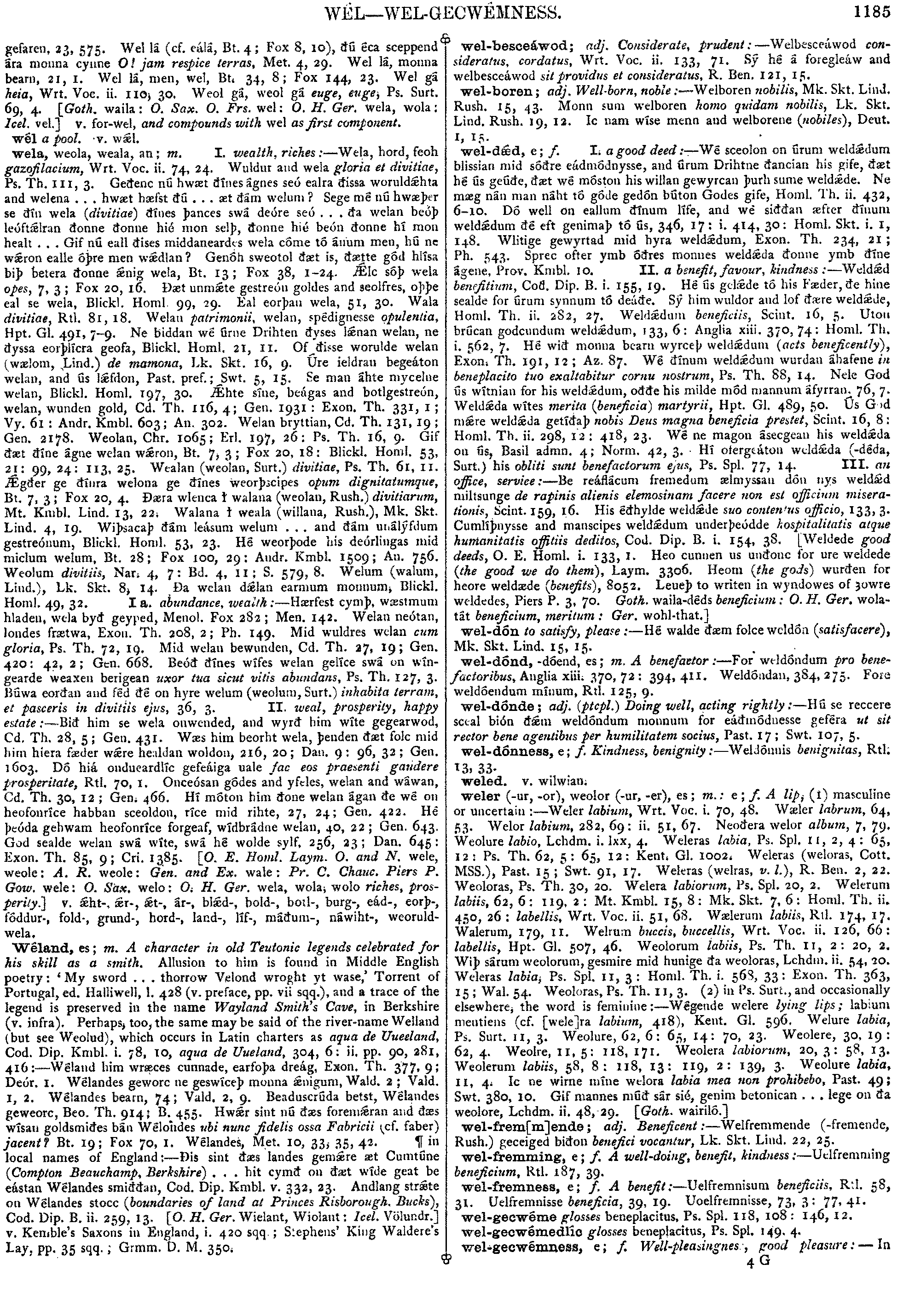
weler (-ur, -or), weolor (-ur, -er), es; m.: e; f. A lip, (1) masculine or uncertain:--Weler labium, Wrt. Voc. i. 70, 48. Wæler labrum, 64, 53. Welor labium, 282, 69: ii. 51, 67. Neoðera welor album, 7, 79. Weolure labio, Lchdm. i. lxx, 4. Weleras labia, Ps. Spl. 11, 2, 4: 65, 12: Ps. Th. 62, 5: 65, 12: Kent. Gl. 1002. Weleras (weloras, Cott. MSS.), Past. 15; Swt. 91, 17. Weleras (welras, v. l.), R. Ben. 2, 22. Weoloras, Ps. Th. 30, 20. Welera labiorum, Ps. Spl. 20, 2. Welerum labiis, 62, 6: 119, 2: Mt. Kmbl. 15, 8: Mk. Skt. 7, 6: Homl. Th. ii. 450, 26: labellis, Wrt. Voc. ii. 51, 68. Wælerum labiis, Rtl. 174, 17. Walerum, 179, 11. Welrum buccis, buccellis, Wrt. Voc. ii. 126, 66: labellis, Hpt. Gl. 507, 46. Weolorum labiis, Ps. Th. 11, 2: 20, 2. Wiþ sárum weolorum, gesmire mid hunige ða weoloras, Lchdm. ii. 54, 20. Weleras labia, Ps. Spl. 11, 3: Homl. Th. i. 568, 33: Exon. Th. 363, 15; Wal. 54. Weoloras, Ps. Th. 11, 3. (2) in Ps. Surt., and occasionally elsewhere, the word is feminine:--Wégende welere lying lips; labium mentiens (cf. [wele]ra labium, 418), Kent. Gl. 596. Welure labia, Ps. Surt. 11, 3. Weolure, 62, 6: 65, 14: 70, 23. Weolere, 30, 19: 62, 4. Weolre, 11, 5: 118, 171. Weolera labiorum, 20, 3: 58, 13. Weolerum labiis, 58, 8: 118, 13: 119, 2: 139, 3. Weolure labia, 11, 4. Ic ne wirne míne welora labia mea non prohibebo, Past. 49; Swt. 380, 10. Gif mannes múð sár sié, genim betonican . . . lege on ða weolore, Lchdm. ii. 48, 29. [Goth. wairiló.]
|
Source: Bosworth/Toller, page b1187, entry 4 View original page image as: [TIFF] [PNG] [View previous entry] [View next entry] |
[Comment on this entry] [View comments] |
The following entry has been hand-corrected once. |
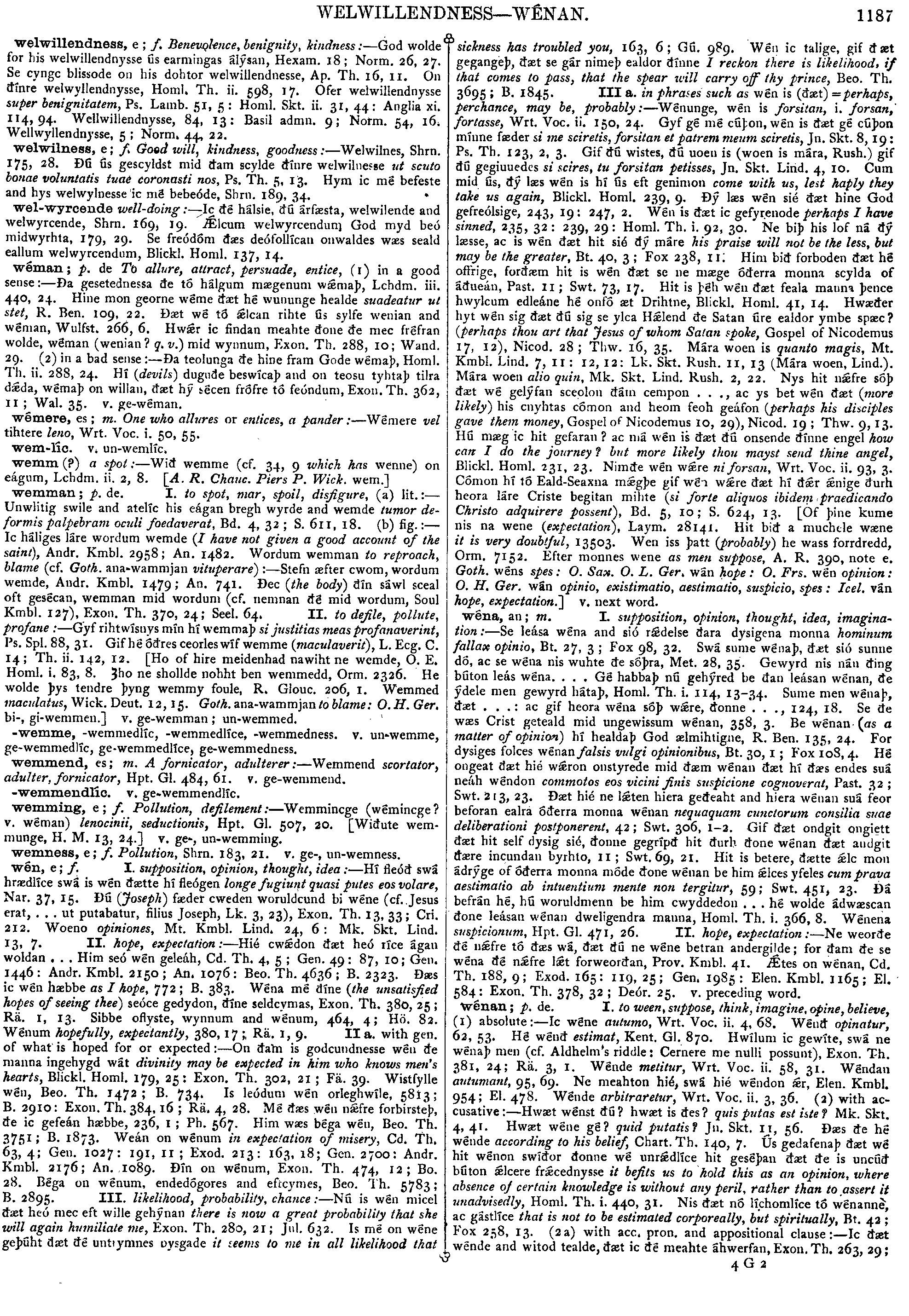
wéman;
p.
de
To
allure,
attract,
persuade,
entice,
(1)
in
a
good
sense:--Ða
gesetednessa
ðe
tó
hálgum
mægenum
wmaþ,
Lchdm.
iii.
440,
24.
Hine
mon
georne
wéme
ðæt
hé
wununge
healde
suadeatur
ut
stet,
R.
Ben.
109,
22.
Ðæt
wé
tó
lcan
rihte
ús
sylfe
wenian
and
wéman,
Wulfst.
266,
6.
Hwr
ic
findan
meahte
ðone
ðe
mec
fréfran
wolde,
wéman
(wenian?
q.
v.)
mid
wynnum,
Exon.
Th.
288,
10;
Wand.
29.
(2)
in
a
bad
sense:--Ða
teolunga
ðe
hine
fram
Gode
wémaþ,
Homl.
Th.
ii.
288,
24.
Hí
(devils)
duguðe
beswícaþ
and
on
teosu
tyhtaþ
tilra
dda,
wémaþ
on
willan,
ðæt
hý
sécen
frófre
tó
feóndum,
Exon.
Th.
362,
11;
Wal.
35.
v.
ge-wéman.
| Result Page: |  |
Previous | 3 4 5 6 7 8 9 10 11 12 13 14 15 16 17 | Next |  |
Germanic Lexicon Project (main page)
This search system was written by
Sean Crist
Please consider
volunteering
to correct the data in these online dictionaries.
No rights reserved. Feel free to use these data in any way you please.