|
|

Tip: In the search results, you can click on any word or abbreviation for more information.
|
Source: Bosworth/Toller, page d0339, entry 9 View original page image as: [TIFF] [PNG] [View previous entry] [View next entry] |
[Comment on this entry] [View comments] |
The following entry has been hand-corrected once. |
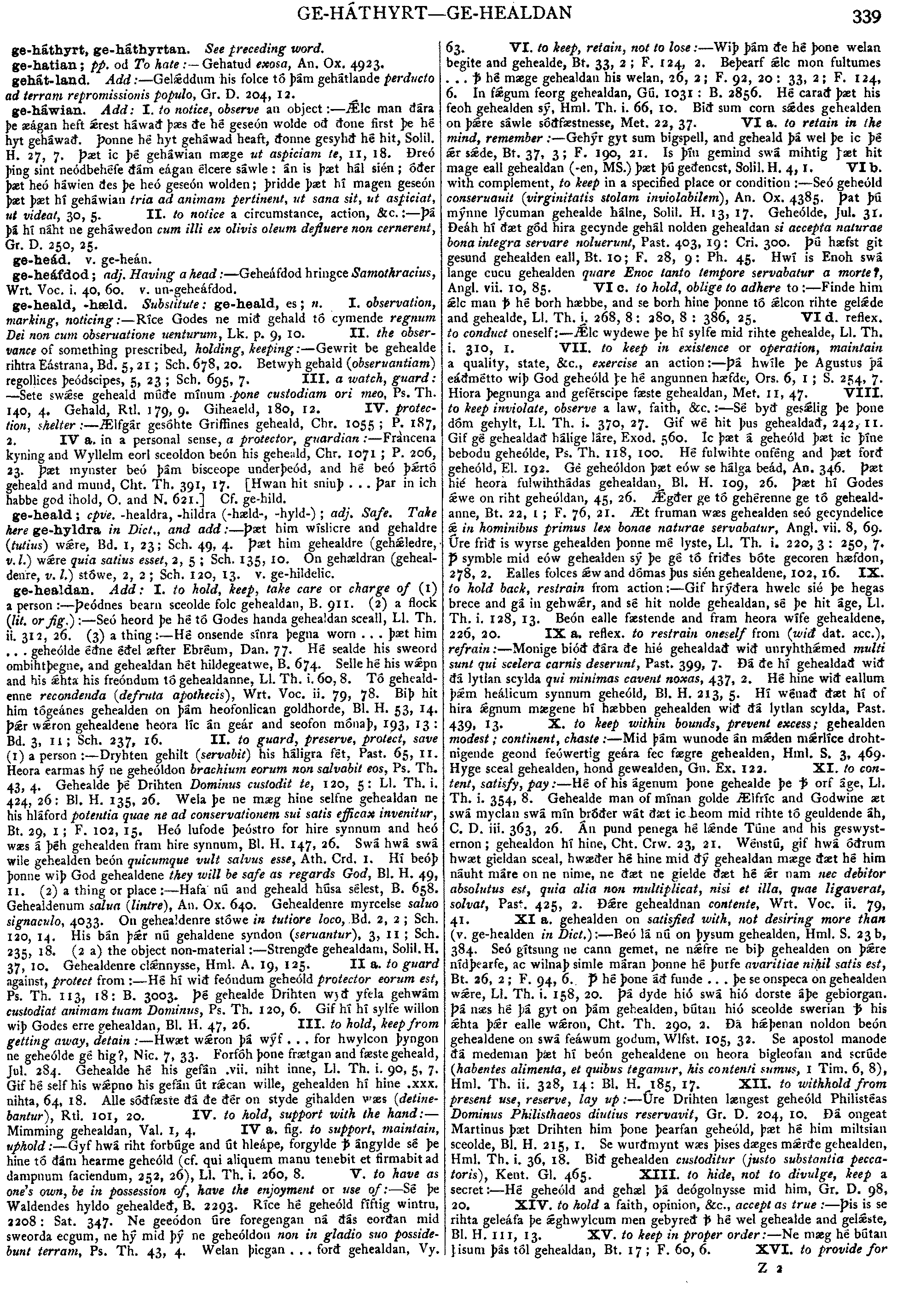
ge-healdan.
Add:
I.
to
hold,
keep,
take
care
or
charge
of
(1)
a
person:--Þeódnes
bearn
sceolde
folc
gehealdan,
B.
911.
(2)
a
flock
(lit.
or
fig.):--Seó
heord
þe
hé
tó
Godes
handa
gehealdan
sceall,
Ll.
Th.
ii.
312,
26.
(3)
a
thing:--Hé
onsende
sínra
þegna
worn
.
.
.
þæt
him
.
.
.
geheólde
éðne
éðel
æfter
Ebréum,
Dan.
77.
Hé
sealde
his
sweord
ombihtþegne,
and
gehealdan
hét
hildegeatwe,
B.
674.
Selle
hé
his
w pn
and
his
hta
his
freóndum
tó
gehealdanne,
Ll.
Th.
i.
60,
8.
Tó
gehealdenne
recondenda
(defruta
apothecis),
Wrt.
Voc.
ii.
79,
78.
Biþ
hit
him
tógeánes
gehealden
on
þám
heofonlican
goldhorde,
Bl.
H.
53,
14.
Þr
wron
gehealdene
heora
líc
án
geár
and
seofon
mónaþ,
193,
13:
Bd.
3,
11;
Sch.
237,
16.
II.
to
guard,
preserve,
protect,
save
(1)
a
person:--Dryhten
gehilt
(servabit)
his
háligra
fét,
Past.
65,
11.
Heora
earmas
hý
ne
geheóldon
brachium
eorum
non
salvabit
eos,
Ps.
Th.
43,
4.
Gehealde
þé
Drihten
Dominus
custodit
te,
120,
5:
Ll.
Th.
i.
424,
26:
Bl.
H.
135,
26.
Wela
þe
ne
mæg
hine
selfne
gehealdan
ne
his
hláford
potentia
quae
ne
ad
conservationem
sui
satis
efficax
invenitur,
Bt.
29,
1;
F.
102,
15.
Heó
lufode
þeóstro
for
hire
synnum
and
heó
wæs
á
þéh
gehealden
fram
hire
synnum,
Bl.
H.
147,
26.
Swá
hwá
swá
wile
gehealden
beón
quicumque
vult
salvus
esse,
Ath.
Crd.
1.
Hí
beóþ
þonne
wiþ
God
gehealdene
they
will
be
safe
as
regards
God,
Bl.
H.
49,
11.
(2)
a
thing
or
place:--Hafa
nú
and
geheald
húsa
sélest,
B.
658.
Gehealdenum
salua
(lintre),
An.
Ox.
640.
Gehealdenre
myrcelse
saluo
signaculo,
4033.
On
gehealdenre
stówe
in
tutiore
loco,
Bd.
2,
2;
Sch.
120,
14.
His
bán
þr
nú
gehaldene
syndon
(seruantur),
3,
11;
Sch.
235,
18.
(2
a)
the
object
non-material:--Strengðe
gehealdam,
Solil.
H.
37,
10.
Gehealdenre
clnnysse,
Hml.
A.
19,
125.
II
a.
to
guard
against,
protect
from:--Hé
hí
wið
feóndum
geheóld
protector
eorum
est,
Ps.
Th.
113,
18:
B.
3003.
Þé
gehealde
Drihten
wyð
yfela
gehwám
custodiat
animam
tuam
Dominus,
Ps.
Th.
120,
6.
Gif
hí
hí
sylfe
willon
wiþ
Godes
erre
gehealdan,
Bl.
H.
47,
26.
III.
to
hold,
keep
from
getting
away,
detain:--Hwæt
wron
þá
wýf
.
.
.
for
hwylcon
þyngon
ne
geheólde
gé
hig?,
Nic.
7,
33.
Forfóh
þone
frætgan
and
fæste
geheald,
Jul.
284.
Gehealde
hé
his
gefán
.vii.
niht
inne,
Ll.
Th.
i.
90,
5,
7.
Gif
hé
self
his
wpno
his
gefán
út
rcan
wille,
gehealden
hí
hine
.xxx.
nihta,
64,
18.
Alle
sóðfæste
ðá
ðe
ðér
on
styde
gihalden
wæs
(detinebantur),
Rtl.
101,
20.
IV.
to
hold,
support
with
the
hand:--Mimming
gehealdan,
Val.
1,
4.
IV
a.
fig.
to
support,
maintain,
uphold:--Gyf
hwá
riht
forbúge
and
út
hleápe,
forgylde
pn
and
his
hta
his
freóndum
tó
gehealdanne,
Ll.
Th.
i.
60,
8.
Tó
gehealdenne
recondenda
(defruta
apothecis),
Wrt.
Voc.
ii.
79,
78.
Biþ
hit
him
tógeánes
gehealden
on
þám
heofonlican
goldhorde,
Bl.
H.
53,
14.
Þr
wron
gehealdene
heora
líc
án
geár
and
seofon
mónaþ,
193,
13:
Bd.
3,
11;
Sch.
237,
16.
II.
to
guard,
preserve,
protect,
save
(1)
a
person:--Dryhten
gehilt
(servabit)
his
háligra
fét,
Past.
65,
11.
Heora
earmas
hý
ne
geheóldon
brachium
eorum
non
salvabit
eos,
Ps.
Th.
43,
4.
Gehealde
þé
Drihten
Dominus
custodit
te,
120,
5:
Ll.
Th.
i.
424,
26:
Bl.
H.
135,
26.
Wela
þe
ne
mæg
hine
selfne
gehealdan
ne
his
hláford
potentia
quae
ne
ad
conservationem
sui
satis
efficax
invenitur,
Bt.
29,
1;
F.
102,
15.
Heó
lufode
þeóstro
for
hire
synnum
and
heó
wæs
á
þéh
gehealden
fram
hire
synnum,
Bl.
H.
147,
26.
Swá
hwá
swá
wile
gehealden
beón
quicumque
vult
salvus
esse,
Ath.
Crd.
1.
Hí
beóþ
þonne
wiþ
God
gehealdene
they
will
be
safe
as
regards
God,
Bl.
H.
49,
11.
(2)
a
thing
or
place:--Hafa
nú
and
geheald
húsa
sélest,
B.
658.
Gehealdenum
salua
(lintre),
An.
Ox.
640.
Gehealdenre
myrcelse
saluo
signaculo,
4033.
On
gehealdenre
stówe
in
tutiore
loco,
Bd.
2,
2;
Sch.
120,
14.
His
bán
þr
nú
gehaldene
syndon
(seruantur),
3,
11;
Sch.
235,
18.
(2
a)
the
object
non-material:--Strengðe
gehealdam,
Solil.
H.
37,
10.
Gehealdenre
clnnysse,
Hml.
A.
19,
125.
II
a.
to
guard
against,
protect
from:--Hé
hí
wið
feóndum
geheóld
protector
eorum
est,
Ps.
Th.
113,
18:
B.
3003.
Þé
gehealde
Drihten
wyð
yfela
gehwám
custodiat
animam
tuam
Dominus,
Ps.
Th.
120,
6.
Gif
hí
hí
sylfe
willon
wiþ
Godes
erre
gehealdan,
Bl.
H.
47,
26.
III.
to
hold,
keep
from
getting
away,
detain:--Hwæt
wron
þá
wýf
.
.
.
for
hwylcon
þyngon
ne
geheólde
gé
hig?,
Nic.
7,
33.
Forfóh
þone
frætgan
and
fæste
geheald,
Jul.
284.
Gehealde
hé
his
gefán
.vii.
niht
inne,
Ll.
Th.
i.
90,
5,
7.
Gif
hé
self
his
wpno
his
gefán
út
rcan
wille,
gehealden
hí
hine
.xxx.
nihta,
64,
18.
Alle
sóðfæste
ðá
ðe
ðér
on
styde
gihalden
wæs
(detinebantur),
Rtl.
101,
20.
IV.
to
hold,
support
with
the
hand:--Mimming
gehealdan,
Val.
1,
4.
IV
a.
fig.
to
support,
maintain,
uphold:--Gyf
hwá
riht
forbúge
and
út
hleápe,
forgylde
 ángylde
sé
þe
hine
tó
ðám
hearme
geheóld
(cf.
qui
aliquem
manu
tenebit
et
firmabit
ad
dampnum
faciendum,
252,
26),
Ll.
Th.
i.
260,
8.
V.
to
have
as
one's
own,
be
in
possession
of,
have
the
enjoyment
or
use
of:--Sé
þe
Waldendes
hyldo
gehealdeð,
B.
2293.
Ríce
hé
geheóld
fíftig
wintru,
2208:
Sat.
347.
Ne
geeódon
úre
foregengan
ná
ðás
eorðan
mid
sweorda
ecgum,
ne
hý
mid
þý
ne
geheóldon
non
in
gladio
suo
possidebunt
terram,
Ps.
Th.
43,
4.
Welan
þicgan
.
.
.
forð
gehealdan,
Vy.
63.
VI.
to
keep,
retain,
not
to
lose:--Wiþ
þám
ðe
hé
þone
welan
begite
and
gehealde,
Bt.
33,
2;
F.
124,
2.
Beþearf
lc
mon
fultumes
.
.
.
hé
mæge
gehealdan
his
welan,
26,
2;
F.
92,
20:
33,
2;
F.
124,
6.
In
fgum
feorg
gehealdan,
Gú.
1031:
B.
2856.
Hé
carað
þæt
his
feoh
gehealden
sý,
Hml.
Th.
i.
66,
10.
Bið
sum
corn
sdes
gehealden
on
þre
sáwle
sóðfæstnesse,
Met.
22,
37.
VI
a.
to
retain
in
the
mind,
remember:--Gehýr
gyt
sum
bigspell,
and
geheald
þá
wel
þe
ic
þé
r
sde,
Bt.
37,
3;
F.
190,
21.
Is
þín
gemind
swá
mihtig
þæt
hit
mage
eall
gehealdan
(-en,
MS.)
þæt
þú
geðencst,
Solil.
H.
4,
1.
VI
b.
with
complement,
to
keep
in
a
specified
place
or
condition:--Seó
geheóld
conseruauit
(virginitatis
stolam
inviolabilem),
An.
Ox.
4385.
Þat
þú
mýnne
lýcuman
gehealde
hálne,
Solil.
H.
13,
17.
Geheólde,
Jul.
31.
Ðeáh
hí
ðæt
gód
hira
gecynde
gehál
nolden
gehealdan
si
accepta
naturae
bona
integra
servare
noluerunt,
Past.
403,
19:
Cri.
300.
Þú
hæfst
git
gesund
gehealden
eall,
Bt.
10;
F.
28,
9:
Ph.
45.
Hwí
is
Enoh
swá
lange
cucu
gehealden
quare
Enoc
tanto
tempore
servabatur
a
morte?,
Angl.
vii.
10,
85.
VI
c.
to
hold,
oblige
to
adhere
to:--Finde
him
lc
man
hé
borh
hæbbe,
and
se
borh
hine
þonne
tó
lcon
rihte
gelde
and
gehealde,
Ll.
Th.
i.
268,
8:
280,
8:
386,
25.
VI
d.
reflex.
to
conduct
oneself:--Æ-acute;lc
wydewe
þe
hí
sylfe
mid
rihte
gehealde,
Ll.
Th.
i.
310,
1.
VII.
to
keep
in
existence
or
operation,
maintain
a
quality,
state,
&c.,
exercise
an
action:--Þá
hwíle
þe
Agustus
þá
eáðmétto
wiþ
God
geheóld
þe
hé
angunnen
hæfde,
Ors.
6,
1;
S.
254,
7.
Hiora
þegnunga
and
geférscipe
fæste
gehealdan,
Met.
11,
47.
VIII.
to
keep
inviolate,
observe
a
law,
faith,
&c.:--Sé
byð
geslig
þe
þone
dóm
gehylt,
Ll.
Th.
i.
370,
27.
Gif
wé
hit
þus
gehealdað,
242,
11.
Gif
gé
gehealdað
hálige
láre,
Exod.
560.
Ic
þæt
á
geheóld
þæt
ic
þíne
bebodu
geheólde,
Ps.
Th.
118,
100.
Hé
fulwihte
onféng
and
þæt
forð
geheóld,
El.
192.
Gé
geheóldon
þæt
eów
se
hálga
beád,
An.
346.
Þæt
hié
heora
fulwihthádas
gehealdan,
Bl.
H.
109,
26.
Þæt
hí
Godes
we
on
riht
geheóldan,
45,
26.
Æ-acute;gðer
ge
tó
gehérenne
ge
tó
gehealdanne,
Bt.
22,
1;
F.
76,
21.
Æt
fruman
wæs
gehealden
seó
gecyndelice
in
hominibus
primus
lex
bonae
naturae
servabatur,
Angl.
vii.
8,
69.
Úre
frið
is
wyrse
gehealden
þonne
mé
lyste,
Ll.
Th.
i.
220,
3:
250,
7.
Þ-bar;
symble
mid
eów
gehealden
sý
þe
gé
tó
friðes
bóte
gecoren
hæfdon,
278,
2.
Ealles
folces
w
and
dómas
þus
sién
gehealdene,
102,
16.
IX.
to
hold
back,
restrain
from
action:--Gif
hrýðera
hwelc
sié
þe
hegas
brece
and
gá
in
gehwr,
and
sé
hit
nolde
gehealdan,
sé
þe
hit
áge,
Ll.
Th.
i.
128,
13.
Beón
ealle
fæstende
and
fram
heora
wífe
gehealdene,
226,
20.
IX
a.
reflex.
to
restrain
oneself
from
(wið
dat.
acc.),
refrain:--Monige
bióð
ðára
ðe
hié
gehealdað
wið
unryhthmed
multi
sunt
qui
scelera
carnis
deserunt,
Past.
399,
7.
Ðá
ðe
hí
gehealdað
wið
ðá
lytlan
scylda
qui
minimas
cavent
noxas,
437,
2.
Hé
hine
wið
eallum
þm
heálicum
synnum
geheóld,
Bl.
H.
213,
5.
Hí
wénað
ðæt
hí
of
hira
gnum
mægene
hí
hæbben
gehealden
wið
ðá
lytlan
scylda.
Past.
439,
13.
X.
to
keep
within
bounds,
prevent
excess;
gehealden
modest;
continent,
chaste:--Mid
þám
wunode
án
mden
mrlíce
drohtnigende
geond
feówertig
geára
fec
fægre
gehealden,
Hml.
S.
3,
469.
Hyge
sceal
gehealden,
hond
gewealden,
Gn.
Ex.
122.
XI.
to
content,
satisfy,
pay:--Hé
of
his
ágenum
þone
gehealde
þe
orf
áge,
Ll.
Th.
i.
354,
8.
Gehealde
man
of
mínan
golde
Ælfríc
and
Godwine
æt
swá
myclan
swá
mín
bróðer
wát
ðæt
ic
heom
mid
rihte
tó
geuldende
áh,
C.
D.
iii.
363,
26.
Án
pund
penega
hé
lnde
Túne
and
his
geswysternon;
gehealdon
hí
hine,
Cht.
Crw.
23,
21.
Wénstú,
gif
hwá
óðrum
hwæt
gieldan
sceal,
hwæðer
hé
hine
mid
ðý
gehealdan
mæge
ðæt
hé
him
náuht
máre
on
ne
nime,
ne
ðæt
ne
gielde
ðæt
hé
r
nam
nec
debitor
absolutus
est,
quia
alia
non
multiplicat,
nisi
et
illa,
quae
ligaverat,
solvat,
Past.
425,
2.
Ðre
gehealdnan
contente,
Wrt.
Voc.
ii.
79,
41.
XI
a.
gehealden
on
satisfied
with,
not
desiring
more
than
(v.
ge-healden
in
Dict.):--Beó
lá
nú
on
þysum
gehealden,
Hml.
S.
23b,
384.
Seó
gítsung
ne
cann
gemet,
ne
nfre
ne
biþ
gehealden
on
þre
nídþearfe,
ac
wilnaþ
simle
máran
þonne
hé
þurfe
avaritiae
nihil
satis
est,
Bt.
26,
2;
F.
94,
6.
Þ-bar;
hé
þone
áð
funde
.
.
.
þe
se
onspeca
on
gehealden
wre,
Ll.
Th.
i.
158,
20.
Þá
dyde
hió
swá
hió
dorste
áþe
gebiorgan.
Þá
næs
hé
þá
gyt
on
þám
gehealden,
bútan
hió
sceolde
swerian
his
hta
þr
ealle
wron,
Cht.
Th.
290,
2.
Ðá
hþenan
noldon
beón
gehealdene
on
swá
feáwum
godum,
Wlfst.
105,
32.
Se
apostol
manode
ðá
medeman
þæt
hí
beón
gehealdene
on
heora
bigleofan
and
scúde
(habentes
alimenta,
et
quibus
tegamur,
his
contenti
sumus,
1
Tim.
6,
8),
Hml.
Th.
ii.
328,
14:
Bl.
H.
185,
17.
XII.
to
withhold
from
present
use,
reserve,
lay
up:--Úre
Drihten
længest
geheóld
Philistéas
Dominus
Philisthaeos
diutius
reservavit,
Gr.
D.
204,
10.
Ðá
ongeat
Martinus
þæt
Drihten
him
þone
þearfan
geheóld,
þæt
hé
him
miltsian
sceolde,
Bl.
H.
215,
1.
Se
wurðmynt
wæs
þises
dæges
mrðe
gehealden,
Hml.
Th.
i.
36,
18.
Bið
gehealden
custoditur
(justo
substantia
peccatoris),
Kent.
Gl.
465.
XIII.
to
hide,
not
to
divulge,
keep
a
secret:--Hé
geheóld
and
gehæl
þá
deógolnysse
mid
him,
Gr.
D.
98,
20.
XIV.
to
hold
a
faith,
opinion,
&c.,
accept
as
true:--Þis
is
se
rihta
geleáfa
þe
ghwylcum
men
gebyreð
hé
wel
gehealde
and
gelste,
Bl.
H.
111,
13.
XV.
to
keep
in
proper
order:--Ne
mæg
hé
bútan
þisum
þás
tól
gehealdan,
Bt.
17;
F.
60,
6.
XVI.
to
provide
for
ángylde
sé
þe
hine
tó
ðám
hearme
geheóld
(cf.
qui
aliquem
manu
tenebit
et
firmabit
ad
dampnum
faciendum,
252,
26),
Ll.
Th.
i.
260,
8.
V.
to
have
as
one's
own,
be
in
possession
of,
have
the
enjoyment
or
use
of:--Sé
þe
Waldendes
hyldo
gehealdeð,
B.
2293.
Ríce
hé
geheóld
fíftig
wintru,
2208:
Sat.
347.
Ne
geeódon
úre
foregengan
ná
ðás
eorðan
mid
sweorda
ecgum,
ne
hý
mid
þý
ne
geheóldon
non
in
gladio
suo
possidebunt
terram,
Ps.
Th.
43,
4.
Welan
þicgan
.
.
.
forð
gehealdan,
Vy.
63.
VI.
to
keep,
retain,
not
to
lose:--Wiþ
þám
ðe
hé
þone
welan
begite
and
gehealde,
Bt.
33,
2;
F.
124,
2.
Beþearf
lc
mon
fultumes
.
.
.
hé
mæge
gehealdan
his
welan,
26,
2;
F.
92,
20:
33,
2;
F.
124,
6.
In
fgum
feorg
gehealdan,
Gú.
1031:
B.
2856.
Hé
carað
þæt
his
feoh
gehealden
sý,
Hml.
Th.
i.
66,
10.
Bið
sum
corn
sdes
gehealden
on
þre
sáwle
sóðfæstnesse,
Met.
22,
37.
VI
a.
to
retain
in
the
mind,
remember:--Gehýr
gyt
sum
bigspell,
and
geheald
þá
wel
þe
ic
þé
r
sde,
Bt.
37,
3;
F.
190,
21.
Is
þín
gemind
swá
mihtig
þæt
hit
mage
eall
gehealdan
(-en,
MS.)
þæt
þú
geðencst,
Solil.
H.
4,
1.
VI
b.
with
complement,
to
keep
in
a
specified
place
or
condition:--Seó
geheóld
conseruauit
(virginitatis
stolam
inviolabilem),
An.
Ox.
4385.
Þat
þú
mýnne
lýcuman
gehealde
hálne,
Solil.
H.
13,
17.
Geheólde,
Jul.
31.
Ðeáh
hí
ðæt
gód
hira
gecynde
gehál
nolden
gehealdan
si
accepta
naturae
bona
integra
servare
noluerunt,
Past.
403,
19:
Cri.
300.
Þú
hæfst
git
gesund
gehealden
eall,
Bt.
10;
F.
28,
9:
Ph.
45.
Hwí
is
Enoh
swá
lange
cucu
gehealden
quare
Enoc
tanto
tempore
servabatur
a
morte?,
Angl.
vii.
10,
85.
VI
c.
to
hold,
oblige
to
adhere
to:--Finde
him
lc
man
hé
borh
hæbbe,
and
se
borh
hine
þonne
tó
lcon
rihte
gelde
and
gehealde,
Ll.
Th.
i.
268,
8:
280,
8:
386,
25.
VI
d.
reflex.
to
conduct
oneself:--Æ-acute;lc
wydewe
þe
hí
sylfe
mid
rihte
gehealde,
Ll.
Th.
i.
310,
1.
VII.
to
keep
in
existence
or
operation,
maintain
a
quality,
state,
&c.,
exercise
an
action:--Þá
hwíle
þe
Agustus
þá
eáðmétto
wiþ
God
geheóld
þe
hé
angunnen
hæfde,
Ors.
6,
1;
S.
254,
7.
Hiora
þegnunga
and
geférscipe
fæste
gehealdan,
Met.
11,
47.
VIII.
to
keep
inviolate,
observe
a
law,
faith,
&c.:--Sé
byð
geslig
þe
þone
dóm
gehylt,
Ll.
Th.
i.
370,
27.
Gif
wé
hit
þus
gehealdað,
242,
11.
Gif
gé
gehealdað
hálige
láre,
Exod.
560.
Ic
þæt
á
geheóld
þæt
ic
þíne
bebodu
geheólde,
Ps.
Th.
118,
100.
Hé
fulwihte
onféng
and
þæt
forð
geheóld,
El.
192.
Gé
geheóldon
þæt
eów
se
hálga
beád,
An.
346.
Þæt
hié
heora
fulwihthádas
gehealdan,
Bl.
H.
109,
26.
Þæt
hí
Godes
we
on
riht
geheóldan,
45,
26.
Æ-acute;gðer
ge
tó
gehérenne
ge
tó
gehealdanne,
Bt.
22,
1;
F.
76,
21.
Æt
fruman
wæs
gehealden
seó
gecyndelice
in
hominibus
primus
lex
bonae
naturae
servabatur,
Angl.
vii.
8,
69.
Úre
frið
is
wyrse
gehealden
þonne
mé
lyste,
Ll.
Th.
i.
220,
3:
250,
7.
Þ-bar;
symble
mid
eów
gehealden
sý
þe
gé
tó
friðes
bóte
gecoren
hæfdon,
278,
2.
Ealles
folces
w
and
dómas
þus
sién
gehealdene,
102,
16.
IX.
to
hold
back,
restrain
from
action:--Gif
hrýðera
hwelc
sié
þe
hegas
brece
and
gá
in
gehwr,
and
sé
hit
nolde
gehealdan,
sé
þe
hit
áge,
Ll.
Th.
i.
128,
13.
Beón
ealle
fæstende
and
fram
heora
wífe
gehealdene,
226,
20.
IX
a.
reflex.
to
restrain
oneself
from
(wið
dat.
acc.),
refrain:--Monige
bióð
ðára
ðe
hié
gehealdað
wið
unryhthmed
multi
sunt
qui
scelera
carnis
deserunt,
Past.
399,
7.
Ðá
ðe
hí
gehealdað
wið
ðá
lytlan
scylda
qui
minimas
cavent
noxas,
437,
2.
Hé
hine
wið
eallum
þm
heálicum
synnum
geheóld,
Bl.
H.
213,
5.
Hí
wénað
ðæt
hí
of
hira
gnum
mægene
hí
hæbben
gehealden
wið
ðá
lytlan
scylda.
Past.
439,
13.
X.
to
keep
within
bounds,
prevent
excess;
gehealden
modest;
continent,
chaste:--Mid
þám
wunode
án
mden
mrlíce
drohtnigende
geond
feówertig
geára
fec
fægre
gehealden,
Hml.
S.
3,
469.
Hyge
sceal
gehealden,
hond
gewealden,
Gn.
Ex.
122.
XI.
to
content,
satisfy,
pay:--Hé
of
his
ágenum
þone
gehealde
þe
orf
áge,
Ll.
Th.
i.
354,
8.
Gehealde
man
of
mínan
golde
Ælfríc
and
Godwine
æt
swá
myclan
swá
mín
bróðer
wát
ðæt
ic
heom
mid
rihte
tó
geuldende
áh,
C.
D.
iii.
363,
26.
Án
pund
penega
hé
lnde
Túne
and
his
geswysternon;
gehealdon
hí
hine,
Cht.
Crw.
23,
21.
Wénstú,
gif
hwá
óðrum
hwæt
gieldan
sceal,
hwæðer
hé
hine
mid
ðý
gehealdan
mæge
ðæt
hé
him
náuht
máre
on
ne
nime,
ne
ðæt
ne
gielde
ðæt
hé
r
nam
nec
debitor
absolutus
est,
quia
alia
non
multiplicat,
nisi
et
illa,
quae
ligaverat,
solvat,
Past.
425,
2.
Ðre
gehealdnan
contente,
Wrt.
Voc.
ii.
79,
41.
XI
a.
gehealden
on
satisfied
with,
not
desiring
more
than
(v.
ge-healden
in
Dict.):--Beó
lá
nú
on
þysum
gehealden,
Hml.
S.
23b,
384.
Seó
gítsung
ne
cann
gemet,
ne
nfre
ne
biþ
gehealden
on
þre
nídþearfe,
ac
wilnaþ
simle
máran
þonne
hé
þurfe
avaritiae
nihil
satis
est,
Bt.
26,
2;
F.
94,
6.
Þ-bar;
hé
þone
áð
funde
.
.
.
þe
se
onspeca
on
gehealden
wre,
Ll.
Th.
i.
158,
20.
Þá
dyde
hió
swá
hió
dorste
áþe
gebiorgan.
Þá
næs
hé
þá
gyt
on
þám
gehealden,
bútan
hió
sceolde
swerian
his
hta
þr
ealle
wron,
Cht.
Th.
290,
2.
Ðá
hþenan
noldon
beón
gehealdene
on
swá
feáwum
godum,
Wlfst.
105,
32.
Se
apostol
manode
ðá
medeman
þæt
hí
beón
gehealdene
on
heora
bigleofan
and
scúde
(habentes
alimenta,
et
quibus
tegamur,
his
contenti
sumus,
1
Tim.
6,
8),
Hml.
Th.
ii.
328,
14:
Bl.
H.
185,
17.
XII.
to
withhold
from
present
use,
reserve,
lay
up:--Úre
Drihten
længest
geheóld
Philistéas
Dominus
Philisthaeos
diutius
reservavit,
Gr.
D.
204,
10.
Ðá
ongeat
Martinus
þæt
Drihten
him
þone
þearfan
geheóld,
þæt
hé
him
miltsian
sceolde,
Bl.
H.
215,
1.
Se
wurðmynt
wæs
þises
dæges
mrðe
gehealden,
Hml.
Th.
i.
36,
18.
Bið
gehealden
custoditur
(justo
substantia
peccatoris),
Kent.
Gl.
465.
XIII.
to
hide,
not
to
divulge,
keep
a
secret:--Hé
geheóld
and
gehæl
þá
deógolnysse
mid
him,
Gr.
D.
98,
20.
XIV.
to
hold
a
faith,
opinion,
&c.,
accept
as
true:--Þis
is
se
rihta
geleáfa
þe
ghwylcum
men
gebyreð
hé
wel
gehealde
and
gelste,
Bl.
H.
111,
13.
XV.
to
keep
in
proper
order:--Ne
mæg
hé
bútan
þisum
þás
tól
gehealdan,
Bt.
17;
F.
60,
6.
XVI.
to
provide
for
|
Source: Bosworth/Toller, page d0342, entry 6 View original page image as: [TIFF] [PNG] [View previous entry] [View next entry] |
[Comment on this entry] [View comments] |
The following entry has been hand-corrected once. |
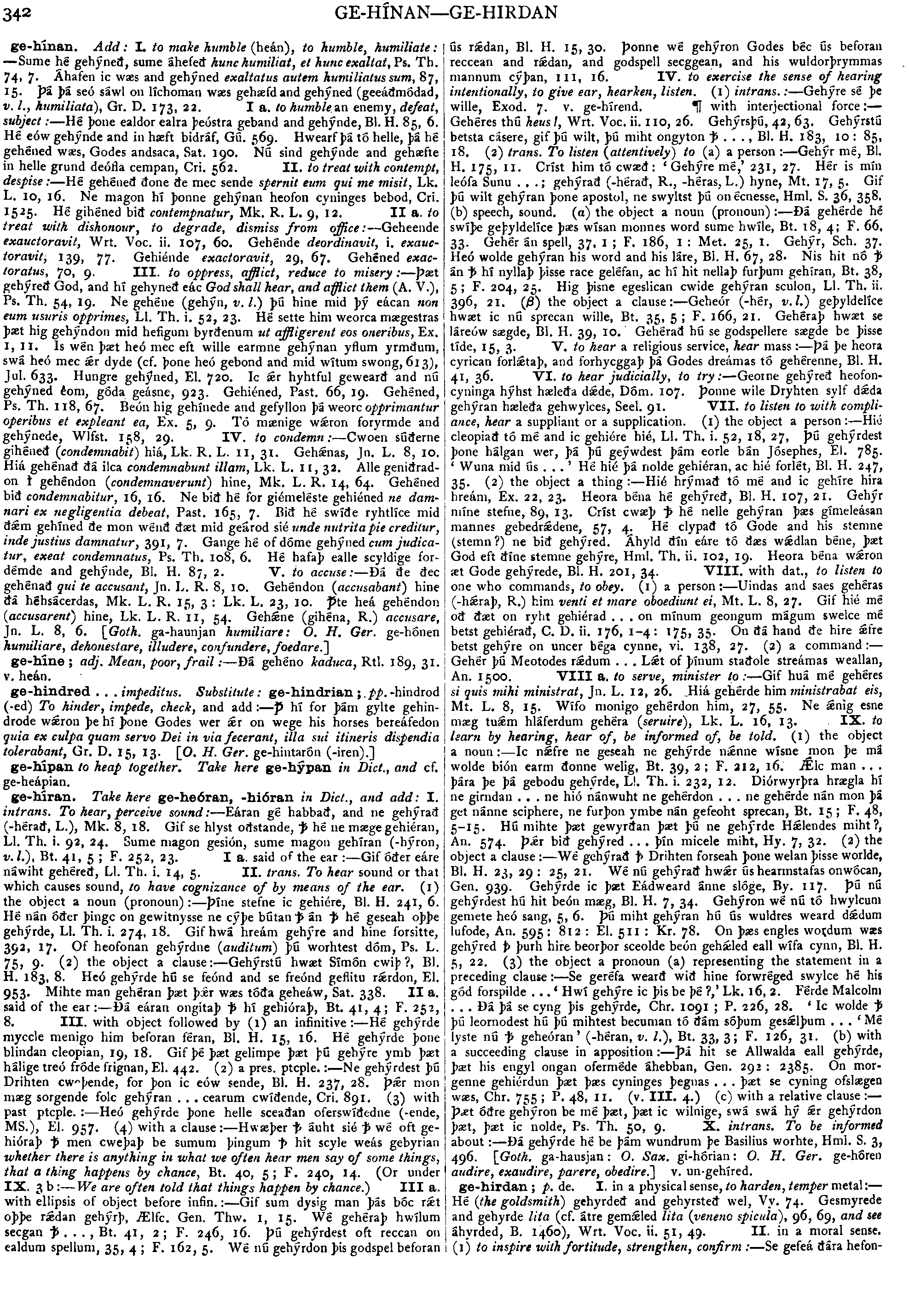
ge-hirdan;
p.
de.
I.
in
a
physical
sense,
to
harden,
temper
metal
:--
H (the
goldsmith)
gehyrde
(the
goldsmith)
gehyrde and
gehyrste
wel,
Vy.
74.
Gesmyrede
and
gehyrde
lita
(cf.
and
gehyrste
wel,
Vy.
74.
Gesmyrede
and
gehyrde
lita
(cf.
 tre
gem
tre
gem led
lita
(veneno
spicula),
96,
69,
and
see
hyrded,
B.
1460),
Wrt.
Voc.
ii.
51,
49.
II.
in
a
moral
sense,
(1)
to
inspire
with
fortitude,
strengthen,
confirm
:--
Se
gefeá
ra
heofon-
led
lita
(veneno
spicula),
96,
69,
and
see
hyrded,
B.
1460),
Wrt.
Voc.
ii.
51,
49.
II.
in
a
moral
sense,
(1)
to
inspire
with
fortitude,
strengthen,
confirm
:--
Se
gefeá
ra
heofon-
|
Source: Bosworth/Toller, page d0352, entry 11 View original page image as: [TIFF] [PNG] [View previous entry] [View next entry] |
[Comment on this entry] [View comments] |
The following entry has been hand-corrected once. |
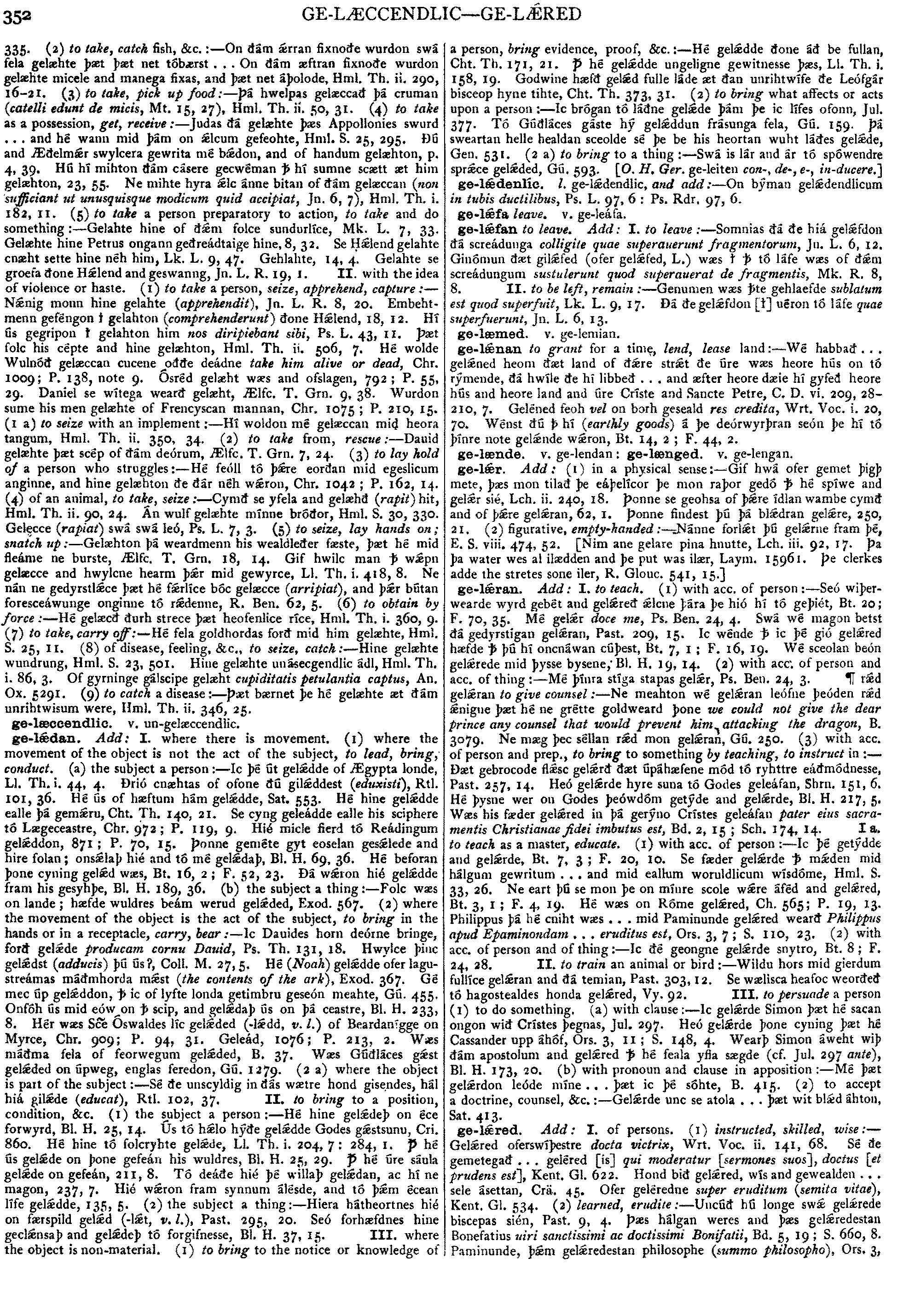
ge-lran.
Add:
I.
to
teach.
(1)
with
ace.
of
person:--Seó
wiþerwearde
wyrd
gebét
and
gelreð
lcne
þára
þe
hió
hí
tó
geþiét,
Bt.
20;
F.
70,
35.
Mé
gelr
doce
me,
Ps.
Ben.
24,
4.
Swá
wé
magon
betst
ðá
gedyrstigan
gelran,
Past.
209,
15.
Ic
wénde
ic
þé
gió
gelred
hæfde
þú
hí
oncnáwan
cúþest,
Bt.
7,
1;
F.
16,
19.
Wé
sceolan
beón
gelrede
mid
þysse
bysene,
Bl.
H.
19,
14.
(2)
with
acc.
of
person
and
acc.
of
thing:--Mé
þínra
stíga
stapas
gelr,
Ps.
Ben.
24,
3.

rd
gelran
to
give
counsel:--Ne
meahton
wé
gelran
leófne
þeóden
rd
nigne
þæt
hé
ne
grétte
goldweard
þone
we
could
not
give
the
dear
prince
any
counsel
that
would
prevent
him
attacking
the
dragon,
B.
3079.
Ne
mæg
þec
séllan
rd
mon
gelran,
Gú.
250.
(3)
with
acc.
of
person
and
prep.,
to
bring
to
something
by
teaching,
to
instruct
in:--Ðæt
gebrocode
flsc
gelrð
ðæt
úpáhæfene
mód
tó
ryhttre
eáðmódnesse,
Past.
257,
14.
Heó
gelrde
hyre
suna
tó
Godes
geleáfan,
Shrn.
151,
6.
Hé
þysne
wer
on
Godes
þeówdóm
getýde
and
gelrde,
Bl.
H.
217,
5.
Wæs
his
fæder
gelred
in
þá
gerýno
Crístes
geleáfan
pater
eius
sacramentis
Christianae
fidei
imbutus
est,
Bd.
2,
15;
Sch.
174,
14.
I
a.
to
teach
as
a
master,
educate.
(1)
with
acc.
of
person:--Ic
þé
getýdde
and
gelrde,
Bt.
7,
3;
F.
20,
10.
Se
fæder
gelrde
mden
mid
hálgum
gewritum
.
.
.
and
mid
eallum
woruldlicum
wísdóme,
Hml.
S.
33,
26.
Ne
eart
þú
se
mon
þe
on
mínre
scole
wre
áféd
and
gelred,
Bt.
3,
1;
F.
4,
19.
Hé
wæs
on
Róme
gelred,
Ch.
565;
P.
19,
13.
Philippus
þá
hé
cniht
wæs
.
.
.
mid
Paminunde
gelred
wearð
Philippus
apud
Epaminondam
.
.
.
eruditus
est,
Ors.
3,
7;
S.
110,
23.
(2)
with
acc.
of
person
and
of
thing:--Ic
ðé
geongne
gelrde
snytro,
Bt.
8;
F.
24,
28.
II.
to
train
an
animal
or
bird:--Wildu
hors
mid
gierdum
fullíce
gelran
and
ðá
temian,
Past.
303,
12.
Se
wælisca
heafoc
weorðeð
tó
hagostealdes
honda
gelred,
Vy.
92.
III.
to
persuade
a
person
(1)
to
do
something.
(a)
with
clause:--Ic
gelrde
Simon
þæt
hé
sacan
ongon
wið
Crístes
þegnas,
Jul.
297.
Heó
gelrde
þone
cyning
þæt
hé
Cassander
upp
áhóf,
Ors.
3,
11;
S.
148,
4.
Wearþ
Simon
áweht
wiþ
ðám
apostolum
and
gelred
hé
feala
yfla
sægde
(cf.
Jul.
297
ante),
Bl.
H.
173,
20.
(b)
with
pronoun
and
clause
in
apposition:--Mé
þæt
gelrdon
leóde
míne
.
.
.
þæt
ic
þé
sóhte,
B.
415.
(2)
to
accept
a
doctrine,
counsel,
&c.:--Gelrde
unc
se
atola
.
.
.
þæt
wit
bld
áhton,
Sat.
413.
|
Source: Bosworth/Toller, page d0384, entry 3 View original page image as: [TIFF] [PNG] [View previous entry] [View next entry] |
[Comment on this entry] [View comments] |
The following entry has been hand-corrected once. |
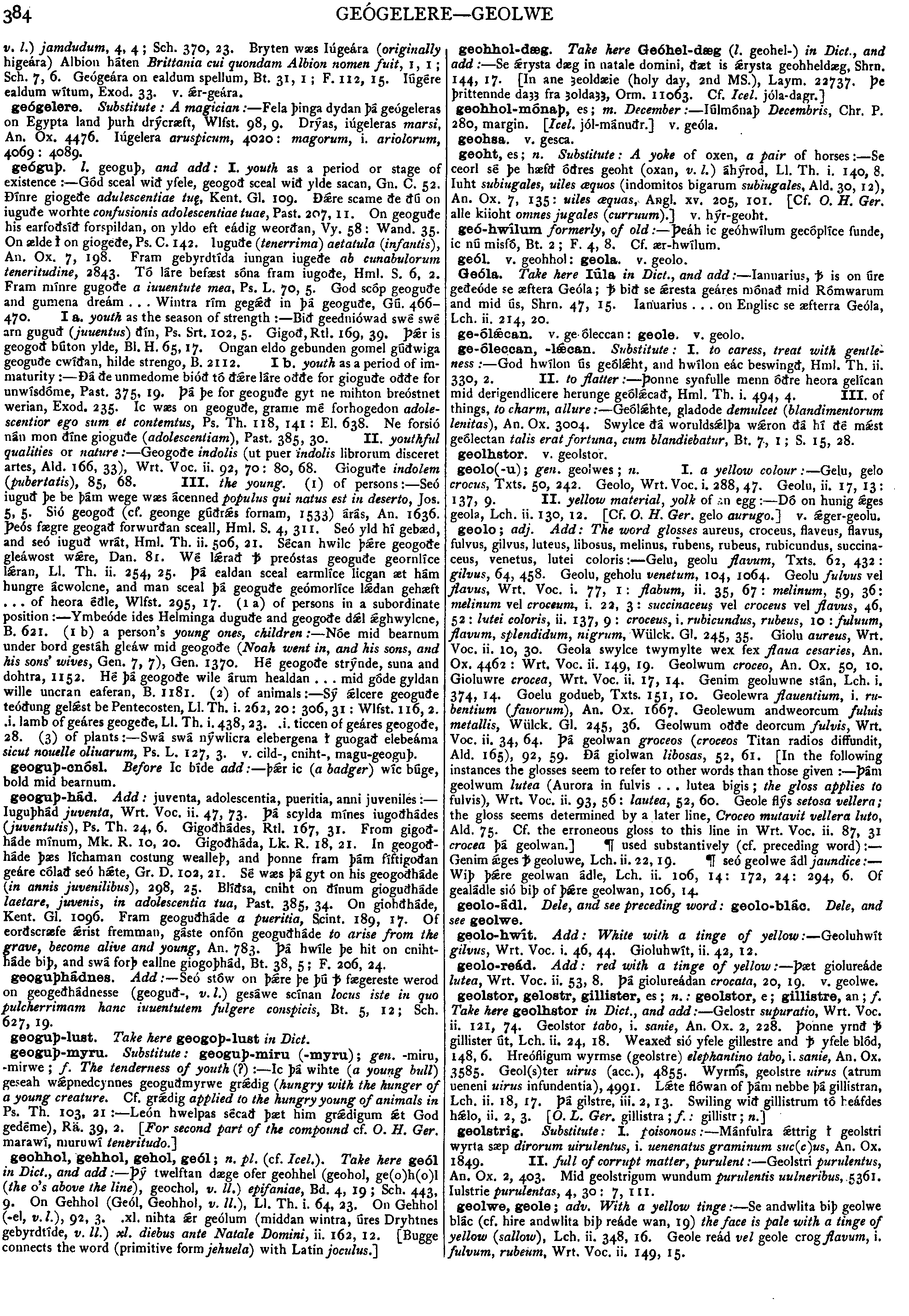
geóguþ.
l.
geoguþ,
and
add:
I.
youth
as
a
period
or
stage
of
existence:--Gód
sceal
wið
yfele,
geogoð
sceal
wið
ylde
sacan,
Gn.
C.
52.
Ðínre
giogeðe
adulescentiae
tu ,
Kent.
Gl.
109.
Ðre
scame
ðe
ðú
on
iuguðe
worhte
confusionis
adolescentiae
tuae,
Past.
207,
11.
On
geoguðe
his
earfoðsíð
forspildan,
on
yldo
eft
eádig
weorðan,
Vy.
58:
Wand.
35.
On
ælde
,
Kent.
Gl.
109.
Ðre
scame
ðe
ðú
on
iuguðe
worhte
confusionis
adolescentiae
tuae,
Past.
207,
11.
On
geoguðe
his
earfoðsíð
forspildan,
on
yldo
eft
eádig
weorðan,
Vy.
58:
Wand.
35.
On
ælde
 on
giogeðe,
Ps.
C.
142.
Iuguðe
(tenerrima)
aetatula
(infantis),
An.
Ox.
7,
198.
Fram
gebyrdtída
iungan
iugeðe
ab
cunabulorum
teneritudine,
2843.
Tó
láre
befæst
sóna
fram
iugoðe,
Hml.
S.
6,
2.
Fram
mínre
gugoðe
a
iuuentute
mea,
Ps.
L.
70,
5.
God
scóp
geoguðe
and
gumena
dreám
.
.
.
Wintra
rím
gegð
in
þá
geoguðe,
Gú.
466-470.
I
a.
youth
as
the
season
of
strength:--Bið
geedniówad
swé
swé
arn
guguð
(juuentus)
ðín,
Ps.
Srt.
102,
5.
Gigoð,
Rtl.
169,
39.
Þr
is
geogoð
búton
ylde,
Bl.
H.
65,
17.
Ongan
eldo
gebunden
gomel
gúðwiga
geoguðe
cwíðan,
hilde
strengo,
B.
2112.
I
b.
youth
as
a
period
of
immaturity:--Ðá
ðe
unmedome
bióð
tó
ðre
láre
oððe
for
gioguðe
oððe
for
unwísdóme,
Past.
375,
19.
Þá
þe
for
geoguðe
gyt
ne
mihton
breóstnet
werian,
Exod.
235.
Ic
wæs
on
geoguðe,
grame
mé
forhogedon
adolescentior
ego
sum
et
contemtus,
Ps.
Th.
118,
141:
El.
638.
Ne
forsió
nán
mon
ðíne
gioguðe
(adolescentiam),
Past.
385,
30.
II.
youthful
qualities
or
nature:--Geogoðe
indolis
(ut
puer
indolis
librorum
disceret
artes,
Ald.
166,
33),
Wrt.
Voc.
ii.
92,
70:
80,
68.
Gioguðe
indolem
(pubertatis),
85,
68.
III.
the
young.
(1)
of
persons:--Seó
iuguð
þe
be
þám
wege
wæs
ácenned
populus
qui
natus
est
in
deserto,
Jos.
5,
5.
Sió
geogoð
(cf.
geonge
gúðrs
fornam,
1533)
árás,
An.
1636.
Þeós
fægre
geogað
forwurðan
sceall,
Hml.
S.
4,
311.
Seó
yld
hí
gebæd,
and
seó
iuguð
wrát,
Hml.
Th.
ii.
506,
21.
Sécan
hwilc
þre
geogoðe
gleáwost
wre,
Dan.
81.
Wé
lrað
preóstas
geoguðe
geornlíce
lran,
Ll.
Th.
ii.
254,
25.
Þá
ealdan
sceal
earmlíce
licgan
æt
hám
hungre
ácwolcne,
and
man
sceal
þá
geoguðe
geómorlíce
ldan
gehæft
.
.
.
of
heora
éðle,
Wlfst.
295,
17.
(1
a)
of
persons
in
a
subordinate
position:--Ymbeóde
ides
Helminga
duguðe
and
geogoðe
dl
ghwylcne,
B.
621.
(1
b)
a
person's
young
ones,
children:--Nóe
mid
bearnum
under
bord
gestáh
gleáw
mid
geogoðe
(Noah
went
in,
and
his
sons,
and
his
sons'
wives,
Gen.
7,
7),
Gen.
1370.
Hé
geogoðe
strýnde,
suna
and
dohtra,
1152.
Hé
þá
geogoðe
wile
árum
healdan
.
.
.
mid
góde
gyldan
wille
uncran
eaferan,
B.
1181.
(2)
of
animals:--Sý
lcere
geoguðe
teóðung
gelst
be
Pentecosten,
Ll.
Th.
i.
262,
20:
306,
31:
Wlfst.
116,
2.
.i.
lamb
of
geáres
geogeðe,
Ll.
Th.
i.
438,
23.
.i.
ticcen
of
geáres
geogoðe,
28.
(3)
of
plants:--Swá
swá
nýwlicra
elebergena
guogað
elebeáma
sicut
nouelle
oliuarum,
Ps.
L.
127,
3.
v.
cild-,
cniht-,
magu-geoguþ.
on
giogeðe,
Ps.
C.
142.
Iuguðe
(tenerrima)
aetatula
(infantis),
An.
Ox.
7,
198.
Fram
gebyrdtída
iungan
iugeðe
ab
cunabulorum
teneritudine,
2843.
Tó
láre
befæst
sóna
fram
iugoðe,
Hml.
S.
6,
2.
Fram
mínre
gugoðe
a
iuuentute
mea,
Ps.
L.
70,
5.
God
scóp
geoguðe
and
gumena
dreám
.
.
.
Wintra
rím
gegð
in
þá
geoguðe,
Gú.
466-470.
I
a.
youth
as
the
season
of
strength:--Bið
geedniówad
swé
swé
arn
guguð
(juuentus)
ðín,
Ps.
Srt.
102,
5.
Gigoð,
Rtl.
169,
39.
Þr
is
geogoð
búton
ylde,
Bl.
H.
65,
17.
Ongan
eldo
gebunden
gomel
gúðwiga
geoguðe
cwíðan,
hilde
strengo,
B.
2112.
I
b.
youth
as
a
period
of
immaturity:--Ðá
ðe
unmedome
bióð
tó
ðre
láre
oððe
for
gioguðe
oððe
for
unwísdóme,
Past.
375,
19.
Þá
þe
for
geoguðe
gyt
ne
mihton
breóstnet
werian,
Exod.
235.
Ic
wæs
on
geoguðe,
grame
mé
forhogedon
adolescentior
ego
sum
et
contemtus,
Ps.
Th.
118,
141:
El.
638.
Ne
forsió
nán
mon
ðíne
gioguðe
(adolescentiam),
Past.
385,
30.
II.
youthful
qualities
or
nature:--Geogoðe
indolis
(ut
puer
indolis
librorum
disceret
artes,
Ald.
166,
33),
Wrt.
Voc.
ii.
92,
70:
80,
68.
Gioguðe
indolem
(pubertatis),
85,
68.
III.
the
young.
(1)
of
persons:--Seó
iuguð
þe
be
þám
wege
wæs
ácenned
populus
qui
natus
est
in
deserto,
Jos.
5,
5.
Sió
geogoð
(cf.
geonge
gúðrs
fornam,
1533)
árás,
An.
1636.
Þeós
fægre
geogað
forwurðan
sceall,
Hml.
S.
4,
311.
Seó
yld
hí
gebæd,
and
seó
iuguð
wrát,
Hml.
Th.
ii.
506,
21.
Sécan
hwilc
þre
geogoðe
gleáwost
wre,
Dan.
81.
Wé
lrað
preóstas
geoguðe
geornlíce
lran,
Ll.
Th.
ii.
254,
25.
Þá
ealdan
sceal
earmlíce
licgan
æt
hám
hungre
ácwolcne,
and
man
sceal
þá
geoguðe
geómorlíce
ldan
gehæft
.
.
.
of
heora
éðle,
Wlfst.
295,
17.
(1
a)
of
persons
in
a
subordinate
position:--Ymbeóde
ides
Helminga
duguðe
and
geogoðe
dl
ghwylcne,
B.
621.
(1
b)
a
person's
young
ones,
children:--Nóe
mid
bearnum
under
bord
gestáh
gleáw
mid
geogoðe
(Noah
went
in,
and
his
sons,
and
his
sons'
wives,
Gen.
7,
7),
Gen.
1370.
Hé
geogoðe
strýnde,
suna
and
dohtra,
1152.
Hé
þá
geogoðe
wile
árum
healdan
.
.
.
mid
góde
gyldan
wille
uncran
eaferan,
B.
1181.
(2)
of
animals:--Sý
lcere
geoguðe
teóðung
gelst
be
Pentecosten,
Ll.
Th.
i.
262,
20:
306,
31:
Wlfst.
116,
2.
.i.
lamb
of
geáres
geogeðe,
Ll.
Th.
i.
438,
23.
.i.
ticcen
of
geáres
geogoðe,
28.
(3)
of
plants:--Swá
swá
nýwlicra
elebergena
guogað
elebeáma
sicut
nouelle
oliuarum,
Ps.
L.
127,
3.
v.
cild-,
cniht-,
magu-geoguþ.
|
Source: Bosworth/Toller, page d0402, entry 6 View original page image as: [TIFF] [PNG] [View previous entry] [View next entry] |
[Comment on this entry] [View comments] |
The following entry has been hand-corrected once. |
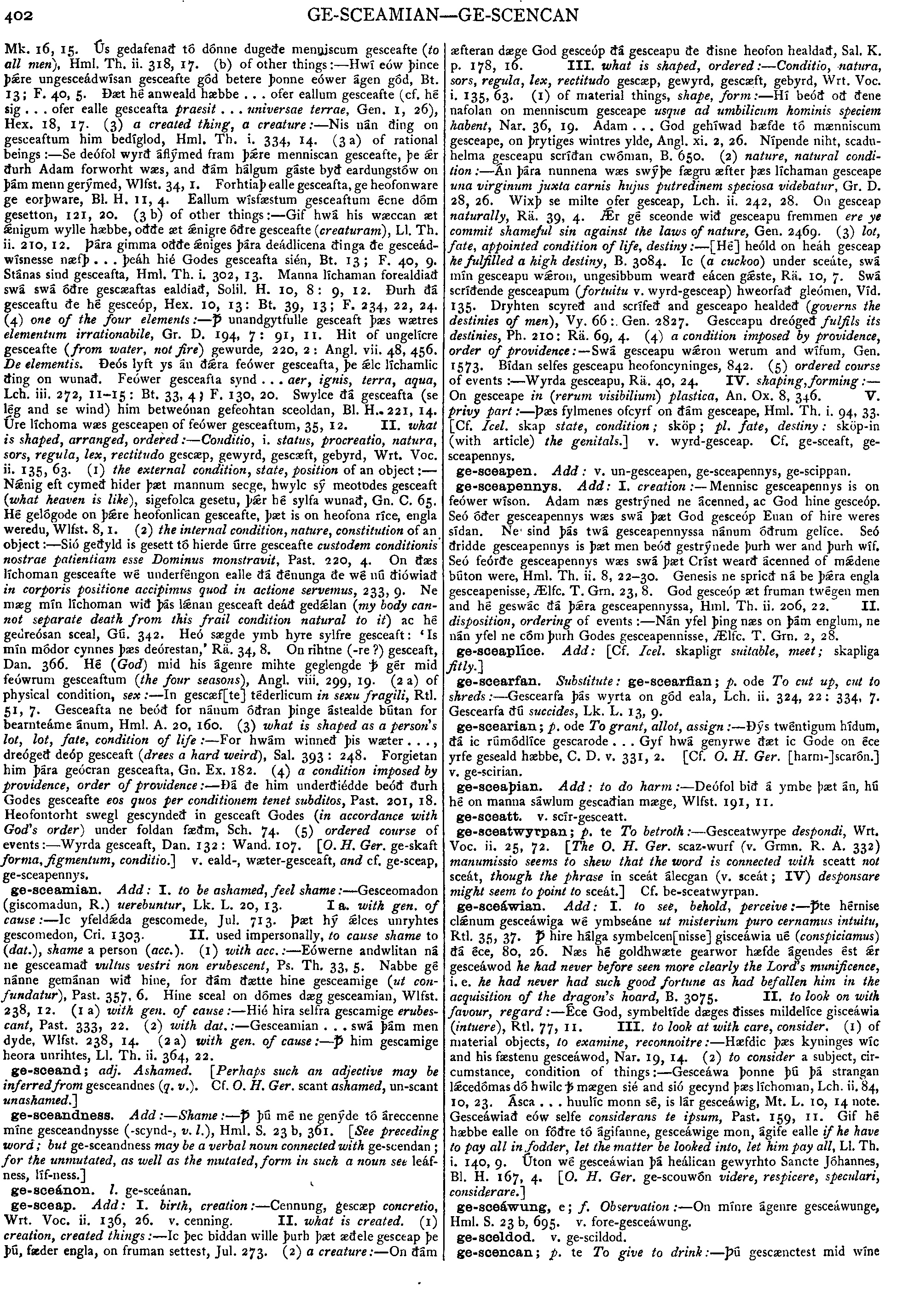
ge-sceap.
Add:
I.
birth,
creation
:--
Cennung,
gescæp
concretio,
Wrt.
Voc.
ii.
136,
26.
v.
cenning.
II.
what
is
created,
(l)
creation,
created
things
:--
Ic
þec
biddan
wille
þurh
þæt
æðele
gesceap
þe
þú,
fæder
engla,
on
fruman
settest,
Jul.
273.
(2)
a
creature
:--
On
ðám
æfteran
dæge
God
gesceóp
ðá
gesceapu
ðe
ðisne
heofon
healdað,
Sal.
K.
p.
178,
ID.
III.
what
is
shaped,
ordered
:--
Conditio,
natura,
sors,
regula,
lex,
rectitudo
gescæp,
gewyrd,
gescæft,
gebyrd,
Wrt.
Voc.
i.
135,
63.
(l)
of
material
things,
shape,
form
:--
Hí
beóð
oð
ðene
nafolan
on
menniscum
gesceape
usque
ad
umbilicum
hominis
speciem
habent,
Nar.
36,
19.
Adam
.
.
.
God
gehíwad
hæfde
tó
mænniscum
gesceape,
on
þrytiges
wintres
ylde,
Angl.
xi.
2,
26.
Nípende
niht,
scaduhelma
gesceapu
scríðan
cwóman,
B.
650.
(2)
nature,
natural
condition
:--
Án
þára
nunnena
wæs
swýþe
fægru
æfter
þæs
líchaman
gesceape
una
virginum
juxta
carnis
hujus
putredinem
speciosa
videbatur,
Gr.
D.
28,
26.
Wixþ
se
milte
ofer
gesceap,
Lch.
ii.
242,
28.
On
gesceap
naturally,
Rä.39,
4.
Æ-acute;r
gé
sceonde
wið
gesceapu
fremmen
ere
ye
commit
shameful
sin
against
the
laws
of
nature,
Gen.
2469.
(3)
lot,
fate,
appointed
condition
of
life,
destiny
:--
[Hé]
heóld
on
heáh
gesceap
he
fulfilled
a
high
destiny,
B.
3084.
Ic
(a
cuckoo)
under
sceáte,
swá
mín
gesceapu
wron,
ungesibbum
wearð
eácen
gste,
Rä.10,
7.
Swá
scríðende
gesceapum
(fortuitu
v.
wyrd-gesceap)
hweorfað
gleómen,
Víd.
135.
Dryhten
scyreð
and
scrífeð
and
gesceapo
healdeð
(governs
the
destinies
of
men),
Vy.
66
:.
Gen.
2827.
Gesceapu
dreógeð
fulfils
its
destinies,
Ph.
210:
Rä.69,
4.
(4)
a
condition
imposed
by
providence,
order
of
providence
:--
Swá
gesceapu
wron
werum
and
wífum,
Gen.
1573.
Bídan
selfes
gesceapu
heofoncyninges,
842.
(5)
ordered
courss
of
events
:--
Wyrda
gesceapu,
Ru.
40,
24.
IV.
shaping,
forming
:--
On
gesceape
in
(rerum
visibilium)
plastica,
An.
Ox.
8,
346.
V.
privy
part
:--
Þæs
fylmenes
ofcyrf
on
ðám
gesceape,
Hml.
Th.
i.
94,
33.
[Cf.
Icel.
skap
state,
condition;
skOp
;
pl.
fate,
destiny:
skOp-in
(with
article)
the
genitals]
v.
wyrd-gesceap.
Cf.
ge-sceaft,
ge-sceapennys.
|
Source: Bosworth/Toller, page d0444, entry 14 View original page image as: [TIFF] [PNG] [View previous entry] [View next entry] |
[Comment on this entry] [View comments] |
The following entry has been hand-corrected once. |
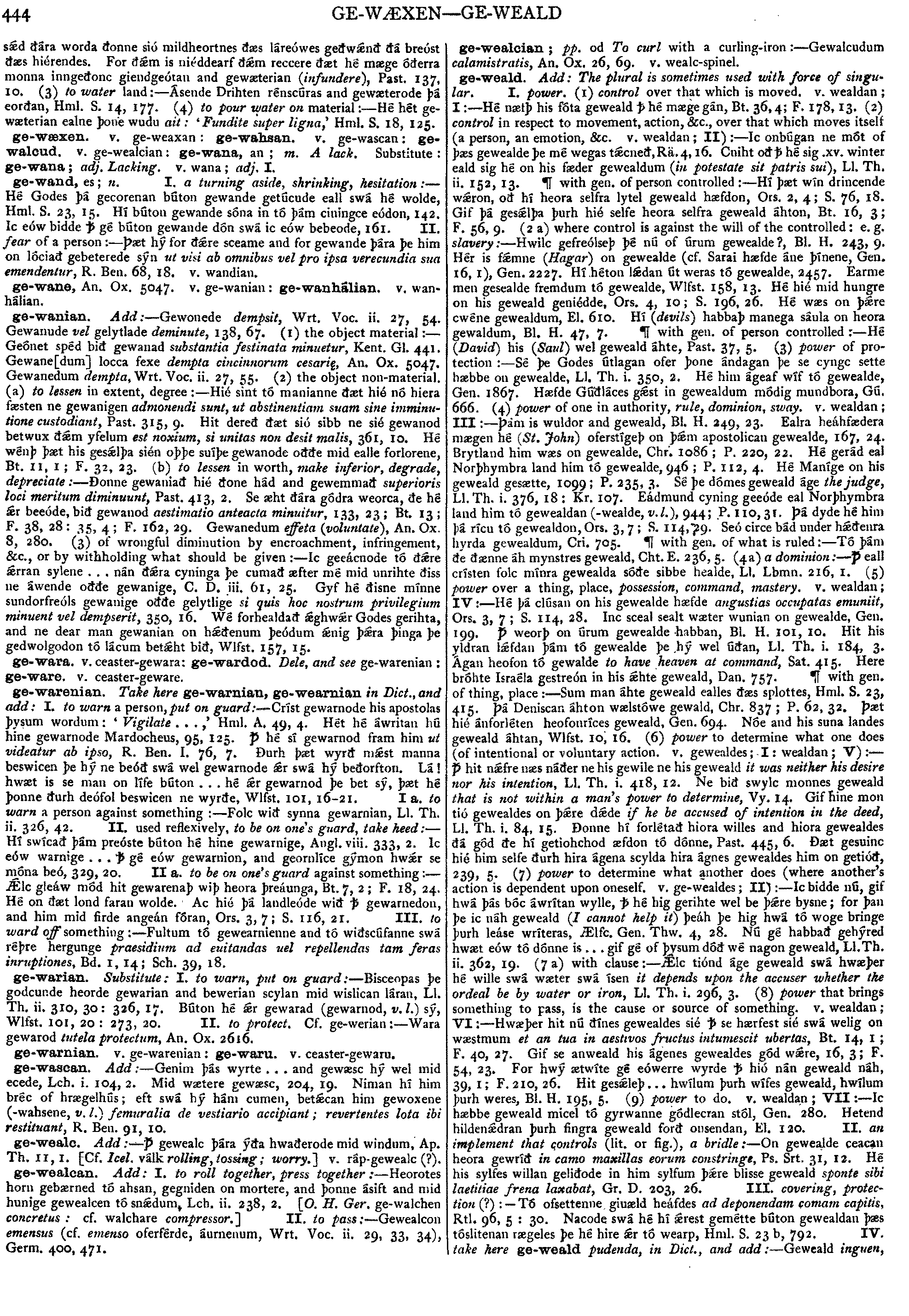
ge-weald.
Add:
The
plural
is
sometimes
used
with
force
of
singular.
I.
power.
(1)
control
over
that
which
is
moved,
v.
wealdan;
I
:--
Hé
nætþ
his
fóta
geweald
hé
mæge
gán,
Bt.
36,
4;
F.
178,
13.
(2)
control
in
respect
to
movement,
action,
&c.,
over
that
which
moves
itself
(a
person,
an
emotion,
&c.
v.
wealdan;
II)
:--
Ic
onbúgan
ne
mót
of
þæs
gewealde
þe
mé
wegas
tcneð,
Rä.
4,
16.
Cniht
oð
he
sig
.xv.
winter
eald
sig
hé
on
his
fæder
gewealdum
(in
potestate
sit
patris
sui),
Ll.
Th.
ii.
152,
13.

with
gen.
of
person
controlled
:--
Hí
þæt
wín
drincende
wron,
oð
hí
heora
selfra
lytel
geweald
hæfdon,
Ors.
2,
4;
S.
76,
18.
Gif
þá
geslþa
þurh
hié
selfe
heora
selfra
geweald
áhton,
Bt.
16,
3;
F.
56,
9.
(2
a)
where
control
is
against
the
will
of
the
controlled:
e.g.
slavery
:--
Hwilc
gefreólseþ
þé
nú
of
úrum
gewealde?,
Bl.
H.
243,
9.
Hér
is
fmne
(Hagar)
on
gewealde
(cf.
Sarai
hæfde
áne
þínene,
Gen.
16,
1),
Gen.
2227.
Hí
héton
ldan
út
weras
tó
gewealde,
2457.
Earme
men
gesealde
fremdum
tó
gewealde,
Wlfst.
158,
13.
Hé
hié
mid
hungre
on
his
geweald
geniédde,
Ors.
4,
10;
S.
196,
26.
Hé
wæs
on
þre
cwéne
gewealdum,
El.
610.
Hí
(devils)
habbaþ
manega
sáula
on
heora
gewaldum,
Bl.
H.
47,
7.

with
gen.
of
person
controlled
:--
Hé
(David)
his
(Saul)
wel
geweald
áhte,
Past.
37,
5.
(3)
power
of
protection
:--
Sé
þe
Godes
útlagan
ofer
þone
ándagan
þe
se
cyngc
sette
hæbbe
on
gewealde,
Ll.
Th.
i.
350,
2.
Hé
him
ágeaf
wíf
tó
gewealde,
Gen.
1867.
Hæfde
Gúðláces
gst
in
gewealdum
módig
mundbora,
Gú.
666.
(4)
power
of
one
in
authority,
rule,
dominion,
sway.
v.
wealdan;
III
:--
Þam
is
wuldor
and
geweald,
Bl.
H.
249,
23.
Ealra
heáhfædera
mægen
hé
(St.
John)
oferstígeþ
on
þm
apostolican
gewealde,
167,
24.
Brytland
him
wæs
on
gewealde,
Chr.
1086;
P.
220,
22.
Hé
gerád
eal
Norþhymbra
land
him
tó
gewealde,
946;
P.
112,
4.
Hé
Maníge
on
his
geweald
gesætte,
1099;
P.
235,
3.
Sé
þe
dómes
geweald
áge
the
judge,
Ll.
Th.
i.
376,
18:
Kr.
107.
Eádmund
cyning
geeóde
eal
Norþhymbra
land
him
tó
gewealdan
(-wealde,
v.
l.),
944;
P.
110,
31.
Þá
dyde
hé
him
þá
rícu
tó
gewealdon,
Ors.
3,
7;
S.
114,
29.
Seó
circe
bád
under
hðenra
hyrda
gewealdum,
Cri.
705.

with
gen.
of
what
is
ruled
:--
Tó
þám
ðe
ðænne
áh
mynstres
geweald,
Cht.
E.
236,
5.
(4
a)
a
dominion
:--
eall
crísten
folc
mínra
gewealda
sóðe
sibbe
healde,
Ll.
Lbmn.
216,
1.
(5)
power
over
a
thing,
place,
possession,
command,
mastery,
v.
wealdan;
IV
:--
Hé
þá
clúsan
on
his
gewealde
hæfde
angustias
occupatas
emuniit,
Ors.
3,
7;
S.
114,
28.
Inc
sceal
sealt
wæter
wunian
on
gewealde,
Gen.
199.
weorþ
on
úrum
gewealde
habban,
Bl.
H.
101,
10.
Hit
his
yldran
lfdan
þám
tó
gewealde
þe
hý
wel
úðan,
Ll.
Th.
i.
184,
3.
Ágan
heofon
tó
gewalde
to
have
heaven
at
command,
Sat.
415.
Here
bróhte
Israéla
gestreón
in
his
hte
geweald,
Dan.
757.

with
gen.
of
thing,
place
:--
Sum
man
áhte
geweald
ealles
ðæs
splottes,
Hml.
S.
23,
415.
Þá
Deniscan
áhton
wælstówe
gewald,
Chr.
837;
P.
62,
32.
Þæt
hié
ánforléten
heofonríces
geweald,
Gen.
694.
Nóe
and
his
suna
landes
geweald
áhtan,
Wlfst.
10,
16.
(6)
power
to
determine
what
one
does
(of
intentional
or
voluntary
action,
v.
gewealdes;
I:
wealdan;
V)
:--
hit
nfre
næs
náðer
ne
his
gewile
ne
his
geweald
it
was
neither
his
desire
nor
his
intention,
Ll.
Th.
i.
418,
12.
Ne
bið
swylc
monnes
geweald
that
is
not
within
a
man's
power
to
determine,
Vy.
14.
Gif
hine
mon
tió
gewealdes
on
þre
dde
if
he
be
accused
of
intention
in
the
deed,
Ll.
Th.
i.
84,
15.
Ðonne
hí
forlétað
hiora
willes
and
hiora
gewealdes
ðá
gód
ðe
hi
getiohchod
æfdon
tó
dónne,
Past.
445,
6.
Ðæt
gesuinc
hié
him
selfe
ðurh
hira
ágena
scylda
hira
ágnes
gewealdes
him
on
getióð,
239,
5.
(7)
power
to
determine
what
another
does
(where
another's
action
is
dependent
upon
oneself,
v.
ge-wealdes;
II)
:--
Ic
bidde
nú,
gif
hwá
þás
bóc
áwrítan
wylle,
hé
hig
gerihte
wel
be
þre
bysne;
for
þan
þe
ic
náh
geweald
(I
cannot
help
it)
þeáh
þe
hig
hwá
tó
woge
bringe
þurh
lease
wríteras,
Ælfc.
Gen.
Thw.
4,
28.
Nú
gé
habbað
gehýred
hwæt
eów
tó
dónne
is
...
gif
gé
of
þysum
dóð
wé
nagon
geweald,
Ll.
Th.
ii.
362,
19.
(7
a)
with
clause
:--
Æ-acute;lc
tiónd
áge
geweald
swá
hwæþer
hé
wille
swá
wæter
swá
ísen
it
depends
upon
the
accuser
whether
the
ordeal
be
by
water
or
iron,
Ll.
Th.
i.
296,
3.
(8)
power
that
brings
something
to
pass,
is
the
cause
or
source
of
something,
v.
wealdan;
VI
:--
Hwæþer
hit
nú
ðínes
gewealdes
sié
se
hærfest
sié
swá
welig
on
wæstmum
et
an
tua
in
aestivos
fructus
intumescit
ubertas,
Bt.
14,
1;
F.
40,
27.
Gif
se
anweald
his
ágenes
gewealdes
gód
wre,
16,
3;
F.
54,
23.
For
hwý
ætwíte
gé
eówerre
wyrde
hió
nán
geweald
náh,
39,
1;
F.
210,
26.
Hit
gesleþ
...
hwílum
þurh
wífes
geweald,
hwílum
þurh
weres,
Bl.
H.
195,
5.
(9)
power
to
do.
v.
wealdan;
VII
:--
Ic
hæbbe
geweald
micel
tó
gyrwanne
gódlecran
stól,
Gen.
280.
Hetend
hildendran
þurh
fingra
geweald
forð
onsendan,
El.
120.
II.
an
implement
that
controls
(lit.
or
fig.),
a
bridle
:--
On
gewealde
ceacan
heora
gewríð
in
camo
maxillas
eorum
constringe,
Ps.
Srt.
31,
12.
Hé
his
sylfes
willan
geliðode
in
him
sylfum
þre
blisse
geweald
sponte
sibi
laetitiae
frena
laxabat,
Gr.
D.
203,
26.
III.
covering,
protection
(?)
:--
Tó
ofsettenne
giuæld
heáfdes
ad
deponendam
comam
capitis,
Rtl.
96,
5:
30.
Nacode
swá
hé
hí
rest
gemétte
búton
gewealdan
þæs
tóslitenan
rægeles
þe
hé
hire
r
tó
wearp,
Hml.
S.
23
b,
792.
IV.
take
here
ge-weald
pudenda,
in
Dict.,
and
add
:--
Geweald
inguen,
|
Source: Bosworth/Toller, page d0475, entry 8 View original page image as: [TIFF] [PNG] [View previous entry] [View next entry] |
[Comment on this entry] [View comments (1)] |
The following entry has been hand-corrected once. |
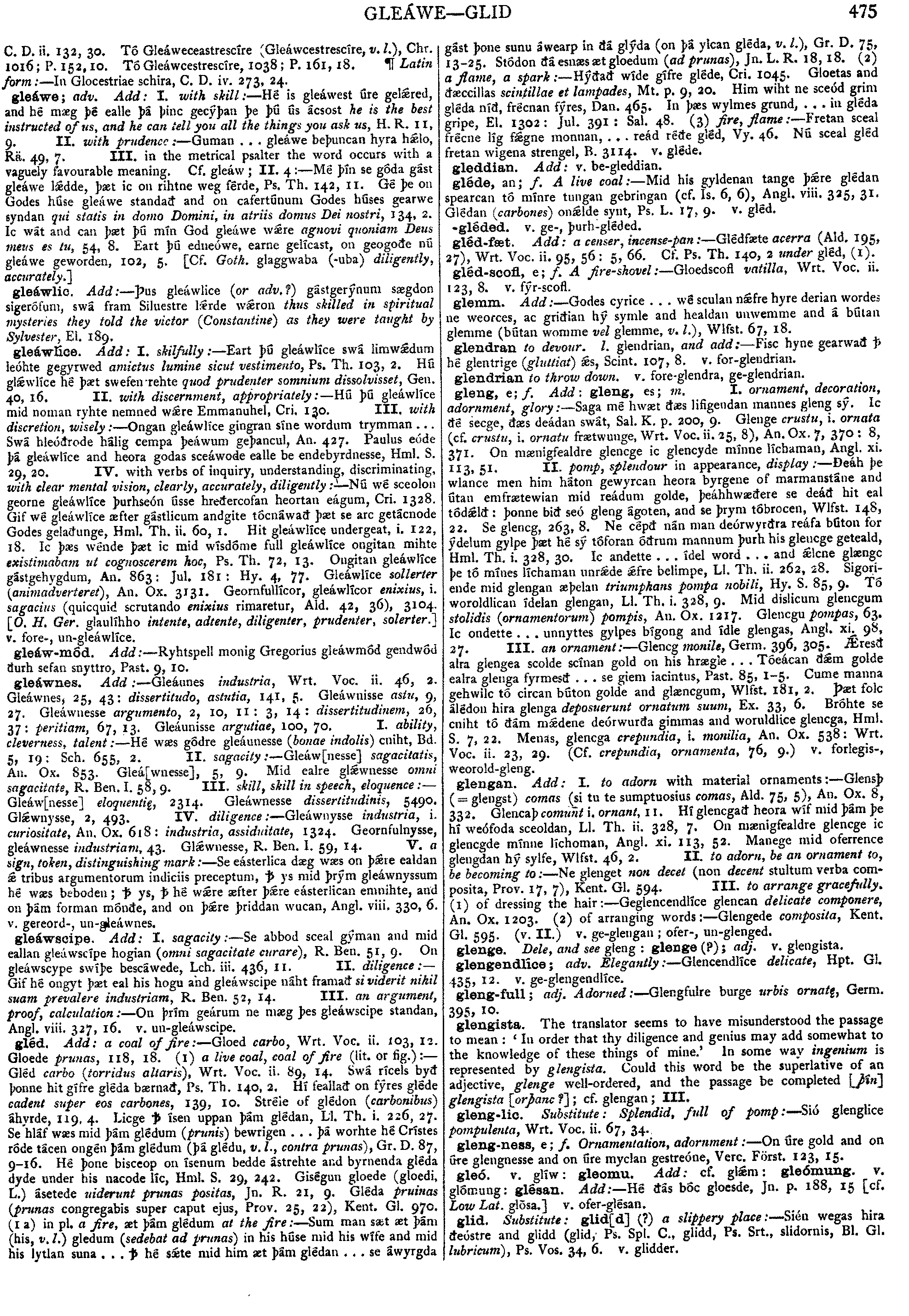
gléd.
Add:
a
coal
of
fire:--Gloed
carbo,
Wrt.
Voc.
ii.
103,
12.
Gloede
prunas,
118,
18.
(1)
a
live
coal,
coal
of
fire
(lit.
or
fig.):--Gléd
carbo
(torridus
altaris),
Wrt.
Voc.
ii.
89,
14.
Swá
rícels
byð
þonne
hit
gífre
gléda
bærnað,
Ps.
Th.
140,
2.
Hí
feallað
on
fýres
gléde
cadent
super
eos
carbones,
139,
10.
Stréie
of
glédon
(carbonibus)
áhyrde,
119,
4.
Licge
ísen
uppan
þám
glédan,
Ll.
Th.
i.
226,
27.
Se
hláf
wæs
mid
þám
glédum
(prunis)
bewrigen
.
.
.
þá
worhte
hé
Crístes
róde
tácen
ongén
þám
glédum
(þá
glédu,
v.
l.,
contra
prunas),
Gr.
D.
87,
9-16.
Hé
þone
bisceop
on
ísenum
bedde
ástrehte
and
byrnenda
gléda
dyde
under
his
nacode
líc,
Hml.
S.
29,
242.
Giségun
gloede
(gloedi,
L.)
ásetede
uiderunt
prunas
positas,
Jn.
R.
21,
9.
Gléda
pruinas
(prunas
congregabis
super
caput
ejus,
Prov.
25,
22),
Kent.
Gl.
970.
(1
a)
in
pl.
a
fire,
æt
þám
glédum
at
the
fire:--Sum
man
sæt
æt
þám
(his,
v.
l.)
gledum
(sedebat
ad
prunas)
in
his
húse
mid
his
wífe
and
mid
his
lytlan
suna
.
.
.
hé
ste
mid
him
æt
þám
glédan
.
.
.
se
áwyrgda
gást
þone
sunu
áwearp
in
ðá
glýda
(on
þá
ylcan
gléda,
v.
l.),
Gr.
D.
75,
13-25.
Stódon
ðá
esnæs
æt
gloedum
(ad
prunas),
Jn.
L.
R.
18,
18.
(2)
a
flame,
a
spark:--Hýðað
wíde
gífre
gléde,
Cri.
1045.
Gloetas
and
ðæccillas
scintillae
et
lampades,
Mt.
p.
9,
20.
Him
wiht
ne
sceód
grim
gléda
níð,
frécnan
fýres,
Dan.
465.
In
þæs
wylmes
grund,
.
.
.
in
gléda
gripe,
El.
1302:
Jul.
391:
Sal.
48.
(3)
fire,
flame:--Fretan
sceal
frécne
líg
fgne
monnan,
.
.
.
reád
réðe
gléd,
Vy.
46.
Nú
sceal
gléd
fretan
wigena
strengel,
B.
3114.
v.
gléde.
|
Source: Bosworth/Toller, page d0476, entry 30 View original page image as: [TIFF] [PNG] [View previous entry] [View next entry] |
[Comment on this entry] [View comments] |
The following entry has been hand-corrected once. |
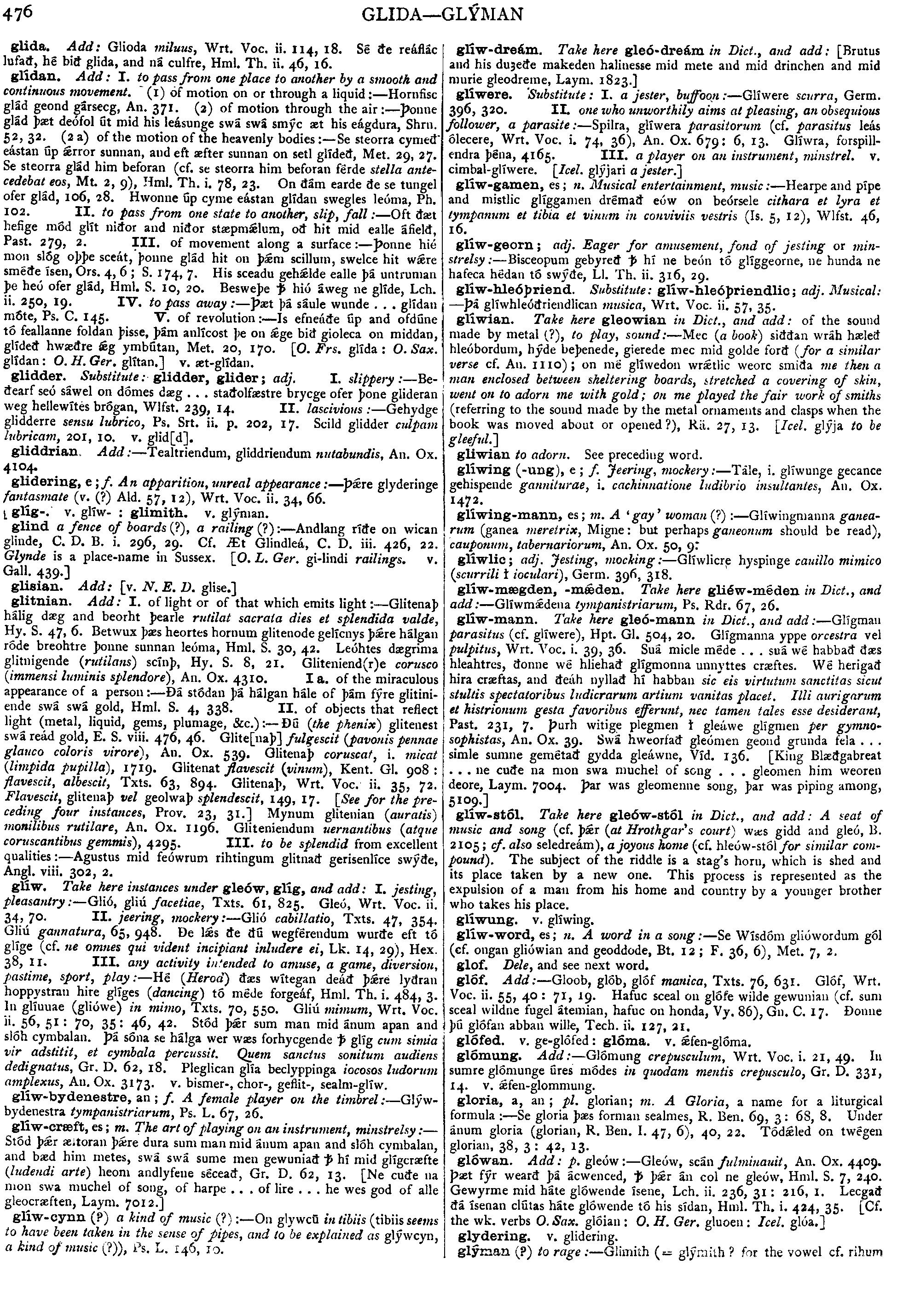
glóf. Add:--Gloob, glób, glóf manica, Txts. 76, 631. Glóf, Wrt. Voc. ii. 55, 40: 71, 19. Hafuc sceal on glófe wilde gewunian (cf. sum sceal wildne fugel átemian, hafuc on honda, Vy. 86), Gn. C. 17 Ðonne þú glófan abban wille, Tech. ii. 127, 21.
|
Source: Bosworth/Toller, page d0496, entry 9 View original page image as: [TIFF] [PNG] [View previous entry] [View next entry] |
[Comment on this entry] [View comments] |
The following entry has been hand-corrected once. |
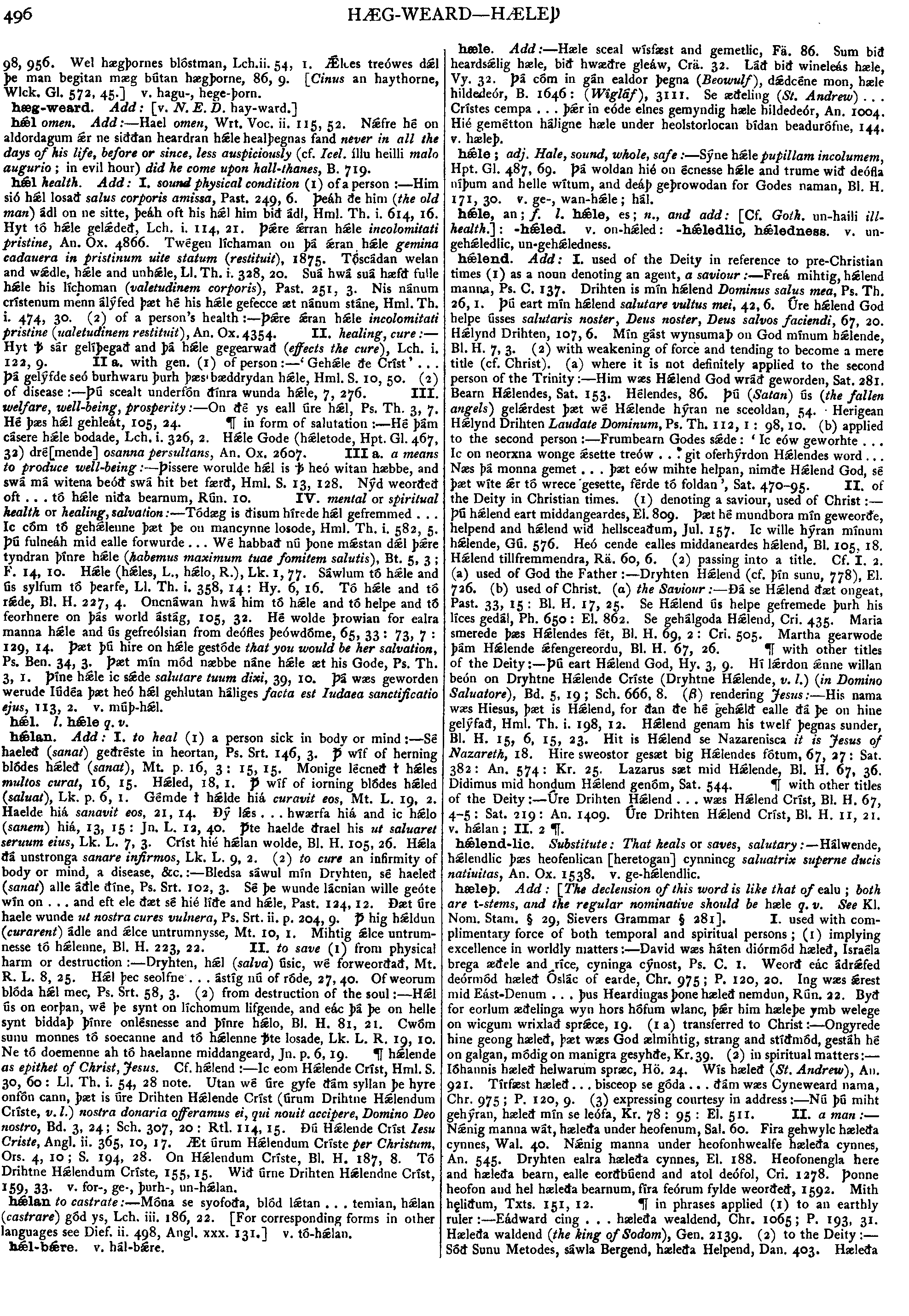
hæle.
Add
:--
Hæle
sceal
wísfæst
and
gemetlic,
Fii.
86.
Sum
bið
heardslig
hæle,
bið
hwæðre
gleáw,
Crë.
32.
Láð
bið
wineleás
hæle,
Vy.
32.
Þá
cám
in
gán
ealdor
þegna
(Beowulf),
ddcéne
mon,
hæle
hildedeór,
B.
1646:
(Wígláf),
3111.
Se
æðeling
(St.
Andrew)
.
.
.
Crístes
cempa
.
.
.
þr
in
eóde
elnes
gemyndig
hæle
hildedeór,
An.
1004.
Hié
gemétton
háligne
hæle
under
heolstorlocan
bídan
beadurófne,
144.
v.
hæleþ.
|
Source: Bosworth/Toller, page d0507, entry 1 View original page image as: [TIFF] [PNG] [View previous entry] [View next entry] |
[Comment on this entry] [View comments] |
The following entry has been hand-corrected once. |
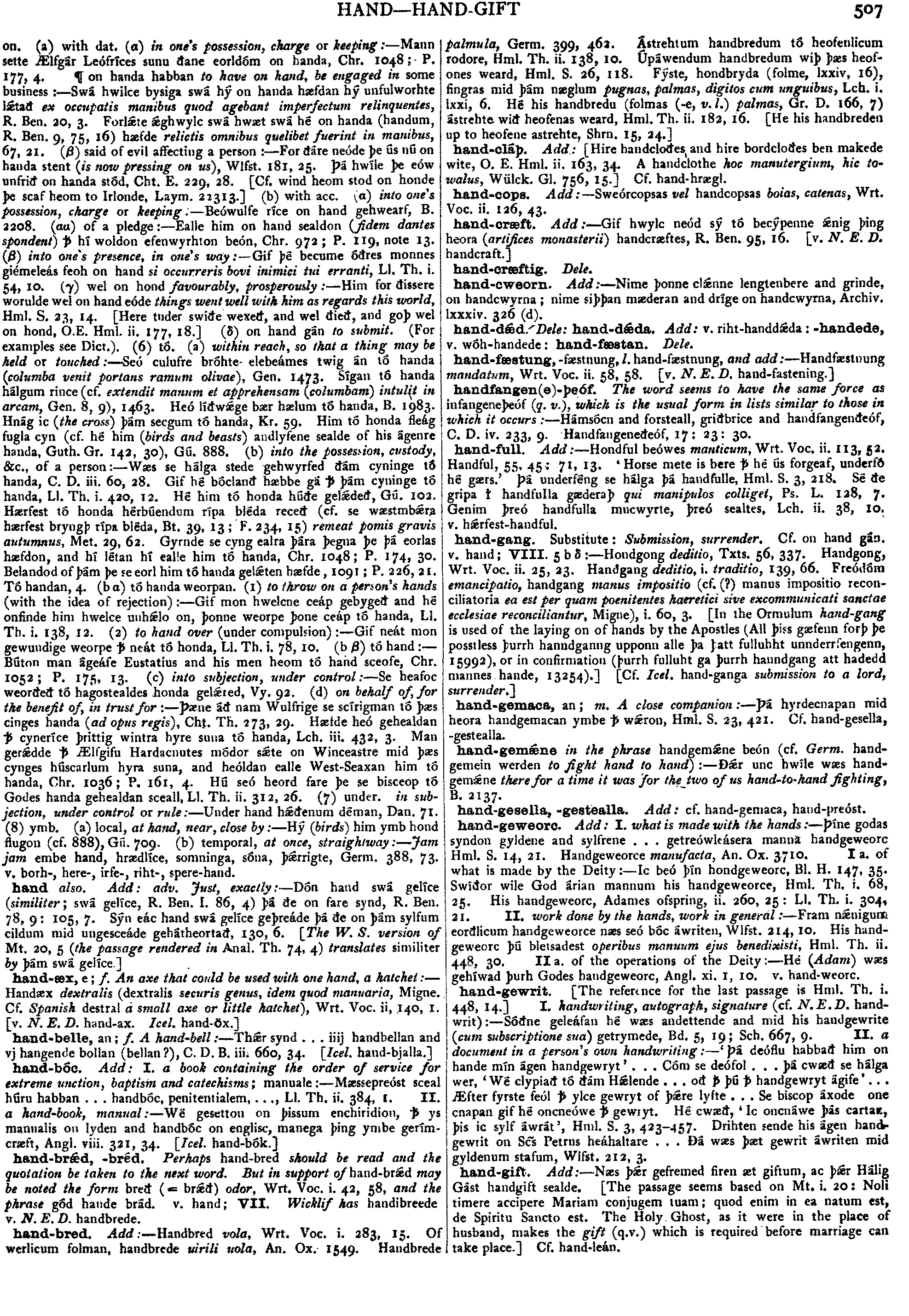
on.
(a)
with
dat.
( )
in
one's
possession,
charge
or
keeping
:--
Mann
sette
Ælfgár
Leófríces
sunu
ðane
eorldóm
on
handa,
Chr.
1048;
P.
177,
4.

on
handa
habban
to
have
on
hand,
be
engaged
in
some
business
:--
Swá
hwilce
bysiga
swá
hý
on
handa
hæfdan
hý
unfulworhte
ltað
ex
occupatis
manibus
quod
agebant
imperfectum
relinquentes,
R.
Ben.
20,
3.
Forlte
ghwylc
swá
hwæt
swá
hé
on
handa
(handum,
R.
Ben.
9,
75,
16)
hæfde
relictis
omnibus
quelibet
fuerint
in
manibus,
67,
21.
(
)
in
one's
possession,
charge
or
keeping
:--
Mann
sette
Ælfgár
Leófríces
sunu
ðane
eorldóm
on
handa,
Chr.
1048;
P.
177,
4.

on
handa
habban
to
have
on
hand,
be
engaged
in
some
business
:--
Swá
hwilce
bysiga
swá
hý
on
handa
hæfdan
hý
unfulworhte
ltað
ex
occupatis
manibus
quod
agebant
imperfectum
relinquentes,
R.
Ben.
20,
3.
Forlte
ghwylc
swá
hwæt
swá
hé
on
handa
(handum,
R.
Ben.
9,
75,
16)
hæfde
relictis
omnibus
quelibet
fuerint
in
manibus,
67,
21.
( )
said
of
evil
affecting
a
person
:--
For
ðáre
neóde
þe
ús
nú
on
handa
stent
(is
now
pressing
on
us),
Wlfst.
181,
25.
Þá
hwíle
þe
eów
unfrið
on
handa
stód,
Cht.
E.
229,
28.
[Cf.
wind
heom
stod
on
honde
þe
scaf
heom
to
Irlonde,
Laym.
22313.UNCERTAIN
]
(b)
with
acc.
()
into
one's
possession,
charge
or
keeping
:--
Beówulfe
ríce
on
hand
gehwearf,
B.
2208.
()
of
a
pledge
:--
Ealle
him
on
hand
sealdon
(fidem
dantes
spondent)
hí
woldon
efenwyrhton
beón,
Chr.
972
;
P.
119,
note
13.
()
into
one's
presence,
in
one's
way
:--
Gif
þé
becume
óðres
monnes
giémeleás
feoh
on
hand
si
occurreris
bovi
inimici
tui
erranti,
Ll.
Th.
i.
54,
10.
(
)
said
of
evil
affecting
a
person
:--
For
ðáre
neóde
þe
ús
nú
on
handa
stent
(is
now
pressing
on
us),
Wlfst.
181,
25.
Þá
hwíle
þe
eów
unfrið
on
handa
stód,
Cht.
E.
229,
28.
[Cf.
wind
heom
stod
on
honde
þe
scaf
heom
to
Irlonde,
Laym.
22313.UNCERTAIN
]
(b)
with
acc.
()
into
one's
possession,
charge
or
keeping
:--
Beówulfe
ríce
on
hand
gehwearf,
B.
2208.
()
of
a
pledge
:--
Ealle
him
on
hand
sealdon
(fidem
dantes
spondent)
hí
woldon
efenwyrhton
beón,
Chr.
972
;
P.
119,
note
13.
()
into
one's
presence,
in
one's
way
:--
Gif
þé
becume
óðres
monnes
giémeleás
feoh
on
hand
si
occurreris
bovi
inimici
tui
erranti,
Ll.
Th.
i.
54,
10.
( )
wel
on
hond
favourably,
prosperously
:--Him
for
ðissere
worulde
wel
on
hand
eóde
things
went
well
with
him
as
regards
this
world,
Hml.
S.
23,
14.
[Here
tuder
swiðe
wexeð,
and
wel
ðieð,
and
goþ
wel
on
hond,
O.
E.
Hml.
ii.
177,
18.]
(
)
wel
on
hond
favourably,
prosperously
:--Him
for
ðissere
worulde
wel
on
hand
eóde
things
went
well
with
him
as
regards
this
world,
Hml.
S.
23,
14.
[Here
tuder
swiðe
wexeð,
and
wel
ðieð,
and
goþ
wel
on
hond,
O.
E.
Hml.
ii.
177,
18.]
( )
on
hand
gán
to
submit.
(For
examples
see
Dict.).
(6)
tó.
(a)
within
reach,
so
that
a
thing
may
be
held
or
touched
:--
Seó
culufre
bróhte
elebeámes
twig
án
tó
handa
(columba
venit
portans
ramum
olivae),
Gen.
1473.
Sígan
tó
handa
hálgum
rince
(cf.
extendit
manum
et
apprehensam
(columbam)
intulit
in
arcam,
Gen.
8,
9),
1463.
Heó
líðwge
bær
hælum
tó
handa,
B.
1983.
Hnág
ic
(the
cross)
þám
secgum
tó
handa,
Kr.
59.
Him
tó
honda
fleág
fugla
cyn
(cf.
hé
him
(birds
and
beasts)
andlyfene
sealde
of
his
ágenre
handa,
Guth.
Gr.
142,
30),
Gú.
888.
(b)
into
the
possession,
custody,
&c.,
of
a
person
:--
Wæs
se
hálga
stede
gehwyrfed
ðám
cyninge
tó
handa,
C.
D.
iii.
60,
28.
Gif
hé
bóclanð
hæbbe
gá
UNCERTAIN
þám
cyninge
tó
handa,
Ll.
Th.
i.
420,
12.
He
him
tó
honda
húðe
geldeð,
Gú.
102.
Hærfest
tó
honda
hérbúendum
rípa
bléda
receð
(cf.
se
wæstmbra
hærfest
bryngþ
rípa
bléda,
Bt.
39,
13
;
F.
234,
15)
remeat
pomis
gravis
autumnus,
Met.
29,
62.
Gyrnde
se
cyng
ealra
þára
þegna
þe
þá
eorlas
hæfdon,
and
hí
létan
hí
ealle
him
tó
handa,
Chr.
1048;
P.
174,
30.
Belandod
of
þám
þe
se
eorl
him
tó
handa
gelten
hæfde,
1091;
P.
226,
21.
Tó
handan,
4.
(b
)
tó
handa
weorpan.
(1)
to
throw
on
a
person's
hands
(with
the
idea
of
rejection)
:--
Gif
mon
hwelcne
ceáp
gebygeð
and
hé
onfinde
him
hwelce
unhlo
on,
þonne
weorpe
þone
ceáp
tó
handa,
Ll.
Th.
i.
138,
12.
(2)
to
hand
over
(under
compulsion)
:--
Gif
neát
mon
gewundige
weorpe
neát
tó
honda,
Ll.
Th.
i.
78,
10.
(b
)
tó
hand
:--
Búton
man
ágeáfe
Eustatius
and
his
men
heom
tó
hand
sceofe,
Chr.
1052;
P.
175,
13.
(c)
into
subjection,
under
control
:--
Se
heafoc
weorðeð
tó
hagostealdes
honda
gelred,
Vy.
92.
(d)
on
behalf
of,
for
the
benefit
of,
in
trust
for
:--
Þæne
áð
nam
Wulfrige
se
scírigman
tó
þæs
cinges
handa
(ad
opus
regis),
Cht.
Th.
273,
29.
Hæfde
heó
gehealdan
cyneríce
þrittig
wintra
hyre
suna
tó
handa,
Lch.
iii.
432,
3.
Man
gerdde
Ælfgifu
Hardacnutes
módor
ste
on
Winceastre
mid
þæs
cynges
húscarlum
hyra
suna,
and
heóldan
ealle
West-Seaxan
him
tó
handa,
Chr.
1036;
P.
161,
4.
Hú
seó
heord
fare
þe
se
bisceop
tó
Godes
handa
gehealdan
sceall.
Ll.
Th.
ii.
312,
26.
(7)
under.
in
subjection,
under
control
or
rule
:--
Under
hand
hðenum
déman,
Dan.
71.
(8)
ymb.
(a)
local,
at
hand,
near,
close
by
:--
Hý
(birds)
him
ymb
hond
flugon
(cf.
888),
Gú.
709.
(b)
temporal,
at
once,
straightway
:--
Jam
jam
embe
hand,
hrædlíce,
somninga,
sóna,
þrrigte,
Germ.
388,
73.
v.
borh-,
here-,
irfe-,
riht-,
spere-hand.
)
on
hand
gán
to
submit.
(For
examples
see
Dict.).
(6)
tó.
(a)
within
reach,
so
that
a
thing
may
be
held
or
touched
:--
Seó
culufre
bróhte
elebeámes
twig
án
tó
handa
(columba
venit
portans
ramum
olivae),
Gen.
1473.
Sígan
tó
handa
hálgum
rince
(cf.
extendit
manum
et
apprehensam
(columbam)
intulit
in
arcam,
Gen.
8,
9),
1463.
Heó
líðwge
bær
hælum
tó
handa,
B.
1983.
Hnág
ic
(the
cross)
þám
secgum
tó
handa,
Kr.
59.
Him
tó
honda
fleág
fugla
cyn
(cf.
hé
him
(birds
and
beasts)
andlyfene
sealde
of
his
ágenre
handa,
Guth.
Gr.
142,
30),
Gú.
888.
(b)
into
the
possession,
custody,
&c.,
of
a
person
:--
Wæs
se
hálga
stede
gehwyrfed
ðám
cyninge
tó
handa,
C.
D.
iii.
60,
28.
Gif
hé
bóclanð
hæbbe
gá
UNCERTAIN
þám
cyninge
tó
handa,
Ll.
Th.
i.
420,
12.
He
him
tó
honda
húðe
geldeð,
Gú.
102.
Hærfest
tó
honda
hérbúendum
rípa
bléda
receð
(cf.
se
wæstmbra
hærfest
bryngþ
rípa
bléda,
Bt.
39,
13
;
F.
234,
15)
remeat
pomis
gravis
autumnus,
Met.
29,
62.
Gyrnde
se
cyng
ealra
þára
þegna
þe
þá
eorlas
hæfdon,
and
hí
létan
hí
ealle
him
tó
handa,
Chr.
1048;
P.
174,
30.
Belandod
of
þám
þe
se
eorl
him
tó
handa
gelten
hæfde,
1091;
P.
226,
21.
Tó
handan,
4.
(b
)
tó
handa
weorpan.
(1)
to
throw
on
a
person's
hands
(with
the
idea
of
rejection)
:--
Gif
mon
hwelcne
ceáp
gebygeð
and
hé
onfinde
him
hwelce
unhlo
on,
þonne
weorpe
þone
ceáp
tó
handa,
Ll.
Th.
i.
138,
12.
(2)
to
hand
over
(under
compulsion)
:--
Gif
neát
mon
gewundige
weorpe
neát
tó
honda,
Ll.
Th.
i.
78,
10.
(b
)
tó
hand
:--
Búton
man
ágeáfe
Eustatius
and
his
men
heom
tó
hand
sceofe,
Chr.
1052;
P.
175,
13.
(c)
into
subjection,
under
control
:--
Se
heafoc
weorðeð
tó
hagostealdes
honda
gelred,
Vy.
92.
(d)
on
behalf
of,
for
the
benefit
of,
in
trust
for
:--
Þæne
áð
nam
Wulfrige
se
scírigman
tó
þæs
cinges
handa
(ad
opus
regis),
Cht.
Th.
273,
29.
Hæfde
heó
gehealdan
cyneríce
þrittig
wintra
hyre
suna
tó
handa,
Lch.
iii.
432,
3.
Man
gerdde
Ælfgifu
Hardacnutes
módor
ste
on
Winceastre
mid
þæs
cynges
húscarlum
hyra
suna,
and
heóldan
ealle
West-Seaxan
him
tó
handa,
Chr.
1036;
P.
161,
4.
Hú
seó
heord
fare
þe
se
bisceop
tó
Godes
handa
gehealdan
sceall.
Ll.
Th.
ii.
312,
26.
(7)
under.
in
subjection,
under
control
or
rule
:--
Under
hand
hðenum
déman,
Dan.
71.
(8)
ymb.
(a)
local,
at
hand,
near,
close
by
:--
Hý
(birds)
him
ymb
hond
flugon
(cf.
888),
Gú.
709.
(b)
temporal,
at
once,
straightway
:--
Jam
jam
embe
hand,
hrædlíce,
somninga,
sóna,
þrrigte,
Germ.
388,
73.
v.
borh-,
here-,
irfe-,
riht-,
spere-hand.
| Result Page: |  |
Previous | 13 14 15 16 17 18 19 20 21 22 23 | Next |  |
Germanic Lexicon Project (main page)
This search system was written by
Sean Crist
Please consider
volunteering
to correct the data in these online dictionaries.
No rights reserved. Feel free to use these data in any way you please.