|
|

Tip: In the search results, you can click on any word or abbreviation for more information.
|
Source: Cleasby/Vigfusson, page b0389, entry 19 View original page image as: [TIFF] [PNG] [View previous entry] [View next entry] |
[Comment on this entry] [View comments] |
The following entry has not been hand-corrected. However, the page is reserved and someone is correcting it. |
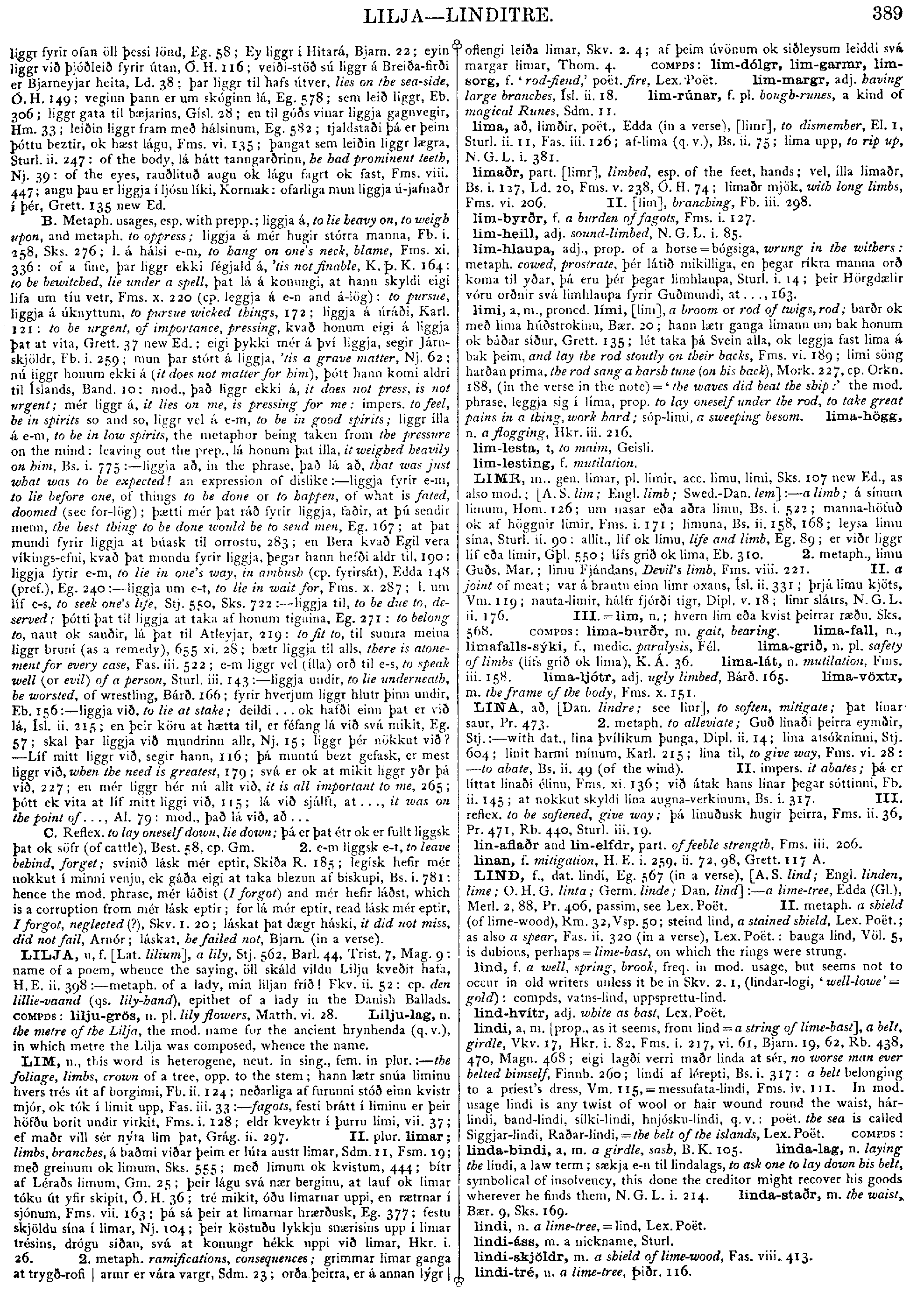
lindi, a, m. [prop., as it seems, from lind = a string of lime-bast] , a belt, girdle, Vkv. 17, Hkr. i. 82, Fms. i. 217, vi. 61, Bjarn. 19, 62, Rb. 438, 470, Magn. 468; eigi lagði verri maðr linda at sér, noworse man ever belted himself, Finnb. 260; lindi af lirepti, Bs. i. 317: a belt belonging to a priest's dress, Vm. 115, = messufata-lindi, Fms. iv. III. In mod. usage lindi is any twist of wool or hair wound round the waist, hár- lindi, band-lindi, silki-lindi, hujosku-lindi, q. v.: poet, the sea is called Siggjar-lindi, Raðar-lindi, -=/ he belt of the islands, Lex. Poët. COMPDS: linda-bindi, a, m. a girdle, s as h, B. K. 105. linda-lag, n. laying the lindi, a law term; sækja e-n til lindalags, to a s k one tolay down his belt, symbolical of insolvency, this done the creditor might recover his goods wherever he finds them, N. G. L. i. 214. linda-staðr, m. thewaist,, Bær. 9, Sks. 169.
|
Source: Cleasby/Vigfusson, page b0390, entry 45 View original page image as: [TIFF] [PNG] [View previous entry] [View next entry] |
[Comment on this entry] [View comments] |
The following entry has been hand-corrected once. |
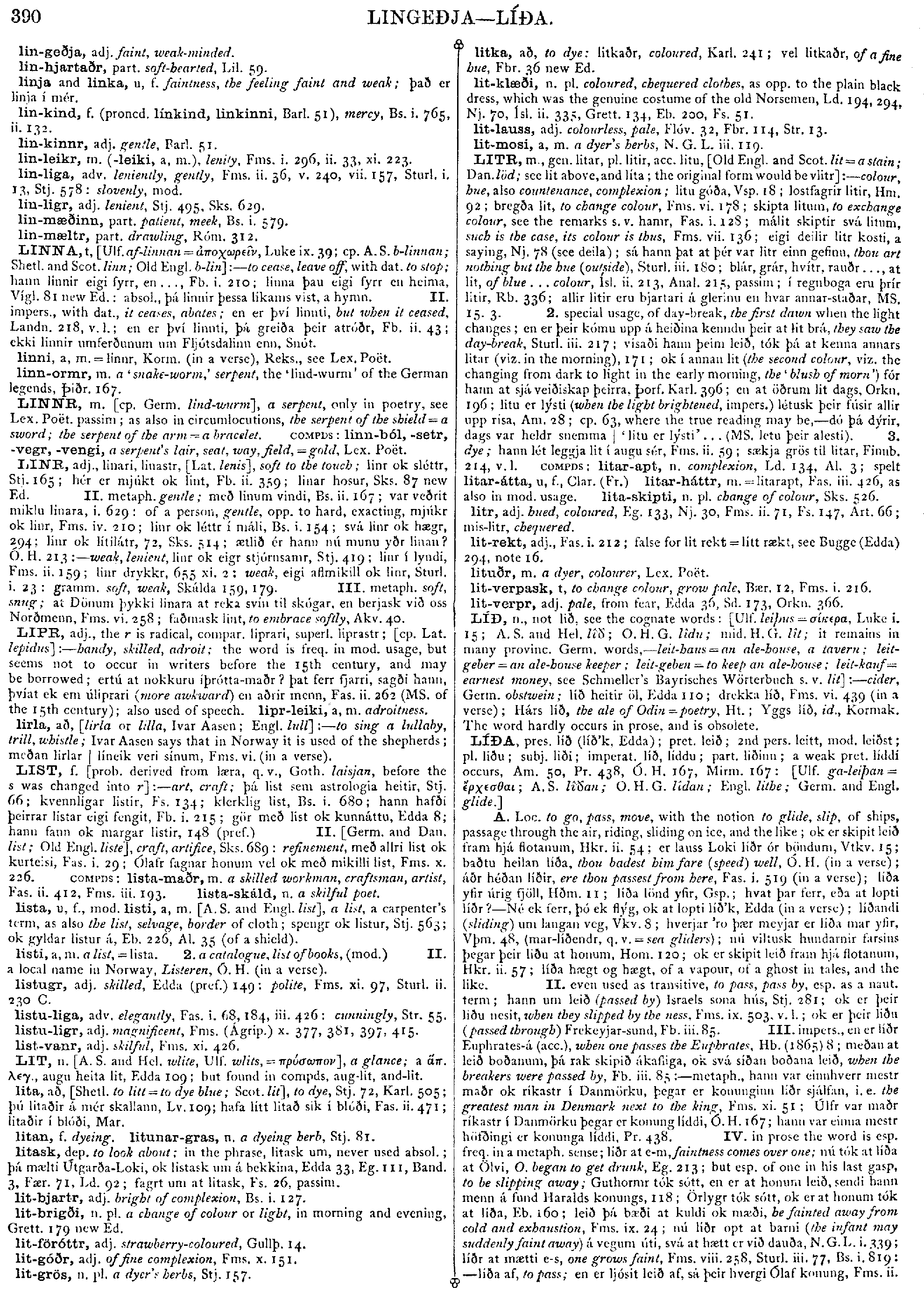
LÍÐA, pres. líð (líð'k, Edda); pret. leið; 2nd pers. leitt, mod. leiðst; pl. liðu; subj. liði; imperat. líð, líddu; part. liðinn; a weak pret. líddi occurs, Am. 50, Pr. 438, Ó.H. 167, Mirm. 167: [Ulf. ga-leiþan = GREEK; A.S. lîðan; O.H.G. lîdan; Engl. lithe; Germ. and Engl. glide.] A. Loc. to go, pass, move, with the notion to glide, slip, of ships, passage through the air, riding, sliding on ice, and the like; ok er skipit leið fram hjá flotanum, Hkr. ii. 54: er lauss Loki líðr or böndum, Vtkv. 15; baðtu heilan líða, thou badest him fare (speed) well, Ó.H. (in a verse); áðr héðan líðir, ere thou passest from here, Fas. i. 519 (in a verse); líða yfir úrig fjöll, Hðm. 11; líða lönd yfir, Gsp.; hvat þar ferr, eða at lopti líðr? -- Né ek ferr, þó ek flýg, ok at lopti líð'k, Edda (in a verse); líðandi (sliding) um langan veg, Vkv. 8; hverjar 'ro þær meyjar er líða mar yfir, Vþm. 48, (mar-líðendr, q.v. = sea gliders); nú viltusk hundarnir farsins þegar þeir liðu at honum, Hom. 120; ok er skipit leið fram hjá flotanum, Hkr. ii. 57; líða hægt og hægt, of a vapour, of a ghost in tales, and the like. II. even used as transitive, to pass, pass by, esp. as a naut. term; hann um leið (passed by) Israels sona hús, Stj. 281; ok er þeir liðu nesit, when they slipped by the ness, Fms. ix. 503, v.l.; ok er þeir líðu (passed through) Frekeyjar-sund, Fb. iii. 85. III. impers., en er líðr Euphrates-á (acc.), when one passes the Euphrates, Hb. (1865) 8; meðan at leið boðanum, þá rak skipið ákafliga, ok svá síðan boðana leið, when the breakers were passed by, Fb. iii. 85 :-- metaph., hann var einnhverr mestr maðr ok ríkastr í Danmörku, þegar er konunginn líðr sjálfan, i.e. the greatest man in Denmark next to the king, Fms. xi. 51; Úlfr var maðr ríkastr í Danmörku þegar er konung líddi, Ó.H. 167; hann var einna mestr höfðingi er konunga líddi, Pr. 438. IV. in prose the word is esp. freq. in a metaph. sense; líðr at e-m, faintness comes over one; nú tók at líða at Ölvi, O. began to get drunk, Eg. 213; but esp. of one in his last gasp, to be slipping away; Guthormr tók sótt, en er at honum leið, sendi hann menn á fund Haralds konungs, 118; Örlygr tók sótt, ok er at honum tók at líða, Eb. 160; leið þá bæði at kuldi ok mæði, he fainted away from cold and exhaustion, Fms. ix. 24; nú líðr opt at barni (the infant may suddenly faint away) á vegum úti, svá at hætt er við dauða, N.G.L. i. 339; líðr at mætti e-s, one grows faint, Fms. viii. 258, Sturl. iii. 77, Bs. i. 819 :-- líða af, to pass; en er ljósit leið af, sá þeir hvergi Ólaf konung, Fms. ii.
|
Source: Cleasby/Vigfusson, page b0393, entry 10 View original page image as: [TIFF] [PNG] [View previous entry] [View next entry] |
[Comment on this entry] [View comments] |
The following entry has been hand-corrected once. |
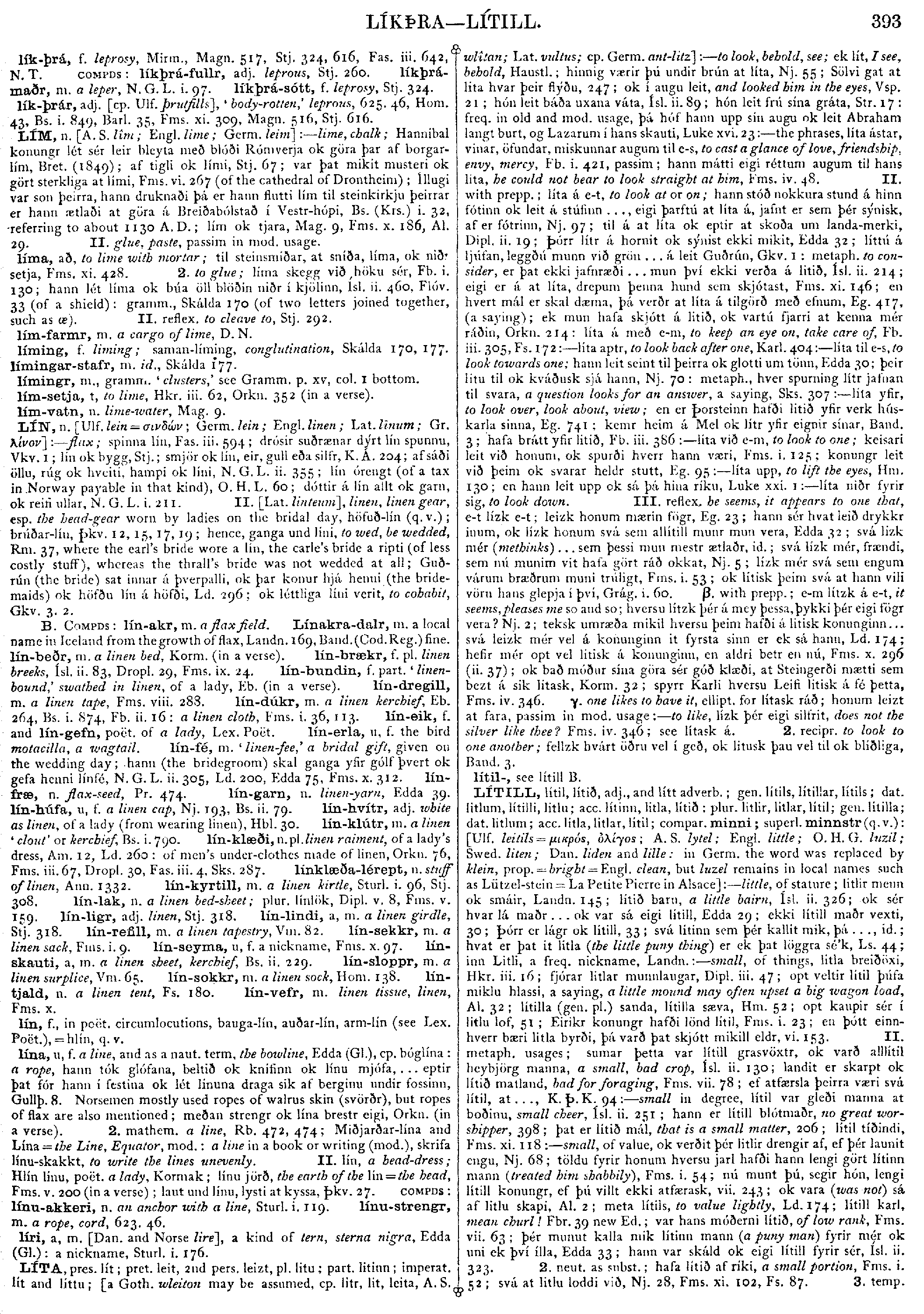
LÍN,
n.
[Ulf.
lein
=
GREEK;
Germ.
lein;
Engl.
linen;
Lat.
l num;
Gr.
GREEK]
:--
flax;
spinna
lín,
Fas.
iii.
594;
drósir
suðrænar
dýrt
lín
spunnu,
Vkv.
1;
lín
ok
bygg,
Stj.;
smjör
ok
lín,
eir,
gull
eða
silfr,
K.Á.
204;
af
sáði
öllu,
rúg
ok
hveiti,
hampi
ok
líni,
N.G.L.
ii.
355;
lín
órengt
(of
a
tax
in
Norway
payable
in
that
kind),
O.H.L.
60;
dóttir
á
lín
allt
ok
garn,
ok
reifi
ullar,
N.G.L.
i.
211.
II.
[Lat.
linteum],
linen,
linen
gear,
esp.
the
head-gear
worn
by
ladies
on
the
bridal
day,
höfuð-lín
(q.v.);
brúðar-lín,
Þkv.
12,
15,
17,
19;
hence,
ganga
und
líni,
to
wed,
be
wedded,
Rm.
37,
where
the
earl's
bride
wore
a
lín,
the
carle's
bride
a
ripti
(of
less
costly
stuff),
whereas
the
thrall's
bride
was
not
wedded
at
all;
Guðrún
(the
bride)
sat
innar
á
þverpalli,
ok
þar
konur
hjá
henni
(the
bride-maids)
ok
höfðu
lín
á
höfði,
Ld.
296;
ok
léttliga
líni
verit,
to
cohabit,
Gkv.
3.
2.
B.
COMPDS:
lín-akr,
m.
a
flax
field.
Línakra-dalr,
m.
a
local
name
in
Iceland
from
the
growth
of
flax,
Landn.
169,
Band.
(Cod.
Reg.)
fine.
lín-beðr,
m.
a
linen
bed,
Korm.
(in
a
verse).
lín-brækr,
f.
pl.
linen
breeks,
Ísl.
ii.
83,
Dropl.
29,
Fms.
ix.
24.
lín-bundin,
f.
part.
'linen-bound,'
swathed
in
linen,
of
a
lady,
Eb.
(in
a
verse).
lín-dregill,
m.
a
linen
tape,
Fms.
viii.
288.
lín-dúkr,
m.
a
linen
kerchief,
Eb.
264,
Bs.
i.
874,
Fb.
ii.
16:
a
linen
cloth,
Fms.
i.
36,
113.
lín-eik,
f.
and
lín-gefn,
poët,
of
a
lady,
Lex.
Poët.
lín-erla,
u,
f.
the
bird
motacilla,
a
wagtail.
lín-fé,
m.
'linen-fee,'
a
bridal
gift,
given
on
the
wedding
day;
hann
(the
bridegroom)
skal
ganga
yfir
gólf
þvert
ok
gefa
henni
línfé,
N.G.L.
ii.
305,
Ld.
200,
Edda
75,
Fms.
x.
312.
lín-fræ,
n.
flax-seed,
Pr.
474.
lín-garn,
n.
linen-yarn,
Edda
39.
lín-húfa,
u,
f.
a
linen
cap,
Nj.
193,
Bs.
ii.
79.
lín-hvítr,
adj.
white
as
linen,
of
a
lady
(from
wearing
linen),
Hbl.
30.
lín-klútr,
m.
a
linen
'clout'
or
kerchief,
Bs.
i.
790.
lín-klæði,
n.
pl.
linen
raiment,
of
a
lady's
dress,
Am.
12,
Ld.
260:
of
men's
under-clothes
made
of
linen,
Orkn.
76,
Fms.
iii.
67,
Dropl.
30,
Fas.
iii.
4,
Sks.
287.
línklæða-lérept,
n.
stuff
of
linen,
Ann.
1332.
lín-kyrtill,
m.
a
linen
kirtle,
Sturl.
i.
96,
Stj.
308.
lín-lak,
n.
a
linen
bed-sheet;
plur.
línlök,
Dipl.
v.
8,
Fms.
v.
159.
lín-ligr,
adj.
linen,
Stj.
318.
lín-lindi,
a,
m.
a
linen
girdle,
Stj.
318.
lín-refill,
m.
a
linen
tapestry,
Vm.
82.
lín-sekkr,
m.
a
linen
sack,
Fms.
i.
9.
lín-seyma,
u,
f.
a
nickname,
Fms.
x.
97.
lín-skauti,
a,
m.
a
linen
sheet,
kerchief,
Bs.
ii.
229.
lín-sloppr,
m.
a
linen
surplice,
Vm.
65.
lín-sokkr,
m.
a
linen
sock,
Hom.
138.
lín-tjald,
n.
a
linen
tent,
Fs.
180.
lín-vefr,
m.
linen
tissue,
linen,
Fms.
x.
num;
Gr.
GREEK]
:--
flax;
spinna
lín,
Fas.
iii.
594;
drósir
suðrænar
dýrt
lín
spunnu,
Vkv.
1;
lín
ok
bygg,
Stj.;
smjör
ok
lín,
eir,
gull
eða
silfr,
K.Á.
204;
af
sáði
öllu,
rúg
ok
hveiti,
hampi
ok
líni,
N.G.L.
ii.
355;
lín
órengt
(of
a
tax
in
Norway
payable
in
that
kind),
O.H.L.
60;
dóttir
á
lín
allt
ok
garn,
ok
reifi
ullar,
N.G.L.
i.
211.
II.
[Lat.
linteum],
linen,
linen
gear,
esp.
the
head-gear
worn
by
ladies
on
the
bridal
day,
höfuð-lín
(q.v.);
brúðar-lín,
Þkv.
12,
15,
17,
19;
hence,
ganga
und
líni,
to
wed,
be
wedded,
Rm.
37,
where
the
earl's
bride
wore
a
lín,
the
carle's
bride
a
ripti
(of
less
costly
stuff),
whereas
the
thrall's
bride
was
not
wedded
at
all;
Guðrún
(the
bride)
sat
innar
á
þverpalli,
ok
þar
konur
hjá
henni
(the
bride-maids)
ok
höfðu
lín
á
höfði,
Ld.
296;
ok
léttliga
líni
verit,
to
cohabit,
Gkv.
3.
2.
B.
COMPDS:
lín-akr,
m.
a
flax
field.
Línakra-dalr,
m.
a
local
name
in
Iceland
from
the
growth
of
flax,
Landn.
169,
Band.
(Cod.
Reg.)
fine.
lín-beðr,
m.
a
linen
bed,
Korm.
(in
a
verse).
lín-brækr,
f.
pl.
linen
breeks,
Ísl.
ii.
83,
Dropl.
29,
Fms.
ix.
24.
lín-bundin,
f.
part.
'linen-bound,'
swathed
in
linen,
of
a
lady,
Eb.
(in
a
verse).
lín-dregill,
m.
a
linen
tape,
Fms.
viii.
288.
lín-dúkr,
m.
a
linen
kerchief,
Eb.
264,
Bs.
i.
874,
Fb.
ii.
16:
a
linen
cloth,
Fms.
i.
36,
113.
lín-eik,
f.
and
lín-gefn,
poët,
of
a
lady,
Lex.
Poët.
lín-erla,
u,
f.
the
bird
motacilla,
a
wagtail.
lín-fé,
m.
'linen-fee,'
a
bridal
gift,
given
on
the
wedding
day;
hann
(the
bridegroom)
skal
ganga
yfir
gólf
þvert
ok
gefa
henni
línfé,
N.G.L.
ii.
305,
Ld.
200,
Edda
75,
Fms.
x.
312.
lín-fræ,
n.
flax-seed,
Pr.
474.
lín-garn,
n.
linen-yarn,
Edda
39.
lín-húfa,
u,
f.
a
linen
cap,
Nj.
193,
Bs.
ii.
79.
lín-hvítr,
adj.
white
as
linen,
of
a
lady
(from
wearing
linen),
Hbl.
30.
lín-klútr,
m.
a
linen
'clout'
or
kerchief,
Bs.
i.
790.
lín-klæði,
n.
pl.
linen
raiment,
of
a
lady's
dress,
Am.
12,
Ld.
260:
of
men's
under-clothes
made
of
linen,
Orkn.
76,
Fms.
iii.
67,
Dropl.
30,
Fas.
iii.
4,
Sks.
287.
línklæða-lérept,
n.
stuff
of
linen,
Ann.
1332.
lín-kyrtill,
m.
a
linen
kirtle,
Sturl.
i.
96,
Stj.
308.
lín-lak,
n.
a
linen
bed-sheet;
plur.
línlök,
Dipl.
v.
8,
Fms.
v.
159.
lín-ligr,
adj.
linen,
Stj.
318.
lín-lindi,
a,
m.
a
linen
girdle,
Stj.
318.
lín-refill,
m.
a
linen
tapestry,
Vm.
82.
lín-sekkr,
m.
a
linen
sack,
Fms.
i.
9.
lín-seyma,
u,
f.
a
nickname,
Fms.
x.
97.
lín-skauti,
a,
m.
a
linen
sheet,
kerchief,
Bs.
ii.
229.
lín-sloppr,
m.
a
linen
surplice,
Vm.
65.
lín-sokkr,
m.
a
linen
sock,
Hom.
138.
lín-tjald,
n.
a
linen
tent,
Fs.
180.
lín-vefr,
m.
linen
tissue,
linen,
Fms.
x.
|
Source: Cleasby/Vigfusson, page b0394, entry 16 View original page image as: [TIFF] [PNG] [View previous entry] [View next entry] |
[Comment on this entry] [View comments] |
The following entry has been hand-corrected once. |
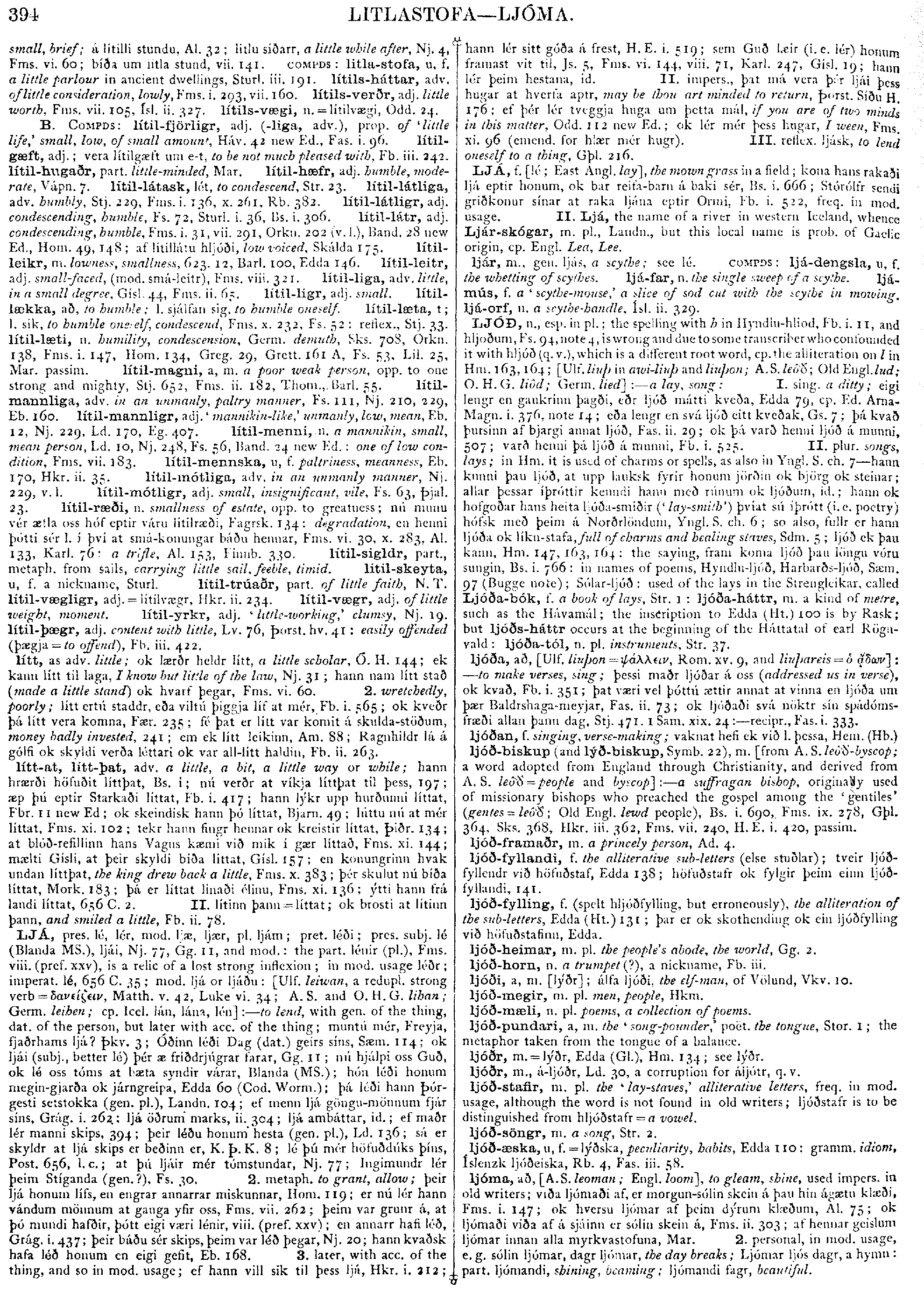
ljóði, a, m. [lýðr]; álfa ljóði, the elf-man, of Völund, Vkv. 10.
|
Source: Cleasby/Vigfusson, page b0395, entry 24 View original page image as: [TIFF] [PNG] [View previous entry] [View next entry] |
[Comment on this entry] [View comments] |
The following entry has been hand-corrected once. |
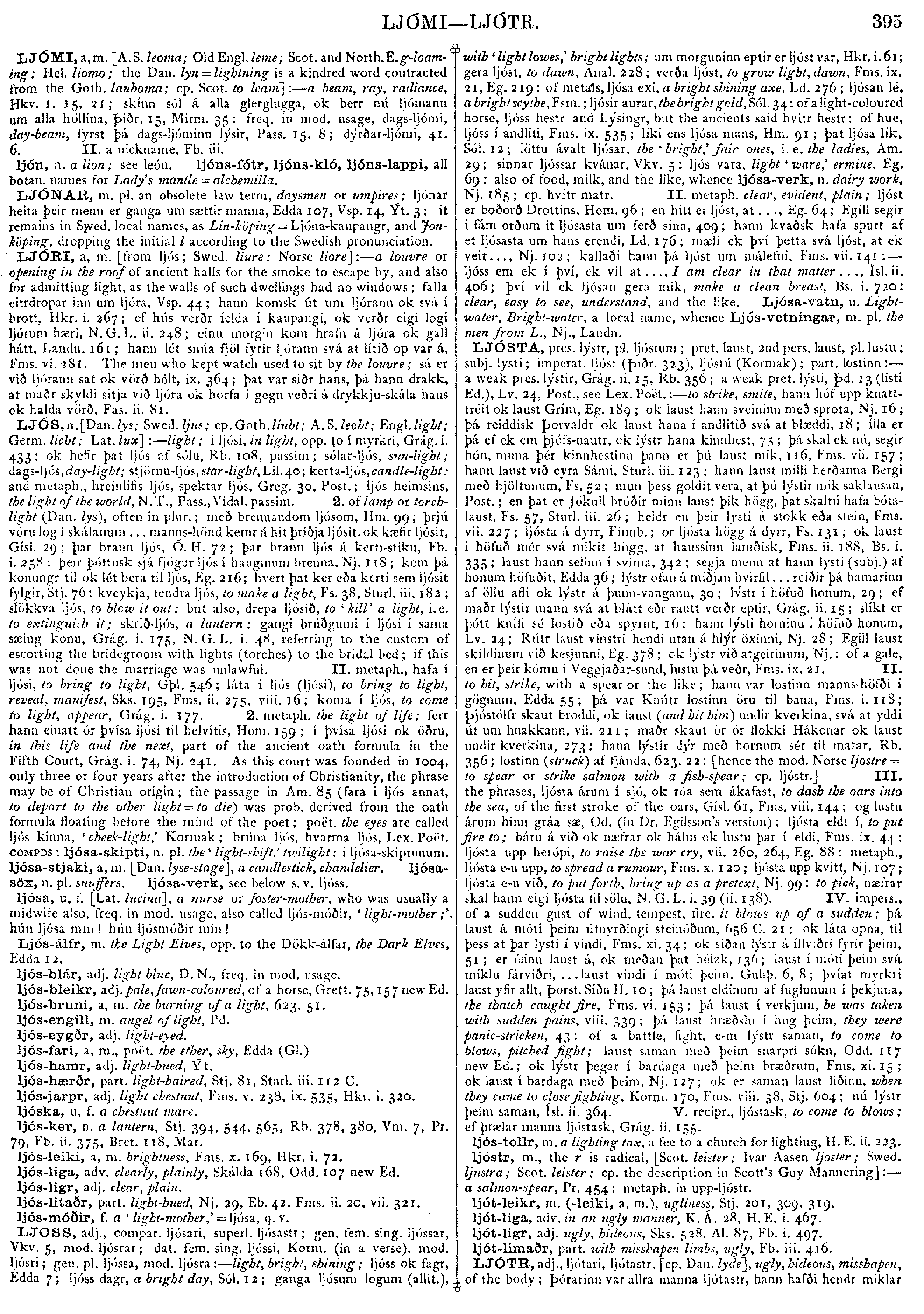
LJÓSS, adj., compar. ljósari, superl. ljósastr; gen. fem. sing. ljóssar, Vkv. 5, mod. ljósrar; dat. fem. sing. ljóssi, Korm. (in a verse), mod. ljósri; gen. pl. ljóssa, mod. ljósra :-- light, bright, shining; ljóss ok fagr, Edda 7; ljóss dagr, a bright day, Sól. 12; ganga ljósum logum (allit.), with 'light lowes,' bright lights; um morguninn eptir er ljóst var, Hkr. i. 61; gera ljóst, to dawn, Anal. 228; verða ljóst, to grow light, dawn, Fms. ix. 21, Eg. 219: of metals, ljósa exi, a bright shining axe, Ld. 276; ljósan lé, a bright scythe, Fsm.; ljósir aurar, the bright gold, Sól. 34: of a light-coloured horse, ljóss hestr and Lýsingr, but the ancients said hvítr hestr: of hue, ljóss í andliti, Fms. ix. 535; líki ens ljósa mans, Hm. 91; þat ljósa lík, Sól. 12; löttu ávalt ljósar, the 'bright,' fair ones, i.e. the ladies, Am. 29; sinnar ljóssar kvánar, Vkv. 5: ljós vara, light 'ware,' ermine, Eg. 69: also of food, milk, and the like, whence ljósa-verk, n. dairy work, Nj. 185; cp. hvítr matr. II. metaph. clear, evident, plain; ljóst er boðorð Drottins, Hom. 96; en hitt er ljóst, at ..., Eg. 64; Egill segir í fám orðum it ljósasta um ferð sína, 409; hann kvaðsk hafa spurt af et ljósasta um hans erendi, Ld. 176; mæli ek því þetta svá ljóst, at ek veit ..., Nj. 102; kallaði hann þá ljóst um málefni, Fms. vii. 141 :-- ljóss em ek í því, ek vil at ..., I am clear in that matter ..., Ísl. ii. 406; því vil ek ljósan gera mik, make a clean breast, Bs. i. 720: clear, easy to see, understand, and the like. Ljósa-vatn, n. Light-water, Bright-water, a local name, whence Ljós-vetningar, m. pl. the men from L., Nj., Landn.
|
Source: Cleasby/Vigfusson, page b0401, entry 8 View original page image as: [TIFF] [PNG] [View previous entry] [View next entry] |
[Comment on this entry] [View comments] |
The following entry has not been hand-corrected. However, the page is reserved and someone is correcting it. |
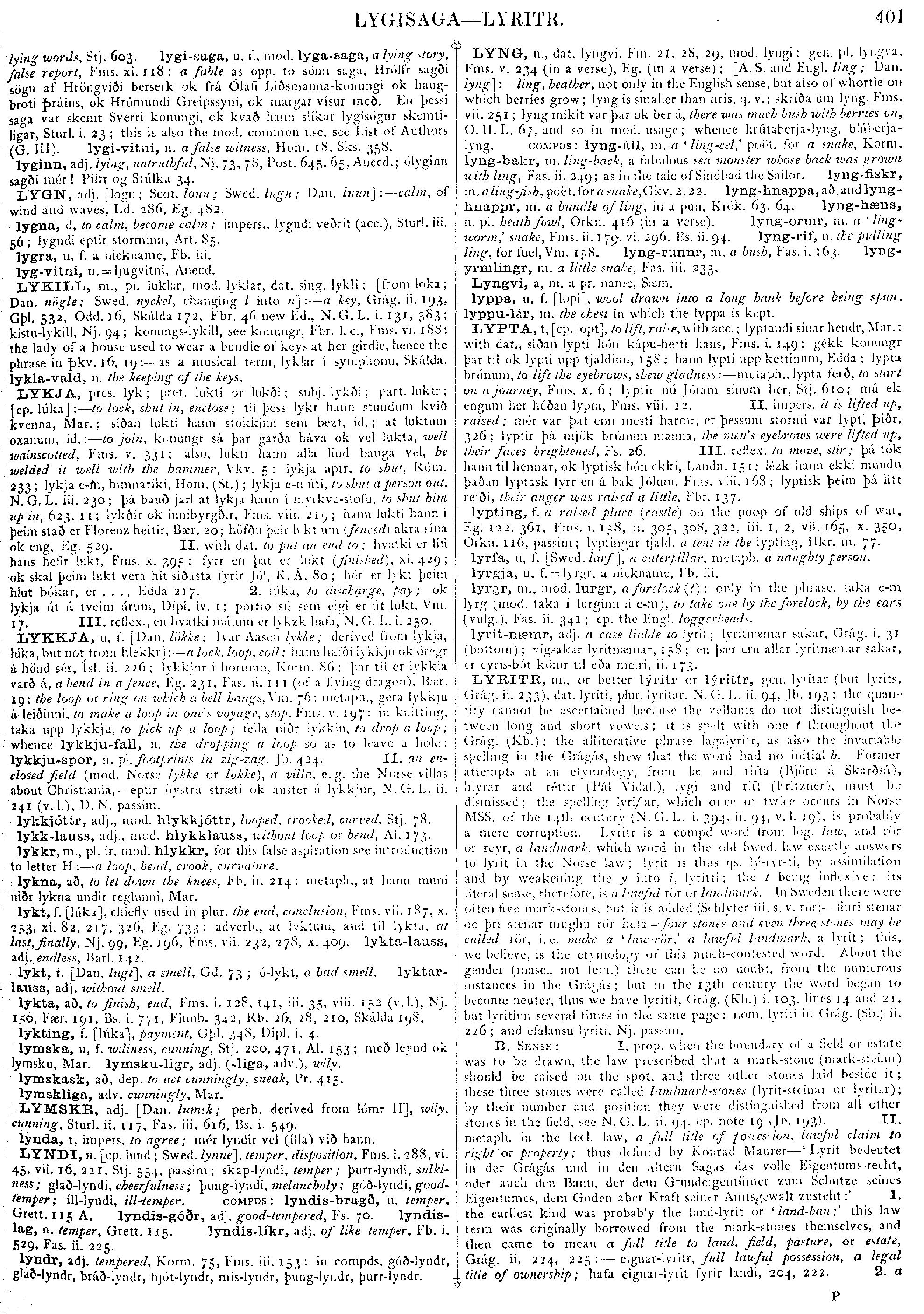
LYKJA, prts. lyk; pret. lukti or lukði; subj. lykði; part. luktr; [cp. lúka] :-- to lock, shut in, enclose; til þess lykr hann stundum kvið kvenna, Mar.; síðan lukti hann stokkinn sem bezt, id.; at luktum oxanum, id. :-- (to join, konungr sá þar garða háva ok vel lukta, well wainscotted, Fms. v. 331; also, lukti hann alla lind bauga vel, he welded it well with the hammer, Vkv. 5: lykja aptr, to shut. Róm. 233; lykja e-m, himnaríki, Hom. (St.); lykja e-n úti, to shut a person out, N. G. L. iii. 230; þá bauð jarl at lykja hann í myrkva-stofu, to shut him up in, 623. II; lykðir ok innibyrgðir, Fms. viii. 219; hann lukti hann í þeim stað er Florenz heitir, Bær. 20; höfðu þeir lukt um (fenced) akra sína ok eng, Eg. 529. II. with dat. to put an end to: hvatki er líti hans hefir lakt, Fms. x. 395; fyrr en þat er lukt (finished), xi. 429; ok skal þeim lukt vera hit síðasta fyrir Jól, K. Á. 80; her er lykt þeim hlut bókar, er ..., Edda 217. 2. lúka, to discharge, pay; ok lykja út á tveim árum, Dipl. iv. j; portio sú sem eigi er út lukt, Vm. 17. III. reflex., en hvatki málum er lykzk liafa, N. G. L. i. 250.
|
Source: Cleasby/Vigfusson, page b0408, entry 6 View original page image as: [TIFF] [PNG] [View previous entry] [View next entry] |
[Comment on this entry] [View comments] |
The following entry has not been hand-corrected. However, the page is reserved and someone is correcting it. |
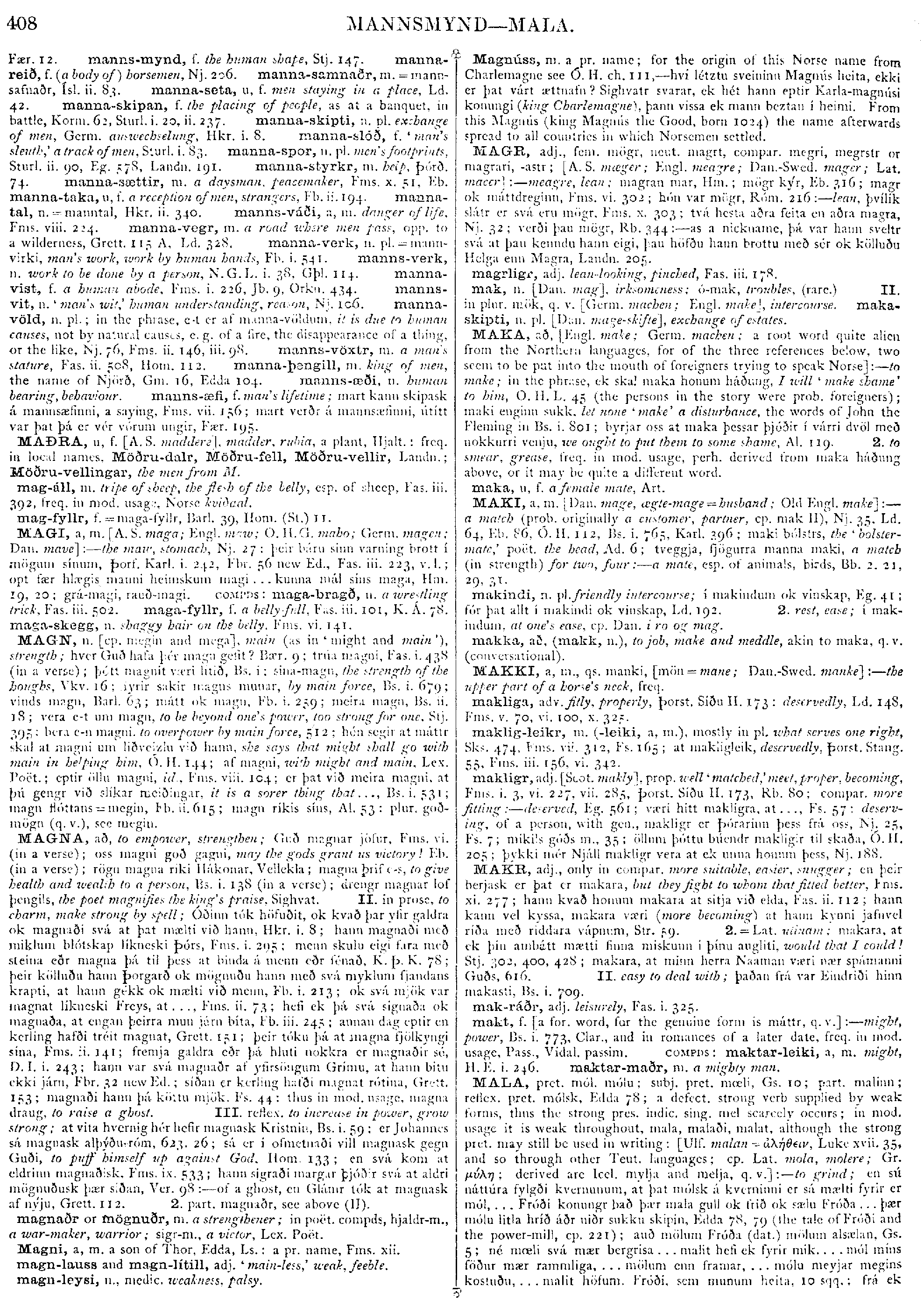
MAGN, n. [cp. mcgin and mega], main (as in 'might and main'), strength; hver Guð ha fa Jx'r inagu gefit? Birr. 9; tnia njagni, Fas. i-438 (in a verse); þett mas;nit VHTÍ litið, Bs. i; lina-magn, /be strength of the boughs, Vkv. 16; ivrir sakir ir. aims munar, by main force, Bs. i. 679; vinds inp. gn, Barl. 63; matt ok inagn, Fb. i. 25. 9; meira magn, Bs. ii. 18; vera e-t uni magn, to be beyond one's power, loo strong for one, Stj. 395: bi-ru e-n magni, to overpower by main force, 51 2; hen segir at mattr ska) at Jiiagni um liðvcivciu v^ð hann, she says that might shall go with main in he'ping him, O. II. 144; af maimi, wi'h might and main. Lex. Poët.; eptir öllu magni, id., Fms. viii. 104; er bat við ineira magni, at Jjú gengr við r-líkar ruciðingar, it i s a sorer thing that..., Bs. i. 531; magn tíóttans -- megin, frb. ii. 6i5; magn rikis sins, Al. 53: plur. goð- inögn (q. v.), see megin.
|
Source: Cleasby/Vigfusson, page b0413, entry 29 View original page image as: [TIFF] [PNG] [View previous entry] [View next entry] |
[Comment on this entry] [View comments] |
The following entry has been hand-corrected once. |
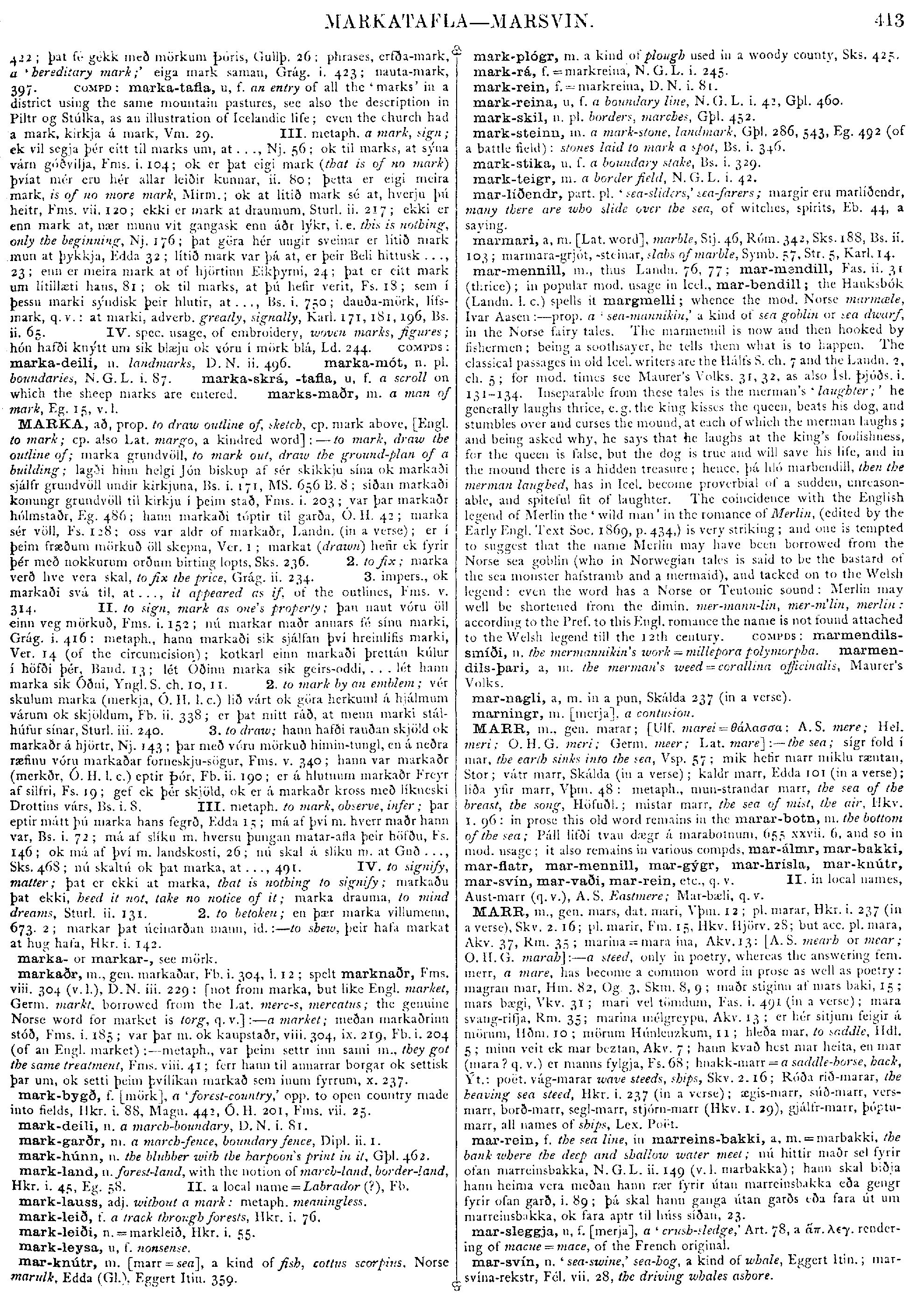
MARR, m., gen. mars, dat. mari, Vþm. 12; pl. marar, Hkr. i. 237 (in a verse), Skv. 2. 16; pl. marir, Fm. 15, Hkv. Hjörv. 28; but acc. pl. mara, Akv. 37, Rm. 35; marina = mara ina, Akv. 13: (A.S. mearh or mear; O.H.G. marah] :-- a steed, only in poetry, whereas the answering fem. merr, a mare, has become a common word in prose as well as poetry: magran mar, Hm. 82, Og. 3, Skm. 8, 9; maðr stiginn af mars baki, 15; mars bægi, Vkv. 31; mari vel tömdum, Fas. i. 491 (in a verse); mara svang-rifja, Rm. 35; marina mélgreypu, Akv. 13; er hér sitjum feigir á mörum, Hðm. 10; mörum Húnlenzkum, 11; hleða mar, to saddle, Hdl. 5; minn veit ek mar beztan, Akv. 7; hann kvað hest mar heita, en mar (mara? q.v.) er manns fylgja, Fs. 68; hnakk-marr = a saddle-horse, hack, Ýt.: poët, vág-marar wave steeds, ships, Skv. 2. 16; Róða rið-marar, the heaving sea steed, Hkr. i. 237 (in a verse); ægis-marr, súð-marr, vers-marr, borð-marr, segl-marr, stjórn-marr (Hkv. 1. 29), gjálfr-marr, þóptu-marr, all names of ships. Lex. Poët.
|
Source: Cleasby/Vigfusson, page b0418, entry 32 View original page image as: [TIFF] [PNG] [View previous entry] [View next entry] |
[Comment on this entry] [View comments] |
The following entry has been hand-corrected once. |
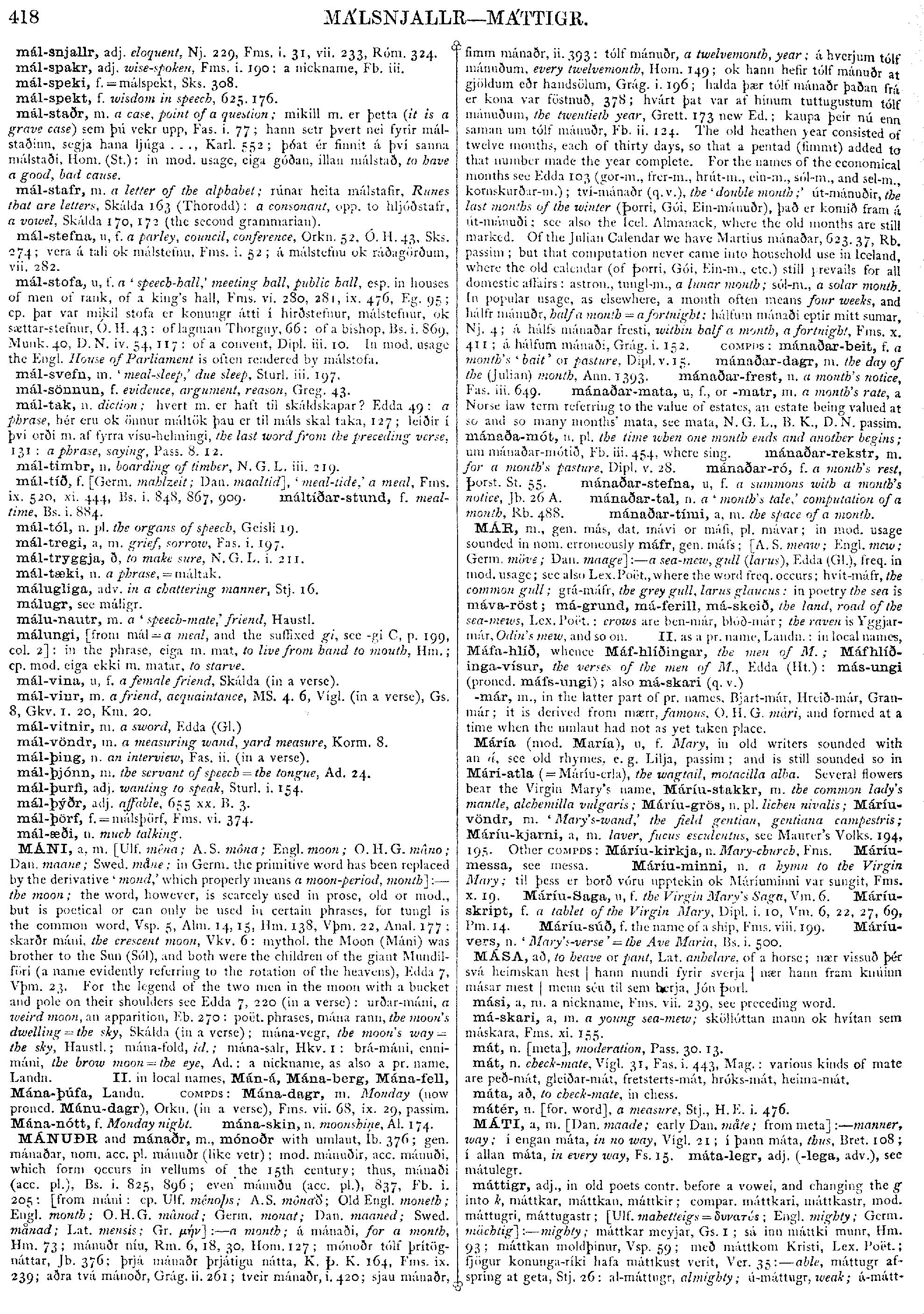
MÁNI, a. m. [Ulf. mêna; A.S. môna; Engl. moon; O.H.G. mâno; Dan. maane; Swed. måne; in Germ. the primitive word has been replaced by the derivative 'mond,' which properly means a moon-period, month] :-- the moon; the word, however, is scarcely used in prose, old or mod., but is poetical or can only be used in certain phrases, for tungl is the common word, Vsp. 5, Alm. 14, 15, Hm. 138, Vþm. 22, Anal. 177; skarðr máni, the crescent moon, Vkv. 6: mythol. the Moon (Máni) was brother to the Sun (Sól), and both were the children of the giant Mundilföri (a name evidently referring to the rotation of the heavens), Edda 7, Vþm. 23. For the legend of the two men in the moon with a bucket and pole on their shoulders see Edda 7, 220 (in a verse): urðar-múni, a weird moon, an apparition, Fb. 270: poët, phrases, mána rann, the moon's dwelling = the sky, Skálda (in a verse); mána-vegr, the moon's way = the sky, Haustl.; mána-fold, id.; mána-salr, Hkv. 1: brá-máni, enni-máni, the brow moon = the eye, Ad.: a nickname, as also a pr. name, Landn. II. in local names, Mán-á, Mána-berg, Mána-fell, Mána-þúfa, Landn. COMPDS: Mána-dagr, m. Monday (now proncd. Mánu-dagr), Orkn. (in a verse), Fms. vii. 68, ix. 29, passim. Mána-nótt, f. Monday night. mána-skin, n. moonshine, Al. 174.
|
Source: Cleasby/Vigfusson, page b0443, entry 6 View original page image as: [TIFF] [PNG] [View previous entry] [View next entry] |
[Comment on this entry] [View comments] |
The following entry has been hand-corrected once. |
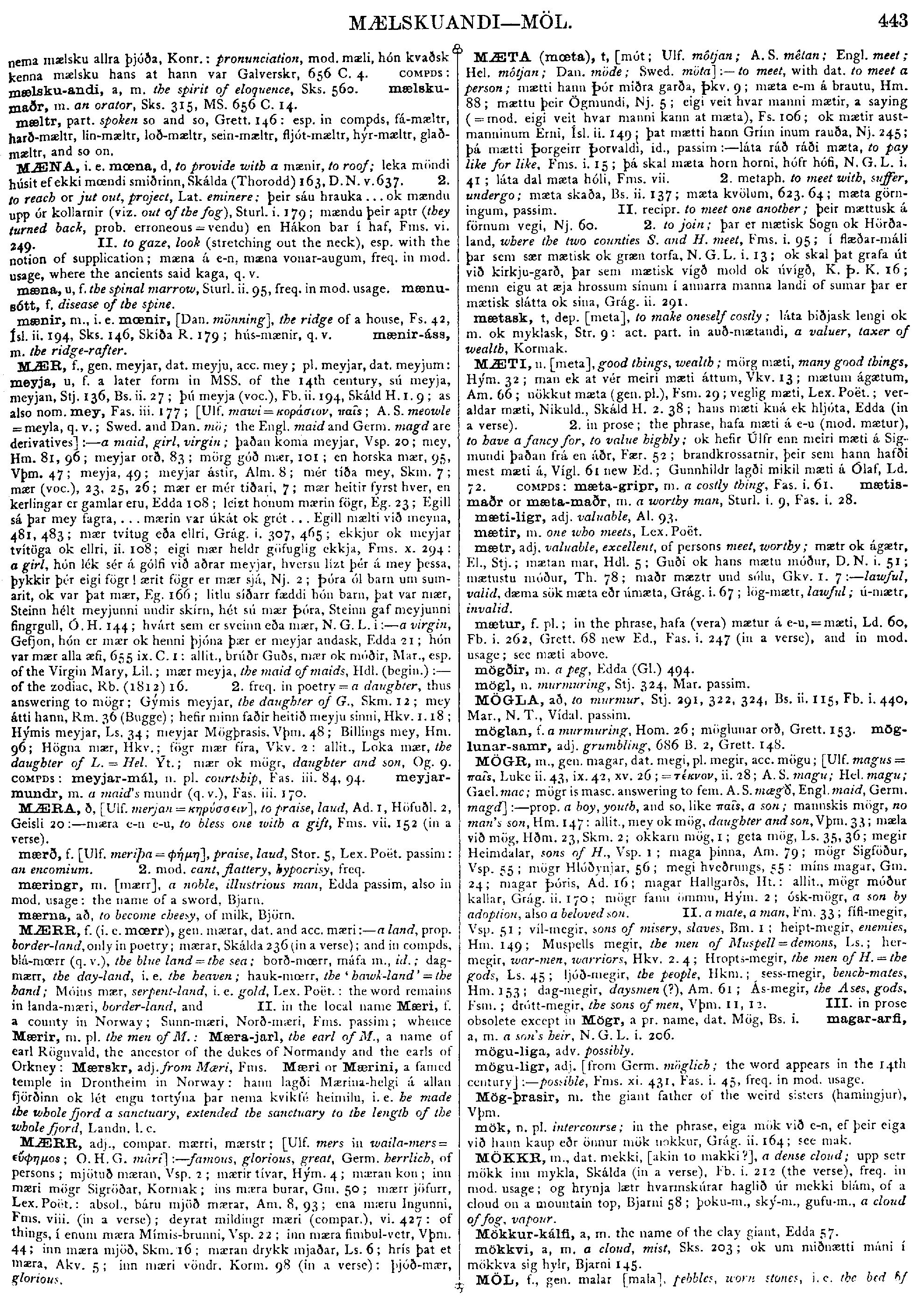
MÆR, f., gen. meyjar, dat. meyju, acc. mey; pl. meyjar, dat. meyjum: meyja, u, f. a later form in MSS. of the 14th century, sú meyja, meyjan, Stj. 136, Bs. ii. 27; þú meyja (voc.), Fb. ii. 194, Skáld H. 1. 9; as also nom. mey, Fas. iii. 177; [Ulf. mawi = GREEK; A.S. meowle = meyla, q.v.; Swed. and Dan. mö; the Engl. maid and Germ. magd are derivatives] :-- a maid, girl, virgin; þaðan koma meyjar, Vsp. 20; mey, Hm. 81, 96; meyjar orð, 83; mörg góð mær, 101; en horska mær, 95, Vþm. 47; meyja, 49; meyjar ástir, Alm. 8; mér tíða mey, Skm. 7; mær (voc.), 23, 25, 26; mær er mér tíðari, 7; mær heitir fyrst hver, en kerlingar er gamlar eru, Edda 108; leizt honum mærin fögr, Eg. 23; Egill sá þar mey fagra, ... mærin var úkát ok grét ... Egill mælti við meyna, 481, 483; mær tvítug eða ellri, Grág. i. 307, 465; ekkjur ok meyjar tvítöga ok ellri, ii. 108; eigi mær heldr göfuglig ekkja, Fms. x. 294: a girl, hón lék sér á gólfi við aðrar meyjar, hversu lízt þér á mey þessa, þykkir þér eigi fögr! ærit fögr er mær sjá, Nj. 2; Þóra ól barn um sumarit, ok var þat mær, Eg. 166; litlu síðarr fæddi hón barn, þat var mær, Steinn hélt meyjunni undir skírn, hét sú mær Þóra, Steinn gaf meyjunni fingrgull, Ó.H. 144; hvárt sem er sveinn eða mær, N.G.L. i :-- a virgin, Gefjon, hón er mær ok henni þjóna þær er meyjar andask, Edda 21; hón var mær alla æfi, 655 ix. C. 1: allit., brúðr Guðs, mær ok móðir, Mar., esp. of the Virgin Mary, Lil.; mær meyja, the maid of maids, Hdl. (begin.) :-- of the zodiac, Rb. (1812) 16. 2. freq. in poetry = a daughter, thus answering to mögr; Gýmis meyjar, the daughter of G., Skm. 12; mey átti hann, Rm. 36 (Bugge); hefir minn faðir heitið meyju sinni, Hkv. 1. 18; Hýmis meyjar, Ls. 34; meyjar Mögþrasis, Vþm. 48; Billings mey, Hm. 96; Högna mær, Hkv.; fögr mær fíra, Vkv. 2: allit., Loka mær, the daughter of L. = Hel. Ýt.; mær ok mögr, daughter and son, Og. 9.COMPDS: meyjar-mál, n. pl. courtship, Fas. iii. 84, 94. meyjar-mundr, m. a maid's mundr (q.v.), Fas. iii. 170.
| Result Page: |  |
Previous | 1 2 3 4 5 6 7 8 9 10 11 12 13 14 | Next |  |
Germanic Lexicon Project (main page)
This search system was written by
Sean Crist
Please consider
volunteering
to correct the data in these online dictionaries.
No rights reserved. Feel free to use these data in any way you please.