|
|

Tip: In the search results, you can click on any word or abbreviation for more information.
|
Source: Cleasby/Vigfusson, page b0715, entry 2 View original page image as: [TIFF] [PNG] [View previous entry] [View next entry] |
[Comment on this entry] [View comments] |
The following entry has been hand-corrected once. |
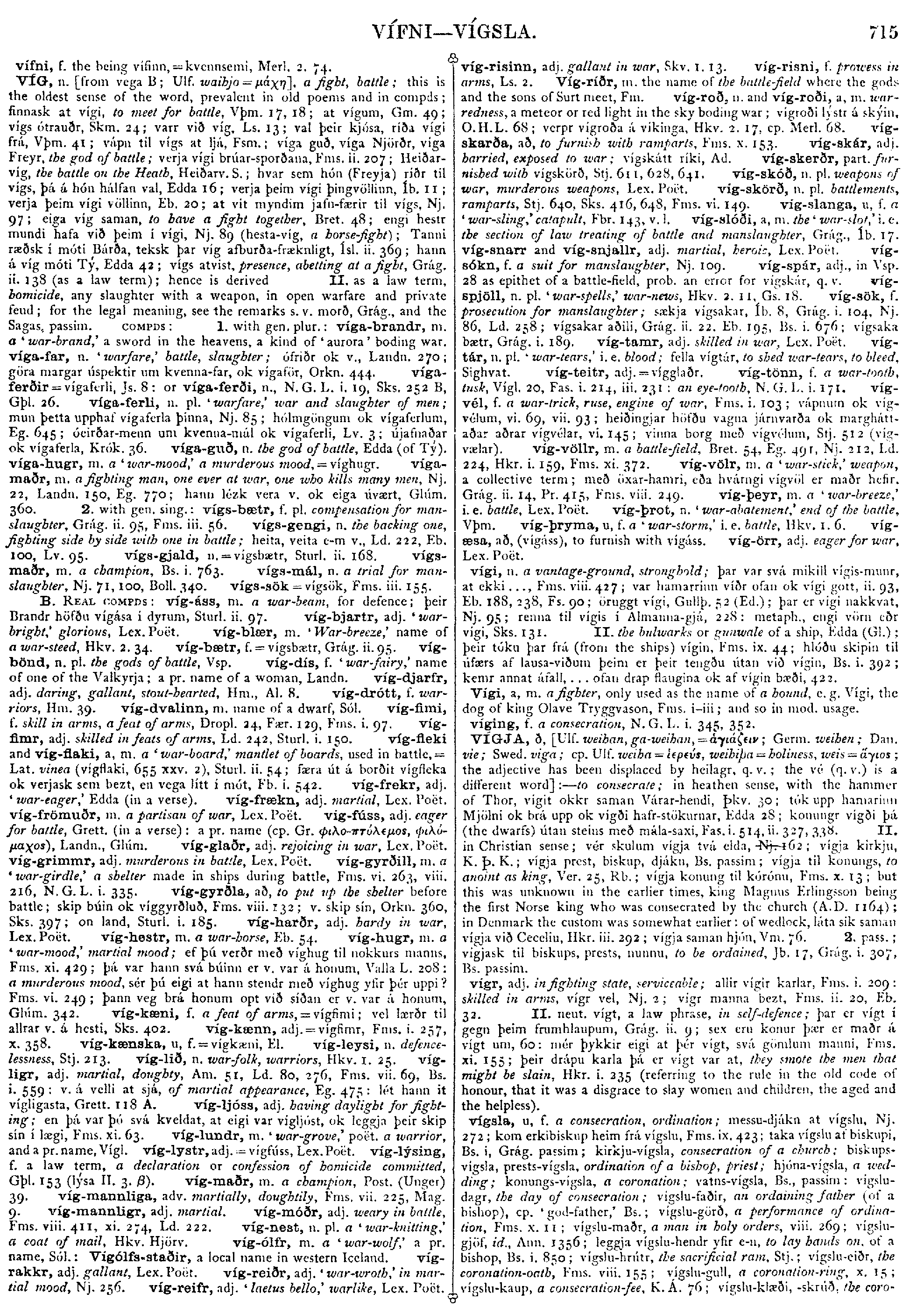
VÍG,
n.
[from
vega
B;
Ulf.
waihjo
=
GREEK],
a
fight,
battle;
this
is
the
oldest
sense
of
the
word,
prevalent
in
old
poems
and
in
compds;
finnask
at
vígi,
to
meet
for
battle,
Vþm.
17,
18;
at
vígum,
Gm.
49;
vígs
ótrauðr,
Skm.
24;
varr
við
víg,
Ls.
13;
val
þeir
kjósa,
ríða
vígi
frá,
Vþm.
41;
vápn
til
vígs
at
ljá,
Fsm.;
víga
guð,
víga
Njörðr,
víga
Freyr,
the
god
of
battle;
verja
vígi
brúar-sporðana,
Fms.
ii.
207;
Heiðar-víg,
the
battle
on
the
Heath,
Heiðarv.
S.;
hvar
sem
hón
(Freyja)
ríðr
til
vígs,
þá
á
hón
hálfan
val,
Edda
16;
verja
þeim
vígi
þingvöllinn,
Íb.
11;
verja
þeim
vígi
völlinn,
Eb.
20;
at
vit
myndim
jafn-færir
til
vígs,
Nj.
97;
eiga
víg
saman,
to
have
a
fight
together,
Bret.
48;
engi
hestr
mundi
hafa
við
þeim
í
vígi,
Nj.
89
(hesta-víg,
a
horse-fight];
Tanni
ræðsk
í
móti
Bárða,
teksk
þar
víg
afburða-fræknligt,
Ísl.
ii.
369;
hann
á
víg
móti
Tý,
Edda
42;
vígs
atvist,
presence,
abetting
at
a
fight,
Grág.
ii.
138
(as
a
law
term);
hence
is
derived
II.
as
a
law
term,
homicide,
any
slaughter
with
a
weapon,
in
open
warfare
and
private
feud;
for
the
legal
meaning,
see
the
remarks
s.v.
morð,
Grág.,
and
the
Sagas,
passim.
COMPDS:
1.
with
gen.
plur.:
víga-brandr,
m.
a
'war-brand,'
a
sword
in
the
heavens,
a
kind
of
'aurora'
boding
war.
víga-far,
n.
'warfare,'
battle,
slaughter;
ófriðr
ok
v.,
Laudn.
270;
göra
margar
úspektir
um
kvenna-far,
ok
vígaför,
Orkn.
444.
víga-ferðir
=
vígaferli,
Js.
8:
or
víga-ferði,
n.,
N.G.L.
i.
19,
Sks.
252
B,
Gþl.
26.
víga-ferli,
n.
pl.
'warfare,'
war
and
slaughter
of
men;
mun
þetta
upphaf
vígaferla
þinna,
Nj.
85;
hólmgöngum
ok
vígaferlum,
Eg.
645;
óeirðar-menn
um
kvenna-mál
ok
vígaferli,
Lv.
3;
újafnaðar
ok
vígaferla,
Krók.
36.
víga-guð,
n.
the
god
of
battle,
Edda
(of
Tý).
víga-hugr,
m.
a
'war-mood,'
a
murderous
mood,
=
víghugr.
víga-maðr,
m.
a
fighting
man,
one
ever
at
war,
one
who
kills
many
men,
Nj.
22,
Landn.
150,
Eg.
770;
hann
lézk
vera
v.
ok
eiga
úvært,
Glúm.
360.
2.
with
gen.
sing.:
vígs-bætr,
f.
pl.
compensation
for
manslaughter,
Grág.
ii.
95,
Fms.
iii.
56.
vígs-gengi,
n.
the
backing
one,
fighting
side
by
side
with
one
in
battle;
heita,
veita
e-m
v.,
Ld.
222,
Eb.
100,
Lv.
95.
víga-gjald,
n.
=
vígsbætr,
Sturl.
ii.
168.
vígs-maðr,
m.
a
champion,
Bs.
i.
763.
vígs-mál,
n.
a
trial
for
manslaughter,
Nj.
71,
100,
Boll.
340.
vígs-sök
=
vígsök,
Fms.
iii.
155.
B.
REAL
COMPDS:
víg-áss,
m.
a
war-beam,
for
defence;
þeir
Brandr
höfðu
vígása
í
dyrum,
Sturl.
ii.
97.
víg-bjartr,
adj.
'war-bright,'
glorious,
Lex.
Poët.
víg-blær,
m.
'War-breeze,'
name
of
a
war-steed,
Hkv.
2.
34.
víg-bætr,
f.
=
vígsbætr,
Grág.
ii.
95.
víg-bönd,
n.
pl.
the
gods
of
battle,
Vsp.
víg-dís,
f.
'war-fairy,'
name
of
one
of
the
Valkyrja;
a
pr.
name
of
a
woman,
Landn.
víg-djarfr,
adj.
daring,
gallant,
stout-hearted,
Hm.,
Al.
8.
víg-drótt,
f.
warriors,
Hm.
39.
víg-dvalinn,
m.
name
of
a
dwarf,
Sól.
víg-fimi,
f.
skill
in
arms,
a
feat
of
arms,
Dropl.
24,
Fær.
129,
Fms.
i.
97.
víg-fimr,
adj.
skilled
in
feats
of
arms,
Ld.
242,
Sturl.
i.
150.
víg-fleki
and
víg-flaki,
a,
m.
a
'war-board,'
mantlet
of
boards,
used
in
battle,
=
Lat.
vinea
(vígflaki,
655
xxv.
2),
Sturl.
ii.
54;
færa
út
á
borðit
vígfleka
ok
verjask
sem
bezt,
en
vega
lítt
í
mót,
Fb.
i.
542.
víg-frekr,
adj.
'war-eager,'
Edda
(in
a
verse).
víg-frækn,
adj.
martial,
Lex.
Poët.
víg-frömuðr,
m.
a
partisan
of
war,
Lex.
Poët.
víg-fúss,
adj.
eager
for
battle,
Grett.
(in
a
verse):
a
pr.
name
(cp.
Gr.
GREEK),
Landn.,
Glúm.
víg-glaðr,
adj.
rejoicing
in
war.
Lex.
Poët.
vig-grimmr,
adj.
murderous
in
battle,
Lex.
Poët.
víg-gyrðill,
m.
a
'war-girdle,'
a
shelter
made
in
ships
during
battle,
Fms.
vi.
263,
viii.
216,
N.G.L.
i.
335.
víg-gyrðla,
að,
to
put
up
the
shelter
before
battle;
skip
búin
ok
víggyrðluð,
Fms.
viii.
132;
v.
skip
sín,
Orkn.
360,
Sks.
397;
on
land,
Sturl.
i.
185.
víg-harðr,
adj.
hardy
in
war,
Lex.
Poët.
víg-hestr,
m,
a
war-horse,
Eb.
54.
víg-hugr,
m.
a
'war-mood,'
martial
mood;
ef
þú
verðr
með
víghug
til
nokkurs
manns,
Fms.
xi.
429;
þá
var
hann
svá
búinn
er
v.
var
á
honum,
Valla
L.
208:
a
murderous
mood,
sér
þú
eigi
at
hann
stendr
með
víghug
yfir
þér
uppi?
Fms.
vi.
249;
þann
veg
brá
honum
opt
við
síðan
er
v.
var
á
honum,
Glúm.
342.
víg-kæni,
f.
a
feat
of
arms,
=
vígfimi;
vel
lærðr
til
allrar
v.
á
hesti,
Sks.
402.
víg-kænn,
adj.
=
vígfimr,
Fms.
i.
257,
x.
358.
víg-kænska,
u,
f.
=
vígkæni,
El.
víg-leysi,
n.
defencelessness
Stj.
213.
víg-lið,
n.
war-folk,
warriors,
Hkv.
1.
25.
víg-ligr,
adj.
martial,
doughty,
Am.
51,
Ld.
80,
276,
Fms.
vii.
69,
Bs.
i.
559:
v.
á
velli
at
sjá,
of
martial
appearance,
Eg.
475:
lét
hann
it
vígligasta,
Grett.
118
A.
víg-ljóss,
adj.
having
daylight
for
fighting;
en
þá
var
þó
svá
kveldat,
at
eigi
var
vígljóst,
ok
leggja
þeir
skip
sín
í
lægi,
Fms.
xi.
63.
víg-lundr,
m.
'war-grove,'
poët,
a
warrior,
and
a
pr.
name,
Vígl.
víg-lystr,
adj.
=
vígfúss,
Lex.
Poët.
víg-lýsing,
f.
a
law
term,
a
declaration
or
confession
of
homicide
committed,
Gþl.
153
(lýsa
II.
3.
 ).
víg-maðr,
m.
a
champion,
Post.
(Unger)
39.
víg-mannliga,
adv.
martially,
doughtily,
Fms.
vii.
225,
Mag.
9.
víg-mannligr,
adj.
martial.
víg-móðr,
adj.
weary
in
battle,
Fms.
viii.
411,
xi.
274,
Ld.
222.
víg-nest,
n.
pl.
a
'war-knitting,'
a
coat
of
mail,
Hkv.
Hjörv.
víg-ólfr,
m.
a
'war-wolf,'
a
pr.
name,
Sól.:
Vígólfs-staðir,
a
local
name
in
western
Iceland.
víg-rakkr,
adj.
gallant,
Lex.
Poët.
víg-reiðr,
adj.
'war-wroth,'
in
martial
mood,
Nj.
256.
víg-reifr,
adj.
'laetus
bello,'
warlike,
Lex.
Poët.,
víg-risinn,
adj.
gallant
in
war,
Skv.
1.
13.
víg-risni,
f.
prowess
in
arms,
Ls.
2.
Víg-ríðr,
m.
the
name
of
the
battle-field
where
the
gods
and
the
sons
of
Surt
meet,
Fm.
víg-roð,
n.
and
víg-roði,
a,
m.
war-redness,
a
meteor
or
red
light
in
the
sky
boding
war;
vígroði
lýstr
á
skýin,
O.H.L.
68;
verpr
vígroða
á
víkinga,
Hkv.
2.
17,
cp.
Merl.
68.
víg-skarða,
að,
to
furnish
with
ramparts,
Fms.
x.
153.
víg-skár,
adj.
harried,
exposed
to
war;
vígskátt
ríki,
Ad.
víg-skerðr,
part.
furnished
with
vígskörð,
Stj.
611
628,
641.
víg-skóð,
n.
pl.
weapons
of
war,
murderous
weapons,
Lex.
Poët.
víg-skörð,
n.
pl.
battlements,
ramparts,
Stj.
640,
Sks.
416,
648,
Fms.
vi.
149.
víg-slanga,
u,
f.
a
'war-sling,'
catapult,
Fbr.
143,
v.l.
víg-slóði,
a,
m.
the
'war-slot,'
i.e.
the
section
of
law
treating
of
battle
and
manslaughter,
Grág.,
Íb.
17.
víg-snarr
and
víg-snjallr,
adj.
martial,
heroic.
Lex.
Poët.
víg-sókn,
f.
a
suit
for
manslaughter,
Nj.
109.
víg-spár,
adj.,
in
Vsp.
28
as
epithet
of
a
battle-field,
prob.
an
error
for
vígskár,
q.v.
víg-spjöll,
n.
pl.
'war-spells,'
war-news,
Hkv.
2.
11,
Gs.
18.
víg-sök,
f.
prosecution
for
manslaughter;
sækja
vígsakar,
Íb.
8,
Grág.
i.
104,
Nj.
86,
Ld.
258;
vígsakar
aðili,
Grág.
ii.
22.
Eb.
195,
Bs.
i.
676;
vígsaka
bætr,
Grág.
i.
189.
víg-tamr,
adj.
skilled
in
war,
Lex.
Poët.
víg-tár,
n.
pl.
'war-tears,'
i.e.
blood;
fella
vígtár,
to
shed
war-tears,
to
bleed,
Sighvat.
víg-teitr,
adj.
=
vígglaðr.
víg-tönn,
f.
a
war-tooth,
tusk,
Vígl.
20,
Fas.
i.
214,
iii.
231:
an
eye-tooth,
N.G.L.
i.
171.
víg-vél,
f.
a
war-trick,
ruse,
engine
of
war,
Fms.
i.
103;
vápnum
ok
vígvélum,
vi.
69,
vii.
93;
heiðingjar
höfðu
vagna
járnvarða
ok
margháttaðar
aðrar
vígvélar,
vi.
145;
vinna
borg
með
vígvélum,
Stj.
512
(vígvælar).
víg-völlr,
m.
a
battle-field,
Bret.
54,
Eg.
491,
Nj.
212,
Ld.
224,
Hkr.
i.
159,
Fms.
xi.
372.
víg-völr,
m.
a
'war-stick,'
weapon,
a
collective
term;
með
öxar-hamri,
eða
hvárngi
vígvöl
er
maðr
hefir,
Grág.
ii.
14,
Pr.
415,
Fms.
viii.
249.
víg-þeyr,
m.
a
'war-breeze,'
i.e.
battle.
Lex.
Poët.
víg-þrot,
n.
'war-abatement'
end
of
the
battle,
Vþm.
víg-þryma,
u,
f.
a
'war-storm,'
i.e.
battle,
Hkv.
1.
6.
víg-æsa,
að,
(vígáss),
to
furnish
with
vígáss.
víg-örr,
adj.
eager
for
war,
Lex.
Poët.
).
víg-maðr,
m.
a
champion,
Post.
(Unger)
39.
víg-mannliga,
adv.
martially,
doughtily,
Fms.
vii.
225,
Mag.
9.
víg-mannligr,
adj.
martial.
víg-móðr,
adj.
weary
in
battle,
Fms.
viii.
411,
xi.
274,
Ld.
222.
víg-nest,
n.
pl.
a
'war-knitting,'
a
coat
of
mail,
Hkv.
Hjörv.
víg-ólfr,
m.
a
'war-wolf,'
a
pr.
name,
Sól.:
Vígólfs-staðir,
a
local
name
in
western
Iceland.
víg-rakkr,
adj.
gallant,
Lex.
Poët.
víg-reiðr,
adj.
'war-wroth,'
in
martial
mood,
Nj.
256.
víg-reifr,
adj.
'laetus
bello,'
warlike,
Lex.
Poët.,
víg-risinn,
adj.
gallant
in
war,
Skv.
1.
13.
víg-risni,
f.
prowess
in
arms,
Ls.
2.
Víg-ríðr,
m.
the
name
of
the
battle-field
where
the
gods
and
the
sons
of
Surt
meet,
Fm.
víg-roð,
n.
and
víg-roði,
a,
m.
war-redness,
a
meteor
or
red
light
in
the
sky
boding
war;
vígroði
lýstr
á
skýin,
O.H.L.
68;
verpr
vígroða
á
víkinga,
Hkv.
2.
17,
cp.
Merl.
68.
víg-skarða,
að,
to
furnish
with
ramparts,
Fms.
x.
153.
víg-skár,
adj.
harried,
exposed
to
war;
vígskátt
ríki,
Ad.
víg-skerðr,
part.
furnished
with
vígskörð,
Stj.
611
628,
641.
víg-skóð,
n.
pl.
weapons
of
war,
murderous
weapons,
Lex.
Poët.
víg-skörð,
n.
pl.
battlements,
ramparts,
Stj.
640,
Sks.
416,
648,
Fms.
vi.
149.
víg-slanga,
u,
f.
a
'war-sling,'
catapult,
Fbr.
143,
v.l.
víg-slóði,
a,
m.
the
'war-slot,'
i.e.
the
section
of
law
treating
of
battle
and
manslaughter,
Grág.,
Íb.
17.
víg-snarr
and
víg-snjallr,
adj.
martial,
heroic.
Lex.
Poët.
víg-sókn,
f.
a
suit
for
manslaughter,
Nj.
109.
víg-spár,
adj.,
in
Vsp.
28
as
epithet
of
a
battle-field,
prob.
an
error
for
vígskár,
q.v.
víg-spjöll,
n.
pl.
'war-spells,'
war-news,
Hkv.
2.
11,
Gs.
18.
víg-sök,
f.
prosecution
for
manslaughter;
sækja
vígsakar,
Íb.
8,
Grág.
i.
104,
Nj.
86,
Ld.
258;
vígsakar
aðili,
Grág.
ii.
22.
Eb.
195,
Bs.
i.
676;
vígsaka
bætr,
Grág.
i.
189.
víg-tamr,
adj.
skilled
in
war,
Lex.
Poët.
víg-tár,
n.
pl.
'war-tears,'
i.e.
blood;
fella
vígtár,
to
shed
war-tears,
to
bleed,
Sighvat.
víg-teitr,
adj.
=
vígglaðr.
víg-tönn,
f.
a
war-tooth,
tusk,
Vígl.
20,
Fas.
i.
214,
iii.
231:
an
eye-tooth,
N.G.L.
i.
171.
víg-vél,
f.
a
war-trick,
ruse,
engine
of
war,
Fms.
i.
103;
vápnum
ok
vígvélum,
vi.
69,
vii.
93;
heiðingjar
höfðu
vagna
járnvarða
ok
margháttaðar
aðrar
vígvélar,
vi.
145;
vinna
borg
með
vígvélum,
Stj.
512
(vígvælar).
víg-völlr,
m.
a
battle-field,
Bret.
54,
Eg.
491,
Nj.
212,
Ld.
224,
Hkr.
i.
159,
Fms.
xi.
372.
víg-völr,
m.
a
'war-stick,'
weapon,
a
collective
term;
með
öxar-hamri,
eða
hvárngi
vígvöl
er
maðr
hefir,
Grág.
ii.
14,
Pr.
415,
Fms.
viii.
249.
víg-þeyr,
m.
a
'war-breeze,'
i.e.
battle.
Lex.
Poët.
víg-þrot,
n.
'war-abatement'
end
of
the
battle,
Vþm.
víg-þryma,
u,
f.
a
'war-storm,'
i.e.
battle,
Hkv.
1.
6.
víg-æsa,
að,
(vígáss),
to
furnish
with
vígáss.
víg-örr,
adj.
eager
for
war,
Lex.
Poët.
|
Source: Cleasby/Vigfusson, page b0717, entry 3 View original page image as: [TIFF] [PNG] [View previous entry] [View next entry] |
[Comment on this entry] [View comments] |
The following entry has been hand-corrected once. |
vík-skart = víkskorit, indented with bays, Post. (Unger) 234.
|
Source: Cleasby/Vigfusson, page b0726, entry 8 View original page image as: [TIFF] [PNG] [View previous entry] [View next entry] |
[Comment on this entry] [View comments] |
The following entry has been hand-corrected once. |
YLMASK, ð, [qs. ylfask or from ólmr?], to chafe, rage; gjarna vilda ek þér legðit eigi fjándskap til mín, eða yðarr kraptr ylmðisk eigi til várrar tignar, Fms. x. 289; þá ylmðisk (ulmþis Cod.) hann í móti, 420 (Ágrip, Mork. 228, l.c.); þá ylmðisk allr herr at móti þeim, Post. (Unger) 220; kalla þeir þetta allt hernað ok rán ... en hinir ylmðusk því meirr, Bs. i. 496 (ylmask, ad 'verða ólmari,' Sturl. ii. 8, l.c.)
|
Source: Cleasby/Vigfusson, page b0728, entry 1 View original page image as: [TIFF] [PNG] [View previous entry] [View next entry] |
[Comment on this entry] [View comments] |
The following entry has been hand-corrected once. |
turn, Fms. x. 2, 6; ílaug hann á ýmsi lönd, Hkr. i. 24; herja á ýmsi lend, Fms. xi. 76, 89; hann falar til ýmissa vista, en ræðr enga, Lv. 57; þeir höfðu þar dvalizk í ýmsum höfnum, Eg. 93; hann seldi ymsum mönnum landnám sitt, Landn. 135; til ymsa ( = ýmissa) skalda, Þorst. Síðu 11. 172; með ýmsum píslum (v. 1. ýmissum), Post. (Unger) 33; Símon, ... hafði ýmsa m. inna álit, 656 C. 26. II. various; ganga þar ýmissar sagnir frá, Fms. ii. 105; fara ... til ýmissa landa, i. II, 77, Fb. i. 525; Orkn. 42; kvikenda líki ýmissa, fugla eða orma, Clern. 133; fann hann til þess ymissa hluti, Fms. ii. 295; í ýmissum stöðum, Stj. 113. III. with another pronom. adj.; einn ok ýiniss, one and another, etc.; um eina staði ok ymissa, Stj. 247; af einum ok ýmissim ágætum steinum, 204; unna einum nú ýmissum, Skv. 3. 39; komu siðan upp í einum ok ýmsum stöðum ok löndum, Stj.; margir ór ýmissum áttum, Orkn. (in a verse); af þeim báðum ok ýmissimi, Stj. 15; allir ok þú y'nisir, all and sundry, i.e. each in turn, Skv. 3. 41. IV. proverbs; ýmsir eiga högg í annars garð, a saying, of dealing mutual blows; verða ýmsir brögðum fegnir, Fms. ix. 494 (in a verse); ýmsar verðr sá er margar ferr, Eg. (a saying). V. neut. as adv.; ýmist hon hugði, Skv. 3. 14; er ýmist sagt hvárr Tarquinius cða son hans færi um nótt, Róm. 386; hann spurði, hví hafa munkar lága skúa ok rauðar hosur? -- þeir svöruðu, ýmist tíðisk nú, Fms. viii. 358; hann görði ýmist, hjó eða lagði, thrust and smote altcrnately, or, now he thrust, now he smote, Nj. 8; Bolli var ýmist í Tungu eða at Helgafelli, Ld. 300; ýmist augum lítandi aptr cða fram, Mar.; into smáhringum ýmist hvítum eða svörtum, Stj. 80; ýmist Skota eðr Bretzkar aldir, Orkn. 90 (in a verse); ymist út eða niðr, Nj. 104; kallaðr ýmist Dofrafóstri cða Lúfa, Fs. 16; hann rennir ýmist upp eða ofan, Fb. iii. 408; hann var ýmist at Borg eðr at Gilsbakka, Ísl. ii. 209.
|
Source: Cleasby/Vigfusson, page b0728, entry 18 View original page image as: [TIFF] [PNG] [View previous entry] [View next entry] |
[Comment on this entry] [View comments] |
The following entry has been hand-corrected once. |
Z
(zet).
The
ancient
language
had
two
sibilant
sounds,
s
and
z;
of
which
the
z
never
stands
at
the
beginning
of
a
word,
but
is
merely
an
s
assimilated
to
a
preceding
dental,
in
the
combinations
ld,
nd,
nn,
ll,
rð,
gð,
see
Gramm.
p.
xxxvi,
col.
I.
:
its
use
in
ancient
vellums
is
very
extensive:
1.
in
genitives;
trollz,
íllz
(íllr),
allz
(allr),
holtz,
Skm.
32;
gullz,
22;
ellz
=
elds,
botz
=
botns,
Gkv.
3.
9;
vatz
and
vaz
=
vatns;
keyptz,
Hm.
107;
mótz,
Knútz
or
Knúz
=
Knúts;
vitz
(vit);
orðz,
sverðz,
barðz,
borðz,
garðz,
harðz,
langbarz,
Gkv.
2.
19;
Hjörvarðz,
Hkv.
Hjörv.
19;
morðz,
bragðz,
flagðz,
Frissb.
107,
l.
19;
or
also
orz,
Hm.
141,
etc.;
prestz,
Christz,
passim;
tjallz,
Edda
ii.
314;
landz
or
lanz,
passim;
fjallz,
Edda
ii-339;
but
tjalldz,
527;
elldz,
vindz,
317,
318;
gandz,
525;
brandz,
529;
valldz,
338;
sverðz,
borðz,
331;
but
borz,
462,
1.
20;
garz,
529;
loptz,
341
(twice);
but
lopz,
317;
netz,
327;
gautz,
345;
hugskozins,
Post.
251.
2.
in
special
forms;
stendz,
Grág.
i.
501
(from
standa);
stennz,
id.,
Ó.
H.
143;
bitzt
from
binda,
Post.
(Unger)
154;
vizk,
vizt,
vatzk
from
vinda
(II),
q.
v.;
but
vinnz
from
vinna,
q.
v.;
biz
=
biðsk
from
biðja,
Post.
(Ungcr)
240:
indeed
bizt,
bazt
may
be
both
from
binda
and
biðja:
bleiza
and
blezza
(to
bless),
höllzti,
qq.
v.;
beztr
or
baztr,
the
best;
œztr
=
œðstr;
þatz
and
þaz
--
þat
es,
Sæm.
passim;
þatztu,
Am.
87;
hvártz
=
hvárt
es,
Grág.
(Kb.)
i.
161:
even
mz
(or
mzt)
for
the
older
mk,
þóttumz,
Gkv.
2.
37.
3.
when
the
z
is
due
to
a
t
following
it;
in
the
reflex,
-sk
is
the
oldest
form,
whence
-z/,
-z,
-zs
t;
andask,
audazt,
andaz,
andazst:
in
the
superl.
zt,
efztir,
Frissb.
78,
1.
20;
harðazta,
l.
33;
snarp-
azta,
l.
16;
ríkaztr,
207,
l.
18;
fríðuzt,
l.
34;
hagazt,
Vkv.
18;
grimmaztan,
Edda
ii.
530;
máttkaztr,
280;
hvitaz,
267;
but
st
is
the
usual
form,
thus,
sárastr,
grimmastr,
hvassastr,
Gh.
17:
in
Ázt-ríðr
=
Ást-ríðr,
Ó.
H.
198,
l.
12.
4.
in
such
words
as
veizla,
gæzla,
reizla,
leizla,
hræzla,
gæzka,
lýzka,
œzka,
æzli,
vitzka
or
vizka,
hirzla,
varzla,
hanzki,
=
veitsla,
...
hirðsla,
varðsla,
handski,
etc.:
in
reflex,
neut.
part.,
thus,
hafa
borizt,
komizt,
farizt,
tekizt,
fundizt,
glazt,
sagzt,
spurzt,
kallazt,
dæmzt,
átzt,
...
(from
bera
...
eiga):
in
reflex.
2nd
pers.
pl.
pres.
and
pret.,
e.
g.
þér
segizt,
þér
sögðuzt,
qs.
segit-st,
sögðut-st,
so
as
to
distinguish
it
from
the
3rd
pers.,
þeir
sögðust,
qs.
sögðu-st.
5.
Gitzurr
or
Gizurr,
þjazi,
Özurr;
afraz-kollr,
Ó.
H.
(pref.);
huliz-hjálmr;
Vitaz-gjafi,
q.
v.;
but
alaðs-festr,
Grág.
(Kb.)
i.
88;
viz,
see
víðr
II:
in
foreign
names,
Jariz-
leifr,
Jariz-karr,
Buriz-leifr,
Gkv.
2.
19,
Fms.
vi.
The
etymology
of
words
may
often
be
decided
by
this;
e.
g.
in
beisl,
a
bridle,
beiskr,
bitter,
the
s
of
the
vellums
shews
that
neither
word
is
derived
from
bíta;
beiskr
is
in
fact
akin
to
Engl.
beestings,
Ulf.
beist
=
GREEK,
A.
S.
beost:
geiska
fullr,
Hkv.
2.
35,
is
not
from
geit,
but
from
geisa:
laz
or
latz
(p.
376,
col.
1)
is
from
Fr.
lace,
not=
Icel.
láss:
misseri
(q.
v.)
is
no
relation
to
miðr,
etc.:
at
lesti,
at
last,
being
spelt
with
s,
not
z,
is
not
related
to
latr,
but
derived
from
leistr
=
a
cobbler's
last,
at
lesti
=
Lat.
in
calce,
see
Mr.
Sweet's
Ed.
of
Gregory's
Pastoral
Care,
p.
474:
again,
vaztir
is
akin
to
vatr
=
vatn:
exceptional
cases,
--
vissi,
pret;
from
vita,
and
sess,
a
seat.
II.
after
a
single
dental
(unless
it
be
t)
s,
not
z,
is
written;
thus,
gen.
Guðs,
boðs,
brauðs,
auðs,
góðs,
óðs,
vaðs,
liðs,
öls,
fals,
háls,
frjáls,
víns,
eins,
etc.,
passim:
z
is
quite
exceptional,
e.
g.
liðz,
Frissb.
106,
ll.
16,
33
(but
liðs,
Hbl.
33,
Am.
43):
so
also
after
rn,
rl,
nl,
rn,
fn,
gn,
barns,
Clem.
134;
karls,
Hkv.
2.2
;
jarls,
Hm.
97;
hrafns,
segls,
regns,
tungls
(regn,
Edda
ii.
340).
The
vellums
are
very
irregular
in
the
distinction
of
a
single
or
double
consonant,
but
the
sibilant
used
shews
the
true
form
of
the
word;
in
'Odz
Colssonar,'
Ö.
H.
(pref.)
l.
II,
the
z
and
s
shew
the
names
to
be
Oddr
and
Kolr,
not
Oðr,
Kollr;
in
a
vellum
els
would
be
gen.
of
él,
e;lz
of
eldr;
in
grunz,
Edda
ii.
287;
lunz,
317;
hlunz,
ranz,
lanz,
333;
elz,
Post,
(Unger)
234;
golz,
225,
l.
23;
odz,
Ó.
H.
(pref.),
l.
II;
alz,
etc.,
the
z
shews
that
though
there
is
only
one
n,
l,
etc.
written,
they
were
actually
sounded
double,
grunnz,
hlunnz,
rannz,
landz,
eldz,
gollz,
oddz,
allz.
2.
the
s
docs
not
change
into
z
if
the
word
is
a
compd;
as,
skáld-skapr,
vind-svalr,
út-suðr,
passim;
hirð-stjóri,
Edda
ii.
335,
shewing
that
in
ancient
times
the
pronunciation
was
more
distinct
than
at
the
present
day;
the
z
in
orðztír
(Edda
ii.
344,
orztír,
463)
shews
that
the
word
is
qs.
orðz-tírr;
yet
we
lind
such
forms
as
innzigli,
Post.
238;
guðzspjall,
239;
ástzamliga,
243;
handzceld,
Barl.;
randzaka.
Post.
134,
l.
29;
but
rannsaka,
l.
14;
nauzyn
=
nauðsyn,
Skálda
167.
21;
nauzun,
Edda
ii.
236;
anzvara,
annzkoti,
=
andsvara,
andskoti,
etc.
III.
about
the
15th
century
(or
earlier)
the
z
sound
began
to
disappear,
and
s
took
its
place,
being
at
present
the
only
sibilant
used
in
Icel.
In
later
vellums
the
z
is
therefore
cither
little
used
or
is
misapplied,
as
in
the
ad-
ditions
by
the
third
hand
in
the
Flatey-book,
or
it
is
used
to
excess
as
in
modern
Dutch.
In
modern
spelling,
including
Editions
of
Sagas,
the
z
has
been
disused,
except
in
the
instances
coming
under
the
rule
given
in
I.
4:
yet
with
exception
of
ðs,
for
the
moderns
write
leiðsla,
hræðsla,
beiðsla,
náðst,
old
leizla,
názt,
except
in
reisla
(i.
e.
reizla)
from
reiða;
hirzla
qs.
hirdsla.
2.
zz
is
sounded
as
ss,
blessa,
Gissur,
Össur;
so
also
vass,
boss,
=
vatz,
botz;
even
ris,
gars,
lans,
sans,
for
orz,
garz,
lanz,
sanz
(gen.
of
orð,
garðr,
land,
sandr).
|
Source: Cleasby/Vigfusson, page b0729, entry 2 View original page image as: [TIFF] [PNG] [View previous entry] [View next entry] |
[Comment on this entry] [View comments] |
The following entry has been hand-corrected once. |
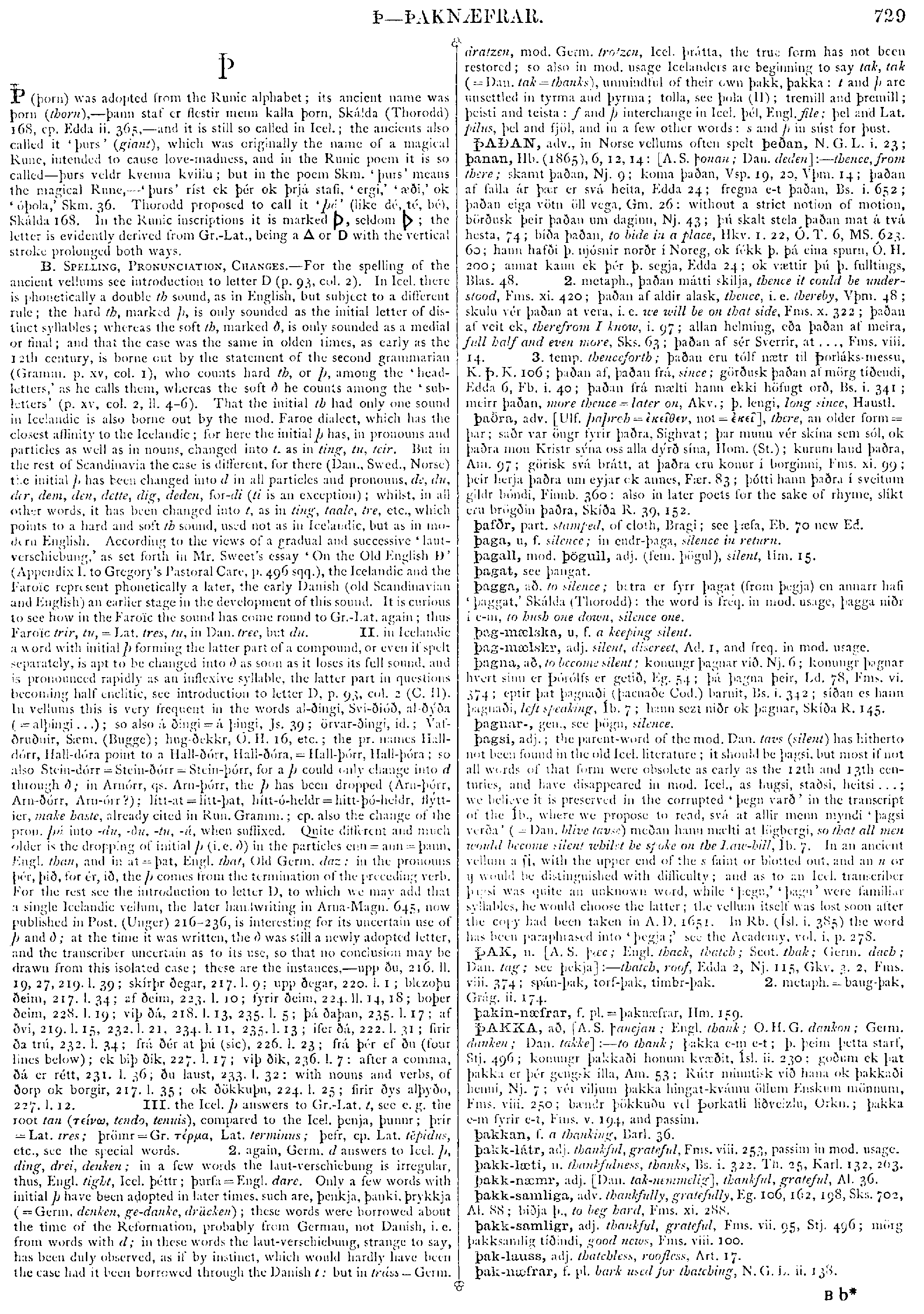
Þ
(þorn)
was
adopted
from
the
Runic
alphabet;
its
ancient
name
was
þorn
(thorn),
--
þann
staf
er
flestir
menn
kalla
þorn,
Skálda
(Thorodd)
168,
cp.
Edda
ii.
365,
--
and
it
is
still
so
called
in
Icel.;
the
ancients
also
called
it
'þurs'
(giant),
which
was
originally
the
name
of
a
magical
Rune,
intended
to
cause
love-madness,
and
in
the
Runic
poem
it
is
so
called
--
þurs
veldr
kvenna
kvillu;
but
in
the
poem
Skm.
'þurs'
means
the
magical
Rune,
--
'þurs'
ríst
ek
þér
ok
þrjá
stafi,
'ergi,'
'æði,'
ok
'óþola,'
Skm.
36.
Thorodd
proposed
to
call
it
'þé'
(like
dé,
té,
bé),
Skálda
168.
In
the
Runic
inscriptions
it
is
marked
RUNE,
seldom
RUNE;
the
letter
is
evidently
derived
from
Gr.-Lat.,
being
a
RUNE
or
RUNE
with
the
vertical
stroke
prolonged
both
ways.
B.
SPELLING,
PRONUNCIATION,
CHANGES.
--
For
the
spelling
of
the
ancient
vellums
see
introduction
to
letter
D
(p.
93,
col.
2).
In
Icel.
there
is
phonetically
a
double
th
sound,
as
in
English,
but
subject
to
a
different
rule;
the
hard
th,
marked
þ
is
only
sounded
as
the
initial
letter
of
distinct
syllables;
whereas
the
soft
th,
marked
ð
is
only
sounded
as
a
medial
or
final;
and
that
the
case
was
the
same
in
olden
times,
as
early
as
the
12th
century,
is
borne
out
by
the
statement
of
the
second
grammarian
(Gramm.
p.
xv,
col.
1),
who
counts
hard
th,
or
þ,
among
the
'head-letters,'
as
he
calls
them,
whereas
the
soft
ð
he
counts
among
the
'sub-letters'
(p.
xv,
col.
2,
ll.
4-6).
That
the
initial
th
had
only
one
sound
in
Icelandic
is
also
borne
out
by
the
mod.
Faroe
dialect,
which
has
the
closest
affinity
to
the
Icelandic;
for
here
the
initial
þ
has,
in
pronouns
and
particles
as
well
as
in
nouns,
changed
into
t
as
in
ting,
tu,
teir.
But
in
the
rest
of
Scandinavia
the
case
is
different,
for
there
(Dan.,
Swed.,
Norse)
the
initial
þ
has
been
changed
into
d
in
all
particles
and
pronouns,
de,
du,
der,
dem,
den,
dette,
dig,
deden,
for-di
(ti
is
an
exception);
whilst,
in
all
other
words,
it
has
been
changed
into
t,
as
in
ting
taale,
tre,
etc.,
which
points
to
a
hard
and
soft
th
sound,
used
not
as
in
Icelandic,
but
as
in
modern
English.
According
to
the
views
of
a
gradual
and
successive
'laut-verschiebung,'
as
set
forth
in
Mr.
Sweet's
essay
'On
the
Old
English
Ð'
(Appendix
1.
to
Gregory's
Pastoral
Care,
p.
496
sqq.),
the
Icelandic
and
the
Faroïc
represent
phonetically
a
later,
the
early
Danish
(old
Scandinavian
and
English)
an
earlier
stage
in
the
development
of
this
sound.
It
is
curious
to
see
how
in
the
Faroïc
the
sound
has
come
round
to
Gr.-Lat.
again;
thus
Faroïc
trir,
tu,
=
Lat.
tres,
tu,
in
Dan.
tree,
but
du.
II.
in
Icelandic
a
word
with
initial
þ
forming
the
latter
part
of
a
compound,
or
even
if
spelt
separately,
is
apt
to
be
changed
into
ð
as
soon
as
it
loses
its
full
sound,
and
is
pronounced
rapidly
as
an
inflexive
syllable,
the
latter
part
in
questions
becoming
half
enclitic,
see
introduction
to
letter
D,
p.
93,
col.
2
(C.
II).
In
vellums
this
is
very
frequent
in
the
words
al-ðingi,
Svi-ðióð,
al-ðýða
(=
alþingi...);
so
also
á
ðingi
=
á
þingi,
Js.
39;
örvar-ðingi,
id.;
Vaf-ðruðnir,
Sæm.
(Bugge);
hug-ðekkr,
Ó.H.
16,
etc.;
the
pr.
names
Hall-dórr,
Hall-dóra
point
to
a
Hall-ðórr,
Hall-ðóra,
=
Hall-þórr,
Hall-þora;
so
also
Stein-dórr
=
Stein-ðórr
=
Stein-þórr,
for
a
þ
could
only
change
into
d
through
ð;
in
Arnórr,
qs.
Arn-þórr,
the
þ
has
been
dropped
(Arn-þórr,
Arn-ðórr,
Arn-órr?);
lítt-at
=
lítt-þat,
hítt-ó-heldr
=
hitt-þó-heldr,
flýttier,
make
haste,
already
cited
in
Run.
Gramm.;
cp.
also
tlie
change
of
the
pron.
þú
into
-du,
-ðu,
-tu,
-ú,
when
suffixed.
Quite
different
and
much
older
is
the
dropping
of
initial
þ
(i.e.
ð)
in
the
particles
enn
=
ann
=
þann,
Engl.
than,
and
in
at
=
þat,
Engl.
that,
Old
Germ.
daz:
in
the
pronouns
þér,
þið,
for
ér,
ið,
the
þ
comes
from
the
termination
of
the
preceding
verb.
For
the
rest
see
the
introduction
to
letter
D,
to
which
we
may
add
that
a
single
Icelandic
vellum,
the
later
handwriting
in
Arna-Magn.
645,
now
published
in
Post.
(Unger)
216-236,
is
interesting
for
its
uncertain
use
of
þ
and
ð;
at
the
time
it
was
written,
the
ð
was
still
a
newly
adopted
letter,
and
the
transcriber
uncertain
as
to
its
use,
so
that
no
conclusion
may
be
drawn
from
this
isolated
case;
these
are
the
instances,
--
upp
ðu,
216.
ll.
19,
27,
219.
l.
39;
skírþr
ðegar,
217.
l.
9;
upp
ðegar,
220.
l.
1;
blezoþu
ðeim,
217.
l.
34;
af
ðeim,
223.
l.
10;
fyrir
ðeim,
224.
ll.
14,
18;
boþer
ðeim,
228.
l.
19;
viþ
ðú,
218.
l.
13,
235.
l.
5;
þá
ðaþan,
235.
l.
17;
af
ðvi,
219.
l.
15,
232.
l.
21,
234.
l.
11,
235.
l.
13;
ifer
ðá,
222.
l.
31;
firir
ða
trú,
232.
l.
34;
frá
ðér
at
þú
(sic),
226.
l.
23;
frá
þér
ef
ðu
(four
lines
below);
ek
biþ
ðik,
227.
l.
17;
viþ
ðik,
236.
l.
7:
after
a
comma,
ðá
er
rétt,
231.
l.
36;
ðu
laust,
233.
l.
32:
with
nouns
and
verbs,
of
ðorp
ok
borgir,
217.
l.
35;
ok
ðökkuþu,
224.
l.
25;
firir
ðys
alþyðo,
227.
l.
12.
III.
the
Icel.
þ
answers
to
Gr.-Lat.
t,
see
e.g.
the
root
tan
(GREEK)
compared
to
the
Icel,
þenja,
þunnr;
þrir
=
Lat.
tres;
þrömr
=
Gr.
GREEK,
Lat.
terminus;
þefr,
cp.
Lat.
t pidus,
etc.,
see
the
special
words.
2.
again,
Germ.
d
answers
to
Icel.
þ,
ding,
drei,
denken;
in
a
few
words
the
laut-verschiebung
is
irregular,
thus,
Engl.
tight,
Icel.
þéttr;
þurfa
=
Engl.
dare.
Only
a
few
words
with
initial
þ
have
been
adopted
in
later
times,
such
are,
þenkja,
þanki,
þrykkja
(=
Germ.
denken,
ge-danke,
drücken);
these
words
were
borrowed
about
the
time
of
the
Reformation,
probably
from
German,
not
Danish,
i.e.
from
words
with
d;
in
these
words
the
laut-verschiebung,
strange
to
say,
has
been
duly
observed,
as
if
by
instinct,
which
would
hardly
have
been
the
case
had
it
been
borrowed
through
the
Danish
t:
but
in
tráss
=
Germ.
dratzen,
mod.
Germ.
trotzen,
Icel.
þrátta,
tlie
true
form
has
not
been
restored;
so
also
in
mod.
usage
Icelanders
are
beginning
to
say
tak,
tak
(=
Dan.
tak
=
thanks),
unmindful
of
their
own
þakk,
þakka:
t
and
þ
are
unsettled
in
tyrma
and
þyrma;
tolla,
see
þola
(II);
tremill
and
þremill;
þeisti
and
teista:
f
and
þ
interchange
in
Icel.
þél,
Engl.
file;
þel
and
Lat.
pilus,
þel
and
fjöl,
and
in
a
few
other
words:
s
and
þ
in
súst
for
þust.
pidus,
etc.,
see
the
special
words.
2.
again,
Germ.
d
answers
to
Icel.
þ,
ding,
drei,
denken;
in
a
few
words
the
laut-verschiebung
is
irregular,
thus,
Engl.
tight,
Icel.
þéttr;
þurfa
=
Engl.
dare.
Only
a
few
words
with
initial
þ
have
been
adopted
in
later
times,
such
are,
þenkja,
þanki,
þrykkja
(=
Germ.
denken,
ge-danke,
drücken);
these
words
were
borrowed
about
the
time
of
the
Reformation,
probably
from
German,
not
Danish,
i.e.
from
words
with
d;
in
these
words
the
laut-verschiebung,
strange
to
say,
has
been
duly
observed,
as
if
by
instinct,
which
would
hardly
have
been
the
case
had
it
been
borrowed
through
the
Danish
t:
but
in
tráss
=
Germ.
dratzen,
mod.
Germ.
trotzen,
Icel.
þrátta,
tlie
true
form
has
not
been
restored;
so
also
in
mod.
usage
Icelanders
are
beginning
to
say
tak,
tak
(=
Dan.
tak
=
thanks),
unmindful
of
their
own
þakk,
þakka:
t
and
þ
are
unsettled
in
tyrma
and
þyrma;
tolla,
see
þola
(II);
tremill
and
þremill;
þeisti
and
teista:
f
and
þ
interchange
in
Icel.
þél,
Engl.
file;
þel
and
Lat.
pilus,
þel
and
fjöl,
and
in
a
few
other
words:
s
and
þ
in
súst
for
þust.
|
Source: Cleasby/Vigfusson, page b0732, entry 27 View original page image as: [TIFF] [PNG] [View previous entry] [View next entry] |
[Comment on this entry] [View comments] |
The following entry has been hand-corrected once. |
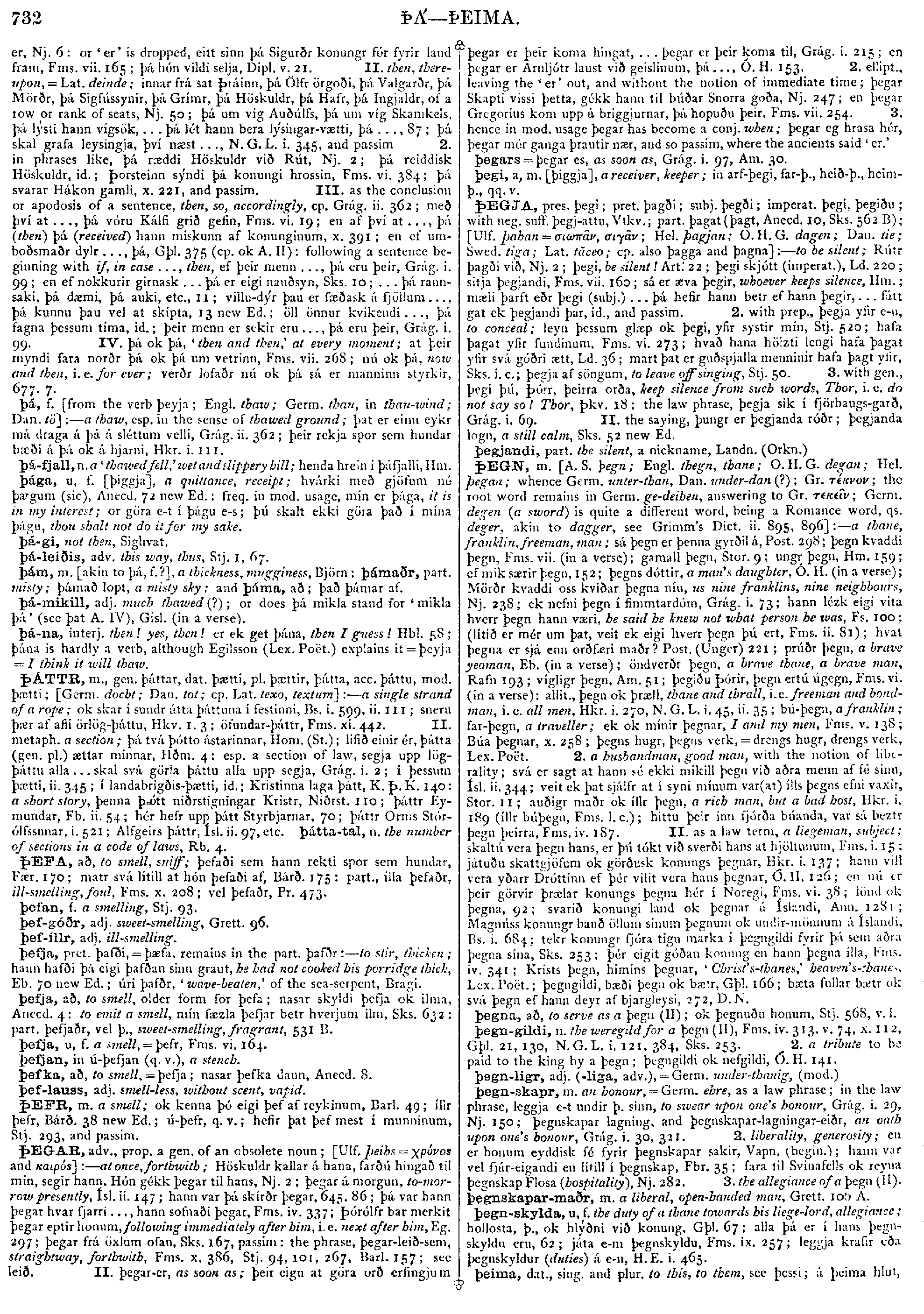
ÞEGN, m. [A.S. þegn; Engl. thegn, thane; O.H.G. degan; Hel. þegan; whence Germ. unter-than, Dan. under-dan(?); Gr. GREEK; the root word remains in Germ. ge-deiben, answering to Gr. GREEK; Germ. degen (a sword) is quite a different word, being a Romance word, qs. deger, akin to dagger, see Grimm's Dict. ii. 895, 896] :-- a thane, franklin, freeman, man; sá þegn er þenna gyrðil á, Post. 298; þegn kvaddi þegn, Fms. vii. (in a verse); gamall þegn, Stor. 9; ungr þegn, Hm. 159; ef mik særir þegn, 152; þegns dóttir, a man's daughter, Ó.H. (in a verse); Mörðr kvaddi oss kviðar þegna níu, us nine franklins, nine neighbours, Nj. 238; ek nefni þegn í fimmtardóm, Grág. i. 73; hann lézk eigi vita hverr þegn hann væri, he said he knew not what person he was, Fs. 100: (lítið er mér um þat, veit ek eigi hverr þegn þú ert, Fms. ii. 81); hvat þegna er sjá enn orðfæri maðr? Post. (Unger) 221; prúðr þegn, a brave yeoman, Eb. (in a verse); öndverðr þegn, a brave thane, a brave man, Rafn 193; vígligr þegn, Am. 51; þegiðu Þórir, þegn ertú úgegn, Fms. vi. (in a verse): allit., þegn ok þræll, thane and thrall, i.e. freeman and bondman, i.e. all men, Hkr. i. 270, N.G.L. i. 45, ii. 35; bú-þegn, a franklin; far-þegn, a traveller; ek ok mínir þegnar, I and my men, Fms. v. 138; Búa þegnar, x. 258; þegns hugr, þegns verk, = drengs hugr, drengs verk, Lex. Poët. 2. a husbandman, good man, with the notion of liberality; svá er sagt at hann sé ekki mikill þegu við adra menn af fé sínu, Ísl. ii. 344; veit ek þat sjálfr at í syni mínum var(at) ílls þegns efni vaxit, Stor. 11; auðigr maðr ok íllr þegn, a rich man, but a bad host, Hkr. i. 189 (íllr búþegu, Fms. l.c.); hittu þeir inn fjórða búanda, var sá beztr þegn þeirra, Fms. iv. 187. II. as a law term, a liegeman, subject; skaltú vera þegn hans, er þú tókt við sverði hans at hjöltunum, Fms. i. 15; játuðu skattgjöfum ok görðusk konungs þegnar, Hkr. i. 137; hann vill vera yðarr Dróttinn ef þér vilit vera hans þegnar, Ó.H. 126; en nú er þeir görvir þrælar konungs þegna hér í Noregi, Fms. vi. 38; lönd ok þegna, 92; svarið konungi land ok þegnar á Íslandi, Ann. 1281; Magnúss konungr bauð öllum sínum þegnum ok undir-mönnum á Íslandi, Bs. i. 684: tekr konungr fjóra tigu marka í þegngildi fyrir þá sem aðra þegna sína, Sks. 253; þér eigit góðan konung en hann þegna ílla, Fms. iv. 341; Krists þegn, himins þegnar, 'Christ's-thanes,' heaven's-thanes, Lex. Poët.; þegngildi, bæði þegn ok bætr, Gþl. 166; bæta fullar bætr ok svá þegn ef hann deyr af bjargleysi, 272, D.N.
|
Source: Cleasby/Vigfusson, page b0739, entry 18 View original page image as: [TIFF] [PNG] [View previous entry] [View next entry] |
[Comment on this entry] [View comments] |
The following entry has been hand-corrected once. |
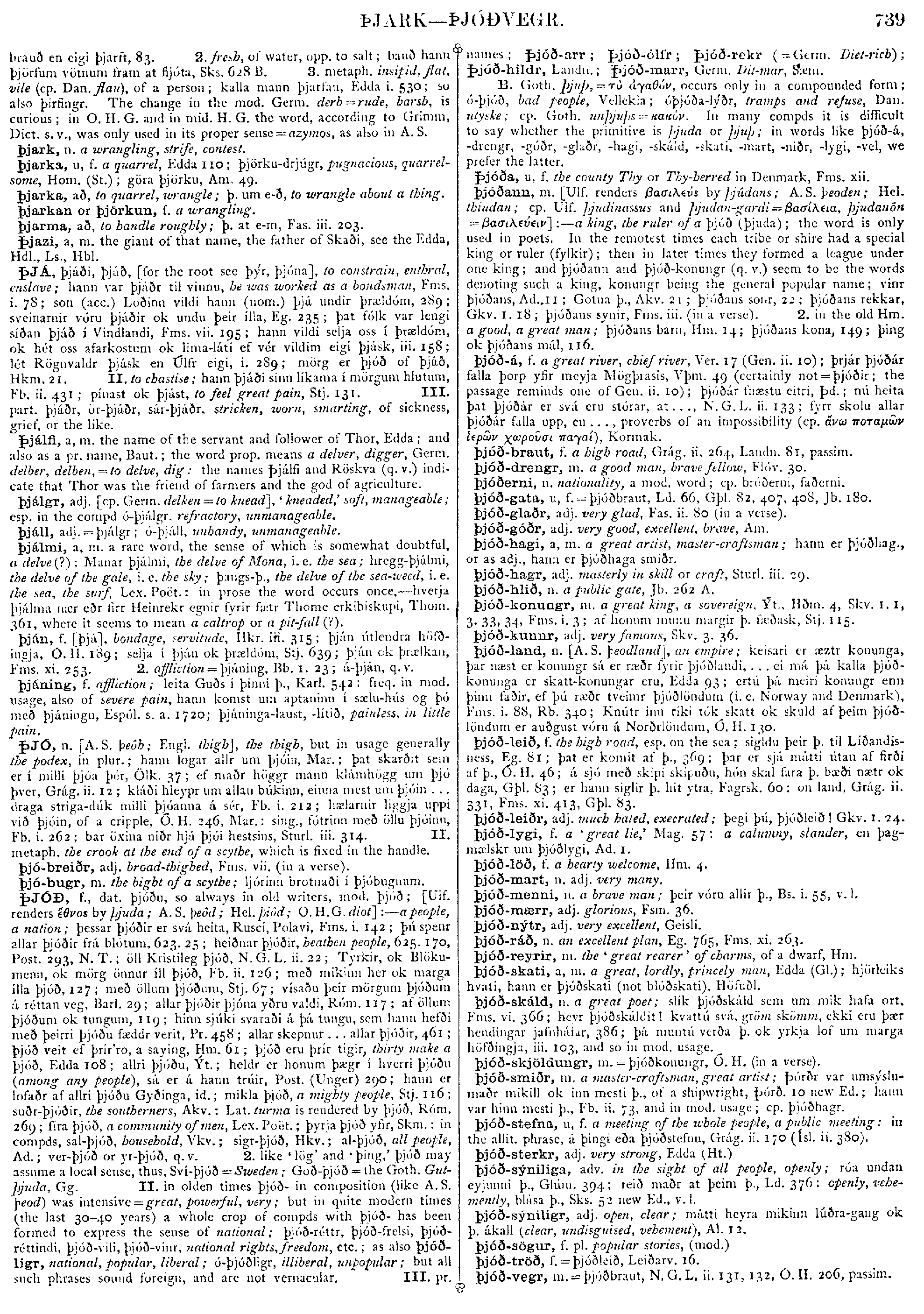
ÞJÓÐ, f., dat. þjóðu, so always in old writers, mod. þjóð; [Ulf. renders GREEK by þjuda; A.S. þeôd; Hel. þiôd; O.H.G. diot] :-- a people, a nation; þessar þjóðir er svá heita, Rusci, Polavi, Fms. i. 142; þú spenr allar þjóðir frá blótum, 623. 25; heiðnar þjóðir, heathen people, 625. 170, Post. 293, N.T.; öll Kristileg þjóð, N.G.L. ii. 22; Tyrkir, ok Blökumenn, ok mörg önnur íll þjóð, Fb. ii. 126; með mikinn her ok marga ílla þjóð, 127; með öllum þjóðinn, Stj. 67; vísaðu þeir mörgum þjóðum á réttan veg, Barl. 29; allar þjóðir þjóna yðru valdi, Róm. 117; af öllum þjóðum ok tungum, 119; hinn sjúki svaraði á þá tungu, sem hann hefði með þeirri þjóðu fæddr verit, Pr. 458; allar skepnur ... allar þjóðir, 461; þjóð veit ef þrír'ro, a saying, Hm, 6l; þjóð eru þrír tigir, thirty make a þjóð, Edda. 108; allri þjóðu, Ýt.; heldr er honum þægr í hverri þjóðu (among any people), sá er á hann trúir, Post. (Unger) 290; hann er lofaðr af allri þjóðu Gyðinga, id.; mikla þjóð, a mighty people, Stj. 116; suðr-þjóðir, the southerners, Akv.: Lat. turma is rendered by þjóð, Róm. 269; fira þjóð, a community of men, Lex. Poët.; þyrja þjóð yfir, Skm.: in compds, sal-þjóð, household, Vkv.; sigr-þjóð, Hkv.; al-þjóð, all people, Ad.; ver-þjóð or yr-þjóð, q.v. 2. like 'lög' and 'þing,' þjóð may assume a local sense, thus, Sví-þjóð = Sweden; Goð-þjóð = the Goth. Gut-þjuda, Gg. II. in olden times þjóð- in composition (like A.S. þeod) was intensive = great, powerful, very; but in quite modern times (the last 30-40 years) a whole crop of compds with þjóð- has been formed to express the sense of national; þjóð-réttr, þjóð-frelsi, þjóð-réttindi, þjóð-vili, þjóð-vinr, national rights, freedom, etc.; as also þjóð-ligr, national, popular, liberal; ó-þjóðligr, illiberal, unpopular; but all such phrases sound foreign, and are not vernacular. III, pr. 'names; Þjóð-arr; Þjóð-ólfr; Þjóð-rekr (= Germ. Diet-rich); Þjóð-hildr, Landn.; Þjóð-marr, Germ. Dit-mar, Sæm. B. Goth. þjuþ, = GREEK occurs only in a compounded form; ó-þjóð, bad people, Vellekla; óþjóða-lýðr, tramps and refuse, Dan. utyske; cp. Goth. unþjuþs = GREEK. In many compds it is difficult to say whether the primitive is þjuda or þjuþ; in words like þjóð-á, -drengr, -góðr, -glaðr, -hagi, -skáld, -skati, -mart, -niðr, -lygi, -vel, we prefer the latter.
|
Source: Cleasby/Vigfusson, page b0745, entry 23 View original page image as: [TIFF] [PNG] [View previous entry] [View next entry] |
[Comment on this entry] [View comments] |
The following entry has been hand-corrected once. |
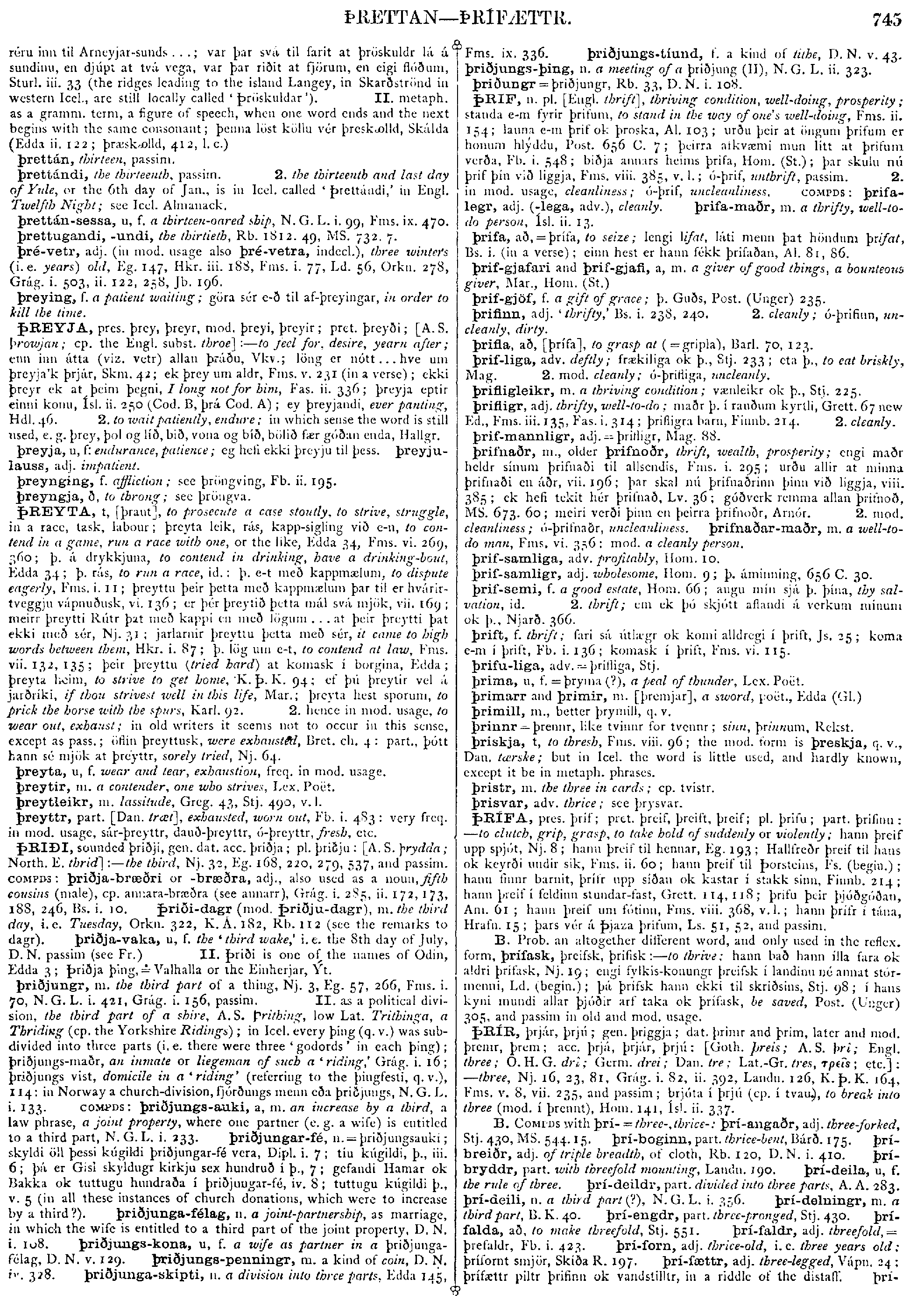
þrif-gjöf, f. a gift of grace; þ. Guðs, Post. (Unger) 235.
|
Source: Cleasby/Vigfusson, page b0745, entry 43 View original page image as: [TIFF] [PNG] [View previous entry] [View next entry] |
[Comment on this entry] [View comments] |
The following entry has been hand-corrected once. |
ÞRÍFA, pres. þríf; pret. þreif, þreift, þreif; pl. þrifu; part. þrifinn :-- to clutch, grip, grasp, to take hold of suddenly or violently; hann þreif upp spjót, Nj. 8; hann þreif til hennar, Eg. 193; Hallfreðr þreif til hans ok keyrði undir sik, Fms. ii. 60; hann þreif til Þorsteins, Fs. (begin.); hann finnr barnit, þrífr upp síðan ok kastar í stakk sinn, Finnb. 214; hann þreif í feldinn stundar-fast, Grett. 114, 118; þrifu þeir þjóðgóðan, Am. 61; hann þreif um fótinn, Fms. viii. 368, v.l.; hann þrífr í tána, Hrafn. 15; þars vér á Þjaza þrifum, Ls. 51, 52, and passim. B. Prob. an altogether different word, arrd only used in the reflex. form, þrífask, þreifsk, þrifisk :-- to thrive; hann bað hann ílla fara ok aldri þrífask, Nj. 19; engi fylkis-konungr þreifsk í landinu né annat stórmenni, Ld. (begin.); þá þrífsk hann ekki til skriðsins, Stj. 98; í hans kyni mundi allar þjóðir arf taka ok þrífask, be saved, Post. (Unger) 305, and passim in old and mod. usage.
| Result Page: |  |
Previous | 1 2 3 4 5 6 7 8 | Next |  |
Germanic Lexicon Project (main page)
This search system was written by
Sean Crist
Please consider
volunteering
to correct the data in these online dictionaries.
No rights reserved. Feel free to use these data in any way you please.