|
|

Search for Ulf again, using less strict matching (846 results)
|
Source: Cleasby/Vigfusson, page b0499, entry 24 View original page image as: [TIFF] [PNG] [View previous entry] [View next entry] |
[Comment on this entry] [View comments] |
The following entry has been hand-corrected once. |
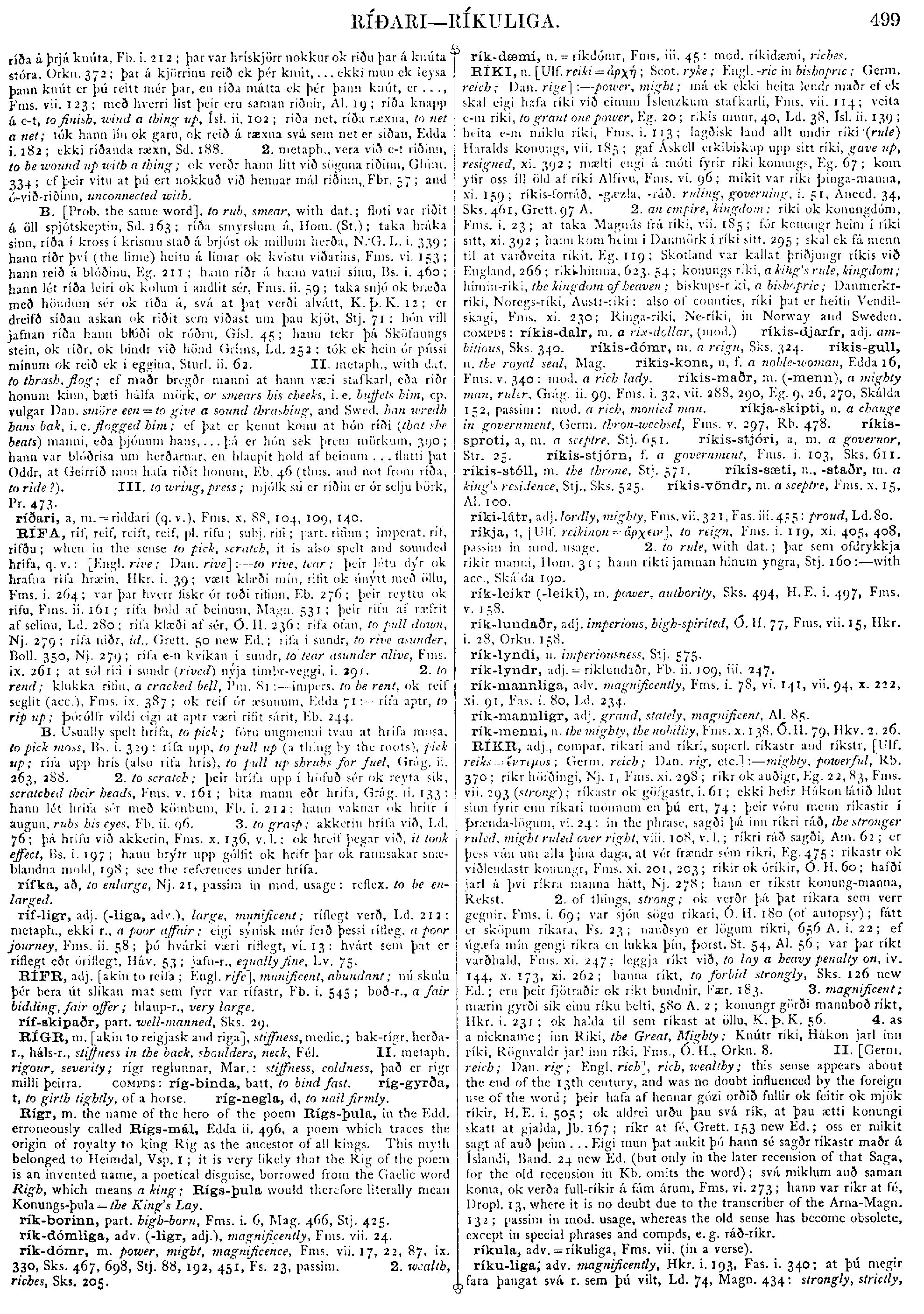
RÍKR, adj., compar. ríkari and ríkri, superl. ríkastr and ríkstr, [Ulf. reiks = GREEK; Germ. reich; Dan. rig, etc.] :-- mighty, powerful, Rb. 370; ríkr höfðingi, Nj. 1, Fms. xi. 298; ríkr ok auðigr, Eg. 22, 83, Fms. vii. 293 (strong); ríkastr ok göfgastr, i. 61; ekki hefir Hákon látið hlut sinn fyrir enn ríkari mönnum en þú ert, 74; þeir vóru menn ríkastir í Þrænda-lögum, vi. 24: in the phrase, sagði þá inn ríkri ráð, the stronger ruled, might ruled over right, viii. 108, v.l.; ríkri ráð sagði, Am. 62; er þess ván um alla þína daga, at vér frændr sem ríkri, Eg. 475; ríkastr ok víðlendastr konungr, Fms. xi. 201, 203; ríkir ok óríkir, Ó.H. 60; hafði jarl á því ríkra manna hátt, Nj. 278; hann er ríkstr konung-manna, Rekst. 2. of things, strong; ok verðr þá þat ríkara sem verr gegnir, Fms. i. 69; var sjón sögu ríkari, Ó.H. 180 (of autopsy); fátt er sköpum ríkara, Fs. 23; nauðsyn er lögum ríkri, 656 A. i. 22; ef úgæfa mín gengi ríkra en lukka þín, Þorst. St. 54, Al. 56; var þar ríkt varðhald, Fms. xi. 247; leggja ríkt við, to lay a heavy penalty on, iv. 144, x. 173, xi. 262; banna ríkt, to forbid strongly, Sks. 126 new Ed.; eru þeir fjötraðir ok ríkt bundnir, Fær. 183. 3. magnificent; mærin gyrði sik einu ríku belti, 580 A. 2; konungr görði mannboð ríkt, Hkr. i. 231; ok halda til sem ríkast at öllu, K.Þ.K. 56. 4. as a nickname; inn Ríki, the Great, Mighty; Knútr ríki, Hákon jarl inn ríki, Rögnvaldr jarl inn ríki, Fms., Ó.H., Orkn. 8. II. [Germ. reich; Dan. rig; Engl. rich], rich, wealthy; this sense appears about the end of the 13th century, and was no doubt influenced by the foreign use of the word; þeir hafa af hennar gózi orðið fullir ok feitir ok mjök ríkir, H.E. i. 505; ok aldrei urðu þau svá rík, at þau ætti konungi skatt at gjalda, Jb. 167; ríkr at fé, Grett. 153 new Ed.; oss er mikit sagt af auð þeim ... Eigi mun þat aukit þó hann sé sagðr ríkastr maðr á Íslandi, Band. 24 new Ed. (but only in the later recension of that Saga, for the old recension in Kb. omits the word); svá miklum auð saman koma, ok verða full-ríkir á fám árum, Fms. vi. 273; hann var ríkr at fé, Dropl. 13, where it is no doubt due to the transcriber of the Arna-Magn. 132; passim in mod. usage, whereas the old sense has become obsolete, except in special phrases and compds, e.g. ráð-ríkr.
|
Source: Cleasby/Vigfusson, page b0500, entry 9 View original page image as: [TIFF] [PNG] [View previous entry] [View next entry] |
[Comment on this entry] [View comments] |
The following entry has been hand-corrected once. |
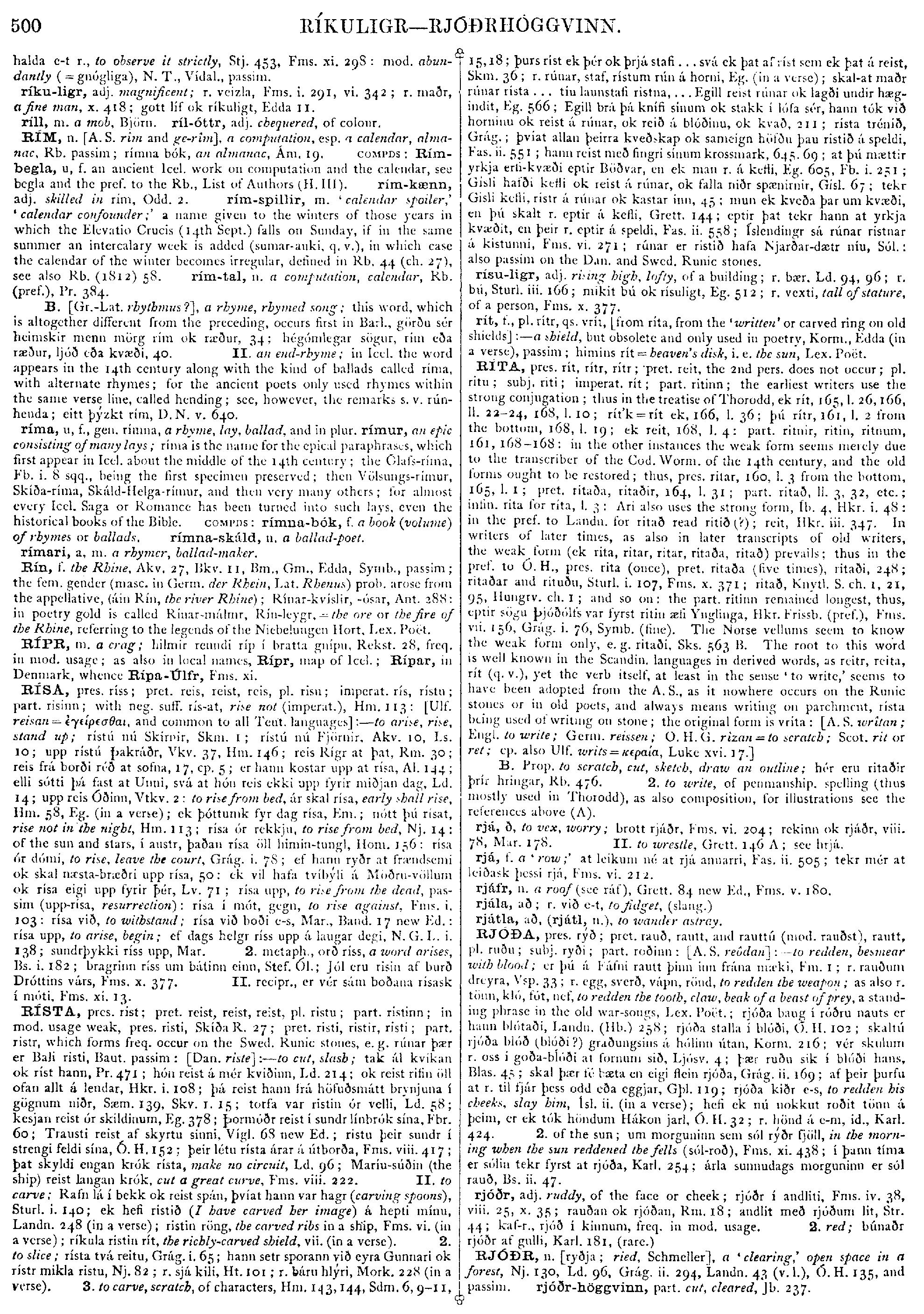
RÍSA, pres. riss; pret. reis, reist, reis, pl. risn; imperat. rís, rístn; part, risinn; with neg. suff. rís-at, rise not (imperat.), Hm. 113: [Ulf. reisan = GREEK, and common to all Teut. languages] :-- to arise, rise, stand up; rístú nú Skírnir, Skm. 1; rístú nú Fjörnir, Akv. 10, Ls. 10; upp rístú Þakráðr, Vkv. 37, Hm. 146; reis Rígr at þat, Rm. 30; reis frá borði réð at sofna, 17, cp. 5; er hann kostar upp at rísa, Al. 144; elli sótti þá fast at Unni, svá at hón reis ekki upp fyrir miðjan dag, Ld. 14; upp reis Óðinn, Vtkv. 2: to rise from bed, ár skal rísa, early shall rise, Hm. 58, Eg. (in a verse); ek þóttumk fyr dag rísa, Em.; nótt þú rísat, rise not in the night, Hm. 113; rísa ór rekkju, to rise from bed, Nj. 14: of the sun and stars, í austr, þaðan rísa öll himin-tungl, Hom. 156: rísa ór dómi, to rise, leave the court, Grág. i. 78; ef hann ryðr at frændsemi ok skal næsta-bræðri upp rísa, 50: ek vil hafa tvíbýli á Möðru-völlum ok rísa eigi upp fyrir þér, Lv. 71; rísa upp, to rise from the dead, passim (upp-rísa, resurrection): rísa í mót, gegn, to rise againsf, Fms. i. 103: rísa við, to withstand; rísa við boði e-s, Mar., Band. 17 new Ed.: rísa upp, to arise, begin; ef dags helgr ríss upp á laugar degi, N.G.L. i. 138; sundrþykki ríss upp, Mar. 2. metaph., orð ríss, a word arises, Bs. i. 182; bragrinn ríss um bátinn einn, Stef. Ól.; Jól eru risin af burð Dróttins várs, Fms. x. 377. II. recipr., er vér sám boðana rísask í móti, Fms. xi. 13.
|
Source: Cleasby/Vigfusson, page b0500, entry 13 View original page image as: [TIFF] [PNG] [View previous entry] [View next entry] |
[Comment on this entry] [View comments] |
The following entry has been hand-corrected once. |
RÍTA, pres. rít, rítr, rítr; pret. reit, the 2nd pers. does not occur; pl. ritu; subj. riti; imperat. rít; part, ritinn; the earliest writers use the strong conjugation; thus in the treatise of Thorodd, ek rít, 165, l. 26, 166, ll. 22-24, 168, l. 10; rít'k = rít ek, 166, 1. 36; þú rítr, 161, l. 2 from the bottom, 168, l. 19; ek reit, 168, l. 4: part, ritnir, ritin, ritnum,161, 168-168: in the other instances the weak form seems merely due to the transcriber of the Cod. Worm, of the 14th century, and the old forms ought to be restored; thus, pres. ritar, 160, l. 3 from the bottom,165, l. 1; pret. ritaða, ritaðir, 164, l. 31; part, ritað, ll. 3, 32, etc.; intin. rita for ríta, l. 3: Ari also uses the strong form, Íb. 4, Hkr. i. 48: in the pref. to Landn. for ritað read ritið(?); reit, Hkr. iii. 347. In writers of later times, as also in later transcripts of old writers, the weak form (ek rita, ritar, ritar, ritaða, ritað) prevails; thus in the pref. to Ó.H., pres. rita (once), pret. ritaða (five times), ritaði, 248; ritaðar and rituðu, Sturl. i. 107, Fms. x. 371; ritað, Knytl. S. ch. 1, 21, 95, Hungrv, ch. 1; and so on: the part, ritinn remained longest, thus, eptir sögu Þjóðólfs var fyrst ritin æli Ynglinga, Hkr. Frissb. (pref.), Fms. vii. 156, Grág. i. 76, Symb. (fine). The Norse vellums seem to know the weak form only, e.g. ritaði, Sks. 563 B. The root to this word is well known in the Scandin. languages in derived words, as reitr, reita, rít (q.v.), yet the verb itself, at least in the sense 'to write,' seems to have been adopted from the A.S., as it nowhere occurs on the Runic stones or in old poets, and always means writing on parchment, rísta being used of writing on stone; the original form is vríta: [A.S. wrítan; Engl. to write; Germ. reissen; O.H.G. rízan = to scratch; Scot. rit or ret; cp. also Ulf. writs = GREEK, Luke xvi. 17.] B. Prop. to scratch, cut, sketch, draw an outline; hér eru ritaðir þrír hringar, Rb. 476. 2. to write, of penmanship, spelling (thus mostly used in Thorodd), as also composition, for illustrations see the references above (A).
|
Source: Cleasby/Vigfusson, page b0501, entry 35 View original page image as: [TIFF] [PNG] [View previous entry] [View next entry] |
[Comment on this entry] [View comments] |
The following entry has been hand-corrected once. |
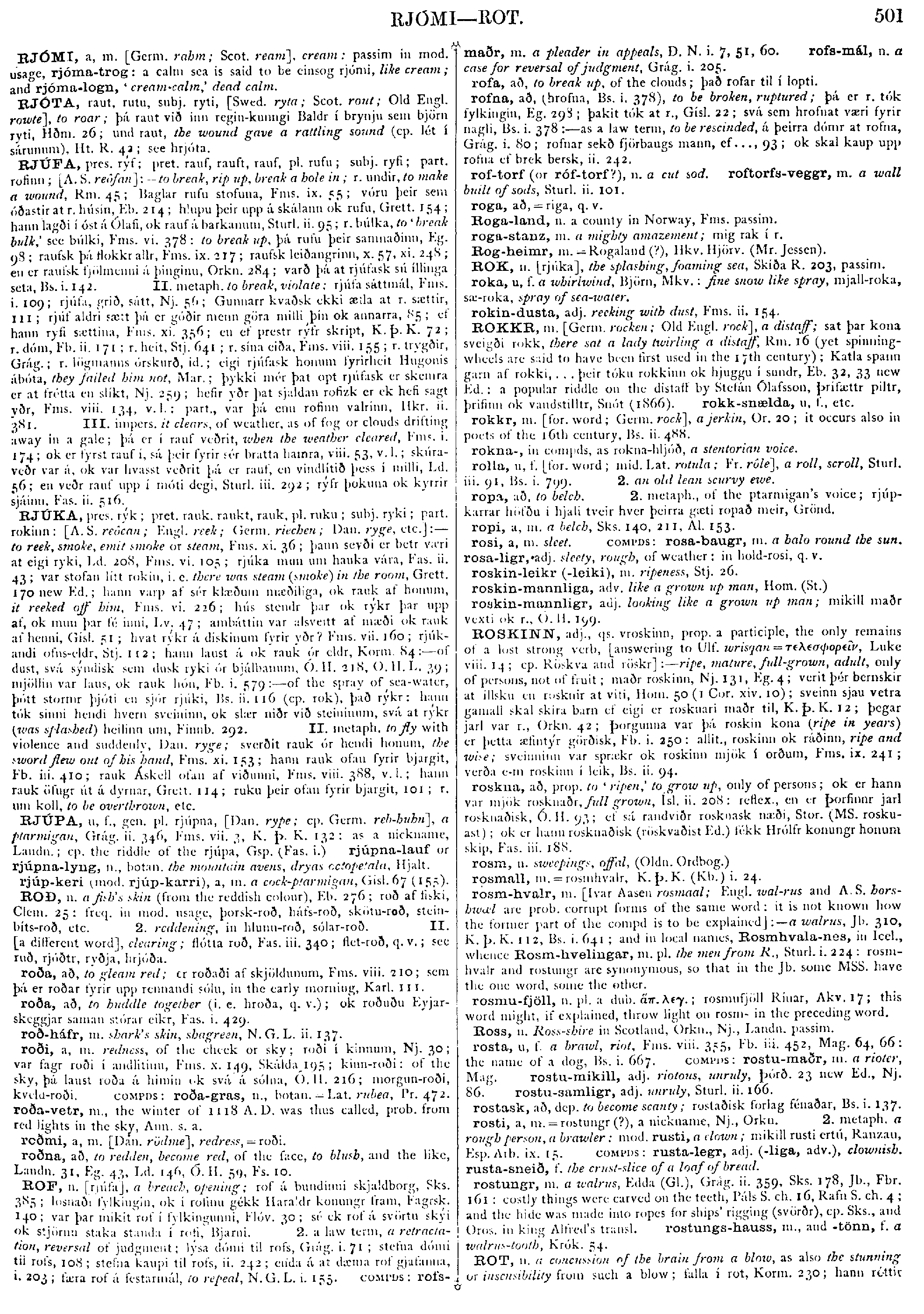
ROSKINN, adj., qs. vroskinn, prop. a participle, the only remains of a lost strong verb, [answering to Ulf. wrisqan = GREEK, Luke viii. 14; cp. Röskva and röskr] :-- ripe, mature, full-grown, adult, only of persons, not of fruit; madr roskinn, Nj. 131, Eg. 4; verit þér bernskir at illsku en rosknir at viti, Hom. 50 (1 Cor. xiv. 10); sveinn sjau vetra gamall skal skira barn ef eigi er rosknari madr til, K.Þ.K. 12; þegar jarl var r., Orkn. 42; Þorgunna var þá roskin kona (ripe in years) er þetta æfintýr görðisk, Fb. i. 250: allit., roskinn ok ráðinn, ripe and wise; sveinninn var sprækr ok roskinn mjök í orðum, Fms. ix. 241; verða e-m roskinn í leik, Bs. ii. 94.
|
Source: Cleasby/Vigfusson, page b0502, entry 21 View original page image as: [TIFF] [PNG] [View previous entry] [View next entry] |
[Comment on this entry] [View comments] |
The following entry has been hand-corrected once. |
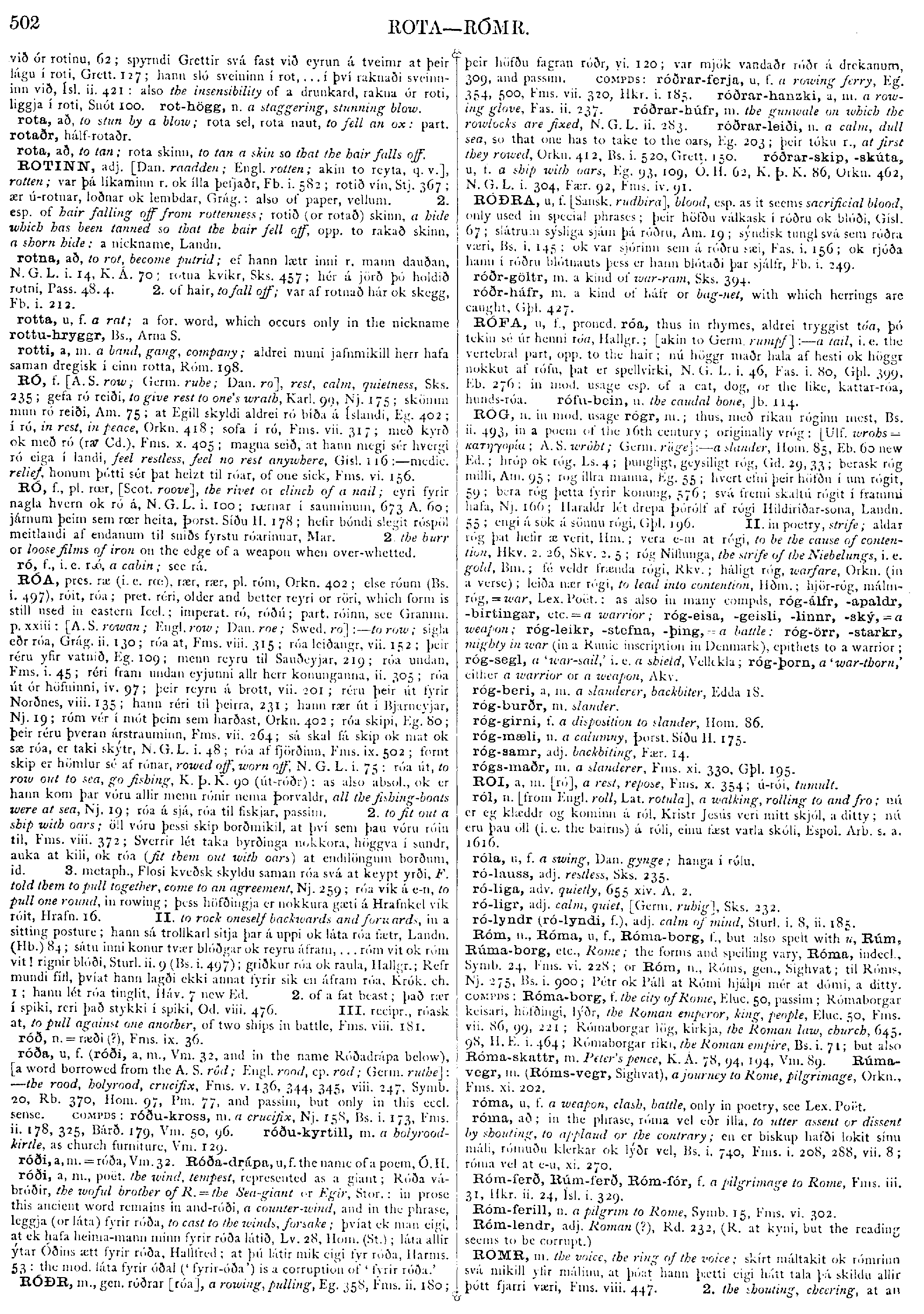
RÓG, n. in mod. usage rógr, m.; thus, með ríkan róginn mest, Bs. ii. 493, in a poem of the 16th century; originally vróg: [Ulf. wrohs = GREEK; A.S. wrôht; Germ. räge] :-- a slander, Hom. 85, Eb. 60 new Ed.; hróp ok róg, Ls. 4; þungligt, geysiligt róg, Gd. 29, 33; berask róg milli, Am. 95; róg íllra manna, Eg. 55; hvert etni þeir hüfðu í um rógit, 59; bera róg þetta fyrir konung, 576; svá fremi skaltú rógit í frammi hafa, Nj. 166; Haraldr lét drepa Þórólf af rógi Hildiriðar-sona, Landn. 55; engi á sök á sönnu rógi, Gþl. 196. II. in poetry, strife; aldar róg þat hefir æ verit, Hm.; vera e-m at rógi, to be the cause of contention, Hkv. 2. 26, Sky. 2. 5; róg Niflunga, the strife of the Niebelungs, i.e.gold, Bm.; fé veldr frænda rógi, Rkv.; háligt róg, warfare, Orkn. (in a verse); leiða nær rógi, to lead into contention, Hðm.; hjör-róg, málm-róg, = war, Lex. Poët.: as also in many compds, róg-álfr, -apaldr, -birtingar, etc. = a warrior; róg-eisa, -geisli, -linnr, -ský, = a weapon; róg-leikr, -stefna, -þing, = a battle: róg-örr, -starkr, mighty in war (in a Runic inscription in Denmark), epithets to a warrior; róg-segl, a 'war-sail,' i.e. a shield, Vellekla; róg-þorn, a 'war-thorn,' either a warrior or a weapon, Akv.
|
Source: Cleasby/Vigfusson, page b0503, entry 56 View original page image as: [TIFF] [PNG] [View previous entry] [View next entry] |
[Comment on this entry] [View comments] |
The following entry has been hand-corrected once. |
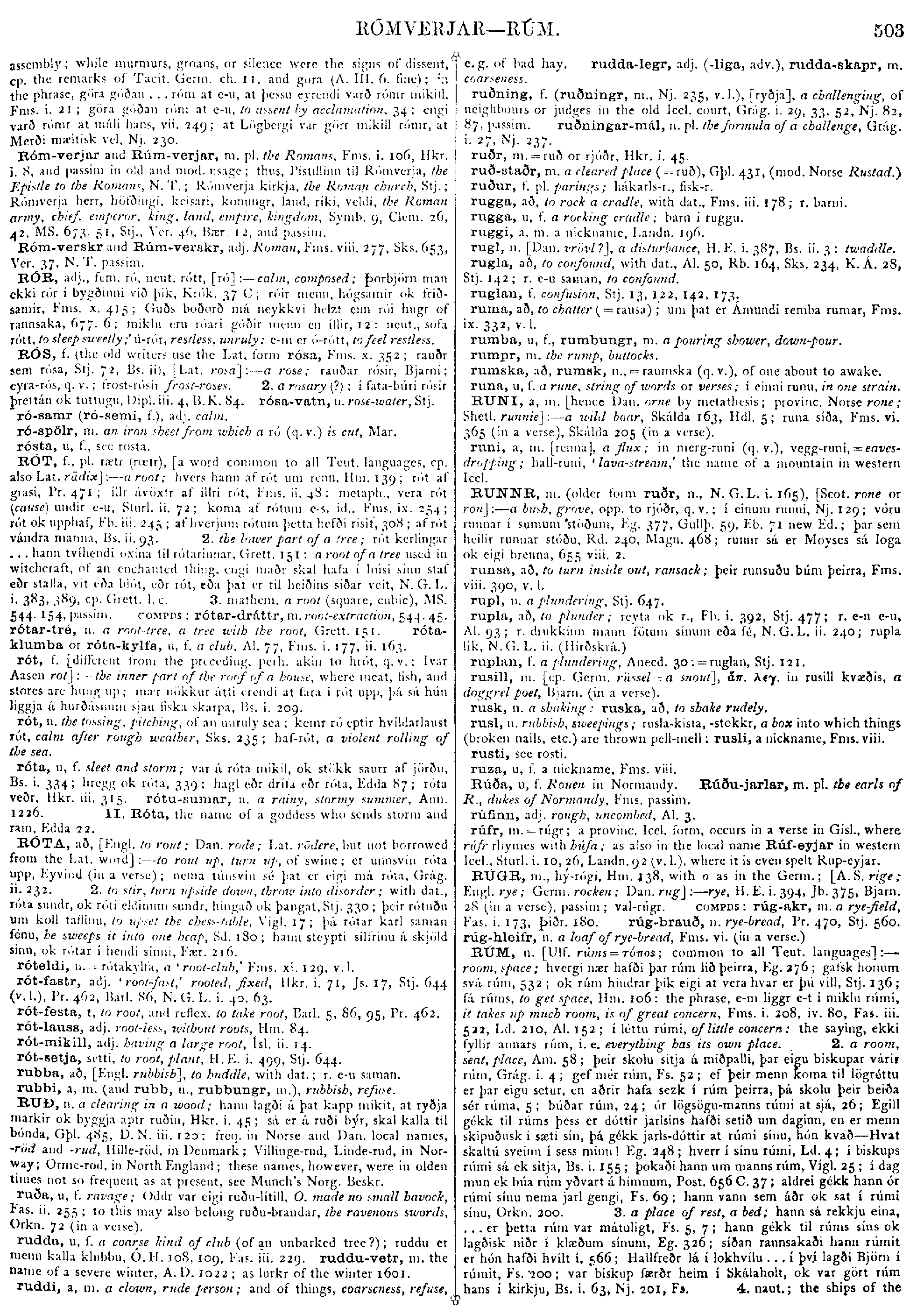
RÚGR, m., hý-rógi, Hm. 138, with o as in the Germ.; [A.S. rige; Engl. rye; Germ. rocken; Dan. rug] :-- rye, H.E. i. 394, Jb. 375, Bjarn. 28 (in a verse), passim; val-rúgr. COMPDS: rúg-ákr, m. a rye-field, Fas. i. 173, Þiðr. 180. rúg-brauð, n. rye-bread, Pr. 470, Stj. 560. rúg-hleifr, n. a loaf of rye-bread, Fms. vi. (in a verse.) RÚM, n. [Ulf. rúms = GREEK; common to all Teut. languages] :-- room, space; hvergi nær hafði þar rúm lið þeirra, Eg. 276; gafsk honum svá rúm, 532; ok rúm hindrar þik eigi at vera hvar er þú vill, Stj. 136; fá rúms, to get space, Hm. 106: the phrase, e-m liggr e-t í miklu rúmi,it takes up much room, is of great concern, Fms. i. 208, iv. 80, Fas. iii. 522, Ld. 210, Al. 152; í léttu rúmi, of little concern: the saying, ekki fyllir annars rúm, i.e. everything has its own place. 2. a room, seat, place, Am. 58; þeir skolu sitja á miðpalli, þar eigu biskupar várir rúm, Grág. i. 4; gef mér rúm, Fs. 52; ef þeir menn koma til lögréttu er þar eigu setur, en aðrir hafa sezk í rúm þeirra, þá skolu þeir beiða sér rúma, 5; búðar rúm, 24; ór lögsögu-manns rúmi at sjá, 26; Egill gékk til rúms þess er dóttir jarlsins hafði setið um daginn, en er menn skipuðusk í sæti sín, þá gékk jarls-dóttir at rúmi sínu, hón kvað -- Hvat skaltú sveinn í sess minn! Eg. 248; hverr í sínu rúmi, Ld. 4; í biskups rúmi sá ek sitja, Bs. i. 155; þokaði hann um manns rúm, Vígl. 25; í dag mun ek búa rúm yðvart á himnum, Post. 656 C. 37; aldrei gékk hann ór rúmi sínu nema jarl gengi, Fs. 69; hann vann sem áðr ok sat í rúmi sínu, Orkn. 200. 3. a place of rest, a bed; hann sá rekkju eina, ... er þetta rúm var mátuligt, Fs. 5, 7; hann gékk til rúms síns ok lagðisk niðr í klæðum sínum, Eg. 326; síðan rannsakaði hann rúmit er hón hafði hvílt í, 566; Hallfreðr lá í lokhvílu ... í því lagði Björn í rúmit, Fs. 200; var biskup færðr heim í Skálaholt, ok var gört rúm hans í kirkju, Bs. i. 63, Nj. 201, Fs. 4. naut.; the ships of the
|
Source: Cleasby/Vigfusson, page b0504, entry 10 View original page image as: [TIFF] [PNG] [View previous entry] [View next entry] |
[Comment on this entry] [View comments] |
The following entry has been hand-corrected once. |
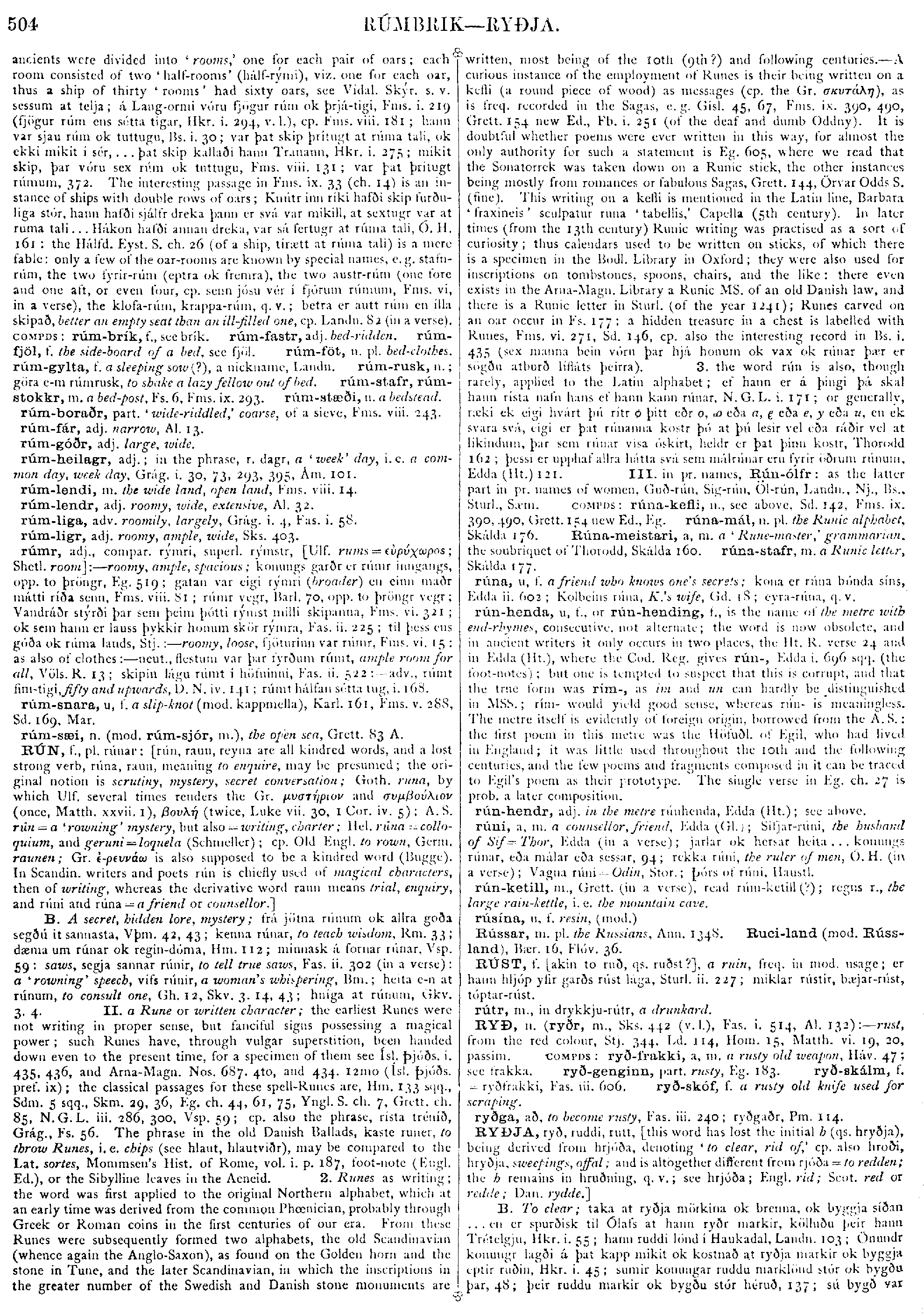
rúmr, adj., compar. rýmri, superl. rýmstr, [Ulf. rums = GREEK; Shetl. room] :-- roomy, ample, spacious; konungs garðr er rúmr inngangs, opp. to þröngr. Eg. 519; gatan var eigi rýmri (broader) en einn maðr mátti ríða senn, Fms. viii. 81; rúmr vegr, Barl. 70, opp. to þröngr vegr; Vandráðr stýrði þar sem þeim þótti rýmst milli skipanna. Fms. vi. 321; ok sem hann er lauss þvkkir honum skör rýmra, Fas. ii. 225; til þess ens góða ok rúma lands, Stj. :-- roomy, loose, fjöturinn var rúmr, Fms. vi. 15: as also of clothes :-- neut., flestum var þar fyrðum rúmt, ample room for all, Völs. R. 13; skipin lágu rúmt í höfninni, Fas. ii. 522 :-- adv., rúmt fim-tigi, fifty and upwards, D.N. iv. 141: rúmt hálfan sétta tug, i. 168.
|
Source: Cleasby/Vigfusson, page b0504, entry 13 View original page image as: [TIFF] [PNG] [View previous entry] [View next entry] |
[Comment on this entry] [View comments] |
The following entry has been hand-corrected once. |
RÚN, f., pl. rúnar: [rún, raun, reyna are all kindred words, and a lost strong verb, rúna, raun, meaning to enquire, may be presumed; the original notion is scrutiny, mystery, secret conversation; Gotb. runa, by which Ulf. several times renders the Gr. GREEK and GREEK (once, Matth. xxvii. 1), GREEK (twice, Luke vii. 30, 1 Cor. iv. 5); A.S. rún = a 'rowning' mystery, but also = writing, charter; Hel. rûna = colloquium, and geruni = loquela (Schmeller); cp. Old Engl. to rown, Germ.raunen; Gr. GREEK is also supposed to be a kindred word (Bugge). In Scandin. writers and poets rún is chiefly used of magical characters, then of writing, whereas the derivative word raun means trial, enquiry, and rúni and rúna = a friend or counsellor.] B. A secret, hidden lore, mystery; frá jötna rúnum ok allra goða segðú it sannasta, Vþm. 42, 43; kenna rúnar, to teach wisdom, Rm. 33; dæma um rúnar ok regin-dóma, Hm. 112; minnask á fornar rúnar, Vsp. 59: saws, segja sannar rúnir, to tell true saws, Fas. ii. 302 (in a verse): a 'rowning' speech, vifs rúnir, a woman's whispering, Bm.; heita e-n at rúnum, to consult one, Gh. 12, Skv. 3. 14, 43; hniga at rúnum, Gkv. 3. 4. II. a Rune or written character; the earliest Runes were not writing in proper sense, but fanciful signs possessing a magical power; such Runes have, through vulgar superstition, been handed down even to the present time, for a specimen of them see Ísl. Þjóðs. i.435, 436, and Arna-Magn. Nos. 687. 4 to, and 434. 12 mo (Ísl. Þjóðs.pref. ix); the classical passages for these spell-Runes are, Hm. 133 sqq.,Sdm. 5 sqq., Skm. 29, 36, Eg. ch. 44, 61, 75, Yngl. S. ch. 7, Grett. ch. 85, N.G.L. iii. 286, 300, Vsp. 59; cp. also the phrase, rísta trénið,Grág., Fs. 56. The phrase in the old Danish Ballads, kaste runer, to throw Rúnes, i.e. chips (see hlaut, hlautviðr), may be compared to the Lat. sortes, Mommsen's Hist, of Rome, vol. i. p. 187, foot-note (Engl. Ed.), or the Sibylline leaves in the Aeneid. 2. Runes as writing;the word was first applied to the original Northern alphabet, which at an early time was derived from the common Phœnician, probably through Greek or Roman coins in the first centuries of our era. From these Runes were subsequently formed two alphabets, the old Scandinavian (whence again the Anglo-Saxon), as found on the Golden horn and the stone in Tune, and the later Scandinavian, in which the inscriptions in the greater number of the Swedish and Danish stone monuments are written, most being of the 10th (9th?) and following centuries. -- A curious instance of the employment of Runes is their being written on a kefli (a round piece of wood) as messages (cp. the Gr. GREEK), as is freq. recorded in the Sagas, e.g. Gísl. 45, 67, Fms. ix. 390, 490, Grett. 154 new Ed., Fb. i. 251 (of the deaf and dumb Oddny). It is doubtful whether poems were ever written in this way, for almost the only authority for such a statement is Eg. 605, where we read that the Sonatorrek was taken down on a Runic stick, the other instances being mostly from romances or fabulous Sagas, Grett. 144, Örvar Odds S.(fine). This writing on a kefli is mentioned in the Latin line, Barbara 'fraxineis' sculpatur runa 'tabellis,' Capella (5th century). In later times (from the 13th century) Runic writing was practised as a sort of curiosity; thus calendars used to be written on sticks, of which there is a specimen in the Bodl. Library in Oxford; they were also used for inscriptions on tombstones, spoons, chairs, and the like: there even exists in the Arna-Magn. Library a Runic MS. of an old Danish law, and there is a Runic letter in Sturl. (of the year 1241); Runes carved on an oar occur in Fs. 177: a hidden treasure in a chest is labelled with Runes, Fms. vi. 271, Sd. 146, cp. also the interesting record in Bs. i. 435 (sex manna bein vóru þar hjá honum ok vax ok rúnar þær er sögðu atburð lifláts þeirra). 3. the word rún is also, though rarely, applied to the Latin alphabet; ef hann er á þingi þá skal hann rísta nafn hans ef hann kann rúnar, N.G.L. i. 171; or generally, ræki ek eigi hvárt þú rítr ô UNCERTAIN þitt eðr o, (O?) UNCERTAIN eða a, (z?) UNCERTAIN eða e, y eða u, en ek svara svá, eigi er þat rúnanna kostr þó at þú lesir vel eða ráðir vel at líkindum, þar sem rúnar visa óskírt, heldr er þat þinn kostr, Thorodd 162; þessi er upphaf allra hátta svá sem málrúnar eru fyrir öðrum minum, Edda (Ht.) 121. III. in pr. names, Rún-ólfr: as the latter part in pr. names of women, Guð-rún, Sig-rún, Öl-rún, Landn., Nj., Bs., Sturl., Sæm. COMPDS: rúna-kefli, n., see above, Sd. 142, Fms. ix. 390, 490, Grett. 154 new Ed., Eg. rúna-mál, n. pl. the Runic alphabet, Skfálda 176. Rúna-meistari, a, m. a 'Rune-master,' grammarian, the soubriquet of Thorodd, Skálda 160. rúna-stafr, m. a Runic letter, Skálda 177.
|
Source: Cleasby/Vigfusson, page b0505, entry 35 View original page image as: [TIFF] [PNG] [View previous entry] [View next entry] |
[Comment on this entry] [View comments] |
The following entry has been hand-corrected once. |
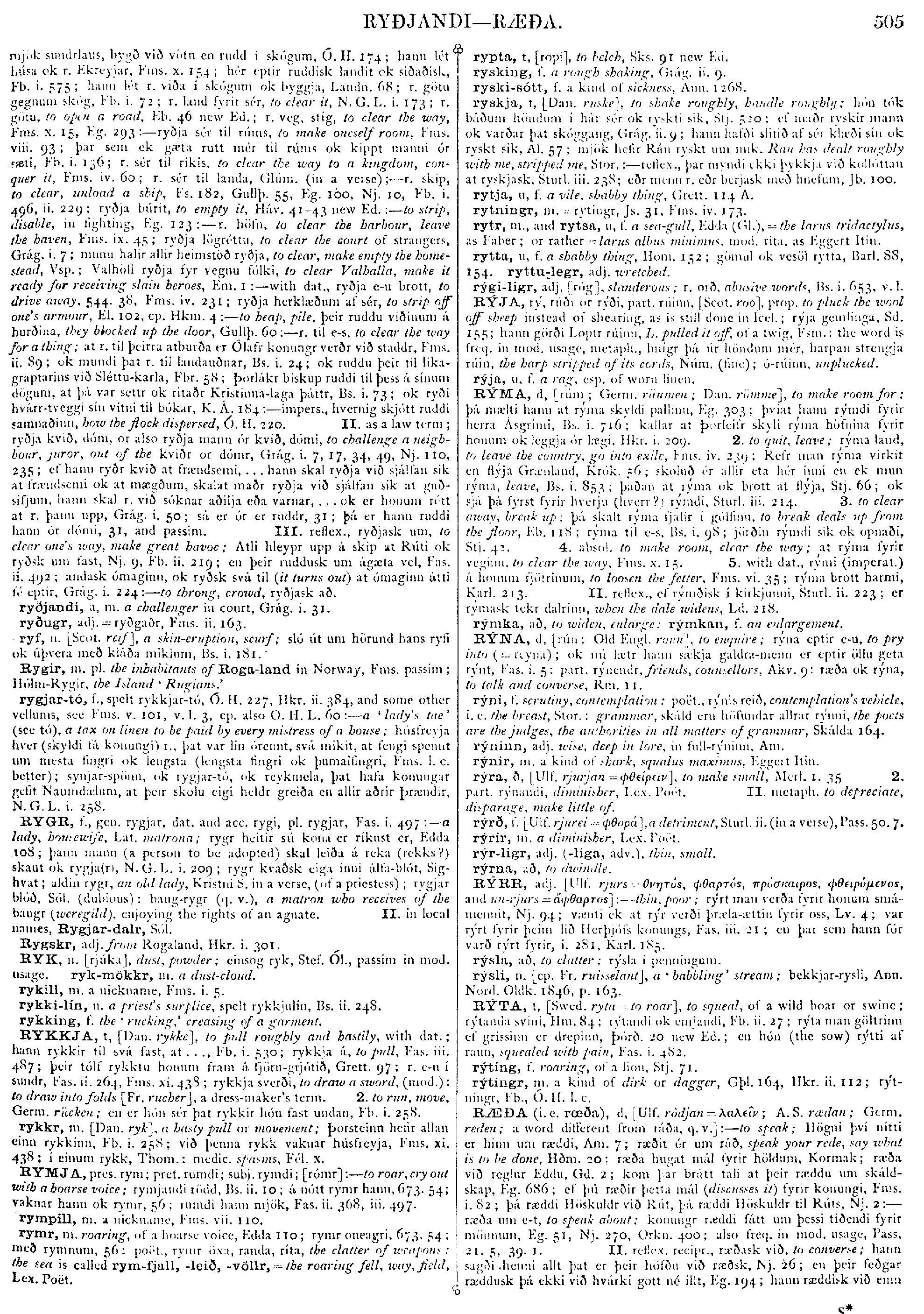
rýra, ð, [Ulf. rjurjan = GREEK], to make small, merl. 1. 35 2. part. rýnandi, diminisher, Lex. Poët. II. metaph. to depreciate, disparage, make little of.
|
Source: Cleasby/Vigfusson, page b0505, entry 36 View original page image as: [TIFF] [PNG] [View previous entry] [View next entry] |
[Comment on this entry] [View comments] |
The following entry has been hand-corrected once. |
rýrð, f. [Ulf. rjurei = GREEK], a detriment, Sturl. ii. (in a verse), Pass. 50. 7.
| Result Page: |  |
Previous | 47 48 49 50 51 52 53 54 55 56 57 58 59 60 61 62 63 64 65 | Next |  |
Germanic Lexicon Project (main page)
This search system was written by
Sean Crist
Please consider
volunteering
to correct the data in these online dictionaries.
No rights reserved. Feel free to use these data in any way you please.