|
|

Tip: In the search results, you can click on any word or abbreviation for more information.
|
Source: Bosworth/Toller, page b0946, entry 1 View original page image as: [TIFF] [PNG] [View previous entry] [View next entry] |
[Comment on this entry] [View comments] |
The following entry has been hand-corrected once. |
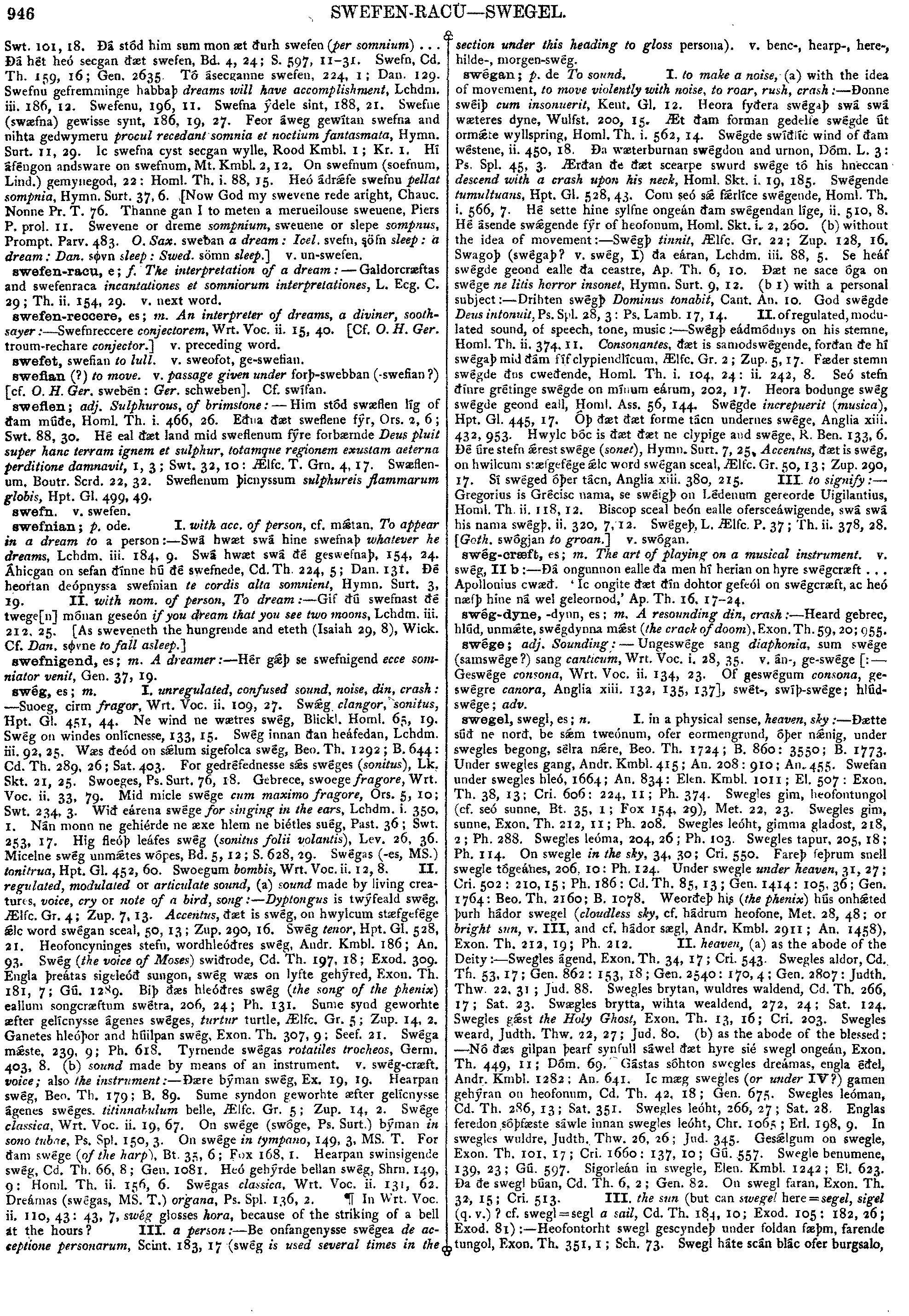
Swt.
101,
18.
Ðá
stód
him
sum
mon
æt
ðurh
swefen
(per
somnium)
.
.
.
Ðá
hét
heó
secgan
ðæt
swefen.
Bd.
4,
24;
S.
597,
11-31.
Swefn,
Cd.
Th.
159,
16;
Gen.
2635.
Tó
ásecganne
swefen,
224,
1;
Dan.
129.
Swefnu
gefremminge
habbaþ
dreams
will
have
accomplishment,
Lchdm.
iii.
186,
12.
Swefenu,
196,
11.
Swefna
ýdele
sint,
188,
21.
Swefne
(swæfna)
gewisse
synt,
186,
19,
27.
Feor
áweg
gewítan
swefna
and
nihta
gedwymeru
procul
recedant
somnia
et
noctium
fantasmata,
Hymn.
Surt.
11,
29.
Ic
swefna
cyst
secgan
wylle,
Rood
Kmbl.
1;
Kr.
1.
Hí
áféngon
andsware
on
swefnum,
Mt.
Kmbl.
2,
12.
On
swefnum
(soefnum.
Lind.)
gemynegod,
22:
Homl.
Th.
i.
88,
15.
Heó
ádr fe
swefnu
pellat
sompnia,
Hymn.
Surt.
37,
6.
[Now
God
my
swevene
rede
aright,
Chauc.
Nonne
Pr.
T.
76.
Thanne
gan
I
to
meten
a
merueilouse
sweuene,
Piers
P.
prol.
11.
Swevene
or
dreme
sompnium,
sweuene
or
slepe
sompnus,
Prompt.
Parv.
483.
O.
Sax.
sweban
UNCERTAIN
a
dream:
Icel.
svefn,
söfn
sleep:
a
dream:
Dan.
søvn
sleep:
Swed.
sömn
sleep.]
v.
un-swefen.
fe
swefnu
pellat
sompnia,
Hymn.
Surt.
37,
6.
[Now
God
my
swevene
rede
aright,
Chauc.
Nonne
Pr.
T.
76.
Thanne
gan
I
to
meten
a
merueilouse
sweuene,
Piers
P.
prol.
11.
Swevene
or
dreme
sompnium,
sweuene
or
slepe
sompnus,
Prompt.
Parv.
483.
O.
Sax.
sweban
UNCERTAIN
a
dream:
Icel.
svefn,
söfn
sleep:
a
dream:
Dan.
søvn
sleep:
Swed.
sömn
sleep.]
v.
un-swefen.
|
Source: Bosworth/Toller, page b0947, entry 15 View original page image as: [TIFF] [PNG] [View previous entry] [View next entry] |
[Comment on this entry] [View comments] |
The following entry has been hand-corrected once. |
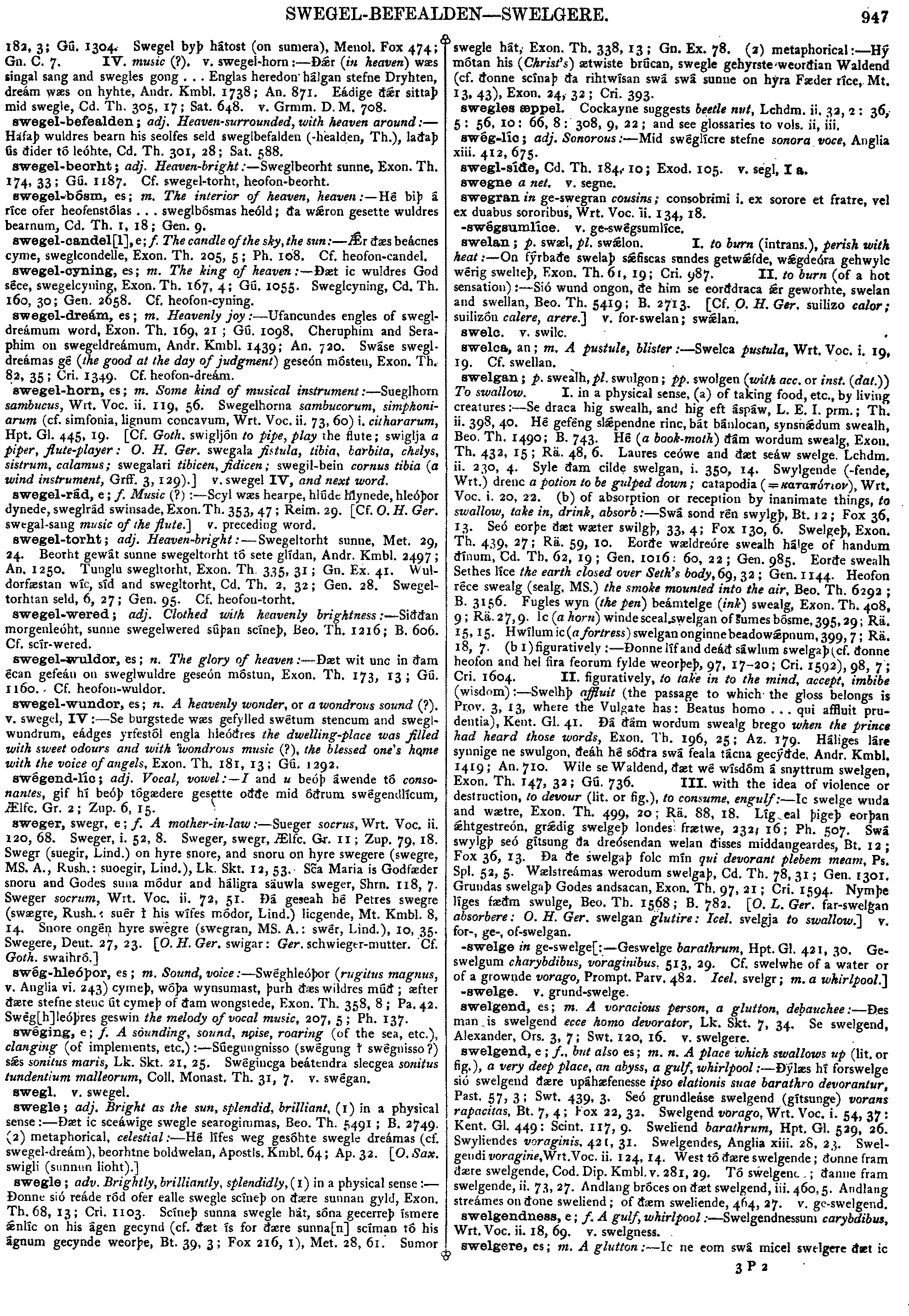
sweger,
swegr,
e;
f.
A
mother-in-law
:--
Sueger
socrus,
Wrt.
Voc.
ii.
120,
68.
Sweger,
i.
52,
8.
Sweger,
swegr,
Ælfc.
Gr.
11;
Zup.
79,
18.
Swegr
(suegir,
Lind.)
on
hyre
snore,
and
snoru
on
hyre
swegere
(swegre,
MS.
A.,
Rush.:
suoegir.
Lind.),
Lk.
Skt.
12,
53.
UNCERTAIN
Maria
is
Godfæder
snoru
and
Godes
suna
módur
and
háligra
sáuwla
sweger,
Shrn.
118,
7.
Sweger
socrum,
Wrt.
Voc.
ii.
72,
51.
Ða
geseah
hé
Petres
swegre
(swægre,
Rush.
suér
 his
wífes
módor,
Lind.)
licgende,
Mt.
Kmbl.
8,
14.
Snore
ongén
hyre
swégre
(swegran,
MS.
A.:
swer,
Lind.),
10,
35.
Swegere,
Deut.
27,
23.
[O.H.
Ger.
swigar:
Ger.
schwieger-mutter.
Cf.
Goth.
swaihró.]
his
wífes
módor,
Lind.)
licgende,
Mt.
Kmbl.
8,
14.
Snore
ongén
hyre
swégre
(swegran,
MS.
A.:
swer,
Lind.),
10,
35.
Swegere,
Deut.
27,
23.
[O.H.
Ger.
swigar:
Ger.
schwieger-mutter.
Cf.
Goth.
swaihró.]
|
Source: Bosworth/Toller, page b0954, entry 19 View original page image as: [TIFF] [PNG] [View previous entry] [View next entry] |
[Comment on this entry] [View comments] |
The following entry has been hand-corrected once. |
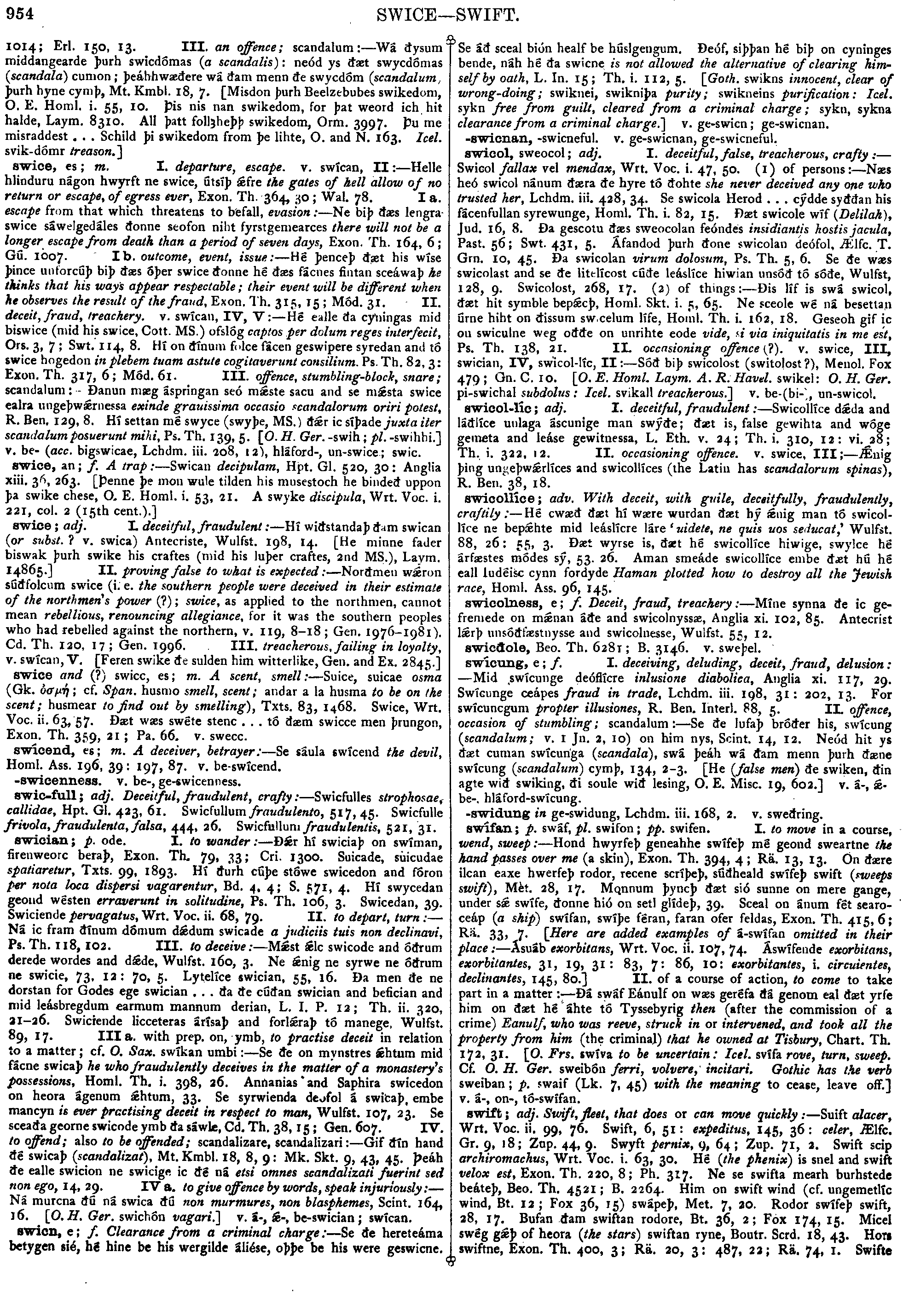
swífan;
p.
swáf,
pl.
swifon;
pp.
swifen.
I.
to
move
in
a
course,
wend,
sweep
:--
Hond
hwyrfeþ
geneahhe
swíféþ
mé
geond
sweartne
the
hand
passes
over
me
(a
skin),
Exon.
Th.
394,
4
;
Rä.
13,
13.
On
ðære
ilcan
eaxe
hwerfeþ
rodor,
recene
scríþeþ,
súðheald
swíféþ
swift
(sweeps
swift),
Met.
28,
17.
Mqnnum
þyncþ
ðæt
sió
sunne
on
mere
gange,
under
s
swífe,
ðonne
hió
on
setl
glídeþ,
39.
Sceal
on
ánum
fét
searo-ceáp
(a
ship)
swífan,
swíþe
féran,
faran
ofer
feldas,
Exon.
Th.
415,
6;
Rä.
33,
7.
[Here
are
added
examples
of
á-swífan
omitted
in
their
place
:--
Asuáb
exorbitans,
Wrt.
Voc.
ii.
107,
74.
Áswífende
exorbitans,
exorbitantes,
31,
19,
31:
83,
7:
86,
10:
exorbitantes,
i.
circuientes,
declinantes,
145,
80.]
II.
of
a
course
of
action,
to
come
to
take
part
in
a
matter
:--
Ðá
swáf
Eánulf
on
wæs
geréfa
ðá
genom
eal
ðæt
yrfe
him
on
ðæt
hé
áhte
tó
Tyssebyrig
then
(after
the
commission
of
a
crime)
Eanulf,
who
was
reeve,
struck
in
or
intervened,
and
took
all
the
property
from
him
(the
criminal)
that
he
owned
at
Tisbury,
Chart.
Th.
172,
31.
[O.
Frs.
swíva
to
be
uncertain:
Icel.
svífa
rove,
tarn,
sweep.
Cf.
O.
H.
Ger.
sweibón
ferri,
volvere,
incitari.
Gothic
has
the
verb
sweiban;
p.
swaif
(Lk.
7,
45)
with
the
meaning
to
cease,
leave
off.]
v.
á-,
on-,
tó-swífan.
|
Source: Bosworth/Toller, page b0967, entry 9 View original page image as: [TIFF] [PNG] [View previous entry] [View next entry] |
[Comment on this entry] [View comments] |
The following entry has been hand-corrected once. |
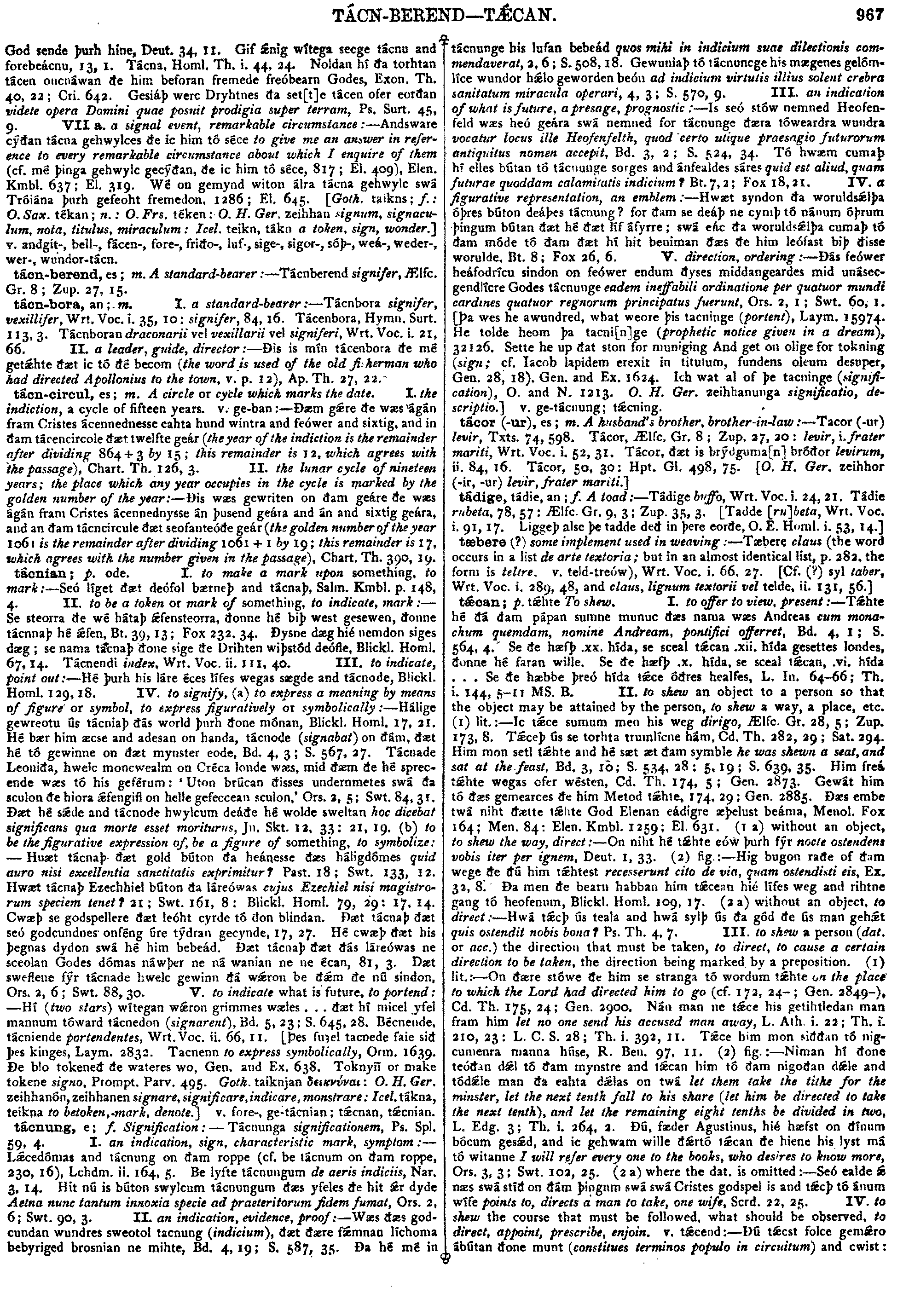
tcan;
p.
thte
To
shew.
I.
to
offer
to
view,
present
:--
Thte
hé
ðá
ðam
pápan
sumne
munuc
ðæs
nama
wæs
Andreas
cum
monachum
quemdam,
nomine
Andream,
pontifici
offerret,
Bd.
4,
1;
S.
564,
4.
Se
ðe
hæfþ
.xx.
hída,
se
sceal
tcan
.xii.
hída
gesettes
londes,
ðonne
hé
faran
wille.
Se
ðe
hæfþ
.x.
hída,
se
sceal
tcan,
.vi.
hída
...
Se
ðe
hæbbe
þreó
hída
tce
óðres
healfes,
L.
In.
64-66;
Th.
i.
144,
5-11
MS.
B.
II.
to
shew
an
object
to
a
person
so
that
the
object
may
be
attained
by
the
person,
to
shew
a
way,
a
place,
etc.
(1)
lit.
:--
Ic
tce
sumum
men
his
weg
dirigo,
Ælfc.
Gr.
28,
5;
Zup.
173,
8.
Tceþ
ús
se
torhta
trumlícne
hám,
Cd.
Th.
282,
29;
Sat.
294.
Him
mon
setl
thte
and
hé
sæt
æt
ðam
symble
he
was
shewn
a
seat,
and
sat
at
the
feast,
Bd.
3,
10;
S.
534,
28:
5,
19;
S.
639,
35.
Him
freá
thte
wegas
ofer
wésten,
Cd.
Th.
174,
5;
Gen.
2873.
Gewát
him
tó
ðæs
gemearces
ðe
him
Metod
thte,
174,
29;
Gen.
2885.
Ðæs
embe
twá
niht
ðætte
thte
God
Elenan
eádigre
æþelust
beáma,
Menol.
Fox
164;
Men.
84:
Elen.
Kmbl.
1259;
El.
631.
(1
a)
without
an
object,
to
shew
the
way,
direct
:--
On
niht
hé
thte
eów
þurh
fýr
nocte
ostendens
vobis
iter
per
ignem,
Deut.
1,
33.
(2)
fig.
:--
Hig
bugon
raðe
of
ðam
wege
ðe
ðú
him
thtest
recesserunt
cito
de
via,
quam
ostendisti
eis,
Ex.
32,
8.
Ða
men
ðe
bearn
habban
him
tcean
hié
lífes
weg
and
rihtne
gang
tó
heofenum,
Blickl.
Homl.
109,
17.
(2
a)
without
an
object,
to
direct
:--
Hwá
tcþ
ús
teals
and
hwá
sylþ
ús
ða
gód
ðe
ús
man
geht
quis
ostendit
nobis
bona?
Ps.
Th.
4,
7.
III.
to
shew
a
person
(dat.
or
acc.)
the
direction
that
must
be
taken,
to
direct,
to
cause
a
certain
direction
to
be
taken,
the
direction
being
marked,
by
a
preposition.
(1)
lit.
:--
On
ðære
stówe
ðe
him
se
stranga
tó
wordum
thte
on
the
place
to
which
the
Lord
had
directed
him
to
go
(cf.
172,
24-;
Gen.
2849-).
Cd.
Th.
175,
24;
Gen.
2900.
Nán
man
ne
tce
his
getihtledan
man
fram
him
let
no
one
send
his
accused
man
away,
L.
Ath.
i.
22;
Th.
i.
210,
23:
L.
C.
S.
28;
Th.
i.
392,
11.
Tce
him
mon
siððan
tó
nigcumenra
manna
húse,
R.
Ben.
97,
11.
(2)
fig.
:--
Niman
hí
ðone
teóðan
dl
tó
ðam
mynstre
and
tcan
him
tó
ðam
nigoðan
dle
and
tódle
man
ða
eahta
dlas
on
twá
let
them
take
the
tithe
for
the
minster,
let
the
next
tenth
fall
to
his
share
(let
him
be
directed
to
take
the
next
tenth),
and
let
the
remaining
eight
tenths
be
divided
in
two,
L.
Edg.
3;
Th.
i.
264,
2.
Ðú,
fæder
Agustinus,
hié
hæfst
on
ðínum
bócum
gesd,
and
ic
gehwam
wille
ðrtó
ttan
ðe
hiene
his,
lyst
má
tó
witanne
I
will
refer
every
one
to
the
books,
who
desires
to
know
more,
Ors.
3,
3;
Swt.
102,
25.
(2
a)
where
the
dat.
is
omitted
:--
Seó
ealde
næs
swá
stíð
on
ðám
þingum
swá
swá
Cristes
godspel
is
and
tcþ
tó
ánum
wífe
points
to,
directs
a
man
to
take,
one
wife,
Scrd.
22,
25.
IV.
to
shew
the
course
that
must
be
followed,
what
should
be
observed,
to
direct,
appoint,
prescribe,
enjoin.
v.
tcend
:--
Ðú
tcst
folce
gemro
ábútan
ðone
munt
(constitues
terminos
populo
in
circuitum)
and
cwist:
'Warniaþ
ðæt
gé
ne
cumon
tó
néh
ðison
munte,'
Ex.
19,
12.
Symle
ðú
thtest
mildheortnesse,
and
ðæt
man
óðrum
miltsode,
Homl.
Th.
i.
68,
23.
Crist
thte:
'Syllaþ
óðrum
bútan
ceápe,'
Homl.
Th.
i.
412,
12.
Eft
hé
him
thte
tó
fultome
ðæt
hé
him
genáme
áne
íserne
hearstepannan
ei
ad
munitionem
suam
protinus
subinfertus:
'Et
tu
sume
tibi
sartaginem
ferream,'
Past.
21;
Swt.
161,
6.
Hig
didon
hine
on
cweartern,
óð
hig
wiste,
hwæt
Drihten
be
him
thte
(quid
juberet
Dominus),
Lev.
24,
12.
Hé
hine
lces
þinges
geclnsode,
swá
se
pápa
him
thte
in
the
manner
prescribed
by
the
pope,
Chr.
1022;
Erl.
161,
38.
Ðá
thte
man
hyre
ðæt
hió
sciolde
bringan
his
fæder
gold
the
court
directed
that
she
was
to
bring
his
father's
gold,
Chart.
Th.
289,
34.
Ðæt
hé
him
ddbóte
tce
ut
sibi
poenitentiam
praescribat,
L.
Ecg.
C.
proem.;
Th.
ii.
130,
35.
Ne
sig
nán
ðing
forlten
ðæs
ðe
se
regol
tce
on
his
fandunge,
R.
Ben.
104,
17.
Béte
hé
swá
micel
swá
déman
tcan
quantum
arbitri
judicaverint,
Ex.
21,
22.
Ðæt
hý
bétan
swá
swá
béc
tcan,
Wulfst.
165,
9.
V.
to
shew
to
the
mind
by
way
of
instruction
or
of
proof,
to
teach.
(1)
of
persons
:--
Se
Hálga
Gást
ðe
thþ
rihtwísnysse,
Homl.
Th.
i.
322,
5.
Æ-acute;fre
se
ðe
áwent
oþþe
se
þe
tcþ
of
Lédene
on
Englisc
fre
hé
sceal
gefadian
hit
swá
ðæt
ðæt
Englisc
hæbbe
his
ágene
wísan
he
that
makes
a
translation
from
Latin
into
English,
or
he
that
in
teaching
turns
Latin
into
English
must
use
idiomatic
English,
Ælfc.
Gen.
Thw.
4,
9.
Ic
ðé
bebeóde
ðæt
ðú
ne
forgite
ðæt
ðæt
ic
r
thte
...
Ic
ðé
thte
ðætte
ðr
wre
ðæt
héhste
gód
maneant
quae
paullo
ante
conclusa
sunt
...
nonne
monstravimus
ea
vera
bona
non
esse,
Bt.
34,
9;
Fox
146,
13-19.
Tc
mé
ðínne
willan
tó
wyrcenne,
42;
Fox
260,
11.
Ic
ðé
mæg
tcan
óþer
ðing,
38,
3;
Fox
198,
29.
Ða
mæssepreóstas
sceolan
heora
scriftbéc
mid
rihte
tcan
and
lran.
Ða
láreówas
sceolan
synnfullum
mannum
eádmódlíce
tcan
and
lran,
ðæt
hié
heora
synna
cunnon
onrihtlíce
geandettan,
Blickl.
Homl.
43,
7-16.
.xii.
lahmenn
scylon
riht
tcean
Wealan
and
Ænglan
...
Ðolien
ealles
ðæs
hý
ágon,
gif
hí
wóh
tcen,
L.
O.
D.
5;
Th.
i.
354,
9-11.
Gif
hwylc
gódra
wile
his
lytlingas
hiom
tó
láre
befæstan,
hig
sceolon
him
éstlíce
tcan,
L.
E.
I.
20;
Th.
ii.
414,
10.
Hé
wile
módum
tcan,
Cd.
Th.
211,
17;
Exod.
527.
Hé
wæs
tcende
dæghwomlíce
binnan
ðam
temple,
Homl.
Th.
i.
412,
29.
(2)
of
things
:--
Seó
emniht
is
swá
swá
wé
r
cwdon
on
.xxima
UNCERTAIN.
kl.
April.,
swá
swá
ða
geleáfullan
rderas
hit
gesetton,
and
eác
gewisse
dægml
ús
swá
tcaþ,
Lchdm.
iii.
256,
22.
VI.
to
shew,
indicate,
signify
:--
Táhte
significat,
Jn.
Skt.
p.
8,
12:
21,
19:
indicaret,
Lk.
Skt.
p.
2,
14.
Gif
ðú
hwæt
be
capitelhúse
tcan
wylle,
Techm.
ii.
122,
4:
118,
8,
17:
129,
3.
v.
be-,
ge-,
mis-tcan.
|
Source: Bosworth/Toller, page b0972, entry 23 View original page image as: [TIFF] [PNG] [View previous entry] [View next entry] |
[Comment on this entry] [View comments] |
The following entry has been hand-corrected once. |
tealtrian;
p.
ode
To
shake,
totter,
stagger,
be
unsteady,
to
be
in
an
uncertain
or
a
precarious
condition
:--
Wé
tealtrigaþ
týdran
móde
hwearfiaþ
heánlíce
we
move
with
uncertain
step
and
feeble
mind,
wander
abjectly,
Exon.
Th.
23,
19;
Cri.
371.
Ðý
læs
ðe
ðæt
eásterlíce
gesceád
tealtrige
lest
the
calculation
of
Easter
be
untrustworthy,
Anglia
viii.
308,
4.
Tealtrian
mid
fótum
to
stagger,
Dial.
1,
4
(Lye).
Ðý
læs
se
steall
cyricean
tealtrian
(taltrigan,
Bd.
M.)
ongunne
ne
status
ecclesiae
vacillare
inciperet,
Bd.
2,
4;
S.
505,
11.
Tealtrian
vacillare,
titubare,
Hpt.
Gl.
529,
73.
Tealtriendum
gliddriendum
nutabundis,
503,
3.
Fela
óþera
gesynto
ða
ðe
him
tealtriende
(taltriendum,
Bd.
M.)
gelumpon
alia
quae
periclitanti
ei
contigissent
prospera,
Bd.
4,
22;
S.
592,
21.
Tealniende
(tealtriende?,
tealtiende?)
nutantes,
Ps.
Lamb.
108,
10.
[v.
Skeat's
Dict.
s.v.
totter.]
v.
preceding
word.
|
Source: Bosworth/Toller, page b0984, entry 12 View original page image as: [TIFF] [PNG] [View previous entry] [View next entry] |
[Comment on this entry] [View comments] |
The following entry has been hand-corrected once. |
tilian,
tiligan,
tilgan,
teolian,
tiolian,
tielian;
p.
ode
To
strive
after
or
for
some
object.
I.
where
the
construction
is
not
determined:--Hé
higode
oððe
tilode
nititur,
Wrt.
Voc.
ii.
59,
69.
Tioludun
perstant,
117,
15.
Tilege
nitatur,
61,
56.
Teolige
decrevit,
Hpt.
Gl.
469,
50.
Tilgende
nisus,
Wrt.
Voc.
ii.
60,
28.
Tilgendum
adnitentibiis,
99,
32.
Tillgendum,
6,
23.
II.
where
the
object
of
effort
is
not
expressed,
to
strive
to
obtain,
to
labour,
toil,
procure
with
effort,
provide,
acquire,
(1)
where
the
person
for
whom
the
action
takes
place
is
not
expressed:--Ic
bebeóde
eallum
mínan
geréfan
ðæt
hí
on
mínan
ágenan
rihtlíce
tilian
and
mé
mid
ðam
feormian
I
command
all
my
reeves,
that
they
obtain
revenue
rightfully
from
my
own
property
and
maintain
me
therewith,
L.
C.
S.
70;
Th.
i.
412,
21.
Se
ðe
wre
scaðiende,
weorðe
se
tiligende
on
rihtlícre
tilðe,
Wulfst.
72,
13.
(2)
with
dat.
of
person
for
whom
the
effort
is
made:--Oxa
teolaþ
his
hláforde,
Homl.
Th.
i.
412,
3.
Se
ðe
him
sylfum
teolaþ,
14.
Se
ðe
him
sylfum
teolaþ,
ná
Gode,
ne
com
se
ná
gyt
binnon
Godes
wíngearde.
Ða
tyliaþ
Gode,
ða
ðe
ne
sécaþ
heora
ágen
gestreón
ðurh
UNCERTAIN
gýtsunge,
ii.
76,
32-34.
Ðæt
hé
ða
eorðan
worhte
and
him
ðéron
tilode
(he
should
provide
for
himself
from
ii),
Gen.
3,
23.
Hit
máre
is
ðonne
ccc
geára
and
lxxii
wintra
syððan
ðyllíc
feoh
wæs
farende
on
eorðan
and
ealle
men
heom
mid
tiledon
(procured
for
themselves
what
they
wanted
with
that
money;
cf.
Amang
ðam
feó
ðe
wé
úre
neóde
mide
bicgaþ,
706),
Homl.
Skt.
i.
23,
703.
Hé
is
wyrðe
ðæt
ðú
him
tilige
he
deserves
that
you
exert
yourself
for
him;
dignus
est
ut
hoc
illi
praestes,
Lk.
Skt.
7,
4.
Preósta
gehwilc
tilige
him
rihtlíce
and
ne
beó
nig
mangere
mid
unrihte
let
every
priest
provide
for
himself
honestly,
and
let
none
be
a
trader
dishonestly,
L.
Edg.
C.
14;
Th.
ii.
246,
23.
Swá
hwá
swá
nige
cýpinge
on
ðam
dæge
begáþ
.
.
.
oððe
nig
cræftig
man
him
on
his
cræfte
tylige
(gets
gain
for
himself
by
working
at
his
craft),
Wulfst.
296,
8.
III.
with
gen.
(1)
of
an
object
to
be
obtained
by
effort,
(a)
without
reference
to
person
for
whom,
to
seek
after,
get
after
seeking,
procure,
make
provision
of:--Ðú
wyfst
and
wda
tylast
you
weave
and
make
provision
of
garments,
Homl.
Th.
i.
488,
26.
Tilaþ
ánra
gehwilc
ágnes
willan
(cf.
winþ
heora
lc.
on
óþer
æfter
his
ágenum
willan,
Bt.
21;
Fox
74,
34),
Met.
11,
83.
Æ-acute;lc
man
ðæs
tiolaþ,
hú
hé
on
écnesse
swincan
mge.
Ps.
Th.
48,
7.
fla
ðe
on
ðam
beóþ
ábisgode
ðæt
hié
sibbe
tiligaþ
(tiliaþ,
Cott.
MSS)
qui
faciendae
pacis
studiis
occupantur,
Past.
47;
Swt.
363,
9.
Ðæt
hí
unrihtes
tiligeaþ,
Ps.
Th.
143,
9.
Tilgaþ,
Exon.
Th.
230,
14;
Ph.
472.
Sume
tiliaþ
wífa
for
ðam
ðæt
hí
þurh
ðæt
mge
mst
bearna
begitan
and
eác
wynsumlíce
libban
uxor
ac
liberi,
qui
jucunditatis
gratia
petantur,
Bt.
24,
3;
Fox
82,
25.
Man
tilode
tó
his
hergeatwæn
ðæs
ðe
man
habban
sceolde
what
was
necessary
for
his
heriots
should
be
provided,
Cod.
Dip.
Kmbl.
iii.
352,
16.
Mid
his
handcræfte
hé
teolode
his
and
his
geférena
forðdda,
Homl.
Th.
i.
392,
16.
Hi
wunnon
æfter
wyrþscipe
and
tiledon
(tiolodon,
Cott.
MS.)
gódes
hlisan
mid
gódum
weorcum,
Bt.
40,
4;
Fox
240,
5.
Ðæt
hé
suá
tilige
ðære
orsorgnesse
mid
ðære
ánfealdnesse
ðætte
hé
ðone
ymboðonc
UNCERTAIN
ðæs
wærscipes
ne
forlte
ut
sic
securitatem
de
simplicitate
possideant,
ut
circumspectionem
prudentiae
non
amittant,
Past.
35;
Swt.
237,
16.
Ic
an
ðæs
landes
Æffan,
and
heó
tilige
uncer
begea
sáwla
þearfe
ðron
I
grant
the
land
to
Æffe,
and
let
her
provide
what
is
necessary
for
both
our
souls
therefrom,
Chart.
Th.
495,
34:
497,
18.
Laboratores
syndon
weorcmen
ðe
tilian
sculon
ðæs
ðe
eall
þeódscype
big
sceall
libban
laboratores
are
workmen,
that
have
to
obtain
by
their
efforts
that
by
which
all
the
nation
has
to
live,
L.
I.
P.
4;
Th.
ii.
306,
35:
Beo.
Th.
3651;
B.
1823.
Hé
sceal
fela
tola
tilian
he
must
procure
many
tools,
Anglia
ix.
262,
27:
261,
10.
Seó
lufu
tuddres
tó
tilianne
amor
ortandi
sobolis.
Bd.
1,
27;
S.
495,
38.
(b)
with
dat.
of
person:--Paulus
him
sylfan
nánes
lofes
ne
tilade
Paul
took
no
praise
to
himself;
nec
Paulus
sibi
aliquid
imputavit,
R.
Ben.
4,
5.
Se
here
tilode
him
ðæs
ðe
hí
behófdan
the
Danes
provided
themselves
with
what
they
needed,
Chr.
1006;
Erl.
140,
16.
Hí
heom
metes
tilodon,
1016;
Erl.
157,
3:
Hexam.
17;
Norm.
26,
9.
Ic
lre
ðæt
ðú
[ne?]
fægenige
óþerra
manna
gódes
and
heora
æþelo
tó
ðon
swíþe
ðæt
ðú
ne
tilige
ðé
selfum
ágnes
I
advise
you
[not]
to
rejoice
so
much
in
other
men's
goodness
and
nobility,
that
you
do
not
provide
yourself
with
your
own,
Bt.
30,
1;
Fox
|
Source: Bosworth/Toller, page b0985, entry 1 View original page image as: [TIFF] [PNG] [View previous entry] [View next entry] |
[Comment on this entry] [View comments] |
The following entry has been hand-corrected once. |
108,
31.
Ðæt
man
him
durh
fixnoðe
bigleofan
tilige,
Homl.
Th.
ii.
208,
19.
Tiliaþ
eów
freónda
get
friends
for
yourselves,
i.
334,
27.
ÐÚ
scealt
mid
earfoðnyssum
ðé
metes
tilian,
18,
15:
Homl.
Skt.
i.
23,
219.
Noe
ongan
to
eorðan
him
tes
tilian
Noe
began
to
provide
himself
with
food
from
the
earth,
Cd.
Th.
94,
6;
Gen.
1557.
Him
tilian
fylle
on
fgum,
Judth.
Thw.
24,
26;
Jud.
208.
Him
metes
tó
tylienne,
Chr.
1052;
Erl.
183,
20.
(2)
of
an
object
to
which
care,
attention,
is
directed,
(a)
in
a
general
sense,
to
care
for,
attend
to,
work
for,
provide
for:--Ðonne
ðú
tilast
ðín
on
eorðan
ne
sylþ
heó
ðé
náne
wæstmas
when
you
try
to
get
subsistence
for
yourself
from
the
ground,
it
will
give
you
no
fruit,
Gen.
4,
12.
Ðonne
se
sacerd
his
on
ða
ilcan
wísan
UNCERTAIN
tielaþ
(tiolaþ,
Cott.
MSS.)
ðe
ðæt
folc
dóþ
when
the
priest
provides
for
himself
in
the
same
way
that
the
people
do,
Past.
18;
Swt.
133,
8.
Se
ðe
ne
gýmþ
ðæra
sceápa
ac
tylaþ
his
sylfes
he
that
heeds
not
the
sheep,
but
takes
care
of
himself,
Homl.
Th.
i.
242,
1.
Se
ðe
his
r
tíde
ne
tiolaþ
ðonne
biþ
his
on
tíd
untilad
he
that
makes
no
provision
for
himself
beforehand
will
be
without
provision
when
the
time
comes,
Bt.
29,
2;
Fox
106,
3.
Hé
wæs
fiscere
and
mid
ðam
cræfte
his
teolode,
Homl.
Th.
i.
394,
2.
Hé
þearfendra
þinga
teolode
he
attended
to
the
concerns
of
the
needy,
Ps.
Th.
108,
30.
Huntigan
and
fuglian
and
fiscian
and
his
on
gehwilce
wísan
tó
ðære
lnan
tilian,
Shrn.
164,
6.
Lífes
tiligan
to
care
for
life,
Exon.
Th.
81,
6;
Cri.
1319:
Salm.
Kmbl.
322;
Sal.
160.
Hié
Norðanhymbra
loud
ergende
wron
and
hiera
tilgende
(providing
for
themselves),
Chr.
876;
Erl.
78,
15.
(b)
in
a
special
sense
of
medical
care,
to
cure,
treat,
tend,
attend
to:--Sceal
ðæs
módes
lce
r
tilian
ðæs
ðe
hé
wénþ
ðæt
ðone
mon
r
mge
gebrengan
on
færwyrde.
Hwílum,
ðeáh,
ðr
ðr
mon
óðres
tiolaþ,
ðr
weaxð
se
óðer.
Forðæm
sceal
se
lce
.
.
.
tilian
ðæs
máran
.
.
.
Hwæðres
ðara
yfela
is
betere
r
tó
tilianne?
Past.
62;
Swt.
457,
10-22.
Ðara
stówa
sum
raþe
rotaþ,
gif
hire
mon
gímeleáslíce
tilaþ,
Lchdm.
ii.
84,
25.
Tiloden
(curabant)
his
lcas,
Bd.
4,
32;
S.
611,
19.
Bútan
his
man
tilige
hé
biþ
ymb
þreó
niht
gefaren
unless
the
patient
be
attended
to,
he
will
be
dead
in
three
days,
Lchdm.
ii.
46,
18.
Hú
mon
scyle
gebrocenes
heáfdes
tiligean,
2,
4.
Tilian,
56,
14.
Hira
man
sceal
tilian
mid
wyrtdrencum,
82,
16.
Hwonan
ic
ðín
tilian
scyle
qui
modo
sit
tuae
curationis,
Bt.
5,
3;
Fox
10,
35.
IV.
with
a
dative,
to
cure,
treat:--Wífman
gif
heó
tilaþ
(curet)
híre
cilde
mid
nigum
wiccecræfte,
L.
Ecg.
P.
iv.
20;
Th.
ii.
210,
17.
V.
with
an
accusative,
(1)
to
gain,
obtain:--Se
ásolcena
ðeówa
ðe
nolde
tilian
nán
ðing
his
hláforde
mid
ðam
befæstum
punde,
Homl.
Th.
ii.
552,
29.
(2)
to
attend
to,
bestow
care
on,
care
for,
(a)
in
a
general
sense:--Se
ðe
ymbe
ða
eorðlícan
spéda
singallíce
hogaþ,
and
ða
écan
gestreón
ne
teolaþ
he
that
is
continually
anxious
about
earthly
wealth,
and
cares
not
for
the
eternal
treasures,
Homl.
Th.
ii.
372,
23.
(b)
of
medical
attention,
to
treat,
attend
to:--His
lcas
hine
mid
sealfum
lange
teolodon,
Guthl.
22;
Gdwin.
96,
15.
(c)
to
till:--Ðæt
land
tó
tilianne,
Chr.
1091;
Erl.
228,
20.
(c
1)
without
object:--Ðá
man
oððe
tilian
sceolde
oððe
eft
tilða
gegaderian,
1097;
Erl.
234,
24.
VI.
where
the
object
for
the
sake
of
which
an
effort
is
made
is
pointed
out
by
a
preposition:--Tó
ðisum
swicolum
lífe
wé
swincaþ
and
tiliaþ
and
tó
ðam
tówerdan
lífe
wé
tiliaþ
hwónlíce
we
labour
and
toil
for
this
deceitful
life,
and
for
the
future
life
we
toil
little,
Homl.
Skt.
ii.
28,
168.
VII.
where
the
object
of
effort
is
expressed
by
an
infinitive
(simple
or
gerund),
or
a
clause,
to
strive,
attempt,
endeavour,
intend,
(1)
with
infin.:--Ðæt
ðe
wé
bécnan
tiliaþ,
Met.
ii.
79.
Ic
nfre
ne
teolade
sittan
on
ánum
willan
mid
ðam
árleásum
cum
impiis
non
sedebo,
Ps.
Th.
25,
5.
Ðá
tilode
hé
ða
stówe
geclnsian
studens
locum
purgare,
Bd.
3,
23;
S.
554,
26.
Hé
hine
monnum
gécyþan
teolode,
Blickl.
Homl.
165,
31.
(2)
with
gerund:--Ðú
tilast
(tiolast,
Cott.
MS.)
wædle
tó
fliónne,
Bt.
14,
2;
Fox
44,
7:
10;
Fox
30,
l.
Manege
tiligaþ
(tiliaþ,
Cott.
MS.)
Gode
to
cwémanne,
39,
10;
Fox
228,
13.
Ic
tiode
ðé
tó
lícianne,
Ps.
Th.
25,
3.
Tylode,
Bd.
5,
24;
S.
649,
11.
Hé
tiolode
(tilode,
Cott.
MSS.)
hié
betwux
him
tó
tóscádanne,
Past.
47;
Swt.
363,
1.
Hé
teolode
tó
árísenne,
Blickl.
Homl.
219,
18.
Hié
ða
londlióde
tiolode
má
ússa
feónda
willan
tó
gefremmanne
ðonne
úrne
illi
maiorem
hosti
quam
mihi
fauorem
accomodantes
efficere
pergebant,
Nar.
6,
19.
Swá
hwylc
man
swá
ðás
scriftbóc
tilige
tó
ábrecanne
quicunque
confessionale
hoc
violare
conatus
fuerit,
L.
Ecg.
P.
Addit.;
Th.
ii.
238,
8.
Ðæt
hié
tilgen
(tiligen,
Cott.
MSS.)
to
kýðanne,
Past.
47
;
Swt.
363,
10.
He
sceal
tilian
suá
tó
libbanne
sic
studet
vivere,
10;
Swt.
61,
18.
(3)
with
a
clause
:--
Da
bilewitan
sint
tó
herigenne
forðæmðe
hié
simle
snincaþ
on
ðæm
ðæt
hi
tieligeaþ
(tiliaþ,
Cote.
MSS.
)
ðæt
hié
ne
sculen
leásunga
secgan
laudandi
sunt
simplices,
quod
studeant
numquam
falsa
dicere,
Past.
35;
Swt.
237,
8.
Ðín
esne
teolode
ðæt
hé
ðíne
sóðe
word
beeode
servus
tuus
exercebatur
in
tuis
justificationibus,
Ps.
Th.
118,
23.
Ðæt
wé
teolian,
ðæt
wé
sýn
gearwe,
Blickl.
Homl.
125,
11.
Uton
teolian
ðæt
ús
ðás
tída
ídle
ne
gewítan,
129,
36:
111,
18.
Hé
sceal
tilian
ðæt
hé
lícige
debet
studere
se
diligi,
Past.
19;
Swt.
147,
14:
L.
E.
I.
28;
Th.
ii.
424,
26:
Bt.
29,
3;
Fox
106,
18:
Met.
16,I.
Tiligean,
Ps.
Th.
138,
17.
Hé
ne
onginþ
tó
tilianne,
ðæt
hé
ðæt
weorð
ágife,
48,
7.
[Sculdest
thu
neure
finden
land
tiled
.
.
.
War
sæ
me
tilede,
þe
erthe
ne
bar
nan
corn,
Chr.
1137
;
Erl.
262,
25,
39.
To
teoliende
efter
istreone,
O.
E.
Homl.
i.
133,
13.
Tulien
after
strene,
ii.
155,
4.
Heo
tileden
on
eorðen.
Laym.
1940.
Ðat
lond
heo
lette
tilien,
2618.
Ure
Louerd
tiled
efter
hore
luue.
UNCERTAIN
A.
R.
404,
14.
Silence
tileð
hire,
and
heo
itiled
bringeð
forð
uode,
78,
15.
Ase
lomen
uorte
tilien
mide
þe
heorte,
384,
17.
In
swinc
ðu
salt
tilen
ði
mete,
Gen.
and
Ex.
363.
Lond
to
tilie,
R.
Glouc.
21,
9.
Heo
swonke
and
tilede
here
lyfiode,
41,
22.
To
taken
his
teme
and
tulyen
(tilien,
tilie)
þe
erthe,
Piers
P.
7,
2.
Many
wyntres
men
lyveden
and
no
mete
ne
tulyeden
(tylied,
tiliden,
tilieden,
teleden),
14,
67.
Ichave
tyled
him
for
that
sore,
Beves
of
Hamtoun
(Halliwell's
Dict.).
Goth.
ga-tilón
to
obtain:
O.
Sax.
tilian
(with
gen.)
to
obtain:
O.
L.
Ger.
tilón
festinare,
exercitari:
O.
Frs.
tilia
to
till,
to
beget:
O.
H.
Ger.
zilén
studere,
conari,
niti,
contendere,
moliri,
adniti;
zilon
(with
gen).]
|
Source: Bosworth/Toller, page b0985, entry 6 View original page image as: [TIFF] [PNG] [View previous entry] [View next entry] |
[Comment on this entry] [View comments] |
The following entry has been hand-corrected once. |
tillíce; adv. Kindly, graciously, v. til, III, Exon. Th. 352, 28; Reim. UNCERTAIN 2.
|
Source: Bosworth/Toller, page b0985, entry 7 View original page image as: [TIFF] [PNG] [View previous entry] [View next entry] |
[Comment on this entry] [View comments] |
The following entry has been hand-corrected once. |
til-módig;
adj.
Noble-minded:--Se
eádga
(Abraham)
Drihtnes
noman
weorðade,
tilmódig
eorl
tiber
onsægde,
Cd.
Th.
113,
14;
Gen.
1887.
Ic
ðé
(Abraham)
bidde
ðæt
dú
tilmódig
treówa
selle,
ðæt
ðú
wilie
mé
wesan
freónd
fremena
tó
UNCERTAIN
leáne
ðara
ðe
ic
ðé
gedón
hæbbe,
170,
22;
Gen.
2817.
Heofona
heáhcyning
trymede
tilmódigne
(Abraham):
'Ne
lt
ðú
ðé
ðín
mod
ásealcan,'
130,
27;
Gen.
2166.
Ða
æðelingas
.
.
.
.xii.
tilmódige
(the
twelve
apostles),
Apstls.
Kmbl.
171;
Ap.
86.
|
Source: Bosworth/Toller, page b0988, entry 23 View original page image as: [TIFF] [PNG] [View previous entry] [View next entry] |
[Comment on this entry] [View comments (1)] |
The following entry has been hand-corrected once. |
Tír,
es;
n.
One
form
of
the
name
of
the
Runic
T;
it
is
also
the
name
of
the
god
corresponding
to
the
Latin
Mars,
and
apparently
used
also
of
the
planet
bearing
his
name;
as
Grimm
notices,
the
Runic
symbol
RUNE
resembles
that
used
for
the
planet
UNCERTAIN
:--
Tír
byþ
tácna
sum,
healdaþ
trýwa
wel
wið
æðelingas,
á
byþ
on
færylde
ofer
nihta
genipu,
nfre
swíceþ,
Runic
pm.
Kmbl.
342,
21-26;
Rún.
17.
The
other
name
of
the
rune
is
Tí,
v.
Tíw,
the
two
forms
Tír,
Tíw
may
be
compared
with
Icelandic
Týrr;
gen.
Týrs
(cf.
Dan.
Tirs-dag),
Týr;
gen.
Týs.
| Result Page: |  |
Previous | 10 11 12 13 14 15 16 17 18 19 20 21 22 23 24 25 26 27 28 | Next |  |
Germanic Lexicon Project (main page)
This search system was written by
Sean Crist
Please consider
volunteering
to correct the data in these online dictionaries.
No rights reserved. Feel free to use these data in any way you please.