|
|

|
Source: Cleasby/Vigfusson, page b0736, entry 4 View original page image as: [TIFF] [PNG] [View previous entry] [View next entry] |
[Comment on this entry] [View comments] |
The following entry has been hand-corrected once. |
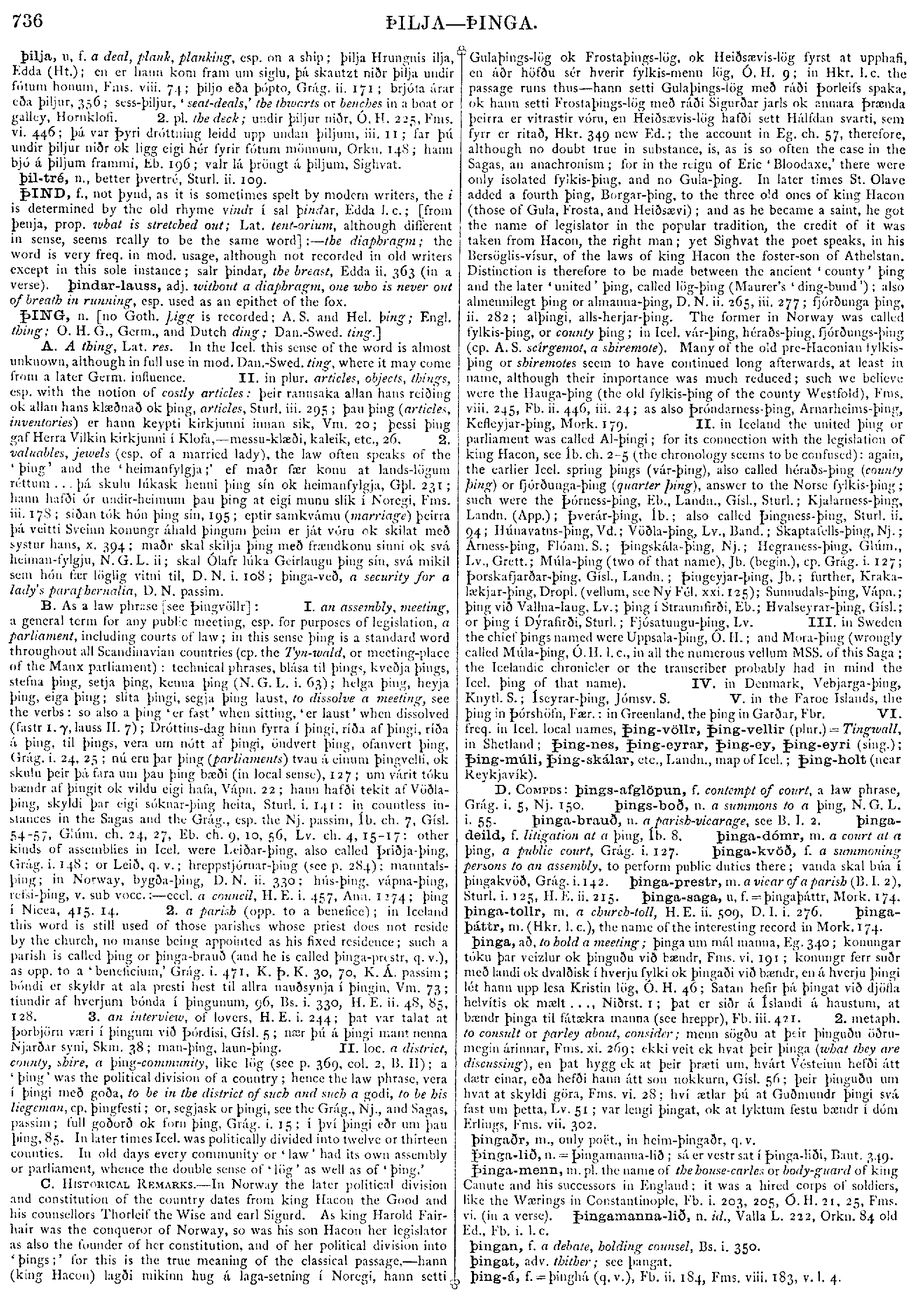
ÞING,
n.
[no
Goth.
þigg
is
recorded;
A.S.
and
Hel.
þing;
Engl.
thing;
O.H.G.,
Germ.,
and
Dutch
ding;
Dan.-Swed.
ting]
A.
A
thing,
Lat.
res.
In
the
Icel.
this
sense
of
the
word
is
almost
unknown,
although
in
full
use
in
mod.
Dan.-Swed.
ting,
where
it
may
come
from
a
later
Germ.
influence.
II.
in
plur.
articles,
objects,
things,
esp.
with
the
notion
of
costly
articles:
þeir
rannsaka
allan
hans
reiðing
ok
allan
hans
klæðnað
ok
þing,
articles,
Sturl.
iii.
295;
þau
þing
(articles,
inventories)
er
hann
keypti
kirkjunni
innan
sik,
Vm.
20;
þessi
þing
gaf
Herra
Vilkin
kirkjunni
í
Klofa,
--
messu-klæði,
kaleik,
etc.,
26.
2.
valuables,
jewels
(esp.
of
a
married
lady),
the
law
often
speaks
of
the
'þing'
and
the
'heimanfylgja;'
ef
maðr
fær
konu
at
lands-lögum
réttum
...
þá
skulu
lúkask
henni
þing
sín
ok
heimanfylgja,
Gþl.
231;
hann
hafði
ór
undir-heimum
þau
þing
at
eigi
munu
slík
í
Noregi,
Fms.
iii.
178;
siðan
tók
hón
þing
sín,
195;
eptir
samkvámu
(marriage)
þeirra
þá
veitti
Sveinn
konungr
áhald
þingum
þeim
er
ját
vóru
ok
skilat
með
systur
hans,
x.
394;
maðr
skal
skilja
þing
með
frændkonu
sinni
ok
svá
heiman-fylgju,
N.G.L.
ii;
skal
Ólafr
lúka
Geirlaugu
þing
sín,
svá
mikil
sem
hón
fær
löglig
vitni
til,
D.N.
i.
108;
þinga-veð,
a
security
for
a
lady's
paraphernalia,
D.N.
passim.
B.
As
a
law
phrase
[see
Þingvöllr]:
I.
an
assembly,
meeting,
a
general
term
for
any
public
meeting,
esp.
for
purposes
of
legislation,
a
parliament,
including
courts
of
law;
in
this
sense
þing
is
a
standard
word
throughout
all
Scandinavian
countries
(cp.
the
Tyn-wald,
or
meeting-place
of
the
Manx
parliament):
technical
phrases,
blása
til
þings,
kveðja
þings,
stefna
þing,
setja
þing,
kenna
þing
(N.G.L.
i.
63);
helga
þing,
heyja
þing,
eiga
þing;
slíta
þingi,
segja
þing
laust,
to
dissolve
a
meeting,
see
the
verbs:
so
also
a
þing
'er
fast'
when
sitting,
'er
laust'
when
dissolved
(fastr
I.
 ,
lauss
II.
7);
Dróttins-dag
hinn
fyrra
í
þingi,
ríða
af
þingi,
ríða
á
þing,
til
þings,
vera
um
nótt
af
þingi,
öndvert
þing,
ofanvert
þing,
Grág.
i.
24,
25;
nú
eru
þar
þing
(parliaments)
tvau
á
einum
þingvelli,
ok
skulu
þeir
þá
fara
um
þau
þing
bæði
(in
local
sense),
127;
um
várit
tóku
bændr
af
þingit
ok
vildu
eigi
hafa,
Vápn.
22;
hann
hafði
tekit
af
Vöðla-þing,
skyldi
þar
eigi
sóknar-þing
heita,
Sturl.
i.
141:
in
countless
instances
in
the
Sagas
and
the
Grág.,
esp.
the
Nj.
passim,
Íb.
ch.
7,
Gísl.
54-57,
Glúm.
ch.
24,
27,
Eb.
ch.
9,
10,
56,
Lv.
ch.
4,
15-17:
other
kinds
of
assemblies
in
Icel.
were
Leiðar-þing,
also
called
Þriðja-þing,
Grág.
i.
148;
or
Leið,
q.v.;
hreppstjórnar-þing
(see
p.
284);
manntals-þing;
in
Norway,
bygða-þing,
D.N.
ii.
330;
hús-þing,
vápna-þing,
refsi-þing,
v.
sub
vocc.
:--
eccl.
a
council,
H.E.
i.
457,
Ann.
1274;
þing
í
Nicea,
415.
14.
2.
a
parish
(opp.
to
a
benefice);
in
Iceland
this
word
is
still
used
of
those
parishes
whose
priest
does
not
reside
by
the
church,
no
manse
being
appointed
as
his
fixed
residence;
such
a
parish
is
called
þing
or
þinga-brauð
(and
he
is
called
þinga-prestr,
q.v.),
as
opp.
to
a
'beneficium,'
Grág.
i.
471,
K.Þ.K.
30,
70,
K.Á.
passim;
bóndi
er
skyldr
at
ala
presti
hest
til
allra
nauðsynja
í
þingin,
Vm.
73;
tíundir
af
hverjum
bónda
í
þingunum,
96,
Bs.
i.
330,
H.E.
ii.
48,
85,
128.
3.
an
interview,
of
lovers,
H.E.
i.
244;
þat
var
talat
at
Þorbjörn
væri
í
þingum
við
Þórdísi,
Gísl.
5;
nær
þú
á
þingi
mant
nenna
Njarðar
syni,
Skm.
38;
man-þing,
laun-þing.
II.
loc.
a
district,
county,
shire,
a
þing-community,
like
lög
(sec
p.
369,
col.
2,
B.
II);
a
'þing'
was
the
political
division
of
a
country;
hence
the
law
phrase,
vera
í
þingi
með
goða,
to
be
in
the
district
of
such
and
such
a
godi,
to
be
his
liegeman,
cp.
þingfesti;
or,
segjask
or
þingi,
see
the
Grág.,
Nj.,
and
Sagas,
passim;
full
goðorð
ok
forn
þing,
Grág.
i.
15;
í
því
þingi
eðr
um
þau
þing,
85.
In
later
times
Icel.
was
politically
divided
into
twelve
or
thirteen
counties.
In
old
days
every
community
or
'law'
had
its
own
assembly
or
parliament,
whence
the
double
sense
of
'lög'
as
well
as
of
'þing.'
C.
HISTORICAL
REMARKS.
--
In
Norway
the
later
political
division
and
constitution
of
the
country
dates
from
king
Hacon
the
Good
and
his
counsellors
Thorleif
the
Wise
and
earl
Sigurd.
As
king
Harold
Fairhair
was
the
conqueror
of
Norway,
so
was
his
son
Hacon
her
legislator
as
also
the
founder
of
her
constitution,
and
of
her
political
division
into
'þings;'
for
this
is
the
true
meaning
of
the
classical
passage,
--
hann
(king
Hacon)
lasgði
mikinn
hug
á
laga-setning
í
Noregi,
hann
setti
Gulaþings-lög
ok
Frostaþings-lög,
ok
Heiðsævis-lög
fyrst
at
upphafi,
en
áðr
höfðu
sér
hverir
fylkis-menn
lög,
Ó.H.
9;
in
Hkr.
l.c.
the
passage
runs
thus
--
hann
setti
Gulaþings-lög
með
ráði
Þorleifs
spaka,
ok
hann
setti
Frostaþings-lög
með
ráði
Sigurðar
jarls
ok
annara
Þrænda
þeirra
er
vitrastir
vóru,
en
Heiðsævis-lög
hafði
sett
Hálfdan
svarti,
sem
fyrr
er
ritað,
Hkr.
349
new
Ed.;
the
account
in
Eg.
ch.
57,
therefore,
although
no
doubt
true
in
substance,
is,
as
is
so
often
the
case
in
the
Sagas,
an
anachronism;
for
in
the
reign
of
Eric
'Bloodaxe,'
there
were
only
isolated
fylkis-þing,
and
no
Gula-þing.
In
later
times
St.
Olave
added
a
fourth
þing,
Borgar-þing,
to
the
three
old
ones
of
king
Hacon
(those
of
Gula,
Frosta,
and
Heiðsævi);
and
as
he
became
a
saint,
he
got
the
name
of
legislator
in
the
popular
tradition,
the
credit
of
it
was
taken
from
Hacon,
the
right
man;
yet
Sighvat
the
poet
speaks,
in
his
Bersöglis-vísur,
of
the
laws
of
king
Hacon
the
foster-son
of
Athelstan.
Distinction
is
therefore
to
be
made
between
the
ancient
'county'
þing
and
the
later
'united'
þing,
called
lög-þing
(Maurer's
'ding-bund');
also
almennilegt
þing
or
almanna-þing,
D.N.
ii.
265,
iii.
277;
fjórðunga
þing,
ii.
282;
alþingi,
alls-herjar-þing.
The
former
in
Norway
was
called
fylkis-þing,
or
county
þing;
in
Icel.
vár-þing,
héraðs-þing,
fjórðungs-þing
(cp.
A.S.
scîrgemot,
a
shiremote).
Many
of
the
old
pre-Haconian
fylkis-þing
or
shiremotes
seem
to
have
continued
long
afterwards,
at
least
in
name,
although
their
importance
was
much
reduced;
such
we
believe
were
the
Hauga-þing
(the
old
fylkis-þing
of
the
county
Westfold),
Fms.
viii.
245,
Fb.
ii.
446,
iii.
24;
as
also
Þróndarness-þing,
Arnarheims-þing,
Kefleyjar-þing,
Mork.
179.
II.
in
Iceland
the
united
þing
or
parliament
was
called
Al-þingi;
for
its
connection
with
the
legislation
of
king
Hacon,
see
Íb.
ch.
2-5
(the
chronology
seems
to
be
confused):
again,
the
earlier
Icel.
spring
þings
(vár-þing),
also
called
héraðs-þing
(county
þing)
or
fjórðunga-þing
(quarter
þing),
answer
to
the
Norse
fylkis-þing;
such
were
the
Þórness-þing,
Eb.,
Landn.,
Gísl.,
Sturl.;
Kjalarness-þing,
Landn.
(App.);
Þverár-þing,
Íb.;
also
called
Þingness-þing,
Sturl.
ii.
94;
Húnavatns-þing,
Vd.;
Vöðla-þing,
Lv.,
Band.;
Skaptafells-þing,
Nj.;
Árness-þing,
Flóam.
S.;
þingskála-þing,
Nj.;
Hegraness-þing,
Glúm.,
Lv.,
Grett.;
Múla-þing
(two
of
that
name),
Jb.
(begin.),
cp.
Grág.
i.
127;
Þorskafjarðar-þing,
Gísl.,
Landn.;
Þingeyjar-þing,
Jb.;
further,
Krakalækjar-þing,
Dropl.
(vellum,
see
Ny
Fél.
xxi.
125);
Sunnudals-þing,
Vápn.;
þing
við
Vallna-laug,
Lv.;
þing
í
Straumfirði,
Eb.;
Hvalseyrar-þing,
Gísl.;
or
þing
í
Dýrafirði,
Sturl.;
Fjósatungu-þing,
Lv.
III.
in
Sweden
the
chief
þings
named
were
Uppsala-þing,
Ó.H.;
and
Mora-þing
(wrongly
called
Múla-þing,
Ó.H.
l.c.,
in
all
the
numerous
vellum
MSS.
of
this
Saga;
the
Icelandic
chronicler
or
the
transcriber
probably
had
in
mind
the
Icel.
þing
of
that
name).
IV.
in
Denmark,
Vebjarga-þing,
Knytl.
S.;
Íseyrar-þing,
Jómsv.
S.
V.
in
the
Faroe
Islands,
the
þing
in
Þórshöfn,
Fær.:
in
Greenland,
the
þing
in
Garðar,
Fbr.
VI.
freq.
in
Icel.
local
names,
Þing-völlr,
Þing-vellir
(plur.)
=
Tingwall,
in
Shetland;
Þing-nes,
Þing-eyrar,
Þing-ey,
Þing-eyri
(sing.);
Þing-múli,
Þing-skálar,
etc.,
Landn.,
map
of
Icel.;
Þing-holt
(near
Reykjavik).
D.
COMPDS:
þings-afglöpun,
f.
contempt
of
court,
a
law
phrase,
Grág.
i.
5,
Nj.
150.
þings-boð,
n.
a
summons
to
a
þing,
N.G.L.
i.
55.
þinga-brauð,
n.
a
parish-vicarage,
see
B.
I.
2.
þinga-deild,
f.
litigation
at
a
þing,
Íb.
8.
þinga-dómr,
m.
a
court
at
a
þing,
a
public
court,
Grág.
i.
127.
þinga-kvöð,
f.
a
summoning
persons
to
an
assembly,
to
perform
public
duties
there;
vanda
skal
búa
í
þingakvöð,
Grág.
i.
142.
þinga-prestr,
m.
a
vicar
of
a
parish
(B.
I.
2),
Sturl.
i.
125,
H.E.
ii.
215.
þinga-saga,
u,
f.
=
þingaþáttr,
Mork.
174.
þinga-tollr,
m.
a
church-toll,
H.E.
ii.
509,
D.I.
276.
þinga-þáttr,
m.
(Hkr.
l.c.),
the
name
of
the
interesting
record
in
Mork.
174.
,
lauss
II.
7);
Dróttins-dag
hinn
fyrra
í
þingi,
ríða
af
þingi,
ríða
á
þing,
til
þings,
vera
um
nótt
af
þingi,
öndvert
þing,
ofanvert
þing,
Grág.
i.
24,
25;
nú
eru
þar
þing
(parliaments)
tvau
á
einum
þingvelli,
ok
skulu
þeir
þá
fara
um
þau
þing
bæði
(in
local
sense),
127;
um
várit
tóku
bændr
af
þingit
ok
vildu
eigi
hafa,
Vápn.
22;
hann
hafði
tekit
af
Vöðla-þing,
skyldi
þar
eigi
sóknar-þing
heita,
Sturl.
i.
141:
in
countless
instances
in
the
Sagas
and
the
Grág.,
esp.
the
Nj.
passim,
Íb.
ch.
7,
Gísl.
54-57,
Glúm.
ch.
24,
27,
Eb.
ch.
9,
10,
56,
Lv.
ch.
4,
15-17:
other
kinds
of
assemblies
in
Icel.
were
Leiðar-þing,
also
called
Þriðja-þing,
Grág.
i.
148;
or
Leið,
q.v.;
hreppstjórnar-þing
(see
p.
284);
manntals-þing;
in
Norway,
bygða-þing,
D.N.
ii.
330;
hús-þing,
vápna-þing,
refsi-þing,
v.
sub
vocc.
:--
eccl.
a
council,
H.E.
i.
457,
Ann.
1274;
þing
í
Nicea,
415.
14.
2.
a
parish
(opp.
to
a
benefice);
in
Iceland
this
word
is
still
used
of
those
parishes
whose
priest
does
not
reside
by
the
church,
no
manse
being
appointed
as
his
fixed
residence;
such
a
parish
is
called
þing
or
þinga-brauð
(and
he
is
called
þinga-prestr,
q.v.),
as
opp.
to
a
'beneficium,'
Grág.
i.
471,
K.Þ.K.
30,
70,
K.Á.
passim;
bóndi
er
skyldr
at
ala
presti
hest
til
allra
nauðsynja
í
þingin,
Vm.
73;
tíundir
af
hverjum
bónda
í
þingunum,
96,
Bs.
i.
330,
H.E.
ii.
48,
85,
128.
3.
an
interview,
of
lovers,
H.E.
i.
244;
þat
var
talat
at
Þorbjörn
væri
í
þingum
við
Þórdísi,
Gísl.
5;
nær
þú
á
þingi
mant
nenna
Njarðar
syni,
Skm.
38;
man-þing,
laun-þing.
II.
loc.
a
district,
county,
shire,
a
þing-community,
like
lög
(sec
p.
369,
col.
2,
B.
II);
a
'þing'
was
the
political
division
of
a
country;
hence
the
law
phrase,
vera
í
þingi
með
goða,
to
be
in
the
district
of
such
and
such
a
godi,
to
be
his
liegeman,
cp.
þingfesti;
or,
segjask
or
þingi,
see
the
Grág.,
Nj.,
and
Sagas,
passim;
full
goðorð
ok
forn
þing,
Grág.
i.
15;
í
því
þingi
eðr
um
þau
þing,
85.
In
later
times
Icel.
was
politically
divided
into
twelve
or
thirteen
counties.
In
old
days
every
community
or
'law'
had
its
own
assembly
or
parliament,
whence
the
double
sense
of
'lög'
as
well
as
of
'þing.'
C.
HISTORICAL
REMARKS.
--
In
Norway
the
later
political
division
and
constitution
of
the
country
dates
from
king
Hacon
the
Good
and
his
counsellors
Thorleif
the
Wise
and
earl
Sigurd.
As
king
Harold
Fairhair
was
the
conqueror
of
Norway,
so
was
his
son
Hacon
her
legislator
as
also
the
founder
of
her
constitution,
and
of
her
political
division
into
'þings;'
for
this
is
the
true
meaning
of
the
classical
passage,
--
hann
(king
Hacon)
lasgði
mikinn
hug
á
laga-setning
í
Noregi,
hann
setti
Gulaþings-lög
ok
Frostaþings-lög,
ok
Heiðsævis-lög
fyrst
at
upphafi,
en
áðr
höfðu
sér
hverir
fylkis-menn
lög,
Ó.H.
9;
in
Hkr.
l.c.
the
passage
runs
thus
--
hann
setti
Gulaþings-lög
með
ráði
Þorleifs
spaka,
ok
hann
setti
Frostaþings-lög
með
ráði
Sigurðar
jarls
ok
annara
Þrænda
þeirra
er
vitrastir
vóru,
en
Heiðsævis-lög
hafði
sett
Hálfdan
svarti,
sem
fyrr
er
ritað,
Hkr.
349
new
Ed.;
the
account
in
Eg.
ch.
57,
therefore,
although
no
doubt
true
in
substance,
is,
as
is
so
often
the
case
in
the
Sagas,
an
anachronism;
for
in
the
reign
of
Eric
'Bloodaxe,'
there
were
only
isolated
fylkis-þing,
and
no
Gula-þing.
In
later
times
St.
Olave
added
a
fourth
þing,
Borgar-þing,
to
the
three
old
ones
of
king
Hacon
(those
of
Gula,
Frosta,
and
Heiðsævi);
and
as
he
became
a
saint,
he
got
the
name
of
legislator
in
the
popular
tradition,
the
credit
of
it
was
taken
from
Hacon,
the
right
man;
yet
Sighvat
the
poet
speaks,
in
his
Bersöglis-vísur,
of
the
laws
of
king
Hacon
the
foster-son
of
Athelstan.
Distinction
is
therefore
to
be
made
between
the
ancient
'county'
þing
and
the
later
'united'
þing,
called
lög-þing
(Maurer's
'ding-bund');
also
almennilegt
þing
or
almanna-þing,
D.N.
ii.
265,
iii.
277;
fjórðunga
þing,
ii.
282;
alþingi,
alls-herjar-þing.
The
former
in
Norway
was
called
fylkis-þing,
or
county
þing;
in
Icel.
vár-þing,
héraðs-þing,
fjórðungs-þing
(cp.
A.S.
scîrgemot,
a
shiremote).
Many
of
the
old
pre-Haconian
fylkis-þing
or
shiremotes
seem
to
have
continued
long
afterwards,
at
least
in
name,
although
their
importance
was
much
reduced;
such
we
believe
were
the
Hauga-þing
(the
old
fylkis-þing
of
the
county
Westfold),
Fms.
viii.
245,
Fb.
ii.
446,
iii.
24;
as
also
Þróndarness-þing,
Arnarheims-þing,
Kefleyjar-þing,
Mork.
179.
II.
in
Iceland
the
united
þing
or
parliament
was
called
Al-þingi;
for
its
connection
with
the
legislation
of
king
Hacon,
see
Íb.
ch.
2-5
(the
chronology
seems
to
be
confused):
again,
the
earlier
Icel.
spring
þings
(vár-þing),
also
called
héraðs-þing
(county
þing)
or
fjórðunga-þing
(quarter
þing),
answer
to
the
Norse
fylkis-þing;
such
were
the
Þórness-þing,
Eb.,
Landn.,
Gísl.,
Sturl.;
Kjalarness-þing,
Landn.
(App.);
Þverár-þing,
Íb.;
also
called
Þingness-þing,
Sturl.
ii.
94;
Húnavatns-þing,
Vd.;
Vöðla-þing,
Lv.,
Band.;
Skaptafells-þing,
Nj.;
Árness-þing,
Flóam.
S.;
þingskála-þing,
Nj.;
Hegraness-þing,
Glúm.,
Lv.,
Grett.;
Múla-þing
(two
of
that
name),
Jb.
(begin.),
cp.
Grág.
i.
127;
Þorskafjarðar-þing,
Gísl.,
Landn.;
Þingeyjar-þing,
Jb.;
further,
Krakalækjar-þing,
Dropl.
(vellum,
see
Ny
Fél.
xxi.
125);
Sunnudals-þing,
Vápn.;
þing
við
Vallna-laug,
Lv.;
þing
í
Straumfirði,
Eb.;
Hvalseyrar-þing,
Gísl.;
or
þing
í
Dýrafirði,
Sturl.;
Fjósatungu-þing,
Lv.
III.
in
Sweden
the
chief
þings
named
were
Uppsala-þing,
Ó.H.;
and
Mora-þing
(wrongly
called
Múla-þing,
Ó.H.
l.c.,
in
all
the
numerous
vellum
MSS.
of
this
Saga;
the
Icelandic
chronicler
or
the
transcriber
probably
had
in
mind
the
Icel.
þing
of
that
name).
IV.
in
Denmark,
Vebjarga-þing,
Knytl.
S.;
Íseyrar-þing,
Jómsv.
S.
V.
in
the
Faroe
Islands,
the
þing
in
Þórshöfn,
Fær.:
in
Greenland,
the
þing
in
Garðar,
Fbr.
VI.
freq.
in
Icel.
local
names,
Þing-völlr,
Þing-vellir
(plur.)
=
Tingwall,
in
Shetland;
Þing-nes,
Þing-eyrar,
Þing-ey,
Þing-eyri
(sing.);
Þing-múli,
Þing-skálar,
etc.,
Landn.,
map
of
Icel.;
Þing-holt
(near
Reykjavik).
D.
COMPDS:
þings-afglöpun,
f.
contempt
of
court,
a
law
phrase,
Grág.
i.
5,
Nj.
150.
þings-boð,
n.
a
summons
to
a
þing,
N.G.L.
i.
55.
þinga-brauð,
n.
a
parish-vicarage,
see
B.
I.
2.
þinga-deild,
f.
litigation
at
a
þing,
Íb.
8.
þinga-dómr,
m.
a
court
at
a
þing,
a
public
court,
Grág.
i.
127.
þinga-kvöð,
f.
a
summoning
persons
to
an
assembly,
to
perform
public
duties
there;
vanda
skal
búa
í
þingakvöð,
Grág.
i.
142.
þinga-prestr,
m.
a
vicar
of
a
parish
(B.
I.
2),
Sturl.
i.
125,
H.E.
ii.
215.
þinga-saga,
u,
f.
=
þingaþáttr,
Mork.
174.
þinga-tollr,
m.
a
church-toll,
H.E.
ii.
509,
D.I.
276.
þinga-þáttr,
m.
(Hkr.
l.c.),
the
name
of
the
interesting
record
in
Mork.
174.
|
Source: Cleasby/Vigfusson, page b0738, entry 20 View original page image as: [TIFF] [PNG] [View previous entry] [View next entry] |
[Comment on this entry] [View comments] |
The following entry has been hand-corrected once. |
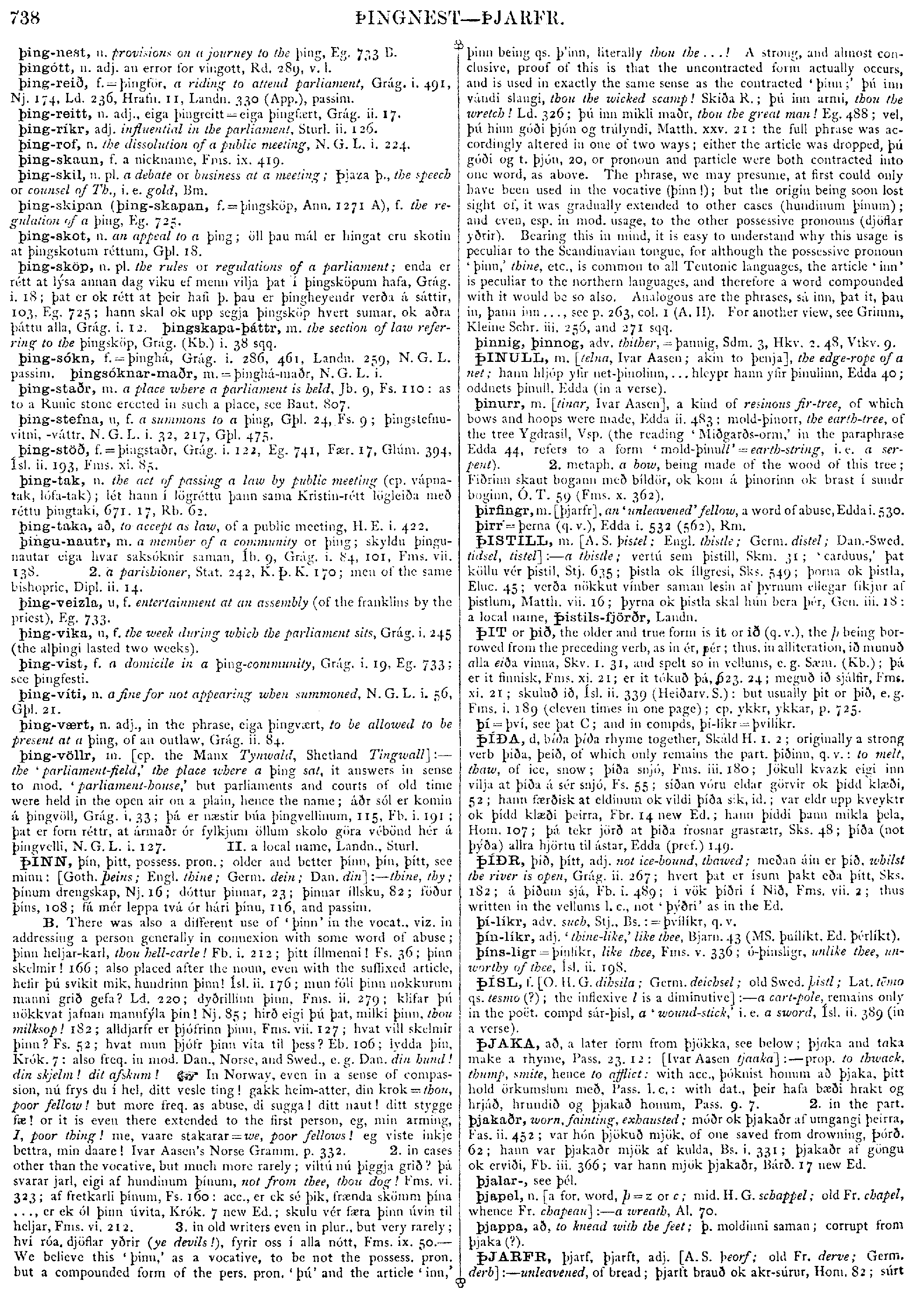
þing-vika, u, f. the week during which the parliament sits, Grág. i. 245 (the alþingi lasted two weeks).
|
Source: Cleasby/Vigfusson, page b0738, entry 25 View original page image as: [TIFF] [PNG] [View previous entry] [View next entry] |
[Comment on this entry] [View comments] |
The following entry has been hand-corrected once. |
ÞINN, þín, þitt, possess. pron.; older and better þínn, þín, þítt, see minn: [Goth. þeins; Engl. thine; Germ. dein; Dan. din] :-- thine, thy; þínum drengskap, Nj. 16; dóttur þinnar, 23; þinnar íllsku, 82; föður þíns, 108; fá mér leppa tvá ór hári þínu, 116, and passim. B. There was also a different use of 'þinn' in the vocat., viz. in addressing a person generally in connexion with some word of abuse; þinn heljar-karl, thou hell-carle! Fb. i. 212; þitt íllmenni! Fs. 36; þinn skelmir! 166; also placed after the noun, even with the suffixed article, hefir þú svikit mik, hundrinn þinn! Ísl. ii. 176; mun fóli þinn nokkurum manni grið gefa? Ld. 220; dyðrillinn þinn, Fms. ii. 279; klifar þú nökkvat jafnan mannfýla þin! Nj. 85; hirð eigi þú þat, milki þinn, thou milksop! 182; alldjarfr er þjófrinn þinn, Fms. vii. 127; hvat vill skelmir þinn? Fs. 52; hvat mun þjófr þinn vita til þess? Eb. 106; lydda þin, Krók. 7: also freq. in mod. Dan., Norse, and Swed., e.g. Dan. din hund! din skjelm! dit afskum! &FINGER; In Norway, even in a sense of compassion, nú frys du í hel, ditt vesle ting! gakk heim-atter, din krok = thou, poor fellow! but more freq. as abuse, di sugga! ditt naut! ditt stygge fæ! or it is even there extended to the first person, eg, min arming, I, poor thing! me, vaarc stakarar = we, poor fellows! eg viste inkje bettra, min daare ! Ivar Aasen's Norse Gramm. p. 332. 2. in cases other than the vocative, but much more rarely; viltú nú þiggja grið ? þá svarar jarl, eigi af hundinum þínum, not from thee, thou dog! Fms. vi. 323; af fretkarli þínum, Fs. 160: acc., er ek sé þik, frænda skömm þína ..., er ek ól þinn úvita, Krók. 7 new Ed.; skulu vér færa þinn úvin til heljar, Fms. vi. 212. 3. in old writers even in plur., but very rarely; hví róa. djöflar yðrir (ye devils!), fyrir oss í alla nótt, Fms. ix. 50. -- We believe this 'þinn,' as a vocative, to be not the possess. pron. but a compounded form of the pers. pron. 'þú' and the article 'inn,' þinn being qs. þ'inn, literally thou the ... ! A strong, and almost conclusive, proof of this is that the uncontracted form actually occurs, and is used in exactly the same sense as the contracted 'þinn;' þú inn vándi slangi, thou the wicked scamp! Skíða R.; þú inn armi, thou the wretch! Ld. 326; þú inn mikli maðr, thou the great man! Eg. 488; vel, þú hinn góði þjón og trúlyndi, Matth. xxv. 21: the full phrase was accordingly altered in one of two ways; either the article was dropped, þú góði og t. þjón, 20, or pronoun and particle were both contracted into one word, as above. The phrase, we may presume, at first could only have been used in the vocative (þinn!); but the origin being soon lost sight of, it was gradually extended to other cases (hundinum þínum); and even, esp. in mod. usage, to the other possessive pronouns (djöflar yðrir). Bearing this in mind, it is easy to understand why this usage is peculiar to the Scandinavian tongue, for although the possessive pronoun 'þinn,' thine, etc., is common to all Teutonic languages, the article 'inn' is peculiar to the northern languages, and therefore a word compounded with it would be so also. Analogous are the phrases, sá inn, þat it, þau in, þann inn ... . see p. 263, col. 1 (A. II). For another view, see Grimm, Kleine Schr. iii. 256, and 271 sqq.
|
Source: Cleasby/Vigfusson, page b0740, entry 25 View original page image as: [TIFF] [PNG] [View previous entry] [View next entry] |
[Comment on this entry] [View comments] |
The following entry has been hand-corrected once. |
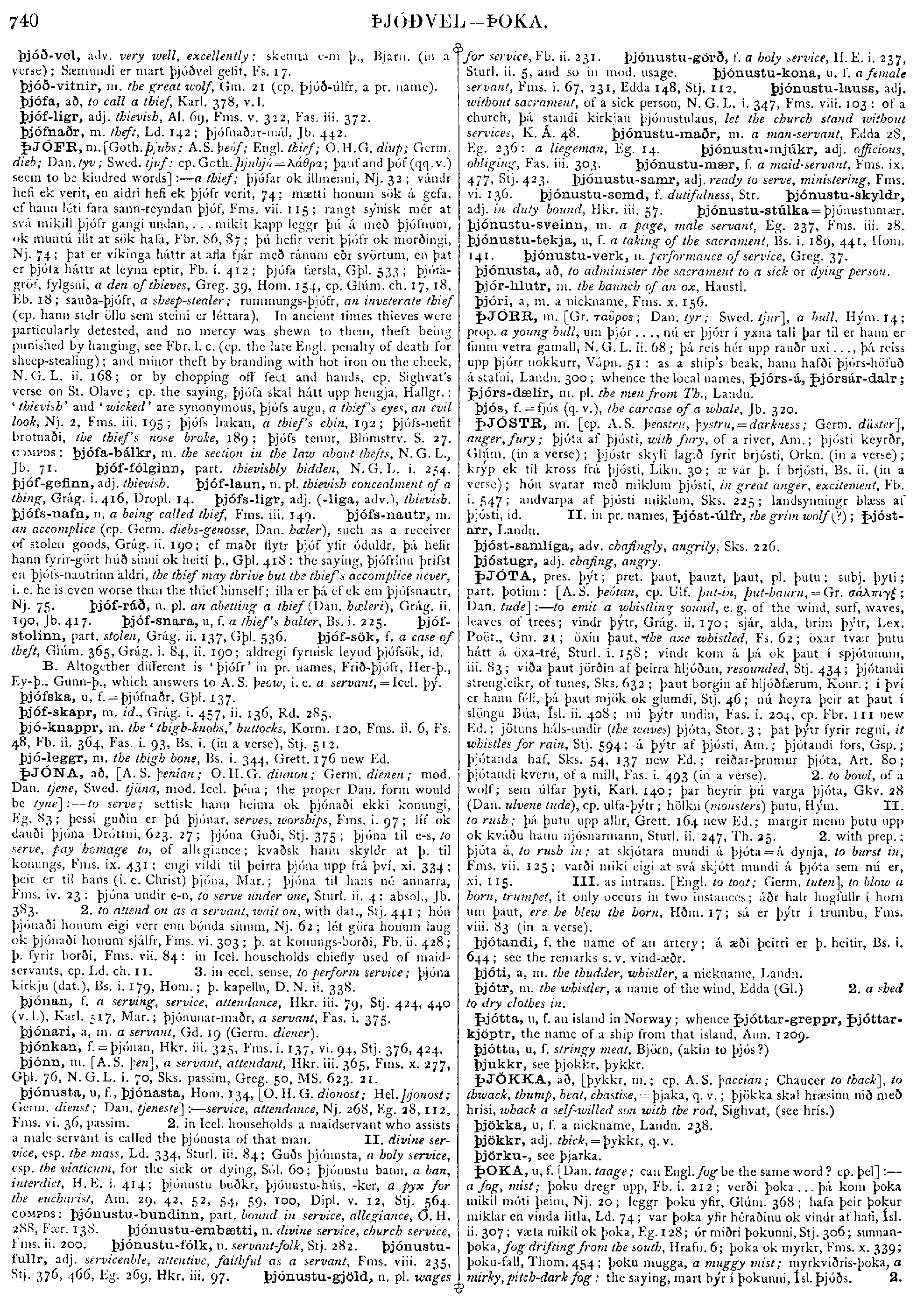
ÞJÓTA, pres. þýt; pret. þaut, þauzt, þaut, pl. þutu; subj. þyti; part. þotinn: [A.S. þeótan, cp. Ulf. þut-in, þut-haurn, = Gr. GREEK; Dan. tude] :-- to emit a whistling sound, e.g. of the wind, surf, waves, leaves of trees; vindr þýtr, Grág. ii. 170; sjár, alda, brim þýtr, Lex. Poët., Gm. 21; öxin þaut, the axe whistled, Fs. 62; öxar tvær þutu hátt á öxa-tré, Sturl. 1. 158; vindr kom á þá ok þaut í spjótunum, iii. 83; víða þaut jörðin af þeirra hljóðan, resounded, Stj. 434; þjótandi strengleikr, of tunes, Sks. 632; þaut borgin af hljóðfærum, Konr.; í því er hann féll, þá þaut mjök ok glumdi, Stj. 46; nú heyra þeir at þaut í slöngu Búa, Ísl. ii. 408; nú þýtr undin, Fas. i. 204, cp. Fbr. 111 new Ed.; jötuns háls-undir (the waves) þjóta, Stor. 3; þat þýtr fyrir regni, it whistles for rain, Stj. 594; á þýtr af þjósti, Am.; þjótandi fors, Gsp.; þjótanda haf, Sks. 54, 137 new Ed.; reiðar-þrumur þjóta, Art. 80; þjótandi kvern, of a mill, Fas. i. 493 (in a verse). 2. to howl, of a wolf; sem úlfar þyti, Karl. 140; þar heyrir þú varga þjóta, Gkv. 28 (Dan. ulvene tude), cp. ulfa-þýtr; hölkn (monsters) þutu, Hým. II. to rush; þá þutu upp allir, Grett. 164 new Ed.; margir menn þutu upp ok kváðu hann njósnarmann, Sturl. ii. 247, Th. 25. 2. with prep.; þjóta ú, to rush in; at skjótara mundi á þjóta = á dynja, to burst in, Fms. vii. 125; varði miki eigi at svá skjótt mundi á þjóta sem nú er, xi. 115. III. as intrans. [Engl. to toot; Germ. tuten], to blow a horn, trumpet, it only occurs in two instances; áðr halr hugfullr í horn um þaut, ere he blew the horn, Hðm. 17; sá er þýtr í trumbu, Fms. viii. 83 (in a verse).
|
Source: Cleasby/Vigfusson, page b0744, entry 19 View original page image as: [TIFF] [PNG] [View previous entry] [View next entry] |
[Comment on this entry] [View comments] |
The following entry has been hand-corrected once. |
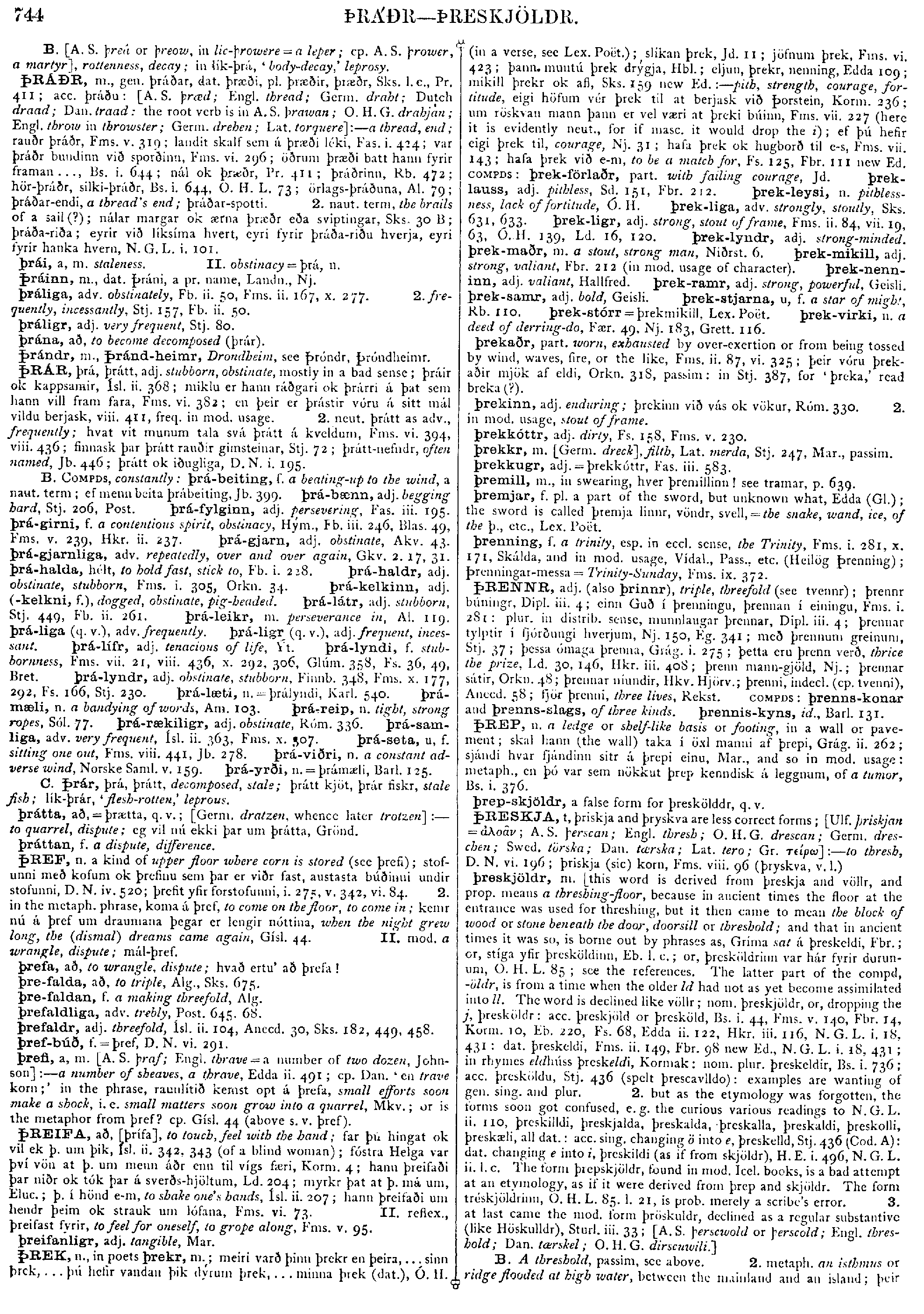
þrefi, a, m. [A.S. þraf; Engl. thrave = number of two dozen, Johnson] :-- a number of sheaves, a thrave, Edda ii. 491; cp. Dan. 'en trave korn;' in the phrase, raunlítið kemst opt á þrefa, small efforts soon make a shock, i.e. small matters soon grow into a quarrel, Mkv.; or is the metaphor from þref? cp. Gísl. 44 (above s.v. þref).
|
Source: Cleasby/Vigfusson, page b0751, entry 1 View original page image as: [TIFF] [PNG] [View previous entry] [View next entry] |
[Comment on this entry] [View comments] |
The following entry has been hand-corrected once. |
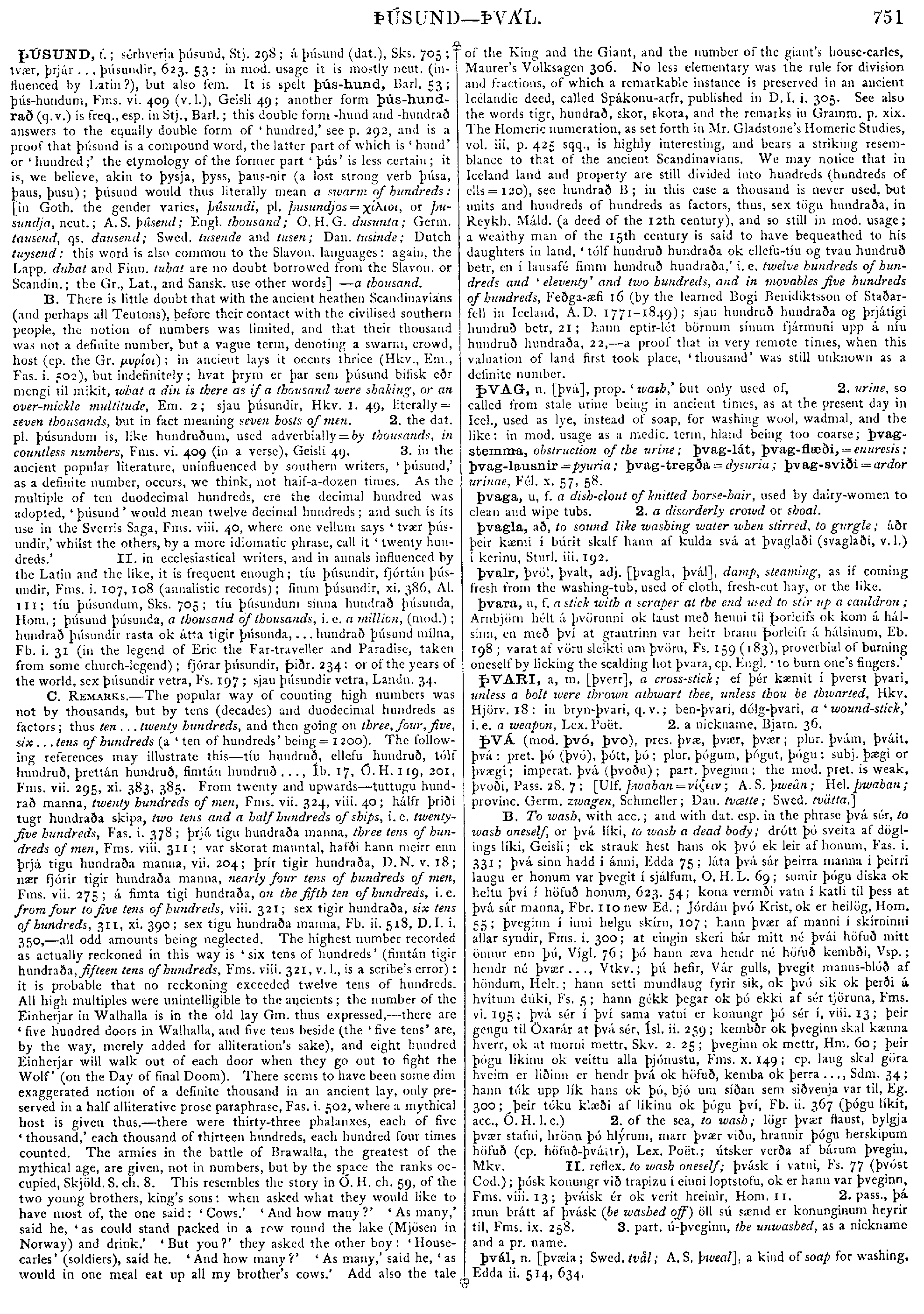
ÞÚSUND, f.; sérhverja þúsund, Stj. 298; á þúsund (dat.), Sks. 705; tvær, þrjár ... þúsundir, 623. 53: in mod. usage it is mostly neut. (influenced by Latin?), but also fem. It is spelt þús-hund, Barl. 53; þús-hundum, Fms. vi. 409 (v.l.), Geisli 49; another form þús-hundrað (q.v.) is freq., esp. in Stj., Barl.; this double form -hund and -hundrað answers to the equally double form of 'hundred,' see p. 292, and is a proof that þúsund is a compound word, the latter part of which is 'hund' or 'hundred;' the etymology of the former part 'þús' is less certain; it is, we believe, akin to þysja, þyss, þaus-nir (a lost strong verb þúsa, þaus, þusu); þúsund would thus literally mean a swarm of hundreds: [in Goth. the gender varies, þûsundi, pl. þusundjos = GREEK, or þusundja, neut.; A.S. þûsend; Engl. thousand; O.H.G. dusunta; Germ. tausend, qs. dausend; Swed. tusende and tusen; Dan. tusinde; Dutch tuysend: this word is also common to the Slavon. languages: again, the Lapp, duhat and Finn. tuhat are no doubt borrowed from the Slavon. or Scandin.; the Gr., Lat., and Sansk. use other words] -- a thousand. B. There is little doubt that with the ancient heathen Scandinavians (and perhaps all Teutons), before their contact with the civilised southern people, the notion of numbers was limited, and that their thousand was not a definite number, but a vague term, denoting a swarm, crowd, host (cp. the Gr. GREEK): in ancient lays it occurs thrice (Hkv., Em., Fas. i. 502), but indefinitely; hvat þrym er þar sem þúsund bifisk eðr mengi til mikit, what a din is there as if a thousand were shaking, or an over-mickle multitude, Em. 2; sjau þúsundir, Hkv. 1. 49, literally = seven thousands, but in fact meaning seven hosts of men. 2. the dat. pl. þúsundum is, like huudruðum, used adverbially = by thousands, in countless numbers, Fms. vi. 409 (in a verse), Geisli 49. 3. in the ancient popular literature, uninfluenced by southern writers, 'þúsund,' as a definite number, occurs, we think, not half-a-dozen times. As the multiple of ten duodecimal hundreds, ere the decimal hundred was adopted, 'þnsund' would mean twelve decimal hundreds; and such is its use in the Sverris Saga, Fms. viii. 40, where one vellum says 'tvær þúsundir,' whilst the others, by a more idiomatic phrase, call it 'twenty hundreds.' II. in ecclesiastical writers, and in annals influenced by the Latin and the like, it is frequent enough; tíu þúsundir, fjórtán þúsundir, Fms. i. 107, 108 (annalistic records); fimm þúsundir, xi. 386, Al. 111; tíu þúsundum, Sks. 705; tíu þúsundum sinna hundrað þúsunda, Hom.; þúsund þúsunda, a thousand of thousands, i.e. a million, (mod.); hundrað þúsundir rasta ok átta tigir þúsunda, ... hundrað þúsund mílna, Fb. i. 31 (in the legend of Eric the Far-traveller and Paradise, taken from some church-legend); fjórar þúsundir, Þiðr. 234: or of the years of the world, sex þúsundir vetra, Fs. 197; sjau þúsundir vetra, Landn. 34. C. REMARKS. -- The popular way of counting high numbers was not by thousands, but by tens (decades) and duodecimal hundreds as factors; thus ten ... twenty hundreds, and then going on three, four, five, six ... tens of hundreds (a 'ten of hundreds' being = 1200). The following references may illustrate this -- tíu hundruð, ellefu hundruð, tólf hundruð, þrettán hundruð, fimtán hundruð ..., Íb. 17, Ó.H. 119, 201, Fms. vii. 295, xi. 383, 385. From twenty and upwards -- tuttugu hundrað manna, twenty hundreds of men, Fms. vii. 324, viii. 40; hálfr þriðitugr hundraða skipa, two tens and a half hundreds of ships, i.e. twenty-five hundreds, Fas. i. 378; þrjá tigu hundraða manna, three tens of hundreds of men, Fms. viii. 311; var skorat manntal, hafði hann meirr enn þrjá tigu hundraða manna, vii. 204; þrír tigir hundraða, D. N. v. 18; user fjorir tigir hundraða manna, nearly four tens of hundreds of men, Fms. vii. 275; á fimta tigi hundraða, on the fifth ten of hundreds, i.e. from four to five tens of hundreds, viii. 321; sex tigir hundraða, six tens of hundreds, 311, xi. 390; sex tigu hundraða manna, Fb. ii. 518, D.I. i. 350, -- all odd amounts being neglected. The highest number recorded as actually reckoned in this way is 'six tens of hundreds' (fimtán tigir hundraða, fifteen tens of hundreds, Fms. viii. 321, v.l., is a scribe's error): it is probable that no reckoning exceeded twelve tens of hundreds. All high multiples were unintelligible to the ancients; the number of the Einherjar in Walhalla is in the old lay Gm. thus expressed, -- there are 'five hundred doors in Walhalla, and five tens beside (the 'five tens' are, by the way, merely added for alliteration's sake), and eight hundred Einherjar will walk out of each door when they go out to fight the Wolf' (on the Day of final Doom). There seems to have been some dim exaggerated notion of a definite thousand in an ancient lay, only preserved in a half alliterative prose paraphrase, Fas. i. 502, where a mythical host is given thus, -- there were thirty-three phalanxes, each of five 'thousand,' each thousand of thirteen hundreds, each hundred four times counted. The armies in the battle of Brawalla, the greatest of the mythical age, are given, not in numbers, but by the space the ranks occupied, Skjöld. S. ch. 8. This resembles the story in Ó.H. ch. 59, of the two young brothers, king's sons: when asked what they would like to have most of, the one said: 'Cows.' 'And how many?' 'As many,' said he, 'as could stand packed in a row round the lake (Mjösen in Norway) and drink.' 'But you?' they asked the other boy: 'House-carles' (soldiers), said he. 'And how many?' 'As many,' said he, 'as would in one meal eat up all my brother's cows.' Add also the tale of the King and the Giant, and the number of the giant's house-carles, Maurer's Volksagen 306. No less elementary was the rule for division and fractions, of which a remarkable instance is preserved in an ancient Icelandic deed, called Spákonu-arfr, published in D.I. i. 305. See also the words tigr, hundrað, skor, skora, and the remarks in Gramm. p. xix. The Homeric numeration, as set forth in Mr. Gladstone's Homeric Studies, vol. iii, p. 425 sqq., is highly interesting, and bears a striking resemblance to that of the ancient Scandinavians. We may notice that in Iceland land and property are still divided into hundreds (hundreds of ells = 120), see hundrað B; in this case a thousand is never used, but units and hundreds of hundreds as factors, thus, sex tögu hundraða, in Reykh. Máld, (a deed of the 12th century), and so still in mod. usage; a wealthy man of the 15th century is said to have bequeathed to his daughters in land, 'tólf hundruð hundraða ok ellefu-tíu og tvau hundruð betr, en í lausafé fimm hundruð hundraða,' i.e. twelve hundreds of hundreds and 'eleventy' and two hundreds, and in movables five hundreds of hundreds, Feðga-æfi 16 (by the learned Bogi Benidiktsson of Staðarfell in Iceland, A.D. 1771-1849); sjau hundruð hundraða og þrjátigi hundruð betr, 21; hann eptir-lét börnum sínum fjármuni upp á níu hundruð hundraða, 22, -- a proof that in very remote times, when this valuation of land first took place, 'thousand' was still unknown as a definite number.
|
Source: Cleasby/Vigfusson, page b0752, entry 10 View original page image as: [TIFF] [PNG] [View previous entry] [View next entry] |
[Comment on this entry] [View comments] |
The following entry has been hand-corrected once. |
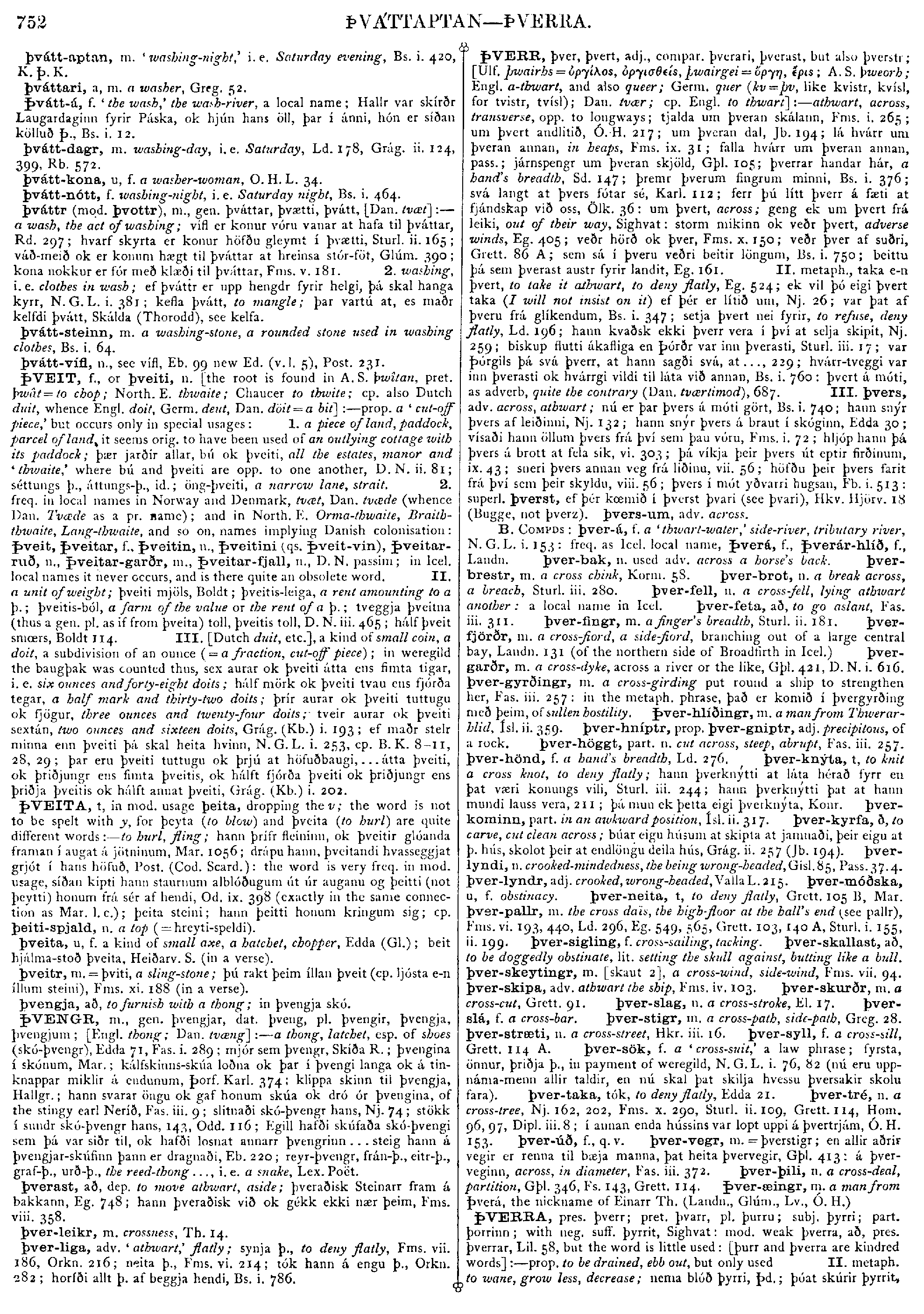
ÞVEIT, f., or þveiti, n. [the root is found in A.S. þwîtan, pret. þwât = to chop; North. E. thwaite; Chaucer to thwite; cp. also Dutch duit, whence Engl. doit, Germ. deut, Dan. döit = a bit] :-- prop. a 'cut-off piece,' but occurs only in special usages: 1. a piece of land, paddock, parcel of land, it seems orig. to have been used of an outlying cottage with its paddock; þær jarðir allar, bú ok þveiti, all the estates, manor and 'thwaite,' where bú and þveiti are opp. to one another, D.N. ii. 81; séttungs þ., áttungs-þ., id.; öng-þveiti, a narrow lane, strait. 2. freq. in local names in Norway and Denmark, tvæt, Dan. tvæde (whence Dan. Tvæde as a pr. name); and in North. E. Orma-thwaite, Braith-thwaite, Lang-thwaite, and so on, names implying Danish colonisation: Þveit, Þveitar, f., Þveitin, n., Þveitini (qs. Þveit-vin), Þveitar-ruð, n., Þveitar-garðr, m., Þveitar-fjall, n., D.N. passim; in Icel. local names it never occurs, and is there quite an obsolete word. II. a unit of weight; þveiti mjöls, Boldt; þveitis-leiga, a rent amounting to a þ.; þveitis-ból, a farm of the value or the rent of a þ.; tveggja þveitna (thus a gen. pl. as if from þveita) toll, þveitis toll, D.N. iii. 465; hálf þveit smœrs, Boldt 114. III. [Dutch duit, etc.], a kind of small coin, a doit, a subdivision of an ounce (= a fraction, cut-off piece); in weregild the baugþak was counted thus, sex aurar ok þveiti átta ens fimta tigar, i.e. six ounces and forty-eight doits; hálf mörk ok þveiti tvau ens fjórða tegar, a half mark and thirty-two doits; þrír aurar ok þveiti tuttugu ok fjögur, three ounces and twenty-four doits; tveir aurar ok þveiti sextan, two ounces and sixteen doits, Grág. (Kb.) i. 193; ef maðr stelr minna enn þveiti þá skal heita hvinn, N.G.L. i. 253, cp. B.K. 8-11, 28, 29; þar eru þveiti tuttugu ok þrjú at höfuðbaugi, ... átta þveiti, ok þriðjungr ens fimta þveitis, ok hálft fjórða þveiti ok þriðjungr ens þriðja þveitis ok hálft annat þveiti, Grág. (Kb.) i. 202.
|
Source: Cleasby/Vigfusson, page b0756, entry 14 View original page image as: [TIFF] [PNG] [View previous entry] [View next entry] |
[Comment on this entry] [View comments] |
The following entry has been hand-corrected once. |
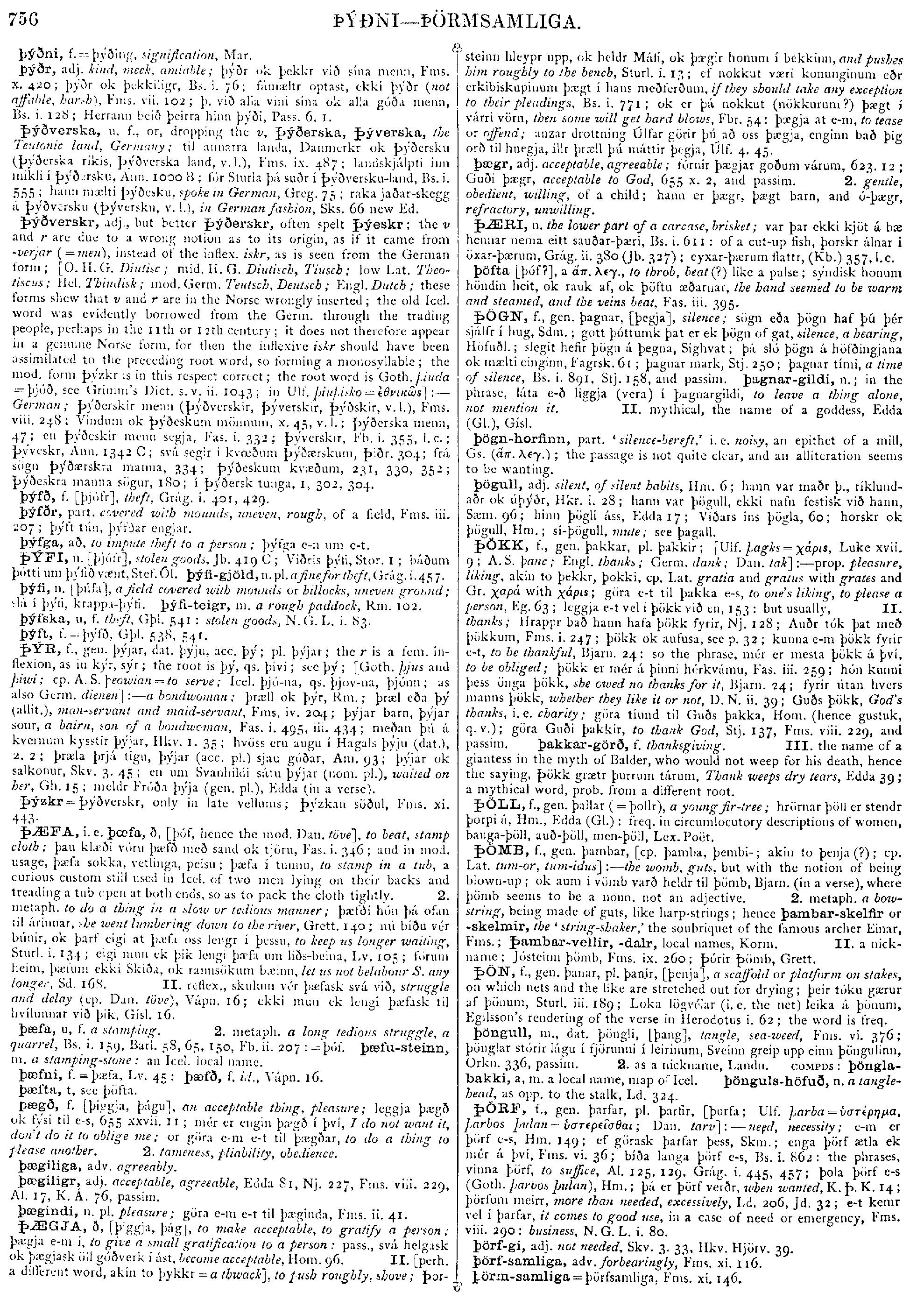
ÞÆFA, i.e. þœfa, ð, [þóf, hence the mod. Dan. töve], to beat, stamp cloth; þau klæði vóru þæfð með sand ok tjöru, Fas. i. 346; and in mod. usage, þæfa sokka, vetlinga, peisu; þæfa í tunnu, to stamp in a tub, a curious custom still used in Icel. of two men lying on their backs and treading a tub open at both ends, so as to pack the cloth tightly. 2. metaph. to do a thing in a slow or tedious manner; þæfði hón þá ofan til árinnar, she went lumbering down to the river, Grett. 140; nú bíðu vér búnir, ok þarf eigi at þæfa oss lengr í þessu, to keep us longer waiting, Sturl. i. 134; eigi mun ek þik lengi þæfa um liðs-beina, Lv. 105; förum heim, þæfum ekki Skíða, ok rannsökum bæinn, let us not belabour S. any longer, Sd. 168. II. reflex., skulum vér þæfask svá við, struggle and delay (cp. Dan. töve), Vápn. 16; ekki mun ek lengi þæfask til hvílunnar við þik, Gísl. 16.
|
Source: Cleasby/Vigfusson, page b0757, entry 2 View original page image as: [TIFF] [PNG] [View previous entry] [View next entry] |
[Comment on this entry] [View comments] |
The following entry has been hand-corrected once. |
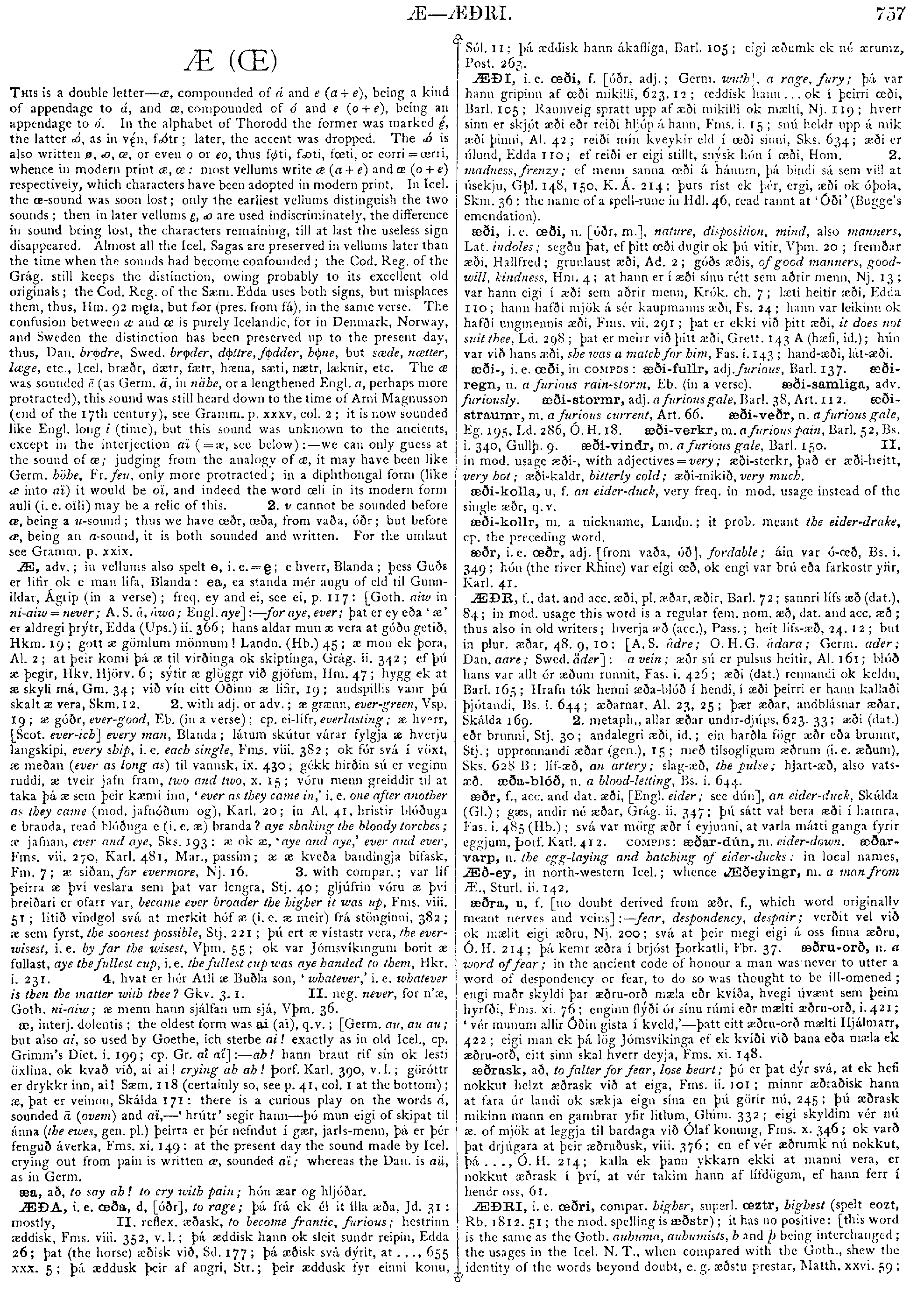
THIS
is
a
double
letter
--
æ,
compounded
of
á
and
e
(a
+
e),
being
a
kind
of
appendage
to
á,
and
œ,
compounded
of
ó
and
e
(o
+
e),
being
an
appendage
to
ó.
In
the
alphabet
of
Thorodd
the
former
was
marked
?,
UNCERTAIN
the
latter
 ,
as
in
vgn,
UNCERTAIN
f
,
as
in
vgn,
UNCERTAIN
f tr;
later,
the
accent
was
dropped.
The
is
also
written
ø,
,
œ,
or
even
o
or
eo,
thus
føti,
fti,
fœti,
or
eorri
=
œrri,
whence
in
modern
print
æ,
œ:
most
vellums
write
æ
(a
+
e)
and
œ
(o
+
e)
respectively,
which
characters
have
been
adopted
in
modern
print.
In
Icel.
the
œ-sound
was
soon
lost;
only
the
earliest
vellums
distinguish
the
two
sounds;
then
in
later
vellums
g,
UNCERTAIN
are
used
indiscriminately,
the
difference
in
sound
being
lost,
the
characters
remaining,
till
at
last
the
useless
sign
disappeared.
Almost
all
the
Icel.
Sagas
are
preserved
in
vellums
later
than
the
time
when
the
sounds
had
become
confounded;
the
Cod.
Reg.
of
the
Grág.
still
keeps
the
distinction,
owing
probably
to
its
excellent
old
originals;
the
Cod.
Reg.
of
the
Sæm.
Edda
uses
both
signs,
but
misplaces
them,
thus,
Hm.
92
mgla,
UNCERTAIN
but
fr
(pres.
from
fá),
in
the
same
verse.
The
confusion
between
æ
and
œ
is
purely
Icelandic,
for
in
Denmark,
Norway,
and
Sweden
the
distinction
has
been
preserved
up
to
the
present
day,
thus,
Dan.
brødre,
Swed.
brøder,
døttre,
fødder,
høne,
but
sæde,
nætter,
læge,
etc.,
Icel.
bræðr,
dætr,
fætr,
hæna,
sæti,
nætr,
læknir,
etc.
The
æ
was
sounded
tr;
later,
the
accent
was
dropped.
The
is
also
written
ø,
,
œ,
or
even
o
or
eo,
thus
føti,
fti,
fœti,
or
eorri
=
œrri,
whence
in
modern
print
æ,
œ:
most
vellums
write
æ
(a
+
e)
and
œ
(o
+
e)
respectively,
which
characters
have
been
adopted
in
modern
print.
In
Icel.
the
œ-sound
was
soon
lost;
only
the
earliest
vellums
distinguish
the
two
sounds;
then
in
later
vellums
g,
UNCERTAIN
are
used
indiscriminately,
the
difference
in
sound
being
lost,
the
characters
remaining,
till
at
last
the
useless
sign
disappeared.
Almost
all
the
Icel.
Sagas
are
preserved
in
vellums
later
than
the
time
when
the
sounds
had
become
confounded;
the
Cod.
Reg.
of
the
Grág.
still
keeps
the
distinction,
owing
probably
to
its
excellent
old
originals;
the
Cod.
Reg.
of
the
Sæm.
Edda
uses
both
signs,
but
misplaces
them,
thus,
Hm.
92
mgla,
UNCERTAIN
but
fr
(pres.
from
fá),
in
the
same
verse.
The
confusion
between
æ
and
œ
is
purely
Icelandic,
for
in
Denmark,
Norway,
and
Sweden
the
distinction
has
been
preserved
up
to
the
present
day,
thus,
Dan.
brødre,
Swed.
brøder,
døttre,
fødder,
høne,
but
sæde,
nætter,
læge,
etc.,
Icel.
bræðr,
dætr,
fætr,
hæna,
sæti,
nætr,
læknir,
etc.
The
æ
was
sounded
 (as
Germ.
ä,
in
nähe,
or
a
lengthened
Engl.
a,
perhaps
more
protracted),
this
sound
was
still
heard
down
to
the
time
of
Arni
Magnusson
(end
of
the
17th
century),
see
Gramm.
p.
xxxv,
col.
2;
it
is
now
sounded
like
Engl.
long
i
(time),
but
this
sound
was
unknown
to
the
ancients,
except
in
the
interjection
aï
(=
æ
see
below)
:--
we
can
only
guess
at
the
sound
of
œ;
judging
from
the
analogy
of
æ,
it
may
have
been
like
Germ.
höhe,
Fr.
feu,
only
more
protracted;
in
a
diphthongal
form
(like
æ
into
aï)
it
would
be
oï,
and
indeed
the
word
œli
in
its
modern
form
auli
(i.e.
oïli)
may
be
a
relic
of
this.
2.
v
cannot
be
sounded
before
œ,
being
a
u-sound;
thus
we
have
œðr,
œða,
from
vaða,
óðr;
but
before
æ,
being
an
a-sound,
it
is
both
sounded
and
written.
For
the
umlaut
see
Gramm.
p.
xxix.
(as
Germ.
ä,
in
nähe,
or
a
lengthened
Engl.
a,
perhaps
more
protracted),
this
sound
was
still
heard
down
to
the
time
of
Arni
Magnusson
(end
of
the
17th
century),
see
Gramm.
p.
xxxv,
col.
2;
it
is
now
sounded
like
Engl.
long
i
(time),
but
this
sound
was
unknown
to
the
ancients,
except
in
the
interjection
aï
(=
æ
see
below)
:--
we
can
only
guess
at
the
sound
of
œ;
judging
from
the
analogy
of
æ,
it
may
have
been
like
Germ.
höhe,
Fr.
feu,
only
more
protracted;
in
a
diphthongal
form
(like
æ
into
aï)
it
would
be
oï,
and
indeed
the
word
œli
in
its
modern
form
auli
(i.e.
oïli)
may
be
a
relic
of
this.
2.
v
cannot
be
sounded
before
œ,
being
a
u-sound;
thus
we
have
œðr,
œða,
from
vaða,
óðr;
but
before
æ,
being
an
a-sound,
it
is
both
sounded
and
written.
For
the
umlaut
see
Gramm.
p.
xxix.
|
Source: Cleasby/Vigfusson, page b0757, entry 3 View original page image as: [TIFF] [PNG] [View previous entry] [View next entry] |
[Comment on this entry] [View comments] |
The following entry has been hand-corrected once. |
Æ, adv.; in vellums also spelt e, i.e. = g; UNCERTAIN e hverr, Blanda; þess Guðs er lifir ok e man lifa, Blanda: ea, ea standa mér augu of eld til Gunnildar, Ágrip (in a verse); freq. ey and ei, see ei, p. 117: [Goth. aiw in ni-aiw = never; A.S. â, âwa; Engl. aye] :-- for aye, ever; þat er ey eða 'æ' er aldregi þrýtr, Edda (Ups.) ii. 366; hans aldar mun æ vera at góðu getið, Hkm. 19; gott æ gömlum mönnum! Landn. (Hb.) 45; æ mon ek þora, Al. 2; at þeir komi þá æ til virðinga ok skiptinga, Grág. ii. 342; ef þú æ þegir, Hkv. Hjörv. 6; sýtir æ glöggr við gjöfum, Hm. 47; hygg ek at æ skyli má, Gm. 34; við vín eitt Óðinn æ lifir, 19; andspillis vanr þú skalt æ vera, Skm. 12. 2. with adj. or adv.; æ grænn, ever-green, Vsp. 19; æ góðr, ever-good, Eb. (in a verse); cp. ei-lífr, everlasting; æ hverr, [Scot. ever-ich] every man, Blanda; látum skútur várar fylgja æ hverju langskipi, every ship, i.e. each single, Fms. viii. 382; ok fór svá í vöxt, æ meðan (ever as long as) til vannsk, ix. 430; gékk hirðin sú er veginn ruddi, æ tveir jafn fram, two and two, x. 15; vóru menn greiddir til at taka þá æ sem þeir kæmi inn, 'ever as they came in,' i,e. one after another as they came (mod. jafnóðum og), Karl. 20; in Al. 41, hristir blóðuga e branda, read blóðuga e (i.e. æ) branda? aye shaking the bloody torches; æ jafnan, ever and aye, Sks. 193: æ ok æ, 'aye and aye,' ever and ever, Fms. vii. 270, Karl. 481, Mar., passim; æ æ kveða bandingja bifask, Fm. 7; æ síðan, for evermore, Nj. 16. 3. with compar.; var líf þeirra æ því veslara sem þat var lengra, Stj, 40; gljúfrin vóru æ því breiðari er ofarr var, became ever broader the higher it was up, Fms. viii. 51; lítið vindgol svá at merkit hóf æ (i.e. æ meir) frá stönginni, 382; æ sem fyrst, the soonest possible, Stj. 221; þú ert æ vístastr vera, the ever-wisest, i.e. by far the wisest, Vþm. 55; ok var Jómsvíkingum borit æ fullast, aye the fullest cup, i.e. the fullest cup was aye handed to them, Hkr. i. 231. 4. hvat er hér Atli æ Buðla son, 'whatever' i.e. whatever is then the matter with thee? Gkv. 3. 1. II. neg. never, for n'æ, Goth. ni-aiw; æ menn hann sjálfan um sjá, Vþm. 36.
| Result Page: |  |
Previous | 91 92 93 94 95 96 97 98 99 100 101 102 | Next |  |
Germanic Lexicon Project (main page)
This search system was written by
Sean Crist
Please consider
volunteering
to correct the data in these online dictionaries.
No rights reserved. Feel free to use these data in any way you please.