|
|

þor (6 results)
ðor (4 results)
Search for Thor again, using less strict matching (145 results)
|
Source: Cleasby/Vigfusson, page b0739, entry 9 View original page image as: [TIFF] [PNG] [View previous entry] [View next entry] |
[Comment on this entry] [View comments] |
The following entry has been hand-corrected once. |
Þjálfi, a, m. the name of the servant and follower of Thor, Edda; and also as a pr. name, Baut.; the word prop. means a delver, digger, Germ. delber, delben, = to delve, dig: the names Þjálfi and Röskva (q.v.) indicate that Thor was the friend of farmers and the god of agriculture.
|
Source: Cleasby/Vigfusson, page b0743, entry 10 View original page image as: [TIFF] [PNG] [View previous entry] [View next entry] |
[Comment on this entry] [View comments] |
The following entry has been hand-corrected once. |
Þór-duna, u, f. a mod. poët, word, from Dan. torden, the din of Thor, i.e. thunder, Bjarni.
|
Source: Cleasby/Vigfusson, page b0743, entry 11 View original page image as: [TIFF] [PNG] [View previous entry] [View next entry] |
[Comment on this entry] [View comments] |
The following entry has been hand-corrected once. |
ÞÓRR,
m.,
gen.
Þórs,
dat.
and
acc.
Þór,
but
Þóri
dat.,
Bragi;
in
Runic
inscriptions
spelt
Þur;
[A.S.
þunor;
Engl.
thunder;
North.
E.
thunner;
Dutch
donder;
O.H.G.
donar;
Germ.
donner;
Hel.
thunar;
Dan.
Tor,
in
tor-den;
cp.
Lat.
t no
and
tonitrus;
the
word
Þór-r
is
therefore
formed
by
absorption
of
the
middle
n,
and
contraction
of
an
older
dissyllabic
Þonor
into
one
syllable,
and
is
a
purely
Scandinavian
form;
hence
in
A.S.
charters
or
diplomas
it
is
a
sure
sign
of
forgery
when
names
compd
with
þur-
appear
in
deeds
pretending
to
be
of
a
time
earlier
than
the
Danish
invasion
in
the
9th
century;
although
in
later
times
they
abound;
the
Engl.
Thurs-day
is
a
later
form,
in
which
the
phonetic
rule
of
the
Scandin.
tongue
has
been
followed;
perh.
it
is
a
North.
E.
form.
There
is
a
short
essay
by
Jacob
Grimm
on
the
etymology
of
this
word.]
A.
The
god
Thor,
the
god
of
thunder,
keeper
of
the
hammer,
the
ever-fighting
slayer
of
trolls
and
destroyer
of
evil
spirits,
the
friend
of
mankind,
the
defender
of
the
earth,
the
heavens,
and
the
gods,
for
without
Thor
and
his
hammer
the
earth
would
become
the
helpless
prey
of
the
giants.
He
was
the
consecrator,
the
hammer
being
the
cross
or
holy
sign
of
the
ancient
heathen,
hence
the
expressive
phrase
on
a
heathen
Danish
Runic
stone,
Þurr
vigi
þassi
runar,
'Thor,
consecrate
these
Runes!'
Rafn
193.
Thor
was
the
son
of
mother
Earth;
blunt,
hot-tempered,
without
fraud
or
guile,
of
few
words
and
ready
stroke,
--
such
was
Thor,
the
favourite
deity
of
the
ancients.
The
finest
legends
of
the
Edda,
-
and
the
best
lays
(the
lays
of
Hymir,
Thrym,
and
Harbard)
refer
to
Thor,
see
the
Edda
passim,
Eb.
the
first
chapters
--
hann
varðveitti
þar
í
eyinni
Þórs-hof,
ok
var
mikill
vin
Þórs,
...
hann
gékk
til
fréttar
við
Þór
ástvin
sinn
...,
Eb.;
Helgi
var
blandinn
í
trú,
hann
trúði
á
Krist,
en
hét
á
Þór
til
sjófara
ok
harðræða,
Landn.
206.
For
a
head
of
Thor
carved
on
the
high-seat
pillars,
see
Eb.,
Fbr.:
or
on
a
talisman,
Fs.
97.
B.
COMPDS
OF
PROPER
NAMES.
--
The
name
of
Thor
has
always
been
thought
to
sound
well,
and
is
much
used
in
pr.
names;
(hann
átti)
son
er
Steinn
hét,
þann
svein
gaf
Þórólfr
Þór
vin
símim
ok
kallaði
Þorstein,
Eb.;
uncompd
only
in
the
form
Þórir
of
a
man,
Þóra
of
a
woman,
but
common
in
compds,
where
in
mod.
usage
the
vowel
is
sounded
long
before
a
vowel,
and
before
b
and
d,
elsewhere
short,
but
in
old
times
it
was
no
doubt
ó
throughout;
--
thus,
as
a
prefix,
Þór-álfr,
Þórólfr,
Þórarr,
Þór-arinn,
Þór-oddr,
Þór-haddr,
Þór-halli,
Þór-hallr;
but
Þor-bergr,
Þor-björn,
Þor-brandr,
Þor-finnr,
Þor-gautr,
Þor-geirr,
Þor-gestr
(Þórgestlingar,
the
family
of
Th.,
Eb.),
Þor-grímr,
Þor-gils,
Þor-gnýr,
Þor-kell
(qs.
Þorketill),
Þor-lákr
(sounded
Þollákr,
Bs.
i.
356,
l.
18,
and
so
in
mod.
usage),
Þor-leifr,
Þor-leikr,
Þor-ljótr,
Þor-móðr,
Þor-mundr
(Dan.
Runic
stone),
Þor-steinn
(sounded
Þosteinn,
and
often,
spelt
so
in
later
vellums),
Þor-valdr,
Þor-varðr,
Þór-viðr;
of
women,
Þór-ey,
Þór-arna,
Þor-finna,
Þor-gríma,
Þor-gunna,
Þór-halla,
Þór-hildr,
Þór-unn,
Þór-dís,
Þor-gerðr,
Þor-björg,
Þor-katla,
Þór-ný,
Þor-veig,
Þór-vör.
2.
as
a
suffix.
-Þórr,
-Þóra,
-dórr,
-dóra;
Arn-órr,
qs.
Arn-þórr
and
Arn-óra,
Stein-dórr,
Hall-dórr
and
Hall-dóra,
Berg-þórr
and
Berg-þóra,
Ey-þórr
and
Ey-þóra,
Haf-þórr.
Of
all
these
names,
three
demand
special
mention,
viz.
Þórðr,
being
a
contr.
qs.
Þór-røðr
(as
Bárðr
=
Bár-röðr),
the
old
uncontr.
form
occurs
in
poems
of
the
10th
century,
e.g.
Þórröðr
vinon
óra,
Korm.
132;
so
Sighvat
calls
his
own
father
Þórröðr
(dissyll.).
yet
he
makes
it
rhyme
as
if
contracted
(Þorröðr
er
var
forðum),
so
Þorðr
skor
Bjarn.
(in
a
verse):
the
other
name
is
Þuríðr,
a
fem.
name,
a
weakened
form
for
Þóríðr,
Íb.
363
(qs.
Þór-ríðr,
like
Sig-ríðr);
thirdly,
Þyri,
a
fem.
name,
weakened
from
Þór-vé,
or
still
older
Þór-veig,
mod.
Dan.
Thyra,
see
Landn.
309;
Þurvi
(Þiurvi),
gen.
Þurviar,
on
Runic
stones.
II.
in
local
names,
Þórs-mörk,
Þórs-nes,
Þórs-á,
Landn.,
Eb.;
whence
Þórs-nes-ingar,
the
men
from
Th.,
Landn.;
and
Þórs-ness-lönd,
-þing,
Eb.,
Landn.,
Korm.:
Þórsnesinga-goðord,
Landn.,
Eb.
.
Sturl.:
Þórs-engi,
n.,
i.e.
Þórs-vengi,
=
Thaasinge
in
Fünen,
Denmark.
C.
COMPDS:
Þórs-dagr,
m.
[A.S.
Þunresdæg;
O.H.G.
Donares-tac,
Toniris-tag;
mid.
Germ.
Donres-tac;
mod.
Germ.
Donners-tag;
Dutch
Donder-dag;
Swed.-Dan.
Tors-dag;
in
Engl.
also
contr.
Thursday]
:--
Thursday,
dies
Jovis,
N.G.L.
ii.
347,
Rb.
572,
Fms.
ix.
317,
passim;
Helgi-Þórsdagr,
Holy
Thursday,
Ascension
Day,
Js.
11,
Fms.
ix.
526,
D.N.;
Skíri-Þórsdagr,
Dan.
Skjertorsdag,
Thursday
in
Passion-week,
passim.
Þórs-hani,
a,
m.
a
bird,
cp.
Óðins-hani.
Þórs-hof,
n.
the
temple
of
Jove,
Clem.,
Al.
no
and
tonitrus;
the
word
Þór-r
is
therefore
formed
by
absorption
of
the
middle
n,
and
contraction
of
an
older
dissyllabic
Þonor
into
one
syllable,
and
is
a
purely
Scandinavian
form;
hence
in
A.S.
charters
or
diplomas
it
is
a
sure
sign
of
forgery
when
names
compd
with
þur-
appear
in
deeds
pretending
to
be
of
a
time
earlier
than
the
Danish
invasion
in
the
9th
century;
although
in
later
times
they
abound;
the
Engl.
Thurs-day
is
a
later
form,
in
which
the
phonetic
rule
of
the
Scandin.
tongue
has
been
followed;
perh.
it
is
a
North.
E.
form.
There
is
a
short
essay
by
Jacob
Grimm
on
the
etymology
of
this
word.]
A.
The
god
Thor,
the
god
of
thunder,
keeper
of
the
hammer,
the
ever-fighting
slayer
of
trolls
and
destroyer
of
evil
spirits,
the
friend
of
mankind,
the
defender
of
the
earth,
the
heavens,
and
the
gods,
for
without
Thor
and
his
hammer
the
earth
would
become
the
helpless
prey
of
the
giants.
He
was
the
consecrator,
the
hammer
being
the
cross
or
holy
sign
of
the
ancient
heathen,
hence
the
expressive
phrase
on
a
heathen
Danish
Runic
stone,
Þurr
vigi
þassi
runar,
'Thor,
consecrate
these
Runes!'
Rafn
193.
Thor
was
the
son
of
mother
Earth;
blunt,
hot-tempered,
without
fraud
or
guile,
of
few
words
and
ready
stroke,
--
such
was
Thor,
the
favourite
deity
of
the
ancients.
The
finest
legends
of
the
Edda,
-
and
the
best
lays
(the
lays
of
Hymir,
Thrym,
and
Harbard)
refer
to
Thor,
see
the
Edda
passim,
Eb.
the
first
chapters
--
hann
varðveitti
þar
í
eyinni
Þórs-hof,
ok
var
mikill
vin
Þórs,
...
hann
gékk
til
fréttar
við
Þór
ástvin
sinn
...,
Eb.;
Helgi
var
blandinn
í
trú,
hann
trúði
á
Krist,
en
hét
á
Þór
til
sjófara
ok
harðræða,
Landn.
206.
For
a
head
of
Thor
carved
on
the
high-seat
pillars,
see
Eb.,
Fbr.:
or
on
a
talisman,
Fs.
97.
B.
COMPDS
OF
PROPER
NAMES.
--
The
name
of
Thor
has
always
been
thought
to
sound
well,
and
is
much
used
in
pr.
names;
(hann
átti)
son
er
Steinn
hét,
þann
svein
gaf
Þórólfr
Þór
vin
símim
ok
kallaði
Þorstein,
Eb.;
uncompd
only
in
the
form
Þórir
of
a
man,
Þóra
of
a
woman,
but
common
in
compds,
where
in
mod.
usage
the
vowel
is
sounded
long
before
a
vowel,
and
before
b
and
d,
elsewhere
short,
but
in
old
times
it
was
no
doubt
ó
throughout;
--
thus,
as
a
prefix,
Þór-álfr,
Þórólfr,
Þórarr,
Þór-arinn,
Þór-oddr,
Þór-haddr,
Þór-halli,
Þór-hallr;
but
Þor-bergr,
Þor-björn,
Þor-brandr,
Þor-finnr,
Þor-gautr,
Þor-geirr,
Þor-gestr
(Þórgestlingar,
the
family
of
Th.,
Eb.),
Þor-grímr,
Þor-gils,
Þor-gnýr,
Þor-kell
(qs.
Þorketill),
Þor-lákr
(sounded
Þollákr,
Bs.
i.
356,
l.
18,
and
so
in
mod.
usage),
Þor-leifr,
Þor-leikr,
Þor-ljótr,
Þor-móðr,
Þor-mundr
(Dan.
Runic
stone),
Þor-steinn
(sounded
Þosteinn,
and
often,
spelt
so
in
later
vellums),
Þor-valdr,
Þor-varðr,
Þór-viðr;
of
women,
Þór-ey,
Þór-arna,
Þor-finna,
Þor-gríma,
Þor-gunna,
Þór-halla,
Þór-hildr,
Þór-unn,
Þór-dís,
Þor-gerðr,
Þor-björg,
Þor-katla,
Þór-ný,
Þor-veig,
Þór-vör.
2.
as
a
suffix.
-Þórr,
-Þóra,
-dórr,
-dóra;
Arn-órr,
qs.
Arn-þórr
and
Arn-óra,
Stein-dórr,
Hall-dórr
and
Hall-dóra,
Berg-þórr
and
Berg-þóra,
Ey-þórr
and
Ey-þóra,
Haf-þórr.
Of
all
these
names,
three
demand
special
mention,
viz.
Þórðr,
being
a
contr.
qs.
Þór-røðr
(as
Bárðr
=
Bár-röðr),
the
old
uncontr.
form
occurs
in
poems
of
the
10th
century,
e.g.
Þórröðr
vinon
óra,
Korm.
132;
so
Sighvat
calls
his
own
father
Þórröðr
(dissyll.).
yet
he
makes
it
rhyme
as
if
contracted
(Þorröðr
er
var
forðum),
so
Þorðr
skor
Bjarn.
(in
a
verse):
the
other
name
is
Þuríðr,
a
fem.
name,
a
weakened
form
for
Þóríðr,
Íb.
363
(qs.
Þór-ríðr,
like
Sig-ríðr);
thirdly,
Þyri,
a
fem.
name,
weakened
from
Þór-vé,
or
still
older
Þór-veig,
mod.
Dan.
Thyra,
see
Landn.
309;
Þurvi
(Þiurvi),
gen.
Þurviar,
on
Runic
stones.
II.
in
local
names,
Þórs-mörk,
Þórs-nes,
Þórs-á,
Landn.,
Eb.;
whence
Þórs-nes-ingar,
the
men
from
Th.,
Landn.;
and
Þórs-ness-lönd,
-þing,
Eb.,
Landn.,
Korm.:
Þórsnesinga-goðord,
Landn.,
Eb.
.
Sturl.:
Þórs-engi,
n.,
i.e.
Þórs-vengi,
=
Thaasinge
in
Fünen,
Denmark.
C.
COMPDS:
Þórs-dagr,
m.
[A.S.
Þunresdæg;
O.H.G.
Donares-tac,
Toniris-tag;
mid.
Germ.
Donres-tac;
mod.
Germ.
Donners-tag;
Dutch
Donder-dag;
Swed.-Dan.
Tors-dag;
in
Engl.
also
contr.
Thursday]
:--
Thursday,
dies
Jovis,
N.G.L.
ii.
347,
Rb.
572,
Fms.
ix.
317,
passim;
Helgi-Þórsdagr,
Holy
Thursday,
Ascension
Day,
Js.
11,
Fms.
ix.
526,
D.N.;
Skíri-Þórsdagr,
Dan.
Skjertorsdag,
Thursday
in
Passion-week,
passim.
Þórs-hani,
a,
m.
a
bird,
cp.
Óðins-hani.
Þórs-hof,
n.
the
temple
of
Jove,
Clem.,
Al.
|
Source: Cleasby/Vigfusson, page b0747, entry 12 View original page image as: [TIFF] [PNG] [View previous entry] [View next entry] |
[Comment on this entry] [View comments] |
The following entry has been hand-corrected once. |
þrótt-öfligr, adj. mighty, of Thor, Hým.
|
Source: Cleasby/Vigfusson, page b0747, entry 23 View original page image as: [TIFF] [PNG] [View previous entry] [View next entry] |
[Comment on this entry] [View comments] |
The following entry has been hand-corrected once. |
þrúðigr, adj. [A.S. þrydge], doughty, an epithet of Thor; Þórr, þrúðigr Áss, Þkv.
|
Source: Cleasby/Vigfusson, page b0747, entry 27 View original page image as: [TIFF] [PNG] [View previous entry] [View next entry] |
[Comment on this entry] [View comments] |
The following entry has been hand-corrected once. |
ÞRÚÐR, f., acc. and dat. Þrúði, the name of a goddess, the daughter of Thor and Sif, Edda, Lex. Poët.; also the name of a woman, Þrúðr; as also in compds, Her-þrúðr, Sig-þrúðr, Jar-þrúðr, Landn., Fms.; cp. the Germ. drude = a witch or evil fairy, Grimm's Dict. s.v. B. IN COMPDS; [the etymology may be illustrated from the Goth. þroþjan = GREEK, us-þroþjan = GREEK, us-þroþeins = GREEK; to this root belongs í-þrótt (q.v.), qs. ið-þrót; perh. also þróttr, q.v.; or is it akin to Germ. drude (for which see Grimm's Dict.)?]: used in some old poët. compd words referring to Thor: Þrúð-hamarr, m. the master hammer of Thor, Ls. 57: Þrúð-heimr, Þrúð-vangr, m. the name of the mythical abode of Thor, Gm. 4, Edda: þ;rúð-valdr, in þrúðvaldr goða, the heroic, doughty defender of the gods, i.e. Thor, Hbl.
|
Source: Cleasby/Vigfusson, page b0750, entry 14 View original page image as: [TIFF] [PNG] [View previous entry] [View next entry] |
[Comment on this entry] [View comments] |
The following entry has been hand-corrected once. |
ÞURS (sounded þuss), m., this interesting word occurs in no other Teut. language; [Dan. tosse = a fool] :-- a giant, with a notion of surliness and stupidity; þursa líki þykki mér á þér vera, ertattu til brúðar borinn, Alm. 2; þurs (gen.) ráðbani, slayer of the giants, i.e. Thor, Hým. 19; með þursi þríhöfðuðum, Skm.; líkari eru þeir þursum at vexti ok sýn enn menskum mönnum, Eg. 110; þegja skal þurs ef hann sitr nökviðr við eld, Ísl. ii. 317 (see nökviðr); hann var kominn af þursum, Fas. i. 412; þursinn (the goblin) skautzt inn í bjargit, ii. 29; svá hefir Grettir sagt, at fyrir dalnum hafi ráðit blendingr, þurs einn, sá er Þórir hét, Grett. 137; vér skulum ginna þá sem þursa, Nj. 263; hrím-þurs, q.v. 2. a dull fellow, a dunce, Dan. tosse; so in the ditty, opt er sá í orðum nýtr, sem iðkar mentan kæra | en þursinn heimskr þegja hlýtr, sem þrjózkast við at læra, Hallgr. 3. the Rune Þ, Skm., Skálda 168. II. a nickname, Eg.; svarti-þ., a nickname. COMPDS: þursa-berg, n. 'giant-rock,' a kind of whetstone or hone, cp. the legend of Hrungnir. þursa-skegg, n., botan. giant's-beard, a kind of coral, corallina officinalis, as also the name of a sea-weed, fucus corneus, Maurer's Volksagen. þussa-sprengir, m. a nickname, Landn.
|
Source: Cleasby/Vigfusson, page b0753, entry 26 View original page image as: [TIFF] [PNG] [View previous entry] [View next entry] |
[Comment on this entry] [View comments] |
The following entry has been hand-corrected once. |
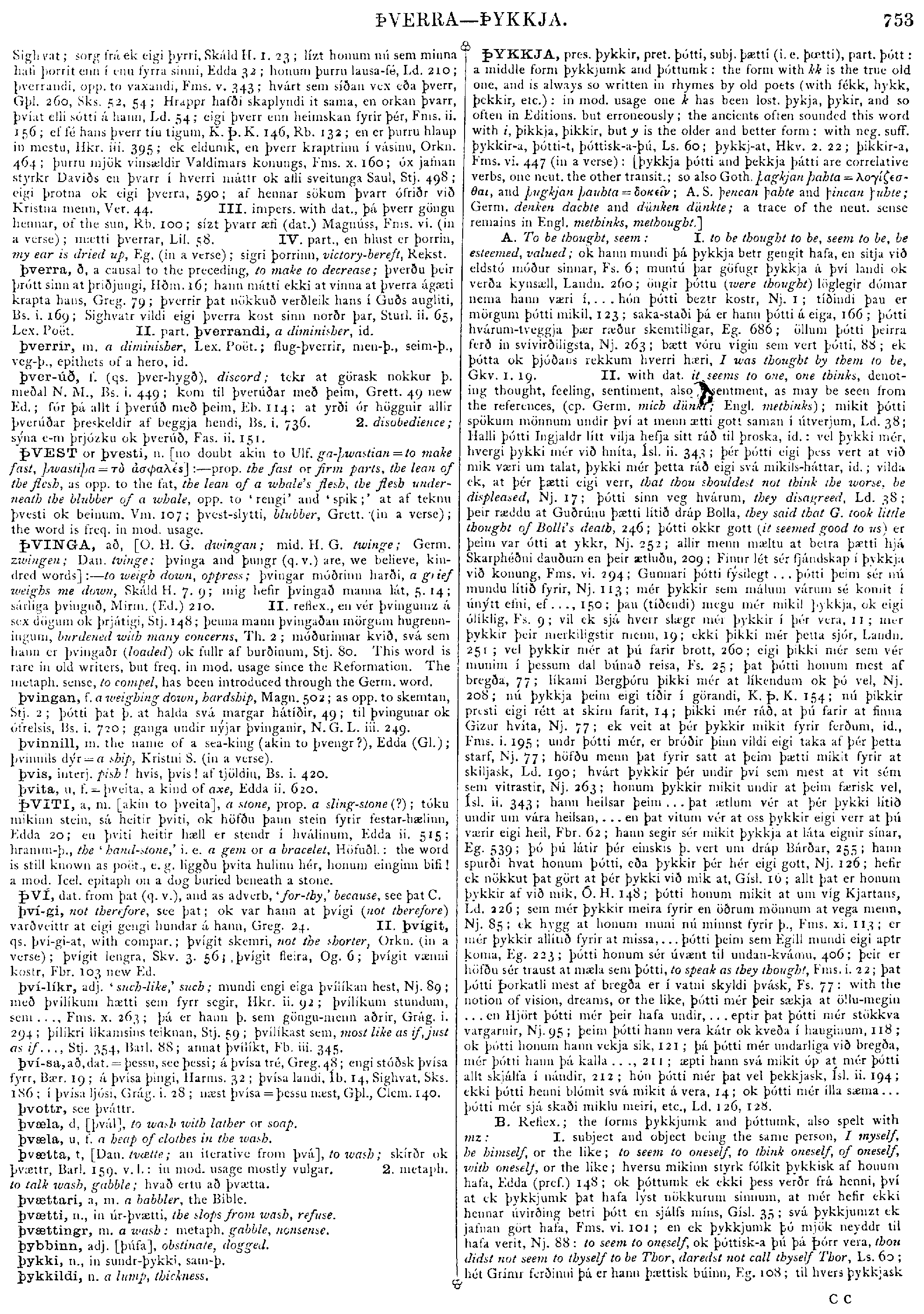
ÞYKKJA,
pres.
þykkir,
pret.
þótti,
subj.
þætti
(i.e.
þœtti),
part.
þótt:
a
middle
form
þykkjumk
and
þóttumk:
the
form
with
kk
is
the
true
old
one,
and
is
always
so
written
in
rhymes
by
old
poets
(with
fékk,
hykk,
þekkir,
etc.):
in
mod.
usage
one
k
has
been
lost,
þykja,
þykir,
and
so
often
in
Editions,
but
erroneously;
the
ancients
often
sounded
this
word
with
i,
þikkja,
þikkir,
but
y
is
the
older
and
better
form:
with
neg.
suff.
þykkir-a,
þótti-t,
þóttisk-a-þú,
Ls.
60;
þykkj-at,
Hkv.
2.
22;
þikkir-a,
Fms.
vi.
447
(in
a
verse):
[þykkja
þótti
and
þekkja
þátti
are
correlative
verbs,
one
neut.
the
other
transit.;
so
also
Goth.
þagkjan
þahta
=
GREEK
and
þugkjan
þauhta
=
GREEK;
A.S.
þencan
þahte
and
þincan
þuhte;
Germ.
denken
dachte
and
dünken
dünkte;
a
trace
of
the
neut.
sense
remains
in
Engl.
methinks,
methought.]
A.
To
be
thought,
seem:
I.
to
be
thought
to
be,
seem
to
be,
be
esteemed,
valued;
ok
hann
mundi
þá
þykkja
betr
gengit
hafa,
en
sitja
við
eldstó
móður
sinnar,
Fs.
6;
muntú
þar
göfugr
þykkja
á
því
landi
ok
verða
kynsæll,
Landn.
260;
öngir
þóttu
(were
thought)
löglegir
dómar
nema
hann
væri
í,
...
hón
þótti
beztr
kostr,
Nj.
1;
tíðindi
þau
er
mörgum
þótti
mikil,
123;
saka-staði
þá
er
hann
þótti
á
eiga,
166;
þótti
hvárum-tveggja
þær
ræður
skemtiligar,
Eg.
686;
öllum
þótti
þeirra
ferð
in
svívirðiligsta,
Nj.
263;
bætt
vóru
vígin
sem
vert
þótti,
88;
ek
þótta
ok
þjóðans
rekkum
hverri
hæri,
I
was
thought
by
them
to
be,
Gkv.
1.
19.
II.
with
dat.
it
seems
to
one,
one
thinks,
denoting
thought,
feeling,
sentiment,
also
resentment,
as
may
be
seen
from
the
references,
(cp.
Germ.
mich
dünkt;
Engl.
methinks);
mikit
þótti
spökum
mönnum
undir
því
at
menn
ætti
gott
saman
í
útverjum,
Ld.
38;
Halli
þótti
Ingjaldr
lítt
vilja
hefja
sitt
ráð
til
þroska,
id.:
vel
þykki
mér,
hvergi
þykki
mér
við
hníta,
Ísl.
ii.
343;
þér
þótti
eigi
þess
vert
at
við
mik
væri
um
talat,
þykki
mér
þetta
ráð
eigi
svá
mikils-háttar,
id.;
vilda
ek,
at
þér
þætti
eigi
verr,
that
thou
shouldest
not
think
the
worse,
be
displeased,
Nj.
17;
þótti
sinn
veg
hvárum,
they
disagreed,
Ld.
38;
þeir
ræddu
at
Guðrúnu
þætti
lítið
dráp
Bolla,
they
said
that
G.
took
little
thought
of
Bolli's
death,
246;
þótti
okkr
gott
(it
seemed
good
to
us)
er
þeim
var
ótti
at
ykkr,
Nj.
252;
allir
menn
mæltu
at
betra
þætti
hjá
Skarphéðni
dauðum
en
þeir
ætluðu,
209;
Finnr
lét
sér
fjándskap
í
þykkja
við
konung,
Fms.
vi.
294;
Gunnari
þótti
fýsilegt
...
þótti
þeim
sér
nú
mundu
lítið
fyrir,
Nj.
113;
mér
þykkir
sem
málum
várum
sé
komit
í
únýtt
efni,
ef
...,
150;
þan
(tíðendi)
megu
mér
mikil
þykkja,
ok
eigi
ólíklig,
Fs.
9;
vil
ek
sjá
hverr
slægr
mér
þykkir
í
þér
vera,
11;
mér
þykkir
þeir
merkiligstir
menn,
19;
ekki
þikki
mér
þetta
sjór,
Landn.
251;
vel
þykkir
mér
at
þú
farir
brott,
260;
eigi
þikki
mér
sem
vér
munim
í
þessum
dal
búnað
reisa,
Fs.
25;
þat
þótti
honum
mest
af
bregða,
77;
líkami
Bergþóru
þikki
mér
at
líkendum
ok
þó
vel,
Nj.
208;
nú
þykkja
þeim
eigi
tíðir
í
görandi,
K.Þ.K.
154;
nú
þikkir
presti
eigi
rétt
at
skírn
farit,
14;
þikki
mér
ráð,
at
þú
farir
at
finna
Gizur
hvíta,
Nj.
77;
ek
veit
at
þér
þykkir
mikit
fyrir
ferðum,
id.,
Fms.
i.
195;
undr
þótti
mér,
er
bróðir
þinn
vildi
eigt
taka
af
þér
þetta
starf,
Nj.
77;
höfðu
menn
þat
fyrir
satt
at
þeim
þætti
mikit
fyrir
at
skiljask,
Ld.
190;
hvárt
þykkir
þér
undir
því
sem
mest
at
vit
sém
sem
vitrastir,
Nj.
263;
honum
þykkir
mikit
undir
at
þeim
færisk
vel,
Ísl.
ii.
343;
hann
heilsar
þeim
...
þat
ætlum
vér
at
þér
þykki
lítið
undir
um
vára
heilsan,
...
en
þat
vitum
vér
at
oss
þykkir
eigi
verr
at
þú
værir
eigi
heil,
Fbr.
62;
hann
segir
sér
mikit
þykkja
at
láta
eignir
sínar,
Eg.
539;
þó
þú
látir
þér
einskis
þ.
vert
um
dráp
Bárðar,
255;
hann
spurði
hvat
honum
þótti,
eða
þykkir
þér
hér
eigi
gott,
Nj.
126;
hefir
ek
nökkut
þat
gört
at
þér
þykki
við
mik
at,
Gísl.
16;
allt
þat
er
honum
þykkir
af
við
mik,
Ó.H.
148;
þótti
honum
mikit
at
um
víg
Kjartans,
Ld.
226;
sem
mér
þykkir
meira
fyrir
en
öðrum
mönnum
at
vega
menn,
Nj.
85;
ek
hygg
at
honum
muni
nú
minnst
fyrir
þ.,
Fms.
xi.
113;
er
mér
þykkir
allítið
fyrir
at
missa,
...
þótti
þeim
sem
Egill
mundi
eigi
aptr
koma,
Eg.
223;
þótti
honum
sér
úvænt
til
undan-kvámu,
406;
þeir
er
höfðu
sér
traust
at
mæla
sem
þótti,
to
speak
as
they
thought,
Fms.
i.
22;
þat
þótti
Þorkatli
mest
af
bregða
er
í
vatni
skyldi
þvásk,
Fs.
77:
with
the
notion
of
vision,
dreams,
or
the
like,
þótti
mér
þeir
sækja
at
öllu-megin
...
en
Hjört
þótti
mér
þeir
hafa
undir,
...
eptir
þat
þótti
mér
stökkva
vargarnir,
Nj.
95;
þeim
þótti
hann
vera
kátr
ok
kveða
í
hauginum,
118;
ok
þótti
honum
hann
vekja
sik,
121;
þá
þótti
mér
undarliga
við
bregða,
mér
þótti
hann
þá
kalla
...,
211;
æpti
hann
svá
mikit
óp
at
mér
þótti
allt
skjálfa
í
nándir,
212;
hón
þótti
mér
þat
vel
þekkjask,
Ísl.
ii.
194;
ekki
þótti
henni
blómit
svá
mikit
á
vera,
14;
ok
þótti
mér
ílla
sæma
...
þótti
mér
sjá
skaði
miklu
meiri,
etc.,
Ld.
126.
128.
B.
Reflex.;
the
forms
þykkjumk
and
þóttumk,
also
spelt
with
mz:
I.
subject
and
object
being
the
same
person,
I
myself,
he
himself,
or
the
like;
to
seem
to
oneself,
to
think
oneself,
of
oneself,
with
oneself,
or
the
like;
hversu
mikinn
styrk
fólkit
þykkisk
af
honum
hafa,
Edda
(pref.)
148;
ok
þóttumk
ek
ekki
þess
verðr
frá
henni,
því
at
ek
þykkjumk
þat
hafa
lýst
nökkurum
sinnum,
at
mér
hefir
ekki
hennar
úvirðing
betri
þótt
en
sjálfs
míns,
Gísl.
35;
svá
þykkjumzt
ek
jafnan
gört
hafa,
Fms.
vi.
101;
en
ek
þykkjumk
þó
mjök
neyddr
til
hafa
verit,
Nj.
88:
to
seem
to
oneself,
ok
þóttisk-a
þú
þá
Þórr
vera,
thou
didst
not
seem
to
thyself
to
be
Thor,
daredst
not
call
thyself
Thor,
Ls.
60;
hét
Grímr
ferðinni
þá
er
hann
þættisk
búinn,
Eg.
108;
til
hvers
þykkjask
|
Source: Cleasby/Vigfusson, page b0763, entry 3 View original page image as: [TIFF] [PNG] [View previous entry] [View next entry] |
[Comment on this entry] [View comments] |
The following entry has been hand-corrected once. |
Öku-Þórr, m., one of the names of Thor, Edda 14, 28, but not found in the poems themselves; the öku- is not to be derived from aka, but is rather of Finnish origin, Ukko being the thunder-god of the Chudic tribes.
|
Source: Cleasby/Vigfusson, page b0765, entry 1 View original page image as: [TIFF] [PNG] [View previous entry] [View next entry] |
[Comment on this entry] [View comments] |
The following entry has been hand-corrected once. |
'opposite-seat,' high-seat, so called because two seats are placed opposite to one another; in ancient timbered halls the benches were placed longways, running along the walls of the halls (sec bekkr), with the two seats of honour in the middle facing one another; the northern bench facing the sun, was called öndvegi it æðra, the higher or first high-seat, the opposite or southern bench being it úæðra, the lower or second high-seat; the two high-seats were the most honoured places in the hall, and a chief guest used to be placed in the southern high-seat. In England the master and mistress sitting opposite one another at each end of the table may be a remnant of this old Scandinavian custom. The sides of the high-seat were ornamented with uprights (öndugis-súlur) carved with figures, such as a head of Thor or the like; these posts were regarded with religious reverence; many of the settlers of Iceland are said to have taken the high-seat posts with them, and when near Iceland to have thrown them over-board to drift ashore, and where they found them, there they took up their abode. When a man of rank died, the son, after all rites performed, solemnly seated himself in his father's seat, as a token of succession: in Vd. ch. 23, the sons sat not in the father's seat before they had avenged his death. B. References in illustration of this: Þorgerðr sat á tali við Þorstein bróður sinn í öndvegi, Ísl. ii. 200; var þeim Illuga ok sonum hans skipat í öndvegi, en þeim brúðguma á annat öndvegi gegnt Illuga, konur sátu a palli, 250; Guðmundr sat í öndvegi, en Þórir Helgason gagnvart honum, en konur sátu á palli, brúðr sat á miðjan pall, etc., Lv. 37; á hinn úæðra bekk gagnvert öndugi mínu (better, 'útar frá öndnginu,' v.l.), Nj. 129; þat var forn siðr í Noregi ok svá í Danmörk ok Svíþjóðu, at konungs hásæti var á miðjan langbekk í veizlustofum, sat þar dróttning til vinstri handar konungi, var þat kallat konungs öndvegi ..., annat öndvegi var á hinn úæðra pall, etc., Fms. vi. 439; af öllum hirðmönnum virði konungr mest skáld sín, þeir skipuðu annat öndvegi, Eg. 24; konungr tekr blíðliga við Hjálmari, ok skipar í öndvegi gegnt sér, Fms. iii. 79; þér mun skipat á inn óæðra bekk gegnt öndugi Rúts, Nj. 32; reis hann þá upp or rekkju ok settisk í öndvegi, Eg. 644; eta at ölkrásim ok í öndugi at senda, Akv. 36; nú skal presti bjóða ok konu hans til erfis, sitja skal hann í andvegi ok kona hans í hjá honum, N.G.L. i. 404; hann gékk í höllina ok sá þar sitja í öndugi Baldr bróður sinn, Edda 38; jarl gékk inn í stofuna, var þar fjölmenni mikit, þar sat í öndugi maðr gamall ... jarl settisk öðrum-megin gagnvart Þorgný, Ó.H. 66; hann sá mann mikinn ok vegligan í öndvegi, Glúm. 336; ef maðr verðr dauðr, þá skal arfi í öndvegi setjask, Js. 75; heim skal búanda stemna ok til húss fara ... stemni hann honum inn til andvegis, N.G.L. i. 217, 219: the saying, eigi verðr öllum í öndvegi skipað, it is not for all to sit on the high-seat, cp. Horace's non cuivis homini contingit adire Corinthum. COMPDS: öndugis-höldr, m. (Fas. ii. 261), and öndugis-maðr, m. (Fagrsk., Eg. 575, Mag. 3), the man sitting in the öndvegi opposed to the lord of the house, the king's first man, Fagrsk. ch. 219, Fas. iii. 31; in Hom. (St.) 'architriclinus', John ii. 9, is rendered by öndvegis-maðr. öndvegis-súla, u, f. the high-seat post or upright, Landn. 34, 35, 96, 261, Korm. 6, Gísl. 140, cp. Landn. 301. öndvegis-sæti, n., Gþl. 252.
| Result Page: |  |
Previous | 1 2 3 4 5 6 7 8 9 10 | Next |  |
Germanic Lexicon Project (main page)
This search system was written by
Sean Crist
Please consider
volunteering
to correct the data in these online dictionaries.
No rights reserved. Feel free to use these data in any way you please.