|
|

þis (412 results)
ðis (836 results)
Search for This again, using less strict matching (3542 results)
|
Source: Wright's Gothic Grammar, page b0327, entry 27 View original page image as: [TIFF] [PNG] [View previous entry] [View next entry] |
[Comment on this entry] [View comments] |
The following entry has been hand-corrected once. |
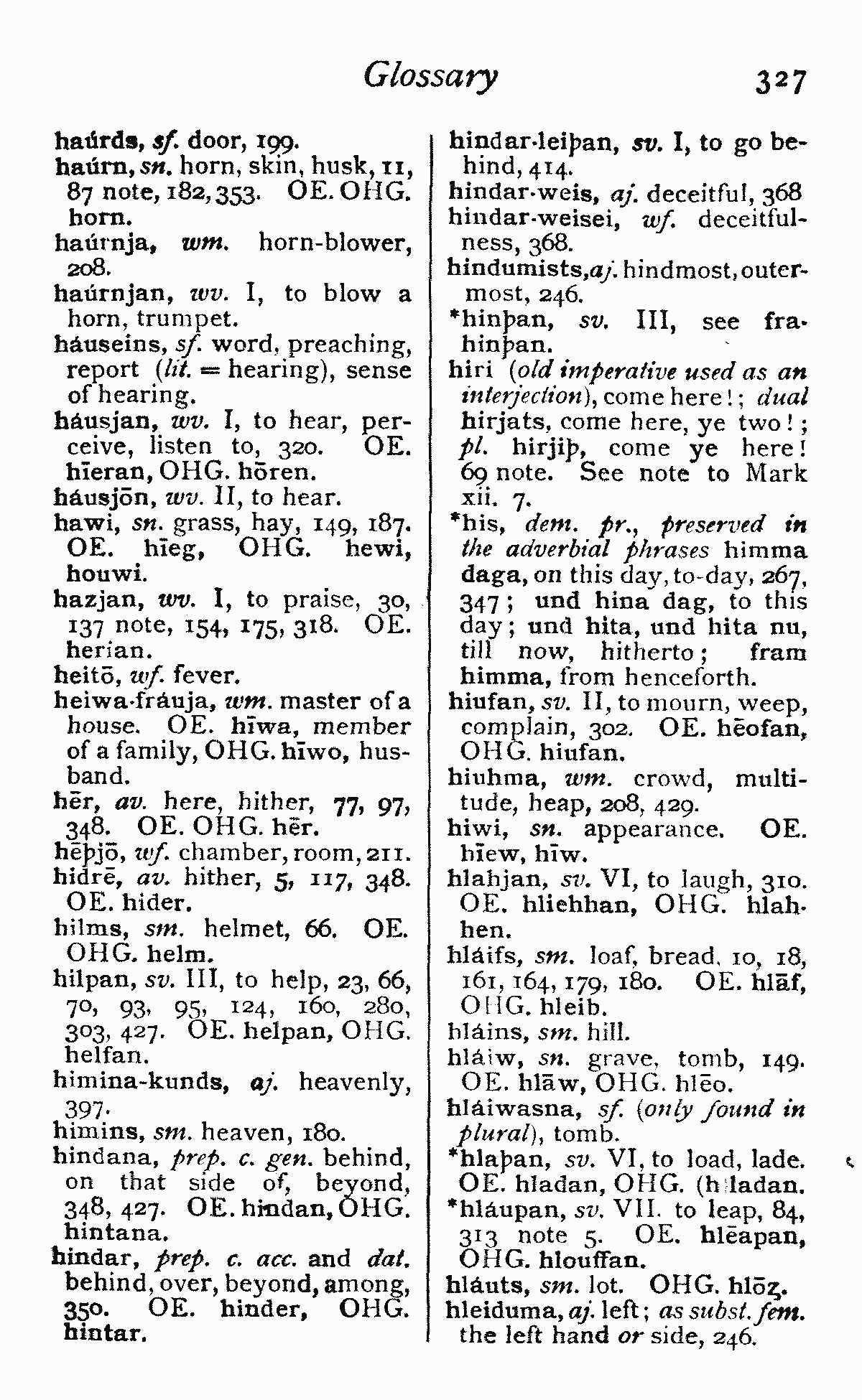
*his, dem. pr., preserved in the adverbial phrases himma daga, on this day, to-day, 267, 347; und hina dag, to this day; und hita, und hita nu, till now, hitherto; fram himma, from henceforth.
|
Source: Wright's Gothic Grammar, page b0340, entry 34 View original page image as: [TIFF] [PNG] [View previous entry] [View next entry] |
[Comment on this entry] [View comments] |
The following entry has been hand-corrected once. |
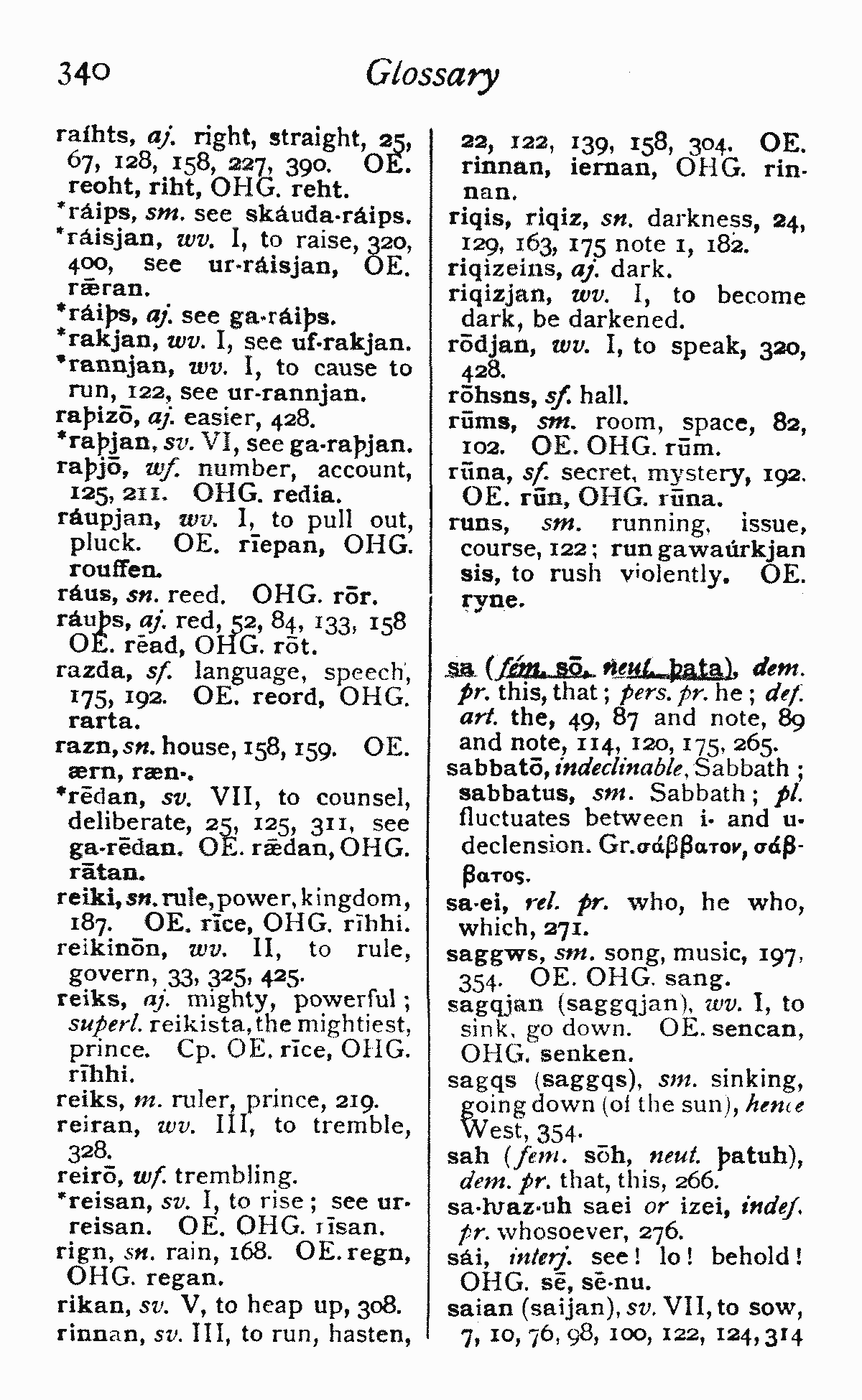
sa
(fem.
s ,
neut.
þata),
dem.
pr.
this,
that;
pers.
pr.
he;
def.
art.
the,
49,
87
and
note,
89
and
note,
114,
120,
175,
265.
,
neut.
þata),
dem.
pr.
this,
that;
pers.
pr.
he;
def.
art.
the,
49,
87
and
note,
89
and
note,
114,
120,
175,
265.
|
Source: Wright's Gothic Grammar, page b0340, entry 39 View original page image as: [TIFF] [PNG] [View previous entry] [View next entry] |
[Comment on this entry] [View comments] |
The following entry has been hand-corrected once. |
sah
(fem.
sh,
neut.
þatuh),
dem.
pr.
that,
this,
266.
|
Source: Wright's Gothic Grammar, page b0348, entry 26 View original page image as: [TIFF] [PNG] [View previous entry] [View next entry] |
[Comment on this entry] [View comments] |
The following entry has been hand-corrected once. |
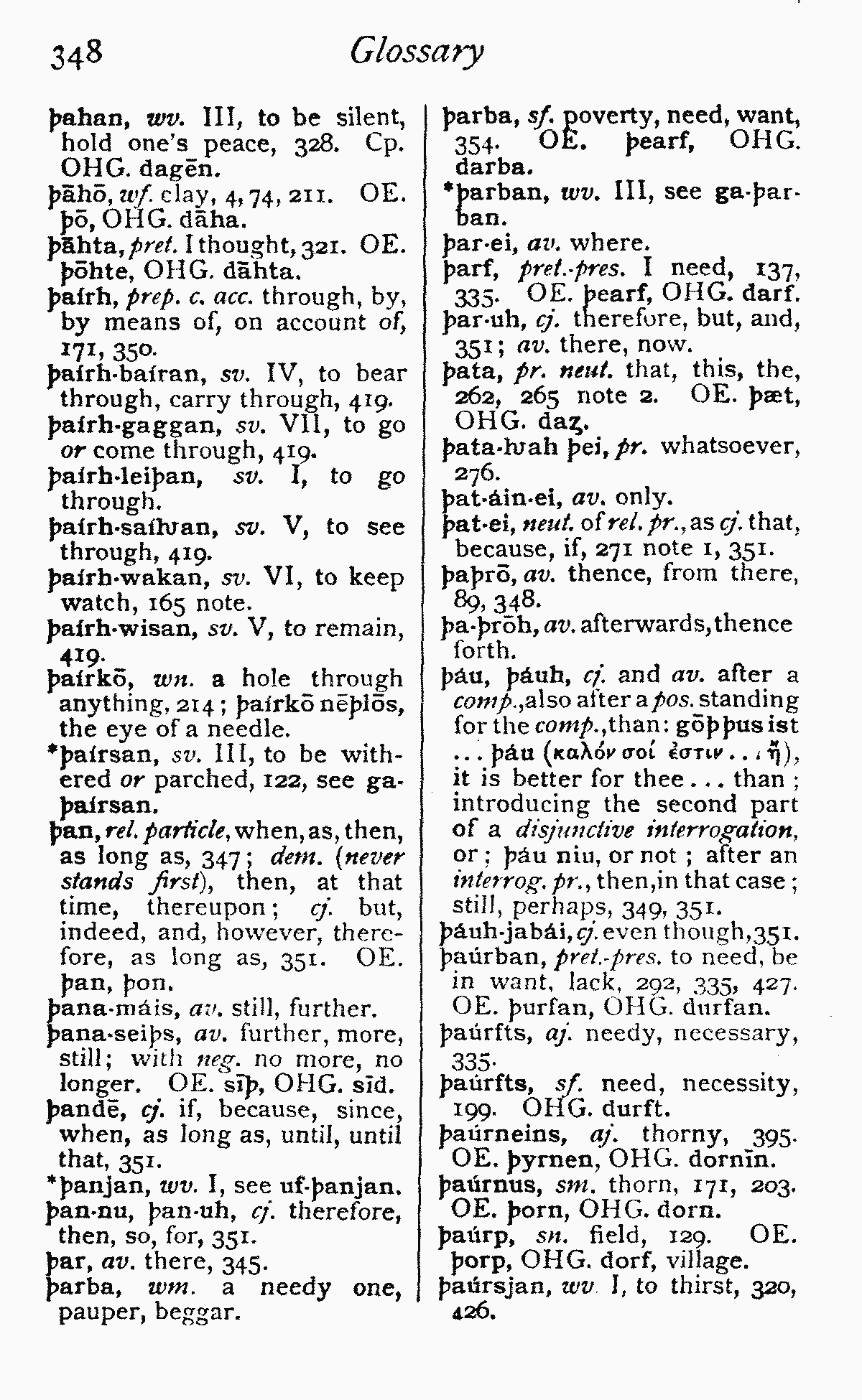
þata,
pr.
neut.
that,
this,
the,
262,
265
note
2.
OE.
þæt,
OHG.
da .
.
|
Source: Bosworth/Toller, page b0001, entry 3 View original page image as: [TIFF] [PNG] [View previous entry] [View next entry] |
[Comment on this entry] [View comments (1)] |
The following entry has been hand-corrected once. |
B.
The
short
or
unaccented
Anglo-Saxon
a
is
contained
in
the
following
words,
which
are
represented
by
modern
English
terms
of
the
same
import,
having
the
sound
of
a
in
man;
as
Can,
man,
span,
hand,
land,
sand,
camp,
dranc,
etc.
2.
The
short
a
is
often
found
in
the
final
syllables
of
inflections,
-a,
-an,
-as,
-aþ,
etc.
It
generally
appears
in
the
radix
before
a
doubled
consonant,
as
swamm
a
fungus,
wann
wan;
or
two
different
consonants,
as
mp,
mb,
nt,
nc,
ng,
etc.
--
Camp,
lamb,
plante,
dranc,
lang,
etc.
3.
The
radical
short
a
can
only
stand
before
a
single
consonant
and
st,
sc,
when
this
single
consonant
and
these
double
letters
are
again
followed,
in
the
inflections
or
formative
syllables,
by
a,
o,
u
in
nouns;
and
by
a,
o,
u,
e
in
adjectives;
and
a,
o,
u,
and
ia
in
verbs;
as
Dagas,
daga
from
dæg,
hwalas
from
hwæl,
fatu
from
fæt,
gastas
from
gæst,
ascas
from
æsc;
adj.
Smales,
smale,
smalost,
smalu,
from
smæl
small;
Lates,
latu,
latost,
from
læt
late:
Stapan,
faran,
starian,
wafian.
Grimm's
Deut.
Gram.
vol.
i.
p.
223,
2nd
edit.
1822.
In
other
cases,
the
short
or
unaccented
æ
is
used
instead
of
a.
See
Æ
in
its
alphabetical
order.
4.
The
remarks
in
3.
are
of
great
importance
in
declining
words,
for
monosyllables,
ending
in
a
single
consonant,
in
st
or
sc,
change
the
æ
into
a,
whenever
the
consonant
or
consonants
are
followed
by
a,
o,
u
in
nouns,
and
a,
o,
u,
e
in
adjectives,
vide
Æ.
5.
It
must
be
remembered
then,
that
a
short
a
cannot
stand
in
a
word
(1)
when
it
ends
in
a
single
consonant,
that
is,
when
no
inflections
of
a,
o,
u
in
nouns
follow;
as
in
Stæf,
fræt:
(2)
when
in
nouns
a
single
consonant
is
followed
by
e;
as
Stæfes,
stæfe,
wæter:
(3)
when
the
word
has
any
other
double
consonants
besides
st,
sc,
though
followed
by
a,
o,
u;
as
Cræft,
cræfta,
ægru
n.
pl.
of
æg:
(4)
in
contracted
words,
when
æ
is
not
in
the
last
syllable;
as
Æcer,
pl.
æceras,
æcerum,
contracted
æcras,
æcrum;
wæpen,
pl.
wæpenu
;
mægen,
pl.
mægenu,
contracted
wæpnu,
and
mægnu.
6.
Though
I
have
given
in
C.
3.
the
reasons,
which
Grimm
assigns
for
making
the
prefixed
a-
UNCERTAIN
long,
I
believe
it
is
generally
short
in
A.
Sax.
as
in
Eng.
a-bide
=
A.
Sax.
a-bídan
=
bídan,
so
a-cende
=
cende:--
Ic
todæg
cende
[cende
Surt;
acende
Spl.
T;
Th.]
ðé
ego
hodie
genui
te,
Ps.
Spl.
2,
7.
A-beran=beran
to
bear
:--
Hefige
byrðyna
man
aberan
ne
mæg
a
man
is
not
able
to
bear
heavy
burdens,
Mt.
Bos.
23,
4.
Ne
here
ge
sacc
nolite
fortare
sacculum,
Lk.
Bos.
10,
4.
A-biddan
=
biddan
to
ask,
pray
:--
Abiddaþ
[biddaþ
Cott.]
hine
pray
to
him.
Bt.
42
;
Fox
258,
21.
Ic
bidde
ðé,
Drihten
I
pray
to
thee,
Lord,
Gen.
19,
18.
It
is
evident
by
these
examples
that
words
have
the
same
meaning
with
and
without
the
prefixed
a-:
this
a-
was
not
prominent
or
long,
and
therefore
this
prefix
is
left
unaccented
in
this
Dictionary.
7.
a-
prefixed,
sometimes
denotes
Negation,
deterioration,
or
opposition,
as
From,
out,
away;
thus
awendan
to
turn
from,
subvert,
from
wendan
to
turn;
amód
out
of
or
without
mind,
mad;
adón
to
do
away,
banish,
composed
of
a
from,
dón
to
do,
vide
Æ.
The
prefixed
a-
does
not
always
appear
to
alter
the
signification
:
in
this
case
it
is
generally
omitted
in
modern
English
words
derived
immediately
from
Saxon,
--
thus,
Aberan
to
bear;
abrecan
to
break;
abítan
to
bite.
The
prefixed
a-,
in
such
cases,
seems
to
add
some
little
force
or
intensity
to
the
original
signification
of
the
word
to
which
it
is
joined,
--
thus,
f ran
to
make
afraid;
terrere:
a-fran
to
terrify,
dismay,
astound;
exterrere,
perterrere,
consternare,
stupefacere.
ran
to
make
afraid;
terrere:
a-fran
to
terrify,
dismay,
astound;
exterrere,
perterrere,
consternare,
stupefacere.
|
Source: Bosworth/Toller, page b0001, entry 4 View original page image as: [TIFF] [PNG] [View previous entry] [View next entry] |
[Comment on this entry] [View comments (1)] |
The following entry has been hand-corrected once. |
C.
The
long
Anglo-Saxon
á
is
accented,
and
words
containing
this
long
or
accented
á
are
now
represented
by
English
terms,
with
the
vowel
sounded
like
o
in
no
and
bone.
The
following
words
have
either
the
same
or
an
analogous
meaning,
both
in
English
and
Anglo-Saxon:
Hám
home,
án
one,
bán
bone,
hán
hone,
stán
stone,
sár
sore,
rap
UNCERTAIN
rope,
lár
lore,
gást
ghost,
wrát
wrote.
Sometimes
the
accented
or
long
á
is
represented
in
English
by
oa;
as
Ác
an
oak,
gád
a
goad,
lád
load,
rád
road,
brád
broad,
fám
foam,
lám
loam,
sápe
soap,
ár
oar,
bár
boar,
hár
hoar,
bat
boat,
gát
goat,
áta
oat,
áþ
oath,
láþ
loath.
Occasionally
á
becomes
oe
in
English;
as
Dá
a
doe,
fa
UNCERTAIN
a
foe,
tá
toe,
wá
woe;
but
the
oe,
in
these
words,
has
the
sound
of
o
in
no.
The
same
may
be
said
of
oa
in
oak,
goad.
Hence
it
appears
that
the
Anglo-Saxon
á
is
represented
by
the
modern
English
o,
oa,
and
oe,
which
have
the
sound
of
o
in
no
and
bone;
as
Rád
rode
(p.
of
ride),
rád
a
road,
and
dá,
a
doe.
Deut.
Gram,
von
Jacob
Grimm,
vol.
i.
pp.
358,
397,
398,
3rd
edit.
1840.
2.
The
long
á
is
often
changed
into
as
Lár
lore,
lran
to
teach,
an
one,
nig
any.
3.
The
following
is
a
precise
summary
from
Grimm
of
the
prefixed
a-,
long
or
accented.
The
prefixed
á
is
long
because
it
is
a
contraction
and
represents
the
preposition
æf
of,
off,
from,
away,
out
of,
or
the
preposition
on
on,
in,
upon,
into,
or
as
the
Lat.
in
and
Eng.
un;
as
á-dúne
for
æf-dúne,
á-wendian
for
æf-wendian,
á-drædan
for
on-drædan,
á-gean
for
on-gean,
á-týnan
to
unshut,
open,
Ps.
Spl.
38,
13,
for
on-týnan,
un-týnan
to
open.
Á,
as
an
inseparable
particle,
is
long
because
it
represents
the
inseparable
prefixed
particles
ar,
ur,
ir,
in
O.
H.
Ger.
and
O.
Sax.
commonly
expressing
the
meaning
of
the
Latin
prepositions
ab,
ex,
ad,
etc:
A.
Sax.
á-hebban,
O.
H.
Ger.
ur-hefan
elevare;
A.
Sax.
á-fyllan,
O.
H.
Ger.
ar-fullan
implere;
A.
Sax.
a-beran,
O.
H.
Ger.
ar-peran
ferre,
efferre;
A.
Sax.
á-scínan,
O.
H.
Ger.
ir-scínan
clarescere.
The
peculiar
force
which
this
particle
imparts
to
different
verbs
may
correspond
(1)
to
the
Latin
ex
out,
as
á-gangan
to
go
out;
exire:
(2)
to
the
English
up,
as
á-hleápan
to
leap
up;
exsilire:
á-fyllan
to
fill
up;
implere:
(3)
it
expresses
the
idea
of
an
origin
,
becoming,
growing,
á-blacian
to
blacken,
to
become
black;
á-heardian
to
grow
hard:
(4)
it
corresponds
to
the
Latin
re,
as
á-geban
reddere,
á-lósian
redimere,
á-sécan
requirere:
(5)
it
is
often
used
merely
to
render
a
verb
transitive,
or
to
impart
a
greater
force
to
the
transitive
meaning
of
the
simple
verb,
--
á-beódan
offerre,
a-ceapian
emere,
á-lecgan
ponere,
á-sleán
occidere:
(6)
it
is
used
with
intransitive
verbs,
where
it
has
hardly
any
meaning,
unless
it
suggests
the
commencement
or
beginning
of
the
action,
as
á-hleahan
ridere,
á-sweltan
mori:
(7)
it
expresses
the
end,
aim,
or
purpose
of
an
action,
as
á-dómian
condemnare,
á-biddan
deprecari,
á-wirþan
perire.
But,
after
all,
it
must
be
borne
in
mind,
that
the
various
shades
of
its
meaning
are
innumerable,
and
that,
even
in
one
and
the
same
compound,
it
often
assumes
different
meanings.
For
further
illustration
we
must
therefore
refer
to
the
compounds
in
which
it
occurs,
Grm.
ii.
818-832.
I
have,
in
justice
to
Grimm,
given
his
motives
for
marking
the
prefixed
á-
long:
I
believe,
however,
it
is
short.
See
B.
6.
|
Source: Bosworth/Toller, page b0002, entry 19 View original page image as: [TIFF] [PNG] [View previous entry] [View next entry] |
[Comment on this entry] [View comments] |
The following entry has been hand-corrected once. |
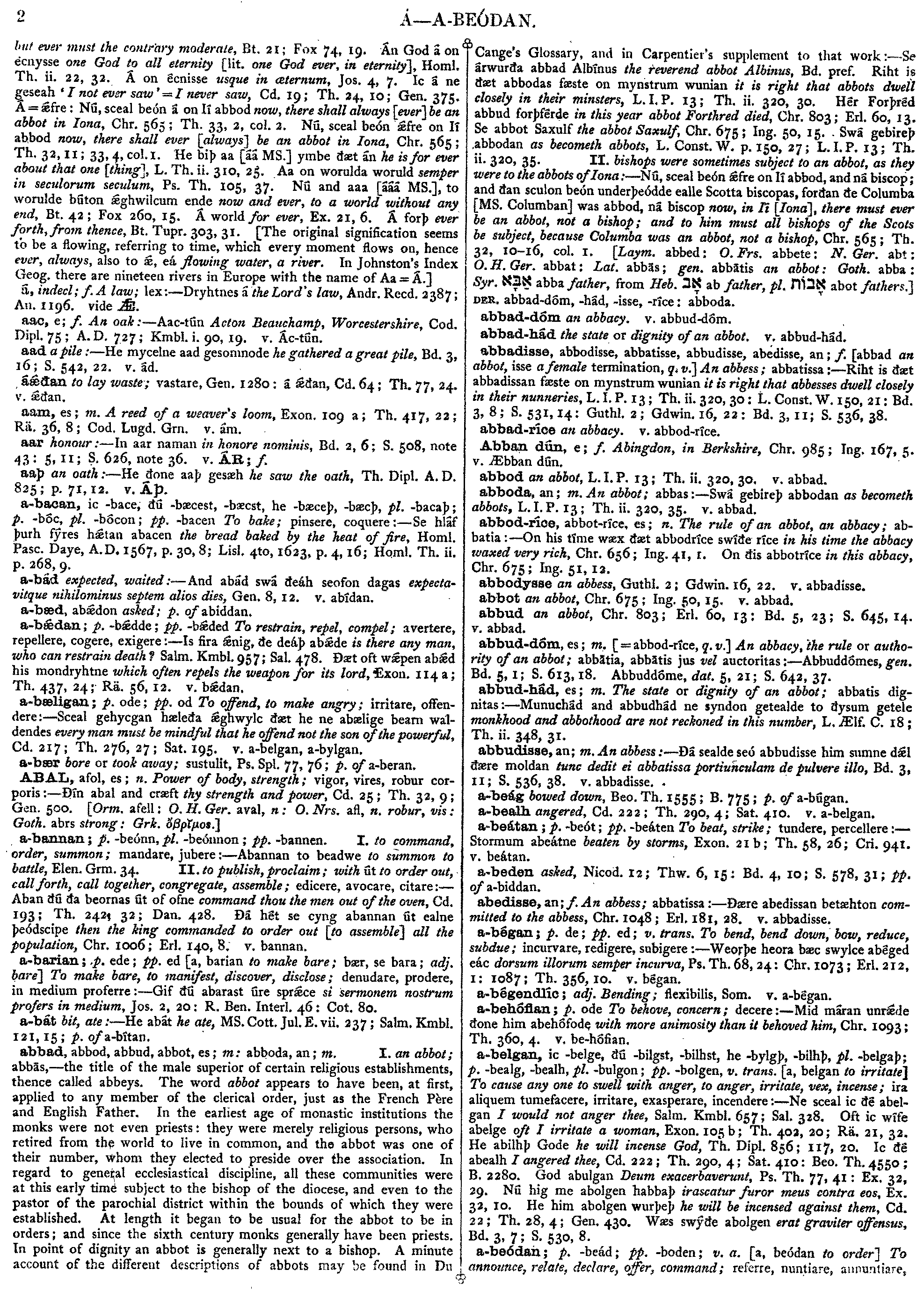
abbad,
abbod,
abbud,
abbot,
es;
m:
abboda,
an;
m.
I.
an
abbot;
abb s,
--
the
title
of
the
male
superior
of
certain
religious
establishments,
thence
called
abbeys.
The
word
abbot
appears
to
have
been,
at
first,
applied
to
any
member
of
the
clerical
order,
just
as
the
French
Père
and
English
Father.
In
the
earliest
age
of
monastic
institutions
the
monks
were
not
even
priests:
they
were
merely
religious
persons,
who
retired
from
the
world
to
live
in
common,
and
the
abbot
was
one
of
their
number,
whom
they
elected
to
preside
over
the
association.
In
regard
to
general
ecclesiastical
discipline,
all
these
communities
were
at
this
early
time
subject
to
the
bishop
of
the
diocese,
and
even
to
the
pastor
of
the
parochial
district
within
the
bounds
of
which
they
were
established.
At
length
it
began
to
be
usual
for
the
abbot
to
be
in
orders;
and
since
the
sixth
century
monks
generally
have
been
priests.
In
point
of
dignity
an
abbot
is
generally
next
to
a
bishop.
A
minute
account
of
the
different
descriptions
of
abbots
may
be
found
in
Du
Cange's
Glossary,
and
in
Carpentier's
supplement
to
that
work
:--
Se
árwurða
abbad
Albínus
the
reverend
abbot
Albinus,
Bd.
pref.
Riht
is
ðæt
abbodas
fæste
on
mynstrum
wunian
it
is
right
that
abbots
dwell
closely
in
their
minsters,
L.
I.
P.
13;
Th.
ii.
320,
30.
Her
Forþréd
abbud
forþférde
in
this
year
abbot
Forthred
died,
Chr.
803;
Erl.
60,
13.
Se
abbot
Saxulf
the
abbot
Saxulf,
Chr.
675;
Ing.
50,
15.
Swá
gebireþ
abbodan
as
becometh
abbots,
L.
Const.
W.
p.
150,
27;
L.
I.
P.
13;
Th.
ii.
320,
35.
II.
bishops
were
sometimes
subject
to
an
abbot,
as
they
were
to
the
abbots
of
Iona
:--
Nú,
sceal
beón
fre
on
Ií
abbod,
and
ná
biscop;
and
ðan
sculon
beón
underþeódde
ealle
Scotta
biscopas,
forðan
ðe
Columba
[MS.
Columban]
was
abbod,
ná
biscop
now,
in
Ií
[Iona]
,
there
must
ever
be
an
abbot,
not
a
bishop;
and
to
him
must
all
bishops
of
the
Scots
be
subject,
because
Columba
was
an
abbot,
not
a
bishop,
Chr.
565;
Th.
32,
10-16,
col.
l.
[Laym.
abbed:
O.
Frs.
abbete:
N.
Ger.
abt:
O.
H.
Ger.
abbat:
Lat.
abbas;
gen.
abbtis
an
abbot:
Goth.
abba
:
Syr.
HEBREW
abba
father,
from
Heb.
HEBREW
ab
father,
pl.
HEBREW
abot
fathers.]
DER.
abbad-dóm,
-hád,
-isse,
-ríce:
abboda.
s,
--
the
title
of
the
male
superior
of
certain
religious
establishments,
thence
called
abbeys.
The
word
abbot
appears
to
have
been,
at
first,
applied
to
any
member
of
the
clerical
order,
just
as
the
French
Père
and
English
Father.
In
the
earliest
age
of
monastic
institutions
the
monks
were
not
even
priests:
they
were
merely
religious
persons,
who
retired
from
the
world
to
live
in
common,
and
the
abbot
was
one
of
their
number,
whom
they
elected
to
preside
over
the
association.
In
regard
to
general
ecclesiastical
discipline,
all
these
communities
were
at
this
early
time
subject
to
the
bishop
of
the
diocese,
and
even
to
the
pastor
of
the
parochial
district
within
the
bounds
of
which
they
were
established.
At
length
it
began
to
be
usual
for
the
abbot
to
be
in
orders;
and
since
the
sixth
century
monks
generally
have
been
priests.
In
point
of
dignity
an
abbot
is
generally
next
to
a
bishop.
A
minute
account
of
the
different
descriptions
of
abbots
may
be
found
in
Du
Cange's
Glossary,
and
in
Carpentier's
supplement
to
that
work
:--
Se
árwurða
abbad
Albínus
the
reverend
abbot
Albinus,
Bd.
pref.
Riht
is
ðæt
abbodas
fæste
on
mynstrum
wunian
it
is
right
that
abbots
dwell
closely
in
their
minsters,
L.
I.
P.
13;
Th.
ii.
320,
30.
Her
Forþréd
abbud
forþférde
in
this
year
abbot
Forthred
died,
Chr.
803;
Erl.
60,
13.
Se
abbot
Saxulf
the
abbot
Saxulf,
Chr.
675;
Ing.
50,
15.
Swá
gebireþ
abbodan
as
becometh
abbots,
L.
Const.
W.
p.
150,
27;
L.
I.
P.
13;
Th.
ii.
320,
35.
II.
bishops
were
sometimes
subject
to
an
abbot,
as
they
were
to
the
abbots
of
Iona
:--
Nú,
sceal
beón
fre
on
Ií
abbod,
and
ná
biscop;
and
ðan
sculon
beón
underþeódde
ealle
Scotta
biscopas,
forðan
ðe
Columba
[MS.
Columban]
was
abbod,
ná
biscop
now,
in
Ií
[Iona]
,
there
must
ever
be
an
abbot,
not
a
bishop;
and
to
him
must
all
bishops
of
the
Scots
be
subject,
because
Columba
was
an
abbot,
not
a
bishop,
Chr.
565;
Th.
32,
10-16,
col.
l.
[Laym.
abbed:
O.
Frs.
abbete:
N.
Ger.
abt:
O.
H.
Ger.
abbat:
Lat.
abbas;
gen.
abbtis
an
abbot:
Goth.
abba
:
Syr.
HEBREW
abba
father,
from
Heb.
HEBREW
ab
father,
pl.
HEBREW
abot
fathers.]
DER.
abbad-dóm,
-hád,
-isse,
-ríce:
abboda.
|
Source: Bosworth/Toller, page b0002, entry 27 View original page image as: [TIFF] [PNG] [View previous entry] [View next entry] |
[Comment on this entry] [View comments] |
The following entry has been hand-corrected once. |
abbod-ríce, abbot-ríce, es; n. The rule of an abbot, an abbacy; abbatia :-- On his tíme wæx ðæt abbodríce swíðe ríce in his time the abbacy waxed very rich, Chr. 656; Ing. 41, l. On ðis abbotríce in this abbacy, Chr. 675; Ing. 51, 12.
|
Source: Bosworth/Toller, page b0002, entry 32 View original page image as: [TIFF] [PNG] [View previous entry] [View next entry] |
[Comment on this entry] [View comments] |
The following entry has been hand-corrected once. |
abbud-hád, es; m. The state or dignity of an abbot; abbatis dignitas :-- Munuchád and abbudhád ne syndon getealde to ðysum getele monkhood and abbothood are not reckoned in this number, L. Ælf. C. 18; Th. ii. 348, 31.
|
Source: Bosworth/Toller, page b0004, entry 35 View original page image as: [TIFF] [PNG] [View previous entry] [View next entry] |
[Comment on this entry] [View comments (2)] |
The following entry has been hand-corrected once. |
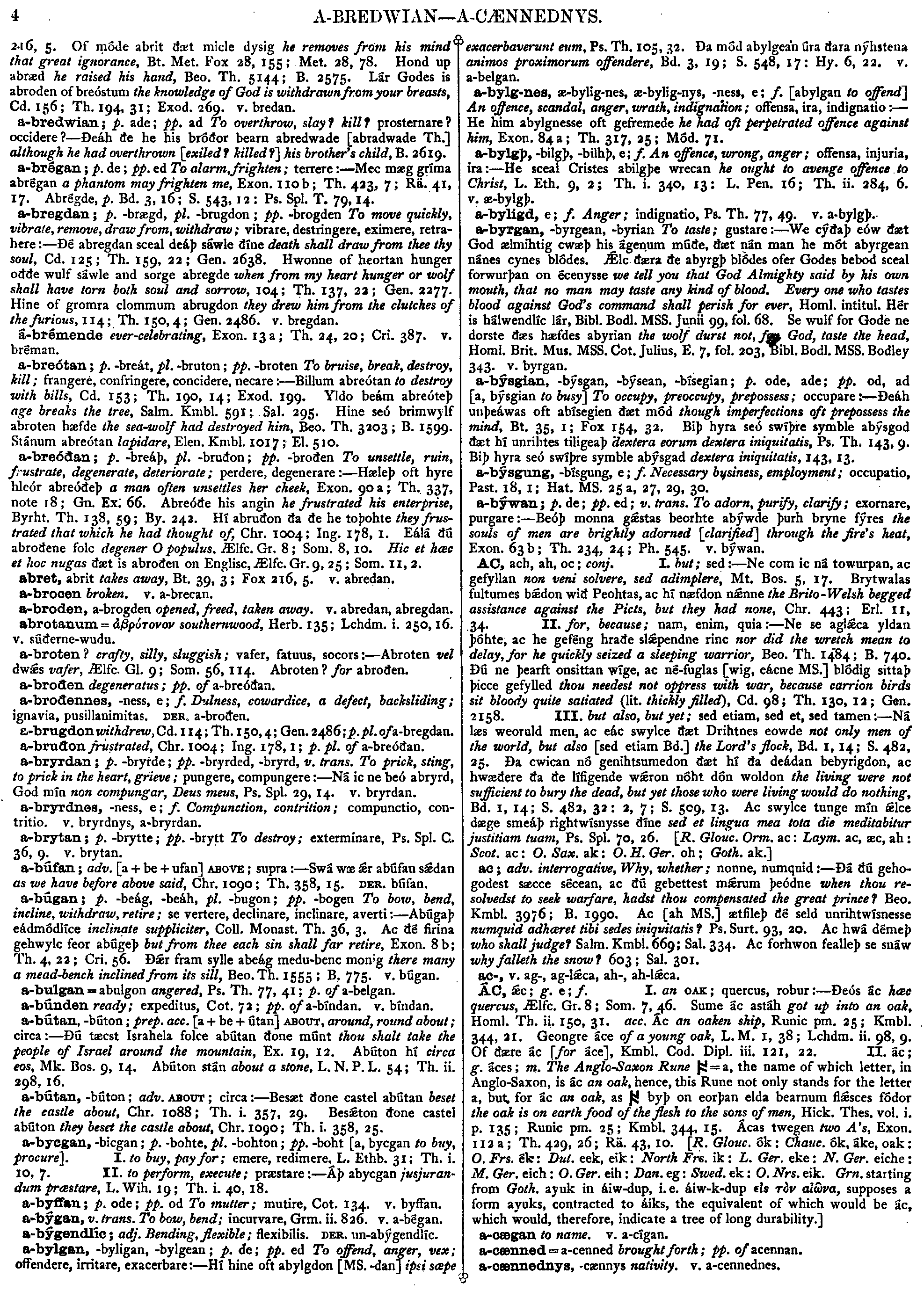
AC,
íéc;
g.
e;
f.
I.
an
OAK
;
quercus,
robur
:--
Ðeós
ác
nece
quercus,
Ælfc.
Gr.
8;
Som.
7,
46.
Sume
ác
astáh
got
up
into
an
oak,
Homl.
Th.
ii.
150,
31.
acc.
Ac
an
oaken
ship.
Runic
pm.
25;
Kmbl.
344,
21.
Geongre
ace
of
a
young
oak,
L.
M.
l,
38;
Lchdm,
ii.
98,
9.
Of
ðære
ác
[for
áce],
Kmbl.
Cod.
Dipl.
iii.
121,
22.
II.
ác;
g.
Sees;
m.
The
Anglo-Saxon
Rune
J-.
=
a,
the
name
of
which
letter,
in
Anglo-Saxon,
is
ic
an
oak,
hence,
this
Rune
not
only
stands
for
the
letter
a,
but
for
ác
an
oak,
as
J...
byþ
on
eorþan
elda
bearnum
flsces
fódor
the
oak
is
on
earth
food
ofthefiesh
to
the
sons
of
men,
Hick.
Thes.
vol.
i.
p.
135;
Runic
pm.
25;
Kmbl.
344,
15.
Ácas
twegen
two
A's,
Exon.
| Result Page: | 1 2 3 4 5 6 7 8 9 10 | Next |  |
Germanic Lexicon Project (main page)
This search system was written by
Sean Crist
Please consider
volunteering
to correct the data in these online dictionaries.
No rights reserved. Feel free to use these data in any way you please.