|
|

|
Source: Cleasby/Vigfusson, page b0091, entry 27 View original page image as: [TIFF] [PNG] [View previous entry] [View next entry] |
[Comment on this entry] [View comments] |
The following entry has been hand-corrected once. |
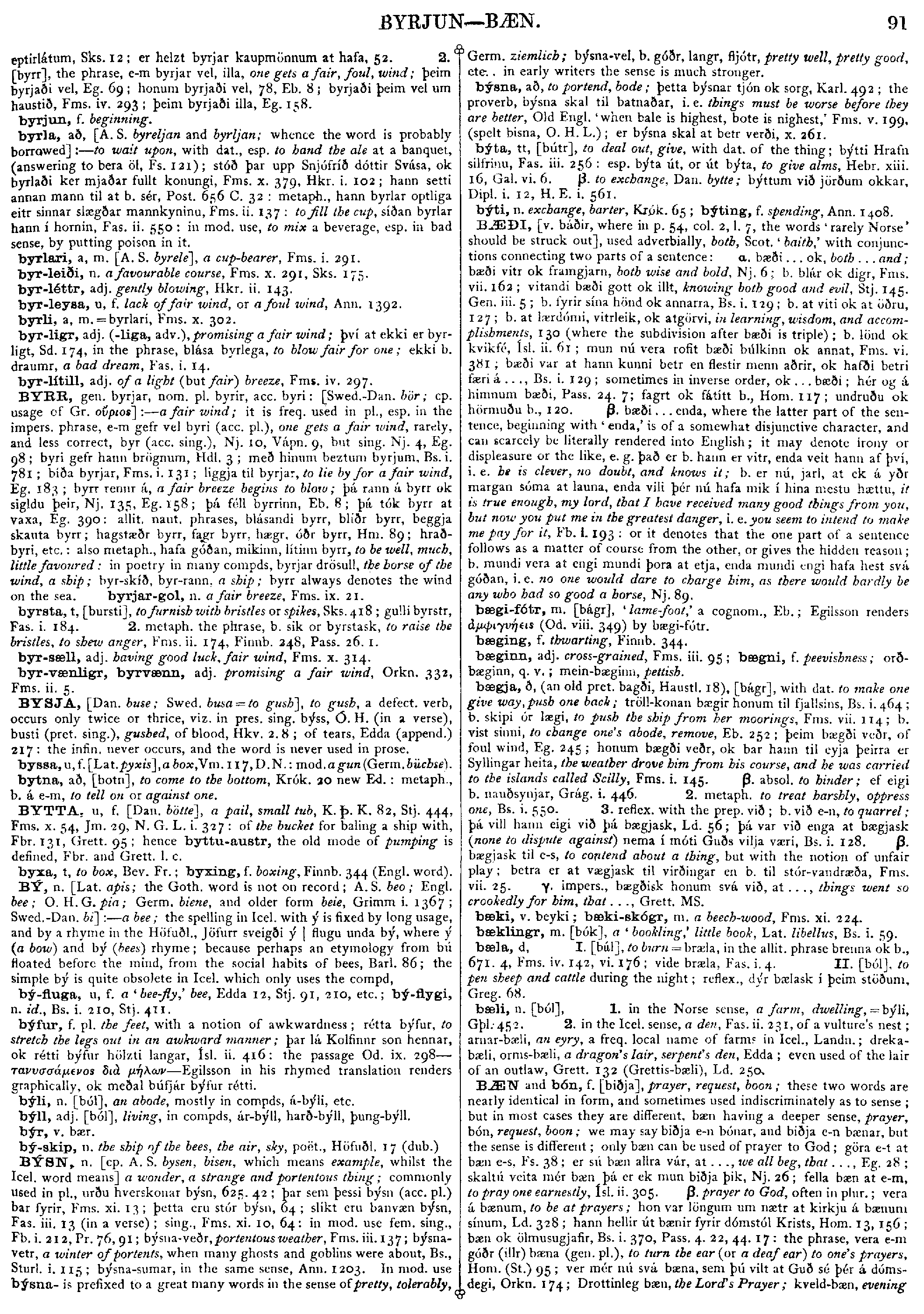
BÝSN, n. [cp. A. S. bysen, bisen, which means example, whilst the Icel. word means] a wonder, a strange and portentous thing; commonly Used in pl., urðu hverskonar býsn, 625. 42; þar sem þessi býsn (acc. pl.) bar fyrir, Fms. xi. 13; þetta eru stór býsn, 64; slíkt eru banvæn býsn, Fas. iii. 13 (in a verse); sing., Fms. xi. 10, 64: in mod. use fem. sing., Fb. i. 212, Pr. 76, 91; býsna-veðr, portentous weather, Fms. iii. 137; býsna- vetr, a winter of portents, when many ghosts and goblins were about, Bs., Sturl. i. 115; býsna-sumar, in the same sense, Ann. 1203. In mod. use býsna- is prefixed to a great many words in the sense of pretty, tolerably, Germ, ziemlich; býsna-vel, b. góðr, langr, fljótr, pretty well, pretty good, etc. in early writers the sense is much stronger.
|
Source: Cleasby/Vigfusson, page b0093, entry 1 View original page image as: [TIFF] [PNG] [View previous entry] [View next entry] |
[Comment on this entry] [View comments] |
The following entry has been hand-corrected once. |
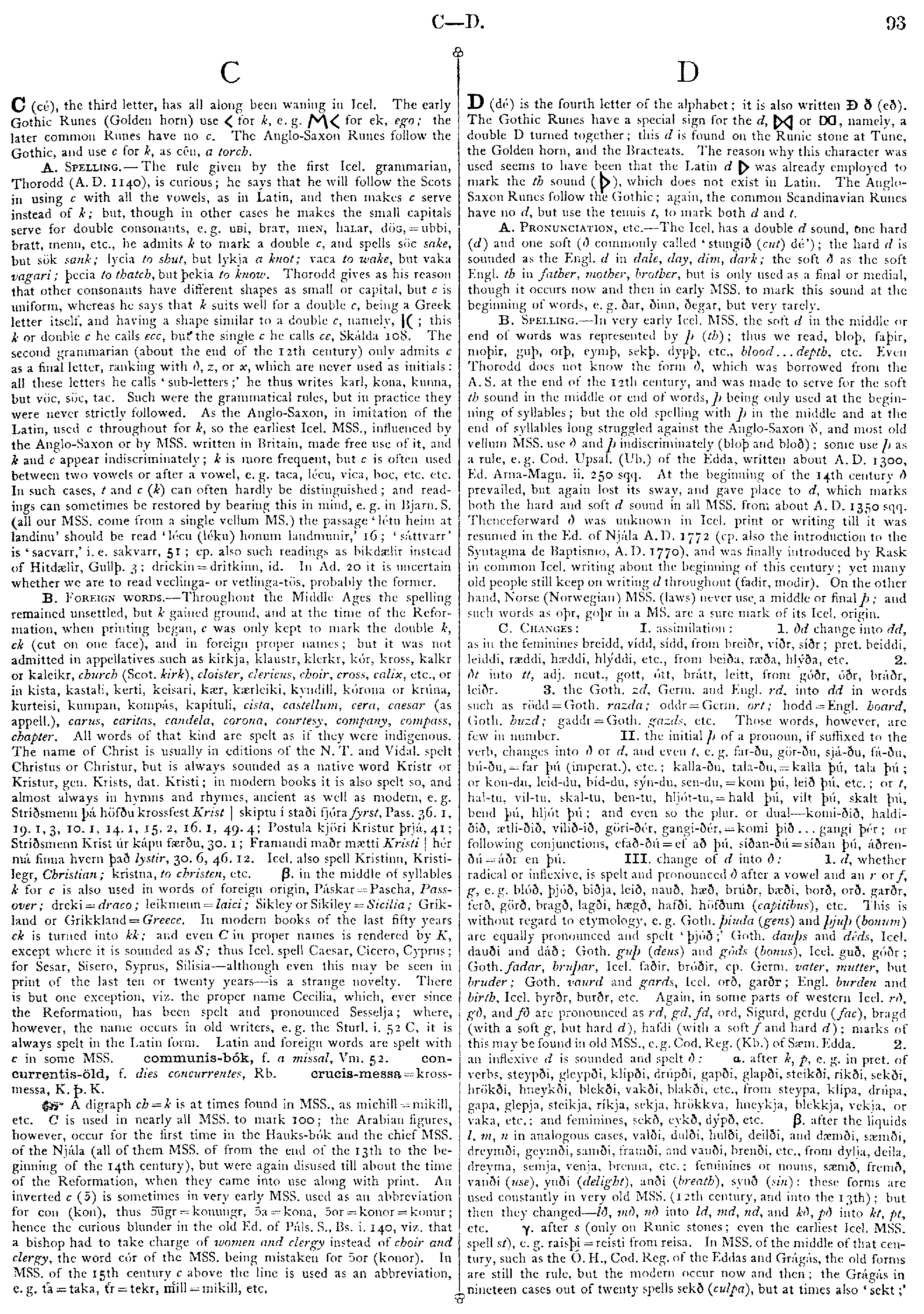
C
(cé),
the
third
letter,
has
all
along
been
waning
in
Icel.
The
early
Gothic
Runes
(Golden
horn)
use
RUNE
for
k,
e.g.
RUNE
for
ek,
ego;
the
later
common
Runes
have
no
c.
The
Anglo-Saxon
Runes
follow
the
Gothic,
and
use
c
tor
k,
as
cén,
a
torch.
A.
SPELLING.
--
The
rule
given
by
the
first
Icel.
grammarian,
Thorodd
(A.D.
1140),
is
curious;
he
says
that
he
will
follow
the
Scots
in
using
c
with
all
the
vowels,
as
in
Latin,
and
then
makes
c
serve
instead
of
k;
but,
though
in
other
cases
he
makes
the
small
capitals
serve
for
double
consonants,
e.
g.
uBi,
braT,
meN,
haLar,
döG,
=
ubbi,
bratt,
menn,
etc.,
he
admits
k
to
mark
a
double
c,
and
spells
söc
sake,
but
sök
sank;
lycia
to
shut,
but
lykja
a
knot;
vaca
to
wake,
but
vaka
vagari;
þecia
to
thatch,
but
þekia
to
know.
Thorodd
gives
as
his
reason
that
other
consonants
have
different
shapes
as
small
or
capital,
but
c
is
uniform,
whereas
he
says
that
k
suits
well
for
a
double
c,
being
a
Greek
letter
itself,
and
having
a
shape
similar
to
a
double
c,
namely,
RUNE;
this
k
or
double
c
he
calls
ecc,
but
the
single
c
he
calls
ce,
Skálda
108.
The
second
grammarian
(about
the
end
of
the
12th
century)
only
admits
c
as
a
final
letter,
ranking
with
ð,
z,
or
x,
which
are
never
used
as
initials:
all
these
letters
he
calls
'sub-letters;'
he
thus
writes
karl,
kona,
kunna,
but
vöc,
söc,
tac.
Such
were
the
grammatical
rules,
but
in
practice
they
were
never
strictly
followed.
As
the
Anglo-Saxon,
in
imitation
of
the
Latin,
used
c
throughout
for
k,
so
the
earliest
Icel.
MSS.,
influenced
by
the
Anglo-Saxon
or
by
MSS.
written
in
Britain,
made
free
use
of
it,
and
k
and
c
appear
indiscriminately;
k
is
more
frequent,
but
c
is
often
used
between
two
vowels
or
after
a
vowel,
e.g.
taca,
lécu,
vica,
hoc,
etc.
etc.
In
such
cases,
t
and
c
(k)
can
often
hardly
be
distinguished;
and
readings
can
sometimes
be
restored
by
bearing
this
in
mind,
e.g.
in
Bjarn.
S.
(all
our
MSS.
come
from
a
single
vellum
MS.)
the
passage
'létu
heim
at
landinu'
should
be
read
'lécu
(léku)
honum
landmunir,'
16;
'
sáttvarr'
is
'sacvarr,'
i.e.
sakvarr,
51;
cp.
also
such
readings
as
bikdælir
instead
of
Hitdælir,
Gullþ.
3;
drickin
=
dritkinn,
id.
In
Ad.
20
it
is
uncertain
whether
we
are
to
read
veclinga-
or
vetlinga-tös,
probably
the
former.
B.
FOREIGN
WORDS.
--
Throughout
the
Middle
Ages
the
spelling
remained
unsettled,
but
k
gained
ground,
and
at
the
time
of
the
Reformation,
when
printing
began,
c
was
only
kept
to
mark
the
double
k,
ek
(cut
on
one
face),
and
in
foreign
proper
names;
but
it
was
not
admitted
in
appellatives
such
as
kirkja,
klaustr,
klerkr,
kór,
kross,
kalkr
or
kaleikr,
church
(Scot,
kirk),
cloister,
clericus,
choir,
cross,
calix,
etc.,
or
in
kista,
kastali,
kerti,
keisari,
kær,
kærleiki,
kyndill,
kórona
or
krúna,
kurteisi,
kumpan,
kompás,
kapítuli,
cista,
castellum,
cern,
caesar
(as
appell.),
carus,
caritas,
candela,
corona,
courtesy,
company,
compass,
chapter.
All
words
of
that
kind
are
spelt
as
if
they
were
indigenous.
The
name
of
Christ
is
usually
in
editions
of
the
N.T.
and
Vidal.
spelt
Christus
or
Christur,
but
is
always
sounded
as
a
native
word
Kristr
or
Kristur,
gen.
Krists,
dat.
Kristi;
in
modern
books
it
is
also
spelt
so,
and
almost
always
in
hymns
and
rhymes,
ancient
as
well
as
modern,
e.g.
Stríðsmenn
þá
höfðu
krossfest
Krist
|
skiptu
í
staði
fjóra
fyrst,
Pass.
36.
I,
19.1,
3,
10.1,
14.1,
15.2,
16.1,
49.4;
Postula
kjöri
Kristur
þrjá,
41;
Stríðsmenn
Krist
úr
kúpu
færðu,
30.1;
Framandi
maðr
mætti
Kristi
|
hér
má
fínna
hvern
það
lystir,
30.6,
46.12.
Icel.
also
spell
Kristinn,
Kristilegr,
Christian;
kristna,
to
christen,
etc.
 .
in
the
middle
of
syllables
k
for
c
is
also
used
in
words
of
foreign
origin,
Páskar
=
Pascha,
Passover;
dreki
=
draco;
leikmenn
=
laici;
Sikley
or
Sikiley
=
Sicilia;
Grikland
or
Grikkland
=
Greece.
In
modern
books
of
the
last
fifty
years
ck
is
turned
into
kk;
and
even
C
in
proper
names
is
rendered
by
K,
except
where
it
is
sounded
as
S;
thus
Icel.
spell
Caesar,
Cicero,
Cyprus;
for
Sesar,
Sisero,
Syprus,
Silisia
--
although
even
this
may
be
seen
in
print
of
the
last
ten
or
twenty
years
--
is
a
strange
novelty.
There
is
but
one
exception,
viz.
the
proper
name
Cecilia,
which,
ever
since
the
Reformation,
has
been
spelt
and
pronounced
Sesselja;
where,
however,
the
name
occurs
in
old
writers,
e.g.
the
Sturl.
i.
52
C,
it
is
always
spelt
in
the
Latin
form.
Latin
and
foreign
words
are
spelt
with
c
in
some
MSS.
communis-bók,
f.
a
missal,
Vm.
52.
concurrentis-öld,
f.
dies
concurrentes,
Rb.
crucis-messa
=
kross-messa,
K.Þ.K.
&hand;
A
digraph
ch
=
k
is
at
times
found
in
MSS.,
as
michill
=
mikill,
etc.
C
is
used
in
nearly
all
MSS.
to
mark
100;
the
Arabian
figures,
however,
occur
for
the
first
time
in
the
Hauks-bók
and
the
chief
MSS.
of
the
Njála
(all
of
them
MSS.
of
from
the
end
of
the
13th
to
the
beginning
of
the
14th
century),
but
were
again
disused
till
about
the
time
of
the
Reformation,
when
they
came
into
use
along
with
print.
An
inverted
c
(&c-reversed-long;)
is
sometimes
in
very
early
MSS.
used
as
an
abbreviation
for
con
(kon),
thus
&c-reversed-long;ugr
=
konungr,
&c-reversed-long;a
=
kona,
&c-reversed-long;or
=
konor
=
konur;
hence
the
curious
blunder
in
the
old
Kd.
of
Páls.
S.,
Bs.
i.
140,
viz.
that
a
bishop
had
to
take
charge
of
women
and
clergy
instead
of
choir
and
clergy,
the
word
cór
of
the
MSS.
being
mistaken
for
&c-reversed-long;or
(konor).
In
MSS.
of
the
15th
century
c
above
the
line
is
used
as
an
abbreviation,
e.g.
t&c-super;a
=
taka,
t&c-super;r
=
tekr,
m&c-super;ill
=
mikill,
etc.
.
in
the
middle
of
syllables
k
for
c
is
also
used
in
words
of
foreign
origin,
Páskar
=
Pascha,
Passover;
dreki
=
draco;
leikmenn
=
laici;
Sikley
or
Sikiley
=
Sicilia;
Grikland
or
Grikkland
=
Greece.
In
modern
books
of
the
last
fifty
years
ck
is
turned
into
kk;
and
even
C
in
proper
names
is
rendered
by
K,
except
where
it
is
sounded
as
S;
thus
Icel.
spell
Caesar,
Cicero,
Cyprus;
for
Sesar,
Sisero,
Syprus,
Silisia
--
although
even
this
may
be
seen
in
print
of
the
last
ten
or
twenty
years
--
is
a
strange
novelty.
There
is
but
one
exception,
viz.
the
proper
name
Cecilia,
which,
ever
since
the
Reformation,
has
been
spelt
and
pronounced
Sesselja;
where,
however,
the
name
occurs
in
old
writers,
e.g.
the
Sturl.
i.
52
C,
it
is
always
spelt
in
the
Latin
form.
Latin
and
foreign
words
are
spelt
with
c
in
some
MSS.
communis-bók,
f.
a
missal,
Vm.
52.
concurrentis-öld,
f.
dies
concurrentes,
Rb.
crucis-messa
=
kross-messa,
K.Þ.K.
&hand;
A
digraph
ch
=
k
is
at
times
found
in
MSS.,
as
michill
=
mikill,
etc.
C
is
used
in
nearly
all
MSS.
to
mark
100;
the
Arabian
figures,
however,
occur
for
the
first
time
in
the
Hauks-bók
and
the
chief
MSS.
of
the
Njála
(all
of
them
MSS.
of
from
the
end
of
the
13th
to
the
beginning
of
the
14th
century),
but
were
again
disused
till
about
the
time
of
the
Reformation,
when
they
came
into
use
along
with
print.
An
inverted
c
(&c-reversed-long;)
is
sometimes
in
very
early
MSS.
used
as
an
abbreviation
for
con
(kon),
thus
&c-reversed-long;ugr
=
konungr,
&c-reversed-long;a
=
kona,
&c-reversed-long;or
=
konor
=
konur;
hence
the
curious
blunder
in
the
old
Kd.
of
Páls.
S.,
Bs.
i.
140,
viz.
that
a
bishop
had
to
take
charge
of
women
and
clergy
instead
of
choir
and
clergy,
the
word
cór
of
the
MSS.
being
mistaken
for
&c-reversed-long;or
(konor).
In
MSS.
of
the
15th
century
c
above
the
line
is
used
as
an
abbreviation,
e.g.
t&c-super;a
=
taka,
t&c-super;r
=
tekr,
m&c-super;ill
=
mikill,
etc.
|
Source: Cleasby/Vigfusson, page b0103, entry 1 View original page image as: [TIFF] [PNG] [View previous entry] [View next entry] |
[Comment on this entry] [View comments] |
The following entry has not been hand-corrected. However, the page is reserved and someone is correcting it. |
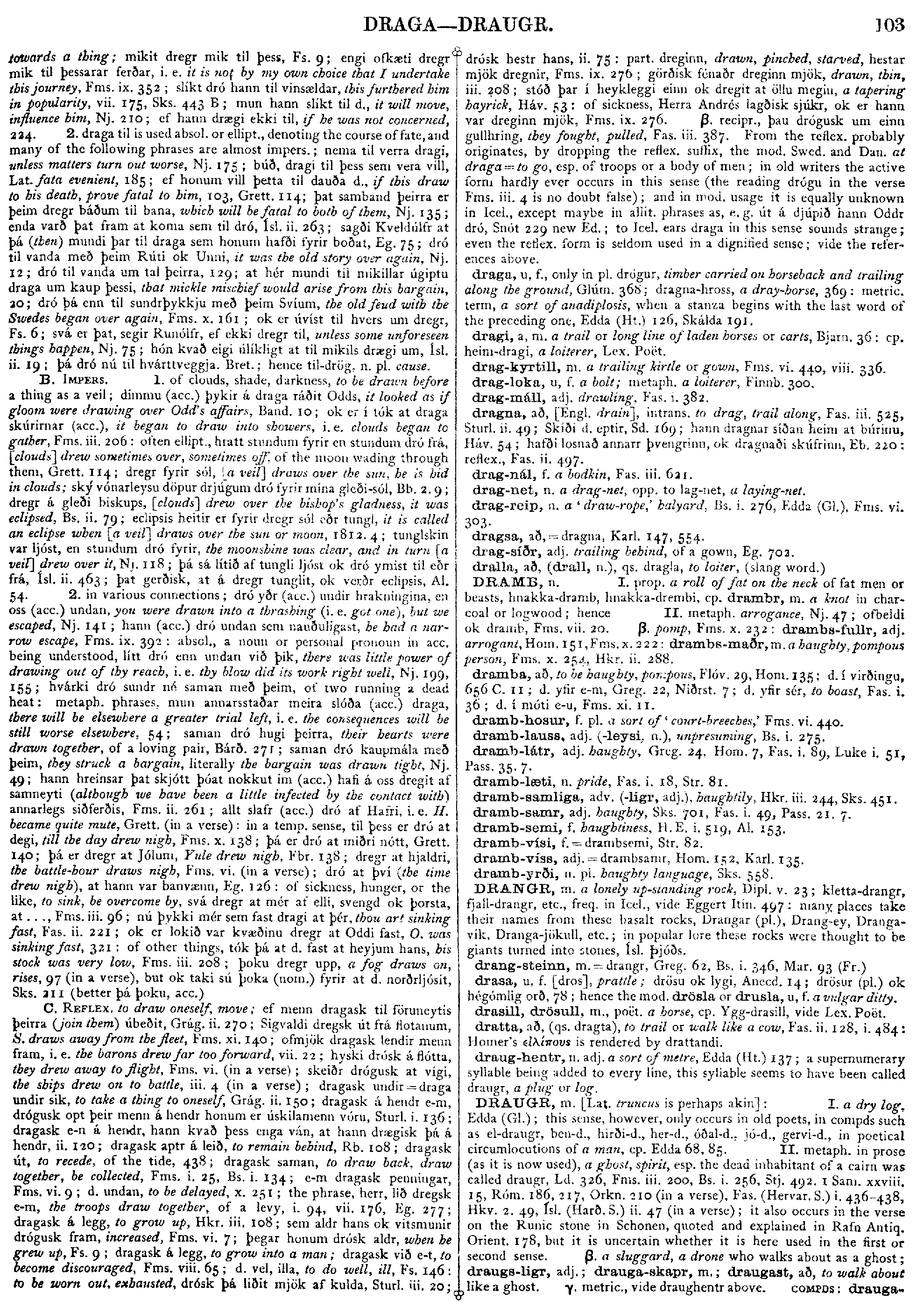
iatvards a thing; mikit dregr mik til þess, Fs. 9; engi ofkæti dregr' mik til þessarar ferðar, i. e. it i s no(by my own choice that í -undertake this journey, Fms. ix. 352; slíkt dró hann til vinsældar, ibis furthered him in popularity, vii. 175, Sks. 443 B; mun hann slikt til d., it will move, influence him, Nj. 210; ef hann drægi ekki til, if he was not concerned, 224. 2. dragatil isusedabsol. or ellipt., denoting the course of fate, and many of the following phrases are almost impers.; nema til verra dragi, unless matters turn out worse, Nj. 175; búð, dragi til þess sem vera vill, Lat. y at a evenient, 185; ef honum vill þetta til dauða d., if ibis draw to his death, prove fatal to him, 103, Grett. 114; þat samband þeirra er þeim dregr báðum til bana, which will be fatal to both of them, Nj. 135; enda varð þat fram at koma sem til dró, Ísl. ii. 263; sagði Kveldúlfr at þá (then) mundi þar ti! draga sem honum hafði fyrir boðat, Eg. 75; dró til vanda með þeim Rúti ok Unni, it was the old story over again, Nj. 12; dró til vanda um tai þeirra, 129; at her mundi til nnkillar ugiptu draga um kaup þessi, that mickle mischief would arise from this bargain, 30; dró þá enn til sundrþykkju með þeim Svíum, the old feud with the Swedes began over again, Fms. x. 161; ok er úvíst til hvers um dregr, Fs. 6; svá er þat, segir Runólfr, ef ekki dregr til, unless some unforeseen things happen, Nj. 75; hón kvað eigi tilikligt at til mikils drsegi um, Ísl. ii. 19; þá dró nú til hvárttveggja. Bret.; hence til-drög. n. pl. cause. B. IMPERS. 1. of clouds, shade, darkness, to be drav-'n before a thing as a veil; dimmu (acc.) þykir á draga ráðit Odds, it looked as if gloom were drawing over Odd's affairs, Band. 10; ok er í lók at draga skurirnar (acc.), it began to draw into showers, i. e. clouds began to gather, Fms. iii. 206: often ellipt., hratt stundum fyrir en stundum dró frá, [clouds] drew sometimes over, sometiin. es off, of the moon wading through them, Grett. 114; dregr fyrir sol, a veil] draws over (be sun, be is bid in clouds; sky vónarleysu döpur drjugum dró iyrir mína gleði-sól, Bb. 2. 9; dregr á gleði biskups, [clouds'] drew over the bishop's gladness, it was eclipsed, Bs. ii. 79; eclipsis heitir er fyrir dregr sól rðr tungl, it is called an eclipse when [a veif] draws over the sun or moon, 1812. 4; tunglskin var Ijost, en stundum dró fyrir, the moonshine was clear, and in turn [a veil] drew over it, Nj. 118; þá sá lítið af tungli Ijóst ok dró ymist til eor frá, Ísl. ii. 463; þat gerðisk, at á dregr tunglit, ok verðr eclipsis, A]. 54. 2. in various connections; dró yðr (acc.) undir hrakningina, en oss (acc.) undan, you were drawn into a thrashing (i. e. got one] , but we escaped, Nj. 141; hann (acc.) dró undan sem r. auðuligast, he bad a nar- row escape, Fms. ix. 392: absol., a noun or personal pronoun in acc. being understood, lítt dró enn undan við þik, there ivas little power of drawing out of thy reach, i. e. thy blow did its work right well. Nj. 199, 155; hvárki dró sundr nó saman með þeim, of two running a dead heat: metaph. phrases, mun annarsstaðar meira slóða (acc.) draga, there will be elsewhere a greater trial left, i. e. the consequences will be still worse elsewhere, 54; saman dró hugi þeirra, their hearts were drawn together, of a loving pair, Bárð. 271; saman dró kaupmála með þeim, they struck a bargain, literally the bargain was drawn tight, Nj. 49; hann hreinsar þat skjótt þóat nokkut im (acc.) hafi á oss dregit af samneyti (although we have been a little infected by the contact witb) annarlegs siðferðis, Fms. ii. 261; allt slafr (acc.) dro af Hafri, i. e. //. became quite mute, Grett. (in a verse): in a temp, sense, til þess er dró at degi, till the day drew nigh, Fms. x. 138; þá er dró at miðri nótt, Grett. 140; þá er dregr at Joluni, Yule drew nigh, Fbr. 138; dregr at hjaldri, the battle-hour draws nigh, Fms. vi. (in a verse); dró at því (the time drew nigh), at hann var banvænn, Eg. 126: of sickness, hunger, or the like, to sink, be overcome by, svá dregr at mér af elli, svengd ok þorsta, at..., Fms. iii. 96; nú þvkki mér sem fast dragi at þér, th ow art sinking fast, Fas. ii. 221; ok er lokið var kvæðinu dregr at Oddi fast, O. was sinking fast, 321: of other things, tók þá at d. fast at heyjum bans, hi s s to ek was very low, Fms. iii. 208; þoku dregr upp, a fog draws on, rises, 97 (in a verse), but ok taki sú poka (nom.) fyrir at d. norðrljósit, Sks. an (better þá þoku, acc.) C. REFLEX, to draw oneself, move; ef menn dragask til föruneytis þeirra (Join them) úbeðit, Grág. ii. 270; Sigvaldi dregsk út frá flotanum, 8. draws away from the fleet, Fms. xi. 140; ofmjök dragask lendir menn fram, i. e. the barons drew far too forward, vii. 22; hyski drósk á flótta, they drew away to flight, Fms. vi. (in a verse); skeiðr drógusk at vigi, the ship s drewon tobattle, iii. 4 (in a verse); dragask undir -- draga undir sik, to take a thing tooneself, Grág. ii. 150; dragask á hendr e-m, drógusk opt þeir menn á hendr honum er uskilamenn voru, Sturl. i. 136; dragask e-n á heridr, hann kvað þess enga van, at hann drægisk þá á hendr, ii. 120; dragask aptr á leið, to remain behind, Rb. 108; dragask út, to recede, of the tide, 438; dragask saman, to draw back, draw together, be collected, Fms. i. 25, Bs. i. 134; e-m dragask peimingar, Fms. vi. 9; d. undan, to be delayed, x. 251; the phrase, herr, lið dregsk e-m, the troops draw together, of a levy, i. 94, vii. 176, Eg. 277; dragask á legg, t o gro w up, Hkr. iii. 108; sem aldr hans ok vitsmunir drógusk fram, increased, Fms. vi. 7; þegar honum drósk aldr, when he grew up, Fs. 9; dragask á legg, to grow into a man; dragask við e-t, t o become discouraged, Fms. via. 65; d. vel, ilia, to do well, ill, Fs. 146: to be worn out, exhausted, drósk þá liðit mjök af kulda, Stud. üi. 20; drósk hestr hans, ii. 75 •' part, dreginn, drawn, pinched, starved, hestar mjök dregnir, Fms. ix. 276; görðisk fénaðr dreginn mjök, drawn, thin, iii. 208; stóð þar í heykleggi einn ok dregit at o!lu megin, a tapering hayrick, Háv. 53: of sickness, Herra Andrés lagðisk sjúkr, ok er hann var dreginn mjök, Fms. ix. 276. /3. recipr., þau drógusk um einn gullhring, they fought, pulled. Fas. iii. 387. From the reflex, probably originates, by dropping the reflex, suffix, the mod. Swed. and Dan. at draga -- to go, esp. of troops or a body of men; in old writers the active form hardly ever occurs in this sense (the reading drogu in the verse Fms. iii. 4 is no doubt false); and in rrod. usage it is equally unknown in Icel., except maybe in allit. phrases as, e. g. út á djúpið hann Oddr dró, Snot 229 new Ed.; to Icel. ears draga in this sense sounds strange; even the rerlex. form is seldom used in a dignified sense; vide the refer- ences above.
|
Source: Cleasby/Vigfusson, page b0104, entry 5 View original page image as: [TIFF] [PNG] [View previous entry] [View next entry] |
[Comment on this entry] [View comments] |
The following entry has not been hand-corrected. However, the page is reserved and someone is correcting it. |
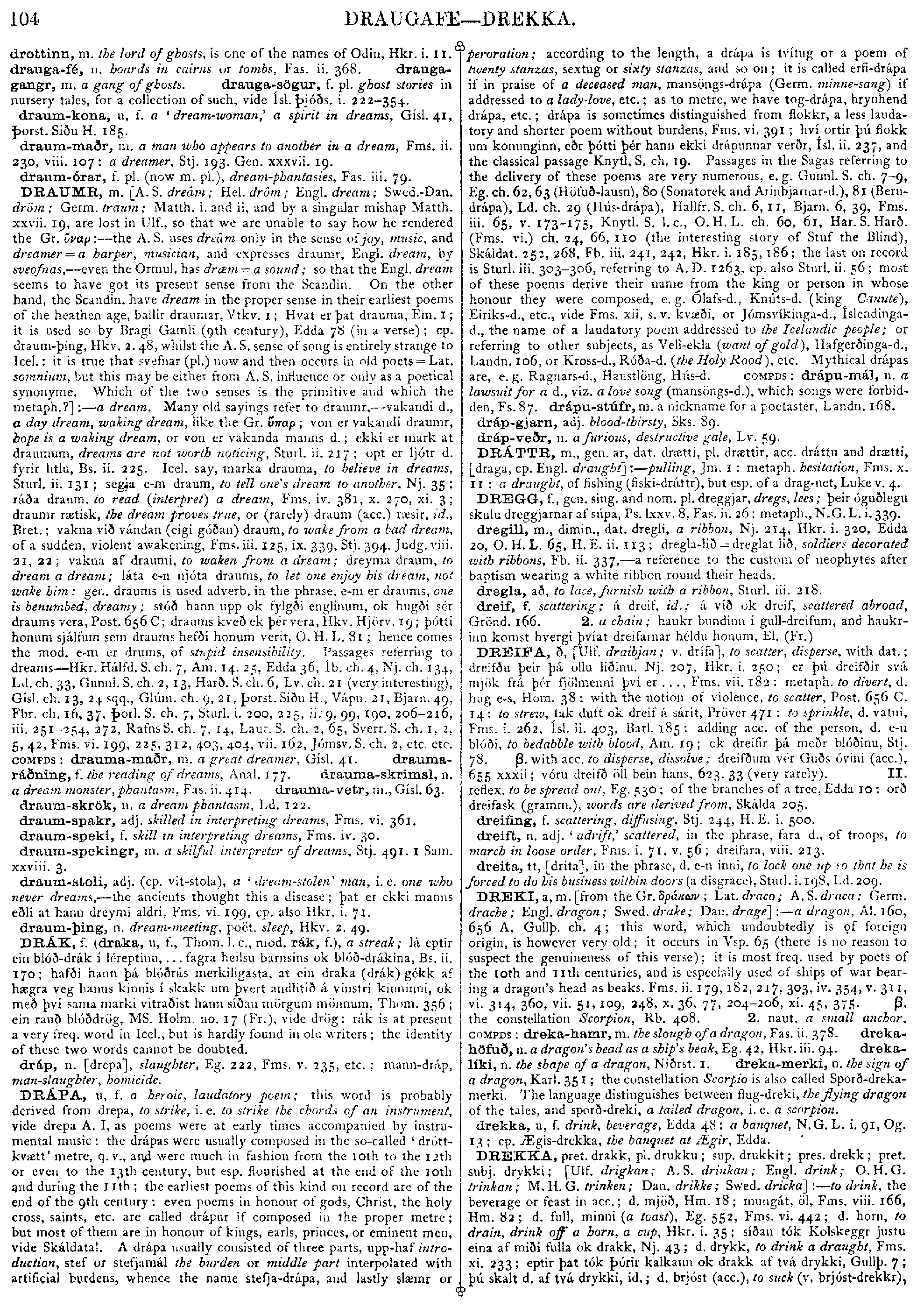
DRAUMR, m. [A. S. dream; Hel. drorn; Engl. dream; Swed. -Dan. drain; Germ, traum; Matth. i. and ii, and by a singular mishap Matth. xxvii. 19, are lost in Ulf., so that we are unable to say how he rendered the Gr. ôvap'. -- the A. S. uses dream onlv in the sense of jo y, music, and dreamer= a bar per, musician, and expresses draumr, Engl. dream, by sveofnas, -- even the Ormul. has drœm = a sound; so that the Engl. dream seems to have got its present sense from the Scandin. On the other hand, the Scandin. have dream in the proper sense in their earliest poems of the heathen age, ballir draumar, Vtkv. I; Hvat er þat draurna, Em. I; it is used so by Bragi Gamli (gth century), Edda 78 (iu a verse); cp. draum-þing, Hkv. 2. 48, whilst the A. S. sense of song is entirely strange to Icel.: it is true that svefnar (pl.) now and then occurs in old poets = Lat. somnium, but this may be either from A. S. influence or only as a poetical synonyme. Which of the two senses is the primitive and which the metaph. ?] :-- a dream. Many old sayings refer to draumr, -- vakandi d., a day dream, waking dream, like the Gr. virap; von er vakandi draumr, hope is a waking dream, or von er vakanda maims d.; ekki er mark at draumum, dreams are not worth noticing, Sturl. ii. 217; opt er Ijotr d. fyrir litlu, Bs. ii. 225. Icel, say, marka drauma, to believe in dreams, Sturl. ii. 131; seg^a e-m draum, to tell one's dream to another, Nj. 35; ráða dranm, to read (interpret) a dream, Fms. iv. 381, x. 270, xi. 3; draumr raetisk, the dream proves true, or (rarely) draum (acc.) ræsir, id., Bret.; vakna við vándan (eigi góðan) draum, to wake from a bad dream, of a sudden, violent awakening, Fms. iii. 125, ix. 339, Stj. 394. Judg. viii. 21, 22; vakna af draumi, to waken from a dream; dreyma draum, to dream a dream; láta e-n njóta draurns, to let one enjoy his dream, not wake him: gen. draums is used adverb, in the phrase, e-m er draums, one is benumbed, dreamy: stóð hann upp ok fylgði englinum, ok hugði sér draums vera, Post. 656 C; draums kveð ek ber vera, Hkv. Hjorv. 19; þótti honum sjálfum sern draums hefði honum verit, 0. H. L. 81; hence comes the mod. e-m er drums, of stupid insensibility. Passages referring to dreams -- Hkr. Hálfd. S. ch. 7, Am. 14. 25, Edda 36, lb. ch. 4, Nj. ch. 134, Ld. ch. 33, Gunnl. S. ch. 2, 13, Harð. S. ch. 6, Lv. ch. 21 (very interesting), Gísl. ch. 13, 24 sqq., Glúm. ch. 9, 21, þorst. Síðu H., Vápn. 21, Bjarn. 49, Fbr. ch. 16, 37, fiorl. S. ch. 7, Sturl. i. 200, 225, ii. 9, 99, 190, 206-216, iii. 251-254, 272, RafnsS. ch. 7, 14, Laur. S. ch. 2, 65, Sverr. S. ch. I. 2. 5, 42, Fms. vi. 199, 225, 312, 403, 404, vii. 162, Jóinsv. S. ch. 2, etc. etc. COMPDS: drauma-maðr, m. a great dreamer, Gísl. 41. drauma- ráðning, f. the reading of dreams, Anal. 177. drauma-skrimsl, n. a dream monster, phantasm, Fas. ii. 414. drauma-vetr, m., Gísl. 63.
|
Source: Cleasby/Vigfusson, page b0121, entry 46 View original page image as: [TIFF] [PNG] [View previous entry] [View next entry] |
[Comment on this entry] [View comments] |
The following entry has been hand-corrected once. |
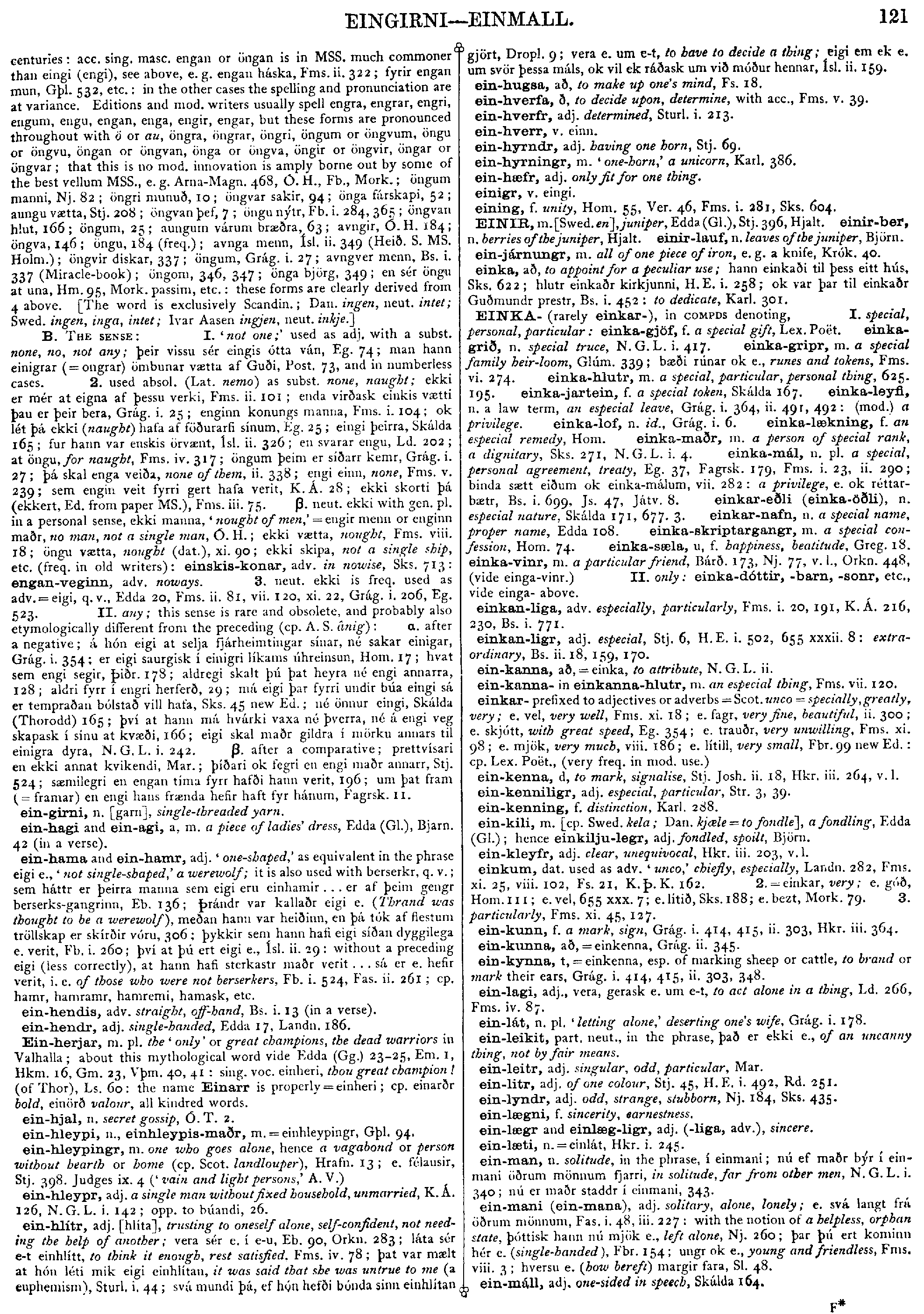
ein-lyndr, adj. odd, strange, stubborn, Nj. 184, Sks. 435.
|
Source: Cleasby/Vigfusson, page b0123, entry 9 View original page image as: [TIFF] [PNG] [View previous entry] [View next entry] |
[Comment on this entry] [View comments] |
The following entry has been hand-corrected once. |
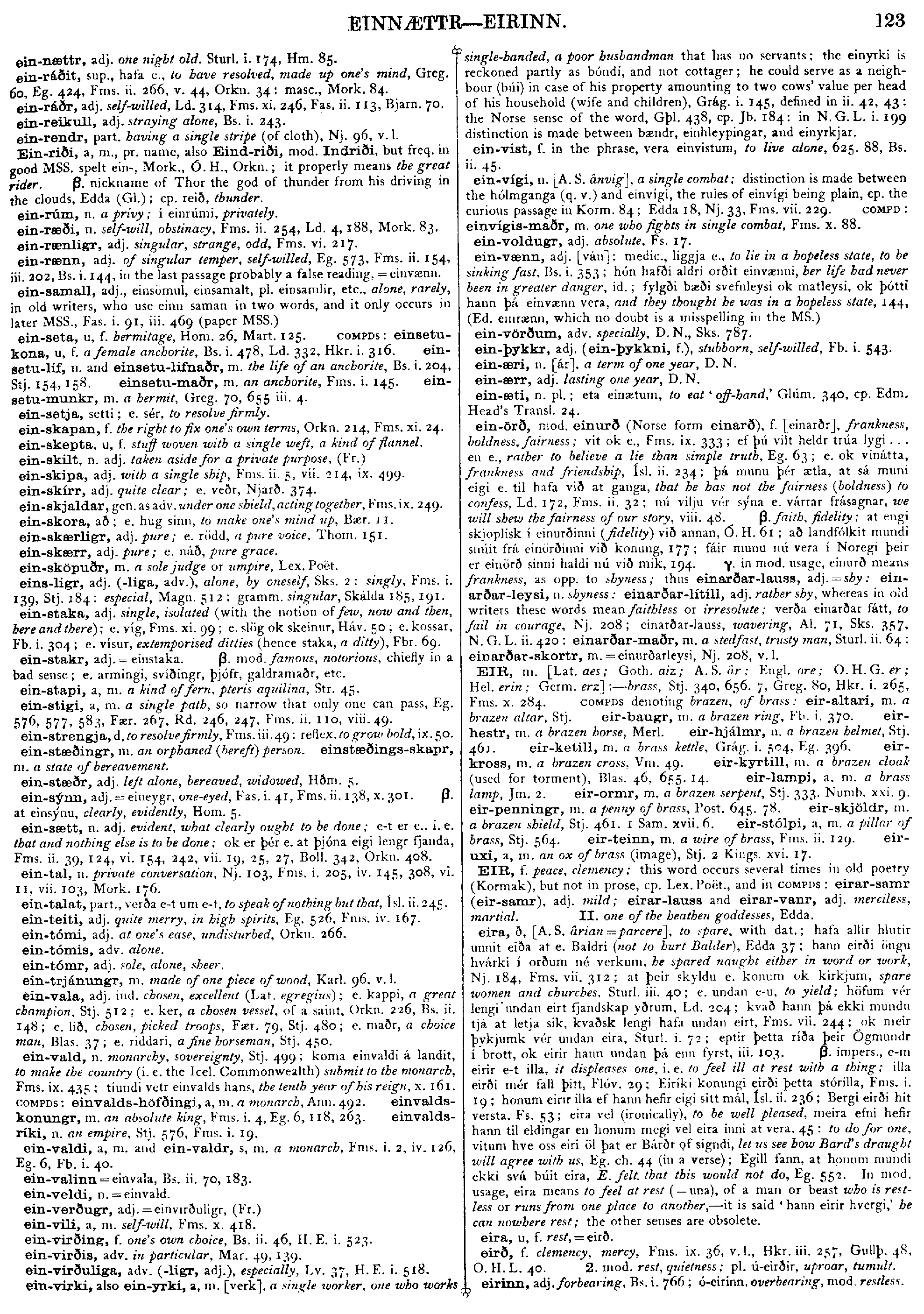
ein-rænligr, adj. singular, strange, odd, Fms. vi. 217.
|
Source: Cleasby/Vigfusson, page b0134, entry 19 View original page image as: [TIFF] [PNG] [View previous entry] [View next entry] |
[Comment on this entry] [View comments] |
The following entry has been hand-corrected once. |
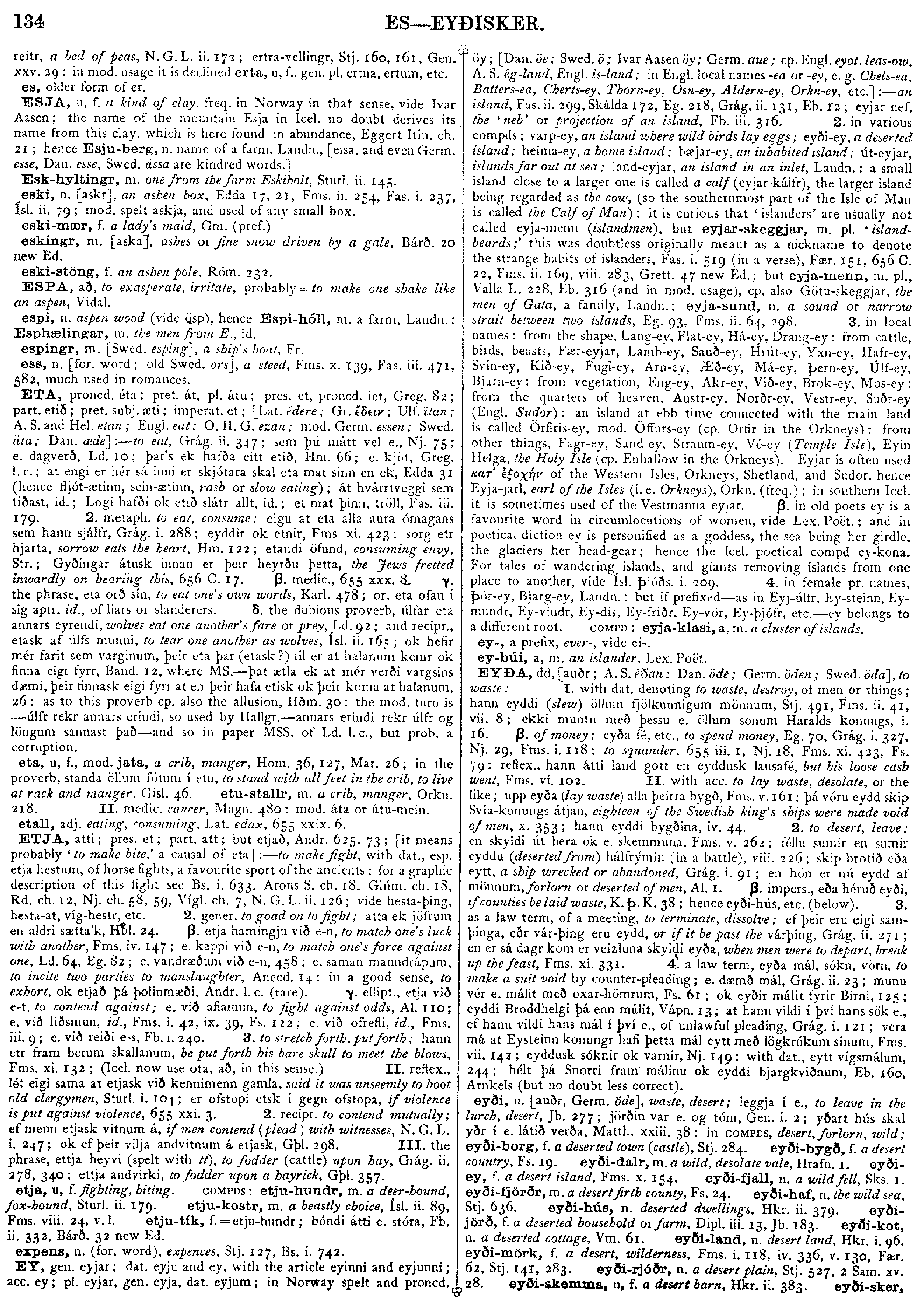
EY,
gen.
eyjar;
dat.
eyju
and
ey,
with
the
article
eyinni
and
eyjunni;
acc.
ey;
pl.
eyjar,
gen.
eyja,
dat.
eyjum;
in
Norway
spelt
and
proncd.
öy;
[Dan.
öe;
Swed.
ö;
Ivar
Aasen
öy;
Germ.
aue;
cp.
Engl.
eyot,
leas-ow,
A.
S.
êg-land,
Engl.
is-land;
in
Engl.
local
names
-ea
or
-ey,
e.g.
Chels-ea,
Batters-ea,
Cherts-ey,
Thorn-ey,
Osn-ey,
Aldern-ey,
Orkn-ey,
etc.]
:--
an
island,
Fas.
ii.
299,
Skálda
172,
Eg.
218,
Grág.
ii.
131,
Eb.
12;
eyjar
nef,
the
'neb'
or
projection
of
an
island,
Fb.
iii.
316.
2.
in
various
compds;
varp-ey,
an
island
where
wild
birds
lay
eggs;
eyði-ey,
a
deserted
island;
heima-ey,
a
home
island;
bæjar-ey,
an
inhabited
island;
út-eyjar,
islands
far
out
at
sea;
land-eyjar,
an
island
in
an
inlet,
Landn.:
a
small
island
close
to
a
larger
one
is
called
a
calf
(eyjar-kálfr),
the
larger
island
being
regarded
as
the
cow,
(so
the
southernmost
part
of
the
Isle
of
Man
is
called
the
Calf
of
Man):
it
is
curious
that
'islanders'
are
usually
not
called
eyja-menn
(islandmen),
but
eyjar-skeggjar,
m.
pl.
'island-beards;'
this
was
doubtless
originally
meant
as
a
nickname
to
denote
the
strange
habits
of
islanders,
Fas.
i.
519
(in
a
verse),
Fær.
151,
656
C.
22,
Fms.
ii.
169,
viii.
283,
Grett.
47
new
Ed.;
but
eyja-menn,
m.
pl.,
Valla
L.
228,
Eb.
316
(and
in
mod.
usage),
cp.
also
Götu-skeggjar,
the
men
of
Gata,
a
family,
Landn.;
eyja-sund,
n.
a
sound
or
narrow
strait
between
two
islands,
Eg.
93,
Fms.
ii.
64,
298.
3.
in
local
names:
from
the
shape,
Lang-ey,
Flat-ey,
Há-ey,
Drang-ey:
from
cattle,
birds,
beasts,
Fær-eyjar,
Lamb-ey,
Sauð-ey,
Hrút-ey,
Yxn-ey,
Hafr-ey,
Svín-ey,
Kið-ey,
Fugl-ey,
Arn-ey,
Æð-ey,
Má-ey,
Þern-ey,
Úlf-ey,
Bjarn-ey:
from
vegetation,
Eng-ey,
Akr-ey,
Við-ey,
Brok-ey,
Mos-ey:
from
the
quarters
of
heaven,
Austr-ey,
Norðr-ey,
Vestr-ey,
Suðr-ey
(Engl.
Sudor):
an
island
at
ebb
time
connected
with
the
main
land
is
called
Örfiris-ey,
mod.
Öffurs-ey
(cp.
Orfir
in
the
Orkneys):
from
other
things,
Fagr-ey,
Sand-ey,
Straum-ey,
Vé-ey
(Temple
Isle),
Eyin
Helga,
the
Holy
Isle
(cp.
Enhallow
in
the
Orkneys).
Eyjar
is
often
used
GREEK
of
the
Western
Isles,
Orkneys,
Shetland,
and
Sudor,
hence
Eyja-jarl,
earl
of
the
Isles
(i.e.
Orkneys),
Orkn.
(freq.);
in
southern
Icel.
it
is
sometimes
used
of
the
Vestmanna
eyjar.
.
in
old
poets
ey
is
a
favourite
word
in
circumlocutions
of
women,
vide
Lex.
Poët.;
and
in
poetical
diction
ey
is
personified
as
a
goddess,
the
sea
being
her
girdle,
the
glaciers
her
head-gear;
hence
the
Icel.
poetical
compd
ey-kona.
For
tales
of
wandering
islands,
and
giants
removing
islands
from
one
place
to
another,
vide
Ísl.
Þjóðs.
i.
209.
4.
in
female
pr.
names,
Þór-ey,
Bjarg-ey,
Landn.:
but
if
prefixed--as
in
Eyj-úlfr,
Ey-steinn,
Ey-mundr,
Ey-vindr,
Ey-dís,
Ey-fríðr,
Ey-vör,
Ey-þjófr,
etc.--ey
belongs
to
a
different
root.
COMPD:
eyja-klasi,
a,
m.
a
cluster
of
islands.
|
Source: Cleasby/Vigfusson, page b0135, entry 5 View original page image as: [TIFF] [PNG] [View previous entry] [View next entry] |
[Comment on this entry] [View comments] |
The following entry has been hand-corrected once. |
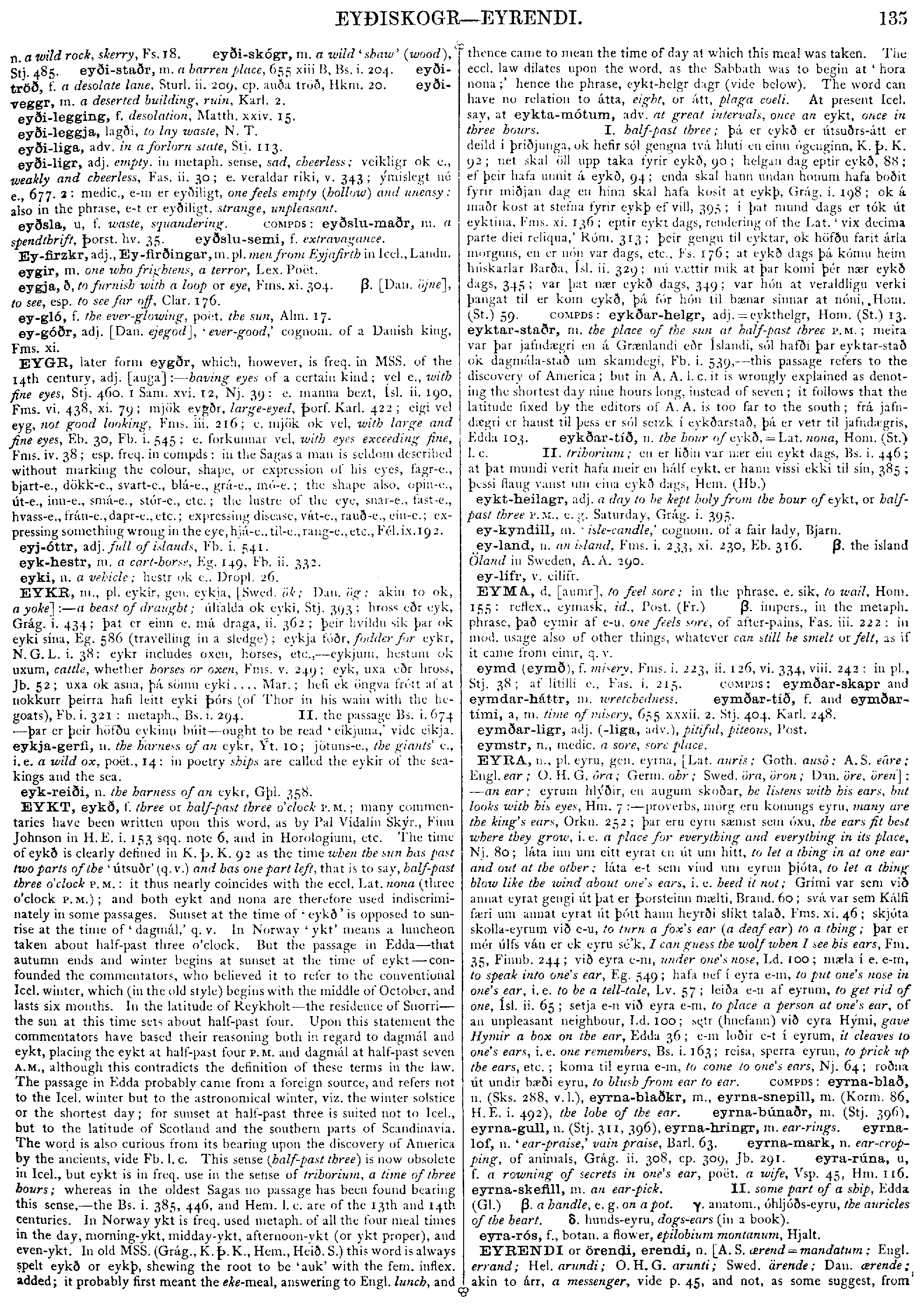
eyði-ligr, adj. empty, in metaph. sense, sad, cheerless; veikligr ok e., weakly and cheerless, Fas. ii. 30; e. veraldar riki, v. 343; ýmislegt né e., 677. 2: medic., e-m er eyðiligt, one feels empty (hollow) and uneasy: also in the phrase, e-t er eyðiligt, strange, unpleasant.
|
Source: Cleasby/Vigfusson, page b0143, entry 1 View original page image as: [TIFF] [PNG] [View previous entry] [View next entry] |
[Comment on this entry] [View comments] |
The following entry has been hand-corrected once. |
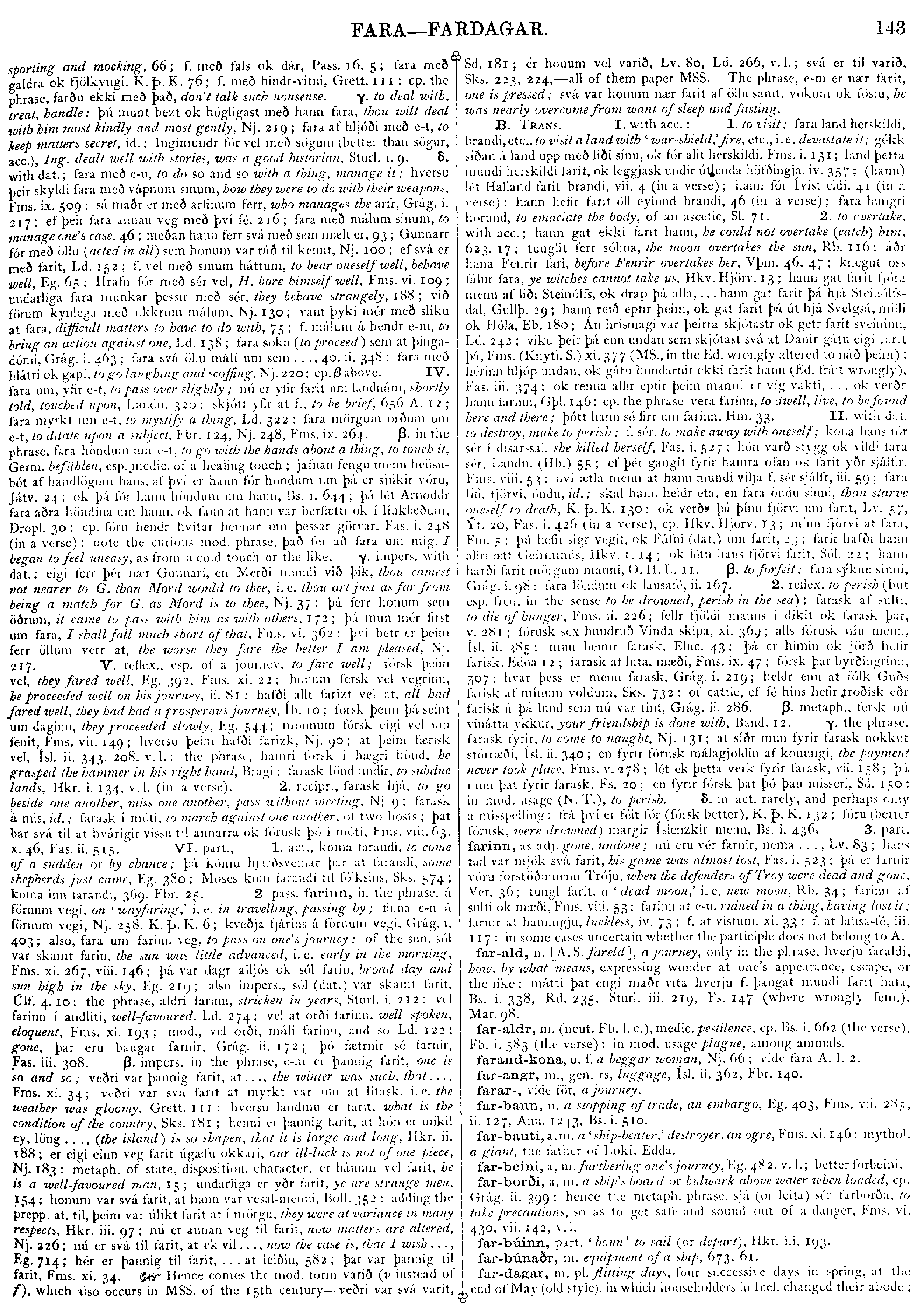
sporting
and
mocking,
66;
f.
með
fals
ok
dár,
Pass.
16.
5;
fara
með
galdra
ok
fjölkyngi,
K.
Þ.
K.
76;
f.
með
hindr-vitni,
Grett.
111;
cp.
the
phrase,
farðu
ekki
með
það,
don't
talk
such
nonsense.
 .
to
deal
with,
treat,
handle;
þú
munt
bezt
ok
hógligast
með
hann
fara,
thou
wilt
deal
with
him
most
kindly
and
most
gently,
Nj.
219;
fara
af
hljóði
með
e-t,
to
keep
matters
secret,
id.;
Ingimundr
fór
vel
með
sögum
(better
than
sögur,
acc.),
Ing.
dealt
well
with
stories,
was
a
good
historian.
Stud.
i.
9.
.
to
deal
with,
treat,
handle;
þú
munt
bezt
ok
hógligast
með
hann
fara,
thou
wilt
deal
with
him
most
kindly
and
most
gently,
Nj.
219;
fara
af
hljóði
með
e-t,
to
keep
matters
secret,
id.;
Ingimundr
fór
vel
með
sögum
(better
than
sögur,
acc.),
Ing.
dealt
well
with
stories,
was
a
good
historian.
Stud.
i.
9.
 .
with
dat.;
fara
með
e-u,
to
do
so
and
so
with
a
thing,
manage
it;
hversu
þeir
skyldi
fara
með
vápnum
sínum,
how
they
were
to
do
with
their
weapons,
Fms.
ix.
509;
sá
maðr
er
með
arfinum
ferr,
who
manages
the
arfr,
Grág.
i.
217;
ef
þeir
fara
annan
veg
með
því
fé,
216;
fara
með
málum
sínum,
to
manage
one's
case,
46;
meðan
hann
ferr
svá
með
sem
mælt
er,
93;
Gunnarr
fór
með
öllu
(acted
in
all)
sem
honum
var
ráð
til
kennt,
Nj.
100;
ef
svá
er
með
farit,
Ld.
152;
f.
vel
með
sínum
háttum,
to
bear
oneself
well,
behave
well,
Eg.
65;
Hrafn
fór
með
sér
vel,
H.
bore
himself
well,
Fms.
vi.
109;
undarliga
fara
munkar
þessir
með
sér,
they
behave
strangely,
188;
við
förum
kynlega
með
okkrum
málum,
Nj.
130;
vant
þyki
mér
með
slíku
at
fara,
difficult
matters
to
have
to
do
with,
75;
f.
málum
á
hendr
e-m,
to
bring
an
action
against
one,
Ld.
138;
fara
sókn
(to
proceed)
sem
at
þingadómi,
Grág.
i.
463;
fara
svá
öllu
máli
um
sem
...,
40,
ii.
348;
fara
með
hlátri
ok
gapi,
to
go
laughing
and
scoffing,
Nj.
220;
cp.
above.
IV.
fara
um,
yfir
e-t,
to
pass
over
slightly;
nú
er
yfir
farit
um
landnám,
shortly
told,
touched
upon,
Landn.
320;
skjótt
yfir
at
f.,
to
be
brief,
656
A.
12;
fara
myrkt
um
e-t,
to
mystify
a
thing,
Ld.
322;
fara
mörgum
orðum
um
e-t,
to
dilate
upon
a
subject,
Fbr.
124,
Nj.
248,
Fms.
ix.
264.
.
in
the
phrase,
fara
höndum
um
e-t,
to
go
with
the
hands
about
a
thing,
to
touch
it,
Germ.
befühlen,
esp.
medic.
of
a
healing
touch;
jafnan
fengu
menn
heilsubót
af
handlögum
hans,
af
því
er
hann
fór
höndum
um
þá
er
sjúkir
vóru,
Játv.
24;
ok
pá
fór
hann
höndum
um
hann,
Bs.
i.
644;
þá
lét
Arnoddr
fara
aðra
höndina
um
hann,
ok
fann
at
hann
var
berfættr
ok
í
línklæðum.
Dropl.
30;
cp.
fóru
hendr
hvítar
hennar
um
þessar
görvar,
Fas.
i.
248
(in
a
verse):
note
the
curious
mod.
phrase,
það
fer
að
fara
um
mig,
I
began
to
feel
uneasy,
as
from
a
cold
touch
or
the
like.
.
impers.
with
dat.;
eigi
ferr
þér
nær
Gunnari,
en
Merði
mundi
við
þik,
thou
camest
not
nearer
to
G.
than
Mord
would
to
thee,
i.e.
tbou
art
just
as
far
from
being
a
match
for
G.
as
Mord
is
to
thee,
Nj.
37;
þá
ferr
honum
sem
öðrum,
it
came
to
pass
with
him
as
with
others,
172;
þá
mun
mér
first
um
fara,
I
shall
fall
much
short
of
that,
Fms.
vi.
362;
því
betr
er
þeim
ferr
öllum
verr
at,
the
worse
they
fare
the
better
I
am
pleased,
Nj.
217.
V.
reflex.,
esp.
of
a
journey,
to
fare
well;
fórsk
þeim
vel,
they
fared
well,
Eg.
392,
Fms.
xi.
22;
honum
fersk
vel
vegrinn,
he
proceeded
well
on
his
journey,
ii.
81;
hafði
allt
farizt
vel
at,
all
had
fared
well,
they
had
had
a
prosperous
journey,
Íb.
10;
fórsk
þeim
þá
seint
um
daginn,
they
proceeded
slowly,
Eg.
544;
mönnum
fórsk
eigi
vel
um
fenit,
Fms.
vii.
149;
hversu
þeim
hafði
farizk,
Nj.
90;
at
þeim
færisk
vel,
Ísl.
ii.
343,
208,
v.l.:
the
phrase,
hamri
fórsk
í
hægri
hönd,
he
grasped
the
hammer
in
his
right
hand,
Bragi;
farask
lönd
undir,
to
subdue
lands,
Hkr.
i.
134,
v.l.
(in
a
verse).
2.
recipr.,
farask
hjá,
to
go
beside
one
another,
miss
one
another,
pass
without
meeting,
Nj.
9;
farask
á
mis,
id.,
farask
í
móti,
to
march
against
one
another,
of
two
hosts;
þat
bar
svá
til
at
hvárigir
vissu
til
annarra
ok
fórusk
þó
í
móti,
Fms.
viii.
63,
x.
46,
Fas.
ii.
515.
VI.
part.,
1.
act.,
koma
farandi,
to
come
of
a
sudden
or
by
chance;
þá
kómu
hjarðsveinar
þar
at
farandi,
some
shepherds
just
came,
Eg.
380;
Moses
kom
farandi
til
fólksins,
Sks.
574;
koma
inn
farandi,
369,
Fbr.
25.
2.
pass.
farinn,
in
the
phrase,
á
förnum
vegi,
on
'wayfaring,'
i.e.
in
travelling,
passing
by;
finna
e-n
á
förnum
vegi,
Nj.
258,
K.
Þ.
K.
6;
kveðja
fjárins
á
förnum
vegi,
Grág.
i.
403;
also,
fara
um
farinn
veg,
to
pass
on
one's
journey;
of
the
sun.
sól
var
skamt
farin,
the
sun
was
little
advanced,
i.e.
early
in
the
morning,
Fms.
xi.
267,
viii.
146;
þá
var
dagr
alljós
ok
sól
farin,
broad
day
and
sun
high
in
the
sky,
Eg.
219;
also
impers.,
sól
(dat.)
var
skamt
farit,
Úlf.
4.
10:
the
phrase,
aldri
farinn,
stricken
in
years,
Sturl.
i.
212;
vel
farinn
í
andliti,
well-favoured,
Ld.
274;
vel
at
orði
farinn,
well
spoken,
eloquent,
Fms.
xi.
193;
mod.,
vel
orði,
máli
farinn,
and
so
Ld.
122;
gone,
þar
eru
baugar
farnir,
Grág.
ii.
172;
þó
fætrnir
sé
farnir,
Fas.
iii.
308.
.
impers.
in
the
phrase,
e-m
er
þannig
farit,
one
is
so
and
so;
veðri
var
þannig
farit,
at
...,
the
winter
was
such,
that
...,
Fms.
xi.
34;
veðri
var
svá
farit
at
myrkt
var
um
at
litask,
i.e.
the
weather
was
gloomy,
Grett.
111;
hversu
landinu
er
farit,
what
is
the
condition
of
the
country,
Sks.
181;
henni
er
þannig
farit,
at
hón
er
mikil
ey,
löng
...,
(the
island)
is
so
shapen,
that
it
is
large
and
long,
Hkr.
ii.
188;
er
eigi
einn
veg
farit
úgæfu
okkari,
our
ill-luck
is
not
of
one
piece,
Nj.
183:
metaph.
of
state,
disposition,
character,
er
hánum
vel
farit,
he
is
a
well-favoured
man,
15;
undarliga
er
yðr
farit,
ye
are
strange
men,
154;
honum
var
svá
farit,
at
hann
var
vesal-menni,
Boll.
352:
adding
the
prepp.
at,
til,
þeim
var
úlíkt
farit
at
í
mörgu,
they
were
at
variance
in
many
respects,
Hkr.
iii.
97;
nú
er
annan
veg
til
farit,
now
matters
are
altered,
Nj.
226;
nú
er
svá
til
farit,
at
ek
vil
...,
now
the
case
is,
that
I
wish
...,
Eg.
714;
hér
er
þannig
til
farit,
...
at
leiðin,
582;
þar
var
þannig
til
farit,
Fms.
xi.
34.
UNCERTAIN
Hence
comes
the
mod.
form
varið
(v
instead
of
f),
which
also
occurs
in
MSS.
of
the
15th
century--veðri
var
svá
varit,
Sd.
181;
ér
honum
vel
varið,
Lv.
80,
Ld.
266,
v.l.;
svá
er
til
varið,
Sks.
223,
224,--all
of
them
paper
MSS.
The
phrase,
e-m
er
nær
farit,
one
is
pressed;
svá
var
honum
nær
farit
af
öllu
samt,
vökum
ok
föstu,
he
was
nearly
overcome
from
want
of
sleep
and
fasting.
.
with
dat.;
fara
með
e-u,
to
do
so
and
so
with
a
thing,
manage
it;
hversu
þeir
skyldi
fara
með
vápnum
sínum,
how
they
were
to
do
with
their
weapons,
Fms.
ix.
509;
sá
maðr
er
með
arfinum
ferr,
who
manages
the
arfr,
Grág.
i.
217;
ef
þeir
fara
annan
veg
með
því
fé,
216;
fara
með
málum
sínum,
to
manage
one's
case,
46;
meðan
hann
ferr
svá
með
sem
mælt
er,
93;
Gunnarr
fór
með
öllu
(acted
in
all)
sem
honum
var
ráð
til
kennt,
Nj.
100;
ef
svá
er
með
farit,
Ld.
152;
f.
vel
með
sínum
háttum,
to
bear
oneself
well,
behave
well,
Eg.
65;
Hrafn
fór
með
sér
vel,
H.
bore
himself
well,
Fms.
vi.
109;
undarliga
fara
munkar
þessir
með
sér,
they
behave
strangely,
188;
við
förum
kynlega
með
okkrum
málum,
Nj.
130;
vant
þyki
mér
með
slíku
at
fara,
difficult
matters
to
have
to
do
with,
75;
f.
málum
á
hendr
e-m,
to
bring
an
action
against
one,
Ld.
138;
fara
sókn
(to
proceed)
sem
at
þingadómi,
Grág.
i.
463;
fara
svá
öllu
máli
um
sem
...,
40,
ii.
348;
fara
með
hlátri
ok
gapi,
to
go
laughing
and
scoffing,
Nj.
220;
cp.
above.
IV.
fara
um,
yfir
e-t,
to
pass
over
slightly;
nú
er
yfir
farit
um
landnám,
shortly
told,
touched
upon,
Landn.
320;
skjótt
yfir
at
f.,
to
be
brief,
656
A.
12;
fara
myrkt
um
e-t,
to
mystify
a
thing,
Ld.
322;
fara
mörgum
orðum
um
e-t,
to
dilate
upon
a
subject,
Fbr.
124,
Nj.
248,
Fms.
ix.
264.
.
in
the
phrase,
fara
höndum
um
e-t,
to
go
with
the
hands
about
a
thing,
to
touch
it,
Germ.
befühlen,
esp.
medic.
of
a
healing
touch;
jafnan
fengu
menn
heilsubót
af
handlögum
hans,
af
því
er
hann
fór
höndum
um
þá
er
sjúkir
vóru,
Játv.
24;
ok
pá
fór
hann
höndum
um
hann,
Bs.
i.
644;
þá
lét
Arnoddr
fara
aðra
höndina
um
hann,
ok
fann
at
hann
var
berfættr
ok
í
línklæðum.
Dropl.
30;
cp.
fóru
hendr
hvítar
hennar
um
þessar
görvar,
Fas.
i.
248
(in
a
verse):
note
the
curious
mod.
phrase,
það
fer
að
fara
um
mig,
I
began
to
feel
uneasy,
as
from
a
cold
touch
or
the
like.
.
impers.
with
dat.;
eigi
ferr
þér
nær
Gunnari,
en
Merði
mundi
við
þik,
thou
camest
not
nearer
to
G.
than
Mord
would
to
thee,
i.e.
tbou
art
just
as
far
from
being
a
match
for
G.
as
Mord
is
to
thee,
Nj.
37;
þá
ferr
honum
sem
öðrum,
it
came
to
pass
with
him
as
with
others,
172;
þá
mun
mér
first
um
fara,
I
shall
fall
much
short
of
that,
Fms.
vi.
362;
því
betr
er
þeim
ferr
öllum
verr
at,
the
worse
they
fare
the
better
I
am
pleased,
Nj.
217.
V.
reflex.,
esp.
of
a
journey,
to
fare
well;
fórsk
þeim
vel,
they
fared
well,
Eg.
392,
Fms.
xi.
22;
honum
fersk
vel
vegrinn,
he
proceeded
well
on
his
journey,
ii.
81;
hafði
allt
farizt
vel
at,
all
had
fared
well,
they
had
had
a
prosperous
journey,
Íb.
10;
fórsk
þeim
þá
seint
um
daginn,
they
proceeded
slowly,
Eg.
544;
mönnum
fórsk
eigi
vel
um
fenit,
Fms.
vii.
149;
hversu
þeim
hafði
farizk,
Nj.
90;
at
þeim
færisk
vel,
Ísl.
ii.
343,
208,
v.l.:
the
phrase,
hamri
fórsk
í
hægri
hönd,
he
grasped
the
hammer
in
his
right
hand,
Bragi;
farask
lönd
undir,
to
subdue
lands,
Hkr.
i.
134,
v.l.
(in
a
verse).
2.
recipr.,
farask
hjá,
to
go
beside
one
another,
miss
one
another,
pass
without
meeting,
Nj.
9;
farask
á
mis,
id.,
farask
í
móti,
to
march
against
one
another,
of
two
hosts;
þat
bar
svá
til
at
hvárigir
vissu
til
annarra
ok
fórusk
þó
í
móti,
Fms.
viii.
63,
x.
46,
Fas.
ii.
515.
VI.
part.,
1.
act.,
koma
farandi,
to
come
of
a
sudden
or
by
chance;
þá
kómu
hjarðsveinar
þar
at
farandi,
some
shepherds
just
came,
Eg.
380;
Moses
kom
farandi
til
fólksins,
Sks.
574;
koma
inn
farandi,
369,
Fbr.
25.
2.
pass.
farinn,
in
the
phrase,
á
förnum
vegi,
on
'wayfaring,'
i.e.
in
travelling,
passing
by;
finna
e-n
á
förnum
vegi,
Nj.
258,
K.
Þ.
K.
6;
kveðja
fjárins
á
förnum
vegi,
Grág.
i.
403;
also,
fara
um
farinn
veg,
to
pass
on
one's
journey;
of
the
sun.
sól
var
skamt
farin,
the
sun
was
little
advanced,
i.e.
early
in
the
morning,
Fms.
xi.
267,
viii.
146;
þá
var
dagr
alljós
ok
sól
farin,
broad
day
and
sun
high
in
the
sky,
Eg.
219;
also
impers.,
sól
(dat.)
var
skamt
farit,
Úlf.
4.
10:
the
phrase,
aldri
farinn,
stricken
in
years,
Sturl.
i.
212;
vel
farinn
í
andliti,
well-favoured,
Ld.
274;
vel
at
orði
farinn,
well
spoken,
eloquent,
Fms.
xi.
193;
mod.,
vel
orði,
máli
farinn,
and
so
Ld.
122;
gone,
þar
eru
baugar
farnir,
Grág.
ii.
172;
þó
fætrnir
sé
farnir,
Fas.
iii.
308.
.
impers.
in
the
phrase,
e-m
er
þannig
farit,
one
is
so
and
so;
veðri
var
þannig
farit,
at
...,
the
winter
was
such,
that
...,
Fms.
xi.
34;
veðri
var
svá
farit
at
myrkt
var
um
at
litask,
i.e.
the
weather
was
gloomy,
Grett.
111;
hversu
landinu
er
farit,
what
is
the
condition
of
the
country,
Sks.
181;
henni
er
þannig
farit,
at
hón
er
mikil
ey,
löng
...,
(the
island)
is
so
shapen,
that
it
is
large
and
long,
Hkr.
ii.
188;
er
eigi
einn
veg
farit
úgæfu
okkari,
our
ill-luck
is
not
of
one
piece,
Nj.
183:
metaph.
of
state,
disposition,
character,
er
hánum
vel
farit,
he
is
a
well-favoured
man,
15;
undarliga
er
yðr
farit,
ye
are
strange
men,
154;
honum
var
svá
farit,
at
hann
var
vesal-menni,
Boll.
352:
adding
the
prepp.
at,
til,
þeim
var
úlíkt
farit
at
í
mörgu,
they
were
at
variance
in
many
respects,
Hkr.
iii.
97;
nú
er
annan
veg
til
farit,
now
matters
are
altered,
Nj.
226;
nú
er
svá
til
farit,
at
ek
vil
...,
now
the
case
is,
that
I
wish
...,
Eg.
714;
hér
er
þannig
til
farit,
...
at
leiðin,
582;
þar
var
þannig
til
farit,
Fms.
xi.
34.
UNCERTAIN
Hence
comes
the
mod.
form
varið
(v
instead
of
f),
which
also
occurs
in
MSS.
of
the
15th
century--veðri
var
svá
varit,
Sd.
181;
ér
honum
vel
varið,
Lv.
80,
Ld.
266,
v.l.;
svá
er
til
varið,
Sks.
223,
224,--all
of
them
paper
MSS.
The
phrase,
e-m
er
nær
farit,
one
is
pressed;
svá
var
honum
nær
farit
af
öllu
samt,
vökum
ok
föstu,
he
was
nearly
overcome
from
want
of
sleep
and
fasting.
|
Source: Cleasby/Vigfusson, page b0147, entry 3 View original page image as: [TIFF] [PNG] [View previous entry] [View next entry] |
[Comment on this entry] [View comments] |
The following entry has been hand-corrected once. |
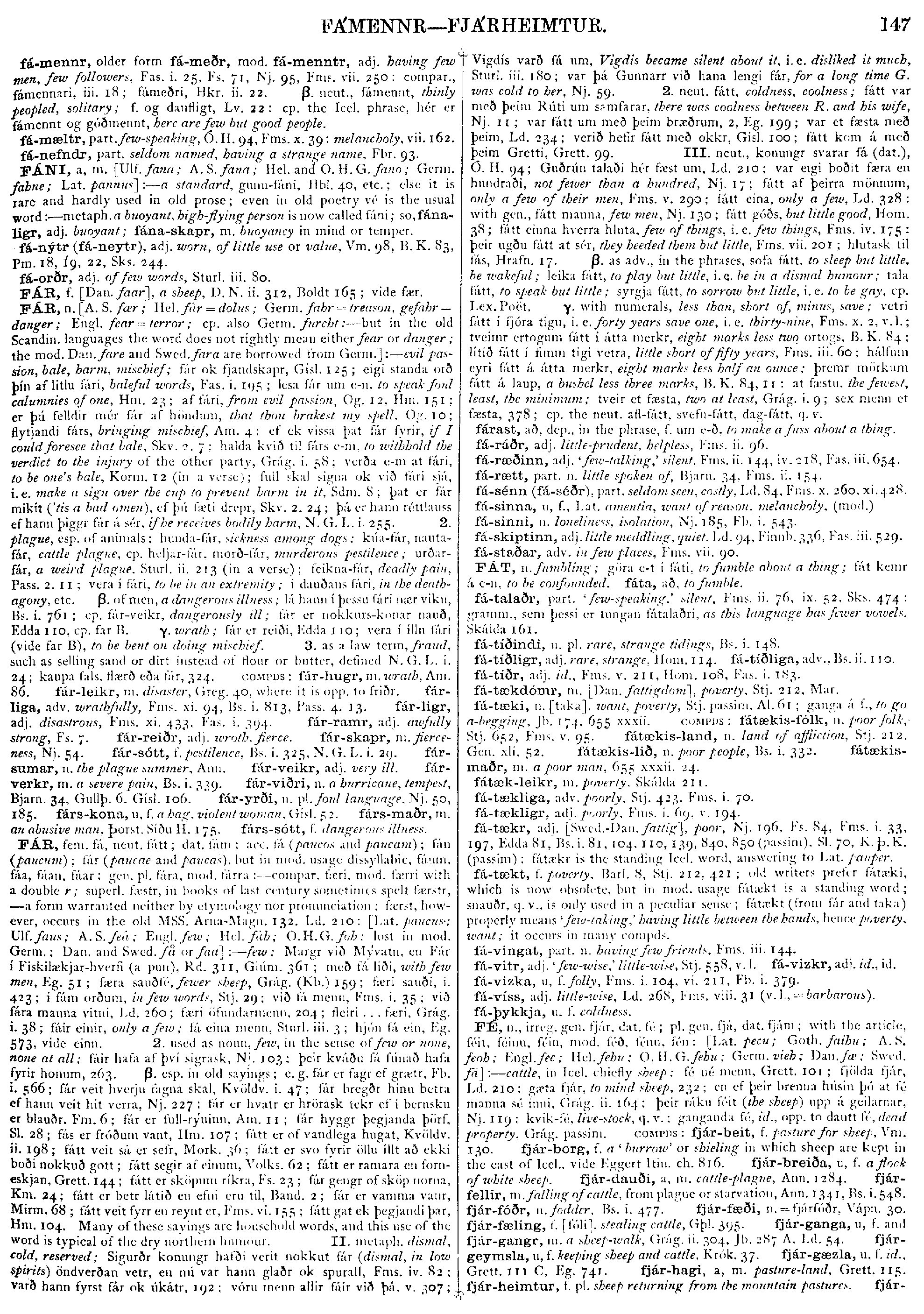
fá-nefndr, part. seldom named, having a strange name, Fbr. 93.
| Result Page: |  |
Previous | 3 4 5 6 7 8 9 10 11 12 13 14 15 16 17 18 | Next |  |
Germanic Lexicon Project (main page)
This search system was written by
Sean Crist
Please consider
volunteering
to correct the data in these online dictionaries.
No rights reserved. Feel free to use these data in any way you please.