|
|

|
Source: Bosworth/Toller, page d0248, entry 1 View original page image as: [TIFF] [PNG] [View previous entry] [View next entry] |
[Comment on this entry] [View comments] |
The following entry has been hand-corrected once. |
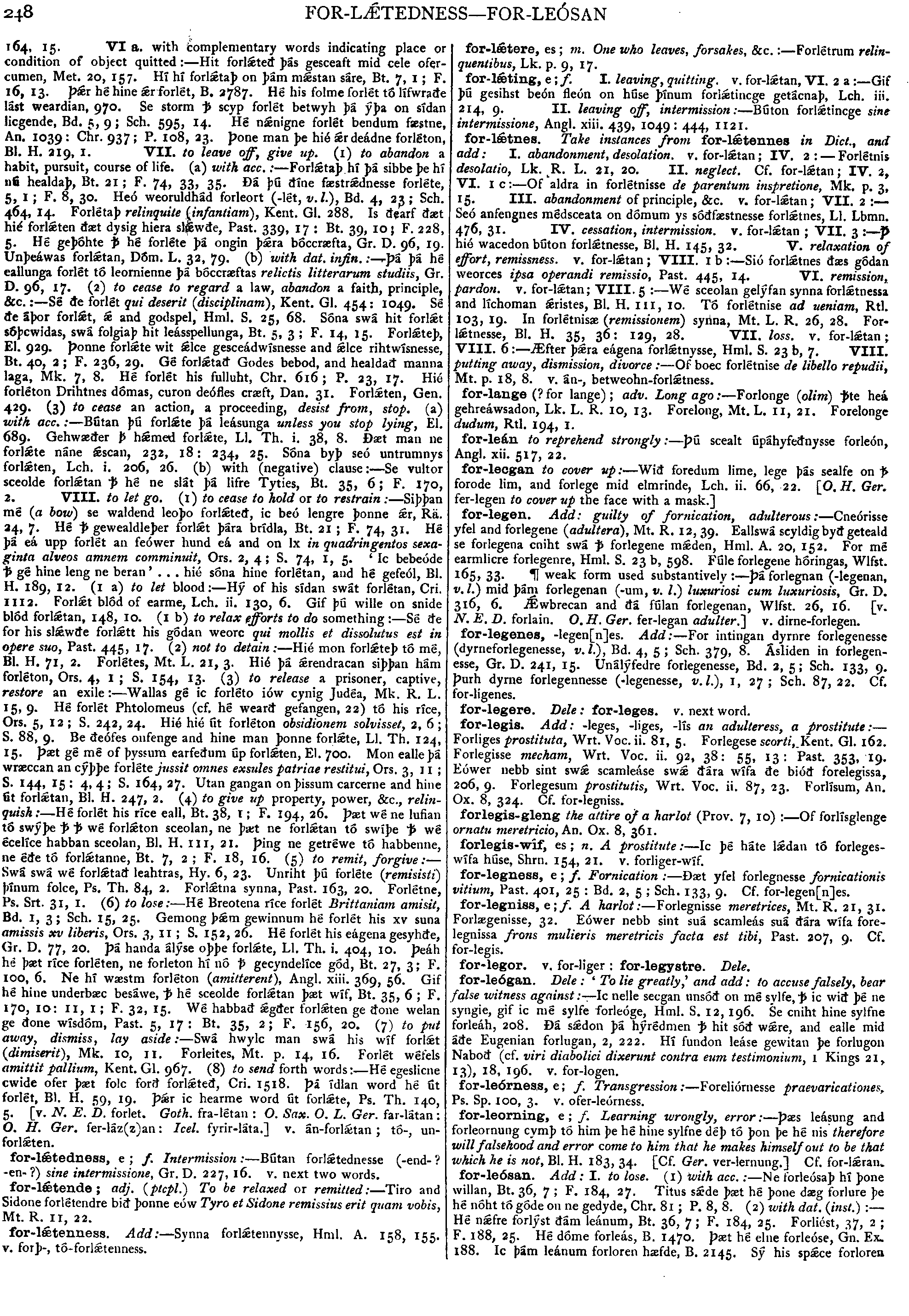
164,
15.
VI
a.
with
complementary
words
indicating
place
or
condition
of
object
quitted
:--
Hit
forl teð
þás
gesceaft
mid
cele
ofercumen,
Met.
20,
157.
Hí
hí
forltaþ
on
þám
mstan
sáre,
Bt.
7,
1;
F.
16,
13.
Þr
hé
hine
r
forlét,
B.
2787.
Hé
his
folme
forlét
tó
lífwraðe
lást
weardian,
970.
Se
storm
teð
þás
gesceaft
mid
cele
ofercumen,
Met.
20,
157.
Hí
hí
forltaþ
on
þám
mstan
sáre,
Bt.
7,
1;
F.
16,
13.
Þr
hé
hine
r
forlét,
B.
2787.
Hé
his
folme
forlét
tó
lífwraðe
lást
weardian,
970.
Se
storm
 scyp
forlét
betwyh
þá
ýþa
on
sídan
licgende,
Bd.
5,
9;
Sch.
595,
14.
Hé
nnigne
forlét
bendum
fæstne,
An.
1039:
Chr.
937;
P.
108,
23.
Þone
man
þe
hié
r
deádne
forléton,
Bl.
H.
219,
1.
VII.
to
leave
of,
give
up.
(1)
to
abandon
a
habit,
pursuit,
course
of
life,
(a)
with
acc.
:--
Forltaþ
hí
þá
sibbe
þe
hí
nú
healdaþ,
Bt.
21;
F.
74,
33,
35.
Ðá
þú
ðíne
fæstrdnesse
forléte,
5,
1;
F.
8,
30.
Heó
weoruldhád
forleort
(-lét,
v.
l.),
Bd.
4,
23;
Sch.
464,
14.
Forlétaþ
relinquite
(infantiam),
Kent.
Gl.
288.
Is
ðearf
ðæt
hié
forlten
ðæt
dysig
hiera
slwde,
Past.
339,
17:
Bt.
39,
10;
F.
228,
5.
Hé
geþóhte
hé
forléte
þá
ongin
þra
bóccræfta,
Gr.
D.
96,
19.
Unþeáwas
forltan,
Dóm.
L.
32,
79.
(b)
with
dat.
infin.
:--
Þá
þá
hé
eallunga
forlét
tó
leornienne
þá
bóccræftas
relictis
litterarum
studiis,
Gr.
D.
96,
17.
(2)
to
cease
to
regard
a
law,
abandon
a
faith,
principle,
&c.
:--
Sé
ðe
forlét
qui
deserit
(disciplinam),
Kent.
Gl.
454:
1049.
Sé
ðe
áþor
forlt,
and
godspel,
Hml.
S.
25,
68.
Sóna
swá
hit
forlt
sóþcwidas,
swá
folgiaþ
hit
leásspellunga,
Bt.
5,
3;
F.
14,
15.
Forlteþ,
El.
929.
Þonne
forlte
wit
lce
gesceádwísnesse
and
lce
rihtwísnesse,
Bt.
40,
2;
F.
236,
29.
Gé
forltað
Godes
bebod,
and
healdað
manna
laga,
Mk.
7,
8.
Hé
forlét
his
fulluht,
Chr.
616;
P.
23,
17.
Hié
forléton
Drihtnes
dómas,
curon
deófles
cræft,
Dan.
31.
Forlten,
Gen.
429.
(3)
to
cease
an
action,
a
proceeding,
desist
from,
stop.
(a)
with
acc.
:--
Bútan
þú
forlte
þá
leásunga
unless
you
stop
lying,
El.
689.
Gehwæðer
hmed
forlte,
Ll.
Th.
i.
38,
8.
Ðæt
man
ne
forlte
náne
scan,
232,
18:
234,
25.
Sóna
byþ
seó
untrumnys
forlten,
Lch.
i.
206,
26.
(b)
with
(negative)
clause
:--
Se
vultor
sceolde
forltan
hé
ne
slát
þá
lifre
Tyties,
Bt.
35,
6;
F.
170,
2.
VIII.
to
let
go.
(1)
to
cease
to
hold
or
to
restrain
:--
Siþþan
mé
(a
bow)
se
waldend
leoþo
forlteð,
ic
beó
lengre
þonne
r,
Rä.
24,
7.
Hé
gewealdleþer
forlt
þára
brídla,
Bt.
21;
F.
74,
31.
Hé
þá
eá
upp
forlét
an
feówer
hund
eá
and
on
lx
in
quadringentos
sexaginta
alveos
amnem
comminuit,
Ors.
2,
4;
S.
74,
1,
5.
'Ic
bebeóde
gé
hine
leng
ne
beran'
...
hié
sóna
hine
forlétan,
and
he
gefeól,
Bl.
H.
189,
12.
(1
a)
to
let
blood
:--
Hý
of
his
sídan
swát
forlétan,
Cri.
1112.
Forlt
blód
of
earme,
Lch.
ii.
130,
6.
Gif
þú
wille
on
snide
blód
forltan,
148,
10.
(1
b)
to
relax
efforts
to
do
something
:--
Sé
ðe
for
his
slwðe
forltt
his
gódan
weorc
qui
mollis
et
dissolutus
est
in
opere
suo,
Past.
445,
17.
(2)
not
to
detain
:--
Hié
mon
forlteþ
tó
mé,
Bl.
H.
71,
2.
Forlétes,
Mt.
L.
21,
3.
Hié
þá
rendracan
siþþan
hám
forléton,
Ors.
4,
1;
S.
154,
13.
(3)
to
release
a
prisoner,
captive,
restore
an
exile
:--
Wallas
gé
ic
forléto
iów
cynig
Judéa,
Mk.
R.
L.
15,
9.
Hé
forlét
Phtolomeus
(cf.
hé
wearð
gefangen,
22)
tó
his
ríce,
Ors.
5,
12;
S.
242,
24.
Hié
hié
út
forléton
obsidionem
solvisset,
2,
6;
S.
88,
9.
Be
ðeófes
onfenge
and
hine
man
þonne
forlte.
Ll.
Th.
124,
15.
Þæt
gé
mé
of
þyssum
earfeðum
úp
forlten,
El.
700.
Mon
ealle
þá
wræccan
an
cýþþe
forléte
jussit
omnes
exsules
patriae
restitui,
Ors.
3,
11;
S.
144,
15:
4,
4;
S.
164,
27.
Utan
gangan
on
þissum
carcerne
and
hine
út
forltan,
Bl.
H.
247,
2.
(4)
to
give
up
property,
power,
&c.,
relinquish
:--
Hé
forlét
his
ríce
eall,
Bt.
38,
1;
F.
194,
26.
Þæt
wé
ne
lufian
tó
swýþe
wé
forlton
sceolan,
ne
þæt
ne
forltan
tó
swíþe
wé
écelíce
habban
sceolan,
Bl.
H.
111,
21.
Þing
ne
getréwe
tó
habbenne,
ne
éðe
tó
forltanne,
Bt.
7,
2;
F.
18,
16.
(5)
to
remit,
forgive
:--
Swá
swá
wé
forltað
leahtras,
Hy.
6,
23.
Unriht
þú
forléte
(remisisti)
þínum
folce,
Ps.
Th.
84,
2.
Forltna
synna,
Past.
163,
20.
Forlétne,
Ps.
Srt.
31,
1.
(6)
to
lose
:--
Hé
Breotena
ríce
forlét
Brittaniam
amisit,
Bd.
1,
3;
Sch.
15,
25.
Gemong
þm
gewinnum
hé
forlét
his
xv
suna
amissis
xv
liberis.
Ors.
3,
11;
S.
152,
26.
Hé
forlét
his
eágena
gesyhðe,
Gr.
D.
77,
20.
Þá
handa
álýse
oþþe
forlte,
Ll.
Th.
i.
404,
10.
Þeáh
hé
þæt
ríce
forléten,
ne
forléton
hí
nó
gecyndelíce
gód,
Bt.
27,
3;
F.
100,
6.
Ne
hí
wæstm
forléton
(amitterent),
Angl.
xiii.
369,
56.
Gif
hé
hine
underbæc
besáwe,
hé
sceolde
forltan
þæt
wíf,
Bt.
35,
6;
F.
170,
10:
11,
1;
F.
32,
15.
Wé
habbað
gðer
forlten
ge
ðone
welan
ge
ðone
wísdóm,
Past.
5,
17:
Bt.
35,
2;
F.
156,
20.
(7)
to
put
away,
dismiss,
lay
aside
:--
Swá
hwylc
man
swá
his
wíf
forlt
(dimiserit),
Mk.
10,
11.
Forleites,
Mt.
p.
14,
16.
Forlét
wéfels
amittit
pallium,
Kent.
Gl.
967.
(8)
to
send
forth
words
:--
Hé
egeslicne
cwide
ofer
þæt
folc
forð
forlteð,
Cri.
1518.
Þá
ídlan
word
hé
út
forlét,
Bl.
H.
59,
19.
Þr
ic
hearme
word
út
forlte,
Ps.
Th.
140,
5.
[v.
N.
E.
D.
forlet.
Goth.
fra-létan:
O.
Sax.
O.
L.
Ger.
far-látan:
O.
H.
Ger.
fer-láz(z)an:
Icel.
fyrir-láta.]
v.
án-forltan;
tó-,
un-forlten.
scyp
forlét
betwyh
þá
ýþa
on
sídan
licgende,
Bd.
5,
9;
Sch.
595,
14.
Hé
nnigne
forlét
bendum
fæstne,
An.
1039:
Chr.
937;
P.
108,
23.
Þone
man
þe
hié
r
deádne
forléton,
Bl.
H.
219,
1.
VII.
to
leave
of,
give
up.
(1)
to
abandon
a
habit,
pursuit,
course
of
life,
(a)
with
acc.
:--
Forltaþ
hí
þá
sibbe
þe
hí
nú
healdaþ,
Bt.
21;
F.
74,
33,
35.
Ðá
þú
ðíne
fæstrdnesse
forléte,
5,
1;
F.
8,
30.
Heó
weoruldhád
forleort
(-lét,
v.
l.),
Bd.
4,
23;
Sch.
464,
14.
Forlétaþ
relinquite
(infantiam),
Kent.
Gl.
288.
Is
ðearf
ðæt
hié
forlten
ðæt
dysig
hiera
slwde,
Past.
339,
17:
Bt.
39,
10;
F.
228,
5.
Hé
geþóhte
hé
forléte
þá
ongin
þra
bóccræfta,
Gr.
D.
96,
19.
Unþeáwas
forltan,
Dóm.
L.
32,
79.
(b)
with
dat.
infin.
:--
Þá
þá
hé
eallunga
forlét
tó
leornienne
þá
bóccræftas
relictis
litterarum
studiis,
Gr.
D.
96,
17.
(2)
to
cease
to
regard
a
law,
abandon
a
faith,
principle,
&c.
:--
Sé
ðe
forlét
qui
deserit
(disciplinam),
Kent.
Gl.
454:
1049.
Sé
ðe
áþor
forlt,
and
godspel,
Hml.
S.
25,
68.
Sóna
swá
hit
forlt
sóþcwidas,
swá
folgiaþ
hit
leásspellunga,
Bt.
5,
3;
F.
14,
15.
Forlteþ,
El.
929.
Þonne
forlte
wit
lce
gesceádwísnesse
and
lce
rihtwísnesse,
Bt.
40,
2;
F.
236,
29.
Gé
forltað
Godes
bebod,
and
healdað
manna
laga,
Mk.
7,
8.
Hé
forlét
his
fulluht,
Chr.
616;
P.
23,
17.
Hié
forléton
Drihtnes
dómas,
curon
deófles
cræft,
Dan.
31.
Forlten,
Gen.
429.
(3)
to
cease
an
action,
a
proceeding,
desist
from,
stop.
(a)
with
acc.
:--
Bútan
þú
forlte
þá
leásunga
unless
you
stop
lying,
El.
689.
Gehwæðer
hmed
forlte,
Ll.
Th.
i.
38,
8.
Ðæt
man
ne
forlte
náne
scan,
232,
18:
234,
25.
Sóna
byþ
seó
untrumnys
forlten,
Lch.
i.
206,
26.
(b)
with
(negative)
clause
:--
Se
vultor
sceolde
forltan
hé
ne
slát
þá
lifre
Tyties,
Bt.
35,
6;
F.
170,
2.
VIII.
to
let
go.
(1)
to
cease
to
hold
or
to
restrain
:--
Siþþan
mé
(a
bow)
se
waldend
leoþo
forlteð,
ic
beó
lengre
þonne
r,
Rä.
24,
7.
Hé
gewealdleþer
forlt
þára
brídla,
Bt.
21;
F.
74,
31.
Hé
þá
eá
upp
forlét
an
feówer
hund
eá
and
on
lx
in
quadringentos
sexaginta
alveos
amnem
comminuit,
Ors.
2,
4;
S.
74,
1,
5.
'Ic
bebeóde
gé
hine
leng
ne
beran'
...
hié
sóna
hine
forlétan,
and
he
gefeól,
Bl.
H.
189,
12.
(1
a)
to
let
blood
:--
Hý
of
his
sídan
swát
forlétan,
Cri.
1112.
Forlt
blód
of
earme,
Lch.
ii.
130,
6.
Gif
þú
wille
on
snide
blód
forltan,
148,
10.
(1
b)
to
relax
efforts
to
do
something
:--
Sé
ðe
for
his
slwðe
forltt
his
gódan
weorc
qui
mollis
et
dissolutus
est
in
opere
suo,
Past.
445,
17.
(2)
not
to
detain
:--
Hié
mon
forlteþ
tó
mé,
Bl.
H.
71,
2.
Forlétes,
Mt.
L.
21,
3.
Hié
þá
rendracan
siþþan
hám
forléton,
Ors.
4,
1;
S.
154,
13.
(3)
to
release
a
prisoner,
captive,
restore
an
exile
:--
Wallas
gé
ic
forléto
iów
cynig
Judéa,
Mk.
R.
L.
15,
9.
Hé
forlét
Phtolomeus
(cf.
hé
wearð
gefangen,
22)
tó
his
ríce,
Ors.
5,
12;
S.
242,
24.
Hié
hié
út
forléton
obsidionem
solvisset,
2,
6;
S.
88,
9.
Be
ðeófes
onfenge
and
hine
man
þonne
forlte.
Ll.
Th.
124,
15.
Þæt
gé
mé
of
þyssum
earfeðum
úp
forlten,
El.
700.
Mon
ealle
þá
wræccan
an
cýþþe
forléte
jussit
omnes
exsules
patriae
restitui,
Ors.
3,
11;
S.
144,
15:
4,
4;
S.
164,
27.
Utan
gangan
on
þissum
carcerne
and
hine
út
forltan,
Bl.
H.
247,
2.
(4)
to
give
up
property,
power,
&c.,
relinquish
:--
Hé
forlét
his
ríce
eall,
Bt.
38,
1;
F.
194,
26.
Þæt
wé
ne
lufian
tó
swýþe
wé
forlton
sceolan,
ne
þæt
ne
forltan
tó
swíþe
wé
écelíce
habban
sceolan,
Bl.
H.
111,
21.
Þing
ne
getréwe
tó
habbenne,
ne
éðe
tó
forltanne,
Bt.
7,
2;
F.
18,
16.
(5)
to
remit,
forgive
:--
Swá
swá
wé
forltað
leahtras,
Hy.
6,
23.
Unriht
þú
forléte
(remisisti)
þínum
folce,
Ps.
Th.
84,
2.
Forltna
synna,
Past.
163,
20.
Forlétne,
Ps.
Srt.
31,
1.
(6)
to
lose
:--
Hé
Breotena
ríce
forlét
Brittaniam
amisit,
Bd.
1,
3;
Sch.
15,
25.
Gemong
þm
gewinnum
hé
forlét
his
xv
suna
amissis
xv
liberis.
Ors.
3,
11;
S.
152,
26.
Hé
forlét
his
eágena
gesyhðe,
Gr.
D.
77,
20.
Þá
handa
álýse
oþþe
forlte,
Ll.
Th.
i.
404,
10.
Þeáh
hé
þæt
ríce
forléten,
ne
forléton
hí
nó
gecyndelíce
gód,
Bt.
27,
3;
F.
100,
6.
Ne
hí
wæstm
forléton
(amitterent),
Angl.
xiii.
369,
56.
Gif
hé
hine
underbæc
besáwe,
hé
sceolde
forltan
þæt
wíf,
Bt.
35,
6;
F.
170,
10:
11,
1;
F.
32,
15.
Wé
habbað
gðer
forlten
ge
ðone
welan
ge
ðone
wísdóm,
Past.
5,
17:
Bt.
35,
2;
F.
156,
20.
(7)
to
put
away,
dismiss,
lay
aside
:--
Swá
hwylc
man
swá
his
wíf
forlt
(dimiserit),
Mk.
10,
11.
Forleites,
Mt.
p.
14,
16.
Forlét
wéfels
amittit
pallium,
Kent.
Gl.
967.
(8)
to
send
forth
words
:--
Hé
egeslicne
cwide
ofer
þæt
folc
forð
forlteð,
Cri.
1518.
Þá
ídlan
word
hé
út
forlét,
Bl.
H.
59,
19.
Þr
ic
hearme
word
út
forlte,
Ps.
Th.
140,
5.
[v.
N.
E.
D.
forlet.
Goth.
fra-létan:
O.
Sax.
O.
L.
Ger.
far-látan:
O.
H.
Ger.
fer-láz(z)an:
Icel.
fyrir-láta.]
v.
án-forltan;
tó-,
un-forlten.
|
Source: Bosworth/Toller, page d0251, entry 29 View original page image as: [TIFF] [PNG] [View previous entry] [View next entry] |
[Comment on this entry] [View comments] |
The following entry has been hand-corrected once. |
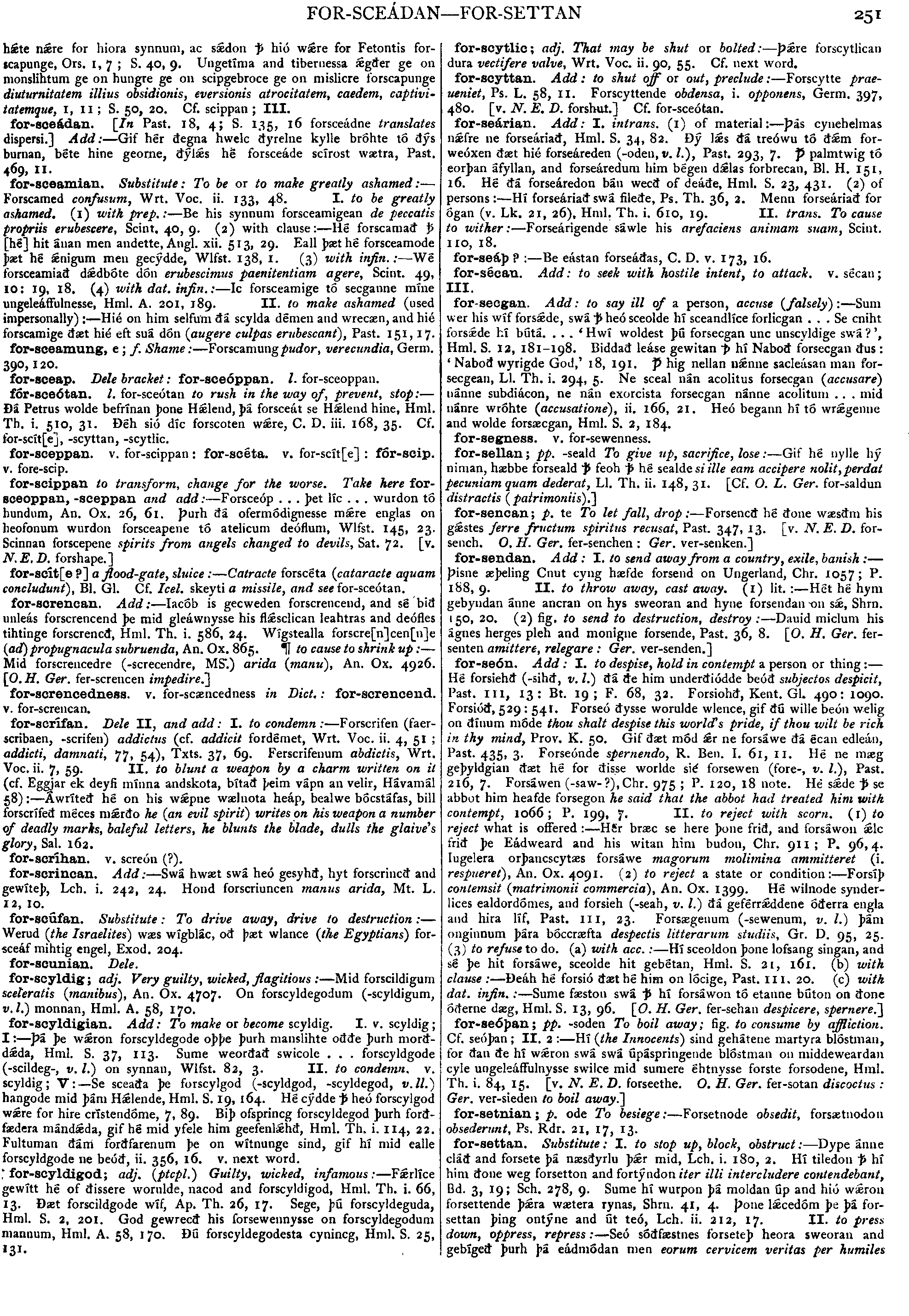
for-sendan.
Add:
I.
to
send
away
from
a
country,
exile,
banish
:--
Þisne
æþeling
Cnut
cyng
hæfde
forsend
on
Ungerland,
Chr.
1057;
P.
188,
9.
II.
to
throw
away,
cast
away.
(1)
lit.
:--
Hét
hé
hym
gebyndan
ánne
ancran
on
hys
sweoran
and
hyne
forsendan
on
s,
Shrn.
150,
20.
(2)
fig.
to
send
to
destruction,
destroy
:--
Dauid
miclum
his
ágnes
herges
pleh
and
monigne
forsende,
Past.
36,
8.
[O.
H.
Ger.
fer-senten
amittere,
relegare:
Ger.
ver-senden.]
|
Source: Bosworth/Toller, page d0256, entry 1 View original page image as: [TIFF] [PNG] [View previous entry] [View next entry] |
[Comment on this entry] [View comments] |
The following entry has been hand-corrected once. |
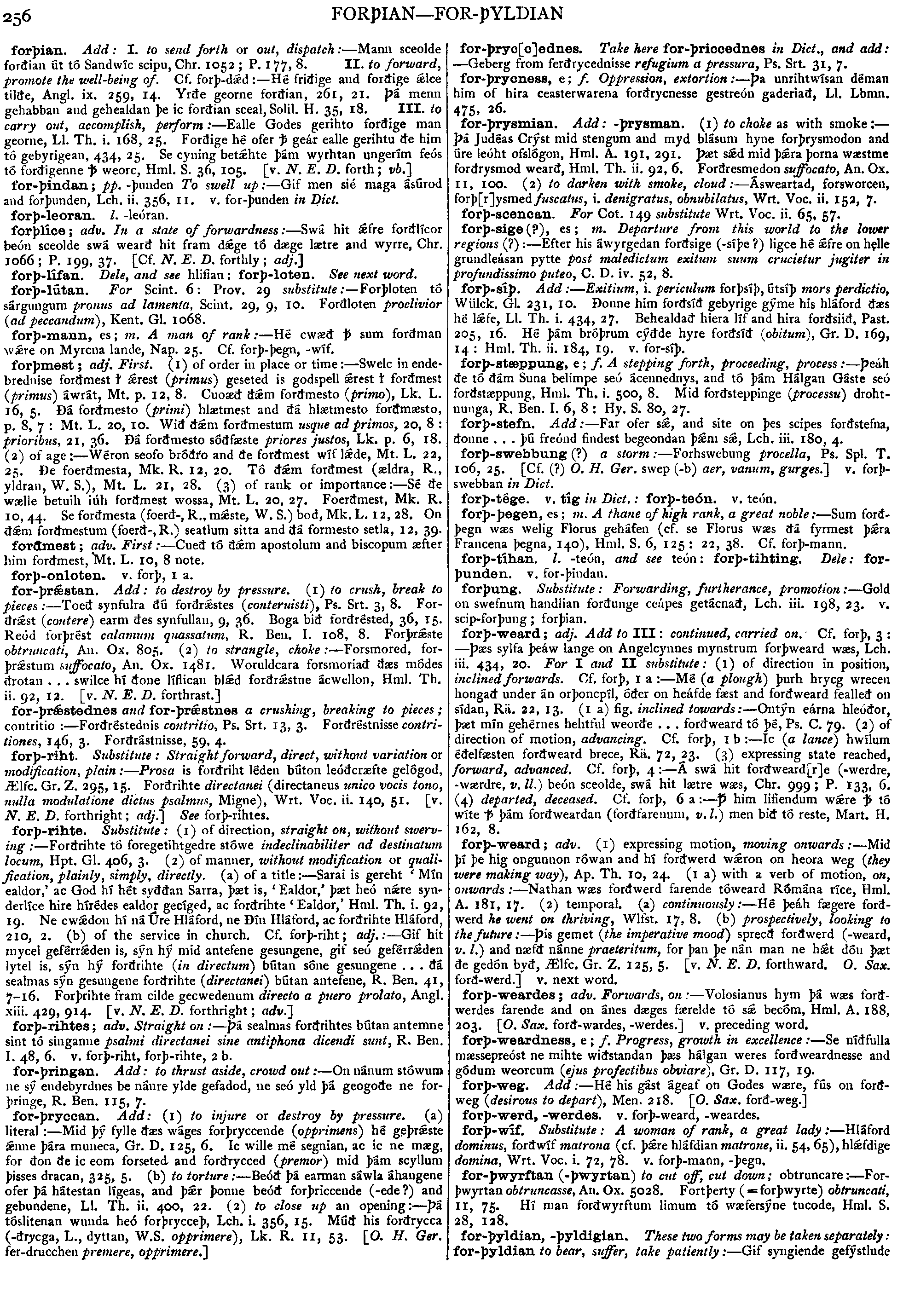
forþian.
Add:
I.
to
send
forth
or
out,
dispatch
:--
Mann
sceolde
forðian
út
to
Sandwíc
scipu,
Chr.
1052;
P.
177,
8.
II.
to
forward,
promote
the
well-being
of.
Cf.
forþ-dd
:--
He
friðige
and
forðige
lce
tilðe,
Angl.
ix.
259,
14.
Yrðe
georne
forðian,
261,
21.
Þá
menn
gehabban
and
gehealdan
þe
ic
forðian
sceal,
Solil.
H.
35,
18.
III.
to
carry
out,
accomplish,
perform
:--
Ealle
Godes
gerihto
forðige
man
georne,
Ll.
Th.
i.
168,
25.
Forðige
hé
ofer
geár
ealle
gerihtu
ðe
him
tó
gebyrigean,
434,
25.
Se
cyning
bethte
þám
wyrhtan
ungerím
feós
tó
forðigenne
weorc,
Hml.
S.
36,
105.
[v.
N.
E.
D.
forth;
vb.]
|
Source: Bosworth/Toller, page d0276, entry 21 View original page image as: [TIFF] [PNG] [View previous entry] [View next entry] |
[Comment on this entry] [View comments] |
The following entry has been hand-corrected once. |
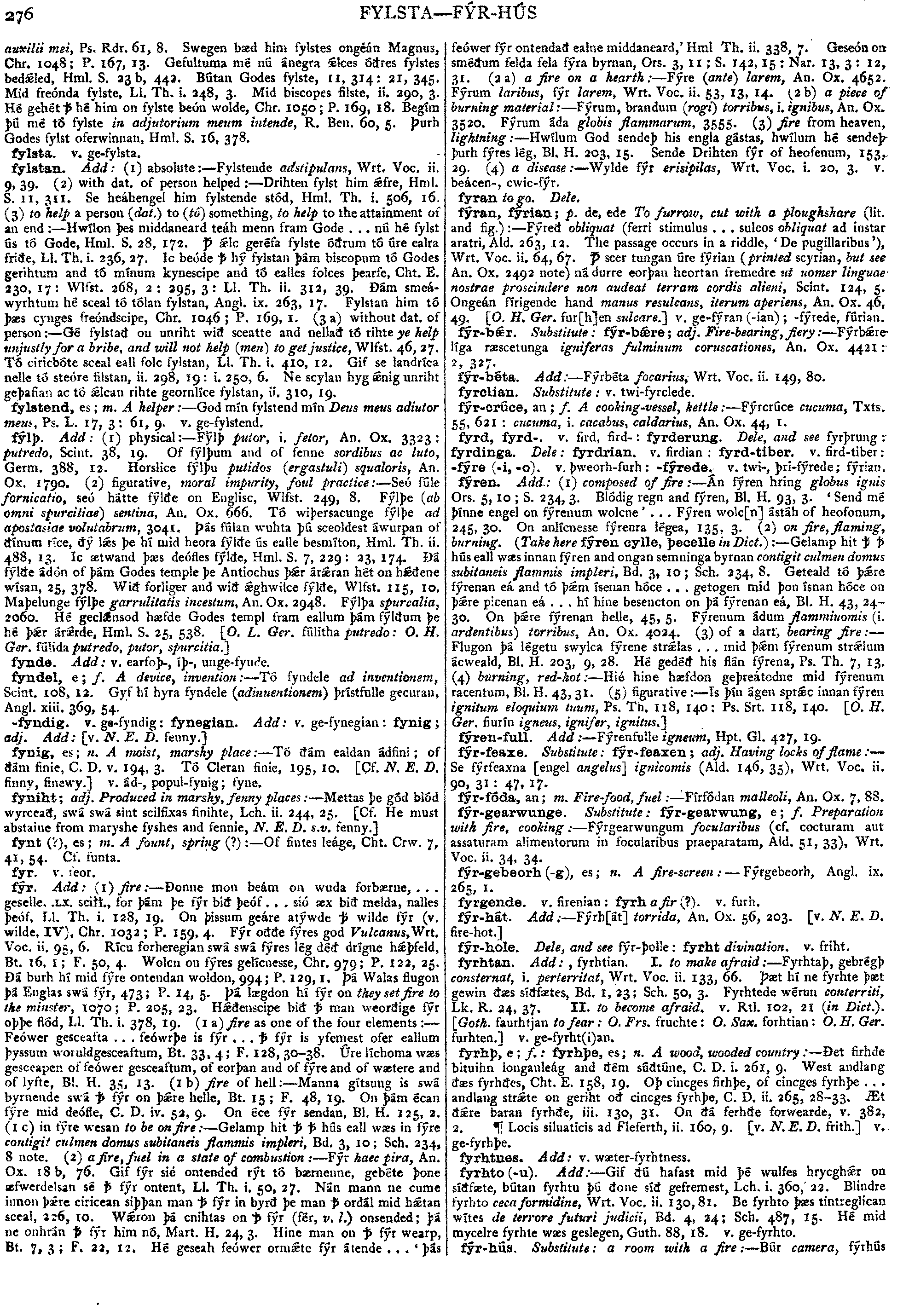
fýren.
Add.:
(1)
composed
of
fire:--Án
fýren
hring
globus
ignis
Ors.
5,
10;
S.
234,
3.
Blódig
regn
and
fýren,
Bl.
H.
93,
3.
'Send
mé
þínne
engel
on
fýrenum
wolcne'
.
.
.
Fýren
wolc[n]
ástáh
of
heofonum,
245,
30.
On
anlícnesse
fýrenra
légea,
135,
3.
(2)
on
fire,
flaming,
burning.
(Take
here
fýren
cylle,
þecelle
in
Dict.):--Gelamp
hit
hús
eall
wæs
innan
fýren
and
ongan
semninga
byrnan
contigit
culmen
domus
subitaneis
flammis
impleri,
Bd.
3,
10;
Sch.
234,
8.
Geteald
tó
þre
fýrenan
eá
and
tó
þm
ísenan
hóce
.
.
.
getogen
mid
þon
ísnan
hóce
on
þre
picenan
eá
.
.
.
hí
hine
besencton
on
þá
fýrenan
eá,
Bl.
H.
43,
24-30.
On
þre
fýrenan
helle,
45,
5.
Fýrenum
ádum
flammiuomis
(i.
ardentibus)
torribus,
An.
Ox.
4024.
(3)
of
a
dart;
bearing
fire:--Flugon
þá
légetu
swylca
fýrene
strlas
.
.
.
mid
þm
fýrenum
strlum
ácweald,
Bl.
H.
203,
9,
28.
Hé
gedéð
his
flán
fýrena,
Ps.
Th.
7,
13.
(4)
burning,
red-hot:--Hié
hine
hæfdon
geþreátodne
mid
fýrenum
racentum,
Bl.
H.
43,
31.
(5)
figurative:--Is
þín
ágen
sprc
innan
fýren
ignitum
eloquium
tuum,
Ps.
Th.
118,
140:
Ps.
Srt.
118,
140.
[O.
H.
Ger.
fiurín
igneus,
ignifer,
ignitus.]
|
Source: Bosworth/Toller, page d0293, entry 3 View original page image as: [TIFF] [PNG] [View previous entry] [View next entry] |
[Comment on this entry] [View comments] |
The following entry has been hand-corrected once. |
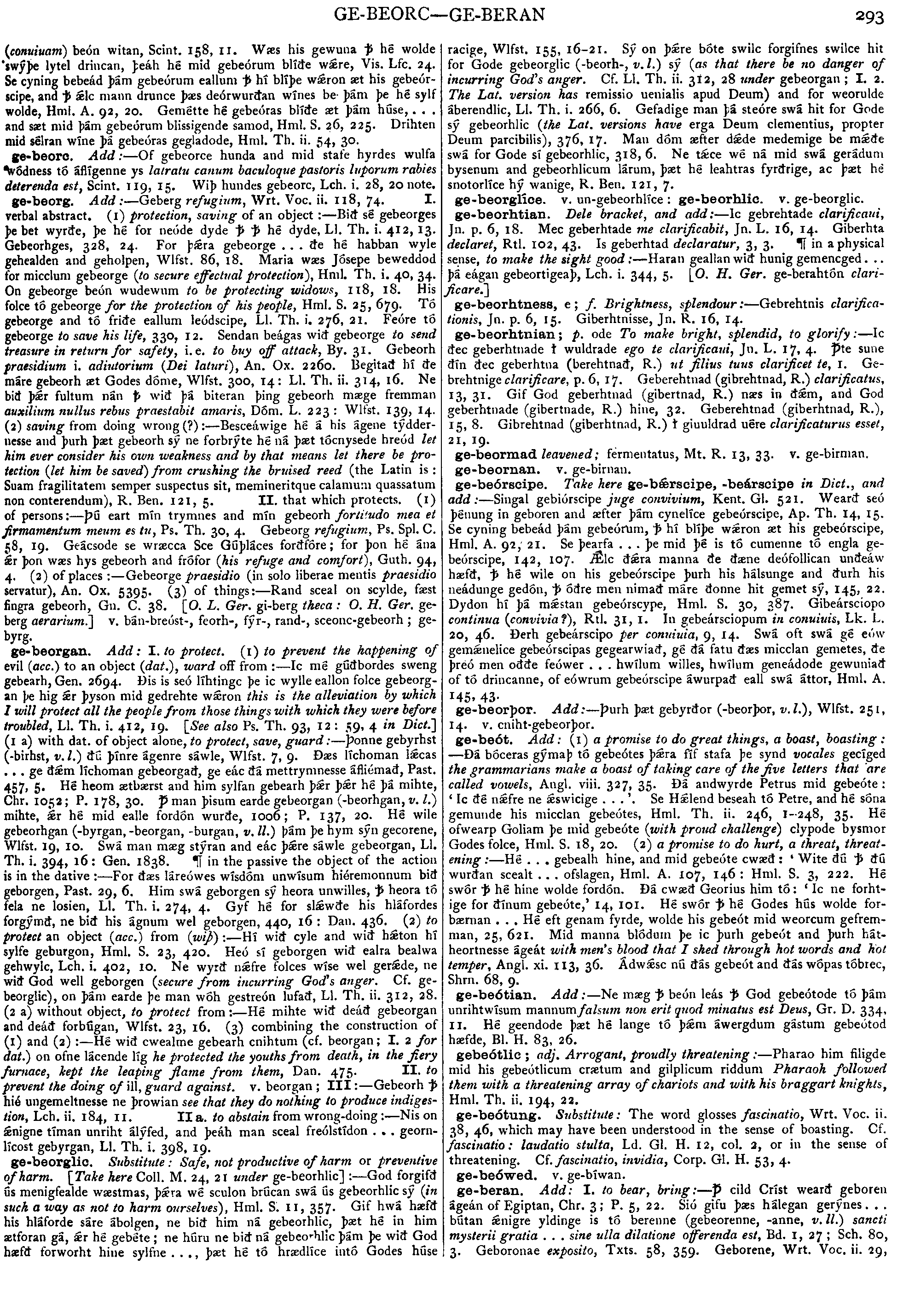
ge-beorg.
Add
:--
Geberg
refugium,
Wrt.
Voc.
ii.
118,
74.
I.
verbal
abstract.
(1)
protection,
saving
of
an
object
:--
Bið
sé
gebeorges
þe
bet
wyrðe,
þe
hé
for
neóde
dyde
hé
dyde.
Ll.
Th.
i.
412,
13.
Gebeorhges,
328,
24.
For
þra
gebeorge
.
.
.
ðe
hé
habban
wyle
gehealden
and
geholpen,
Wlfst.
86,
18.
Maria
wæs
Jósepe
beweddod
for
micclum
gebeorge
(to
secure
effectual
protection),
Hml.
Th.
i.
40,
34.
On
gebeorge
beón
wudewum
to
be
protecting
widows,
118,
18.
His
folce
tó
gebeorge
for
the
protection
of
his
people,
Hml.
S.
25,
679.
Tó
gebeorge
and
to
friðe
eallum
leódscipe,
Ll.
Th.
i.
276,
21.
Feóre
to
gebeorge
to
save
his
life,
330,
12.
Sendan
beágas
wið
gebeorge
to
send
treasure
in
return
for
safety,
i.
e.
to
buy
off
attack,
By.
31.
Gebeorh
praesidium
i.
adiutorium
(Dei
laturi),
An.
Ox.
2260.
Begitað
hí
ðe
máre
gebeorh
æt
Godes
dóme,
Wlfst.
300,
14:
Ll.
Th.
ii.
314,
16.
Ne
bið
þr
fultum
nán
wið
þá
biteran
þing
gebeorh
mæge
fremman
auxilium
nullus
rebus
praestabit
amaris,
Dóm.
L.
223
:
Wlfst.
139,
14.
(2)
saving
from
doing
wrong
(?)
:--
Besceáwige
hé
á
his
ágene
týdder-nesse
and
þurh
þæt
gebeorh
sý
ne
forbrýte
hé
ná
þæt
tócnysede
hreód
let
him
ever
consider
his
own
weakness
and
by
that
means
let
there
be
protection
(let
him
be
saved)
from
crushing
the
bruised
reed
(the
Latin
is
:
Suam
fragilitatem
semper
suspectus
sit,
memineritque
calamum
quassatum
non
conterendum),
R.
Ben.
121,
5.
II.
that
which
protects.
(1)
of
persons
:--
þú
eart
min
trymnes
and
mín
gebeorh
foriitudo
mea
et
firmamentum
meum
es
tu,
Ps.
Th.
30,
4.
Gebeorg
refugium,
Ps.
Spl.
C.
58,
19.
Geácsode
se
wræcca
Sce
Gúþláces
forðfóre;
for
þon
hé
ána
r
þon
wæs
hys
gebeorh
and
frófor
(his
refuge
and
comfort),
Guth.
94,
4.
(2)
of
places
:--
Gebeorge
praesidio
(in
solo
liberae
mentis
praesidio
servatur),
An.
Ox.
5395.
(3)
of
things
:--
Rand
sceal
on
scylde,
fæst
fingra
gebeorh,
Gn.
C.
38.
[O.
L.
Ger.
gi-berg
theca
:
O.
H.
Ger.
ge-berg
aerarium.]
v.
bán-breóst-,
feorh-,
fyr-,
rand-,
sceonc-gebeorh
;
gebyrg
|
Source: Bosworth/Toller, page d0334, entry 17 View original page image as: [TIFF] [PNG] [View previous entry] [View next entry] |
[Comment on this entry] [View comments] |
The following entry has been hand-corrected once. |
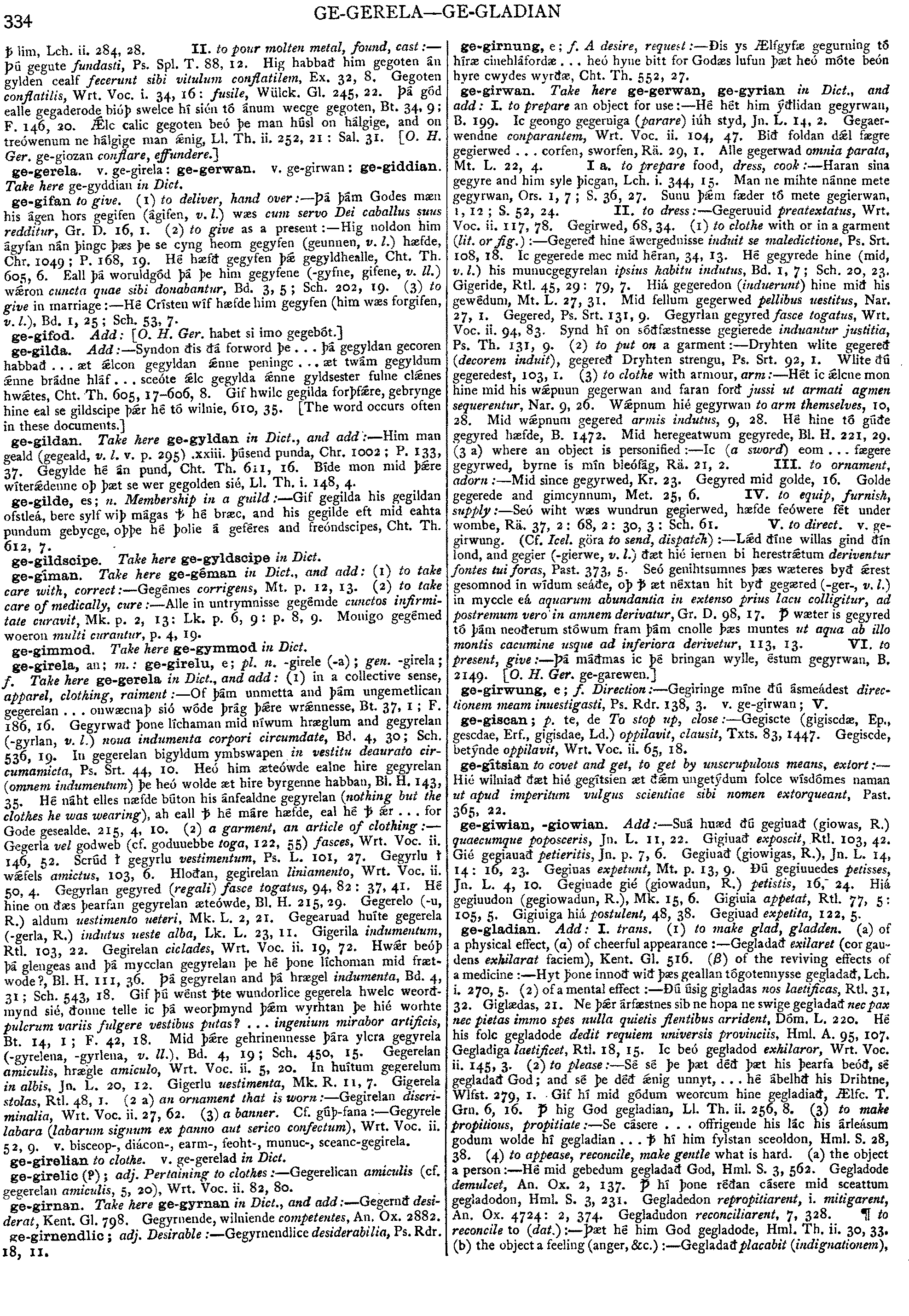
ge-girwan.
Take
here
ge-gerwan,
ge-gyrian
in
Dict.,
and
add:
I.
to
prepare
an
object
for
use:--Hé
hét
him
ýðlidan
gegyrwan,
B.
199.
Ic
geongo
gegerniga
(parare)
iúh
styd,
Jn.
L.
14,
2.
Gegaerwendne
conparantem,
Wrt.
Voc.
ii.
104,
47.
Bið
foldan
dl
fægre
gegierwed
.
.
.
corfen,
sworfen,
Rä.
29,
1.
Alle
gegerwad
omnia
parata,
Mt.
L.
22,
4.
I
a.
to
prepare
food,
dress,
cook:--Haran
sina
gegyre
and
him
syle
þicgan,
Lch.
i.
344,
15.
Man
ne
mihte
nánne
mete
gegyrwan,
Ors.
1,
7;
S.
36,
27.
Sunu
þm
fæder
tó
mete
gegierwan,
1,
12;
S.
52,
24.
II.
to
dress:--Gegeruuid
preatextatus,
Wrt.
Voc.
ii.
117,
78.
Gegirwed,
68,
34.
(1)
to
clothe
with
or
in
a
garment
(lit.
or
fig.):--Gegereð
hine
áwergednisse
induit
se
maledictions,
Ps.
Srt.
108,
18.
Ic
gegerede
mec
mid
héran,
34,
13.
Hé
gegyrede
hine
(mid,
v.
l.)
his
munucgegyrelan
ipsius
habitu
indutus,
Bd.
1,
7;
Sch.
20,
23.
Gigeride,
Rtl.
45,
29:
79,
7.
Hiá
gegeredon
(induerunt)
hine
mið
his
gewédum,
Mt.
L.
27,
31.
Mid
fellum
gegerwed
pellibus
uestitus,
Nar.
27,
1.
Gegered,
Ps.
Srt.
131,
9.
Gegyrlan
gegyred
fasce
togatus,
Wrt.
Voc.
ii.
94,
83.
Synd
hí
on
sóðfæstnesse
gegierede
induantur
justitia,
Ps.
Th.
131,
9.
(2)
to
put
on
a
garment:--Dryhten
wlite
gegereð
(decorem
induit),
gegereð
Dryhten
strengu,
Ps.
Srt.
92,
1.
Wlite
ðú
gegeredest,
103,
1.
(3)
to
clothe
with
armour,
arm:--Hét
ic
lcne
mon
hine
mid
his
wpnun
gegerwan
and
faran
forð
jussi
ut
armati
agmen
sequerentur,
Nar.
9,
26.
Wpnum
hié
gegyrwan
to
arm
themselves,
10,
28.
Mid
wpnum
gegered
armis
indutus,
9,
28.
Hé
hine
tó
gúðe
gegyred
hæfde,
B.
1472.
Mid
heregeatwum
gegyrede,
Bl.
H.
221,
29.
(3
a)
where
an
object
is
personified:--Ic
(a
sword)
eom
.
.
.
fægere
gegyrwed,
byrne
is
mín
bleófág,
Rä.
21,
2.
III.
to
ornament,
adorn:--Mid
since
gegyrwed,
Kr.
23.
Gegyred
mid
golde,
16.
Golde
gegerede
and
gimcynnum,
Met.
25,
6.
IV.
to
equip,
furnish,
supply:--Seó
wiht
wæs
wundrun
gegierwed,
hæfde
feówere
fét
under
wombe,
Rä.
37,
2:
68,
2:
30,
3:
Sch.
61.
V.
to
direct.
v.
gegirwung.
(Cf.
Icel.
göra
to
send,
dispatch):--Ld
ðíne
willas
gind
ðín
lond,
and
gegier
(-gierwe,
v.
l.)
ðæt
hié
iernen
bi
herestrtum
deriventur
fontes
tui
foras,
Past.
373,
5.
Seó
genihtsumnes
þæs
wæteres
byð
rest
gesomnod
in
wídum
seáðe,
oþ
æt
néxtan
hit
byð
gegæred
(-ger-,
v.
l.)
in
myccle
eá
aquarum
abundantia
in
extenso
prius
lacu
colligitur,
ad
postremum
vero
in
amnem
derivatur,
Gr.
D.
98,
17.
Þ-bar;
wæter
is
gegyred
tó
þám
neoðerum
stówum
fram
þám
cnolle
þæs
muntes
ut
aqua
ab
illo
montis
cacumine
usque
ad
inferiora
derivetur,
113,
13.
VI.
to
present,
give:--Þá
máðmas
ic
þé
bringan
wylle,
éstum
gegyrwan,
B.
2149.
[O.
H.
Ger.
ge-garewen.?
|
Source: Bosworth/Toller, page d0354, entry 3 View original page image as: [TIFF] [PNG] [View previous entry] [View next entry] |
[Comment on this entry] [View comments] |
The following entry has been hand-corrected once. |
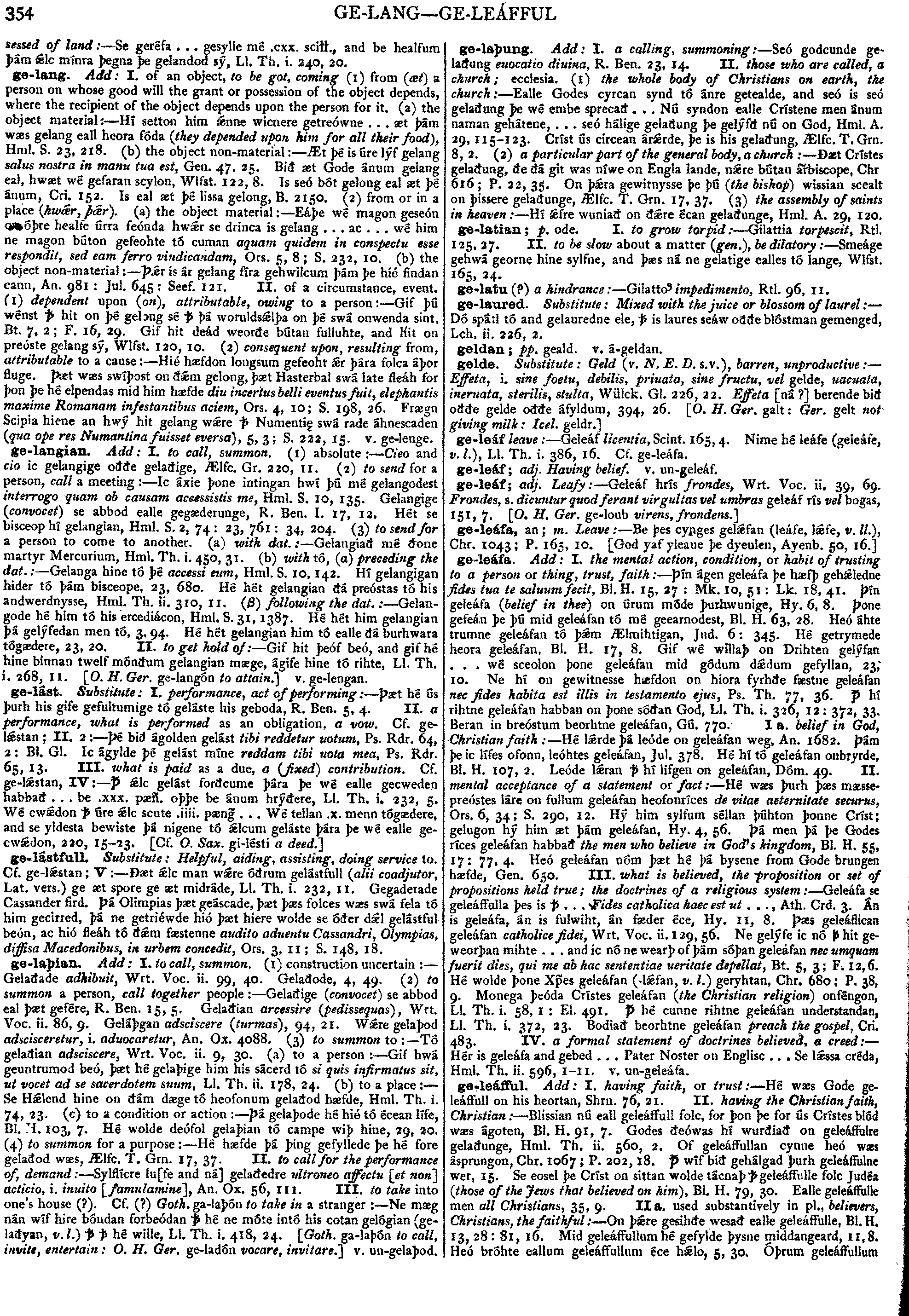
ge-langian.
Add:
I.
to
call,
summon.
(1)
absolute:--Cieo
and
cio
ic
gelangige
oððe
gelaðige,
Ælfc.
Gr.
220,
11.
(2)
to
send
for
a
person,
call
a
meeting:--Ic
áxie
þone
intingan
hwí
þú
mé
gelangodest
interrogo
quam
ob
causam
aceessistis
me,
Hml.
S.
10,
135.
Gelangige
(convocet)
se
abbod
ealle
gegæderunge,
R.
Ben.
I.
17,
12.
Hét
se
bisceop
hí
gelangian,
Hml.
S.
2,
74:
23,
761:
34,
204.
(3)
to
send
for
a
person
to
come
to
another.
(a)
with
dat.:--Gelangiað
mé
ðone
martyr
Mercurium,
Hml.
Th.
i.
450,
31.
(b)
with
tó,
( )
preceding
the
dat.:--Gelanga
hine
tó
þé
accessi
eum,
Hml.
S.
10,
142.
Hí
gelangigan
hider
tó
þám
bisceope,
23,
680.
Hé
hét
gelangian
ðá
preóstas
tó
his
andwerdnysse,
Hml.
Th.
ii.
310,
11.
(
)
preceding
the
dat.:--Gelanga
hine
tó
þé
accessi
eum,
Hml.
S.
10,
142.
Hí
gelangigan
hider
tó
þám
bisceope,
23,
680.
Hé
hét
gelangian
ðá
preóstas
tó
his
andwerdnysse,
Hml.
Th.
ii.
310,
11.
( )
following
the
dat.:--Gelangode
hé
him
tó
his
ercediácon,
Hml.
S.
31,
1387.
Hé
hét
him
gelangian
þá
gelýfedan
men
tó,
3,
94.
Hé
hét
gelangian
him
tó
ealle
ðá
burhwara
tógædere,
23,
20.
II.
to
get
hold
of:--Gif
hit
þeóf
beó,
and
gif
hé
hine
binnan
twelf
mónðum
gelangian
mæge,
ágife
hine
tó
rihte,
Ll.
Th.
i.
268,
11.
[O.
H.
Ger.
ge-langón
to
attain.]
v.
ge-lengan.
)
following
the
dat.:--Gelangode
hé
him
tó
his
ercediácon,
Hml.
S.
31,
1387.
Hé
hét
him
gelangian
þá
gelýfedan
men
tó,
3,
94.
Hé
hét
gelangian
him
tó
ealle
ðá
burhwara
tógædere,
23,
20.
II.
to
get
hold
of:--Gif
hit
þeóf
beó,
and
gif
hé
hine
binnan
twelf
mónðum
gelangian
mæge,
ágife
hine
tó
rihte,
Ll.
Th.
i.
268,
11.
[O.
H.
Ger.
ge-langón
to
attain.]
v.
ge-lengan.
|
Source: Bosworth/Toller, page d0379, entry 5 View original page image as: [TIFF] [PNG] [View previous entry] [View next entry] |
[Comment on this entry] [View comments] |
The following entry has been hand-corrected once. |
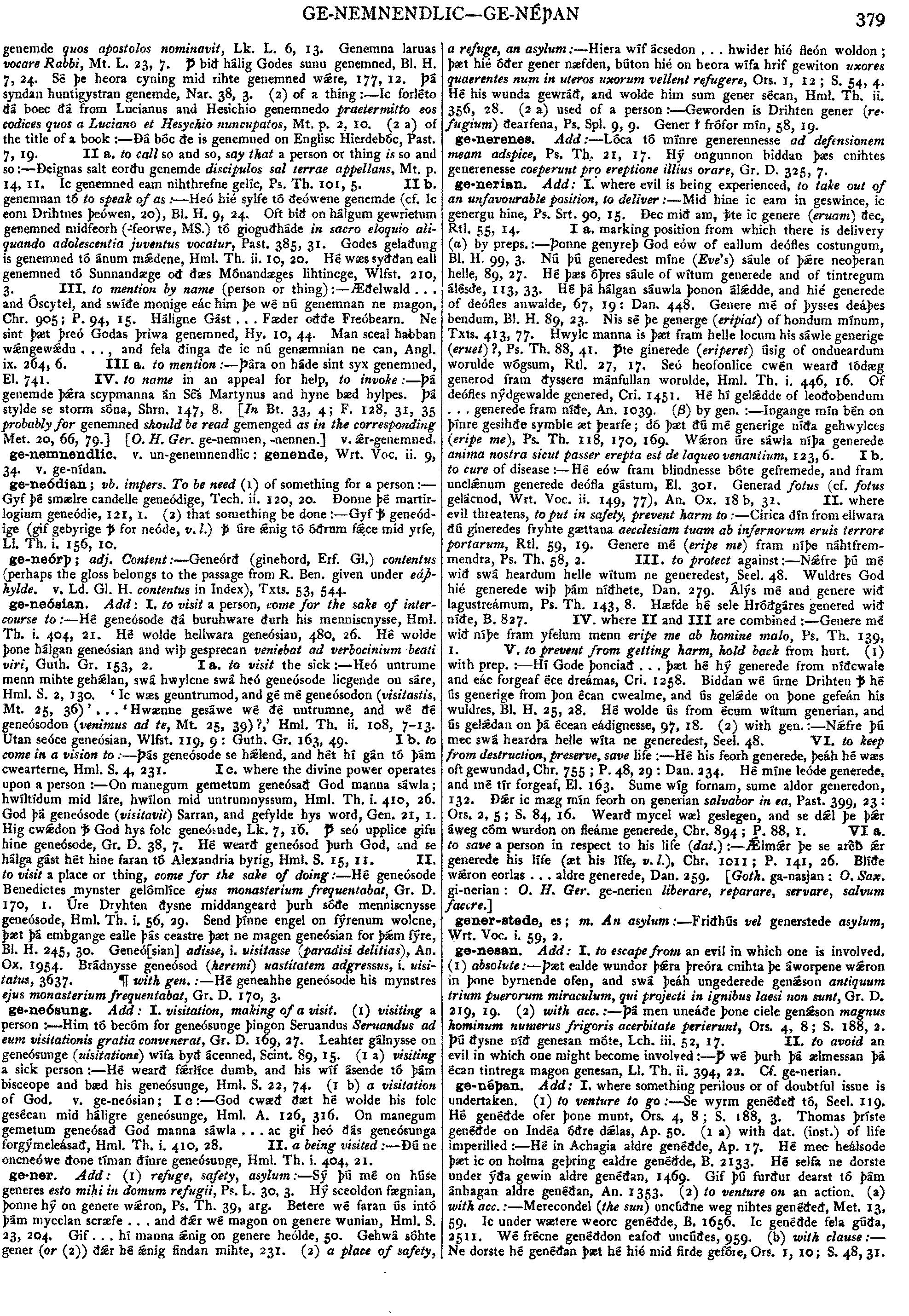
ge-neósian.
Add:
I.
to
visit
a
person,
come
for
the
sake
of
intercourse
to
:--
Hé
geneósode
ðá
burunware
ðurh
his
menniscnysse,
Hml.
Th.
i.
404,
21.
Hé
wolde
hellwara
geneósian,
480,
26.
Hé
wolde
þone
hálgan
geneósian
and
wiþ
gesprecan
veniebat
ad
verbocinium
beati
viri,
Guth.
Gr.
153,
2.
I
a.
to
visit
the
sick
:--
Heó
untrume
menn
mihte
gehlan,
swá
hwylcne
swá
heó
geneósode
licgende
on
sáre,
Hml.
S.
2,
130,'
Ic
wæs
geuntrumod,
and
gé
mé
geneósodon
(visitastis,
Mt.
25,
36)'
.
.
.
'
Hwænne
gesáwe
wé
ðé
untrumne,
and
wé
ðé
geneósodon
(venimus
ad
te,
Mt.
25,
39)
?,'
Hml.
Th.
ii.
108,
7-13.
Utan
seóce
geneósian,
Wlfst.
119,
9
:
Guth.
Gr.
163,
49.
I
b.
to
come
in
a
vision
to
:--
Þás
geneósode
se
hlend,
and
hét
hí
gán
tó
þám
cwearterne,
Hml.
S.
4,
231.
Ic.
where
the
divine
power
operates
upon
a
person
:--
On
manegum
gemetum
geneósað
God
manna
sáwla;
hwíltídum
mid
láre,
hwílon
mid
untrumnyssum,
Hml.
Th.
i.
410,
26.
God
þá
geneósode
(visitavit)
Sarran,
and
gefylde
hys
word,
Gen.
21,
l.
Hig
cwdon
God
hys
folc
geneósude,
Lk.
7,
16.
Þ
UNCERTAIN
seó
upplice
gifu
hine
geneósode,
Gr.
D.
38,
7.
Hé
wearð
geneósod
þurh
God,
and
se
hálga
gást
hét
hine
faran
tó
Alexandria
byrig,
Hml.
S.
15,
ll.
II.
to
visit
a
place
or
thing,
come
for
the
sake
of
doing
:--
Hé
geneósode
Benedictes
mynster
gelómlíce
ejus
monasterium
frequentabat,
Gr.
D.
170,
l.
Úre
Dryhten
ðysne
middangeard
þurh
sóðe
menniscnysse
geneósode,
Hml.
Th.
i.
56,
29.
Send
þínne
engel
on
fýrenum
wolcne,
þæt
þá
embgange
ealle
þás
ceastre
þæt
ne
magen
geneósian
for
þm
fýre,
Bl.
H.
245,
30.
Geneo[sian]
adisse,
i.
uisitasse
(parodisi
delitias),
An.
Ox.
1954.
Brádnysse
geneósod
(heremi)
uastitatem
adgressus,
i.
uisi-tatus,
3637.

with
gen.
:--
Hé
geneahhe
geneósode
his
mynstres
ejus
monasterium
frequentabat,
Gr.
D.
170,
3.
|
Source: Bosworth/Toller, page d0392, entry 1 View original page image as: [TIFF] [PNG] [View previous entry] [View next entry] |
[Comment on this entry] [View comments (1)] |
The following entry has been hand-corrected once. |
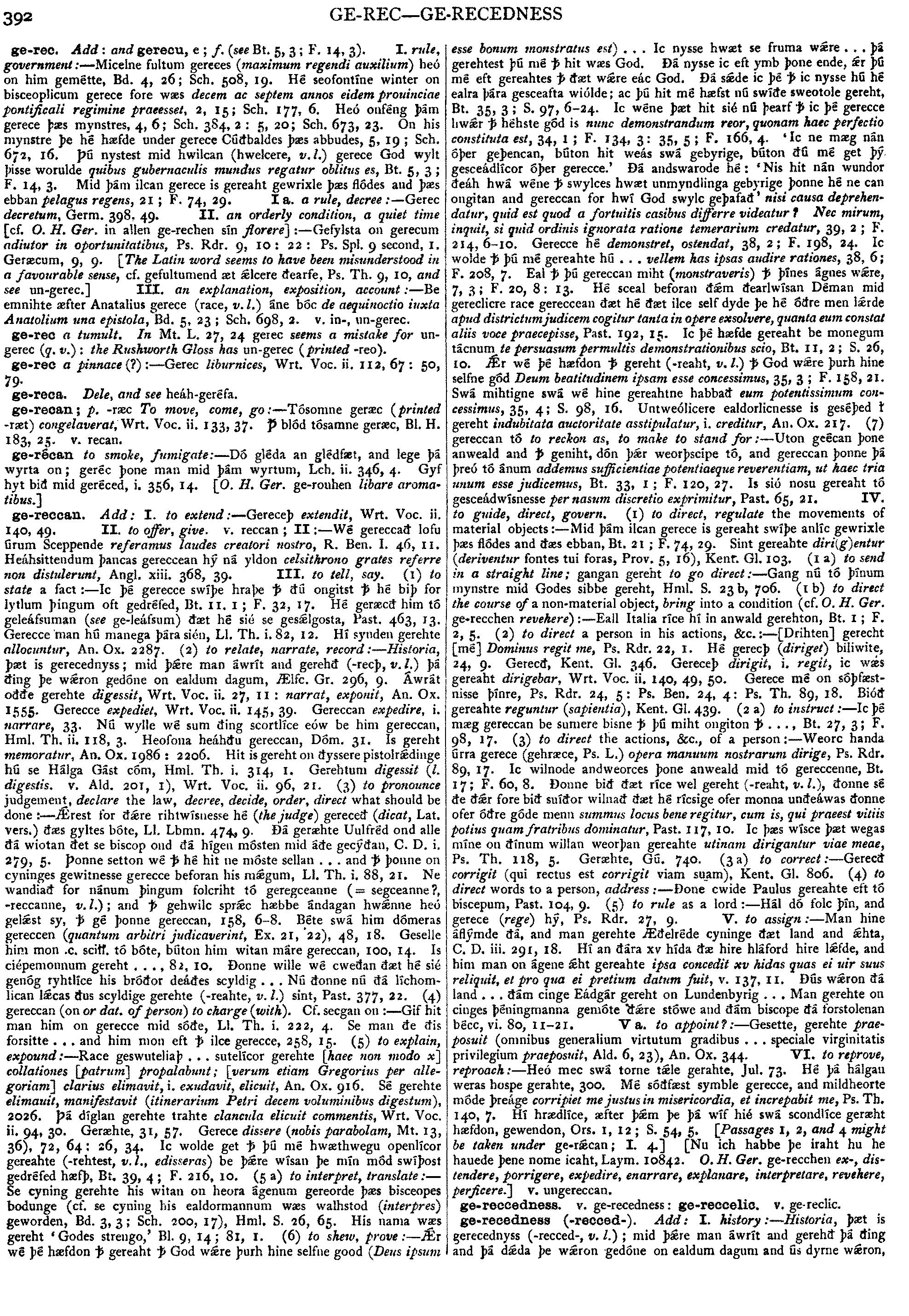
ge-rec.
Add:
and
gerecu,
e
;
f.
(
see
Bt.
5,
3;
F.
14,
3).
I.
rule,
government
:--
Micelne
fultum
gereces
(maximum
regendi
auxilium)
néo
on
him
gemétte,
Bd.
4,
26;
Sch.
508,
19.
He
seofontine
winter
on
bisceoplicum
gerece
fore
wæs
decem
ac
septem
annos
eidem
prouinciae
pontificali
regimine
praeesset,
2,
15;
Sch.
177,
6.
Heó
onféng
Þam
gerece
þæs
mynstres,
4,
6;
Sch.
384,
2
:
5,
20;
Sch.
673,
23.
On
his
mynstre
þe
hé
hæfde
under
gerece
cúðbaldes
þæs
abbudes,
5,
19
;
Sch.
672,
16.
Þú
nystest
mid
hwilcan
(hwelcere,
v.
l.)
gerece
God
wylt
þisse
worulde
quibus
gubernactulis
mundus
regatur
oblitus
es,
Bt.
5,
3
;
F.
14,
3.
Mid
þám
ilcan
gerece
is
gereaht
gewrixle
þæs
flódes
and
þæs
ebban
pelagus
regens,
21
;
F.
74,
29,
Ia.
a
rule,
decree
:--
Gerec
decretum,
Germ.
398,
49.
II.
an
orderly
condition,
a
quiet
time
[cf.
O.
H.
Ger.
in
allen
ge-rechen
sin
florere]
:--
Gefylsta
on
gerecum
ndiutor
in
oportunitatibus,
Ps.
Rdr.
9,
10
:
22
:
Ps.
Spl.
9
second,
l.
Geræcum,
9,
9.
[The
Latin
word
seems
to
have
been
misunderstood
in
a
favourable
sense,
cf.
gefultumend
æt
lcere
ðearfe.
Ps.
Th.
9,
10,
and
see
un-gerec.]
III.
an
explanation,
exposition,
account
:--
Be
emnihte
æfter
Anatalius
gerece
(race,
v.
l.)
áne
bóc
de
aequinoctio
iuxta
Anatolium
una
epislola,
Bd.
5,
23
;
Sch.
698,
2.
v.
in-,un-gerec.
ge-rec
a
tumult.
In
Mt.
L.
27,
24
gerec
seems
a
mistake
for
un-gerec
(q.
v.)
:
the
Rushworth
Gloss
has
un-gerec
(printed
-reo).ge-rec
a
pinnace
(?)
:--
Gerec
liburnices,
Wrt.
Voc.
ii.
112,
67:
50,
79
.ge-reca.
Dele,
and
see
heáh-geréfa.ge-recan;
ILLEGIBLE
-ræc
To
move,
come,
g
o
:--
Tósomne
geræc
(printed
-ræt)
congelaverat.
Wrt.
Voc.
ii.
133,
37.
ILLEGIBLE
blód
tósamne
geræc,
Bl.
H.
183,
25.
v.
recan.ge-récan
to
smoke,
fumigate
:--
Dó
gléda
an
glédfæt,
and
lege
þá
wyrta
on;
geréc
þone
man
mid
þám
wyrtum,
Lch.
ii.
346,
4.
Gyf
hyt
bið
mid
gereced,
i.
356,
14.
[O.
H.
Ger.
ge-rouhen
libare
aromatibus
.]ge-reccan.
Add:
I.
to
extend
:--
Gereceþ
extendit,
Wrt.
Voc.
ii.
140,
49.
II.
to
offer,
give.
v.
reccan
;
II
:--
Wé
gereccað
lofu
Úrum
Sceppende
referamus
laudes
creatori
nostro,
R.
Ben.
I.
46,
ii.
Heahsittendum
þancas
gereccean
hý
ná
yldon
celsithrono
grates
referre
non
distulerunt,
Angl.
xiii.
368,
39.
III.
to
tell,
say.
(1)
to
state
a
fact
:--
Ic
þé
gerecce
swíþe
hraþe
ILLEGIBLE
ðú
ongitst
ILLEGIBLE
hé
biþ
for
lytlum
þingum
oft
gedréfed,
Bt.
II.
I
;
F.
32,
17.
Hé
geræcð
him
tó
geleáfsuman
(see
ge-leáfsum)
ðæt
hé
sié
se
geslgosta,
Past.
463,
13.
Gerecce
man
hú
manega
þára
sién,
Ll.
Th.
i.
82,
12.
Hí
synden
gerehte
allocuntur,
An.
Ox.
2287.
(2)
to
relate,
narrate,
record
:--
Historia,
þæt
is
gerecednyss;
mid
þre
man
áwrít
and
gerehð
(-recþ,
v.
l.)
þá
ðing
þe
wron
gedóne
on
ealdum
dagum,
Ælfc.
Gr.
296,
9.
Áwrát
oððe
gerehte
digessit,
Wrt.
Voc.
ii.
27,
ii
:
narrat,
exponit,
An.
Ox.
1555.
Gerecce
expediet,
Wrt.
Voc.
ii.
145,
39.
Gereccan
expedire,
i.
narrare,
33.
Nú
wylle
wé
sum
ðing
scortlíce
eów
be
him
gereccan,
Hml.
Th.
ii.
118,
3.
Heofona
heáhðu
gereccan,
Dóm.
31.
Is
gereht
memoratur,
An.
Ox.
1986
:
2206.
Hit
is
gereht
on
ðyssere
pistolrdinge
hú
se
Hálga
Gást
óm,
Hml.
Th.
i.
314,
l.
Ge-ehtum
digessit
(l.
digestis.
v.
Aid.
201,
l),
Wrt.
Voc.
ii.
96,
21.
(3)
to
pronounce
judgement,
declare
the
law,
decree,
decide,
order,
direct
what
should
be
done
:--
Æ-acute;rest
for
ðre
rihtwísnesse
hé
(the
judge]
gereceð
(dicat,
Lat.
vers.
)
ðæs
gyltes
bote,
Ll.
Lbmn.
474,
9.
Ðá
geræhte
Uulfréd
ond
alle
ðá
wiotan
ðet
se
biscop
ond
ðá
hígen
mósten
mid
áðe
gecýðan,
C.
D.
i.
279
5.
þonne
setton
wé
hé
hit
ne
móste
sellan
.
.
.
and
ILLEGIBLE
þonne
on
cyninges
gewitnesse
gerecce
beforan
his
mgum,
Ll.
Th.
i.
88,
21.
Ne
wandiað
for
nánum
þingum
folcriht
tó
geregceanne
(=segclanne
?
,
-reccanne,
v.
l.
)
;
and
Þ
gehwilc
sprc
hæbbe
ándagan
hwnne
heó
gelst
sy,
ILLEGIBLE
gé
þonne
gereccan,
158,
6-8.
Béte
swá
him
dómeras
gereccen
(quantum
arbitri
judicaverint,
Ex.
21,
22),
48,
18.
Geselle
him
mon
.
c.
scitf.
tó
bóte,
búton
him
witan
máre
gereccan,
100,
14.
Is
ciépemonnum
gereht
.
.
.
,
82,
10,
Ðonne
wille
wé
cweðan
ðæt
hé
sié
genóg
ryhtlíce
his
bróðor
deáðes
scyldig
.
.
.
Nú
ðonne
nú
ðá
líchomlican
lcas
ðus
scyldige
gerehte
(-reahte,
v.
l.)
sint,
Past.
377,
22.
(4)
gereccan
(on
or
dat.
of
person)
to
charge
(with).
Cf.
secgan
on
:--
Gif
hit
man
him
on
gerecce
mid
sóðe,
Ll.
Th.
i.
222,
4.
Se
man
ðe
ðis
forsitte
.
.
.
and
him
mon
eft
þilce
gerecce,
258,
15.
(5)
to
explain,
expound
:--
Race
geswuteliaþ
.
.
.
sutelícor
gerehte
[haee
non
modo
x]
collationes
[patrum]
propalabnnt;
[verum
etiam
Gregorius
per
allegoriam]
clarius
elimavit,
i.
exudavit,
elicuit,
An.
Ox.
916.
Sé
gerehte
elimauit,
manifestavit
(itinerarium
Petri
decem
voluminibus
digestum),
2026.
Þá
diglan
gerehte
trahte
clancula
elicuit
commentis,
Wrt.
Voc.
ii.
94,
30.
Geræhte,
31,
57.
Gerece
dissere
(nobis
parabolam,
Mt.
13,
36),
72,
64:
26,
34.
Ic
wolde
get
þú
me
hwæthwegu
openlícor
gereahte
(-rehtest,
v.
l.
,
edisseras)
be
þre
wísan
þe
mín
mód
swíþost
gedréfed
hæfþ,
Bt.
39,
4
;
F.
216,
10.
(5
a)
to
interpret,
translate
:--
Se
cyning
gerehte
his
witan
on
heora
ágenum
gereorde
þæs
bisceopes
bodunge
(cf.
se
cyning
his
ealdormannum
wæs
walhstod
interpres
geworden,
Bd.
3,
3;
Sch.
200,
17,
Hml.
S.
26,
65.
His
nama
wæs
gereht
'Godes
strengo,
'
Bl.
9,
14;
81,
I.
(6)
to
shew,
prove
:--
Æ-acute;r
wé
þé
hæfdon
ILLEGIBLE
gereaht
ILLEGIBLE
God
wre
þurh
hine
selfne
good
(Deus
ipsum
esse
bonum
monsíratus
est)
.
.
.
Ic
nysse
hwæt
se
fruma
wre
.
.
.
þá
gerehtest
þú
mé
ILLEGIBLE
hit
wæs
God.
Ðá
nysse
ic
eft
ymb
þone
ende,
r
þú
mé
eft
gereahtes
ILLEGIBLE
ðæt
wre
eác
God.
Ðá
sde
ic
þé
ILLEGIBLE
ic
nysse
Hé
hé
ealra
þára
gesceafta
wiólde;
ac
þú
hit
me
hæfst
nú
swíðe
sweotole
gereht,
Bt.
35,
3
;
S.
97.
6-24.
Ic
wéne
þæt
hit
sié
nú
þearf
ILLEGIBLE
ic
þé
gerecce
liwr
ILLEGIBLE
héhste
gód
is
nunc
demonstrandum
reor,
quonam
haec
perfectio
constituta
est,
34,
l
;
F.
134,
3:
35,
5
;
F.
166,
4.
'Ic
ne
mæg
nán
óþer
geþencan,
búton
hit
weás
swá
gebyrige,
buton
ðú
mé
get
þý.
gesceádlícor
óþer
gerecce.
Ðá
andswarode
hé
:
'
Nis
hit
nán
wundor
ðeáh
hwá
wéne
ILLEGIBLE
swylces
hwæt
unmyndlinga
gebyrige
þonne
hé
ne
can
ongitan
and
gereccan
for
hwí
God
swylc
geþafað'
nisi
causa
deprehendatur,
quid
est
quod
a
fortuitis
casibus
differre
videatur
ILLEGIBLE
.(
Nec
mirum,
inquit,
si
quid
ordinis
ignorata
ratione
temerarium
credatur,
39,
2
;
F.
214,
6-10.
Gerecce
hé
demonstret,
ostendat,
38,
2;
F.
198,
24.
Ic
wolde
ILLEGIBLE
þú
mé
gereahte
hú
.
.
.
vellem
has
ipsas
audire
rationes,
38,
6;
F.
208,
7.
Eal
ILLEGIBLE
þú
gereccan
miht
monstraveris
ILLEGIBLE
þínes
ágnes
wre,
7,
3;
F.
20,
8:13.
Hé
sceal
beforan
ðm
ðearlwísan
Déman
mid
gereclicre
race
gereccean
ðæt
hé
ðæt
ilce
self
dyde
þe
hé
óðre
men
lrde
apud
districtum
judicem
cogitur
tanta
in
opere
exsolvere,
quanta
eum
constat
aliis
voce
praecepisse,
Past.
192,
15.
Ic
þé
hæfde
gereaht
be
monegum
tácnum
te
persuasum
permullis
demonstrationibus
scio,
Bt.
ll,
2;
S.
26,
10.
Æ-acute;r
wé
þé
hæfdon
gereht
(-reaht,
v.l.
)
God
wre
þurh
hine
selfne
gód
Deum
beatitudinem
ipsam
esse
concessimus,
35,
3
;
F.
158,
21.
Swá
mihtigne
swá
wé
hine
gereahtne
habbað
eum
potentissimum
concessimus,
35,
4;
S.
98,
16.
Untweólicere
ealdorlicnesse
is
geséþed
ILLEGIBLE
gereht
indubitata
auctoritate
asstipulatur,
i.
creditur,
An.
Ox.
217.
(7)
gereccan
tó
to
reckon
as,
to
make
to
stand
for
:--
Uton
geécan
þone
anweald
and
ILLEGIBLE
geniht,
dón
þr
weorþscipe
tó,
and
gereccan
þonne
þá
þreó
tó
ánum
addemus
sufficienliae
poten/iaeque
reverentiam,
ut
haec
tria
unum
esse
judicemus,
Bt.
33,
I;
F.
120,
27.
Is
sió
nosu
gereaht
tó
gesceádwísnesse
per
nasum
discretio
exprimitur,
Past.
65,
21.
IV.
to
guide,
direct,
govern.
(1)
to
direct,
regulate
the
movements
of
material
objects
:--
Mid
þám
ilcan
gerece
is
gereaht
swíþe
anlic
gewrixle
þæs
flódes
and
ðæs
ebban.
Bt.
21
;
F.
74,
29.
Sint
gereahte
diri(g)entur
(deriventur
fantes
tui
foras,
Prov.
5,
16),
Kent.
Gl.
103.
(l
a)
to
send
in
a
straight
line;
gangan
gereht
to
go
direct
:--
Gang
nú
tó
þínum
mynstre
mid
Godes
sibbe
gereht,
Hml.
S.
23
b,
706.
(l
b)
to
direct
the
course
of
a
non-material
object,
bring
into
a
condition
(cf.
O.
H.
Ger.
ge-recchen
revehere)
:--
Eall
Italia
ríce
hí
in
anwald
gerehton,
Bt.
I;
F.
2,
5.
(2)
to
direct
a
person
in
his
actions,
&
c.
:--
[Drihten]
gerecht
[mé]
Dominus
regit
me,
Ps.
Rdr.
22,
l.
Hé
gerecþ
(diriget)
biliwite,
24,
9.
Gerecð,
Kent.
Gl.
346.
Gereceþ
dirigit,
i.
regit,
ic
wæs
gereaht
dirigebar,
Wrt.
Voc.
ii.
140,
49,
50.
Gerece
me
on
sðþfæstnisse
þínre,
Ps.
Rdr.
24,
5:
Ps.
Ben.
24,
4:
Ps.
Th.
89,
18.
Bióð
gereahte
reguntur
(sapientia),
Kent.
Gl.
439.
(2
a)
to
instruct
:--
Ic
þé
mæg
gereccan
be
sumere
bisne
ILLEGIBLE
þú
miht
ongiton
ILLEGIBLE
.
.
.
,
Bt.
27,
3;
F.
98,
17.
(3)
to
direct
the
actions,
&
c.
,
of
a
person
:--
Weorc
handa
úrra
gerece
(gehræce,
Ps.
L.
)
opera
manuum
nostrarum
dirige,
Ps.
Rdr.
89,
17.
Ic
wilnode
andweorces
þone
anweald
mid
to
gereccenne,
Bt.
17;
F.
60,
8.
Ðonne
bið
ðæt
rice
wel
gereht
(-reaht,
v.
l.),
ðonne
sé
ðe
ðr
fore
bið
suíðor
wilnað
ðæt
hé
rícsige
ofer
monna
unðeáwas
ðonne
ofer
óðre
góde
menn
summus
locus
bene
regitur,
cum
is,
qui
praeest
vitiis
potius
quam
fratribus
dominatur,
Past.
117,
10.
Ic
þæs
wísce
þæt
wegas
mine
on
ðínum
willan
weorþan
gereahte
utinam
dirigantur
viae
meae,
Ps.
Th.
118,
5.
Geræhte
,
Gú.
740.
(33)
to
correct
:--
Gerecð
corrigit
(qui
rectus
est
corrigit
viam
suam),
Kent.
Gl.
806.
(4)
to
direct
words
to
a
person,
address
:--
Ðone
cwide
Paulus
gereahte
eft
to
biscepum,
Past.
104,
9.
(5)
to
rule
as
a
lord
:--
Hal
dó
folc
bin,
and
gerece
(rege)
hy.
Ps.
Rdr.
27,
9.
V.
to
assign
:--
Man
hine
áflýmde
ðá,
and
man
gerehte
Æðelréde
cyninge
ðæt
land
and
hta,
C.
D.
iii.
291,
18.
Hí
an
ðára
xv
hída
ðæ
hire
hlaford
hire
lfde,
and
him
man
on
ágene
ht
gereahte
ipsa
concedit
xv
hidas
quas
ei
uir
suus
reliquit,
el
pro
qua
ei
pretium
datum
fuit,
v.
137,
ii.
Ðús
wron
ðá
land
.
.
.
ðám
cinge
Eádgár
gereht
on
Lundenbyrig
.
.
.
Man
gerehte
on
cinges
þéningmanna
gemóte
ðre
stówe
and
ðám
biscope
ðá
forstolenan
bécc,
vi.
80,
11,21.
Va.
to
appoint?
:--
Gesette,
gerehte
prae-posuit
(omnibus
generalium
virtutum
gradibus
...
speciale
virginitatis
privilegium
praeposuit,
Aid.
6,
23),
An.
Ox.
344.
VI.
to
reprove,
reproach
:--
Heó
mec
swá
torne
tle
gerahte.
Jul.
73.
Hé
þá
hálgan
weras
hospe
gerahte,
300.
Mé
sóðfæst
symble
gerecce,
and
mildheorte
mode
þreáge
corripiet
me
Justus
in
misericordia,
et
increpabit
me,
Ps.
Th.
140,
7.
Hi
hrædlíce,
æfter
þm
þe
þá
wíf
hié
swá
scondlíce
geræht
hæfdon,
gewendon,
Ors.
1,
12;
S.
54,
5.
[Passages
I.
2,
and
4
might
be
taken
under
ge-rcan;
I.
4.]
[Nu
ich
habbe
þe
iraht
hu
he
hauede
þene
nome
icaht,
Laym.
10842.
O.
H.
Ger.
ge-recchen
ex-,
dis-tendere,
porrigere,
expedire,
enarrare,
explanare,
interpretare,
revehere,
perftcere.
]
v.
ungereccan.ge-reccedness.
v.
ge-recedness:
ge-reccelic.
v.
ge-reclic.ge-recedness
(-recced-).
Add:
I.
history
:--
Historia,
þæt
is
gerecednyss
(-recced-,
v.
l.)
;
mid
þre
man
áwrít
and
gerehð
þá
ðing
and
þá
dda
þe
wron
gedóne
on
ealdum
dagum
and
ús
dyrne
wron.
|
Source: Bosworth/Toller, page d0407, entry 5 View original page image as: [TIFF] [PNG] [View previous entry] [View next entry] |
[Comment on this entry] [View comments] |
The following entry has been hand-corrected once. |
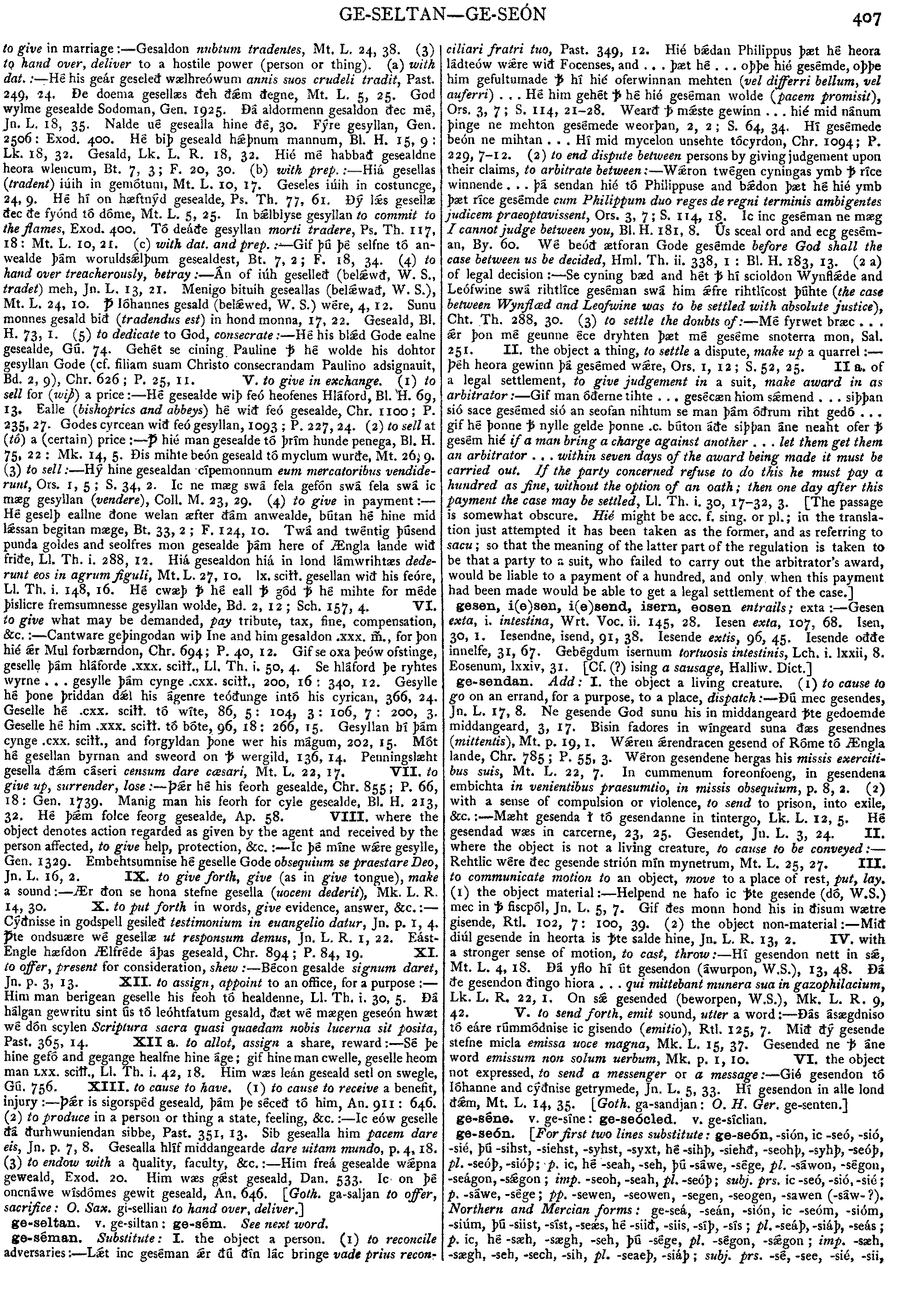
ge-sendan.
Add:
I.
the
object
a
living
creature.
(l)
to
cause
to
go
on
an
errand,
for
a
purpose,
to
a
place,
dispatch
:--
Ðú
mec
gesendes,
Jn.
L.
17,
8.
Ne
gesende
God
sunu
his
in
middangeard
te
gedoemde
middangeard,
3,
17.
Bisin
fadores
in
wíngeard
suna
ðæs
gesendnes
(mittentis),
Mt.
p.
19,
I.
Wren
rendracen
gesend
of
Róme
tó
Ængla
lande,
Chr.
785
;
P.
55,
3.
Wéron
gesendene
hergas
his
missis
exercitibus
suis,
Mt.
L.
22,
7.
In
cummenum
foreonfoeng,
in
gesendena
embichta
in
venientibus
praesumtio,
in
missis
obsequium,
p.
8,
2.
(2)
with
a
sense
of
compulsion
or
violence,
to
send
to
prison,
into
exile,
&c.
:--
Mæht
gesenda
 tó
gesendanne
in
tintergo,
Lk.
L.
12,
5.
Hé
gesendad
wæs
in
carcerne,
23,
25.
Gesendet,
Jn.
L.
3,
24.
II.
where
the
object
is
not
a
living
creature,
to
cause
to
be
conveyed
:--
Rehtlic
wére
ðec
gesende
strión
mín
mynetrum,
Mt.
L.
25,
27.
III.
to
communicate
motion
to
an
object,
move
to
a
place
of
rest,
put,
lay.
(l)
the
object
material
:--
Helpend
ne
hafo
ic
te
gesende
(dó,
W.S.)
mec
in
fiscpól,
Jn.
L.
5,
7.
Gif
ðes
monn
bond
his
in
ðisum
wætre
gisende.
Rtl.
102,
7:
100,
39.
(2)
the
object
non-material
:--
Mið
diúl
gesende
in
heorta
is
te
salde
hine,
Jn.
L.
R.
13,
2.
IV.
with
a
stronger
sense
of
motion,
to
cast,
throw
:--
Hí
gesendon
nett
in
s,
Mt.
L.
4,
18.
Ðá
yflo
hí
út
gesendon
(áwurpon,
W.S.),
13,
48.
Ðá
ðe
gesendon
ðingo
hiora
.
.
.
qui
mittebant
munera
sua
in
gazophilacium,
Lk.
L.
R.
22,
I.
On
s
gesended
(beworpen,
W.S.),
Mk.
L.
R.
9,
42.
V.
to
send
forth,
emit
sound,
utter
a
word
:--
Ðás
ásægdniso
tó
eáre
rúmmódnise
ic
gisendo
(emitio).
Rtl.
125,
7.
Mið
ðý
gesende
stefne
micla
emissa
uoce
magna,
Mk.
L.
15,
37.
Gesended
ne
áne
word
emissum
non
solum
uerbum,
Mk.
p.
I.
10.
VI.
the
object
not
expressed
,
to
send
a
messenger
or
a
message
:--
Gié
gesendon
tó
Ióhanne
and
cýðnise
getrymede,
Jn.
L.
5,
33.
Hí
gesendon
in
alle
lond
ðm,
Mt.
L.
14,
35.
[Goth.
ga-sandjan:
O.H.Ger.
ge-senten.]
tó
gesendanne
in
tintergo,
Lk.
L.
12,
5.
Hé
gesendad
wæs
in
carcerne,
23,
25.
Gesendet,
Jn.
L.
3,
24.
II.
where
the
object
is
not
a
living
creature,
to
cause
to
be
conveyed
:--
Rehtlic
wére
ðec
gesende
strión
mín
mynetrum,
Mt.
L.
25,
27.
III.
to
communicate
motion
to
an
object,
move
to
a
place
of
rest,
put,
lay.
(l)
the
object
material
:--
Helpend
ne
hafo
ic
te
gesende
(dó,
W.S.)
mec
in
fiscpól,
Jn.
L.
5,
7.
Gif
ðes
monn
bond
his
in
ðisum
wætre
gisende.
Rtl.
102,
7:
100,
39.
(2)
the
object
non-material
:--
Mið
diúl
gesende
in
heorta
is
te
salde
hine,
Jn.
L.
R.
13,
2.
IV.
with
a
stronger
sense
of
motion,
to
cast,
throw
:--
Hí
gesendon
nett
in
s,
Mt.
L.
4,
18.
Ðá
yflo
hí
út
gesendon
(áwurpon,
W.S.),
13,
48.
Ðá
ðe
gesendon
ðingo
hiora
.
.
.
qui
mittebant
munera
sua
in
gazophilacium,
Lk.
L.
R.
22,
I.
On
s
gesended
(beworpen,
W.S.),
Mk.
L.
R.
9,
42.
V.
to
send
forth,
emit
sound,
utter
a
word
:--
Ðás
ásægdniso
tó
eáre
rúmmódnise
ic
gisendo
(emitio).
Rtl.
125,
7.
Mið
ðý
gesende
stefne
micla
emissa
uoce
magna,
Mk.
L.
15,
37.
Gesended
ne
áne
word
emissum
non
solum
uerbum,
Mk.
p.
I.
10.
VI.
the
object
not
expressed
,
to
send
a
messenger
or
a
message
:--
Gié
gesendon
tó
Ióhanne
and
cýðnise
getrymede,
Jn.
L.
5,
33.
Hí
gesendon
in
alle
lond
ðm,
Mt.
L.
14,
35.
[Goth.
ga-sandjan:
O.H.Ger.
ge-senten.]
| Result Page: |  |
Previous | 3 4 5 6 7 8 9 10 11 12 13 14 15 16 | Next |  |
Germanic Lexicon Project (main page)
This search system was written by
Sean Crist
Please consider
volunteering
to correct the data in these online dictionaries.
No rights reserved. Feel free to use these data in any way you please.