|
|

Search for Sege again, using less strict matching (46 results)
|
Source: Bosworth/Toller, page d0301, entry 17 View original page image as: [TIFF] [PNG] [View previous entry] [View next entry] |
[Comment on this entry] [View comments] |
The following entry has been hand-corrected once. |
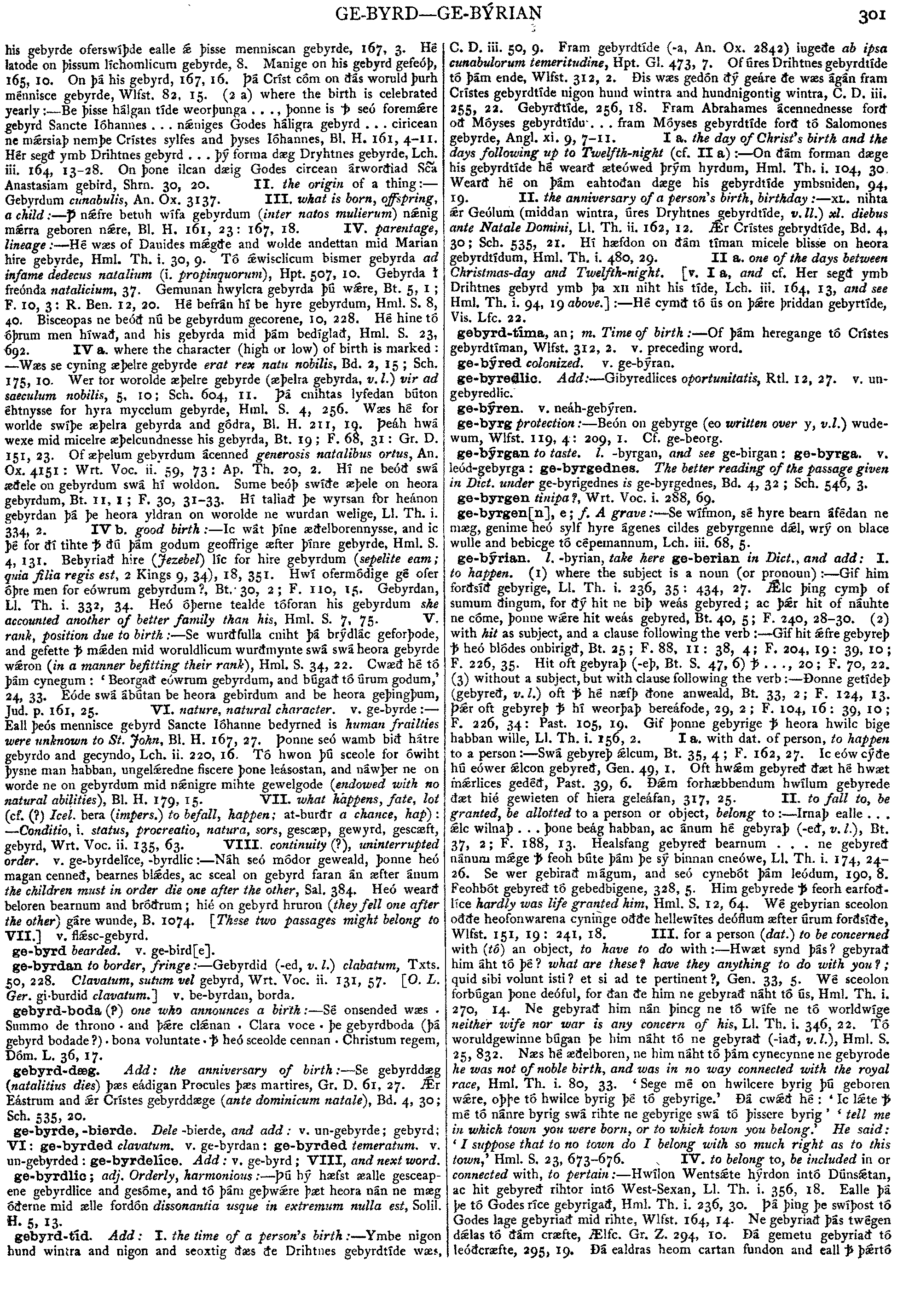
ge-býrian.
l.
-byrian,
take
here
ge-berian
in
Dict.,
and
add:
I.
to
happen.
(1)
where
the
subject
is
a
noun
(or
pronoun)
:--
Gif
him
forðsíð
gebyrige,
Ll.
Th.
i.
236,
35:
434,
27.
Æ-acute;lc
þing
cymþ
of
sumum
ðingum,
for
ðý
hit
ne
biþ
weás
gebyred;
ac
þ r
hit
of
náuhte
ne
cóme,
þonne
wre
hit
weás
gebyred,
Bt.
40,
5;
F.
240,
28-30.
(2)
with
hit
as
subject,
and
a
clause
following
the
verb
:--
Gif
hit
fre
gebyreþ
r
hit
of
náuhte
ne
cóme,
þonne
wre
hit
weás
gebyred,
Bt.
40,
5;
F.
240,
28-30.
(2)
with
hit
as
subject,
and
a
clause
following
the
verb
:--
Gif
hit
fre
gebyreþ
 heó
blódes
onbirigð,
Bt.
25;
F.
88,
11:
38,
4;
F.
204,
19:
39,
10;
F.
226,
35.
Hit
oft
gebyraþ
(-eþ,
Bt.
S.
47,
6)
...,
20;
F.
70,
22.
(3)
without
a
subject,
but
with
clause
following
the
verb
:--
Ðonne
getídeþ
(gebyreð,
v.l.)
oft
hé
næfþ
ðone
anweald,
Bt.
33,
2;
F.
124,
13.
Þr
oft
gebyreþ
hí
weorþaþ
bereáfode,
29,
2;
F.
104,
16:
39,
10;
F.
226,
34:
Past.
105,
19.
Gif
þonne
gebyrige
heora
hwilc
bige
habban
wille,
Ll.
Th.
i.
156,
2.
I
a.
with
dat.
of
person,
to
happen
to
a
person
:--
Swá
gebyreþ
lcum,
Bt.
35,
4;
F.
162,
27.
Ic
eów
cýðe
hú
eówer
lcon
gebyreð,
Gen.
49,
1.
Oft
hwm
gebyreð
ðæt
hé
hwæt
mrlices
gedéð,
Past.
39,
6.
Ðm
forhæbbendum
hwílum
gebyrede
ðæt
hié
gewieten
of
hiera
geleáfan,
317,
25.
II.
to
fall
to,
be
granted,
be
allotted
to
a
person
or
object,
belong
to
:--
Irnaþ
ealle
...
lc
wilnaþ
...
þone
beág
habban,
ac
ánum
hé
gebyraþ
(-eð,
v.l.),
Bt.
37,
2;
F.
188,
13.
Healsfang
gebyreð
bearnum
...
ne
gebyreð
nánum
mge
feoh
búte
þám
þe
sý
binnan
cneówe,
Ll.
Th.
i.
174,
24-26.
Se
wer
gebirað
mágum,
and
seó
cynebót
þám
leódum,
190,
8.
Feohbót
gebyreð
tó
gebedbigene,
328,
5.
Him
gebyrede
feorh
earfoðlíce
hardly
was
life
granted
him.
Hml.
S.
12,
64.
Wé
gebyrian
sceolon
oððe
heofonwarena
cyninge
oððe
hellewítes
deóflum
æfter
úrum
forðsíðe,
Wlfst.
151,
19:
241,
18.
III.
for
a
person
(dat.)
to
be
concerned
with
(tó)
an
object,
to
have
to
do
with
:--
Hwæt
synd
þás?
gebyrað
him
áht
tó
þé?
what
are
these?
have
they
anything
to
do
with
you?;
quid
sibi
volunt
isti?
et
si
ad
te
pertinent?,
Gen.
33,
5.
Wé
sceolon
forbúgan
þone
deóful,
for
ðan
ðe
him
ne
gebyrað
náht
tó
ús,
Hml.
Th.
i.
270,
14.
Ne
gebyrað
him
nán
þincg
ne
tó
wífe
ne
tó
worldwíge
neither
wife
nor
war
is
any
concern
of
his,
Ll.
Th.
i.
346,
22.
Tó
woruldgewinne
búgan
þe
him
náht
tó
ne
gebyrað
(-iað,
v.l.),
Hml.
S.
25,
832.
Næs
hé
æðelboren,
ne
him
náht
tó
þám
cynecynne
ne
gebyrode
he
was
not
of
noble
birth,
and
was
in
no
way
connected
with
the
royal
race,
Hml.
Th.
i.
80,
33.
'Sege
mé
on
hwilcere
byrig
þú
geboren
wre,
oþþe
tó
hwilce
byrig
þé
tó
gebyrige.'
Ðá
cwð
hé:
'Ic
lte
mé
tó
nánre
byrig
swá
rihte
ne
gebyrige
swá
tó
þissere
byrig'
'tell
me
in
which
town
you
were
born,
or
to
which
town
you
belong.'
He
said:
'I
suppose
that
to
no
town
do
I
belong
with
so
much
right
as
to
this
town,'
Hml.
S.
23,
673-676.
IV.
to
belong
to,
be
included
in
or
connected
with,
to
pertain
:--
Hwilon
Wentste
hýrdon
intó
Dúnstan,
ac
hit
gebyreð
rihtor
intó
West-Sexan,
Ll.
Th.
i.
356,
18.
Ealle
þá
þe
tó
Godes
ríce
gebyrigað,
Hml.
Th.
i.
236,
30.
Þá
þing
þe
swíþost
tó
Godes
lage
gebyriað
mid
rihte,
Wlfst.
164,
14.
Ne
gebyriað
þás
twégen
dlas
tó
ðám
cræfte,
Ælfc.
Gr.
Z.
294,
10.
Ðá
gemetu
gebyriað
tó
leóðcræfte,
295,
19.
Ðá
ealdras
heom
cartan
fundon
and
eall
þrtó
heó
blódes
onbirigð,
Bt.
25;
F.
88,
11:
38,
4;
F.
204,
19:
39,
10;
F.
226,
35.
Hit
oft
gebyraþ
(-eþ,
Bt.
S.
47,
6)
...,
20;
F.
70,
22.
(3)
without
a
subject,
but
with
clause
following
the
verb
:--
Ðonne
getídeþ
(gebyreð,
v.l.)
oft
hé
næfþ
ðone
anweald,
Bt.
33,
2;
F.
124,
13.
Þr
oft
gebyreþ
hí
weorþaþ
bereáfode,
29,
2;
F.
104,
16:
39,
10;
F.
226,
34:
Past.
105,
19.
Gif
þonne
gebyrige
heora
hwilc
bige
habban
wille,
Ll.
Th.
i.
156,
2.
I
a.
with
dat.
of
person,
to
happen
to
a
person
:--
Swá
gebyreþ
lcum,
Bt.
35,
4;
F.
162,
27.
Ic
eów
cýðe
hú
eówer
lcon
gebyreð,
Gen.
49,
1.
Oft
hwm
gebyreð
ðæt
hé
hwæt
mrlices
gedéð,
Past.
39,
6.
Ðm
forhæbbendum
hwílum
gebyrede
ðæt
hié
gewieten
of
hiera
geleáfan,
317,
25.
II.
to
fall
to,
be
granted,
be
allotted
to
a
person
or
object,
belong
to
:--
Irnaþ
ealle
...
lc
wilnaþ
...
þone
beág
habban,
ac
ánum
hé
gebyraþ
(-eð,
v.l.),
Bt.
37,
2;
F.
188,
13.
Healsfang
gebyreð
bearnum
...
ne
gebyreð
nánum
mge
feoh
búte
þám
þe
sý
binnan
cneówe,
Ll.
Th.
i.
174,
24-26.
Se
wer
gebirað
mágum,
and
seó
cynebót
þám
leódum,
190,
8.
Feohbót
gebyreð
tó
gebedbigene,
328,
5.
Him
gebyrede
feorh
earfoðlíce
hardly
was
life
granted
him.
Hml.
S.
12,
64.
Wé
gebyrian
sceolon
oððe
heofonwarena
cyninge
oððe
hellewítes
deóflum
æfter
úrum
forðsíðe,
Wlfst.
151,
19:
241,
18.
III.
for
a
person
(dat.)
to
be
concerned
with
(tó)
an
object,
to
have
to
do
with
:--
Hwæt
synd
þás?
gebyrað
him
áht
tó
þé?
what
are
these?
have
they
anything
to
do
with
you?;
quid
sibi
volunt
isti?
et
si
ad
te
pertinent?,
Gen.
33,
5.
Wé
sceolon
forbúgan
þone
deóful,
for
ðan
ðe
him
ne
gebyrað
náht
tó
ús,
Hml.
Th.
i.
270,
14.
Ne
gebyrað
him
nán
þincg
ne
tó
wífe
ne
tó
worldwíge
neither
wife
nor
war
is
any
concern
of
his,
Ll.
Th.
i.
346,
22.
Tó
woruldgewinne
búgan
þe
him
náht
tó
ne
gebyrað
(-iað,
v.l.),
Hml.
S.
25,
832.
Næs
hé
æðelboren,
ne
him
náht
tó
þám
cynecynne
ne
gebyrode
he
was
not
of
noble
birth,
and
was
in
no
way
connected
with
the
royal
race,
Hml.
Th.
i.
80,
33.
'Sege
mé
on
hwilcere
byrig
þú
geboren
wre,
oþþe
tó
hwilce
byrig
þé
tó
gebyrige.'
Ðá
cwð
hé:
'Ic
lte
mé
tó
nánre
byrig
swá
rihte
ne
gebyrige
swá
tó
þissere
byrig'
'tell
me
in
which
town
you
were
born,
or
to
which
town
you
belong.'
He
said:
'I
suppose
that
to
no
town
do
I
belong
with
so
much
right
as
to
this
town,'
Hml.
S.
23,
673-676.
IV.
to
belong
to,
be
included
in
or
connected
with,
to
pertain
:--
Hwilon
Wentste
hýrdon
intó
Dúnstan,
ac
hit
gebyreð
rihtor
intó
West-Sexan,
Ll.
Th.
i.
356,
18.
Ealle
þá
þe
tó
Godes
ríce
gebyrigað,
Hml.
Th.
i.
236,
30.
Þá
þing
þe
swíþost
tó
Godes
lage
gebyriað
mid
rihte,
Wlfst.
164,
14.
Ne
gebyriað
þás
twégen
dlas
tó
ðám
cræfte,
Ælfc.
Gr.
Z.
294,
10.
Ðá
gemetu
gebyriað
tó
leóðcræfte,
295,
19.
Ðá
ealdras
heom
cartan
fundon
and
eall
þrtó
|
Source: Bosworth/Toller, page d0337, entry 21 View original page image as: [TIFF] [PNG] [View previous entry] [View next entry] |
[Comment on this entry] [View comments] |
The following entry has been hand-corrected once. |
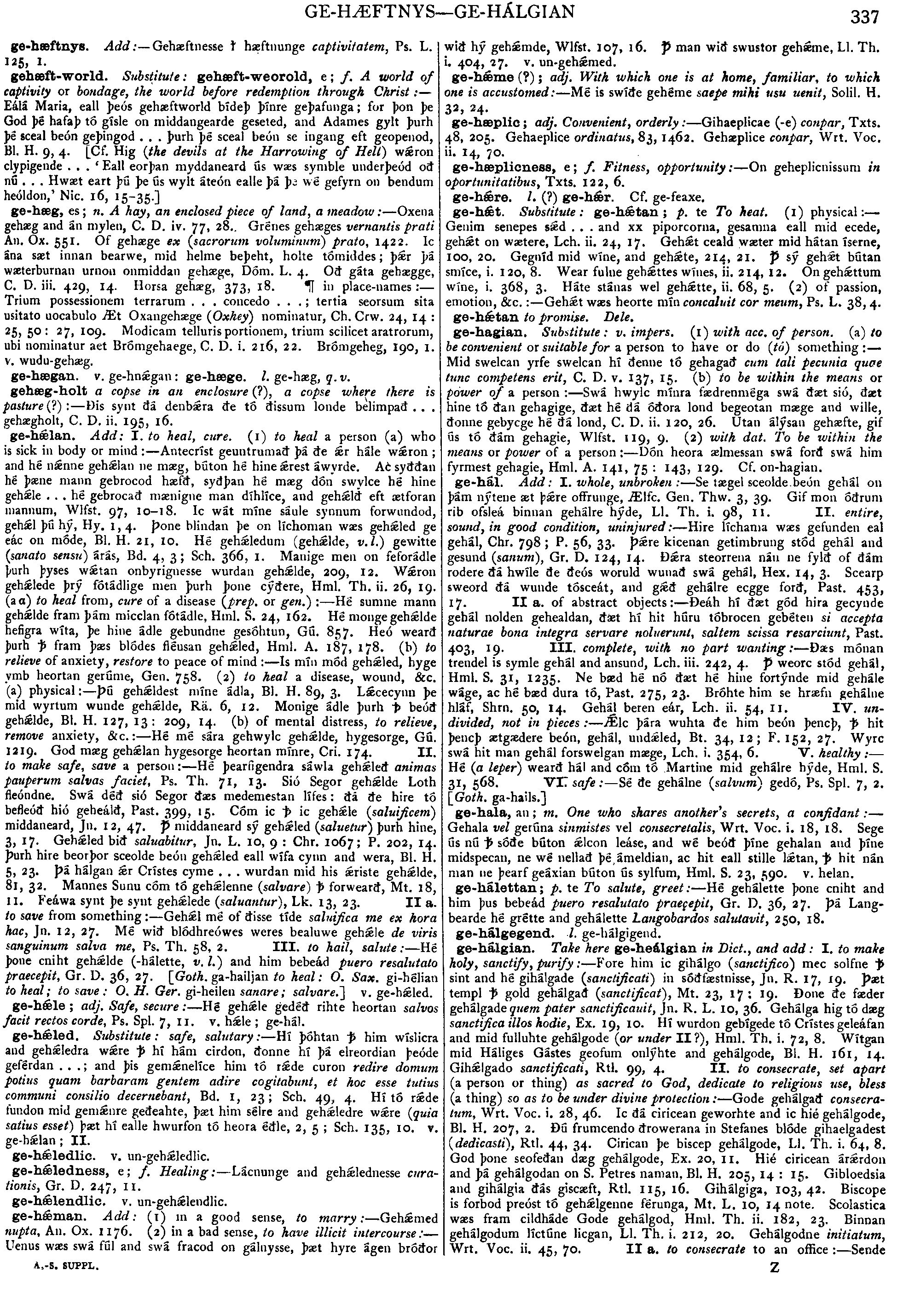
ge-hala,
an;
m.
One
who
shares
another's
secrets,
a
confidant:--Gehala
vel
gerúna
sinmistes
vel
consecretalis,
Wrt.
Voc.
i.
18,
18.
Sege
ús
nú
sóðe
búton
lcon
leáse,
and
wé
beóð
þíne
gehalan
and
þíne
midspecan,
ne
wé
nellað
þé
ámeldian,
ac
hit
eall
stille
ltan,
hit
nán
man
ne
þearf
geáxian
búton
ús
sylfum,
Hml.
S.
23,
590.
v.
helan.
|
Source: Bosworth/Toller, page d0453, entry 6 View original page image as: [TIFF] [PNG] [View previous entry] [View next entry] |
[Comment on this entry] [View comments] |
The following entry has been hand-corrected once. |
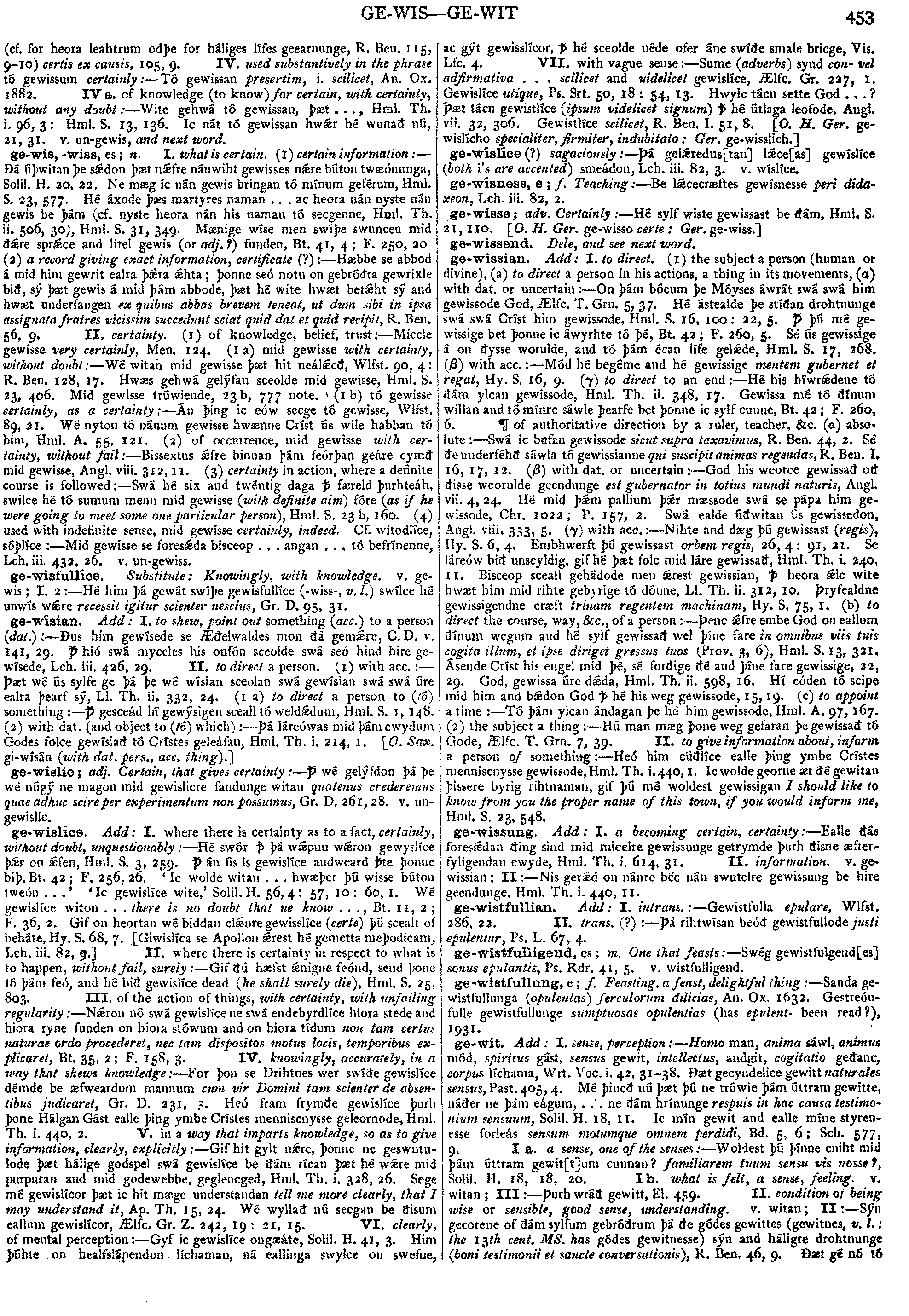
ge-wislíce.
Add:
I.
where
there
is
certainty
as
to
a
fact,
certainly,
without
doubt,
unquestionably:--Hé
swór
þá
wpnu
wron
gewyslíce
þr
on
fen,
Hml.
S.
3,
259.
Þ-bar;
án
ús
is
gewislíce
andweard
te
þonne
biþ,
Bt.
42;
F.
256,
26.
'Ic
wolde
witan
.
.
.
hwæþer
þú
wisse
búton
tweón
.
.
.
'
'Ic
gewislíce
wite,'
Solil.
H.
56,
4:
57,
10:
60,
1.
Wé
gewislíce
witon
.
.
.
there
is
no
doubt
that
we
know
.
.
.,
Bt.
11,
2;
F.
36,
2.
Gif
on
heortan
wé
biddan
clnre
gewisslíce
(certe)
þú
scealt
of
beháte,
Hy.
S.
68,
7.
[Giwislíca
se
Apollon
rest
hé
gemetta
meþodicam,
Lch.
iii.
82,
9.]
II.
where
there
is
certainty
in
respect
to
what
is
to
happen,
without
fail,
surely:--Gif
ðú
hæfst
nigne
feónd,
send
þone
tó
þám
feó,
and
hé
bið
gewislíce
dead
(he
shall
surely
die),
Hml.
S.
25,
803.
III.
of
the
action
of
things,
with
certainty,
with
unfailing
regularity:--Nron
nó
swá
gewislíce
ne
swá
endebyrdlíce
hiora
stede
and
hiora
ryne
funden
on
hiora
stówum
and
on
hiora
tídum
non
tam
certus
naturae
ordo
procederet,
nec
tam
dispositos
motus
locis,
temporibus
explicaret,
Bt.
35,
2;
F.
158,
3.
IV.
knowingly,
accurately,
in
a
way
that
shews
knowledge:--For
þon
se
Drihtnes
wer
swíðe
gewislíce
démde
be
æfweardum
mannum
cum
vir
Domini
tam
scienter
de
absentibus
judicaret,
Gr.
D.
231,
3.
Heó
fram
frymðe
gewislíce
þurh
þone
Hálgan
Gást
ealle
þing
ymbe
Crístes
menniscnysse
geleornode,
Hml.
Th.
i.
440,
2.
V.
in
a
way
that
imparts
knowledge,
so
as
to
give
information,
clearly,
explicitly:--Gif
hit
gylt
nre,
þonne
ne
geswutulode
þæt
hálige
godspel
swá
gewislíce
be
ðám
rícan
þæt
hé
wre
mid
purpuran
and
mid
godewebbe,
geglencged,
Hml.
Th.
i.
328,
26.
Sege
mé
gewislícor
þæt
ic
hit
mæge
understandan
tell
me
more
clearly,
that
I
may
understand
it,
Ap.
Th.
15,
24.
Wé
wyllað
nú
secgan
be
ðisum
eallum
gewislícor,
Ælfc.
Gr.
Z.
242,
19:
21,
15.
VI.
clearly,
of
mental
perception:--Gyf
ic
gewislíce
ongæáte,
Solil.
H.
41,
3.
Him
þúhte
on
healfslápendon
líchaman,
ná
eallinga
swylce
on
swefne,
ac
gýt
gewisslícor,
hé
sceolde
néde
ofer
áne
swíðe
smale
bricge,
Vis.
Lfc.
4.
VII.
with
vague
sense:--Sume
(adverbs)
synd
con-
vel
adfirmativa
.
.
.
scilicet
and
uidelicet
gewislíce,
Ælfc.
Gr.
227,
1.
Gewislíce
utique,
Ps.
Srt.
50,
18:
54,
13.
Hwylc
tácn
sette
God
.
.
.?
Þæt
tácn
gewistlíce
(ipsum
videlicet
signum)
hé
útlaga
leofode,
Angl.
vii.
32,
306.
Gewistlíce
scilicet,
R.
Ben.
I.
51,
8.
[O.
H.
Ger.
ge wislícho
specialiter,
firmiter,
indubitato:
Ger.
ge-wisslich.]
wislícho
specialiter,
firmiter,
indubitato:
Ger.
ge-wisslich.]
|
Source: Bosworth/Toller, page d0512, entry 3 View original page image as: [TIFF] [PNG] [View previous entry] [View next entry] |
[Comment on this entry] [View comments] |
The following entry has been hand-corrected once. |
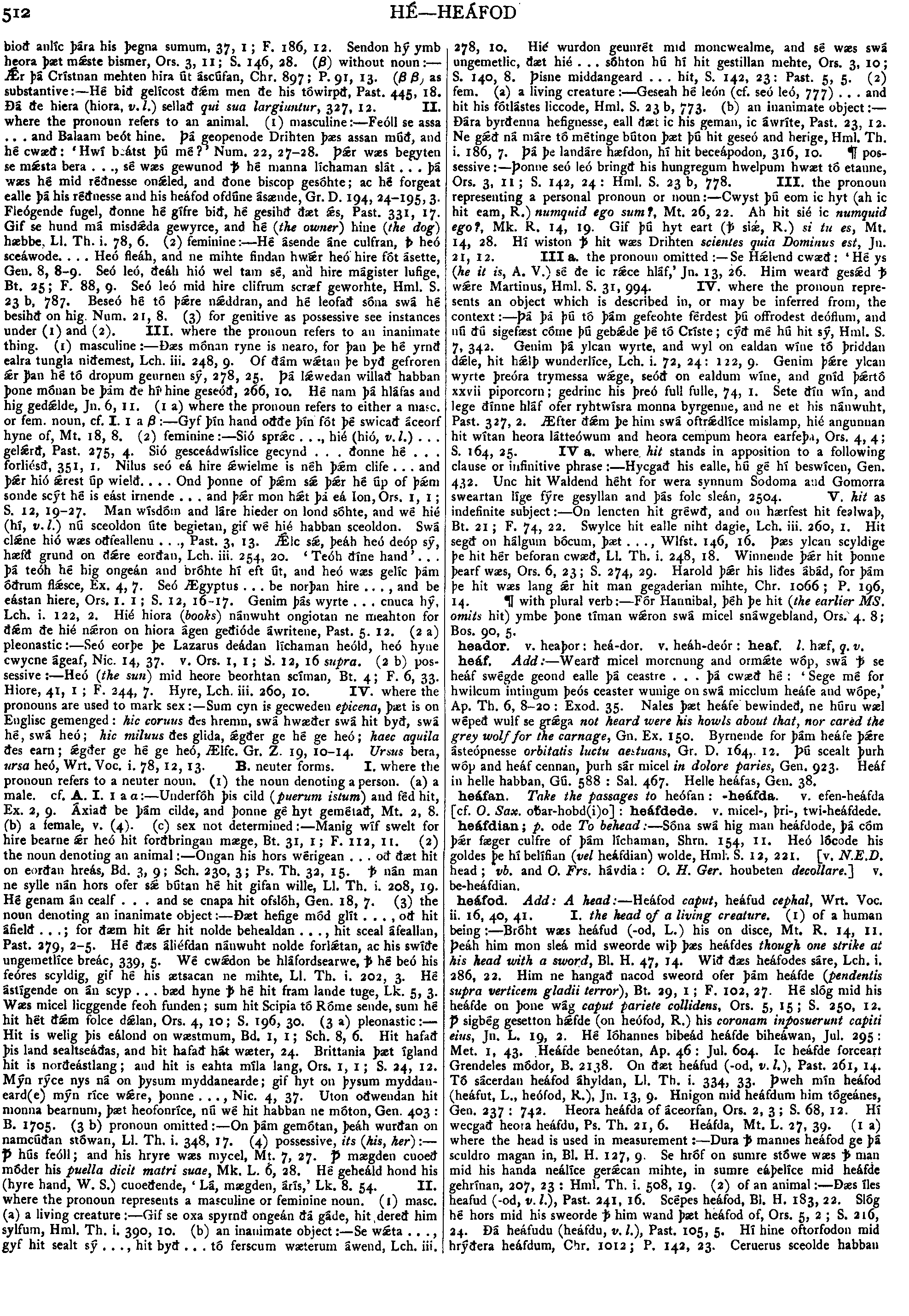
heáf.
Add
:--
Wearð
micel
morcnung
and
ormte
wóp,
swá
se
heáf
swégde
geond
ealle
þá
ceastre
.
.
.
þá
cwæð
hé
:
'Sege
mé
for
hwilcum
intingum
þeós
ceaster
wunige
on
swá
micclum
heáfe
and
wópe,'
Ap.
Th.
6,
8-20:
Exod.
35.
Nales
þæt
heáfe
bewindeð,
ne
húru
wæl
wépeð
wulf
se
grga
not
heard
were
his
howls
about
that,
nor
cared
the
grey
wolf
for
the
carnage,
Gn.
Ex.
150.
Byrnende
for
þám
heáfe
þre
ásteópnesse
orbitatis
luctu
aestuans,
UNCERTAIN
Gr.
D.
164,
12.
Þú
scealt
þurh
wóp
and
heáf
cennan,
þurh
sár
micel
in
dolore
paries,
Gen.
923.
Heáf
in
helle
habban,
Gú.
588
:
Sal.
467.
Helle
heáfas,
Gen.
38.
|
Source: Bosworth/Toller, page d0555, entry 20 View original page image as: [TIFF] [PNG] [View previous entry] [View next entry] |
[Comment on this entry] [View comments] |
The following entry has been hand-corrected once. |
hnecca.
Add:
--
Hnecca
occipitium,
Wrt.
Voc.
i.
282,
41
:
occiput,
ii.
63,
22
:
cervix,
posteriora
colli,
Txts.
110,
1165.
Hnecca
(snecca,
MS.)
occipitium,
82,
720.
'Befleh
 rest
nne
þwang
þ
rest
nne
þwang
þ m
biscope
fram
þm
hneccan
oþ
þone
h
m
biscope
fram
þm
hneccan
oþ
þone
h h
(a
vertice
usque
ad
calcaneum
and
him
heáfod
syþþan
of
ceorf'
.
.
.
Sume
men
gesetton
corfene
heáfod
eft
t
h
(a
vertice
usque
ad
calcaneum
and
him
heáfod
syþþan
of
ceorf'
.
.
.
Sume
men
gesetton
corfene
heáfod
eft
t
 m
sweóran
(cervici),
Gr.
D.
198,
4-12.
Sege
him
m
m
sweóran
(cervici),
Gr.
D.
198,
4-12.
Sege
him
m s
s heáfod
fram
þm
hneccan
corfen,
Ap.
Th.
8,
17.
Þæs
hneccan
hylt
eádmdnyss
cuius
ceruicem
inclinat
humilitas,
Scint.
20,
2.
v.
hracca.
heáfod
fram
þm
hneccan
corfen,
Ap.
Th.
8,
17.
Þæs
hneccan
hylt
eádmdnyss
cuius
ceruicem
inclinat
humilitas,
Scint.
20,
2.
v.
hracca.
|
Source: Bosworth/Toller, page d0559, entry 12 View original page image as: [TIFF] [PNG] [View previous entry] [View next entry] |
[Comment on this entry] [View comments] |
The following entry has been hand-corrected once. |
hord.
Add:
I.
an
accumulation
of
valuable
things
hidden
away
or
laid
by
for
preservation
or
future
use
(see
also
IV).
(l)
of
precious
metals,
jewels,
&c.
:--
Sege
 s
n
hwr
se
ealda
hord
(of
coins)
s
þe
þ
d
s
n
hwr
se
ealda
hord
(of
coins)
s
þe
þ
d gellce
fundest,
Hml.
S.
23,
661.
Hord
sceal
in
streónum
bdan,
Gn.
Ex.
68.
Wyrm,
hordes
hyrde,
B.
887.
Mma
hord
mnne,
2799.
Scealt
þ
þnes
unþances
þone
hord
meldian,
þe
þ
sylfwilles
r
noldest
can,
Hml.
S.
23,
716.
Ne
hdeþ
eów
hord
in
eorþe
nolite
thesaurizare
vobis
thesauros
in
terra,
Mt.
R.
6,
19.
Draca
hord
beweotode,
B.
2212.
Se
gsceaa
hord
gesceát,
dryhtsele
dyrnne,
2319.
Gong
hord
sceáwian
under
hrne
stn,
2744.
Hord
warian,
Rä.
32,
21
:
88,
22.
(2)
of
material
valuable
for
its
properties
:--
Sege
eallum
mannum
sna
sw
h
geopenia
mne
byrgene,
h
magon
r
findan
sw
deórwurne
hord
(the
miracle-working
remains
of
St.
Swithin)
heora
dre
gold
ne
bi
nhte
wur
wi
þ
foresdan
mmas,
Hml.
8.
21,
54.
II.
a
valuable
article
:--
Bi
seó
mddor
hordum
gehroden,
Rä.
81,
17.
III.
of
non-material
things,
(l)
that
are
valued
:--
Hdeþ
eów
hord
in
heofonum,
Mt.
R.
6,
20.
Ðurh
sefan
snyttro,
searoonca
hord,
Past.
9,
II.
Sceal
þæs
heánan
hyge
hord
unginnost,
Gn.
Ex.
206.
H
(Christ)
æteówde
m
eác
his
nlican
hordas,
h
m
geht,
Hml.
S.
7,
38.
(2)
that
are
concealed
:--
Synna
hord.
Ps.
C.
155.
Dyrne
hordas
abdita
(secretorum)
archana,
An.
Ox.
4216.
IV.
a
place
where
treasure
is
deposited;
the
condition
of
being
deposited
(in
the
phrases
of
horde,
on
hard,
but
perhaps
the
passages
might
be
taken
under
I.
See
N.
E.
D.
hoard;
2)
:--
Þ
h
gaderast
and
heist
on
þnum
horde
tuis
ea
divitiis
annumerare
maluisti,
Bt.
14,
2
;
F.
44,
5.
Wæs
gold
hæfen
of
horde,
B.
1108.
Bg
and
siglu,
eall
swylce
hyrsta
swylce
on
horde
r
nhdige
genumen
hæfdon,
3165.
gellce
fundest,
Hml.
S.
23,
661.
Hord
sceal
in
streónum
bdan,
Gn.
Ex.
68.
Wyrm,
hordes
hyrde,
B.
887.
Mma
hord
mnne,
2799.
Scealt
þ
þnes
unþances
þone
hord
meldian,
þe
þ
sylfwilles
r
noldest
can,
Hml.
S.
23,
716.
Ne
hdeþ
eów
hord
in
eorþe
nolite
thesaurizare
vobis
thesauros
in
terra,
Mt.
R.
6,
19.
Draca
hord
beweotode,
B.
2212.
Se
gsceaa
hord
gesceát,
dryhtsele
dyrnne,
2319.
Gong
hord
sceáwian
under
hrne
stn,
2744.
Hord
warian,
Rä.
32,
21
:
88,
22.
(2)
of
material
valuable
for
its
properties
:--
Sege
eallum
mannum
sna
sw
h
geopenia
mne
byrgene,
h
magon
r
findan
sw
deórwurne
hord
(the
miracle-working
remains
of
St.
Swithin)
heora
dre
gold
ne
bi
nhte
wur
wi
þ
foresdan
mmas,
Hml.
8.
21,
54.
II.
a
valuable
article
:--
Bi
seó
mddor
hordum
gehroden,
Rä.
81,
17.
III.
of
non-material
things,
(l)
that
are
valued
:--
Hdeþ
eów
hord
in
heofonum,
Mt.
R.
6,
20.
Ðurh
sefan
snyttro,
searoonca
hord,
Past.
9,
II.
Sceal
þæs
heánan
hyge
hord
unginnost,
Gn.
Ex.
206.
H
(Christ)
æteówde
m
eác
his
nlican
hordas,
h
m
geht,
Hml.
S.
7,
38.
(2)
that
are
concealed
:--
Synna
hord.
Ps.
C.
155.
Dyrne
hordas
abdita
(secretorum)
archana,
An.
Ox.
4216.
IV.
a
place
where
treasure
is
deposited;
the
condition
of
being
deposited
(in
the
phrases
of
horde,
on
hard,
but
perhaps
the
passages
might
be
taken
under
I.
See
N.
E.
D.
hoard;
2)
:--
Þ
h
gaderast
and
heist
on
þnum
horde
tuis
ea
divitiis
annumerare
maluisti,
Bt.
14,
2
;
F.
44,
5.
Wæs
gold
hæfen
of
horde,
B.
1108.
Bg
and
siglu,
eall
swylce
hyrsta
swylce
on
horde
r
nhdige
genumen
hæfdon,
3165.
|
Source: Bosworth/Toller, page d0575, entry 8 View original page image as: [TIFF] [PNG] [View previous entry] [View next entry] |
[Comment on this entry] [View comments (3)] |
The following entry has been hand-corrected once. |
hwá.
Add;
pl.
n.
hwá;
dat.
hwám,
hwm.
I.
in
direct
questions.
(1)
hwá
who
:--
Hwm
(hwám,
v.
l.)
beóð
dás
ðyllecan
gelícran?
quibus
isti
sunt
similes
?,
Past.
226,
23.
Æt
hwám
(from
hwm,
R.
a
quibus)
nimað
cyningas
gafol?,
Mt.
17,
25
:
Hml.
Th.
i.
510,
32.
(2)
hwæt
what,
where
the
subject
of
the
question
may
be
of
any
gender
or
of
either
number,
(a)
alone,
questions
asking
for
the
nature,
character,
extent,
&c.,
of
person
or
thing
:--
Hwæt
is
se
dumba,
sé
þe
on
sumre
dene
resteð?,
Sal.
229.
Hwæt
is
þeós
wundrung?,
Cri.
89.
Hwæt
is
wuldor
þín
þe
þú
upp
árrdest,
þá
þú
goda
ússa
gilp
gehngdest
?,
An.
1319.
Hwæt
sindon
þá
gimmas
búton
God
sylfa?,
Cri.
694.
(b)
strengthened
by
fre
:--
Hwæt
þis
fre
beón
scyle?,
Hml.
S.
23,
532
:
516.
(c)
with
partitive
gen.
:--
Hwæt
wæs
seó
Salamones
ræste
elles
búton
se
hálga
innoð?,
Bl.
H.
11,
19.
(d)
with
gen.
,
what
manner
of
:--
Ac
hwæt
wile
ðæt
nú
beón
weorca
ðæt
ús
on
óðerre
stówe
forbiét
ðæt
wé
hit
beforan
mannum
dón,
on
ððerre
lrd
búton
ðæt
wé
hit
helen
?
quid
est
ergo,
quod
opus
nostrum
et
ita
faciendum
est,
nevideatur,
et
tamen,
ut
debeat
videri
praecipitur
?
Past.
451,
2.
Hwæt
þis
fre
beón
sceole
frlices
whatever
manner
of
marvellous
thing
must
this
be?,
Hml.
S.
23,
516.
Hwæt
gifest
þú
mé
freómanna
to
frófre?,
Gen.
2174.
II.
introducing
an
exclamatory
clause.
Cf.
III.
1
B
iii
a
;
hwilc;
II
:--
Eála!
hwæt
se
forma
gítsere
wre,
þe
rest
þá
eorþan
ongan
delfan
æfter
golde,
Bt.
15
;
F.
48,
22:
Met.
8,
55.
III.
in
dependent
clauses.
(1)
after
verbs
(or
verbal
nouns
or
adjectives')
of
asking,
learning,
knowing,
seeing,
saying,
(a)
hwá
:--
Hé
frægn
.
.
.
hwá
þá
duru
heólde,
Fin.
23.
Heofon
ongeat
hwá
hine
getremede,
Cri.
1150.
þonne
bið
gecýðed
hwá
unclnnisse
líf
álifde,
Dóm.
62.
Hwæt
wille
gé
cueðan
hwæs
oððe
hwæs
gé
sién
?
quid
vos
hujus
vel
illius
dicitis,
Past.
211,
13.
(b)
hwæt
(for
meaning
see
I.
A
above),
(a)
alone,
(i)
of
persons
:--
Ðá
Sde
Paulus
þone
engel
hwæt
seó
góde
sáwel
wre.
Ðá
sde
hé
him
þæt
heó
wre
mildheortnesse
fyligende
and
staðolfæst
.
.
.
.
Wlfst.
237,
II.
Hú
mihte
Adam
tócnáwan
hwæt
hé
wre
.
.
.
?,
Hml.
Th.
i.
14,
4.
Ic
wát
ge
hwæt
þú
eart
ge
for
hwon
þú
gnornast
scio
qui
es,
et
quare
maeres,
Bd.
2,
12;
Sch.
156,
14.
þám
deófle
wæs
micel
twínung
hwæt
Críst
wre,
Hml.
Th.
i.
168,
10.
Hé
hine
hét
secgan
hwæt
his
geféran
wron,
Bt.
16,
2;
F.
52,
23.
(ii)
of
things
:--
Sum
blind
þearfa
gehýrde
myccle
menigo
féran;
þá
áhsode
hé
hwæt
þæt
wre,
Bl.
H.
15,
17.
Hé
áscode
hwæt
hyt
sóðes
wre
for
hwig
hym
man
swá
frlíce
æfter
sende,
Hml.
A.
184,
94.
Hú
ne
wást
þú
hwæt
(
pound;
,
v.
l.)
wé
cweþaþ.
Bt.
34,
5
;
F.
138,
34,
Uton
spyrian
hwæt
þá
geforan,
þá
þe
God
tufedon,
and
hwæt
þá
gefóran,
þá
þe
God
græmedon,
Wlfst.
130,
11-13.
Oð
ðæt
ic
wite
hwæt
God
wylle
hwæt
be
mé
gewurðe
donec
sciam
quid
de
me
fieri
uelit
Deus,
Bd.
5,
19
;
Sch.
670,
12.
þá
frægn
Scipia
hiene
an
hwý
hit
gelang
wre
.
.
.
,
Ors.
5,
3;
S.
222,
15.
Ic
nát
mid
hwí
ic
delfe.
Hml.
S.
23
b,
764.
Uton
gehýran
hwæt
hé
dyde
and
mid
hwý
hé
ús
freó
gedyde,
Bl.
H.
83,
31.
Hé
him
sægde
þurh
hwæt
seó
sául
eádegust
gewurde,
159,
28.
(B)
with
gen.
(i)
where
the
noun
in
the
genitive
denotes
a
class
or
kind,
how
many
or
how
much
of
which
is
in
question
:--
Hé
befrán
hwæt
hí
him
feós
geúðon
he
asked
what
(how
much)
money
they
would
give
him,
Hml.
Th.
ii.
242,
16.
Mé
lysteþ
ic
wite
hwæt
sóþes
sý
be
þre
wísan
quid
hoc
de
re
veritas
habeat,
ignore,
Gr.
D.
303,
6.
Be
þm
hringum
mon
mehte
witan
hwæt
Rómána
duguðe
gefeallen
wæs,
Ors.
4,
9
;
S.
190,
13.
Áríman
hwæt
þr
mancynnes
forwearð,
1,
11
;
S.
50,
13.
Tó
secganne
hwæt
hiera
folces
forwurde,
5,
2;
S.
220,
9.
(ii)
where
the
genitive
denotes
a
single
object,
what
part
of
:--
Sege
mé
hwæt
his
(wealth)
þé
deórast
þince,
Bt.
13;
F.
38,
10.
(iii)
where
the
noun
in
genitive
denotes
that,
the
manner
or
kind
of
which
is
in
question,
what
kind
of
:--
Befrínende
hwæt
frlices
wre,
Hml.
S.
31,
243.
(iii
a)
what
wonderful
kind
of.
Cf.
II
:--
Hit
is
on
hrædinge
earfoðrecce
hwæt
hé
gesáwenlicra
wundra
worhte,
Wlfst.
22,
14.
(iv)
where
the
genitive
denotes
objects
the
number
of
which
is
in
question
:--
Saga
mé
hú
fela
si
fugela
cynna.
Ic
ðé
secge
twá
and
fiftig.
Saga
mé
hwæt
fisccynna
si.
Ic
ðé
secge
six
and
þrittig,
Sal.
K.
204,
5-10.
(2)
after
other
verbs,
(a)
hwá
:--
Hié
ofergeáton
.
.
.
hwá
him
dugeðaforgeafbld,
Gen.
2581.
(b)
hwæt.
(a)
alone
:--
Ne
in
huon
ð
ú
hlada
hæfis
ðú
neque
in
quo
hatirias
habes.
Jn.
L.
4,
11.
Þú
wille
cweþan
þá
welgan
habban
mid
hwám
hí
mægen
þæt
eall
gebétan,
Bt.
26,
2
;
F-
92,
35-
Eall
hwæt
(þæt,
v.
l.)
hi
willniaþ
hí
begitaþ,
40,
7;
F.
242,
22.
Hwæt
seó
rding
cwyð
.
.
.
,
hyt
ys
tó
gýmanne,
Angl.
viii.
323,
32.
(B)
with
gen.
Cf.
I
B
i
:--
Hé
giémde
hwæt
hé
hæfde
monna
gerímes,
and
ne
nóm
náne
ware
húlice
hié
wron,
Ors.
5,
4;
S.
224,
21.
(3)
where
the
hwæt-clause
is
subject
to
the
verb
of
the
main
clause
:--
Bið
æt
Gode
ánum
gelang
eal
hwæt
wé
gefaran
scylon,
Wlfst.
122,
9.
with
elliptical
construction,
the
mam
clause
not
expressed
:--
Æ-acute;lc
man
hwæt
((it
did
not
matter
?)
what)
.
.
.
his
háde
tó
belumpe
folgade,
sé
þe
wolde,
Chr.
1086
;
P.
219,
31.
IV.
as
an
indefinite
pronoun,
(1)
hwá
(a)
alone,
with
much
the
same
sense
as
man,
any
one
:--
Ne
selle
mon
tó
fela
ðm
de
lytles
ðyrfe,
ðý
ls
hwá
him
self
weorðe
tó
wdlan,
and
him
ðonne
gehreówe
sió
ælmesse
ne,
cum
pauca
oportet,
plurima
praebeant,
et
ipsi
postmodun
minime
inopiam
tolerantes
ad
impatientiam
erumpant,
Past.
325,
7.
Ðæt
is
ðæt
mann
(mon,
v.
l.)
forwierne
his
sweorde
blódes,
ðæt
hwá
forwirne
his
láre
ðæt
hé
mid
ðre
ne
ofsleá
ðæs
flsces
lustas
gladium
a
sanguine
prohibere
est
praedicationis
verbum
a
carnalis
vitae
interfectione
retinere,
379,
2.
Hwá
þe
heom
þises
bereáfie,
God
sié
heom
wráð,
Cht
Th.
621,
22.
Gif
ðú
hwene
gesihst
geðeón
on
góde,
blissa
on
his
ddum,
Hex.
44,
28.
(b)
with
gen.
:--
Gif
hwá
þonne
þegena
sý
þe
on
his
bóclande
cyricean
hæbbe,
Ll.
Th.
i.
262,
11.
(2)
hwæt.
(a)
alone
:--
Gif
him
hwæt
mistímað,
Hex.
44,
30.
Weald
hwæt
heom
tíde,
Ll.
Th.
ii.
316,
25.
Gif
hí
on
hwon
(ówiht,
v.
l.)
ágylton
siqua
delinquissent.
Bd.
3,
5;
Sch.
204,
22.
Gif
þú
tódlst
hwæt
on
feówer,
Angl.
viii.
335,
24:
Bl.
H.
97,
27.
(b)
with
gen.
:--
Gif
hié
hwæt
suá
heálicra
yfela
on
him
ongieten
si
qua
valde
sunt
eorum
prava,
Past.
197,
5.
Gif
him
gebyrige
ðæt
hé
on
ðæs
hwæt
befoo
ðe
wið
his
willan
sié,
198,
23.
Hwæt
swylces,
Gr.
D.
138,
2.
Gif
hí
hwæt
litles
understandaþ
of
þám
Lýden-bócum,
Ælfc.
Gen.
Thw.
2,
10.
U
anomalous
construction
where
V.
l
is
used
as
well
:--
Mé
bet
lícað
swá
hwæt
swá
þú
in
Rómána
cyricean
.
.
.
oððe
on
hwilcre
óþre
hwæt
þæs
geméte,
Gode
má
lícode
mihi
placet,
ut
siue
in
Romana
.
.
.
seu
in
qualibet
ecclesia
aliquid
invenisti
quod
plus
Deo
possit
placere,
Bd.
1,
27
;
Sch.
65,
5.
V.
in
combination
with
swá.
(1)
swá
hwá
(hwæt)
swá.
See
also
(7
a)
:--
Swá
hwá
swá
hilð
his
gódan
weorc,
.
.
.
ne
lt
hé
nánne
óðerne
æfter
him,
Fast.
449,
29.
Swá
hwá
þonne
swá
þæs
wyrþe
biþ
hé
.
.
.
,
Bt.
5,
1
;
F.
10,
13.
Gif
twégen
eówer
geþafigaþ
be
ngum
þinge
swá
hwæs
swá
hé
gebiddan
(be
lcum
þinge
þe
hig
biddað,
W.
S.)
si
duo
ex
vobis
consenserint
de
omni
re
quamcumque
petierint,
Mt.
R.
18,
19.
Hé
gelýfd
swá
hwæt
swá
hé
cwyð,
gewurðe
þis,
Mk.
11.
23:
Lk.
10,
35.
Swá
hwæt
swá
(quicquid)
.
.
.
gelumpe,
þæt
eall
(totum
hoc)
se
ofen
.
.
.
of
ásude,
Bd.
4,
9
;
Sch.
393,
11.
(1
a)
with
gen.
:--
Hé
forgifeþ
eall
swá
hwæt
swá
þes
middangeard
.
.
.
byligða
geworhte,
Bl.
H.
9,
11.
(2)
swá
hwá
(hwæt)
:--
Suá
huá
dringe
selles
quicumque
potum
dederit,
Mt.
L.
10,
42:
Mk.
R.
11.
23.
Swá
hwæs
hé
gewilnode
him
ne
forwyrnde
God,
Hml.
S.
34,
193.
Swá
hwæt
hé
gewyrce,
Ll.
Th.
i.
78,
7.
Swá
hwæt
(huæd,
L.)
gecweoðas,
dóað
,
Jn.
R.
2,
5.
(3)
hwá
(hwæt)
swá
:--
Hwæt
swá
þin
hand
mæge
wyrcan,
Gr.
D.
327,
26.
(4)
Swá
hwá
(hwæt)
sé
:--
And
suá
chuæt
ðá
quamcumque,
Mt.
L.
18,
19.
(4
a)
Swá
hwá
(hwæt)
sé
þe
:--
Suá
huá
sé
ðe
wælle
quicumque
uoluerit.
Mk.
L.
10,
43.
Suá
huá
sé
ðe
ne
hæfeð
.
.
.
genumen
bið
from
him
 ðm,
Lk.
L.
8,
18.
Hu,
Mk.
L.
to,
44.
Há,
11.
23
(5)
Sé
swá
hwá
(hwæt).
Cf.
(7
b)
:--
suá
huæt
(quodcumque)
from
mé
ðé
gewæxe,
Mk.
L.
7,
11.
suá
huæd,
Lk.
L.
10,
35.
(5
a)
Sé
þe
swá
hwá
(hwæt).
Cf.
(7b)
:--
Sé
ðe
suá
huá
quicumque,
Lk.
L.
9,
5
:
48.
þte
swá
hwæt
(quodcumque)
is
of
mé,
Mk.
R.
7,
II.
Ðá
ðegnas
sægdun
him
ðá
ðe
swá
hwæt
(huæd,
L.)
hiæ
dydun
narrauerunt
illi
quaecumque
fecerunt,
Lk.
R.
9,
10.
(6)
Sé
swá
hwá
(hwæt)
:--
Ðá
suæ
huæt
(chuæt)
quaecumque,
Mt.
L.
18,
18.
(6a)
Sé
þe
swá
(hwæt).
Cf.
(7
c)
:--
Sé
ðe
suá
cnuá
ðec
genédes
.
.
.
geong
mið
him,
Mt.
L.
5,
41.
(7)
where
eal
qualifies
the
indefinite
form.
[Though
probably
eal
in
every
case
is
adjective
in
the
following
passages,
they
may
suggest
that
the
construction
might
easily
come
to
be
considered
as
one
in
which
eal
was
substantive,
and
the
hw-
forms
were
relatives.]
(a)
Cf.
(1),
(1
a)
:--
þr
mé
æteówde
hit
self
eall
swá
hwæt
swá
mé
mislícode
ubi
omne
quad
displicebat
se
patenter
ostenderet,
Gr.
D.
3,
18.
þá
gemétton
hí
.
.
.
eall
swá
hwæt
swá
mihton
beón
gesewene
.
.
.
invenerunt
.
.
.
quaeque
poterant
.
.
.
videri,
129,
5.
Hweþer
hí
magen
ábiddan
eall
swá
hwæt
swá
heó
biddað,
and
begytan
eall
hi
gewilniað
si
omnia
quae
volunt
possunt,
et
cuncta
impetrant
quae
desiderant
obtinere,
166,
21.
Eall
swá
hwæt
swá
hé
findan
mihte,
hé
dælde
quidquid
habere
potuit,
expendit,
293,
7.
Eal
hé
mót
ástundian,
swá
hwæt
swá
fram
his
gingrum
forgýmeleásod
bið
ad
ipsum
respicit
quicquid
a
discipulis
delinquitur,
R.
Ben.
61,
7.
Eal
swá
hwæt
swá
ic
þé
gehét,
eal
ic
hit
gesette,
Bl.
H.
147,
8
:
21,
23.
Eal
swá
hwæt
swá
hé
geseah,
ealles
hé
ðm,
Lk.
L.
8,
18.
Hu,
Mk.
L.
to,
44.
Há,
11.
23
(5)
Sé
swá
hwá
(hwæt).
Cf.
(7
b)
:--
suá
huæt
(quodcumque)
from
mé
ðé
gewæxe,
Mk.
L.
7,
11.
suá
huæd,
Lk.
L.
10,
35.
(5
a)
Sé
þe
swá
hwá
(hwæt).
Cf.
(7b)
:--
Sé
ðe
suá
huá
quicumque,
Lk.
L.
9,
5
:
48.
þte
swá
hwæt
(quodcumque)
is
of
mé,
Mk.
R.
7,
II.
Ðá
ðegnas
sægdun
him
ðá
ðe
swá
hwæt
(huæd,
L.)
hiæ
dydun
narrauerunt
illi
quaecumque
fecerunt,
Lk.
R.
9,
10.
(6)
Sé
swá
hwá
(hwæt)
:--
Ðá
suæ
huæt
(chuæt)
quaecumque,
Mt.
L.
18,
18.
(6a)
Sé
þe
swá
(hwæt).
Cf.
(7
c)
:--
Sé
ðe
suá
cnuá
ðec
genédes
.
.
.
geong
mið
him,
Mt.
L.
5,
41.
(7)
where
eal
qualifies
the
indefinite
form.
[Though
probably
eal
in
every
case
is
adjective
in
the
following
passages,
they
may
suggest
that
the
construction
might
easily
come
to
be
considered
as
one
in
which
eal
was
substantive,
and
the
hw-
forms
were
relatives.]
(a)
Cf.
(1),
(1
a)
:--
þr
mé
æteówde
hit
self
eall
swá
hwæt
swá
mé
mislícode
ubi
omne
quad
displicebat
se
patenter
ostenderet,
Gr.
D.
3,
18.
þá
gemétton
hí
.
.
.
eall
swá
hwæt
swá
mihton
beón
gesewene
.
.
.
invenerunt
.
.
.
quaeque
poterant
.
.
.
videri,
129,
5.
Hweþer
hí
magen
ábiddan
eall
swá
hwæt
swá
heó
biddað,
and
begytan
eall
hi
gewilniað
si
omnia
quae
volunt
possunt,
et
cuncta
impetrant
quae
desiderant
obtinere,
166,
21.
Eall
swá
hwæt
swá
hé
findan
mihte,
hé
dælde
quidquid
habere
potuit,
expendit,
293,
7.
Eal
hé
mót
ástundian,
swá
hwæt
swá
fram
his
gingrum
forgýmeleásod
bið
ad
ipsum
respicit
quicquid
a
discipulis
delinquitur,
R.
Ben.
61,
7.
Eal
swá
hwæt
swá
ic
þé
gehét,
eal
ic
hit
gesette,
Bl.
H.
147,
8
:
21,
23.
Eal
swá
hwæt
swá
hé
geseah,
ealles
hé
|
Source: Bosworth/Toller, page d0579, entry 3 View original page image as: [TIFF] [PNG] [View previous entry] [View next entry] |
[Comment on this entry] [View comments] |
The following entry has been hand-corrected once. |
hwanne.
Add:
I.
in
direct
questions
:--
Hwænne
(huoenne,
L.,
hwonne,
R.)
gesáwe
wé
þé
hingrigendne?,
Mt.
25,
37.
Huonne,
L.,
hwanne.
R.,
38.
Hwænne
(huoenne,
L.,
hwenne,
R.)
beóð
þás
þing?,
Lk.
21,
7:
Jn.
6,
25.
Hwenne
gewyrð
þæt?,
Solil.
H.
46,
20.
II.
in
dependent
clauses.
(1)
where
the
time
at
which
the
action
of
the
main
clause
takes
place
is
fixed
by
the
dependent
clause
:--
Hwænne
(huonne,
L.,
hwenne,
R.)
ic
bræc
fíf
hláfas
...
.
and
hú
fela
wyligena
gé
námon
fulle?,
Mk.
8,
19:
20.
Hé
sceal
winnan
and
sorgian
hwonne
se
dæg
cume
...
búton
hé
r
hwæt
for
Gode
gedyde,
Bl.
H.
97,
26.
(2)
after
verbs
expressing
attempt
to
know,
knowing,
or
causing
to
know
:--
Þá
áhsodon
hí
hine
hwænne
(huoenne,
L.,
hwenne,
R.)
Godes
ríce
cóme,
Lk.
17,
20.
Wuton
cunnian
hwænne
hine
God
lte,
Ps.
Th.
70,
10:
Sal.
414.
Bewitigan
hwonne
úp
cyme
æðelast
tungla,
Ph.
93:
102:
114.
Gé
nyton
hwænne
seó
tíd
ys,
Mk.
13,
33.
Hwonne,
Bl.
H.
117,
27:
Gen.
2601.
Sege
ús
hwænne
(hoenne,
L.,
hwænne,
R.)
þás
þing
gewurðan,
Mt.
24,
3:
Ors.
4,
10;
S.
194,
24:
An.
136.
Him
se
reogolweord
gebeóde
foran
tó
hwonne
sió
tíd
sié,
Cht.
E.
81,
13:
Ll.
Th.
i.
160,
12.
(3)
after
verbs
expressing
desire,
expectation
with
hope
or
fear,
waiting,
(to
desire,
&c.)
the
time
when
:--
Hæleð
langode
...
hwonne
hié
of
nearwe
stæppan
mósten,
Gen.
1433.
Ic
wéne
mé
...
hwænne
mé
Dryhtnes
ród
...
gefetige,
Kr.
136.
Wit
unc
simble
ondrédon
hwonne
wit
sceoldon
feallan
of
þám
olfende,
Shrn.
38,
15.
Hié
wron
on
þre
ondrdinge
hwonne
hié
on
þá
eorþan
besuncene
wurden,
Ors.
2,
6;
S.
88,
14.
Beóð
beofigende
hwonne
...,
Sat.
622.
Menn
ne
magon
gebídon
hwonne
hé
him
tó
cume,
Bt.
39,
1;
F.
212,
2:
8;
F.
26,
12:
Exod.
250.
(3
a)
where
the
verb
in
the
main
clause
has
an
object
to
which
the
dependent
clause
is
in
apposition
:--
Hine
ðæs
heardost
langode
hwanne
hé
of
ðisse
worlde
móste,
Bl.
H.
227,
1.
Ic
þæs
fres
on
wénum
sæt,
hwonne
mé
wráðra
sum
aldre
beheówe,
Gen.
2700:
1028.
Hé
bád
sóðra
geháta,
hwonne
him
lífes
weard
...
reste
ágeáfe,
1426:
2276.
Hé
wyrde
bídeþ,
hwonne
God
wille
þisse
worlde
ende
gewyricean,
Bl.
H.
109,
32.
(4)
until
:--
Hire
þynceð
lang
seó
ylding
and
seó
uferung
hwænne
heó
cume
tó
Gode
the
time
when
she
may
come
to
God
seems
long
delayed;
differtur
a
regno,
Gr.
D.
245,
7.
Him
þúhte
fre
tó
lang
hwonne
hé
móste
beón
ymbe
þæs
líchaman
oferfylle,
Wlfst.
236,
11:
By.
67.
III.
with
indefinite
force.
(1)
of
time,
at
some
time
or
other,
some
day
:--
Hé
nú
hwonne
bið
árísende
quandoque
resurrecturus,
Bd.
2,
1;
Sch.
107,
10:
Bl.
H.
123,
32.
Þeáh
hí
seldum
hwonne
(on
rare
occasions)
beswemde
weorþon,
Bt.
37,
4;
F.
192,
28.
(2)
in
other
connections
:--
Ic
wéne
nú
hwonne
dysige
men
willon
wundrian
quod
quidem
cuipiam
mirum
forte
videatur,
Bt.
36,
6;
F.
182,
15.
Ic
wát
ðeáh
ðú
cweþe
nú
hwonne
tó
mé:
'Hwylc
unryht
mæg
bión
máre
...?,'
'quae'
vero
inquies
'potest
iniquior
esset
confusio
...?,'
39,
9;
F.
224,
27.
IV.
as
co-ordinating
relative
:--
Se
forma
dæge
ðaere
daerstana,
ðonne
huoenne
eóstro
ásægcas
primo
die
azymorum,
quando
pascha
immolant,
Mk.
L.,
R.
14,
12.
Siððan
hundtwelftig
wintra
wræce
bisgodon
fge
þeóda;
hwonne
(and
then)
freá
wolde
on
wrlogan
wíte
settan,
Gen.
1265.
v.
seld-hwanne.
|
Source: Bosworth/Toller, page d0581, entry 15 View original page image as: [TIFF] [PNG] [View previous entry] [View next entry] |
[Comment on this entry] [View comments] |
The following entry has been hand-corrected once. |
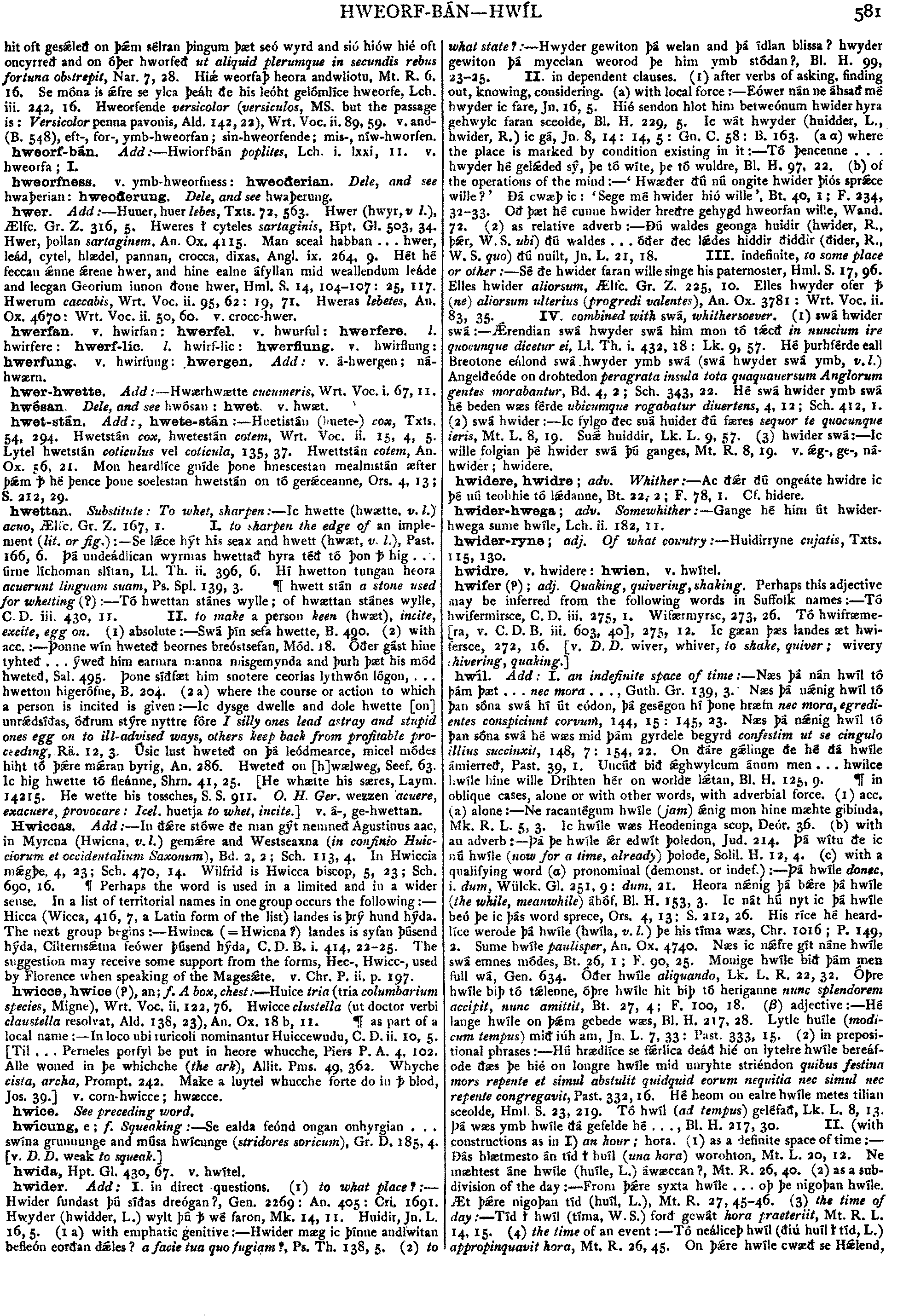
hwider.
Add:
I.
in
direct
questions,
(I)
to
what
place?
:--
Hwider
fundast
þ
sas
dreógan?,
Gen.
2269:
An.
405:
Cri.
1691.
Hwyder
(hwidder,
L.)
wylt
þ
w
faron,
Mk.
14,
II.
Huidir,
Jn.
L.
16,
5.
(l
a)
with
emphatic
genitive
:--
Hwider
mæg
ic
þnne
andlwitan
befleón
eoran
dles?
a
facie
tua
quo
fugiqm?,
Ps.
Th.
138,
5.
(2)
to
what
state
?
:--
Hwyder
gewiton
þ
welan
and
þ
dlan
blissa
?
hwyder
gewiton
þ
mycclan
weorod
þe
him
ymb
stdan
?,
Bl.
H.
99,
23-25.
II.
in
dependent
clauses.
(l)
after
verbs
of
asking,
finding
out,
knowing,
considering,
(a)
with
local
force
:--
Eówer
nn
ne
bsa
m
hwyder
ic
fare,
Jn.
16,
5.
Hié
sendon
hlot
him
betweónum
hwider
hyra
gehwylc
faran
sceolde,
Bl.
H.
229,
5.
Ic
wt
hwyder
(huidder,
L.
,
hwider,
R.)
ic
g,
Jn.
8,
14:
14,
5
:
Gn.
C.
58
:
B.
163.
(a
 )
where
the
place
is
marked
by
condition
existing
in
it
:--
T
þencenne
.
.
.
hwyder
h
gelded
s,
þe
t
wte,
þe
t
wuldre,
Bl.
H.
97,
22.
(b)
of
the
operations
of
the
mind
:--
'
Hwæer
n
ongite
hwider
þiós
sprce
wille
?
'
Ð
cwæþ
ic:
'
Sege
m
hwider
hió
wille',
Bt.
40,
l;
F.
234,
32-33.
O
þæt
h
cunne
hwider
hrere
gehygd
hweorfan
wille,
Wand.
72.
(2)
as
relative
adverb
:--
Ð
waldes
geonga
huidir
(hwider,
R.
,
þr,
W.
S.
ubi)
waldes
.
.
.
er
ec
ldes
hiddir
iddir
(ider,
R.
,
W.
S.
quo)
nuilt,
Jn.
L.
21,
18.
III.
indefinite,
to
some
place
or
other
:--
S
e
hwider
faran
wille
singe
his
paternoster,
Hml.
S.
17,
96.
Elles
hwider
aliorsum,
Ælfc.
Gr.
Z.
225,
10.
Elles
hwyder
ofer
(ne)
aliorsum
ulterius
(progredi
valentes),
An.
Ox.
3781
:
Wrt.
Voc.
ii.
83;
35.
IV.
combined
with
sw,
whithersoever.
(1)
sw
hwider
sw
:--
Æ-long;rendian
sw
hwyder
sw
him
mon
t
tc
in
nuncium
ire
quocunque
dicetur
ei,
Ll.
Th.
i.
432,
18
:
Lk.
9,
57.
H
þurhfrde
eall
Breotone
eálond
sw
hwyder
ymb
sw
(sw
hwyder
sw
ymb,
v.
l.)
Angeleóde
on
drohtedon
peragrata
insula
tota
quaquauersum
Anglorum
gentes
morabantur,
Bd.
4,
2
;
Sch.
343,
22.
H
sw
hwider
ymb
sw
h
beden
wæs
frde
ubicumque
rogabatur
diuertens,
4,
12;
Sch.
412,
I.
(2)
sw
hwider
:--
Ic
fylgo
ec
su
huider
færes
sequor
te
quocunque
ieris.
Mt.
L.
8,
19.
Suhuiddir,
Lk.
L.
9,
57.
(3)
hwider
sw
:--
Ic
wille
folgian
þ
hwider
sw
þ
ganges,
Mt.
R.
8,
19.
v.
g-,
ge-,
n-hwider;
hwidere.
)
where
the
place
is
marked
by
condition
existing
in
it
:--
T
þencenne
.
.
.
hwyder
h
gelded
s,
þe
t
wte,
þe
t
wuldre,
Bl.
H.
97,
22.
(b)
of
the
operations
of
the
mind
:--
'
Hwæer
n
ongite
hwider
þiós
sprce
wille
?
'
Ð
cwæþ
ic:
'
Sege
m
hwider
hió
wille',
Bt.
40,
l;
F.
234,
32-33.
O
þæt
h
cunne
hwider
hrere
gehygd
hweorfan
wille,
Wand.
72.
(2)
as
relative
adverb
:--
Ð
waldes
geonga
huidir
(hwider,
R.
,
þr,
W.
S.
ubi)
waldes
.
.
.
er
ec
ldes
hiddir
iddir
(ider,
R.
,
W.
S.
quo)
nuilt,
Jn.
L.
21,
18.
III.
indefinite,
to
some
place
or
other
:--
S
e
hwider
faran
wille
singe
his
paternoster,
Hml.
S.
17,
96.
Elles
hwider
aliorsum,
Ælfc.
Gr.
Z.
225,
10.
Elles
hwyder
ofer
(ne)
aliorsum
ulterius
(progredi
valentes),
An.
Ox.
3781
:
Wrt.
Voc.
ii.
83;
35.
IV.
combined
with
sw,
whithersoever.
(1)
sw
hwider
sw
:--
Æ-long;rendian
sw
hwyder
sw
him
mon
t
tc
in
nuncium
ire
quocunque
dicetur
ei,
Ll.
Th.
i.
432,
18
:
Lk.
9,
57.
H
þurhfrde
eall
Breotone
eálond
sw
hwyder
ymb
sw
(sw
hwyder
sw
ymb,
v.
l.)
Angeleóde
on
drohtedon
peragrata
insula
tota
quaquauersum
Anglorum
gentes
morabantur,
Bd.
4,
2
;
Sch.
343,
22.
H
sw
hwider
ymb
sw
h
beden
wæs
frde
ubicumque
rogabatur
diuertens,
4,
12;
Sch.
412,
I.
(2)
sw
hwider
:--
Ic
fylgo
ec
su
huider
færes
sequor
te
quocunque
ieris.
Mt.
L.
8,
19.
Suhuiddir,
Lk.
L.
9,
57.
(3)
hwider
sw
:--
Ic
wille
folgian
þ
hwider
sw
þ
ganges,
Mt.
R.
8,
19.
v.
g-,
ge-,
n-hwider;
hwidere.
|
Source: Bosworth/Toller, page d0609, entry 13 View original page image as: [TIFF] [PNG] [View previous entry] [View next entry] |
[Comment on this entry] [View comments] |
The following entry has been hand-corrected once. |
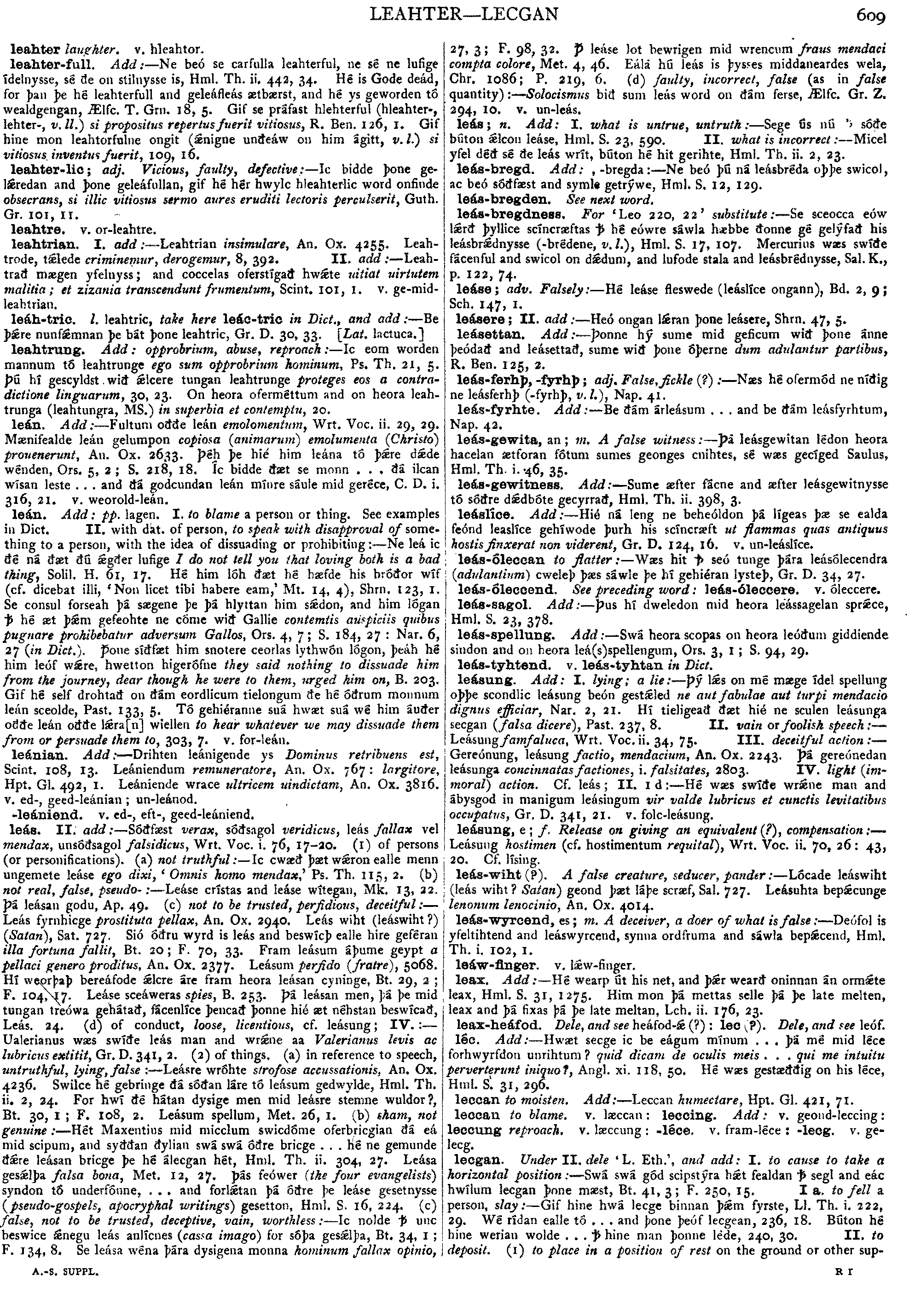
leás;
n.
Add:
I.
what
is
untrue,
untruth
:--
Sege
ús
nú
ILLEGIBLE
sóðe
búton
lcon
leáse,
Hml.
S.
23,
590.
II.
what
is
incorrect
:--
Micel
yfel
déð
sé
ðe
leás
wrít,
búton
hé
hit
gerihte,
Hml.
Th.
ii.
2,
23.
| Result Page: |  |
Previous | 1 2 3 4 5 | Next |  |
Germanic Lexicon Project (main page)
This search system was written by
Sean Crist
Please consider
volunteering
to correct the data in these online dictionaries.
No rights reserved. Feel free to use these data in any way you please.