|
|

Tip: In the search results, you can click on any word or abbreviation for more information.
|
Source: Bosworth/Toller, page b0152, entry 8 View original page image as: [TIFF] [PNG] [View previous entry] [View next entry] |
[Comment on this entry] [View comments (1)] |
The following entry has been hand-corrected once. |
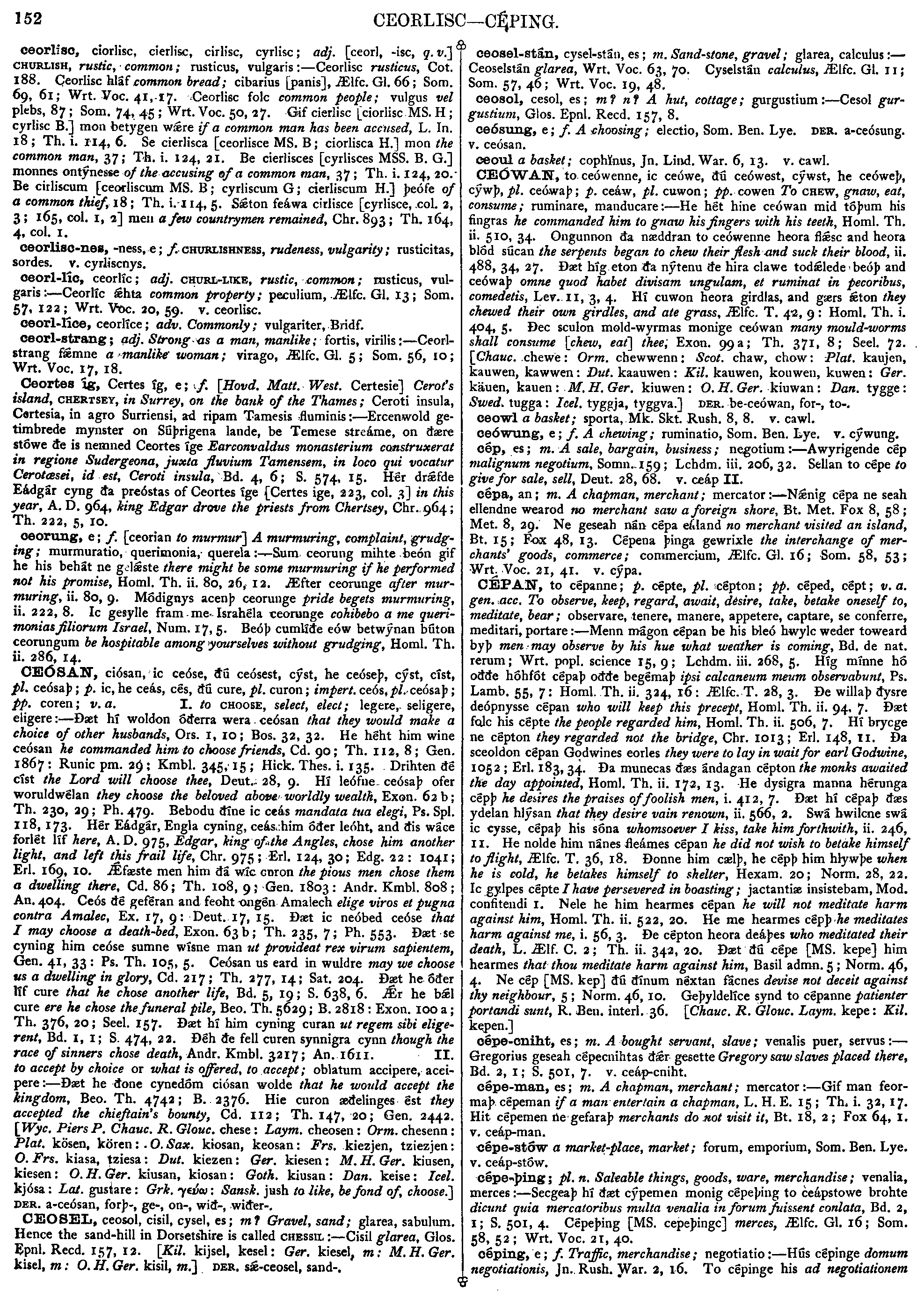
CEÓSAN.
ciósan,
ic
ceóse,
ðú
ceósest,
cýst,
he
ceóseþ,
cýst,
císt,
pl.
ceósaþ;
p.
ic,
he
ceás,
cés,
ðú
cure,
pl.
curon;
impert.
ceós,
pl.
ceósaþ;
pp.
coren;
v.
a.
I.
to
CHOOSE,
select,
elect;
legere,
seligere,
eligere
:--
Ðæt
hí
woldon
óðerra
wera
ceósan
that
they
would
make
a
choice
of
other
husbands,
Ors.
1,
10;
Bos.
32,
32.
He
héht
him
wine
ceósan
he
commanded
him
to
choose
friends,
Cd.
90;
Th.
112,
8;
Gen.
1867:
Runic
pm.
29;
Kmbl.
345,
15
;
Hick.
Thes.
i.
135.
Drihten
ðé
císt
the
lord
will
choose
thee,
Deut.
28,
9.
Hí
leófne
ceósaþ
ofer
woruldwélan
they
choose
the
beloved
above
worldly
wealth,
Exon.
62b;
Th.
230,
29;
Ph.
479.
Bebodu
ðíne
ic
ceás
mandata
tua
elegi,
Ps.
Spl.
118,
173.
Hér
Eádgár,
Engla
cyning,
ceás
him
óðer
leóht,
and
ðis
wáce
forlét
líf
here,
A.
D.
975,
Edgar,
king
of
the
Angles,
chose
him
another
light,
and
left
this
frail
life,
Chr.
975;
Erl.
124,
30;
Edg.
22:
1041;
Erl.
169,
10.
Æ-acute;fæste
men
him
ðá
wlc
cnron
UNCERTAIN
the
pious
men
chose
them
a
dwelling
there,
Cd.
86;
Th.
108,
9;
Gen.
1803:
Andr.
Kmbl.
808;
An.
404.
Ceós
ðé
geféran
and
feoht
ongén
Amalech
elige
viros
et
pugna
contra
Amalec,
Ex.
17,
9:
Deut.
17,
15.
Ðæt
ic
neóbed
ceóse
that
I
may
choose
a
death-bed,
Exon.
63b;
Th.
235,
7;
Ph.
553.
Ðæt
se
cyning
him
ceóse
sumne
wísne
man
ut
provideat
rex
virum
sapientem,
Gen.
41,
33:
Ps.
Th.
105,
5.
Ceósan
us
eard
in
wuldre
may
we
choose
us
a
dwelling
in
glory,
Cd.
217;
Th.
277,
14;
Sat.
204.
Ðæt
he
óðer
líf
cure
that
he
chose
another
life,
Bd.
5,
19;
S.
638,
6.
Æ-acute;r
he
b l
cure
ere
he
chose
the
funeral
pile,
Beo.
Th.
5629;
B.
2818:
Exon.
100a;
Th.
376,
20;
Seel.
157.
Ðæt
hí
him
cyning
curan
ut
regem
sibi
eligerent,
Bd.
1,
1;
S.
474,
22.
Ðéh
ðe
fell
curen
synnigra
cynn
though
the
race
of
sinners
chose
death,
Andr.
Kmbl.
3217;
An.
1611.
II.
to
accept
by
choice
or
what
is
offered,
to
accept;
oblatum
accipere,
accipere
:--
Ðæt
he
ðone
cynedóm
ciósan
wolde
that
he
would
accept
the
kingdom,
Beo.
Th.
4742;
B.
2376.
Hie
curon
æðelinges
ést
they
accepted
the
chieftain's
bounty,
Cd.
112;
Th.
147,
20;
Gen.
2442.
[Wyc.
Piers
P.
Chauc.
R.
Glouc.
chese:
Laym.
cheosen:
Orm.
chesenn:
Plat.
kösen,
kören:
O.
Sax.
kiosan,
keosan:
Frs.
kiezjen,
tziezjen:
O.
Frs.
kiasa,
tziesa:
Dut.
kiezen:
Ger.
kiesen:
M.
H.
Ger.
kiusen,
kiesen:
O.
H.
Ger.
kiusan,
kiosan:
Goth.
kiusan:
Dan.
keise:
Icel.
kjósa:
Lat.
gustare:
Grk.
GREEK
:
Sansk.
jush
to
like,
be
fond
of,
choose.]
DER.
a-ceósan,
forþ-,
ge-,
on-,
wið-,
wiðer-.
l
cure
ere
he
chose
the
funeral
pile,
Beo.
Th.
5629;
B.
2818:
Exon.
100a;
Th.
376,
20;
Seel.
157.
Ðæt
hí
him
cyning
curan
ut
regem
sibi
eligerent,
Bd.
1,
1;
S.
474,
22.
Ðéh
ðe
fell
curen
synnigra
cynn
though
the
race
of
sinners
chose
death,
Andr.
Kmbl.
3217;
An.
1611.
II.
to
accept
by
choice
or
what
is
offered,
to
accept;
oblatum
accipere,
accipere
:--
Ðæt
he
ðone
cynedóm
ciósan
wolde
that
he
would
accept
the
kingdom,
Beo.
Th.
4742;
B.
2376.
Hie
curon
æðelinges
ést
they
accepted
the
chieftain's
bounty,
Cd.
112;
Th.
147,
20;
Gen.
2442.
[Wyc.
Piers
P.
Chauc.
R.
Glouc.
chese:
Laym.
cheosen:
Orm.
chesenn:
Plat.
kösen,
kören:
O.
Sax.
kiosan,
keosan:
Frs.
kiezjen,
tziezjen:
O.
Frs.
kiasa,
tziesa:
Dut.
kiezen:
Ger.
kiesen:
M.
H.
Ger.
kiusen,
kiesen:
O.
H.
Ger.
kiusan,
kiosan:
Goth.
kiusan:
Dan.
keise:
Icel.
kjósa:
Lat.
gustare:
Grk.
GREEK
:
Sansk.
jush
to
like,
be
fond
of,
choose.]
DER.
a-ceósan,
forþ-,
ge-,
on-,
wið-,
wiðer-.
|
Source: Bosworth/Toller, page b0152, entry 14 View original page image as: [TIFF] [PNG] [View previous entry] [View next entry] |
[Comment on this entry] [View comments] |
The following entry has been hand-corrected once. |
CEÓWAN,
to
ceówenne,
ic
ceówe,
ðú
ceówest,
cýwst,
he
ceóweþ,
cýwþ,
pl.
ceówaþ;
p.
ceáw,
pl.
cuwon;
pp.
cowen
To
CHEW,
gnaw,
eat,
consume;
ruminare,
manducare
:--
He
hét
hine
ceówan
mid
tóþum
his
fingras
he
commanded
him
to
gnaw
his
fingers
with
his
teeth,
Homl.
Th.
ii.
510,
34.
Ongunnon
ða
næddran
to
ceówenne
heora
flsc
and
heora
blód
súcan
the
serpents
began
to
chew
their
flesh
and
suck
their
blood,
ii.
488,
34,
27.
Ðæt
híg
eton
ða
nýtenu
ðe
hira
clawe
todlede
beóþ
and
ceówaþ
omne
quod
habet
divisam
ungulam,
et
ruminat
in
pecoribus,
comedetis,
Lev.
11,
3,
4.
Hí
cuwon
heora
girdlas,
and
gærs
ton
they
chewed
their
own
girdles,
and
ate
grass,
Ælfc.
T.
42,
9:
Homl.
Th.
i.
404,
5.
Ðec
sculon
mold-wyrmas
monige
ceówan
many
mould-warms
shall
consume
[chew,
eat]
thee;
Exon.
99a;
Th.
371,
8;
Seel.
72.
[Chauc.
chewe:
Orm.
chewwenn:
Scot.
chaw,
chow:
Plat.
kaujen,
kauwen,
kawwen:
Dut.
kaauwen:
Kil.
kauwen,
kouwen,
kuwen:
Ger.
käuen,
kauen:
M.
H.
Ger.
kiuwen:
O.
H.
Ger.
kiuwan:
Dan.
tygge:
Swed.
tugga:
Icel.
tyggja,
tyggya.]
DER.
be-ceówan,
for-,
to-.
|
Source: Bosworth/Toller, page b0173, entry 35 View original page image as: [TIFF] [PNG] [View previous entry] [View next entry] |
[Comment on this entry] [View comments] |
The following entry has been hand-corrected once. |
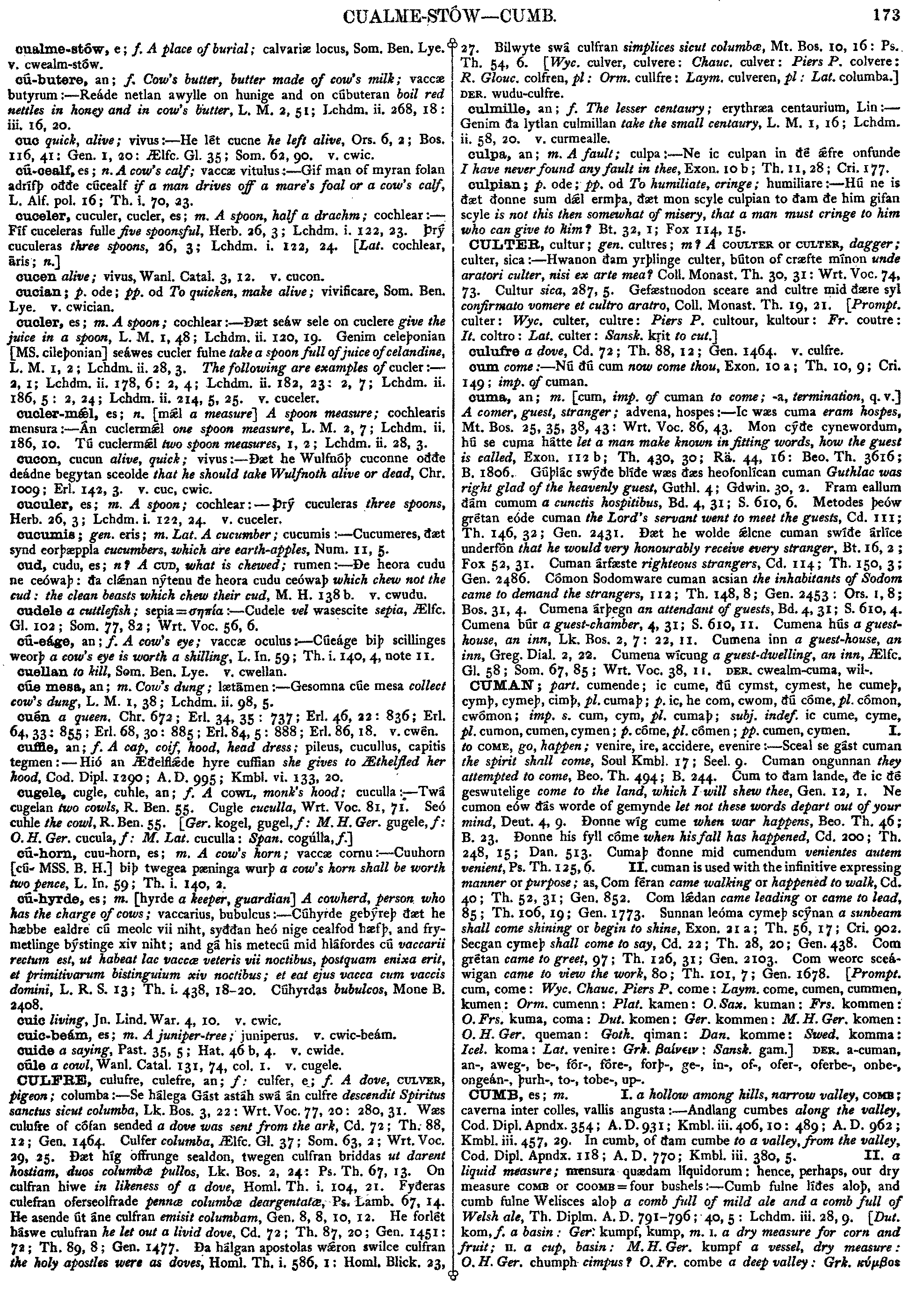
CUMAN;
part.
cumende;
ic
cume,
ðú
cymst,
cymest,
he
cumeþ,
cymþ,
cymeþ,
cimþ,
pl.
cumaþ;
p.
ic,
he
com,
cwom,
ðú
cóme,
pl.
cómon,
cwómon;
imp.
s.
cum,
cym,
pl.
cumaþ;
subj.
indef.
ic
cume,
cyme,
pl.
cumon,
cumen,
cymen;
p.
cóme,
pl.
cómen;
pp.
cumen,
cymen.
I.
to
COME,
go,
happen;
venire,
ire,
accidere,
evenire
:--
Sceal
se
gást
cuman
the
spirit
shall
come,
Soul
Kmbl.
17;
Seel.
9.
Cuman
ongunnan
they
attempted
to
come,
Beo.
Th.
494;
B.
244.
Cum
to
ðam
lande,
ðe
ic
ðé
geswutelige
come
to
the
land,
which
I
will
shew
thee,
Gen.
12,
1.
Ne
cumon
eów
ðás
worde
of
gemynde
let
not
these
words
depart
out
of
your
mind,
Deut.
4,
9.
Ðonne
wíg
cume
when
war
happens,
Beo.
Th.
46;
B.
23.
Ðonne
his
fyll
cóme
when
his
fall
has
happened,
Cd.
200;
Th.
248,
15;
Dan.
513.
Cumaþ
ðonne
mid
cumendum
venientes
autem
venient,
Ps.
Th.
125,
6.
II.
cuman
is
used
with
the
infinitive
expressing
manner
or
purpose;
as,
Com
féran
came
walking
or
happened
to
walk,
Cd.
40;
Th.
52,
31;
Gen.
852.
Com
ldan
came
leading
or
came
to
lead,
85;
Th.
106,
19;
Gen.
1773.
Sunnan
leóma
cymeþ
scýnan
a
sunbeam
shall
come
shining
or
begin
to
shine,
Exon.
21a;
Th.
56,
17;
Cri.
902.
Secgan
cymeþ
shall
come
to
say,
Cd.
22;
Th.
28,
20;
Gen.
438.
Com
grétan
came
to
greet,
97;
Th.
126,
31;
Gen.
2103.
Com
weorc
sceá-wigan
came
to
view
the
work,
80;
Th.
101,
7;
Gen.
1678.
[Prompt.
cum,
come:
Wyc.
Chauc.
Piers
P.
come:
Laym.
come,
cumen,
cummen,
kumen:
Orm.
cumenn:
Plat.
kamen:
O.
Sax.
kuman:
Frs.
kommen:
O.
Frs.
kuma,
coma:
Dut.
komen:
Ger.
kommen:
M.
H.
Ger.
komen:
O.
H.
Ger.
queman:
Goth.
qiman:
Dan.
komme:
Swed.
komma:
Icel.
koma:
Lat.
venire:
Grk.
GREEK
:
Sansk.
gam.]
DER.
a-cuman,
an-,
aweg-,
be-,
fór-,
fóre-,
forþ-,
ge-,
in-,
of-,
ofer-,
oferbe-,
onbe-,
ongeán-,
þurh-,
to-,
tobe-,
up-.
|
Source: Bosworth/Toller, page b0182, entry 29 View original page image as: [TIFF] [PNG] [View previous entry] [View next entry] |
[Comment on this entry] [View comments] |
The following entry has been hand-corrected once. |
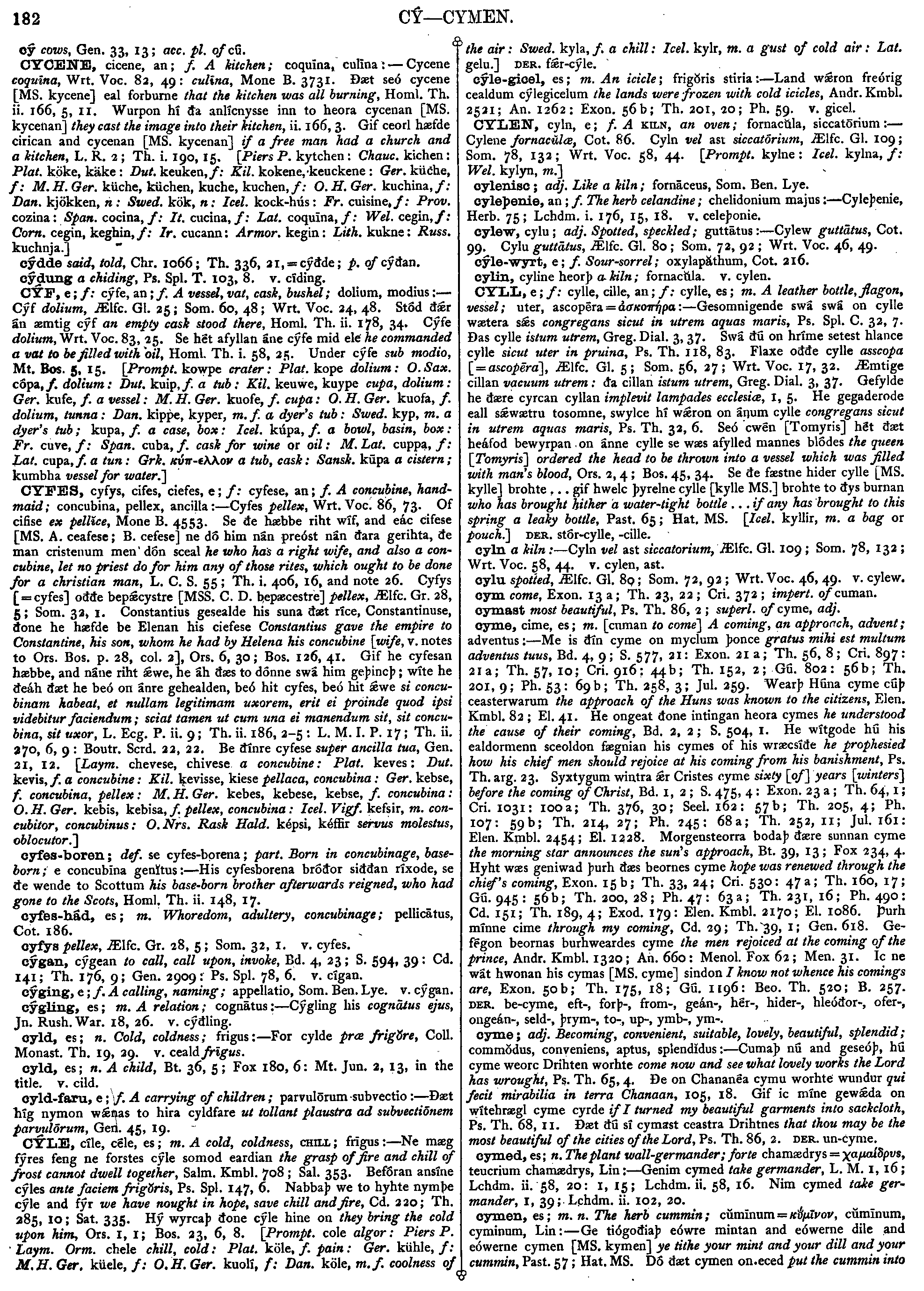
cyme,
cime,
es;
m.
[cuman
to
come]
A
coming,
an
approach,
advent;
adventus
:--
Me
is
ðín
cyme
on
myclum
þonce
gratus
mihi
est
multum
adventus
tuus,
Bd.
4,
9;
S.
577,
21:
Exon.
21a;
Th.
56,
8;
Cri.
897:
21a;
Th.
57,
10;
Cri.
916:
44b;
Th.
152,
2;
Gú.
802:
56b;
Th.
201,
9;
Ph.
53:
69b;
Th.
258,
3;
Jul.
259.
Wearþ
Húna
cyme
cúþ
ceasterwarum
the
approach
of
the
Huns
was
known
to
the
citizens,
Elen.
Kmbl.
82;
El.
41.
He
ongeat
ðone
intingan
heora
cymes
he
understood
the
cause
of
their
coming,
Bd.
2,
2;
S.
504,
1.
He
wítgode
hú
his
ealdormenn
sceoldon
fægnian
his
cymes
of
his
wræcsíðe
he
prophesied
how
his
chief
men
should
rejoice
at
his
coming
from
his
banishment,
Ps.
Th.
arg.
23.
Syxtygum
wintra
r
Cristes
cyme
UNCERTAIN
sixty
[of]
years
[winters]
before
the
coming
of
Christ,
Bd.
1,
2;
S.
475,
4:
Exon.
23a;
Th.
64,
1;
Cri.
1031:
100a;
Th.
376,
30;
Seel.
162:
57b;
Th.
205,
4;
Ph.
107:
59b;
Th.
214,
27;
Ph.
245:
68a;
Th.
252,
11;
Jul.
161:
Elen.
Kmbl.
2454;
El.
1228.
Morgensteorra
bodaþ
ðære
sunnan
cyme
the
morning
star
announces
the
sun's
approach,
Bt.
39,
13;
Fox
234,
4.
Hyht
wæs
geniwad
þurh
ðæs
beornes
cyme
hope
was
renewed
through
the
chief's
coming,
Exon.
15b;
Th.
33,
24;
Cri.
530:
47a;
Th.
160,
17;
Gú.
945:
56b;
Th.
200,
28;
Ph.
47:
63a;
Th.
231,
16;
Ph.
490:
Cd.
151;
Th.
189,
4;
Exod.
179:
Elen.
Kmbl.
2170;
El.
1086.
Þurh
mínne
cime
through
my
coming,
Cd.
29;
Th.
39,
1;
Gen.
618.
Gefégon
beornas
burhweardes
cyme
the
men
rejoiced
at
the
coming
of
the
prince,
Andr.
Kmbl.
1320;
Ah.
660:
Menol.
Fox
62;
Men.
31.
Ic
ne
wát
hwonan
his
cymas
[MS.
cyme]
sindon
I
know
not
whence
his
comings
are,
Exon.
50b;
Th.
175,
18;
Gú.
1196:
Beo.
Th.
520;
B.
257.
DER.
be-cyme,
eft-,
forþ-,
from-,
geán-,
hér-,
hider-,
hleóðor-,
ofer-,
ongeán-,
seld-,
þrym-,
to-,
up-,
ymb-,
ym-.
|
Source: Bosworth/Toller, page b0183, entry 11 View original page image as: [TIFF] [PNG] [View previous entry] [View next entry] |
[Comment on this entry] [View comments] |
The following entry has been hand-corrected once. |
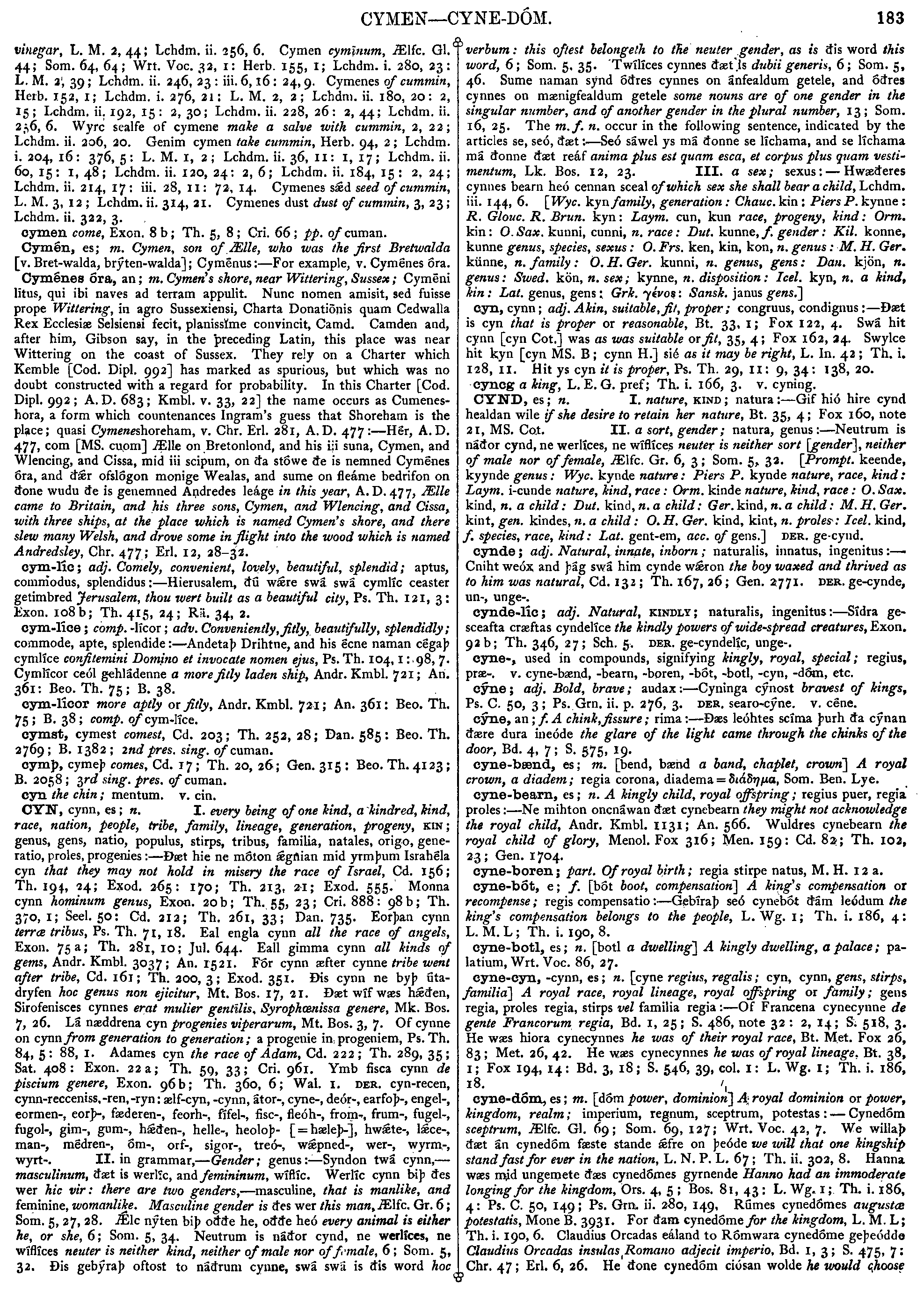
CYN,
cynn,
es;
n.
I.
every
being
of
one
kind,
a
kindred,
kind,
race,
nation,
people,
tribe,
family,
lineage,
generation,
progeny,
KIN;
genus,
gens,
natio,
populus,
stirps,
tribus,
familia,
natales,
origo,
generatio,
proles,
progenies
:--
Ðæt
hie
ne
móton
gnian
mid
yrmþum
Israhéla
cyn
that
they
may
not
hold
in
misery
the
race
of
Israel,
Cd.
156;
Th.
194,
24;
Exod.
265:
170;
Th.
213,
21;
Exod.
555.
Monna
cynn
hominum
genus,
Exon.
20b;
Th.
55,
23;
Cri.
888:
98b;
Th.
370,
1;
Seel.
50:
Cd.
212;
Th.
261,
33;
Dan.
735.
Eorþan
cynn
terræ
tribus,
Ps.
Th.
71,
18.
Eal
engla
cynn
all
the
race
of
angels,
Exon.
75a;
Th.
281,
10;
Jul.
644.
Eall
gimma
cynn
all
kinds
of
gems,
Andr.
Kmbl.
3037;
An.
1521.
Fór
cynn
æfter
cynne
tribe
went
after
tribe,
Cd.
161;
Th.
200,
3;
Exod.
351.
Ðis
cynn
ne
byþ
útadryfen
hoc
genus
non
ejicitur,
Mt.
Bos.
17,
21.
Ðæt
wíf
wæs
hðen,
Sirofenisces
cynnes
erat
mulier
gent lis,
Syrophœnissa
UNCERTAIN
genere,
Mk.
Bos.
7,
26.
Lá
næddrena
cyn
progenies
viperarum,
Mt.
Bos.
3,
7.
Of
cynne
on
cynn
from
generation
to
generation;
a
progenie
in,
progeniem,
Ps.
Th.
84,
5:
88,
1.
Adames
cyn
the
race
of
Adam,
Cd.
222;
Th.
289,
35;
Sat.
408:
Exon.
22a;
Th.
59,
33;
Cri.
961.
Ymb
fisca
cynn
de
piscium
genere,
Exon.
96b;
Th.
360,
6;
Wal.
1.
DER.
cyn-recen,
cynn-recceniss,
-ren,
-ryn:
ælf-cyn,
-cynn,
átor-,
cyne-,
deór-,
earfoþ-,
engel-,
eormen-,
eorþ-,
fæderen-,
feorh-,
fífel-,
fisc-,
fleóh-,
from-,
frum-,
fugel-,
fugol-,
gim-,
gum-,
hðen-,
helle-,
heoloþ-
[
=
hæleþ-],
hwte-,
lce-,
man-,
médren-,
óm-,
orf-,
sigor-,
treó-,
wpned-,
wer-,
wyrm-,
wyrt-.
II.
in
grammar,
--
Gender;
genus
:--
Syndon
twá
cynn,
--
masculinum,
ðæt
is
werlíc,
and
femininum,
wíflíc.
Werlíc
cynn
biþ
ðes
wer
hic
vir:
there
are
two
genders,
--
masculine,
that
is
manlike,
and
feminine,
womanlike.
Masculine
gender
is
ðes
wer
this
man,
Ælfc.
Gr.
6;
Som.
5,
27,
28.
Æ-acute;lc
nýten
biþ
oððe
he,
oððe
heó
every
animal
is
either
he,
or
she,
6;
Som.
5,
34.
Neutrum
is
náðor
cynd,
ne
werlíces,
ne
wíflíces
neuter
is
neither
kind,
neither
of
male
nor
of
female,
6;
Som.
5,
32.
Ðis
gebýraþ
oftost
to
náðrum
cynne,
swá
swá
is
ðis
word
hoc
verbum:
this
oftest
belongeth
to
the
neuter
gender,
as
is
ðis
word
this
word,
6;
Som.
5.
35.
Twílíces
cynnes
ðæt
Is
ILLEGIBLE
dubii
generis,
6;
Som.
5,
46.
Sume
naman
synd
óðres
cynnes
on
ánfealdum
getele,
and
óðres
cynnes
on
mænigfealdum
getele
some
nouns
are
of
one
gender
in
the
singular
number,
and
of
another
gender
in
the
plural
number,
13;
Som.
16,
25.
The
m.
f.
n.
occur
in
the
following
sentence,
indicated
by
the
articles
se,
seó,
ðæt
:--
Seó
sáwel
ys
má
ðonne
se
líchama,
and
se
líchama
má
ðonne
ðæt
reáf
anima
plus
est
guam
esca,
et
corpus
plus
quam
vestimentum,
Lk.
Bos.
12,
23.
III.
a
sex;
sexus
:--
Hwæðeres
cynnes
bearn
heó
cennan
sceal
of
which
sex
she
shall
bear
a
child,
Lchdm.
iii.
144,
6.
[Wyc.
kyn
family,
generation:
Chauc.
kin:
Piers
P.
kynne:
R.
Glouc.
R.
Brun.
kyn:
Laym.
cun,
kun
race,
progeny,
kind:
Orm.
kin:
O.
Sax.
kunni,
cunni,
n.
race:
Dut.
kunne,
f.
gender:
Kil.
konne,
kunne
genus,
species,
sexus:
O.
Frs.
ken,
kin,
kon,
n.
genus:
M.
H.
Ger.
künne,
n.
family:
O.
H.
Ger.
kunni,
n.
genus,
gens:
Dan.
kjön,
n.
genus:
Swed.
kön,
n.
sex;
kynne,
n.
disposition:
Icel.
kyn,
n.
a
kind,
kin:
Lat.
genus,
gens;
Grk.
GREEK
:
Sansk.
janus
gens.]
lis,
Syrophœnissa
UNCERTAIN
genere,
Mk.
Bos.
7,
26.
Lá
næddrena
cyn
progenies
viperarum,
Mt.
Bos.
3,
7.
Of
cynne
on
cynn
from
generation
to
generation;
a
progenie
in,
progeniem,
Ps.
Th.
84,
5:
88,
1.
Adames
cyn
the
race
of
Adam,
Cd.
222;
Th.
289,
35;
Sat.
408:
Exon.
22a;
Th.
59,
33;
Cri.
961.
Ymb
fisca
cynn
de
piscium
genere,
Exon.
96b;
Th.
360,
6;
Wal.
1.
DER.
cyn-recen,
cynn-recceniss,
-ren,
-ryn:
ælf-cyn,
-cynn,
átor-,
cyne-,
deór-,
earfoþ-,
engel-,
eormen-,
eorþ-,
fæderen-,
feorh-,
fífel-,
fisc-,
fleóh-,
from-,
frum-,
fugel-,
fugol-,
gim-,
gum-,
hðen-,
helle-,
heoloþ-
[
=
hæleþ-],
hwte-,
lce-,
man-,
médren-,
óm-,
orf-,
sigor-,
treó-,
wpned-,
wer-,
wyrm-,
wyrt-.
II.
in
grammar,
--
Gender;
genus
:--
Syndon
twá
cynn,
--
masculinum,
ðæt
is
werlíc,
and
femininum,
wíflíc.
Werlíc
cynn
biþ
ðes
wer
hic
vir:
there
are
two
genders,
--
masculine,
that
is
manlike,
and
feminine,
womanlike.
Masculine
gender
is
ðes
wer
this
man,
Ælfc.
Gr.
6;
Som.
5,
27,
28.
Æ-acute;lc
nýten
biþ
oððe
he,
oððe
heó
every
animal
is
either
he,
or
she,
6;
Som.
5,
34.
Neutrum
is
náðor
cynd,
ne
werlíces,
ne
wíflíces
neuter
is
neither
kind,
neither
of
male
nor
of
female,
6;
Som.
5,
32.
Ðis
gebýraþ
oftost
to
náðrum
cynne,
swá
swá
is
ðis
word
hoc
verbum:
this
oftest
belongeth
to
the
neuter
gender,
as
is
ðis
word
this
word,
6;
Som.
5.
35.
Twílíces
cynnes
ðæt
Is
ILLEGIBLE
dubii
generis,
6;
Som.
5,
46.
Sume
naman
synd
óðres
cynnes
on
ánfealdum
getele,
and
óðres
cynnes
on
mænigfealdum
getele
some
nouns
are
of
one
gender
in
the
singular
number,
and
of
another
gender
in
the
plural
number,
13;
Som.
16,
25.
The
m.
f.
n.
occur
in
the
following
sentence,
indicated
by
the
articles
se,
seó,
ðæt
:--
Seó
sáwel
ys
má
ðonne
se
líchama,
and
se
líchama
má
ðonne
ðæt
reáf
anima
plus
est
guam
esca,
et
corpus
plus
quam
vestimentum,
Lk.
Bos.
12,
23.
III.
a
sex;
sexus
:--
Hwæðeres
cynnes
bearn
heó
cennan
sceal
of
which
sex
she
shall
bear
a
child,
Lchdm.
iii.
144,
6.
[Wyc.
kyn
family,
generation:
Chauc.
kin:
Piers
P.
kynne:
R.
Glouc.
R.
Brun.
kyn:
Laym.
cun,
kun
race,
progeny,
kind:
Orm.
kin:
O.
Sax.
kunni,
cunni,
n.
race:
Dut.
kunne,
f.
gender:
Kil.
konne,
kunne
genus,
species,
sexus:
O.
Frs.
ken,
kin,
kon,
n.
genus:
M.
H.
Ger.
künne,
n.
family:
O.
H.
Ger.
kunni,
n.
genus,
gens:
Dan.
kjön,
n.
genus:
Swed.
kön,
n.
sex;
kynne,
n.
disposition:
Icel.
kyn,
n.
a
kind,
kin:
Lat.
genus,
gens;
Grk.
GREEK
:
Sansk.
janus
gens.]
|
Source: Bosworth/Toller, page b0192, entry 14 View original page image as: [TIFF] [PNG] [View previous entry] [View next entry] |
[Comment on this entry] [View comments] |
The following entry has been hand-corrected once. |
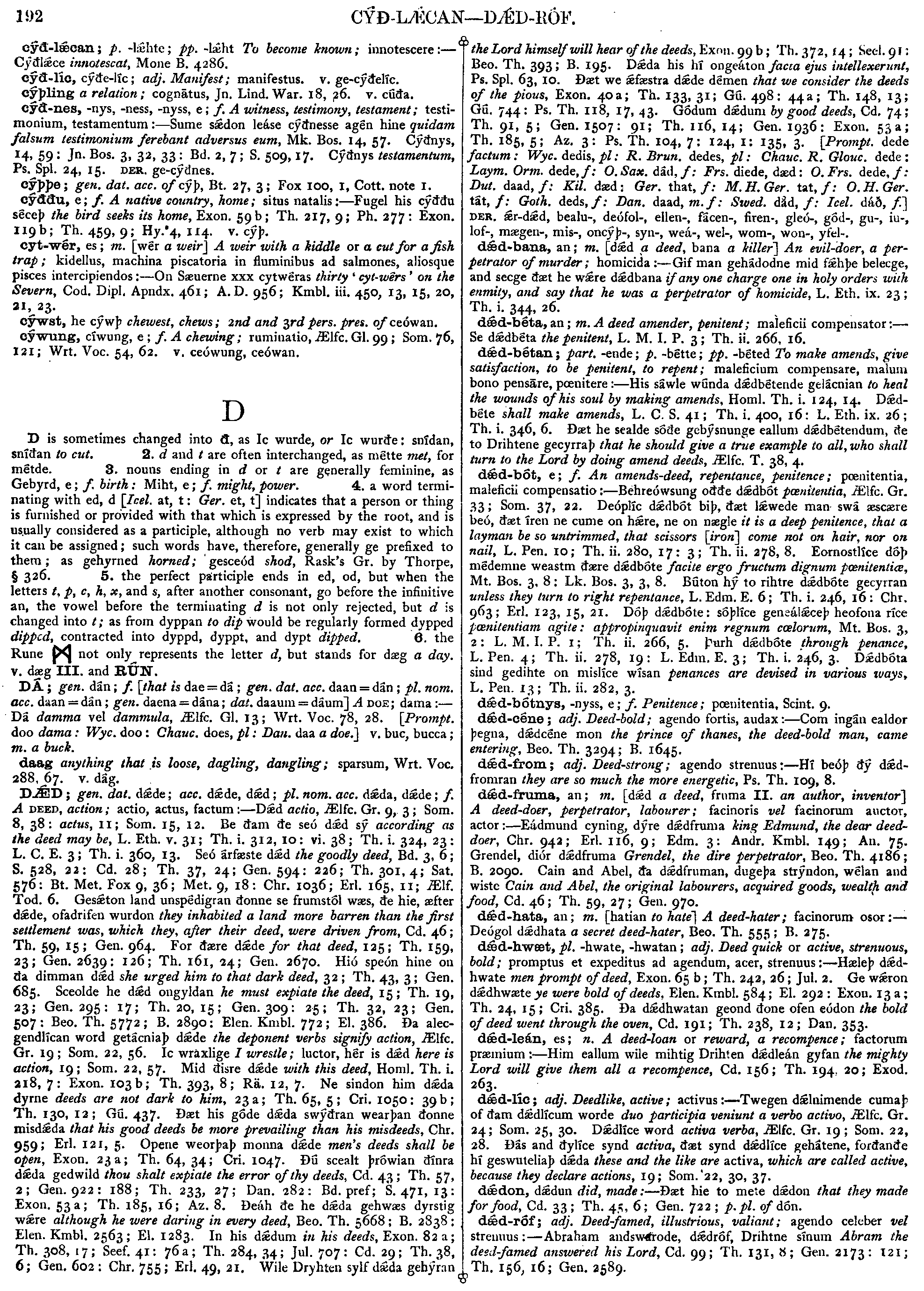
DÆ-acute;D;
gen.
dat.
dde;
acc.
dde,
dd;
pl.
nom.
acc.
dda,
dde;
f.
A
DEED,
action;
actio,
actus,
factum
:--
Dd
actio,
Ælfc.
Gr.
9,
3;
Som.
8,
38:
actus,
11;
Som.
15,
12.
Be
ðam
ðe
seó
dd
sý
according
as
the
deed
may
be,
L.
Eth.
v.
31;
Th.
i.
312,
10:
vi.
38;
Th.
i.
324,
23:
L.
C.
E.
3;
Th.
i.
360,
13.
Seó
árfæste
dd
the
goodly
deed,
Bd.
3,
6;
S.
528,
22:
Cd.
28;
Th.
37,
24;
Gen.
594:
226;
Th.
301,
4;
Sat.
576:
Bt.
Met.
Fox
9,
36;
Met.
9,
18:
Chr.
1036;
Erl.
165,
11;
Ælf.
Tod.
6.
Geston
land
unspédigran
ðonne
se
frumstól
wæs,
ðe
hie,
æfter
dde,
ofadrifen
wurdon
they
inhabited
a
land
more
barren
than
the
first
settlement
was,
which
they,
after
their
deed,
were
driven
from,
Cd.
46;
Th.
59,
15;
Gen.
964.
For
ðære
dde
for
that
deed,
125;
Th.
159,
23;
Gen.
2639:
126;
Th.
161,
24;
Gen.
2670.
Hió
speón
hine
on
ða
dimman
dd
she
urged
him
to
that
dark
deed,
32;
Th.
43,
3;
Gen.
685.
Sceolde
he
dd
ongyldan
he
must
expiate
the
deed,
15;
Th.
19,
23;
Gen.
295:
17;
Th.
20,
15;
Gen.
309:
25;
Th.
32,
23;
Gen.
507:
Beo.
Th.
5772;
B.
2890:
Elen.
Kmbl.
772;
El.
386.
Ða
alecgendlícan
word
getácniaþ
dde
the
deponent
verbs
signify
action,
Ælfc.
Gr.
19;
Som.
22,
56.
Ic
wraxlige
I
wrestle;
luctor,
hér
is
dd
here
is
action,
19;
Som.
22,
57.
Mid
ðisre
dde
with
this
deed,
Homl.
Th.
i.
218,
7:
Exon.
103
b;
Th.
393,
8;
Rä.
12,
7.
Ne
sindon
him
dda
dyrne
deeds
are
not
dark
to
him,
23
a;
Th.
65,
5;
Cri.
1050:
39
b;
Th.
130,
12;
Gú.
437.
Ðæt
his
góde
dda
swýðran
wearþan
ðonne
misdda
that
his
good
deeds
be
more
prevailing
than
his
misdeeds,
Chr.
959;
Erl.
121,
5.
Opene
weorþaþ
monna
dde
men's
deeds
shall
be
open,
Exon.
23
a;
Th.
64,
34;
Cri.
1047.
Ðú
scealt
þrówian
ðínra
dda
gedwild
thou
shalt
expiate
the
error
of
thy
deeds,
Cd.
43;
Th.
57,
2;
Gen.
922:
188;
Th.
233,
27;
Dan.
282:
Bd.
pref;
S.
471,
13:
Exon.
53
a;
Th.
185,
16;
Az.
8.
Ðeáh
ðe
he
dda
gehwæs
dyrstig
wre
although
he
were
daring
in
every
deed,
Beo.
Th.
5668;
B.
2838:
Elen.
Kmbl.
2563;
El.
1283.
In
his
ddum
in
his
deeds,
Exon.
82
a;
Th.
308,
17;
Seef.
41:
76
a;
Th.
284,
34;
Jul.
707:
Cd.
29;
Th.
38,
6;
Gen.
602:
Chr.
755;
Erl.
49,
21.
Wile
Dryhten
sylf
dda
gehýran
the
Lord
himself
will
hear
of
the
deeds,
Exon.
99
b;
Th.
372,
14;
Seel.
91:
Beo.
Th.
393;
B.
195.
Dda
his
hí
ongeáton
facta
ejus
intellexerunt,
Ps.
Spl.
63,
10.
Ðæt
we
fæstra
dde
démen
that
we
consider
the
deeds
of
the
pious,
Exon.
40
a;
Th.
133,
31;
Gú.
498:
44
a;
Th.
148,
13;
Gú.
744:
Ps.
Th.
118,
17,
43.
Gódum
ddum
by
good
deeds,
Cd.
74;
Th.
91,
5;
Gen.
1507:
91;
Th.
116,
14;
Gen.
1936:
Exon.
53
a;
Tb.
185,
5;
Az.
3:
Ps.
Th.
104,
7:
124,
1:
135,
3.
[Prompt.
dede
factum:
Wyc.
dedis,
pl:
R.
Brun.
dedes,
pl:
Chauc.
R.
Glouc.
dede:
Laym.
Orm.
dede,
f:
O.
Sax.
dád,
f:
Frs.
diede,
dæd:
O.
Frs.
dede,
f:
Dut.
daad,
f:
Kil.
dæd:
Ger.
that,
f:
M.
H.
Ger.
tat,
f:
O.
H.
Ger.
tát,
f:
Goth.
deds,
f:
Dan.
daad,
m.
f:
Swed.
dåd,
f:
Icel.
dáð,
f.]
DER.
r-dd,
bealu-,
deófol-,
ellen-,
fácen-,
firen-,
gleó-,
gód-,
gu-,
iu-,
lof-,
mægen-,
mis-,
oncýþ-,
syn-,
weá-,
wel-,
wom-,
won-,
yfel-.
|
Source: Bosworth/Toller, page b0196, entry 16 View original page image as: [TIFF] [PNG] [View previous entry] [View next entry] |
[Comment on this entry] [View comments] |
The following entry has been hand-corrected once. |
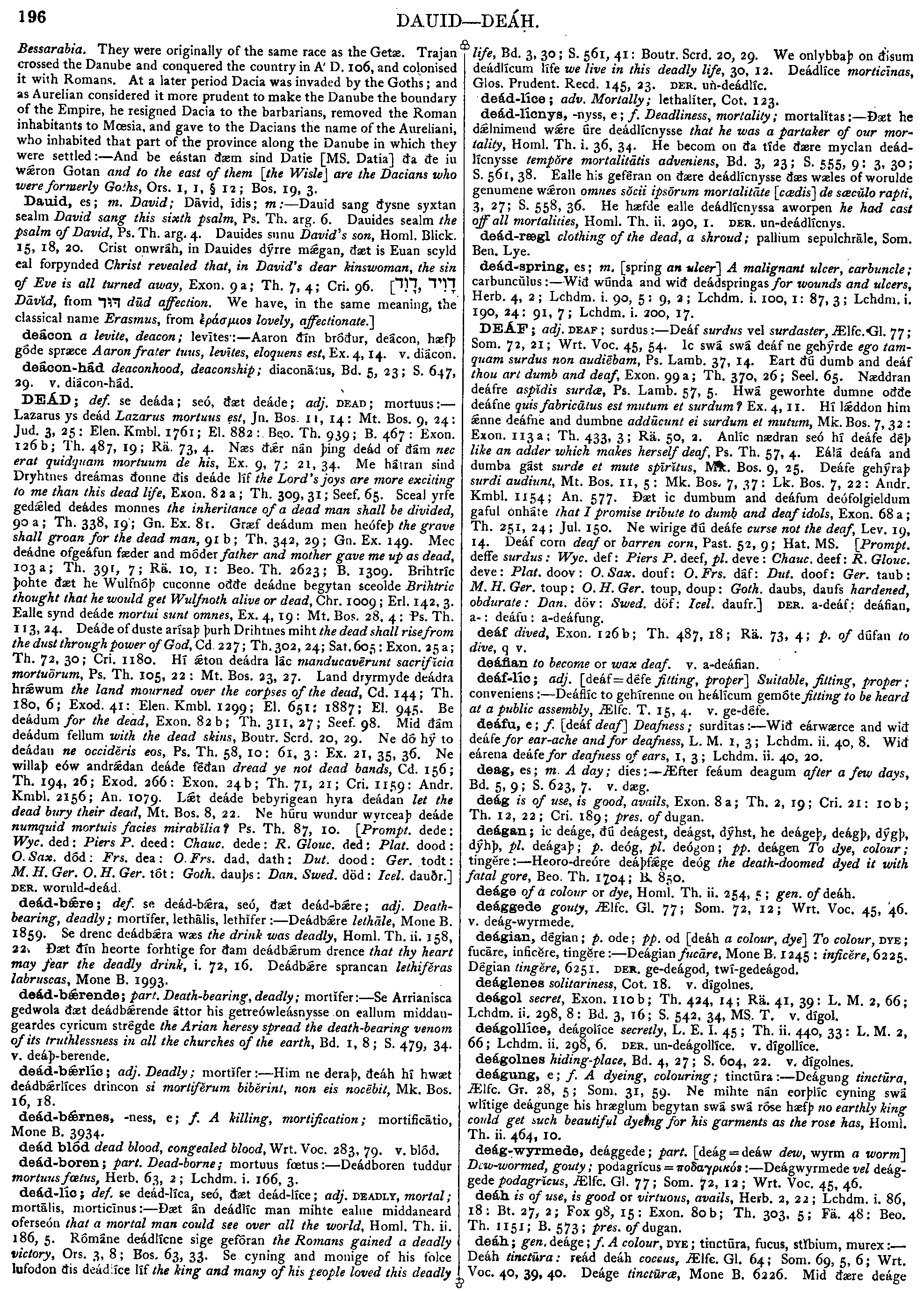
DEÁF;
adj.
DEAF;
surdus
:--
Deáf
surdus
vel
surdaster,
Ælfc.
Gl.
77;
Som.
72,
21;
Wrt.
Voc.
45,
54.
Ic
swá
swá
deáf
ne
gehýrde
ego
tamquam
surdus
non
audi bam,
Ps.
Lamb.
37,
14.
Eart
ðú
dumb
and
deáf
thou
art
dumb
and
deaf,
Exon.
99
a;
Th.
370,
26;
Seel.
65.
Næddran
deáfne
asp
bam,
Ps.
Lamb.
37,
14.
Eart
ðú
dumb
and
deáf
thou
art
dumb
and
deaf,
Exon.
99
a;
Th.
370,
26;
Seel.
65.
Næddran
deáfne
asp dis
surdæ,
Ps.
Lamb.
57,
5.
Hwá
geworhte
dumne
oððe
deáfne
quis
fabric
dis
surdæ,
Ps.
Lamb.
57,
5.
Hwá
geworhte
dumne
oððe
deáfne
quis
fabric tus
est
mutum
et
surdum?
Ex.
4,
11.
Hí
lddon
him
nne
deáfne
and
dumbne
add
tus
est
mutum
et
surdum?
Ex.
4,
11.
Hí
lddon
him
nne
deáfne
and
dumbne
add cunt
ei
surdum
et
mutum,
Mk.
Bos.
7,
32:
Exon.
113
a;
Th.
433,
3;
Rä.
50,
2.
Anlíc
nædran
seó
hí
deáfe
déþ
like
an
adder
which
makes
herself
deaf,
Ps.
Th.
57,
4.
Eálá
deáfa
and
dumba
gást
surde
et
mute
sprtus,
Mk.
Bos
9,
25.
Deáfe
gehýraþ
surdi
audiunt,
Mt.
Bos.
11,
5:
Mk.
Bos.
7,
37:
Lk.
Bos.
7,
22:
Andr.
cunt
ei
surdum
et
mutum,
Mk.
Bos.
7,
32:
Exon.
113
a;
Th.
433,
3;
Rä.
50,
2.
Anlíc
nædran
seó
hí
deáfe
déþ
like
an
adder
which
makes
herself
deaf,
Ps.
Th.
57,
4.
Eálá
deáfa
and
dumba
gást
surde
et
mute
sprtus,
Mk.
Bos
9,
25.
Deáfe
gehýraþ
surdi
audiunt,
Mt.
Bos.
11,
5:
Mk.
Bos.
7,
37:
Lk.
Bos.
7,
22:
Andr.
|
Source: Bosworth/Toller, page b0197, entry 20 View original page image as: [TIFF] [PNG] [View previous entry] [View next entry] |
[Comment on this entry] [View comments] |
The following entry has been hand-corrected once. |
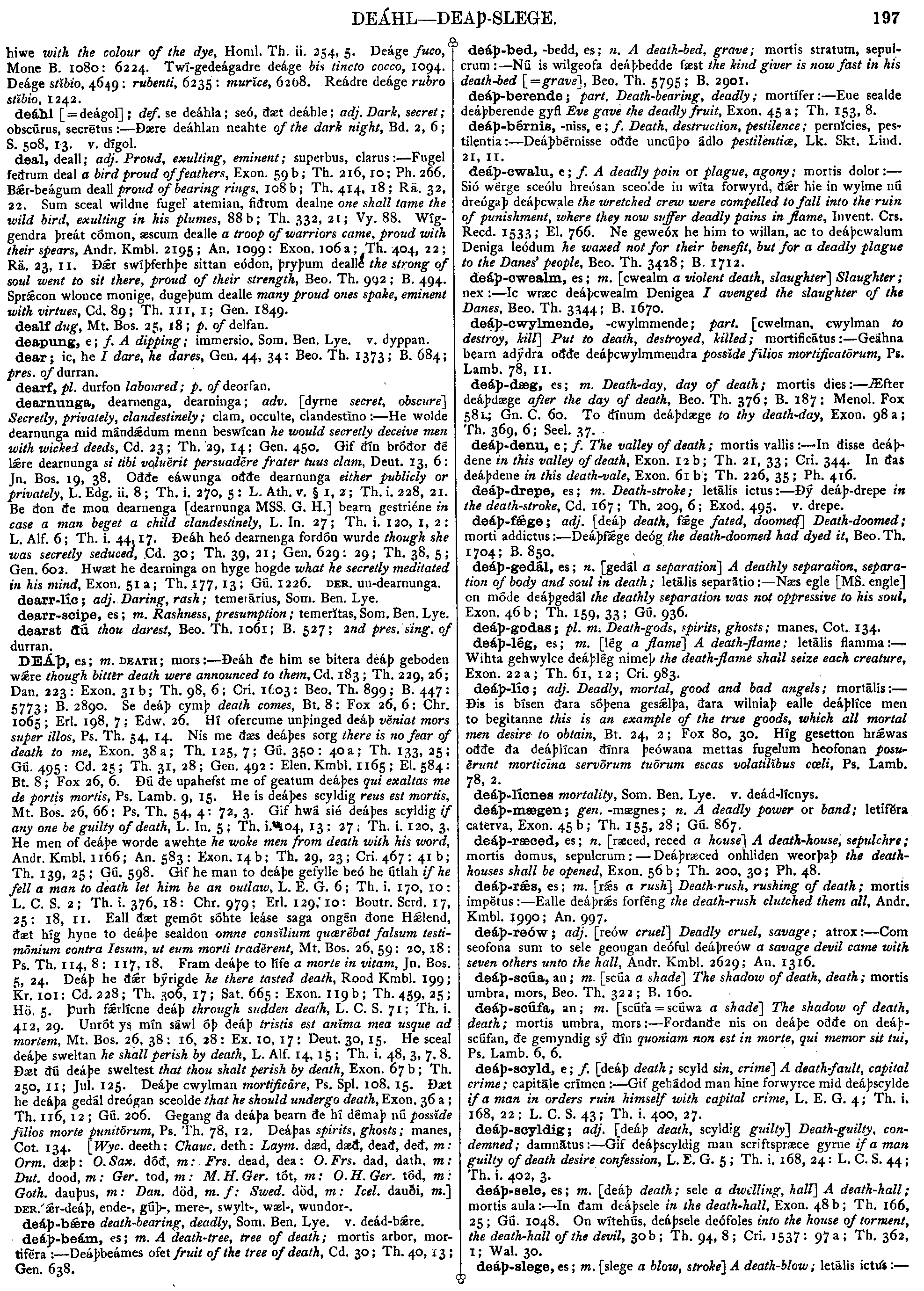
deáþ-dæg, es; m. Death-day, day of death; mortis dies :-- Æfter deáþdæge after the day of death, Beo. Th. 376; B. 187: Menol. Fox 581; Gn. C. 60. To ðínum deáþdæge to thy death-day, Exon. 98 a; Th. 369, 6; Seel. 37.
|
Source: Bosworth/Toller, page b0201, entry 11 View original page image as: [TIFF] [PNG] [View previous entry] [View next entry] |
[Comment on this entry] [View comments] |
The following entry has been hand-corrected once. |
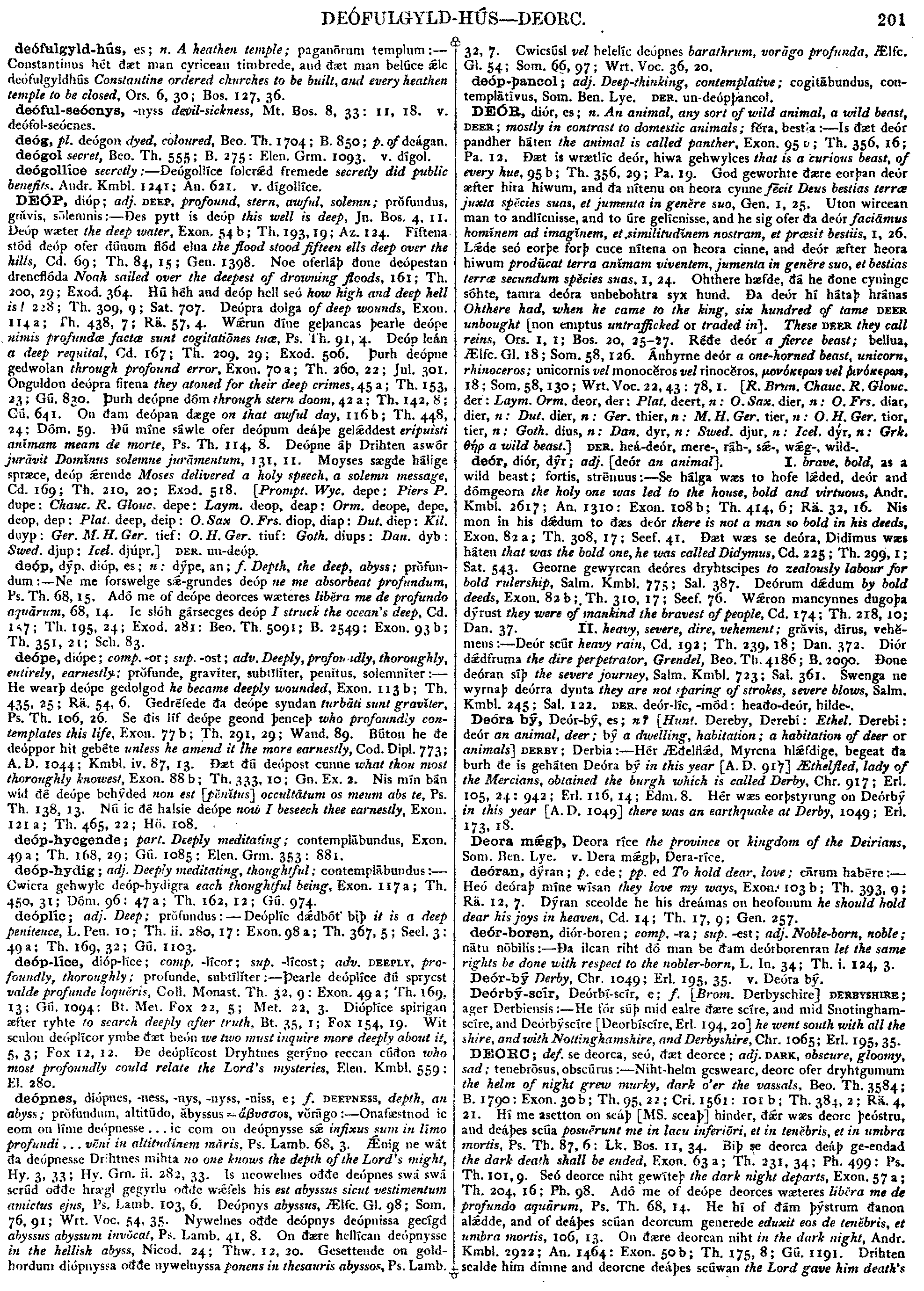
deóplic;
adj.
Deep;
pr fundus
:--
Deóplíc
ddbót
biþ
it
is
a
deep
penitence,
L.
Pen.
10;
Th.
ii.
280,
17:
Exon.
98
a;
Th.
367,
5;
Seel.
3:
49
a;
Th.
169,
32;
Gú.
1103.
fundus
:--
Deóplíc
ddbót
biþ
it
is
a
deep
penitence,
L.
Pen.
10;
Th.
ii.
280,
17:
Exon.
98
a;
Th.
367,
5;
Seel.
3:
49
a;
Th.
169,
32;
Gú.
1103.
|
Source: Bosworth/Toller, page b0207, entry 21 View original page image as: [TIFF] [PNG] [View previous entry] [View next entry] |
[Comment on this entry] [View comments] |
The following entry has been hand-corrected once. |
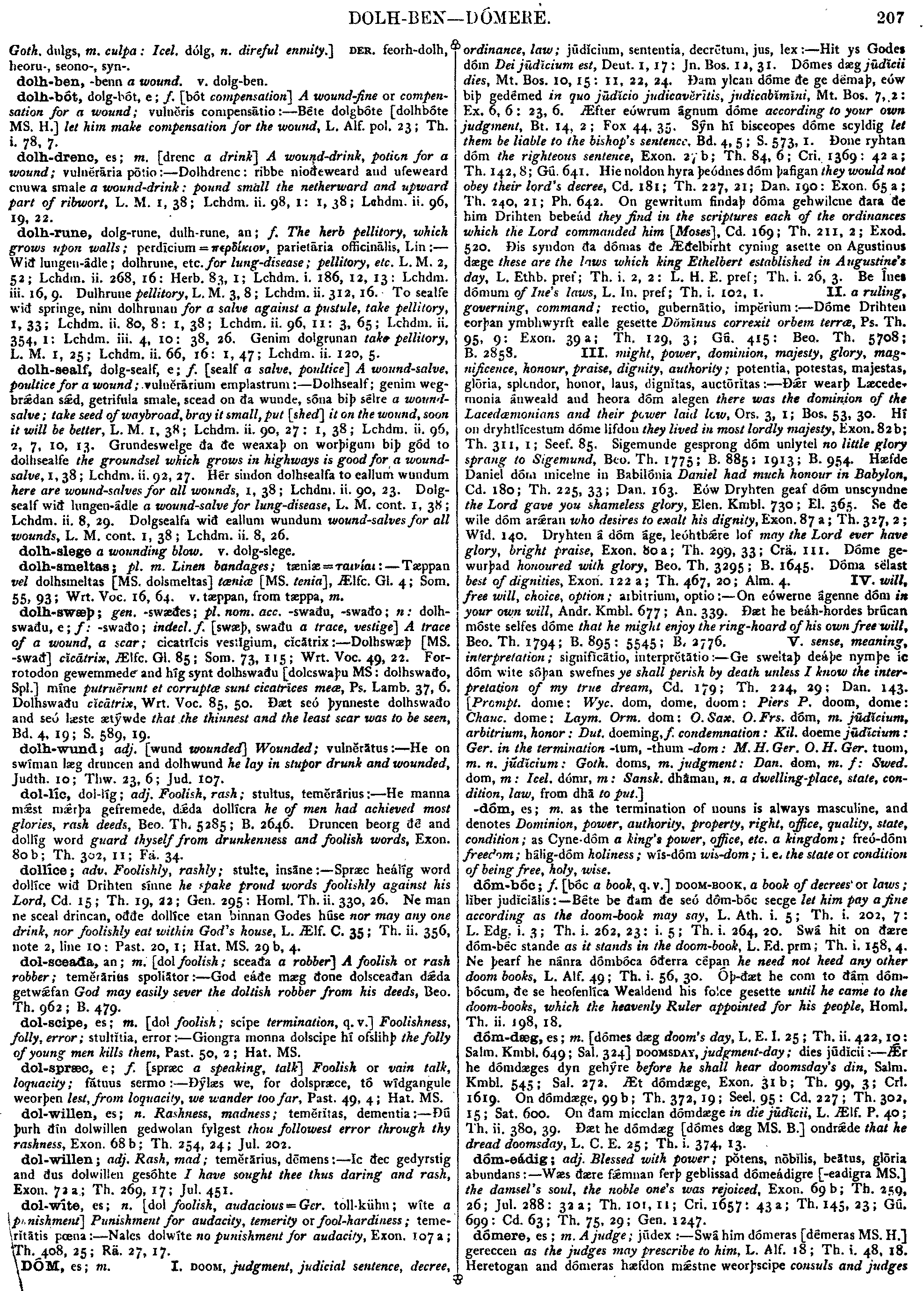
dóm-dæg,
es;
m.
[dómes
dæg
doom's
day,
L.
E.
I.
25;
Th.
ii.
422,
10:
Salm.
Kmbl.
649;
Sal.
324]
DOOMSDAY,
judgment-day;
dies
jdcii-Æ-acute;r
he
dómdæges
dyn
gehýre
before
he
shall
hear
doomsday's
din,
Salm.
Kmbl.
545;
Sal.
272.
Æt
dómdæge,
Exon.
31
b;
Th.
99,
3;
Cri.
1619.
On
dómdæge,
99
b;
Th.
372,
19;
Seel.
95:
Cd.
227;
Th.
302,
15;
Sat.
600.
On
ðam
micclan
dómdæge
in
die
jdcii,
L.
Ælf.
P.
40;
Th.
ii.
380,
39.
Ðæt
he
dómdæg
[dómes
dæg
MS.
B.]
ondrde
that
he
dread
doomsday,
L.
C.
E.
25;
Th.
i.
374,
13.
| Result Page: |  |
Previous | 1 2 3 4 5 6 7 8 9 10 11 12 13 | Next |  |
Germanic Lexicon Project (main page)
This search system was written by
Sean Crist
Please consider
volunteering
to correct the data in these online dictionaries.
No rights reserved. Feel free to use these data in any way you please.