|
|

|
Source: Bosworth/Toller, page b1006, entry 11 View original page image as: [TIFF] [PNG] [View previous entry] [View next entry] |
[Comment on this entry] [View comments (1)] |
The following entry has been hand-corrected once. |
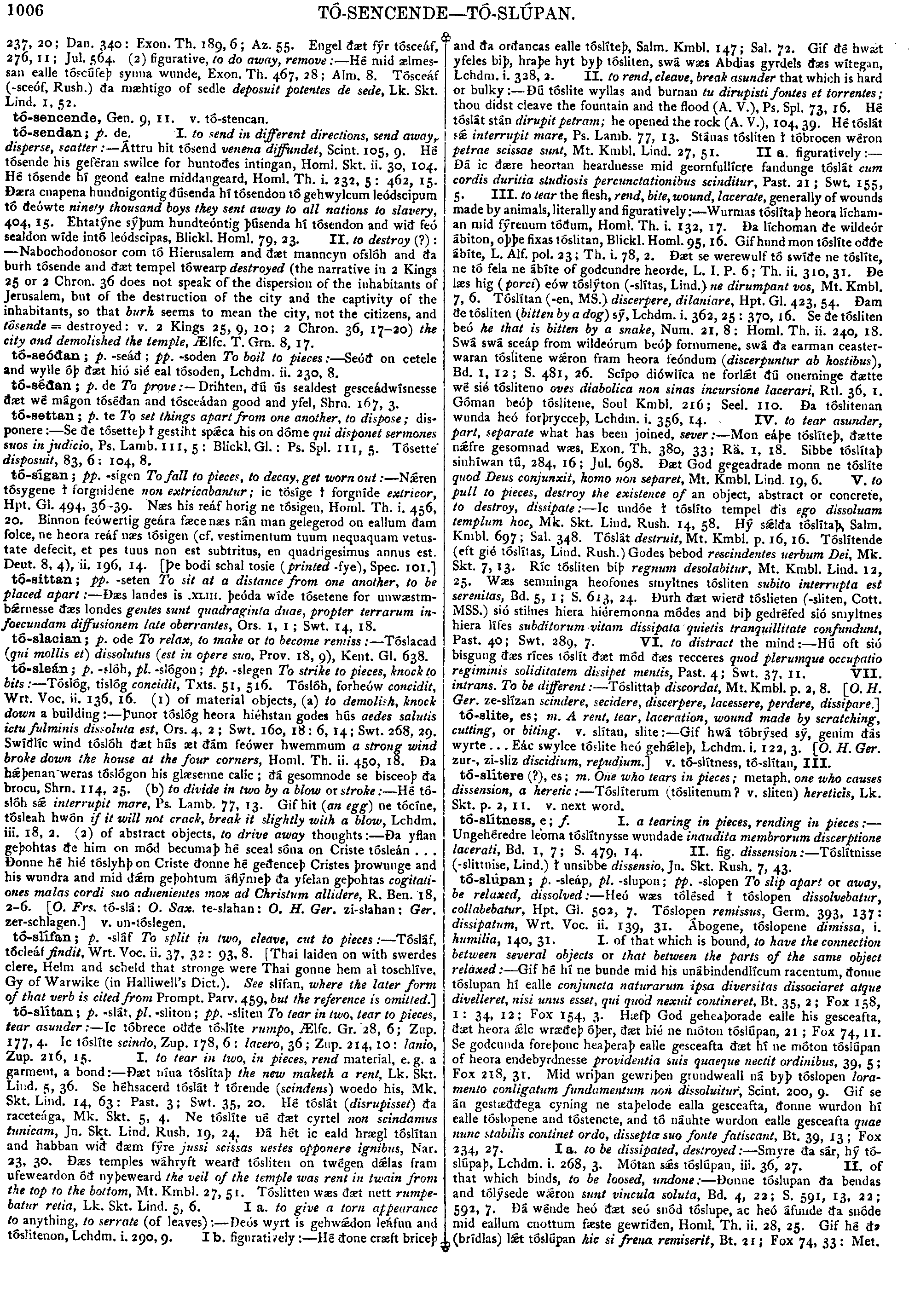
tó-slífan;
p.
-sláf
To
split
in
two,
cleave,
cut
to
pieces
:--
Tósláf,
tócleáf
findit.
Wrt.
Voc.
ii.
37,
32
:
93,
8.
[Thai
laiden
on
with
swerdes
clere,
Helm
and
scheld
that
stronge
were
Thai
gonne
hem
al
toschlíve,
Gy
of
Warwike
(in
Halliwell's
Dict.
).
See
slífan,
where
the
later
form
of
that
verb
is
cited
from
Prompt.
Parv.
459,
but
the
reference
is
omitted.
']
tó-slítan;
p.
-slát,
pl.
-sliton
;
pp.
-sliten
To
tear
in
two,
tear
to
pieces,
tear
asunder
:--
Ic
tóbrece
oððe
tóslíte
rumpo,
Ælfc.
Gr.
28,
6;
Zup.
177,
4.
Ic
tóslíte
scinrio,
Zup.
178,
6
:
lacero,
36;
Zup.
214,
10:
lanio,
Zup.
216,
15.
I.
to
tear
in
two,
in
pieces,
rend
material,
e.
g.
a
garment,
a
bond
:--
Ðæt
níua
tóslítaþ
the
new
maketh
a
rent,
Lk.
Skt.
Lind.
5,
36.
Se
héhsacerd
tóslát
 torende
(scindens)
woedo
his,
Mk.
Skt.
Lind.
14,
63:
Past.
3;
Swt.
35,
20.
Hé
tóslát
(disrupisset)
ða
raceteága,
Mk.
Skt.
5,
4.
Ne
tóslíte
ué
ðæt
cyrtel
non
scindamus
tunicam,
Jn.
Skt.
Lind.
Rush.
19,
24.
Ðá
hét
ic
eald
hrægl
tóslítan
and
habban
wið
ðæm
fýre
jussi
scissas
uestes
opponere
ignibus,
Nar.
23,
30.
Ðæs
temples
wáhryft
wearð
tósliten
on
twégen
d
torende
(scindens)
woedo
his,
Mk.
Skt.
Lind.
14,
63:
Past.
3;
Swt.
35,
20.
Hé
tóslát
(disrupisset)
ða
raceteága,
Mk.
Skt.
5,
4.
Ne
tóslíte
ué
ðæt
cyrtel
non
scindamus
tunicam,
Jn.
Skt.
Lind.
Rush.
19,
24.
Ðá
hét
ic
eald
hrægl
tóslítan
and
habban
wið
ðæm
fýre
jussi
scissas
uestes
opponere
ignibus,
Nar.
23,
30.
Ðæs
temples
wáhryft
wearð
tósliten
on
twégen
d las
fram
ufeweardon
oð
nyþeweard
the
veil
of
the
temple
was
rent
in
twain
from
the
top
to
the
bottom.
Mt.
Kmbl.
27,
51.
Tóslitten
wæs
ðæt
nett
rumpe-batur
retia,
Lk.
Skt.
Lind.
5,
6.
I
a.
to
give
a
torn
appearance
to
anything,
to
serrate
(of
leaves)
:--
Ðeós
wyrt
is
gehwdon
leáfun
and
tóslitenon,
Lchdm.
i.
290,
9.
I
b.
figuratively
:--
Hé
ðone
cræft
briceþ
and
ða
orðancas
ealle
tóslíteþ.
Salm.
Kmbl.
147;
Sal.
72.
Gif
ðé
hwæt
yfeles
biþ,
hraþe
hyt
byþ
tósliten,
swá
wæs
Abdias
gyrdels
ðæs
wítegan.
Lchdm.
i.
328,
2.
II.
to
rend,
cleave,
break
asunder
that
which
is
hard
or
bulky
:--
Ðú
tóslite
wyllas
and
burnan
tu
dirupisti
fontes
et
torrentes;
thou
didst
cleave
the
fountain
and
the
flood
(A.
V.
),
Ps.
Spl.
73,
16.
Hé
tóslát
stán
dirupit
petram;
he
opened
the
rock
(A.
V.
),
104,
39.
Hé
tóslát
sinterrupit
mare,
Ps.
Lamb.
77,
13.
Stánas
tósliten
tobrocen
wéron
petrae
scissae
sunt,
Mt.
Kmbl.
Lind.
27,
51.
II
a.
figuratively
:--
Ðá
ic
ðære
heortan
heardnesse
mid
geornfullícre
fandunge
tóslát
cum
cordis
duritia
studiosis
percunctationibus
scinditur.
Past.
21;
Swt.
155,
5.
III.
to
tear
the
flesh,
rend,
bite,
wound,
lacerate,
generally
of
wounds
made
by
animals,
literally
and
figuratively
:--
Wurmas
tóslítaþ
heora
lícham
las
fram
ufeweardon
oð
nyþeweard
the
veil
of
the
temple
was
rent
in
twain
from
the
top
to
the
bottom.
Mt.
Kmbl.
27,
51.
Tóslitten
wæs
ðæt
nett
rumpe-batur
retia,
Lk.
Skt.
Lind.
5,
6.
I
a.
to
give
a
torn
appearance
to
anything,
to
serrate
(of
leaves)
:--
Ðeós
wyrt
is
gehwdon
leáfun
and
tóslitenon,
Lchdm.
i.
290,
9.
I
b.
figuratively
:--
Hé
ðone
cræft
briceþ
and
ða
orðancas
ealle
tóslíteþ.
Salm.
Kmbl.
147;
Sal.
72.
Gif
ðé
hwæt
yfeles
biþ,
hraþe
hyt
byþ
tósliten,
swá
wæs
Abdias
gyrdels
ðæs
wítegan.
Lchdm.
i.
328,
2.
II.
to
rend,
cleave,
break
asunder
that
which
is
hard
or
bulky
:--
Ðú
tóslite
wyllas
and
burnan
tu
dirupisti
fontes
et
torrentes;
thou
didst
cleave
the
fountain
and
the
flood
(A.
V.
),
Ps.
Spl.
73,
16.
Hé
tóslát
stán
dirupit
petram;
he
opened
the
rock
(A.
V.
),
104,
39.
Hé
tóslát
sinterrupit
mare,
Ps.
Lamb.
77,
13.
Stánas
tósliten
tobrocen
wéron
petrae
scissae
sunt,
Mt.
Kmbl.
Lind.
27,
51.
II
a.
figuratively
:--
Ðá
ic
ðære
heortan
heardnesse
mid
geornfullícre
fandunge
tóslát
cum
cordis
duritia
studiosis
percunctationibus
scinditur.
Past.
21;
Swt.
155,
5.
III.
to
tear
the
flesh,
rend,
bite,
wound,
lacerate,
generally
of
wounds
made
by
animals,
literally
and
figuratively
:--
Wurmas
tóslítaþ
heora
lícham an
mid
fýrenum
tóðum,
Homl.
Th.
i.
132,
17.
Ða
líchoman
ðe
wildeór
ábiton,
oþþe
fixas
tóslitan,
Blickl.
Homl.
95,
16.
Gifhund
mon
tóslíte
oððe
ábíte,
L.
Alf.
pol.
23;
Th.
i.
78,
2.
Ðæt
se
werewulf
tó
swíðe
ne
tóslíte,
ne
tó
fela
ne
ábíte
of
godcundre
heorde,
L.
I.
P.
6;
Th.
ii.
310,
31.
Ðe
læs
hig
(porci)
eów
tóslýton
(-slítas,
Lind.
)
ne
dirumpant
vos,
Mt.
Kmbl.
7,
6.
Tóslítan
(-en,
MS.
)
discerpere,
dilaniare.
Hpt.
Gl.
423,
54.
Ðam
ðe
tósliten
(bitten
by
a
dog)
sý,
Lchdm.
i.
362,
25
:
370,
16.
Se
ðe
tósliten
beó
he
that
is
bitten
by
a
snake,
Num.
21,
8:
Homl.
Th.
ii.
240,
18.
Swá
swá
sceáp
from
wildeórum
beóþ
fornumene,
swá
ða
earman
ceasterwaran
tóslitene
wron
fram
heora
feóndum
(discerpuntur
ab
hostibus),
Bd.
1,
12
;
S.
481,
26.
Scípo
diówlíca
ne
forlt
ðú
onerninge
ðætte
wé
sié
tósliteno
oves
diabolica
non
sinas
incursione
lacerari.
Rtl.
36,
1.
Góman
beóþ
tóslitene,
Soul
Kmbl.
216;
Seel.
110.
Ða
tóslitenan
wunda
heó
forþrycceþ,
Lchdm.
i.
356,
14.
IV.
to
tear
asunder,
part,
separate
what
has
been
joined,
sever
:--
Mon
eá
þe
tóslíteþ,
ðætte
nfre
gesomnad
wæs,
Exon.
Th.
380,
33;
Rä.
1.
18.
Sibbe
tóslítaþ
sinhíwan
tú,
284,
16;
Jul.
698.
Ðæt
God
gegeadrade
monn
ne
tóslíte
quod
Deus
conjunxit,
homo
non
separet.
Mt.
Kmbl.
Lind.
19,
6.
V.
to
pull
to
pieces,
destroy
the
existence
of
an
object,
abstract
or
concrete,
to
destroy,
dissipate
:--
Ic
undóe
tóslíto
tempel
ðis
ego
dissoluam
templum
hoc,
Mk.
Skt.
Lind.
Rush.
14,
58.
Hý
slða
tóslítaþ,
Salm.
Kmbl.
697;
Sal.
348.
Tóslát
destruit,
Mt.
Kmbl.
p.
16,
16.
Tóslítende
(eft
gié
tóslítas,
Lind.
Rush.
)
Godes
bebod
rescindentes
uerbum
Dei,
Mk.
Skt.
7,
13.
Ríc
tósliten
biþ
regnum
desolabitur,
Mt.
Kmbl.
Lind.
12,
25.
Wæs
semninga
heofones
smyltnes
tósliten
subito
interrupta
est
serenitas,
Bd.
5,
1
;
S.
613,
24.
Ðurh
ðæt
wierð
tóslieten
(-sliten,
Cott.
MSS.)
sió
stilnes
hiera
hiéremonna
módes
and
biþ
gedréfed
sió
smyltnes
hiera
lífes
subditorum
vitam
dissipata
quietis
tranquillitate
confundunt,
Past.
40;
Swt.
289,
7.
VI.
to
distract
the
mind
:--
Hú
oft
sió
bisgung
ðæs
ríces
tóslít
ðæt
mód
ðæs
recceres
quod
plerumque
occupatio
regiminis
soliditatem
dissipet
mentis,
Past.
4;
Swt.
37,
11.
VII.
intrans.
To
be
different
:--
Tóslittaþ
discordat,
Mt.
Kmbl.
p.
2,
8.
[O.
H.
Ger.
ze-slízan
scindere,
secidere,
discerpere,
lacessere,
perdere,
dissipare.]
tó-slite,
es;
m.
A
rent,
lear,
laceration,
wound
made
by
scratching,
cutting,
or
biting,
v.
slítan,
slite
:--
Gif
hwá
tóbrýsed
sý,
genim
ðás
wyrte
.
.
.
Eác
swylce
tóslite
heó
gehleþ,
Lchdm.
i.
122,
3.
[O.
H.
Ger.
zur-,
zi-sliz
discidium,
repudium.]
v.
tó-slítness,
tó-slítan,
III.
an
mid
fýrenum
tóðum,
Homl.
Th.
i.
132,
17.
Ða
líchoman
ðe
wildeór
ábiton,
oþþe
fixas
tóslitan,
Blickl.
Homl.
95,
16.
Gifhund
mon
tóslíte
oððe
ábíte,
L.
Alf.
pol.
23;
Th.
i.
78,
2.
Ðæt
se
werewulf
tó
swíðe
ne
tóslíte,
ne
tó
fela
ne
ábíte
of
godcundre
heorde,
L.
I.
P.
6;
Th.
ii.
310,
31.
Ðe
læs
hig
(porci)
eów
tóslýton
(-slítas,
Lind.
)
ne
dirumpant
vos,
Mt.
Kmbl.
7,
6.
Tóslítan
(-en,
MS.
)
discerpere,
dilaniare.
Hpt.
Gl.
423,
54.
Ðam
ðe
tósliten
(bitten
by
a
dog)
sý,
Lchdm.
i.
362,
25
:
370,
16.
Se
ðe
tósliten
beó
he
that
is
bitten
by
a
snake,
Num.
21,
8:
Homl.
Th.
ii.
240,
18.
Swá
swá
sceáp
from
wildeórum
beóþ
fornumene,
swá
ða
earman
ceasterwaran
tóslitene
wron
fram
heora
feóndum
(discerpuntur
ab
hostibus),
Bd.
1,
12
;
S.
481,
26.
Scípo
diówlíca
ne
forlt
ðú
onerninge
ðætte
wé
sié
tósliteno
oves
diabolica
non
sinas
incursione
lacerari.
Rtl.
36,
1.
Góman
beóþ
tóslitene,
Soul
Kmbl.
216;
Seel.
110.
Ða
tóslitenan
wunda
heó
forþrycceþ,
Lchdm.
i.
356,
14.
IV.
to
tear
asunder,
part,
separate
what
has
been
joined,
sever
:--
Mon
eá
þe
tóslíteþ,
ðætte
nfre
gesomnad
wæs,
Exon.
Th.
380,
33;
Rä.
1.
18.
Sibbe
tóslítaþ
sinhíwan
tú,
284,
16;
Jul.
698.
Ðæt
God
gegeadrade
monn
ne
tóslíte
quod
Deus
conjunxit,
homo
non
separet.
Mt.
Kmbl.
Lind.
19,
6.
V.
to
pull
to
pieces,
destroy
the
existence
of
an
object,
abstract
or
concrete,
to
destroy,
dissipate
:--
Ic
undóe
tóslíto
tempel
ðis
ego
dissoluam
templum
hoc,
Mk.
Skt.
Lind.
Rush.
14,
58.
Hý
slða
tóslítaþ,
Salm.
Kmbl.
697;
Sal.
348.
Tóslát
destruit,
Mt.
Kmbl.
p.
16,
16.
Tóslítende
(eft
gié
tóslítas,
Lind.
Rush.
)
Godes
bebod
rescindentes
uerbum
Dei,
Mk.
Skt.
7,
13.
Ríc
tósliten
biþ
regnum
desolabitur,
Mt.
Kmbl.
Lind.
12,
25.
Wæs
semninga
heofones
smyltnes
tósliten
subito
interrupta
est
serenitas,
Bd.
5,
1
;
S.
613,
24.
Ðurh
ðæt
wierð
tóslieten
(-sliten,
Cott.
MSS.)
sió
stilnes
hiera
hiéremonna
módes
and
biþ
gedréfed
sió
smyltnes
hiera
lífes
subditorum
vitam
dissipata
quietis
tranquillitate
confundunt,
Past.
40;
Swt.
289,
7.
VI.
to
distract
the
mind
:--
Hú
oft
sió
bisgung
ðæs
ríces
tóslít
ðæt
mód
ðæs
recceres
quod
plerumque
occupatio
regiminis
soliditatem
dissipet
mentis,
Past.
4;
Swt.
37,
11.
VII.
intrans.
To
be
different
:--
Tóslittaþ
discordat,
Mt.
Kmbl.
p.
2,
8.
[O.
H.
Ger.
ze-slízan
scindere,
secidere,
discerpere,
lacessere,
perdere,
dissipare.]
tó-slite,
es;
m.
A
rent,
lear,
laceration,
wound
made
by
scratching,
cutting,
or
biting,
v.
slítan,
slite
:--
Gif
hwá
tóbrýsed
sý,
genim
ðás
wyrte
.
.
.
Eác
swylce
tóslite
heó
gehleþ,
Lchdm.
i.
122,
3.
[O.
H.
Ger.
zur-,
zi-sliz
discidium,
repudium.]
v.
tó-slítness,
tó-slítan,
III.
|
Source: Bosworth/Toller, page b1007, entry 21 View original page image as: [TIFF] [PNG] [View previous entry] [View next entry] |
[Comment on this entry] [View comments (1)] |
The following entry has been hand-corrected once. |
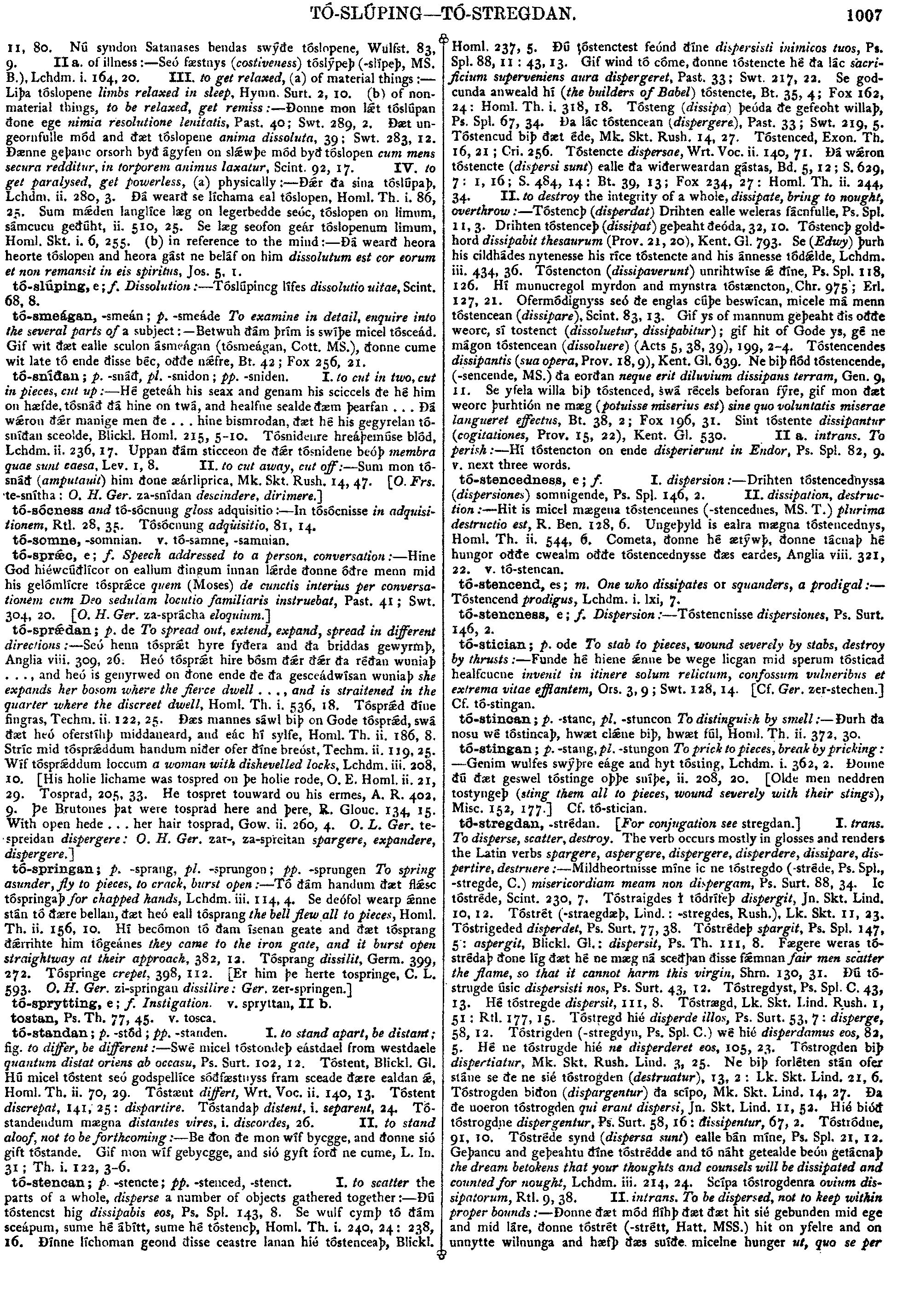
tó-stregdan,
-strédan.
[For
conjugation
see
stregdan.]
I.
trans.
To
disperse,
scatter,
destroy.
The
verb
occurs
mostly
in
glosses
and
renders
the
Latin
verbs
spargere,
aspergere,
dispergere,
disperdere,
dissipare,
dis-pertire,
destruere
:--
Mildheortnisse
míne
ic
ne
tóstregdo
(-stréde.
Ps.
Spl.
,
|
Source: Bosworth/Toller, page b1008, entry 14 View original page image as: [TIFF] [PNG] [View previous entry] [View next entry] |
[Comment on this entry] [View comments (1)] |
The following entry has been hand-corrected once. |
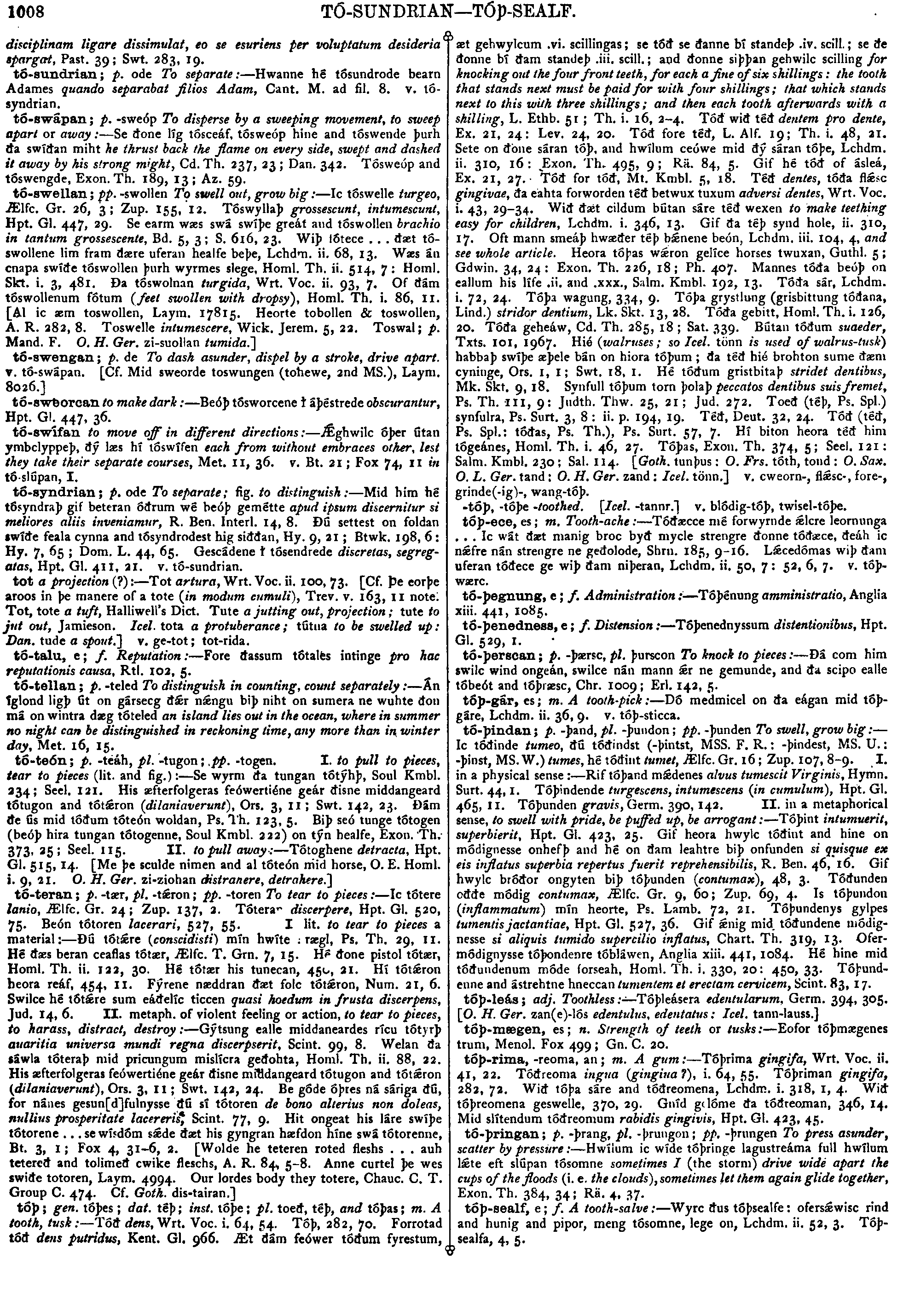
tóþ
gen.
tóþes;
dat.
téþ,
inst.
tóþe;
pl.
toeð,
téþ,
and
tóþas;
m.
A
tooth,
tusk
:--
Tóð
dens,
Wrt.
Voc.
i.
64,
54.
Tóþ,
282,
70.
Forrotad
tóð
dens
putridus,
Kent.
Gl.
966.
Æt
ðám
feówer
tóðum
fyrestum,
æt
gehwylcum
.
vi.
scillingas;
se
tóð
se
ðanne
bí
standeþ
.
iv.
scill
;
se
ðe
ðonne
bí
dam
standeþ
.
iii.
scill.
;
and
ðonne
siþþan
gehwilc
scilling
for
knocking
out
the
four
front
teeth,
for
each
a
fine
of
six
shillings:
the
tooth
that
stands
next
must
be
paid
for
with
four
shillings;
that
which
stands
next
to
this
with
three
shillings;
and
then
each
tooth
afterwards
with
a
shilling,
L.
Ethb.
51;
Th.
i.
16,
2-4.
Tóð
wið
téð
dentem
pro
dente,
Ex.
21,
24:
Lev.
24,
20.
Tóð
fore
téð,
L.
Alf.
19;
Th.
i.
48,
21.
Sete
on
ðone
sáran
tóþ,
and
hwílum
ceówe
mid
ðý
sáran
tóþe,
Lchdm.
ii.
310,
16
:
.
Exon.
Th.
495,
9
;
Ra.
84,
5.
Gif
hé
tóð
of
ásleá,
Ex.
21,
27.
Tóð
for
tóð,
Mt.
Kmbl.
5,
18.
Téð
dentes,
tóða
flsc
gingivae,
ða
eahta
forworden
téð
betwux
tuxum
adversi
dentes,
Wrt.
Voc.
i.
43,
29-34.
Wið
ðaét
cildum
bútan
sáre
téð
wexen
to
make
teething
easy
for
children,
Lchdm.
i.
346,
13.
Gif
ða
téþ
synd
hole,
ii.
310,
17.
Oft
mann
smeáþ
hwæðer
téþ
bnene
beón,
Lchdm.
iii.
104,
4,
and
see
whole
article.
Heora
tóþas
wron
gelíce
horses
twuxan.
Guthl.
5
;
Gdwin.
34,
24:
Exon.
Th.
226,
18;
Ph.
407.
Mannes
tóða
beóþ
on
eallum
his
lífe
.
ii.
and
.xxx.
,
Salm.
Kmbl.
192,
13.
Tóða
sár.
Lchdm.
i.
72,
24.
Tóþa
wagung,
334,
9.
Tóþa
grystlung
(grisbittung
tóðana,
Lind.
)
stridor
dentium,
Lk.
Skt.
13,
28.
Tóða
gebitt.
Homl.
Th.
i.
126,
20.
Tóða
geheáw,
Cd.
Th.
285,
18
;
Sae.
339.
Bútan
tóðum
suaeder,
Txts.
101,
1967.
Hié
(walruses;
so
Icel.
tonn
is
used
of
walrus-tusk)
habbaþ
swíþe
æþele
bán
on
hiora
tóðum
;
ða
téð
hié
brohton
sume
ðæm
cyninge.
Ors.
1.
1;
Swt.
18,
1.
Hé
tóðum
gristbitaþ
stridet
dentibus,
Mk.
Skt.
9,
18.
Synfull
toþum
torn
þolaþ
peccatos
dentibus
suis
fremet,
Ps.
Th.
in,
9:
Judth.
Thw.
25,
21;
Jud.
272.
Toeð
(téþ,
Ps.
Spl.
)
synfulra.
Ps.
Surt.
3,
8
:
ii.
p.
194,
19.
Téð,
Deut.
32,
24.
Tóð
(téð,
Ps.
Spl.
:
tóðas,
Ps.
Th.
),
Ps.
Surt.
57,
7.
Hí
biton
heora
téð
him
tógeánes,
Homl.
Th.
i.
46,
27.
Tóþas,
Exon.
Th.
374,
5;
Seel.
121:
Salm.
Kmbl.
230;
Sal.
114.
[Goth.
tunþus:
O.
Frs.
tóth,
tond
:
O.
Sax.
O.
L.
Ger.
zand:
O.
H.
Ger.
zand:
Icel.
tonn.]
v.
cweorn-,
flsc-,
fore-,
grinde(-ig)-,
wang-tóþ.
|
Source: Bosworth/Toller, page b1009, entry 9 View original page image as: [TIFF] [PNG] [View previous entry] [View next entry] |
[Comment on this entry] [View comments] |
The following entry has been hand-corrected once. |
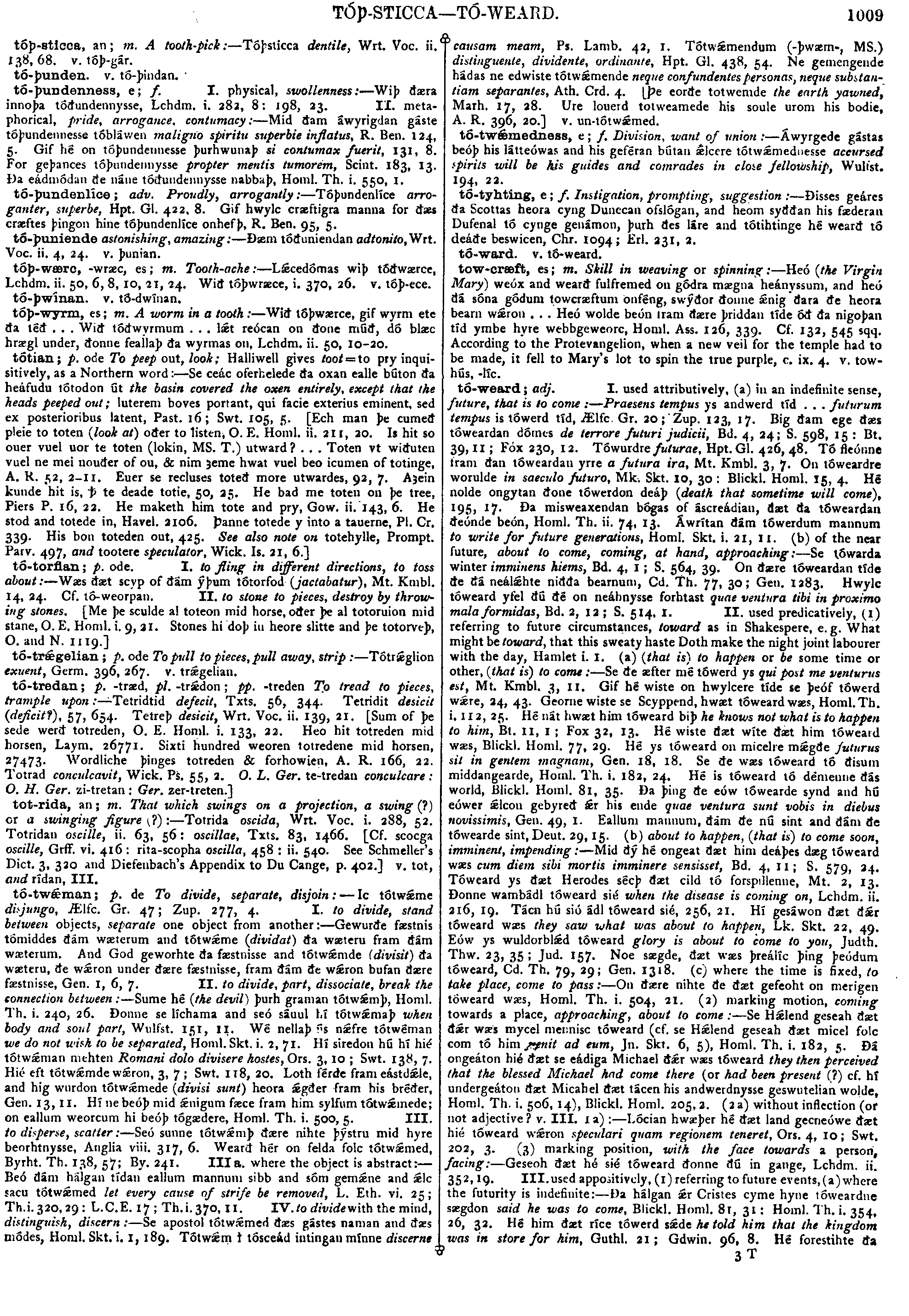
tótian; p. ode To peep out, look; Halliwell gives toot=to pry inquisitively, as a Northern word :-- Se ceác oferhelede ða oxan ealle búton ða heáfudu tótodon út the basin covered the oxen entirely, except that the heads peeped out; luterem boves portant, qui facie exterius eminent, sed ex posterioribus latent, Past. 16; Swt. 105, 5. [Ech man þe cumeð pleie to toten (look at) oðer to listen, O. E. Homl. ii. 211, 20. Is hit so ouer vuel nor te toten (lokin, MS. T. ) utward ? . . . Toten vt wiðuten vuel ne mei nouðer of ou, & nim jeme hwat vuel beo icumen of totinge, A. R. 52, 2-II. Euer se recluses toteó more utwardes, 92, 7. Ajein kunde hit is, þ te deade totie, 50, 25. He bad me toten on þe tree. Piers P. 16, 22. He maketh him ecte and pry, Gow. ii. 143, 6. He stod and totede in, Havel. 2106. þanne totede y into a tauerne, Pl. Cr. 339. His bon toteden out, 425. See also note on totehylle, Prompt. Parv. 497, and tootere speculator, Wick. Is. 21, 6.]
|
Source: Bosworth/Toller, page b1009, entry 13 View original page image as: [TIFF] [PNG] [View previous entry] [View next entry] |
[Comment on this entry] [View comments] |
The following entry has been hand-corrected once. |
tot-rida, an; m. That which swings on a projection, a swing (?) or a swinging figure (?) :-- Totrida oscida, Wrt. Voc. i. 288, 52. Totridan oscille, ii. 63, 56: oscillae, Txts. 83, 1466. [Cf. scocga oscille, Grff. vi. 416 : rita-scopha oscilla, 458 : ii. 540. See Schmeller's Dict. 3, 320 and Diefenbach's Appendix to Du Cange, p. 402.] v. tot, and rídan, III.
|
Source: Bosworth/Toller, page b1012, entry 25 View original page image as: [TIFF] [PNG] [View previous entry] [View next entry] |
[Comment on this entry] [View comments] |
The following entry has been hand-corrected once. |
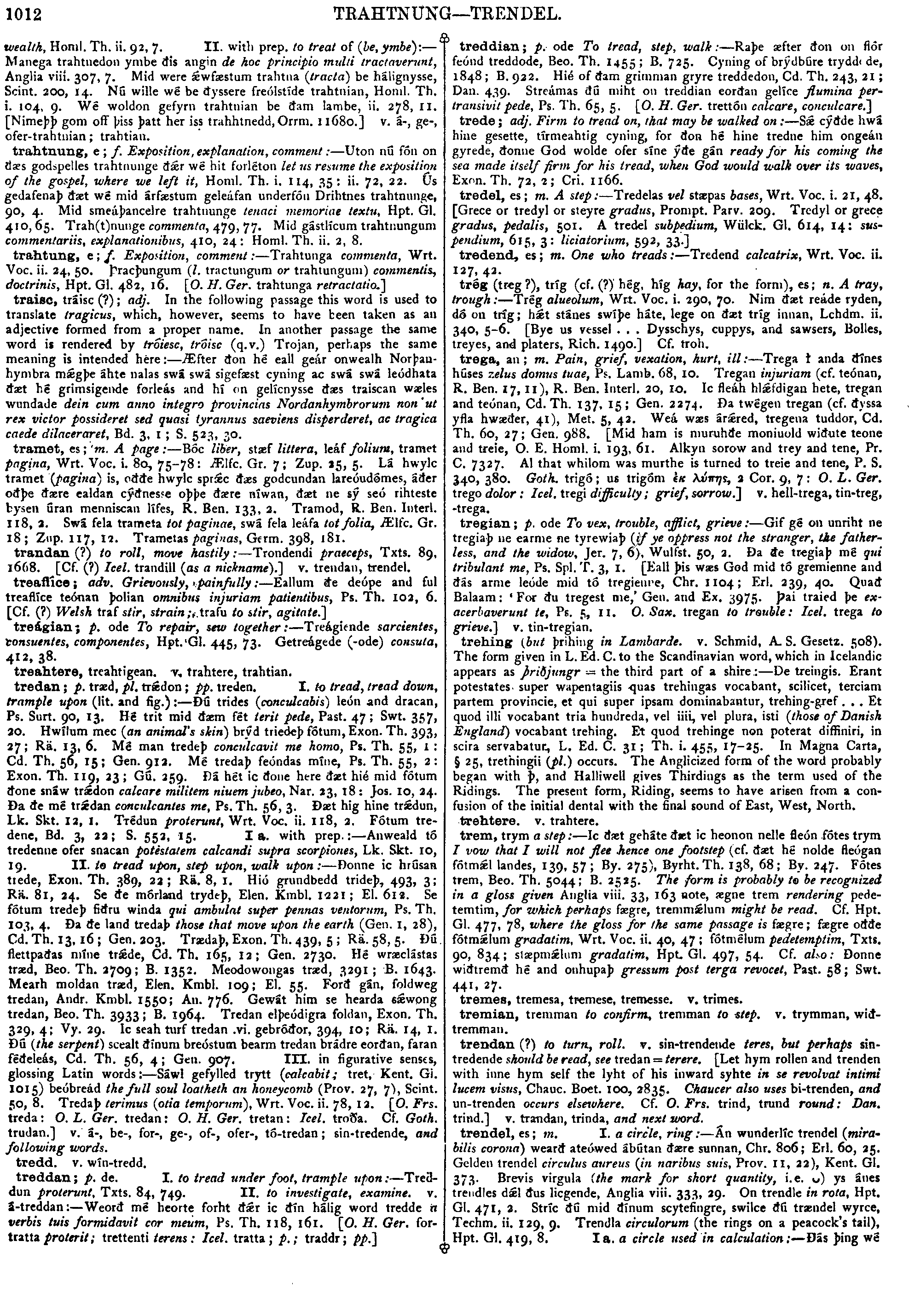
trendan (?) to turn, , roll. v. sin-trendet. de teres, but perhaps sin-tredende should be read, see tredan = terere. [Let hym rollen and trenden with inne hym self the lyht of his inward syhte in se revolvat intimi lucem visus, Chauc. Boet. 100, 2835. Chaucer also uses bi-trenden, and un-trenden occurs elsewhere. Cf. O. Frs. trind, trund round: Dan. trind.] v. trandan, trinda, and next word.
|
Source: Bosworth/Toller, page b1013, entry 6 View original page image as: [TIFF] [PNG] [View previous entry] [View next entry] |
[Comment on this entry] [View comments (2)] |
The following entry has been hand-corrected once. |
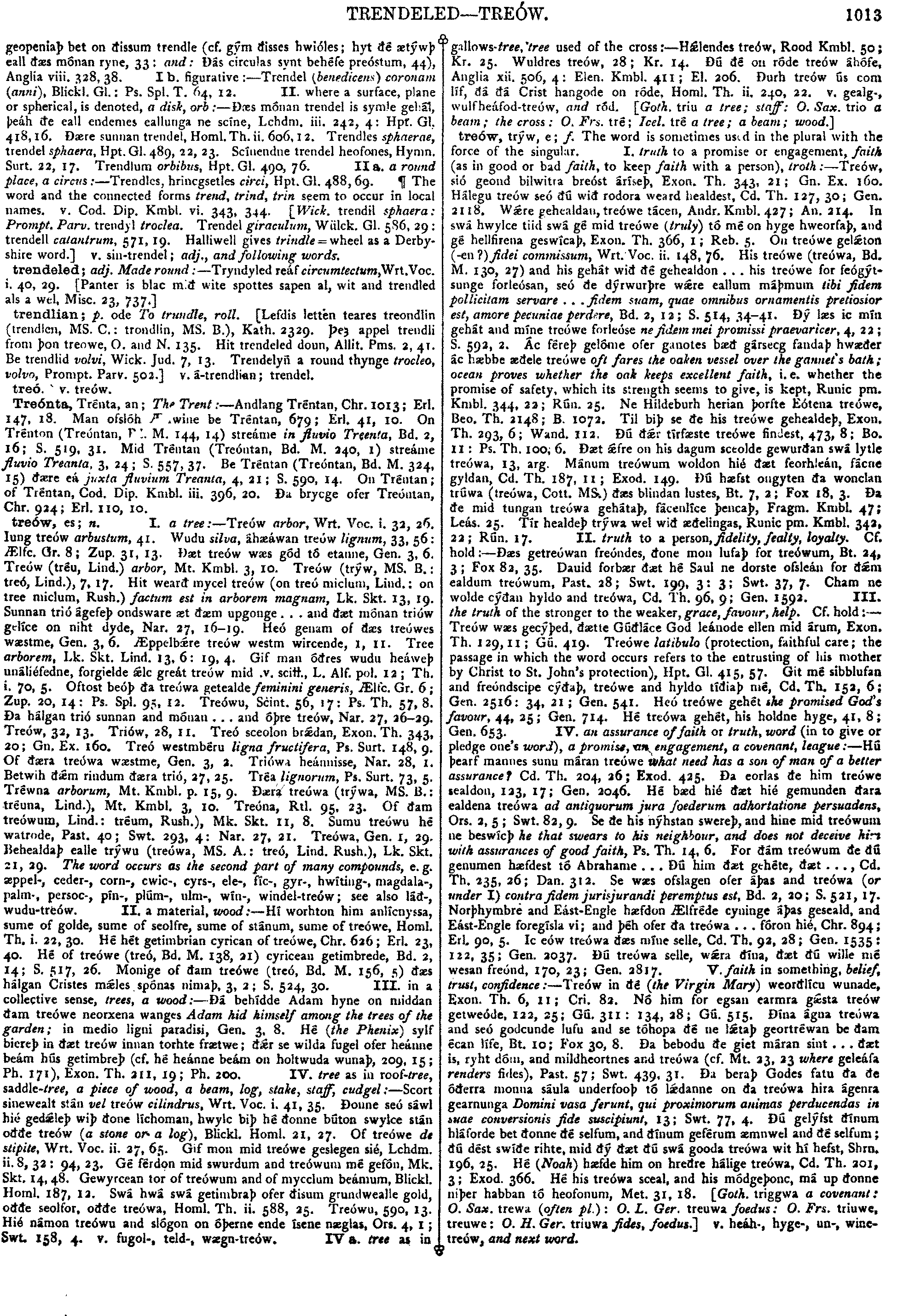
treów,
es;
n.
I.
a
tree
:--
Treów
arbor,
Wrt.
Voc.
i.
32,
26.
Iung
treów
arbustum,
41.
Wudu
silva.
a.
áhæáwan
treów
lignum,
33,
56:
Ælfc.
Gr.
8;
Zup.
31,
13.
Ðæt
treów
wæs
gód
tó
etanne,
Gen.
3,
6.
Treów
(tréu,
Lind.
)
arbor,
Mt.
Kmbl.
3,
10.
Treów
(trýw,
MS.
B.
:
treó,
Lind.
),
7a
17
wearð
mycel
treów
(on
treó
miclum).
Lind.
:
on
tree
miclum,
Rush.
factum
est
in
arborem
magnam,
Lk.
Skt.
13,
19.
Sunnan
trió
ágefeþ
ondsware
æt
ðæm
upgonge
.
.
.
and
ðæt
monan
triów
gerlice
on
niht
dyde,
Nar.
27,
16-19.
Heó
genam
of
ðæs
treówes
wæstme,
Gen.
3,
6.
Æppelbre
treów
westm
wircende,
l,
11.
Tree
arborem,
Lk.
Skt.
Lind.
13,
6:
19,
4.
Gif
man
óðres
wudu
heáweþ
unáliéfedne,
forgielde
lc
greát
treów
mid
.
v.
sci.
,
L.
Alf.
pol.
12
;
Th.
i.
70.
5.
Óftost
beóþ
ða
treówa
getealde
feminini
generis,
Ælfc.
Gr.
6
;
Zup.
20,
14:
Ps.
Spl.
95,
12.
Treówu,
Scint.
56,
17:
Ps.
Th.
57,
8.
Ða
hálgan
trió
sunnan
and
mónan
.
.
.
and
óþre
treów,
Nar.
27,
.
16-29.
Treów,
32,
13,
Triów,
28,
11.
Treó
sceolon
brdan,
Exon.
Th.
343,
20;
On.
Ex.
160.
Treó
westmbéru
ligna
fructifera.
Ps.
Surt.
148,
9.
Of
ðæra
treówa
wæstme,
Gen.
3,
2.
Triówa
heánnisse,
Nar.
28,
1.
Betwih
ðm
rindum
ðæra
trió,
27,
25.
Tréa
lígnorum,
Ps.
Surt.
73,
5.
Tréwna
arborum,
Mt.
Kmbl.
p.
15,
9.
Ðæra
treówa
(trýwa,
MS.
B.
:
tréuna,
Lind.
),
Mt.
Kmbl.
3,
10.
Treóna,
Rtl.
95,
23.
Of
ðam
treówum,
Lind.
:
tréum,
Rush.,
Mk.
Skt.
11,
8.
Sumu
treówu
he
watrode.
Past.
40;
Swt.
293,
4:
Nar.
27,
21.
Treówa,
Gen.
1,
29.
Behealdaþ
ealle
trýwu
(treówa,
MS.
A.
:
treó,
Lind.
Rush.
),
Lk.
Skt.
21,
29.
The
word
occurs
as
the
second
part
of
many
compounds,
e.
g.
seppel-,
ceder-,
corn-,
cwic-,
cyrs-,
ele-,
fíc-,
gyr-,
hwíting-,
magdala-,
palm-,
persoc-,
pín-,
plúm-,
ulm-,
wín-,
windel-treów;
see
also
láð-,
wudu-treów.
II.
a
material,
wood
:--
Hí
worhton
him
anlícnyssa,
sume
of
golde,
sume
of
seolfre,
sume
of
stánum,
sume
of
treówe,
Homl.
Th.
i.
22,
30.
Hé
hét
getimbrian
cyrican
of
treówe,
Chr.
626
;
Erl.
23,
40.
Hé
of
treówe
(treó,
Bd.
M.
138,
21)
cyricean
getimbrede,
Bd.
2,
14;
S.
517,
26.
Monige
of
ðam
treówe
(treó,
Bd.
M.
156,
5)
ðæs
hálgan
Cristes
mles
spónas
nimaþ,
3,
2;
S.
524,
30.
III.
in
a
collective
sense,
trees,
a
wood
:--
Ð
á
behídde
Adam
hyne
on
middan
ðam
treówe
neorxena
wanges
Adam
hid
himself
among
the
trees
of
the
garden;
in
medio
ligni
paradisi,
Gen.
3,
8.
Hé
(the
Phenix]
sylf
bicreþ
in
ð
æt
treów
innan
torhte
frætwe;
ðr
se
wilda
fugel
ofer
heunne
beám
hús
getimbreþ
(cf.
hé
heánne
beám
on
holtwuda
wunaþ,
209,
15;
Ph.
171),
Exon.
Th.
211,
19;
Ph.
200.
IV.
tree
as
in
roof-tree,
saddle-
tree,
a
piece
of
wood,
a
beam,
log,
stake,
staff,
cudgel
:--
Scort
sineweah
stall
vel
treów
cilindrus,
Wrt.
Voc.
i.
41,
35.
Ðonne
seó
sáwl
hié
gedleþ
wiþ
ðone
líchoman,
hwylc
biþ
hé
ðonne
búton
swylce
stán
oððe
treów
(a
stone
or
a
log).
Blickl.
Homl.
21,
27.
Of
treówe
de
stipite.
Wrt.
Voc.
ii.
27,
65.
Gif
mon
mid
treówe
geslegen
sié,
Lchdm.
ii.
S.
32
:
94,
23.
Gé
férdon
mid
swurdum
and
treówuiu
mé
gefón,
Mk.
Skt.
14,
48.
Gewyrcean
tor
of
treówum
and
of
mycclum
beámum,
Blickl.
Homl.
187,
12.
Swá
hwá
swá
getimbraþ
ofer
ðisum
grundwealle
gold,
oððe
seolfor,
oððe
treówa,
Homl.
Th.
ii.
588,
25.
Treówu,
590,
13.
Hié
námon
treówu
and
slógon
on
óþerne
ende
ísene
neglas,
Ors.
4,
1;
Swt.
158,
4.
v.
fugol-,
teld-,
wægn-treów.
IV
a.
tree
as
in
gallows-
tree,
tree
used
of
the
cross
:--
Hlendes
treów,
Rood
Kmbl.
50;
Kr.
25.
Wuldres
treów,
28
;
Kr.
14.
Ðú
ðé
on
róde
treów
áhófe,
Anglia
xii.
506,
4:
Elen.
Kmbl.
411;
El.
206.
Ðurh
treów
ús
com
líf,
ðá
ðá
Crist
hangode
on
róde,
Homl.
Th.
ii.
240,
22.
v.
gealg-,
wulfheáfod-treów,
and
ród.
[Goth.
triu
a
tree;
staff:
O.
Sax.
trio
a
beam;
the
cross
:
O.
Frs.
tré;
Icel,
tré
a
tree;
a
beam;
wood.]
|
Source: Bosworth/Toller, page b1015, entry 23 View original page image as: [TIFF] [PNG] [View previous entry] [View next entry] |
[Comment on this entry] [View comments] |
The following entry has been hand-corrected once. |
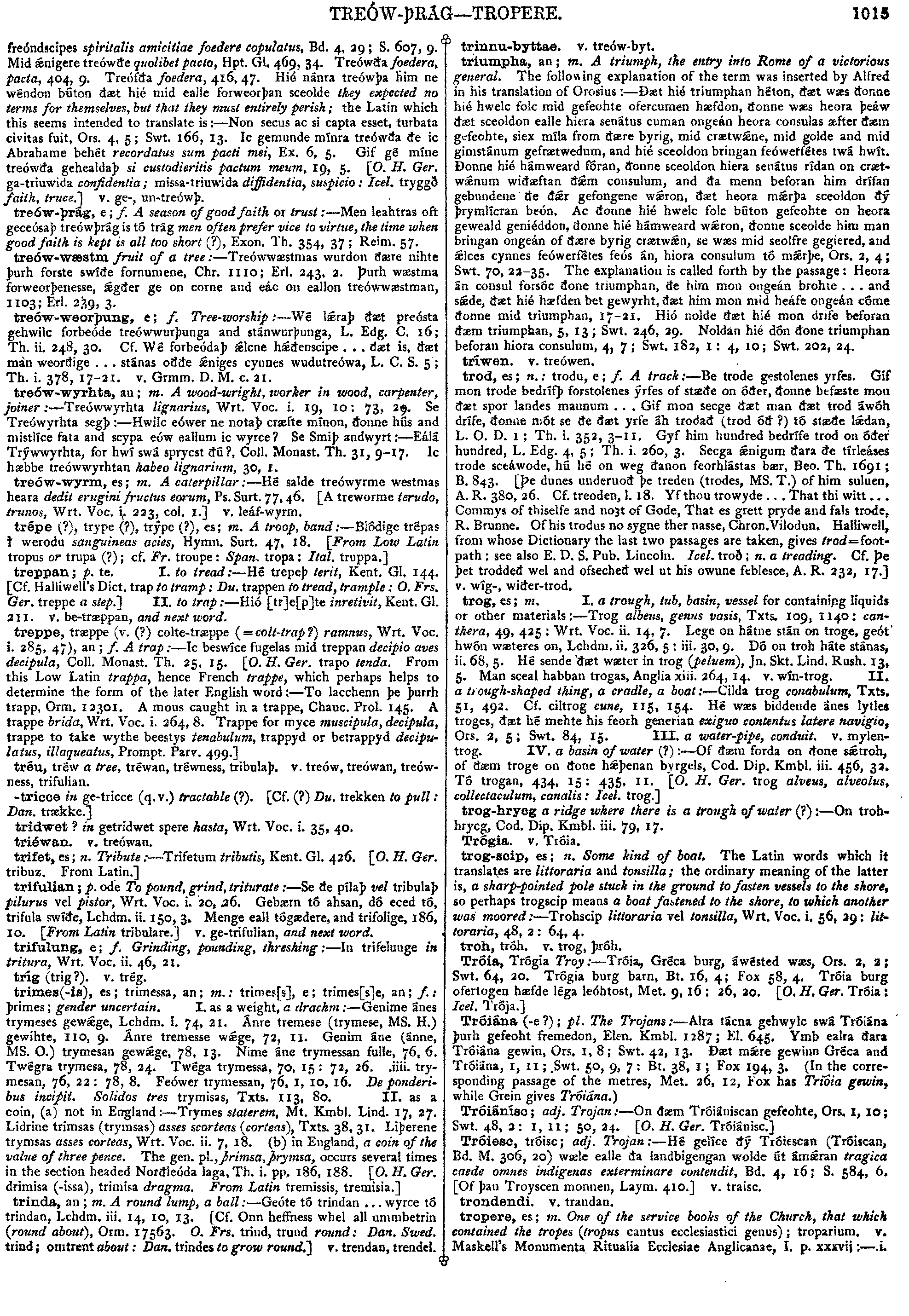
trod,
es;
n.
:
trodu,
e;
f.
A
track
:--
Be
trode
gestolenes
yrfes.
Gif
mon
trode
bedrífþ
forstolenes
yrfes
of
stæðe
on
óðer,
ðonne
befæste
mon
ðæt
spor
landes
mannum
.
.
.
Gif
mon
secge
ðæt
man
ðæt
trod
áwóh
drífe,
ðonne
mót
se
ðe
ðæt
yrfe
áh
trodað
(trod
óð
?)
tó
stæðe
ldan,
L.
O.
Ð.
1
;
Th.
i.
352,
3-11.
Gyf
him
hundred
bedrífe
trod
on
óðer
hundred,
L.
Edg.
4,
5
;
Th.
i.
260,
3.
Secga
nigum
ðara
ðe
tírleáses
trode
sceáwode,
hú
hé
on
weg
ðanon
feorhlástas
bær.
Beo.
Th.
1691;
B.
843.
[þe
dunes
underuoð
þe
treden
(trodes,
MS.
T.
)
of
him
suluen,
A.
R.
380,
26.
Cf.
treoden,
1.
18.
Yf
thou
trowyde
.
.
.
That
thi
witt.
.
.
Commys
of
thiselfe
and
not
of
Gode,
That
es
grett
pryde
and
fals
trode,
R.
Brunne.
Of
his
trodus
no
sygne
ther
nasse,
Chron.
Vilodun.
Halliwell,
from
whose
Dictionary
the
last
two
passages
are
taken,
gives
trod=footpath
:
see
also
E.
D.
S.
Pub.
Lincoln.
Icel.
troð;
n.
a
treading.
Cf.
þe
þet
troddeð
wel
and
ofsecheð
wel
ut
his
owune
feblesce,
A.
R.
232,
17.]
v.
wíg-,
wiðer-trod.
|
Source: Bosworth/Toller, page b1016, entry 17 View original page image as: [TIFF] [PNG] [View previous entry] [View next entry] |
[Comment on this entry] [View comments] |
The following entry has been hand-corrected once. |
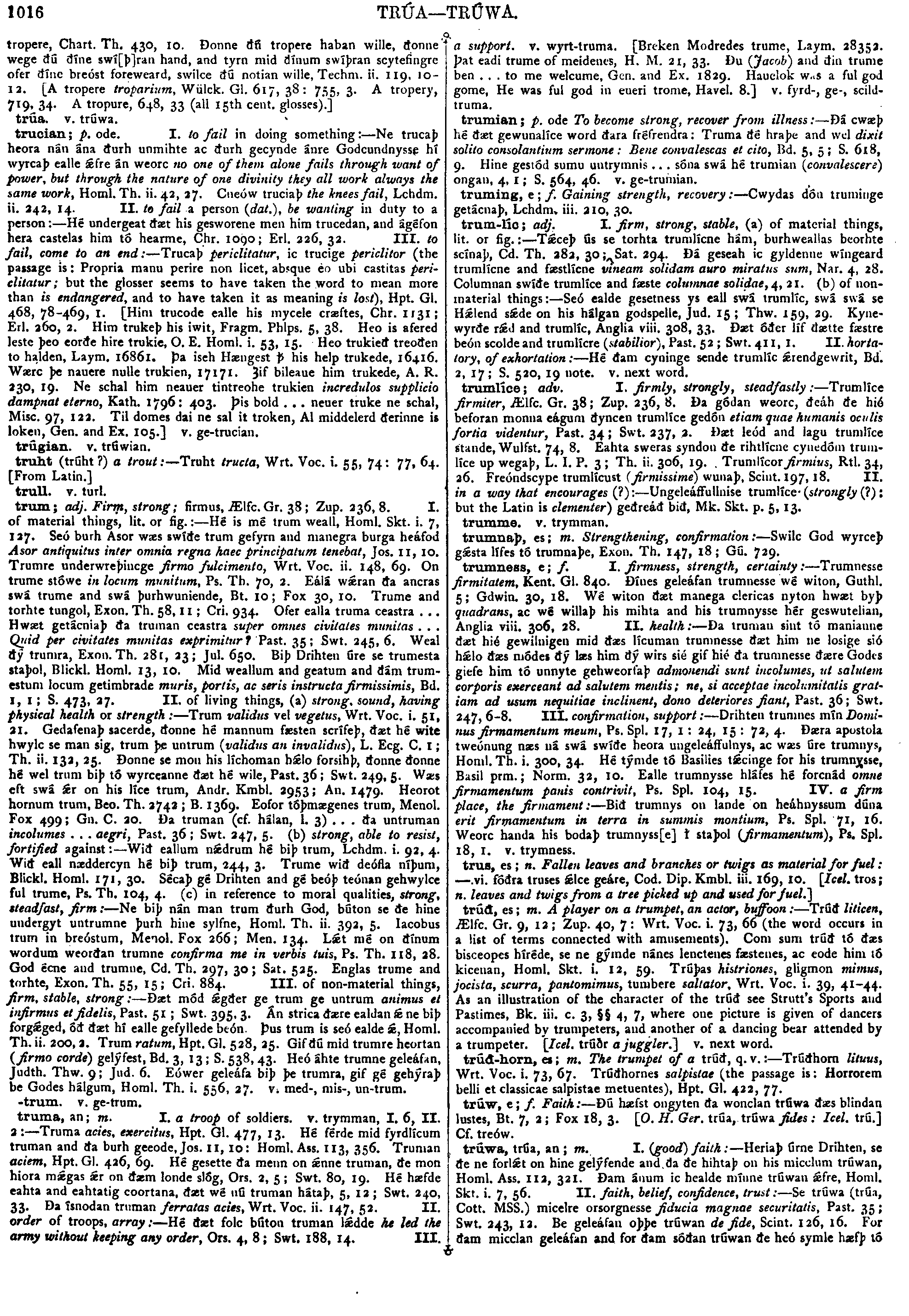
trúð, es; m. A player on a trumpet, an actor, buffoon :-- Trúð liticen, Ælfc. Gr. 9, 12; Zup. 40, 7: Wrt. Voc. i. 73, 66 (the word occurs in a list of terms connected with amusements). Com sum trúð tó ðæs bisceopes híréde, se ne gýmde nánes lenctenes fæstenes, ac eode him tó kicenan, Homl. Skt. i. 12, 59. Trúþas histriones, gligmon mimus, jocista, scurra, pantomimus, tumbere saltator. Wrt. Voc. i. 39, 41-44. As an illustration of the character of the trúð see Strutt's Sports and Pastimes, Bk. iii. c. 3, § § 4, 7, where one picture is given of dancers accompanied by trumpeters, and another of a dancing bear attended by a trumpeter. [Icel. trúðr a juggler.] v. next word.
|
Source: Bosworth/Toller, page b1018, entry 17 View original page image as: [TIFF] [PNG] [View previous entry] [View next entry] |
[Comment on this entry] [View comments] |
The following entry has been hand-corrected once. |
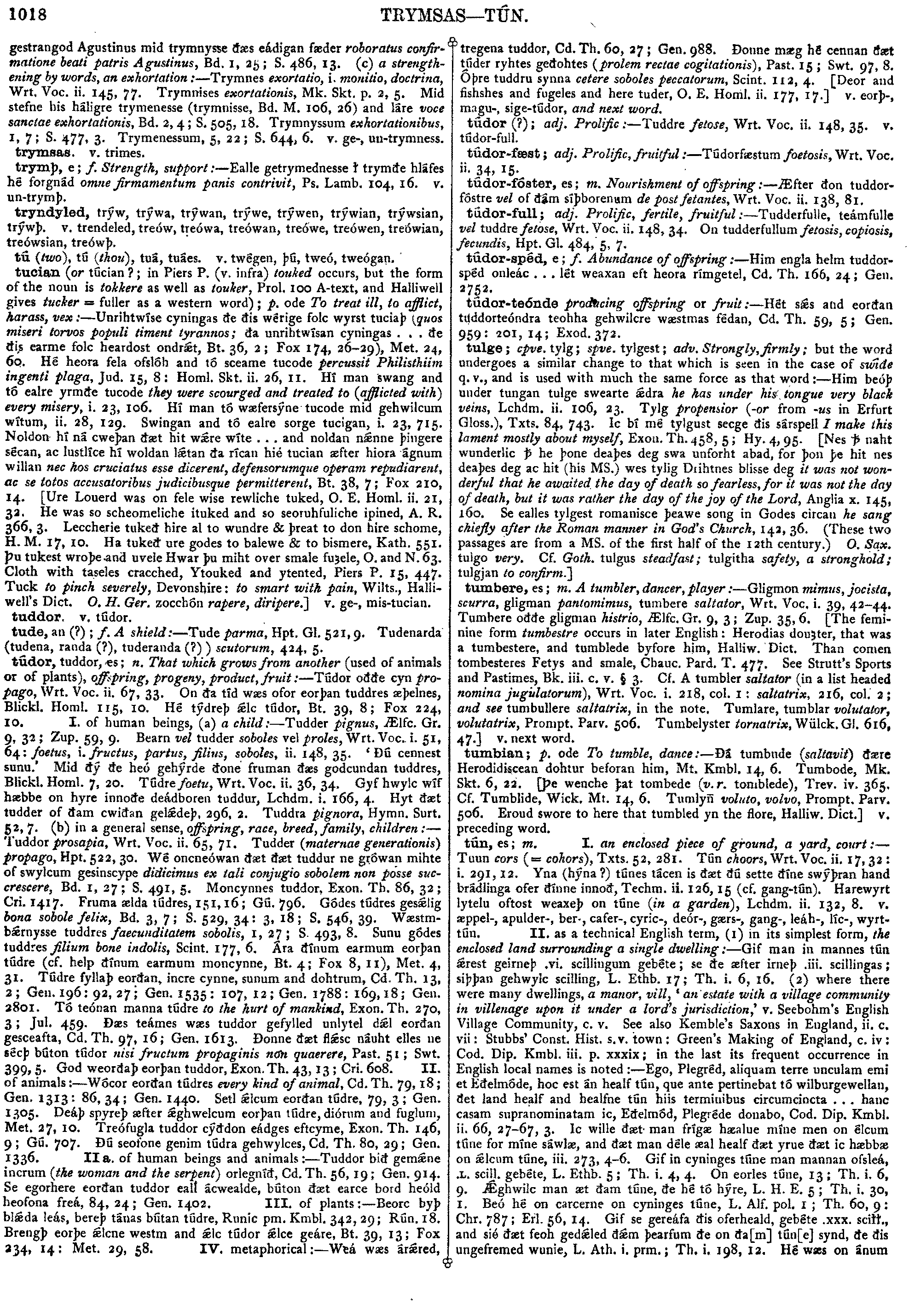
tumbere,
es;
m.
A
tumbler,
dancer,
player:
--
Gligmon
mimus,
jocista,
scurra,
gligman
pantomimus,
tumbere
saltator,
Wrt.
Voc.
i.
39,
42-44.
Tumbere
oððe
gligman
histrio,
Ælfc.
Gr.
9,
3;
Zup.
35,
6.
[The
feminine
form
tumbestre
occurs
in
later
English:
Herodias
dou ter,
that
was
a
tumbestere,
and
tumblede
byfore
him.
Halliw.
Dict.
Than
comen
tombesteres
Fetys
and
smale.
Chauc.
Pard.
T.
477.
See
Strutt's
Sports
and
Pastimes,
Bk.
iii.
c.
v.
§
3.
Cf.
A
tumbler
saltator
(in
a
list
headed
nomina
jugulatorum),
Wrt.
Voc.
i.
218,
col.
2:
saltatrix,
216,
col.
2;
and
see
tumbullere
saltalrix,
in
the
note.
Tumlare,
tumblar
volutator,
volutatrix,
Prompt.
Parv.
506.
Tumbelyster
tornatrix,
Wülck.
Gl.
616,
47.]
v.
next
word.
ter,
that
was
a
tumbestere,
and
tumblede
byfore
him.
Halliw.
Dict.
Than
comen
tombesteres
Fetys
and
smale.
Chauc.
Pard.
T.
477.
See
Strutt's
Sports
and
Pastimes,
Bk.
iii.
c.
v.
§
3.
Cf.
A
tumbler
saltator
(in
a
list
headed
nomina
jugulatorum),
Wrt.
Voc.
i.
218,
col.
2:
saltatrix,
216,
col.
2;
and
see
tumbullere
saltalrix,
in
the
note.
Tumlare,
tumblar
volutator,
volutatrix,
Prompt.
Parv.
506.
Tumbelyster
tornatrix,
Wülck.
Gl.
616,
47.]
v.
next
word.
| Result Page: |  |
Previous | 72 73 74 75 76 77 78 79 80 81 82 83 84 85 86 87 88 89 90 | Next |  |
Germanic Lexicon Project (main page)
This search system was written by
Sean Crist
Please consider
volunteering
to correct the data in these online dictionaries.
No rights reserved. Feel free to use these data in any way you please.