|
|

Search for Sceal again, using less strict matching (1731 results)
|
Source: Bosworth/Toller, page d0580, entry 28 View original page image as: [TIFF] [PNG] [View previous entry] [View next entry] |
[Comment on this entry] [View comments (1)] |
The following entry has been hand-corrected once. |
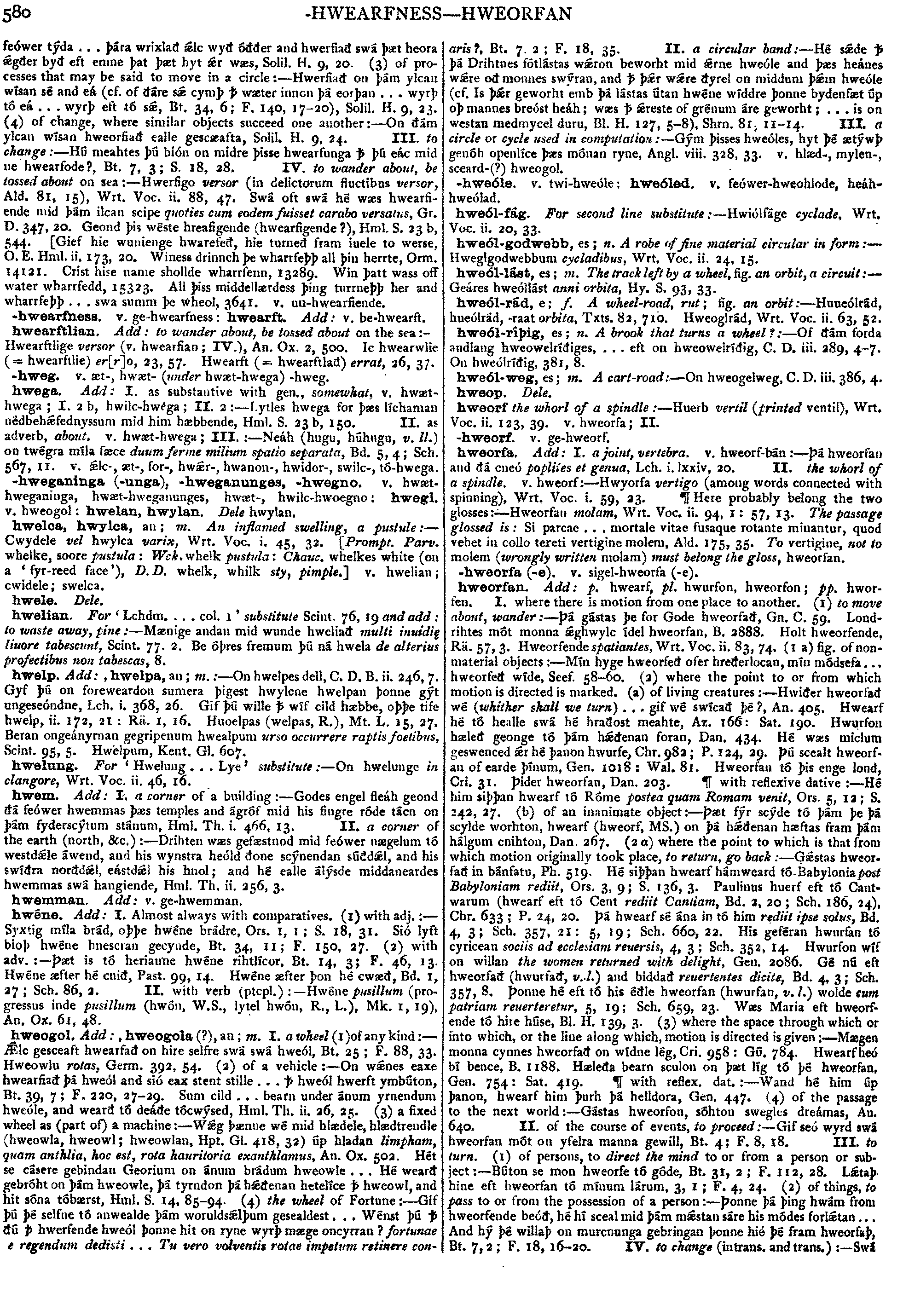
hweorfan.
Add:
p.
hwearf,
pl.
hwurfon,
hweorfon;
pp.
hworfen.
I.
where
there
is
motion
from
one
place
to
another.
(1)
to
move
about,
wander
:--
Þá
gástas
þe
for
Gode
hweorfað,
Gn.
C.
59.
Lond-rihtes
 mót
monna
mót
monna
 ghwylc
ídel
hweorfan,
B.
2888.
Holt
hweorfende,
Rä,
57,
3.
Hweorfende
spatiantes,
Wrt.
Voc.
ii.
83,
74.
(1
a)
fig.
of
non-material
objects
:--
Mín
hyge
hweorfeð
ofer
hreðer
locan,
mín
módsefa.
.
.
hweorfeð
wíde,
Seef.
58-60.
(2)
where
the
point
to
or
from
which
motion
is
directed
is
marked.
(a)
of
living
creatures
:--
Hwiðer
hweorfað
wé
(whither
shall
we
turn)
.
.
.
gif
wé
swícað
þé
?,
An.
405.
Hwearf
hé
tó
healle
swá
hé
hraðost
meahte,
Az.
166:
Sat.
190.
Hwurfon
hæleð
geonge
tó
þám
hðenan
foran,
Dan.
434.
Hé
wæs
miclum
geswenced
r
hé
þanon
hwurfe,
Chr.
982
;
P.
124,
29.
Þú
scealt
hweorfan
of
earde
þínum,
Gen.
1018
:
Wal.
81.
Hweorfan
tó
þis
enge
lond,
Cri.
31.
Þider
hweorfan,
Dan.
203.

with
reflexive
dative
:--
Hé
him
siþþan
hwearf
tó
Róme
postea
quam
Roman
venit,
Ors.
5,
12
;
S.
242,
27.
(b)
of
an
inanimate
object
:--
Þæt
fýr
scýde
tó
þám
þe
þá
scylde
worhton,
hwearf
(hweorf,
MS.
)
on
þá
hðenan
hæftas
fram
þám
hálgum
cnihton,
Dan.
267.
(2
ghwylc
ídel
hweorfan,
B.
2888.
Holt
hweorfende,
Rä,
57,
3.
Hweorfende
spatiantes,
Wrt.
Voc.
ii.
83,
74.
(1
a)
fig.
of
non-material
objects
:--
Mín
hyge
hweorfeð
ofer
hreðer
locan,
mín
módsefa.
.
.
hweorfeð
wíde,
Seef.
58-60.
(2)
where
the
point
to
or
from
which
motion
is
directed
is
marked.
(a)
of
living
creatures
:--
Hwiðer
hweorfað
wé
(whither
shall
we
turn)
.
.
.
gif
wé
swícað
þé
?,
An.
405.
Hwearf
hé
tó
healle
swá
hé
hraðost
meahte,
Az.
166:
Sat.
190.
Hwurfon
hæleð
geonge
tó
þám
hðenan
foran,
Dan.
434.
Hé
wæs
miclum
geswenced
r
hé
þanon
hwurfe,
Chr.
982
;
P.
124,
29.
Þú
scealt
hweorfan
of
earde
þínum,
Gen.
1018
:
Wal.
81.
Hweorfan
tó
þis
enge
lond,
Cri.
31.
Þider
hweorfan,
Dan.
203.

with
reflexive
dative
:--
Hé
him
siþþan
hwearf
tó
Róme
postea
quam
Roman
venit,
Ors.
5,
12
;
S.
242,
27.
(b)
of
an
inanimate
object
:--
Þæt
fýr
scýde
tó
þám
þe
þá
scylde
worhton,
hwearf
(hweorf,
MS.
)
on
þá
hðenan
hæftas
fram
þám
hálgum
cnihton,
Dan.
267.
(2
 )
where
the
point
to
which
is
that
from
which
motion
originally
took
place,
to
return,
go
back
:--
Gstas
hweorfað
in
bánfatu,
Ph.
519.
Hé
siþþan
hwearf
hámweard
tó
Babylonia
post
Babylonian
rediit,
Ors.
3,
9;
S.
136,
3.
Paulinus
huerf
eft
tó
Cantwarum
(hwearf
eft
tó
Cent
rediit
Cantiam,
Bd.
2,
20
;
Sch.
186,
24),
Chr.
633
;
P.
24,
20.
Þá
hwearf
sé
ána
in
tó
him
rediit
ipse
solus,
Bd.
4,
3;
Sch.
357,
21:
5,
19;
Sch.
660,
22.
His
geféran
hwurfan
tó
cyricean
sociis
ad
ecclesiam
reuersis,
4,
3
;
Sch.
352,
14.
Hwurfon
wíf
on
willan
the
women
returned
with
delight,
Gen.
2086.
Gé
nú
eft
hweorfað
(hwurfað,
v.
l.)
and
biddað
reuertentes
dicite,
Bd.
4,
3;
Sch.
357,
8.
Þonne
hé
eft
tó
his
éðle
hweorfan
(hwurfan,
v.
l.)
wolde
cum
patriam
reuerteretur,
5,
19;
Sch.
659,
23.
Wæs
Maria
eft
hweorfende
tó
hire
húse,
Bl.
H.
139,
3.
(3)
where
the
space
through
which
or
into
which,
or
the
line
along
which,
motion
is
directed
is
given
:--
Mægen
monna
cynnes
hweorfað
on
wídne
lég,
Cri.
958
:
Gú.
784.
Hwearf
heo
bí
bence,
B.
1188.
Hæleða
bearn
sculon
on
þæt
líg
tó
þé
hweorfan,
Gen.
754:
Sat.
419.

with
reflex,
dat.
:--
Wand
hé
him
úp
þanon,
hwearf
him
þurh
þá
helldora,
Gen.
447.
(4)
of
the
passage
to
the
next
world
:--
Gástas
hweorfon,
sóhtou
swegles
dreámas,
An.
640.
II.
of
the
course
of
events,
to
proceed
:--
Gif
seó
wyrd
swá
hweorfan
mót
on
yfelra
manna
gewill,
Bt.
4;
F.
8,
18.
III.
to
turn.
(1)
of
persons,
to
direct
the
mind
to
or
from
a
person
or
subject
:--
Búton
se
mon
hweorfe
tó
góde,
Bt.
31,
2
;
F.
112,
28.
Ltaþ
hine
eft
hweorfan
tó
minium
lárum,
3,
1;
F.
4,
24.
(2)
of
things,
to
pass
to
or
from
the
possession
of
a
person
:--
Þonne
þá
þing
hwám
from
hweorfende
beóð,
hé
hí
sceal
mid
þám
mstan
sáre
his
módes
forltan.
.
.
And
hý
þé
willaþ
on
murcnunga
gebringan
þonne
hié
þé
fram
hweorfaþ,
Bt.
7,
2
;
F.
18,
16-20.
IV.
to
change
(intrans.
and
trans.
)
:--
Swá
)
where
the
point
to
which
is
that
from
which
motion
originally
took
place,
to
return,
go
back
:--
Gstas
hweorfað
in
bánfatu,
Ph.
519.
Hé
siþþan
hwearf
hámweard
tó
Babylonia
post
Babylonian
rediit,
Ors.
3,
9;
S.
136,
3.
Paulinus
huerf
eft
tó
Cantwarum
(hwearf
eft
tó
Cent
rediit
Cantiam,
Bd.
2,
20
;
Sch.
186,
24),
Chr.
633
;
P.
24,
20.
Þá
hwearf
sé
ána
in
tó
him
rediit
ipse
solus,
Bd.
4,
3;
Sch.
357,
21:
5,
19;
Sch.
660,
22.
His
geféran
hwurfan
tó
cyricean
sociis
ad
ecclesiam
reuersis,
4,
3
;
Sch.
352,
14.
Hwurfon
wíf
on
willan
the
women
returned
with
delight,
Gen.
2086.
Gé
nú
eft
hweorfað
(hwurfað,
v.
l.)
and
biddað
reuertentes
dicite,
Bd.
4,
3;
Sch.
357,
8.
Þonne
hé
eft
tó
his
éðle
hweorfan
(hwurfan,
v.
l.)
wolde
cum
patriam
reuerteretur,
5,
19;
Sch.
659,
23.
Wæs
Maria
eft
hweorfende
tó
hire
húse,
Bl.
H.
139,
3.
(3)
where
the
space
through
which
or
into
which,
or
the
line
along
which,
motion
is
directed
is
given
:--
Mægen
monna
cynnes
hweorfað
on
wídne
lég,
Cri.
958
:
Gú.
784.
Hwearf
heo
bí
bence,
B.
1188.
Hæleða
bearn
sculon
on
þæt
líg
tó
þé
hweorfan,
Gen.
754:
Sat.
419.

with
reflex,
dat.
:--
Wand
hé
him
úp
þanon,
hwearf
him
þurh
þá
helldora,
Gen.
447.
(4)
of
the
passage
to
the
next
world
:--
Gástas
hweorfon,
sóhtou
swegles
dreámas,
An.
640.
II.
of
the
course
of
events,
to
proceed
:--
Gif
seó
wyrd
swá
hweorfan
mót
on
yfelra
manna
gewill,
Bt.
4;
F.
8,
18.
III.
to
turn.
(1)
of
persons,
to
direct
the
mind
to
or
from
a
person
or
subject
:--
Búton
se
mon
hweorfe
tó
góde,
Bt.
31,
2
;
F.
112,
28.
Ltaþ
hine
eft
hweorfan
tó
minium
lárum,
3,
1;
F.
4,
24.
(2)
of
things,
to
pass
to
or
from
the
possession
of
a
person
:--
Þonne
þá
þing
hwám
from
hweorfende
beóð,
hé
hí
sceal
mid
þám
mstan
sáre
his
módes
forltan.
.
.
And
hý
þé
willaþ
on
murcnunga
gebringan
þonne
hié
þé
fram
hweorfaþ,
Bt.
7,
2
;
F.
18,
16-20.
IV.
to
change
(intrans.
and
trans.
)
:--
Swá
|
Source: Bosworth/Toller, page d0581, entry 4 View original page image as: [TIFF] [PNG] [View previous entry] [View next entry] |
[Comment on this entry] [View comments (1)] |
The following entry has been hand-corrected once. |
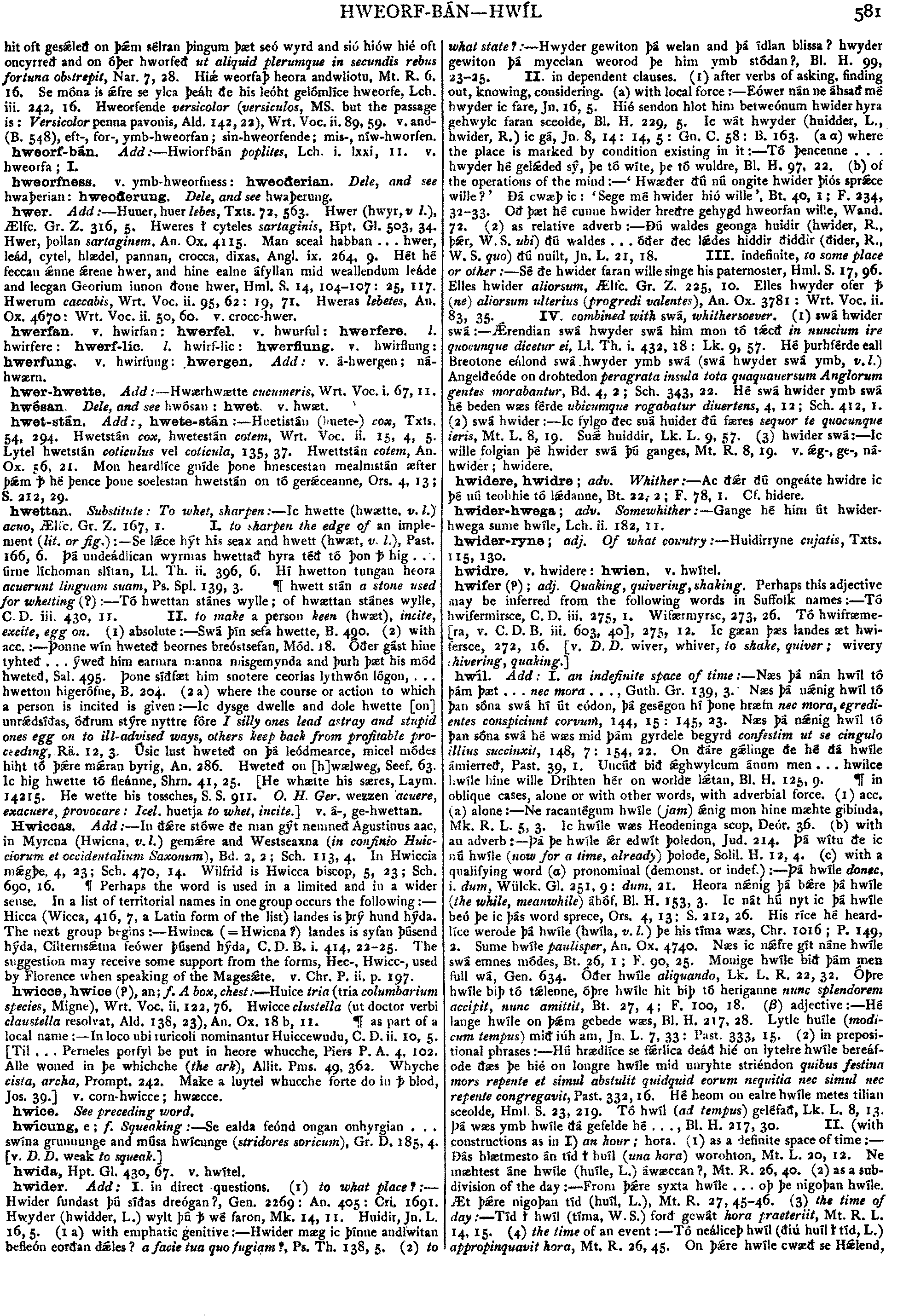
hwer.
Add
:--
Huuer,
huer
lebes,
Txts.
72,
563.
Hwer
(hwyr,
v.
l.),
Ælfc.
Gr.
Z.
316,
5.
Hweres
 cyteles
sartaginis.
Hpt.
Gl.
503,
34.
Hwer,
þollan
sartaginem.
An.
Ox.
4115.
Man
sceal
habban
.
.
.
hwer,
leád,
cytel,
hlædel,
pannan,
crocca,
dixas,
Angl.
ix.
264,
9.
H
cyteles
sartaginis.
Hpt.
Gl.
503,
34.
Hwer,
þollan
sartaginem.
An.
Ox.
4115.
Man
sceal
habban
.
.
.
hwer,
leád,
cytel,
hlædel,
pannan,
crocca,
dixas,
Angl.
ix.
264,
9.
H t
h
feccan
t
h
feccan
 nne
rene
hwer,
and
hine
ealne
nne
rene
hwer,
and
hine
ealne
 fyllan
mid
weallendum
leáde
and
lecgan
Georium
innon
fyllan
mid
weallendum
leáde
and
lecgan
Georium
innon
 one
hwer,
Hml.
8.
14,
104-107:
25,
117.
Hwerum
caccabis,
Wrt.
Voc.
ii.
95,
62
:
19,
71.
Hweras
lebetes.
An.
Ox.
4670:
Wrt.
Voc.
ii.
50,
60.
v.
crocc-hwer.
one
hwer,
Hml.
8.
14,
104-107:
25,
117.
Hwerum
caccabis,
Wrt.
Voc.
ii.
95,
62
:
19,
71.
Hweras
lebetes.
An.
Ox.
4670:
Wrt.
Voc.
ii.
50,
60.
v.
crocc-hwer.
|
Source: Bosworth/Toller, page d0586, entry 35 View original page image as: [TIFF] [PNG] [View previous entry] [View next entry] |
[Comment on this entry] [View comments] |
The following entry has been hand-corrected once. |
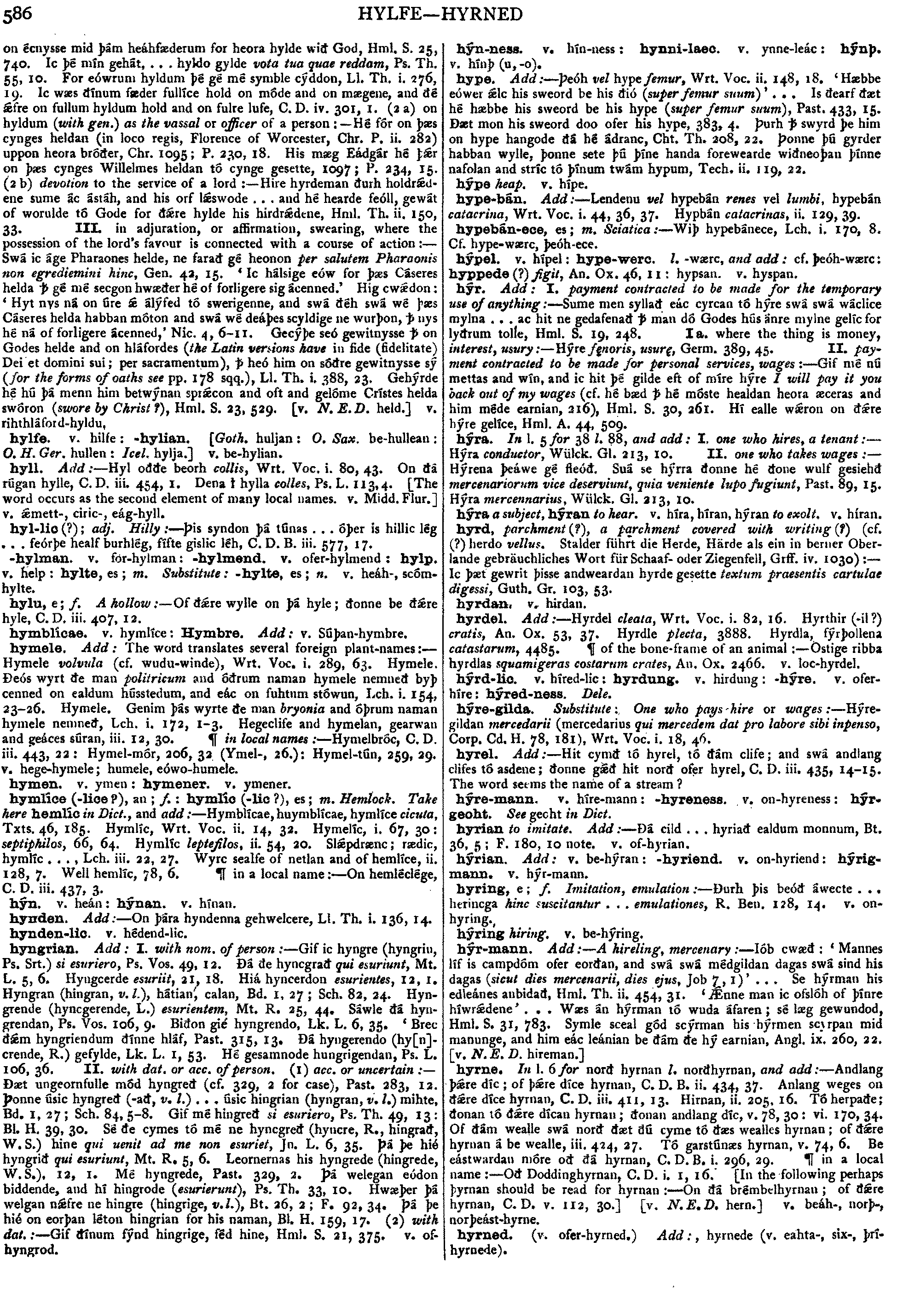
h r-mann.
Add
:--
A
hireling,
mercenary
:--
I
r-mann.
Add
:--
A
hireling,
mercenary
:--
I b
cwæ
:
'
Mannes
l
b
cwæ
:
'
Mannes
l f
is
campdm
ofer
eoran,
and
sw
sw
mdgildan
dagas
sw
sind
his
dagas
(sicut
dies
mercenarii,
dies
ejus.
Job
7,
1)'.
.
.
Se
hrman
his
edleánes
anbida,
Hml.
Th.
ii.
454,
31.
'Æ-long;nne
man
ic
ofslh
of
þnre
hwrdene'
.
.
.
Wæs
n
hrman
t
wuda
faren;
s
læg
gewundod,
Hml.
S.
31,
783.
Symle
sceal
gd
scrman
his
hrmen
scyrpan
mid
manunge,
and
him
eác
leánian
be
m
e
h
earnian,
Angl.
ix.
260,
22.
[v.
N.
E.
D.
hireman.]
f
is
campdm
ofer
eoran,
and
sw
sw
mdgildan
dagas
sw
sind
his
dagas
(sicut
dies
mercenarii,
dies
ejus.
Job
7,
1)'.
.
.
Se
hrman
his
edleánes
anbida,
Hml.
Th.
ii.
454,
31.
'Æ-long;nne
man
ic
ofslh
of
þnre
hwrdene'
.
.
.
Wæs
n
hrman
t
wuda
faren;
s
læg
gewundod,
Hml.
S.
31,
783.
Symle
sceal
gd
scrman
his
hrmen
scyrpan
mid
manunge,
and
him
eác
leánian
be
m
e
h
earnian,
Angl.
ix.
260,
22.
[v.
N.
E.
D.
hireman.]
|
Source: Bosworth/Toller, page d0588, entry 3 View original page image as: [TIFF] [PNG] [View previous entry] [View next entry] |
[Comment on this entry] [View comments] |
The following entry has been hand-corrected once. |
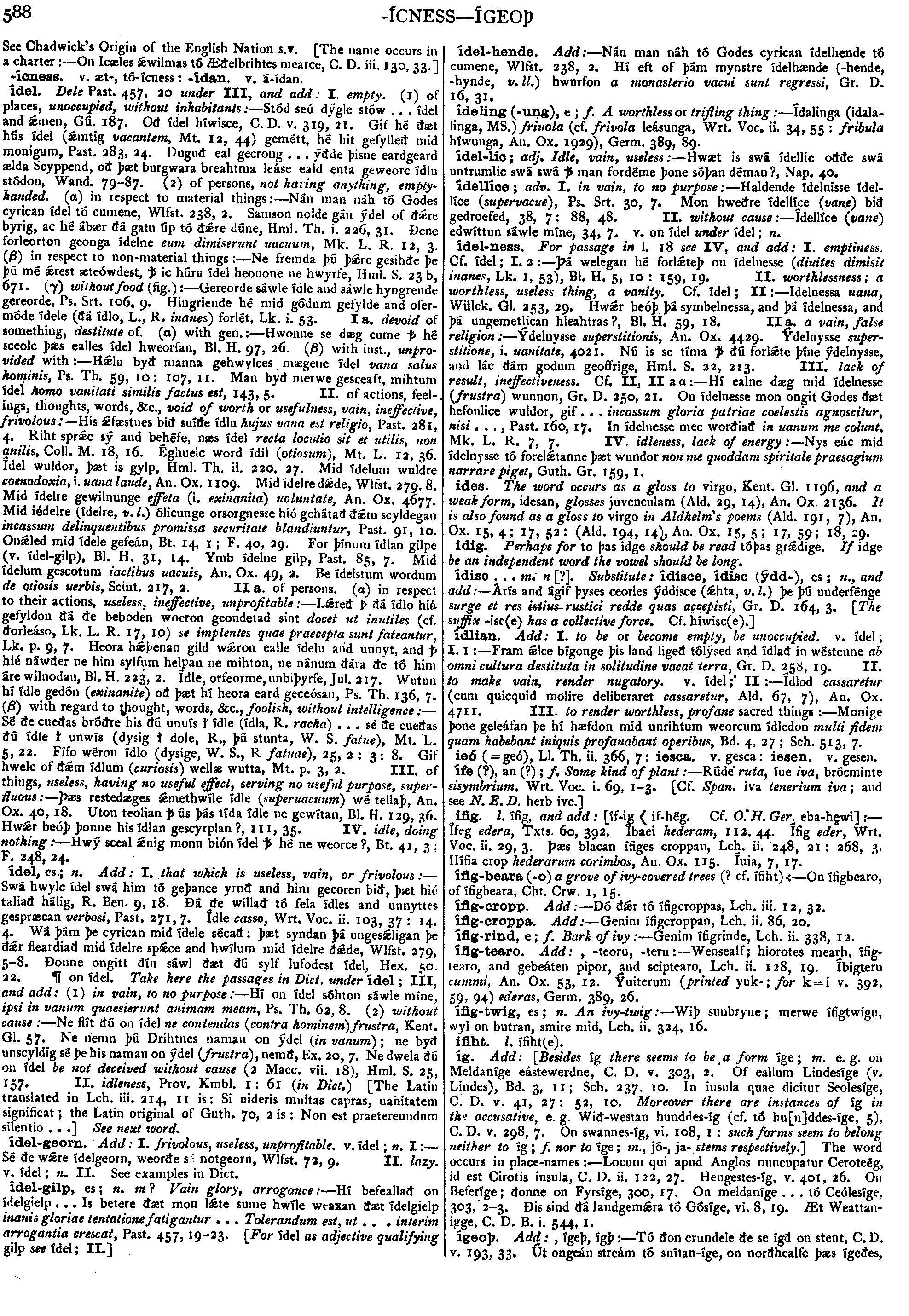
del.
Dele
Past.
457,
20
under
III.
and
add:
I.
empty,
(l)
of
places,
unoccupied,
without
inhabitants
:--
Std
seó
dgle
stw
.
.
.
del
and
men,
G .
187.
O
del
hwisce,
C.
D.
v.
319,
21.
Gif
h
æt
hs
del
(mtig
vacantem.
Mt.
12,
44)
gemtt,
h
hit
gefylle
mid
monigum,
Past.
283,
24.
Dugu
eal
gecrong
.
.
.
de
þisne
eardgeard
ælda
Scyppend,
o
þæt
burgwara
breahtma
leáse
eald
enta
geweorc
dlu
stdon,
Wand.
79-87.
(2)
of
persons,
not
having
anything,
empty-handed,
()
in
respect
to
material
things
:--
Nn
man
nh
t
Godes
cyrican
del
t
cumene.
Wlfst.
238,
2.
Samson
nolde
gn
del
of
re
byrig,
ac
h
bær
gatu
p
t
re
dne,
Hml.
Th.
i.
226,
31.
Ðene
forleorton
geonga
delne
eum
dimiserunt
uacuum,
Mk.
L.
R.
12,
3.
(
.
187.
O
del
hwisce,
C.
D.
v.
319,
21.
Gif
h
æt
hs
del
(mtig
vacantem.
Mt.
12,
44)
gemtt,
h
hit
gefylle
mid
monigum,
Past.
283,
24.
Dugu
eal
gecrong
.
.
.
de
þisne
eardgeard
ælda
Scyppend,
o
þæt
burgwara
breahtma
leáse
eald
enta
geweorc
dlu
stdon,
Wand.
79-87.
(2)
of
persons,
not
having
anything,
empty-handed,
()
in
respect
to
material
things
:--
Nn
man
nh
t
Godes
cyrican
del
t
cumene.
Wlfst.
238,
2.
Samson
nolde
gn
del
of
re
byrig,
ac
h
bær
gatu
p
t
re
dne,
Hml.
Th.
i.
226,
31.
Ðene
forleorton
geonga
delne
eum
dimiserunt
uacuum,
Mk.
L.
R.
12,
3.
( )
in
respect
to
non-material
things
:--
Ne
fremda
þ
þre
gesihe
þe
þ
m
rest
æteówdest,
)
in
respect
to
non-material
things
:--
Ne
fremda
þ
þre
gesihe
þe
þ
m
rest
æteówdest,
 ic
hru
del
heonone
ne
hwyrfe,
Hml.
S.
23
b,
671.
(
ic
hru
del
heonone
ne
hwyrfe,
Hml.
S.
23
b,
671.
( )
without
food
(fig.)
:--
Gereorde
swle
dle
and
swle
hyngrende
gereorde,
Ps.
Srt.
106,
9.
Hingriende
h
mid
gdum
gefylde
and
ofer-mde
dele
(
dlo,
L.,
R.
inanes)
forlt,
Lk.
i.
53.
Ia.
devoid
of
something,
destitute
of.
()
with
gen.
:--
Hwonne
se
dæg
cume
h
sceole
þæs
ealles
del
hweorfan,
Bl.
H.
97,
26.
()
with
inst.
,
unpro-vided
with
:--
Hlu
by
manna
gehwylces
mægene
del
vana
solus
hominis,
Ps.
Th.
59,
10:
107,
II.
Man
by
merwe
gesceaft,
mihtum
del
homo
vanitati
similis
factus
est,
143,
5.
II.
of
actions,
feel-ings,
thoughts,
words,
&c.,
void
of
worth
or
usefulness,
vain,
ineffective,
frivolous
:--
His
fæstnes
bi
sue
dlu
hujus
vana
est
religio,
Past.
281,
4.
Riht
sprc
s
and
behfe,
næs
del
recta
locutio
sit
et
utilis,
non
anilis,
Coll.
M.
18,
16.
&E-long;ghnelc
word
dil
(otiosum).
Mt.
L.
12,
36.
&I-long;del
wuldor,
þæt
is
gylp,
Hml.
Th.
ii.
220,
27.
Mid
delum
wuldre
coenodoxia,
i.
uana
laude,
An.
Ox.
1109.
Mid
delre
dde,
Wlfst.
279,
8.
Mid
delre
gewilnunge
effeta
(i.
exinanita)
uoluntate,
An.
Ox.
4677.
Mid
iédelre
(delre,
v.
l.)
licunge
orsorgnesse
hié
gehta
m
scyldegan
incassum
delinquentibus
promissa
securitate
blandiuntur,
Past.
91,
10.
Onled
mid
dele
gefeán,
Bt.
14,
l;
F.
40,
29.
For
þnum
dlan
gilpe
(v.
del-gilp).
Bl.
H.
31,
14.
Ymb
delne
gilp,
Past.
85,
7.
Mid
delum
gescotum
iactibus
uacuis,
An.
Ox.
49,
2.
Be
delstum
wordum
de
otiosis
uerbis,
Scint.
217,
2.
II
a.
of
persons,
()
in
respect
to
their
actions,
useless,
ineffective,
unprofitable
:--
Lre
dlo
hiá
gefyldon
e
beboden
woeron
geondetad
sint
docet
ut
inutiles
(cf.
orleáso,
Lk.
L.
R.
17,
10)
se
implentes
quae
praecepta
sunt
fateantur,
Lk.
p.
9,
7.
Heora
hþenan
gild
wron
ealle
delu
and
unnyt,
and
hié
nwer
ne
him
sylfum
helpan
ne
mihton,
ne
nnum
ra
e
t
him
re
wilnodan,
Bl.
H.
223,
2.
&I-long;dle,
orfeorme,
unbiþyrfe,
Jul.
217.
Wutun
h
dle
gedn
(exinanite)
o
þæt
h
heora
eard
geceósan,
Ps.
Th.
136,
7.
()
with
regard
to
thought,
words,
&c.
,
foolish,
without
intelligence
:--
S
e
cueas
brre
his
unus
dle
(dla,
R.
racha)
.
.
.
s
e
cueas
dle
unws
(dysig
dole,
R.,
þ
stunta,
W.
S.
fatue),
Mt.
L.
5.
22.
Ffo
wron
dlo
(dysige,
W.
S.
,
R
fatuae),
25,
2
:
3:
8.
Gif
hwelc
of
m
dlum
(curiosis)
wellæ
wutta,
Mt.
p.
3,
2.
III.
of
things,
useless,
having
no
useful
effect,
serving
no
useful
purpose,
super-fluous
:--
Þæs
restedæges
methwle
dle
(superuacuum)
w
tellaþ,
An.
Ox.
40,
18.
Uton
teolian
s
þs
tda
dle
ne
gewtan,
Bl.
H.
129,
36.
Hwr
beóþ
þonne
his
dlan
gescyrplan?,
111,
35.
IV.
idle,
doing
nothing
:--
Hw
sceal
nig
monn
bión
del
h
ne
weorce
?,
Bt.
41,
3;
F.
248,
24.
)
without
food
(fig.)
:--
Gereorde
swle
dle
and
swle
hyngrende
gereorde,
Ps.
Srt.
106,
9.
Hingriende
h
mid
gdum
gefylde
and
ofer-mde
dele
(
dlo,
L.,
R.
inanes)
forlt,
Lk.
i.
53.
Ia.
devoid
of
something,
destitute
of.
()
with
gen.
:--
Hwonne
se
dæg
cume
h
sceole
þæs
ealles
del
hweorfan,
Bl.
H.
97,
26.
()
with
inst.
,
unpro-vided
with
:--
Hlu
by
manna
gehwylces
mægene
del
vana
solus
hominis,
Ps.
Th.
59,
10:
107,
II.
Man
by
merwe
gesceaft,
mihtum
del
homo
vanitati
similis
factus
est,
143,
5.
II.
of
actions,
feel-ings,
thoughts,
words,
&c.,
void
of
worth
or
usefulness,
vain,
ineffective,
frivolous
:--
His
fæstnes
bi
sue
dlu
hujus
vana
est
religio,
Past.
281,
4.
Riht
sprc
s
and
behfe,
næs
del
recta
locutio
sit
et
utilis,
non
anilis,
Coll.
M.
18,
16.
&E-long;ghnelc
word
dil
(otiosum).
Mt.
L.
12,
36.
&I-long;del
wuldor,
þæt
is
gylp,
Hml.
Th.
ii.
220,
27.
Mid
delum
wuldre
coenodoxia,
i.
uana
laude,
An.
Ox.
1109.
Mid
delre
dde,
Wlfst.
279,
8.
Mid
delre
gewilnunge
effeta
(i.
exinanita)
uoluntate,
An.
Ox.
4677.
Mid
iédelre
(delre,
v.
l.)
licunge
orsorgnesse
hié
gehta
m
scyldegan
incassum
delinquentibus
promissa
securitate
blandiuntur,
Past.
91,
10.
Onled
mid
dele
gefeán,
Bt.
14,
l;
F.
40,
29.
For
þnum
dlan
gilpe
(v.
del-gilp).
Bl.
H.
31,
14.
Ymb
delne
gilp,
Past.
85,
7.
Mid
delum
gescotum
iactibus
uacuis,
An.
Ox.
49,
2.
Be
delstum
wordum
de
otiosis
uerbis,
Scint.
217,
2.
II
a.
of
persons,
()
in
respect
to
their
actions,
useless,
ineffective,
unprofitable
:--
Lre
dlo
hiá
gefyldon
e
beboden
woeron
geondetad
sint
docet
ut
inutiles
(cf.
orleáso,
Lk.
L.
R.
17,
10)
se
implentes
quae
praecepta
sunt
fateantur,
Lk.
p.
9,
7.
Heora
hþenan
gild
wron
ealle
delu
and
unnyt,
and
hié
nwer
ne
him
sylfum
helpan
ne
mihton,
ne
nnum
ra
e
t
him
re
wilnodan,
Bl.
H.
223,
2.
&I-long;dle,
orfeorme,
unbiþyrfe,
Jul.
217.
Wutun
h
dle
gedn
(exinanite)
o
þæt
h
heora
eard
geceósan,
Ps.
Th.
136,
7.
()
with
regard
to
thought,
words,
&c.
,
foolish,
without
intelligence
:--
S
e
cueas
brre
his
unus
dle
(dla,
R.
racha)
.
.
.
s
e
cueas
dle
unws
(dysig
dole,
R.,
þ
stunta,
W.
S.
fatue),
Mt.
L.
5.
22.
Ffo
wron
dlo
(dysige,
W.
S.
,
R
fatuae),
25,
2
:
3:
8.
Gif
hwelc
of
m
dlum
(curiosis)
wellæ
wutta,
Mt.
p.
3,
2.
III.
of
things,
useless,
having
no
useful
effect,
serving
no
useful
purpose,
super-fluous
:--
Þæs
restedæges
methwle
dle
(superuacuum)
w
tellaþ,
An.
Ox.
40,
18.
Uton
teolian
s
þs
tda
dle
ne
gewtan,
Bl.
H.
129,
36.
Hwr
beóþ
þonne
his
dlan
gescyrplan?,
111,
35.
IV.
idle,
doing
nothing
:--
Hw
sceal
nig
monn
bión
del
h
ne
weorce
?,
Bt.
41,
3;
F.
248,
24.
|
Source: Bosworth/Toller, page d0589, entry 11 View original page image as: [TIFF] [PNG] [View previous entry] [View next entry] |
[Comment on this entry] [View comments] |
The following entry has been hand-corrected once. |
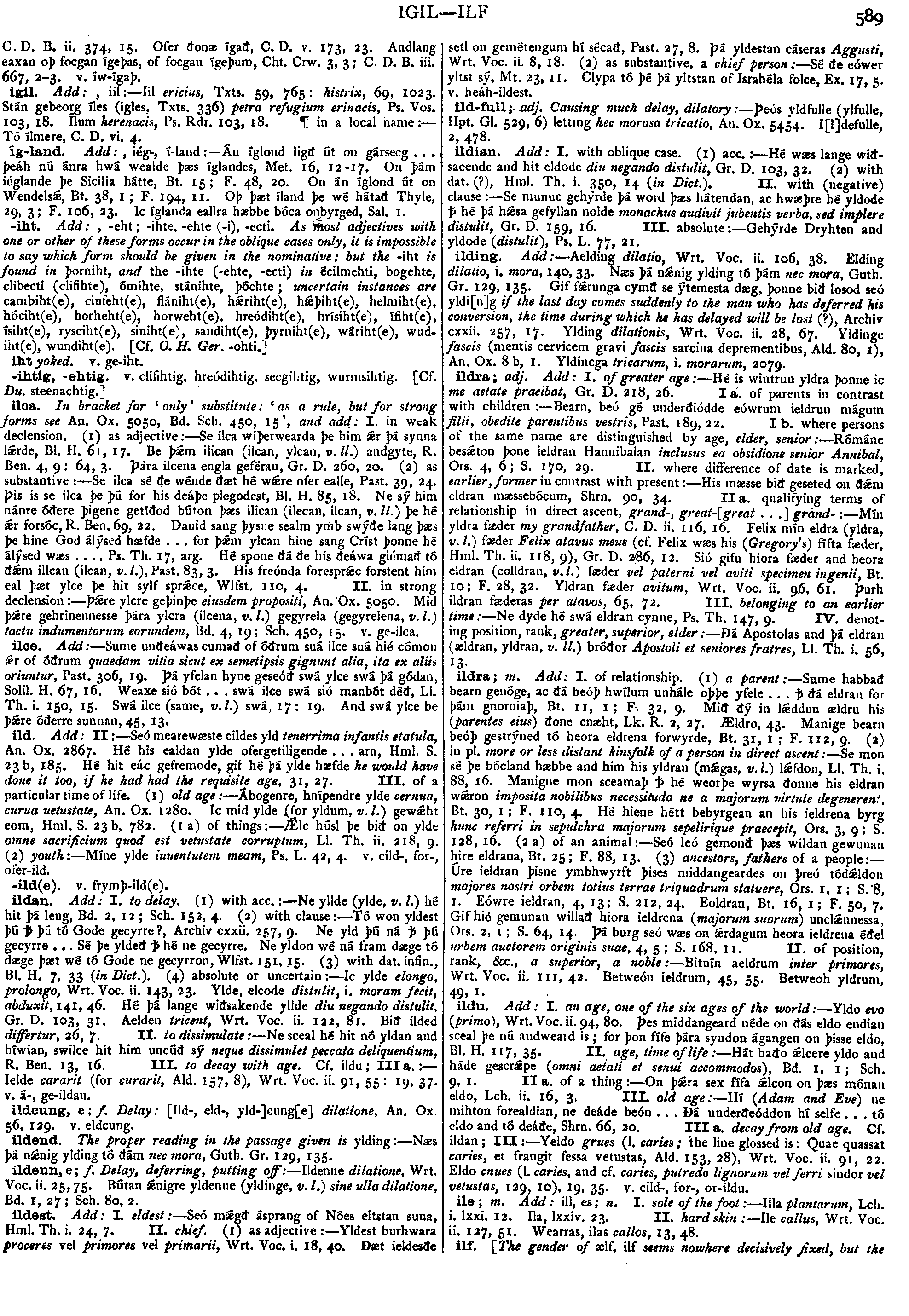
ildan.
Add:
I.
to
delay,
(l)
with
acc.
:--
Ne
yllde
(ylde,
v.
l.)
h
hit
þ
leng,
Bd.
2,
12;
Sch.
152,
4.
(2)
with
clause
:--
T
won
yldest
þ
þ
t
Gode
gecyrre?,
Archiv
cxxii.
257,
9.
Ne
yld
þ
n
þ
gecyrre
.
.
.
S
þe
ylde
h
ne
gecyrre.
Ne
yldon
w
n
fram
dæge
t
dæge
þæt
w
t
Gode
ne
gecyrron,
Wlfst.
151,
15.
(3)
with
dat.
infin.
,
Bl.
H.
7,
33
(in
Dict.).
(4)
absolute
or
uncertain
:--
Ic
ylde
elongo,
prolongo,
Wrt.
Voc.
ii.
143,
23.
Ylde,
elcode
distulit,
i.
moram
fecit,
abduxit,
141,
46.
H
þ
lange
wisakende
yllde
diu
negando
distulit,
Gr.
D.
103,
31.
Ælden
tricent,
Wrt.
Voc.
ii.
122,
81.
Bi
ilded
differtur,
16,
7.
II.
to
dissimulate
:--
Ne
sceal
h
hit
n
yldan
and
hwian,
swilce
hit
him
unc
s
neque
dissimulet
peccata
deliquentium,
R.
Ben.
13,
16.
III.
to
decay
with
age.
Cf.
ildu;
IIIa.
:--
Ielde
cararit
(for
curarit,
Ald.
157,
8),
Wrt.
Voc.
ii.
91,
55:
19,
37.
v.
-,
ge-ildan.
|
Source: Bosworth/Toller, page d0589, entry 21 View original page image as: [TIFF] [PNG] [View previous entry] [View next entry] |
[Comment on this entry] [View comments] |
The following entry has been hand-corrected once. |
ildu.
Add:
I.
an
age,
one
of
the
six
ages
of
the
world
:--
Yldo
evo
(primo,)
Wrt.
Voc.
ii.
94,
80.
Þes
middangeard
nde
on
s
eldo
endian
sceal
þe
n
andweard
is;
for
þon
ffe
þra
syndon
gangen
on
þisse
eldo,
Bl.
H.
117,
35.
II.
age,
time
of
life
:--
Ht
bao
lcere
yldo
and
hde
gescrpe
(omni
aetati
et
senui
accommodos),
Bd.
l,
1;
Sch.
9,
II
a.
of
a
thing
:--
On
þra
sex
ffa
lcon
on
þæs
mnan
eldo,
Lch.
ii.
16,
3.
III.
old
age
:--
H
(Adam
and
Eve)
ne
mihton
forealdian,
ne
deáde
beón
.
.
.
Ð
undereóddon
h
selfe
.
.
.
t
eldo
and
t
deáe,
Shrn.
66,
20.
III
a.
decay
from
old
age.
Cf.
ildan;
III
:--
Yeldo
grues
(l.
caries;
the
line
glossed
is:
Quae
quassat
caries,
et
frangit
fessa
vetustas,
Ald.
153,
28),
Wrt.
Voc.
ii.
91,
22.
Eldo
cnues
(l.
caries,
and
cf.
caries,
putredo
lignorum
vel
ferri
sindor
vel
vetustas,
129,
10),
19,
35.
v.
cild-,
for-,
or-ildu.
|
Source: Bosworth/Toller, page d0590, entry 10 View original page image as: [TIFF] [PNG] [View previous entry] [View next entry] |
[Comment on this entry] [View comments] |
The following entry has been hand-corrected once. |
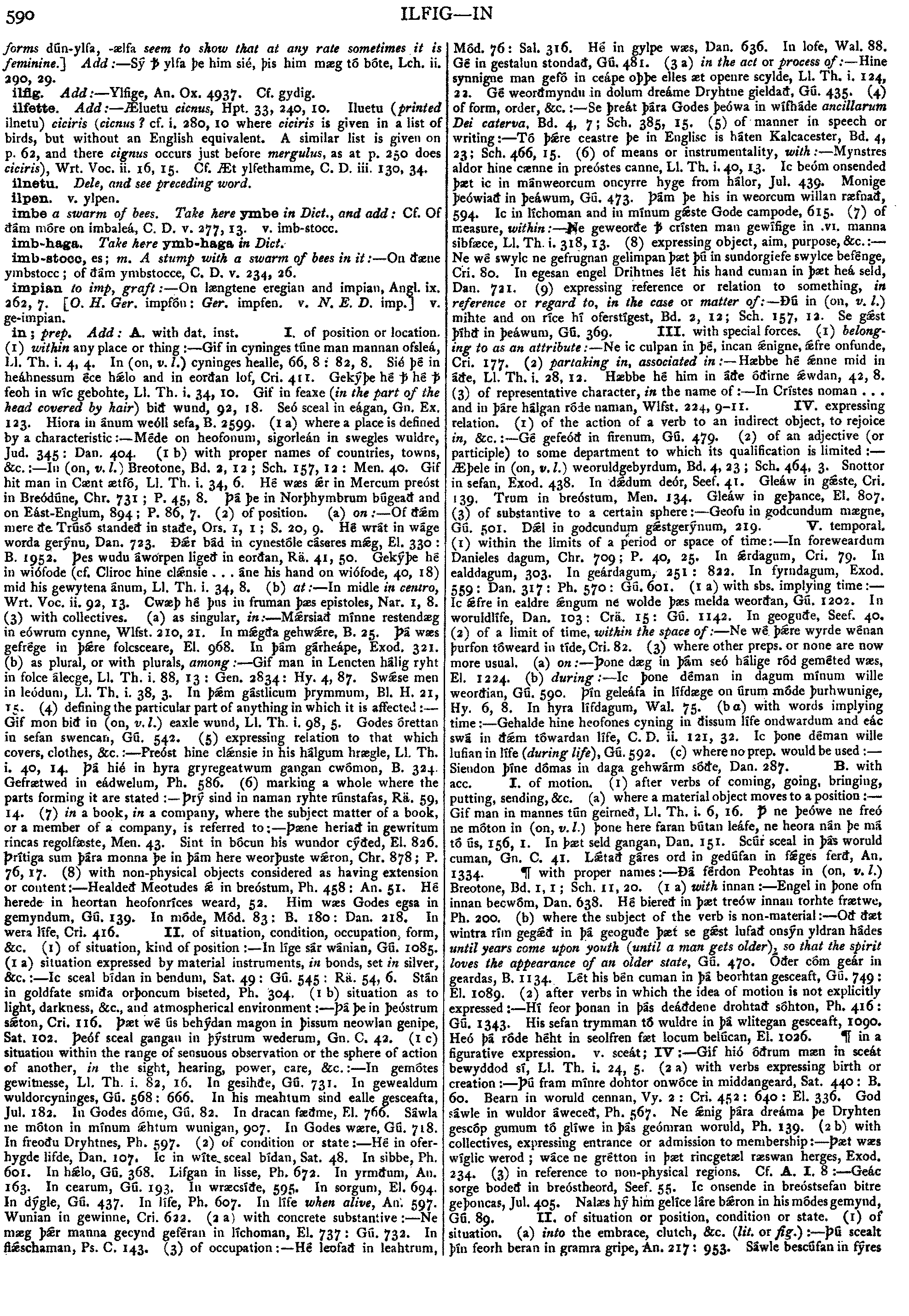
in;
prep.
Add:
A.
with
dat.
inst.
I.
of
position
or
location,
(1)
within
any
place
or
thing
:--
Gif
in
cyninges
túne
man
mannan
ofsleá,
Ll.
Th.
i.
4,
4.
In
(on,
v.l.)
cyninges
healle,
66,
8:
82,
8.
Sié
þé
in
heáhnessum
éce
hlo
and
in
eorðan
lof,
Cri.
411.
Gekýþe
hé
hé
feoh
in
wíc
gebohte.
Ll.
Th.
i.
34,
10.
Gif
in
feaxe
(in
the
part
of
the
head
covered
by
hair)
bið
wund,
92,
18.
Seó
sceal
in
eágan,
Gn.
Ex.
123.
Hiora
in
ánum
weóll
sefa,
B.
2599.
(1
a)
where
a
place
is
defined
by
a
characteristic
:--
Méde
on
heofonum,
sigorleán
in
swegles
wuldre,
Jud.
345:
Dan.
404.
(1
b)
with
proper
names
of
countries,
towns,
&c.
:--
In
(on,
v.l.)
Breotone,
Bd.
2,
12;
Sch.
157,
12:
Men.
40.
Gif
hit
man
in
Cænt
ætfó,
LI.
Th.
i.
34,
6.
Hé
wæs
r
in
Mercum
preóst
in
Breódúne.
Chr.
731;
P.
45,
8.
Þá
þe
in
Norþhymbrum
búgeað
and
on
Eást-Englum,
894;
P.
86,
7.
(2)
of
position.
(a)
on
:--
Of
ðm
mere
ðe.
Trúsó
standeð
in
staðe,
Ors.
1,
1;
S.
20,
9.
Hé
wrát
in
wáge
worda
gerýnu,
Dan.
723.
Ðr
bád
in
cynestóle
cáseres
mg,
El.
330:
B.
1952.
Þes
wudu
áworpen
ligeð
in
eorðan,
Rä.
41,
50.
Gekýþe
hé
in
wiófode
(cf.
Cliroc
hine
clnsie
...
áne
his
hand
on
wiófode,
40,
18)
mid
his
gewytena
ánum,
Ll.
Th.
i.
34,
8.
(b)
at
:--
In
midle
in
centro,
Wrt.
Voc.
ii.
92,
13.
Cwæþ
hé
þus
in
fruman
þæs
epistoles,
Nar.
1.
8.
(3)
with
collectives,
(a)
as
singular,
in
:--
Mrsiað
mínne
restendæg
in
eówrum
cynne,
Wlfst.
210,
21.
In
mgða
gehwre,
B.
25.
Þá
wæs
gefrége
in
þre
folcsceare,
El.
968.
In
þám
gárheápe,
Exod.
321.
(b)
as
plural,
or
with
plurals,
among
:--
Gif
man
in
Lencten
hálig
ryht
in
folce
álecge,
Ll.
Th.
i.
88,
13:
Gen.
2834:
Hy.
4,
87.
Swse
men
in
leódum,
Ll.
Th.
i.
38,
3.
In
þm
gástlicum
þrymmum,
Bl.
H.
21,
15.
(4)
defining
the
particular
part
of
anything
in
which
it
is
affected
:--
Gif
mon
bið
in
(on,
v.l.)
eaxle
wund,
Ll.
Th.
i.
98,
5.
Godes
órettan
in
sefan
swencan,
Gú.
542.
(5)
expressing
relation
to
that
which
covers,
clothes,
&c.
:--
Preóst
hine
clnsie
in
his
hálgum
hrægle,
Ll.
Th.
i.
40,
14.
Þá
hie
in
hyra
gryregeatwum
gangan
cwómon,
B.
324.
Gefrætwed
in
eádwelum,
Ph.
586.
(6)
marking
a
whole
where
the
parts
forming
it
are
stated
:--
Þrý
sind
in
naman
ryhte
rúnstafas,
Rä.
59,
14.
(7)
in
a
book,
in
a
company,
where
the
subject
matter
of
a
book,
or
a
member
of
a
company,
is
referred
to
:--
Þæne
heriað
in
gewritum
rincas
regolfæste,
Men.
43.
Sint
in
bócun
his
wundor
cýðed,
El.
826.
Þrítiga
sum
þára
monna
þe
in
þám
here
weorþuste
wron,
Chr.
878;
P.
76,
17.
(8)
with
non-physical
objects
considered
as
having
extension
or
content
:--
Healdeð
Meotudes
in
breóstum,
Ph.
458:
An.
51.
Hé
herede
in
heortan
heofonríces
weard,
52.
Him
wæs
Godes
egsa
in
gemyndum,
Gú.
139.
In
móde,
Mód.
83:
B.
180:
Dan.
218.
In
wera
lífe,
Cri.
416.
II.
of
situation,
condition,
occupation,
form,
&c.
(1)
of
situation,
kind
of
position
:--
In
líge
sár
wánian,
Gú.
1085.
(1
a)
situation
expressed
by
material
instruments,
in
bonds,
set
in
silver,
&c.
:--
Ic
sceal
bídan
in
bendum,
Sat.
49:
Gú.
545:
Rä.
54,
6.
Stán
in
goldfate
smiða
orþoncum
biseted,
Ph.
304.
(1
b)
situation
as
to
light,
darkness,
&c.,
and
atmospherical
environment
:--
Þá
þe
in
þeóstrum
ston,
Cri.
116.
Þæt
wé
ús
behýdan
magon
in
þissum
neowlan
genipe,
Sat.
102.
Þeóf
sceal
gangan
in
þýstrum
wederum,
Gn.
C.
42.
(1
c)
situation
within
the
range
of
sensuous
observation
or
the
sphere
of
action
of
another,
in
the
sight,
hearing,
power,
care,
&c.
:--
In
gemótes
gewitnesse,
Ll.
Th.
i.
82,
16,
In
gesihðe,
Gú.
731.
In
gewealdum
wuldorcyninges,
Gú.
568:
666.
In
his
meahtum
sind
ealle
gesceafta,
Jul.
182.
In
Godes
dóme,
Gú.
82.
In
dracan
fæðme,
E.l.
766.
Sáwla
ne
móton
in
mínum
htum
wunigan,
907.
In
Godes
wære,
Gú.
718.
In
freoðu
Dryhtnes,
Ph.
597.
(2)
of
condition
or
state
:--
Hé
in
oferhygde
lifde,
Dan.
107.
Ic
in
wíte,
sceal
bídan,
Sat.
48.
In
sibbe.
Ph.
601.
In
hlo,
Gú.
368.
Lifgan
in
lisse,
Ph.
672.
In
yrmðum,
An.
163.
In
cearum,
Gú.
193.
In
wræcsíðe,
595.
In
sorgum,
El.
694.
In
dýgle,
Gú.
437.
In
lífe,
Ph.
607.
In
lífe
when
alive,
An.
597.
Wunian
in
gewinne,
Cri.
622.
(2
a)
with
concrete
substantive
:--
Ne
mæg
þr
manna
gecynd
geféran
in
líchoman,
El.
737:
Gú.
732.
In
flschaman,
Ps.
C.
143.
(3)
of
occupation
:--
Hé
leofað
in
leahtrum,
Mód.
76:
Sal.
316.
Hé
in
gylpe
wæs,
Dan.
636.
In
lofe,
Wal.
88.
Gé
in
gestalun
stondað,
Gú.
481.
(3
a)
in
the
act
or
process
of
:--
Hine
synnigne
man
gefó
in
ceápe
oþþe
elles
æt
openre
scylde,
Ll.
Th.
i.
124,
22.
Gé
weorðmyndu
in
dolum
dreáme
Dryhtne
gieldað,
Gú.
435.
(4)
of
form,
order,
&c.
:--
Se
þreát
Þára
Godes
þeówa
in
wífháde
ancillarum
Dei
caterva,
Bd.
4,
7;
Sch.
385,
15.
(5)
of
manner
in
speech
or
writing
:--
Tó
þre
ceastre
þe
in
Englisc
is
háten
Kalcacester,
Bd.
4,
23;
Sch.
466,
15.
(6)
of
means
or
instrumentality,
with
:--
Mynstres
aldor
hine
cænne
in
preóstes
canne,
Ll.
Th.
i.
40,
13.
Ic
beóm
onsended
þæt
ic
in
mánweorcum
oncyrre
hyge
from
hálor,
Jul.
439.
Monige
þeówiað
in
þeáwum,
Gú.
473.
Þám
þe
his
in
weorcum
willan
ræfnað,
594.
Ic
in
líchoman
and
in
mínum
gste
Gode
campode,
615.
(7)
of
measure,
within
:--
Ne
geweorðe
crísten
man
gewífige
in
.vi.
manna
sibfæce,
Ll.
Th.
i.
318,
13.
(8)
expressing
object,
aim,
purpose,
&c.
:--
Ne
wé
swylc
ne
gefrugnan
gelimpan
þæt
þú
in
sundorgiefe
swylce
befénge,
Cri.
80.
In
egesan
engel
Drihtnes
lét
his
hand
cuman
in
þæt
heá
seld,
Dan.
721.
(9)
expressing
reference
or
relation
to
something,
in
reference
or
regard
to,
in
the
case
or
matter
of
:--
Ðú
in
(on,
v.l.)
mihte
and
on
ríce
hí
oferstígest,
Bd.
2,
12;
Sch.
157,
12.
Se
gst
þíhð
in
þeáwum,
Gú.
369.
III.
with
special
forces.
(1)
belonging
to
as
an
attribute
:--
Ne
ic
culpan
in
þé,
incan
nigne,
fre
onfunde,
Cri.
177.
(2)
partaking
in,
associated
in
:--
Hæbbe
hé
nne
mid
in
áðe,
Ll.
Th.
i.
28,
12.
Hæbbe
hé
him
in
áðe
óðirne
wdan,
42,
8.
(3)
of
representative
character,
in
the
name
of
:--
In
Crístes
noman
...
and
in
þáre
hálgan
róde
naman,
Wlfst.
224,
9-11.
IV.
expressing
relation,
(1)
of
the
action
of
a
verb
to
an
indirect
object,
to
rejoice
in,
&c.
:--
Gé
gefeóð
in
firenum,
Gú.
479.
(2)
of
an
adjective
(or
participle)
to
some
department
to
which
its
qualification
is
limited
:--
Æþele
in
(on,
v.l.)
weoruldgebyrdum,
Bd.
4,
23;
Sch.
464,
3.
Snottor
in
sefan,
Exod.
438.
In
ddum
deór,
Seef.
41.
Gleáw
in
gste,
Cri.
139.
Trum
in
breóstum,
Men.
134.
Gleáw
in
geþance,
El.
807.
(3)
of
substantive
to
a
certain
sphere
:--
Geofu
in
godcundum
mægne,
Gú.
501.
Dl
in
godcundum
gstgerýnum,
219.
V.
temporal,
(1)
within
the
limits
of
a
period
or
space
of
time
:--
In
foreweardum
Danieles
dagum,
Chr.
709;
P.
40,
25.
In
rdagum,
Cri.
79.
In
ealddagum,
303.
In
geárdagum,
251:
822.
In
fyrndagum,
Exod.
559:
Dan.
317:
Ph.
570:
Gú.
601.
(1
a)
with
sbs.
implying
time
:--
Ic
fre
in
ealdre
ngum
ne
wolde
þæs
melda
weorðan,
Gú.
1202.
In
woruldlífe,
Dan.
103:
Crä.
15:
Gú.
1142.
In
geoguðe,
Seef.
40.
(2)
of
a
limit
of
time,
within
the
space
of
:--
Ne
wé
þre
wyrde
wénan
þurfon
tóweard
in
tíde,
Cri.
82.
(3)
where
other
preps.
or
none
are
now
more
usual,
(a)
on
:--
Þone
dæg
in
þám
seó
hálige
ród
geméted
wæs,
El.
1224.
(b)
during
:--
Ic
þone
déman
in
dagum
mínum
wille
weorðian,
Gú.
590.
Þín
geleáfa
in
lífdæge
on
úrum
móde
þurhwunige,
Hy.
6,
8.
In
hyra
lífdagum,
Wal.
75.
(b
)
with
words
implying
time
:--
Gehalde
hine
heofones
cyning
in
ðissum
lífe
ondwardum
and
eác
swá
in
ðm
tówardan
lífe,
C.D.
ii.
121,
32.
Ic
þone
déman
wille
lufian
in
lífe
(during
life),
Gú.
592.
(c)
where
no
prep.
would
be
used
:--
Siendon
þine
dómas
in
daga
gehwárm
sóðe,
Dan.
287.
B.
with
acc.
I.
of
motion.
(1)
after
verbs
of
coming,
going,
bringing,
putting,
sending,
&c.
(a)
where
a
material
object
moves
to
a
position
:--
Gif
man
in
mannes
tún
geirneð,
Ll.
Th.
i.
6,
16.
ne
þeówe
ne
freó
ne
móton
in
(on,
v.l.)
þone
here
faran
bútan
leáfe,
ne
heora
nán
þe
má
tó
ús,
156,
1.
In
þæt
seld
gangan,
Dan.
151.
Scúr
sceal
in
þás
woruld
cuman,
Gn.
C.
41.
Ltað
gáres
ord
in
gedúfan
in
fges
ferð,
An.
1334.

with
proper
names
:--
Ðá
férdon
Peohtas
in
(on,
v.l.)
Breotone,
Bd.
1.
1;
Sch.
11,
20.
(1
a)
with
innan
:--
Engel
in
þone
ofn
innan
becwóm,
Dan.
638.
Hé
biereð
in
þæt
treów
innan
torhte
frætwe.
Ph.
200.
(b)
where
the
subject
of
the
verb
is
non-material
:--
Oð
ðæt
wintra
rím
gegð
in
þá
geoguðe
þæt
se
gst
lufað
onsýn
yldran
hádes
until
years
come
upon
youth
(until
a
man
gets
older),
so
that
the
spirit
loves
the
appearance
of
an
older
state,
Gú.
470.
Óðer
cóm
geár
in
geardas,
B.
1134.
Lét
his
bén
cuman
in
þá
beorhtan
gesceaft,
Gú.
749:
El.
1089.
(2)
after
verbs
in
which
the
idea
of
motion
is
not
explicitly
expressed
:--
Hí
feor
þonan
in
þás
deáðdene
drohtað
sóhton,
Ph.
416:
Gú.
1343.
His
sefan
trymman
tó
wuldre
in
þá
wlitegan
gesceaft,
1090.
Heó
þá
róde
héht
in
seolfren
fæt
locum
belúcan,
El.
1026.

in
a
figurative
expression,
v.
sceát;
IV
:--
Gif
hió
óðrum
mæn
in
sceát
bewyddod
sí,
Ll.
Th.
i.
24,
5.
(2
a)
with
verbs
expressing
birth
or
creation
:--
Þú
fram
mínre
dohtor
onwóce
in
middangeard.
Sat.
440:
B.
60.
Bearn
in
woruld
cennan,
Vy.
2:
Cri.
452:
640:
El.
336.
God
sáwle
in
wuldor
áweceð.
Ph.
567.
Ne
nig
þára
dreáma
þe
Dryhten
gescóp
gumum
tó
glíwe
in
þás
geómran
woruld,
Ph.
139.
(2
b)
with
collectives,
expressing
entrance
or
admission
to
membership
:--
Þæt
wæs
wíglic
werod;
wáce
ne
grétton
in
þæt
rincgetael
ræswan
herges,
Exod.
234.
(3)
in
reference
to
non-physical
regions.
Cf.
A.
I.
8
:--
Geác
sorge
bodeð
in
breóstheord,
Seef.
55.
Ic
onsende
in
breóstsefan
bitre
geþoncas,
Jul.
405.
Nalæs
hý
him
gelíce
láre
bron
in
his
módes
gemynd,
Gú.
89.
II.
of
situation
or
position,
condition
or
state.
(1)
of
situation.
(a)
into
the
embrace,
clutch,
&c.
(lit.
or
fig.)
:--
Þú
scealt
þín
feorh
beran
in
gramra
gripe,
An.
217:
953.
Sáwle
bescúfan
in
fýres
|
Source: Bosworth/Toller, page d0591, entry 3 View original page image as: [TIFF] [PNG] [View previous entry] [View next entry] |
[Comment on this entry] [View comments] |
The following entry has been hand-corrected once. |
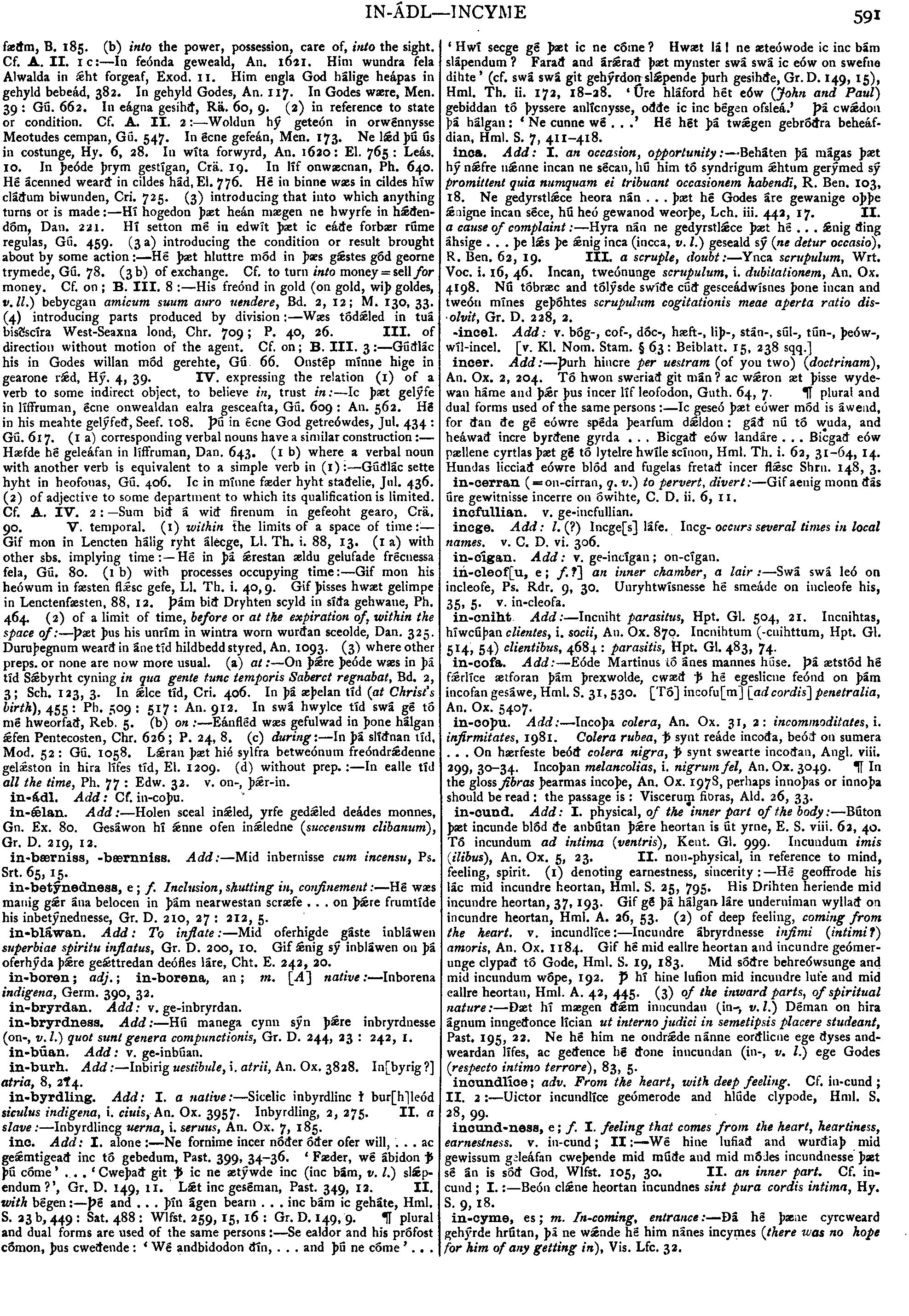
in-lan.
Add
:--
Holen
sceal
inled,
yrfe
gedled
deádes
monnes,
Gn.
Ex.
80.
Gesáwon
hí
nne
ofen
inledne
(succensum
clibanum),
Gr.
D.
219,
12.
|
Source: Bosworth/Toller, page d0592, entry 19 View original page image as: [TIFF] [PNG] [View previous entry] [View next entry] |
[Comment on this entry] [View comments] |
The following entry has been hand-corrected once. |
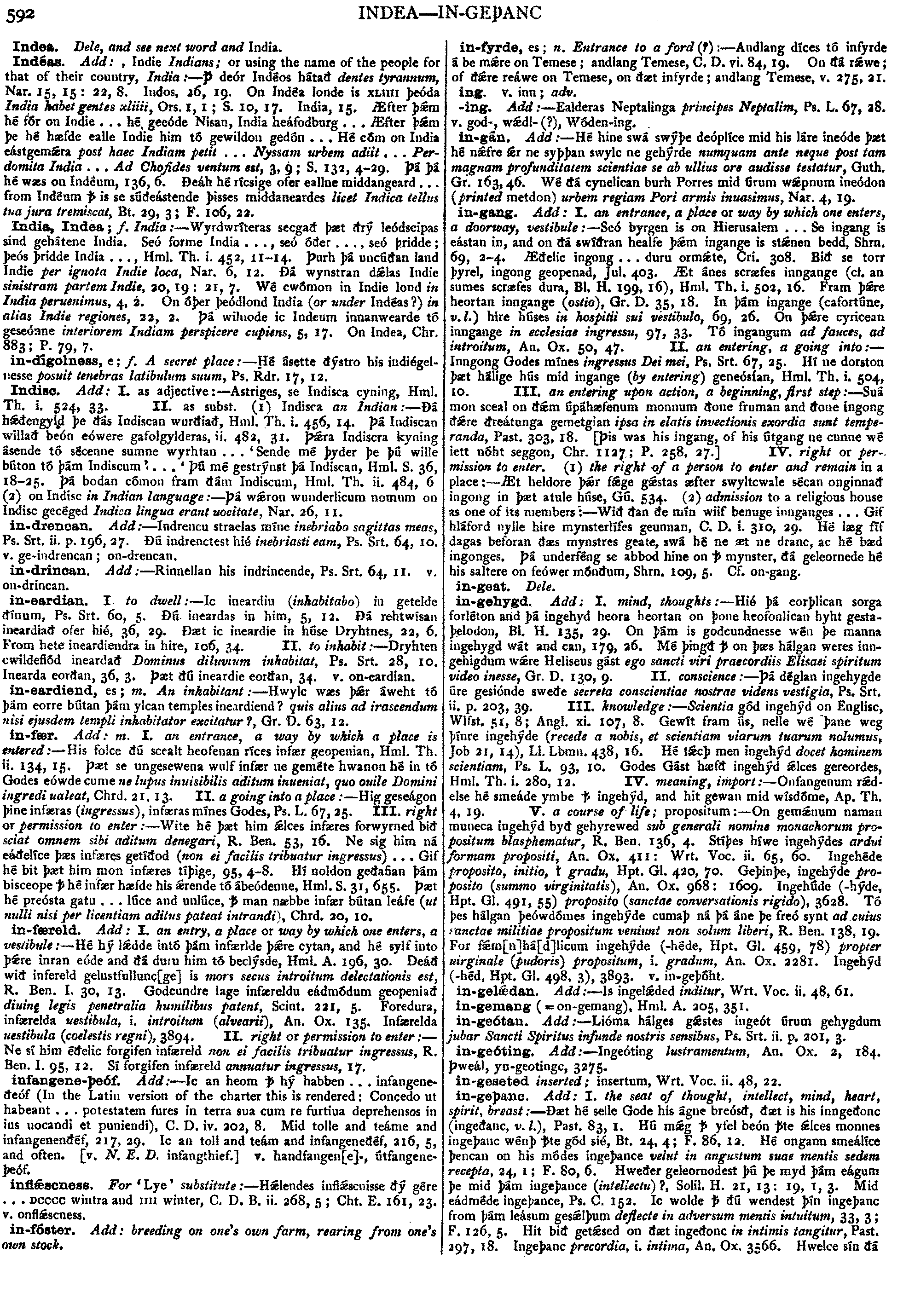
in-gang.
Add:
I.
an
entrance,
a
place
or
way
by
which
one
enters,
a
doorway,
vestibule
:--
Seó
byrgen
is
on
Hierusalem
...
Se
ingang
is
eástan
in,
and
on
ðá
swíðran
healfe
þm
ingange
is
stnen
bedd,
Shrn.
69,
2-4.
Æðelic
ingong
...
duru
ormte,
Cri.
308.
Bið
se
torr
þyrel,
ingong
geopenad,
Jul.
403.
Æt
ánes
scræfes
inngange
(cf.
an
sumes
scræfes
dura,
Bl.
H.
199,
16),
Hml.
Th.
i.
502,
16.
Fram
þre
heortan
inngange
(ostio),
Gr.
D.
35,
18.
In
þám
ingange
(cafortúne,
v.l.)
hire
húses
in
hospitii
sui
vestibulo,
69,
26.
On
þre
cyricean
inngange
in
ecclesiae
ingressu,
97,
33.
Tó
ingangum
ad
fauces,
ad
introitum,
An.
Ox.
50,
47.
II.
an
entering,
a
going
into
:--
Inngong
Godes
mínes
ingressus
Dei
mei.
Ps.
Srt.
67,
25.
Hí
ne
dorston
þæt
hálige
hús
mid
ingange
(by
entering)
geneósían.
Hml.
Th.
i.
504,
10.
III.
an
entering
upon
action,
a
beginning,
first
step
:--
Suá
mon
sceal
on
ðm
úpáhæfenum
monnum
ðone
fruman
and
ðone
ingong
ðre
ðreátunga
gemetgian
ipsa
in
elatis
invectionis
exordia
sunt
temperanda,
Past.
303,
18.
[Þis
was
his
ingang,
of
his
útgang
ne
cunne
wé
iett
nóht
seggon,
Chr.
1127;
P.
258,
27.]
IV.
right
or
permission
to
enter,
(1)
the
right
of
a
person
to
enter
and
remain
in
a
place
:--
Æt
heldore
þr
fge
gstas
æfter
swyltcwale
sécan
onginnað
ingong
in
þæt
atule
húse,
Gú.
534.
(2)
admission
to
a
religious
house
as
one
of
its
members
:--
Wið
ðan
ðe
mín
wiif
benuge
innganges
...
Gif
hláford
nylle
hire
mynsterlífes
geunnan,
C.D.
i.
310,
29.
Hé
læg
fíf
dagas
beforan
ðæs
mynstres
geate,
swá
hé
ne
æt
ne
dranc,
ac
hé
bæd
ingonges.
Þá
underféng
se
abbod
hine
on
mynster,
ðá
geleornede
hé
his
saltere
on
feówer
móndum,
Shrn.
109,
5.
Cf.
on-gang.
|
Source: Bosworth/Toller, page d0593, entry 18 View original page image as: [TIFF] [PNG] [View previous entry] [View next entry] |
[Comment on this entry] [View comments] |
The following entry has been hand-corrected once. |
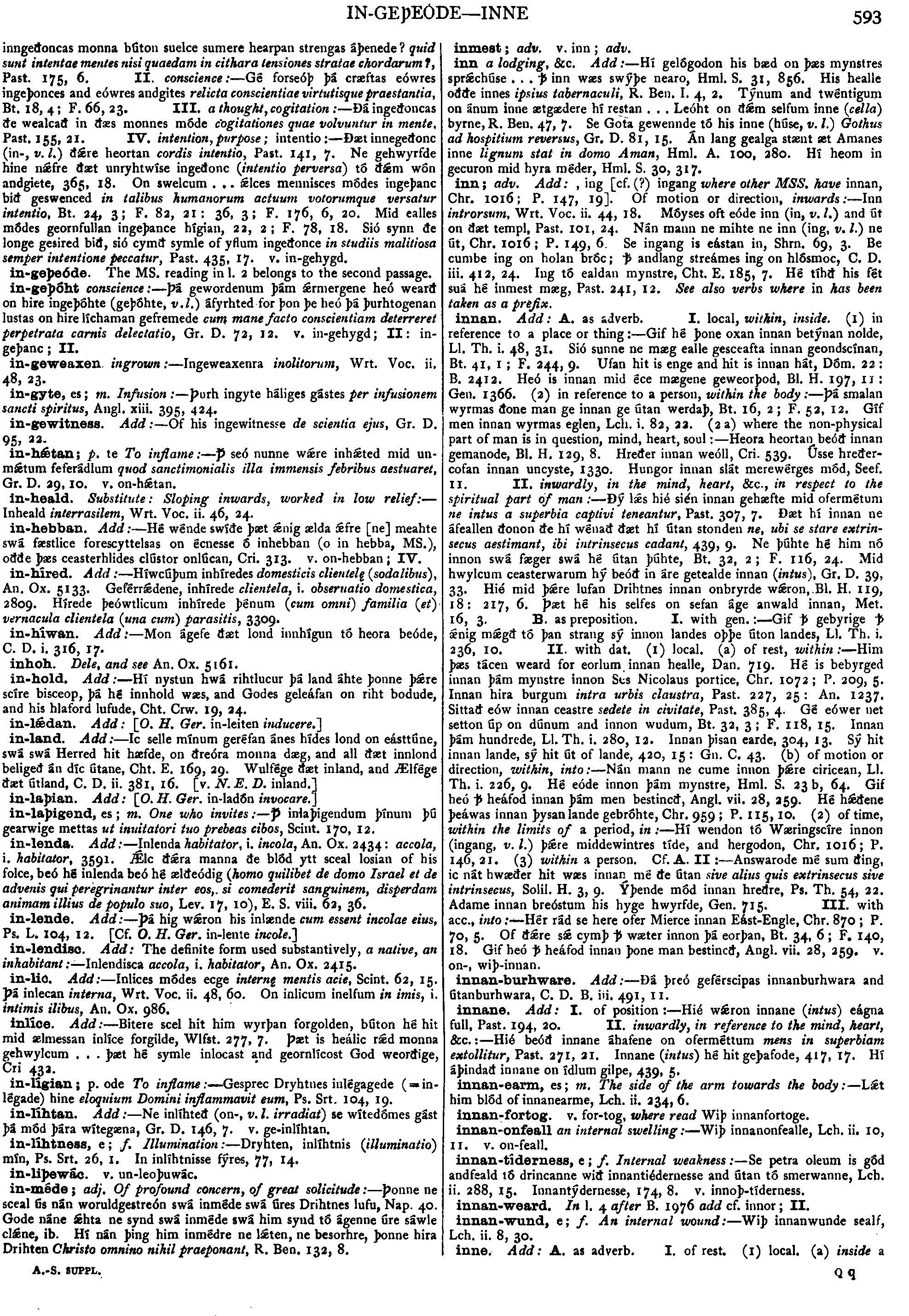
in-lenda.
Add
:--
Inlenda
habitator,
i.
incola,
An.
Ox.
2434:
accola,
i.
habitator,
3591.
Æ-acute;lc
ðra
manna
ðe
blód
ytt
sceal
losian
of
his
folce,
beó
hé
inlenda
beó
hé
ælðeódig
(homo
quilibet
de
domo
Israel
et
de
advents
qui
peregrinaniur
inter
eos,.
si
comederit
sanguinem,
disperdam
animam
illius
de
populo
suo,
Lev.
17,
10),
E.
S.
viii.
62,
36.
| Result Page: |  |
Previous | 150 151 152 153 154 155 156 157 158 159 160 161 162 163 164 165 166 167 168 | Next |  |
Germanic Lexicon Project (main page)
This search system was written by
Sean Crist
Please consider
volunteering
to correct the data in these online dictionaries.
No rights reserved. Feel free to use these data in any way you please.