|
|

|
Source: Bosworth/Toller, page b0814, entry 3 View original page image as: [TIFF] [PNG] [View previous entry] [View next entry] |
[Comment on this entry] [View comments] |
The following entry has been hand-corrected once. |
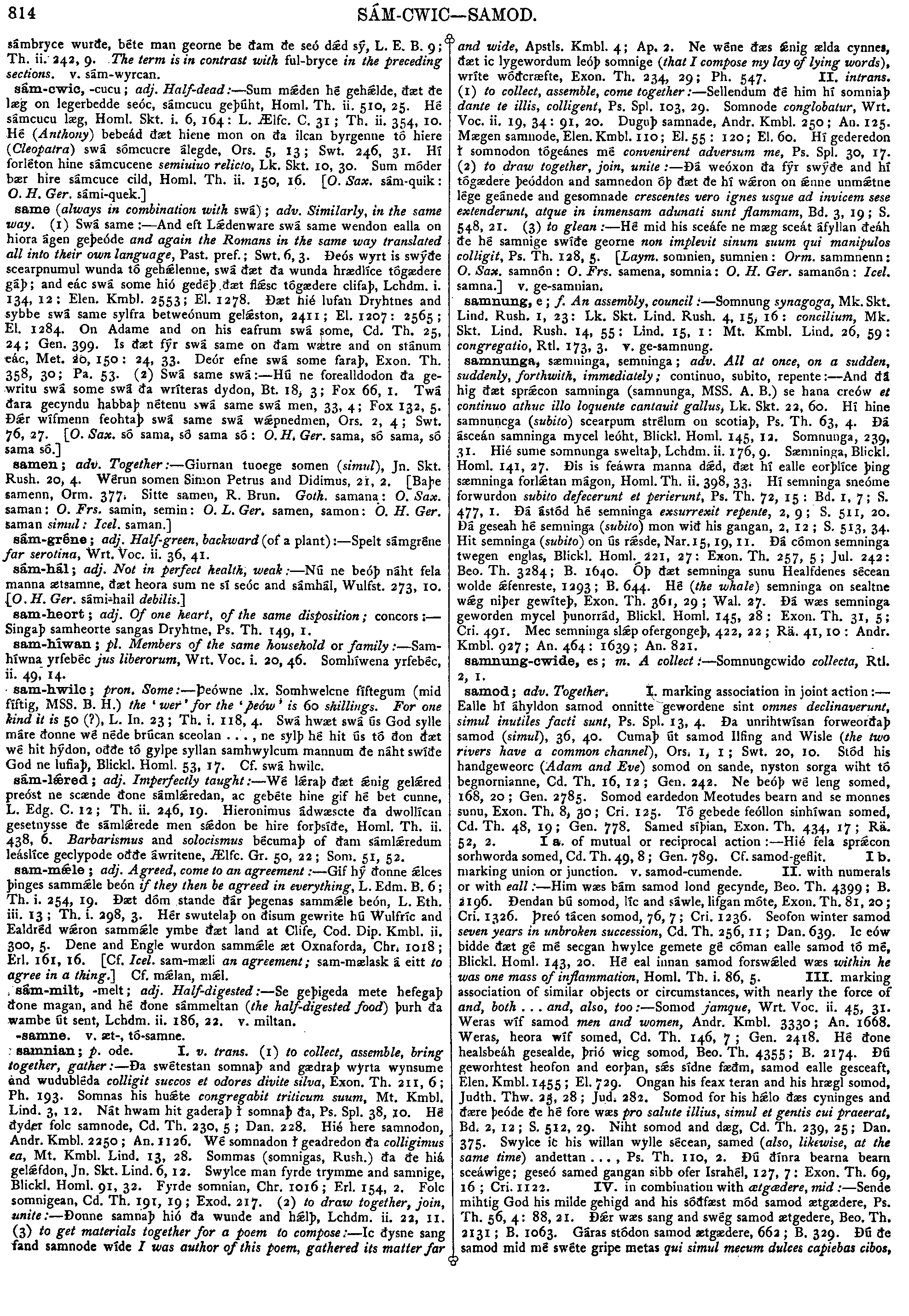
same
(always
in
combination
with
swá);
adv.
Similarly,
in
the
same
way.
(l)
Swá
same
:--
And
eft
L denware
swá
same
wendon
ealla
on
hiora
ágen
geþeóde
and
again
the
Romans
in
the
same
way
translated
all
into
their
own
language,
Past.
pref.
;
Swt.
6,
3.
Ðeós
wyrt
is
swýðe
scearpnumul
wunda
tó
gehlenne,
swá
ðæt
ða
wunda
hrædlíce
tógædere
gáþ;
and
eác
swá
some
hió
gedéþ
ðæt
flsc
tógædere
clifaþ.
Lchdm.
i.
134,
12:
Elen.
Kmbl.
2553;
El.
1278.
Ðæt
hié
lufan
Dryhtnes
and
sybbe
swá
same
sylfra
betweónum
gelston,
2411;
El.
1207:
2565;
El.
1284.
On
Adame
and
on
his
eafrum
swá
some,
Cd.
Th.
25,
24;
Gen.
399.
Is
ðæt
fýr
swá
same
on
ðam
wætre
and
on
stánum
eác.
Met.
20,
150
:
24,
33.
Deór
efne
swá
some
faraþ,
Exon.
Th.
358,
30;
Pa.
53.
(2)
Swá
same
swá
:--
Hú
ne
forealldodon
ða
gewritu
swá
some
swá
ða
wríteras
dydon,
Bt.
18,
3;
Fox
66,
1.
Twá
ðara
gecyndu
habbaþ
nétenu
swá
same
swá
men,
33,
4;
Fox
132,
5.
Ðr
wífmenn
feohtaþ
swá
same
swá
wpnedmen.
Ors.
2,
4;
Swt.
76,
27.
[O.
Sax.
só
sama,
só
sama
só:
O.
H.
Ger.
sama.
só
sama,
só
sama
só.]
denware
swá
same
wendon
ealla
on
hiora
ágen
geþeóde
and
again
the
Romans
in
the
same
way
translated
all
into
their
own
language,
Past.
pref.
;
Swt.
6,
3.
Ðeós
wyrt
is
swýðe
scearpnumul
wunda
tó
gehlenne,
swá
ðæt
ða
wunda
hrædlíce
tógædere
gáþ;
and
eác
swá
some
hió
gedéþ
ðæt
flsc
tógædere
clifaþ.
Lchdm.
i.
134,
12:
Elen.
Kmbl.
2553;
El.
1278.
Ðæt
hié
lufan
Dryhtnes
and
sybbe
swá
same
sylfra
betweónum
gelston,
2411;
El.
1207:
2565;
El.
1284.
On
Adame
and
on
his
eafrum
swá
some,
Cd.
Th.
25,
24;
Gen.
399.
Is
ðæt
fýr
swá
same
on
ðam
wætre
and
on
stánum
eác.
Met.
20,
150
:
24,
33.
Deór
efne
swá
some
faraþ,
Exon.
Th.
358,
30;
Pa.
53.
(2)
Swá
same
swá
:--
Hú
ne
forealldodon
ða
gewritu
swá
some
swá
ða
wríteras
dydon,
Bt.
18,
3;
Fox
66,
1.
Twá
ðara
gecyndu
habbaþ
nétenu
swá
same
swá
men,
33,
4;
Fox
132,
5.
Ðr
wífmenn
feohtaþ
swá
same
swá
wpnedmen.
Ors.
2,
4;
Swt.
76,
27.
[O.
Sax.
só
sama,
só
sama
só:
O.
H.
Ger.
sama.
só
sama,
só
sama
só.]
|
Source: Bosworth/Toller, page b0858, entry 1 View original page image as: [TIFF] [PNG] [View previous entry] [View next entry] |
[Comment on this entry] [View comments] |
The following entry has been hand-corrected once. |
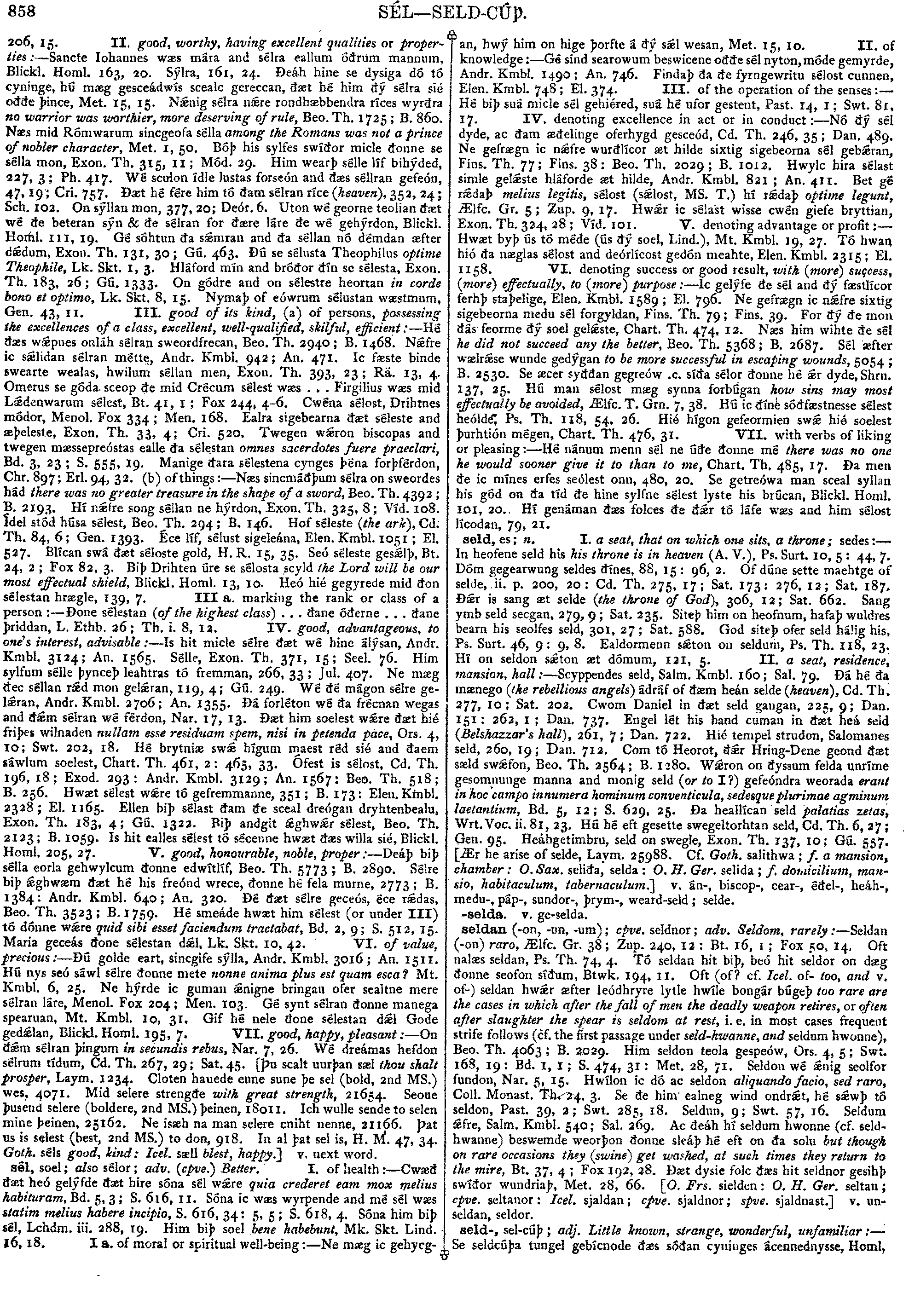
206,
15.
II.
good,
worthy,
having
excellent
qualities
or
properties
:--Sancte
Iohannes
wæs
mára
and
sélra
eallum
óðrum
mannum,
Blickl.
Homl.
163,
20.
Sýlra,
161,
24.
Ðeáh
hine
se
dysiga
dó
tó
cyninge,
hú
mæg
gesceádwís
scealc
gereccan,
ðæt
hé
him
ðý
sélra
sié
oððe
þince,
Met.
15,
15.
Nnig
sélra
nre
rondhæbbendra
ríces
wyrðra
no
warrior
was
worthier,
more
deserving
of
rule,
Beo.
Th.
1725
;
B.
860.
Næs
mid
Rómwarum
sincgeofa
sélla
among
the
Romans
was
not
a
prince
of
nobler
character,
Met.
1,
50.
Bóþ
his
sylfes
swíðor
micle
ðonne
se
sélla
mon,
Exon.
Th.
315,
11
;
Mód.
29.
Him
wearþ
sélle
líf
bihýded,
227,
3
;
Ph.
417.
Wé
sculon
ídle
lustas
forseón
and
ðæs
séllran
gefeón,
47,
19
;
Cri.
757.
Ðæt
hé
fére
him
tó
ðam
sélran
ríce
(heaven),
352,
24
;
Sch.
102.
On
sýllan
mon,
377,
20
;
Deór.
6.
Uton
wé
georne
teolian
ðæt
wé
ðe
beteran
sýn
&
ðe
sélran
for
ðære
láre
ðe
wé
gehýrdon,
Blickl.
Homl.
111,
19.
Gé
sóhtun
ða
smran
and
ða
séllan
nó
démdan
æfter
ddum,
Exon.
Th.
131,
30;
Gú.
463.
Ðú
se
sélusta
Theophilus
optime
Theophile,
Lk.
Skt.
1,
3.
Hláford
mín
and
bróðor
ðín
se
sélesta,
Exon.
Th.
183,
26
;
Gú.
1333.
On
gódre
and
on
sélestre
heortan
in
corde
bono
et
optimo,
Lk.
Skt.
8,
15.
Nymaþ
of
eówrum
sélustan
wæstmum,
Gen.
43,
11.
III.
good
of
its
kind,
(a)
of
persons,
possessing
the
excellences
of
a
class,
excellent,
well-qualified,
skilful,
efficient
:--Hé
ðæs
wpnes
onláh
sélran
sweordfrecan,
Beo.
Th.
2940
;
B.
1468.
Nfre
ic
slidan
sélran
métte,
Andr.
Kmbl.
942
;
An.
471.
Ic
fæste
binde
swearte
wealas,
hwilum
séllan
men,
Exon.
Th.
393,
23
;
Rä.
13,
4.
Omerus
se
góda
sceop
ðe
mid
Crécum
sélest
wæs
.
.
.
Firgilius
wæs
mid
Ldenwarum
sélest,
Bt.
41,
1
;
Fox
244,
4-6.
Cwéna
sélost,
Drihtnes
módor,
Menol.
Fox
334
;
Men.
168.
Ealra
sigebearna
ðæt
séleste
and
æþeleste,
Exon.
Th.
33,
4
;
Cri.
520.
Twegen
wron
biscopas
and
twegen
mæssepreóstas
ealle
ða
sélestan
omnes
sacerdotes
fuere
praeclari,
Bd.
3,
23
;
S.
555,
19.
Manige
ðara
sélestena
cynges
þéna
forþférdon,
Chr.
897
;
Erl.
94,
32.
(b)
of
things
:--Næs
sincmáðþum
sélra
on
sweordes
hád
there
was
no
greater
treasure
in
the
shape
of
a
sword,
Beo.
Th.
4392
;
B.
2193.
Hí
nfre
song
séllan
ne
hýrdon,
Exon.
Th.
325,
8
;
Víd.
108.
Ídel
stód
húsa
sélest.
Beo.
Th.
294
;
B.
146.
Hof
séleste
(the
ark),
Cd.
Th.
84,
6
;
Gen.
1393.
Éce
líf,
sélust
sigeleána,
Elen.
Kmbl.
1051
;
El.
527.
Blícan
swá
ðæt
séloste
gold,
H.
R.
15,
35.
Seó
séleste
geslþ,
Bt.
24,
2
;
Fox
82,
3.
Biþ
Drihten
úre
se
sélosta
scyld
the
Lord
will
be
our
most
effectual
shield.
Blickl.
Homl.
13,
10.
Heó
hié
gegyrede
mid
ðon
sélestan
hrægle,
139,
7.
IIIa.
marking
the
rank
or
class
of
a
person
:--Ðone
sélestan
(of
the
highest
class)
.
.
.
ðane
óðerne
.
.
.
ðane
þriddan,
L.
Ethb.
26
;
Th.
i.
8,
12.
IV.
good,
advantageous,
to
one's
interest,
advisable
:--Is
hit
micle
sélre
ðæt
wé
hine
álýsan,
Andr.
Kmbl.
3124
;
An.
1565.
Sélle,
Exon.
Th.
371,
15
;
Seel.
76.
Him
sylfum
sélle
þynceþ
leahtras
tó
fremman,
266,
33
;
Jul.
407.
Ne
mæg
ðec
séllan
rd
mon
gelran,
119,
4
;
Gú.
249.
Wé
ðé
mágon
sélre
ge lran,
Andr.
Kmbl.
2706
;
An.
1355.
Ðá
forléton
wé
ða
frécnan
wegas
and
ðm
sélran
wé
férdon,
Nar.
17,
13.
Ðæt
him
soelest
wre
ðæt
hié
friþes
wilnaden
nullam
esse
residuam
spem,
nisi
in
petenda
pace,
Ors.
4,
10
;
Swt.
202,
18.
Hé
brytniæ
sw
hígum
maest
réd
sié
and
ðaem
sáwlum
soelest,
Chart.
Th.
461,
2
:
465,
33.
Ófest
is
sélost,
Cd.
Th.
196,
18
;
Exod.
293
:
Andr.
Kmbl.
3129
;
An.
1567
:
Beo.
Th.
518
;
B.
256.
Hwæt
sélest
wre
tó
gefremmanne,
351
;
B.
173
:
Elen.
Kmbl.
2328
;
El.
1165.
Ellen
biþ
sélast
ðam
ðe
sceal
dreógan
dryhtenbealu,
Exon.
Th.
183,
4
;
Gú.
1322.
Biþ
andgit
ghwr
sélest,
Beo.
Th.
2123
;
B.
1059.
Is
hit
ealles
sélest
tó
sécenne
hwæt
ðæs
willa
sié,
Blickl.
Homl.
205,
27.
V.
good,
honourable,
noble,
proper
:--Deáþ
biþ
sélla
eorla
gehwylcum
ðonne
edwítlíf,
Beo.
Th.
5773
;
B.
2890.
Sélre
biþ
ghwæm
ðæt
hé
his
freónd
wrece,
ðonne
hé
fela
murne,
2773
;
B.
1384
:
Andr.
Kmbl.
640
;
An.
320.
Ðé
ðæt
sélre
geceós,
éce
rdas,
Beo.
Th.
3523
;
B.
1759.
Hé
smeáde
hwæt
him
sélest
(or
under
III)
tó
dónne
wre
quid
sibi
esset
faciendum
tractabat,
Bd.
2,
9
;
S.
512,
15.
Maria
geceás
ðone
sélestan
dl,
Lk.
Skt.
10,
42.
VI.
of
value,
precious
:--Ðú
golde
eart,
sincgife
sýlla.
Andr.
Kmbl.
3016
;
An.
1511.
Hú
nys
seó
sáwl
sélre
ðonne
mete
nonne
anima
plus
est
quam
esca
?
Mt.
Kmbl.
6,
25.
Ne
hýrde
ic
guman
nigne
bringan
ofer
sealtne
mere
sélran
láre,
Menol.
Fox
204
;
Men.
103.
Gé
synt
sélran
ðonne
manega
spearuan,
Mt.
Kmbl.
10,
31.
Gif
hé
nele
ðone
sélestan
dl
Gode
gedlan,
Blickl.
Homl.
195,
7,
VII.
good,
happy,
pleasant
:--On
ðm
sélran
þingum
in
secundis
rebus,
Nar.
7,
26.
Wé
dreámas
hefdon
sélrum
tídum,
Cd.
Th.
267,
29
;
Sat.
45.
[Þu
scalt
uurþan
sæl
thou
shalt
prosper,
Laym.
1234.
Cloten
hauede
enne
sune
þe
sel
(bold,
2nd
MS.)
wes,
4071.
Mid
selere
strengðe
with
great
strength,
21654.
Seoue
þusend
selere
(boldere,
2nd
MS.)
þeinen,
18011.
Ich
wulle
sende
to
selen
mine
þeinen,
25162.
Ne
isæh
na
man
selere
cniht
nenne,
21166.
Þat
us
is
selest
(best,
2nd
MS.)
to
don,
918.
In
al
þat
sel
is,
H.
M.
47,
34.
Goth.
séls
good,
kind
:
Icel.
sæll
blest,
happy.]
v.
next
word.
lran,
Andr.
Kmbl.
2706
;
An.
1355.
Ðá
forléton
wé
ða
frécnan
wegas
and
ðm
sélran
wé
férdon,
Nar.
17,
13.
Ðæt
him
soelest
wre
ðæt
hié
friþes
wilnaden
nullam
esse
residuam
spem,
nisi
in
petenda
pace,
Ors.
4,
10
;
Swt.
202,
18.
Hé
brytniæ
sw
hígum
maest
réd
sié
and
ðaem
sáwlum
soelest,
Chart.
Th.
461,
2
:
465,
33.
Ófest
is
sélost,
Cd.
Th.
196,
18
;
Exod.
293
:
Andr.
Kmbl.
3129
;
An.
1567
:
Beo.
Th.
518
;
B.
256.
Hwæt
sélest
wre
tó
gefremmanne,
351
;
B.
173
:
Elen.
Kmbl.
2328
;
El.
1165.
Ellen
biþ
sélast
ðam
ðe
sceal
dreógan
dryhtenbealu,
Exon.
Th.
183,
4
;
Gú.
1322.
Biþ
andgit
ghwr
sélest,
Beo.
Th.
2123
;
B.
1059.
Is
hit
ealles
sélest
tó
sécenne
hwæt
ðæs
willa
sié,
Blickl.
Homl.
205,
27.
V.
good,
honourable,
noble,
proper
:--Deáþ
biþ
sélla
eorla
gehwylcum
ðonne
edwítlíf,
Beo.
Th.
5773
;
B.
2890.
Sélre
biþ
ghwæm
ðæt
hé
his
freónd
wrece,
ðonne
hé
fela
murne,
2773
;
B.
1384
:
Andr.
Kmbl.
640
;
An.
320.
Ðé
ðæt
sélre
geceós,
éce
rdas,
Beo.
Th.
3523
;
B.
1759.
Hé
smeáde
hwæt
him
sélest
(or
under
III)
tó
dónne
wre
quid
sibi
esset
faciendum
tractabat,
Bd.
2,
9
;
S.
512,
15.
Maria
geceás
ðone
sélestan
dl,
Lk.
Skt.
10,
42.
VI.
of
value,
precious
:--Ðú
golde
eart,
sincgife
sýlla.
Andr.
Kmbl.
3016
;
An.
1511.
Hú
nys
seó
sáwl
sélre
ðonne
mete
nonne
anima
plus
est
quam
esca
?
Mt.
Kmbl.
6,
25.
Ne
hýrde
ic
guman
nigne
bringan
ofer
sealtne
mere
sélran
láre,
Menol.
Fox
204
;
Men.
103.
Gé
synt
sélran
ðonne
manega
spearuan,
Mt.
Kmbl.
10,
31.
Gif
hé
nele
ðone
sélestan
dl
Gode
gedlan,
Blickl.
Homl.
195,
7,
VII.
good,
happy,
pleasant
:--On
ðm
sélran
þingum
in
secundis
rebus,
Nar.
7,
26.
Wé
dreámas
hefdon
sélrum
tídum,
Cd.
Th.
267,
29
;
Sat.
45.
[Þu
scalt
uurþan
sæl
thou
shalt
prosper,
Laym.
1234.
Cloten
hauede
enne
sune
þe
sel
(bold,
2nd
MS.)
wes,
4071.
Mid
selere
strengðe
with
great
strength,
21654.
Seoue
þusend
selere
(boldere,
2nd
MS.)
þeinen,
18011.
Ich
wulle
sende
to
selen
mine
þeinen,
25162.
Ne
isæh
na
man
selere
cniht
nenne,
21166.
Þat
us
is
selest
(best,
2nd
MS.)
to
don,
918.
In
al
þat
sel
is,
H.
M.
47,
34.
Goth.
séls
good,
kind
:
Icel.
sæll
blest,
happy.]
v.
next
word.
|
Source: Bosworth/Toller, page b0949, entry 5 View original page image as: [TIFF] [PNG] [View previous entry] [View next entry] |
[Comment on this entry] [View comments] |
The following entry has been hand-corrected once. |
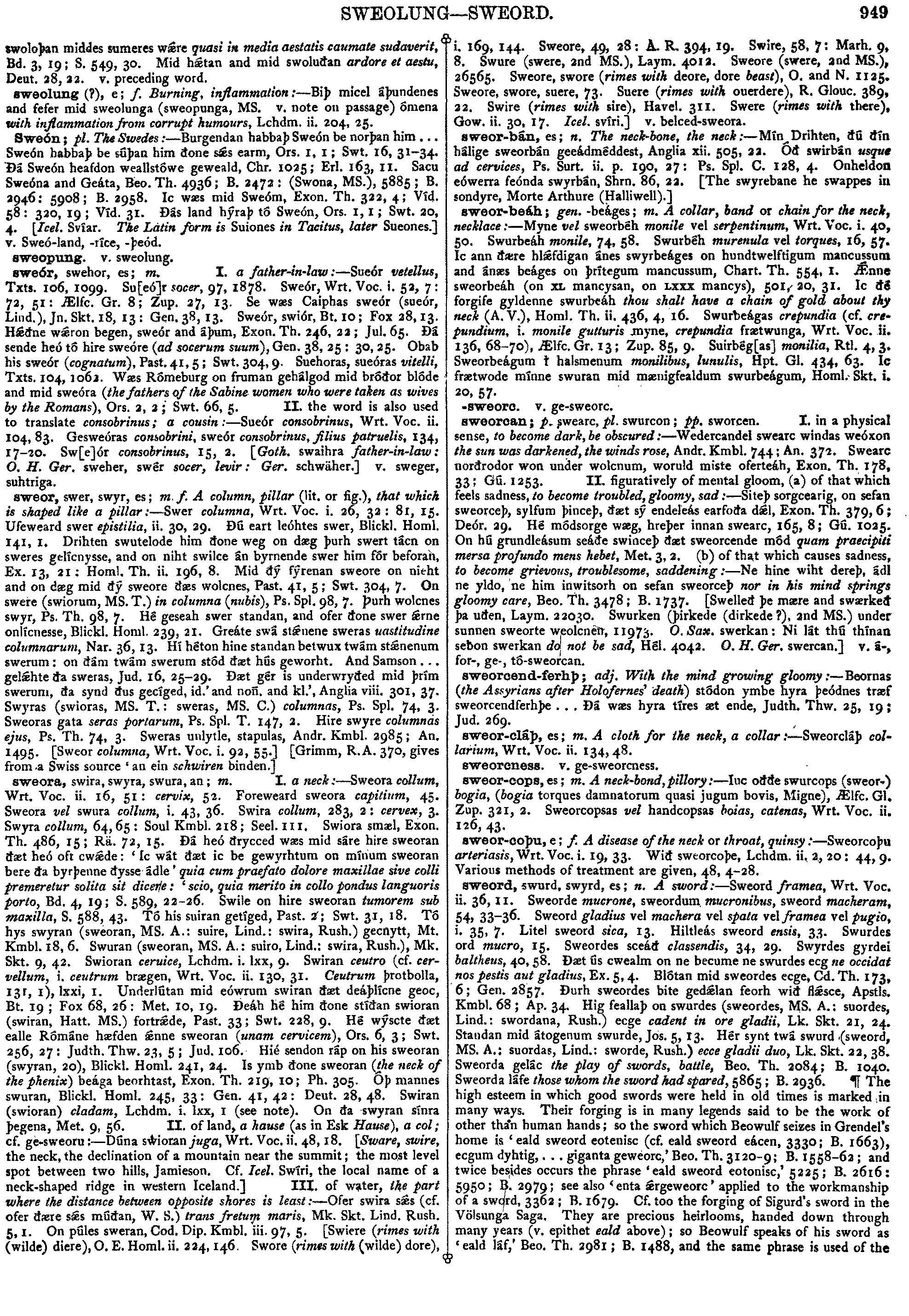
sweór,
swehor,
es;
m.
I.
a
father-in-law:--Sueór
vetellus,
Txts.
106,
1099.
Su[eó]r
socer,
97,
1878.
Sweór,
Wrt.
Voc.
i.
52,
7:
72,
51:
Ælfc.
Gr.
8;
Zup.
27,
13.
Se
wæs
Caiphas
sweór
(sueór,
Lind.),
Jn.
Skt.
18,
13:
Gen.
38,
13.
Sweór,
swiór,
Bt.
10;
Fox
28,
13.
Hdne
wron
begen,
sweór
and
áþum,
Exon.
Th.
246,
22;
Jul.
65.
Ðá
sende
heó
tó
hire
sweóre
(ad
socerum
suum),
Gen.
38,
25:
30,
25.
Obab
his
sweór
(cognatum),
Past.
41,
5;
Swt.
304,
9.
Suehoras,
sueóras
vitelli,
Txts.
104,
1062.
Wæs
Rómeburg
on
fruman
gehálgod
mid
bróðor
blóde
and
mid
sweóra
(the
fathers
of
the
Sabine
women
who
were
taken
as
wives
by
the
Romans),
Ors.
2,
2;
Swt.
66,
5.
II.
the
word
is
also
used
to
translate
consobrinus;
a
cousin:--Sueór
consobrinus,
Wrt.
Voc.
ii.
104,
83.
Gesweóras
consobrini,
sweór
consobrinus,
filius
patruelis,
134,
17-20.
Sw[e]ór
consobrinus,
15,
2.
[Goth.
swaihra
father-in-law:
O.
H.
Ger.
sweher,
swér
socer,
levir:
Ger.
schwäher.]
v.
sweger,suhtriga.
|
Source: Bosworth/Toller, page b0953, entry 17 View original page image as: [TIFF] [PNG] [View previous entry] [View next entry] |
[Comment on this entry] [View comments] |
The following entry has been hand-corrected once. |
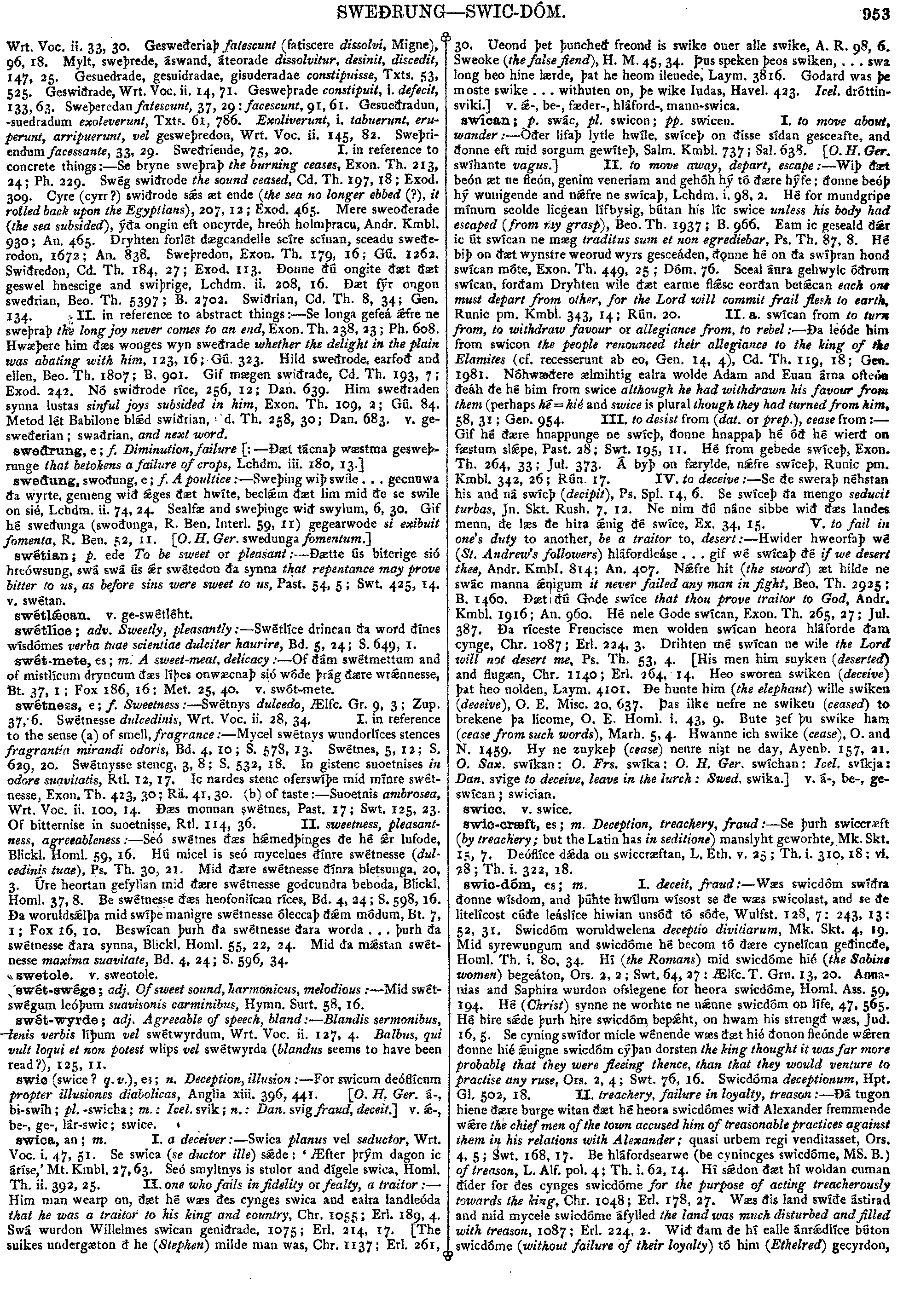
swic-dóm,
es;
m.
I.
deceit,
fraud:--Wæs
swicdóm
swíðra
ðonne
wísdom,
and
þúhte
hwílum
wísost
se
ðe
wæs
swicolast,
and
se
ðe
litelícost
cúðe
leáslíce
hiwian
unsóð
tó
sóðe,
Wulfst.
128,
7:
243,
13:
52,
31.
Swicdóm
woruldwelena
deceptio
divitiarum,
Mk.
Skt.
4,
19.
Mid
syrewungum
and
swicdóme
hé
becom
tó
ðære
cynelícan
geðincðe,
Homl.
Th.
i.
80,
34.
Hí
(the
Romans)
mid
swicdóme
hié
(the
Sabine
women)
begeáton,
Ors.
2,
2;
Swt.
64,
27:
Ælfc.
T.
Grn.
13,
20.
Annanias
and
Saphira
wurdon
ofslegene
for
heora
swicdóme,
Homl.
Ass.
59,
194.
Hé
(Christ)
synne
ne
worhte
ne
nnne
swicdóm
on
lífe,
47,
565.
Hé
hire
sde
þurh
hire
swicdóm,
bepht,
on
hwam
his
strengð
wæs,
Jud.
16,
5.
Se
cyning
swíðor
micle
wénende
wæs
ðæt
hié
ðonon
fleónde
wren
ðonne
hié
nigne
swicdóm
cýþan
dorsten
the
king
thought
it
was
far
more
probable
that
they
were
fleeing
thence,
than
that
they
would
venture
to
practise
any
ruse,
Ors.
2,
4;
Swt.
76,
16.
Swicdóma
deceptionum,
Hpt.
Gl.
502,
18.
II.
treachery,
failure
in
loyalty,
treason:--Ðá
tugon
hiene
ðære
burge
witan
ðæt
hé
heora
swicdómes
wið
Alexander
fremmende
wre
the
chief
men
of
the
town
accused
him
of
treasonable
practices
against
them
in
his
relations
with
Alexander;
quasi
urbem
regi
venditasset,
Ors.
4,
5;
Swt.
168,
17.
Be
hláfordsearwe
(be
cynincges
swicdóme,
MS.
B.)
of
treason,
L.
Alf.
pol.
4;
Th.
i.
62,
14.
Hí
sdon
ðæt
hí
woldan
cuman
ðider
for
ðes
cynges
swicdóme
for
the
purpose
of
acting
treacherously
towards
the
king,
Chr.
1048;
Erl.
178,
27.
Wæs
ðis
land
swíðe
ástirad
and
mid
mycele
swicdóme
áfylled
the
land
was
much
disturbed
and
filled
with
treason,
1087;
Erl.
224,
2.
Wið
ðam
ðe
hí
ealle
ánrdlíce
búton
swicdóme
(without
failure
of
their
loyalty)
tó
him
(Ethelred)
gecyrdon,
|
Source: Bosworth/Toller, page b0990, entry 1 View original page image as: [TIFF] [PNG] [View previous entry] [View next entry] |
[Comment on this entry] [View comments (1)] |
The following entry has been hand-corrected once. |
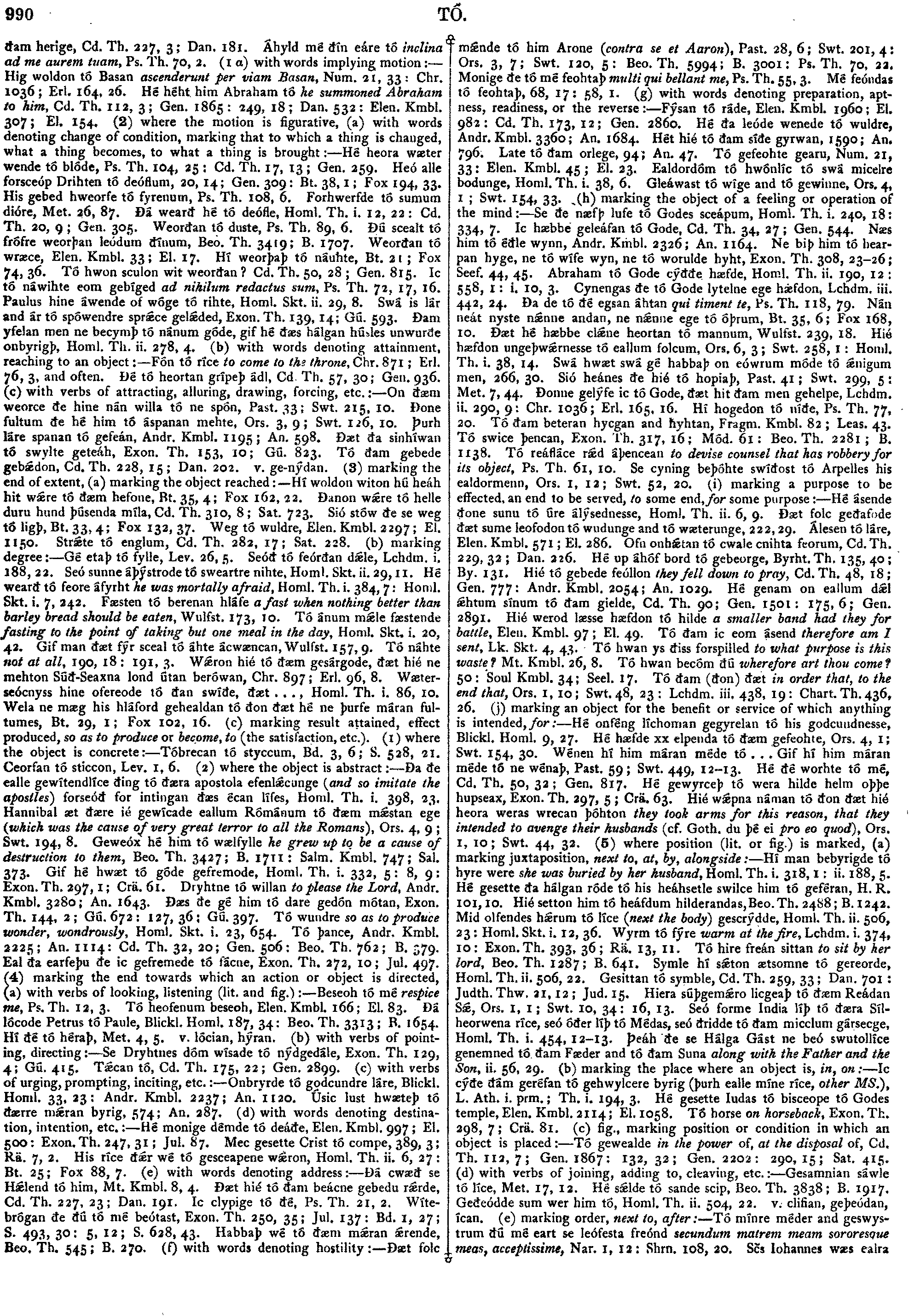
ðam
herige,
Cd.
Th.
227,
3;
Dan.
181.
Áhyld
mé
ðín
eáre
tó
inclina
ad
me
aurem
tuam,
Ps.
Th.
70,
2.
(Ia)
with
words
implying
motion
:--
Hig
woldon
tó
Basan
ascenderunt
per
viam
Basan,
Num.
21,
33:
Chr.
1036;
Erl.
164,
26.
Hé
héht
him
Abraham
tó
he
summoned
Abraham
to
him,
Cd.
Th.
112,
3;
Gen.
1865:
249,18;
Dan.
532:
Elen.
Kmbl.
307;
El.
154.
(2)
where
the
motion
is
figurative,
(a)
with
words
denoting
change
of
condition,
marking
that
to
which
a
thing
is
changed,
what
a
thing
becomes,
to
what
a
thing
is
brought
:--
Hé
heora
wæter
wende
tó
blóde,
Ps.
Th.
104,
25
:
Cd.
Th.
17,
13
;
Gen.
259.
Heó
alle
forsceóp
Drihten
tó
deóflum,
20,
14;
Gen.
309:
Bt.
38,
l;
Fox
194,
33.
His
gebed
hweorfe
tó
fyrenutn,
Ps.
Th.
108,
6.
Forhwerfde
tó
sumum
dióre,
Met.
26,
87.
Ðá
wearð
hé
tó
deófle.
Homl.
Th.
i.
12,
22:
Cd.
Th.
20,
9
;
Gen.
305.
Weorðan
tó
duste.
Ps.
Th.
89,
6.
Ðú
scealt
tó
frófre
weorþan
leódum
ðínum,
Beo.
Th.
3419;
B.
1707.
Weorðan
tó
wræce,
Elen.
Kmbl.
33;
El.
17.
Hí
weorþaþ
tó
náuhte.
Bt.
21;
Fox
74,
36.
Tó
hwon
sculon
wit
weorðan
?
Cd.
Th.
50,
28
;
Gen.
815.
Ic
tó
náwihte
eom
gebíged
ad
nihilum
redactus
sum,
Ps.
Th.
72,
17,
16.
Paulus
hine
áwende
of
wóge
tó
rihte.
Homl.
Skt.
ii.
29,
8.
Swá
is
lár
and
ár
tó
spówendre
sprce
gelded,
Exon.
Th.
139,
14;
Gú.
593.
Ðam
yfelan
men
ne
becymþ
tó
nánum
góde,
gif
hé
ðæs
hálgan
húsles
unwurðe
onbyrigþ.
Homl.
Th.
ii.
278,
4.
(b)
with
words
denoting
attainment,
reaching
to
an
object
:--
Fón
tó
ríce
to
come
to
ens
throne,
Chr.
871;
Erl.
76,
3,
and
often.
Ðé
tó
heortan
grípeþ
ádl,
Cd
Th.
57,
30;
Gen.
936.
(c)
with
verbs
of
attracting,
alluring,
drawing,
forcing,
etc.
:--
On
ðæm
weorce
ðe
hine
nán
willa
tó
ne
spón,
Past.
33;
Swt.
215,
10.
Done
fultum
ðe
hé
him
tó
áspanan
mehte.
Ors.
3,
9;
Swt.
126,
10.
Þurh
láre
spanan
tó
gefeán.
Andr.
Kmbl.
1195;
An.
598.
Ðæt
ða
sinhíwan
tó
swylte
geteáh.
Exon.
Th.
153,
10;
Gú.
823.
Tó
ðam
gebede
gebdon.
Cd.
Th.
228,
15
;
Dan.
202.
v.
ge-nýdan.
(3)
marking
the
end
of
extent,
(a)
marking
the
object
reached
:--
Hí
woldon
witon
hú
heáh
hit
wre
tó
ðæm
hefone.
Bt.
35,
4;
Fox
162,
22.
Ðanon
wre
tó
helle
duru
hund
þúsenda
míla,
Cd.
Th.
310,
8;
Sat.
723.
Sió
stów
ðe
se
weg
tó
ligþ,
Bt.
33,
4;
Fox
132,
37.
Weg
tó
wuldre,
Elen.
Kmbl.
2297;
El.
1150.
Strte
tó
englum,
Cd.
Th.
282,
17;
Sat.
228.
(b)
marking
degree
:--
Gé
etaþ
tó
fylle,
Lev.
26,
5.
Seóð
tó
feórðan
dle,
Lchdm.
i.
188,
22.
Seó
sunne
þýstrode
tó
sweartre
nihte,
Homl.
Skt.
ii.
29,
ii.
Hé
wearð
tó
feore
áfyrht
he
was
mortally
afraid,
Homl.
Th.
i.
384,
7:
Homl.
Skt.
i.
7,
242.
Fæsten
tó
berenan
hláfe
a
fast
when
nothing
better
than
barley
bread
should
be
eaten.
Wulfst.
173,
10.
Tó
ánum
mle
fæstende
fasting
to
the
point
of
taking
but
one
meal
in
the
day.
Homl.
Skt.
i.
20,
43.
Gif
man
ðæt
fýr
sceal
tó
áhte
Scwæncan,
Wulfst.
157,
9.
Tó
náhte
not
at
all,
190,
18
:
191,
3.
Wron
hié
tó
ðæm
gesárgode,
ðæt
hié
ne
mehton
Súð-Seaxna
lond
útan
berówan,
Chr.
897;
Erl.
96,
8.
Wæter-seócnyss
hine
ofereode
tó
ðan
swíðe,
ðæt
.
.
.
,
Homl.
Th.
i.
86,
10.
Wela
ne
mæg
his
hláford
gehealdan
tó
ðon
ðæt
hé
ne
þurfe
máran
ful-tumes,
Bt.
29,
l;
Fox
102,
16.
(c)
marking
result
attained,
effect
produced,
so
as
to
produce
or
become,
to
(the
satisfaction,
etc.
).
(l)
where
the
object
is
concrete
:--
Tóbrecan
tó
styccum,
Bd.
3,
6;
S.
528,
21.
Ceorfan
tó
sticcon,
Lev.
I.
6.
(2)
where
the
object
is
abstract
:--
Ða
ðe
ealle
gewítendlíce
ðing
tó
ðæra
apostola
efenlcunge
(and
so
imitate
the
apostles)
forseóð
for
intingan
ðæs
écan
lífes,
Homl.
Th.
i.
398,
23.
Hannibal
æt
ðære
ié
gewícade
eallum
Rómánum
tó
ðæm
mstan
ege
(which
was
the
cause
of
very
great
terror
to
all
the
Romans),
Ors.
4,
9
;
Swt.
194,
8.
Geweóx
hé
him
tó
wælfylle
he
grew
up
to
be
a
cause
of
destruction
to
them,
Beo.
Th.
3427;
B.
1711:
Salm.
Kmbl.
747;
Sal.
373.
Gif
hé
hwæt
tó
góde
gefremode.
Homl.
Th.
i.
332,
5:
8,
9:
Exon.
Th.
297,
1;
Crii.
61.
Dryhtne
tó
willan
to
please
the
Lord,
Andr.
Kmbl.
3280;
An.
1643.
Ðæs
ðe
gé
him
tó
dare
gedón
mótan.
Exon.
Th.
144,
2
;
Gú.
672
:
127,
36:
Gú.
397.
Tó
wundre
so
as
to
produce
wonder,
wondrously,
Homl.
Skt.
i.
23,
654.
Tó
þance,
Andr.
Kmbl.
2225;
An.
1114:
Cd.
Th.
32,
20;
Gen.
506:
Beo.
Th.
762;
B.
379.
Eal
ða
earfeþu
ðe
ic
gefremede
tó
fácne,
Exon.
Th.
272,
10;
Jul.
497.
(4)
marking
the
end
towards
which
an
action
or
object
is
directed,
(a)
with
verbs
of
looking,
listening
(lit.
and
fig.
)
:--
Beseoh
tó
mé
respite
me,
Ps.
Th.
12,
3.
Tó
heofenum
beseoh,
Elen.
Kmbl.
166;
El.
83.
Ðá
lócode
Petrus
tó
Paule,
Blickl.
Homl.
187,
34:
Beo.
Th.
3313;
B.
1654.
Hí
ðé
tó
héraþ,
Met.
4,
5.
v.
Iócian,
hýran.
(b)
with
verbs
of
pointing,
directing
:--
Se
Dryhtnes
dóm
wísade
tó
nýdgedále,
Exon.
Th.
129,
4;
Gu.
415.
Tcan
tó,
Cd.
Th.
175,
22;
Gen.
2899.
(c)
with
verbs
of
urging,
prompting,
inciting,
etc.
:--
Onbryrde
tó
godcundre
láre,
Blickl.
Homl.
33,
23:
Andr.
Kmbl.
2237;
An.
1120.
Úsic
lust
hwæteþ
tó
ðærre
mran
byrig,
574;
An.
287.
(d)
with
words
denoting
destination,
intention,
etc.
:--
Hé
monige
démde
tó
deáðe,
Elen.
Kmbl.
997;
El.
500:
Exon.
Th.
247,
31;
Jul.
87.
Mec
gesette
Crist
tó
compe,
389,
3;
RS.
7,
2.
His
ríce
ðr
wé
tó
gesceapene
wron,
Homl.
Th.
ii.
6,
27:
Bt.
25;
Fox
88,
7.
(e)
with
words
denoting
address
:--
Ðá
cwæð
se
Hlend
to
him,
Mt.
Kmbl.
8,
4.
Ðæt
hié
tó
ðam
beácne
gebedu
rrde,
Cd.
Th.
227,
23;
Dan.
191.
Ic
clypige
tó
ðé,
Ps.
Th.
21,
2.
Wíte-brógan
ðe
ðú
tó
mé
beótast,
Exon.
Th.
250,
35;
Jul.
137:
Bd.
l,
27;
S.
493,
30:
5,
12;
S.
628,
43.
Habbaþ
wé
tó
ðæm
mran
rende,
Beo.
Th.
545;
B.
270.
(f)
with
words
denoting
hostility
:--
Ðæt
folc
|
Source: Bosworth/Toller, page b1011, entry 9 View original page image as: [TIFF] [PNG] [View previous entry] [View next entry] |
[Comment on this entry] [View comments] |
The following entry has been hand-corrected once. |
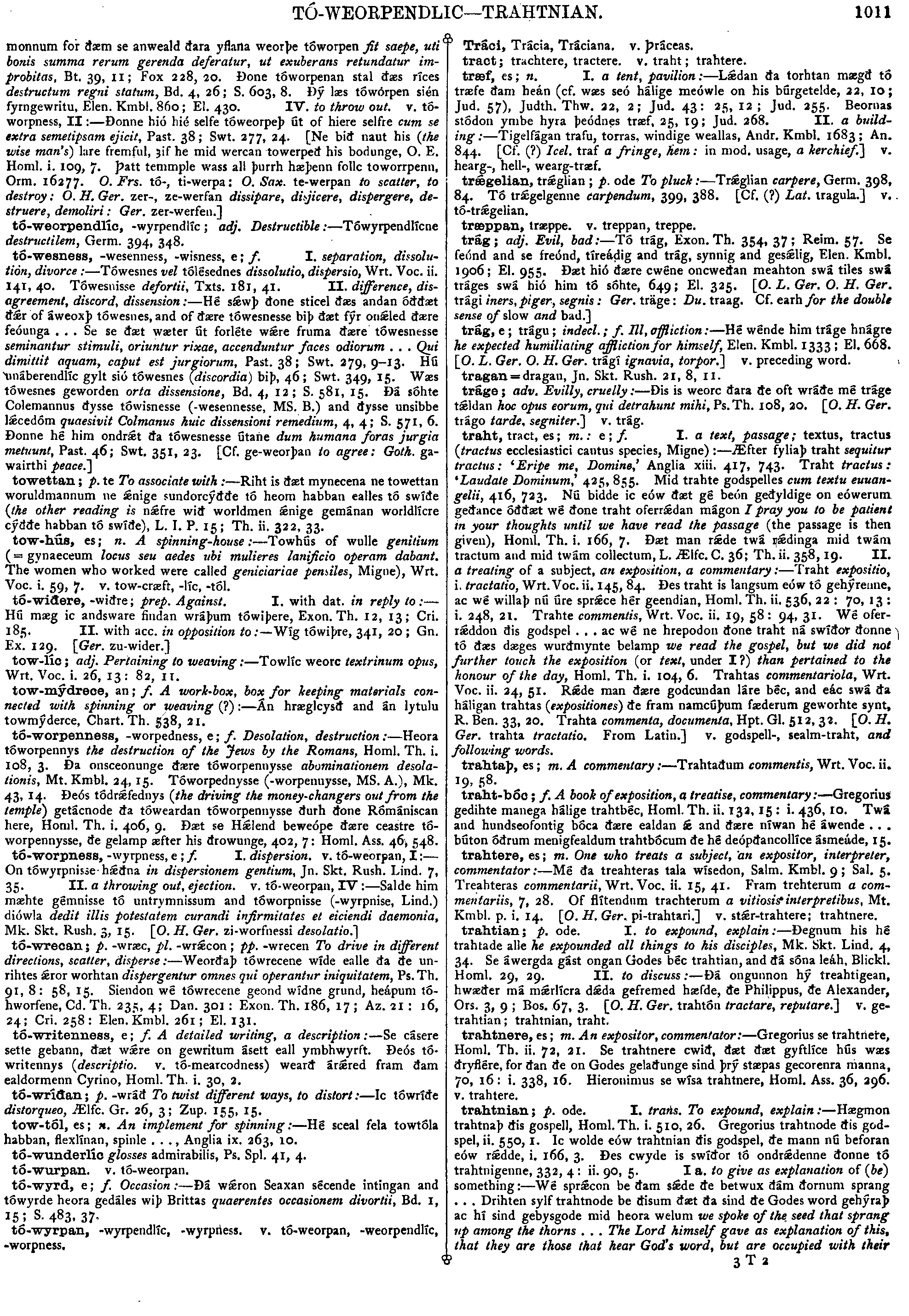
tó-worpenness,
-worpedness,
e;
f.
Desolation,
destruction
:--
Heora
tóworpennys
the
destruction
of
the
Jews
by
the
Romans,
Homl.
Th.
i.
108,
3.
Ða
onsceonunge
ðære
tóworpennysse
abominationem
desolationis,
Mt.
Kmbl.
24,
15.
Tóworpednysse
(-worpenuysse,
MS.
A.
),
Mk.
43,
14.
Ðeós
tódrfednys
(the
driving
the
money-changers
out
from
the
temple)
getácnode
ða
tóweardan
tóworpennysse
ðurh
ðone
Rómániscan
here,
Homl.
Th.
i.
406,
9.
Ðæt
se
Hlend
beweópe
ðære
ceastre
tóworpennysse,
ðe
gelamp
æfter
his
ðrowunge,
402,
7:
Homl.
Ass.
46,
548.
|
Source: Bosworth/Toller, page b1014, entry 26 View original page image as: [TIFF] [PNG] [View previous entry] [View next entry] |
[Comment on this entry] [View comments (1)] |
The following entry has been hand-corrected once. |
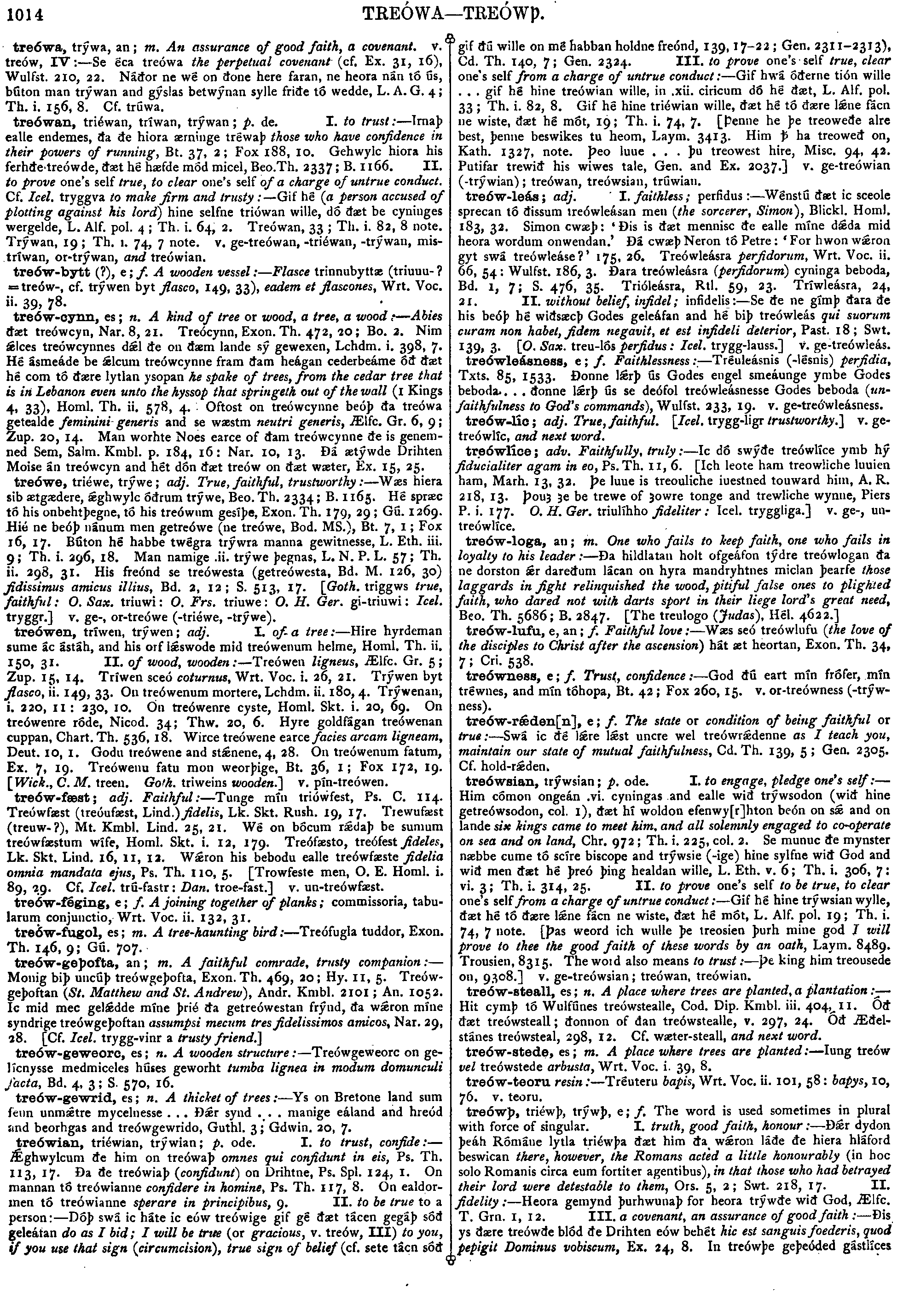
treówþe
triéwþ,
trýwþ,
e;
f.
The
word
is
used
sometimes
in
plural
with
force
of
singular.
I.
truth,
good
faith,
honour
:--
Ðr
dydon
þeáh
Rómáne
lytla
triéwþa
ðæt
him
ða
wron
láðe
ðe
hiera
hláford
beswican
there,
however,
the
Romans
acted
a
little
honourably
(in
hoc
solo
Romanis
circa
eum
fortiter
agentibus),
in
that
those
who
had
betrayed
their
lord
were
detestable
to
them,
Ors.
5,
2;
Swt.
218,
17.
II.
fidelity
:--
Heora
gemynd
þurhwunaþ
for
heora
trýwðe
wið
God,
Ælfc.
T.
Grn.
1,
12.
III.
a
covenant,
an
assurance
of
good
faith
:--
Ðis
ys
ðære
treówðe
blód
ðe
Drihten
eów
behét
hic
est
sanguisfoederis,
quod
pepigit
Dominus
vobiscum,
Ex.
24,
8.
In
treówþe
geþeóded
gástlíces
|
Source: Bosworth/Toller, page b1064, entry 17 View original page image as: [TIFF] [PNG] [View previous entry] [View next entry] |
[Comment on this entry] [View comments] |
The following entry has been hand-corrected once. |
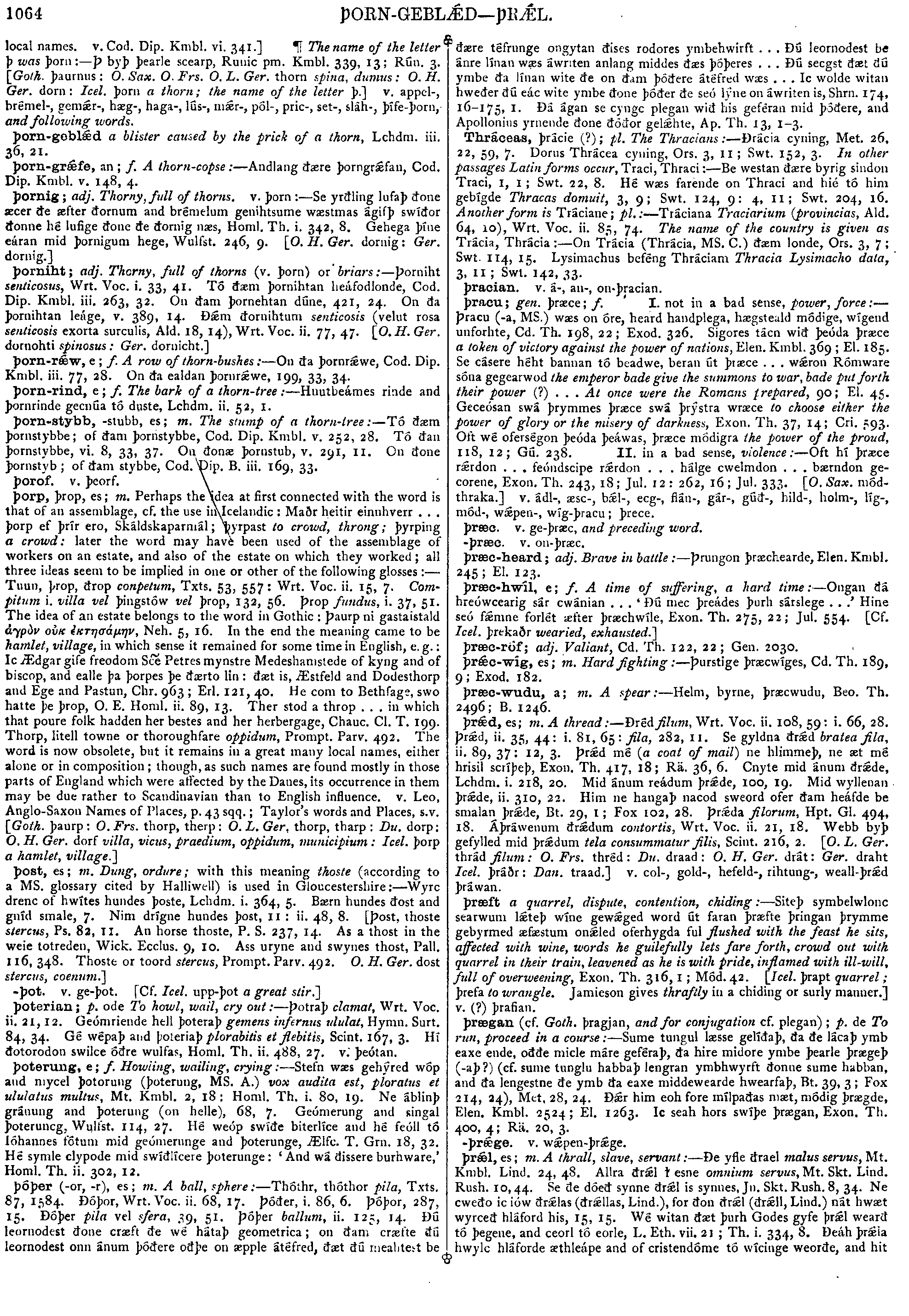
þracu;
gen.
þræce;
f.
I.
not
in
a
bad
sense,
power,
force
:--
Þracu
(-a,
MS.)
wæs
on
óre,
heard
handplega,
hægsteald
módige,
wígend
unforhte,
Cd.
Th.
198,
22;
Exod.
326.
Sigores
tácn
wið
þeóda
þræce
a
token
of
victory
against
the
power
of
nations,
Elen.
Kmbl.
369;
El.
185.
Se
cásere
héht
bannan
tó
beadwe,
beran
út
þræce
...
wron
Rómware
sóna
gegearwod
the
emperor
bade
give
the
summons
to
war,
bade
put
forth
their
power(?)
...
At
once
were
the
Romans
prepared,
90;
El.
45.
Geceósan
swá
þrymmes
þræce
swá
þrýstra
wræce
to
choose
either
the
power
of
glory
or
the
misery
of
darkness,
Exon.
Th.
37,
14;
Cri.
593.
Oft
wé
oferségon
þeóda
þeáwas,
þræce
módigra
the
power
of
the
proud,
118,
12;
Gú.
238.
II.
in
a
bad
sense,
violence
:--
Oft
hí
þræce
rrdon
...
feóndscipe
rrdon
...
hálge
cwelmdon
...
bærndon
gecorene,
Exon.
Th.
243,
18;
Jul.
12:
262,
16;
Jul.
333.
[O.
Sax.
módthraka.]
v.
ádl-,
æsc-,
bl-,
ecg-,
flán-,
gár-,
gúð-,
hild-,
holm-,
líg-,
mód-,
wpen-,
wíg-þracu;
þrece.
|
Source: Bosworth/Toller, page b1136, entry 16 View original page image as: [TIFF] [PNG] [View previous entry] [View next entry] |
[Comment on this entry] [View comments] |
The following entry has been hand-corrected once. |
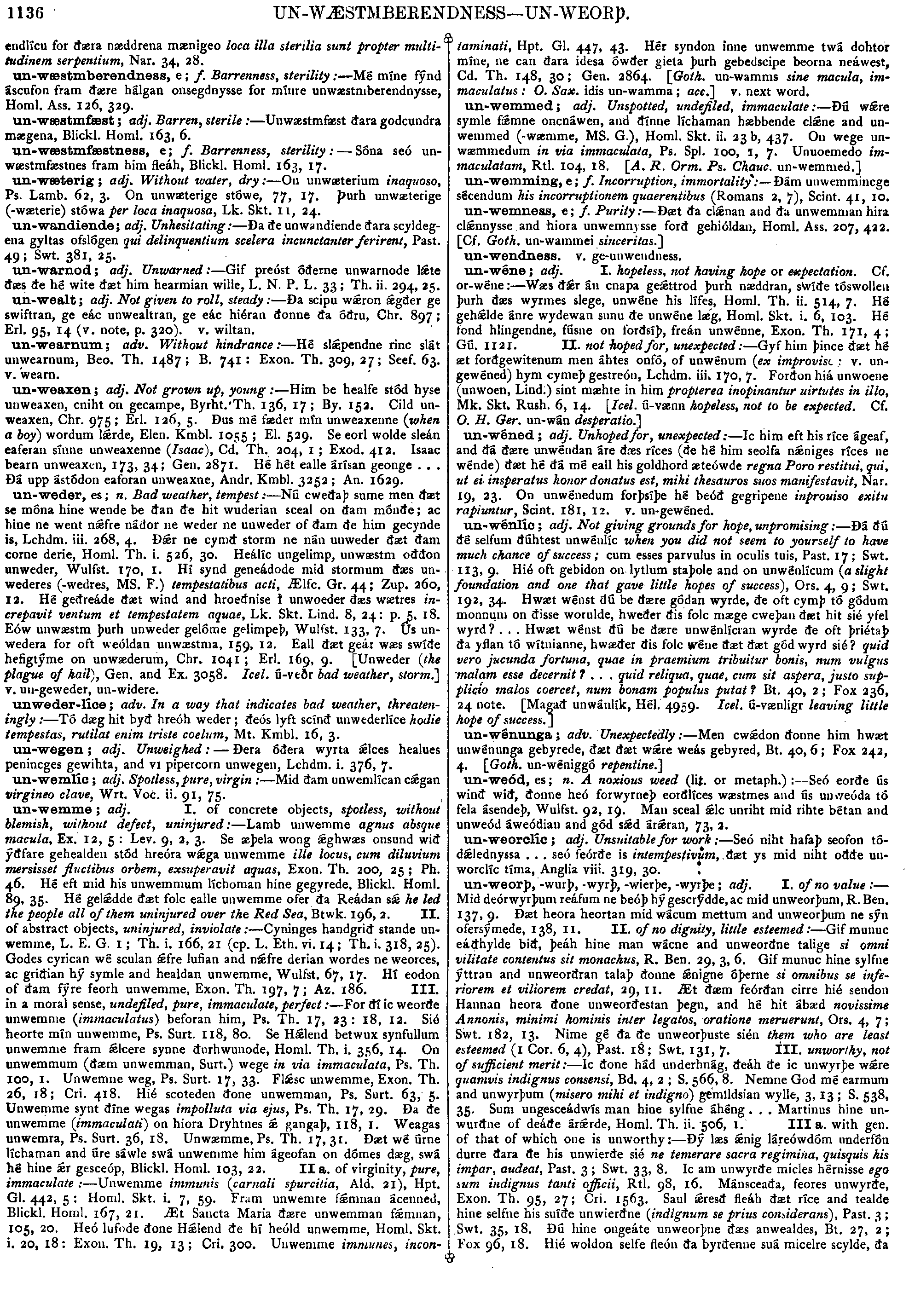
un-wemming, e; f. Incorruption, immortality :-- Ðám unwemmincge sécendum his incorruptionem quaerentibus (Romans 2, 7), Scint. 41, 10.
|
Source: Bosworth/Toller, page d0105, entry 8 View original page image as: [TIFF] [PNG] [View previous entry] [View next entry] |
[Comment on this entry] [View comments] |
The following entry has been hand-corrected once. |
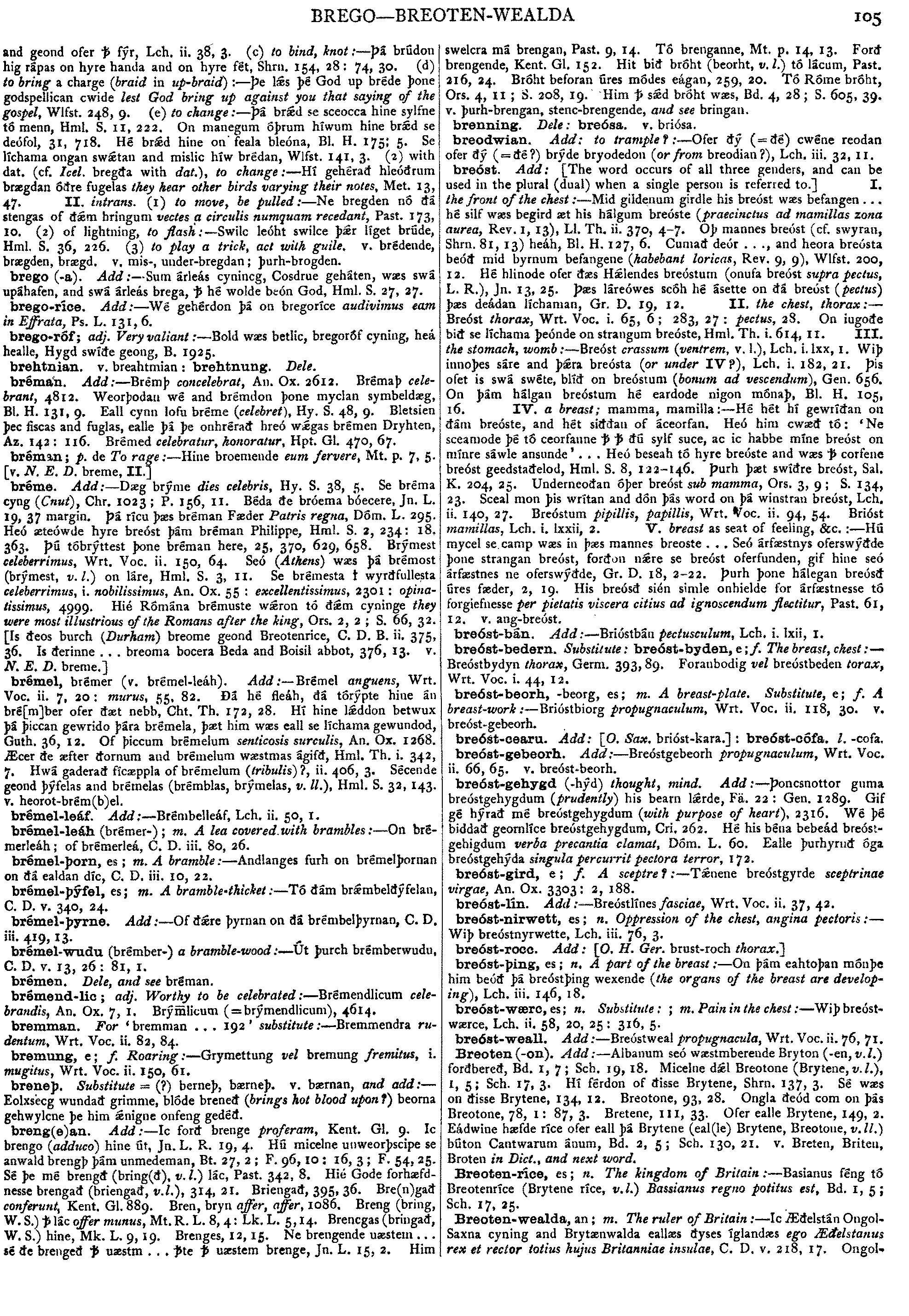
br me.
Add
:--
Dæg
br
me.
Add
:--
Dæg
br me
dies
Celebris,
Hy.
S.
38,
5.
Se
brma
cyng
(Cnuf),
Chr.
1023
;
P.
156,
II.
Bda
me
dies
Celebris,
Hy.
S.
38,
5.
Se
brma
cyng
(Cnuf),
Chr.
1023
;
P.
156,
II.
Bda
 e
bróema
bóecere,
Jn.
L.
10,
37
margin.]
Þ
e
bróema
bóecere,
Jn.
L.
10,
37
margin.]
Þ r
r cu
þæs
brman
Fæder
Patris
regna,
Dom.
L.
295.
Heó
æteówde
hyre
breóst
þm
brman
Philippe,
Hml.
S.
2,
234:
18,
363.
Þ
cu
þæs
brman
Fæder
Patris
regna,
Dom.
L.
295.
Heó
æteówde
hyre
breóst
þm
brman
Philippe,
Hml.
S.
2,
234:
18,
363.
Þ t
t brttest
þone
brman
here,
25,
370,
629,
658.
Brmest
celeberrimus,
Wrt.
Voc.
ii.
150,
64.
Seó
(Athens)
wæs
þ
brmost
(brmest,
v.
l.)
on
lre,
Hml.
S.
3,
II.
Se
brmesta
brttest
þone
brman
here,
25,
370,
629,
658.
Brmest
celeberrimus,
Wrt.
Voc.
ii.
150,
64.
Seó
(Athens)
wæs
þ
brmost
(brmest,
v.
l.)
on
lre,
Hml.
S.
3,
II.
Se
brmesta
 wyrfullesta
celeberrimus,
i.
nobilissimus,
An.
Ox.
55
:
excellentissimus,
2301
:
opina-tissimus,
4999.
Hié
Rmna
brmuste
w
wyrfullesta
celeberrimus,
i.
nobilissimus,
An.
Ox.
55
:
excellentissimus,
2301
:
opina-tissimus,
4999.
Hié
Rmna
brmuste
w ron
t
m
cyninge
they
were
most
illustrious
of
the
Romans
after
the
king,
Ors.
2,
2
;
S.
66,
32.
[Is
eos
burch
(Durham)
breome
geond
Breotenrice,
C.
D.
B.
ii.
375,
36.
Is
erinne
.
.
.
breoma
bocera
Beda
and
Boisil
abbot,
376,
13.
v.
N.
E.
D.
breme.]
ron
t
m
cyninge
they
were
most
illustrious
of
the
Romans
after
the
king,
Ors.
2,
2
;
S.
66,
32.
[Is
eos
burch
(Durham)
breome
geond
Breotenrice,
C.
D.
B.
ii.
375,
36.
Is
erinne
.
.
.
breoma
bocera
Beda
and
Boisil
abbot,
376,
13.
v.
N.
E.
D.
breme.]
| Result Page: |  |
Previous | 1 2 3 4 5 6 7 8 9 10 | Next |  |
Germanic Lexicon Project (main page)
This search system was written by
Sean Crist
Please consider
volunteering
to correct the data in these online dictionaries.
No rights reserved. Feel free to use these data in any way you please.