|
|

|
Source: Cleasby/Vigfusson, page b0420, entry 21 View original page image as: [TIFF] [PNG] [View previous entry] [View next entry] |
[Comment on this entry] [View comments] |
The following entry has been hand-corrected once. |
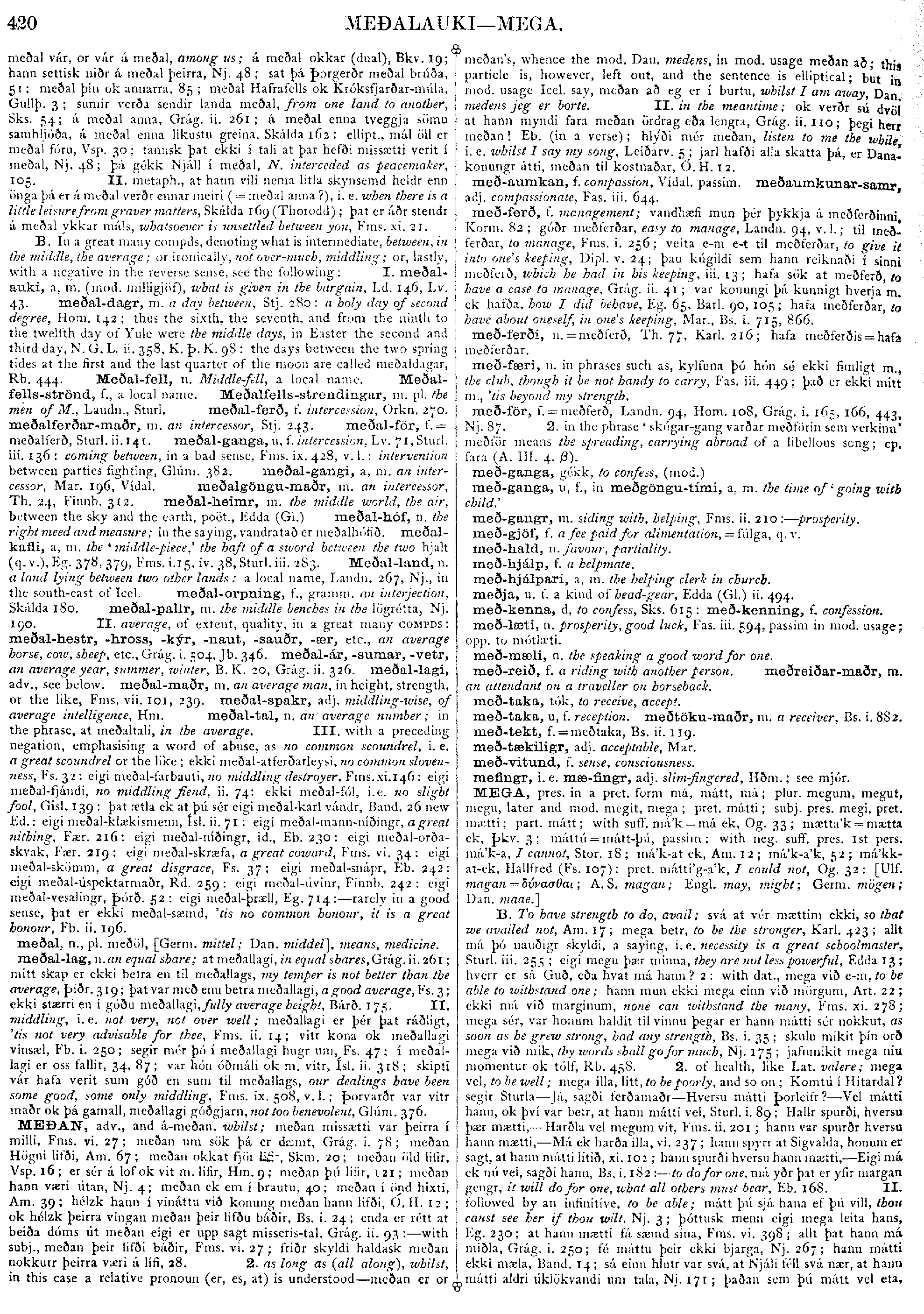
með-reið, f. a riding with another person. meðreiðar-maðr, m. an attendant on a traveller on horseback.
|
Source: Cleasby/Vigfusson, page b0463, entry 11 View original page image as: [TIFF] [PNG] [View previous entry] [View next entry] |
[Comment on this entry] [View comments] |
The following entry has been hand-corrected once. |
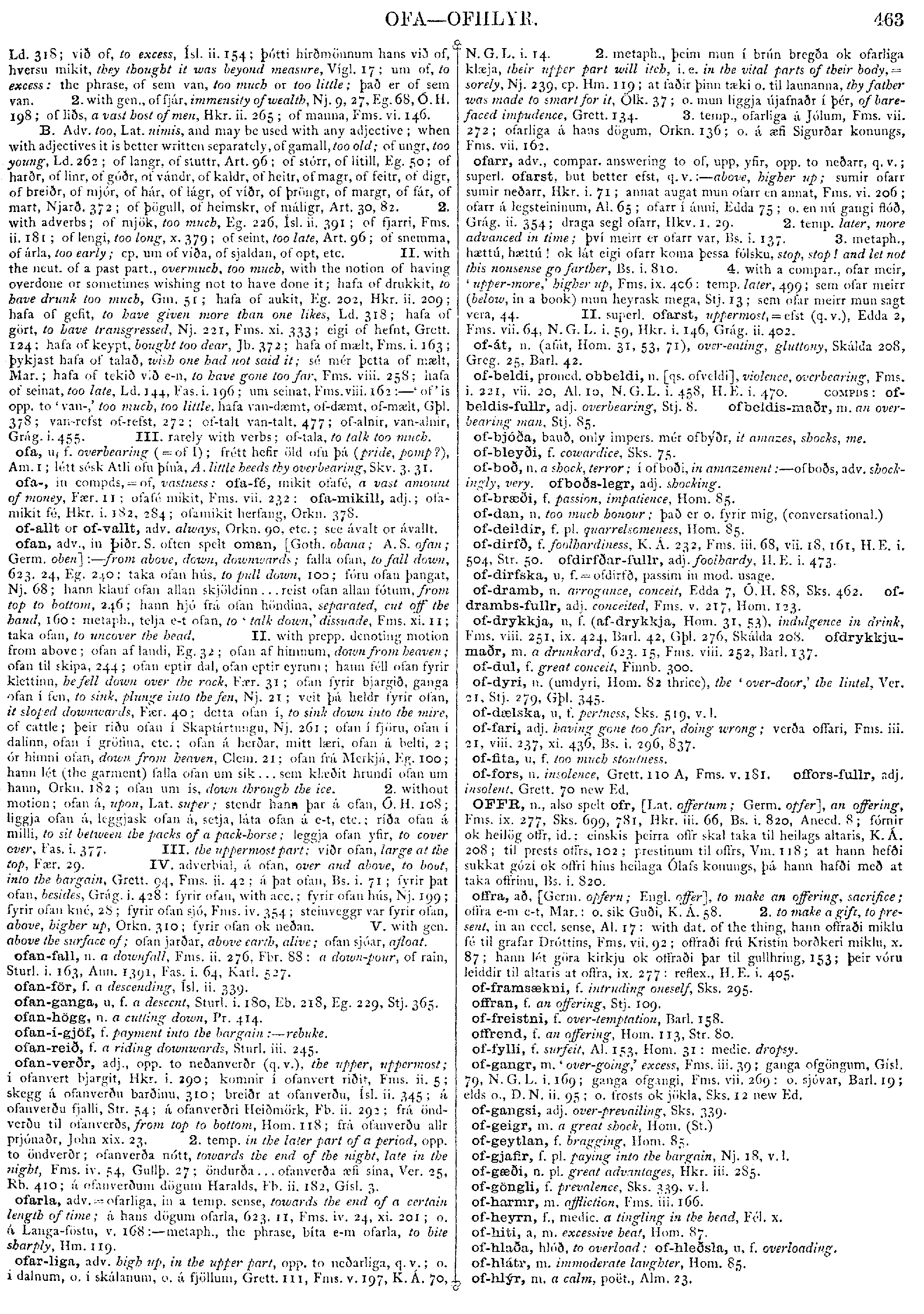
ofan-reið, f. a riding downwards, Sturl. iii. 245.
|
Source: Cleasby/Vigfusson, page b0483, entry 16 View original page image as: [TIFF] [PNG] [View previous entry] [View next entry] |
[Comment on this entry] [View comments] |
The following entry has been hand-corrected once. |
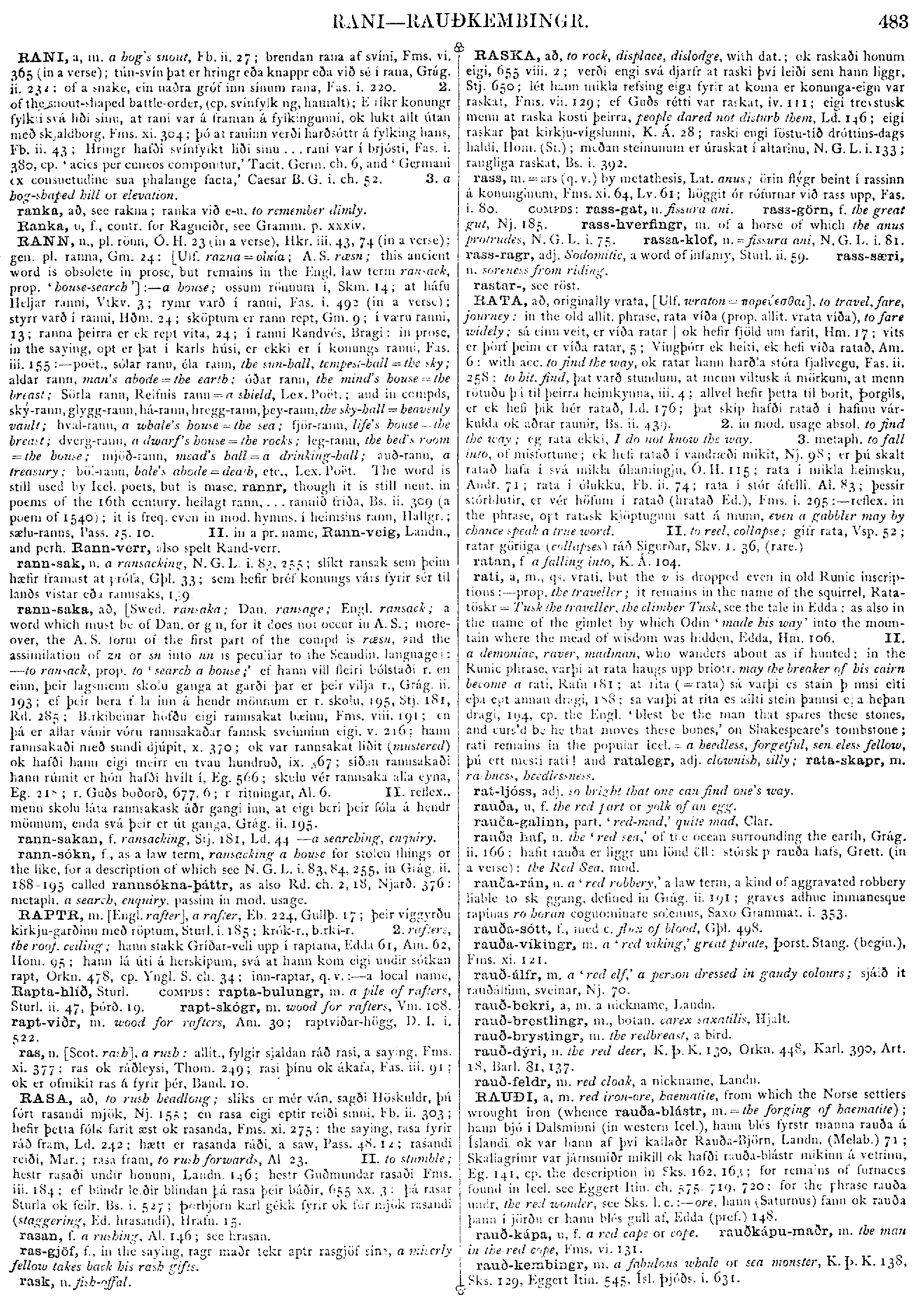
rass, m. = ars (q.v.) by metathesis, Lat. anus; örin flýgr beint í rassinn á konunginum, Fms. xi. 64, Lv. 6l; höggit ór rófurnar við rass upp, Fas. i. 80. COMPDS: rass-gat, n. fissura ani. rass-görn, f. the great gut, Nj. 185. rass-hverfingr, m. of a horse of which the anus protrudes, N.G.L. i. 75. rassa-klof, n. fissura ani, N.G.L. i. 81. rass-ragr, adj. Sodomitic, a word of infamy, Sturl. ii. 59. rass-særi, n. soreness from riding.
|
Source: Cleasby/Vigfusson, page b0489, entry 7 View original page image as: [TIFF] [PNG] [View previous entry] [View next entry] |
[Comment on this entry] [View comments] |
The following entry has been hand-corrected once. |
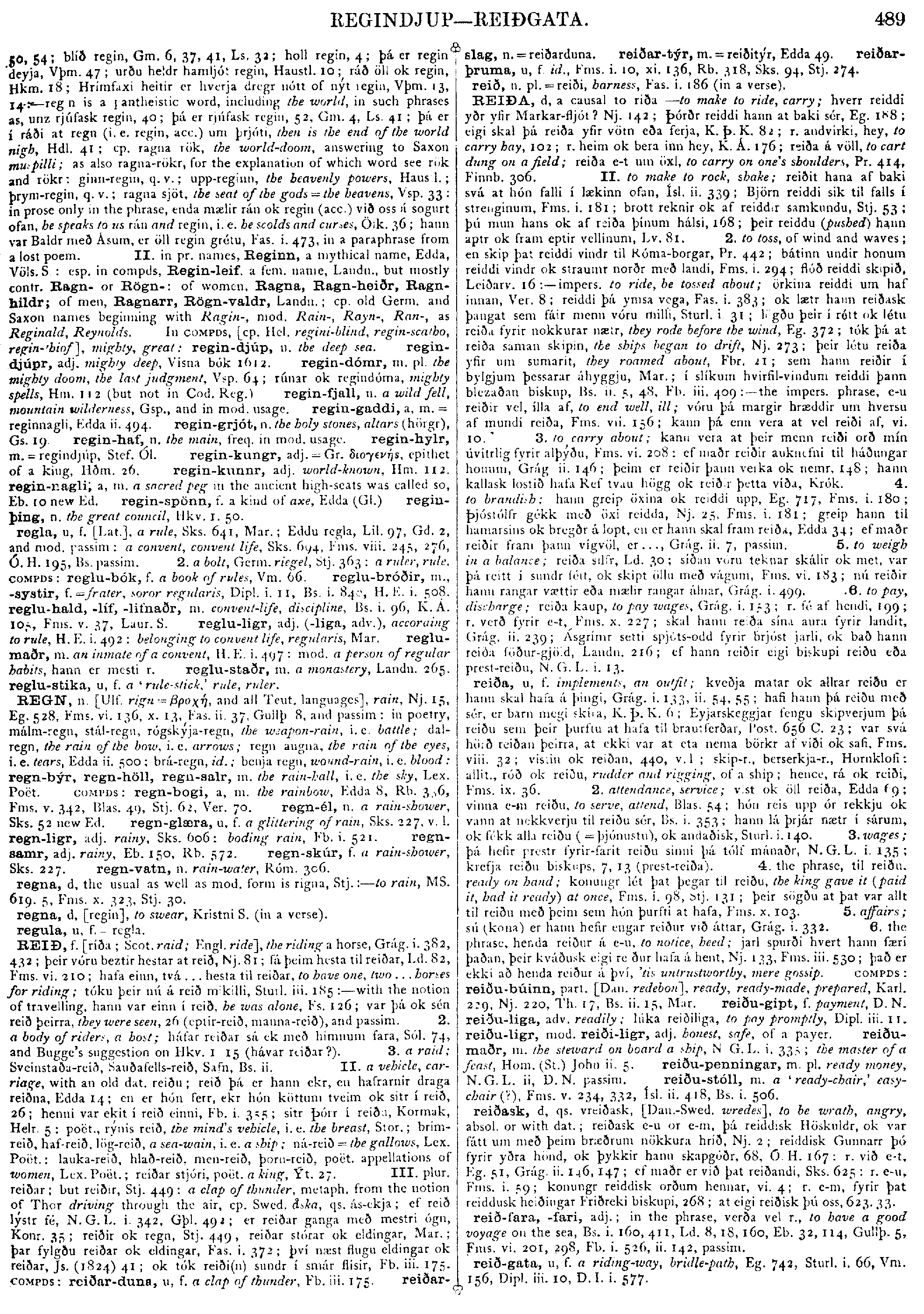
REIÐ, f. [ríða; Scot. raid; Engl. ride], the riding a horse, Grág. i. 382, 432; þeir vóru beztir hestar at reið, Nj. 81; fá þeim hesta til reiðar, Ld. 82, Fms. vi. 210; hafa einn, tvá ... hesta til reiðar, to have one, tivo ... horses for riding; tóku þeir nú á reið mikilli, Sturl. iii. 185 :-- with the notion of travelling, hann var einn í reið, he was alone, Fs. 126; var þá ok sén reið þeirra, they were seen, 26 (eptir-reið, manna-reið), and passim. 2. a body of riders, a host; háfar reiðar sá ek með himnum fara, Sól. 74, and Bugge's suggestion on Hkv. 1 15 (hávar reiðar?). 3. a raid; Sveinstaða-reið, Sauðafells-reið, Safn, Bs. ii. II. a vehicle, carriage, with an old dat. reiðu; reið þá er hann ekr, en hafrarnir draga reiðna, Edda 14; en er hón ferr, ekr hón köttum tveim ok sitr í reið, 26; henni var ekit í reið einni, Fb. i. 355; sitr Þórr í reiða, Kormak, Helr. 5: poét., rýnis reið, the mind's vehicle, i.e. the breast, Stor.; brim-reið, haf-reið, lög-reið, a sea-wain, i.e. a ship; ná-reið = the gallows, Lex. Poët.: lauka-reið, hlað-reið, men-reið, þorn-reið, poët, appellations of women, Lex. Poët.; reiðar stjóri, poët. a king, Ýt. 27. III. plur. reiðar; but reiðir, Stj. 449: a clap of thunder, metaph. from the notion of Thor driving through the air, cp. Swed. åska, qs. ás-ekja; ef reið lýstr fé, N.G.L. i. 342, Gþl. 492; er reiðar ganga með mestri ógn, Konr. 35; reiðir ok regn, Stj. 449, reiðar stórar ok eldingar, Mar.; þar fylgðu reiðar ok eldingar, Fas. i. 372; því næst flugu eldingar ok reiðar, Js. (1824) 41; ok tók reiði(n) sundr í smár flísir, Fb. iii. 175. COMPDS: reiðar-duna, u, f. a clap of thunder, Fb. iii. 175. reiðar-slag, n. = reiðarduna. reiðar-týr, m. = reiðitýr, Edda 49. reiðar-þruma, u, f id., Fms. i. 10, xi. 136, Rb. 318, Sks. 94, Stj. 274.
|
Source: Cleasby/Vigfusson, page b0490, entry 2 View original page image as: [TIFF] [PNG] [View previous entry] [View next entry] |
[Comment on this entry] [View comments] |
The following entry has been hand-corrected once. |
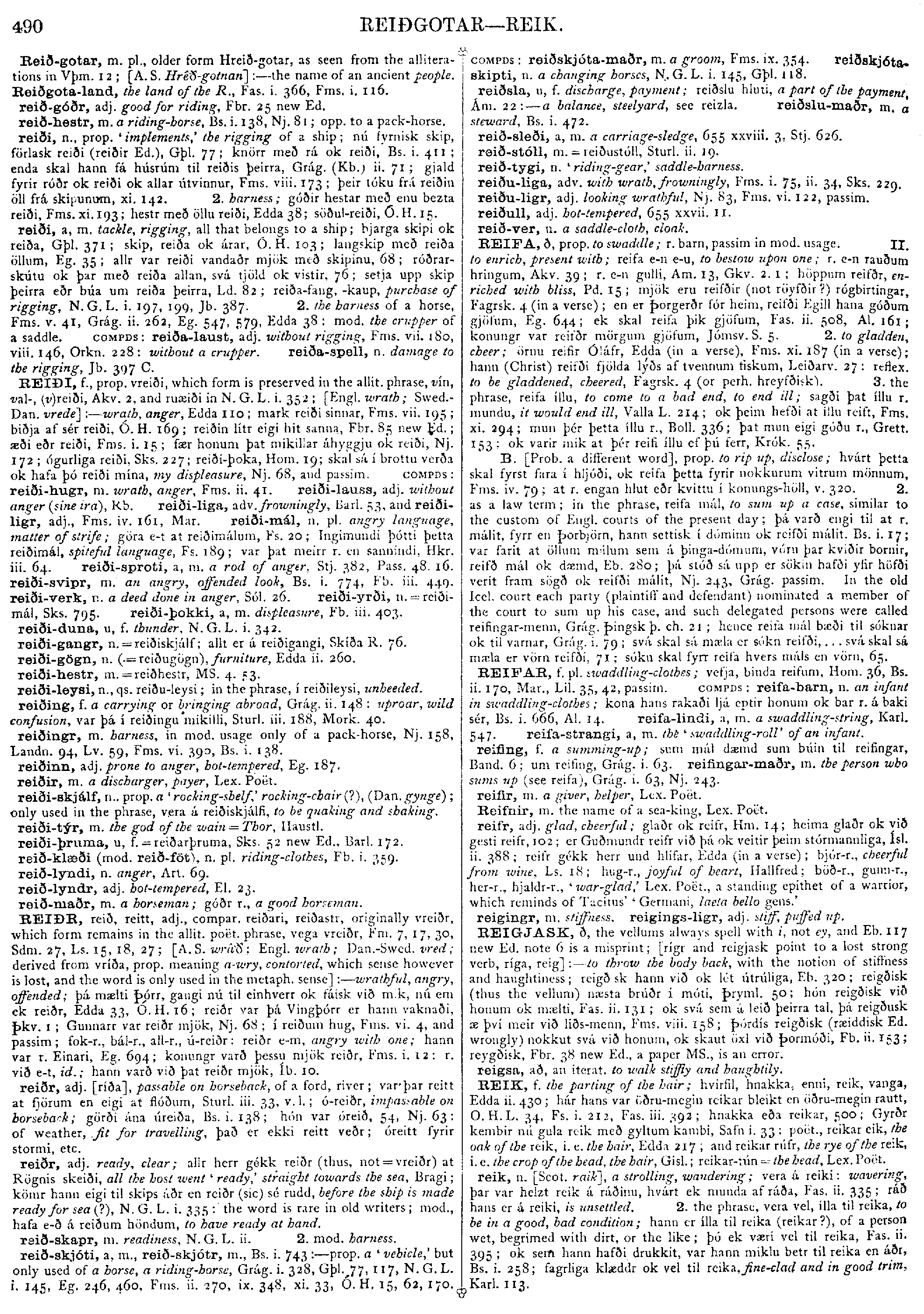
reið-góðr, adj. good for riding, Fbr. 25 new Ed.
|
Source: Cleasby/Vigfusson, page b0498, entry 39 View original page image as: [TIFF] [PNG] [View previous entry] [View next entry] |
[Comment on this entry] [View comments] |
The following entry has been hand-corrected once. |
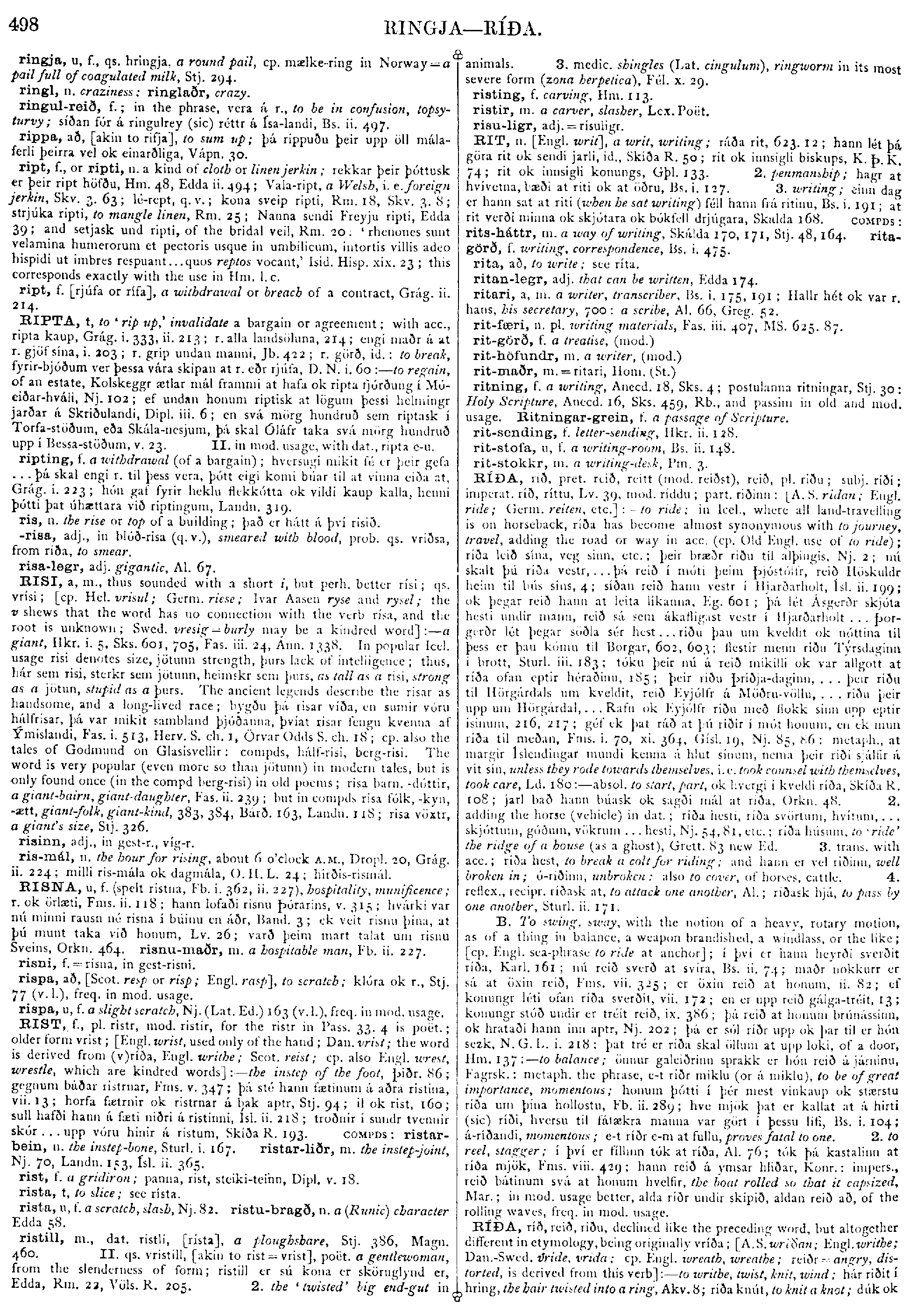
RÍÐA, ríð, pret. reið, reitt (mod. reiðst), reið, pl. riðu; subj. riði; imperat. ríð, ríttu, Lv. 39, mod. ríddu; part. riðinn: [A.S. ridan; Engl. ride; Germ. reiten, etc.] :-- to ride; in Icel., where all land-travelling is on horseback, ríða has become almost synonymous with to journey, travel, adding the road or way in acc. (cp. Old Engl. use of to ride); ríða leið sína, veg sinn, etc.; þeir bræðr riðu til alþingis, Nj. 2; nú skalt þú riða vestr, ... þá reið í móti þeim Þjóstólfr, reið Höskuldr heim til hús síns, 4; síðan reið hann vestr í Hjarðarholt, Ísl. ii. 199; ok þegar reið hann at leita líkanna, Eg. 601; þá lét Ásgerðr skjóta hesti undir mann, reið sá sem ákafligast vestr í Hjarðarholt ... Þorgerðr lét þegar söðla sér hest ... riðu þau um kveldit ok nóttina til þess er þau kómu til Borgar, 602, 603; flestir menn riðu Týrsdaginn í brott, Sturl. iii. 183; tóku þeir nú á reið mikilli ok var allgott at ríða ofan eptir héraðinu, 185; þeir riðu Þriðja-daginn, ... þeir riðu til Hörgárdals um kveldit, reið Eyjólfr á Möðru-völlu, ... riðu þeir upp um Hörgárdal, ... Rafn ok Eyjólfr riðu með flokk sinn upp eptir ísinum, 216, 217; géf ek þat ráð at þú ríðir í mót honum, en ek mun ríða til meðan, Fms. i. 70, xi. 364, Gísl. 19, Nj. 85, 86: metaph., at margir Íslendingar mundi kenna á hlut sínum, nema þeir riði sjálfir á vit sín, unless they rode towards themselves, i.e. took counsel with themselves, took care, Ld. 180 :-- absol. to start, part, ok hvergi í kveldi ríða, Skíða R. 108; jarl bað hann búask ok sagði mál at riðu, Orkn. 48. 2. adding the horse (vehicle) in dat.; ríða hesti, ríða svörtum, hvítum, ... skjóttum, góðum, vökrum ... hesti, Nj. 54, 8l, etc.; ríða húsum, to 'ride' the ridge of a house (as a ghost), Grett. 83 new Ed. 3. trans. with acc.; ríða hest, to break a colt for riding; and hann er vel riðinn, well broken in; ó-riðinn, unbroken: also to cover, of horses, cattle. 4. reflex., recipr. ríðask at, to attack one another, Al.; ríðask hjá, to pass by one another, Sturl. ii. 171. B. To swing, sway, with the notion of a heavy, rotary motion, as of a thing in balance, a weapon brandished, a windlass, or the like; [cp. Engl. sea-phrase to ride at anchor]; í því er hann heyrði sverðit ríða, Karl. 161; nú reið sverð at svíra, Bs. ii. 74; maðr nokkurr er sá at öxin reið, Fms. vii. 325; er öxin reið at honum, ii. 82; ef konungr léti ofan ríða sverðit, vii. 172; en er upp reið gáiga-tréit, 13; konungr stóð undir er tréit reið, ix. 386; þá reið at honum brúnássinn, ok hrataði hann inn aptr, Nj. 202; þá er sól riðr upp ok þar til er hón sezk, N.G.L. i. 218; þat tré er riða skal öllum at upp loki, of a door, Hm. 137 :-- to balance; önnur galeiðrinn sprakk er hón reið á járninu, Fagrsk.: metaph. the phrase, e-t ríðr miklu (or á miklu), to be of great importance, momentous; honum þótti í þér mest vinkaup ok stærstu ríða um þína hollostu, Fb. ii. 289; hve mjök þat er kallat at á hirti (sic) ríði, hversu til fátækra manna var gört í þessu lífi, Bs. i. 104; á-ríðandi, momentous; e-t ríðr e-m at fullu, proves fatal to one. 2. to reel, stagger; í því er fíllinn tók at ríða, Al. 76; tók þá kastalinn at ríða mjök, Fms. viii. 429; hann reið á ymsar hliðar, Konr.: impers., reið bátinum svá at honum hvelfir, the boat rolled so that it capsized, Mar.; in mod. usage better, alda ríðr undir skipið, aldan reið að, of the rolling waves, freq. in mod. usage.
|
Source: Cleasby/Vigfusson, page b0512, entry 44 View original page image as: [TIFF] [PNG] [View previous entry] [View next entry] |
[Comment on this entry] [View comments] |
The following entry has been hand-corrected once. |
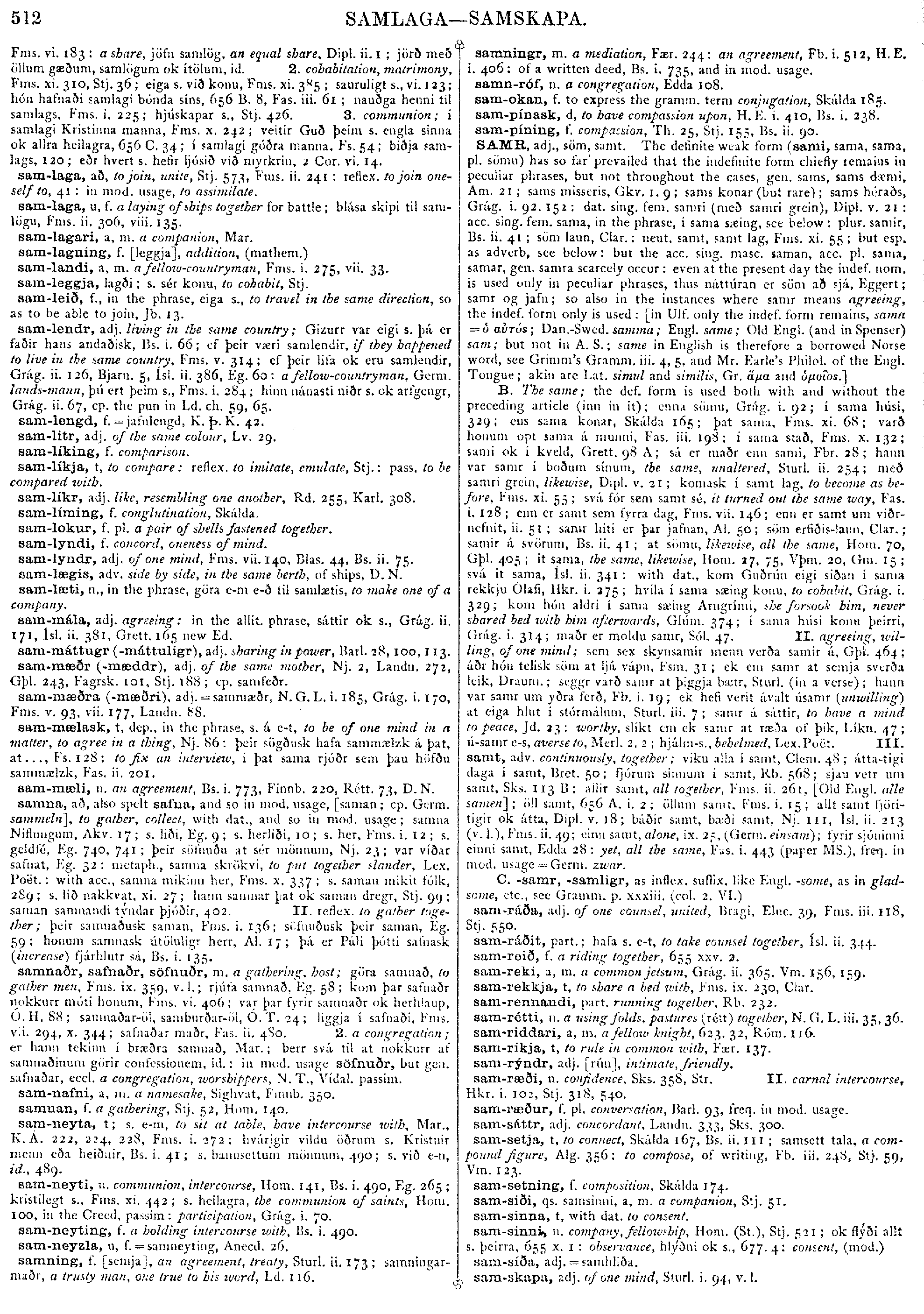
sam-reið, f. a riding together, 655 xxv. 2.
|
Source: Cleasby/Vigfusson, page b0543, entry 8 View original page image as: [TIFF] [PNG] [View previous entry] [View next entry] |
[Comment on this entry] [View comments] |
The following entry has been hand-corrected once. |
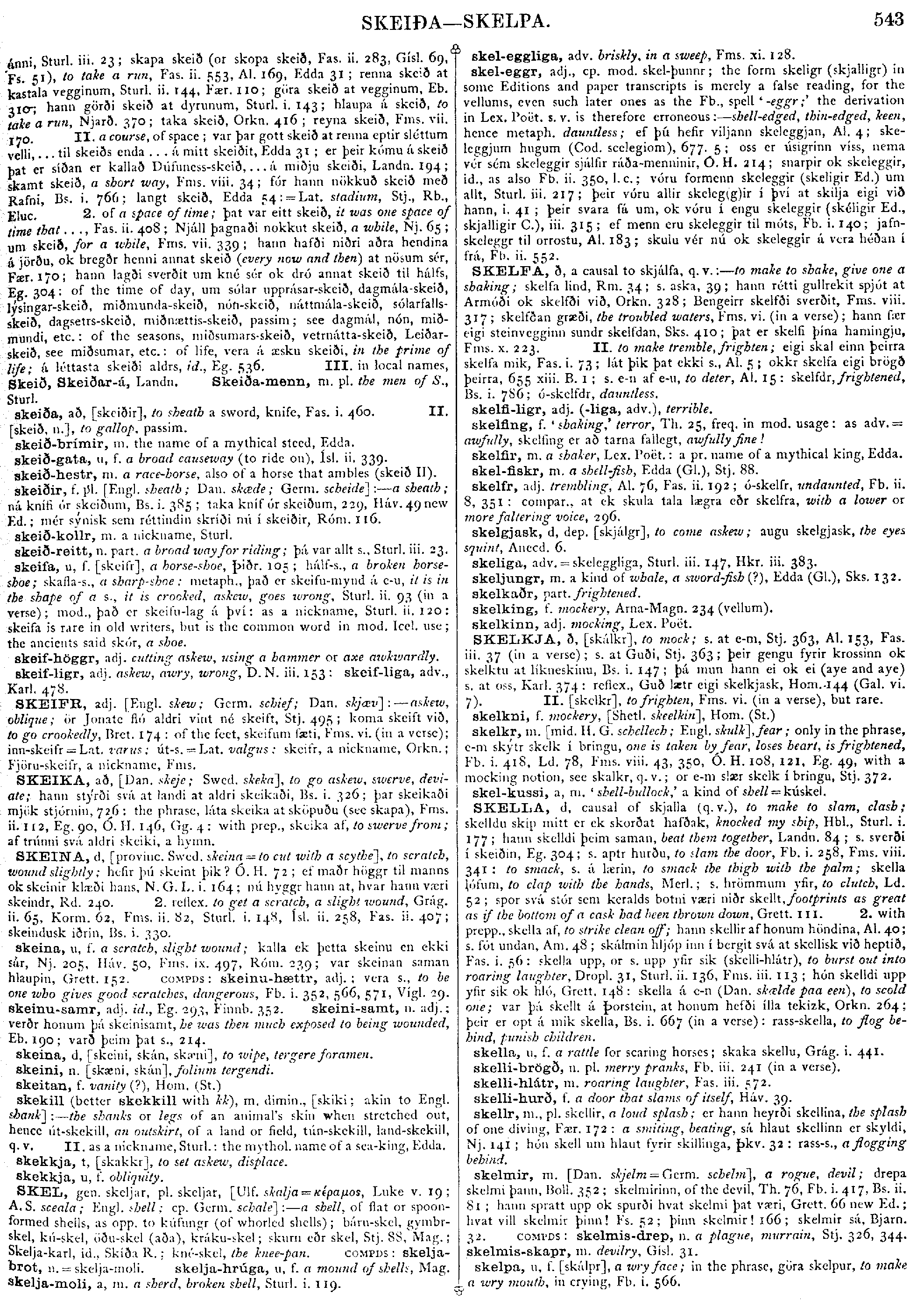
skeið-reitt, n. part. a broad way for riding; þá var allt s., Sturl. iii. 23.
|
Source: Cleasby/Vigfusson, page b0622, entry 7 View original page image as: [TIFF] [PNG] [View previous entry] [View next entry] |
[Comment on this entry] [View comments] |
The following entry has been hand-corrected once. |
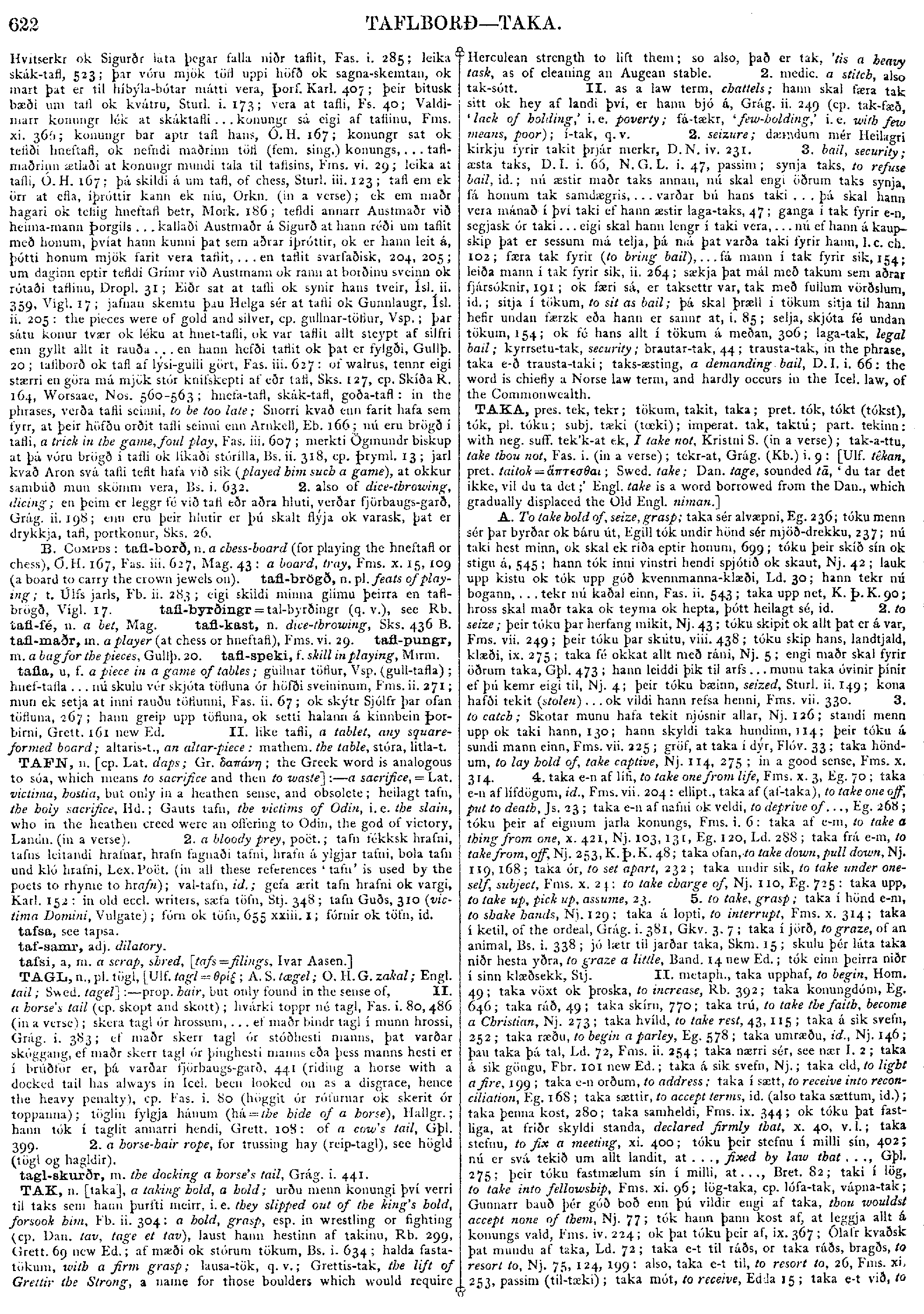
TAGL, n., pl. tögl, (Ulf. tagl = GREEK; A.S. tægel; O.H.G. zakal; Engl. tail; Swed. tagel] :-- prop. hair, but only found in the sense of, II. a horse's tail (cp. skopt and skott); hvárki toppr né tagl, Fas. i. 80, 486 (in a verse); skera tagl ór hrossum, ... ef maðr bindr tagl í munn hrossi, Grág. i. 383; ef maðr skerr tagl ór stóðhesti manns, þat varðar skóggang, ef maðr skerr tagl ór þinghesti manns eða þess manns hesti er í brúðför er, þá varðar fjörbaugs-garð, 441 (riding a horse with a docked tail has always in Icel. been looked on as a disgrace, hence the heavy penalty), cp. Fas. i. 80 (höggit ór rófurnar ok skerit ór toppanna); töglin fylgja hánum (há = the hide of a horse), Hallgr.; hann tók í taglit annarri hendi, Grett. 108: of a cow's tail, Gþl. 399. 2. a horse-hair rope, for trussing hay (reip-tagl), see högld (tögl og hagldir).
|
Source: Cleasby/Vigfusson, page b0646, entry 1 View original page image as: [TIFF] [PNG] [View previous entry] [View next entry] |
[Comment on this entry] [View comments] |
The following entry has been hand-corrected once. |
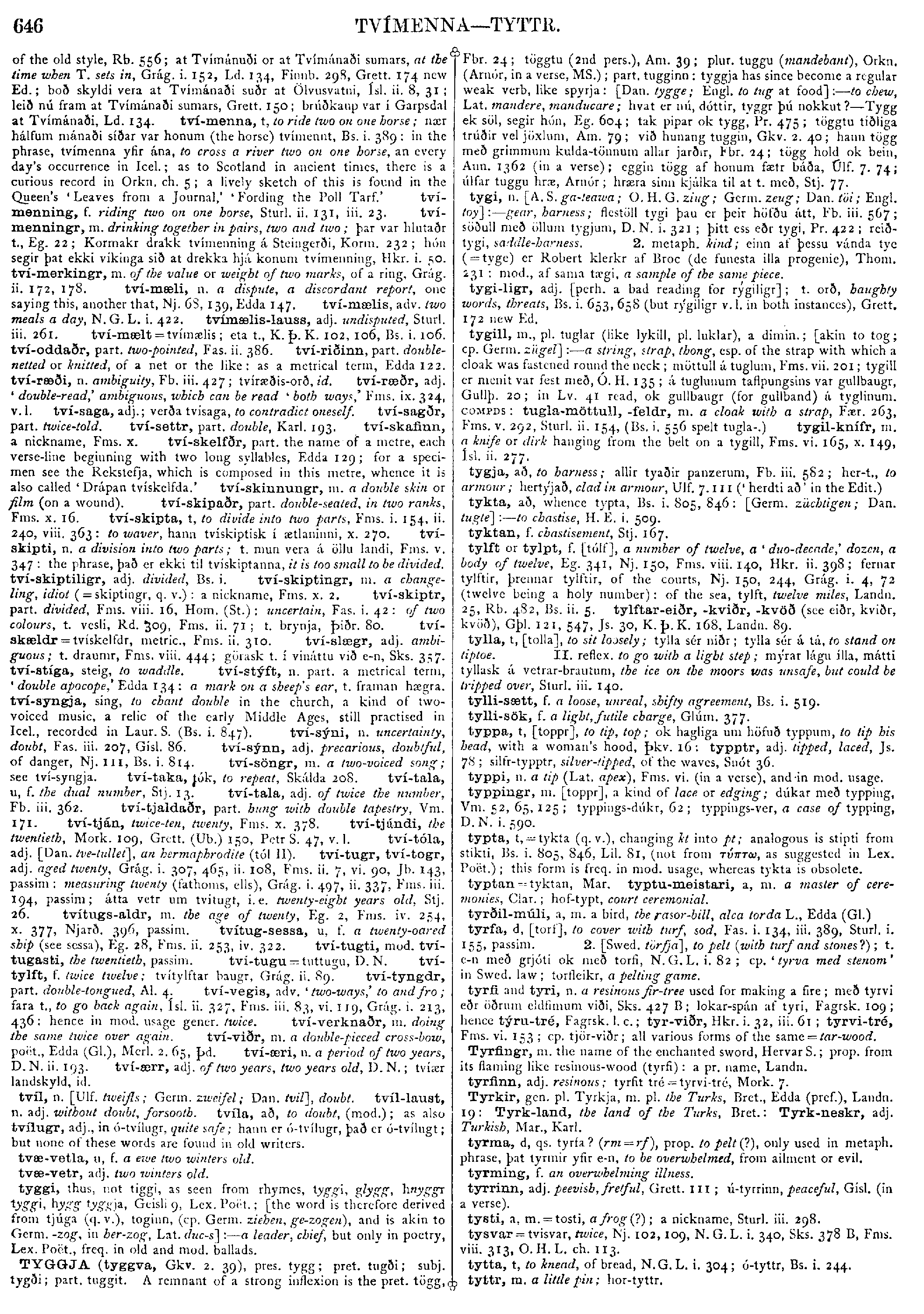
of the old style, Rb. 556; at Tvímánuði or at Tvímánaði sumars, at the time when T. sets in, Grág. i. 152, Ld. 134, Finnb. 298, Grett. 174 new Ed.; boð skyldi vera at Tvímánaði suðr at Ölvusvatni, Ísl. ii. 8, 31; leið nú fram at Tvímánaði sumars, Grett. 150; brúðkaup var í Garpsdal at Tvímánaði, Ld. 134. tví-menna, t, to ride two on one horse; nær hálfum mánaði síðar var honum (the horse) tvímennt, Bs. i. 389: in the phrase, tvímenna yfir ána, to cross a river two on one horse, an every day's occurrence in Icel.; as to Scotland in ancient times, there is a curious record in Orkn. ch. 5; a lively sketch of this is found in the Queen's 'Leaves from a Journal,' 'Fording the Poll Tarf.' tví-menning, f. riding two on one horse, Sturl. ii. 131, iii. 23. tví-menningr, m. drinking together in pairs, two and two; þar var hlutaðr t., Eg. 22; Kormakr drakk tvímenning á Steingerði, Korm. 232; hón segir þat ekki víkinga sið at drekka hjá konum tvímenning, Hkr. i. 50. tví-merkingr, m. of the value or weight of two marks, of a ring, Grág. ii. 172, 178. tví-mæli, n. a dispute, a discordant report, one saying this, another that, Nj. 68, 139, Edda 147. tví-mælis, adv. two meals a day, N.G.L. i. 422. tvímælis-lauss, adj. undisputed, Sturl. iii. 261. tví-mælt = tvímælis; eta t., K.Þ.K. 102, 106, Bs. i. 106. tví-oddaðr, part. two-pointed, Fas. ii. 386. tví-riðinn, part. double-netted or knitted, of a net or the like: as a metrical term, Edda 122. tví-ræði, n. ambiguity, Fb. iii. 427; tvíræðis-orð, id. tví-ræðr, adj. 'double-read,' ambiguous, which can be read 'both ways' Fms. ix. 324, v.l. tví-saga, adj.; verða tvísaga, to contradict oneself. tví-sagðr, part. twice-told. tí-settr, part. double, Karl. 193. tví-skafinn, a nickname, Fms. x. tví-skelfðr, part. the name of a metre, each verse-line beginning with two long syllables, Edda 129; for a specimen see the Rekstefja, which is composed in this metre, whence it is also called 'Drápan tvískelfda.' tví-skinnungr, m. a double skin or film (on a wound). tví-skipaðr, part. double-seated, in two ranks, Fms. x. 16. tví-skipta, t, to divide into two parts, Fms. i. 154, ii. 240, viii. 363: to waver, hann tvískiptisk í ætlaninni, x. 270. tví-skipti, n. a division into two parts; t. mun vera á öllu landi, Fms. v. 347: the phrase, það er ekki til tvískiptanna, it is too small to be divided. tví-skiptiligr, adj. divided, Bs. i. tví-skiptingr, m. a changeling, idiot (= skiptingr, q.v.): a nickname, Fms. x. 2. tví-skiptr, part. divided, Fms. viii. 16, Hom. (St.): uncertain, Fas. i. 42: of two colours, t. vesli, Rd. 309, Fms. ii. 71; t. brynja, Þiðr. 80. tví-skældr = tvískelfdr, metric., Fms. ii. 310. tví-slægr, adj. ambiguous; t. draumr, Fms. viii. 444; görask t. í vináttu við e-n, Sks. 357. tví-stíga, steig, to waddle. tví-stýft, n. part. a metrical term, 'double apocope' Edda 134: a mark on a sheep's ear, t. framan hægra. tví-syngja, sing, to chant double in the church, a kind of two-voiced music, a relic of the early Middle Ages, still practised in Icel., recorded in Laur. S. (Bs. i. 847). tví-sýni, n. uncertainty, doubt, Fas. iii. 207, Gísl. 86. tví-sýnn, adj. precarious, doubtful, of danger, Nj. 111, Bs. i. 814. tví-söngr, m. a two-voiced song; see tví-syngja. tví-taka, tók, to repeat, Skálda 208. tví-tala, u, f. the dual number, Stj. 13. tví-tala, adj. of twice the number, Fb. iii. 362. tví-tjaldaðr, part. hung with double tapestry, Vm. 171. tví-tján, twice-ten, twenty, Fms. x. 378. tví-tjándi, the twentieth, Mork. 109, Grett. (Ub.) 150, Petr S. 47, v.l. tví-tóla, adj. [Dan. tve-tullet], an hermaphrodite (tól II). tví-tugr, tví-togr, adj. aged twenty, Grág. i. 307, 465, ii. 108, Fms. ii. 7, vi. 90, Jb. 143, passim: measuring twenty (fathoms, ells), Grág. i. 497, ii. 337, Fms. iii. 194, passim; átta vetr um tvítugt, i.e. twenty-eight years old, Stj. 26. tvítugs-aldr, m. the age of twenty, Eg. 2, Fms. iv. 254, x. 377, Njarð. 396, passim. tvítug-sessa, u, f. a twenty-oared ship (see sessa), Eg. 28, Fms. ii. 253, iv. 322. tví-tugu, mod. tví-tugasti, the twentieth, passim. tví-tugu = tuttugu, D.N. tví-tylft, f. twice twelve; tvítylftar baugr, Grág. ii. 89. tví-tyngdr, part. double-tongued, Al. 4. tví-vegis, adv. 'two-ways' to and fro; fara t., to go back again, Ísl. ii. 327, Fms. iii. 83, vi. 119, Grág. i. 213, 436: hence in mod. usage gener. twice. tví-verknaðr, m. doing the same twice over again. tví-viðr, m. a double-pieced cross-bow, poët., Edda (Gl.), Merl. 2. 65, Þd. tví-æri, n. a period of two years, D.N. ii. 193. tví-ærr, adj. of two years, two years old, D.N.; tvíær landskyld, id.
| Result Page: |  |
Previous | 1 2 3 4 5 6 7 | Next |  |
Germanic Lexicon Project (main page)
This search system was written by
Sean Crist
Please consider
volunteering
to correct the data in these online dictionaries.
No rights reserved. Feel free to use these data in any way you please.