|
|

Tip: In the search results, you can click on any word or abbreviation for more information.
|
Source: Cleasby/Vigfusson, page b0324, entry 12 View original page image as: [TIFF] [PNG] [View previous entry] [View next entry] |
[Comment on this entry] [View comments] |
The following entry has been hand-corrected once. |
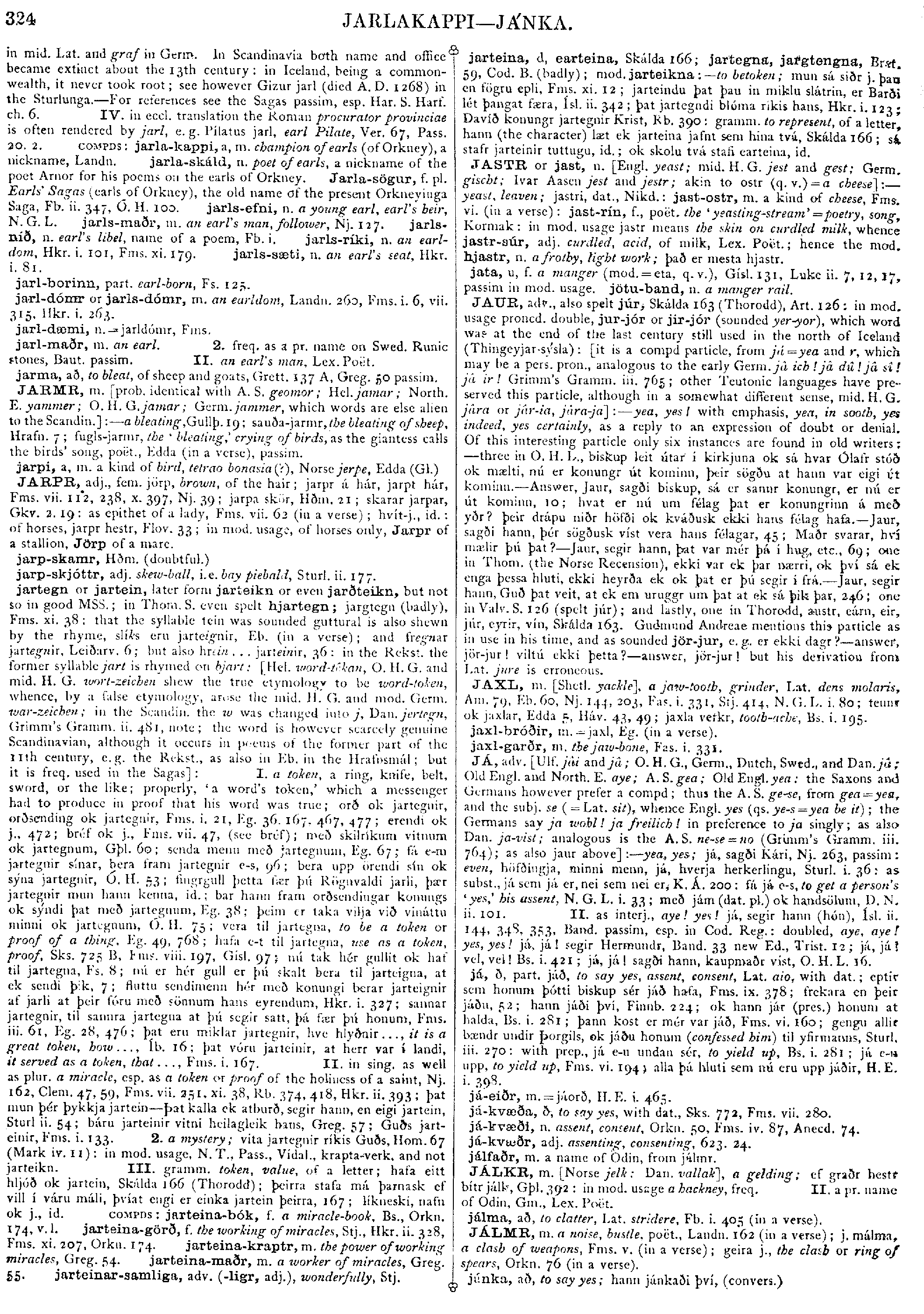
jartegn or jartein, later form jarteikn or even jarðteikn, but not so in good MSS.; in Thom. S. even spelt hjartegn; jargtegn (badly), Fms. xi. 38: that the syllable tein was sounded guttural is also shewn by the rhyme, slíks eru jarteignir, Eb. (in a verse); and fregnar jartegnir, Leiðarv. 6; but also hrein ... jarteinir, 36: in the Rekst. the former syllable jart is rhymed on bjart: [Hel. word-têkan, O. H. G. and mid. H. G. wort-zeichen shew the true etymology to be word-token, whence, by a false etymology, arose the mid. H. G. and mod. Germ. war-zeichen; in the Scandin. the w was changed into j, Dan. jertegn, Grimm's Gramm. ii. 481, note; the word is however scarcely genuine Scandinavian, although it occurs in poems of the former part of the 11th century, e.g. the Rekst., as also in Eb. in the Hrafnsmál; but it is freq. used in the Sagas]: I. a token, a ring, knife, belt, sword, or the like; properly, 'a word's token,' which a messenger had to produce in proof that his word was true; orð ok jartegnir, orðsending ok jartegnir, Fms. i. 21. Eg. 36. 167, 467, 477; erendi ok j., 472; bréf ok j., Fms. vii. 47, (see bréf); með skilríkum vitnum ok jartegnum, Gþl. 60; senda menn með jartegnum, Eg. 67; fá e-m jartegnir sínar, bera fram jartegnir e-s, 96; bera upp örendi sín ok sýna jartegnir, Ó. H. 53; fingrgull þetta fær þú Rögnvaldi jarli, þær jartegnir mun hann kenna, id.; bar hann fram orðsendingar konungs ok sýndi þat með jartegnum, Eg. 38; þeim er taka vilja við vináttu minni ok jartegnum, Ó. H. 75; vera til jartegna, to be a token or proof of a thing, Eg. 49, 768; hafa e-t til jartegna, use as a token, proof, Sks. 725 B, Fms. viii. 197, Gísl. 97; nú tak hér gullit ok haf til jartegna, Fs. 8; nú er hér gull er þú skalt bera til jarteigna, at ek sendi þik, 7; fluttu sendimenn hér með konungi berar jarteignir af jarli at þeir fóru með sönnum hans eyrendum, Hkr. i. 327; sannar jartegnir, til sannra jartegna at þú segir satt, þá fær þú honum, Fms. iii. 61, Eg. 28, 476; þat eru miklar jartegnir, hve hlyðnir ..., it is a great token, how ..., Íb. 16; þat vóru jarteinir, at herr var í landi, it served as a token, that ..., Fms. i. 167. II. in sing, as well as plur. a miracle, esp. as a token or proof of the holiness of a saint, Nj. 162, Clem. 47, 59, Fms. vii. 351, xi. 38, Rb. 374, 418, Hkr. ii. 393; þat mun þér þykkja jartein -- Þat kalla ek atburð, segir hann, en eigi jartein, Sturl ii. 54; báru jarteinir vitni heilagleik hans, Greg. 57; Guðs jarteinir, Fms. i. 133. 2. a mystery; vita jartegnir ríkis Guðs, Hom. 67 (Mark iv. 11): in mod. usage, N. T., Pass., Vídal., krapta-verk, and not jarteikn. III. gramm. token, value, of a letter; hafa eitt hljóð ok jartein, Skálda 166 (Thorodd); þeirra stafa má þarnask ef vill í váru máli, þvíat engi er einka jartein þeirra, 167; líkneski, nafn ok j., id. COMPDS: jarteina-bók, f. a miracle-book, Bs., Orkn. 174, v.l. jarteina-görð, f. the working of miracles, Stj., Hkr. ii. 328, Fms. xi. 207, Orkn. 174. jarteina-kraptr, m. the power of working miracles, Greg. 54. jarteina-maðr, m. a worker of miracles, Greg. 55. jarteinar-samliga, adv. (-ligr, adj.), wonderfully, Stj.
|
Source: Cleasby/Vigfusson, page b0324, entry 13 View original page image as: [TIFF] [PNG] [View previous entry] [View next entry] |
[Comment on this entry] [View comments] |
The following entry has been hand-corrected once. |
jarteina, d, earteina, Skálda 166; jartegna, jargtengna, Bret. 59, Cod. B. (badly); mod. jarteikna :-- to betoken; mun sá siðr j. þau en fögru epli, Fms. xi. 12; jarteindu þat þau in miklu slátrin, er Barði lét þangat færa, Ísl. ii. 342; þat jartegndi blóma ríkis hans, Hkr. i. 123; Davíð konungr jartegnir Krist, Rb. 390: gramm. to represent, of a letter, hann (the character) læt ek jarteina jafnt sem hina tvá,, Skálda 166; sá stafr jarteinir tuttugu, id.; ok skolu tvá stafi earteina, id.
|
Source: Cleasby/Vigfusson, page b0326, entry 15 View original page image as: [TIFF] [PNG] [View previous entry] [View next entry] |
[Comment on this entry] [View comments] |
The following entry has been hand-corrected once. |
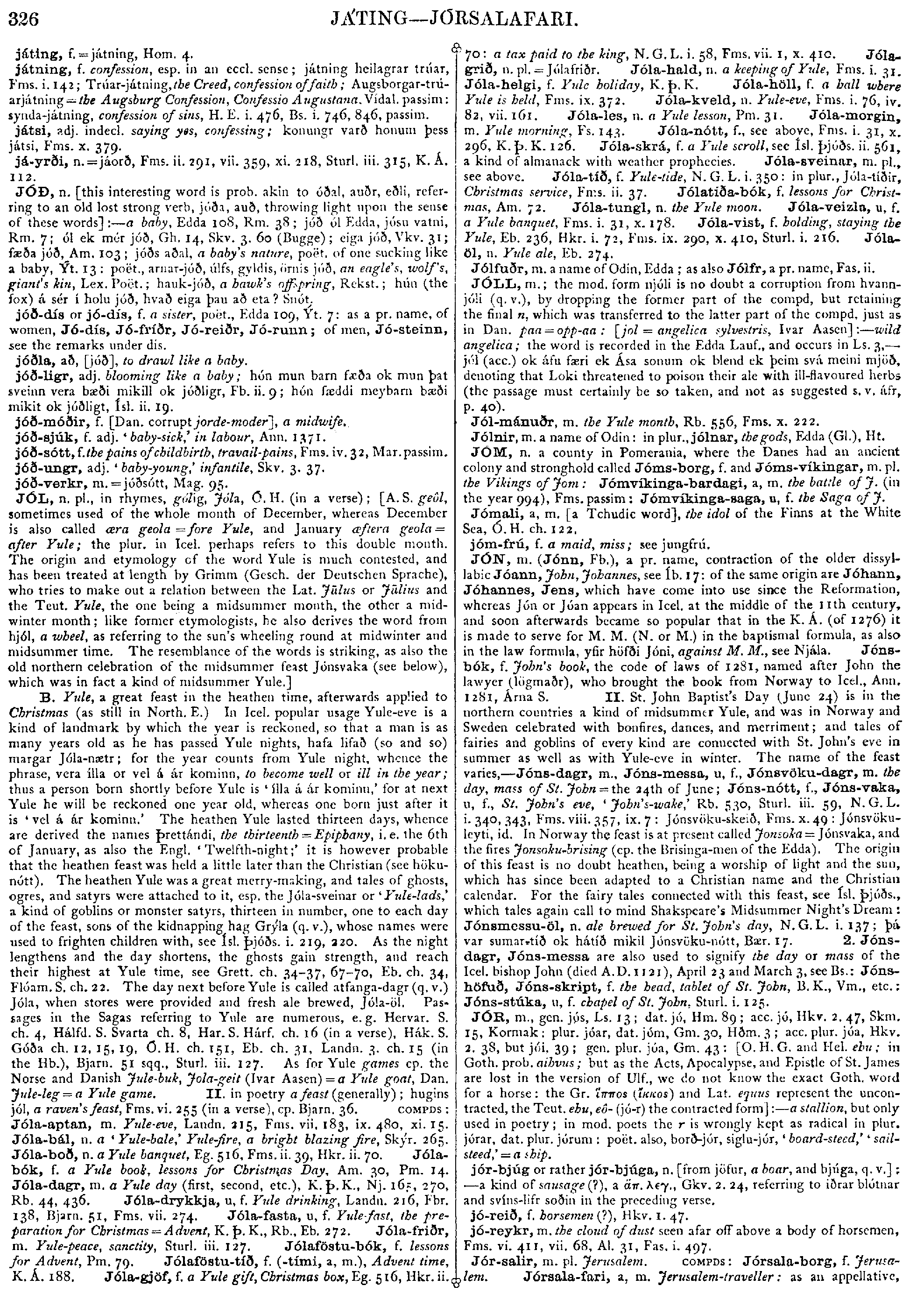
B. Yule, a great feast in the heathen time, afterwards applied to Christmas (as still in North. E.) In Icel. popular usage Yule-eve is a kind of landmark by which the year is reckoned, so that a man is as many years old as he has passed Yule nights, hafa lifað (so and so) margar Jóla-nætr; for the year counts from Yule night, whence the phrase, vera ílla or vel á ár kominn, to become well or ill in the year; thus a person born shortly before Yule is 'ílla á ár kominn,' for at next Yule he will be reckoned one year old, whereas one born just after it is 'vel á ár kominn.' The heathen Yule lasted thirteen days, whence are derived the names Þrettándi, the thirteenth = Epiphany, i.e. the 6th of January, as also the Engl. 'Twelfth-night;' it is however probable that the heathen feast was held a little later than the Christian (see hökunótt). The heathen Yule was a great merry-making, and tales of ghosts, ogres, and satyrs were attached to it, esp. the Jóla-sveinar or 'Yule-lads,' a kind of goblins or monster satyrs, thirteen in number, one to each day of the feast, sons of the kidnapping hag Grýla (q.v.), whose names were used to frighten children with, see Ísl. Þjóðs. i. 219, 220. As the night lengthens and the day shortens, the ghosts gain strength, and reach their highest at Yule time, see Grett. ch. 34-37, 67-70, Eb. ch. 34, Flóam. S. ch. 22. The day next before Yule is called atfanga-dagr (q.v.) Jóla, when stores were provided and fresh ale brewed, Jóla-öl. Passages in the Sagas referring to Yule are numerous, e.g. Hervar. S. ch. 4, Hálfd. S. Svarta ch. 8, Har. S. Hárf. ch. 16 (in a verse), Hák. S. Góða ch. 12, 15, 19, Ó. H. ch. 151, Eb. ch. 31, Landn. 3. ch. 15 (in the Hb.), Bjarn. 51 sqq., Sturl. iii. 127. As for Yule games cp. the Norse and Danish Jule-buk, Jola-geit (Ivar Aasen) = a Yule goat, Dan. Jule-leg = a Yule game. II. in poetry a feast (generally); hugins jól, a raven's feast, Fms. vi. 255 (in a verse), cp. Bjarn. 36. COMPDS: Jóla-aptan, m. Yule-eve, Landn. 215, Fms. vii. 183, ix. 480, xi. 15. Jóla-bál, n. a 'Yule-bale,' Yule-fire, a bright blazing fire, Skýr. 265. Jóla-boð, n. a Yule banquet, Eg. 516, Fms. ii. 39, Hkr. ii. 70. Jóla-bók, f. a Yule book, lessons for Christmas Day, Am. 30, Pm. 14. Jóla-dagr, m. a Yule day (first, second, etc.), K. Þ. K., Nj. 165, 270, Rb. 44, 436. Jóla-drykkja, u, f. Yule drinking, Landn. 216, Fbr. 138, Bjarn. 51, Fms. vii. 274. Jóla-fasta, u, f. Yule-fast, the preparation for Christmas = Advent, K. Þ. K., Rb., Eb. 272. Jóla-friðr, m. Yule-peace, sanctity, Sturl. iii. 127. Jólaföstu-bók, f. lessons for Advent, Pm. 79. Jólaföstu-tíð, f. (-tími, a, m.), Advent time, K. Á. 188. Jóla-gjöf, f. a Yule gift, Christmas box, Eg. 516, Hkr. ii. 70: a tax paid to the king, N. G. L. i. 58, Fms. vii. 1, x. 410. Jóla-grið, n. pl. = Jólafriðr. Jóla-hald, n. a keeping of Yule, Fms. i. 31. Jóla-helgi, f. Yule holiday, K. Þ. K. Jóla-höll, f. a hall where Yule is held, Fms. ix. 372. Jóla-kveld, n. Yule-eve, Fms. i. 76, iv. 82, vii. 161. Jóla-les, n. a Yule lesson, Pm. 31. Jóla-morgin, m. Yule morning, Fs. 143. Jóla-nótt, f., see above, Fms. i. 31, x. 296, K. Þ. K. 126. Jóla-skrá, f. a Yule scroll, see Ísl. Þjóðs. ii. 561, a kind of almanack with weather prophecies. Jóla-sveinar, m. pl., see above. Jóla-tíð, f. Yule-tide, N. G. L. i. 350: in plur., Jóla-tíðir, Christmas service, Fms. ii. 37. Jólatíða-bók, f. lessons for Christmas, Am. 72. Jóla-tungl, n. the Yule moon. Jóla-veizla, u, f. a Yule banquet, Fms. i. 31, x. 178. Jóla-vist, f. holding, staying the Yule, Eb. 236, Hkr. i. 72, Fms. ix. 290, x. 410, Sturl. i. 216. Jóla-öl, n. Yule ale, Eb. 274.
|
Source: Cleasby/Vigfusson, page b0326, entry 18 View original page image as: [TIFF] [PNG] [View previous entry] [View next entry] |
[Comment on this entry] [View comments] |
The following entry has been hand-corrected once. |
Jól-mánuðr, m. the Yule month, Rb. 556, Fms. x. 222.
|
Source: Cleasby/Vigfusson, page b0326, entry 23 View original page image as: [TIFF] [PNG] [View previous entry] [View next entry] |
[Comment on this entry] [View comments] |
The following entry has been hand-corrected once. |
JÓN, m. (Jónn, Fb.), a pr. name, contraction of the older dissyllabic Jóann, John, Johannes, see Íb. 17: of the same origin are Jóhann, Jóhannes, Jens, which have come into use since the Reformation, whereas Jón or Jóan appears in Icel. at the middle of the 11th century, and soon afterwards became so popular that in the K. Á. (of 1276) it is made to serve for M. M. (N. or M.) in the baptismal formula, as also in the law formula, yfir höfði Jóni, against M. M., see Njála. Jóns-bók, f. John's book, the code of laws of 1281, named after John the lawyer (lögmaðr), who brought the book from Norway to Icel., Ann. 1281, Árna S. II. St. John Baptist's Day (June 24) is in the northern countries a kind of midsummer Yule, and was in Norway and Sweden celebrated with bonfires, dances, and merriment; and tales of fairies and goblins of every kind are connected with St. John's eve in summer as well as with Yule-eve in winter. The name of the feast varies, -- Jóns-dagr, m., Jóns-messa, u, f., Jónsvöku-dagr, m. the day, mass of St. John = the 24th of June; Jóns-nótt, f., Jóns-vaka, u, f., St. John's eve, 'John's-wake,' Rb. 530, Sturl. iii. 59, N. G. L. i. 340, 343, Fms. viii. 357, ix. 7: Jónsvöku-skeið, Fms. x. 49: Jónsvöku-leyti, id. In Norway the feast is at present called Jonsoka = Jónsvaka, and the fires Jonsoku-brising (cp. the Brisinga-men of the Edda). The origin of this feast is no doubt heathen, being a worship of light and the sun, which has since been adapted to a Christian name and the Christian calendar. For the fairy tales connected with this feast, see Ísl. Þjóðs., which tales again call to mind Shakspeare's Midsummer Night's Dream: Jónsmessu-öl, n. ale brewed for St. John's day, N. G. L. i. 137; þá var sumar-tíð ok hátíð mikil Jónsvöku-nótt, Bær. 17. 2. Jóns-dagr, Jóns-messa are also used to signify the day or mass of the Icel. bishop John (died A.D. 1121), April 23 and March 3, see Bs.: Jóns-höfuð, Jóns-skript, f. the head, tablet of St. John, B. K., Vm., etc.: Jóns-stúka, u, f. chapel of St. John, Sturl. i. 125.
|
Source: Cleasby/Vigfusson, page b0327, entry 1 View original page image as: [TIFF] [PNG] [View previous entry] [View next entry] |
[Comment on this entry] [View comments] |
The following entry has been hand-corrected once. |
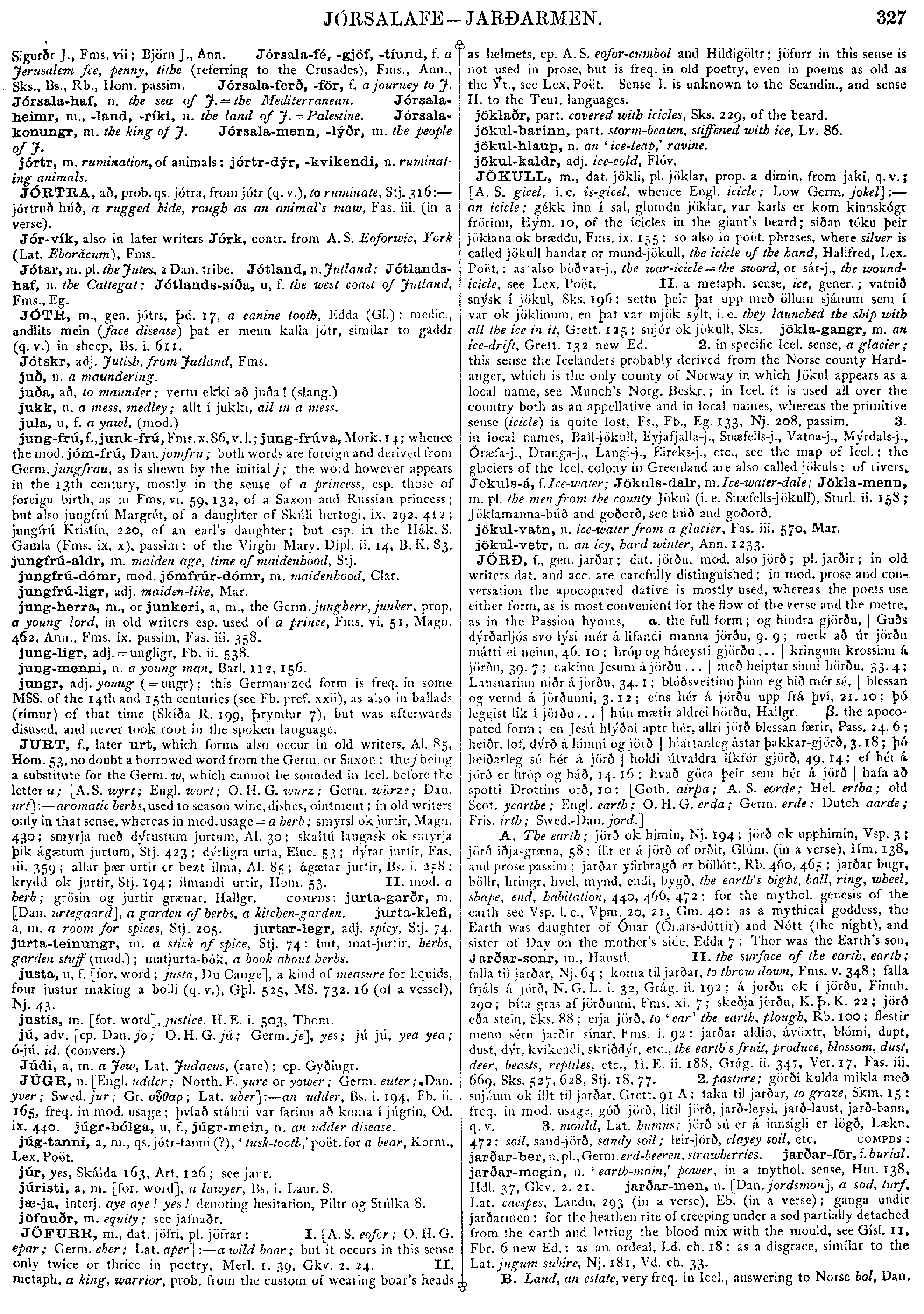
Sigurðr J., Fms. vii; Björn J., Ann. Jórsala-fé, -gjöf, -tíund, f. a Jerusalem fee, penny, tithe (referring to the Crusades), Fms., Ann., Sks., Bs., Rb., Hom. passim. Jórsala-ferð, -för, f. a journey to J. Jórsala-haf, n. the sea of J. = the Mediterranean. Jórsala-heimr, m., -land, -ríki, n. the land of J. = Palestine. Jórsala-konungr, m. the king of J. Jórsala-menn, -lýðr, m. the people of J.
|
Source: Cleasby/Vigfusson, page b0327, entry 39 View original page image as: [TIFF] [PNG] [View previous entry] [View next entry] |
[Comment on this entry] [View comments] |
The following entry has been hand-corrected once. |
A. The earth; jörð ok himin, Nj. 194; jörð ok upphimin, Vsp. 3; jörð iðja-græna, 58; íllt er á jörð of orðit, Glúm. (in a verse), Hm. 138, and prose passim; jarðar yfirbragð er böllótt, Rb. 460, 465; jarðar bugr, böllr, hringr, hvel, mynd, endi, bygð, the earth's bight, ball, ring, wheel, shape, end, habitation, 440, 466, 472: for the mythol. genesis of the earth see Vsp. l.c., Vþm. 20, 21, Gm. 40: as a mythical goddess, the Earth was daughter of Ónar (Ónars-dóttir) and Nótt (the night), and sister of Day on the mother's side, Edda 7: Thor was the Earth's son, Jarðar-sonr, m., Haustl. II. the surface of the earth, earth; falla til jarðar, Nj. 64; koma til jarðar, to throw down, Fms. v. 348; falla frjáls á jörð, N. G. L. i. 32, Grág. ii. 192; á jörðu ok í jörðu, Finnb. 290; bíta gras af jörðunni, Fms. xi. 7; skeðja jörðu, K. Þ. K. 22; jörð eða stein, Sks. 88; erja jörð, to 'ear' the earth, plough, Rb. 100; flestir menn séru jarðir sínar, Fms. i. 92: jarðar aldin, ávöxtr, blómi, dupt, dust, dýr, kvikendi, skriðdýr, etc., the earth's fruit, produce, blossom, dust, deer, beasts, reptiles, etc., H. E. ii. 188, Grág. ii. 347, Ver. 17, Fas. iii. 669, Sks. 527, 628, Stj. 18, 77. 2. pasture; görði kulda mikla með snjóum ok íllt til jarðar, Grett. 91 A; taka til jarðar, to graze, Skm. 15: freq. in mod. usage, góð jörð, lítil jörð, jarð-leysi, jarð-laust, jarð-bann, q.v. 3. mould, Lat. humus; jörð sú er á innsigli er lögð, Lækn. 472: soil, sand-jörð, sandy soil; leir-jörð, clayey soil, etc. COMPDS: jarðar-ber, n. pl., Germ. erd-beeren, strawberries. jarðar-för, f. burial. jarðar-megin, n. 'earth-main,' power, in a mythol. sense, Hm. 138, Hdl. 37, Gkv. 2. 21. jarðar-men, n. [Dan. jordsmon], a sod, turf, Lat. caespes, Landn. 293 (in a verse), Eb. (in a verse); ganga undir jarðarmen: for the heathen rite of creeping under a sod partially detached from the earth and letting the blood mix with the mould, see Gísl. 11, Fbr. 6 new Ed.: as an ordeal, Ld. ch. 18: as a disgrace, similar to the Lat. jugum subire, Nj. 181, Vd. ch. 33.
|
Source: Cleasby/Vigfusson, page b0336, entry 1 View original page image as: [TIFF] [PNG] [View previous entry] [View next entry] |
[Comment on this entry] [View comments] |
The following entry has been hand-corrected once. |
ekki
héldi
þat
er
mælt
var,
248;
það
er
mér
að
kenna,
it
is
brought
home
to
me;
yðr
er
þat
kenna,
Am.
51:
k.
e-m
um
e-t,
to
charge
one
with
a
thing;
Þorgeirr
vildi
ekki
at
bræðrum
hans
mætti
um
kenna,
hvat
sem
í
görðisk,
Nj.
252;
kenndu
þeir
því
mest
um,
at
Kjartan
hafði
þegit
skikkjuna,
Fms.
x.
295.
IV.
to
know,
perceive,
feel,
taste,
scent;
þegar
hirðin
hafði
kennt
(tasted)
fyrsta
rétt,
Fas.
iii.
302;
þeir
kenna
svá
sætan
ilm
at
þeir
höfðu
aldri
fyrr
slíkan
kenndan,
Fms.
i.
228;
kenna
fúlt,
to
perceive
a
foul
smell,
Hallfred;
kenna
daun,
Fms.
viii.
230;
þeir
brugðu
í
munn
sér
ok
þóttusk
ekki
jafnsætt
kennt
hafa,
Fb.
i.
539;
hundarnir
röktu
sporin,
þvíat
þeir
kenndu
(got
scent
of)
af
hreinstökunum,
Ó.
H.
152;
kenndi
djákninn
ekki
(he
felt
not)
at
þeir
lægi
á
honum,
Bs.
i.
464;
hón
kenndi
(she
felt
pain)
í
meira
lagi,
þá
er
nálgaðisk
hátíð
Þorláks
biskups,
323.
 .
kenna
niðr
(or
niðri),
to
touch
the
bottom;
en
er
skipin
kenndu
niðr
þá
gékk
jarl
á
land,
Hkr.
i.
206;
ok
er
skipit
kenndi
niðr,
hlupu
þeir
fyrir
borð,
Grett.
97,
Fms.
viii.
317,
ix.
23;
svá
var
djúpt
á
bæði
borð,
at
forkarnir
kenndu
eigi
niðr,
it
was
so
deep
that
the
boat-hooks
did
not
reach
the
bottom,
Ld.
56;
þá
er
skipit
flaut
ok
eigi
kenndi
niðr,
78.
.
kenna
niðr
(or
niðri),
to
touch
the
bottom;
en
er
skipin
kenndu
niðr
þá
gékk
jarl
á
land,
Hkr.
i.
206;
ok
er
skipit
kenndi
niðr,
hlupu
þeir
fyrir
borð,
Grett.
97,
Fms.
viii.
317,
ix.
23;
svá
var
djúpt
á
bæði
borð,
at
forkarnir
kenndu
eigi
niðr,
it
was
so
deep
that
the
boat-hooks
did
not
reach
the
bottom,
Ld.
56;
þá
er
skipit
flaut
ok
eigi
kenndi
niðr,
78.
 .
absol.,
þá
er
þeir
kómu
upp
í
heiðina,
kenndi
at
brá
lit,
the
colour
was
felt
to
change,
i.e.
it
began
to
darken,
Sturl.
iii.
217
C;
þá
kenndi
(one
could
scent)
ór
laukinum,
Fbr.
215;
þá
er
maðr
heilundi
er
köra
(acc.
or
gen.?)
kennir
inn
til
heila-basta,
Grág.
ii.
91.
2.
with
prepp.;
kenna
af
(á,
at),
to
perceive,
see;
þess
kennir
nú
at
(af?)
at
þér
þykkir
ek
févani,
it
is
clear
that
...,
I
see
that
...,
Eb.
38;
kenndi
þess
mjök
á
(it
was
much
to
be
seen)
um
marga
Upplendinga,
at
ílla
hafði
lekat
UNCERTAIN
aftaka
Þóris,
Ó.
H.
188;
þess
kenna
margir
af,
at
þú
ert
frændstórr,
Fb.
ii.
270;
deyr
allt
þat
er
af
kennir
(all
die
that
taste
or
smell
of
it),
þeir
deyja
þegar
er
þeir
kenna
af,
Rb.
352
:--
kenna
til,
to
smart,
feel
pain,
ache,
freq.
in
mod.
usage.
3.
with
gen.
to
have
feeling
of,
feel;
kenna
mæði,
lo
be
exhausted,
Eg.
124;
hjarta
manns
kennir
alls,
Skálda
169;
kenna
sóttar,
to
feel
sickness;
kona
kennir
sér
sóttar,
of
childbirth,
Fs.
26,
Fas.
ii.
504,
Sd.
176:
kenna
karlmanns,
to
'know'
a
man,
cohabit
with,
Mar.;
ek
kennda
eigi
karlmanns,
barn
at
bera,
Hom.
30;
kenna
aflsmunar,
liðsmunar,
ríkismunar,
to
feel
the
odds,
be
overmatched,
Hkr.
i.
286,
Fms.
iv.
331,
Ld.
38;
kenna
harðinda,
Fms.
vi.
110;
kenna
kulda
af
e-u,
to
feel
cold
from,
Eb.
42;
k.
hita
af
e-u,
Bs.
i.
42;
k.
odds,
benja,
to
feel
the
point,
the
wound,
Am.
59,
88;
virðisk
mér
ákall
þetta
meir
kenna
ranglætis
en
réttvísi,
it
is
more
prompted
by
overbearing
than
by
justice,
Fb.
i.
19;
hón
kenndi
þess
at
þar
stóð
ör
í,
ii.
365;
nú
má
vera
at
mér
kenni
heiptar
við
suma
menn,
that
I
feel
hatred
against
somebody,
Sturl.
iii.
233;
tók
þá
at
kenna
annars
litar,
it
began
to
grow
dark,
171;
vínviðr
var
efst
þar
sem
holta
kenndi,
the
holts
were
covered
with
vines,
Þorf.
Karl.
420;
kenna
fæðu,
to
taste
food,
Stj.
490,
492;
but
also
k.
á
fæðu,
453,
517;
kenna
grunns,
to
touch
the
bottom,
of
a
ship
or
anything
afloat,
Grág.
ii.
353;
k.
endi-skeiðs,
Bragi.
V.
to
call,
name;
kenna
e-t
við
e-n,
to
call
after
one;
Helgi
trúði
á
Krist,
ok
kenndi
því
við
hann
bústað
sinn,
i.e.
called
it
after
Christ
(Christness),
Landn.
207;
í
þeim
fjórðungi
er
dómrinn
er
við
kenndr,
in
the
quarter
by
which
name
the
court
is
called,
Grág.
i.
65;
at
helga
Þór
allt
landnám
sitt
ok
kenna
við
hann,
Landn.
97;
k.
mánuðinn
við
þann
mann
sem
vatnsins
gætir,
Rb.
104;
við
þann
er
kennt
Gunnars-holt,
Nj.
29;
Oddbjörn
er
Oddbjarnar-leið
er
við
kennd,
Eg.
102;
Fleiri
hlupu
þeir
fyrir
berg,
þar
sem
við
þá
er
kennt
síðan,
Landn.
36;
kenna
þá
með
margfjölda
atkvæði,
address
them
in
the
plural,
Sks.
312;
sá
var
kenndr
(nicknamed)
Knarrar-smiðr
Ór,
43;
Nótt
en
Nörvi
kennda,
i.e.
Night,
the
daughter
of
Norvi,
Alm.
30;
hvar
eru
Hjörvarði
haugar
kenndir,
where
are
the
hows
called
Hjorward's?
Fas.
i.
519
(in
a
verse);
Mæringr
mér
of
kenndr,
my
own
sword
M.,
Bjarn.
(in
a
verse);
hlutir
er
þú
skal
varask,
at
þú
verðir
eigi
við
kenndr,
Sks.
358,
780;
kenndr
við
styr,
morð,
connected
with,
Korm.
2.
in
poetry,
to
call
by
a
periphrasis
or
descriptive
name;
rétt
er
at
kenna
(to
call)
hana
(a
woman)
svá,
at
kalla
hana
selju
þess
er
hón
miðlar,
Edda;
hvernig
skal
kenna
Þór?
--
Svá
at
kalla
hann
son
Óðins
...,
how
is
Thor
to
be
called?
--
Thus,
call
him
the
'son
of
Odin,'
53:
hvernig
skal
kenna
mann?
--
Hanna
skal
k.
við
verk
sín,
67:
with
prep.,
kona
er
kennd
við
stein,
Edda;
ok
kenn
þó
hvárn
til
sinnar
iðnar,
Fms.
vi.
362;
konu
skal
k.
til
alls
kvenn-búnaðar,
Edda,
etc.,
see
Edda
(Skáldskm.)
passim;
hence
kennd
heiti
(compound
or
circumlocutory
names),
opp.
to
ókennd
heiti
(plain
appellatives),
Edda
49.
.
absol.,
þá
er
þeir
kómu
upp
í
heiðina,
kenndi
at
brá
lit,
the
colour
was
felt
to
change,
i.e.
it
began
to
darken,
Sturl.
iii.
217
C;
þá
kenndi
(one
could
scent)
ór
laukinum,
Fbr.
215;
þá
er
maðr
heilundi
er
köra
(acc.
or
gen.?)
kennir
inn
til
heila-basta,
Grág.
ii.
91.
2.
with
prepp.;
kenna
af
(á,
at),
to
perceive,
see;
þess
kennir
nú
at
(af?)
at
þér
þykkir
ek
févani,
it
is
clear
that
...,
I
see
that
...,
Eb.
38;
kenndi
þess
mjök
á
(it
was
much
to
be
seen)
um
marga
Upplendinga,
at
ílla
hafði
lekat
UNCERTAIN
aftaka
Þóris,
Ó.
H.
188;
þess
kenna
margir
af,
at
þú
ert
frændstórr,
Fb.
ii.
270;
deyr
allt
þat
er
af
kennir
(all
die
that
taste
or
smell
of
it),
þeir
deyja
þegar
er
þeir
kenna
af,
Rb.
352
:--
kenna
til,
to
smart,
feel
pain,
ache,
freq.
in
mod.
usage.
3.
with
gen.
to
have
feeling
of,
feel;
kenna
mæði,
lo
be
exhausted,
Eg.
124;
hjarta
manns
kennir
alls,
Skálda
169;
kenna
sóttar,
to
feel
sickness;
kona
kennir
sér
sóttar,
of
childbirth,
Fs.
26,
Fas.
ii.
504,
Sd.
176:
kenna
karlmanns,
to
'know'
a
man,
cohabit
with,
Mar.;
ek
kennda
eigi
karlmanns,
barn
at
bera,
Hom.
30;
kenna
aflsmunar,
liðsmunar,
ríkismunar,
to
feel
the
odds,
be
overmatched,
Hkr.
i.
286,
Fms.
iv.
331,
Ld.
38;
kenna
harðinda,
Fms.
vi.
110;
kenna
kulda
af
e-u,
to
feel
cold
from,
Eb.
42;
k.
hita
af
e-u,
Bs.
i.
42;
k.
odds,
benja,
to
feel
the
point,
the
wound,
Am.
59,
88;
virðisk
mér
ákall
þetta
meir
kenna
ranglætis
en
réttvísi,
it
is
more
prompted
by
overbearing
than
by
justice,
Fb.
i.
19;
hón
kenndi
þess
at
þar
stóð
ör
í,
ii.
365;
nú
má
vera
at
mér
kenni
heiptar
við
suma
menn,
that
I
feel
hatred
against
somebody,
Sturl.
iii.
233;
tók
þá
at
kenna
annars
litar,
it
began
to
grow
dark,
171;
vínviðr
var
efst
þar
sem
holta
kenndi,
the
holts
were
covered
with
vines,
Þorf.
Karl.
420;
kenna
fæðu,
to
taste
food,
Stj.
490,
492;
but
also
k.
á
fæðu,
453,
517;
kenna
grunns,
to
touch
the
bottom,
of
a
ship
or
anything
afloat,
Grág.
ii.
353;
k.
endi-skeiðs,
Bragi.
V.
to
call,
name;
kenna
e-t
við
e-n,
to
call
after
one;
Helgi
trúði
á
Krist,
ok
kenndi
því
við
hann
bústað
sinn,
i.e.
called
it
after
Christ
(Christness),
Landn.
207;
í
þeim
fjórðungi
er
dómrinn
er
við
kenndr,
in
the
quarter
by
which
name
the
court
is
called,
Grág.
i.
65;
at
helga
Þór
allt
landnám
sitt
ok
kenna
við
hann,
Landn.
97;
k.
mánuðinn
við
þann
mann
sem
vatnsins
gætir,
Rb.
104;
við
þann
er
kennt
Gunnars-holt,
Nj.
29;
Oddbjörn
er
Oddbjarnar-leið
er
við
kennd,
Eg.
102;
Fleiri
hlupu
þeir
fyrir
berg,
þar
sem
við
þá
er
kennt
síðan,
Landn.
36;
kenna
þá
með
margfjölda
atkvæði,
address
them
in
the
plural,
Sks.
312;
sá
var
kenndr
(nicknamed)
Knarrar-smiðr
Ór,
43;
Nótt
en
Nörvi
kennda,
i.e.
Night,
the
daughter
of
Norvi,
Alm.
30;
hvar
eru
Hjörvarði
haugar
kenndir,
where
are
the
hows
called
Hjorward's?
Fas.
i.
519
(in
a
verse);
Mæringr
mér
of
kenndr,
my
own
sword
M.,
Bjarn.
(in
a
verse);
hlutir
er
þú
skal
varask,
at
þú
verðir
eigi
við
kenndr,
Sks.
358,
780;
kenndr
við
styr,
morð,
connected
with,
Korm.
2.
in
poetry,
to
call
by
a
periphrasis
or
descriptive
name;
rétt
er
at
kenna
(to
call)
hana
(a
woman)
svá,
at
kalla
hana
selju
þess
er
hón
miðlar,
Edda;
hvernig
skal
kenna
Þór?
--
Svá
at
kalla
hann
son
Óðins
...,
how
is
Thor
to
be
called?
--
Thus,
call
him
the
'son
of
Odin,'
53:
hvernig
skal
kenna
mann?
--
Hanna
skal
k.
við
verk
sín,
67:
with
prep.,
kona
er
kennd
við
stein,
Edda;
ok
kenn
þó
hvárn
til
sinnar
iðnar,
Fms.
vi.
362;
konu
skal
k.
til
alls
kvenn-búnaðar,
Edda,
etc.,
see
Edda
(Skáldskm.)
passim;
hence
kennd
heiti
(compound
or
circumlocutory
names),
opp.
to
ókennd
heiti
(plain
appellatives),
Edda
49.
|
Source: Cleasby/Vigfusson, page b0336, entry 10 View original page image as: [TIFF] [PNG] [View previous entry] [View next entry] |
[Comment on this entry] [View comments] |
The following entry has been hand-corrected once. |
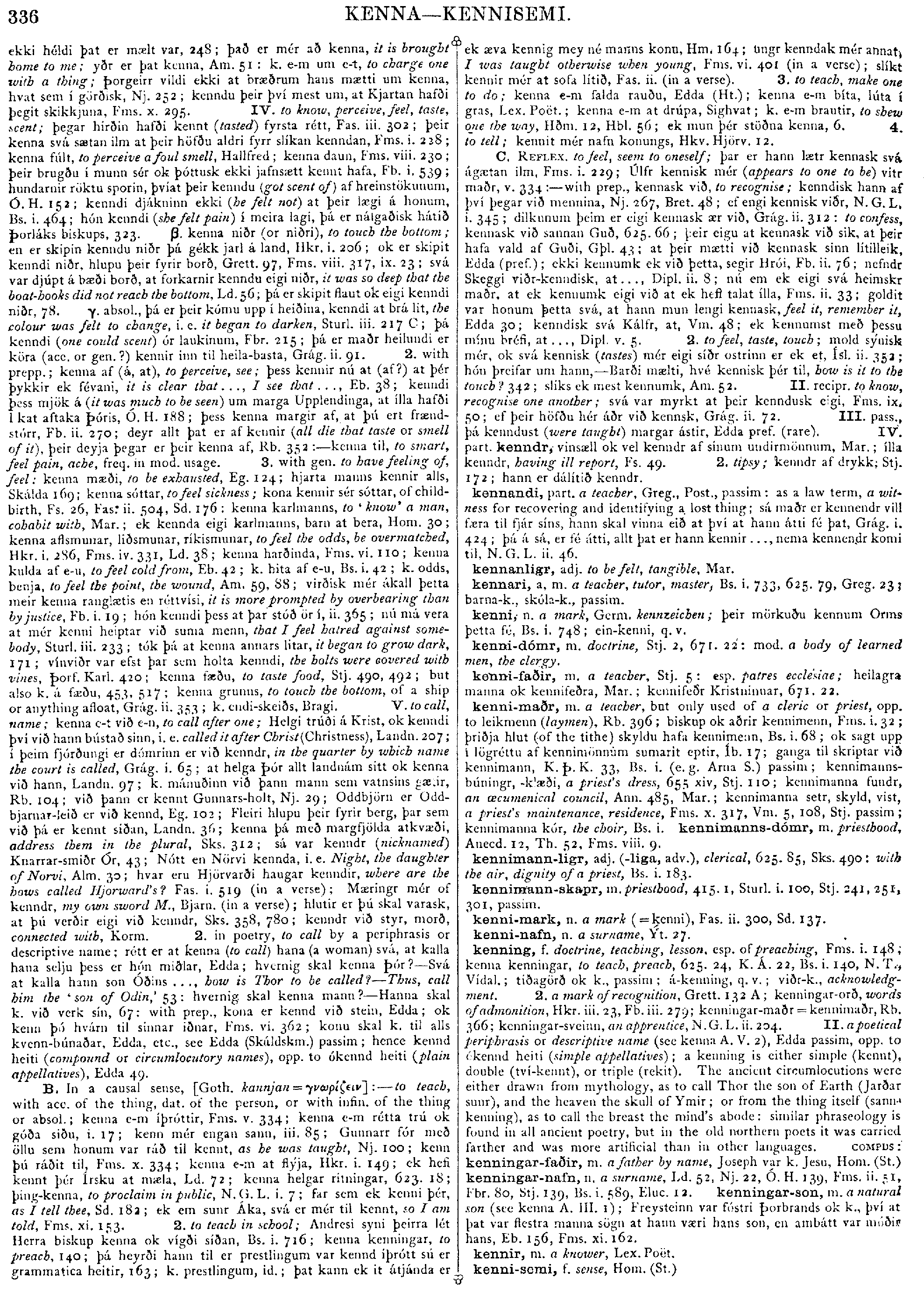
kenni-maðr, m. a teacher, but only used of a cleric or priest, opp. to leikmenn (laymen), Rb. 396; biskup ok aðrir kennimenn, Fms. i. 32; þriðja hlut (of the tithe) skyldu hafa kennimenn, Bs. i. 68; ok sagt upp í lögréttu af kennimönnum sumarit eptir, Íb. 17; ganga til skriptar við kennimann, K. Þ. K. 33, Bs. i. (e.g. Arna S.) passim; kennimanns-búningr, -klæði, a priest's dress, 655 xiv, Stj. 110; kennimanna fundr, an œcumenical council, Ann. 485, Mar.; kennimanna setr, skyld, vist, a priest's maintenance, residence, Fms. x. 317, Vm. 5, 108, Stj. passim; kennimanna kór, the choir, Bs. i. kennimanns-dómr, m. priesthood, Anecd. 12, Th. 52, Fms. viii. 9.
|
Source: Cleasby/Vigfusson, page b0336, entry 15 View original page image as: [TIFF] [PNG] [View previous entry] [View next entry] |
[Comment on this entry] [View comments] |
The following entry has been hand-corrected once. |
kenning, f. doctrine, teaching, lesson, esp. of preaching, Fms. i. 148; kenna kenningar, to teach, preach, 625. 24, K. Á. 22, Bs. i. 140, N. T., Vídal.; tíðagörð ok k., passim; á-kenning, q.v.; viðr-k., acknowledgment. 2. a mark of recognition, Grett. 132 A; kenningar-orð, words of admonition, Hkr. iii. 23, Fb. iii. 279; kenningar-maðr = kennimaðr, Rb. 366; kenningar-sveinn, an apprentice, N. G. L. ii. 204. II. a poetical periphrasis or descriptive name (see kenna A. V. 2), Edda passim, opp. to ókennd heiti (simple appellatives); a kenning is either simple (kennt), double (tví-kennt), or triple (rekit). The ancient circumlocutions were either drawn from mythology, as to call Thor the son of Earth (Jarðar sunr), and the heaven the skull of Ymir; or from the thing itself (sann-kenning), as to call the breast the mind's abode: similar phraseology is found in all ancient poetry, but in the old northern poets it was carried farther and was more artificial than in other languages. COMPDS: kenningar-faðir, m. a father by name, Joseph var k. Jesu, Hom. (St.) kenningar-nafn, n. a surname, Ld. 52, Nj. 22, Ó. H. 139, Fms. ii. 51, Fbr. 80, Stj. 139, Bs. i. 589, Eluc. 12. kenningar-son, m. a natural son (see kenna A. 111. 1); Freysteinn var fóstri Þorbrands ok k., því at þat var flestra manna sögn at hann væri hans son, en ambátt var móðir hans, Eb. 156, Fms. xi. 162.
| Result Page: |  |
Previous | 20 21 22 23 24 25 26 27 28 29 30 31 32 33 34 35 36 37 38 | Next |  |
Germanic Lexicon Project (main page)
This search system was written by
Sean Crist
Please consider
volunteering
to correct the data in these online dictionaries.
No rights reserved. Feel free to use these data in any way you please.