|
|

Tip: In the search results, you can click on any word or abbreviation for more information.
|
Source: Bosworth/Toller, page b1088, entry 8 View original page image as: [TIFF] [PNG] [View previous entry] [View next entry] |
[Comment on this entry] [View comments] |
The following entry has been hand-corrected once. |
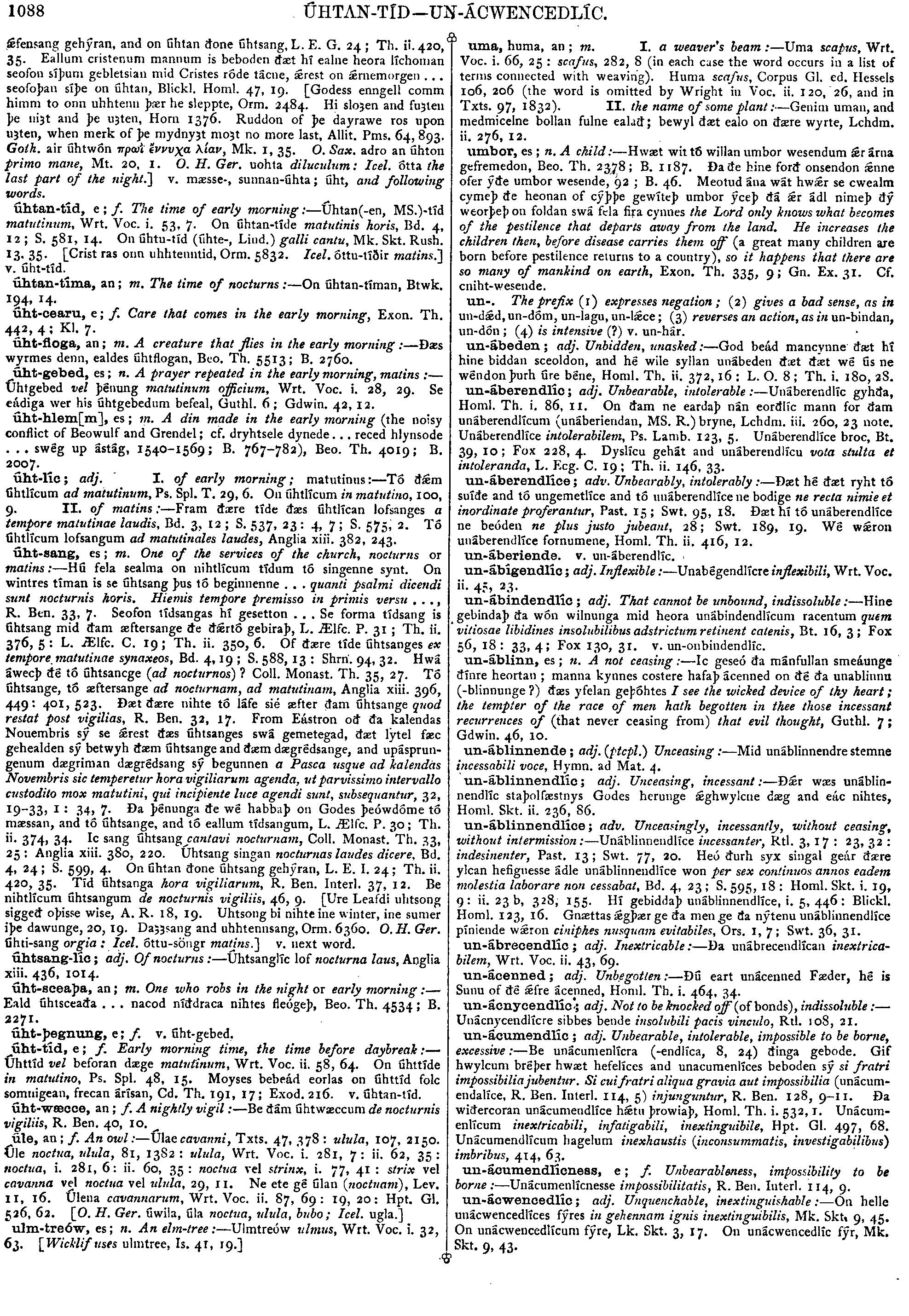
úht-sang,
es;
m.
One
of
the
services
of
the
church,
nocturns
or
matins
:--
Hú
fela
sealma
on
nihtlícum
tídum
tó
singenne
synt.
On
wintres
tíman
is
se
úhtsang
þus
tó
beginnenne
...
quanti
psalmi
dicendi
sunt
nocturnis
horis.
Hiemis
tempore
premisso
in
primis
versu...,
R.
Ben.
33,
7.
Seofon
tídsangas
hí
gesetton
...
Se
forma
tídsang
is
úhtsang
mid
ðam
æftersange
ðe
ð rtó
gebiraþ,
L.
Ælfc.
P.
31;
Th.
ii.
376,
5:
L.
Ælfc.
C.
19;
Th.
ii.
350,
6.
Of
ðære
tíde
úhtsanges
ex
tempore
matutinae
synaxeos,
Bd.
4,
19;
S.
588,
13:
Shrn.
94,
32.
Hwá
áwecþ
ðé
tó
úhtsancge
(ad
nocturnos)?
Coll.
Monast.
Th.
35,
27.
Tó
úhtsange,
tó
æftersange
ad
nocturnam,
ad
matutinam,
Anglia
xiii.
396,
449:
401,
523.
Ðæt
ðære
nihte
tó
láfe
sié
æfter
ðam
úhtsange
quod
restat
post
vigilias,
R.
Ben.
32,
17.
From
Eástron
oð
ða
kalendas
Nouembris
sý
se
rest
ðæs
úhtsanges
swá
gemetegad,
ðæt
lýtel
fæc
gehealden
sý
betwyh
ðæm
úhtsange
and
ðæm
dægrédsange,
and
upásprungenum
dægriman
dægrédsang
sý
begunnen
a
Pasca
usque
ad
kalendas
Novembris
sic
temperetur
hora
vigiliarum
agenda,
ut
parvissimo
intervallo
custodito
mox
matutini,
qui
incipiente
luce
agendi
sunt,
subsequantur,
32,
19-33,
1:
34,
7.
Ða
þénunga
ðe
wé
habbaþ
on
Godes
þeówdóme
tó
mæssan,
and
tó
úhtsange,
and
tó
eallum
tídsangum,
L.
Ælfc.
P.
30;
Th.
ii.
374,
34.
Ic
sang
úhtsang
cantavi
nocturnam,
Coll.
Monast.
Th.
33,
25:
Anglia
xiii.
380,
220.
Úhtsang
singan
nocturnas
laudes
dicere,
Bd.
4,
24;
S.
599,
4.
On
úhtan
ðone
úhtsang
gehýran,
L.
E.
I.
24;
Th.
ii.
420,
35.
Tíd
úhtsanga
hora
vigiliarum,
R.
Ben.
Interl.
37,
12.
Be
nihtlícum
úhtsangum
de
nocturnis
vigiliis,
46,
9.
[Ure
Leafdi
ulttsong
siggeð
oþisse
wise,
A.
R.
18,
19.
Uhtsong
bi
nihte
ine
winter,
ine
sumer
iþe
dawunge,
20,
19.
Da
rtó
gebiraþ,
L.
Ælfc.
P.
31;
Th.
ii.
376,
5:
L.
Ælfc.
C.
19;
Th.
ii.
350,
6.
Of
ðære
tíde
úhtsanges
ex
tempore
matutinae
synaxeos,
Bd.
4,
19;
S.
588,
13:
Shrn.
94,
32.
Hwá
áwecþ
ðé
tó
úhtsancge
(ad
nocturnos)?
Coll.
Monast.
Th.
35,
27.
Tó
úhtsange,
tó
æftersange
ad
nocturnam,
ad
matutinam,
Anglia
xiii.
396,
449:
401,
523.
Ðæt
ðære
nihte
tó
láfe
sié
æfter
ðam
úhtsange
quod
restat
post
vigilias,
R.
Ben.
32,
17.
From
Eástron
oð
ða
kalendas
Nouembris
sý
se
rest
ðæs
úhtsanges
swá
gemetegad,
ðæt
lýtel
fæc
gehealden
sý
betwyh
ðæm
úhtsange
and
ðæm
dægrédsange,
and
upásprungenum
dægriman
dægrédsang
sý
begunnen
a
Pasca
usque
ad
kalendas
Novembris
sic
temperetur
hora
vigiliarum
agenda,
ut
parvissimo
intervallo
custodito
mox
matutini,
qui
incipiente
luce
agendi
sunt,
subsequantur,
32,
19-33,
1:
34,
7.
Ða
þénunga
ðe
wé
habbaþ
on
Godes
þeówdóme
tó
mæssan,
and
tó
úhtsange,
and
tó
eallum
tídsangum,
L.
Ælfc.
P.
30;
Th.
ii.
374,
34.
Ic
sang
úhtsang
cantavi
nocturnam,
Coll.
Monast.
Th.
33,
25:
Anglia
xiii.
380,
220.
Úhtsang
singan
nocturnas
laudes
dicere,
Bd.
4,
24;
S.
599,
4.
On
úhtan
ðone
úhtsang
gehýran,
L.
E.
I.
24;
Th.
ii.
420,
35.
Tíd
úhtsanga
hora
vigiliarum,
R.
Ben.
Interl.
37,
12.
Be
nihtlícum
úhtsangum
de
nocturnis
vigiliis,
46,
9.
[Ure
Leafdi
ulttsong
siggeð
oþisse
wise,
A.
R.
18,
19.
Uhtsong
bi
nihte
ine
winter,
ine
sumer
iþe
dawunge,
20,
19.
Da sang
and
uhhtennsang.
Orm.
6360.
O.
H.
Ger.
úhti-sang
orgia:
Icel.
óttu-sóngr
matins.]
v
next
word.
sang
and
uhhtennsang.
Orm.
6360.
O.
H.
Ger.
úhti-sang
orgia:
Icel.
óttu-sóngr
matins.]
v
next
word.
|
Source: Bosworth/Toller, page b1089, entry 26 View original page image as: [TIFF] [PNG] [View previous entry] [View next entry] |
[Comment on this entry] [View comments] |
The following entry has been hand-corrected once. |
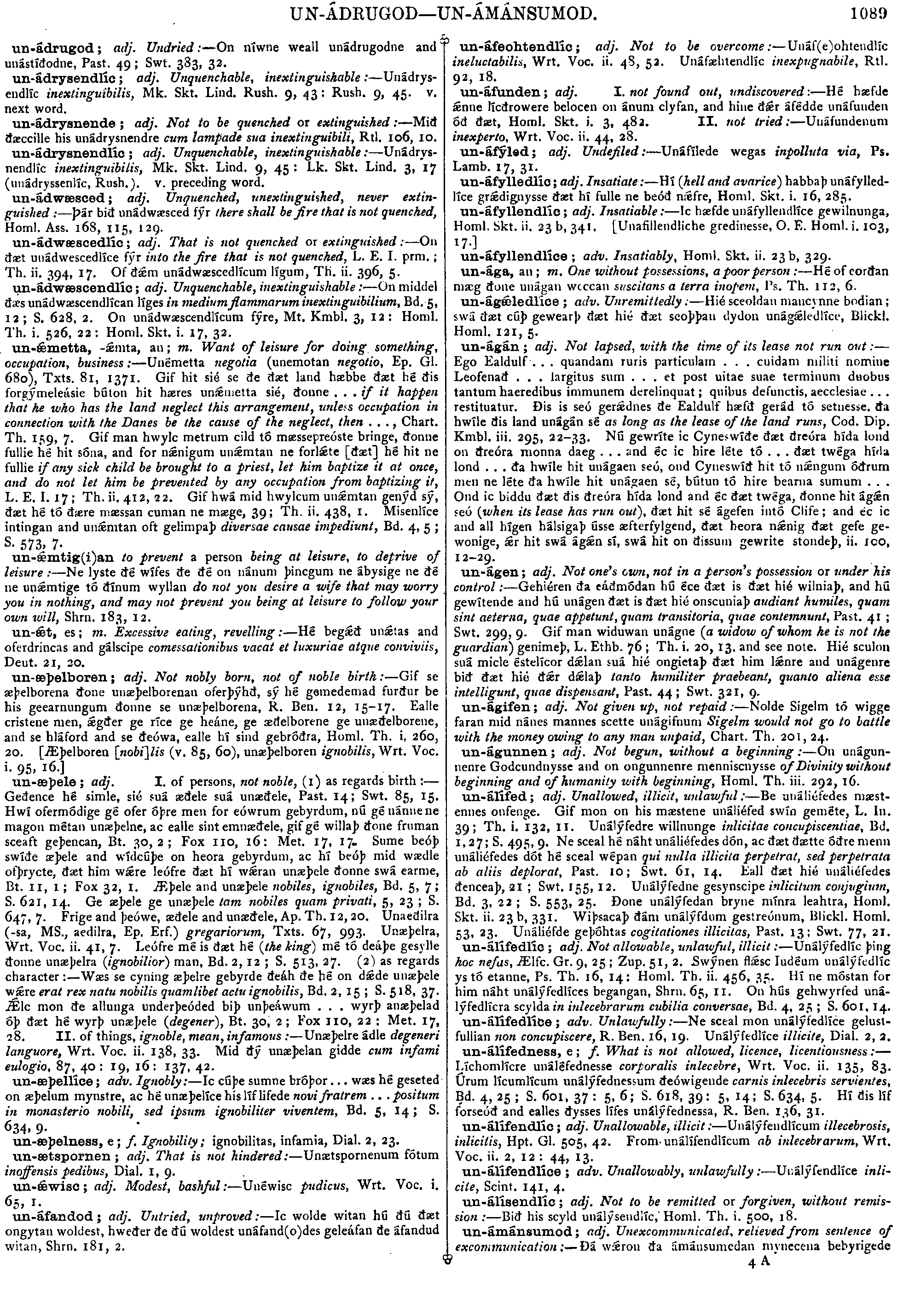
un-ágán;
adj.
Not
lapsed,
with
the
time
of
its
lease
not
run
out
:--
Ego
Ealdulf
...
quandam
ruris
particulam
...
cuidam
militi
nomine
Leofenað
...
largitus
sum
...
et
post
uitae
suae
terminum
duobus
tantum
haeredibus
immunem
derelinquat;
quibus
defunctis,
aecclesiae
...
restituatur.
Ðis
is
seó
gerdnes
ðe
Ealdulf
hæfð
gerád
tó
setnesse,
ða
hwíle
ðis
land
unágán
sé
as
long
as
the
lease
of
the
land
runs,
Cod.
Dip.
Kmbl.
iii.
295,
22-33.
Nú
gewríte
ic
Cyneswíðe
ðæt
ðreóra
hída
lond
on
ðreóra
monna
daeg
...
and
éc
ic
hire
léte
tó
...
ðæt
twéga
hída
lond
...
ða
hwíle
hit
unágaen
seó,
and
Cyneswíð
hit
tó
nngum
óðrum
men
ne
léte
ða
hwíle
hit
unágaen
sé,
bútun
tó
hire
bearna
sumum
...
Ond
ic
biddu
ðæt
ðis
ðreóra
hída
lond
and
éc
ðæt
twéga,
ðonne
hit
ágn
seó
(when
its
lease
has
run
out),
ðæt
hit
sé
ágefen
intó
Clife;
and
ec
ic
and
all
hígen
hálsigaþ
ússe
æfterfylgend,
ðæt
heora
nnig
ðæt
gefe
gewonige,
r
hit
swá
ágæn
sí,
swá
hit
on
ðissum
gewrite
stondeþ,
ii.
100,
12-29.
|
Source: Bosworth/Toller, page b1092, entry 40 View original page image as: [TIFF] [PNG] [View previous entry] [View next entry] |
[Comment on this entry] [View comments] |
The following entry has been hand-corrected once. |
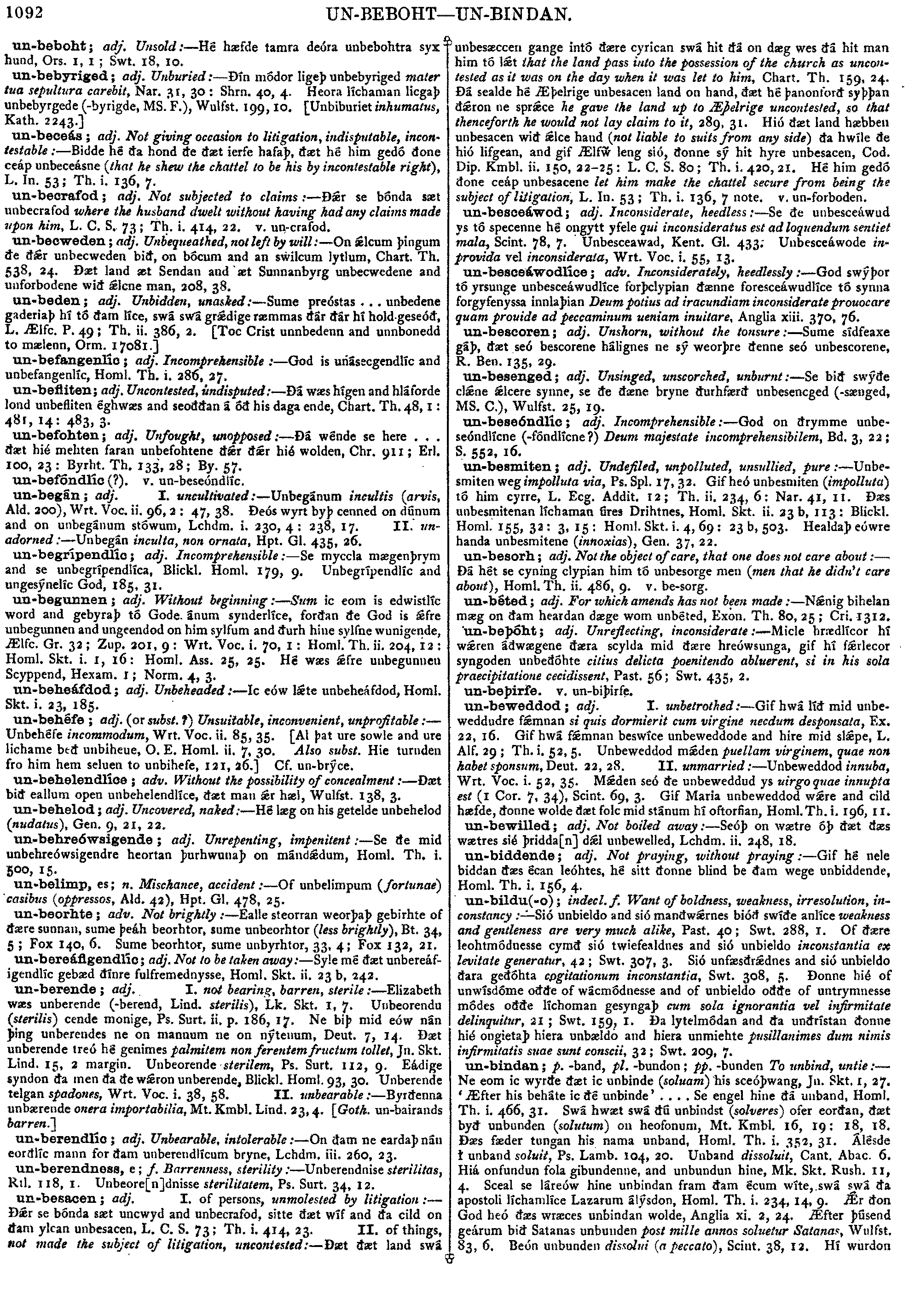
un-bindan;
p.
-band,
pl.
-bundon;
pp.
-bunden
To
unbind,
untie
:--
Ne
eom
ic
wyrðe
ðæt
ic
unbinde
(soluam)
his
sceóþwang,
Jn.
Skt.
1,
27.
'Æfter
his
beháte
ic
ðé
unbinde'
...
Se
engel
hire
ðá
unband,
Homl.
Th.
i.
466,
31.
Swá
hwæt
swá
ðú
unbindst
(solveres)
ofer
eorðan,
ðæt
byð
unbunden
(solutum)
on
heofonum,
Mt.
Kmbl.
16,
19:
18,
18.
Ðæs
fæder
tungan
his
nama
unband,
Homl.
Th.
i.
352,
31.
Álésde
 unband
soluit,
Ps.
Lamb.
104,
20.
Unband
dissoluit,
Cant.
Abac.
6.
Hiá
onfundun
fola
gibundenne,
and
unbundun
hine,
Mk.
Skt.
Rush.
11,
4.
Sceal
se
láreów
hine
unbindan
fram
ðam
écum
wíte,
swá
swá
ða
apostoli
líchamlíce
Lazarum
álýsdon,
Homl.
Th.
i.
234,
14,
9.
Æ-acute;r
ðon
God
heó
ðæs
wræces
unbindan
wolde,
Anglia
xi.
2,
24.
Æfter
þúsend
geárum
bið
Satanas
unbunden
post
mille
annos
soluetur
Satanas,
Wulfst.
83,
6.
Beón
unbunden
dissolui
(a
peccato),
Scint.
38,
12.
Hí
wurdon
anbundene,
Homl.
Th.
ii.
20,
8.
From
synna
bendum
unbundeno
a
peccatorum
vinculis
absolutos,
Rtl.
7,
13.
[Cf.
Goth.
and-bindan:
O.
Sax.
ant-bindan:
O.
H.
Ger.
int-,
in-bindan.]
v.
on-bindan.
unband
soluit,
Ps.
Lamb.
104,
20.
Unband
dissoluit,
Cant.
Abac.
6.
Hiá
onfundun
fola
gibundenne,
and
unbundun
hine,
Mk.
Skt.
Rush.
11,
4.
Sceal
se
láreów
hine
unbindan
fram
ðam
écum
wíte,
swá
swá
ða
apostoli
líchamlíce
Lazarum
álýsdon,
Homl.
Th.
i.
234,
14,
9.
Æ-acute;r
ðon
God
heó
ðæs
wræces
unbindan
wolde,
Anglia
xi.
2,
24.
Æfter
þúsend
geárum
bið
Satanas
unbunden
post
mille
annos
soluetur
Satanas,
Wulfst.
83,
6.
Beón
unbunden
dissolui
(a
peccato),
Scint.
38,
12.
Hí
wurdon
anbundene,
Homl.
Th.
ii.
20,
8.
From
synna
bendum
unbundeno
a
peccatorum
vinculis
absolutos,
Rtl.
7,
13.
[Cf.
Goth.
and-bindan:
O.
Sax.
ant-bindan:
O.
H.
Ger.
int-,
in-bindan.]
v.
on-bindan.
|
Source: Bosworth/Toller, page b1097, entry 2 View original page image as: [TIFF] [PNG] [View previous entry] [View next entry] |
[Comment on this entry] [View comments] |
The following entry has been hand-corrected once. |
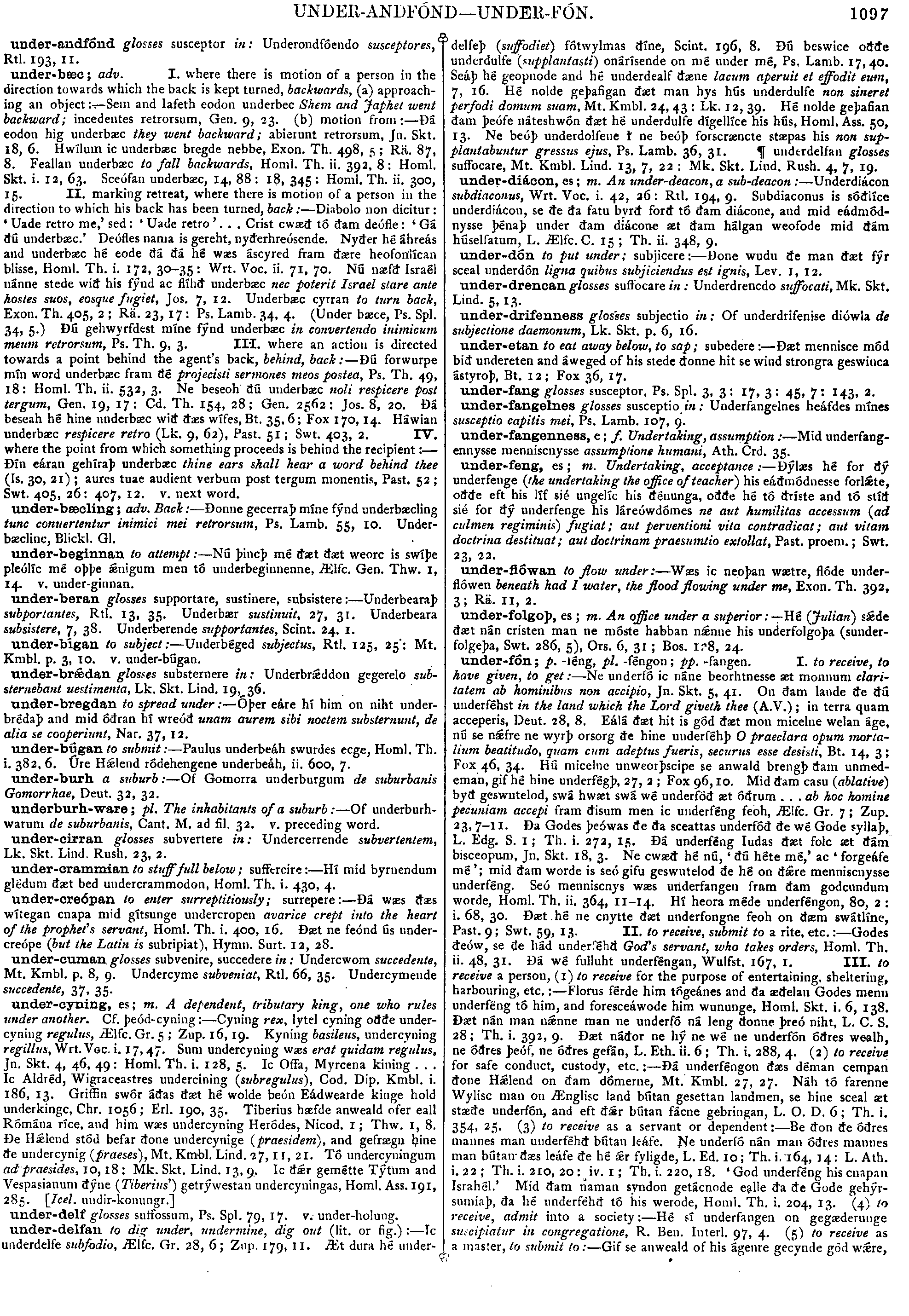
under-bæc; adv. I. where there is motion of a person in the direction towards which the back is kept turned, backwards, (a) approaching an object :-- Sem and Iafeth eodon underbec Shem and Japhet went backward; incedentes retrorsum, Gen. 9, 23. (b) motion from :-- Ðá eodon hig underbæc they went backward; abierunt retrorsum, Jn. Skt. 18, 6. Hwílum ic underbæc bregde nebbe, Exon. Th. 498, 5; Rä. 87, 8. Feallan underbæc to fall backwards, Homl. Th. ii. 392, 8: Homl. Skt. i. 12, 63. Sceófan underbæc, 14, 88: 18, 345: Hontl. Th. ii. 300, 15. II. marking retreat, where there is motion of a person in the direction to which his back has been turned, back :-- Diabolo non dicitur: 'Uade retro me,' sed: 'Uade retro' ... Crist cwæð tó ðam deófle: 'Gá ðú underbæc.' Deófles nama is gereht, nyðerhreósende. Nyðer hé áhreás and underbæc hé eode ðá ðá hé wæs áscyred fram ðære heofonlícan blisse, Homl. Th. i. 172, 30-35: Wrt. Voc. ii. 71, 70. Nú næfð Israél nánne stede wið his fýnd ac flíhð underbæc nec poterit Israel stare ante hostes suos, eosque fugiet, Jos. 7, 12. Underbæc cyrran to turn back, Exon. Th. 405, 2; Rä. 23, 17: Ps. Lamb. 34, 4. (Under bæce, Ps. Spl. 34, 5.) Ðú gehwyrfdest míne fýnd underbæc in convertendo inimicum meum retrorsum, Ps. Th. 9, 3. III. where an action is directed towards a point behind the agent's back, behind, back :-- Ðú forwurpe mín word underbæc fram ðé projecisti sermones meos postea, Ps. Th. 49, 18: Homl. Th. ii. 532, 3. Ne beseoh ðú underbæc noli respicere post tergum, Gen. 19, 17: Cd. Th. 154, 28; Gen. 2562: Jos. 8, 20. Ðá beseah hé hine underbæc wið ðæs wífes, Bt. 35, 6; Fox 170, 14. Háwian underbæc respicere retro (Lk. 9, 62), Past. 51; Swt. 403, 2. IV. where the point from which something proceeds is behind the recipient :-- Ðín eáran gehíraþ underbæc thine ears shall hear a word behind thee (Is. 30, 21); aures tuae audient verbum post tergum monentis, Past. 52; Swt. 405, 26: 407, 12. v. next word.
|
Source: Bosworth/Toller, page b1121, entry 10 View original page image as: [TIFF] [PNG] [View previous entry] [View next entry] |
[Comment on this entry] [View comments] |
The following entry has been hand-corrected once. |
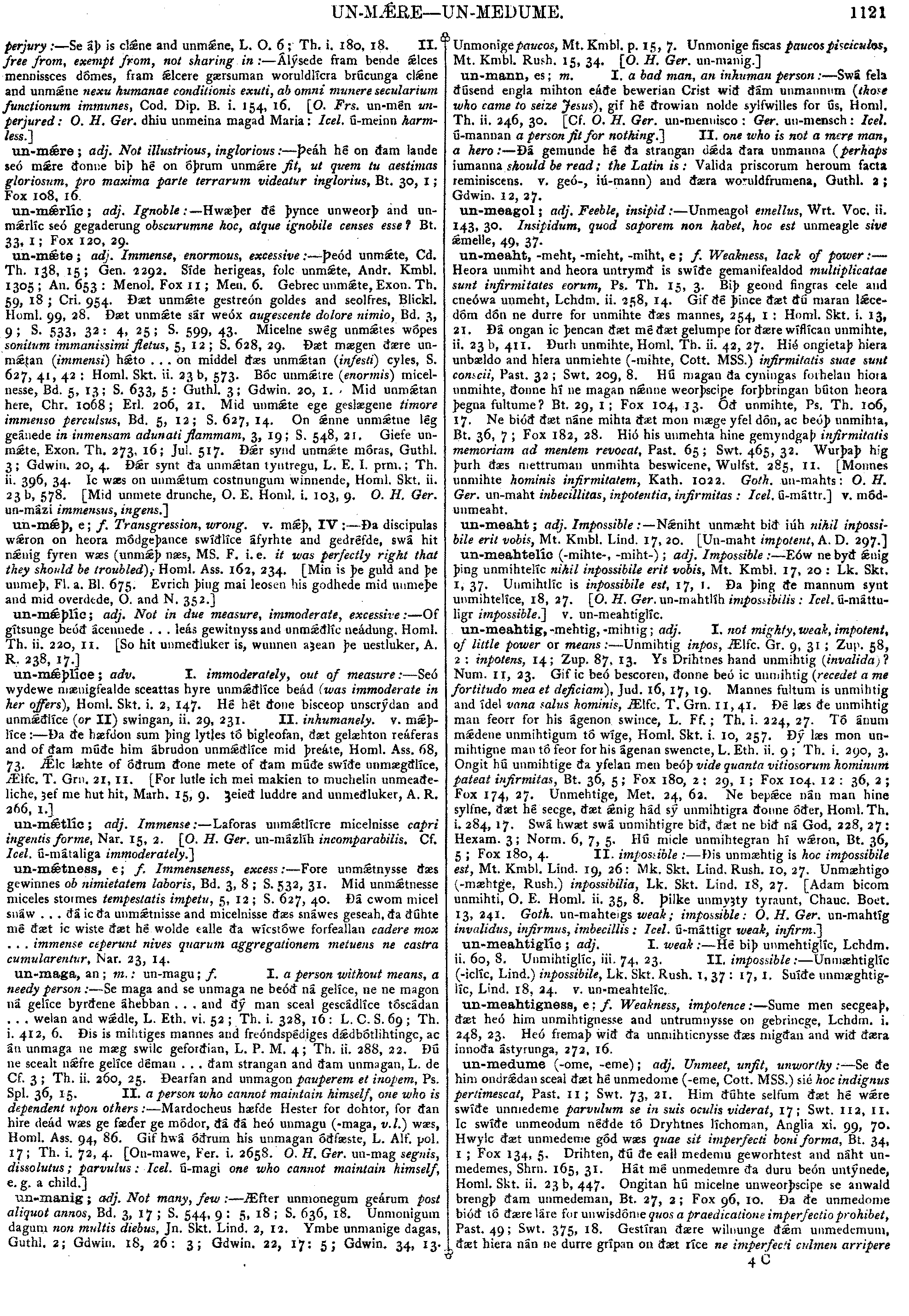
un-manig; adj. Not many, few :-- Æfter unmonegum geárum post aliquot annos, Bd. 3, 17; S. 544, 9: 5, 18; S. 636, 18. Unmonigum dagum non multis diebus, Jn. Skt. Lind. 2, 12. Ymbe unmanige dagas, Guthl. 2; Gdwin. 18, 26: 3; Gdwin. 22, 17: 5; Gdwin. 34, 13. Unmonige paucos, Mt. Kmbl. p. 15, 7. Unmonige fiscas paucos pisciculos, Mt. Kmbl. Rush. 15, 34. [O. H. Ger. un-manig.]
|
Source: Bosworth/Toller, page b1124, entry 7 View original page image as: [TIFF] [PNG] [View previous entry] [View next entry] |
[Comment on this entry] [View comments] |
The following entry has been hand-corrected once. |
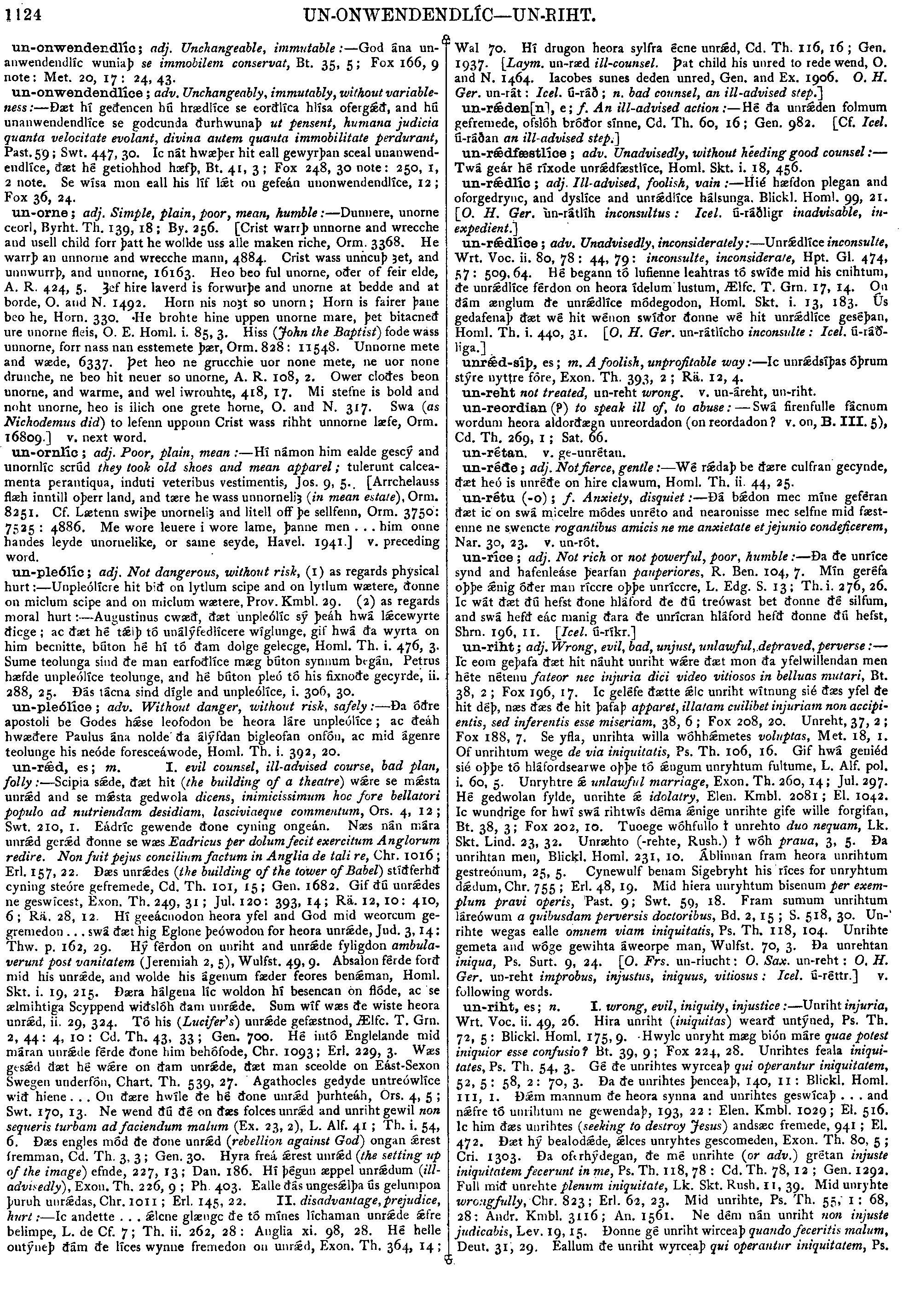
un-rd,
es;
m.
I.
evil
counsel,
ill-advised
course,
bad
plan,
folly
:--
Scipia
sde,
ðæt
hit
(the
building
of
a
theatre)
wre
se
msta
unrd
and
se
msta
gedwola
dicens,
inimicissimum
hoc
fore
bellatori
populo
ad
nutriendam
desidiam,
lasciviaeque
commentum,
Ors.
4,
12;
Swt.
210,
1.
Eádríc
gewende
ðone
cyning
ongeán.
Næs
nán
mára
unrd
gerd
ðonne
se
wæs
Eadricus
per
dolum
fecit
exercitum
Anglorum
redire.
Non
fuit
pejus
concilium
factum
in
Anglia
de
tali
re,
Chr.
l016;
Erl.
157,
22.
Ðæs
unrdes
(the
building
of
the
tower
of
Babel)
stíðferhð
cyning
steóre
gefremede,
Cd.
Th.
101,
15;
Gen.
1682.
Gif
ðú
unrdes
ne
geswícest,
Exon.
Th.
249,
31;
Jul.
120:
393,
14;
Rä.
12,
10:
410,
6;
Rä.
28,
12.
Hí
geeácnodon
heora
yfel
and
God
mid
weorcum
gegremedon
...
swá
ðæt
hig
Eglone
þeówodon
for
heora
unrde,
Jud.
3,
14:
Thw.
p.
162,
29.
Hý
férdon
on
unriht
and
unrde
fyligdon
ambulaverunt
post
vanitatem
(Jeremiah
2,
5),
Wulfst.
49,
9.
Absalon
férde
forð
mid
his
unrde,
and
wolde
his
ágenum
fæder
feores
benman,
Homl.
Skt.
i.
19,
215.
Ðæra
hálgena
líc
woldon
hí
besencan
on
flóde,
ac
se
ælmihtiga
Scyppend
wiðslóh
ðam
unrde.
Sum
wíf
wæs
ðe
wiste
heora
unrd,
ii.
29,
324.
Tó
his
(Lucifer's)
unrde
gefæstnod,
Ælfc.
T.
Grn.
2.
44:
4,
10:
Cd.
Th.
43,
33;
Gen.
700.
Hé
intó
Englelande
mid
máran
unrde
férde
ðone
him
behófode,
Chr.
1093;
Erl.
229,
3.
Wæs
gesd
ðæt
hé
wre
on
ðam
unrde,
ðæt
man
sceolde
on
Eást-Sexon
Swegen
underfón,
Chart.
Th.
539,
27.
Agathocles
gedyde
untreówlíce
wið
hiene...
On
ðære
hwíle
ðe
hé
ðone
unrd
þurhteáh,
Ors.
4,
5;
Swt.
170,
53.
Ne
wend
ðú
ðé
on
ðæs
folces
unrd
and
unriht
gewil
non
sequeris
turbam
ad
faciendum
malum
(Ex.
23,
2),
L.
Alf.
41;
Th.
i.
54,
6.
Ðæs
engles
mód
ðe
ðone
unrd
(rebellion
against
God)
ongan
rest
fremman,
Cd.
Th.
3,
3;
Gen.
30.
Hyra
freá
rest
unrd
(the
setting
up
of
the
image)
efnde,
227,
13;
Dan.
186.
Hí
þégun
æppel
unrdum
(ill-advisedly),
Exon.
Th.
226,
9;
Ph.
403.
Ealle
ðás
ungeslþa
ús
gelumpon
þuruh
unrdas,
Chr.
1011;
Erl.
145,
22.
II.
disadvantage,
prejudice,
hurt
:--
Ic
andette
...
lcne
glængc
ðe
tó
mínes
líchaman
unrde
fre
belimpe,
L.
de
Cf.
7;
Th.
ii.
262,
28:
Anglia
xi.
98,
28.
Hé
helle
ontýneþ
ðám
ðe
líces
wynne
fremedon
on
unrd,
Exon.
Th.
364,
14;
Wal
70.
Hí
drugon
heora
sylfra
écne
unrd,
Cd.
Th.
116,
16;
Gen.
1937.
[Laym.
un-ræd
ill-counsel.
Þat
child
his
unred
to
rede
wend,
O.
and
N.
1464.
Iacobes
sunes
deden
unred,
Gen.
and
Ex.
1906.
O.
H.
Ger.
un-rát:
Icel.
ú-ráð;
n.
bad
counsel,
an
ill-advised
step.]
|
Source: Bosworth/Toller, page b1128, entry 21 View original page image as: [TIFF] [PNG] [View previous entry] [View next entry] |
[Comment on this entry] [View comments] |
The following entry has been hand-corrected once. |
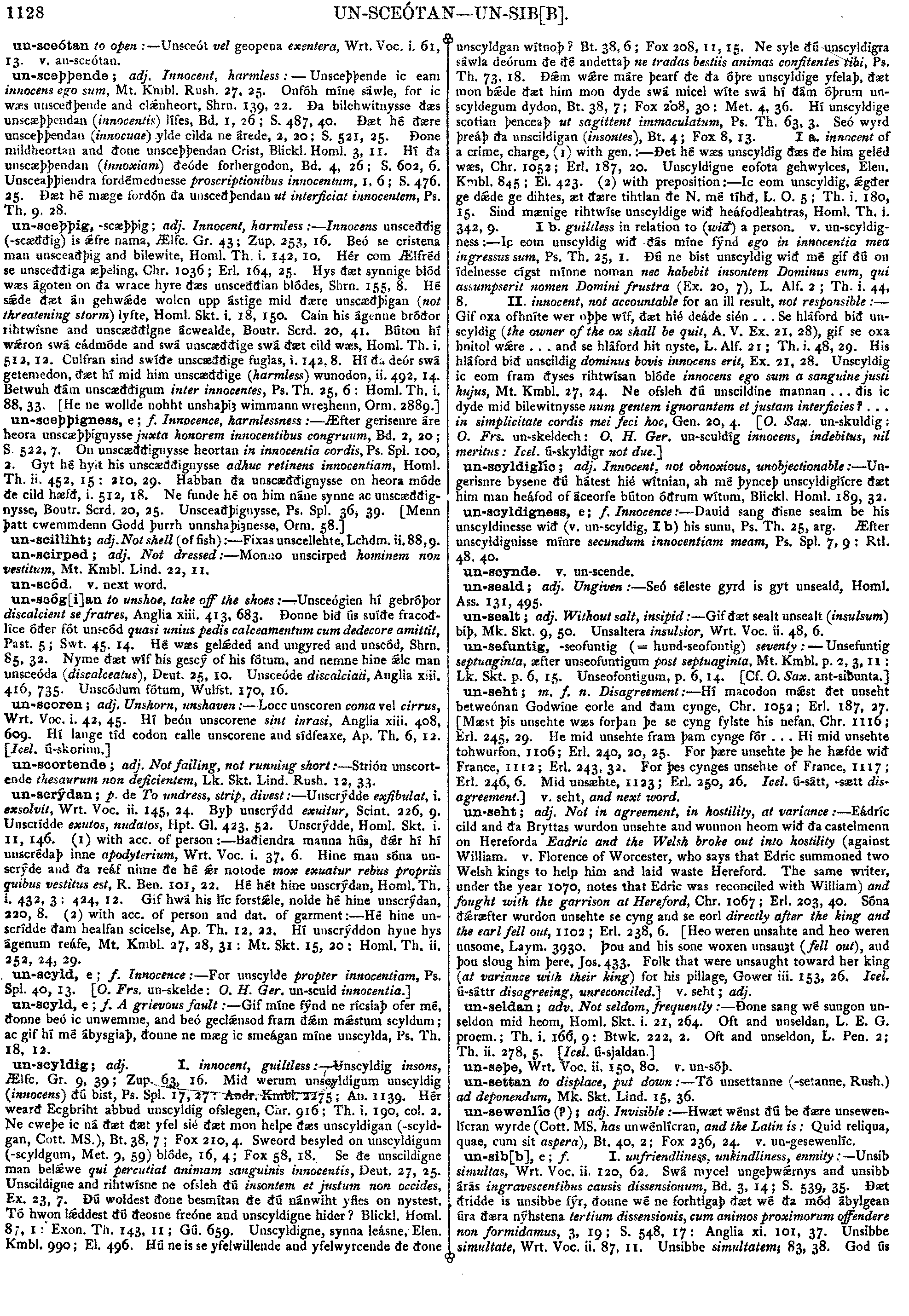
un-sefuntig,
-seofuntig
(
=
hund-seofontig)
seventy
:--
Unsefuntig
septuaginta,
æfter
unseofuntigum
post
septuaginta,
Mt.
Kmbl.
p.
2,
3,
11:
Lk.
Skt.
p.
6,
15.
Unseofontigum,
p.
6,
14.
[Cf.
O.
Sax.
ant-si unta.]
|
Source: Bosworth/Toller, page b1142, entry 8 View original page image as: [TIFF] [PNG] [View previous entry] [View next entry] |
[Comment on this entry] [View comments] |
The following entry has been hand-corrected once. |
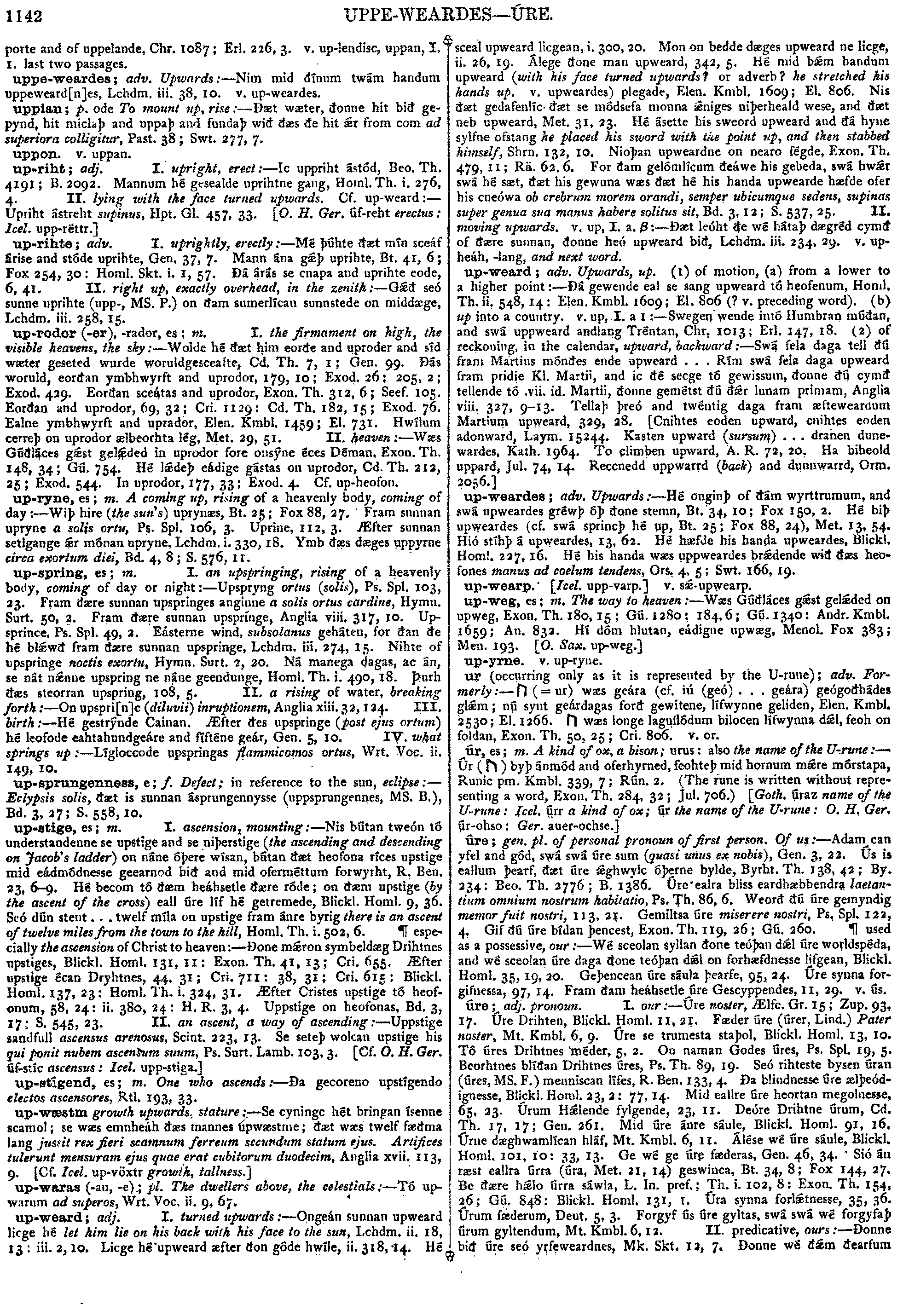
up-spring,
es;
m.
I.
an
upspringing,
rising
of
a
heavenly
body,
coming
of
day
or
night
:--
Upspryng
ortus
(solis),
Ps.
Spl.
103,
23.
Fram
ðære
sunnan
upspringes
anginne
a
solis
ortus
cardine,
Hymn.
Surt.
50,
2.
Fram
ðære
sunnan
upspringe,
Anglia
viii.
317,
10.
Up-sprince,
Ps.
Spl.
49,
2.
Eásterne
wind,
subsolanus
geháten,
for
ðan
ðe
hé
blwð
fram
ðære
sunnan
upspringe,
Lchdm.
iii.
274,
15.
Nihte
of
upspringe
noctis
exortu,
Hymn.
Surt.
2,
20.
Ná
manega
dagas,
ac
án,
se
nát
nnne
upspring
ne
náne
geendunge,
Homl.
Th.
i.
490,
18.
Þurh
ðæs
steorran
upspring,
108,
5.
II.
a
rising
of
water,
breaking
forth
:--
On
upspri[n]c
(diluvii)
inruptionem,
Anglia
xiii.
32,
124.
III.
birth
:--
Hé
gestrýnde
Cainan.
Æfter
ðes
upspringe
(post
ejus
ortum)
hé
leofode
eahtahundgeáre
and
fífténe
geár,
Gen.
5,
10.
IV.
what
springs
up
:--
Lígloccode
upspringas
flammicomos
ortus,
Wrt.
Voc.
ii.
149,
10.
|
Source: Bosworth/Toller, page b1143, entry 10 View original page image as: [TIFF] [PNG] [View previous entry] [View next entry] |
[Comment on this entry] [View comments] |
The following entry has been hand-corrected once. |
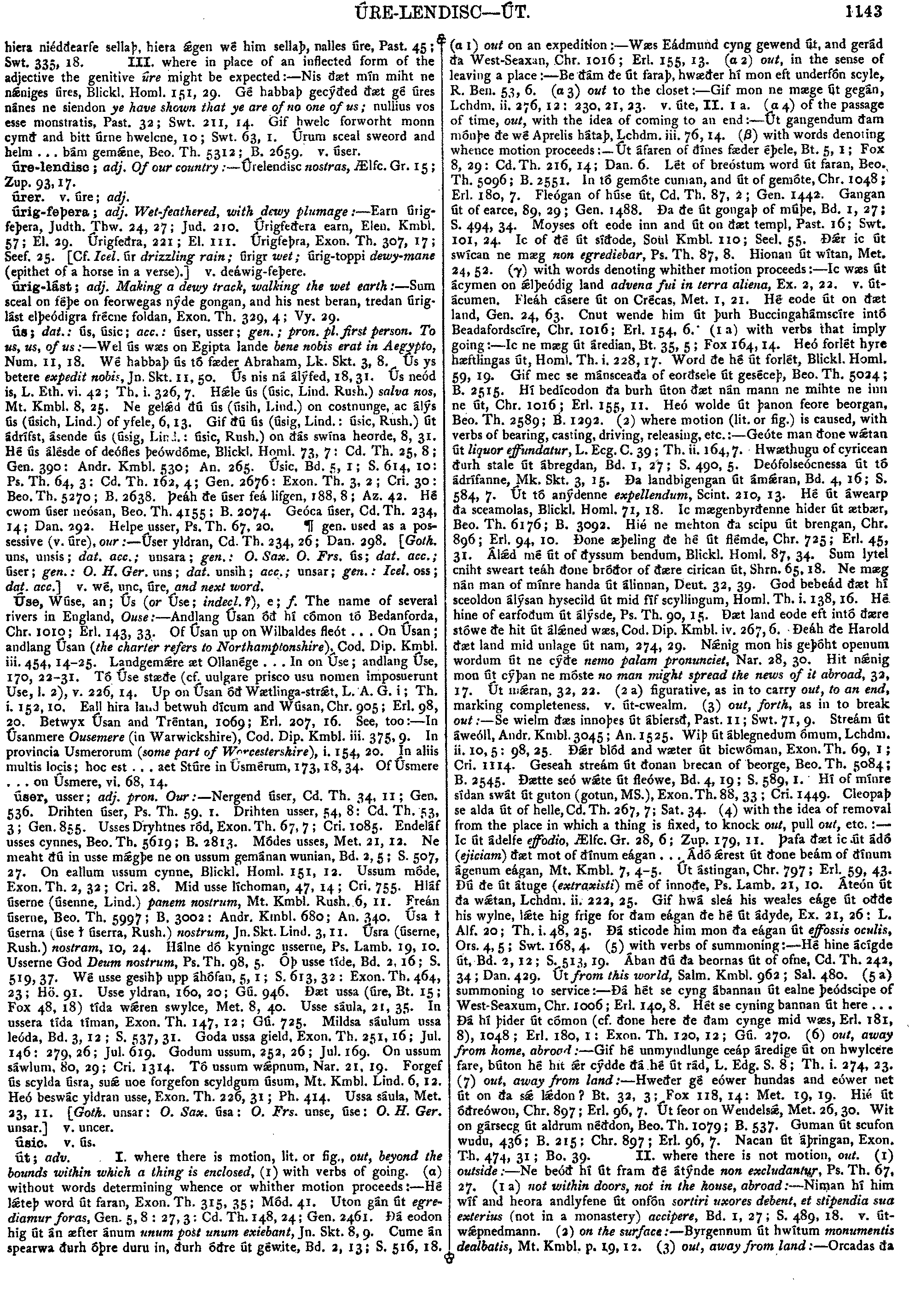
út;
adv.
I.
where
there
is
motion,
lit.
or
fig.,
out,
beyond
the
bounds
within
which
a
thing
is
enclosed,
(1)
with
verbs
of
going.
( )
without
words
determining
whence
or
whither
motion
proceeds
:--
Hé
lteþ
word
út
faran,
Exon.
Th.
315,
35;
Mód.
41.
Uton
gán
út
egrediamur
foras,
Gen.
5,
8:
27,
3:
Cd.
Th.
148,
24;
Gen.
2461.
Ðá
eodon
hig
út
án
æfter
ánum
unum
post
unum
exiebant,
Jn.
Skt.
8,
9.
Cume
án
spearwa
ðurh
óþre
duru
in,
ðurh
óðre
út
géwite,
Bd.
2,
13;
S.
516,
18.
(
1)
out
on
an
expedition
:--
Wæs
Eádmund
cyng
gewend
út,
and
gerád
ða
West-Seaxan,.Chr.
1016;
Erl.
155,
13.
(
2)
out,
in
the
sense
of
leaving
a
place
:--
Be
ðá
ðe
út
faraþ,
hwæðer
hí
mon
eft
underfón
scyle,
R.
Ben.
53,
6.
(
3)
out
to
the
closet
:--
Gif
mon
ne
mæge
út
gegán,
Lchdm.
ii.
276,
12:
230,
21,
23.
v.
úte,
II.
1
a.
(
4)
of
the
passage
of
time,
out,
with
the
idea
of
coming
to
an
end
:--
Út
gangendum
ðam
mónþe
ðe
wé
Aprelis
hátaþ,
Lchdm.
iii.
76,
14.
(
)
without
words
determining
whence
or
whither
motion
proceeds
:--
Hé
lteþ
word
út
faran,
Exon.
Th.
315,
35;
Mód.
41.
Uton
gán
út
egrediamur
foras,
Gen.
5,
8:
27,
3:
Cd.
Th.
148,
24;
Gen.
2461.
Ðá
eodon
hig
út
án
æfter
ánum
unum
post
unum
exiebant,
Jn.
Skt.
8,
9.
Cume
án
spearwa
ðurh
óþre
duru
in,
ðurh
óðre
út
géwite,
Bd.
2,
13;
S.
516,
18.
(
1)
out
on
an
expedition
:--
Wæs
Eádmund
cyng
gewend
út,
and
gerád
ða
West-Seaxan,.Chr.
1016;
Erl.
155,
13.
(
2)
out,
in
the
sense
of
leaving
a
place
:--
Be
ðá
ðe
út
faraþ,
hwæðer
hí
mon
eft
underfón
scyle,
R.
Ben.
53,
6.
(
3)
out
to
the
closet
:--
Gif
mon
ne
mæge
út
gegán,
Lchdm.
ii.
276,
12:
230,
21,
23.
v.
úte,
II.
1
a.
(
4)
of
the
passage
of
time,
out,
with
the
idea
of
coming
to
an
end
:--
Út
gangendum
ðam
mónþe
ðe
wé
Aprelis
hátaþ,
Lchdm.
iii.
76,
14.
( )
with
words
denoting
whence
motion
proceeds
:--
Út
áfaren
of
ðínes
fæder
éþele,
Bt.
5,
1;
Fox
8,
29:
Cd.
Th.
216,
14;
Dan.
6.
Lét
of
breóstum
word
út
faran,
Beo.
Th.
5096;
B.
2551.
In
tó
gemóte
cuman,
and
út
of
gemóte.
Chr.
1048;
Erl.
180,
7.
Fleógan
of
húse
út,
Cd.
Th.
87,
2;
Gen.
1442.
Gangan
út
of
earce,
89,
29;
Gen.
1488.
Ða
ðe
út
gongaþ
of
múþe,
Bd.
1,
27;
S.
494,
34.
Moyses
oft
eode
inn
and
út
on
ðæt
tempt,
Past.
16;
Swt.
101,
24.
Ic
of
ðé
út
síðode,
Soul
Kmbl.
110;
Seel.
55,
Ðr
ic
út
swícan
ne
mæg
non
egrediebar,
Ps.
Th.
87,
8.
Hionan
út
wítan,
Met.
24,
52.
(
)
with
words
denoting
whence
motion
proceeds
:--
Út
áfaren
of
ðínes
fæder
éþele,
Bt.
5,
1;
Fox
8,
29:
Cd.
Th.
216,
14;
Dan.
6.
Lét
of
breóstum
word
út
faran,
Beo.
Th.
5096;
B.
2551.
In
tó
gemóte
cuman,
and
út
of
gemóte.
Chr.
1048;
Erl.
180,
7.
Fleógan
of
húse
út,
Cd.
Th.
87,
2;
Gen.
1442.
Gangan
út
of
earce,
89,
29;
Gen.
1488.
Ða
ðe
út
gongaþ
of
múþe,
Bd.
1,
27;
S.
494,
34.
Moyses
oft
eode
inn
and
út
on
ðæt
tempt,
Past.
16;
Swt.
101,
24.
Ic
of
ðé
út
síðode,
Soul
Kmbl.
110;
Seel.
55,
Ðr
ic
út
swícan
ne
mæg
non
egrediebar,
Ps.
Th.
87,
8.
Hionan
út
wítan,
Met.
24,
52.
( )
with
words
denoting
whither
motion
proceeds
:--
Ic
wæs
út
ácymen
on
lþeódig
land
advena
fui
in
terra
aliena,
Ex.
2,
22.
v.
útácumen.
Fleáh
cásere
út
on
Crécas,
Met.
1,
21.
Hé
eode
út
on
ðæt
land,
Gen.
24,
63.
Cnut
wende
him
út
þurh
Buccingahámscíre
intó
Beadafordscíre,
Chr,
1016;
Erl.
154,
6.
(1
a)
with
verbs
that
imply
going
:--
Ic
ne
mæg
út
áredian,
Bt.
35,
5;
Fox
164,
14.
Heó
forlét
hyre
hæftlingas
út,
Homl.
Th.
i.
228,
17.
Word
ðe
hé
út
forlét,
Blickl.
Homl.
59,
19.
Gif
mec
se
mánsceaða
of
eorðsele
út
geséceþ,
Beo.
Th.
5024;
B.
2515.
Hí
bedícodon
ða
burh
úton
ðæt
nán
mann
ne
mihte
ne
inn
ne
út,
Chr.
1016;
Erl.
155,
11.
Heó
wolde
út
þanon
feore
beorgan,
Beo.
Th.
2589;
B.
1292.
(2)
where
motion
(lit.
or
fig.)
is
caused,
with
verbs
of
bearing,
casting,
driving,
releasing,
etc.
:--
Geóte
man
ðone
wtan
út
liquor
effundatur,
L.
Ecg.
C.
39;
Th.
ii.
164,
7.
Hwæthugu
of
cyricean
ðurh
stale
út
ábregdan,
Bd.
1,
27;
S.
490,
5.
Deófolseócnessa
út
tó
ádrífanne,
Mk.
Skt.
3,
15.
Ða
landbigengan
út
ámran,
Bd.
4,
16;
S.
584,
7.
Út
tó
anýdenne
expellendum,
Scint.
210,
13.
Hé
út
áwearp
ða
sceamolas,
Blickl.
Homl.
71,
18.
Ic
mægenbyrðenne
hider
út
ætbær,
Beo.
Th.
6176;
B.
3092.
Hié
ne
mehton
ða
scipu
út
brengan,
Chr.
896;
Erl.
94,
10.
Ðone
æþeling
ðe
hé
út
flémde,
Chr.
725;
Erl.
45,
31.
Áld
mé
út
of
ðyssum
bendum,
Blickl.
Homl.
87,
34.
Sum
lytel
cniht
sweart
teáh
ðone
bróðor
of
ðære
cirican
út,
Shrn.
65,
18.
Ne
mæg
nán
man
of
mínre
handa
út
álinnan,
Deut.
32,
39.
God
bebeád
ðæt
hí
sceoldon
álýsan
hysecild
út
mid
fíf
scyllingum,
Homl.
Th.
i.
138,
16.
Hé
hine
of
earfoðum
út
álýsde,
Ps.
Th.
90,
15.
Ðæt
land
eode
eft
intó
ðære
stówe
ðe
hit
út
álned
wæs,
Cod.
Dip.
Kmbl.
iv.
267,
6.
Ðeáh
ðe
Harold
ðæt
land
mid
unlage
út
nam,
274,
29.
Nnig
mon
his
geþóht
openum
wordum
út
ne
cýðe
nemo
palam
pronunciet,
Nar.
28,
30.
Hit
nnig
mon
út
cýþan
ne
móste
no
man
might
spread
the
news
of
it
abroad,
32,
17.
Út
mran,
32,
22.
(2
a)
figurative,
as
in
to
carry
out,
to
an
end,
marking
completeness.
v.
út-cwealm.
(3)
out,
forth,
as
in
to
break
out
:--
Se
wielm
ðæs
innoþes
út
ábiersð,
Past.
11;
Swt.
71,
9.
Streám
út
áweóll,
Andr.
Kmbl.
3045;
An.
1525.
Wiþ
út
áblegnedum
ómum,
Lchdm.
ii.
10,
5:
98,
25.
Ðr
blód
and
wæter
út
bicwóman,
Exon.
Th.
69,
1;
Cri.
1114.
Geseah
streám
út
ðonan
brecan
of
beorge,
Beo.
Th.
5084;
B.
2545.
Ðætte
seó
wte
út
fleówe,
Bd.
4,
19;
S.
589,
1.
Hí
of
mínre
sídan
swát
út
guton
(gotun,
MS.),
Exon.
Th.
88,
33;
Cri.
1449.
Cleopaþ
se
alda
út
of
belle,
Cd.
Th.
267,
7;
Sat.
34.
(4)
with
the
idea
of
removal
from
the
place
in
which
a
thing
is
fixed,
to
knock
out,
pull
out,
etc.
:--
Ic
út
ádelfe
effodio,
Ælfc.
Gr.
28,
6;
Zup.
199,
11.
Þafa
ðæt
ic
út
ádó
(ejiciam)
ðæt
mot
of
ðínum
eágan
...
Ádó
rest
út
ðone
beám
of
ðínum
ágenum
eágan,
Mt.
Kmbl.
7,
4-5.
Út
ástingan,
Chr.
797;
Erl.
59,
43.
Ðú
ðe
út
átuge
(extraxisti)
mé
of
innoðe,
Ps.
Lamb.
21,
10.
Áteón
út
ða
wtan,
Lchdm.
ii.
222,
25.
Gif
hwá
sleá
his
weales
eáge
út
oððe
his
wylne,
lte
hig
frige
for
ðám
eágan
ðe
hé
út
ádyde,
Ex.
21,
26:
L.
Alf.
20;
Th.
i.
48,
25.
Ðá
sticode
him
mon
ða
eágan
út
effossis
oculis,
Ors.
4,
5;
Swt.
168,
4.
(5)
with
verbs
of
summoning
:--
Hé
hine
ácígde
út,
Bd.
2,
12;
S.
513,
19.
Ában
ðú
ða
beornas
út
of
ofne,
Cd.
Th.
242,
34;
Dan.
429.
Út
from
this
world,
Salm.
Kmbl.
962;
Sal.
480.
(5
a)
summoning
to
service
:--
Ðá
hét
se
cyng
ábannan
út
ealne
þeódscipe
of
West-Seaxum.
Chr.
1006;
Erl.
140,
8.
Hét
se
cyning
bannan
út
here
...
Ðá
hí
þider
út
cómon
(cf.
ðone
here
ðe
ðam
cynge
mid
wæs,
Ed.
181,
8),
1048;
Erl.
180,
1:
Exon.
Th.
120,
12;
Gú.
270.
(6)
out,
away
from
home,
abroad
:--
Gif
hé
unmyndlunge
ceáp
áredige
út
on
hwylcere
fare,
búton
hé
hit
r
cýdde
ðá
hé
út
rád,
L.
Edg.
S.
8;
Th.
i.
274,
23.
(7)
out,
away
from
land
:--
Hweðer
gé
eówer
hundas
and
eówer
net
út
on
ða
s
ldon?
Bt.
32,
3;
Fox
118,
14:
Met.
19,
19.
Hié
út
óðreówon,
Chr.
897;
Erl.
96,
7.
Út
feor
on
Weudels,
Met.
26,
30.
Wit
)
with
words
denoting
whither
motion
proceeds
:--
Ic
wæs
út
ácymen
on
lþeódig
land
advena
fui
in
terra
aliena,
Ex.
2,
22.
v.
útácumen.
Fleáh
cásere
út
on
Crécas,
Met.
1,
21.
Hé
eode
út
on
ðæt
land,
Gen.
24,
63.
Cnut
wende
him
út
þurh
Buccingahámscíre
intó
Beadafordscíre,
Chr,
1016;
Erl.
154,
6.
(1
a)
with
verbs
that
imply
going
:--
Ic
ne
mæg
út
áredian,
Bt.
35,
5;
Fox
164,
14.
Heó
forlét
hyre
hæftlingas
út,
Homl.
Th.
i.
228,
17.
Word
ðe
hé
út
forlét,
Blickl.
Homl.
59,
19.
Gif
mec
se
mánsceaða
of
eorðsele
út
geséceþ,
Beo.
Th.
5024;
B.
2515.
Hí
bedícodon
ða
burh
úton
ðæt
nán
mann
ne
mihte
ne
inn
ne
út,
Chr.
1016;
Erl.
155,
11.
Heó
wolde
út
þanon
feore
beorgan,
Beo.
Th.
2589;
B.
1292.
(2)
where
motion
(lit.
or
fig.)
is
caused,
with
verbs
of
bearing,
casting,
driving,
releasing,
etc.
:--
Geóte
man
ðone
wtan
út
liquor
effundatur,
L.
Ecg.
C.
39;
Th.
ii.
164,
7.
Hwæthugu
of
cyricean
ðurh
stale
út
ábregdan,
Bd.
1,
27;
S.
490,
5.
Deófolseócnessa
út
tó
ádrífanne,
Mk.
Skt.
3,
15.
Ða
landbigengan
út
ámran,
Bd.
4,
16;
S.
584,
7.
Út
tó
anýdenne
expellendum,
Scint.
210,
13.
Hé
út
áwearp
ða
sceamolas,
Blickl.
Homl.
71,
18.
Ic
mægenbyrðenne
hider
út
ætbær,
Beo.
Th.
6176;
B.
3092.
Hié
ne
mehton
ða
scipu
út
brengan,
Chr.
896;
Erl.
94,
10.
Ðone
æþeling
ðe
hé
út
flémde,
Chr.
725;
Erl.
45,
31.
Áld
mé
út
of
ðyssum
bendum,
Blickl.
Homl.
87,
34.
Sum
lytel
cniht
sweart
teáh
ðone
bróðor
of
ðære
cirican
út,
Shrn.
65,
18.
Ne
mæg
nán
man
of
mínre
handa
út
álinnan,
Deut.
32,
39.
God
bebeád
ðæt
hí
sceoldon
álýsan
hysecild
út
mid
fíf
scyllingum,
Homl.
Th.
i.
138,
16.
Hé
hine
of
earfoðum
út
álýsde,
Ps.
Th.
90,
15.
Ðæt
land
eode
eft
intó
ðære
stówe
ðe
hit
út
álned
wæs,
Cod.
Dip.
Kmbl.
iv.
267,
6.
Ðeáh
ðe
Harold
ðæt
land
mid
unlage
út
nam,
274,
29.
Nnig
mon
his
geþóht
openum
wordum
út
ne
cýðe
nemo
palam
pronunciet,
Nar.
28,
30.
Hit
nnig
mon
út
cýþan
ne
móste
no
man
might
spread
the
news
of
it
abroad,
32,
17.
Út
mran,
32,
22.
(2
a)
figurative,
as
in
to
carry
out,
to
an
end,
marking
completeness.
v.
út-cwealm.
(3)
out,
forth,
as
in
to
break
out
:--
Se
wielm
ðæs
innoþes
út
ábiersð,
Past.
11;
Swt.
71,
9.
Streám
út
áweóll,
Andr.
Kmbl.
3045;
An.
1525.
Wiþ
út
áblegnedum
ómum,
Lchdm.
ii.
10,
5:
98,
25.
Ðr
blód
and
wæter
út
bicwóman,
Exon.
Th.
69,
1;
Cri.
1114.
Geseah
streám
út
ðonan
brecan
of
beorge,
Beo.
Th.
5084;
B.
2545.
Ðætte
seó
wte
út
fleówe,
Bd.
4,
19;
S.
589,
1.
Hí
of
mínre
sídan
swát
út
guton
(gotun,
MS.),
Exon.
Th.
88,
33;
Cri.
1449.
Cleopaþ
se
alda
út
of
belle,
Cd.
Th.
267,
7;
Sat.
34.
(4)
with
the
idea
of
removal
from
the
place
in
which
a
thing
is
fixed,
to
knock
out,
pull
out,
etc.
:--
Ic
út
ádelfe
effodio,
Ælfc.
Gr.
28,
6;
Zup.
199,
11.
Þafa
ðæt
ic
út
ádó
(ejiciam)
ðæt
mot
of
ðínum
eágan
...
Ádó
rest
út
ðone
beám
of
ðínum
ágenum
eágan,
Mt.
Kmbl.
7,
4-5.
Út
ástingan,
Chr.
797;
Erl.
59,
43.
Ðú
ðe
út
átuge
(extraxisti)
mé
of
innoðe,
Ps.
Lamb.
21,
10.
Áteón
út
ða
wtan,
Lchdm.
ii.
222,
25.
Gif
hwá
sleá
his
weales
eáge
út
oððe
his
wylne,
lte
hig
frige
for
ðám
eágan
ðe
hé
út
ádyde,
Ex.
21,
26:
L.
Alf.
20;
Th.
i.
48,
25.
Ðá
sticode
him
mon
ða
eágan
út
effossis
oculis,
Ors.
4,
5;
Swt.
168,
4.
(5)
with
verbs
of
summoning
:--
Hé
hine
ácígde
út,
Bd.
2,
12;
S.
513,
19.
Ában
ðú
ða
beornas
út
of
ofne,
Cd.
Th.
242,
34;
Dan.
429.
Út
from
this
world,
Salm.
Kmbl.
962;
Sal.
480.
(5
a)
summoning
to
service
:--
Ðá
hét
se
cyng
ábannan
út
ealne
þeódscipe
of
West-Seaxum.
Chr.
1006;
Erl.
140,
8.
Hét
se
cyning
bannan
út
here
...
Ðá
hí
þider
út
cómon
(cf.
ðone
here
ðe
ðam
cynge
mid
wæs,
Ed.
181,
8),
1048;
Erl.
180,
1:
Exon.
Th.
120,
12;
Gú.
270.
(6)
out,
away
from
home,
abroad
:--
Gif
hé
unmyndlunge
ceáp
áredige
út
on
hwylcere
fare,
búton
hé
hit
r
cýdde
ðá
hé
út
rád,
L.
Edg.
S.
8;
Th.
i.
274,
23.
(7)
out,
away
from
land
:--
Hweðer
gé
eówer
hundas
and
eówer
net
út
on
ða
s
ldon?
Bt.
32,
3;
Fox
118,
14:
Met.
19,
19.
Hié
út
óðreówon,
Chr.
897;
Erl.
96,
7.
Út
feor
on
Weudels,
Met.
26,
30.
Wit
|
Source: Bosworth/Toller, page b1193, entry 10 View original page image as: [TIFF] [PNG] [View previous entry] [View next entry] |
[Comment on this entry] [View comments] |
The following entry has been hand-corrected once. |
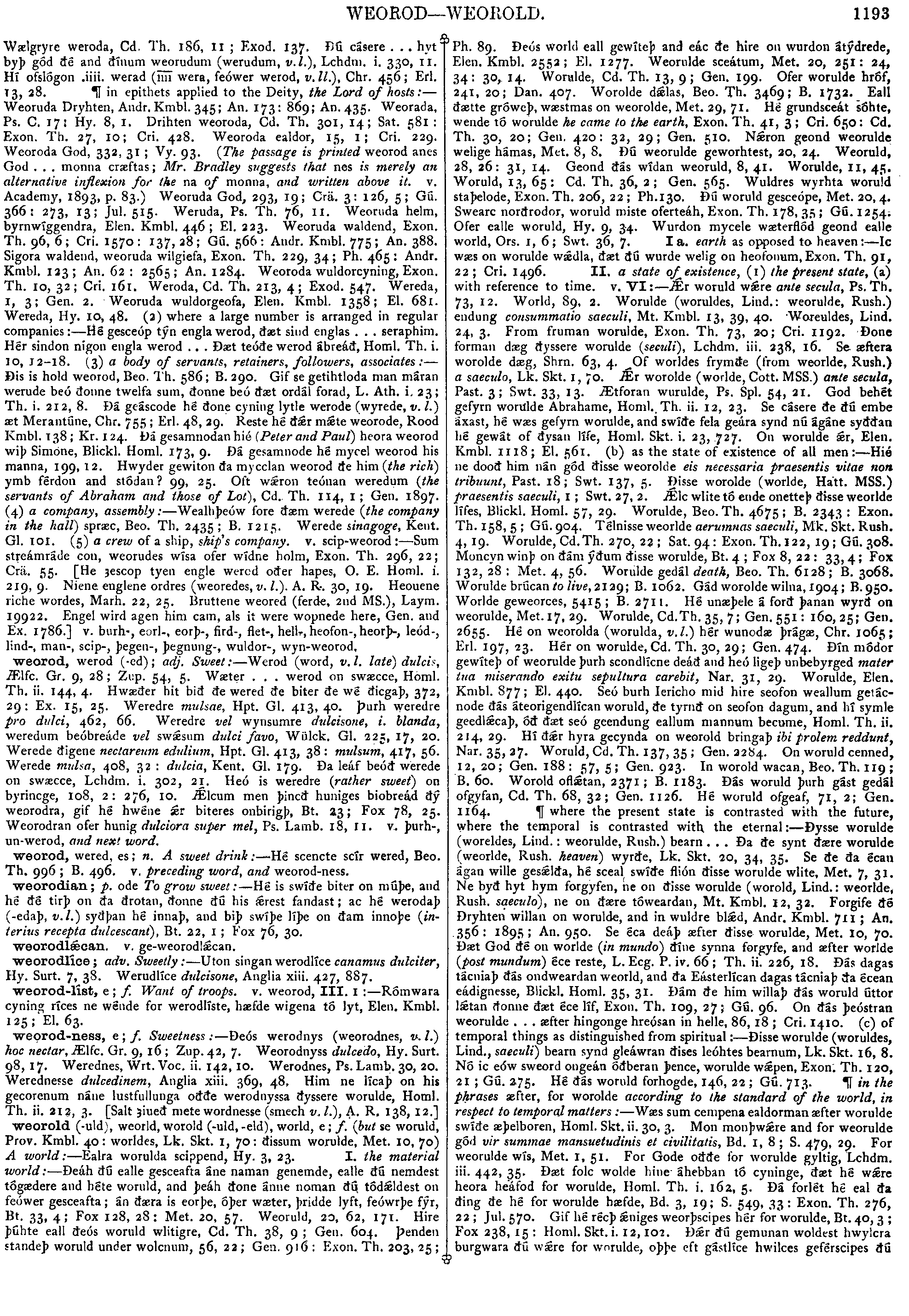
Ph.
89.
Ðeós
world
eall
gewíteþ
and
eác
ðe
hire
on
wurdon
átýdrede,
Elen.
Kmbl.
2552;
El.
1277.
Weorulde
sceátum,
Met.
20,
251:
24,
34:
30,
14.
Worulde,
Cd.
Th.
13,
9;
Gen.
199.
Ofer
worulde
hróf,
241,
20;
Dan.
407.
Worolde
dlas,
Beo.
Th.
3469;
B.
1732.
Eall
ðætte
gróweþ,
wæstmas
on
weorolde,
Met.
29,
71.
Hé
grundsceát
sóhte,
wende
tó
worulde
he
came
to
the
earth,
Exon.
Th.
41,
3;
Cri.
650:
Cd.
Th.
30,
20;
Gen.
420:
32,
29;
Gen.
510.
Nron
geond
weorulde
welige
hámas,
Met.
8,
8.
Ðú
weorulde
geworhtest,
20,
24.
Weoruld,
28,
26:
31,
14.
Geond
ðás
wídan
weoruld,
8,
41.
Worulde,
11,
45.
Woruld,
13,
65:
Cd.
Th.
36,
2;
Gen.
565.
Wuldres
wyrhta
woruld
staþelode,
Exon.
Th.
206,
22
;
Ph.
130.
Ðú
woruld
gesceópe,
Met.
20,
4.
Swearc
norðrodor,
woruld
miste
oferteáh,
Exon.
Th.
178,
35
;
Gu.
1254.
Ofer
ealle
woruld,
Hy.
9,
34.
Wurdon
mycele
wæterflód
geond
ealle
world.
Ors.
l,
6;
Swt.
36,
7.
Ia.
earth
as
opposed
to
heaven
:--
Ic
wæs
on
worulde
wdla,
ðæt
ðú
wurde
welig
on
heofonum,
Exon.
Th.
91,
22;
Cri.
1496.
II.
a
state
of
existence,
(1)
the
present
state,
(a)
with
reference
to
time.
v.
VI
:--
Æ-acute;r
woruld
wre
ante
secula.
Ps.
Th.
73,
12.
World,
89,
2.
Worulde
(woruldes,
Lind.
:
weorulde,
Rush.)
endung
consummatio
saeculi.
Mt.
Kmbl.
13,
39,
40.
Woreuldes,
Lind.
24,
3.
From
fruman
worulde,
Exon.
Th.
73,
20;
Cri.
1192.
Ðone
forman
dæg
ðyssere
worulde
(seculi),
Lchdm.
iii.
238,
16.
Se
æftera
worolde
dæg,
Shrn.
63,
4.
Of
worldes
frymðe
(from
weorlde.
Rush.)
a
saeculo,
Lk.
Skt.
l,
70.
Æ-acute;r
worolde
(worlde,
Cott.
MSS.)
aste
secula,
Past.
3;
Swt.
33,
13.
Ætforan
wurulde,
Ps.
Spl.
54,
21.
God
behét
gefyrn
worulde
Abrahame,
Homl.
Th.
ii.
12,
23.
Se
cásere
ðe
ðú
embe
áxast,
hé
wæs
gefyrn
worulde,
and
swíðe
fela
geára
synd
nú
ágáne
syððan
hé
gewát
of
ðysan
life,
Homl.
Skt.
i.
23,
727.
On
worulde
r,
Elen.
Kmbl.
1118;
El.
561.
(b)
as
the
seate
of
existence
of
all
men
:--
Hié
ne
dooð
him
nán
gód
ðisse
weorolde
eis
necessaria
praesentis
vitae
non
tribuunt,
Past.
18;
Swt.
137,
5.
Ðisse
worolde
(worlde,
Hatt.
MSS.)
praesentis
saeculi,
1;
Swt.
27,
2.
Æ-acute;lc
wlite
tó
ende
onetteþ
ðisse
weorlde
lífes,
Blickl.
Homl.
57,
29.
Worulde,
Beo.
Th.
4675;
B.
2343
:
Exon.
Th.
158,
5
;
Gú.
904.
Télnisse
weorlde
aerumnas
saeculi,
Mk.
Skt.
Rush.
4,
19.
Worulde,
Cd.
Th.
270,
22
;
Sat.
94:
Exon.
Th.
122,
19;
Gú.
308.
Moncyn
winþ
on
ðám
ýðum
ðisse
worulde,
Bt.
4
;
Fox
8,
22
:
33,
4;
Fox
132,
28
:
Met.
4,
56.
Worulde
gedál
death,
Beo.
Th.
6128;
B.
3068.
Worulde
brúcan
to
live,
2129;
B.
1062.
Gád
worolde
wilna,
1904;
B.
950.
Worlde
geweorces,
5415
;
B.
2711.
Hé
unæþele
á
forð
þanan
wyrð
on
weorulde,
Met.
17,
29.
Worulde,
Cd.
Th.
35,
7;
Gen.
551:
160,
25;
Gen.
2655.
Hé
on
weorolda
(worulda,
v.l.)
hér
wunodæ
þrágæ,
Chr.
1065;
Erl.
197,
23.
Hér
on
worulde,
Cd.
Th.
30,
29;
Gen.
474.
Ðín
módor
gewíteþ
of
weorulde
þurh
scondlícne
deáð
and
heó
ligeþ
unbebyrged
mater
ena
miserando
exitu
sepultura
carebit,
Nar.
31,
29.
Worulde,
Elen.
Kmbl.
877;
El.
440.
Seó
burh
Iericho
mid
hire
seofon
weallum
getác node
ðás
áteorigendlícan
woruld,
ðe
tyrnð
on
seofon
dagum,
and
hí
symle
geedlcaþ,
óð
ðæt
seó
geendung
eallum
mannum
becume,
Homl.
Th.
ii.
214,
29.
Hí
ðr
hyra
gecynda
on
weorold
bringaþ
ibi
prolem
reddunt,
Nar.
35,
27.
Woruld,
Cd.
Th.
137,
35;
Gen.
2284.
On
woruld
cenned,
12,
20;
Gen.
188:
57,
5;
Gen.
923.
In
worold
wacan,
Beo.
Th.
119
;
B.
60.
Worold
ofltan,
2371;
B.
1183.
Ðás
woruld
þurh
gást
gedál
ofgyfan,
Cd.
Th.
68,
32;
Gen.
1126.
Hé
woruld
ofgeaf,
71,
2;
Gen.
1164.

where
the
present
state
is
contrasted
with
the
future,
where
the
temporal
is
contrasted
with
the
eternal
:--
Ðysse
worulde
(woreldes,
Lind.:
weorulde,
Rush.)
bearn
.
.
.
Ða
ðe
synt
ðære
worulde
(weorlde,
Rush.
heaven)
wyrðe,
Lk.
Skt.
20,
34,
35.
Se
ðe
ða
écan
ágan
wille
geslða,
hé
sceal
swíðe
flión
ðisse
worulde
wlite.
Met.
7,
31.
Ne
byð
hyt
hym
forgyfen,
ne
on
ðisse
worulde
(worold,
Lind.:
weorlde,
Rush.
saeculo),
ne
on
ðære
tóweardan,
Mt.
Kmbl.
12,
32.
Forgife
ðé
Ðryhten
willan
on
worulde,
and
in
wuldre
bld,
Andr.
Kmbl.
711;
An.
356:
1895
;
An.
950.
Se
éca
deáþ
æfter
ðisse
worulde,
Met.
10,
70.
Ðæt
God
ðé
on
worlde
(in
mundo)
ðíne
synna
forgyfe,
and
æfter
worlde
(post
mundum)
éce
reste,
L.
Ecg.
P.
iv.
66
;
Th.
ii.
226,
18.
Ðás
dagas
tácniaþ
ðás
ondweardan
weorld,
and
ða
Eásterlícan
dagas
tácniaþ
ða
écean
eádignesse,
Blickl.
Homl.
35,
31.
Ðám
ðe
him
willaþ
ðás
woruld
úttor
ltan
ðonne
ðæt
éce
líf,
Exon.
Th.
109,
27;
Gú.
96.
On
ðás
þeóstran
weorulde
.
.
.
æfter
hingonge
hreósan
in
helle,
86,
18
;
Cri.
1410.
(c)
of
temporal
things
as
distinguished
from
spiritual
:--
Ðisse
worulde
(woruldes,
Lind.,
saeculi)
bearn
synd
gleáwran
ðises
leóhtes
bearnum,
Lk.
Skt.
16,
8.
Nó
ic
eów
sweord
ongeán
óðberan
þence,
worulde
wpen.
Exon.
Th.
120,
21
;
Gú.
275.
Hé
ðás
woruld
forhogde,
146,
22;
Gú.
713.

in
the
phrases
æfter,
for
worolde
according
to
the
standard
of
the
world,
in
respect
to
temporal
matters
:--
Wæs
sum
cempena
ealdorman
æfter
worulde
swíde
æþelboren.
Homl.
Skt.
ii.
30,
3.
Mon
monþwre
and
for
weorulde
gód
vir
summae
mansuetudinis
et
civilitatis,
Bd.
1,
8;
S.
479,
29.
For
weorulde
wís,
Met.
1,
51.
For
Gode
oððe
for
worulde
gyltig,
Lchdm.
iii.
442,
35.
Ðæt
folc
wolde
hine
áhebban
tó
cyninge,
ðæt
hé
wre
heora
heáfod
for
worulde,
Homl.
Th.
i.
162,
5.
Ðá
forlét
hé
eal
ða
ðing
ðe
hé
for
worulde
hæfde.
Bd.
3,
19;
S.
549,
33:
Exon.
Th.
276,
22
;
Jul.
570.
Gif
hé
récþ
niges
weorþscipes
hér
for
worulde.
Bt.
40,
3
;
Fox
238,
15
:
Homl.
Skt.
i.
12,
102.
Ðr
ðú
gemunan
woldest
hwylcra
burgwara
ðú
wre
for
worulde,
oþþe
eft
gástlíce
hwilces
geférscipes
ðú
node
ðás
áteorigendlícan
woruld,
ðe
tyrnð
on
seofon
dagum,
and
hí
symle
geedlcaþ,
óð
ðæt
seó
geendung
eallum
mannum
becume,
Homl.
Th.
ii.
214,
29.
Hí
ðr
hyra
gecynda
on
weorold
bringaþ
ibi
prolem
reddunt,
Nar.
35,
27.
Woruld,
Cd.
Th.
137,
35;
Gen.
2284.
On
woruld
cenned,
12,
20;
Gen.
188:
57,
5;
Gen.
923.
In
worold
wacan,
Beo.
Th.
119
;
B.
60.
Worold
ofltan,
2371;
B.
1183.
Ðás
woruld
þurh
gást
gedál
ofgyfan,
Cd.
Th.
68,
32;
Gen.
1126.
Hé
woruld
ofgeaf,
71,
2;
Gen.
1164.

where
the
present
state
is
contrasted
with
the
future,
where
the
temporal
is
contrasted
with
the
eternal
:--
Ðysse
worulde
(woreldes,
Lind.:
weorulde,
Rush.)
bearn
.
.
.
Ða
ðe
synt
ðære
worulde
(weorlde,
Rush.
heaven)
wyrðe,
Lk.
Skt.
20,
34,
35.
Se
ðe
ða
écan
ágan
wille
geslða,
hé
sceal
swíðe
flión
ðisse
worulde
wlite.
Met.
7,
31.
Ne
byð
hyt
hym
forgyfen,
ne
on
ðisse
worulde
(worold,
Lind.:
weorlde,
Rush.
saeculo),
ne
on
ðære
tóweardan,
Mt.
Kmbl.
12,
32.
Forgife
ðé
Ðryhten
willan
on
worulde,
and
in
wuldre
bld,
Andr.
Kmbl.
711;
An.
356:
1895
;
An.
950.
Se
éca
deáþ
æfter
ðisse
worulde,
Met.
10,
70.
Ðæt
God
ðé
on
worlde
(in
mundo)
ðíne
synna
forgyfe,
and
æfter
worlde
(post
mundum)
éce
reste,
L.
Ecg.
P.
iv.
66
;
Th.
ii.
226,
18.
Ðás
dagas
tácniaþ
ðás
ondweardan
weorld,
and
ða
Eásterlícan
dagas
tácniaþ
ða
écean
eádignesse,
Blickl.
Homl.
35,
31.
Ðám
ðe
him
willaþ
ðás
woruld
úttor
ltan
ðonne
ðæt
éce
líf,
Exon.
Th.
109,
27;
Gú.
96.
On
ðás
þeóstran
weorulde
.
.
.
æfter
hingonge
hreósan
in
helle,
86,
18
;
Cri.
1410.
(c)
of
temporal
things
as
distinguished
from
spiritual
:--
Ðisse
worulde
(woruldes,
Lind.,
saeculi)
bearn
synd
gleáwran
ðises
leóhtes
bearnum,
Lk.
Skt.
16,
8.
Nó
ic
eów
sweord
ongeán
óðberan
þence,
worulde
wpen.
Exon.
Th.
120,
21
;
Gú.
275.
Hé
ðás
woruld
forhogde,
146,
22;
Gú.
713.

in
the
phrases
æfter,
for
worolde
according
to
the
standard
of
the
world,
in
respect
to
temporal
matters
:--
Wæs
sum
cempena
ealdorman
æfter
worulde
swíde
æþelboren.
Homl.
Skt.
ii.
30,
3.
Mon
monþwre
and
for
weorulde
gód
vir
summae
mansuetudinis
et
civilitatis,
Bd.
1,
8;
S.
479,
29.
For
weorulde
wís,
Met.
1,
51.
For
Gode
oððe
for
worulde
gyltig,
Lchdm.
iii.
442,
35.
Ðæt
folc
wolde
hine
áhebban
tó
cyninge,
ðæt
hé
wre
heora
heáfod
for
worulde,
Homl.
Th.
i.
162,
5.
Ðá
forlét
hé
eal
ða
ðing
ðe
hé
for
worulde
hæfde.
Bd.
3,
19;
S.
549,
33:
Exon.
Th.
276,
22
;
Jul.
570.
Gif
hé
récþ
niges
weorþscipes
hér
for
worulde.
Bt.
40,
3
;
Fox
238,
15
:
Homl.
Skt.
i.
12,
102.
Ðr
ðú
gemunan
woldest
hwylcra
burgwara
ðú
wre
for
worulde,
oþþe
eft
gástlíce
hwilces
geférscipes
ðú
| Result Page: |  |
Previous | 2 3 4 5 6 7 8 9 10 11 12 13 14 15 16 17 18 19 20 | Next |  |
Germanic Lexicon Project (main page)
This search system was written by
Sean Crist
Please consider
volunteering
to correct the data in these online dictionaries.
No rights reserved. Feel free to use these data in any way you please.