|
|

|
Source: Cleasby/Vigfusson, page b0024, entry 56 View original page image as: [TIFF] [PNG] [View previous entry] [View next entry] |
[Comment on this entry] [View comments] |
The following entry has been hand-corrected once. |
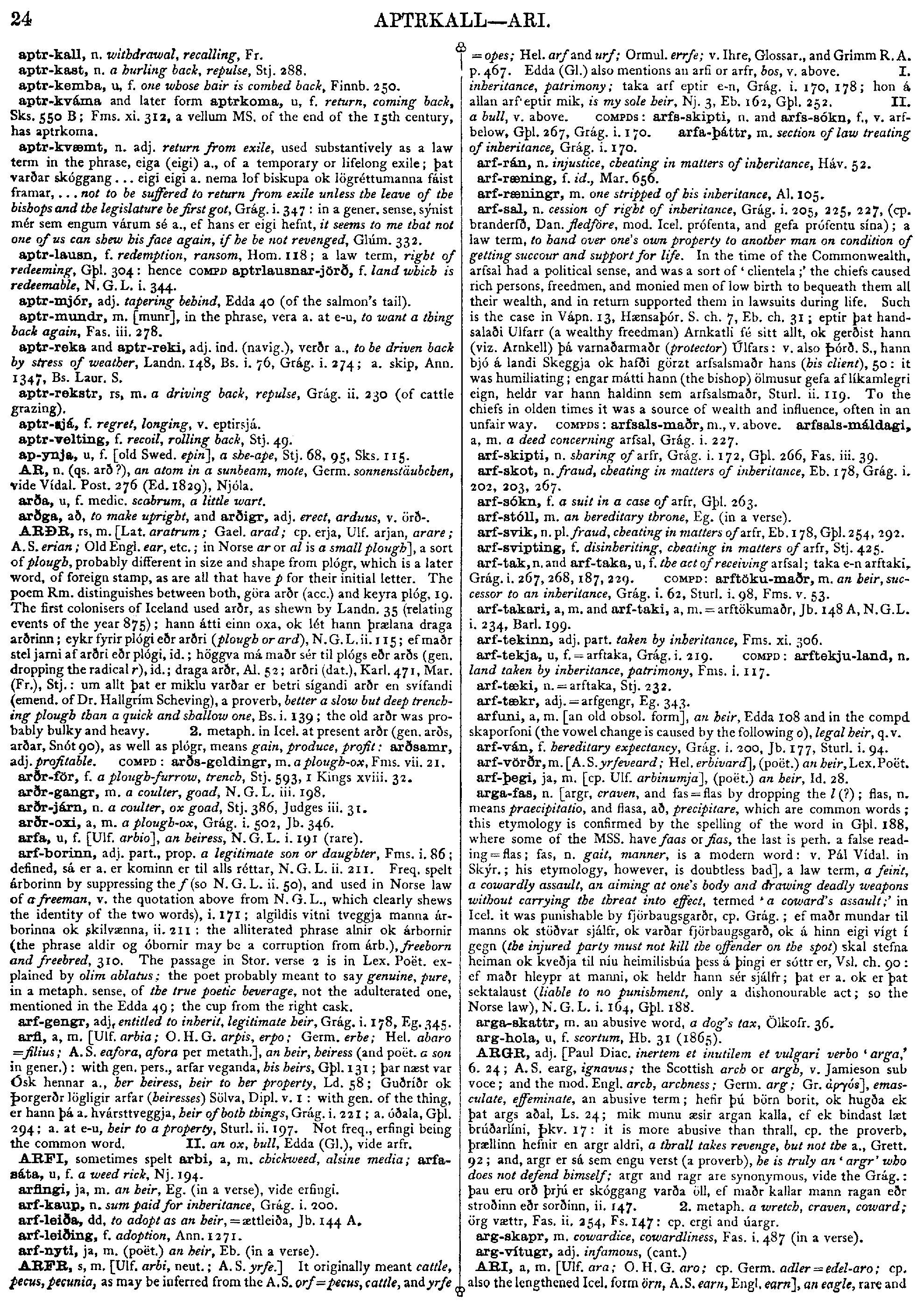
ARGR, adj. [Paul Diac. inertem et inutilem et vulgari verbo 'arga,' 6. 24; A. S. earg, ignavus; the Scottish arch or argh, v. Jamieson sub voce; and the mod. Engl. arch, archness; Germ. arg; Gr. GREEK], emasculate, effeminate, an abusive term; hefir þú börn borit, ok hugða ek þat args aðal, Ls. 24; mik munu æsir argan kalla, ef ek bindast læt brúðarlíni, Þkv. 17: it is more abusive than thrall, cp. the proverb, þrællinn hefnir en argr aldri, a thrall takes revenge, but not the a., Grett. 92; and, argr er sá sem engu verst (a proverb), he is truly an 'argr' who does not defend himself; argr and ragr are synonymous, vide the Grág.: þau eru orð þrjrú er skóggang varða öll, ef maðr kallar mann ragan eðr stroðinn eðr sorðinn, ii. 147. 2. metaph. a wretch, craven, coward; örg vættr, Fas. ii. 254, Fs. 147: cp. ergi and úargr.
|
Source: Cleasby/Vigfusson, page b0027, entry 2 View original page image as: [TIFF] [PNG] [View previous entry] [View next entry] |
[Comment on this entry] [View comments] |
The following entry has been hand-corrected once. |
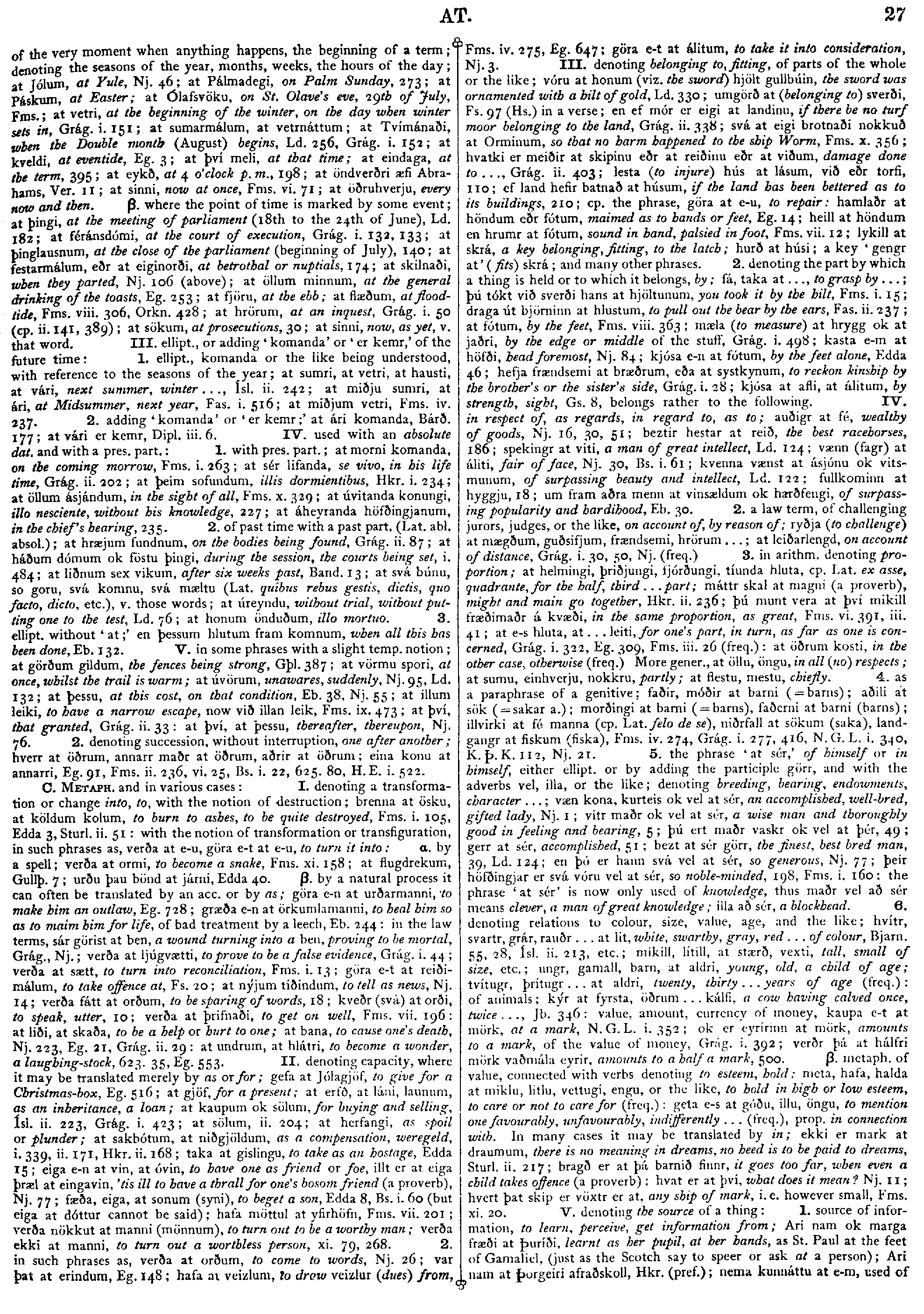
C.
METAPH.
and
in
various
cases:
I.
denoting
a
transforma-
tion
or
change
into,
to,
with
the
notion
of
destruction;
brenna
at
ösku,
at
köldum
kolum,
to
burn
to
ashes,
to
be
quite
destroyed,
Fms.
i.
105,
Edda
3,
Sturl.
ii.
51:
with
the
notion
of
transformation
or
transfiguration,
in
such
phrases
as,
verða
at
e-u,
göra
e-t
at
e-u,
to
turn
it
into:
a.
by
a
spell;
verða
at
ormi,
to
become
a
snake,
Fms.
xi.
158;
at
flugdrekum,
Gullþ.
7;
urðu
þau
bönd
at
járni,
Edda
40.
P.
by
a
natural
process
it
can
often
be
translated
by
an
acc.
or
by
as;
göra
e-n
at
urðarmanni,
'
t
o
make
him
an
outlaw,
Eg.
728;
græða
e-n
at
orkumlamanni,
to
heal
him
so
as
to
maim
him
for
life,
of
bad
treatment
by
a
leech,
Eb.
244:
in
the
law
terms,
sár
görist
at
ben,
a
wound
turning
into
a
ben,
proving
to
be
mortal,
Grág.,
Nj.;
verða
at
ljúgvætti,
to
prove
to
be
a
false
evidence,
Grág.
i.
44;
verða
at
sætt,
to
turn
into
reconciliation,
Fms.
i.
13;
göra
e-t
at
reiði
málum,
to
take
offence
at,
Fs.
20;
at
nýjum
tíðindum,
to
tell
as
news,
Nj.
14;
verða
fátt
at
orðum,
to
be
sparing
of
words,
18;
kveðr
(svá)
at
orði,
to
speak,
utter,
10;
verða
at
þrifnaði,
to
geton
well,
Fms.
vii.
196:
at
liði,
at
skaða,
to
be
a
help
or
hurt
to
one;
at
bana,
to
cause
one's
death,
Nj.
223,
Eg.
21,
Grág.
ii.
29:
at
undrum,
at
hlátri,
to
become
a
wonder,
a
laughing-stock,
623.
35,
Eg.
553.
II.
denoting
capacity,
where
it
may
be
translated
merely
by
as
or
for;
gefa
at
Jólagjöf,
to
give
for
a
Christmas-box,
Eg.
516;
at
gjöf,
for
a
present;
at
erfð,
at
láni,
launum,
as
an
inheritance,
a
loan;
at
kaupum
ok
sökum,
for
buying
and
selling,
Ísl.
ii.
223,
Grág.
i.
423;
at
solum,
ii.
204;
at
herfangi,
as
spoil
or
plunder;
at
sakbótum,
at
niðgjöldum,
as
a
compensation,
weregeld,
i.
339,
ii.
171,
Hkr.
ii.
168;
taka
at
gíslingu,
to
take
as
an
hostage,
Edda
15;
eiga
e-n
at
vin,
at
óvin,
to
have
one
as
friend
or
foe,
illt
er
at
eiga
þræl
at
eingavin,
'tis
ill
to
have
a
thrall
for
one's
bosom
friend
(a
proverb),
Nj.
77;
fæða,
eiga,
at
sonum
(syni),
to
beget
a
son,
Edda
8,
Bs.
i.
60
(but
eiga
at
dóttur
cannot
be
said);
hafa
möttul
at
yfirhöfn,
Fms.
vii.
201;
verða
nökkut
at
manni
(mönnum),
to
turn
out
to
be
a
worthy
man;
verða
ekki
at
manni,
to
turn
out
a
worthless
person,
xi.
79,
268.
2.
in
such
phrases
as,
verða
at
orðum,
to
come
towards,
Nj.
26;
var
þat
at
erindum,
Eg.
148;
hafa
at
veizlum,
to
draw
veizlur
(dues)
from,
'Fms.
iv.
275,
Eg.
647;
gora
e-t
at
álitum,
to
take
it
into
consideration,
Nj-3.
III.
denoting
belonging
to,
fitting,
of
parts
of
the
whole
or
the
like;
vóru
at
honum
(viz.
the
sword)
hjölt
gullbúin,
the
sword
was
ornamented
with
a
hilt
of
gold,
Ld.
330;
umgörð
at
(belonging
to)
sverði,
Fs.
97
(Hs.)
in
a
verse;
en
ef
mór
er
eigi
at
landinu,
if
there
be
no
turf
moor
belonging
to
the
land,
Grág.
ii.
338;
svá
at
eigi
brotnaði
nokkuð
at
Orminum,
so
that
no
harm
happened
to
the
ship
Worm,
Fms.
x.
356;
hvatki
er
meiðir
at
skipinu
eðr
at
reiðinu
eðr
at
viðum,
damage
done
t
o
...,
Grág.
ii.
403;
lesta
(to
injure)
hús
at
lásum,
við
eðr
torfi,
110;
ef
land
hefir
batnað
at
húsum,
if
the
land
has
been
bettered
as
to
its
buildings,
210;
cp.
the
phrase,
göra
at
e-u,
to
repair:
hamlaðr
at
höndum
eðr
fótum,
maimed
as
to
hands
or
feet,
Eg.
14;
heill
at
höndum
en
hrumr
at
fótum,
sound
in
band,
palsied
in
foot,
Fms.
vii.
12;
lykill
at
skrá,
a
key
belonging,
fitting,
to
the
latch;
hurð
at
húsi;
a
key
'gengr
at'
(fits)
skrá;
and
many
other
phrases.
2.
denoting
the
part
by
which
a
thing
is
held
or
to
which
it
belongs,
by;
fá,
taka
at...,
to
grasp
by
...;
þú
tókt
við
sverði
hans
at
hjöltunum,
you
took
it
by
the
bill,
Fms.
i.
15;
draga
út
björninn
at
hlustum,
to
pull
out
the
bear
by
the
ears,
Fas.
ii.
237;
at
fótum,
by
the
feet,
Fms.
viii.
363;
mæla
(to
measure)
at
hrygg
ok
at
jaðri,
by
the
edge
or
middle
of
the
stuff,
Grág.
i.
498;
kasta
e-m
at
höfði,
head
foremost,
Nj.
84;
kjósa
e-n
at
fótum,
by
the
feet
alone,
Edda
46;
hefja
frændsemi
at
bræðrum,
eða
at
systkynum,
to
reckon
kinship
by
the
brother's
or
the
sister's
side,
Grág.
i.
28;
kjósa
at
afli,
at
álitum,
by
strength,
sight,
Gs.
8,
belongs
rather
to
the
following.
IV.
in
respect
of,
as
regards,
in
regard
to,
as
to;
auðigr
at
fé,
wealthy
of
goods,
Nj.
16,
30,
51;
beztir
hestar
at
reið,
the
best
racehorses,
186;
spekingr
at
viti,
a
man
of
great
intellect,
Ld.
124;
vænn
(fagr)
at
áliti,
fair
of
face,
Nj.
30,
Bs.
i.
61;
kvenna
vænst
at
ásjónu
ok
vits
munum,
of
surpassing
beauty
and
intellect,
Ld.
122;
fullkominn
at
hyggju,
18;
um
fram
aðra
menn
at
vinsældum
ok
harðfengi,
of
surpass-
ing
popularity
and
hardihood,
Eb.
30.
2.
a
law
term,
of
challenging
jurors,
judges,
or
the
like,
on
account
of,
by
reason
of;
ryðja
(to
challenge)
at
mægðum,
guðsifjum,
frændsemi,
hrörum
...;
at
leiðarlengd,
on
account
of
distance,
Grág.
i.
30,
50,
Nj.
(freq.)
3.
in
arithm.
denoting
pro
portion;
at
helmingi,
þriðjungi,
fjórðungi,
tíunda
hluta,
cp.
Lat.
ex
asse,
quadrante,
for
the
half,
third...
part;
máttr
skal
at
magni
(a
proverb),
might
and
main
go
together,
Hkr.
ii.
236;
þú
munt
vera
at
því
mikill
fræðimaðr
á
kvæði,
in
the
same
proportion,
as
great,
Fms.
vi.
391,
iii.
41;
at
e-s
hluta,
at...
leiti,
for
one's
part,
in
turn,
as
far
as
one
is
con
cerned,
Grág.
i.
322,
Eg.
309,
Fms.
iii.
26
(freq.):
at
öðrum
kosti,
in
the
other
case,
otherwise
(freq.)
More
gener.,
at
öllu,
öngu,
in
all
(no)
respects;
at
sumu,
einhverju,
nokkru,
partly;
at
flestu,
mestu,
chiefly.
4.
as
a
paraphrase
of
a
genitive;
faðir,
móðir
at
barni
(=
barns);
aðili
at
sök
(=
sakar
a.);
morðingi
at
barni
(=
barns),
faðerni
at
barni
(barns);
illvirki
at
fé
manna
(cp.
Lat.
felo
de
se),
niðrfall
at
sökum
(saka),
land
gangr
at
fiskum
(fiska),
Fms.
iv.
274,
Grág.
i.
277,
416,
N.
G.
L.
i.
340,
K.
Þ.
K.
112,
Nj.
21.
5.
the
phrase
'at
sér,'
of
himself
or
in
himself,
either
ellipt.
or
by
adding
the
participle
görr,
and
with
the
adverbs
vel,
ilia,
or
the
like;
denoting
breeding,
bearing,
endowments,
character
...;
væn
kona,
kurteis
ok
vel
at
sér,
an
accomplished,
well-bred,
gifted
lady,
Nj.
I;
vitr
maðr
ok
vel
at
sér,
a
wise
man
and
thoroughly
good
in
feeling
and
bearing,
5;
þú
ert
maðr
vaskr
ok
vel
at
þér,
49;
gerr
at
sér,
accomplished,
51;
bezt
at
sér
görr,
the
finest,
best
bred
man,
39,
Ld.
124;
en
þó
er
hann
svá
vel
at
sér,
so
generous,
Nj.
77;
þeir
höfðingjar
er
svá
vóru
vel
at
sér,
so
noble-minded,
198,
Fms.
i.
160:
the
phrase
'at
sér'
is
now
only
used
of
knowledge,
thus
maðr
vel
að
sér
means
clever,
a
man
of
great
knowledge;
illa
að
sér,
a
blockhead.
6.
denoting
relations
to
colour,
size,
value,
age,
and
the
like;
hvitr,
svartr,
grár,
rauðr
...
at
lit,
white,
swarthy,
gray,
red
...
of
colour,
Bjarn.
55,
28,
Ísl.
ii.
213,
etc.;
mikill,
litill,
at
stærð,
vexti,
tall,
small
of
size,
etc.;
ungr,
gamall,
barn,
at
aldri,
young,
old,
a
child
of
age;
tvítugr,
þrítugr
...
at
aldri,
twenty,
thirty
...
years
of
age
(freq.):
of
animals;
kyr
at
fyrsta,
öðrum
...
kálfi,
a
cow
having
calved
once,
twice...,
Jb.
346:
value,
amount,
currency
of
money,
kaupa
e-t
at
mörk,
at
a
mark,
N.
G.
L.
1.
352;
ok
er
eyririnn
at
mörk,
amounts
to
a
mark,
of
the
value
of
money,
Grág.
i.
392;
verðr
þá
at
hálfri
murk
vaðmála
eyrir,
amounts
to
a
half
a
mark,
500.
 .
metaph.
of
value,
connected
with
verbs
denoting
to
esteem,
hold;
meta,
hafa,
halda
at
miklu,
litlu,
vettugi,
engu,
or
the
like,
to
hold
in
high
or
low
esteem,
to
care
or
not
to
care
for
(freq.):
geta
e-s
at
góðu,
illu,
öngu,
to
mention
one
favourably,
unfavourably,
indifferently
...
(freq.),
prop,
in
connection
with.
In
many
cases
it
may
be
translated
by
in;
ekki
er
mark
at
draumum,
there
is
no
meaning
in
dreams,
no
heed
is
to
be
paid
to
dreams,
Sturl.
ii.
217;
bragð
er
at
þá
barnið
finnr,
it
goes
too
far,
when
even
a
child
takes
offence
(a
proverb):
hvat
er
at
því,
what
does
it
mean?
Nj.
11;
hvert
þat
skip
er
vöxtr
er
at,
any
ship
of
mark,
i.
e.
however
small,
Fms.
xi.
2O.
V.
denoting
the
source
of
a
thing:
1.
source
of
infor
mation,
to
learn,
perceive,
get
information
from;
Ari
nam
ok
marga
fræði
at
Þuríði,
learnt
as
her
pupil,
at
her
hands,
as
St.
Paul
at
the
feet
of
Gamaliel,
(just
as
the
Scotch
say
to
speer
or
ask
at
a
person);
Ari
nam
at
Þorgeiri
afraðskoll,
Hkr.
(pref.);
nema
kunnáttu
at
e-m,
used
of
.
metaph.
of
value,
connected
with
verbs
denoting
to
esteem,
hold;
meta,
hafa,
halda
at
miklu,
litlu,
vettugi,
engu,
or
the
like,
to
hold
in
high
or
low
esteem,
to
care
or
not
to
care
for
(freq.):
geta
e-s
at
góðu,
illu,
öngu,
to
mention
one
favourably,
unfavourably,
indifferently
...
(freq.),
prop,
in
connection
with.
In
many
cases
it
may
be
translated
by
in;
ekki
er
mark
at
draumum,
there
is
no
meaning
in
dreams,
no
heed
is
to
be
paid
to
dreams,
Sturl.
ii.
217;
bragð
er
at
þá
barnið
finnr,
it
goes
too
far,
when
even
a
child
takes
offence
(a
proverb):
hvat
er
at
því,
what
does
it
mean?
Nj.
11;
hvert
þat
skip
er
vöxtr
er
at,
any
ship
of
mark,
i.
e.
however
small,
Fms.
xi.
2O.
V.
denoting
the
source
of
a
thing:
1.
source
of
infor
mation,
to
learn,
perceive,
get
information
from;
Ari
nam
ok
marga
fræði
at
Þuríði,
learnt
as
her
pupil,
at
her
hands,
as
St.
Paul
at
the
feet
of
Gamaliel,
(just
as
the
Scotch
say
to
speer
or
ask
at
a
person);
Ari
nam
at
Þorgeiri
afraðskoll,
Hkr.
(pref.);
nema
kunnáttu
at
e-m,
used
of
|
Source: Cleasby/Vigfusson, page b0046, entry 16 View original page image as: [TIFF] [PNG] [View previous entry] [View next entry] |
[Comment on this entry] [View comments] |
The following entry has been hand-corrected once. |
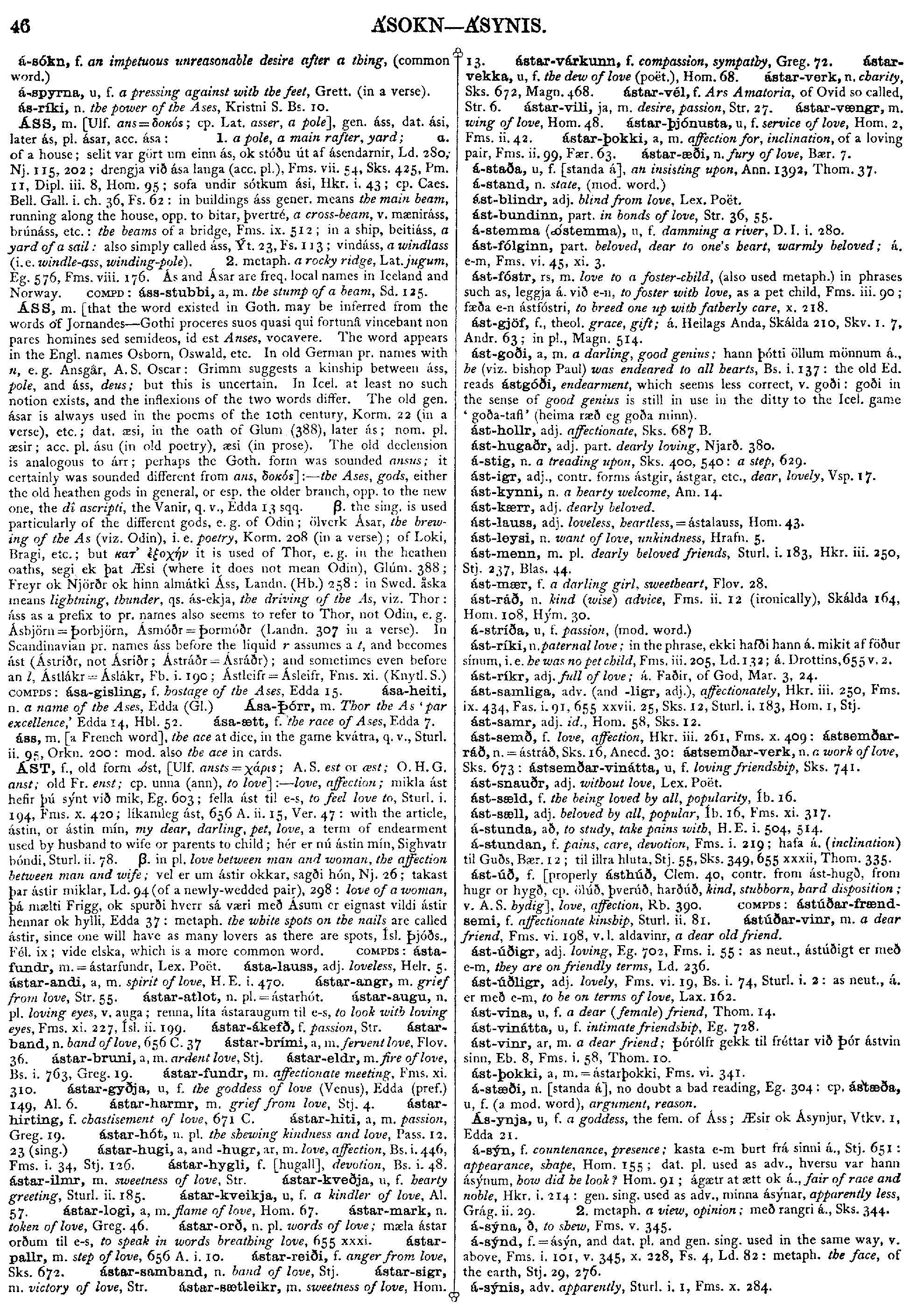
ást-goði, a, m. a darling, good genius; hann þótti öllum mönnum á., he (viz. bishop Paul) was endeared to all hearts, Bs. i. 137: the old Ed. reads ástgóði, endearment, which seems less correct, v. goði: goði in the sense of good genius is still in use in the ditty to the Icel. game 'goða-tafl' (heima ræð eg goða minn).
|
Source: Cleasby/Vigfusson, page b0161, entry 43 View original page image as: [TIFF] [PNG] [View previous entry] [View next entry] |
[Comment on this entry] [View comments] |
The following entry has been hand-corrected once. |
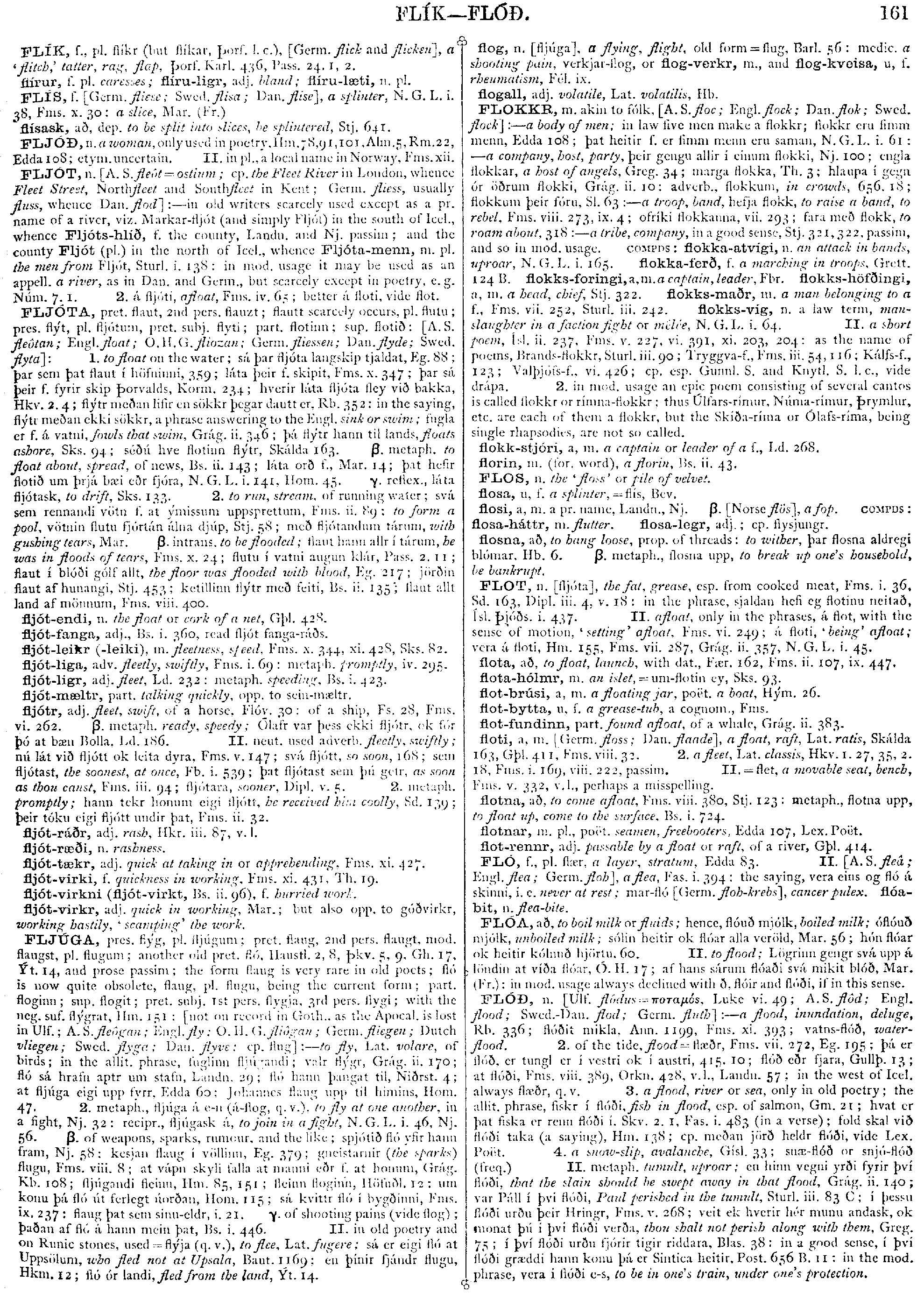
FLÓÐ, n. [Ulf. flôdus = GREEK, Luke vi. 49; A. S. flôd; Engl. flood; Swed.-Dan. flod; Germ. fluth] :-- a flood, inundation, deluge, Rb. 336; flóðit mikla, Ann. 1199, Fms. xi. 393; vatns-flóð, water-flood. 2. of the tide, flood = flæðr, Fms. vii. 272, Eg. 195; þá er flóð, er tungl er í vestri ok í austri, 415. 10; flóð eðr fjara, Gullþ. 13; at flóði, Fms. viii. 389, Orkn. 428, v.l., Landn. 57: in the west of Icel. always flæðr, q.v. 3. a flood, river or sea, only in old poetry; the allit. phrase, fiskr í flóði, fish in flood, esp. of salmon, Gm. 21; hvat er þat fiska er renn flóði í, Skv. 2. 1, Fas. i. 483 (in a verse); fold skal við flóði taka (a saying), Hm. 138; cp. meðan jörð heldr flóði, vide Lex. Poët. 4. a snow-slip, avalanche, Gísl. 33; snæ-flóð or snjó-flóð (freq.) II. metaph. tumult, uproar; en hinn vegni yrði fyrir því flóði, that the slain should be swept away in that flood, Grág. ii. 140; var Páll í því flóði, Paul perished in the tumult, Sturl. iii. 83 C; í þessu flóði urðu þeir Hringr, Fms. v. 268; veit ek hverir hér munu andask, ok monat þú í því flóði verða, thou shalt not perish along with them, Greg. 75; í því flóði urðu fjórir tigir riddara, Blas. 38: in a good sense, í því flóði græddi hann konu þá er Sintica heitir, Post. 656 B. 11: in the mod. phrase, vera í flóði e-s, to be in one's train, under one's protection.
|
Source: Cleasby/Vigfusson, page b0204, entry 1 View original page image as: [TIFF] [PNG] [View previous entry] [View next entry] |
[Comment on this entry] [View comments] |
The following entry has been hand-corrected once. |
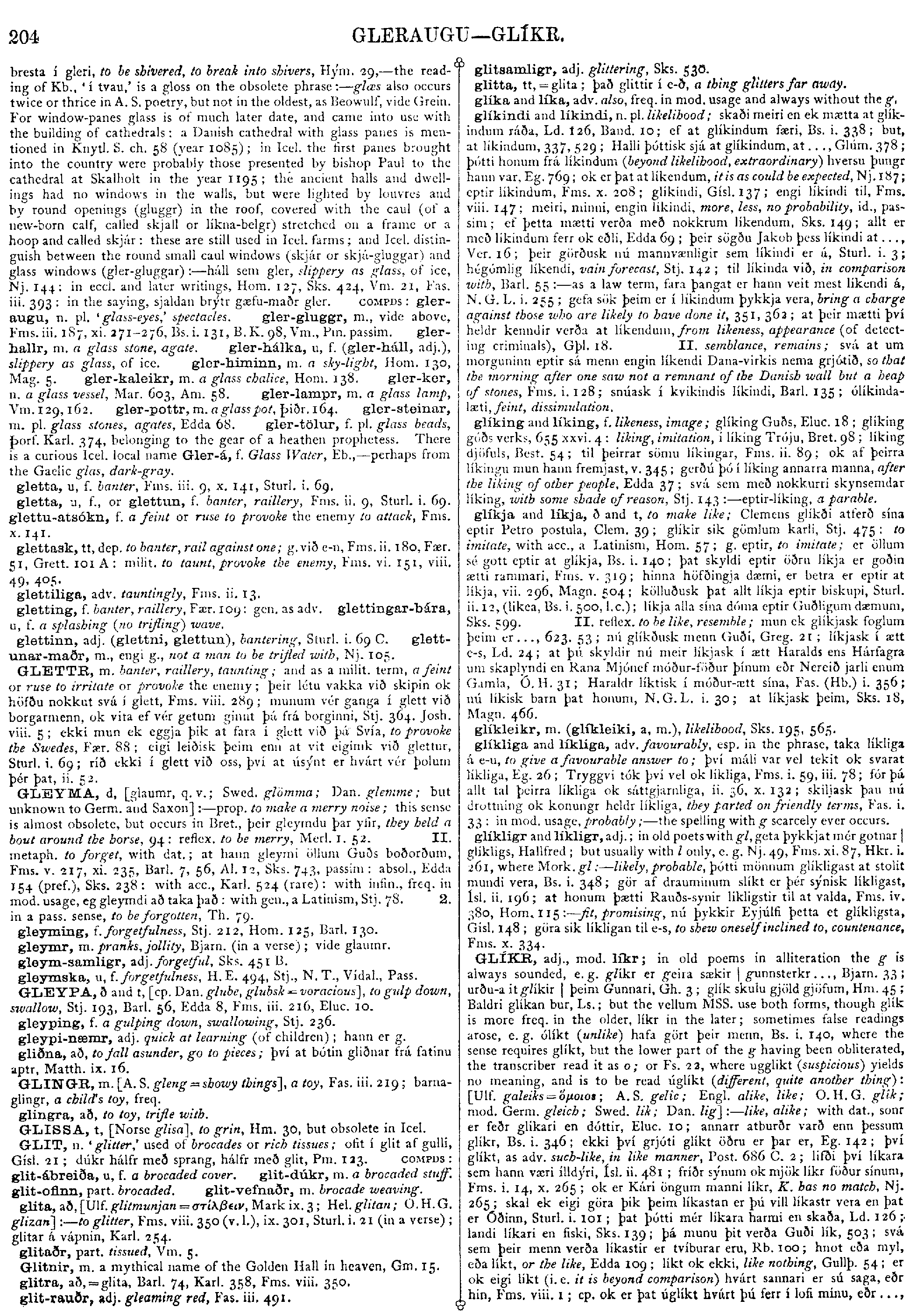
bresta í gleri, to be shivered, to break into shivers, Hým. 29, -- the reading of Kb., 'í tvau,' is a gloss on the obsolete phrase :-- glæs also occurs twice or thrice in A. S. poetry, but not in the oldest, as Beowulf, vide Grein. For window-panes glass is of much later date, and came into use with the building of cathedrals: a Danish cathedral with glass panes is mentioned in Knytl. S. ch. 58 (year 1085); in Icel. the first panes brought into the country were probably those presented by bishop Paul to the cathedral at Skalholt in the year 1195; the ancient halls and dwellings had no windows in the walls, but were lighted by louvres and by round openings (gluggr) in the roof, covered with the caul (of a new-born calf, called skjall or líkna-belgr) stretched on a frame or a hoop and called skjár: these are still used in Icel. farms; and Icel. distinguish between the round small caul windows (skjár or skjá-gluggar) and glass windows (gler-gluggar) :-- háll sem gler, slippery as glass, of ice, Nj. 144: in eccl. and later writings, Hom. 127, Sks. 424, Vm. 21, Fas. iii. 393: in the saying, sjaldan brýtr gæfu-maðr gler. COMPDS: gler-augu, n. pl. 'glass-eyes,' spectacles. gler-gluggr, m., vide above, Fms. iii. 187, xi. 271-276, Bs. i. 131, B. K. 98, Vm., Pm. passim. gler-hallr, m. a glass stone, agate. gler-hálka, u, f. (gler-háll, adj.), slippery as glass, of ice. gler-himinn, m. a sky-light, Hom. 130, Mag. 5. gler-kaleikr, m. a glass chalice, Hom. 138. gler-ker, n. a glass vessel, Mar. 603, Am. 58. gler-lampr, m. a glass lamp, Vm. 129, 162. gler-pottr, m. a glass pot, Þiðr. 164. gler-steinar, m. pl. glass stones, agates, Edda 68. gler-tölur, f. pl. glass beads, Þorf. Karl. 374, belonging to the gear of a heathen prophetess. There is a curious Icel. local name Gler-á, f. Glass Water, Eb., -- perhaps from the Gaelic glas, dark-gray.
|
Source: Cleasby/Vigfusson, page b0292, entry 23 View original page image as: [TIFF] [PNG] [View previous entry] [View next entry] |
[Comment on this entry] [View comments] |
The following entry has been hand-corrected once. |
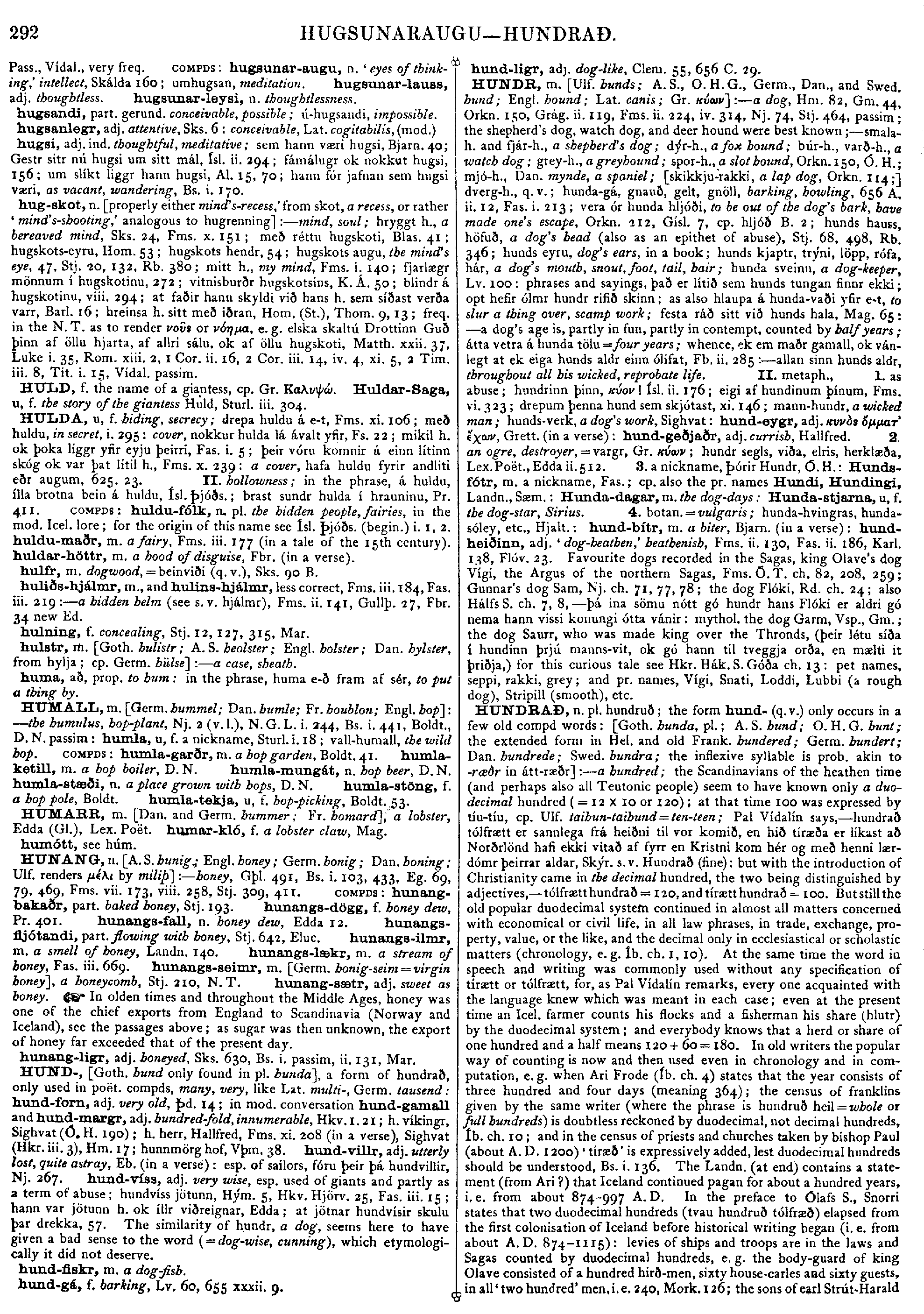
HUNDRAÐ, n. pl. hundruð; the form hund- (q.v.) only occurs in a few old compd words: [Goth. hunda, pl.; A. S. hund; O. H. G. hunt; the extended form in Hel. and old Frank, hundered; Germ. hundert; Dan. hundrede; Swed. hundra; the inflexive syllable is prob. akin to -ræðr in átt-ræðr] :-- a hundred; the Scandinavians of the heathen time (and perhaps also all Teutonic people) seem to have known only a duo-decimal hundred ( = 12 × 10 or 120); at that time 100 was expressed by tíu-tíu, cp. Ulf. taihun-taihund = ten-teen; Pal Vídalín says, -- hundrað tólfrætt er sannlega frá heiðni til vor komið, en hið tíræða er líkast að Norðrlönd hafi ekki vitað af fyrr en Kristni kom hér og með henni lærdómr þeirrar aldar, Skýr. s.v. Hundrað (fine): but with the introduction of Christianity came in the decimal hundred, the two being distinguished by adjectives, -- tólfrætt hundrað = 120, and tírætt hundrað = 100. But still the old popular duodecimal system continued in almost all matters concerned with economical or civil life, in all law phrases, in trade, exchange, property, value, or the like, and the decimal only in ecclesiastical or scholastic matters (chronology, e.g. Íb. ch. 1, 10). At the same time the word in speech and writing was commonly used without any specification of tírætt or tólfrætt, for, as Pal Vídalín remarks, every one acquainted with the language knew which was meant in each case; even at the present time an Icel. farmer counts his flocks and a fisherman his share (hlutr) by the duodecimal system; and everybody knows that a herd or share of one hundred and a half means 120 + 60 = 180. In old writers the popular way of counting is now and then used even in chronology and in computation, e.g. when Ari Frode (Íb. ch. 4) states that the year consists of three hundred and four days (meaning 364); the census of franklins given by the same writer (where the phrase is hundruð heil = whole or full hundreds) is doubtless reckoned by duodecimal, not decimal hundreds, Íb. ch. 10; and in the census of priests and churches taken by bishop Paul (about A.D. 1200) 'tíræð' is expressively added, lest duodecimal hundreds should be understood, Bs. i. 136. The Landn. (at end) contains a statement (from Ari?) that Iceland continued pagan for about a hundred years, i.e. from about 874-997 A.D. In the preface to Ólafs S., Snorri states that two duodecimal hundreds (tvau hundruð tólfræð) elapsed from the first colonisation of Iceland before historical writing began (i.e. from about A.D. 874-1115): levies of ships and troops are in the laws and Sagas counted by duodecimal hundreds, e.g. the body-guard of king Olave consisted of a hundred hirð-men, sixty house-carles and sixty guests, in all 'two hundred' men, i.e. 240, Mork. 126; the sons of earl Strút-Harald
|
Source: Cleasby/Vigfusson, page b0426, entry 26 View original page image as: [TIFF] [PNG] [View previous entry] [View next entry] |
[Comment on this entry] [View comments] |
The following entry has been hand-corrected once. |
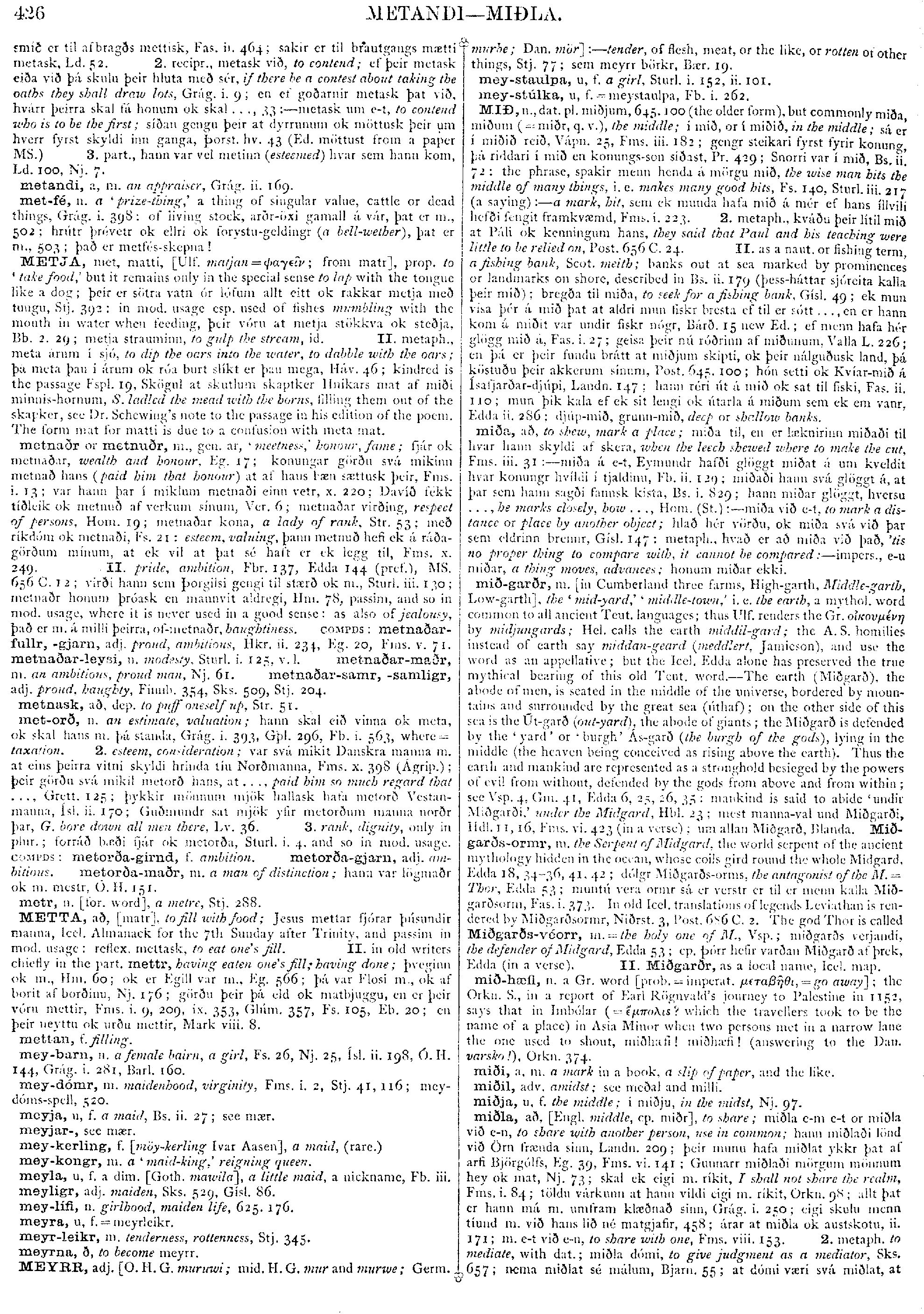
MIÐ, n., dat. pl. miðjum, 645. 100 (the older form), but commonly miða miðum ( = miðr, q.v.), the middle; í mið, or í miðið, in the middle; sá er í miðið reið, Vápn. 25, Fms. iii. 182; gengr steikari fyrst fyrir konung, þá riddari í mið en konungs-son siðast, Pr. 429; Snorri var í mið, Bs. ii. 72: the phrase, spakir menn henda á mörgu mið, the wise man hits the middle of many things, i.e. makes many good hits, Fs. 140, Sturl. iii. 217 (a saying) :-- a mark, hit, sem ek munda hafa mið á mér ef hans íllvili hefði fengit framkvæmd, Fms. i. 223. 2. metaph., kváðu þeir lítil mið at Páli ok kenningum hans, they said that Paul and his teaching were little to be relied on, Post. 656 C. 24. II. as a naut. or fishing term, a fishing bank, Scot. meith; banks out at sea marked by prominences or landmarks on shore, described in Bs. ii. 179 (þess-háttar sjóreita kalla þeir mið); bregða til miða, to seek for a fishing bank, Gísl. 49; ek mun visa þér á mið þat at aldri mun fiskr bresta ef til er sótt ..., en er hann kom á miðit var undir fiskr nógr, Bárð. 15 new Ed.; ef menn hafa hér glögg mið á, Fas. i. 27; geisa þeir nú róðrinn af miðunum, Valla L. 226; en þá er þeir fundu brátt at miðjum skipti, ok þeir nálguðusk land, þá köstuðu þeir akkerum sínum, Post. 645. 100; hón setti ok Kvíar-mið á Ísafjarðar-djúpi, Landn. 147; hann réri út á mið ok sat til fiski, Fas. ii. 110; mun þik kala ef ek sit lengi ok útarla á miðum sem ek em vanr, Edda ii. 286; djúp-mið, grann-mið, deep or shallow banks.
|
Source: Cleasby/Vigfusson, page b0470, entry 21 View original page image as: [TIFF] [PNG] [View previous entry] [View next entry] |
[Comment on this entry] [View comments] |
The following entry has been hand-corrected once. |
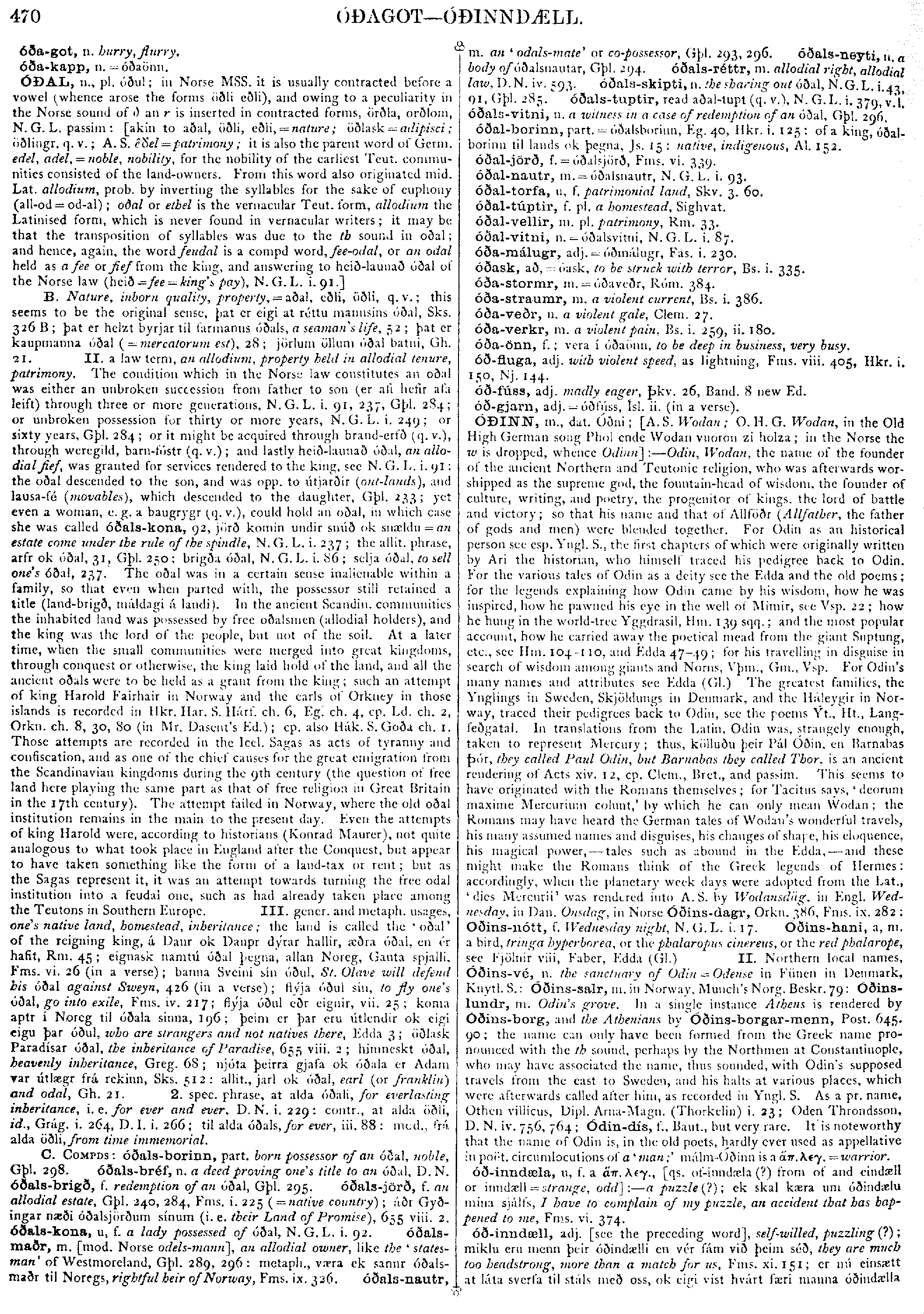
ÓÐINN, m., dat. Óðni; [A.S. Wodan; O.H.G. Wodan, in the Old High German song Phol ende Wodan vuoron zi holza; in the Norse the w is dropped, whence Odinn] :-- Odin, Wodan, the name of the founder of the ancient Northern and Teutonic religion, who was afterwards worshipped as the supreme god, the fountain-head of wisdom, the founder of culture, writing, and poetry, the progenitor of kings, the lord of battle and victory; so that his name and that of Allföðr (Allfather, the father of gods and men) were blended together. For Odin as an historical person see esp. Yngl. S., the first chapters of which were originally written by Ari the historian, who himself traced his pedigree back to Odin. For the various tales of Odin as a deity see the Edda and the old poems; for the legends explaining how Odin came by his wisdom, how he was inspired, how he pawned his eye in the well of Mimir, see Vsp. 22; how he hung in the world-tree Yggdrasil, Hm. 139 sqq.; and the most popular account, how he carried away the poetical mead from the giant Suptung, etc., see Hm. 104-110. and Edda 47-49; for his travelling in disguise in search of wisdom among giants and Norns, Vþm., Gm., Vsp. For Odin's many names and attributes see Edda (Gl.) The greatest families, the Ynglings in Sweden, Skjöldungs in Denmark, and the Háleygir in Norway, traced their pedigrees back to Odin, see the poems Ýt., Ht., Langfeðgatal. In translations from the Latin, Odin was, strangely enough, taken to represent Mercury; thus, kölluðu þeir Pál Óðin, en Barnabas Þór, they called Paul Odin, but Barnabas they called Thor, is an ancient rendering of Acts xiv. 12, cp. Clem., Bret., and passim. This seems to have originated with the Romans themselves; for Tacitus says, 'deorum maxime Mercurium colunt,' by which he can only mean Wodan; the Romans may have heard the German tales of Wodan's wonderful travels, his many assumed names and disguises, his changes of shape, his eloquence, his magical power, -- tales such as abound in the Edda, -- and these might make the Romans think of the Greek legends of Hermes: accordingly, when the planetary week days were adopted from the Lat., 'dies Mercurii' was rendered into A.S. by Wodansdäg, in Engl. Wednesday, in Dan. Onsdag, in Norse Óðins-dagr, Orkn. 386, Fms. ix. 282: Óðins-nótt, f. Wednesday night, N.G.L. i. 17. Óðins-hani, a, m. a bird, tringa hyperborea, or the phalaropus cinereus, or the red phalarope, see Fjölnir viii, Faber, Edda (Gl.) II. Northern local names, Óðins-vé, n. the sanctuary of Odin = Odense in Fünen in Denmark, Knytl. S.: Óðins-salr, m. in Norway. Munch's Norg. Beskr. 79: Óðins-lundr, m. Odin's grove. In a single instance Athens is rendered by Óðins-borg, and the Athenians by Óðins-borgar-menn, Post. 645. 90; the name can only have been formed from the Greek name pronounced with the th sound, perhaps by the Northmen at Constantinople, who may have associated the name, thus sounded, with Odin's supposed travels from the east to Sweden, and his halts at various places, which were afterwards called after him, as recorded in Yngl. S. As a pr. name, Othen villicus, Dipl. Arna-Magn. (Thorkelin) i. 23; Oden Throndsson, D.N. iv. 756, 764; Ódin-dís, f., Baut., but very rare. It is noteworthy that the name of Odin is, in the old poets, hardly ever used as appellative in poët. circumlocutions of a 'man;' málm-Óðinn is a GREEK = warrior.
|
Source: Cleasby/Vigfusson, page b0475, entry 37 View original page image as: [TIFF] [PNG] [View previous entry] [View next entry] |
[Comment on this entry] [View comments] |
The following entry has been hand-corrected once. |
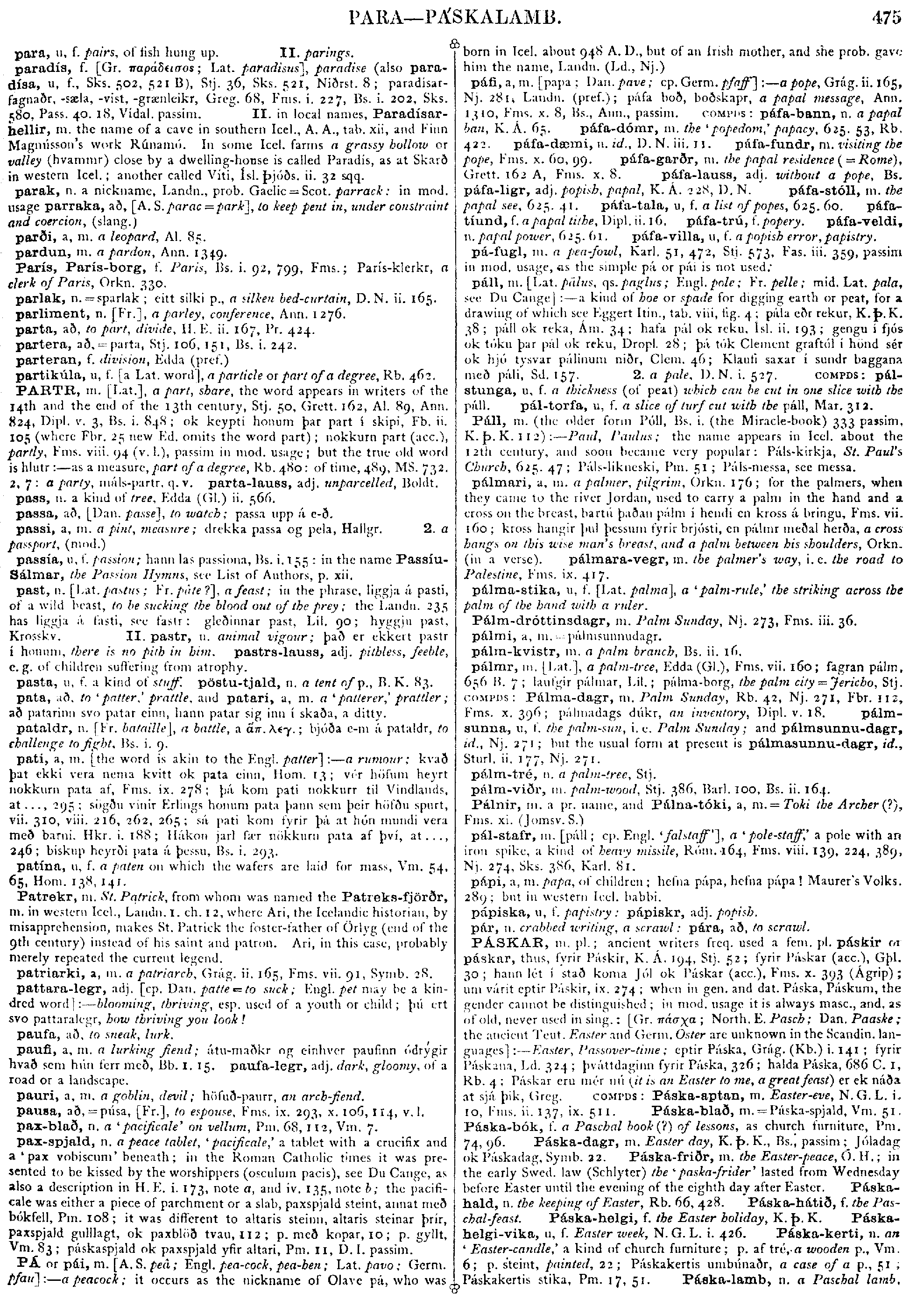
Páll, m. (the older form Póll, Bs. i. (the Miracle-book) 333 passim, K.Þ.K. 112) :-- Paul, Paulus; the name appears in Icel. about the 12th century, and soon became very popular: Páls-kirkja, St. Paul's Church, 625. 47; Páls-líkneski, Pm. 51; Páls-messa, see messa.
| Result Page: |  |
Previous | 1 2 3 4 5 |
Germanic Lexicon Project (main page)
This search system was written by
Sean Crist
Please consider
volunteering
to correct the data in these online dictionaries.
No rights reserved. Feel free to use these data in any way you please.