|
|

|
Source: Bosworth/Toller, page d0759, entry 1 View original page image as: [TIFF] [PNG] [View previous entry] [View next entry] |
[Comment on this entry] [View comments] |
The following entry has been hand-corrected once. |
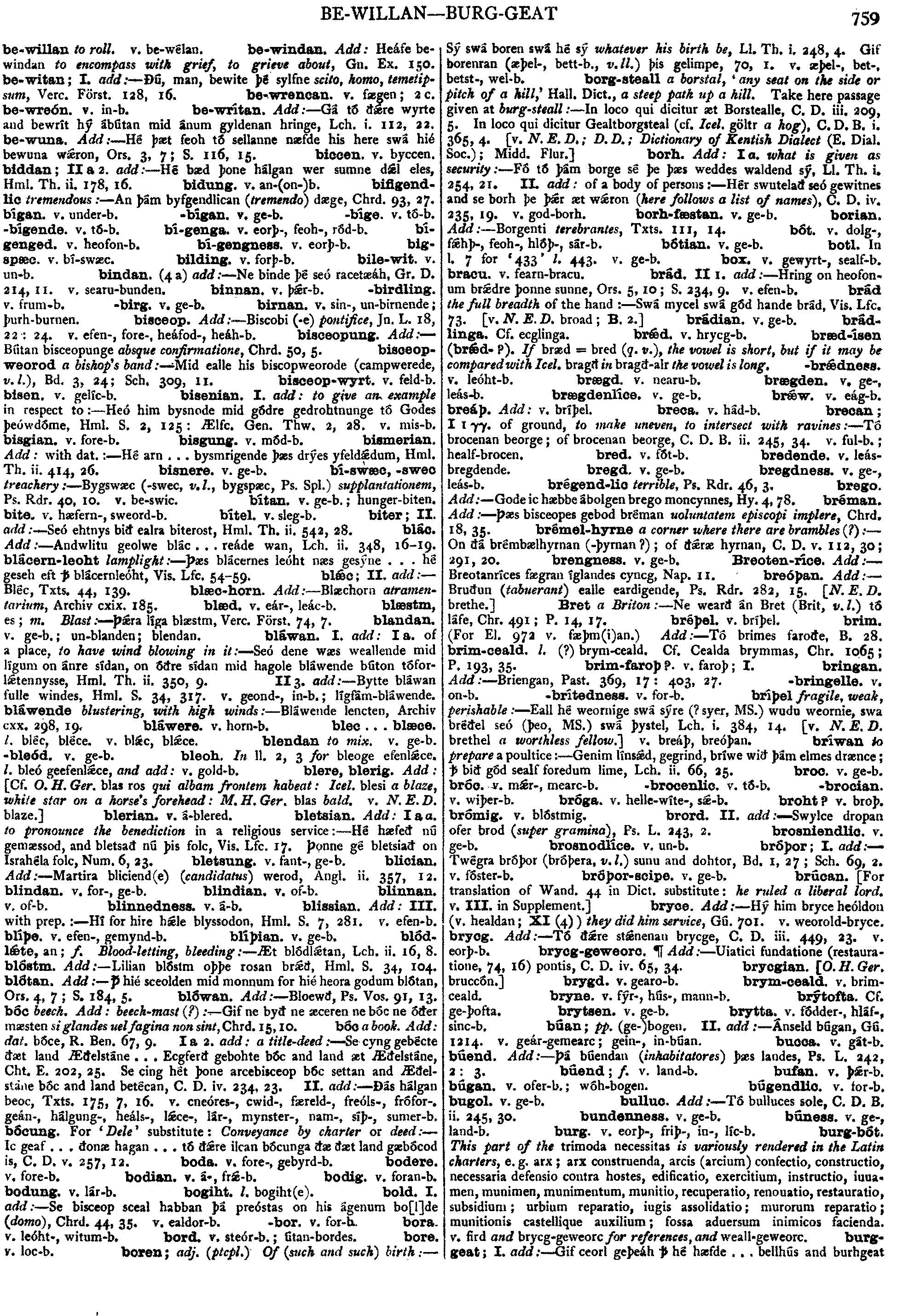
be-willan
to
roll,
v.
be-wélan.
be-windan.
Add:
Heáfe
bewindan
to
encompass
with
grief,
to
grieve
about,
Gn.
Ex.
150.
be-witan;
I.
add
:--
Ðú,
man,
bewite
þé
sylfne
scito,
homo,
temetipsum,
Verc.
Först.
128,
16.
be-wrencan.
v.
fægen;
2
c.
be-wreón.
v.
in-b.
be-wrítan.
Add
:--
Gá
tó
ð re
wyrte
and
bewrít
hý
ábútan
mid
ánum
gyldenan
hringe,
Lch.
i.
112,
22.
be-wuna.
Add
:--
Hé
þæt
feoh
tó
sellanne
næfde
his
here
swá
hié
bewuna
wron,
Ors.
3,
7;
S.
116,
15.
biccen.
v.
byccen.
biddan;
II
a
2.
add
:--
Hé
bæd
þone
hálgan
wer
sumne
dl
eles,
Hml.
Th.
ii.
178,
16.
bidung.
v.
an-(on-)b.
bifigendlic
tremendous
:--
An
þám
byfgendlican
(tremendo)
dæge,
Chrd.
93,
27.
bígan.
v.
under-b.
-bígan.
v.
ge-b.
-bíge.
v.
tó-b.
-bígende.
v.
tó-b.
bí-genga.
v.
eorþ-,
feoh-,
ród-b.
bí-genged.
v.
heofon-b.
bí-gengness.
v.
eorþ-b.
big-spæc.
v.
bí-swæc.
bilding.
v.
forþ-b.
bile-wit.
v.
un-b.
bindan.
(4
a)
add
:--
Ne
binde
þé
seó
racetæáh,
Gr.
D.
214,
11.
v.
searu-bunden.
binnan.
v.
þr-b.
-birdling.
v.
frum-b.
-birg.
v.
ge-b.
birnan.
v.
sin-,
un-birnende;
þurh-burnen.
bisceop.
Add
:--
Biscobi
(-e)
pontifice,
Jn.
L.
18,
22:
24.
v.
efen-,
fore-,
heáfod-,
heáh-b.
bisceopung.
Add
:--
Bútan
bisceopunge
absque
confirmatione,
Chrd.
50,
5.
bisceop-weorod
a
bishop's
band
:--
Mid
ealle
his
biscopweorode
(campwerede,
v.
l.),
Bd.
3,
24;
Sch.
309,
11.
bisceop-wyrt.
v.
feld-b.
bisen.
v.
gelíc-b.
bisenian.
I.
add:
to
give
an
example
in
respect
to
:--
Heó
him
bysnode
mid
gódre
gedrohtnunge
tó
Godes
þeówdóme,
Hml.
S.
2,
125:
Ælfc.
Gen.
Thw.
2,
28.
v.
mis-b.
bisgian.
v.
fore-b.
bisgung.
v.
mód-b.
bismerian.
Add:
with
dat.
:--
He
arn
...
bysmrigende
þæs
drýes
yfelddum,
Hml.
Th.
ii.
414,
26.
bisnere.
v.
ge-b.
bí-swæc,
-swec
treachery
:--
Bygswæc
(-swec,
v.
l.,
bygspæc,
Ps.
Spl.)
supplantationem,
Ps.
Rdr.
40,
10.
v.
be-swic.
bítan.
v.
ge-b.;
hunger-biten.
bite.
v.
hæfern-,
sweord-b.
bítel.
v.
sleg-b.
biter;
II.
add
:--
Seó
ehtnys
bið
ealra
biterost,
Hml.
Th.
ii.
542,
28.
blác.
Add
:--
Andwlitu
geolwe
blác
...
reáde
wan,
Lch.
ii.
348,
16-19.
blácern-leoht
lamplight
:--
Þæs
blácernes
leóht
næs
gesýne
...
hé
geseh
eft
re
wyrte
and
bewrít
hý
ábútan
mid
ánum
gyldenan
hringe,
Lch.
i.
112,
22.
be-wuna.
Add
:--
Hé
þæt
feoh
tó
sellanne
næfde
his
here
swá
hié
bewuna
wron,
Ors.
3,
7;
S.
116,
15.
biccen.
v.
byccen.
biddan;
II
a
2.
add
:--
Hé
bæd
þone
hálgan
wer
sumne
dl
eles,
Hml.
Th.
ii.
178,
16.
bidung.
v.
an-(on-)b.
bifigendlic
tremendous
:--
An
þám
byfgendlican
(tremendo)
dæge,
Chrd.
93,
27.
bígan.
v.
under-b.
-bígan.
v.
ge-b.
-bíge.
v.
tó-b.
-bígende.
v.
tó-b.
bí-genga.
v.
eorþ-,
feoh-,
ród-b.
bí-genged.
v.
heofon-b.
bí-gengness.
v.
eorþ-b.
big-spæc.
v.
bí-swæc.
bilding.
v.
forþ-b.
bile-wit.
v.
un-b.
bindan.
(4
a)
add
:--
Ne
binde
þé
seó
racetæáh,
Gr.
D.
214,
11.
v.
searu-bunden.
binnan.
v.
þr-b.
-birdling.
v.
frum-b.
-birg.
v.
ge-b.
birnan.
v.
sin-,
un-birnende;
þurh-burnen.
bisceop.
Add
:--
Biscobi
(-e)
pontifice,
Jn.
L.
18,
22:
24.
v.
efen-,
fore-,
heáfod-,
heáh-b.
bisceopung.
Add
:--
Bútan
bisceopunge
absque
confirmatione,
Chrd.
50,
5.
bisceop-weorod
a
bishop's
band
:--
Mid
ealle
his
biscopweorode
(campwerede,
v.
l.),
Bd.
3,
24;
Sch.
309,
11.
bisceop-wyrt.
v.
feld-b.
bisen.
v.
gelíc-b.
bisenian.
I.
add:
to
give
an
example
in
respect
to
:--
Heó
him
bysnode
mid
gódre
gedrohtnunge
tó
Godes
þeówdóme,
Hml.
S.
2,
125:
Ælfc.
Gen.
Thw.
2,
28.
v.
mis-b.
bisgian.
v.
fore-b.
bisgung.
v.
mód-b.
bismerian.
Add:
with
dat.
:--
He
arn
...
bysmrigende
þæs
drýes
yfelddum,
Hml.
Th.
ii.
414,
26.
bisnere.
v.
ge-b.
bí-swæc,
-swec
treachery
:--
Bygswæc
(-swec,
v.
l.,
bygspæc,
Ps.
Spl.)
supplantationem,
Ps.
Rdr.
40,
10.
v.
be-swic.
bítan.
v.
ge-b.;
hunger-biten.
bite.
v.
hæfern-,
sweord-b.
bítel.
v.
sleg-b.
biter;
II.
add
:--
Seó
ehtnys
bið
ealra
biterost,
Hml.
Th.
ii.
542,
28.
blác.
Add
:--
Andwlitu
geolwe
blác
...
reáde
wan,
Lch.
ii.
348,
16-19.
blácern-leoht
lamplight
:--
Þæs
blácernes
leóht
næs
gesýne
...
hé
geseh
eft
 blácernleóht,
Vis.
Lfc.
54-59.
blc;
II.
add
:--
Bléc,
Txts.
44,
139.
blæc-horn.
Add
:--
Blæchorn
atramentarium,
Archiv
cxix.
185.
blæd,
v.
eár-,
leác-b.
blæstm,
es;
m.
Blast
:--
Þra
líga
blæstm,
Verc.
Först.
74,
7.
blandan.
v.
ge-b.;
un-blanden;
blendan.
bláwan.
I.
add:
I
a.
of
a
place,
to
have
wind
blowing
in
it
:--
Seó
dene
wæs
weallende
mid
lígum
on
ánre
sídan,
on
óðre
sídan
mid
hagole
bláwende
búton
tóforltennysse,
Hml.
Th.
ii.
350,
9.
II
3.
add
:--
Bytte
bláwan
fulle
windes.
Hml.
S.
34,
317.
v.
geond-,
in-b.;
lígfám-bláwende.
bláwende
blustering,
with
high
winds
:--
Bláwende
lencten,
Archiv
cxx.
298,
19.
bláwere.
v.
horn-b.
blec
...
blæce.
l.
bléc,
bléce.
v.
blc,
blce.
blendan
to
mix,
v.
ge-b.
-bleód.
v.
ge-b.
bleoh.
In
ll.
2,
3
for
bleoge
efenlce.
l.
bleó
geefenlce,
and
add:
v.
gold-b.
blere,
blerig.
Add:
[Cf.
O.
H.
Ger.
blas
ros
qui
albam
frontem
habeat:
Icel.
blesi
a
blaze,
white
star
on
a
horse's
forehead:
M.
H.
Ger.
blas
bald,
v.
N.
E.
D.
blaze.]
blerian.
v.
á-blered.
bletsian.
Add:
I
a
blácernleóht,
Vis.
Lfc.
54-59.
blc;
II.
add
:--
Bléc,
Txts.
44,
139.
blæc-horn.
Add
:--
Blæchorn
atramentarium,
Archiv
cxix.
185.
blæd,
v.
eár-,
leác-b.
blæstm,
es;
m.
Blast
:--
Þra
líga
blæstm,
Verc.
Först.
74,
7.
blandan.
v.
ge-b.;
un-blanden;
blendan.
bláwan.
I.
add:
I
a.
of
a
place,
to
have
wind
blowing
in
it
:--
Seó
dene
wæs
weallende
mid
lígum
on
ánre
sídan,
on
óðre
sídan
mid
hagole
bláwende
búton
tóforltennysse,
Hml.
Th.
ii.
350,
9.
II
3.
add
:--
Bytte
bláwan
fulle
windes.
Hml.
S.
34,
317.
v.
geond-,
in-b.;
lígfám-bláwende.
bláwende
blustering,
with
high
winds
:--
Bláwende
lencten,
Archiv
cxx.
298,
19.
bláwere.
v.
horn-b.
blec
...
blæce.
l.
bléc,
bléce.
v.
blc,
blce.
blendan
to
mix,
v.
ge-b.
-bleód.
v.
ge-b.
bleoh.
In
ll.
2,
3
for
bleoge
efenlce.
l.
bleó
geefenlce,
and
add:
v.
gold-b.
blere,
blerig.
Add:
[Cf.
O.
H.
Ger.
blas
ros
qui
albam
frontem
habeat:
Icel.
blesi
a
blaze,
white
star
on
a
horse's
forehead:
M.
H.
Ger.
blas
bald,
v.
N.
E.
D.
blaze.]
blerian.
v.
á-blered.
bletsian.
Add:
I
a
 .
to
pronounce
the
benediction
in
a
religious
service
:--
Hé
hæfeð
nú
gemæssod,
and
bletsað
nú
þis
folc,
Vis.
Lfc.
17.
Þonne
gé
bletsiað
on
Israhéla
folc,
Num.
6,
23.
bletsung.
v.
fant-,
ge-b.
blician.
Add
:--
Martira
bliciend(e)
(candidatus)
werod,
Angl.
ii.
357,
12.
blindan.
v.
for-,
ge-b.
blindian.
v.
of-b.
blinnan.
v.
of-b.
blinnedness.
v.
á-b.
blissian.
Add:
III.
with
prep.
:--
Hí
for
hire
hle
blyssodon,
Hml.
S.
7,
281.
v.
efen-b.
blíþe.
v.
efen-,
gemynd-b.
blíþian.
v.
ge-b.
blod-lte,
an;
f.
Blood-letting,
bleeding
:--
Æt
blódltan,
Lch.
ii.
16,
8.
blostm.
Add
:--
Lilian
blóstm
oþþe
rosan
brð,
Hml.
S.
34,
104.
blótan.
Add
:--
hié
sceolden
mid
monnum
for
hié
heora
godum
blótan,
Ors.
4,
7;
S.
184,
5.
blówan.
Add
:--
Bloewð,
Ps.
Vos.
91,
13.
bóc
beech.
Add:
beech-mast
(?)
:--
Gif
ne
byð
ne
æceren
ne
bóc
ne
oðer
mæsten
si
glandes
uel
fagina
non
sint,
Chrd.
15,
10.
bóc
a
book.
Add:
dat.
bóce,
R.
Ben.
67,
9.
I
a
2.
add:
a
title-deed
:--
Se
cyng
gebécte
ðæt
land
Æðelstáne
...
Ecgferð
gebohte
bóc
and
land
æt
Æðelstáne,
Cht.
E.
202,
25.
Se
cing
hét
þone
arcebisceop
bóc
settan
and
Æðelstáne
bóc
and
land
betécan,
C.
D.
iv.
234,
23.
II.
add
:--
Ðás
hálgan
beoc,
Txts.
175,
7,
16.
v.
cneóres-,
cwid-,
færeld-,
freóls-,
frófor-,
geán-,
hálgung-,
heáls-,
lce-,
lár-,
mynster-,
nam-,
síþ-,
sumer-b.
bócung.
For
'Dele'
substitute:
Conveyance
by
charter
or
deed
:--
Ic
geaf
...
ðonæ
hagan
...
tó
ðre
ilcan
bócunga
ðæ
ðæt
land
gæbócod
is,
C.
D.
v.
257,
12.
boda.
v.
fore-,
gebyrd-b.
bodere.
v.
fore-b.
bodian.
v.
á-,
fr-b.
bodig.
v.
foran-b.
bodung.
v.
lár-b.
bogiht.
l.
bogiht(e).
bold.
I.
add
:--
Se
biseeop
sceal
habban
þá
preóstas
on
his
ágenum
bo[l]de
(domo),
Chrd.
44,
35.
v.
ealdor-b.
-bor.
v.
for-b.
bora.
v.
leóht-,
witum-b.
bord.
v.
steor-b.;
útan-bordes.
bore.
v.
loc-b.
boren;
adj.
(ptcpl.)
Of
(such
and
such)
birth
:--
Sý
swá
boren
swá
hé
sý
whatever
his
birth
be,
Ll.
Th.
i.
248,
4.
Gif
borenran
(æþel-,
bett-b.,
v.
ll.)
þis
gelimpe,
70,
1.
v.
æþel-,
bet-,
betst-,
wel-b.
borg-steall
a
borstal,
'any
seat
on
the
side
or
pitch
of
a
hill,'
Hall.
Dict.,
a
steep
path
up
a
hill.
Take
here
passage
given
at
burg-steall
:--
In
loco
qui
dicitur
æt
Borstealle,
C.
D.
iii.
209,
5.
In
loco
qui
dicitur
Gealtborgsteal
(cf.
Icel.
göltr
a
hog),
C.
D.
B.
i.
365,
4.
[v.
N.
E.
D.;
D.
D.;
Dictionary
of
Kentish
Dialect
(E.
Dial.
Soc.);
Midd.
Flur.]
borh.
Add:
I
a.
what
is
given
as
security
:--
Fó
tó
þam
borge
sé
þe
þæs
weddes
waldend
sý,
Ll.
Th.
i.
254,
21.
II.
add:
of
a
body
of
persons
:--
Hér
swutelað
seó
gewitnes
and
se
borh
þe
þr
æt
wron
(here
follows
a
list
of
names),
C.
D.
iv.
235,
19.
v.
god-borh.
borh-fæstan.
v.
ge-b.
borian.
Add
:--
Borgenti
terebrantes,
Txts.
111,
14.
bót.
v.
dolg-,
fhþ-,
feoh-,
hlóþ-,
sár-b.
bótian.
v.
ge-b.
botl.
In
l.
7
for
'433'
l.
443.
v.
ge-b.
box.
v.
gewyrt-,
sealf-b.
bracu.
v.
fearn-bracu.
brád.
II
1.
add
:--
Hring
on
heofonum
brdre
þonne
sunne,
Ors.
5,
10;
S.
234,
9.
v.
efen-b.
brád
the
full
breadth
of
the
hand
:--
Swá
mycel
swá
gód
hande
brád,
Vis.
Lfc.
73.
[v.
N.
E.
D.
broad;
B.
2.]
brádian.
v.
ge-b.
brádlinga.
Cf.
ecglinga.
brd.
v.
hrycg-b.
bræd-ísen
(brd-
?).
If
bræd
=
bred
(q.
v.),
the
vowel
is
short,
but
if
it
may
be
compared
with
Icel.
bragð
in
bragð-alr
the
vowel
is
long.
-brdness.
v.
leoht-b.
brægd.
v.
nearu-b.
brægden.
v.
ge-,
leás-b.
brægdenlíce.
v.
ge-b.
brw.
v.
eág-b.
breáþ.
Add:
v.
bríþel.
breca.
v.
hád-b.
brecan;
I
1
.
to
pronounce
the
benediction
in
a
religious
service
:--
Hé
hæfeð
nú
gemæssod,
and
bletsað
nú
þis
folc,
Vis.
Lfc.
17.
Þonne
gé
bletsiað
on
Israhéla
folc,
Num.
6,
23.
bletsung.
v.
fant-,
ge-b.
blician.
Add
:--
Martira
bliciend(e)
(candidatus)
werod,
Angl.
ii.
357,
12.
blindan.
v.
for-,
ge-b.
blindian.
v.
of-b.
blinnan.
v.
of-b.
blinnedness.
v.
á-b.
blissian.
Add:
III.
with
prep.
:--
Hí
for
hire
hle
blyssodon,
Hml.
S.
7,
281.
v.
efen-b.
blíþe.
v.
efen-,
gemynd-b.
blíþian.
v.
ge-b.
blod-lte,
an;
f.
Blood-letting,
bleeding
:--
Æt
blódltan,
Lch.
ii.
16,
8.
blostm.
Add
:--
Lilian
blóstm
oþþe
rosan
brð,
Hml.
S.
34,
104.
blótan.
Add
:--
hié
sceolden
mid
monnum
for
hié
heora
godum
blótan,
Ors.
4,
7;
S.
184,
5.
blówan.
Add
:--
Bloewð,
Ps.
Vos.
91,
13.
bóc
beech.
Add:
beech-mast
(?)
:--
Gif
ne
byð
ne
æceren
ne
bóc
ne
oðer
mæsten
si
glandes
uel
fagina
non
sint,
Chrd.
15,
10.
bóc
a
book.
Add:
dat.
bóce,
R.
Ben.
67,
9.
I
a
2.
add:
a
title-deed
:--
Se
cyng
gebécte
ðæt
land
Æðelstáne
...
Ecgferð
gebohte
bóc
and
land
æt
Æðelstáne,
Cht.
E.
202,
25.
Se
cing
hét
þone
arcebisceop
bóc
settan
and
Æðelstáne
bóc
and
land
betécan,
C.
D.
iv.
234,
23.
II.
add
:--
Ðás
hálgan
beoc,
Txts.
175,
7,
16.
v.
cneóres-,
cwid-,
færeld-,
freóls-,
frófor-,
geán-,
hálgung-,
heáls-,
lce-,
lár-,
mynster-,
nam-,
síþ-,
sumer-b.
bócung.
For
'Dele'
substitute:
Conveyance
by
charter
or
deed
:--
Ic
geaf
...
ðonæ
hagan
...
tó
ðre
ilcan
bócunga
ðæ
ðæt
land
gæbócod
is,
C.
D.
v.
257,
12.
boda.
v.
fore-,
gebyrd-b.
bodere.
v.
fore-b.
bodian.
v.
á-,
fr-b.
bodig.
v.
foran-b.
bodung.
v.
lár-b.
bogiht.
l.
bogiht(e).
bold.
I.
add
:--
Se
biseeop
sceal
habban
þá
preóstas
on
his
ágenum
bo[l]de
(domo),
Chrd.
44,
35.
v.
ealdor-b.
-bor.
v.
for-b.
bora.
v.
leóht-,
witum-b.
bord.
v.
steor-b.;
útan-bordes.
bore.
v.
loc-b.
boren;
adj.
(ptcpl.)
Of
(such
and
such)
birth
:--
Sý
swá
boren
swá
hé
sý
whatever
his
birth
be,
Ll.
Th.
i.
248,
4.
Gif
borenran
(æþel-,
bett-b.,
v.
ll.)
þis
gelimpe,
70,
1.
v.
æþel-,
bet-,
betst-,
wel-b.
borg-steall
a
borstal,
'any
seat
on
the
side
or
pitch
of
a
hill,'
Hall.
Dict.,
a
steep
path
up
a
hill.
Take
here
passage
given
at
burg-steall
:--
In
loco
qui
dicitur
æt
Borstealle,
C.
D.
iii.
209,
5.
In
loco
qui
dicitur
Gealtborgsteal
(cf.
Icel.
göltr
a
hog),
C.
D.
B.
i.
365,
4.
[v.
N.
E.
D.;
D.
D.;
Dictionary
of
Kentish
Dialect
(E.
Dial.
Soc.);
Midd.
Flur.]
borh.
Add:
I
a.
what
is
given
as
security
:--
Fó
tó
þam
borge
sé
þe
þæs
weddes
waldend
sý,
Ll.
Th.
i.
254,
21.
II.
add:
of
a
body
of
persons
:--
Hér
swutelað
seó
gewitnes
and
se
borh
þe
þr
æt
wron
(here
follows
a
list
of
names),
C.
D.
iv.
235,
19.
v.
god-borh.
borh-fæstan.
v.
ge-b.
borian.
Add
:--
Borgenti
terebrantes,
Txts.
111,
14.
bót.
v.
dolg-,
fhþ-,
feoh-,
hlóþ-,
sár-b.
bótian.
v.
ge-b.
botl.
In
l.
7
for
'433'
l.
443.
v.
ge-b.
box.
v.
gewyrt-,
sealf-b.
bracu.
v.
fearn-bracu.
brád.
II
1.
add
:--
Hring
on
heofonum
brdre
þonne
sunne,
Ors.
5,
10;
S.
234,
9.
v.
efen-b.
brád
the
full
breadth
of
the
hand
:--
Swá
mycel
swá
gód
hande
brád,
Vis.
Lfc.
73.
[v.
N.
E.
D.
broad;
B.
2.]
brádian.
v.
ge-b.
brádlinga.
Cf.
ecglinga.
brd.
v.
hrycg-b.
bræd-ísen
(brd-
?).
If
bræd
=
bred
(q.
v.),
the
vowel
is
short,
but
if
it
may
be
compared
with
Icel.
bragð
in
bragð-alr
the
vowel
is
long.
-brdness.
v.
leoht-b.
brægd.
v.
nearu-b.
brægden.
v.
ge-,
leás-b.
brægdenlíce.
v.
ge-b.
brw.
v.
eág-b.
breáþ.
Add:
v.
bríþel.
breca.
v.
hád-b.
brecan;
I
1
 .
of
ground,
to
make
uneven,
to
intersect
with
ravines
:--
Tó
brocenan
beorge;
of
brocenan
beorge,
C.
D.
B.
ii.
245,
34.
v.
ful-b.;
healf-brocen.
bred.
v.
fót-b.
bredende.
v.
leás-bregdende.
bregd.
v.
ge-b.
bregdness.
v.
ge-,
leás-b.
brégend-lic
terrible,
Ps.
Rdr.
46,
3.
brego.
Add
:--
Gode
ic
hæbbe
ábolgen
brego
moncynnes,
Hy.
4,
78.
bréman.
Add
:--
Þæs
bisceopes
gebod
bréman
uoluntatem
episcopi
implere,
Chrd.
18,
35.
brémel-hyrne
a
corner
where
there
are
brambles
(?)
:--
On
ðá
brémbælhyrnan
(-þyrnan?);
of
ðræ
hyrnan,
C.
D.
v.
112,
30;
291,
20.
brengness.
v.
ge-b.
Breoten-ríce.
Add
:--
Breotanríces
fægran
íglandes
cyncg,
Nap.
11.
breóþan.
Add
:--
Bruðun
(tabuerant)
ealle
eardigende,
Ps.
Rdr.
282,
15.
[N.
E.
D.
brethe.]
Bret
a
Briton
:--
Ne
wearð
án
Bret
(Brit,
v.
l.)
tó
láfe,
Chr.
491;
P.
14,
17.
bréþel.
v.
bríþel.
brim.
(For
El.
972
v.
fæþm(i)an.)
Add
:--
Tó
brimes
faroðe,
B.
28.
brim-ceald.
l.
(?)
brym-ceald.
Cf.
Cealda
brymmas,
Chr.
1065;
P.
193,
35.
brim-faroþ?.
v.
faroþ;
I.
bringan.
Add
:--
Briengan,
Past.
369,
17:
403,
27.
-bringelle.
v.
on-b.
-brítedness.
v.
for-b.
bríþel
fragile,
weak,
perishable
:--
Eall
hé
weornige
swá
sýre
(?
syer,
MS.)
wudu
weornie,
swa
bréðel
seó
(þeo,
MS.)
swá
þystel,
Lch.
i.
384,
14.
[v.
N.
E.
D.
brethel
a
worthless
fellow.]
v.
breáþ,
breóþan.
bríwan
to
prepare
a
poultice
:--
Genim
línsd,
gegrind,
bríwe
wið
þám
elmes
drænce;
bið
gód
sealf
foredum
lime,
Lch.
ii.
66,
25.
broc.
v.
ge-b.
bróc.
v.
mr-,
mearc-b.
-brocenlic.
v.
tó-b.
-brocian.
v.
wiþer-b.
bróga.
v.
helle-wíte-,
s-b.
broht
?
v.
broþ.
brómig.
v.
blóstmig.
brord.
II.
add
:--
Swylce
dropan
ofer
brod
(super
gramina),
Ps.
L.
243,
2.
brosniendlic.
v.
ge-b.
broanodlíce.
v.
un-b.
bróþor;
I.
add
:--
Twégra
bróþor
(bróþera,
v.
l.)
sunu
and
dohtor,
Bd.
1,
27;
Sch.
69,
2.
v.
fóster-b.
bróþor-scipe.
v.
ge-b.
brúcan.
[For
translation
of
Wand.
44
in
Dict.
substitute:
he
ruled
a
liberal
lord.
v.
III.
in
Supplement.]
bryce.
Add
:--
Hý
him
bryce
heóldon
(v.
healdan;
XI
(4))
they
did
him
service,
Gú.
701.
v.
weorold-bryce.
brycg.
Add
:--
Tó
ðre
stnenan
brycge,
C.
D.
iii.
449,
23.
v.
eorþ-b.
brycg-geweorc.

Add
:--
Uiatici
fundatione
(restauratione,
74,
16)
pontis,
C.
D.
iv.
65,
34.
brycgian.
[O.
H.
Ger.
bruccón.]
brygd.
v.
gearo-b.
brym-ceald.
v.
brim-ceald.
bryne.
v.
fýr-,
hús-,
mann-b.
brýtofta.
Cf.
ge-þofta.
brytsen.
v.
ge-b.
brytta.
v.
fódder-,
hláf-,
sinc-b.
búan;
pp.
(ge-)bogen.
II.
add
:--
Ánseld
búgan,
Gú.
1214.
v.
geár-gemearc;
gein-,
in-búan.
bucca.
v.
gát-b.
búend.
Add
:--
Þá
búendan
(inhabitatores)
þæs
landes,
Ps.
L.
242,
2:
3.
búend;
f.
v.
land-b.
bufan.
v.
þr-b.
búgan.
v.
ofer-b.;
wóh-bogen.
búgendlic.
v.
for-b.
bugol.
v.
ge-b.
bulluc.
Add
:--
Tó
bulluces
sole,
C.
D.
B.
ii.
245,
30.
bundenness.
v.
ge-b.
búness.
v.
ge-,
land-b.
burg.
v.
eorþ-,
friþ-,
in-,
líc-b.
burg-bót.
This
part
of
the
trimoda
necessitas
is
variously
rendered
in
the
Latin
charters,
e.g.
arx;
arx
construenda,
arcis
(arcium)
confectio,
constructio,
necessaria
defensio
contra
hostes,
edificatio,
exercitium,
instructio,
iuuamen,
munimen,
munimentum,
munitio,
recuperatio,
renouatio,
restauratio,
subsidium;
urbium
reparatio,
iugis
assolidatio;
murorum
reparatio;
munitionis
castellique
auxilium;
fossa
aduersum
inimicos
facienda.
v.
fird
and
brycg-geweorc
for
references,
and
weall-geweorc.
burg-geat;
I.
add
:--
Gif
ceorl
geþeáh
hé
hæfde
...
bellhús
and
burhgeat
.
of
ground,
to
make
uneven,
to
intersect
with
ravines
:--
Tó
brocenan
beorge;
of
brocenan
beorge,
C.
D.
B.
ii.
245,
34.
v.
ful-b.;
healf-brocen.
bred.
v.
fót-b.
bredende.
v.
leás-bregdende.
bregd.
v.
ge-b.
bregdness.
v.
ge-,
leás-b.
brégend-lic
terrible,
Ps.
Rdr.
46,
3.
brego.
Add
:--
Gode
ic
hæbbe
ábolgen
brego
moncynnes,
Hy.
4,
78.
bréman.
Add
:--
Þæs
bisceopes
gebod
bréman
uoluntatem
episcopi
implere,
Chrd.
18,
35.
brémel-hyrne
a
corner
where
there
are
brambles
(?)
:--
On
ðá
brémbælhyrnan
(-þyrnan?);
of
ðræ
hyrnan,
C.
D.
v.
112,
30;
291,
20.
brengness.
v.
ge-b.
Breoten-ríce.
Add
:--
Breotanríces
fægran
íglandes
cyncg,
Nap.
11.
breóþan.
Add
:--
Bruðun
(tabuerant)
ealle
eardigende,
Ps.
Rdr.
282,
15.
[N.
E.
D.
brethe.]
Bret
a
Briton
:--
Ne
wearð
án
Bret
(Brit,
v.
l.)
tó
láfe,
Chr.
491;
P.
14,
17.
bréþel.
v.
bríþel.
brim.
(For
El.
972
v.
fæþm(i)an.)
Add
:--
Tó
brimes
faroðe,
B.
28.
brim-ceald.
l.
(?)
brym-ceald.
Cf.
Cealda
brymmas,
Chr.
1065;
P.
193,
35.
brim-faroþ?.
v.
faroþ;
I.
bringan.
Add
:--
Briengan,
Past.
369,
17:
403,
27.
-bringelle.
v.
on-b.
-brítedness.
v.
for-b.
bríþel
fragile,
weak,
perishable
:--
Eall
hé
weornige
swá
sýre
(?
syer,
MS.)
wudu
weornie,
swa
bréðel
seó
(þeo,
MS.)
swá
þystel,
Lch.
i.
384,
14.
[v.
N.
E.
D.
brethel
a
worthless
fellow.]
v.
breáþ,
breóþan.
bríwan
to
prepare
a
poultice
:--
Genim
línsd,
gegrind,
bríwe
wið
þám
elmes
drænce;
bið
gód
sealf
foredum
lime,
Lch.
ii.
66,
25.
broc.
v.
ge-b.
bróc.
v.
mr-,
mearc-b.
-brocenlic.
v.
tó-b.
-brocian.
v.
wiþer-b.
bróga.
v.
helle-wíte-,
s-b.
broht
?
v.
broþ.
brómig.
v.
blóstmig.
brord.
II.
add
:--
Swylce
dropan
ofer
brod
(super
gramina),
Ps.
L.
243,
2.
brosniendlic.
v.
ge-b.
broanodlíce.
v.
un-b.
bróþor;
I.
add
:--
Twégra
bróþor
(bróþera,
v.
l.)
sunu
and
dohtor,
Bd.
1,
27;
Sch.
69,
2.
v.
fóster-b.
bróþor-scipe.
v.
ge-b.
brúcan.
[For
translation
of
Wand.
44
in
Dict.
substitute:
he
ruled
a
liberal
lord.
v.
III.
in
Supplement.]
bryce.
Add
:--
Hý
him
bryce
heóldon
(v.
healdan;
XI
(4))
they
did
him
service,
Gú.
701.
v.
weorold-bryce.
brycg.
Add
:--
Tó
ðre
stnenan
brycge,
C.
D.
iii.
449,
23.
v.
eorþ-b.
brycg-geweorc.

Add
:--
Uiatici
fundatione
(restauratione,
74,
16)
pontis,
C.
D.
iv.
65,
34.
brycgian.
[O.
H.
Ger.
bruccón.]
brygd.
v.
gearo-b.
brym-ceald.
v.
brim-ceald.
bryne.
v.
fýr-,
hús-,
mann-b.
brýtofta.
Cf.
ge-þofta.
brytsen.
v.
ge-b.
brytta.
v.
fódder-,
hláf-,
sinc-b.
búan;
pp.
(ge-)bogen.
II.
add
:--
Ánseld
búgan,
Gú.
1214.
v.
geár-gemearc;
gein-,
in-búan.
bucca.
v.
gát-b.
búend.
Add
:--
Þá
búendan
(inhabitatores)
þæs
landes,
Ps.
L.
242,
2:
3.
búend;
f.
v.
land-b.
bufan.
v.
þr-b.
búgan.
v.
ofer-b.;
wóh-bogen.
búgendlic.
v.
for-b.
bugol.
v.
ge-b.
bulluc.
Add
:--
Tó
bulluces
sole,
C.
D.
B.
ii.
245,
30.
bundenness.
v.
ge-b.
búness.
v.
ge-,
land-b.
burg.
v.
eorþ-,
friþ-,
in-,
líc-b.
burg-bót.
This
part
of
the
trimoda
necessitas
is
variously
rendered
in
the
Latin
charters,
e.g.
arx;
arx
construenda,
arcis
(arcium)
confectio,
constructio,
necessaria
defensio
contra
hostes,
edificatio,
exercitium,
instructio,
iuuamen,
munimen,
munimentum,
munitio,
recuperatio,
renouatio,
restauratio,
subsidium;
urbium
reparatio,
iugis
assolidatio;
murorum
reparatio;
munitionis
castellique
auxilium;
fossa
aduersum
inimicos
facienda.
v.
fird
and
brycg-geweorc
for
references,
and
weall-geweorc.
burg-geat;
I.
add
:--
Gif
ceorl
geþeáh
hé
hæfde
...
bellhús
and
burhgeat
|
Source: Bosworth/Toller, page d0764, entry 38 View original page image as: [TIFF] [PNG] [View previous entry] [View next entry] |
[Comment on this entry] [View comments] |
The following entry has been hand-corrected once. |
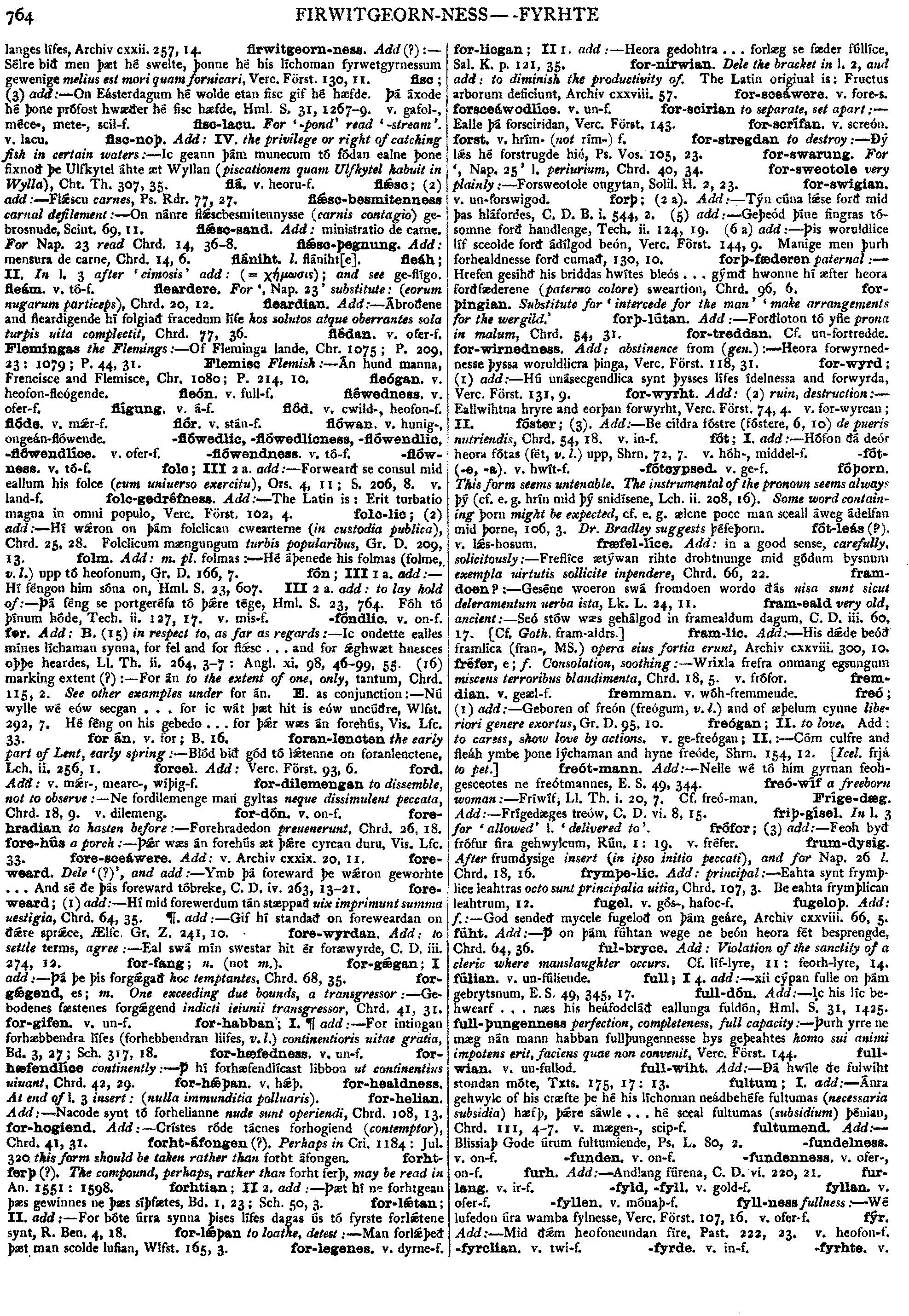
foran-lencten
the
early
part
of
Lent,
early
spring
:--
Blód
bið
gód
tó
ltenne
on
foranlenctene,
Lch.
ii.
256,
1.
|
Source: Bosworth/Toller, page d0768, entry 8 View original page image as: [TIFF] [PNG] [View previous entry] [View next entry] |
[Comment on this entry] [View comments] |
The following entry has been hand-corrected once. |
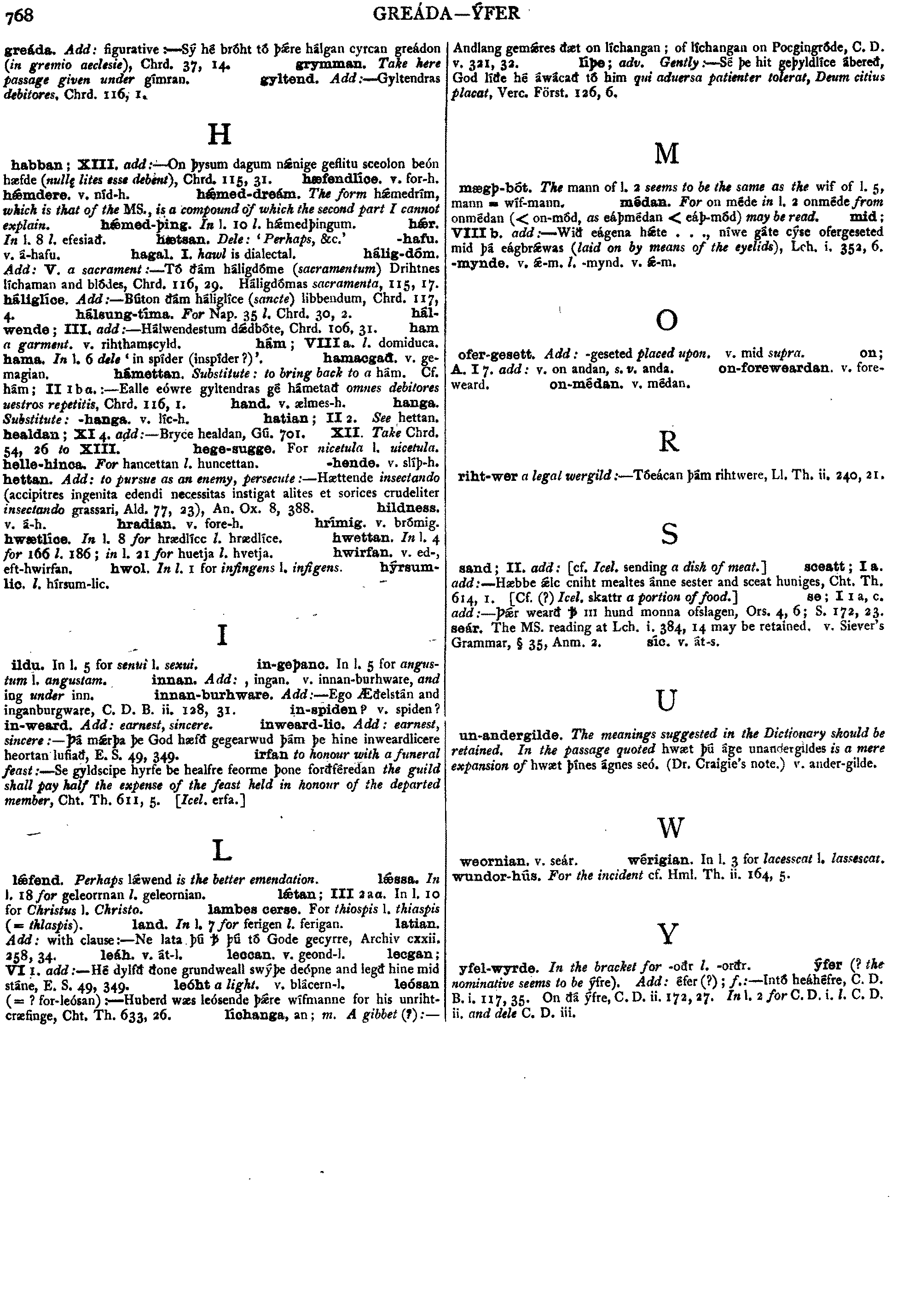
hmed-dream.
The
form
hmedrím,
which
is
that
of
the
MS.,
is
a
compound
of
which
the
second
part
I
cannot
explain.
|
Source: Bright's OE Grammar, page b0266, entry 22 View original page image as: [TIFF] [PNG] [View previous entry] [View next entry] |
[Comment on this entry] [View comments] |
The following entry has been hand-corrected once. |
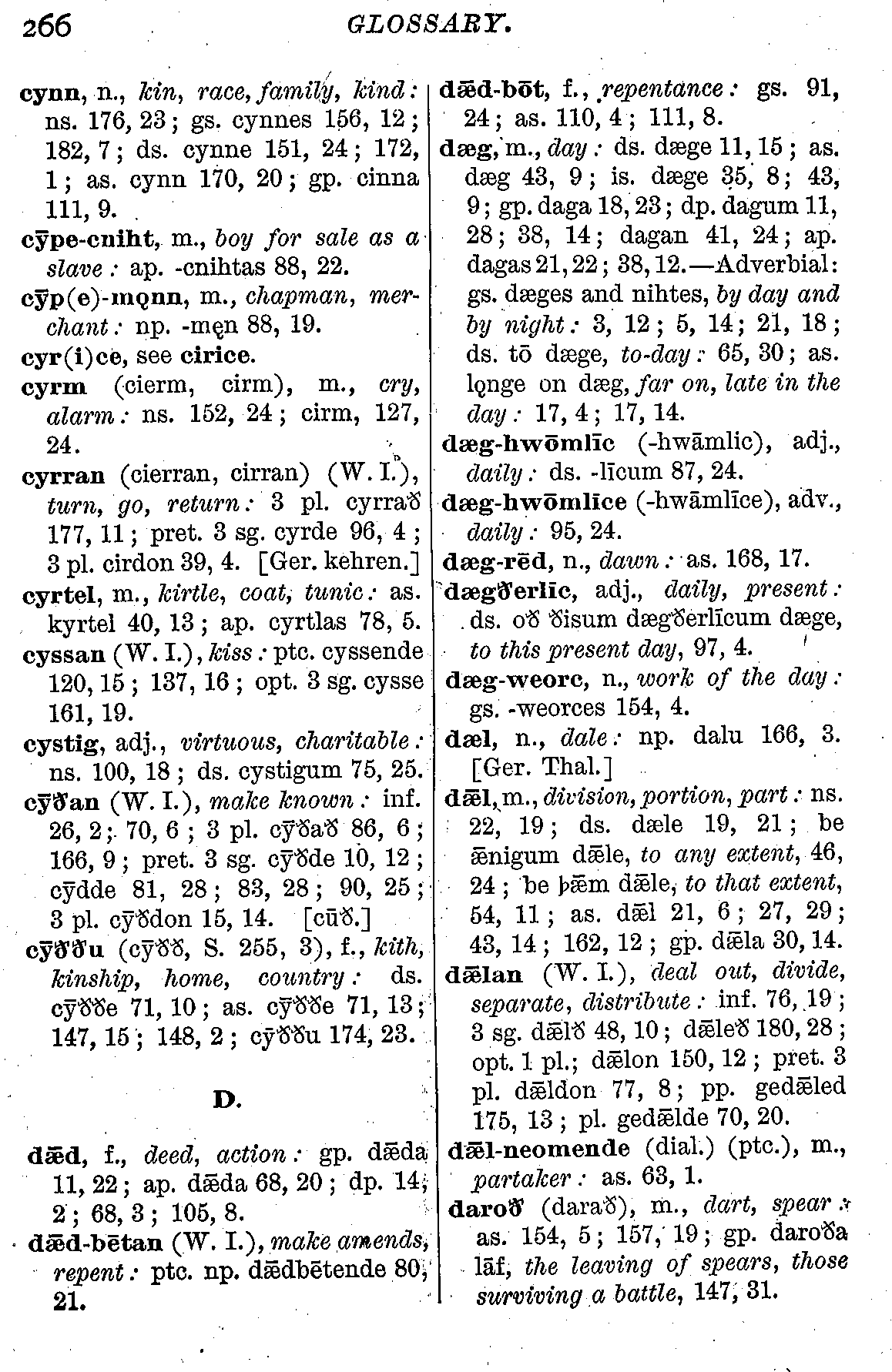
 nigum
dle
to
any
extent
be
þm
dle
to
that
extent
nigum
dle
to
any
extent
be
þm
dle
to
that
extent
|
Source: Bright's OE Grammar, page b0285, entry 25 View original page image as: [TIFF] [PNG] [View previous entry] [View next entry] |
[Comment on this entry] [View comments] |
The following entry has been hand-corrected once. |
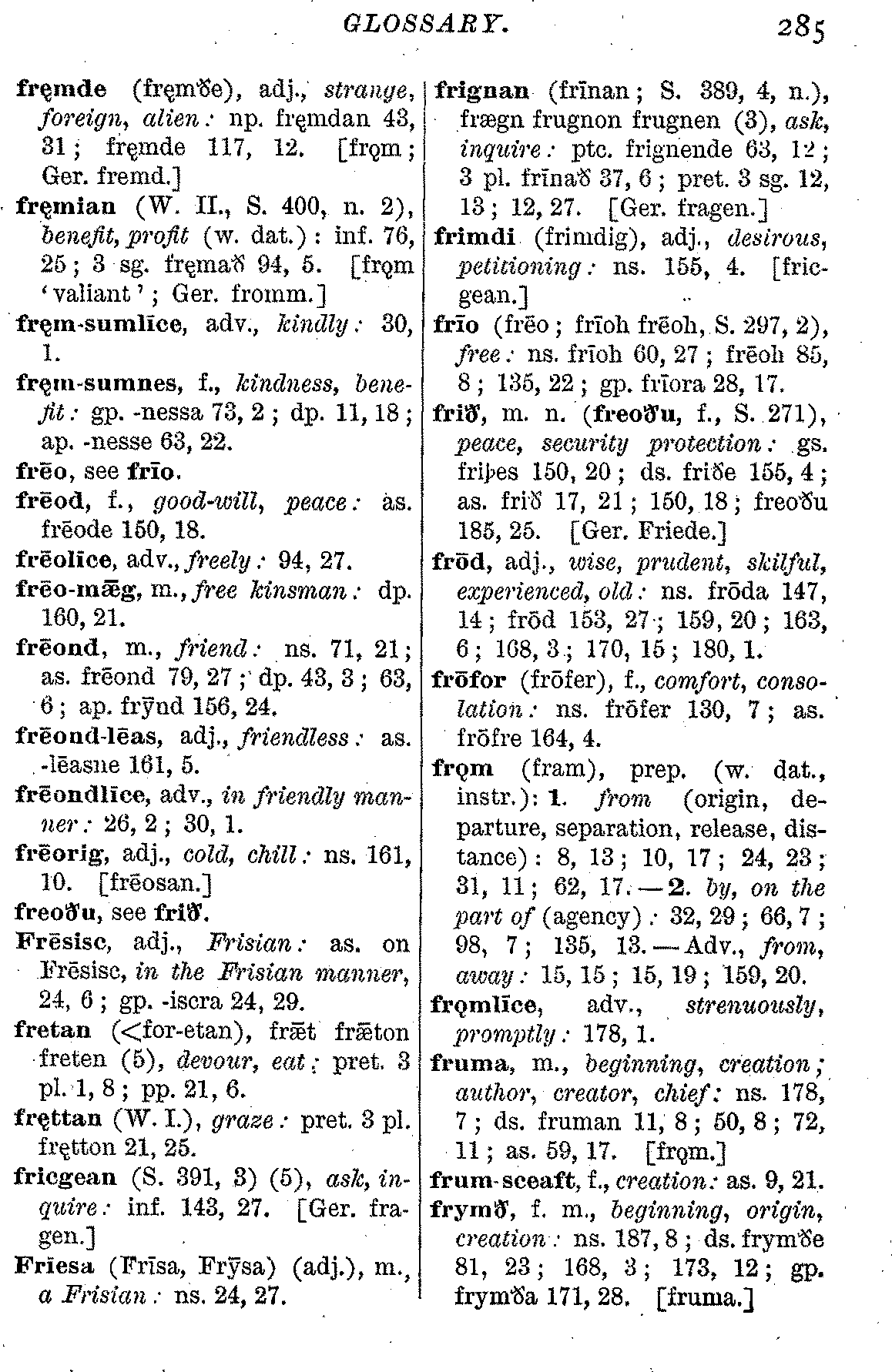
from (fram) prep (w dat instr); adv 1 from (origin, departure, separation, release, distance) 2 by, on the part of (agency) 3 adv from, away
|
Source: Bright's OE Grammar, page b0312, entry 11 View original page image as: [TIFF] [PNG] [View previous entry] [View next entry] |
[Comment on this entry] [View comments] |
The following entry has been hand-corrected once. |
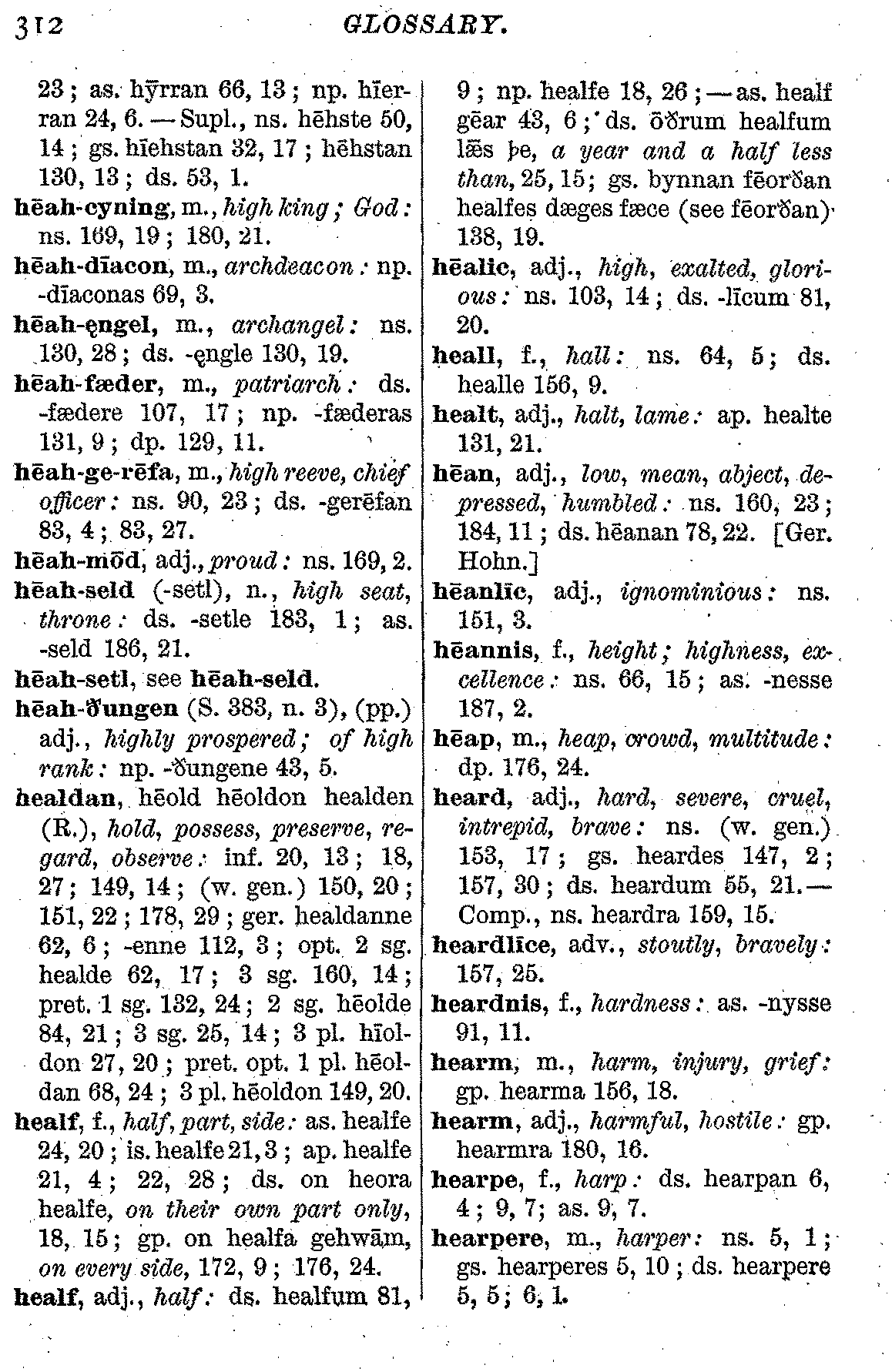
 m
on
every
side
m
on
every
side
|
Source: Bright's OE Grammar, page b0355, entry 33 View original page image as: [TIFF] [PNG] [View previous entry] [View next entry] |
[Comment on this entry] [View comments] |
The following entry has been hand-corrected once. |
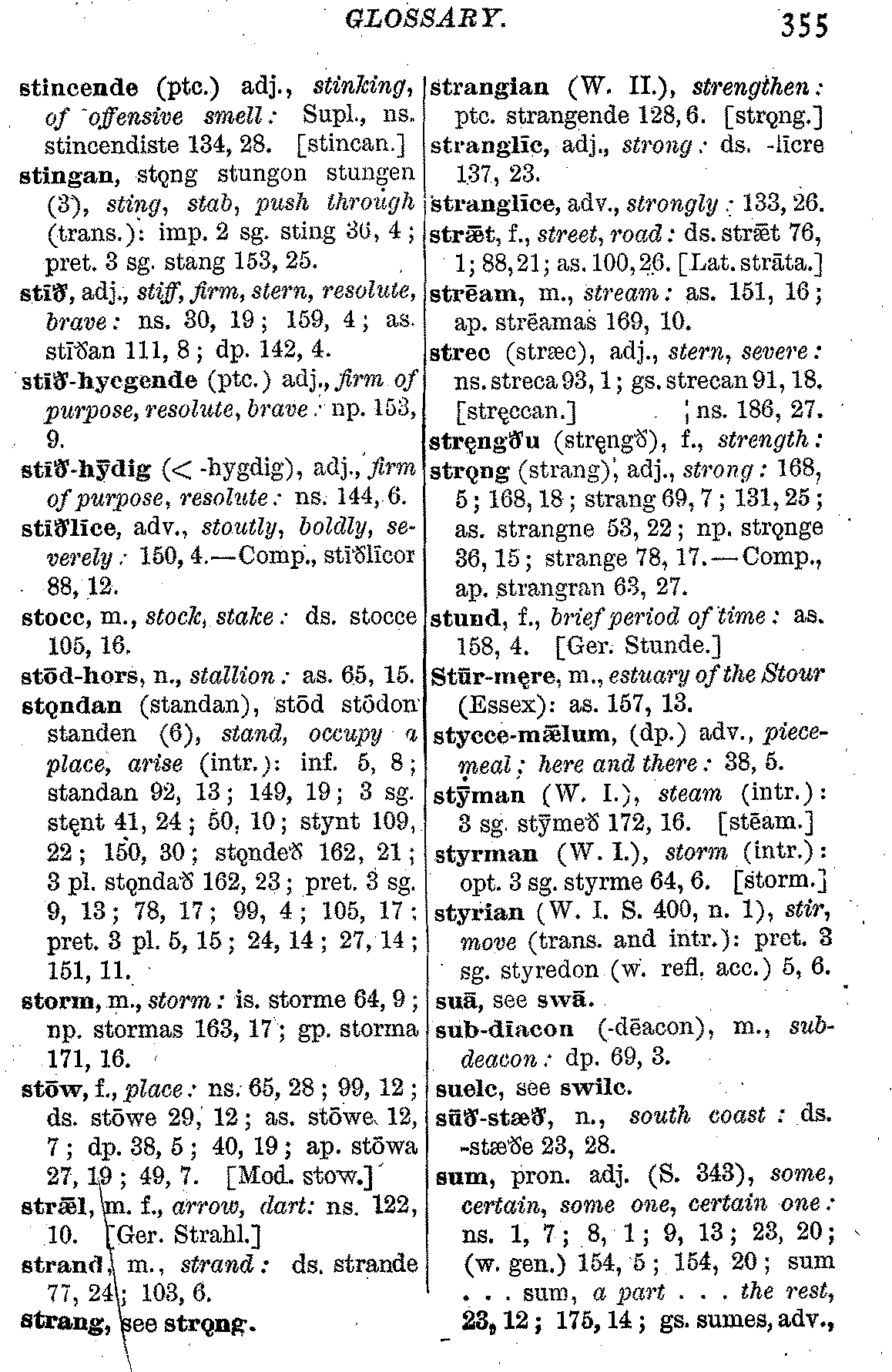
sum pron adj some, certain, some one, certain one (w gen)
sum ... sum a part ... the rest sumes adv somewhat sumum ... sumum sume dæge one day sum hund about a hundred syxa sum one of six (with five others)
|
Source: Cleasby/Vigfusson, page b0001, entry 1 View original page image as: [TIFF] [PNG] [View previous entry] [View next entry] |
[Comment on this entry] [View comments] |
The following entry has been hand-corrected once. |
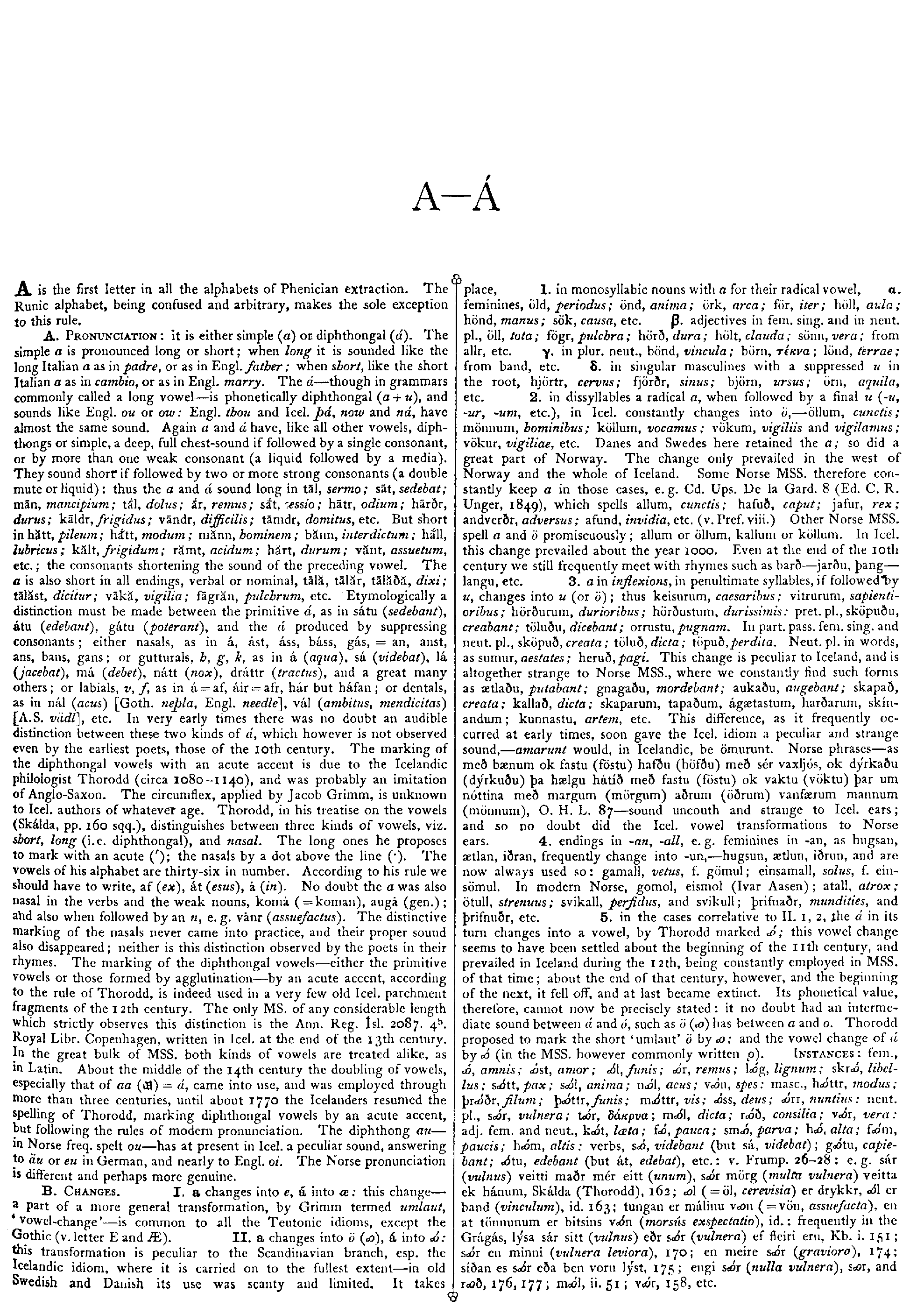
A.
is
the
first
letter
in
all
the
alphabets
of
Phenician
extraction.
The
Runic
alphabet,
being
confused
and
arbitrary,
makes
the
sole
exception
to
this
rule.
A.
PRONUNCIATION:
it
is
either
simple
(a)
or
diphthongal
(á).
The
simple
a
is
pronounced
long
or
short;
when
long
it
is
sounded
like
the
long
Italian
a
as
in
padre,
or
as
in
Engl.
father;
when
short,
like
the
short
Italian
a
as
in
cambio,
or
as
in
Engl.
marry.
The
á
--
though
in
grammars
commonly
called
a
long
vowel
--
is
phonetically
diphthongal
(a
+
u),
and
sounds
like
Engl.
ou
or
ow:
Engl.
thou
and
Icel.
þá,
now
and
ná,
have
almost
the
same
sound.
Again
a
and
á
have,
like
all
other
vowels,
diph-
thongs
or
simple,
a
deep,
full
chest-sound
if
followed
by
a
single
consonant,
or
by
more
than
one
weak
consonant
(a
liquid
followed
by
a
media).
They
sound
short
if
followed
by
two
or
more
strong
consonants
(a
double
mute
or
liquid):
thus
the
a
and
á
sound
long
in
tál,
sermo;
sát,
sedebat;
mán,
mancipium;
tál,
dolus;
ár,
remits;
sát,
sessio,
hátr,
odium;
hárðr,
durus;
káldr,
frigidus;
vándr,
difficilis;
támdr,
domitus,
etc.
But
short
in
hátt,
pileum;
hátt,
modum;
mánn,
bominem;
bánn,
interdictum;
háll,
lubricus;
kált,
frigidum;
rámt,
acidum;
hárt,
durum;
vánt,
assuetum,
etc.;
the
consonants
shortening
the
sound
of
the
preceding
vowel.
The
a
is
also
short
in
all
endings,
verbal
or
nominal,
tala,
talar,
talaða,
dixi;
talast,
dicitur;
vaka,
vigilia;
fagran,
pulchrum,
etc.
Etymologically
a
distinction
must
be
made
between
the
primitive
á,
as
in
sátu
(sedebant),
átu
(edebant),
gátu
(poterant),
and
the
á
produced
by
suppressing
consonants;
either
nasals,
as
in
á,
ást,
áss,
báss,
gás,
=
an,
anst,
ans,
bans,
gans;
or
gutturals,
h,
g,
k,
as
in
á
(aqua),
sá
(videbat),
lá
(jacebat),
má
(debet),
nátt
(nox),
dráttr
(tractus),
and
a
great
many
others;
or
labials,
v,
f,
as
in
á
=
af,
áir
=
afr,
hár
but
háfan;
or
dentals,
as
in
nál
(acus)
[Goth.
nepla,
Engl.
needle],
vál
(ambitus,
mendicitas)
[A.
S.
vädl],
etc.
In
very
early
times
there
was
no
doubt
an
audible
distinction
between
these
two
kinds
of
á,
which
however
is
not
observed
even
by
the
earliest
poets,
those
of
the
10th
century.
The
marking
of
the
diphthongal
vowels
with
an
acute
accent
is
due
to
the
Icelandic
philologist
Thorodd
(circa
1080-1140),
and
was
probably
an
imitation
of
Anglo-Saxon.
The
circumflex,
applied
by
Jacob
Grimm,
is
unknown
to
Icel.
authors
of
whatever
age.
Thorodd,
in
his
treatise
on
the
vowels
(Skálda,
pp.
160
sqq.),
distinguishes
between
three
kinds
of
vowels,
viz.
short,
long
(i.
e.
diphthongal),
and
nasal.
The
long
ones
he
proposes
to
mark
with
an
acute
( );
the
nasals
by
a
dot
above
the
line
(•).
The
vowels
of
his
alphabet
are
thirty-six
in
number.
According
to
his
rule
we
should
have
to
write,
af
(ex),
át
(esus),
ä
(in).
No
doubt
the
a
was
also
nasal
in
the
verbs
and
the
weak
nouns,
komå
(=
koman),
augä
(gen.);
and
also
when
followed
by
an
n,
e.
g.
vänr
(assuefactus).
The
distinctive
marking
of
the
nasals
never
came
into
practice,
and
their
proper
sound
also
disappeared;
neither
is
this
distinction
observed
by
the
poets
in
their
rhymes.
The
marking
of
the
diphthongal
vowels
--
either
the
primitive
vowels
or
those
formed
by
agglutination
--
by
an
acute
accent,
according
to
the
rule
of
Thorodd,
is
indeed
used
in
a
very
few
old
Icel.
parchment
fragments
of
the
12th
century.
The
only
MS.
of
any
considerable
length
which
strictly
observes
this
distinction
is
the
Ann.
Reg.
Ísl.
2087.
4b.
Royal
Libr.
Copenhagen,
written
in
Icel.
at
the
end
of
the
13th
century.
In
the
great
bulk
of
MSS.
both
kinds
of
vowels
are
treated
alike,
as
in
Latin.
About
the
middle
of
the
14th
century
the
doubling
of
vowels,
especially
that
of
aa
()
=
á,
came
into
use,
and
was
employed
through
more
than
three
centuries,
until
about
1770
the
Icelanders
resumed
the
spelling
of
Thorodd,
marking
diphthongal
vowels
by
an
acute
accent,
but
following
the
rules
of
modern
pronunciation.
The
diphthong
au
--
in
Norse
freq.
spelt
ou
--
has
at
present
in
Icel.
a
peculiar
sound,
answering
to
äu
or
eu
in
German,
and
nearly
to
Engl.
oi.
The
Norse
pronunciation
is
different
and
perhaps
more
genuine.
B.
CHANGES.
I.
a
changes
into
æ,
á
into
Æ:
this
change
--
a
part
of
a
more
general
transformation,
by
Grimm
termed
umlaut,
'vowel-change'
--
is
common
to
all
the
Teutonic
idioms,
except
the
Gothic
(v.
letter
E
and
Æ).
II.
a
changes
into
ö
(),
á
into
:
this
transformation
is
peculiar
to
the
Scandinavian
branch,
esp.
the
Icelandic
idiom,
where
it
is
carried
on
to
the
fullest
extent
--
in
old
Swedish
and
Danish
its
use
was
scanty
and
limited.
It
takes
place,
1.
in
monosyllabic
nouns
with
a
for
their
radical
vowel,
.
feminines,
öld,
periodus;
önd,
anima;
örk,
arca;
för,
iter;
höll,
aula;
hönd,
manus;
sök,
causa,
etc.
);
the
nasals
by
a
dot
above
the
line
(•).
The
vowels
of
his
alphabet
are
thirty-six
in
number.
According
to
his
rule
we
should
have
to
write,
af
(ex),
át
(esus),
ä
(in).
No
doubt
the
a
was
also
nasal
in
the
verbs
and
the
weak
nouns,
komå
(=
koman),
augä
(gen.);
and
also
when
followed
by
an
n,
e.
g.
vänr
(assuefactus).
The
distinctive
marking
of
the
nasals
never
came
into
practice,
and
their
proper
sound
also
disappeared;
neither
is
this
distinction
observed
by
the
poets
in
their
rhymes.
The
marking
of
the
diphthongal
vowels
--
either
the
primitive
vowels
or
those
formed
by
agglutination
--
by
an
acute
accent,
according
to
the
rule
of
Thorodd,
is
indeed
used
in
a
very
few
old
Icel.
parchment
fragments
of
the
12th
century.
The
only
MS.
of
any
considerable
length
which
strictly
observes
this
distinction
is
the
Ann.
Reg.
Ísl.
2087.
4b.
Royal
Libr.
Copenhagen,
written
in
Icel.
at
the
end
of
the
13th
century.
In
the
great
bulk
of
MSS.
both
kinds
of
vowels
are
treated
alike,
as
in
Latin.
About
the
middle
of
the
14th
century
the
doubling
of
vowels,
especially
that
of
aa
()
=
á,
came
into
use,
and
was
employed
through
more
than
three
centuries,
until
about
1770
the
Icelanders
resumed
the
spelling
of
Thorodd,
marking
diphthongal
vowels
by
an
acute
accent,
but
following
the
rules
of
modern
pronunciation.
The
diphthong
au
--
in
Norse
freq.
spelt
ou
--
has
at
present
in
Icel.
a
peculiar
sound,
answering
to
äu
or
eu
in
German,
and
nearly
to
Engl.
oi.
The
Norse
pronunciation
is
different
and
perhaps
more
genuine.
B.
CHANGES.
I.
a
changes
into
æ,
á
into
Æ:
this
change
--
a
part
of
a
more
general
transformation,
by
Grimm
termed
umlaut,
'vowel-change'
--
is
common
to
all
the
Teutonic
idioms,
except
the
Gothic
(v.
letter
E
and
Æ).
II.
a
changes
into
ö
(),
á
into
:
this
transformation
is
peculiar
to
the
Scandinavian
branch,
esp.
the
Icelandic
idiom,
where
it
is
carried
on
to
the
fullest
extent
--
in
old
Swedish
and
Danish
its
use
was
scanty
and
limited.
It
takes
place,
1.
in
monosyllabic
nouns
with
a
for
their
radical
vowel,
.
feminines,
öld,
periodus;
önd,
anima;
örk,
arca;
för,
iter;
höll,
aula;
hönd,
manus;
sök,
causa,
etc.
 .
adjectives
in
fem.
sing,
and
in
neut.
pl.,
öll,
tota;
fögr,
pulchra;
hörð,
dura;
hölt,
clauda;
sönn,
vera;
from
allr,
etc.
.
in
plur.
neut.,
bönd,
vincula;
börn,
GREEK;
lönd,
terrae;
from
band,
etc.
.
adjectives
in
fem.
sing,
and
in
neut.
pl.,
öll,
tota;
fögr,
pulchra;
hörð,
dura;
hölt,
clauda;
sönn,
vera;
from
allr,
etc.
.
in
plur.
neut.,
bönd,
vincula;
börn,
GREEK;
lönd,
terrae;
from
band,
etc.
 .
in
singular
masculines
with
a
suppressed
u
in
the
root,
hjörtr,
cervus;
fjörðr,
sinus;
björn,
ursus;
örn,
aquila,
etc.
2.
in
dissyllables
a
radical
a,
when
followed
by
a
final
u
(-u,
-ur,
-um,
etc.),
in
Icel.
constantly
changes
into
ö,
--
öllum,
cunctis;
mönnum,
hominibus;
köllum,
vocamus;
vökum,
vigiliis
and
vigilamus;
vökur,
vigiliae,
etc.
Danes
and
Swedes
here
retained
the
a;
so
did
a
great
part
of
Norway.
The
change
only
prevailed
in
the
west
of
Norway
and
the
whole
of
Iceland.
Some
Norse
MSS.
therefore
con-
stantly
keep
a
in
those
cases,
e.
g.
Cd.
Ups.
De
la
Gard.
8
(Ed.
C.
R.
Unger,
1849),
which
spells
allum,
cunctis;
hafuð,
caput;
jafur,
rex;
andverðr,
adversus;
afund,
invidia,
etc.
(v.
Pref.
viii.)
Other
Norse
MSS.
spell
a
and
ö
promiscuously;
allum
or
öllum,
kallum
or
köllum.
In
Icel.
this
change
prevailed
about
the
year
1000.
Even
at
the
end
of
the
loth
century
we
still
frequently
meet
with
rhymes
such
as
barð
--
jarðu,
þang
--
langu,
etc.
3.
a
in
inflexions,
in
penultimate
syllables,
if
followed
by
u,
changes
into
u
(or
ö);
thus
keisurum,
caesaribus;
vitrurum,
sapienti-
oribus;
hörðurum,
durioribus;
hörðustum,
durissimis:
pret.
pl.,
sköpuðu,
creabant;
töluðu,
dicebant;
orrustu,
pugnam.
In
part.
pass.
fem.
sing,
and
neut.
pl.,
sköpuð,
creata;
töluð,
dicta;
töpuð,
perdi/
a.
Neut.
pl.
in
words,
as
sumur,
aestates;
heruð,
pagi.
This
change
is
peculiar
to
Iceland,
and
is
altogether
strange
to
Norse
MSS.,
where
we
constantly
find
such
forms
as
ætlaðu,
putabant;
gnagaðu,
mordebant;
aukaðu,
augebant;
skapað,
creata;
kallað,
dicta;
skaparum,
tapaðum,
ágætastum,
harðarum,
skín-
andum;
kunnastu,
artem,
etc.
This
difference,
as
it
frequently
oc-
curred
at
early
times,
soon
gave
the
Icel.
idiom
a
peculiar
and
strange
sound,
--
amarunt
would,
in
Icelandic,
be
ömurunt.
Norse
phrases
--
as
með
bænum
ok
fastu
(fostu)
hafðu
(höfðu)
með
sér
vaxljós,
ok
dýrkaðu
(dýrkuðu)
þa
hælgu
hátíð
með
fastu
(föstu)
ok
vaktu
(vöktu)
þar
um
nóttina
með
margum
(mörgum)
aðrum
(öðrum)
vanfærum
mannum
(monnum),
O.
H.
L.
87
--
sound
uncouth
and
strange
to
Icel.
ears;
and
so
no
doubt
did
the
Icel.
vowel
transformations
to
Norse
ears.
4.
endings
in
-an,
-all,
e.
g.
feminines
in
-an,
as
hugsan,
ætlan,
iðran,
frequently
change
into
-un,
--
hugsun,
ætlun,
iðrun,
and
are
now
always
used
so:
gamall,
vetus,
f.
gömul;
einsamall,
solus,
f.
ein-
sömul.
In
modern
Norse,
gomol,
eismol
(Ivar
Aasen);
atall,
atrox;
ötull,
strenuus;
svikall,
perfidus,
and
svikull;
þrifnaðr,
mundities,
and
þrifnuðr,
etc.
5.
in
the
cases
correlative
to
II.
1,
2,
the
á
in
its
turn
changes
into
a
vowel,
by
Thorodd
marked
;
this
vowel
change
seems
to
have
been
settled
about
the
beginning
of
the
11th
century,
and
prevailed
in
Iceland
during
the
12th,
being
constantly
employed
in
MSS.
of
that
time;
about
the
end
of
that
century,
however,
and
the
beginning
of
the
next,
it
fell
off,
and
at
last
became
extinct.
Its
phonetical
value,
therefore,
cannot
now
be
precisely
stated:
it
no
doubt
had
an
interme-
diate
sound
between
á
and
ó,
such
as
ö
(oo)
has
between
a
and
o.
Thorodd
proposed
to
mark
the
short
'umlaut'
ö
by
;
and
the
vowel
change
of
á
by
(in
the
MSS.
however
commonly
written
).
INSTANCES:
fcm.,
,
amnis;
st,
amor;
l,
funis;
r,
remits;
lg,
lignum;
skr,
libel-
lus;
stt,
pax;
sl,
anima;
nl,
acus;
vn,
spes:
masc.,
httr,
modus;
þrðr,
fîlum;
þttr,
funis;
mttr,
vis;
ss,
deus;
rr,
nuntius:
neut.
pl.,
sr,
vulnera;
tr,
GREEK;
ml,
dicta;
rð,
consilia;
vr,
vera:
adj.
fem,
and
neut.,
koát,
læta;
f,
pauca;
sm,
parva;
h,
alta;
fm,
paucis;
hm,
altis:
verbs,
s,
videbant
(but
sá,
videbat);
gtu,
capie-
bant;
tu,
edebant
(but
at,
edebat),
etc.:
v.
Frump.
26-28:
e.
g.
sár
(vulnus)
veitti
maðr
mer
eitt
(unum),
sr
mörg
(multa
vulnera)
veitta
ek
hánum,
Skálda
(Thorodd),
162;
l
(=
öl,
cerevisia)
er
drykkr,
l
er
band
(vinculum),
id.
163;
tungan
er
málinu
vn
(=
vön,
assuefacta),
en
at
tönnunum
er
bitsins
vn
(morsils
exspectatio),
id.:
frequently
in
the
Grágás,
lýsa
sár
sitt
(vulnus)
eðr
sr
(vulnera)
ef
fleiri
eru,
Kb.
i.
151;
sr
en
minni
(vulnera
leviora),
170;
en
meire
sr
(graviora),
174;
síðan
es
sr
eða
ben
voru
lýst,
175;
engi
sr
(nulla
vulnera),
sr,
and
rð,
176,
177;
ml,
ii.
51;
vr,
158,
.
in
singular
masculines
with
a
suppressed
u
in
the
root,
hjörtr,
cervus;
fjörðr,
sinus;
björn,
ursus;
örn,
aquila,
etc.
2.
in
dissyllables
a
radical
a,
when
followed
by
a
final
u
(-u,
-ur,
-um,
etc.),
in
Icel.
constantly
changes
into
ö,
--
öllum,
cunctis;
mönnum,
hominibus;
köllum,
vocamus;
vökum,
vigiliis
and
vigilamus;
vökur,
vigiliae,
etc.
Danes
and
Swedes
here
retained
the
a;
so
did
a
great
part
of
Norway.
The
change
only
prevailed
in
the
west
of
Norway
and
the
whole
of
Iceland.
Some
Norse
MSS.
therefore
con-
stantly
keep
a
in
those
cases,
e.
g.
Cd.
Ups.
De
la
Gard.
8
(Ed.
C.
R.
Unger,
1849),
which
spells
allum,
cunctis;
hafuð,
caput;
jafur,
rex;
andverðr,
adversus;
afund,
invidia,
etc.
(v.
Pref.
viii.)
Other
Norse
MSS.
spell
a
and
ö
promiscuously;
allum
or
öllum,
kallum
or
köllum.
In
Icel.
this
change
prevailed
about
the
year
1000.
Even
at
the
end
of
the
loth
century
we
still
frequently
meet
with
rhymes
such
as
barð
--
jarðu,
þang
--
langu,
etc.
3.
a
in
inflexions,
in
penultimate
syllables,
if
followed
by
u,
changes
into
u
(or
ö);
thus
keisurum,
caesaribus;
vitrurum,
sapienti-
oribus;
hörðurum,
durioribus;
hörðustum,
durissimis:
pret.
pl.,
sköpuðu,
creabant;
töluðu,
dicebant;
orrustu,
pugnam.
In
part.
pass.
fem.
sing,
and
neut.
pl.,
sköpuð,
creata;
töluð,
dicta;
töpuð,
perdi/
a.
Neut.
pl.
in
words,
as
sumur,
aestates;
heruð,
pagi.
This
change
is
peculiar
to
Iceland,
and
is
altogether
strange
to
Norse
MSS.,
where
we
constantly
find
such
forms
as
ætlaðu,
putabant;
gnagaðu,
mordebant;
aukaðu,
augebant;
skapað,
creata;
kallað,
dicta;
skaparum,
tapaðum,
ágætastum,
harðarum,
skín-
andum;
kunnastu,
artem,
etc.
This
difference,
as
it
frequently
oc-
curred
at
early
times,
soon
gave
the
Icel.
idiom
a
peculiar
and
strange
sound,
--
amarunt
would,
in
Icelandic,
be
ömurunt.
Norse
phrases
--
as
með
bænum
ok
fastu
(fostu)
hafðu
(höfðu)
með
sér
vaxljós,
ok
dýrkaðu
(dýrkuðu)
þa
hælgu
hátíð
með
fastu
(föstu)
ok
vaktu
(vöktu)
þar
um
nóttina
með
margum
(mörgum)
aðrum
(öðrum)
vanfærum
mannum
(monnum),
O.
H.
L.
87
--
sound
uncouth
and
strange
to
Icel.
ears;
and
so
no
doubt
did
the
Icel.
vowel
transformations
to
Norse
ears.
4.
endings
in
-an,
-all,
e.
g.
feminines
in
-an,
as
hugsan,
ætlan,
iðran,
frequently
change
into
-un,
--
hugsun,
ætlun,
iðrun,
and
are
now
always
used
so:
gamall,
vetus,
f.
gömul;
einsamall,
solus,
f.
ein-
sömul.
In
modern
Norse,
gomol,
eismol
(Ivar
Aasen);
atall,
atrox;
ötull,
strenuus;
svikall,
perfidus,
and
svikull;
þrifnaðr,
mundities,
and
þrifnuðr,
etc.
5.
in
the
cases
correlative
to
II.
1,
2,
the
á
in
its
turn
changes
into
a
vowel,
by
Thorodd
marked
;
this
vowel
change
seems
to
have
been
settled
about
the
beginning
of
the
11th
century,
and
prevailed
in
Iceland
during
the
12th,
being
constantly
employed
in
MSS.
of
that
time;
about
the
end
of
that
century,
however,
and
the
beginning
of
the
next,
it
fell
off,
and
at
last
became
extinct.
Its
phonetical
value,
therefore,
cannot
now
be
precisely
stated:
it
no
doubt
had
an
interme-
diate
sound
between
á
and
ó,
such
as
ö
(oo)
has
between
a
and
o.
Thorodd
proposed
to
mark
the
short
'umlaut'
ö
by
;
and
the
vowel
change
of
á
by
(in
the
MSS.
however
commonly
written
).
INSTANCES:
fcm.,
,
amnis;
st,
amor;
l,
funis;
r,
remits;
lg,
lignum;
skr,
libel-
lus;
stt,
pax;
sl,
anima;
nl,
acus;
vn,
spes:
masc.,
httr,
modus;
þrðr,
fîlum;
þttr,
funis;
mttr,
vis;
ss,
deus;
rr,
nuntius:
neut.
pl.,
sr,
vulnera;
tr,
GREEK;
ml,
dicta;
rð,
consilia;
vr,
vera:
adj.
fem,
and
neut.,
koát,
læta;
f,
pauca;
sm,
parva;
h,
alta;
fm,
paucis;
hm,
altis:
verbs,
s,
videbant
(but
sá,
videbat);
gtu,
capie-
bant;
tu,
edebant
(but
at,
edebat),
etc.:
v.
Frump.
26-28:
e.
g.
sár
(vulnus)
veitti
maðr
mer
eitt
(unum),
sr
mörg
(multa
vulnera)
veitta
ek
hánum,
Skálda
(Thorodd),
162;
l
(=
öl,
cerevisia)
er
drykkr,
l
er
band
(vinculum),
id.
163;
tungan
er
málinu
vn
(=
vön,
assuefacta),
en
at
tönnunum
er
bitsins
vn
(morsils
exspectatio),
id.:
frequently
in
the
Grágás,
lýsa
sár
sitt
(vulnus)
eðr
sr
(vulnera)
ef
fleiri
eru,
Kb.
i.
151;
sr
en
minni
(vulnera
leviora),
170;
en
meire
sr
(graviora),
174;
síðan
es
sr
eða
ben
voru
lýst,
175;
engi
sr
(nulla
vulnera),
sr,
and
rð,
176,
177;
ml,
ii.
51;
vr,
158,
|
Source: Cleasby/Vigfusson, page b0002, entry 3 View original page image as: [TIFF] [PNG] [View previous entry] [View next entry] |
[Comment on this entry] [View comments] |
The following entry has been hand-corrected once. |
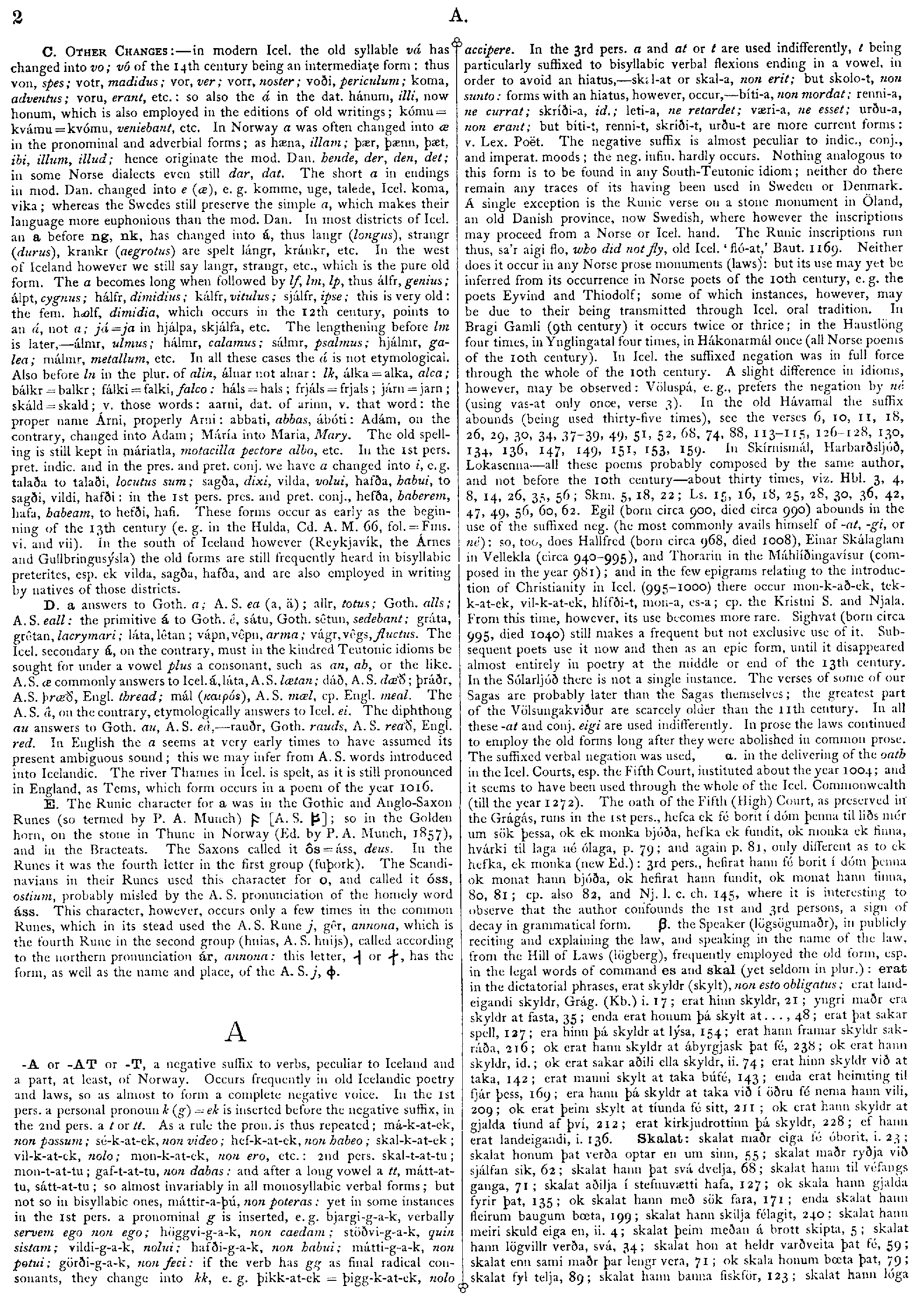
-A
or
-AT
or
-T,
a
negative
suffix
to
verbs,
peculiar
to
Iceland
and
a
part,
at
least,
of
Norway.
Occurs
frequently
in
old
Icelandic
poetry
and
laws,
so
as
almost
to
form
a
complete
negative
voice.
In
the
1st
pers.
a
personal
pronoun
k
(g)
=
ek
is
inserted
before
the
negative
suffix,
in
the
2nd
pers.
a
t
or
tt.
As
a
rule
the
pron.
as
thus
repeated;
má-k-at-ek,
non
possum;
sé-k-at-ek,
non
video;
hef-k-at-ek,
non
habeo;
skal-k-at-ek;
vil-k-at-ek,
nolo;
mon-k-at-ek,
non
ero,
etc.:
2nd
pers.
skal-t-at-tu;
mon-t-at-tu;
gaf-t-at-tu,
non
dabas:
and
after
a
long
vowel
a
tt,
mátt-at-
tu,
sátt-at-tu;
so
almost
invariably
in
all
monosyllabic
verbal
forms;
but
not
so
in
bisyllabic
ones,
máttir-a-þú,
non
poteras:
yet
in
some
instances
in
the
1st
pers.
a
pronominal
g
is
inserted,
e.
g.
bjargi-g-a-k,
verbally
servem
ego
non
ego;
höggvi-g-a-k,
non
cædam;
stöðvi-g-a-k,
quin
sistam;
vildi-g-a-k,
nolui;
hafði-g-a-k,
non
babui;
mátti-g-a-k,
non
potui;
görði-g-a-k,
non
feci:
if
the
verb
has
gg
as
final
radical
con-
sonants,
they
change
into
kk,
e.
g.
þikk-at-ek
=
þigg-k-at-ek,
nolo
accipere.
In
the
3rd
pers.
a
and
at
or
t
are
used
indifferently,
t
being
particularly
suffixed
to
bisyllabic
verbal
flexions
ending
in
a
vowel,
in
order
to
avoid
an
hiatus,
--
skal-at
or
skal-a,
non
erit;
but
skolo-t,
non
sunto:
forms
with
an
hiatus,
however,
occur,
--
bítí-a,
non
mordat;
renni-a,
ne
currat;
skríði-a,
id.;
leti-a,
ne
retardet;
vaeri-a,
ne
esset;
urðu-a,
non
erant;
but
bíti-t,
renni-t,
skríði-t,
urðu-t
are
more
current
forms:
v.
Lex.
Poët.
The
negative
suffix
is
almost
peculiar
to
indic.,
conj.,
and
imperat.
moods;
the
neg.
infin.
hardly
occurs.
Nothing
analogous
to
this
form
is
to
be
found
in
any
South-Teutonic
idiom;
neither
do
there
remain
any
traces
of
its
having
been
used
in
Sweden
or
Denmark.
A
single
exception
is
the
Runic
verse
on
a
stone
monument
in
Öland,
an
old
Danish
province,
now
Swedish,
where
however
the
inscriptions
may
proceed
from
a
Norse
or
Icel.
hand.
The
Runic
inscriptions
run
thus,
sár
aigi
flo,
who
did
not
fly,
old
Icel.
'flo-at,'
Baut.
1169.
Neither
does
it
occur
in
any
Norse
prose
monuments
(laws):
but
its
use
may
yet
be
inferred
from
its
occurrence
in
Norse
poets
of
the
10th
century,
e.
g.
the
poets
Eyvind
and
Thiodolf;
some
of
which
instances,
however,
may
be
due
to
their
being
transmitted
through
Icel.
oral
tradition.
In
Bragi
Gamli
(9th
century)
it
occurs
twice
or
thrice;
in
the
Haustlöng
four
times,
in
Ynglingatal
four
times,
in
Hákonarmál
once
(all
Norse
poems
of
the
10th
century).
In
Icel.
the
suffixed
negation
was
in
full
force
through
the
whole
of
the
10th
century.
A
slight
difference
in
idioms,
however,
may
be
observed:
Völuspá,
e.
g.,
prefers
the
negation
by
né
(using
vas-at
only
once,
verse
3).
In
the
old
Hávamal
the
suffix
abounds
(being
used
thirty-five
times),
see
the
verses
6,
10,
11,
18,
26,
29,
30,
34,
37-39,
49,
51,
52,
68,
74,
88,
113-115,
126-128,
130,
134,
136,
147,
149,
151,
153,
159.
In
Skírnismál,
Harbarðsljóð,
Lokasenna
--
all
these
poems
probably
composed
by
the
same
author,
and
not
before
the
loth
century
--
about
thirty
times,
viz.
Hbl.
3,
4,
8,
14,
26,
35,
56;
Skm.
5,
18,
22;
Ls.
15,
16,
18,
25,
28,
30,
36,
42,
47,
49,
56,
60,
62.
Egil
(born
circa
900,
died
circa
990)
abounds
in
the
use
of
the
suffixed
neg.
(he
most
commonly
avails
himself
of
-at,
-gi,
or
né;
so,
too,
does
Hallfred
(born
circa
968,
died
1008),
Einar
Skálaglam
in
Vellekla
(circa
940-995),
and
Thorarin
in
the
Máhlíðingavísur
(com-
posed
in
the
year
981);
and
in
the
few
epigrams
relating
to
the
introduc-
tion
of
Christianity
in
Icel.
(995-1000)
there
occur
mon-k-að-ek,
tek-
k-at-ek,
vil-k-at-ek,
hlífði-t,
mon-a,
es-a;
cp.
the
Kristni
S.
and
Njala.
From
this
time,
however,
its
use
becomes
more
rare.
Sighvat
(born
circa
995,
died
1040)
still
makes
a
frequent
but
not
exclusive
use
of
it.
Sub-
sequent
poets
use
it
now
and
then
as
an
epic
form,
until
it
disappeared
almost
entirely
in
poetry
at
the
middle
or
end
of
the
13th
century.
In
the
Sólarljóð
there
is
not
a
single
instance.
The
verses
of
some
of
our
Sagas
are
probably
later
than
the
Sagas
themselves;
the
greatest
part
of
the
Völsungakviður
are
scarcely
older
than
the
11th
century.
In
all
these
-at
and
conj.
eigi
are
used
indifferently.
In
prose
the
laws
continued
to
employ
the
old
forms
long
after
they
were
abolished
in
common
prose.
The
suffixed
verbal
negation
was
used,
a.
in
the
delivering
of
the
oath
in
the
Icel.
Courts,
esp.
the
Fifth
Court,
instituted
about
the
year
1004;
and
it
seems
to
have
been
used
through
the
whole
of
the
Icel.
Commonwealth
(till
the
year
1272).
The
oath
of
the
Fifth
(High)
Court,
as
preserved
in
the
Grágás,
runs
in
the
1st
pers.,
hefka
ek
fé
borit
í
dóm
þenna
til
liðs
mér
um
sök
þessa,
ok
ek
monka
bjóða,
hefka
ek
fundit,
ok
monka
ek
finna,
hvárki
til
laga
né
ólaga,
p.
79;
and
again
p.
81,
only
different
as
to
ek
hefka,
ek
monka
(new
Ed.):
3rd
pers.,
hefirat
hann
fé;
borit
í
dóm
þenna
ok
monat
hann
bjóða,
ok
hefirat
hann
fundit,
ok
monat
hann
tinna,
80,
81;
cp.
also
82,
and
Nj.
l.
c.
ch.
145,
where
it
is
interesting
to
observe
that
the
author
confounds
the
ist
and
3rd
persons,
a
sign
of
decay
in
grammatical
form.
.
the
Speaker
(lögsögumaðr),
in
publicly
reciting
and
explaining
the
law,
and
speaking
in
the
name
of
the
law,
from
the
Hill
of
Laws
(lögberg),
frequently
employed
the
old
form,
esp.
in
the
legal
words
of
command
es
and
skal
(yet
seldom
in
plur.):
erat
in
the
dictatorial
phrases,
erat
skyldr
(skylt),
non
esto
obligatus;
erat
land-
eigandi
skyldr,
Grág.
(Kb.)
i.
17;
erat
hinn
skyldr,
21;
yngri
maðr
era
skyldr
at
fasta,
35;
enda
erat
honum
þá
skylt
at
...,
48;
erat
þat
sakar
spell,
127;
era
hinn
þá
skyldr
at
lýsa,
154;
erat
hann
framar
skyldr
sak-
ráða,
216;
ok
erat
hann
skyldr
at
ábyrgjask
þat
fé,
238;
ok
erat
hann
skyldr,
id.;
ok
erat
sakar
aðili
ella
skyldr,
ii.
74;
erat
hinn
skyldr
við
at
taka,
142;
erat
manni
skylt
at
taka
búfé,
143;
enda
erat
heimting
til
fjár
þess,
169;
era
hann
þá
skyldr
at
taka
við
í
öðru
fé
nema
hann
vili,
209;
ok
erat
þeim
skylt
at
tíunda
fé
sitt,
211;
ok
erat
hann
skyldr
at
gjalda
tíund
af
því,
212;
erat
kirkjudrottinn
þá
skyldr,
228;
ef
hann
erat
landeigaadi,
i.
136.
Skalat:
skalat
maðr
eiga
fó
óborit,
i.
23;
skalat
homum
þat
verða
optar
en
um
siun,
55;
skalat
maðr
ryðja
við
sjálfan
sik,
62;
skalat
hann
þat
svá
dvelja,
68;
skalat
hann
til
véfangs
ganga,
71;
skalat
aðilja
í
stefnuvætti
hafa,
127;
ok
skala
hann
gjalda
fyrir
þat,
135;
ok
skalat
hann
með
sök
fara,
171;
enda
skalat
hann
fleirum
baugum
bœta,
199;
skalat
hann
skilja
félagit,
240;
skalat
hann
meiri
skuld
eiga
en,
ii.
4;
skalat
þeim
meðan
á
brott
skipta,
5;
skalat
hann
lögvillr
verða,
svá,
34;
skalat
hon
at
heldr
varðveita
þat
fé,
59;
í
skalat
enn
sami
maðr
þar
lengr
vera,
71;
ok
skala
honum
bæta
þat,
79;
skalat
fyl
telja,
89;
skalat
hann
banna
fiskför,
123;
skalat
hann
lóga
|
Source: Cleasby/Vigfusson, page b0003, entry 7 View original page image as: [TIFF] [PNG] [View previous entry] [View next entry] |
[Comment on this entry] [View comments] |
The following entry has been hand-corrected once. |
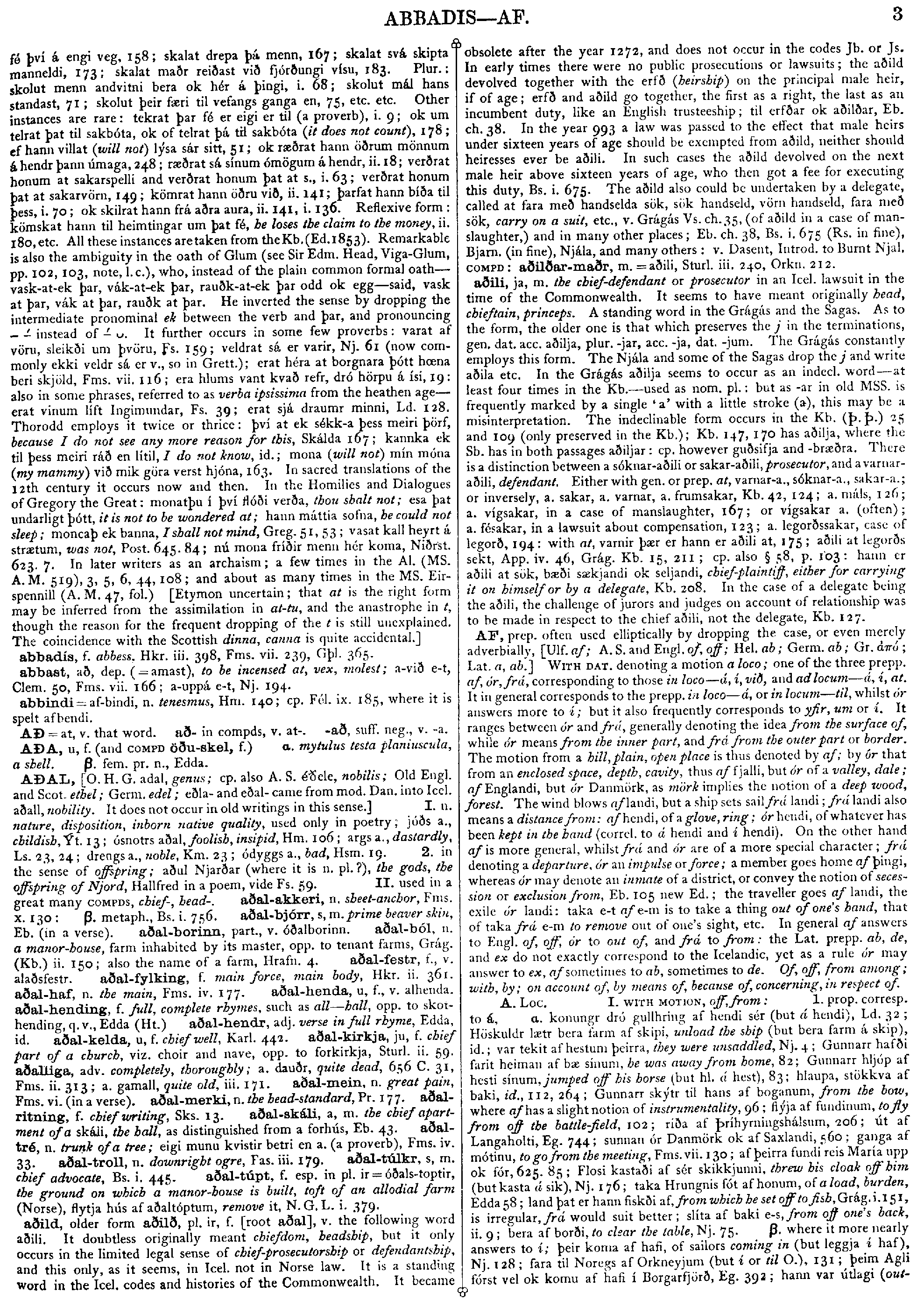
AÐAL,
[O.
H.
G.
adal,
genus;
cp.
also
A.
S.
éðele,
nobilis;
Old
Engl.
and
Scot,
ethel;
Germ,
edel;
eðla-
and
eðal-
came
from
mod.
Dan.
into
Icel.
aðall,
nobility.
It
does
not
occur
in
old
writings
in
this
sense.]
I.
n.
nature,
disposition,
inborn
native
quality,
used
only
in
poetry;
jóðs
a.,
childish,
Ýt.
13;
ósnotrs
aðal,
foolish,
insipid,
Hm.
106;
args
a.,
dastardly,
Ls.
23,
24;
drengs
a.,
noble,
Km.
23;
ódyggs
a.,
bad,
Hsm.
19.
2.
in
the
sense
of
offspring;
aðul
Njarðar
(where
it
is
n.
pl.?),
the
gods,
the
offspring
of
Njord,
Hallfred
in
a
poem,
vide
Fs.
59.
II.
used
in
a
great
many
COMPDS,
chief-,
head-.
aðal-akkeri,
n.
sheet-anchor,
Fms.
x.
130:
.
metaph.,
Bs.
i.
756.
aðal-bjórr,
s,
m.
prime
beaver
skin,
Eb.
(in
a
verse).
aðal-borinn,
part.,
v.
óðalborinn.
aðal-ból,
n.
a
manor-house,
farm
inhabited
by
its
master,
opp.
to
tenant
farms,
Grág.
(Kb.)
ii.
150;
also
the
name
of
a
farm,
Hrafn.
4.
aðal-festr,
f.,
v.
alaðsfestr.
aðal-fylking,
f.
main
force,
main
body,
Hkr.
ii.
361.
aðal-haf,
n.
the
main,
Fms.
iv.
177.
aðal-henda,
u,
f.,
v.
alhenda.
aðal-hending,
f.
full,
complete
rhymes,
such
as
all
--
hall,
opp.
to
skot-
hending,
q.
v.,
Edda
(Ht.)
aðal-hendr,
adj.
verse
in
full
rhyme,
Edda,
id.
aðal-kelda,
u,
f.
chief
well,
Karl.
442.
aðal-kirkja,
ju,
f.
chief
part
of
a
church,
viz.
choir
and
nave,
opp.
to
forkirkja,
Sturl.
ii.
59.
aðalliga,
adv.
completely,
thoroughly;
a.
dauðr,
quite
dead,
656
C.
31,
Fms.
ii.
313;
a.
gamall,
quite
old,
iii.
171.
aðal-mein,
n.
great
pain,
Fms.
vi.
(in
a
verse),
aðal-merki,
n.
the
head-standard,
Pr.
177.
aðal-
ritning,
f.
chief
writing,
Sks.
13.
aðal-skáli,
a,
m.
the
chief
apart-
ment
of
a
skáli,
the
hall,
as
distinguished
from
a
forhús,
Eb.
43.
aðal-
tré,
n.
trunk
of
a
tree;
eigi
munu
kvistir
betri
en
a.
(a
proverb),
Fms.
iv.
33.
aðal-troll,
n.
downright
ogre,
Fas.
iii.
179.
aðal-túlkr,
s,
m.
chief
advocate,
Bs.
i.
445.
aðal-túpt,
f.
esp.
in
pl.
ir
=
óðals-toptir,
the
ground
on
which
a
manor-bouse
is
built,
toft
of
an
allodial
farm
(Norse),
flytja
hús
af
aðaltóptum,
remove
it,
N.
G.
L.
i.
| Result Page: |  |
Previous | 121 122 123 124 125 126 127 128 129 130 131 132 133 134 135 136 137 138 139 | Next |  |
Germanic Lexicon Project (main page)
This search system was written by
Sean Crist
Please consider
volunteering
to correct the data in these online dictionaries.
No rights reserved. Feel free to use these data in any way you please.