|
|

Search for Ors again, using less strict matching (3072 results)
|
Source: Bosworth/Toller, page d0572, entry 12 View original page image as: [TIFF] [PNG] [View previous entry] [View next entry] |
[Comment on this entry] [View comments (1)] |
The following entry has been hand-corrected once. |
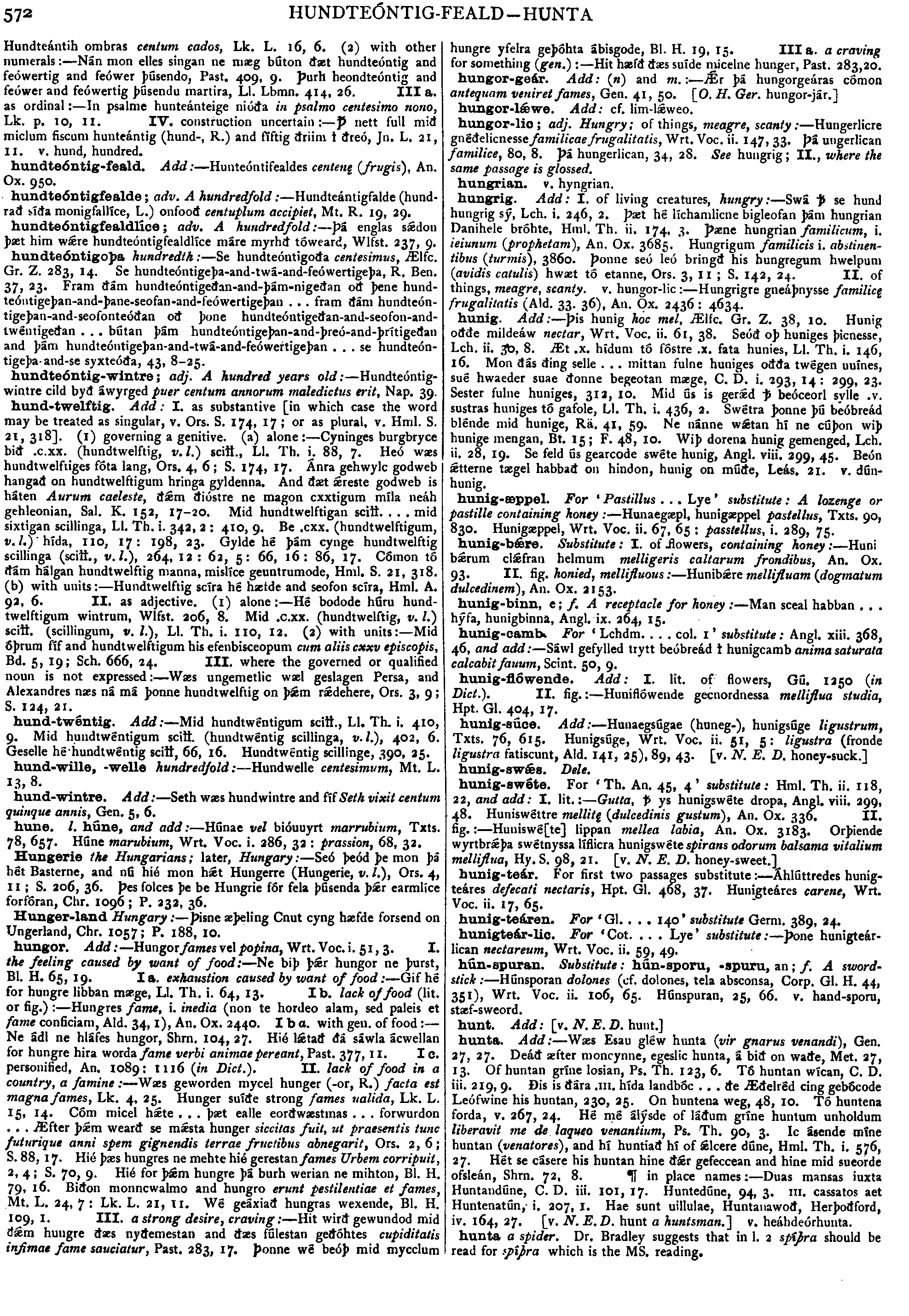
Hungerie
the
Hungarians;
later,
Hungary
:--
Seó
beód
þe
mon
þá
hét
Basterne,
and
nú
hié
mon
h t
Hungerre
(Hungerie,
v.
l.,
Ors.
4,
11;
S.
206,
36.
þes
folces
þe
be
Hungrie
fór
fela
þúsenda
þr
earmlíce
forfóran,
Chr.
1096;
P.
332,
36.
t
Hungerre
(Hungerie,
v.
l.,
Ors.
4,
11;
S.
206,
36.
þes
folces
þe
be
Hungrie
fór
fela
þúsenda
þr
earmlíce
forfóran,
Chr.
1096;
P.
332,
36.
|
Source: Bosworth/Toller, page d0572, entry 14 View original page image as: [TIFF] [PNG] [View previous entry] [View next entry] |
[Comment on this entry] [View comments] |
The following entry has been hand-corrected once. |
hungor.
Add;
--
Hungor
fames
vel
popina,
Wrt.
Voc.
i.
51,
3.
I.
the
feeling
caused
by
want
of
food
:--
Ne
biþ
þr
hungor
ne
þurst,
Bl.
H.
65,
19.
I
a.
exhaustion
caused
by
want
of
food
:--
Gif
hé
for
hungre
libban
mæge,
Ll.
Th.
i.
64,
13.
Ib.
lack
of
food
(lit.
or
fig.)
:--
Hungres
fame,
i.
inedia
(non
te
hordeo
alam,
sed
paleis
et
fame
conficiam,
Aid.
34,
1),
An.
Ox.
2440.
I
b
a.
with
gen.
of
food
:--
Ne
ádl
ne
hláfes
hungor,
Shrn.
104,
27.
Hié
ltað
ðá
sáwla
ácwellan
for
hungre
hira
worda
fame
verbi
animaepereant,
Past.
377,
11.
Ic.
personified,
An.
1089:
1116
(in
Dict.).
II.
lack
of
food
in
a
country,
a
famine
:--
Wæs
geworden
mycel
hunger
(-or,
R.
)
facta
est
magna
fames,
Lk.
4,
25.
Hunger
suíðe
strong
fames
ualida,
Lk.
L.
15,
14.
Cóm
micel
hte
.
.
.
þæt
ealle
eorðwæstmas
.
.
.
forwurdon
.
.
.
Æfter
þm
wearð
se
msta
hunger
siccitas
fuit,
uí
praesentis
tunc
fufnrique
anni
spem
gignendis
terrae
fructibus
abnegarit,
Ors.
2,
6;
S.
88.
17.
Hié
þæs
hungres
ne
mehte
hié
gerestan
fames
Urbem
corripuit,
2,
4;
S.
70,
9.
Hié
for
þm
hungre
þá
burh
werian
ne
mihton,
Bl.
H.
79,
16.
Biðon
monncwalmo
and
hungro
erunt
pestilentiae
et
fames,
Mt.
L.
24,
7
:
Lk.
L.
21,
11.
Wé
geáxiað
hungras
wexende,
Bl.
H.
109,
1.
III.
a
strong
desire,
craving
:--
Hit
wirð
gewundod
mid
ðm
hungre
ð
æs
nyðemestan
and
ðæs
fúlestan
geðóhtes
cupiditatis
infimae
fame
sauciatur,
Past.
283,
17.
þonne
wé
beóþ
mid
mycclum
hungre
yfelra
geþóhta
ábisgode,
61.
H.
19,
15.
III
a.
a
craving
for
something
(gen.)
:--
Hit
hæfð
ðæs
sníde
micelne
hunger,
Past.
283,
20.
|
Source: Bosworth/Toller, page d0572, entry 19 View original page image as: [TIFF] [PNG] [View previous entry] [View next entry] |
[Comment on this entry] [View comments] |
The following entry has been hand-corrected once. |
hungrig.
Add;
I.
of
living
creatures,
hungry
:--
Swá
 se
hund
hungrig
sý,
Lch.
i.
246,
2.
þæt
hé
líchamlicne
bigleofan
þám
hungrian
Danihele
bróhte,
Hml.
Th.
ii.
174,
3.
þæne
hungrian
familicum,
i.
ieiunum
(prophetam),
An.
Ox.
3685,
Hungrigum
familicis
i.
abstinentibus
(turmis),
3860.
þonne
seó
leó
bringð
his
hungregum
hwelpum
(avidis
calulis)
hwæt
tó
etanne,
Ors.
3,
11
;
S.
142,
24.
II.
of
things,
meagre,
scanty,
v.
hungor-lic
:--
Hungrigre
gneáþnysse
familice
frugalitatis
(Ald.
33.
36),
An.
Ox.
2436:
4634.
se
hund
hungrig
sý,
Lch.
i.
246,
2.
þæt
hé
líchamlicne
bigleofan
þám
hungrian
Danihele
bróhte,
Hml.
Th.
ii.
174,
3.
þæne
hungrian
familicum,
i.
ieiunum
(prophetam),
An.
Ox.
3685,
Hungrigum
familicis
i.
abstinentibus
(turmis),
3860.
þonne
seó
leó
bringð
his
hungregum
hwelpum
(avidis
calulis)
hwæt
tó
etanne,
Ors.
3,
11
;
S.
142,
24.
II.
of
things,
meagre,
scanty,
v.
hungor-lic
:--
Hungrigre
gneáþnysse
familice
frugalitatis
(Ald.
33.
36),
An.
Ox.
2436:
4634.
|
Source: Bosworth/Toller, page d0573, entry 10 View original page image as: [TIFF] [PNG] [View previous entry] [View next entry] |
[Comment on this entry] [View comments] |
The following entry has been hand-corrected once. |
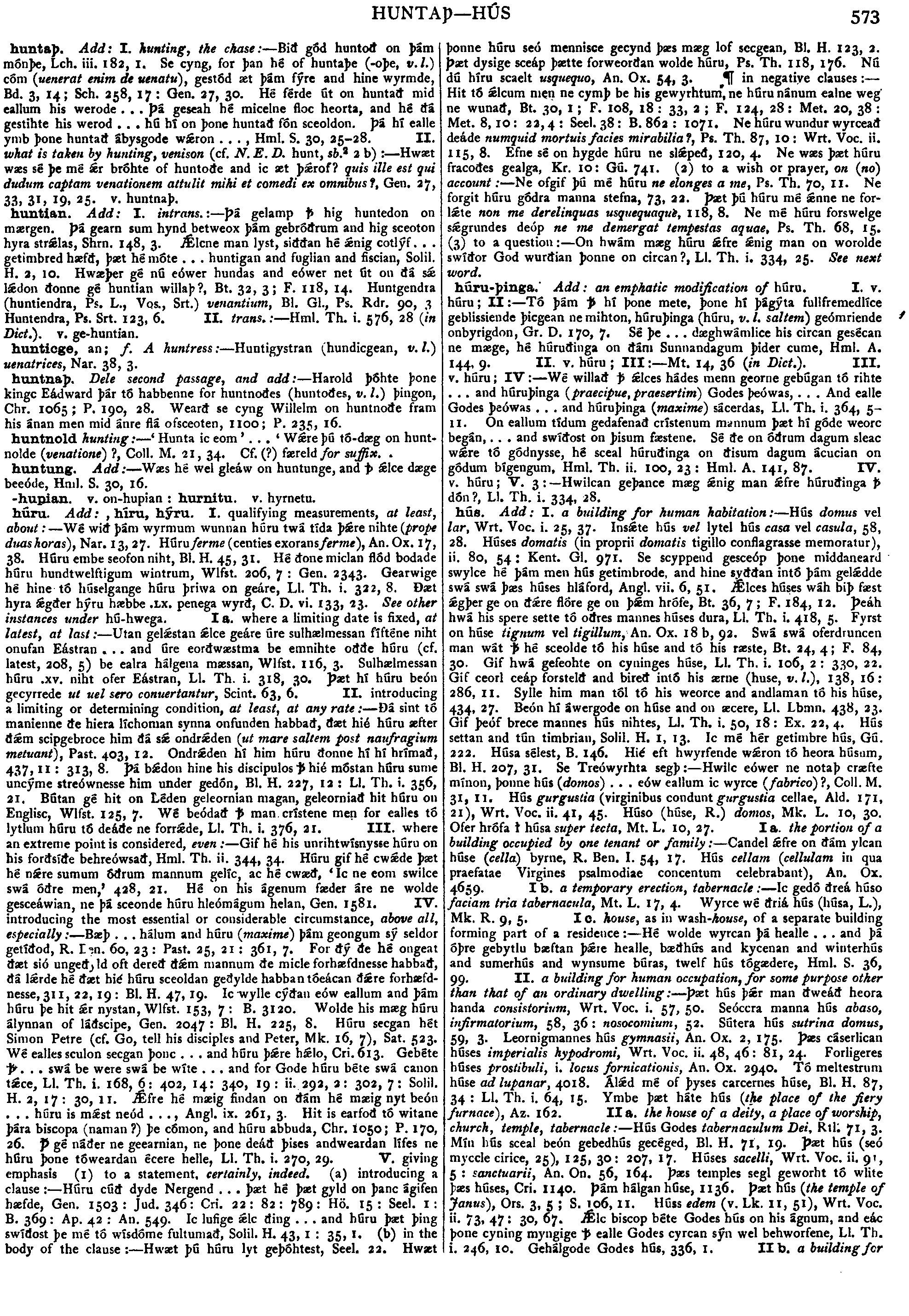
hús.
Add:
I.
a
building
for
human
habitation
:--
Hús
domus
vel
lar,
Wrt.
Voc.
i.
25,
37.
Inste
hús
vel
lytel
hús
caso
vel
casula,
58,
28.
Húses
domatis
(in
proprii
domatis
tigillo
conflagrasse
memoratur),
ii.
80,
54;
Kent.
Gl.
971.
Se
scyppend
gesceóp
þone
middaneard
swylce
hé
þám
men
hús
getimbrode,
and
hine
syððan
meó
þám
geldde
swá
swá
þæs
húses
hláford,
Angl.
vii.
6,
51.
Æ-acute;lces
húses
wáh
biþ
fæst
gþer
ge
on
ðre
flóre
ge
on
þm
hrófe,
Bt.
36,
7
;
F.
184,
12.
Þeáh
hwá
his
spere
sette
tó
oðres
mannes
húses
dura,
Ll.
Th.
i.
418,
5.
Fyrst
on
húse
tignum
vel
tigillum,
An.
Ox.
18
b,
92.
Swá
swá
oferdruncen
man
wát
hé
sceolde
tó
his
húse
and
tó
his
ræste,
Bt.
24,
4;
F.
84,
30.
Gif
hwá
gefeohte
on
cyninges
húse.
Ll.
Th.
i.
106,
2
;
330,
32.
Gif
ceorl
ceáp
forstelð
and
bireð
meó
his
ærne
(húse,
v.
l.),
138,
16;
286,
11.
Sylle
him
man
tól
tó
his
weorce
and
andlaman
tó
his
húse,
434,
27.
Beón
hí
áwergode
on
húse
and
on
æcere,
Ll.
Lbmn.
438,
23.
Gif
þeóf
brece
mannes
hús
nihtes,
Ll.
Th.
i.
50,
18
:
Ex.
22,
4.
Hús
settan
and
tún
timbrian.
Solil.
H.
1,
13.
Ic
mé
her
getimbre
hús,
Gú.
222.
Húsa
sélest,
B.
146.
Hié
eft
hwyrfende
wron
tó
heora
húsum,
Bl.
H.
207,
31.
Se
Treówyrhta
segþ
:--
Hwilc
eówer
ne
notaþ
cræfte
mínon,
þonne
hús
(.
domos)
.
.
.
eów
eallum
ic
wyrce
(fabrico)
?,
Coll.
M.
31,
11.
Hús
gurgustia
(virginibus
condunt
gurgustia
cellae,
Aid.
171,
21),
Wrt.
Voc.
ii.
41,
45.
Húso
(húse,
R.
)
domos.
Mk.
L.
10,
30.
Ofer
hrófa
 húsa
super
tecta,
Mt.
L.
10,
27.
I
a.
the
portion
of
a
building
occupied
by
one
tenant
or
family
:--
Candel
fre
on
ðám
ylcan
húse
(cella)
byrne,
R.
Ben.
I.
54,
17.
Hús
cellam
(cellulam
in
qua
praefatae
Virgines
psalmodiae
concentum
celebrabant),
An.
Ox.
4659.
I
b.
a
temporary
erection,
tabernacle
:--
Ic
gedó
ðreá
húso
faciam
tria
tabernacula,
Mt.
L.
17,
4.
Wyrce
wé
ðriá
hús
(húsa,
L.),
Mk.
R.
9,
5.
I
c.
house,
as
in
wash-
house,
of
a
separate
building
forming
part
of
a
residence
:--
Hé
wolde
wyrcan
þá
healle
.
.
.
and
þá
óþre
gebytlu
bæftan
þre
healle,
bæðhús
and
kycenan
and
winterhús
and
sumerhús
and
wynsume
búras,
twelf
hús
tógædere,
Hml.
S.
36,
99.
II.
a
building
for
human
occupation,
for
some
purpose
other
than
that
of
an
ordinary
dwelling
:--
þæt
hús
þsér
man
ðweáð
heora
handa
consistoritim,
Wrt.
Voc.
i.
57,
50.
Seóccra
manna
hús
abaso,
infirmatorium,
58,
36
:
nosocomium,
52.
Sútera
hús
sutrina
domus,
59,
3.
Leornigmannes
hús
gymnasii,
An.
Ox.
2,
175.
þæs
cáserlican
húses
imperialis
hypodromi,
Wrt.
Voc.
ii.
48,
46:
81,
24.
Forligeres
húses
prostibuli,
i.
locus
fornicationis,
An.
Ox.
2940.
tó
meltestruni
húse
ad
lupanar,
4018.
Ald
mé
of
þyses
carcernes
húse,
Bl.
H.
87,
34
:
Ll.
Th.
i.
64,
15.
Ymbe
þæt
háte
hús
(the
place
of
the
fiery
furnace),
Az.
162.
II
a.
the
house
of
a
deity,
a
place
of
worship,
church,
temple,
tabernacle
:--
Hús
Godes
tabernaculum
Dei,
Rtl.
71,
3.
Mín
hús
sceal
beón
gebedhús
gecéged,
Bl.
H.
71,
19.
þæt
hús
(seó
myccle
cirice,
25),
125,
30:
207,
17.
Húses
sacelli,
Wrt.
Voc.
ii.
91,
5
:
sanctuarii,
An.
On.
56,
164.
þæs
temples
segl
geworht
tó
wlite
þæs
húses,
Cri.
1140.
JJám
hálgan
húse,
1136.
þæt
hús
(the
temple
of
Janus),
Ors.
3,
5
;
S.
106,
11.
Húss
edem
(v.
Lk.
II,
51),
Wrt.
Voc.
ii.
73,
47
:
67.
Æ-acute;lc
biscop
béte
Godes
hús
on
his
ágnum,
and
eác
þone
cyning
myngige
ealle
Godes
cyrcan
sýn
wel
behworfene,
Ll.
Th.
i.
246,
10.
Gehálgode
Godes
hús,
336,
1.
II
b.
a
building
for
húsa
super
tecta,
Mt.
L.
10,
27.
I
a.
the
portion
of
a
building
occupied
by
one
tenant
or
family
:--
Candel
fre
on
ðám
ylcan
húse
(cella)
byrne,
R.
Ben.
I.
54,
17.
Hús
cellam
(cellulam
in
qua
praefatae
Virgines
psalmodiae
concentum
celebrabant),
An.
Ox.
4659.
I
b.
a
temporary
erection,
tabernacle
:--
Ic
gedó
ðreá
húso
faciam
tria
tabernacula,
Mt.
L.
17,
4.
Wyrce
wé
ðriá
hús
(húsa,
L.),
Mk.
R.
9,
5.
I
c.
house,
as
in
wash-
house,
of
a
separate
building
forming
part
of
a
residence
:--
Hé
wolde
wyrcan
þá
healle
.
.
.
and
þá
óþre
gebytlu
bæftan
þre
healle,
bæðhús
and
kycenan
and
winterhús
and
sumerhús
and
wynsume
búras,
twelf
hús
tógædere,
Hml.
S.
36,
99.
II.
a
building
for
human
occupation,
for
some
purpose
other
than
that
of
an
ordinary
dwelling
:--
þæt
hús
þsér
man
ðweáð
heora
handa
consistoritim,
Wrt.
Voc.
i.
57,
50.
Seóccra
manna
hús
abaso,
infirmatorium,
58,
36
:
nosocomium,
52.
Sútera
hús
sutrina
domus,
59,
3.
Leornigmannes
hús
gymnasii,
An.
Ox.
2,
175.
þæs
cáserlican
húses
imperialis
hypodromi,
Wrt.
Voc.
ii.
48,
46:
81,
24.
Forligeres
húses
prostibuli,
i.
locus
fornicationis,
An.
Ox.
2940.
tó
meltestruni
húse
ad
lupanar,
4018.
Ald
mé
of
þyses
carcernes
húse,
Bl.
H.
87,
34
:
Ll.
Th.
i.
64,
15.
Ymbe
þæt
háte
hús
(the
place
of
the
fiery
furnace),
Az.
162.
II
a.
the
house
of
a
deity,
a
place
of
worship,
church,
temple,
tabernacle
:--
Hús
Godes
tabernaculum
Dei,
Rtl.
71,
3.
Mín
hús
sceal
beón
gebedhús
gecéged,
Bl.
H.
71,
19.
þæt
hús
(seó
myccle
cirice,
25),
125,
30:
207,
17.
Húses
sacelli,
Wrt.
Voc.
ii.
91,
5
:
sanctuarii,
An.
On.
56,
164.
þæs
temples
segl
geworht
tó
wlite
þæs
húses,
Cri.
1140.
JJám
hálgan
húse,
1136.
þæt
hús
(the
temple
of
Janus),
Ors.
3,
5
;
S.
106,
11.
Húss
edem
(v.
Lk.
II,
51),
Wrt.
Voc.
ii.
73,
47
:
67.
Æ-acute;lc
biscop
béte
Godes
hús
on
his
ágnum,
and
eác
þone
cyning
myngige
ealle
Godes
cyrcan
sýn
wel
behworfene,
Ll.
Th.
i.
246,
10.
Gehálgode
Godes
hús,
336,
1.
II
b.
a
building
for
|
Source: Bosworth/Toller, page d0574, entry 1 View original page image as: [TIFF] [PNG] [View previous entry] [View next entry] |
[Comment on this entry] [View comments] |
The following entry has been hand-corrected once. |
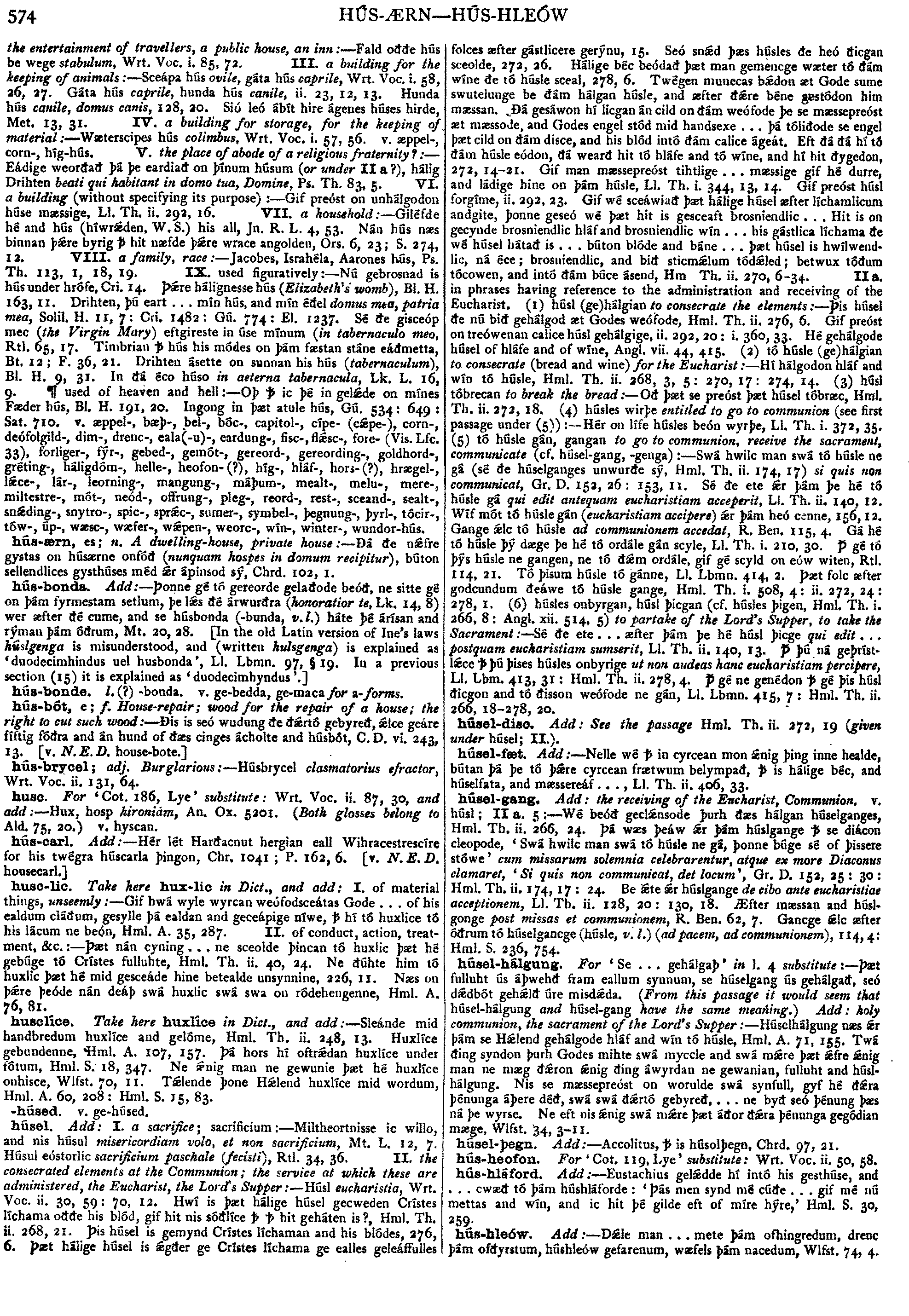
the
entertainment
of
travellers,
a
public
house,
an
inn
:--
Fald
oððe
hús
be
wege
stabulum.
Wrt.
Voc.
i.
85,
72.
III.
a
building
for
the
keeping
of
animals
:--
Sceápa
hús
ovile,
gáta
hús
caprile,
Wrt.
Voc.
i.
58,
26,
27.
Gáta
hús
caprile,
hunda
hús
canile,
ii.
23,
12,
13.
Hunda
hús
canile,
domus
canis,
128,
20.
Sió
leó
ábít
hire
ágenes
húses
hirde,
Met.
13,
31.
IV.
a
building
for
storage,
for
the
keeping
of
material;
--Wæterscipes
hús
colimbus,
Wrt.
Voc.
i.
57,
56.
v.
æppel-,
corn-,
híg-hús.
V.
the
place
of
abode
of
a
religious
fraternity
?
:--
Eádige
weorðað
þá
þe
eardiað
on
þ
ínum
húsum
(or
under
II
a?),
hálig
Drihten
beati
qui
habitant
in
domo
tua,
Domine,
Ps.
Th.
83,
5.
VI.
a
building
(without
specifying
its
purpose)
:--
Gif
preóst
on
unhálgodon
húse
mæssige,
Ll.
Th.
ii.
292,
16.
VII.
a
household
:--
Giléfde
hé
and
hús
(híwrden.
W.S.)
his
all,
Jn.
R.
L.
4,
53.
Nán
hús
næs
binnan
þre
byrig
hit
næfde
þre
wrace
angolden,
Ors.
6,
23;
S.
274,
12.
VIII.
a
family,
race
:--
Jacobes,
Israhéla,
Aarones
hús,
Ps.
Th.
113,
1.
18,
19.
IX.
used
figuratively
:--
Nú
gebrosnad
is
hús
under
hrófe,
Cri.
14.þre
hálignesse
hús
(Elizabeth's
womb),
Bl.
H.
163,
11.
Drihten,
þú
eart
.
.
.
min
hús,
and
nun
éðel
domus
mea,
patria
mea,
Solil.
H.
ii.
7:
Cri.
1482:
Gú.
774:
El.
1237.
Sé
ðe
gisceóp
mec
(the
Virgin
Mary)
eftgireste
in
úse
mínum
(in
tabernaculo
meo,
Rtl.
65,
17.
Timbrian
hús
his
módes
on
þám
fæstan
stáne
eáðmetta,
Bt.
12
;
F.
36,
21.
Drihten
ásette
on
sunnan
his
hús
(tabernaculum),
Bl.
H.
9,
31.
In
ð
á
éco
húso
in
aeterna
tabernacula,
Lk.
L.
16,
9.
used
of
heaven
and
hell
:--
Oþ
ic
þe
in
gelde
on
mínes
Fæder
hús,
Bl.
H.
191,
20.
Ingong
in
þæt
atule
hús,
Gú.
534:
649
:
Sat.
710.
v.
æppel-,
bæþ-,
bel-,
bóc-,
capitol-.
cípe-
(cpe-),
corn-,
deófolgild-,
dim-,
drenc-,
eala(-u)-,
eardung-,
fisc-,
flsc-,
fore-
(Vis.
Lfc.
33),
forliger-,
fyr-,
gebed-,
gemót-,
gereord-,
gereording-,
goldhord-,
gréting-,
háligdóm-,
helle-,
heofon-(?),
híg-,
hláf-,
hors-(?),
hrægel-,
lce-,
lár-,
leorning-,
mangung-,
máþum-,
mealt-,
melu-,
mere-,
miltestre-,
mot-,
neód-,
offrung-,
pleg-,
reord-,
rest-,
sceand-,
sealt-,
snding-,
snytro-,
spic-,
sprc-,
sumer-,
symbel-,
þegnung-,
þyrl-,
tðcir-,
tów-,
úp-,
wxsc-,
wæfer-,
wpen-,
weorc-,
win-,
winter-,
wundor-hús.
|
Source: Bosworth/Toller, page d0575, entry 8 View original page image as: [TIFF] [PNG] [View previous entry] [View next entry] |
[Comment on this entry] [View comments (3)] |
The following entry has been hand-corrected once. |
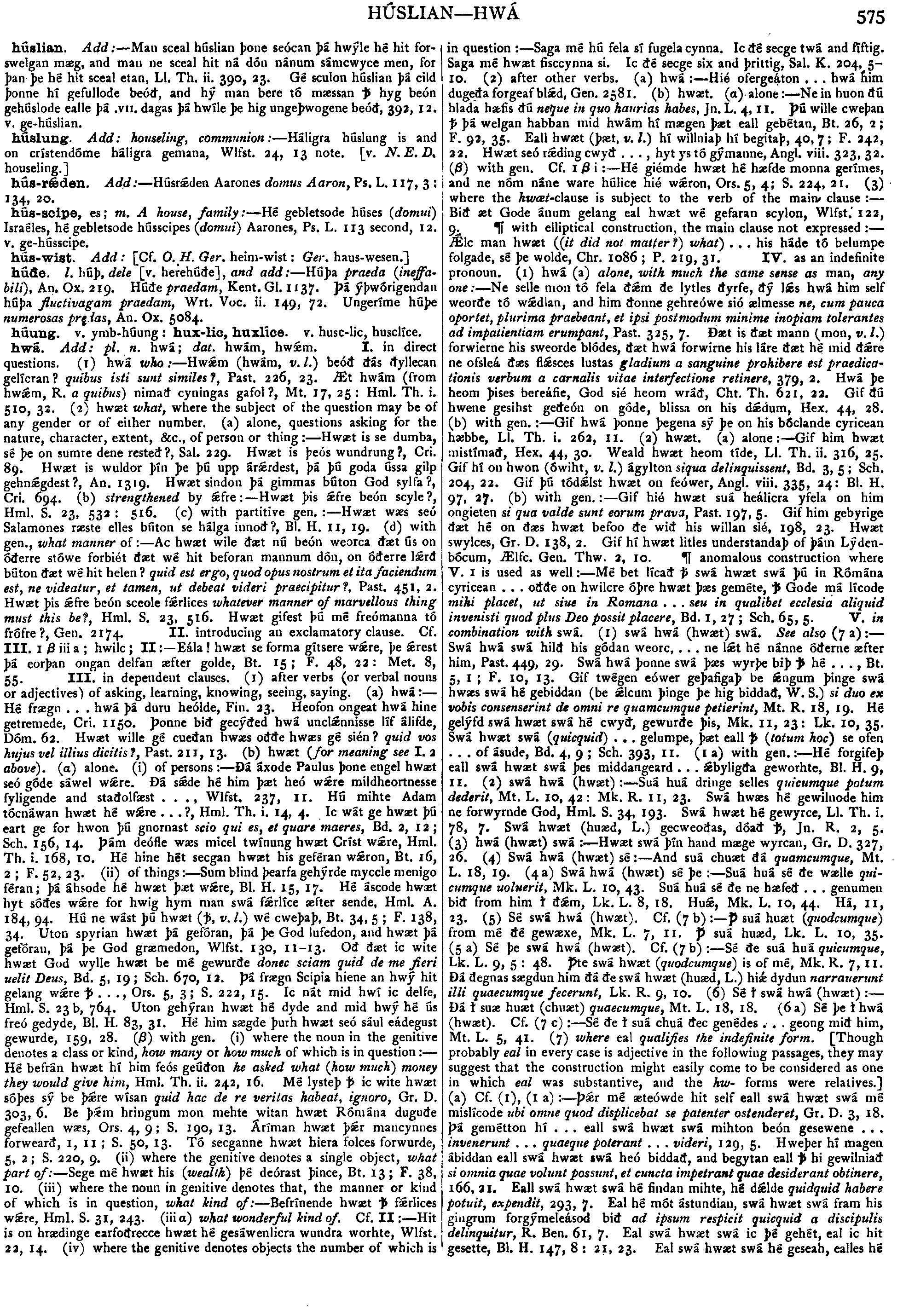
hwá.
Add;
pl.
n.
hwá;
dat.
hwám,
hwm.
I.
in
direct
questions.
(1)
hwá
who
:--
Hwm
(hwám,
v.
l.)
beóð
dás
ðyllecan
gelícran?
quibus
isti
sunt
similes
?,
Past.
226,
23.
Æt
hwám
(from
hwm,
R.
a
quibus)
nimað
cyningas
gafol?,
Mt.
17,
25
:
Hml.
Th.
i.
510,
32.
(2)
hwæt
what,
where
the
subject
of
the
question
may
be
of
any
gender
or
of
either
number,
(a)
alone,
questions
asking
for
the
nature,
character,
extent,
&c.,
of
person
or
thing
:--
Hwæt
is
se
dumba,
sé
þe
on
sumre
dene
resteð?,
Sal.
229.
Hwæt
is
þeós
wundrung?,
Cri.
89.
Hwæt
is
wuldor
þín
þe
þú
upp
árrdest,
þá
þú
goda
ússa
gilp
gehngdest
?,
An.
1319.
Hwæt
sindon
þá
gimmas
búton
God
sylfa?,
Cri.
694.
(b)
strengthened
by
fre
:--
Hwæt
þis
fre
beón
scyle?,
Hml.
S.
23,
532
:
516.
(c)
with
partitive
gen.
:--
Hwæt
wæs
seó
Salamones
ræste
elles
búton
se
hálga
innoð?,
Bl.
H.
11,
19.
(d)
with
gen.
,
what
manner
of
:--
Ac
hwæt
wile
ðæt
nú
beón
weorca
ðæt
ús
on
óðerre
stówe
forbiét
ðæt
wé
hit
beforan
mannum
dón,
on
ððerre
lrd
búton
ðæt
wé
hit
helen
?
quid
est
ergo,
quod
opus
nostrum
et
ita
faciendum
est,
nevideatur,
et
tamen,
ut
debeat
videri
praecipitur
?
Past.
451,
2.
Hwæt
þis
fre
beón
sceole
frlices
whatever
manner
of
marvellous
thing
must
this
be?,
Hml.
S.
23,
516.
Hwæt
gifest
þú
mé
freómanna
to
frófre?,
Gen.
2174.
II.
introducing
an
exclamatory
clause.
Cf.
III.
1
B
iii
a
;
hwilc;
II
:--
Eála!
hwæt
se
forma
gítsere
wre,
þe
rest
þá
eorþan
ongan
delfan
æfter
golde,
Bt.
15
;
F.
48,
22:
Met.
8,
55.
III.
in
dependent
clauses.
(1)
after
verbs
(or
verbal
nouns
or
adjectives')
of
asking,
learning,
knowing,
seeing,
saying,
(a)
hwá
:--
Hé
frægn
.
.
.
hwá
þá
duru
heólde,
Fin.
23.
Heofon
ongeat
hwá
hine
getremede,
Cri.
1150.
þonne
bið
gecýðed
hwá
unclnnisse
líf
álifde,
Dóm.
62.
Hwæt
wille
gé
cueðan
hwæs
oððe
hwæs
gé
sién
?
quid
vos
hujus
vel
illius
dicitis,
Past.
211,
13.
(b)
hwæt
(for
meaning
see
I.
A
above),
(a)
alone,
(i)
of
persons
:--
Ðá
Sde
Paulus
þone
engel
hwæt
seó
góde
sáwel
wre.
Ðá
sde
hé
him
þæt
heó
wre
mildheortnesse
fyligende
and
staðolfæst
.
.
.
.
Wlfst.
237,
II.
Hú
mihte
Adam
tócnáwan
hwæt
hé
wre
.
.
.
?,
Hml.
Th.
i.
14,
4.
Ic
wát
ge
hwæt
þú
eart
ge
for
hwon
þú
gnornast
scio
qui
es,
et
quare
maeres,
Bd.
2,
12;
Sch.
156,
14.
þám
deófle
wæs
micel
twínung
hwæt
Críst
wre,
Hml.
Th.
i.
168,
10.
Hé
hine
hét
secgan
hwæt
his
geféran
wron,
Bt.
16,
2;
F.
52,
23.
(ii)
of
things
:--
Sum
blind
þearfa
gehýrde
myccle
menigo
féran;
þá
áhsode
hé
hwæt
þæt
wre,
Bl.
H.
15,
17.
Hé
áscode
hwæt
hyt
sóðes
wre
for
hwig
hym
man
swá
frlíce
æfter
sende,
Hml.
A.
184,
94.
Hú
ne
wást
þú
hwæt
(
pound;
,
v.
l.)
wé
cweþaþ.
Bt.
34,
5
;
F.
138,
34,
Uton
spyrian
hwæt
þá
geforan,
þá
þe
God
tufedon,
and
hwæt
þá
gefóran,
þá
þe
God
græmedon,
Wlfst.
130,
11-13.
Oð
ðæt
ic
wite
hwæt
God
wylle
hwæt
be
mé
gewurðe
donec
sciam
quid
de
me
fieri
uelit
Deus,
Bd.
5,
19
;
Sch.
670,
12.
þá
frægn
Scipia
hiene
an
hwý
hit
gelang
wre
.
.
.
,
Ors.
5,
3;
S.
222,
15.
Ic
nát
mid
hwí
ic
delfe.
Hml.
S.
23
b,
764.
Uton
gehýran
hwæt
hé
dyde
and
mid
hwý
hé
ús
freó
gedyde,
Bl.
H.
83,
31.
Hé
him
sægde
þurh
hwæt
seó
sául
eádegust
gewurde,
159,
28.
(B)
with
gen.
(i)
where
the
noun
in
the
genitive
denotes
a
class
or
kind,
how
many
or
how
much
of
which
is
in
question
:--
Hé
befrán
hwæt
hí
him
feós
geúðon
he
asked
what
(how
much)
money
they
would
give
him,
Hml.
Th.
ii.
242,
16.
Mé
lysteþ
ic
wite
hwæt
sóþes
sý
be
þre
wísan
quid
hoc
de
re
veritas
habeat,
ignore,
Gr.
D.
303,
6.
Be
þm
hringum
mon
mehte
witan
hwæt
Rómána
duguðe
gefeallen
wæs,
Ors.
4,
9
;
S.
190,
13.
Áríman
hwæt
þr
mancynnes
forwearð,
1,
11
;
S.
50,
13.
Tó
secganne
hwæt
hiera
folces
forwurde,
5,
2;
S.
220,
9.
(ii)
where
the
genitive
denotes
a
single
object,
what
part
of
:--
Sege
mé
hwæt
his
(wealth)
þé
deórast
þince,
Bt.
13;
F.
38,
10.
(iii)
where
the
noun
in
genitive
denotes
that,
the
manner
or
kind
of
which
is
in
question,
what
kind
of
:--
Befrínende
hwæt
frlices
wre,
Hml.
S.
31,
243.
(iii
a)
what
wonderful
kind
of.
Cf.
II
:--
Hit
is
on
hrædinge
earfoðrecce
hwæt
hé
gesáwenlicra
wundra
worhte,
Wlfst.
22,
14.
(iv)
where
the
genitive
denotes
objects
the
number
of
which
is
in
question
:--
Saga
mé
hú
fela
si
fugela
cynna.
Ic
ðé
secge
twá
and
fiftig.
Saga
mé
hwæt
fisccynna
si.
Ic
ðé
secge
six
and
þrittig,
Sal.
K.
204,
5-10.
(2)
after
other
verbs,
(a)
hwá
:--
Hié
ofergeáton
.
.
.
hwá
him
dugeðaforgeafbld,
Gen.
2581.
(b)
hwæt.
(a)
alone
:--
Ne
in
huon
ð
ú
hlada
hæfis
ðú
neque
in
quo
hatirias
habes.
Jn.
L.
4,
11.
Þú
wille
cweþan
þá
welgan
habban
mid
hwám
hí
mægen
þæt
eall
gebétan,
Bt.
26,
2
;
F-
92,
35-
Eall
hwæt
(þæt,
v.
l.)
hi
willniaþ
hí
begitaþ,
40,
7;
F.
242,
22.
Hwæt
seó
rding
cwyð
.
.
.
,
hyt
ys
tó
gýmanne,
Angl.
viii.
323,
32.
(B)
with
gen.
Cf.
I
B
i
:--
Hé
giémde
hwæt
hé
hæfde
monna
gerímes,
and
ne
nóm
náne
ware
húlice
hié
wron,
Ors.
5,
4;
S.
224,
21.
(3)
where
the
hwæt-clause
is
subject
to
the
verb
of
the
main
clause
:--
Bið
æt
Gode
ánum
gelang
eal
hwæt
wé
gefaran
scylon,
Wlfst.
122,
9.
with
elliptical
construction,
the
mam
clause
not
expressed
:--
Æ-acute;lc
man
hwæt
((it
did
not
matter
?)
what)
.
.
.
his
háde
tó
belumpe
folgade,
sé
þe
wolde,
Chr.
1086
;
P.
219,
31.
IV.
as
an
indefinite
pronoun,
(1)
hwá
(a)
alone,
with
much
the
same
sense
as
man,
any
one
:--
Ne
selle
mon
tó
fela
ðm
de
lytles
ðyrfe,
ðý
ls
hwá
him
self
weorðe
tó
wdlan,
and
him
ðonne
gehreówe
sió
ælmesse
ne,
cum
pauca
oportet,
plurima
praebeant,
et
ipsi
postmodun
minime
inopiam
tolerantes
ad
impatientiam
erumpant,
Past.
325,
7.
Ðæt
is
ðæt
mann
(mon,
v.
l.)
forwierne
his
sweorde
blódes,
ðæt
hwá
forwirne
his
láre
ðæt
hé
mid
ðre
ne
ofsleá
ðæs
flsces
lustas
gladium
a
sanguine
prohibere
est
praedica tionis
verbum
a
carnalis
vitae
interfectione
retinere,
379,
2.
Hwá
þe
heom
þises
bereáfie,
God
sié
heom
wráð,
Cht
Th.
621,
22.
Gif
ðú
hwene
gesihst
geðeón
on
góde,
blissa
on
his
ddum,
Hex.
44,
28.
(b)
with
gen.
:--
Gif
hwá
þonne
þegena
sý
þe
on
his
bóclande
cyricean
hæbbe,
Ll.
Th.
i.
262,
11.
(2)
hwæt.
(a)
alone
:--
Gif
him
hwæt
mistímað,
Hex.
44,
30.
Weald
hwæt
heom
tíde,
Ll.
Th.
ii.
316,
25.
Gif
hí
on
hwon
(ówiht,
v.
l.)
ágylton
siqua
delinquissent.
Bd.
3,
5;
Sch.
204,
22.
Gif
þú
tódlst
hwæt
on
feówer,
Angl.
viii.
335,
24:
Bl.
H.
97,
27.
(b)
with
gen.
:--
Gif
hié
hwæt
suá
heálicra
yfela
on
him
ongieten
si
qua
valde
sunt
eorum
prava,
Past.
197,
5.
Gif
him
gebyrige
ðæt
hé
on
ðæs
hwæt
befoo
ðe
wið
his
willan
sié,
198,
23.
Hwæt
swylces,
Gr.
D.
138,
2.
Gif
hí
hwæt
litles
understandaþ
of
þám
Lýden-bócum,
Ælfc.
Gen.
Thw.
2,
10.
U
anomalous
construction
where
V.
l
is
used
as
well
:--
Mé
bet
lícað
swá
hwæt
swá
þú
in
Rómána
cyricean
.
.
.
oððe
on
hwilcre
óþre
hwæt
þæs
geméte,
Gode
má
lícode
mihi
placet,
ut
siue
in
Romana
.
.
.
seu
in
qualibet
ecclesia
aliquid
invenisti
quod
plus
Deo
possit
placere,
Bd.
1,
27
;
Sch.
65,
5.
V.
in
combination
with
swá.
(1)
swá
hwá
(hwæt)
swá.
See
also
(7
a)
:--
Swá
hwá
swá
hilð
his
gódan
weorc,
.
.
.
ne
lt
hé
nánne
óðerne
æfter
him,
Fast.
449,
29.
Swá
hwá
þonne
swá
þæs
wyrþe
biþ
hé
.
.
.
,
Bt.
5,
1
;
F.
10,
13.
Gif
twégen
eówer
geþafigaþ
be
ngum
þinge
swá
hwæs
swá
hé
gebiddan
(be
lcum
þinge
þe
hig
biddað,
W.
S.)
si
duo
ex
vobis
consenserint
de
omni
re
quamcumque
petierint,
Mt.
R.
18,
19.
Hé
gelýfd
swá
hwæt
swá
hé
cwyð,
gewurðe
þis,
Mk.
11.
23:
Lk.
10,
35.
Swá
hwæt
swá
(quicquid)
.
.
.
gelumpe,
þæt
eall
(totum
hoc)
se
ofen
.
.
.
of
ásude,
Bd.
4,
9
;
Sch.
393,
11.
(1
a)
with
gen.
:--
Hé
forgifeþ
eall
swá
hwæt
swá
þes
middangeard
.
.
.
byligða
geworhte,
Bl.
H.
9,
11.
(2)
swá
hwá
(hwæt)
:--
Suá
huá
dringe
selles
quicumque
potum
dederit,
Mt.
L.
10,
42:
Mk.
R.
11.
23.
Swá
hwæs
hé
gewilnode
him
ne
forwyrnde
God,
Hml.
S.
34,
193.
Swá
hwæt
hé
gewyrce,
Ll.
Th.
i.
78,
7.
Swá
hwæt
(huæd,
L.)
gecweoðas,
dóað
,
Jn.
R.
2,
5.
(3)
hwá
(hwæt)
swá
:--
Hwæt
swá
þin
hand
mæge
wyrcan,
Gr.
D.
327,
26.
(4)
Swá
hwá
(hwæt)
sé
:--
And
suá
chuæt
ðá
quamcumque,
Mt.
L.
18,
19.
(4
a)
Swá
hwá
(hwæt)
sé
þe
:--
Suá
huá
sé
ðe
wælle
quicumque
uoluerit.
Mk.
L.
10,
43.
Suá
huá
sé
ðe
ne
hæfeð
.
.
.
genumen
bið
from
him
ðm,
Lk.
L.
8,
18.
Hu,
Mk.
L.
to,
44.
Há,
11.
23
(5)
Sé
swá
hwá
(hwæt).
Cf.
(7
b)
:--
suá
huæt
(quodcumque)
from
mé
ðé
gewæxe,
Mk.
L.
7,
11.
suá
huæd,
Lk.
L.
10,
35.
(5
a)
Sé
þe
swá
hwá
(hwæt).
Cf.
(7b)
:--
Sé
ðe
suá
huá
quicumque,
Lk.
L.
9,
5
:
48.
þte
swá
hwæt
(quodcumque)
is
of
mé,
Mk.
R.
7,
II.
Ðá
ðegnas
sægdun
him
ðá
ðe
swá
hwæt
(huæd,
L.)
hiæ
dydun
narrauerunt
illi
quaecumque
fecerunt,
Lk.
R.
9,
10.
(6)
Sé
swá
hwá
(hwæt)
:--
Ðá
suæ
huæt
(chuæt)
quaecumque,
Mt.
L.
18,
18.
(6a)
Sé
þe
swá
(hwæt).
Cf.
(7
c)
:--
Sé
ðe
suá
cnuá
ðec
genédes
.
.
.
geong
mið
him,
Mt.
L.
5,
41.
(7)
where
eal
qualifies
the
indefinite
form.
[Though
probably
eal
in
every
case
is
adjective
in
the
following
passages,
they
may
suggest
that
the
construction
might
easily
come
to
be
considered
as
one
in
which
eal
was
substantive,
and
the
hw-
forms
were
relatives.]
(a)
Cf.
(1),
(1
a)
:--
þr
mé
æteówde
hit
self
eall
swá
hwæt
swá
mé
mislícode
ubi
omne
quad
displicebat
se
patenter
ostenderet,
Gr.
D.
3,
18.
þá
gemétton
hí
.
.
.
eall
swá
hwæt
swá
mihton
beón
gesewene
.
.
.
invenerunt
.
.
.
quaeque
poterant
.
.
.
videri,
129,
5.
Hweþer
hí
magen
ábiddan
eall
swá
hwæt
swá
heó
biddað,
and
begytan
eall
hi
gewilniað
si
omnia
quae
volunt
possunt,
et
cuncta
impetrant
quae
desiderant
obtinere,
166,
21.
Eall
swá
hwæt
swá
hé
findan
mihte,
hé
dælde
quidquid
habere
potuit,
expendit,
293,
7.
Eal
hé
mót
ástundian,
swá
hwæt
swá
fram
his
gingrum
forgýmeleásod
bið
ad
ipsum
respicit
quicquid
a
discipulis
delinquitur,
R.
Ben.
61,
7.
Eal
swá
hwæt
swá
ic
þé
gehét,
eal
ic
hit
gesette,
Bl.
H.
147,
8
:
21,
23.
Eal
swá
hwæt
swá
hé
geseah,
ealles
hé
tionis
verbum
a
carnalis
vitae
interfectione
retinere,
379,
2.
Hwá
þe
heom
þises
bereáfie,
God
sié
heom
wráð,
Cht
Th.
621,
22.
Gif
ðú
hwene
gesihst
geðeón
on
góde,
blissa
on
his
ddum,
Hex.
44,
28.
(b)
with
gen.
:--
Gif
hwá
þonne
þegena
sý
þe
on
his
bóclande
cyricean
hæbbe,
Ll.
Th.
i.
262,
11.
(2)
hwæt.
(a)
alone
:--
Gif
him
hwæt
mistímað,
Hex.
44,
30.
Weald
hwæt
heom
tíde,
Ll.
Th.
ii.
316,
25.
Gif
hí
on
hwon
(ówiht,
v.
l.)
ágylton
siqua
delinquissent.
Bd.
3,
5;
Sch.
204,
22.
Gif
þú
tódlst
hwæt
on
feówer,
Angl.
viii.
335,
24:
Bl.
H.
97,
27.
(b)
with
gen.
:--
Gif
hié
hwæt
suá
heálicra
yfela
on
him
ongieten
si
qua
valde
sunt
eorum
prava,
Past.
197,
5.
Gif
him
gebyrige
ðæt
hé
on
ðæs
hwæt
befoo
ðe
wið
his
willan
sié,
198,
23.
Hwæt
swylces,
Gr.
D.
138,
2.
Gif
hí
hwæt
litles
understandaþ
of
þám
Lýden-bócum,
Ælfc.
Gen.
Thw.
2,
10.
U
anomalous
construction
where
V.
l
is
used
as
well
:--
Mé
bet
lícað
swá
hwæt
swá
þú
in
Rómána
cyricean
.
.
.
oððe
on
hwilcre
óþre
hwæt
þæs
geméte,
Gode
má
lícode
mihi
placet,
ut
siue
in
Romana
.
.
.
seu
in
qualibet
ecclesia
aliquid
invenisti
quod
plus
Deo
possit
placere,
Bd.
1,
27
;
Sch.
65,
5.
V.
in
combination
with
swá.
(1)
swá
hwá
(hwæt)
swá.
See
also
(7
a)
:--
Swá
hwá
swá
hilð
his
gódan
weorc,
.
.
.
ne
lt
hé
nánne
óðerne
æfter
him,
Fast.
449,
29.
Swá
hwá
þonne
swá
þæs
wyrþe
biþ
hé
.
.
.
,
Bt.
5,
1
;
F.
10,
13.
Gif
twégen
eówer
geþafigaþ
be
ngum
þinge
swá
hwæs
swá
hé
gebiddan
(be
lcum
þinge
þe
hig
biddað,
W.
S.)
si
duo
ex
vobis
consenserint
de
omni
re
quamcumque
petierint,
Mt.
R.
18,
19.
Hé
gelýfd
swá
hwæt
swá
hé
cwyð,
gewurðe
þis,
Mk.
11.
23:
Lk.
10,
35.
Swá
hwæt
swá
(quicquid)
.
.
.
gelumpe,
þæt
eall
(totum
hoc)
se
ofen
.
.
.
of
ásude,
Bd.
4,
9
;
Sch.
393,
11.
(1
a)
with
gen.
:--
Hé
forgifeþ
eall
swá
hwæt
swá
þes
middangeard
.
.
.
byligða
geworhte,
Bl.
H.
9,
11.
(2)
swá
hwá
(hwæt)
:--
Suá
huá
dringe
selles
quicumque
potum
dederit,
Mt.
L.
10,
42:
Mk.
R.
11.
23.
Swá
hwæs
hé
gewilnode
him
ne
forwyrnde
God,
Hml.
S.
34,
193.
Swá
hwæt
hé
gewyrce,
Ll.
Th.
i.
78,
7.
Swá
hwæt
(huæd,
L.)
gecweoðas,
dóað
,
Jn.
R.
2,
5.
(3)
hwá
(hwæt)
swá
:--
Hwæt
swá
þin
hand
mæge
wyrcan,
Gr.
D.
327,
26.
(4)
Swá
hwá
(hwæt)
sé
:--
And
suá
chuæt
ðá
quamcumque,
Mt.
L.
18,
19.
(4
a)
Swá
hwá
(hwæt)
sé
þe
:--
Suá
huá
sé
ðe
wælle
quicumque
uoluerit.
Mk.
L.
10,
43.
Suá
huá
sé
ðe
ne
hæfeð
.
.
.
genumen
bið
from
him
ðm,
Lk.
L.
8,
18.
Hu,
Mk.
L.
to,
44.
Há,
11.
23
(5)
Sé
swá
hwá
(hwæt).
Cf.
(7
b)
:--
suá
huæt
(quodcumque)
from
mé
ðé
gewæxe,
Mk.
L.
7,
11.
suá
huæd,
Lk.
L.
10,
35.
(5
a)
Sé
þe
swá
hwá
(hwæt).
Cf.
(7b)
:--
Sé
ðe
suá
huá
quicumque,
Lk.
L.
9,
5
:
48.
þte
swá
hwæt
(quodcumque)
is
of
mé,
Mk.
R.
7,
II.
Ðá
ðegnas
sægdun
him
ðá
ðe
swá
hwæt
(huæd,
L.)
hiæ
dydun
narrauerunt
illi
quaecumque
fecerunt,
Lk.
R.
9,
10.
(6)
Sé
swá
hwá
(hwæt)
:--
Ðá
suæ
huæt
(chuæt)
quaecumque,
Mt.
L.
18,
18.
(6a)
Sé
þe
swá
(hwæt).
Cf.
(7
c)
:--
Sé
ðe
suá
cnuá
ðec
genédes
.
.
.
geong
mið
him,
Mt.
L.
5,
41.
(7)
where
eal
qualifies
the
indefinite
form.
[Though
probably
eal
in
every
case
is
adjective
in
the
following
passages,
they
may
suggest
that
the
construction
might
easily
come
to
be
considered
as
one
in
which
eal
was
substantive,
and
the
hw-
forms
were
relatives.]
(a)
Cf.
(1),
(1
a)
:--
þr
mé
æteówde
hit
self
eall
swá
hwæt
swá
mé
mislícode
ubi
omne
quad
displicebat
se
patenter
ostenderet,
Gr.
D.
3,
18.
þá
gemétton
hí
.
.
.
eall
swá
hwæt
swá
mihton
beón
gesewene
.
.
.
invenerunt
.
.
.
quaeque
poterant
.
.
.
videri,
129,
5.
Hweþer
hí
magen
ábiddan
eall
swá
hwæt
swá
heó
biddað,
and
begytan
eall
hi
gewilniað
si
omnia
quae
volunt
possunt,
et
cuncta
impetrant
quae
desiderant
obtinere,
166,
21.
Eall
swá
hwæt
swá
hé
findan
mihte,
hé
dælde
quidquid
habere
potuit,
expendit,
293,
7.
Eal
hé
mót
ástundian,
swá
hwæt
swá
fram
his
gingrum
forgýmeleásod
bið
ad
ipsum
respicit
quicquid
a
discipulis
delinquitur,
R.
Ben.
61,
7.
Eal
swá
hwæt
swá
ic
þé
gehét,
eal
ic
hit
gesette,
Bl.
H.
147,
8
:
21,
23.
Eal
swá
hwæt
swá
hé
geseah,
ealles
hé
|
Source: Bosworth/Toller, page d0576, entry 12 View original page image as: [TIFF] [PNG] [View previous entry] [View next entry] |
[Comment on this entry] [View comments] |
The following entry has been hand-corrected once. |
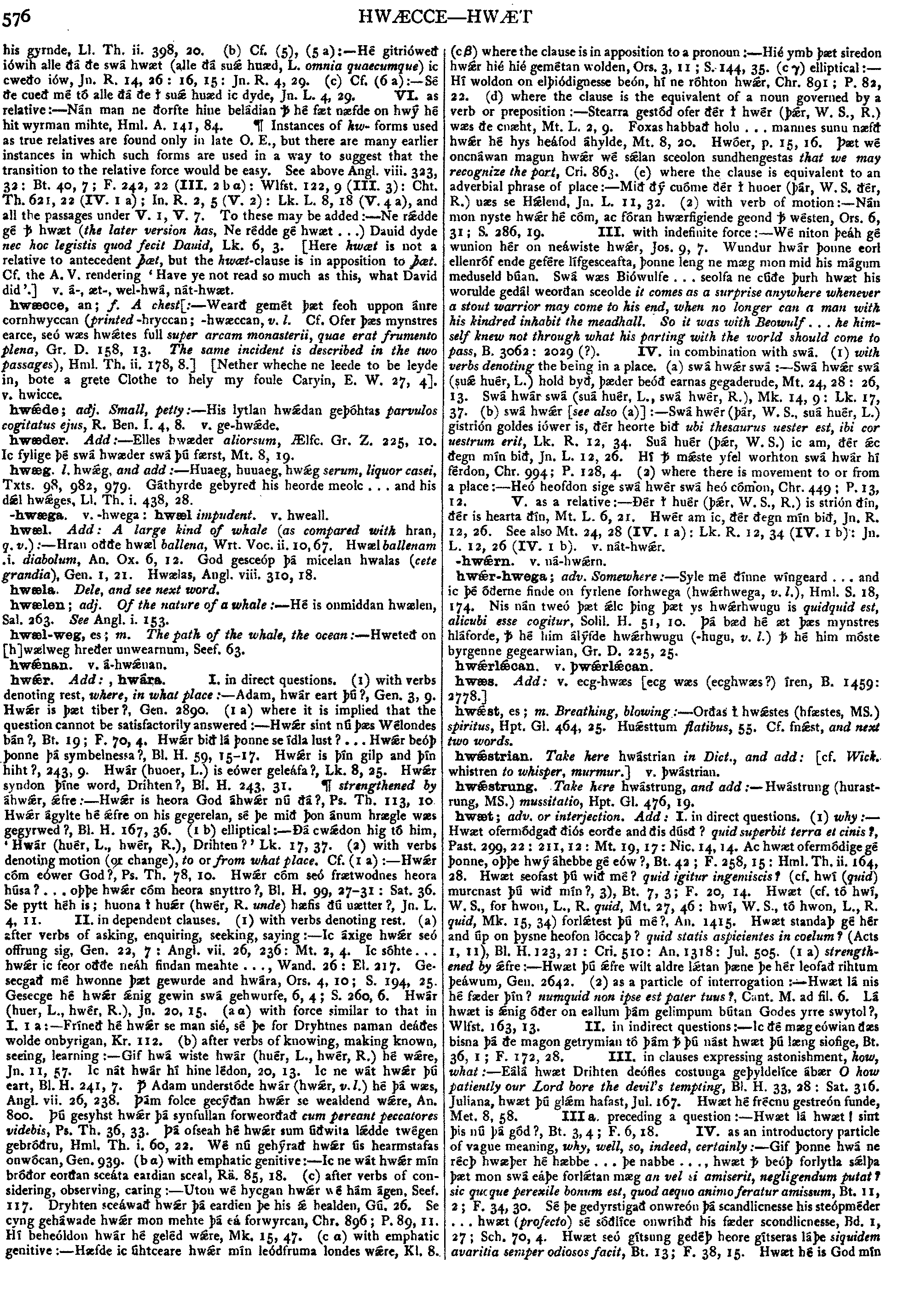
hwr.
Add:
,
hwára.
I.
in
direct
questions.
(1)
with
verbs
denoting
rest,
where,
in
what
place
:--
Adam,
hwár
eart
þú?,
Gen.
3,
9.
Hwr
is
þæt
tiber?,
Gen.
2890.
(1
a)
where
it
is
implied
that
the
question
cannot
be
satisfactorily
answered
:--
Hwr
sint
nú
þæs
Wélondes
bán?,
Bt.
19;
F.
70,
4,
Hwr
bið
lá
þonne
se
ídla
lust?
...
Hwr
beóþ
þonne
þá
symbelnessa?,
Bl.
H.
59,
15-17.
Hwr
is
þín
gilp
and
þín
hiht?,
243,
9.
Hwár
(huoer,
L.)
is
eówer
geleáfa?,
Lk.
8,
25.
Hwr
syndon
þíne
word,
Drihten?,
Bl.
H.
243,
31.

strengthened
by
áhwr,
fre
:--
Hwr
is
heora
God
áhwr
nú
ðá?,
Ps.
Th.
113,
10.
Hwr
ágylte
hé
fre
on
his
gegerelan,
sé
þe
mið
þon
ánum
hrægle
wæs
gegyrwed?,
Bl.
H.
167,
36.
(1
b)
elliptical
:--
Ðá
cwdon
hig
tó
him,
'Hwár
(huér,
L.,
hwér,
R.),
Drihten?'
Lk.
17,
37.
(2)
with
verbs
denoting
motion
(or
change),
to
or
from
what
place.
Cf.
(1
a)
:--
Hwr
cóm
eówer
God?,
Ps.
Th.
78,
10.
Hwr
cóm
seó
frætwodnes
heora
húsa?
...
oþþe
hwr
cóm
heora
snyttro?,
Bl.
H.
99,
27-31:
Sat.
36.
Se
pytt
héh
is;
huona
hur
(hwér,
R.
unde)
hæfis
ðú
uætter?,
Jn.
L.
4,
11.
II.
in
dependent
clauses.
(1)
with
verbs
denoting
rest.
(a)
after
verbs
of
asking,
enquiring,
seeking,
saying
:--
Ic
áxige
hwr
seó
offrung
sig,
Gen.
22,
7:
Angl.
vii.
26,
236:
Mt.
2,
4.
Ic
sóhte
...
hwr
ic
feor
oððe
neáh
findan
meahte
...,
Wand.
26:
El.
217.
Gesecgað
mé
hwonne
þæt
gewurde
and
hwára,
Ors.
4,
10;
S.
194,
25.
Gesecge
hé
hwr
nig
gewin
swá
gehwurfe,
6,
4;
S.
260,
6.
Hwár
(huer,
L.,
hwér,
R.),
Jn.
20,
15.
(a
 )
with
force
similar
to
that
in
I.
1
a
:--
Fríneð
hé
hwr
se
man
sié,
sé
þe
for
Dryhtnes
naman
deáðes
wolde
onbyrigan,
Kr.
112.
(b)
after
verbs
of
knowing,
making
known,
seeing,
learning
:--
Gif
hwá
wiste
hwár
(huér,
L.,
hwér,
R.)
hé
wre,
Jn.
11,
57.
Ic
nát
hwár
hí
hine
lédon,
20,
13.
Ic
ne
wát
hwr
þú
eart,
Bl.
H.
241,
7.
Þ-bar;
Adam
understóde
hwár
(hwr,
v.
l.)
hé
þá
wæs,
Angl.
vii.
26,
238.
Þám
folce
gecýðan
hwr
se
wealdend
wre,
An.
800.
Þú
gesyhst
hwr
þá
synfullan
forweorðað
cum
pereant
peccatores
videbis,
Ps.
Th.
36,
33.
Þá
ofseah
hé
hwr
sum
úðwita
ldde
twégen
gebróðru,
Hml.
Th.
i.
60,
22.
Wé
nú
gehýrað
hwr
ús
hearmstafas
onwócan,
Gen.
939.
(b
)
with
emphatic
genitive
:--
Ic
ne
wát
hwr
mín
bróðor
eorðan
sceáta
eardian
sceal,
Rä.
85,
18.
(c)
after
verbs
of
considering,
observing,
caring
:--
Uton
wé
hycgan
hwr
wé
hám
ágen,
Seef.
117.
Dryhten
sceáwað
hwr
þá
eardien
þe
his
healden,
Gú.
26.
Se
cyng
geháwade
hwr
mon
mehte
þá
eá
forwyrcan,
Chr.
896;
P.
89,
11.
Hí
beheóldon
hwár
hé
geléd
wre,
Mk.
15,
47.
(c
)
with
emphatic
genitive
:--
Hæfde
ic
úhtceare
hwr
mín
leódfruma
londes
wre,
Kl.
8.
(c
)
with
force
similar
to
that
in
I.
1
a
:--
Fríneð
hé
hwr
se
man
sié,
sé
þe
for
Dryhtnes
naman
deáðes
wolde
onbyrigan,
Kr.
112.
(b)
after
verbs
of
knowing,
making
known,
seeing,
learning
:--
Gif
hwá
wiste
hwár
(huér,
L.,
hwér,
R.)
hé
wre,
Jn.
11,
57.
Ic
nát
hwár
hí
hine
lédon,
20,
13.
Ic
ne
wát
hwr
þú
eart,
Bl.
H.
241,
7.
Þ-bar;
Adam
understóde
hwár
(hwr,
v.
l.)
hé
þá
wæs,
Angl.
vii.
26,
238.
Þám
folce
gecýðan
hwr
se
wealdend
wre,
An.
800.
Þú
gesyhst
hwr
þá
synfullan
forweorðað
cum
pereant
peccatores
videbis,
Ps.
Th.
36,
33.
Þá
ofseah
hé
hwr
sum
úðwita
ldde
twégen
gebróðru,
Hml.
Th.
i.
60,
22.
Wé
nú
gehýrað
hwr
ús
hearmstafas
onwócan,
Gen.
939.
(b
)
with
emphatic
genitive
:--
Ic
ne
wát
hwr
mín
bróðor
eorðan
sceáta
eardian
sceal,
Rä.
85,
18.
(c)
after
verbs
of
considering,
observing,
caring
:--
Uton
wé
hycgan
hwr
wé
hám
ágen,
Seef.
117.
Dryhten
sceáwað
hwr
þá
eardien
þe
his
healden,
Gú.
26.
Se
cyng
geháwade
hwr
mon
mehte
þá
eá
forwyrcan,
Chr.
896;
P.
89,
11.
Hí
beheóldon
hwár
hé
geléd
wre,
Mk.
15,
47.
(c
)
with
emphatic
genitive
:--
Hæfde
ic
úhtceare
hwr
mín
leódfruma
londes
wre,
Kl.
8.
(c
 )
where
the
clause
is
in
apposition
to
a
pronoun
:--
Hié
ymb
þæt
siredon
hwr
hié
hié
gemétan
wolden,
Ors.
3,
11;
S.
144,
35.
(c
)
where
the
clause
is
in
apposition
to
a
pronoun
:--
Hié
ymb
þæt
siredon
hwr
hié
hié
gemétan
wolden,
Ors.
3,
11;
S.
144,
35.
(c
 )
elliptical
:--
Hí
woldon
on
elþiódignesse
beón,
hí
ne
róhton
hwr,
Chr.
891;
P.
82,
22.
(d)
where
the
clause
is
the
equivalent
of
a
noun
governed
by
a
verb
or
preposition
:--
Stearra
gestód
ofer
ðér
hwér
(þr,
W.
S.,
R.)
wæs
ðe
cnæht,
Mt.
L.
2,
9.
Foxas
habbað
holu
...
mannes
sunu
næfð
hwr
hé
hys
heáfod
áhylde,
Mt.
8,
20.
Hwóer,
p.
15,
16,
Þaet
wé
oncnáwan
magun
hwr
wé
slan
sceolon
sundhengestas
that
we
may
recognize
the
port,
Cri.
863.
(e)
where
the
clause
is
equivalent
to
an
adverbial
phrase
of
place
:--
Mið
ðý
cuóme
ðér
huoer
(þár,
W.
S.
ðér,
R.)
uæs
se
Hlend,
Jn.
L.
11,
32.
(2)
with
verb
of
motion
:--
Nán
mon
nyste
hwr
hé
cóm,
ac
fóran
hwærfigiende
geond
wésten,
Ors.
6,
31;
S.
286,
19.
III.
with
indefinite
force
:--
Wé
niton
þeáh
gé
wunion
hér
on
neáwiste
hwr,
Jos.
9,
7.
Wundur
hwár
þonne
eorl
ellenróf
ende
gefére
lífgesceafta,
þonne
leng
ne
mæg
mon
mid
his
mágum
meduseld
búan.
Swá
wæs
Biówulfe
...
seolfa
ne
cúðe
þurh
hwæt
his
worulde
gedál
weorðan
sceolde
it
comes
as
a
surprise
anywhere
whenever
a
stout
warrior
may
come
to
his
end,
when
no
longer
can
a
man
with
his
kindred
inhabit
the
meadhall.
So
it
was
with
Beowulf
...
he
himself
knew
not
through
what
his
parting
with
the
world
should
come
to
pass,
B.
3062:
2029
(?).
IV.
in
combination
with
swá.
(1)
with
verbs
denoting
the
being
in
a
place,
(a)
swá
hwr
swá
:--
Swá
hwr
swá
(su
huér,
L.)
hold
byð,
þæder
beóð
earnas
gegaderude,
Mt.
24,
28:
26,
13.
Swá
hwár
swá
(suá
huér,
L.,
swá
hwér,
R.),
Mk.
14,
9:
Lk.
17,
37.
(b)
swá
hwr
[see
also
(a)]
:--
Swá
hwér
(þár,
W.
S.,
suá
huér,
L.)
gistrión
goldes
iówer
is,
ðér
heorte
bid
ubi
thesaurus
uester
est,
ibi
cor
uestrum
erit,
Lk.
R.
12,
34.
Suá
huér
(þr,
W.
S.)
ic
am,
ðér
c
ðegn
mín
bið,
Jn.
L.
12,
26.
Hí
mste
yfel
worhton
swá
hwár
hí
férdon,
Chr.
994;
P.
128,
4.
(2)
where
there
is
movement
to
or
from
a
place
:--
Heó
heofdon
sige
swá
hwér
swá
heó
cómon,
Chr.
449;
P.
13,
12.
V.
as
a
relative
:--
Ðér
huér
(þr,
W.
S.,
R.)
is
strión
ðin,
ðér
is
hearta
ðin,
Mt.
L.
6,
21.
Hwér
am
ic,
ðér
ðegn
mín
bið,
Jn.
R.
12,
26.
See
also
Mt.
24,
28
(IV.
1
a):
Lk.
R.
12,
34
(IV.
1
b):
Jn.
L.
12,
26
(IV.
1
b).
v.
nát-hwr.
)
elliptical
:--
Hí
woldon
on
elþiódignesse
beón,
hí
ne
róhton
hwr,
Chr.
891;
P.
82,
22.
(d)
where
the
clause
is
the
equivalent
of
a
noun
governed
by
a
verb
or
preposition
:--
Stearra
gestód
ofer
ðér
hwér
(þr,
W.
S.,
R.)
wæs
ðe
cnæht,
Mt.
L.
2,
9.
Foxas
habbað
holu
...
mannes
sunu
næfð
hwr
hé
hys
heáfod
áhylde,
Mt.
8,
20.
Hwóer,
p.
15,
16,
Þaet
wé
oncnáwan
magun
hwr
wé
slan
sceolon
sundhengestas
that
we
may
recognize
the
port,
Cri.
863.
(e)
where
the
clause
is
equivalent
to
an
adverbial
phrase
of
place
:--
Mið
ðý
cuóme
ðér
huoer
(þár,
W.
S.
ðér,
R.)
uæs
se
Hlend,
Jn.
L.
11,
32.
(2)
with
verb
of
motion
:--
Nán
mon
nyste
hwr
hé
cóm,
ac
fóran
hwærfigiende
geond
wésten,
Ors.
6,
31;
S.
286,
19.
III.
with
indefinite
force
:--
Wé
niton
þeáh
gé
wunion
hér
on
neáwiste
hwr,
Jos.
9,
7.
Wundur
hwár
þonne
eorl
ellenróf
ende
gefére
lífgesceafta,
þonne
leng
ne
mæg
mon
mid
his
mágum
meduseld
búan.
Swá
wæs
Biówulfe
...
seolfa
ne
cúðe
þurh
hwæt
his
worulde
gedál
weorðan
sceolde
it
comes
as
a
surprise
anywhere
whenever
a
stout
warrior
may
come
to
his
end,
when
no
longer
can
a
man
with
his
kindred
inhabit
the
meadhall.
So
it
was
with
Beowulf
...
he
himself
knew
not
through
what
his
parting
with
the
world
should
come
to
pass,
B.
3062:
2029
(?).
IV.
in
combination
with
swá.
(1)
with
verbs
denoting
the
being
in
a
place,
(a)
swá
hwr
swá
:--
Swá
hwr
swá
(su
huér,
L.)
hold
byð,
þæder
beóð
earnas
gegaderude,
Mt.
24,
28:
26,
13.
Swá
hwár
swá
(suá
huér,
L.,
swá
hwér,
R.),
Mk.
14,
9:
Lk.
17,
37.
(b)
swá
hwr
[see
also
(a)]
:--
Swá
hwér
(þár,
W.
S.,
suá
huér,
L.)
gistrión
goldes
iówer
is,
ðér
heorte
bid
ubi
thesaurus
uester
est,
ibi
cor
uestrum
erit,
Lk.
R.
12,
34.
Suá
huér
(þr,
W.
S.)
ic
am,
ðér
c
ðegn
mín
bið,
Jn.
L.
12,
26.
Hí
mste
yfel
worhton
swá
hwár
hí
férdon,
Chr.
994;
P.
128,
4.
(2)
where
there
is
movement
to
or
from
a
place
:--
Heó
heofdon
sige
swá
hwér
swá
heó
cómon,
Chr.
449;
P.
13,
12.
V.
as
a
relative
:--
Ðér
huér
(þr,
W.
S.,
R.)
is
strión
ðin,
ðér
is
hearta
ðin,
Mt.
L.
6,
21.
Hwér
am
ic,
ðér
ðegn
mín
bið,
Jn.
R.
12,
26.
See
also
Mt.
24,
28
(IV.
1
a):
Lk.
R.
12,
34
(IV.
1
b):
Jn.
L.
12,
26
(IV.
1
b).
v.
nát-hwr.
|
Source: Bosworth/Toller, page d0577, entry 7 View original page image as: [TIFF] [PNG] [View previous entry] [View next entry] |
[Comment on this entry] [View comments] |
The following entry has been hand-corrected once. |
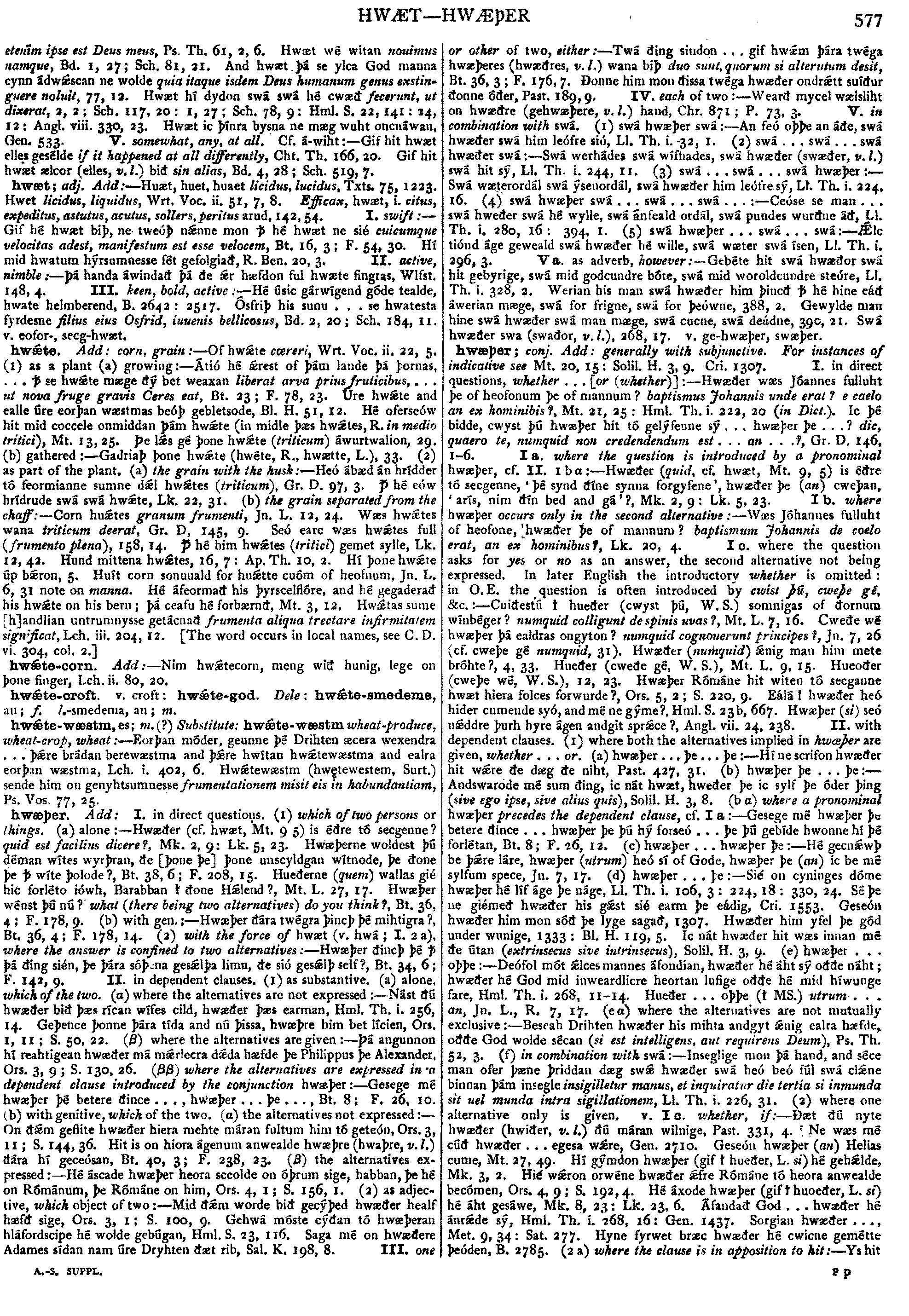
hwæþer
Add:
I.
in
direct
questions.
(1)
which
of
two
persons
or
things,
(a)
alone
:--
Hwæðer
(cf.
hwæt,
Mt.
9,
5)
is
éðre
tó
secgenne?
quid
est
facilius
dicere?,
Mk.
2,
9:
Lk.
5,
23.
Hwæþerne
woldest
þú
déman
wítes
wyrþran,
ðe
[þone
þe]
þone
unscyldgan
wítnode,
þe
ðone
þe
wíte
þolode?,
Bt.
38,
6;
F.
208,
15.
Hueðerne
(quem)
wallas
gié
hic
forléto
iówh,
Barabban
ðone
Hlend?,
Mt.
L.
27,
17.
Hwæþer
wénst
þú
nú?
what
(there
being
two
alternatives)
do
you
think?,
Bt.
36,
4;
F.
178,
9.
(b)
with
gen.
:--
Hwæþer
ðára
twégra
þincþ
þé
mihtigra?,
Bt.
36,
4;
F.
178,
14.
(2)
with
the
force
of
hwæt
(v.
hwá;
I.
2
a),
where
the
answer
is
confined
to
two
alternatives
:--
Hwæþer
ðincþ
þé
þá
ðing
sién,
þe
þára
sóþena
geslþa
limu,
ðe
sió
geslþ
self?,
Bt.
34,
6;
F.
142,
9.
II.
in
dependent
clauses.
(1)
as
substantive,
(a)
alone,
which
of
the
two.
()
where
the
alternatives
are
not
expressed
:--
Nást
ðú
hwæðer
bið
þæs
rícan
wífes
cild,
hwæðer
þæs
earman,
Hml.
Th.
i.
256,
14.
Geþence
þonne
þára
tída
and
nú
þissa,
hwæþre
him
bet
lícien,
Ors.
1,
11;
S.
50,
22.
()
where
the
alternatives
are
given
:--
Þá
angunnon
hí
reahtigean
hwæðer
má
mrlecra
dda
hæfde
þe
Philippus
þe
Alexander,
Ors.
3,
9;
S.
130,
26.
()
where
the
alternatives
are
expressed
in
a
dependent
clause
introduced
by
the
conjunction
hwæþer
:--
Gesege
mé
hwæþer
þé
betere
ðince
...,
hwæþer
...
þe
...,
Bt.
8;
F.
26,
10.
(b)
with
genitive,
which
of
the
two.
()
the
alternatives
not
expressed
:--
On
ðm
geflite
hwæðer
hiera
mehte
máran
fultum
him
tó
geteón,
Ors.
3,
11;
S.
144,
36.
Hit
is
on
hiora
ágenum
anwealde
hwæþre
(hwaþre,
v.
l.)
ðára
hí
geceósan,
Bt.
40,
3;
F.
238,
23.
()
the
alternatives
expressed
:--
Hé
áscade
hwæþer
heora
sceolde
on
óþrum
sige,
habban,
þe
hé
on
Rómánum,
þe
Rómáne
on
him,
Ors.
4,
1;
S.
156,
1.
(2)
as
adjective,
which
object
of
two
:--
Mid
ðm
worde
bið
gecýþed
hwæðer
healf
hæfð
sige,
Ors.
3,
1;
S.
100,
9.
Gehwá
móste
cýðan
tó
hwæþeran
hláfordscipe
hé
wolde
gebúgan,
Hml.
S.
23,
116.
Saga
mé
on
hwæðere
Adames
sídan
nam
úre
Dryhten
ðæt
rib,
Sal.
K.
198,
8.
III.
one
or
other
of
two,
either
:--
Twá
ðing
sindon
...
gif
hwm
þára
twéga
hwæþeres
(hwæðres,
v.
l.)
wana
biþ
duo
sunt,
quorum
si
alterutum
desit,
Bt.
36,
3;
F.
176,
7.
Ðonne
him
mon
ðissa
twéga
hwæðer
ondrtt
suíður
ðonne
óðer,
Past.
189,
9.
IV.
each
of
two
:--
Wearð
mycel
wælsliht
on
hwæðre
(gehwæþere,
v.
l.)
hand,
Chr.
871;
P.
73,
3.
V.
in
combination
with
swá.
(1)
swá
hwæþer
swá
:--
An
feó
oþþe
an
áðe,
swá
hwæðer
swá
him
leófre
sió,
Ll.
Th.
i.
32,
1.
(2)
swá
...
swá
...
swá
hwæðer
swá
:--
Swá
werhádes
swá
wífhades,
swá
hwæðer
(swæðer,
v.
l.)
swá
hit
sý,
Ll.
Th.
i.
244,
11.
(3)
swá
...
swá
...
swá
hwæþer
:--
Swá
wæterordál
swá
ýsenordál,
swá
hwæðer
him
leófre
sý,
Ll.
Th.
i.
224,
16.
(4)
swá
hwæþer
swá
...
swá
...
swá
...
:--
Ceóse
se
man
...
swá
hweðer
swá
hé
wylle,
swá
ánfeald
ordál,
swá
pundes
wurðne
áð,
Ll.
Th.
i.
280,
16:
394,
1.
(5)
swá
hwæþer
...
swá
...
swá
:--
Æ-acute;lc
tiónd
áge
geweald
swá
hwæðer
hé
wille,
swá
wæter
swá
ísen,
Ll.
Th.
i.
296,
3.
V
a.
as
adverb,
however
:--
Gebéte
hit
swá
hwæðor
swá
hit
gebyrige,
swá
mid
godcundre
bóte,
swá
mid
woroldcundre
steóre,
Ll.
Th.
i.
328,
2.
Werian
his
man
swá
hwæðer
him
þincð
hé
hine
eáð
áwerian
mæge,
swá
for
frigne,
swá
for
þeówne,
388,
2.
Gewylde
man
hine
swá
hwæðer
swá
man
mæge,
swá
cucne,
swá
deádne,
390,
21.
Swá
hwæðer
swá
(swaðor,
v.
l.),
268,
17.
v.
ge-hwæþer,
swæþer.
|
Source: Bosworth/Toller, page d0577, entry 8 View original page image as: [TIFF] [PNG] [View previous entry] [View next entry] |
[Comment on this entry] [View comments] |
The following entry has been hand-corrected once. |
hwæþer;
conj.
Add:
generally
with
subjunctive.
For
instances
of
indicative
see
Mt.
20,
15:
Solil.
H.
3,
9.
Cri.
1307.
I.
in
direct
questions,
whether
...
[or
(whither)]
:--
Hwæðer
wæs
Jóannes
fulluht
þe
of
heofonum
þe
of
mannum?
baptismus
Johannis
unde
erat?
e
caelo
an
ex
hominibis?,
Mt.
21,
25:
Hml.
Th.
i.
222,
20
(in
Dict.).
Ic
þé
bidde,
cwyst
þú
hwæþer
hit
tó
gelýfenne
sý
...
hwæþer
þe
...?
dic,
quaero
te,
numquid
nan
credendendum
est
...
an
...?,
Gr.
D.
146,
1-6.
I
a.
where
the
question
is
introduced
by
a
pronominal
hwæþer,
cf.
II.
1
b
:--
Hwæðer
(quid,
cf.
hwæt,
Mt.
9,
5)
is
éðre
tó
secgenne,
'þé
synd
ðíne
synna
forgyfene',
hwæðer
þe
(an)
cweþan,
'arís,
nim
ðín
bed
and
gá'?.
Mk.
2,
9:
Lk.
5,
23.
I
b.
where
hwæþer
occurs
only
in
the
second
alternative
:--
Wæs
Jóhannes
fulluht
of
heofone,
hwæðer
þe
of
mannum?
baptismum
Johannis
de
coelo
erat,
an
ex
hominibus?,
Lk.
20,
4.
I
c.
where
the
question
asks
for
yes
or
no
as
an
answer,
the
second
alternative
not
being
expressed.
In
later
English
the
introductory
whether
is
omitted:
in
O.
E.
the
question
is
often
introduced
by
cwist
þú,
cweþe
gé,
&c.:--
Cuiðestú
hueðer
(cwyst
þú,
W.
S.)
somnigas
of
ðornum
wínbéger?
numquid
colligunt
de
spinis
uvas?,
Mt.
L.
7,
16.
Cweðe
wé
hwæþer
þá
ealdras
ongyton?
numquid
cognouerunt
principes?,
Jn.
7,
26
(cf.
cweþe
gé
numquid,
31).
Hwæðer
(numquid)
nig
man
him
mete
bróhte?,
4,
33.
Hueðer
(cweðe
gé,
W.
S.),
Mt.
L.
9,
15.
Hueoðer
(cweþe
wé,
W.
S.),
12,
23.
Hwæþer
Rómáne
hit
witen
tó
secganne
hwæt
hiera
folces
forwurde?,
Ors.
5,
2;
S.
220,
9.
Eálá!
hwæðer
heó
hider
cumende
syó,
and
mé
ne
gýme?,
Hml.
S.
23
b,
667.
Hwæþer
(si)
seó
nddre
þurh
hyre
ágen
andgit
sprce?,
Angl.
vii.
24,
238.
II.
with
dependent
clauses.
(1)
where
both
the
alternatives
implied
in
hwæþer
are
given,
whether
...
or.
(a)
hwæþer
...
þe
...
þe
:--
Hí
ne
scrifon
hwæðer
hit
wre
ðe
dæg
ðe
niht,
Past.
427,
31.
(b)
hwæþer
þe
...
þe
:--
Andswarode
mé
sum
ðing,
ic
nát
hwæt,
hweðer
þe
ic
sylf
þe
óder
þing
(sive
ego
ipse,
sive
alias
quis),
Solil.
H.
3,
8.
(b
)
where
a
pronominal
hwæþer
precedes
the
dependent
clause,
cf.
I
a
:--
Gesege
mé
hwæþer
þe
betere
ðince
...
hwæþer
þe
þú
hý
forseó
...
þe
þú
gebíde
hwonne
hí
þé
forlétan,
Bt.
8;
F.
26,
12.
(c)
hwæþer
...
hwæþer
þe
:--
Hé
gecnwþ
be
þre
láre,
hwæþer
(utrum)
heó
sí
of
Gode,
hwæþer
þe
(an)
ic
be
mé
sylfum
spece,
Jn.
7,
17.
(d)
hwæþer
...
þe
:--
Sié
on
cyninges
dóme
hwæþer
hé
líf
áge
þe
náge,
Ll.
Th.
i.
106,
3:
224,
18:
330,
24.
Sé
þe
ne
giémeð
hwæðer
his
gst
sié
earm
þe
eádig,
Cri.
1553.
Geseón
hwæðer
him
mon
sóð
þe
lyge
sagað,
1307.
Hwæðer
him
yfel
þe
gód
under
wunige,
1333:
Bl.
H.
119,
5.
Ic
nát
hwæðer
hit
wæs
innan
mé
ðe
útan
(extrinsecus
sive
intrinsecus),
Solil.
H.
3,
9.
(e)
hwæþer
...
oþþe
:--
Deófol
mót
lces
mannes
áfondian,
hwæðer
hé
áht
sý
oððe
náht;
hwæðer
hé
God
mid
inweardlicre
heortan
lufige
oððe
hé
mid
híwunge
fare,
Hml.
Th.
i.
268,
11-14.
Hueðer
...
oþþe
(
MS.)
utrum
...
an,
Jn.
L.,
R.
7,
17.
(e
)
where
the
alternatives
are
not
mutually
exclusive
:--
Beseah
Drihten
hwæðer
his
mihta
andgyt
nig
ealra
hæfde,
oððe
God
wolde
sécan
(si
est
intelligens,
aut
requirens
Deum),
Ps.
Th.
52,
3.
(f)
in
combination
with
swá
:--
Inseglige
mon
þá
hand,
and
séce
man
ofér
þæne
þriddan
dæg
sw
hwæðer
swá
heó
beó
fúl
swá
clne
binnan
þám
insegle
insigilletur
manus,
et
inquiratur
die
tertia
si
inmunda
sit
uel
munda
intra
sigillationem,
Ll.
Th.
i.
226,
31.
(2)
where
one
alternative
only
is
given.
v.
I
c.
whether,
if
:--
Ðæt
ðú
nyte
hwæðer
(hwiðer,
v.
l.)
ðú
máran
wilnige,
Past.
331,
4.
Ne
wæs
mé
cúð
hwæðer
...
egesa
wre,
Gen.
2710.
Geseón
hwæþer
(an)
Helias
cume,
Mt.
27,
49.
Hí
gýmdon
hwæþer
(gif
hueðer,
L.
si)
hé
gehlde,
Mk.
3,
2.
Hié
wron
orwéne
hwæðer
fre
Rómáne
tó
heora
anwealde
becómen,
Ors.
4,
9;
S.
192,
4.
Hé
áxode
hwæþer
(gif
huoeðer,
L.
si)
hé
áht
gesáwe,
Mk.
8,
23:
Lk.
23,
6.
Áfandað
God
...
hwæðer
hé
ánrde
sý,
Hml.
Th.
i.
268,
16:
Gen.
1437.
Sorgian
hwæðer
...,
Met.
9,
34:
Sat.
277.
Hyne
fyrwet
bræc
hwæðer
hé
cwicne
gemétte
þeóden,
B.
2785.
(2
a)
where
the
clause
is
in
apposition
to
kit
:--
Ys
hit
|
Source: Bosworth/Toller, page d0578, entry 3 View original page image as: [TIFF] [PNG] [View previous entry] [View next entry] |
[Comment on this entry] [View comments] |
The following entry has been hand-corrected once. |
hwæt-hwára; adv. A little, somewhat, slightly :-- Þá þeáhhwæðre gebyrede him þæt hié hwæthwára gebugan tó fleónne cum Persarum acies paulatim cederet, Ors. 1, 12; S. 54, 1. Þæt þá munecas hwæthwára furþor restan þonne healfe niht ut modice amplius de media nocte pausentur, R. Ben. 32, 13. Gelencged hwæthwára, 37, 8. Syricas hwæthwára (-hwega, v. l. modice) beteran, 91, 11. Þeáh hwet teartlices hwæthwára stíðlíce (hwæthwega stíðlices, v. l.) geset sý, 5, 11. Cf. æt-hwára.
| Result Page: |  |
Previous | 269 270 271 272 273 274 275 276 277 278 279 280 281 282 283 284 285 286 287 | Next |  |
Germanic Lexicon Project (main page)
This search system was written by
Sean Crist
Please consider
volunteering
to correct the data in these online dictionaries.
No rights reserved. Feel free to use these data in any way you please.