|
|

|
Source: Bosworth/Toller, page b0576, entry 1 View original page image as: [TIFF] [PNG] [View previous entry] [View next entry] |
[Comment on this entry] [View comments] |
The following entry has been hand-corrected once. |
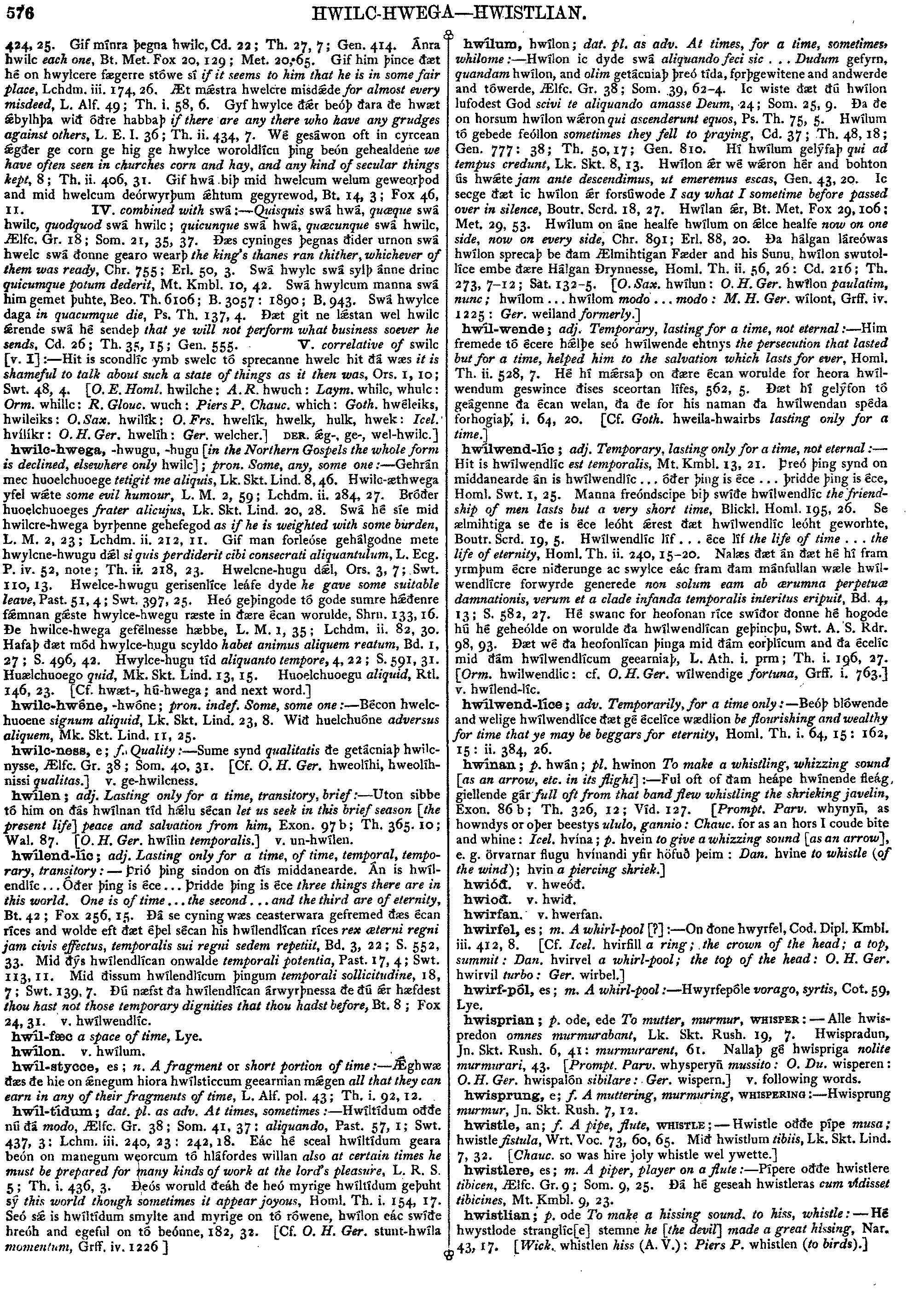
424,
25.
Gif
mínra
þegna
hwilc,
Cd.
22;
Th.
27,
7;
Gen.
414.
Ánra
hwilc
each
one,
Bt.
Met.
Fox
20,
129;
Met.
20,
65.
Gif
him
þince
ðæt
hé
on
hwylcere
fægerre
stówe
sí
if
it
seems
to
him
that
he
is
in
some
fair
place,
Lchdm.
iii.
174,
26.
Æt
m stra
hwelcre
misdde
for
almost
every
misdeed,
L.
Alf.
49;
Th.
i.
58,
6.
Gyf
hwylce
ðr
beóþ
ðara
ðe
hwæt
bylhþa
wið
óðre
habbaþ
if
there
are
any
there
who
have
any
grudges
against
others,
L.
E.
I.
36;
Th.
ii.
434,
7.
Wé
gesáwon
oft
in
cyrcean
gðer
ge
corn
ge
hig
ge
hwylce
woroldlícn
þing
beón
gehealdene
we
have
often
seen
in
churches
corn
and
hay,
and
any
kind
of
secular
things
kept,
8;
Th.
ii.
406,
31.
Gif
hwá
biþ
mid
hwelcum
welum
geweorþod
and
mid
hwelcum
deórwyrþum
htum
gegyrewod.
Bt.
14,
3;
Fox
46,
11.
IV.
combined
with
swá
:--
Quisquis
swá
hwá,
quæque
swá
hwilc,
quodquod
swá
hwilc;
quicunque
swá
hwá,
quæcunque
swá
hwilc,
Ælfc.
Gr.
18;
Som.
21,
35,
37.
Ðæs
cyninges
þegnas
ðider
urnon
swá
hwelc
swá
ðonne
gearo
wearþ
the
king's
thanes
ran
thither,
whichever
of
them
was
ready,
Chr.
755;
Erl.
50,
3.
Swá
hwylc
swá
sylþ
ánne
drinc
quicumque
potum
dederit,
Mt.
Kmbl.
10,
42.
Swá
hwylcum
manna
swá
him
gemet
þuhte,
Beo.
Th.
6106;
B.
3057:
1890;
B.
943.
Swá
hwylce
daga
in
quacumque
die,
Ps.
Th.
137,
4.
Ðæt
git
ne
lstan
wel
hwilc
rende
swá
hé
sendeþ
that
ye
will
not
perform
what
business
soever
he
sends,
Cd.
26;
Th.
35,
15;
Gen.
555.
V.
correlative
of
swilc
[v.
I]
:--
Hit
is
scondlíc
ymb
swelc
tó
sprecanne
hwelc
hit
ðá
wæs
it
is
shameful
to
talk
about
such
a
state
of
things
as
it
then
was,
Ors.
1,
10;
Swt.
48,
4.
[O.
E.
Homl.
hwilche:
A.
R.
hwuch:
Laym.
whilc,
whulc:
Orm.
whillc:
R.
Glouc.
wuch:
Piers
P.
Chauc.
which:
Goth.
hwéleiks,
hwileiks:
O.
Sax.
hwilík:
O.
Nrs.
hwelík,
hwelk,
hulk,
hwek:
Icel.
hvílíkr:
O.
H.
Ger.
hwelíh:
Ger.
welcher.]
DER.
g-,
ge-,
wel-hwilc.
stra
hwelcre
misdde
for
almost
every
misdeed,
L.
Alf.
49;
Th.
i.
58,
6.
Gyf
hwylce
ðr
beóþ
ðara
ðe
hwæt
bylhþa
wið
óðre
habbaþ
if
there
are
any
there
who
have
any
grudges
against
others,
L.
E.
I.
36;
Th.
ii.
434,
7.
Wé
gesáwon
oft
in
cyrcean
gðer
ge
corn
ge
hig
ge
hwylce
woroldlícn
þing
beón
gehealdene
we
have
often
seen
in
churches
corn
and
hay,
and
any
kind
of
secular
things
kept,
8;
Th.
ii.
406,
31.
Gif
hwá
biþ
mid
hwelcum
welum
geweorþod
and
mid
hwelcum
deórwyrþum
htum
gegyrewod.
Bt.
14,
3;
Fox
46,
11.
IV.
combined
with
swá
:--
Quisquis
swá
hwá,
quæque
swá
hwilc,
quodquod
swá
hwilc;
quicunque
swá
hwá,
quæcunque
swá
hwilc,
Ælfc.
Gr.
18;
Som.
21,
35,
37.
Ðæs
cyninges
þegnas
ðider
urnon
swá
hwelc
swá
ðonne
gearo
wearþ
the
king's
thanes
ran
thither,
whichever
of
them
was
ready,
Chr.
755;
Erl.
50,
3.
Swá
hwylc
swá
sylþ
ánne
drinc
quicumque
potum
dederit,
Mt.
Kmbl.
10,
42.
Swá
hwylcum
manna
swá
him
gemet
þuhte,
Beo.
Th.
6106;
B.
3057:
1890;
B.
943.
Swá
hwylce
daga
in
quacumque
die,
Ps.
Th.
137,
4.
Ðæt
git
ne
lstan
wel
hwilc
rende
swá
hé
sendeþ
that
ye
will
not
perform
what
business
soever
he
sends,
Cd.
26;
Th.
35,
15;
Gen.
555.
V.
correlative
of
swilc
[v.
I]
:--
Hit
is
scondlíc
ymb
swelc
tó
sprecanne
hwelc
hit
ðá
wæs
it
is
shameful
to
talk
about
such
a
state
of
things
as
it
then
was,
Ors.
1,
10;
Swt.
48,
4.
[O.
E.
Homl.
hwilche:
A.
R.
hwuch:
Laym.
whilc,
whulc:
Orm.
whillc:
R.
Glouc.
wuch:
Piers
P.
Chauc.
which:
Goth.
hwéleiks,
hwileiks:
O.
Sax.
hwilík:
O.
Nrs.
hwelík,
hwelk,
hulk,
hwek:
Icel.
hvílíkr:
O.
H.
Ger.
hwelíh:
Ger.
welcher.]
DER.
g-,
ge-,
wel-hwilc.
|
Source: Bosworth/Toller, page b0576, entry 2 View original page image as: [TIFF] [PNG] [View previous entry] [View next entry] |
[Comment on this entry] [View comments] |
The following entry has been hand-corrected once. |
hwilc-hwega,
-hwugu,
-hugu
[in
the
Northern
Gospels
the
whole
form
is
declined,
elsewhere
only
hwilc];
pron.
Some,
any,
some
one
:--
Gehrán
mec
huoelchuoege
tetigit
me
aliquis,
Lk.
Skt.
Lind.
8,
46.
Hwilc-æthwega
yfel
wte
some
evil
humour,
L.
M.
2,
59;
Lchdm.
ii.
284,
27.
Bróðer
huoelchuoeges
frater
alicujus,
Lk.
Skt.
Lind.
20,
28.
Swá
hé
síe
mid
hwilcre-hwega
byrþenne
gehefegod
as
if
he
is
weighted
with
some
burden,
L.
M.
2,
23;
Lchdm.
ii.
212,
11.
Gif
man
forleóse
gehálgodne
mete
hwylcne-hwugu
dl
si
quis
perdiderit
cibi
consecrati
aliquantulum,
L.
Ecg.
P.
iv.
52,
note;
Th.
ii.
218,
23.
Hwelcne-hugu
dl,
Ors.
3,
7;
Swt.
110,
13.
Hwelce-hwugu
gerisenlíce
leáfe
dyde
he
gave
some
suitable
leave,
Past.
51,
4;
Swt.
397,
25,
Heó
geþingode
tó
gode
sumre
hðenre
fmnan
gste
hwylce-hwegu
ræste
in
ðære
écan
worulde,
Shrn.
133,
16.
Ðe
hwilce-hwega
gefélnesse
hæbbe,
L.
M.
1,
35;
Lchdm.
ii.
82,
30.
Hafaþ
ðæt
mód
hwylce-hugu
scyldo
habet
animus
aliquem
reatum,
Bd.
1,
27;
S.
496,
42.
Hwylce-hugu
tíd
aliquanto
tempore,
4,
22;
S.
591,
31.
Huælchuoego
quid,
Mk.
Skt.
Lind.
13,
15.
Huoelchuoegu
aliquid,
Rtl.
146,
23.
[Cf.
hwæt-,
hú-hwega;
and
next
word.]
|
Source: Bosworth/Toller, page b0576, entry 3 View original page image as: [TIFF] [PNG] [View previous entry] [View next entry] |
[Comment on this entry] [View comments] |
The following entry has been hand-corrected once. |
hwilc-hwéne, -hwóne; pron. indef. Some, some one :-- Bécon hwelchuoene signum aliquid, Lk. Skt. Lind. 23, 8. Wið huelchuóne adversus aliquem, Mk. Skt. Lind. 11. 25.
|
Source: Bosworth/Toller, page b0576, entry 6 View original page image as: [TIFF] [PNG] [View previous entry] [View next entry] |
[Comment on this entry] [View comments] |
The following entry has been hand-corrected once. |
hwílend-líc;
adj.
Lasting
only
for
a
time,
of
time,
temporal,
temporary,
transitory
:--
Þrió
þing
sindon
on
ðís
middanearde.
Án
is
hwílendlíc
...
Óðer
þing
is
éce
...
Þridde
þing
is
éce
three
things
there
are
in
this
world.
One
is
of
time
...
the
second
...
and
the
third
are
of
eternity,
Bt.
42;
Fox
256,
15.
Ðá
se
cyning
wæs
ceasterwara
gefremed
ðæs
écan
ríces
and
wolde
eft
ðæt
éþel
sécan
his
hwílendlícan
ríces
rex
æterni
regni
jam
civis
effectus,
temporalis
sui
regni
sedem
repetiit,
Bd.
3,
22;
S.
552,
33.
Mid
ðýs
hwílendlícan
onwalde
temporali
potentia,
Past.
17,
4;
Swt.
113,
11.
Mid
ðissum
hwílendlícum
þingum
temporali
sollicitudine,
18,
7;
Swt.
139,
7.
Ðú
næfst
ða
hwílendlícan
árwyrþnessa
ðe
ðú
r
hæfdest
thou
hast
not
those
temporary
dignities
that
thou
hadst
before,
Bt.
8;
Fox
24,
31.
v.
hwílwendlíc.
|
Source: Bosworth/Toller, page b0576, entry 11 View original page image as: [TIFF] [PNG] [View previous entry] [View next entry] |
[Comment on this entry] [View comments] |
The following entry has been hand-corrected once. |
hwílum,
hwílon;
dat.
pl.
as
adv.
At
times,
for
a
time,
sometimes,
whilome
:--
Hwílon
ic
dyde
swá
aliquando
feci
sic
...
Dudum
gefyrn,
quondam
hwílon,
and
olim
getácniaþ
þreó
tída,
forþgewitene
and
andwerde
and
tówerde,
Ælfc.
Gr.
38;
Som.
39,
62-4.
Ic
wiste
ðæt
ðú
hwílon
lufodest
God
scivi
te
aliquando
amasse
Deum,
24;
Som.
25,
9.
Ða
ðe
on
horsum
hwílon
wron
qui
ascenderunt
equos,
Ps.
Th.
75,
5.
Hwílum
tó
gebede
feóllon
sometimes
they
fell
to
praying,
Cd.
37;
Th.
48,
18;
Gen.
777:
38;
Th.
50,
17;
Gen.
810.
Hí
hwílum
gelýfaþ
qui
ad
tempus
credunt,
Lk.
Skt.
8,
13.
Hwílon
r
wé
wron
hér
and
bohton
ús
hwte
jam
ante
descendimus,
ut
emeremus
escas,
Gen.
43,
20.
Ic
secge
ðæt
ic
hwílon
r
forsúwode
I
say
what
I
sometime
before
passed
over
in
silence,
Boutr.
Scrd.
18,
27.
Hwílan
r,
Bt.
Met.
Fox
29,
106;
Met.
29,
53.
Hwílum
on
áne
healfe
hwílum
on
lce
healfe
now
on
one
side,
now
on
every
side,
Chr.
891;
Erl.
88,
20.
Ða
hálgan
láreówas
hwílon
sprecaþ
be
ðam
Ælmihtigan
Fæder
and
his
Sunu,
hwílon
swutollíce
embe
ðære
Hálgan
Ðrynnesse,
Homl.
Th.
ii.
56,
26:
Cd.
216;
Th.
273,
7-12;
Sat.
132-5.
[O.
Sax.
hwílun:
O.
H.
Ger.
hwílon
paulatim,
nunc;
hwílom
...
hwílom
modo
...
modo:
M.
H.
Ger.
wílont.
Grff.
iv.
1225:
Ger.
weiland
formerly.]
|
Source: Bosworth/Toller, page b0579, entry 1 View original page image as: [TIFF] [PNG] [View previous entry] [View next entry] |
[Comment on this entry] [View comments] |
The following entry has been hand-corrected once. |
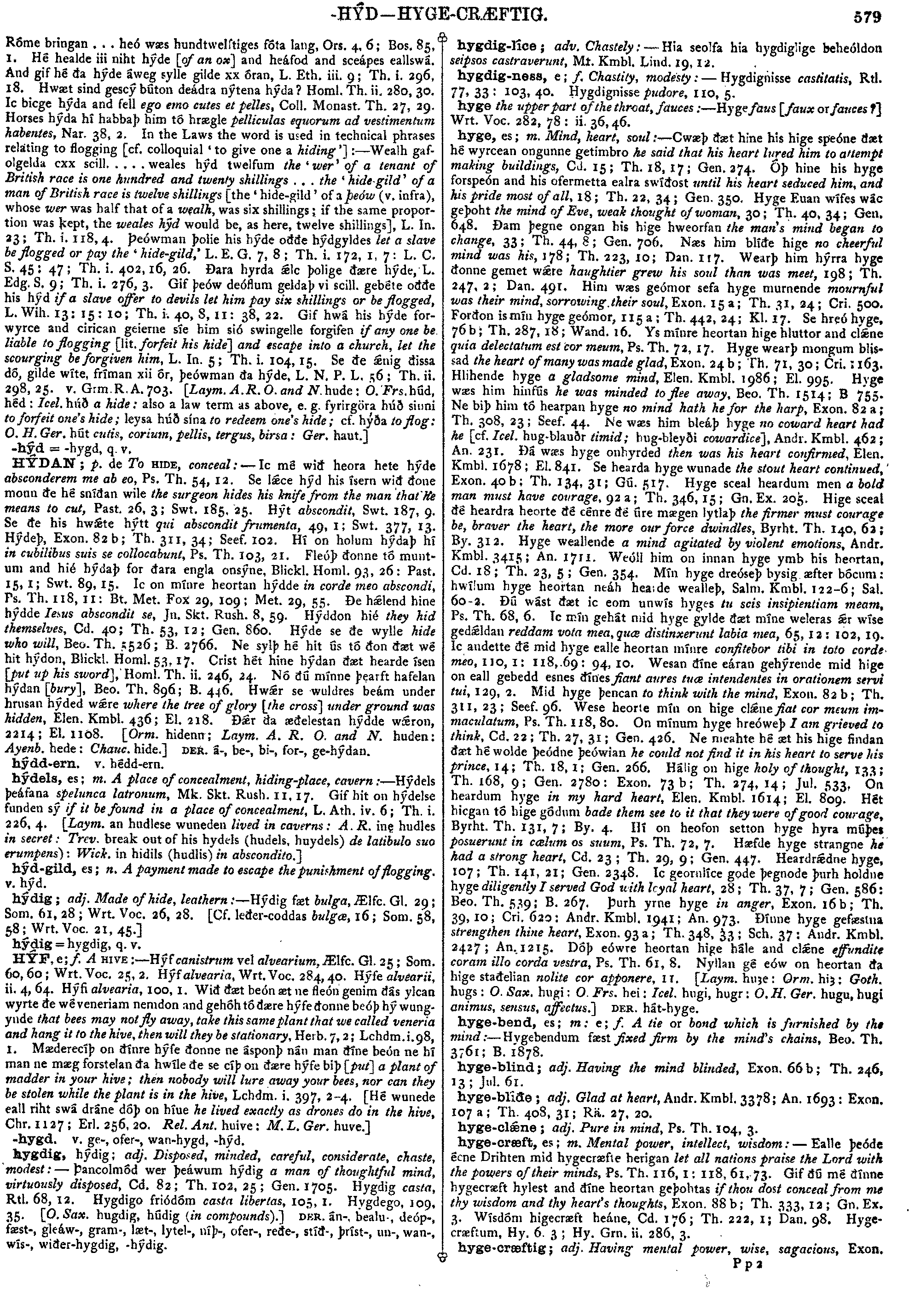
Róme
bringan
...
heó
wæs
hundtwelftiges
fóta
lang,
Ors.
4,
6;
Bos.
85,
1.
Hé
healde
iii
niht
hýde
[of
an
ox]
and
heáfod
and
sceápes
eallswá.
And
gif
hé
ða
hýde
áweg
sylle
gilde
xx
óran,
L.
Eth.
iii.
9;
Th.
i.
296,
118.
Hwæt
sind
gescý
búton
deádra
nýtena
hýda?
Homl.
Th.
ii.
280,
30.
Ic
bicge
hýda
and
fell
ego
emo
cutes
et
pelles,
Coll.
Monast.
Th.
27,
29.
Horses
hýda
hí
habbaþ
him
tó
hrægle
pelliculas
equorum
ad
vestimentum
habentes,
Nar.
38,
2.
In
the
Laws
the
word
is
used
in
technical
phrases
relating
to
flogging
[cf.
colloquial
'to
give
one
a
hiding']
:--
Wealh
gafolgelda
cxx
scill.
...
weales
hýd
twelfum
the
'wer'
of
a
tenant
of
British
race
is
one
hundred
and
twenty
shillings
...
the
'hide-gild'
of
a
man
of
British
race
is
twelve
shillings
[the
'hide-gild'
of
a
þeów
(v.
infra),
whose
wer
was
half
that
of
a
wealh,
was
six
shillings;
if
the
same
proportion
was
kept,
the
weales
hýd
would
be,
as
here,
twelve
shillings],
L.
In.
23;
Th.
i.
118,
4.
Þeówman
þolie
his
hýde
oððe
hýdgyldes
let
a
slave
be
flogged
or
pay
the
'hide-gild,'
L.
E.
G.
7,
8;
Th.
i.
172,
1,
7:
L.
C.
S.
45;
47;
Th.
i.
402,
16,
26.
Ðara
hyrda
lc
þolige
ðære
hýde,
L.
Edg.
S.
9;
Th.
i.
276,
3.
Gif
þeów
deóflum
geldaþ
vi
scill.
gebéte
oððe
his
hýd
if
a
slave
offer
to
devils
let
him
pay
six
shillings
or
be
flogged,
L.
Wih.
13:
15:
10;
Th.
i.
40,
S.
11:
38,
22.
Gif
hwá
his
hýde
forwyrce
and
cirican
geierne
síe
him
sió
swingelle
forgifen
if
any
one
be
liable
to
flogging
[lit.
forfeit
his
hide]
and
escape
into
a
church,
let
the
scourging
be
forgiven
him,
L.
In.
5;
Th.
i.
104,
15.
Se
ðe
nig
ðissa
dó,
gilde
wíte,
fríman
xii
ór,
þeówman
ða
hýde,
L.
N.
P.
L.
56;
Th.
ii.
298,
25.
v.
Grm.
R.
A.
703.
[Laym.
A.
R.
O.
and
N.
hude:
O.
Frs.
húd,
héd:
Icel.
húð
a
hide:
also
a
law
term
as
above,
e.g.
fyrirgöra
húð
sinni
to
forfeit
one's
hide;
leysa
húð
sína
to
redeem
one's
hide;
cf.
hýða
to
flog:
O.
H.
Ger.
hút
cutis,
corium,
pellis,
tergus,
birsa:
Ger.
haut.]
|
Source: Bosworth/Toller, page b0581, entry 2 View original page image as: [TIFF] [PNG] [View previous entry] [View next entry] |
[Comment on this entry] [View comments] |
The following entry has been hand-corrected once. |
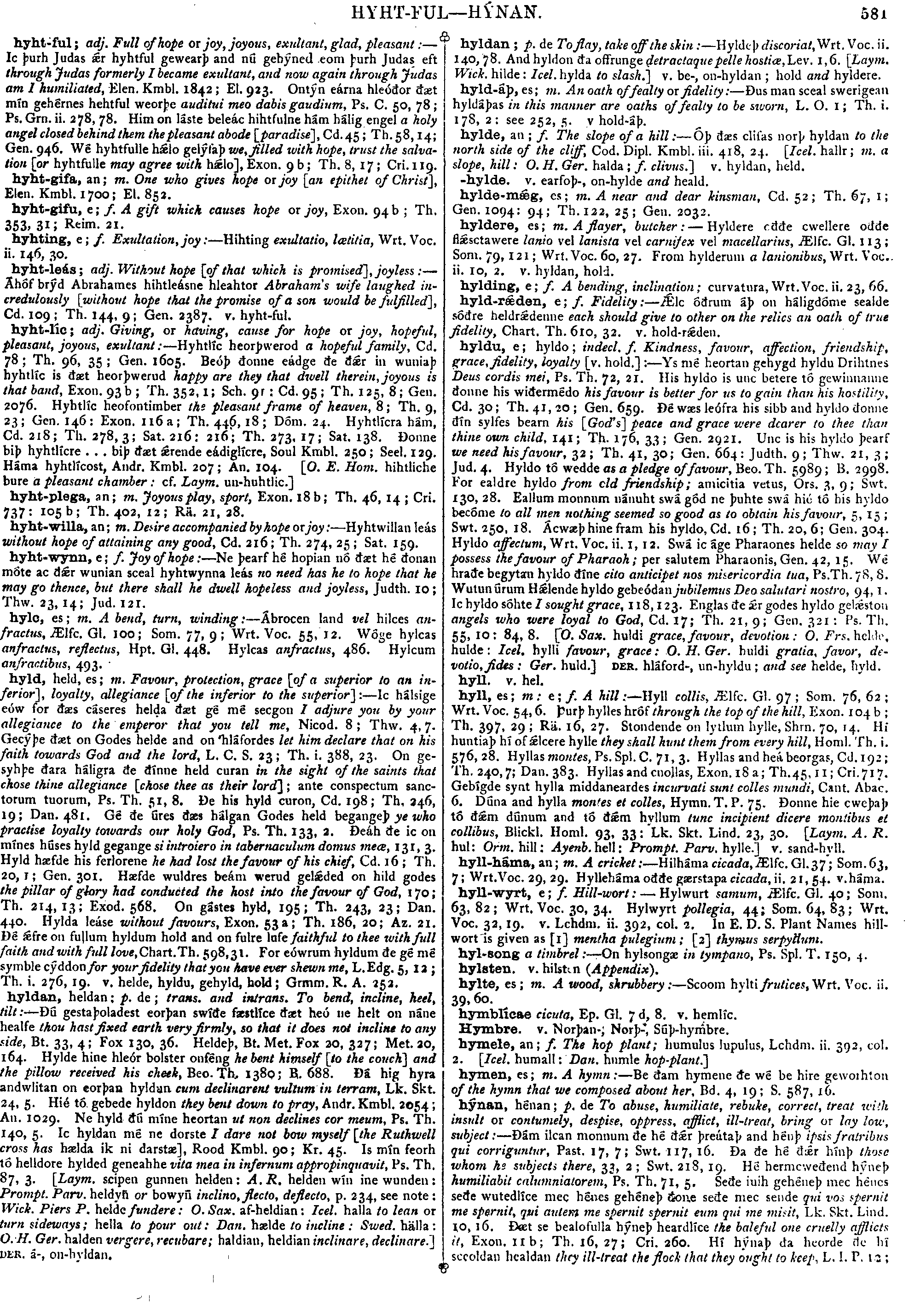
hyht-gifa, an; m. One who gives hope or joy [an epithet of Christ], Elen. Kmbl. 1700; El. 852.
|
Source: Bosworth/Toller, page b0581, entry 33 View original page image as: [TIFF] [PNG] [View previous entry] [View next entry] |
[Comment on this entry] [View comments] |
The following entry has been hand-corrected once. |
hýnan,
hénan;
p.
de
To
abuse,
humiliate,
rebuke,
correct,
treat
with
insult
or
contumely,
despise,
oppress,
afflict,
ill-treat,
bring
or
lay
low,
subject
:--
Ðám
ilcan
monnum
ðe
hé
ðr
þreátaþ
and
hénþ
ipsis
fratribus
qui
corriguntur,
Past.
17,
7;
Swt.
117,
16.
Ða
ðe
he
ðr
hínþ
those
whom
he
subjects
there,
33,
2;
Swt.
218,
19.
Hé
hermcweðend
hýneþ
humiliabit
calumniatorem,
Ps.
Th.
71,
5.
Seðe
iuih
gehéneþ
mec
hénes
seðe
wutedlíce
mec
hénes
gehéneþ
ðone
seðe
mec
sende
qui
vos
spernit
me
spernit,
qui
autem
me
spernit
spernit
eum
qui
me
misit,
Lk.
Skt.
Lind.
10,
16.
Ðæt
se
bealofulla
hýneþ
heardlíce
the
baleful
one
cruelly
afflicts
it,
Exon.
11
b;
Th.
16,
27;
Cri.
260.
Hí
hýnaþ
da
heorde
ðe
hí
sceoldan
healdan
they
ill-treat
the
flock
that
they
ought
to
keep,
L.
I.
P.
12;
|
Source: Bosworth/Toller, page b0582, entry 3 View original page image as: [TIFF] [PNG] [View previous entry] [View next entry] |
[Comment on this entry] [View comments] |
The following entry has been hand-corrected once. |
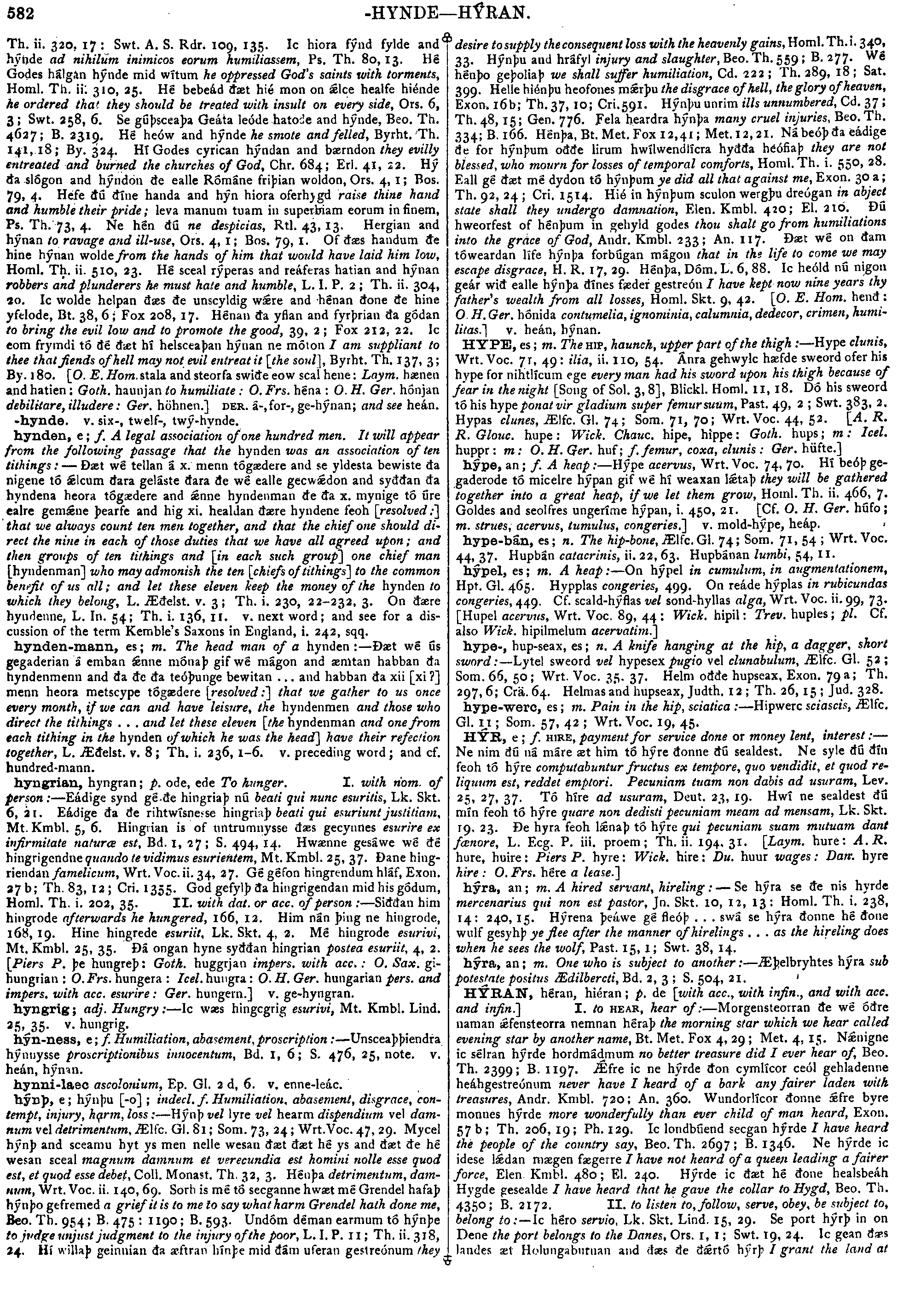
hynden,
e;
f.
A
legal
association
of
one
hundred
men.
It
will
appear
from
the
following
passage
that
the
hynden
was
an
association
of
ten
tithings
:--
Ðæt
wé
tellan
á
x.
menn
tógædere
and
se
yldesta
bewiste
ða
nigene
tó
lcum
ðara
geláste
ðara
ðe
wé
ealle
gecwdon
and
syððan
ða
hyndena
heora
tógædere
and
nne
hyndenman
ðe
ða
x.
mynige
tó
úre
ealre
gemne
þearfe
and
hig
xi.
healdan
ðære
hyndene
feoh
[resolved:]
that
we
always
count
ten
men
together,
and
that
the
chief
one
should
direct
the
nine
in
each
of
those
duties
that
we
have
all
agreed
upon;
and
then
groups
of
ten
tithings
and
[in
each
such
group]
one
chief
man
[hyndenman]
who
may
admonish
the
ten
[chiefs
of
tithings]
to
the
common
benefit
of
us
all;
and
let
these
eleven
keep
the
money
of
the
hynden
to
which
they
belong,
L.
Æðelst.
v.
3;
Th.
i.
230,
22-232,
3.
On
ðære
hyndenne,
L.
In.
54;
Th.
i.
136,
11.
v.
next
word;
and
see
for
a
discussion
of
the
term
Kemble's
Saxons
in
England,
i.
242,
sqq.
|
Source: Bosworth/Toller, page b0582, entry 4 View original page image as: [TIFF] [PNG] [View previous entry] [View next entry] |
[Comment on this entry] [View comments] |
The following entry has been hand-corrected once. |
hynden-mann,
es;
m.
The
head
man
of
a
hynden
:--
Ðæt
wé
ús
gegaderian
á
emban
nne
mónaþ
gif
wé
mágon
and
æmtan
habban
ða
hyndenmenn
and
ða
ðe
ða
teóþunge
bewitan
...
and
habban
ða
xii
[xi?]
menn
heora
metscype
tógædere
[resolved:]
that
we
gather
to
us
once
every
month,
if
we
can
and
have
leisure,
the
hyndenmen
and
those
who
direct
the
tithings
...
and
let
these
eleven
[the
hyndenman
and
one
from
each
tithing
in
the
hynden
of
which
he
was
the
head]
have
their
refection
together,
L.
Æðelst.
v.
8;
Th.
i.
236,
1-6.
v.
preceding
word;
and
cf.
hundred-mann.
| Result Page: |  |
Previous | 80 81 82 83 84 85 86 87 88 89 90 91 92 93 94 95 96 97 98 | Next |  |
Germanic Lexicon Project (main page)
This search system was written by
Sean Crist
Please consider
volunteering
to correct the data in these online dictionaries.
No rights reserved. Feel free to use these data in any way you please.