|
|

|
Source: Bosworth/Toller, page b0533, entry 30 View original page image as: [TIFF] [PNG] [View previous entry] [View next entry] |
[Comment on this entry] [View comments (1)] |
The following entry has been hand-corrected once. |
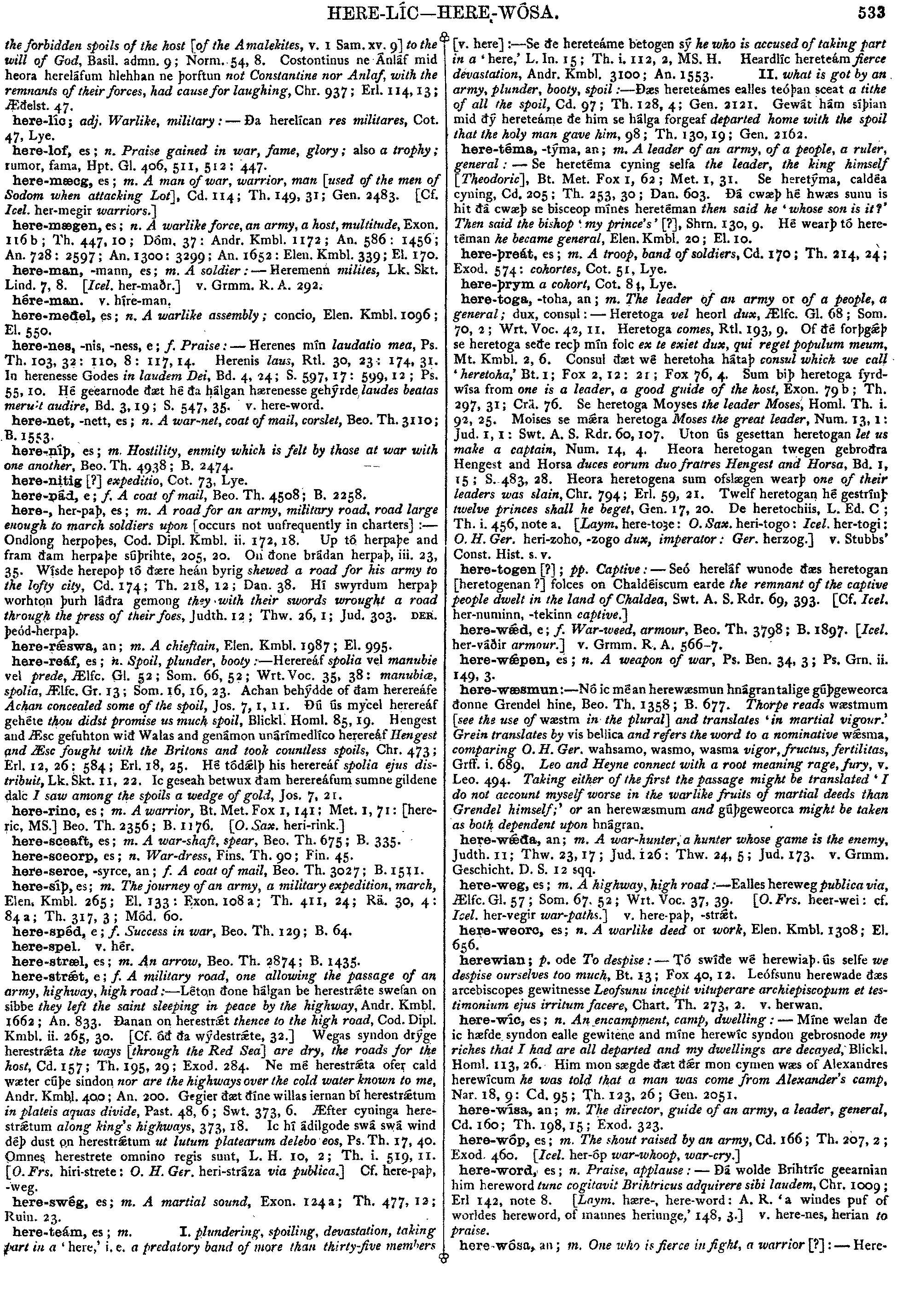
hare-toga,
-toha,
an;
m.
The
leader
of
an
army
or
of
a
people,
a
general;
dux,
consul:--
Heretoga
vel
heorl
dux,
Ælfc.
Gl.
68;
Som.
70,
2;
Wrt.
Voc.
42,
11.
Heretoga
comes,
Rtl.
193,
9.
Of
ðé
forþg þ
se
heretoga
seðe
recþ
mín
folc
ex
te
exiet
dux,
qui
reget
populum
meum,
Mt.
Kmbl.
2,
6.
Consul
ðæt
wé
heretoha
hátaþ
consul
which
we
call
'heretoha,'
Bt.
1;
Fox
2,
12:
21;
Fox
76,
4.
Sum
biþ
heretoga
fyrdwísa
from
one
is
a
leader,
a
good
guide
of
the
host,
Exon.
79b;
Th.
297,
31;
Crä.
76.
Se
heretoga
Moyses
the
leader
Moses,
Homl.
Th.
i.
92,
25.
Moises
se
mra
heretoga
Moses
the
great
leader.
Num.
13,
1:
Jud.
1,
1:
Swt.
A.
S.
Rdr.
60,
107.
Uton
ús
gesettan
heretogan
let
us
make
a
captain,
Num.
14,
4.
Heora
heretogan
twegen
gebroðra
Hengest
and
Horsa
duces
eorum
duo
fratres
Hengest
and
Horsa,
Bd.
1,
15;
S.
483,
28.
Heora
heretogena
sum
ofslægen
wearþ
one
of
their
leaders
was
slain,
Chr.
794;
Erl.
59,
21.
Twelf
heretogan
hé
gestrínþ
twelve
princes
shall
he
beget,
Gen.
17,
20.
De
heretochiis,
L.
Ed.
C;
Th.
i.
456,
note
a.
[Laym,
here-to
þ
se
heretoga
seðe
recþ
mín
folc
ex
te
exiet
dux,
qui
reget
populum
meum,
Mt.
Kmbl.
2,
6.
Consul
ðæt
wé
heretoha
hátaþ
consul
which
we
call
'heretoha,'
Bt.
1;
Fox
2,
12:
21;
Fox
76,
4.
Sum
biþ
heretoga
fyrdwísa
from
one
is
a
leader,
a
good
guide
of
the
host,
Exon.
79b;
Th.
297,
31;
Crä.
76.
Se
heretoga
Moyses
the
leader
Moses,
Homl.
Th.
i.
92,
25.
Moises
se
mra
heretoga
Moses
the
great
leader.
Num.
13,
1:
Jud.
1,
1:
Swt.
A.
S.
Rdr.
60,
107.
Uton
ús
gesettan
heretogan
let
us
make
a
captain,
Num.
14,
4.
Heora
heretogan
twegen
gebroðra
Hengest
and
Horsa
duces
eorum
duo
fratres
Hengest
and
Horsa,
Bd.
1,
15;
S.
483,
28.
Heora
heretogena
sum
ofslægen
wearþ
one
of
their
leaders
was
slain,
Chr.
794;
Erl.
59,
21.
Twelf
heretogan
hé
gestrínþ
twelve
princes
shall
he
beget,
Gen.
17,
20.
De
heretochiis,
L.
Ed.
C;
Th.
i.
456,
note
a.
[Laym,
here-to e:
O.
Sax.
heri-togo:
Icel.
her-togi:
O.
H.
Ger.
heri-zoho,
-zogo
dux,
imperator:
Ger.
herzog.]
v.
Stubbs'
Const.
Hist.
s.
v.
e:
O.
Sax.
heri-togo:
Icel.
her-togi:
O.
H.
Ger.
heri-zoho,
-zogo
dux,
imperator:
Ger.
herzog.]
v.
Stubbs'
Const.
Hist.
s.
v.
|
Source: Bosworth/Toller, page b0533, entry 43 View original page image as: [TIFF] [PNG] [View previous entry] [View next entry] |
[Comment on this entry] [View comments] |
The following entry has been hand-corrected once. |
here-wósa, an; m. One who is fierce in fight, a warrior [?]:-- Here-
|
Source: Bosworth/Toller, page b0534, entry 7 View original page image as: [TIFF] [PNG] [View previous entry] [View next entry] |
[Comment on this entry] [View comments] |
The following entry has been hand-corrected once. |
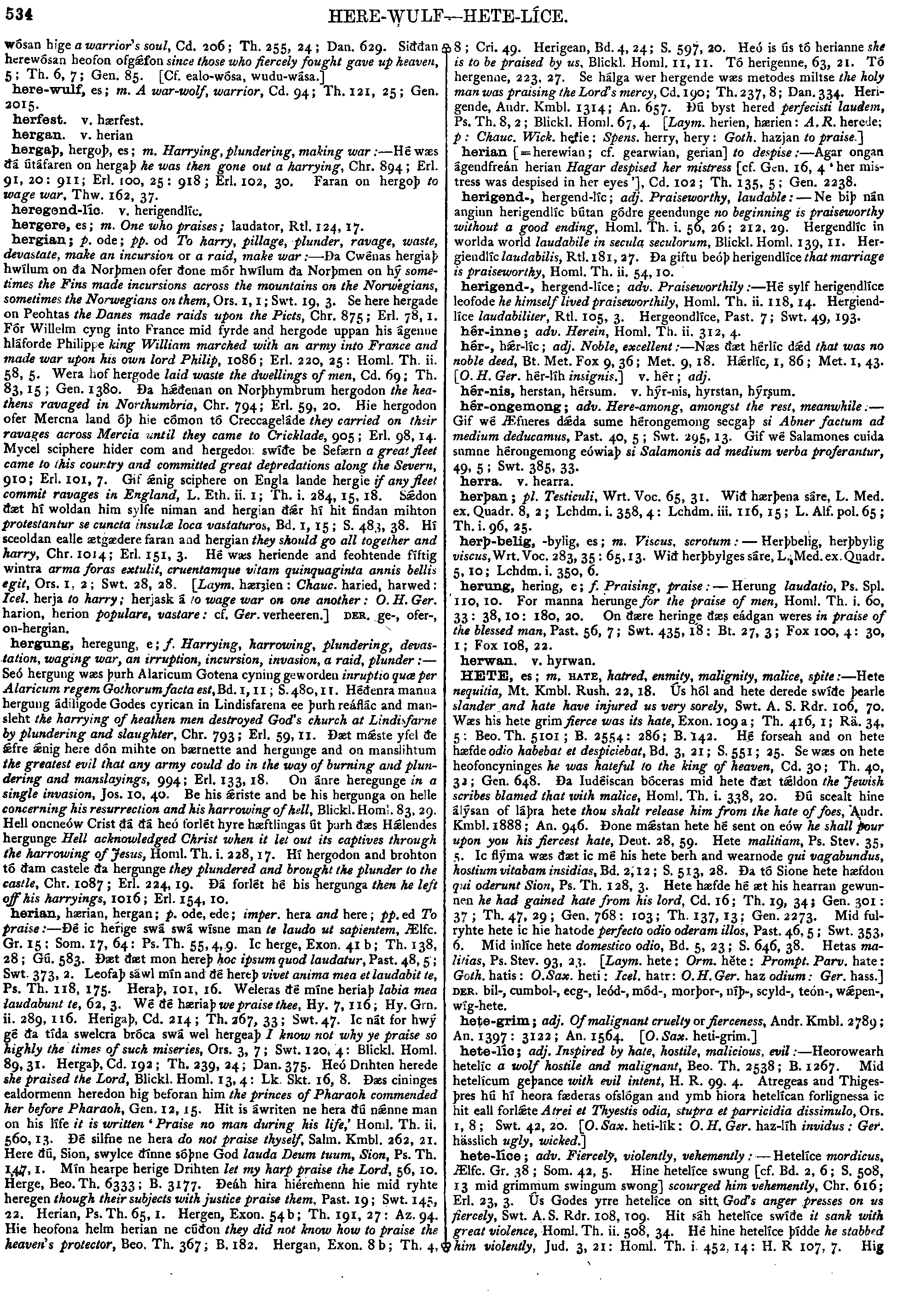
hergere, es; m. One who praises; laudator, Rtl. 124, 17.
|
Source: Bosworth/Toller, page b0534, entry 8 View original page image as: [TIFF] [PNG] [View previous entry] [View next entry] |
[Comment on this entry] [View comments] |
The following entry has been hand-corrected once. |
hergian;
p.
ode;
pp.
od
To
harry,
pillage,
plunder,
ravage,
waste,
devastate,
make
an
incursion
or
a
raid,
make
war:--
Ða
Cwénas
hergiaþ
hwílum
on
ða
Norþmen
ofer
ðone
mór
hwílum
ða
Norþmen
on
hý
sometimes
the
Fins
made
incursions
across
the
mountains
on
the
Norwegians,
sometimes
the
Norwegians
on
them,
Ors.
1,
1;
Swt.
19,
3.
Se
here
hergade
on
Peohtas
the
Danes
made
raids
upon
the
Picts,
Chr.
875;
Erl.
78,
i.
Fór
Willelm
cyng
into
France
mid
fyrde
and
hergode
uppan
his
agenne
hláforde
Philippe
king
William
marched
with
an
army
into
France
and
made
war
upon
his
own
lord
Philip,
1086;
Erl.
220,
25:
Homl.
Th.
ii.
58,
5.
Wera
hof
hergode
laid
waste
the
dwellings
of
men,
Cd.
69;
Th.
83,
15;
Gen.
1380.
Ða
hðenan
on
Norþhymbrum
hergodon
the
heathens
ravaged
in
Northumbria,
Chr.
794;
Erl.
59,
20.
Hie
hergodon
ofer
Mercna
land
óþ
hie
cómon
tó
Creccageláde
they
carried
on
their
ravages
across
Mercia
until
they
came
to
Cricklade,
905;
Erl.
98,
14.
Mycel
sciphere
hider
com
and
hergedon.
swíðe
be
Sefærn
a
great
fleet
came
to
this
country
and
committed
great
depredations
along
the
Severn,
910;
Erl.
101,
7.
Gif
nig
sciphere
on
Engla
lande
hergie
if
any
fleet
commit
ravages
in
England,
L.
Eth.
ii.
1;
Th.
i.
284,
15,
18.
Sdon
ðæt
hí
woldan
him
sylfe
niman
and
hergian
ðr
hí
hit
findan
mihton
protestantur
se
cuncta
insulæ
loca
vastaturos,
Bd.
1,
15;
S.
483,
38.
Hí
sceoldan
ealle
ætgædere
faran
and
hergian
they
should
go
all
together
and
harry.
Chr.
1014;
Erl.
151,
3.
Hé
wæs
heriende
and
feohtende
fíftig
wintra
arma
foras
extulit,
cruentamque
vilam
quinquaginta
annis
bellis
egit,
Ors.
1,
2;
Swt.
28,
28.
[Laym.
hærien:
Chauc.
haried,
harwed:
Icel.
herja
to
harry;
herjask
á
to
wage
war
on
one
another:
O.
H.
Ger.
harion,
herion
populare,
vastare:
cf.
Ger.
verheeren.]
DER.
ge-,
ofer-,
on-hergian.
|
Source: Bosworth/Toller, page b0535, entry 16 View original page image as: [TIFF] [PNG] [View previous entry] [View next entry] |
[Comment on this entry] [View comments] |
The following entry has been hand-corrected once. |
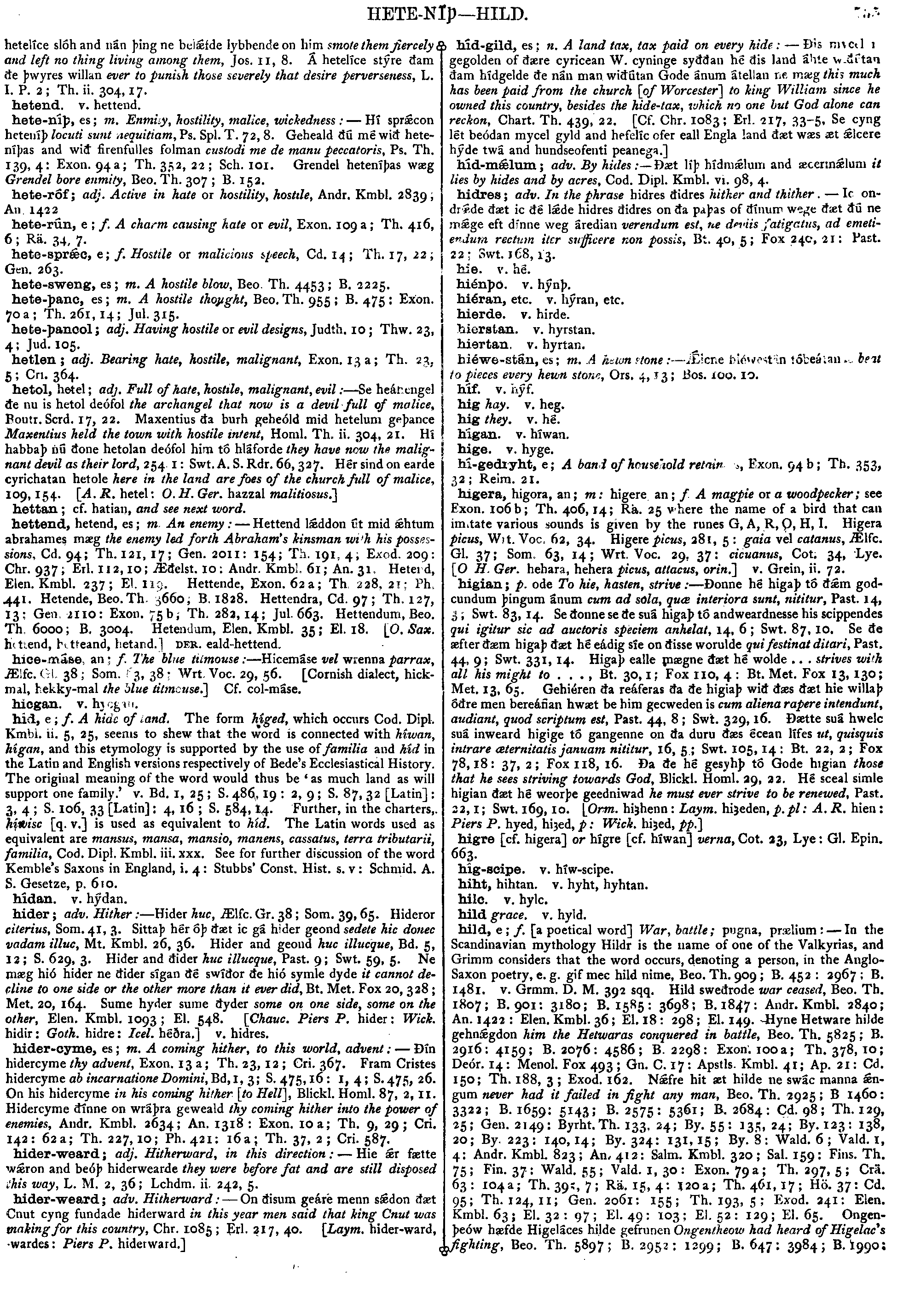
hid, e; f. A hide of land. The form higed, which occurs Cod. Dipl. Kmbl. ii. 5, 25, seems to shew that the word is connected with híwan, higan, and this etymology is supported by the use familia and hid in the Latin and English versions respectively of Bede's Ecclesiastical History. The original meaning of the word would thus be 'as much land as will support one family.' v. Bd. 1. 25; S. 486, , 19: 2, 9; S. 87, 32 [Latin]: 3, 4; S. 106, 33 [Latin]: 4, 16; S. 584, 14. Further, in the charters, . híwisc [q. v.] is used as equivalent to híd. The Latin words used as equivalent are mansus, mansa, mansio, manens, cassatus, terra tributarii, familia, Cod. Dipl. Kmbl. iii. xxx. See for further discussion of the word Kemble's Saxons in England, i. 4: Stubbs' Const. Hist. s. v: Schmid. A. S. Gesetze, p. 610.
|
Source: Bosworth/Toller, page b0535, entry 18 View original page image as: [TIFF] [PNG] [View previous entry] [View next entry] |
[Comment on this entry] [View comments] |
The following entry has been hand-corrected once. |
hider; adv. Hither:-- Hider huc, Ælfc. Gr. 38; Som. 39, 65. Hideror citerius, Som. 41, 3. Sittaþ hér óþ ðæt ic gá hider geond sedete hic donec vadam illuc, Mt. Kmbl. 26, 36. Hider and geond huc illucque, Bd. 5, 12; S. 629, 3. Hider and ðider hac illucque. Past. 9; Swt. 59, 5. Ne mæg hió hider ne ðider sígan ðé swíðor ðe hió symle dyde it cannot decline to one side or the other more than it ever did, Bt. Met. Fox 20, 328; Met. 20, 164. Sume hyder sume ðyder some on one side, some on the other, Elen. Kmbl. 1093; El. 548. [Chauc. Piers P. hider: Wick. hidir: Goth. nidre: Icel. héðra.] v. hidres.
|
Source: Bosworth/Toller, page b0535, entry 22 View original page image as: [TIFF] [PNG] [View previous entry] [View next entry] |
[Comment on this entry] [View comments (1)] |
The following entry has been hand-corrected once. |
híd-gild,
es;
n.
A
land
tax,
tax
paid
on
every
hide:--
Ðis
mycel
UNCERTAIN
gegolden
of
ðære
cyricean
W.
cyninge
syððan
hé
ðis
land
áhte
wíðútan
ðam
hídgelde
ðe
nán
man
wiðútan
Gode
ánum
átellan
ne
mæg
this
much
has
been
paid
from
the
church
[of
Worcester]
to
king
William
since
he
owned
this
country,
besides
the
hide-tax,
which
no
one
but
God
alone
can
reckon,
Chart.
Th.
439,
22.
[Cf.
Chr.
1083;
Erl.
217,
33-5,
Se
cyng
lét
beódan
mycel
gyld
and
hefelíc
ofer
eall
Engla
land
ðæt
wæs
ðæt
lcere
hýde
twá
and
hundseofenti
peanega.]
|
Source: Bosworth/Toller, page b0535, entry 45 View original page image as: [TIFF] [PNG] [View previous entry] [View next entry] |
[Comment on this entry] [View comments] |
The following entry has been hand-corrected once. |
hild,
e;
f.
[a
poetical
word]
War,
battle;
pugna,
prælium:--
In
the
Scandinavian
mythology
Hildr
is
the
name
of
one
of
the
Valkyrias,
and
Grimm
considers
that
the
word
occurs,
denoting
a
person,
in
the
Anglo-Saxon
poetry,
e.
g.
gif
mec
hild
nime.
Beo.
Th.
909;
B.
452:
2967;
B.
1481.
v.
Grmm.
D.
M.
392
sqq.
Hild
sweðrode
war
ceased,
Beo.
Th.
1807;
B.
901:
3180;
B.
1585:
3698;
B.
1847:
Andr.
Kmbl.
2840;
An.
1422:
Elen.
Kmbl.
36;
El.
18:
298;
El.
149.
Hyne
Hetware
hilde
gehngdon
him
the
Hetwaras
conquered
in
battle,
Beo.
Th.
5825;
B.
2916:
4159;
B.
2076:
4586;
B.
2298:
Exon.
100a;
Th.
378,
10;
Deór.
14:
Menol.
Fox
493;
Gn.
C.
17:
Apstls.
Kmbl.
41;
Ap.
21:
Cd.
150;
Th.
188,
3;
Exod.
162.
Nfre
hit
æt
hilde
ne
swác
manna
ngum
never
had
it
failed
in
fight
any
man,
Beo.
Th.
2925;
B
1460:
3322;
6.
1659:
5143;
B.
2575:
5361;
B.
2684:
Cd.
98;
Th.
129,
25;
Gen.
2149:
Byrht.
Th.
133,
24;
By.
55:
135,
24;
By.
123:
138,
20;
By.
223:
140,
14;
By.
324:
131,
15;
By.
8:
Wald.
6;
Vald.
1.
4:
Andr.
Kmbl.
823;
An.
412:
Salm.
Kmbl.
320;
Sal.
159:
Fins.
Th.
75;
Fin.
37:
Wald.
55;
Vald.
1,
30:
Exon.
79a;
Th.
297,
5;
Crä.
63:
104a;
Th.
395,
7;
Rä.
15,
4:
120a;
Th.
461,
17;
Hö.
37:
Cd.
95;
Th.
124,
11;
Gen.
2061:
155;
Th.
193,
5;
Exod.
241:
Elen.
Kmbl.
63;
El.
32:
97;
El.
49:
103;
El,
52:
129;
El.
65.
Ongenþeów
hæfde
Higeláces
hilde
gefrunen
Ongentheow
had
heard
of
Higelac's
fighting,
Beo.
Th.
5897;
B.
2952:
1299;
B.
647:
3984;
3.
1990:
|
Source: Bosworth/Toller, page b0536, entry 50 View original page image as: [TIFF] [PNG] [View previous entry] [View next entry] |
[Comment on this entry] [View comments] |
The following entry has been hand-corrected once. |
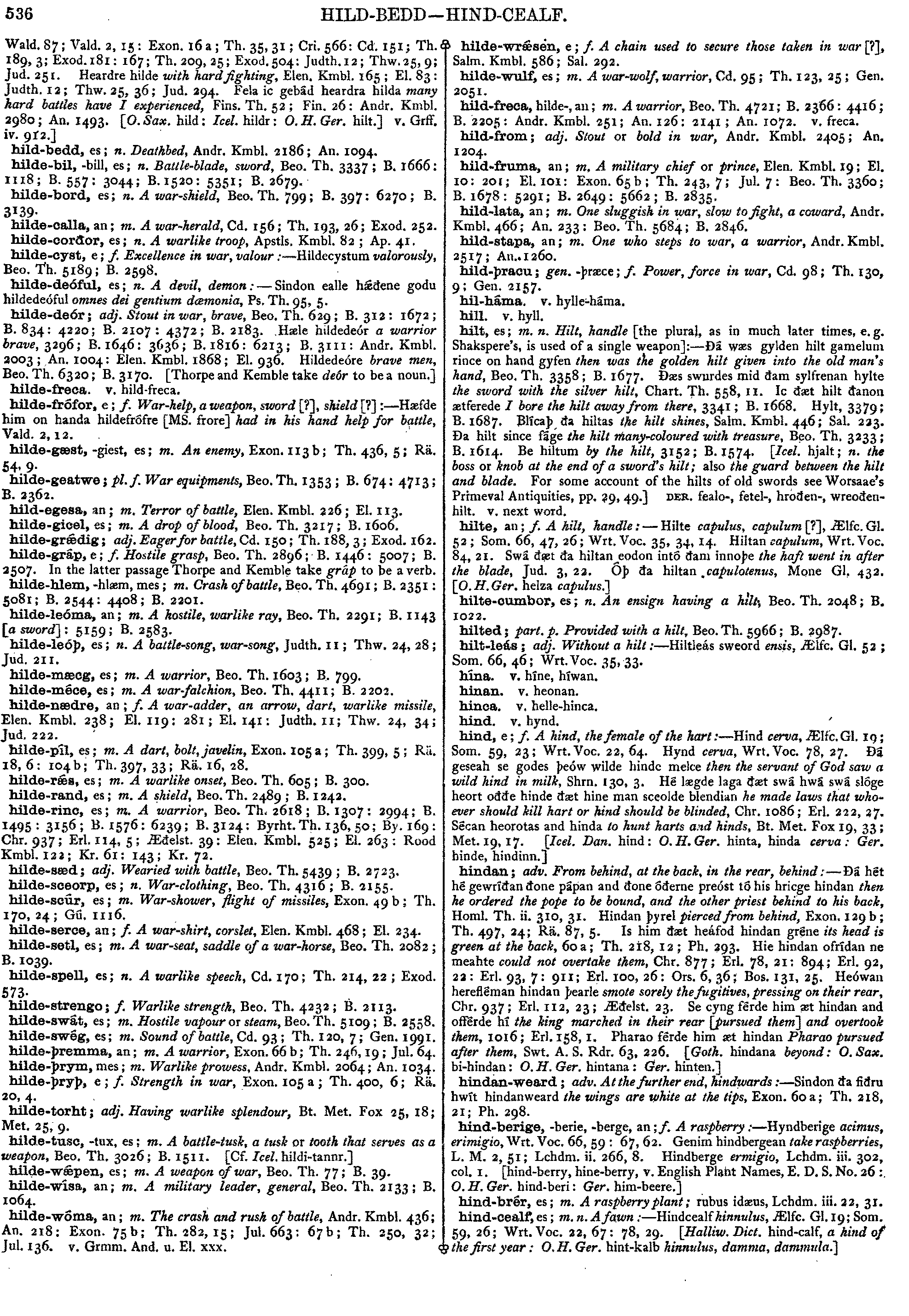
hild-lata, an; m. One sluggish in war, slow to fight, a coward, Andr. Kmbl. 466; An. 233: Beo. Th. 5684; B. 2846.
|
Source: Bosworth/Toller, page b0536, entry 51 View original page image as: [TIFF] [PNG] [View previous entry] [View next entry] |
[Comment on this entry] [View comments] |
The following entry has been hand-corrected once. |
hild-stapa, an; m. One who steps to war, a warrior, Andr. Kmbl. 2517; An. . 1260.
| Result Page: |  |
Previous | 73 74 75 76 77 78 79 80 81 82 83 84 85 86 87 88 89 90 91 | Next |  |
Germanic Lexicon Project (main page)
This search system was written by
Sean Crist
Please consider
volunteering
to correct the data in these online dictionaries.
No rights reserved. Feel free to use these data in any way you please.