|
|

Tip: In the search results, you can click on any word or abbreviation for more information.
|
Source: Cleasby/Vigfusson, page b0322, entry 2 View original page image as: [TIFF] [PNG] [View previous entry] [View next entry] |
[Comment on this entry] [View comments] |
The following entry has been hand-corrected once. |
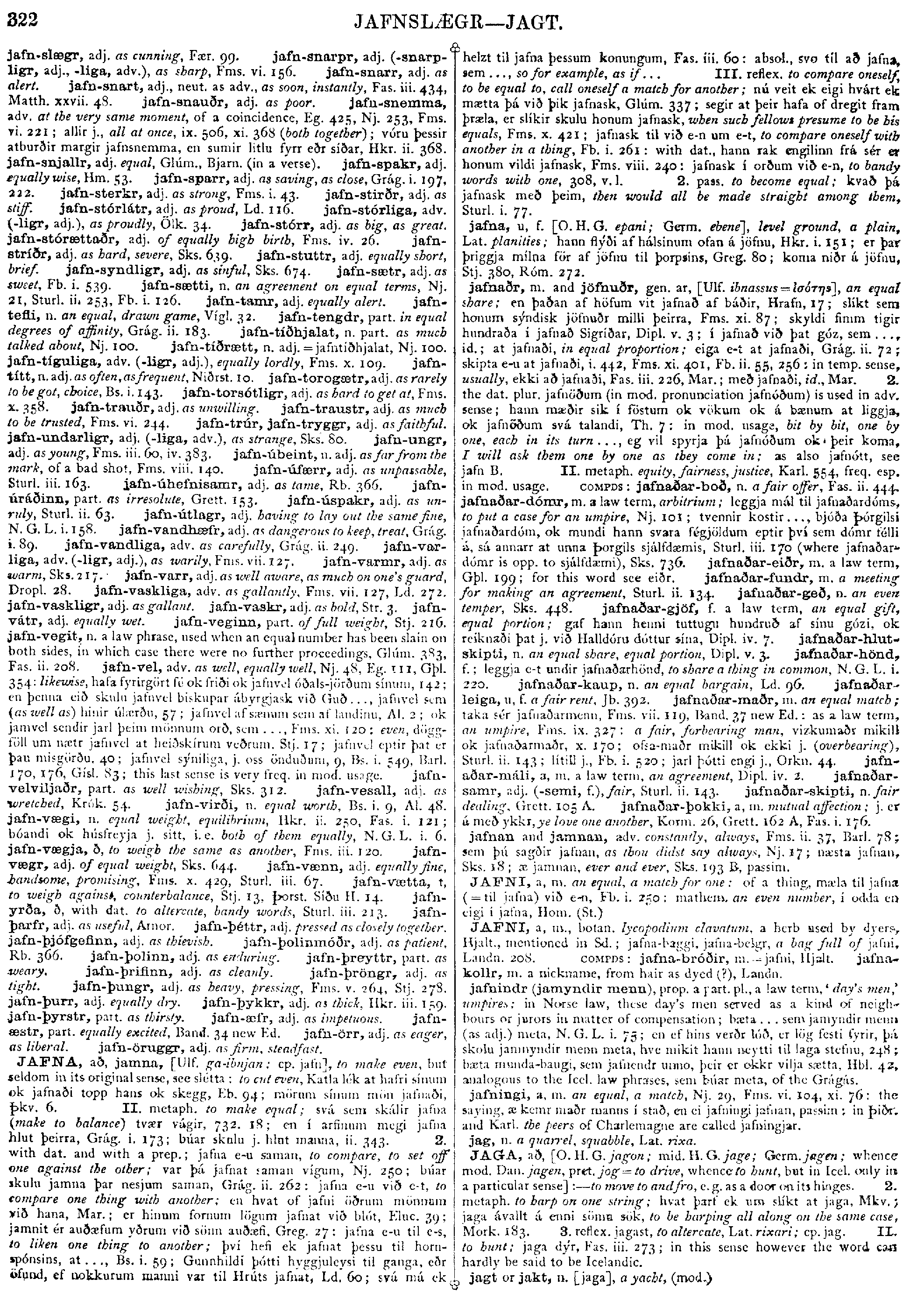
JAFNA, að, jamna, [Ulf. ga-ibnjan: cp. jafn], to make even, but seldom in its original sense, see slétta: to cut even, Katla lék at hafri sínum ok jafnaði topp hans ok skegg, Eb. 94; mörum sínum mön jafnaði, Þkv. 6. II. metaph. to make equal; svá sem skálir jafna (make to balance) tvær vágir, 732. 18; en í arfinum megi jafna hlut þeirra, Grág. i. 173; búar skulu j. hlut manna, ii. 343. 2. with dat. and with a prep.; jafna e-u saman, to compare, to set off one against the other; var þá jafnat saman vígum, Nj. 250; búar skulu jamna þar nesjum saman, Grág. ii. 262: jafna e-u við e-t, to compare one thing with another; en hvat of jafni öðrum mönnum við hana, Mar.; er hinum fornum lögum jafnat við blót, Eluc. 39; jamnit ér auðæfum yðrum við sönn auðæfi, Greg. 27: jafna e-u til e-s, to liken one thing to another; því hefi ek jafnat þessu til hornspónsins, at ..., Bs. i. 59; Gunnhildi þótti hyggjuleysi til ganga, eðr öfund, ef nokkurum manni var til Hrúts jafnat, Ld. 60; svá má ek helzt til jafna þessum konungum, Fas. iii. 60: absol., svo til að jafna, sem ..., so for example, as if ... III. reflex. to compare oneself, to be equal to, call oneself a match for another; nú veit ek eigi hvárt ek mætta þá við þik jafnask, Glúm. 337; segir at þeir hafa of dregit fram þræla, er slíkir skulu honum jafnask, when such fellows presume to be his equals, Fms. x. 421; jafnask til við e-n um e-t, to compare oneself with another in a thing, Fb. i. 261: with dat., hann rak engilinn frá sér er honum vildi jafnask, Fms. viii. 240: jafnask í orðum við e-n, to bandy words with one, 308, v.l. 2. pass. to become equal; kvað þá jafnask með þeim, then would all be made straight among them, Sturl. i. 77.
|
Source: Cleasby/Vigfusson, page b0322, entry 4 View original page image as: [TIFF] [PNG] [View previous entry] [View next entry] |
[Comment on this entry] [View comments] |
The following entry has been hand-corrected once. |
jafnaðr, m. and jöfnuðr, gen. ar, [Ulf. ibnassus = GREEK], an equal share; en þaðan af höfum vit jafnað af báðir, Hrafn, 17; slíkt sem honum sýndisk jöfnuðr milli þeirra, Fms. xi. 87; skyldi fimm tigir hundraða í jafnað Sigríðar, Dipl. v. 3; í jafnað við þat góz, sem ..., id.; at jafnaði, in equal proportion; eiga e-t at jafnaði, Grág. ii. 72; skipta e-u at jafnaði, i. 442, Fms. xi. 401, Fb. ii. 55, 256: in temp. sense, usually, ekki að jafnaði, Fas. iii. 226, Mar.; með jafnaði, id., Mar. 2. the dat. plur. jafnöðum (in mod. pronunciation jafnóðum) is used in adv. sense; hann mæðir sik í föstum ok vökum ok á bænum at liggja, ok jafnöðum svá talandi, Th. 7: in mod. usage, bit by bit, one by one, each in its turn ..., eg vil spyrja þá jafnóðum ok þeir koma, I will ask them one by one as they come in; as also jafnótt, see jafn B. II. metaph. equity, fairness, justice, Karl. 554, freq. esp. in mod. usage. COMPDS: jafnaðar-boð, n. a fair offer, Fas. ii. 444. jafnaðar-dómr, m. a law term, arbitrium; leggja mál til jafnaðardóms, to put a case for an umpire, Nj. 101; tvennir kostir ..., bjóða Þórgilsi jafnaðardóm, ok mundi hann svara fégjöldum eptir því sem dómr félli á, sá annarr at unna Þorgils sjálfdæmis, Sturl. iii. 170 (where jafnaðardómr is opp. to sjálfdæmi), Sks. 736. jafnaðar-eiðr, m. a law term, Gþl. 199; for this word see eiðr. jafnaðar-fundr, m. a meeting for making an agreement, Sturl. ii. 134. jafnaðar-geð, n. an even temper, Sks. 448. jafnaðar-gjöf, f. a law term, an equal gift, equal portion; gaf hann henni tuttugu hundruð af sínu gózi, ok reiknaði þat j. við Halldóru dóttur sína, Dipl. iv. 7. jafnaðar-hlutskipti, n. an equal share, equal portion, Dipl. v. 3. jafnaðar-hönd, f.; leggja e-t undir jafnaðarhönd, to share a thing in common, N. G. L. i. 220. jafnaðar-kaup, n. an equal bargain, Ld. 96. jafnaðar-leiga, u, f. a fair rent, Jb. 392. jafnaðar-maðr, m. an equal match; taka sér jafnaðarmenn, Fms. vii. 119, Band. 37 new Ed.: as a law term, an umpire, Fms. ix. 327: a fair, forbearing man, vizkumaðr mikill ok jafnaðarmaðr, x. 170; ofsa-maðr mikill ok ekki j. (overbearing), Sturl. ii. 143; lítill j., Fb. i. 520; jarl þótti engi j., Orkn. 44. jafnaðar-máli, a, m. a law term, an agreement, Dipl. iv. 2. jafnaðar-samr, adj. (-semi, f.), fair, Sturl. ii. 143. jafnaðar-skipti, n. fair dealing, Grett. 105 A. jafnaðar-þokki, a, m. mutual affection; j. er á með ykkr, ye love one another, Korm. 26, Grett. 162 A, Fas. i. 176.
|
Source: Cleasby/Vigfusson, page b0322, entry 6 View original page image as: [TIFF] [PNG] [View previous entry] [View next entry] |
[Comment on this entry] [View comments] |
The following entry has been hand-corrected once. |
JAFNI, a, m. an equal, a match for one: of a thing, mæl til jafna ( = til jafna) við e-n, Fb. i. 250: mathem. an even number, í odda en eigi í jafna, Hom. (St.)
|
Source: Cleasby/Vigfusson, page b0322, entry 11 View original page image as: [TIFF] [PNG] [View previous entry] [View next entry] |
[Comment on this entry] [View comments] |
The following entry has been hand-corrected once. |
JAGA, að, [O. H. G. jagon; mid. H. G. jage; Germ. jagen; whence mod. Dan. jagen, pret. jog = to drive, whence to hunt, but in Icel. only in a particular sense] :-- to move to and fro, e.g. as a door on its hinges. 2. metaph. to harp on one string; hvat þarf ek um slíkt at jaga, Mkv.; jaga ávallt á enni sömn sök, to be harping all along on the same case, Mork. 183. 3. reflex. jagast, to altercate, Lat. rixari; cp. jag. II. to hunt; jaga dýr, Fas. iii. 273; in this sense however the word can hardly be said to be Icelandic.
|
Source: Cleasby/Vigfusson, page b0323, entry 64 View original page image as: [TIFF] [PNG] [View previous entry] [View next entry] |
[Comment on this entry] [View comments] |
The following entry has been hand-corrected once. |
jarð-varpa, að, to throw one to the earth, a law term.
|
Source: Cleasby/Vigfusson, page b0323, entry 69 View original page image as: [TIFF] [PNG] [View previous entry] [View next entry] |
[Comment on this entry] [View comments] |
The following entry has been hand-corrected once. |
jarkna-steinn, m. [prob. a for. word derived from the A. S. eorcnan-stân] :-- a gem, it occurs only in the following poems, Vkv. 23, 33, Gkv. 1. 18, 3. 9, which may all have been composed by one man, who borrowed the word from the A. S.
|
Source: Cleasby/Vigfusson, page b0323, entry 70 View original page image as: [TIFF] [PNG] [View previous entry] [View next entry] |
[Comment on this entry] [View comments] |
The following entry has been hand-corrected once. |
JARL, m., older form earl, [Hel. erl; A. S. eorl; Engl. earl]: this word had a double sense, one old and common to the Saxons as well as the earliest Scandinavians, one later and specifically Norse, which afterwards became English through the Norse and Danish invasion, and was finally established by the Norman Conquest.
|
Source: Cleasby/Vigfusson, page b0323, entry 72 View original page image as: [TIFF] [PNG] [View previous entry] [View next entry] |
[Comment on this entry] [View comments] |
The following entry has been hand-corrected once. |
B. A chief, as a title, specially Norse and Danish. The Landnáma, which is almost our only source for the political and personal history of Norway before king Harald Fairhair and the settlement of Iceland, records several chiefs of the 8th and 9th centuries who bore an earl's name as a family dignity; Ívarr Upplendinga-jarl (Upplönd, a Norse county), Asbjörn jarl Skerja-blesi, Eyvindr jarl, 317; Atli jarl Mjóvi af Gaulum (a Norse county), Þorkell Naumdæla-jarl (earl in Naumdale, a Norse county), 281; Grjótgarðr jarl í Sölva (a county), 297: and as a family title, the famous Háleygja-jarlar (the earls of the Norse county Hálogaland, whose pedigree from Odin was drawn out in the old poem Háleygja-tal; Hákon jarl Grjótgarðsson, etc.): so also the Mæra-jarlar, the earls of Mæri (a Norse county), the foremost of whom was Rögnvaldr Mæra-jarl, the forefather of the earls of the Orkneys (Orkneyja-jarlar) and the earls of Rouen (Rúðu-jarlar = the dukes of Normandy). II. along with the Danish and Norse invasion the name appears in England, Bjartmár jarl in Ireland, Landn.; Hunda-Steinarr, an earl in England, id.; see also the Saxon Chronicle passim, where the very name indicates a Danish or Norse connexion. It is very likely that many of the earls of the Landnáma were sovereign chiefs, differing from kings only in title, for in old poetry a king and an earl were addressed in the same way. III. about the time of Harald Fairhair all the petty chiefs became liegemen under one king, the earl being in dignity nearest the king, answering to comes
|
Source: Cleasby/Vigfusson, page b0324, entry 16 View original page image as: [TIFF] [PNG] [View previous entry] [View next entry] |
[Comment on this entry] [View comments] |
The following entry has been hand-corrected once. |
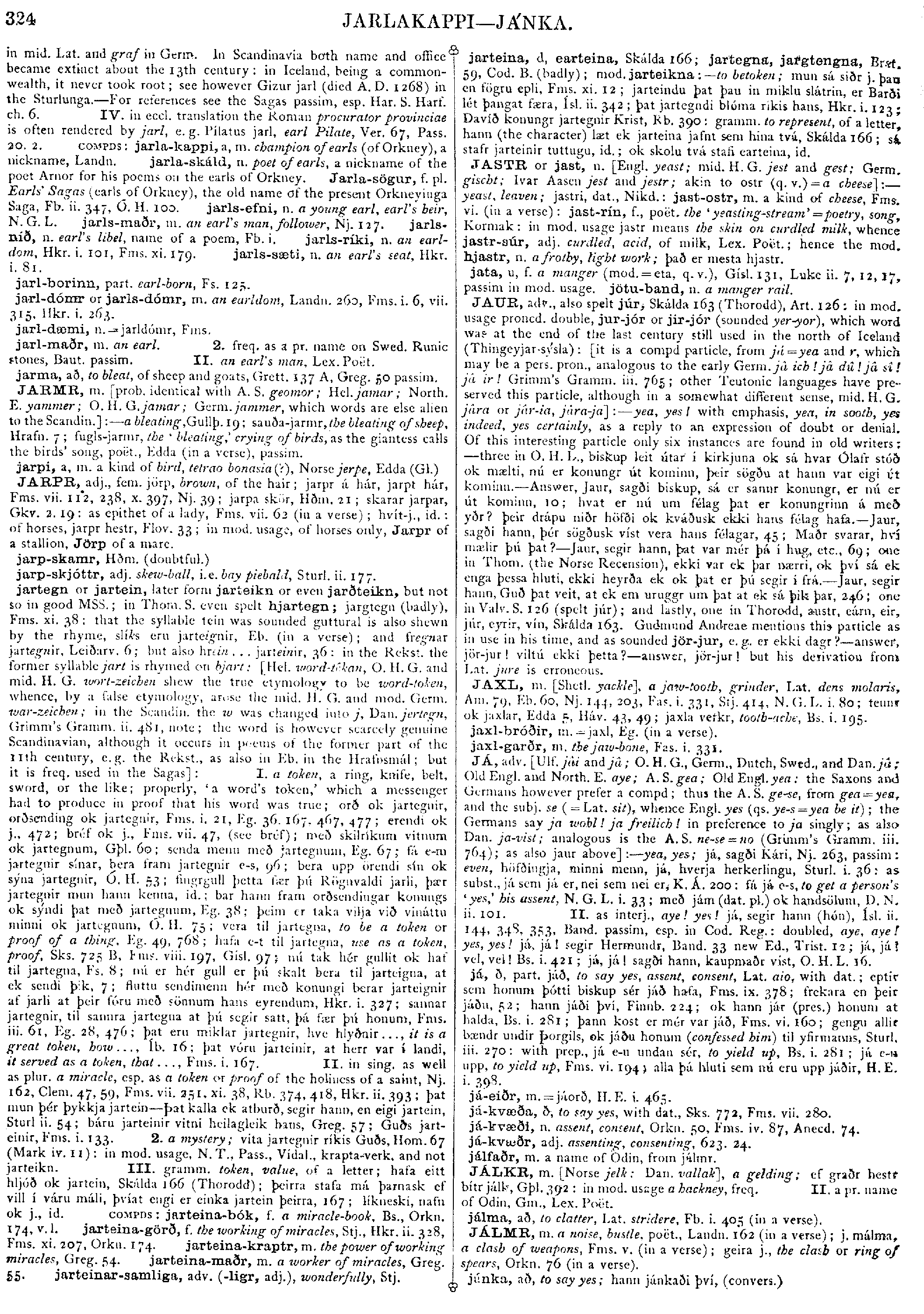
JAUR, adv., also spelt júr, Skálda 163 (Thorodd), Art. 126: in mod. usage proncd. double, jur-jór or jir-jór (sounded yer-yor), which word was at the end of the last century still used in the north of Iceland (Thingeyjar-sýsla): [it is a compd particle, from já = yea and r, which may be a pers. pron., analogous to the early Gmn. jâ ich! jâ dû! jâ sî! jâ ir! Grimm's Gramm. iii. 765; other Teutonic languages have preserved this particle, although in a somewhat different sense, mid. H. G. jâra or jâr-ia, jâra-ja] :-- yea, yes! with emphasis, yea, in sooth, yes indeed, yes certainly, as a reply to an expression of doubt or denial. Of this interesting particle only six instances are found in old writers: -- three in O. H. L., biskup leit útar í kirkjuna ok sá hvar Ólafr stóð ok mælti, nú er konungr út kominn, þeir sögðu at hann var eigi út kominn. -- Answer, Jaur, sagði biskup, sá er sannr konungr, er nú er út kominn, 10; hvat er nú um félag þat er konungrinn á með yðr? þeir drápu niðr höfði ok kváðusk ekki haus félag hafa. -- Jaur, sagði hann, þér sögðusk víst vera hans félagar, 45; Maðr svarar, hvá mælir þú þat ? -- Jaur, segir hann, þat var mér þá í hug, etc., 69; one in Thorn, (the Norse Recension), ekki var ek þar nærri, ok því sá ek enga þessa hluti, ekki heyrða ek ok þat er þú segir í frá. -- Jaur, segir hann, Guð þat veit, at ek em uruggr um þat at ek sá þik þar, 246; one in Valv. S. 126 (spelt júr); and lastly, one in Thorodd, austr, eárn, eir, júr, eyrir, vín, Skálda 163. Gudmund Andreae mentions this particle as in use in his time, and as sounded jör-jur, e.g. er ekki dagr? -- answer, jör-jur! viltú ekki þetta? -- answer, jör-jur! but his derivation from Lat. jure is erroneous.
|
Source: Cleasby/Vigfusson, page b0326, entry 5 View original page image as: [TIFF] [PNG] [View previous entry] [View next entry] |
[Comment on this entry] [View comments] |
The following entry has been hand-corrected once. |
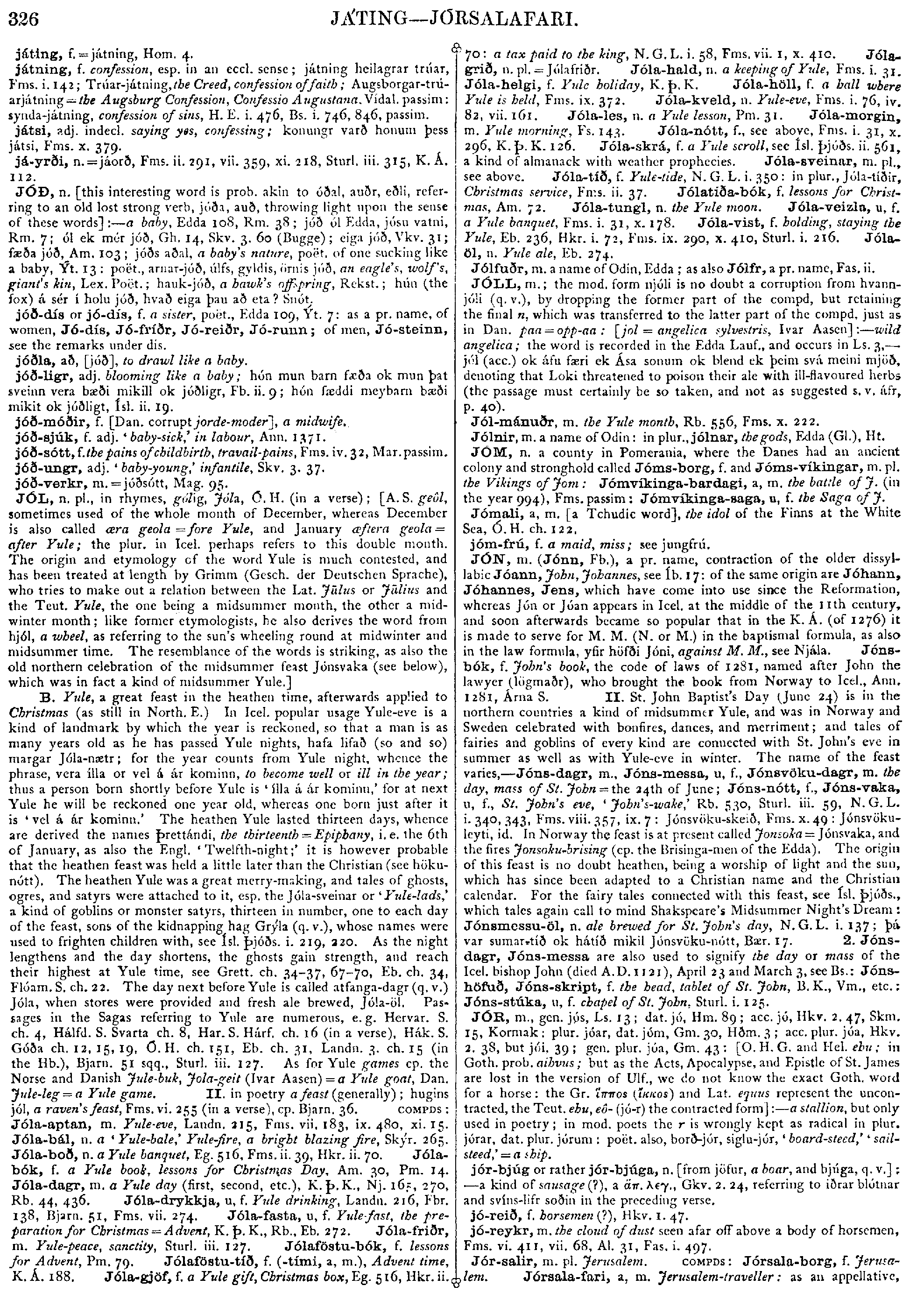
JÓÐ, n. [this interesting word is prob. akin to óðal, auðr, eðli, referring to an old lost strong verb, jóða, auð, throwing light upon the sense of these words] :-- a baby, Edda 108, Rm. 38; jóð ól Edda, jósu vatni, Rm. 7; ól ek mér jóð, Gh. 14, Skv. 3. 60 (Bugge); eiga jóð, Vkv. 31; fæða jóð, Am. 103; jóðs aðal, a baby's nature, poët. of one sucking like a baby, Ýt. 13: poët., arnar-jóð, úlfs, gyldis, örnis jóð, an eagle's, wolf's, giant's kin, Lex. Poët.; hauk-jóð, a hawk's offspring, Rekst.; hún (the fox) á sér í holu jóð, hvað eiga þau að eta? Snót.
| Result Page: |  |
Previous | 283 284 285 286 287 288 289 290 291 292 293 294 295 296 297 298 299 300 301 | Next |  |
Germanic Lexicon Project (main page)
This search system was written by
Sean Crist
Please consider
volunteering
to correct the data in these online dictionaries.
No rights reserved. Feel free to use these data in any way you please.